The University of San Francisco
USF Scholarship: a digital repository @ Gleeson Library |
Geschke Center
Doctoral Dissertations Theses, Dissertations, Capstones and Projects
2018
Using Multiliteracies to Engage and Empower
Students with Complex Support Needs
Sudha Vaghul Krishnan
University of San Francisco, [email protected]
Follow this and additional works at:https://repository.usfca.edu/diss
Part of theSpecial Education and Teaching Commons
This Dissertation is brought to you for free and open access by the Theses, Dissertations, Capstones and Projects at USF Scholarship: a digital repository @ Gleeson Library | Geschke Center. It has been accepted for inclusion in Doctoral Dissertations by an authorized administrator of USF
Recommended Citation
Krishnan, Sudha Vaghul, "Using Multiliteracies to Engage and Empower Students with Complex Support Needs" (2018).Doctoral Dissertations. 445.
The University of San Francisco
USING MULTILITERACIES TO ENGAGE AND EMPOWER STUDENTS
WITH COMPLEX SUPPORT NEEDS
A Dissertation Presented to
The Faculty of the School of Education Learning & Instruction: Special Education
In Partial Fulfillment
of the Requirements for the Degree Doctor of Education
by Sudha Krishnan
THE UNIVERSITY OF SAN FRANCISCO Dissertation Abstract
Using Multiliteracies to Engage and Empower Students with Complex Support Needs This dissertation is comprised of two studies:
• Creating New Learning Spaces Using Multiliteracies with Students with Complex
Support Needs
• Transforming Narrative Identity through Multiliteracies
Students with complex support needs (SCSN) are frequently denied access to meaningful and challenging literacy instruction. These studies explore how student-authored narratives in the individualized education plan (IEP), implemented during a multiliteracies curriculum, can simultaneously engage and empower SCSN. These studies are based on the qualitative research that I conducted from November 15, 2018 to
February 11, 2018 at a special day class for SCSN in a public high school. I implemented a multiliteracies curriculum during student-authored narrative for use at the IEP meeting, which is typically held every year for students labeled with disabilities by the school system.
Transforming Narrative Identity through Multiliteracies relates the transformation of one student’s narrative identity (stories told about the student by himself and others)
during the study. Multiliteracies enabled student agency, and offered this student with complex support needs an opportunity to change his narrative identity from deficit to pride and competence. This case study tracks the changes in a) the cultural narrative and b) the social participation to determine changes in the narrative identity of the student. This article is narrative in style and written keeping in mind special educators and
administrators. The purpose of the article is to alert special educators to hidden narratives in the IEP document and their classroom practices.
This dissertation, written under the direction of the candidate’s dissertation committee and approved by the members of the committee, has been presented to and accepted by the Faculty of the School of Education in partial fulfillment of the requirements for the degree of Doctor of Education. The content and research methodologies presented in this work represent the work of the candidate alone.
Sudha Krishnan July 6, 2018
Candidate Date
Dissertation Committee
Nicola McClung July 6, 2018
Chairperson: Dr. Nicola McClung
Emily Nusbaum May 1, 2018
Dr. Emily Nusbaum
Susan Katz May 1, 2018
Acknowledgements
To Dr. Nicola McClung, the chairperson of my committee for providing me with extensive guidance on research and writing for this study. I have grown so much thanks to your mentorship.
To Dr. Emily Nusbaum for challenging me to think outside the box and to try methods outside of my comfort zone.
To Dr. Susan Katz for providing me with valuable input into my research methodology and writing.
To all the faculty at the University of San Francisco with whom I have had the honor to work with during my tenure here. Especially to Dr. Robert Burns for being a great teacher and mentor. You taught me to value the rigor and discipline of research. To Dr. Hyun Park from San Jose State University who first suggested that I should consider a doctoral program.
Dedication
To my dear son Santosh, whose autism led me toward this exciting field of education. To my dear son Sanjay, whose amazing intellect always inspires me and whose encouragement and counsel were invaluable to my efforts.
To my loving and supportive husband, Prakash, who patiently bore the
responsibilities of the house while freeing me to spend my time in study. I have no words to thank you for your unending love. To my husband’s parents for their support during
these busy years.
To Mrs. Van, Shompa, Padma, Regina, and Mike at Cupertino Middle school. I could not have completed this study without your constant encouragement. To Karen, Christine, Yan, and Cornelia at USF for keeping me going when times were hard!
To my soul sisters, Gayatri, Jay, Latha, Nithya, and Vinutha for all the hugs over the years! I needed every one of them. To my dearest friends Jaya, Sophia and Chittu without whose daily level-headed advice I could not have survived.
To my mother and dear brother, Mohan for always pointing out what is really important in life.
TABLE OF CONTENTS
ABSTRACT ... i
SIGNATURE PAGE ... iii
ACKNOWLEDGEMENTS ... iv
DEDICATION ... v
LIST OF TABLES ... vii
LIST OF FIGURES ... ix
Article Page I. CREATING NEW LEARNING SPACES USING MULTILITERACIES WITH STUDENTS WITH COMPLEX SUPPORT NEEDS ...1
Introduction ... 1
Theoretical Rationale and Related Literature ... 6
The Current Study ... 14
Method ... 17
Results ... 26
Discussion ... 53
References ... 59
II. TRANSFORMING NARRATIVE IDENTITY THROUGH MULTILITERACIES ... 65
Introduction ... 67
Theoretical Rationale and Related Literature ... 68
Method ... 74
Results ... 78
Discussion ... 94
References ... 97
APPENDIX A District and School Permission ...98
APPENDIX B Consent Forms ... 100
List of Tables
Creating New Learning Spaces Using Multiliteracies with Students with Complex Support Needs
Table 1: Description of the Multiple Modes of Expression in Multiliteracies ...7
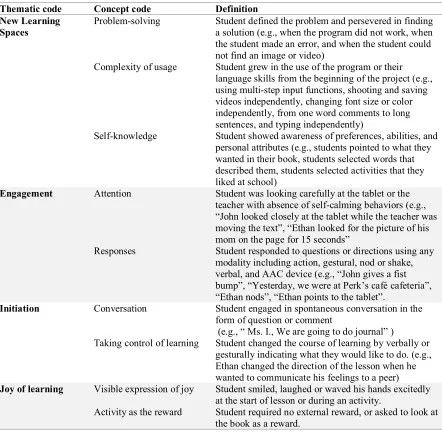
Table 2: Inductively developed thematic, concept codes ... 23
Table 3: Inductive concept codes for student reactions developed during dynamic coding of instruction. ... 24
Table 4: Inductive concept codes for teacher reactions developed during dynamic coding of instruction. ... 25
Table 5: Inductive concept codes for teacher-student interactions developed during dynamic coding of instruction. ... 26
Table 6: Excerpt from the transcript of John’s session showing problem-solving space, December 7, 2017. ... 27
Table 7: Excerpt from the transcript of John’s session showing problem-solving, January 2, 2018. ... 28
Table 8: Excerpt from the transcript of Ethan’s session, January 4, 2018... 28
Table 9: Excerpt from the transcript of Ethan’s session, January 11, 2018... 29
Table 10: Excerpt from the transcript of Ethan’s session showing complexity of usage, December 12, 2017 ... 31
Table 11: Student-Identified Favorite Activities at the School ... 33
Table 12: Student Identification of their Strengths ... 34
Table 13: Excerpt from the transcript of John’s session, January 9, 2018 ... 41
Table 14: Excerpt from the transcript of Ethan’s session, January 11, 2018... 44
List of Tables
Transforming Narrative Identity through Multiliteracies
Table 1: Designing Instruction Based on Multiliteracies ... 69 Table 2: John’s Favorite Activities at Home and School ... 82 Table 3: John’s Strengths Selected from a List of Activities... 83
List of Figures
Creating New Learning Spaces Using Multiliteracies with Students with Complex Support Needs
Figure 1: Identity charts created by the students. ... 32
Figure 2: Pathway to creation of new learning spaces. ... 35
Figure 3: The instructional sequence for traditional instruction with John. ... 36
Figure 4: The instructional sequence for multiliteracies instruction with John. ... 37
Figure 5: The instructional sequence in multiliteracies session with Ethan. ... 38
Figure 6: Concept map illustrating the instructional sequence in traditional instruction in the classroom. ... 39
Figure 7: Concept map illustrating the instructional sequence in multiliteracies instruction in the classroom. ... 40
List of Figures
Transforming Narrative Identity through Multiliteracies
Figure 1: The instructional sequence for traditional instruction with John. ... 79 Figure 2: Identity chart created by John. ... 81 Figure 3: The instructional sequence for multiliteracies instruction with John. ... 86 Figure 4: Concept map illustrating the instructional sequence in traditional instruction in the classroom. ... 87 Figure 5: Concept map illustrating the instructional sequence in multiliteracies
Creating New Learning Spaces Using Multiliteracies with Students with Complex Support Needs
Abstract
Students with complex support needs (SCSN) are frequently denied access to meaningful and challenging literacy instruction. This study explores how student-authored narratives in the individualized education plan (IEP), implemented during a multiliteracies
curriculum, can simultaneously engage and empower SCSN. This study suggests that the multiliteracies framework created new patterns of teacher-student interactions, which led to student engagement, initiation, and joy of learning. Furthermore, new learning spaces were created in the areas of problem-solving, growing complexity in the use of language and tools, and self-knowledge.
Traditional and normative literacy practices highlight deficiencies inside the brains of students with complex support needs (SSCN) to explain their struggles with learning and to justify denying them access to rich literacy experiences. By contrast, multiliteracies practices are thought to provide access to meaningful and challenging literacy instruction regardless of student support needs (Luke and Freebody, 1999;
Kliewer & Biklen, 2001). However, few studies have explored multiliteracies pedagogy with this population to see if this approach affords students more literacy opportunities than traditional approaches or whether research with this unique population and their teachers adds to the conversation on multiliteracies.
The traditional or autonomous model of literacy, privileged in U.S. K-12 schools, views literacy as a neutral, decontextualized set of skills related to the reading and
writing of printed text that must be acquired in a particular developmental sequence (Street, 2003; Perry, 2012). For example, first students are expected to learn the
alphabet, then to decode words, and once they recognize words accurately and fluently, they can finally move on to reading for understanding. When SCSN are unable to climb the required ladder of literacy, they are often excluded from the full range of literacy activities provided to their nondisabled peers across the United States and confined to low level literacy skills or functional skills (Katims, 2000; Kliewer & Biklen,
2001;Conners, 2003; Mirenda, 2003; Foley & Staples, 2007; Kliewer, 2008; Browder et al., 2009; Forts & Luckasson, 2011; Schnorr, 2011; Moretti & Frandell, 2013; Cologon & McNaught, 2014; Copeland, Keefe, & de Valenzuela, 2014).
oral, visual, audio, tactile, gestural, and spatial forms of meaning-making (Cope & Kalantzis, 2000). By allowing all students to participate in literacy activities using the modes of expression that they are comfortable with, and validating both conventional and unconventional forms of grammatical usage, multiliteracies has opened up learning spaces for youth marginalized in educational settings because of their status as minorities, English Language Learners, or immigrants, and has given them a chance to demonstrate their competencies even if they are not fluent in the language expected at school (Street, 2003; Moje & Hinchman, 2004; Morrell, 2004; Leander & Lovvorn, 2006; Black, 2006; Blackburn, 2005, Blackburn, Clark, Kenney, & Smith, 2009; Blackburn & Clark, 2010).
However, applying the pedagogy of multiliteracies to SCSN requires further accommodation and strategies that are responsive to the unique characteristics of these students who may have vastly different ways of making meaning, designing narratives, and using signs and symbols for communication (Kliewer, 2008). This study investigated multiliteracies activities in a special day classroom, proposing they can be meaningful and empowering when designed to be responsive to the learning needs of SCSN. This study involved the creation of a student-authored multimodal book on a tablet, using text, images, audio, and video input, which was presented by two participating students, John and Ethan, (all names pseudonyms) as part of their input into their individualized
education plan (IEP) meeting, typically held annually for all students with special needs in U.S. schools.
Theoretical Rationale and Related Literature
The Pedagogy of Multiliteracies
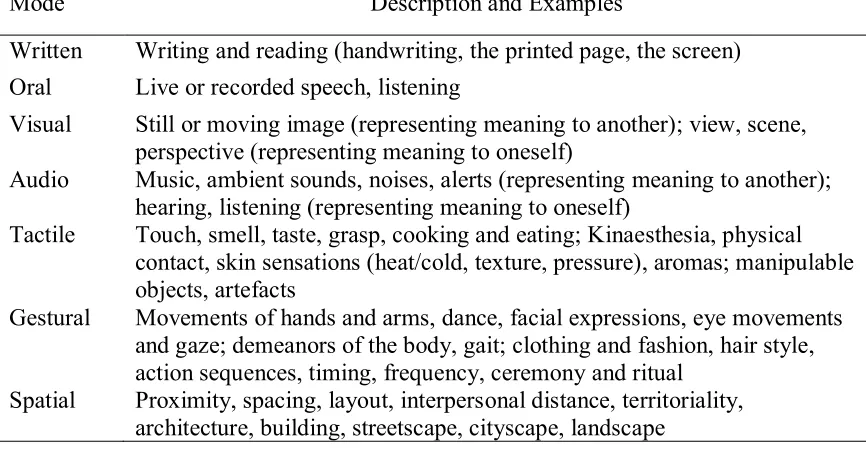
Drawing on the socio-cultural traditions of literacy, I argue that literacy practices are never neutral and different literacy practices can position students differently for failure or success at school (Luke & Freebody, 1999). The pedagogy of multiliteracies (The New London Group, 1996; Serafini & Gee, 2017) challenges the traditional and normative models of literacy in several ways. While the autonomous model defines literacy as a single set of sequential skills in reading and writing of the print-based text, multiliteracies view literacies as being multiple and language as being ideologically and socially constructed (Vygotsky, 1962; Bakhtin, 1981; Serafini & Gee, 2017). Thus, multiliteracies can include various forms of representation and text, as shown in Table 1, including visual, audio, gestural, and spatial (Kress, 2000; Moje & Hinchman, 2004; Morrell, 2004; Duke, Purcell‐Gates, Hall & Tower, 2006; Cope & Kalantzis, 2009). For example, multiliteracies include how people make meaning using the Internet,
multimedia, social media, video games, and even children’s pretend play (Cope & Kalantzis, 2000). By rejecting the privileging of written and spoken language over other diverse modes of meaning-making, and acknowledging the potential and limitations of each mode, multiliteracies recognize the contribution and competence of meaning-makers who may not be “fluent” in the language—as determined by normative school standards
Table 1
Description of the Multiple Modes of Expression in Multiliteracies
Mode Description and Examples
Written Writing and reading (handwriting, the printed page, the screen) Oral Live or recorded speech, listening
Visual Still or moving image (representing meaning to another); view, scene, perspective (representing meaning to oneself)
Audio Music, ambient sounds, noises, alerts (representing meaning to another); hearing, listening (representing meaning to oneself)
Tactile Touch, smell, taste, grasp, cooking and eating; Kinaesthesia, physical contact, skin sensations (heat/cold, texture, pressure), aromas; manipulable objects, artefacts
Gestural Movements of hands and arms, dance, facial expressions, eye movements and gaze; demeanors of the body, gait; clothing and fashion, hair style, action sequences, timing, frequency, ceremony and ritual
Spatial Proximity, spacing, layout, interpersonal distance, territoriality, architecture, building, streetscape, cityscape, landscape
Note. Adapted from “The What of Multiliteracies (2): Multimodality” by M. Kalantzis and B. Cope, 2018; see http://newlearningonline.com/multiliteracies/theory.
implying that the producers and consumers of multimodal texts are not only making meaning from what is represented but also designing their experience of the text while interacting with it (Serafini and Gee, 2017).
The multimodal book project embodied the following four principles of multiliteracies (Cope and Kalantzis, 2015), including:
1. Experiencing, defined as meaning-making in the real-world context also known as situated practice (The New London Group, 1996), which was reflected in the project as being situated in students’ lives and their experiences at school and home.
2. Conceptualizing, scaffolding and supporting students in the knowledge process through multiple modalities, also known as overt instruction (Cope & Kalantzis, 2009,
2015), which was reflected in the project by the scaffolding of the instruction designed to meet student needs and modalities and the explicit instruction of the language of digital tools and critical analysis.
3. Analyzing, the process of critically exploring the socio-cultural contexts and purposes
of learning, also known as critical framing (Mills, 2009), which was reflected in the way the project interrogated the existing deficit identity of the students.
4. Applying, producing texts and putting them to use in communicative action, or in other
words transformed practice (Cope and Kalantzis, 2015), which was reflected in the use
of the multimodal book in the IEP meeting as the students’ input about their strengths and preferences.
English language learner, immigrant, learning abilities, sexual orientation, or minority status (Morrell, 2004; Moje & Hinchman, 2004; Heron-Hruby, Wood, & Mraz, 2008; Bruce, 2008).
By challenging what traditionally counts as literature in schools and using diverse texts, such as rap music lyrics, popular movies (e.g., The Godfather), and documentaries (e.g., The Killing Fields of America), Morrell (2002, 2004, 2005) successfully engaged struggling minority students from two urban high schools in critical reading and writing, enabling them to produce work that is “reserved for the most elite prep schools in the
country” (Morrell, 2008, p. 112).
Working with English language learners, Moje and Hinchman (2004) showed how teachers who moved away from traditional teaching methods and instead
incorporated multiliterate and culturally responsive practices like using topics situated in the students’ lives to generate curriculum about concepts in mathematics (e.g., restaurant
menus to teach percentages) and science (e.g., air quality in the community to teach chemistry, or common illnesses to teach communicable diseases) were successful in motivating previously unenthusiastic learners to engage in learning.
print literacy, they demonstrated their competencies as skilled media readers when they used multimodal learning, as in reading media texts, operating a video camera, and editing the images to create a complex music video.
In yet another study demonstrating that students perform differently in traditional literacy environments as compared to multimodal environments, Leander and Lovvorn (2006) showed that Brian, a middle schooler, who was labeled as a disorganized and disinterested student in his language arts and social studies classes, was actually an enthusiastic and active user when engaging in online multiuser games. He demonstrated his competence in activities like producing and sharing image files, reading discussion boards, chatting with other players, and sending bug reports to the game developers. The authors (Leander & Lovvorn, 2006) argued that literacy practices can be viewed as a dynamic, interactive experience, and while some literacy practices have limited potential for engagement, positive identity development, and agency due to their restricted
routines, others provide students with more significant opportunities for success.
constrained by the requirements of conventional English grammar, while actively
interacting and getting support from the other writers in the community. Eventually, she became a popular fanfiction writer for anime-based characters posting her stories online and connecting with a large number of people on the website.
By using student-created dual language texts and multimodal projects (e.g., story-writing, movie making, quilt making, poetry story-writing, making picture books, powerpoint presentations) that were situated in the life experiences of the immigrant students in Canadian schools, Cummins and Early (2011) demonstrated that the students who had often been restricted to low-level classroom activities got an opportunity to show
themselves to be “intelligent, imaginative and linguistically talented” (Cummins & Early, 2011, p. 4). These projects, referred to by the authors as identity texts, enabled students to express themselves freely in the language or mode of their choice and show their existing knowledge instead of being penalized for it.
While the research discussed above points to the potential of using multiliteracies with students who have been marginalized in schools (Black, 2006; Leander and
Lovvorn, 2006; Cummins & Early, 2011), designing instruction specifically for SCSN requires strategies that are specifically responsive to their needs and preferred modalities. A more in-depth discussion of successfully using multiliteracies with students with significant and complex needs follows in the section below.
Designing multiliteracies instruction with SCSN.
that can inform this study. Kilinic, Chapman, Kelley, Adams & Millinger (2016) found that when they used drama in literacy instruction in a pre-school, they opened up
opportunities for many students with complex support needs to participate. The teachers, who initially had deficit views of the children with support needs based on their
traditional literacy instruction, changed their opinions when they saw that these students were talking more, participating actively in the drama, remembering the stories even after several weeks, and showing problem-solving skills. In fact, one of the students who was determined as needing speech support in her IEP did not need it anymore after
participating in the drama. The authors argued that because the students chose to participate in a way that they were most comfortable with, they were more motivated to participate, and the teachers got a better understanding of their capabilities (Kilinic, Chapman, Kelley, Adams & Millinger, 2016).
Similarly, Collins (2011) touted the role of drama in the transformation of Christopher, an 8-year old African-American boy who was struggling with reading and writing in his classes at school. Christopher, who had previously resisted participating in classroom activities or interactions with his peers, started to actively contribute when he was provided opportunities to choose his mode of participation in the staging of a student-written folktale from a variety of options including writing, set design, costume design, acting and directing. After he successfully designed three costumes for his
of his abilities.
However, multimodality needs to be combined with the sensitivity to the specific ways a child communicates, as was demonstrated by a study with elementary school children by Koppenhaver, Erickson, and Skotko (2001). The authors argue for attribution of meaning to communicative efforts while using multimodal methods. A significant part of this study was to train caregivers to attribute meaning to their children’s various communicative attempts however unclear or small they may be. For example, one mother was asked to take her daughter’s loud noises when she saw particular pictures in a book,
as a sign of interest, and involve her in conversations about it. The authors (Koppenhaver, Erickson, & Skotko, 2001) noted that the parent training resulted in an improvement in the children’s frequency of labeling, commenting, and use of appropriate symbolic
communication by the children.
Studies with older children have reported similar results. Kliewer and Biklen (2001) described the change in an 11-year old student, Rebecca, a child labeled with autism along with severe speech impairments who did not demonstrate conventional
literacy skills. After she was given opportunities for multimodal learning using
Augmentative and Alternative Communication (AAC) device and symbols, with help
from her classmates in an inclusive classroom, she was able to prove her competence and
participate in literacy activities. In the study, the researchers documented how in an
interactive classroom activity in which they wrote and passed notes to each other, the
students included Rebecca by passing and reading out the notes to her. The authors noted
The activity eventually led to the creation of a set of symbols based on the classmates’ interpretation of Rebecca’s facial expressions, which she used to respond to her
classmates on a regular basis. The results from this study suggest that a significant way
to motivate SCSN to engage in communication and literacy is attributing meaning to all
their communicative attempts.
Providing opportunities for success and believing in her competence played a vital role in the transformation of a 15-year old girl, Melinda, according to a study by Ryndak, Morrison, and Sommerstein, (1999). The authors described the tremendous literacy growth in Melinda over a seven-year period, after she was removed from a self-contained classroom and included with general education peers, with activities and assessments modified and designed to make her learning meaningful and accessible. For example, when the class was reading Shakespearean plays, Melinda was given the option of participating by using a variety of modes like reading, making posters, or watching a video. Her engagement in the class improved dramatically and so did her social skills. She became more comfortable in participating in a variety of social settings that she had resisted earlier. In fact, she went on to participate in an included college setting after high school, living in a dormitory with support, which the researchers attributed to
opportunities for success in high school.
The Current Study
Drawing from the conditions which allowed for the successful literacy
would take place during the multimodal book project. The principles of the ability
responsive pedagogy were the following: (a) multimodality of expression (e.g., verbal, facial expression, gestures, body movement, images, videos), (b) attribution of meaning to all communicative attempts (e.g., when student waved hands excitedly at a particular image, it was assumed that he liked that image), (c) belief in student’s competence (e.g.,
all selections of the student were considered to be meaningful and not random), and (d) opportunities for the student to feel successful (e.g., there were no wrong answers; students were given space to use the tablet and produce media on their own).
Situating the multimodal book project in the IEP. Following the lead of
research done by Held, Thoma, and Thomas (2004), this study used the IEP meeting as a context for the authentic use of the multimodal book project. Held, Thoma and Thomas (2004) showed that a student-authored multimedia presentation at the IEP meeting helped a high school student with significant and complex support needs to take control of his IEP meeting. The authors (Held, Thoma, and Thomas, 2004) noted that after the student presentation, the IEP team members started talking with the student, including him in all the discussions, rather than talking about him. The teachers and therapists were amazed to learn of the student’s hopes and dreams and volunteered to help him achieve them. Research Questions
The central questions that foreshadowed my inquiry were the following:
1) What kind of new learning spaces were created by the implementation of the multimodal book project?
Method Field Site
I did my research in a public high school special day class, located in Northern California. The cities served by the school district are racially diverse, (more than 50% of the population is of Asian and Hispanic descent) and the socio-economic status of the community can be considered as middle class with most of the parents of the students employed in the technology sector (Data USA, see www.datausa.io).
The special day class was one of two special day classes for students with moderate and severe disabilities situated at this school. The class had nine students and six para-educators. Four students used wheelchairs, and seven students used AAC devices. It was the teacher’s second year of teaching this class, working as an intern while she was earning a teaching credential from a local university. John and Ethan, two students in the class, were selected by the teacher for the study. I obtained consent from the students to participate in the study while giving them the option to withdraw if they did not want to continue at any time.
The teacher was trained in the four basic principles of the ability responsive pedagogy (multimodality of expression, attribution of meaning to all communicative attempts, belief in student’s competence, and opportunities for the student to feel
successful) before the start of the project. The books were created using images, videos, audio recordings, and text on a tablet application called Book Creator
(www.bookcreator.com). Toward the end of the project, the students shared these books as presentations in their IEP meetings.
40 minutes, the teacher worked with the students to create digital, multimodal books on an online tablet application called Book Creator (www.bookcreator.com), that included the following:
1. Their favorite images of family and school.
2. Videos and images of their favorite activities at home and school (taken by them or staff through the duration of the project).
3. An identity chart with adjectives that best described them. 4. Activities that they identified as their strengths.
5. A transition plan describing what they wanted to do after school. John and Ethan
John was a 15-year-old ninth grader who according to the school records is labeled with autism and visual impairment. Ethan was a 16-year-old tenth grader labeled with cerebral palsy. Both students were Caucasian-Americans from reasonably affluent families that were knowledgeable about special education services and actively advocated for their children.
John preferred to communicate verbally, and could read and write during
classroom activities with teacher assistance. He lived at home with his mother, father and a dog. His parents had made sure that he received necessary services from the district and had worked with varied professionals to expose him to different therapies to improve his communication and academics.
outside of school. Ethan’s input at school was provided entirely through the AAC device,
use of touch screens on the computer or use of facial expressions and gestures.
Data Collection
The research was done over 60 hours of data collection at the site and in
interviews with parents, teachers, and para-educators. The teacher selected the students for the study, keeping in mind the IEP meeting dates which corresponded to the duration of the study and their unique communication styles (Cresswell, 2013).
I followed a qualitative approach along the lines of constructivist grounded theory (Charmaz, 2014) for this study. Grounded theory is the discovery of emerging patterns in data and generating theories from this data (Glaser & Strauss, 2008). Grounded theory is founded on the belief that knowledge creation is dependent on the actual experience in the real world (Morrell, 2008). Constructivist grounded theory adds the following to the traditional notions: a social justice perspective; foregrounding multiple realities; positions and subjectivities of the researcher and the research participants; situated knowledge; and seeing data as partial and problematic.
The data used in the study included:
1. Interviews with parents, teachers, and para-educators. 2. Video recordings of the book project.
3. Ongoing conversations with teachers and aides (Merriam, 1998). 4. Field notes on observations of the classroom.
Interviews. I interviewed parents, teachers, and para-educators before the start of
the project. These interviews were recorded using a digital recorder and transcribed verbatim. Further, I interviewed the parents at the end of the project by phone and recorded the conversation using a digital recorder. At the end of the project, the teacher preferred to provide written answers to my questions by email because she wanted time to think about the questions before she answered them. All my interviews were semi-structured and although I focused on specific topics, I used my questions flexibly without any predetermined wording or order (Merriam, 2009). During the in-person interviews, I wrote my observations of my interviews soon after, so that I could capture any of the body language not available in the audio recordings. While transcribing the interview, I took into consideration the situation, what was said, silences, my relationship with the person, as well as the verbal content of the interview (Charmaz, 2014).
Video recordings of the book project. All teacher-student interactions for the
multiliteracies book project and three sessions of traditional classroom instruction were recorded using a digital video camera. The camera was set up on a desk near to the student and focused primarily on the student. I transcribed all the videos, taking care to record students’ gestures, facial expressions, and emotions. I also wrote field notes during
each session which included my reflections on the process of teacher-student interactions. Ongoing conversations with teacher and para-educators. I had ongoing
these in my field notes and used these to develop codes on staff perception of the students.
Field notes of observations. I wrote my field notes during the observation in the
classrooms or immediately after the sessions. My notes were mostly reflective, including my feelings, reactions, and speculations (Merriam, 2009). Many of these field notes eventually morphed into the memos that helped develop the themes for the study.
Multimodal work samples and documents. The multimodal book created by
the students on the tablet application Book Creator (2018) and the documents used in the instruction of the students were also examined in depth. I used the book to study the following: the student’s intention; the process of making the book; the influence of the
book on classroom staff and parents; and the use of the book in the IEP meeting (Prior, 2003).
In addition to the multiple sources of data, I used feedback from the teacher and para-educators to check my interpretation of the videos. I showed the classroom staff recordings of random clips of the videos to get their feedback so that I could compare it with my conclusions. When there was a consistent discrepancy in the interpretations (this happened in four incidents), I chose not to include it in my study. By triangulating the video transcripts, my field notes and the ongoing conversations with classroom staff, I developed my narrative of the learning spaces created in the classroom during the book project.
Data Analysis
codes or gerund-based phrases (Charmaz, 2014). Then, I did focused coding to select the codes that were meaningful to my study (Charmaz, 2014). Finally, during axial coding, I put together the data from the open codes, shown in Table 2, to form thematic codes (Cresswell, 2013). The transcripts for John’s and Ethan’s sessions resulted in 86 and 44 initial process codes respectively. These initial codes led to the formation of the
following thematic codes: new learning spaces (3 concept codes); engagement (2 concept codes); initiation (2 concept codes); joy of learning (2 concept codes). During the
Table 2
Inductively developed thematic, concept codes
Thematic code Concept code Definition New Learning
Spaces Problem-solving Student defined the problem and persevered in finding a solution (e.g., when the program did not work, when the student made an error, and when the student could not find an image or video)
Complexity of usage Student grew in the use of the program or their language skills from the beginning of the project (e.g., using multi-step input functions, shooting and saving videos independently, changing font size or color independently, from one word comments to long sentences, and typing independently)
Self-knowledge Student showed awareness of preferences, abilities, and personal attributes (e.g., students pointed to what they wanted in their book, students selected words that described them, students selected activities that they liked at school)
Engagement Attention Student was looking carefully at the tablet or the teacher with absence of self-calming behaviors (e.g.,
“John looked closely at the tablet while the teacher was
moving the text”, “Ethan looked for the picture of his mom on the page for 15 seconds”
Responses Student responded to questions or directions using any modality including action, gestural, nod or shake, verbal, and AAC device (e.g., “John gives a fist bump”, “Yesterday, we were at Perk’s café cafeteria”, “Ethan nods”, “Ethan points to the tablet”.
Initiation Conversation Student engaged in spontaneous conversation in the form of question or comment
(e.g., “ Ms. I., We are going to do journal” ) Taking control of learning Student changed the course of learning by verbally or
gesturally indicating what they would like to do. (e.g., Ethan changed the direction of the lesson when he wanted to communicate his feelings to a peer) Joy of learning Visible expression of joy Student smiled, laughed or waved his hands excitedly
at the start of lesson or during an activity.
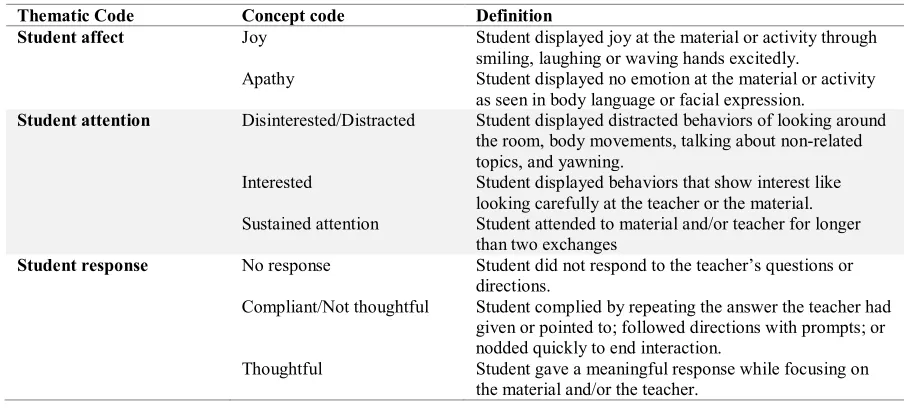
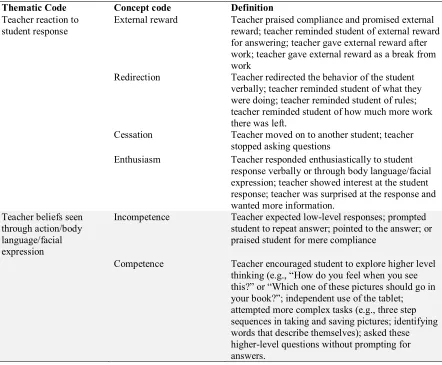
In the second phase, as shown in Table 3, Table 4, and Table 5, I dynamically and sequentially coded the student-teacher interactions in each session with a constructivist perspective using symbolic interactionism (Charmaz, 2014) seeking to make visible hierarchies of power, communication, and opportunity (Cresswell, 2013) by asking the following questions:
1. What is the student affect? 2. How does the student attend? 3. How does the student respond?
4. How does the teacher mirror student enthusiasm?
5. What do teacher’s actions tell about her beliefs about the ability of the student? 6. How long are the student-teacher exchanges?
7. How does the teacher-student interaction affect the content and instruction? 8. Who is in control of instruction?
Table 3
Inductive concept codes for student reactions developed during dynamic coding of instruction.
Thematic Code Concept code Definition
Student affect Joy Student displayed joy at the material or activity through smiling, laughing or waving hands excitedly.
Apathy Student displayed no emotion at the material or activity as seen in body language or facial expression.
Student attention Disinterested/Distracted Student displayed distracted behaviors of looking around the room, body movements, talking about non-related topics, and yawning.
Interested Student displayed behaviors that show interest like looking carefully at the teacher or the material. Sustained attention Student attended to material and/or teacher for longer
than two exchanges
Student response No response Student did not respond to the teacher’s questions or
directions.
Table 4
Inductive concept codes for teacher reactions developed during dynamic coding of instruction.
Thematic Code Concept code Definition Teacher reaction to
student response External reward Teacher praised compliance and promised external reward; teacher reminded student of external reward for answering; teacher gave external reward after work; teacher gave external reward as a break from work
Redirection Teacher redirected the behavior of the student verbally; teacher reminded student of what they were doing; teacher reminded student of rules; teacher reminded student of how much more work there was left.
Cessation Teacher moved on to another student; teacher stopped asking questions
Enthusiasm Teacher responded enthusiastically to student response verbally or through body language/facial expression; teacher showed interest at the student response; teacher was surprised at the response and wanted more information.
Teacher beliefs seen through action/body language/facial expression
Incompetence Teacher expected low-level responses; prompted student to repeat answer; pointed to the answer; or praised student for mere compliance
Competence Teacher encouraged student to explore higher level
thinking (e.g., “How do you feel when you see this?” or “Which one of these pictures should go in
Table 5
Inductive concept codes for teacher-student interactions developed during dynamic coding of instruction.
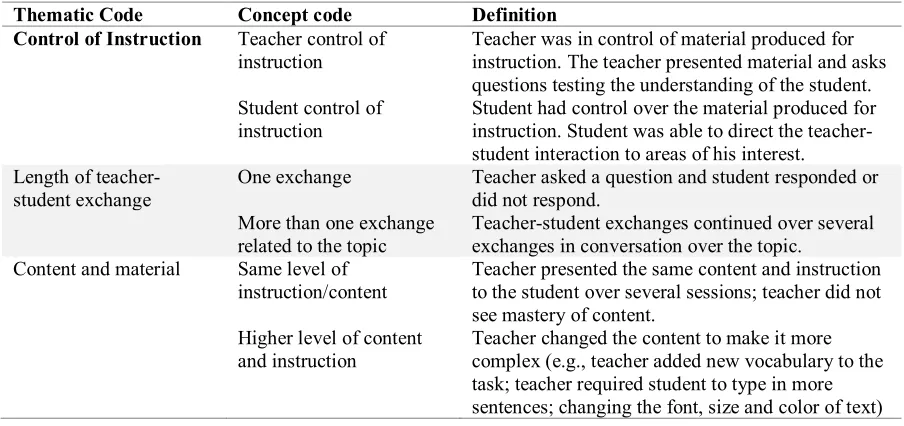
Thematic Code Concept code Definition Control of Instruction Teacher control of
instruction
Teacher was in control of material produced for instruction. The teacher presented material and asks questions testing the understanding of the student. Student control of
instruction
Student had control over the material produced for instruction. Student was able to direct the teacher-student interaction to areas of his interest. Length of
teacher-student exchange One exchange Teacher asked a question and student responded or did not respond. More than one exchange
related to the topic Teacher-student exchanges continued over several exchanges in conversation over the topic. Content and material Same level of
instruction/content Teacher presented the same content and instruction to the student over several sessions; teacher did not see mastery of content.
Higher level of content
and instruction Teacher changed the content to make it more complex (e.g., teacher added new vocabulary to the task; teacher required student to type in more sentences; changing the font, size and color of text)
Results
New Learning Spaces
An analysis of the video transcriptions, field notes and interviews indicated that new learning spaces were created for John and Ethan particularly in the areas of (a) problem-solving, (b) complexity of usage in digital tools and language, and (c) self-knowledge. Many of the skills that were observed in the multiliteracies sessions of the book project had not been previously seen in students in the observations of traditional instruction in class or gathered from the interviews of staff.
Problem-solving. There were many opportunities for problem-solving
was interesting in all these incidents was the perseverance of the students in waiting for or actively finding a solution to the problem. Conversations with staff and observations of traditional classroom sessions had revealed earlier that perseverance was not a quality that described either student; indeed, staff had described the students as being easily frustrated, needing frequent breaks, needing lower cognitive load and a perfect working environment. However, during the multiliteracies project, they were sufficiently
interested in attending to the problem to get what they wanted. In the session shown in Table 6, John showed that he could continue at a task when he wanted, in searching for a video that he had taken in the cafeteria.
Table 6
Excerpt from the transcript of John’s session showing problem-solving space, December 7, 2017
51 Teacher: Keep looking for the cafeteria video.
John looks and presses different icons on the tablet.
52 Teacher: You know what, I think cafeteria video was day 2, so we have to go to a different book, right? I am going to help you, because, I think we have to go to a different book, I just have to double check.
John suddenly tries to press something. 53 Teacher: Go ahead press it.
54 John: This is the cafeteria video.
Table 7
Excerpt from the transcript of John’s session showing problem-solving, January 2, 2018 34 John: Press play
John presses play. Nothing happens. 35 John: Okay, press play
John presses play again. Nothing happens.
36 Teacher: You may want to press it again. I don’t think you started the video. John presses it, but it does not work.
37 Teacher: Oh bummer, I think your fingers are cold, it is not feeling your finger. Press down, maybe that will help.
John reaches out, gets a pencil from the box, and uses the eraser tip of the pencil to press down on the tablet.
Ethan also experienced problems with the tablet functioning due to the high levels of movement in his hands and his desire to do things quickly. During one of the sessions, shown in Table 8, Ethan deleted an audio he had created but was willing to try again and do it right the second time.
Table 8
Excerpt from the transcript of Ethan’s session, January 4, 2018
38 Teacher: Oooh, you deleted it, can we do it one more time? You recorded “please”, but you pressed “no keep” so we have to do it one more time. Let’s add sound, press the record.
Ethan presses ‘add sound’ and ‘record’.
He smiles and then uses the AAC device to say “yes”. He presses ‘use’ this time to save the sound.
Table 9
Excerpt from the transcript of Ethan’s session, January 11, 2018
88 Teacher: First, I think you skipped a page. (goes back to a page) 89 Teacher: You were here, and where did your Amazing Race picture go?
Ethan nods and moves pictures around.
90 Teacher: Yeah, that’s right, you’re looking for it (pointing to the tablet). Ethan continues looking for the picture.
He moves other pictures around.
He finds the picture on the side of the screen and tries to bring it back to the screen.
91Teacher: Do you want to move it back here or leave it here? Ethan points to the place he wants it.
92 Teacher: Good, then move it here, (points) Ethan moves the picture.
Complexity of language usage. Students grew in the complexity of their use of
language and digital tools. While John and Ethan started out mostly observing the teacher work on the application during the first sessions, they quickly picked up the functions and started to operate them independently. They figured out many of the processes in the tablet intuitively. Conversations with staff, before the sessions, had constructed a narrative of John as resisting hard work. For example, the staff said that he would only copy sentences that had already been written down. John surprised the teacher and staff when in one of the sessions, he typed sentences by himself, attempted to spell words that were new and difficult, and corrected errors when he needed to. When John
demonstrated that he could record and save videos by himself, the teacher acknowledged that “he learned it pretty fast.” Ethan was also observed in several sessions as being able
Both the students showed growth in the use of the computer application.
Specifically, John and Ethan used the tablet to take photos and videos of self, friends, and staff; used the functions in the program to input text, images, and videos; used the digital pen to draw on the tablet; moved images, videos, audio, and text around on pages to create their pages; and selected the font, color, and size of their text. In one of the sessions, John showed that he could learn the sequence of changing the color, size, and font of his text with the teacher modeling it just once. I contrasted this with John’s earlier traditional math session where the teacher labored over several turns to get him to count one dollar up or his traditional literacy session, where he would only respond by
repeating the answer given to him by the teacher. Indeed, in the multiliteracies sessions, John demonstrated that he could learn and learn quickly.
Table 10
Excerpt from the transcript of Ethan’s session showing complexity of usage, December 12, 2017
22 Teacher: Here we go. I am going to set it up and you take it away… ready? 3, 2, 1, action!
Teacher hands over the tablet to Ethan. 23 Teacher: What do you want to record?
Ethan has the tablet and he is looking through it Teacher moves out of the way.
24 Teacher: Do you want to move around? You can put it on your lap and move around. What do you want to record?
Ethan puts the tablet on his lap and moves around the room to go to his friend working. He skips one friend and goes to another friend further away. Ethan picks up the tablet and starts recording.
25 Teacher: Looks like you want to record your friend, C____ Ethan is recording.
26 Teacher: Okay, are you done?
Ethan hands over the tablet. 27 Teacher: Let’s press done to stop recording. 28 Teacher: Do you want to use this video?
Ethan nods.
29 Teacher: Okay, go ahead and press use video. Ethan does it.
By contrast, in the traditional sessions, I had observed that Ethan’s responses were either nods or pointing distractedly to one of the choices given. In those sessions, he did not have the opportunity to demonstrate that he could learn complex sequences of functions or showcase his artistic talent.
Self-knowledge. During the final interview, the teacher remarked that the
Identity charts. Students created identity charts, selecting words that best described them as shown in Figure 1. The teacher had a list of 50 identifiers, which she read out in batches of 10, explaining each vocabulary word with everyday examples (e.g., “independent means you like to do things by yourself, like picking your clothes, picking
your lunch…).
Figure 1. Identity charts created by the students.
John registered his choice by circling the words on a sheet of paper. After he had picked ten words, John wanted to add the word “safe” to the list. One of the
para-educators felt that John was repeating what he had heard in the classroom, where staff often tell students to be safe, especially when they are anxious or agitated. Her remarks suggested John displayed a keen awareness of staff perception and staff narratives.
Ethan picked nine words out of a list of 50 words using his device to say “yes” or by placing a mark on the word with a dot marker.
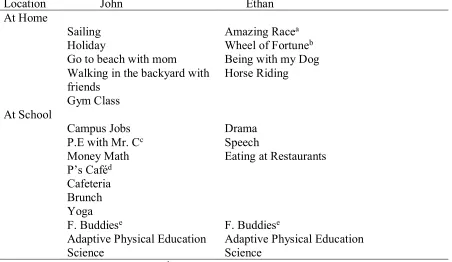
Favorite activities. When students selected their favorite activities at school, as shown in Table 11, the staff were surprised on two counts.
Table 11
Student-Identified Favorite Activities at the School Location John Ethan At Home
Sailing Amazing Racea
Holiday Wheel of Fortuneb
Go to beach with mom Being with my Dog Walking in the backyard with
friends Horse Riding
Gym Class At School
Campus Jobs Drama
P.E with Mr. Cc Speech
Money Math Eating at Restaurants P’s Caféd
Cafeteria Brunch Yoga
F. Buddiese F. Buddiese
Adaptive Physical Education Adaptive Physical Education
Science Science
a The Amazing Race, show on TV. bThe Wheel of Fortune, show on TV. c Mr. C is the
P.E. teacher. dP’s Café is the school district café run by students in their special day
programs. e F. Buddies is the buddy program where school peers hang out with students
during lunch.
First, the staff was surprised to see activities on the list that they knew the students liked because earlier they did not think students were conscious of their
preferences. One staff said, “It’s common knowledge, you know, that John loves to go to
the cafeteria, and he loves his lunch buddy, Mary. Wow! He picked those.” At the IEP
Secondly, the teacher and staff were surprised to see academic subjects in the list (for example, science) and this shattered the stereotypical notions the staff had about students with disabilities of being disinterested in academics. The teacher was thrilled. “Hmm…,” she pondered, “I may need to do more units in science.”
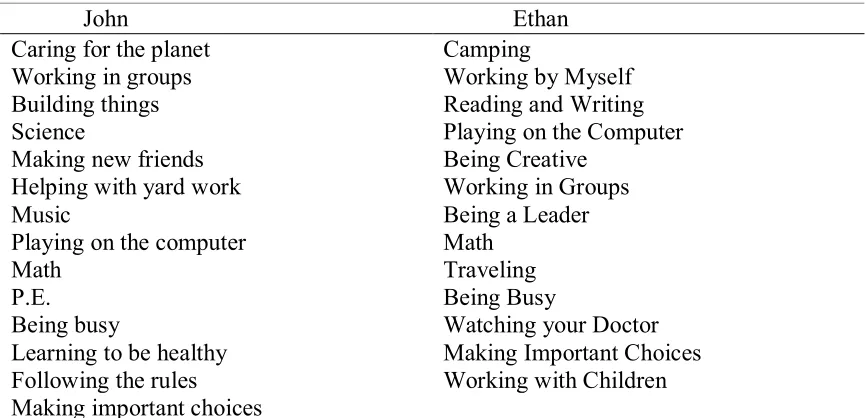
Strengths. Additionally, the students displayed self-awareness when they selected activities they were good at, using a list from a commercial program that was used in classroom transition planning, as shown in Table 12.
Table 12
Student Identification of their Strengths
John Ethan
Caring for the planet Camping
Working in groups Working by Myself
Building things Reading and Writing
Science Playing on the Computer
Making new friends Being Creative
Helping with yard work Working in Groups
Music Being a Leader
Playing on the computer Math
Math Traveling
P.E. Being Busy
Being busy Watching your Doctor
Learning to be healthy Making Important Choices Following the rules Working with Children Making important choices
co-What Were the Pathways to the New Learning Spaces?
Analysis of the data indicated a pathway to the creation of new learning. The multiliteracies framework used in the study created a noticeable shift in teacher-student interaction that resulted in engagement, initiation, and joy of learning, which was ultimately responsible for the creation of new learning spaces as shown in Figure 2.
Figure 2. Pathway to creation of new learning spaces.
In the section below, I describe the analysis of the teacher-student interactions that fostered engagement, intitiation, and joy of learning in the multiliteracies sessions. Figure 3 gives an example of the traditional literacy session in which John participates in reading a modified novel Frankenstein along with his class. John was only slightly engaged by the teacher-made material (by his brief glances at the screen), and he did not display much excitement or affect. The teacher asked mostly factual questions, testing student comprehension and recall, which got a limited response, with much prompting from the teacher. John showed that he was anxious and tried to show through his body language that he wanted to avoid participation. John’s behaviors and engagement fed into the teacher’s belief of student incompetence and when he did not respond to her question,
Figure 3. The instructional sequence for traditional instruction with John.
Similarly, Figure 5 illustrates a multiliteracies session with Ethan. Ethan was working on taking pictures with his tablet. He showed excitement at the co-constructed material which prompted an enthusiastic response from the teacher. Ethan responded to her enthusiasm with more actions, which in turn was reciprocated by the teacher in guidance to new learning. Ethan continued to show sustained attention and high student engagement. When he completed the task, Ethan expressed the joy of learning.
Figure 5. The instructional sequence in multiliteracies session with Ethan.
teacher-time, expression of self-awareness by students, and co-construction of content by the student and teacher.
Repeated analysis of the sequences of instructional patterns for all the sessions led to the formation of a generic model of instructional sequence. Traditional instructional sequences, shown in Figure 6 follow a pattern of teacher’s sole control of content and instruction, low level of student engagement resulting in limited student response, increased self-calming behaviors by student, need for an external reward, leading to teacher beliefs about student’s incompetence, and the same content being repeated until
teacher feels the student has reached mastery.
Figure 6. Concept map illustrating the instructional sequence in traditional instruction in the classroom.
enthusiastic and immediate response from student, alternating student and teacher control of instruction and content, sustained student attention leading to new learning spaces and creation of new knowledge, increasing teacher belief in student competence, and
production of new and more complex co-constructed content for the student.
Figure 7. Concept map illustrating the instructional sequence in multiliteracies instruction in the classroom.
Engagement, initiation, and joy of learning. Engagment, initiation, and joy of
learning were coded in the final analysis as the causal conditions for the central phenomenon of the creation of the new learning spaces.
Engagement. Educational researchers indicate that when students are more
obsess with people touching him even slightly. John exhibited behaviors which in Schlechty’s (2011) language could be described as ritual compliance, passive
compliance, retreatism or rebellion. These were coded in the study as self-calming behaviors. In one of the typical, traditional sessions shown in Table 13, when John worked with the teacher on counting money, these self-calming behaviors are evident, especially in turns 12, 14, 19, 21, 23, 26, 30, and 32. After seeing this video clip, the classrooms staff remarked that John was not engaged in the lesson because of the noise level in the classroom and that he was extremely sensitive to his environment.
Table 13
Excerpt from the transcript of John’s session, January 9, 2018
10 Teacher: Are you listening? Alright, and then you will get your box for five minutes and yoga and then we’re going to have a different journal, on the tablet, okay?
John looks at the schedule and then nods. 11 Teacher: Let’s get on with our list.
Complete the dollar up worksheet. Here’s your worksheet. What is the first thing that you do?
12 John: Ms. I? 13 Teacher: What John
14 John: Can I talk to you? 15 Teacher: Go ahead.
16 Teacher: Yes.
John starts to write his name on the worksheet. 17 Teacher: Okay, let’s do the first one together.
How much does this say?
John is looking at the sheet, one hand on his hair. 18 Teacher: 6, come on, 6 dollars, can you repeat after me? 6 dollars 19 John: Ms. I?
20 Teacher: John?
21 John: Where’s your phone? 22 Teacher: First we’re doing this. 23 John: Do you get the box?
26 Teacher: So if we have 6 dollars and 45 cents and we want the next dollar up, how much is that?
John is looking at the sheet, both hands on head.
27 Teacher: We are at 6 dollars, and we want the next dollar up, (pointing to the answer) 28 John: 7 dollars.
29 Teacher: Okay, it is seven. Can you count seven dollars for me (giving him notes to count).
30 John: Ms. I, I touched you.
31 Teacher: Yes, I did, can you count seven dollars for me?
John gets one dollar puts it on the side. He picks up another dollar, then looks up.
32 John: Ms. l?
33 Teacher: Yes? Remember you’re counting seven dollars.
However, soon after the session described above, he was observed showing authentic engagement and interest in a multiliteracies session even though he continued to be in the same noisy environment (Schlecty, 2011). The para-educators who viewed the video clips of the multiliteracies sessions corroborated these observations. He looked carefully at the tablet or the teacher, rarely looked around and the self-calming behaviors were occasional and not the rule. His responses were immediate, and he wanted to continue working. John showed that when he wanted to, he was able to cope with the environment.
Similarly, Ethan’s engagement was evident through his body language, namely
his looking at the tablet with focus, responding immediately and enthusiastically. Earlier conversations with the teacher and aides had indicated that Ethan’s typical attitude at
20 minutes to 30 minutes without a break. However, Ethan did like to look at his classmates during work, which was often prevented in the classroom by the use of screens to help him stay focused on the task at hand. During one of the multiliteracies sessions, the teacher artfully turned this supposedly distracted behavior into one where he records the activities of his classmates to input into his book. The distraction thus became an engaging activity and created a new learning space for Ethan.
Initiation. Researchers have shown that students, who had no control over their
learning or opportunities to show competence, develop dependency on the teacher or learned helplessness and assume that they cannot succeed without the help of others (Burton, 2002; Abramson, Seligman, & Teasdale, 1978).
The data in this study indicate that students frequently initiated actions that led to learning. Although the teacher supported and encouraged these actions, their motivation was entirely from the student. For example, John initiated selecting videos and pictures that he wanted to include in the book. At the start of most of the sessions, John would take ownership of the tablet and review all the material that he had made in the earlier sessions. He spontaneously shared details about the people and places seen in the pictures that he had included in his book. In one of the sessions, John initiated contact with para-educators to take photos of them and showed them what he had done. This kind of spontaneity and initiation were not observed in the traditional instructional settings.
Analysis of the video data also showed Ethan initiating communication and action. He frequently pointed to what he wanted to do, even when the teacher had
instruction to show his work to classmates or the staff. Table 14 describes a session where Ethan uses his AAC device spontaneously to communicate his feelings toward his classmate. This action created an opportunity for him to include a photo of his friend and to record an audio for that image in the book.
Table 14
Excerpt from the transcript of Ethan’s session, January 11, 2018
67 Teacher: You ready? Let’s create this sentence.
Ethan is still looking at his friends in front of the classroom.
Teacher is pointing at the device, and he nods still looking at others. Ethan smiles.
68 Teacher: You’re smiling at something. What’s making you smile?
Ethan tries to point to something on the device and then looks away again. Teacher looks at what Ethan is looking at, Ethan points to the device again. Ethan uses device to say “I like”.
Teacher prompts him to go to the screen with people. 69 Teacher: You have a list of friends. Who do you like?
Ethan uses the device to say, “I like Jack”
Joy of learning. Kliewer (2008) identified deriving joy from literacy as one of
the critical currents of literate citizenship. The analysis of the videos during
multiliteracies sessions indicated that the students showed enjoyment during learning. They smiled, laughed, and moved their hands excitedly, showing by their facial expressions and gestures that they were having fun.
However, it was evident from the video analysis of the multiliteracies sessions that when the students showed joy, it was very clear from their body language. They expressed joy at the start of each session while reviewing their books, learning new functions, and even performing complex tasks.
The results of the study suggest that the triad of engagement, initiation, and the joy of learning expressed by the students were crucial in creating the new learning spaces in the multiliteracies sessions.
Changes in Perceptions
The teacher. Interview with the teacher revealed that she was amazed at the
reactions of the student to the book project. She remarked, “What surprised me of both
John and Ethan was how intentional their communication was.” This was in contrast to her experience before the project when she had found it difficult to get the students to participate in the classroom instruction. She was candid about John, stating, “With John, it felt like there was this huge bubble around him and there was no breaking into it. I always perceived him as able to do something, but not necessarily willing to do it.” Initially, she had doubts about how the instruction would work remarking, “When
we first started this endeavor I doubted that we would get such genuine answers from both participants. The part about “Who Am I” blew me away!”.
A fragile orchid. The teacher and I shared a moment of deep insight into the how
the perception of the fragility of the orchid, I found that it is, in reality, untrue. Although orchids may need special humidity levels and growing medium, they are robust plants in their natural environments. Not unlike the orchid’s truth, the teacher realized that “after
this project, John is capable so much more than he lets on, or the environment can be chaotic, and he can cope.”
Classroom staff. There was a perceptible change in the language used by the
classroom staff to describe the students after watching the videos of the multiliteracies event. While they had previously grown accustomed to the idea that their students were distracted and non-responsive, needing perfect environments and frequent breaks to work, now they saw the students in a new light. They saw them engaged for extended periods of time with no external reward in many sessions, saw them enthusiastically participating in hard activities. I noted their surprise at the students’ behaviors and their
silence when I pointed out that the students were working despite the noisy environment. A selection of their comments as they were watching videos of the traditional and