Geschke Center
Doctoral Dissertations Theses, Dissertations, Capstones and Projects
2018
School Leaders' and Educators' Perceptions of
Ignatian Identity at Jesuit Cristo Rey Schools
William BludgusUniversity of San Francisco, [email protected]
Follow this and additional works at:https://repository.usfca.edu/diss
Part of theEducational Leadership Commons
This Dissertation is brought to you for free and open access by the Theses, Dissertations, Capstones and Projects at USF Scholarship: a digital repository @ Gleeson Library | Geschke Center. It has been accepted for inclusion in Doctoral Dissertations by an authorized administrator of USF Scholarship: a digital repository @ Gleeson Library | Geschke Center. For more information, please [email protected].
Recommended Citation
Bludgus, William, "School Leaders' and Educators' Perceptions of Ignatian Identity at Jesuit Cristo Rey Schools" (2018).Doctoral Dissertations. 463.
The University of San Francisco
SCHOOL LEADERS’ AND EDUCATORS’ PERCEPTIONS OF IGNATIAN IDENTITY AT JESUIT CRISTO REY SCHOOLS
A Dissertation Presented to
The Faculty of the School of Education Department of Leadership Studies Catholic Educational Leadership Program
In Partial Fulfillment
of the Requirements for the Degree Doctor of Education
by
© 2018 by William Robert Bludgus
THE UNIVERSITY OF SAN FRANCISCO Dissertation Abstract
SCHOOL LEADERS’ AND EDUCATORS’ PERCEPTIONS OF IGNATIAN IDENTITY AT JESUIT CRISTO REY SCHOOLS
Catholic schools have long played a critical role in the education and formation of
students in the United States. In the past half-century, however, Catholic education in the
U.S. has experienced a significant decline, both in the number of schools and in the
number of students served (Miller, 2006; Heft, 2011; NCEA, 2014). The Cristo Rey
Network is a growing movement aimed at revitalizing urban Catholic education for
low-income families. This reinvigoration is dependent on the schools’ commitment to
Catholic identity; for Cristo Rey schools, the charism of each school’s sponsoring
religious organization drives its Catholic identity. This study explored Jesuit, Cristo Rey
schools, and therefore, focused specifically on their Ignatian identity.
This study utilized a mixed-methods, embedded multiple-case study approach;
school leaders and educators were invited to complete the study’s survey, and three
in-depth interviews were conducted at each school. The six Jesuit, Cristo Rey schools in the
study were those, which are solely sponsored by the Society of Jesus, and which have
existed for at least eight years. The study’s survey instrument, the CRIGNIS, is an
adaptation of the Jesuit Schools Network’s IGNatian Identity Survey; each item of the
CRIGNIS was validated for alignment to one of the ten “distinguishing criteria”from
What Makes a Jesuit High School Jesuit? (Jesuit Conference, 2011).
The results from this study showed that, in general, the Ignatian identity across
the schools was perceived to be fairly strong; “Genuine care about each individual
student” and “Being a loving community” were perceived as the schools’ greatest
through this study as well. In addition to overarching trends, the case studies showed that
each school presented its own unique “strengths” and “challenges.” Furthermore, this
study showed great opportunities for Ignatian identity at Jesuit, Cristo Rey schools;
namely, through the CWSP, by connecting with the lived realities and demographics of
their students, and through the continued formation of adults at the schools. There is still
work to be done for schools to realize their full potential and the many gifts of being both
This dissertation, written under the direction of the candidate’s dissertation committee
and approved by the members of the committee, has been presented to and accepted by
the Faculty of the School of Education in partial fulfillment of the requirements for the
degree of Doctor of Education. The content and research methodologies presented in this
work represent the work of the candidate alone.
William Bludgus May 10, 2018
Candidate Date
Dissertation Committee
Ursula Aldana, Ph.D. May 10, 2018
Chairperson
Michael Duffy, Ed.D. May 10, 2018
Desiree Zerquera, Ph.D. May 10, 2018
DEDICATION
This dissertation is dedicated to our students and colleagues
at Cristo Rey San José Jesuit High School --
in particular, to the first-ever graduates of the Class of 2018; we began our journey together at CRSJ
at the same time that I began this dissertation, and we supported and cared for each other
every step of the way.
And to Kelsey,
who has put up with me throughout this entire process.
ACKNOWLEDGEMENTS
This dissertation allowed me to explore my deep appreciations for both Jesuit
education and educational equity; both passions originated from my much younger years.
I am forever in debt to my parents, who both worked multiple jobs, to ensure that I had
access to Catholic education growing up in Bayonne, NJ. Their sacrifice and faith,
coupled with the generous support of St. Peter’s Prep, provided me with a transformative
Jesuit high school experience. I did not know the terminology at the time, but it was at
St. Peter’s, where I was introduced to exceptional Ignatian educators, and where I began
to think, “I want to grow up to be like them.” Tony Azzarto, SJ, Jim DeAngelo, Tim
Caslin, Kaija Dewitt, John Irvine, and Sr. Frances Duncan come to mind, among many
others. Although not a faith-based institution, the University of Miami formally prepared
me to begin a career in education; Dr. Pat Whitely, Dr. Bill Butler, and countless mentors
showed me how to always remain student-centered, and how to always keep learning.
I am grateful to the Jesuit Volunteer Corps, the House of Blue Hope, and the
students and colleagues, whom I encountered during my years in Tanzania; those years
helped to shape my craft, and my soul. My Tanzanian brother, Daudi Mboma, stands out
among all who welcomed and inspired me during those formative years abroad. The
Upper East Side of Manhattan could not present a starker contrast to Mabibo, Dar es
Salaam, but the opportunity to work in Christian Service and Campus Ministry at Loyola
School, deepened my commitments to faith, justice, and Jesuit education. I am grateful
that Steve Katsouros, SJ and Jim Lyness took a chance on a young math teacher, who
was living halfway around the world. The patient mentorship from outstanding Ignatian
as a person and as a professional. During these same years, the Fordham University
Graduate School of Education provided my formal training for school leadership, while
summers working with Brian McCabe and the incredible team at the Xavier HAP
provided the joyful inspiration and humor. During my time in NYC, Daniel
Hendrickson, SJ, Ali Donohue, and my CLA cohort are accredited with pulling me more
deeply into Ignatian Spirituality, while the intentional community at Grace House
enlivened my soul on a nightly basis.
Four years ago, Peter Pabst, SJ and Joe Albers took a chance on a Christian
Service Director, who felt called to be a Dean of Students. Their invitation to Cristo Rey
San José Jesuit High School has led to deeply meaningful work, and personal and
professional growth. Meanwhile, the incredible financial support of the McGrath
Institute for Catholic Educational Leadership has allowed me to pursue this degree and
this research. The joint role of educator and student these past years has been a great
challenge, but an even greater blessing. Our students and colleagues at CRSJ have
offered endless support, and my professors and classmates in the CEL program have
taught me much. I am most grateful for the guidance of my dissertation chair, Dr. Ursula
Aldana, and committee members Dr. Mike Duffy, Dr. Desi Zerquera, and Dr. Bill Hobbs,
as well as to Dr. Doreen Jones; they brought incredible expertise and patience to my
many drafts and revisions. Thanh Ly provided the much needed guidance and
encouragement in my many times of confusion.
This dissertation was the result of inspired collaboration with those in the ministry
of Jesuit education and the Cristo Rey movement across the U.S. My thanks go to the
particular to Brian Melton, who answered so many of my questions along the way. Ralph
Metts, SJ and Mike Gilson, SJ also lent their expertise at times. The research would not
have been possible without the “generosity of spirit” from the leadership of the six
schools in this study. I am most grateful to the presidents and principals, who granted my
access to their schools, and to the many faculty and staff members who took time to
participate in my interviews and surveys. It was a true blessing, to have traveled the
country in the spirit of collaboration and inquiry among our Jesuit, Cristo Rey schools,
and to have learned so much from those doing the work. Our shared ministry has become
my life’s work, and I am so very grateful for the infinite moments of God’s grace, and for
TABLE OF CONTENTS
DISSERTATION ABSTRACT ... iii
DEDICATION ... iv
SIGNATURE PAGE ... v
ACKNOWLEDGEMENTS ... vii
LIST OF TABLES ... xii
LIST OF FIGURES ... xvi
CHAPTER I: THE RESEARCH PROBLEM ... 1
Statement of the Problem ... 1
Background and Need ... 4
Purpose of the Study ... 7
Clarification of Key Concepts ... 7
Conceptual Framework ... 11
Research Questions ... 19
Limitations ... 20
Educational Significance ... 21
Definitions of Terms ... 22
CHAPTER II: REVIEW OF THE LITERATURE ... 30
Restatement of the Problem ... 30
Overview of Catholic Education ... 31
Saint Ignatius of Loyola and Ignatian Spirituality ... 34
Historical Look at Jesuit Education and Ignatian Identity ... 36
Jesuit Education and Ignatian Identity after Vatican II ... 40
The IGNatian Identity Survey ... 49
Cristo Rey Schools ... 50
Cristo Rey Institute ... 58
CHAPTER III: METHODOLOGY ... 61
Restatement of the Purpose of the Study ... 61
Research Design ... 62
Population ... 64
Instrument ... 69
Validity ... 71
Pilot Study ... 88
Data Collection ... 99
Data Analysis Plan ... 101
Ethical Considerations ... 102
CHAPTER IV: RESULTS ... 105
Restatement of the Problem ... 105
Overview ... 106
Surveys Retained and Surveys Discarded ... 109
Demographics ... 113
The Perceptions of School leaders and Educators ... 117
Comparisons Between School leaders and Educators ... 129
Comparisons Among the Six Schools ... 135
Commonalities Among the Six Schools ... 138
The Six Schools as Case Studies: School A ... 142
School B ... 149
School C ... 159
School D ... 168
School E ... 176
School F ... 185
Additional Findings ... 196
Perceptions by Demographics ... 196
CHAPTER V: DISCUSSION ... 206
Overview ... 206
The Corporate Work-Study Program and Ignatian Identity ... 207
Student Demographics and Ignatian Identity ... 211
Intersection of Ignatian Identity and Cristo Rey Identity ... 217
Principals, Mission Identity Officers & Structures, and Jesuit Presence ... 222
Correlational Data and Ignatian Identity ... 227
CHAPTER VI: CONCLUSIONS, IMPLICATIONS, RECOMMENDATIONS ... 232
Summary of the Study ... 232
Conclusions ... 235
Implications ... 258
Recommendations for Future Research ... 260
Recommendations for Future Practice ... 262
REFERENCES ... 269
APPENDICES ... 278
Appendix A: CRIGNIS Survey Instrument Main Items with Aligning What Makes a Jesuit School Jesuit? Criteria ... 279
Appendix B: Interview Questions ... 283
Appendix C: Survey Data from All Respondents ... 285
Appendix D: Survey Data from School Leaders ... 290
Appendix E: Survey Data from Educators ... 295
Appendix F: Survey Data from School A ... 300
Appendix G: Survey Data from School B ... 305
Appendix H: Survey Data from School C ... 310
Appendix I: Survey Data from School D ... 315
Appendix J: Survey Data from School E ... 320
LIST OF TABLES
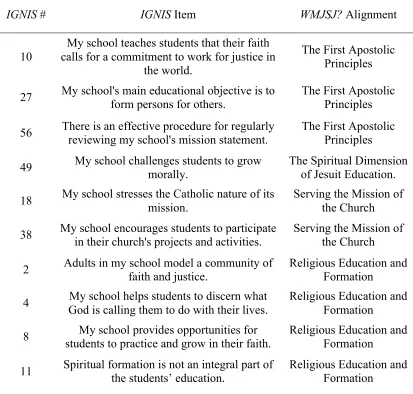
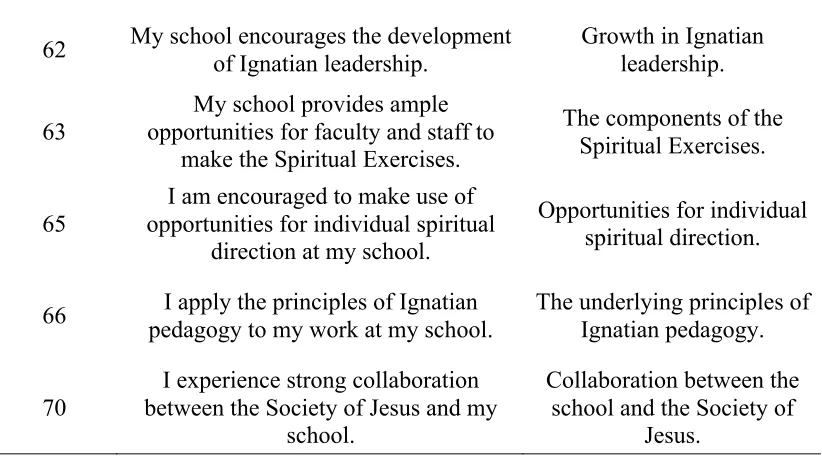
1 Existing 43 IGNIS Items with Documented Alignment to WMJSJ? Criteria ... 72
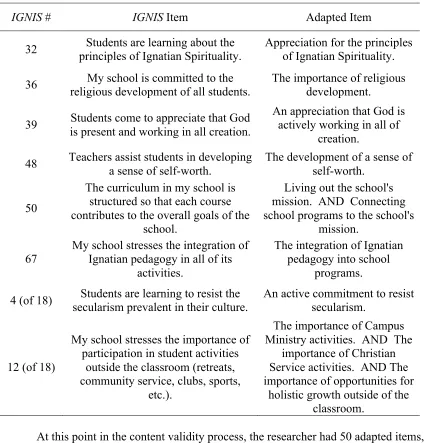
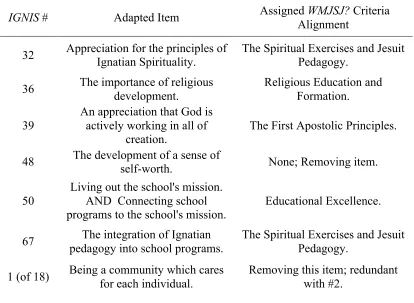
2 First Round of Adapting IGNIS Items ... 75
3 First Round of Discarding IGNIS Items and Rationale ... 77
4 Additional 9 IGNIS Items with Documented Alignment to WMJSJ? Criteria ... 79
5 Second Round of Adapting IGNIS Items ... 79
6 Adapted IGNIS Items Without Initial Documented Alignment to WMJSJ? Criteria ... 81
7 Initial Distribution of Adapted Items to Aligned WMJSJ? ... 82
8 WMJSJ? Criteria Alignment to Adapted IGNIS Items Without Previous Alignment ... 83
9 Items Added to Adapted Instrument (Not in IGNIS) and WMJSJ? Criteria Alignment ... 85
10 Second Distribution of Adapted Items to Aligned WMJSJ? ... 86
11 Linguistic Revisions to Adapted Items ... 86
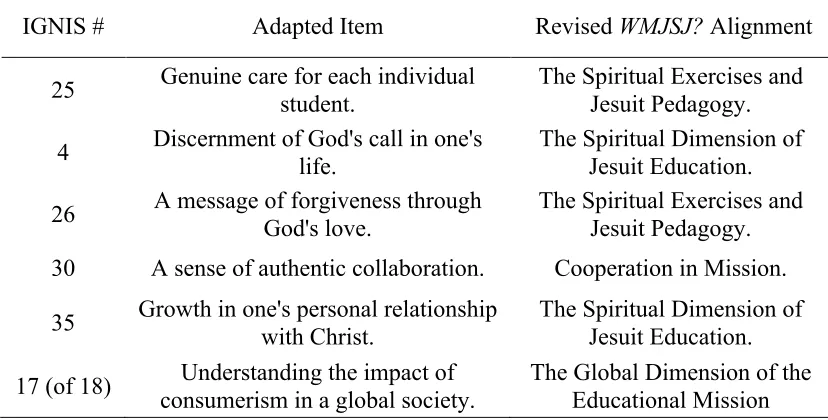
12 WMJSJ? Criteria Alignment Revisions to Adapted Items ... 87
13 Final Distribution of Adapted Items to Aligned WMJSJ? ... 88
14 Gender Identity for Respondents of CRIGNIS Pilot ... 91
15 Race Identity for Respondents of CRIGNIS Pilot ... 91
16 Ethnicity Identity for Respondents of CRIGNIS Pilot ... 91
17 Number of Years Working in Current Schools for Respondents of CRIGNIS Pilot Study ... 92
18 Number of Years Working in Jesuit Education for Respondents of CRIGNIS Pilot Study ... 93
20 Respondents’ Perception Data for “Our Adults Model This” from First Page Items of
CRIGNIS Pilot Study ... 95
21 Respondents’ Perception Data for “Our School Culture Facilitates This” from First Page Items of CRIGNIS Pilot Study ... 96
22 Respondents’ Perception Data for “Our Students Experience This” from First Page Items of CRIGNIS Pilot Study ... 97
23 Number of Survey Recipients ... 109
24 Survey Response Rates ... 111
25 Race Identity for Respondents ... 113
26 Ethnicity Identity for Respondents ... 113
27 Age of Respondents ... 114
28 Education Level of Respondents ... 114
29 Roles of Respondents in Their Respective Schools ... 115
30 Professional Experience of Respondents ... 116
31 Survey Main Items with Medians of 3 for All Sub-Item Categories ... 119
32 Survey Main Items with Medians of 4 for All Sub-Item Categories ... 121
33 Survey Main Items with Medians of 4 for Three Sub-Item Categories ... 122
34 Survey Main Items with Median of 4 for One Sub-Item Category ... 123
35 Survey Main Items with Median of 2 for All Sub-Item Categories ... 124
36 Survey Main Items with Median of 2 for Three Sub-Item Categories ... 125
37 Survey Main Items with Median of 2 for One Sub-Item Category ... 126
38 Total Sub-Item Responses, School Leaders v. Educators ... 130
39 Total Sub-Item Medians, School Leaders v. Educators ... 130
40 Total Sub-Item Modes, School Leaders v. Educators ... 131
42 Main Items Producing Higher Median(s) from School Leaders ... 134
43 Percentages of Total Sub-Item Responses by School ... 135
44 Percentages of Sub-Item Medians by School ... 136
45 Percentages of Sub-Item Modes by School ... 136
46 Main Items Consistently High Across All Schools ... 138
47 Main Items Consistently Low Across All Schools ... 139
48 Main Items Consistently High Across Three or More Schools ... 140
49 Main Items Consistently Low Across Three or More Schools ... 140
50 Main Items with Distinctively High Perception from School A ... 142
51 Main Items with Distinctively Low Perception from School B ... 149
52 Additional Main Items with Distinctively Low Perception from School B ... 151
53 Main Items with Distinctively High Perception from School B ... 154
54 Main Items with Distinctively High Perception from School C ... 159
55 Additional Main Items with Distinctively High Perception from School C ... 160
56 Main Items with Distinctively Low Perception from School D ... 168
57 Main Items with Distinctively High Perception from School E ... 176
58 Additional Main Items with Distinctively High Perception from School E ... 179
59 Main Items with Distinctively Low Perception from School F ... 186
60 Additional Main Items with Distinctively Low Perception from School F ... 187
61 Main Items with One Distinctively Low Median from School F ... 189
62 Total Sub-Item Responses, Female v. Male Respondents ... 197
63 Total Sub-Item Medians, Female v. Male Respondents ... 197
65 Racial and Ethnic Compositions of Staff Members at the Six Schools ... 199
66 Total Sub-Item Responses, Respondents of Color v. White Respondents ... 200
67 Total Sub-Item Medians, Respondents of Color v. White Respondents ... 200
68 Total Sub-Item Modes, Respondents of Color v. White Respondents ... 201
69 Total Sub-Item Responses, Lay v. Religious Respondents ... 203
70 Total Sub-Item Medians, Lay v. Religious Respondents ... 203
71 Total Sub-Item Modes, Lay v. Religious Respondents ... 203
72 Racial and Ethnic Compositions of Students at the Six Schools ... 211
73 Students’ Religious Affiliations ... 212
74 Ninth-grade Students’ Previous School Type ... 215
75 Percentages of “Bonus Question” Responses by School ... 218
76 Correlation Coefficients across Sub-Item Categories ... 228
LIST OF FIGURES
1 Venn diagram of the relationships among “Catholic identity,” “Explicitly Catholic,” “Ignatian identity,” and “Jesuit identity” ... 10
2 The frequency of number of minutes, which respondents took to complete the adapted instrument during CRIGNIS Pilot Study ... 90
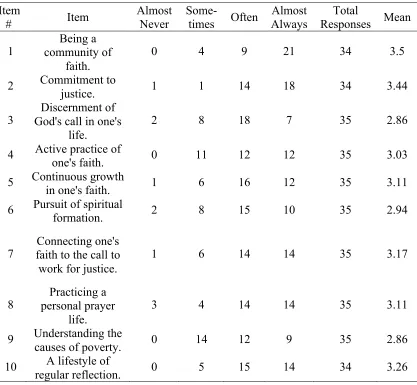
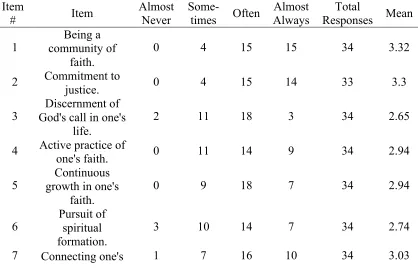
3 The frequency of responses from all completed surveys across all survey sub-items ... 118
CHAPTER I
THE RESEARCH PROBLEM
Statement of the Problem
Cristo Rey schools, a network of urban Catholic high schools, have garnered
noticeable traction in the past two decades. Cristo Rey schools aim to provide a quality,
Catholic, college-preparatory education for low-income families in urban areas; high
school graduation, college success, and college graduation are main goals for all of the
schools’ students (Cristo Rey Network [CRN], 2016a). The first Cristo Rey school
opened its doors in Chicago in 1996, and five years thereafter, the unique model was
replicated in Portland, OR (Kearney, 2008; CRN, 2016a). That initial replication process
proved successful; thus, others followed, and the CRN was formed. As of this writing,
there are 32 CRN high schools in 30 cities across the United States (CRN, 2016a).
A distinguishing hallmark of Cristo Rey schools is an innovative Corporate
Work-Study Program (CWSP), through which all students work at a local business or
non-profit organization five days a month. Mandatory participation in the CWSP funds
approximately 50% of each student’s tuition, though the exact figure varies for each
individual school (Kearney, 2008); this is a main reason why some consider Cristo Rey
schools to be a fiscally effective and sustainable solution to urban Catholic education
moving forward. In recent decades, as many urban Catholic high schools serving
low-income families have consolidated or closed because of a lack of funding (United States
Department of Education, 2008; Brinig & Garnett, 2014; National Catholic Education
Association [NCEA], 2014), Cristo Rey schools are opening, expanding, and growing in
the reality for Catholic schools: “The future belongs to new models of Catholic education
other than the tuition-based model. Tuition keeps going up and we keep pricing out the
students and families who are most in need” (Petrisek, 2016). Cristo Rey schools are a
possible solution to this problem, and many in the field of Catholic education do believe
that Cristo Rey schools offer a means of revitalizing urban Catholic education in the
United States.
The Mission Effectiveness Standards from the CRN outline the criteria for any
Cristo Rey school; the very first standard affirms that a Cristo Rey school must be
“explicitly Catholic”(CRN, 2012). The innovative structure of a Cristo Rey school
presents notable considerations for maintaining the Catholic identity of the school. First,
the CWSP takes students away from the school community and into a corporate, adult
workplace environment five days a week. Each corporate sponsor, its work environment,
and its personnel may support the Catholic mission of the school and the
student-workers’ formation to varying degrees. Secondly, the days spent at work result in five
less academic days each month for students at Cristo Rey schools; therefore the days, on
which students are in class, are longer and more highly structured for academic
instruction. Significant time and energy must be spent preparing students for college
readiness and building a college-going school culture. This could limit opportunities to
incorporate faith life activities into the school day and yearlong calendar. Thirdly, on any
given school day, 25% of the student body is at work; thus, there are few times when the
full school can gather together for community formation. A strong sense of community
1972; Miller, 2006; Center for Catholic School Effectiveness, School of Education,
Loyola University of Chicago, 2012; et.).
Furthermore, Cristo Rey schools attract a broad range of personnel. Cristo Rey
schools have become a national leader in urban education (Kearney, 2008; Heft, 2011;
Bateman, 2014; Sweas, 2014). The schools attract teachers and staff, who are advocates
for urban education reform, social justice, and educational equity in our country, but who
may or may not be Catholic or familiar with Catholic education. The CWSP departments
attract adults with professional business expertise and experience, but not necessarily
those coming from faith-based educational environments. The diversity of adults’
backgrounds can certainly enhance any school, yet all school leaders and educators at
Cristo Rey schools must be committed to and capable of animating a strong Catholic
identity, if Cristo Rey schools are going to be “explicitly Catholic” (CRN, 2012). The
CRN has noted its own desire for strong faith formation programs to support adults in
this ministry: “Adult faith formation is the essential way in which Cristo Rey Network
School communities nurture [their] spirituality” (CRN, 2010).
If Cristo Rey schools are going to be a sustainable model for urban Catholic
education into the future, there must be a high level of intentionality in upholding and
assessing their Catholic identity. This study was designed to contribute to this important
conversation by exploring a particular subset of Cristo Rey schools through one distinct
lens of Catholic identity. Specifically, this study explored the Ignatian identity of six
Jesuit, Cristo Rey schools. All Cristo Rey schools are called to live out their Catholic
identity; however, each Cristo Rey school takes on this responsibility through the len(s)
For Jesuit, Cristo Rey schools, and for any Jesuit school, the focus would be in animating
their Ignatian identity.
Background and Need for Study
The make-up of Catholic education in the United States has changed drastically in
the past fifty years. Prior to the Second Vatican Council (Vatican II), which spanned
from 1962 to 1965, Catholic parochial schools across the U.S. were staffed primarily by
religious – sisters, brothers, and priests (Walch, 2003; Miller, 2006; Heft, 2011). In the
late 1960s, following Vatican II, religious vocations began to experience a substantial
decline; as the number of religious sisters, brothers, and priests decreased by the
thousands, the staffing of parochial schools shifted to almost entirely lay teachers and
administrators (Walch, 2003; Miller, 2006; Heft, 2011). According to 2009 statistics,
Gibson reported that: “In 1967 nearly 60 percent of the principals and teachers in urban
schools were priests and religious” (Heft, 2011). Almost thirty years later, Miller (2006)
reported that: “Religious women constitute less than 4 percent of the full-time
professional staff of Catholic schools, while 95 percent of the teachers are laypersons” (p.
3). This major change in staffing affected Catholic education in two main ways:
operational costs increased dramatically and the responsibility of Catholic identity shifted
mainly to lay colleagues.
First, the staffing shift drove up the cost of operating a Catholic school; religious
sisters, brothers, and priests staffed parochial schools on very modest living stipends,
while lay personnel commanded competitive salaries (Walch, 2003). More lay personnel
meant more money being spent on salaries, which led to higher tuitions in order to
the greatest challenges for schools and families in poorer urban areas. With the rising
operational costs, many parochial schools were forced to close down in the past five
decades. According to both Miller (2006) and Heft (2011), Catholic schools reached
their peak in the United States in 1965, when over 5.5 million students attended 10,931
elementary and 2,465 secondary Catholic schools; by 2005, there were reported only 2.4
million students attending 6,574 elementary and 1,225 secondary Catholic schools. For
this study, it is important to note that the closures have reduced the number of Catholic
high schools by just over 50% in the past half-century. The CRN currently consists of
only 32 Catholic high schools, but it is expanding each year. The model could offer a
notable revival to the number of schools and students in urban Catholic education today.
In addition to the fiscal struggles within Catholic education, the shift to mostly lay
personnel altered the previous reliance on religious personnel for insuring Catholic
identity. “The presence of religious personnel in parochial and secondary schools served
as a built-in guarantee for their Catholic identity” (Miller, 2006). Religious sisters,
brothers, and priests undergo years of faith formation prior to their final vows. Without
their presence, more attention must be given to the adults who lead and teach in Catholic
schools. The shift in personnel called for a more careful process of authentically “hiring
for mission” and a more intentional approach to adult faith formation in Catholic schools.
The first Cristo Rey school was established in inner-city Chicago as a response
from an order of Catholic priests and brothers, the Society of Jesus (Jesuits), to the need
for a Catholic high school for low-income families (CRN, 2016a). Gang involvement,
drug use, violence, and poverty were common realities for youth and adolescents in the
through the realm of education (Kearney, 2008). They decided to start a
college-preparatory school, but the obvious question was: How would such a school for
low-income families be financed? The feasibility team drafted an innovative business model,
through which students would work five days a month at a professional company (or
non-profit corporation), and the company would then pay the school on behalf of the student
toward tuition fees (Kearney, 2008; CRN, 2016b). This CWSP proved to be a fiscal
success within the first few years of Cristo Rey Jesuit High School’s existence, and by
2001, educational leaders in other cities were interested in replicating the model (Sweas,
2014; CRN, 2016a). Two decades later, 32 Cristo Rey schools are operating in urban
areas across the United States. In essence, the model appears to be a fiscally sustainable
solution to the historical problem of being able to fund urban Catholic education after the
shift from religious to lay personnel.
If Cristo Rey schools seem to offer a fiscally viable future for urban Catholic
education, how well prepared are the schools to also be leaders of Catholic identity, given
their unique model and structure? In order to narrow the scope of this study, the
researcher decided to explore a specific subset of Cristo Rey schools through a particular
lens of Catholic identity, namely the Ignatian identity of Jesuit, Cristo Rey schools. The
research questions and research design reflect this explicit decision. As a Catholic order,
the charism of the Jesuits is, by definition, Catholic; for this study, the charism of Jesuit
schools is referred to as “Ignatian identity,” coined from the name of the founder of the
Society of Jesus, Saint Ignatius. The researcher isolated Ignatian identity in order to gain
greater clarity on one particular charism for the Catholic identity among some Cristo Rey
Purpose of the Study
The purpose of this study was to explore and compare the perceptions of school
leaders and educators at Jesuit, Cristo Rey schools regarding the Ignatian identity of their
respective schools. The relatively young network of Cristo Rey schools presents unique
considerations, opportunities, and challenges to maintaining a strong religious identity.
Specifically, this study focused on Ignatian identity, a subset of Catholic identity. As of
this writing, the Society of Jesus (co)sponsors or (co)endorses 14 Cristo Rey schools;
these schools are specifically focused on building and sustaining their Ignatian identity.
This study aimed to identify those opportunities and challenges regarding Ignatian
identity at Jesuit, Cristo Rey schools, and to examine what schools have been doing in
order to capitalize on the opportunities and combat the challenges. Furthermore, this
study aimed to explore the intersection of Ignatian identity and Cristo Rey identity for
Jesuit, Cristo Rey schools.
Clarification of Key Concepts
The terms “explicitly Catholic,” “Catholic identity,” “Ignatian identity,” and
“Jesuit identity” are used throughout this study. Although these concepts allow for
significant overlap, the terms are not identical, nor should they be used interchangeably.
This study did allow for one exception to this; at times, the researcher used the terms
“Ignatian identity” and “Jesuit identity” interchangeably in order to accommodate for
familiarity with interviewees and survey respondents. Some individuals in the study
were more comfortable with the term “Jesuit identity,” as it has been more prevalently
used within the context of their respective schools. In theory, “Ignatian identity” refers to
“Jesuit identity” refers to that which is grounded in the philosophy or spirituality of the
Society of Jesus, a Catholic order of priests and brothers. A school or organization could
embrace an Ignatian identity, and independently follow the teachings of Saint Ignatius
without being affiliated with the Society of Jesus; however, a school or organization
claiming a Jesuit identity, would inherently take on an Ignatian identity. The identity of
the Society of Jesus is an Ignatian identity; Saint Ignatius founded the Jesuits, and his
philosophy and spirituality continues to be those of the Society of Jesus. Each of the six
schools in this study is fully sponsored by the Society of Jesus; therefore in the context of
this study, the interchangeability of “Jesuit identity” and “Ignatian identity” has been
deemed appropriate by the researcher.
The CRN uses the term “explicitly Catholic” in the first of its “Mission
Effectiveness Standards” for assessing Cristo Rey schools; in its entirety, “Standard One”
states: “A Cristo Rey school is explicitly Catholic in mission and enjoys Church
approval” (CRN, 2012). The CRN (2012) provides five criteria for meeting this
standard; they are listed here verbatim:
1. The school meets the requirements of its religious sponsoring body in areas such as
religious identity and mission; community atmosphere; faculty, staff, and board
formation; and programs of religious education, worship, retreats, and community
service.
2. The school incorporates the cultural traditions and customs of the student body into
3. The school has in place personnel, processes, and programs such that the school is
religiously vibrant, marked by its faith-identity in the various aspects of the school’s
life.
4. The school relates collegially with surrounding Catholic high schools, parishes, and
grade schools.
5. The school incorporates the primary elements of the Cristo Rey Network Faith
Formation Document into its religious and faith formation programs.
In the first criterion above, the CRN (2012) affirms each school’s pursuit to animate the
“religious identity and mission” of its respective “religious sponsoring body.” In the
cases of the six Jesuit, Cristo Rey schools in this study, this would mean the animation of
an Ignatian identity. The second, third, and fourth criteria above speak to the integration
of culture and faith, religious vibrancy, and collaboration with other Catholic schools and
parishes; any Catholic school, and therefore any Jesuit school, would be called to implore
these principles in light of their “Catholic identity.” The fifth criterion above references
the CRN’s document entitled A Cristo Rey Spirituality, which calls schools to animate the
Gospel message, build authentic Christian community, and educate students for the
service of others (CRN, 2010); again, these principles would be part of any Catholic
school’s ethos, including Jesuit schools.
“Catholic identity” refers to that which is grounded in the Catholic faith and
teachings of the Catholic Church. All Catholic schools, including all Cristo Rey schools
and all Jesuit schools, are called to fully live out their Catholic identity. As noted,
“Ignatian identity” refers to that which is grounded in the philosophy and spirituality of
out their Ignatian identity. Therefore, all Jesuit schools are called to simultaneously live
out both their Catholic identity and their Ignatian identity, and there is significant overlap
between these two concepts. More comprehensive frameworks for understanding the
components of “Catholic identity” for Catholic schools and “Ignatian identity” for Jesuit
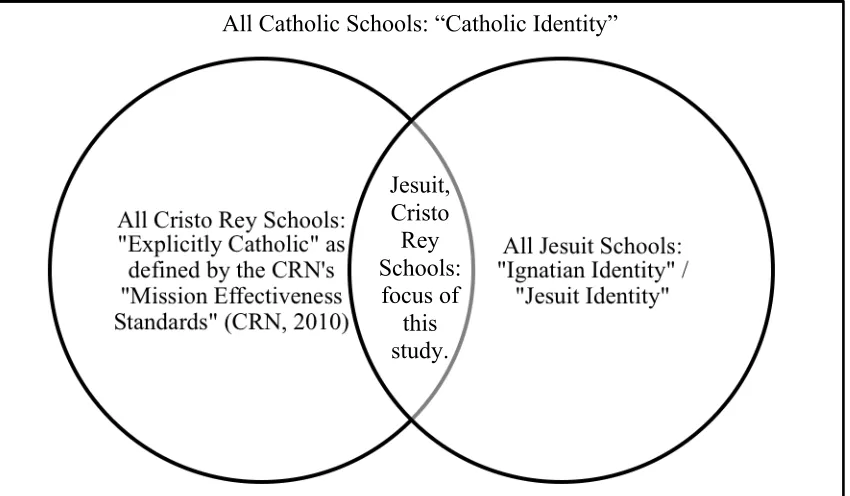
schools are included in the following section. The following figure shows the
relationships among Catholic schools, Jesuit schools, and Cristo Rey schools, and among
the terms “Explicitly Catholic,” “Catholic Identity,” “Ignatian Identity,” and “Jesuit
Identity”:
Figure 1. Venn diagram of the relationships among “Catholic identity,” “Explicitly Catholic,” “Ignatian identity,” and “Jesuit identity.”
When discussing all Cristo Rey schools, the terms “Catholic identity” and
“explicitly Catholic” are appropriate. When discussing Jesuit, Cristo Rey schools, all
four terms, which are discussed in this section are appropriate: “Explicitly Catholic,”
“Catholic Identity,” “Ignatian Identity,” and “Jesuit Identity.” However, this study All Catholic Schools: “Catholic Identity”
Jesuit, Cristo Rey Schools:
focused its scope on “Ignatian identity” for the six Jesuit, Cristo Rey schools in the study.
(Please note that some interviewees in this study have used both “Catholic identity” and
“Ignatian identity” seemingly interchangeably; the terms have been kept in their original
form for direct quotations from the interviewees.)
Conceptual Framework
Multiple conceptual frameworks were utilized in order to form a comprehensive
lens for this study. First, although this study ultimately focused on the more specific
concept of Ignatian identity, a framework for understanding Catholic identity, within a
school setting, was helpful in offering greater context. Secondly, a framework for
understanding the components of Ignatian identity, within the context of a school setting,
was essential. Two frameworks for organizational culture were included in order to
understand how those within an organization (the school leaders and educators, in this
study) perceive organizational culture (components of Ignatian identity, in this study).
As the study also explored the intersection of Ignatian identity and Cristo Rey identity, a
fifth framework was included to help understand any potential competing values for each
school in the study. Finally, as Cristo Rey schools serve predominantly students of color,
frameworks for both culturally relevant pedagogy and culturally responsive curriculum
were critically important; Ignatian formation for students is grounded in a pedagogy
(Ignatian) and a curriculum with varying degrees of explicitness at times.
Miller (2006) collated the main defining characteristics of a Catholic school in the
text entitled Five Essential Marks of Catholic Schools. The “five essential marks” and a
1. Inspired by a Supernatural Vision: Reminds schools that the fundamental, higher
purpose of Catholic education is the formation of the “whole child” to fulfill a
heavenly destiny – to become “good citizens of this world, loving God and neighbor,
and enriching society with the leaven of the gospel, and who will also be citizens of
the world to come, thus fulfilling their destiny to become saints.”
2. Founded on a Christian Anthropology: Emphasizes the Christo-centric aspects of
Catholic education; affirms that Jesus Christ is the “model and means” for Catholic
education, and the “center and fulcrum of the entire enterprise,” including “its
educational philosophy, its curriculum, its community life, its selection of teachers,
and even its physical environment.”
3. Animated by Communion and Community: Emphasizes a Catholic school as a
community of faith with high levels of “teamwork,” among educators and with local
bishops, “cooperation with families,” “a warm, intimate atmosphere,” “strong
teacher-student relationships,” and a “sacramental” environment; affirms a strong
presence of prayer, liturgies, and the Sacraments within the school community.
4. Imbued with a Catholic Worldview throughout its Curriculum: Reminds Catholic
schools that students’ education must be centered on the “love for wisdom and
passion for truth,” encompassing both intellectual and moral development;
emphasizes “religious education” and the integration of “faith, culture, and life.”
5. Sustained by Gospel Witness: Calls educators and all adults in Catholic schools to the
“imitation of Christ” for students, and to “reveal the Christian message not only
through word, but also by every gesture of their behavior”; encourages Catholic
In 2006 (second printing, 2011), the Jesuit Conference published What Makes a
Jesuit School Jesuit?: The Relationship between Jesuit Schools and the Society of Jesus,
Distinguishing Criteria for Verifying the Jesuit Nature of Contemporary Schools. The
document outlines ten “distinguishing criteria” for Jesuit schools, and this framework
formed the basis of Ignatian identity for this study. Each main item of this study’s survey
instrument aligns to at least one of these “distinguishing criteria,” as explicitly explained
in Chapter III. The background of the What Makes a Jesuit School Jesuit? document is
further explained in Chapter II. The ten criteria and a synopsis of each are listed here:
1. The First Apostolic Principles: Reminds Jesuit schools of their core mission as
apostolates of the Society of Jesus, and therefore of their role in the inseparable
“service of faith,” “the promotion of justice,” and “the realization of the Kingdom of
God”; calls schools to always remain mission-driven – through hiring, the selection of
trustees, the orientation and formation of adults, and the school’s various programs.
2. The Spiritual Dimension of Jesuit Education: Calls Jesuit schools to “foster the
development of students as adult members of their faith communities,” facilitating
opportunities for students to “experience Jesus Christ,” while also “respect[ing]
religious difference and promot[ing] interreligious dialogue.”
3. Serving the Mission of the Church: Asserts that every Jesuit school “publically
declares its Catholic identity,” and “acts ‘in the service of the worldwide mission of
the Church’”; also asserts that the school maintains a collaborative relationship with
the bishop and diocese, that “personnel live in conformity with the Gospel,” and that
“students are encouraged to participate actively in the life of their local faith
4. Religious Education and Formation: Reminds Jesuit schools of their responsibility to
provide meaningful and formative religious programs and curriculum, including a
vibrant liturgical life and resourced spiritual retreats; asserts the mission of Jesuit
schools “to preach Jesus Christ and to make Him known,” and to be “a community of
faith that comes together in the Eucharist.”
5. Teaching and Acting Justly: Speaks to the institutional commitment that a Jesuit
school “not only teaches justice but also acts justly”; this includes reaching out to the
“poor and the socially disadvantaged in the neighborhood,” offering “generous
amounts of financial aid based on need,” and transforming the hearts and minds of
students through effective Christian Service programs.
6. The Global Dimension of the Educational Mission: Affirms the global perspective of
Jesuit education; notably, calls for an education through which students “analyze their
own contemporary culture,” “recognize the suffering and pain” and become sensitive
to injustices in different parts of the world, are drawn to “solidarity with the
disadvantaged and dispossessed,” and are “achieving the freedom to work for
justice.”
7. Educational Excellence: Speaks to the distinguished academic and co-curricular
programs of Jesuit schools, all aimed at cultivating a Christian response with
students; places emphases on developing critical thought and knowledge, educating
the “whole person,” preparing students for leadership and collaboration, and
incorporating technology.
8. Cooperation in Mission: Asserts the critical role collaboration plays in a Jesuit school,
the Province, and the active participation of each school as a member of the Jesuit
Schools Network (JSN); also speaks to the orientation and ongoing formation of those
working in the school with regards to mission, the larger context of Jesuit education,
and Ignatian Spirituality.
9. Spiritual Formation and Outreach: Calls for the spiritual formation of and spiritual
opportunities for all board members, personnel, families, and alumni at Jesuit schools;
affirms the needs for careful hiring and selection processes for personnel and board
members, effective ongoing formational programs, and participation in workshops
and seminars from the JSN.
10. The Spiritual Exercises and Jesuit Pedagogy: Speaks specifically to the importance of
offering spiritual direction, experiences with The Spiritual Exercises, and formation
with regards to Ignatian discernment to board members and personnel at a Jesuit
school; emphasizes the need for familiarity with and full integration of The
Characteristics of Jesuit Education and Ignatian Pedagogy: A Practical Approach.
In order to understand how school leaders and educators perceived these
“distinguishing criteria” of Ignatian identity within the context of their respective schools,
two frameworks of organizational culture were considered. This study assumed that the
Ignatian identity of each school was intertwined with the school’s organizational culture.
Schein (1992, 2010) identified “three levels” of organizational culture: “artifacts,”
“espoused beliefs and values,” and “basic underlying assumptions.” “Artifacts” refers to
“visible structures and processes” and “observed behavior”; “espoused beliefs and
values” refers to the “ideals, goals, values, and aspirations” of the organization and its
and values, which “determine perception, thought, and feeling” (Schein, 1992, 2010).
This study assumed that school leaders’ and educators’ perceptions of Ignatian identity
have been informed by these three levels of school culture.
Hatch (1993) expanded upon Schein’s work and provided a framework for the
“dynamism of organizational cultures.” Hatch (1993) included “symbols” as a fourth
level of organizational culture, and moreover, articulated the processes of interplay
between the four levels. According to the “Cultural Dynamics Model,” “realization”
refers to the process linking “values” and “artifacts”; “symbolization” refers to the
process linking “artifacts” and “symbols”; “interpretation” refers to the process linking
“symbols” and “assumptions”; and “manifestation” refers to the process linking
“assumptions” and “values” (Hatch, 1993). Hatch (1993) argued that these processes
informed perceptions of organizational culture, just as the four levels themselves; this
study considered its framework in agreement with Hatch’s view.
The “Competing Values Framework” developed by Cameron and Quinn (1999)
was considered for this study. This study explored the intersection of Ignatian identity
and Cristo Rey identity for the six schools in the study; the study assumed that, in some
ways, these identities would be mutually reinforcing, while in other ways, the two
identities may produce tension. The consideration of the “Competing Values
Framework” helped to frame the exploration of this potential tension. Cameron and
Quinn (1999) identified four types of organizational culture based on their internal or
external focus and on the level of their flexibility and individuality or their stability and
control: “Clan,” “Hierarchy,” “Adhocracy,” and “Market.” “Clan” refers to an
individuality; “Hierarchy” refers to an organizational culture with an internal focus and
high levels of stability and control; “Adhocracy” refers to an organizational culture with
an external focus and high levels of flexibility and individuality; and “Market” refers to
an organizational culture with an external focus and high levels of stability and control
(Cameron & Quinn, 1999). Considering these four tendencies for organizational cultures
helped to inform this study in its exploration of any reinforcement or tension for the
schools with both Ignatian and Cristo Rey identities.
Student demographics naturally surfaced as a critical component of this study.
Thus, frameworks for culturally relevant pedagogy and culturally responsive curriculum
were included. This study focused on Ignatian identity, and therefore on spiritual (and
not academic) formation and animation; yet the work in this spiritual realm still very
much involves both a pedagogy and a curriculum. In other words, there is a methodology
behind the work of spiritual formation. Ladson-Billings (1995) offered a framework for
culturally relevant pedagogy with “three broad propositions”: “conceptions of self and
others,” “social relations,” and “conceptions of knowledge.” According to the research,
culturally relevant educators possessed a number of attributes within each of these three
propositions; they are listed here:
• Conceptions of Self and Others: belief that all students are capable of success;
view of pedagogy as “art” and teaching as “pulling out knowledge”; view of
oneself as a member of the community being served and of teaching as a
• Social Relations: “connectedness with all students”; development of “fluid
student-teacher relationships” and a “community of learners” in which students
learn collaboratively and take responsibility for one another.
• Conceptions of Knowledge: belief that knowledge is “constructed” (not “static”)
and “must be viewed critically”; passion for learning; ability to “scaffold”
learning for students and incorporate “multifaceted” assessment.
Dallavis (2014) drew an important connection between culturally responsive pedagogy
and Catholic identity, particularly surrounding educators’ “conceptions of self and
others” and “social relations.” S. P. Martin (1996) offered recommendations for Catholic
schools to “build on their tradition of Gospel values (and) explore opportunities for
incorporating diversity in their schools.” The research from Dallavis (2014) did suggest
that in a Catholic school setting, teachers’ religious faith drives their beliefs toward high
expectations for student learning and emphases on caring, supportive student-teacher
relationships.
Morey and Kilano (1997) proposed a “framework for infusing attention to
diversity” in curriculum and defined three levels of doing such: “exclusive,” “inclusive,”
and “transformed” (Kea, Campbell-Whatley, & Richards, 2006). The three levels are
described here, based on summaries by Kea, Campbell-Whatley, & Richards (2006):
• Exclusive: lowest level; diversity is “restricted to one part of the course” and
limited to “food, folklore, fun, and fashion”; content includes “traditional
mainstream experiences and stereotypes; instruction is “teacher-centered” and
• Inclusive: “diversity is discussed throughout the course and compared to the
dominant norm”; instruction “remains teacher-centered” but includes varied
assessment methods and opportunities for students to “construct their own
knowledge.”
• Transformed: “curriculum challenges traditional views” through “critical
pedagogy and issue-oriented approaches”; “instruction is student-centered,” and
students’ “personal experiences are analyzed”; students regularly engage in
“self-assessment,” “reflection techniques,” “critical problem solving,” and
“examination of values.”
These three levels should be considered when exploring the extent to which Jesuit, Cristo
Rey schools are implementing components of Ignatian identity in light of the student
demographics and lived experiences at their respective schools.
Research Questions
The study addressed five research questions:
1) What are the perceptions of school leaders and educators of Ignatian identity at their
respective Jesuit, Cristo Rey schools?
• What are the perceptions of school leaders of Ignatian identity at their respective
Jesuit, Cristo Rey schools?
• What are the perceptions of educators of Ignatian identity at their respective
Jesuit, Cristo Rey schools?
• How do these perceptions of school leaders and educators of Ignatian identity at
Jesuit, Cristo Rey schools compare?
• What about being a Jesuit, Cristo Rey school strengthens Ignatian identity?
3) What are the challenges to Ignatian identity at Jesuit, Cristo Rey schools?
• What, if any, tensions exist for schools, which are both Jesuit and Cristo Rey?
4) What are Jesuit, Cristo Rey schools doing to capitalize on the opportunities for
Ignatian identity?
5) What are Jesuit, Cristo Rey schools doing to combat the challenges to Ignatian
identity?
Limitations
There were several limitations to this study. The first limitation was regarding the
sample size. The researcher explored six Jesuit, Cristo Rey schools; this was the total
number of schools, which fit the following three-fold criteria at the time of this study: a.)
each school must be a Cristo Rey school, b.) each school must be solely endorsed or
sponsored by the Society of Jesus (and not co-sponsored or co-endorsed with another
entity), and c.) each school must have been in existence for at least eight years at the time
of the study. Since the researcher was able to explore all six schools, which fit the
description, the sample size was maximized. The six schools were located in five
different urban areas of the U.S., and therefore the sample was geographically diverse.
However, the sample size remained small, as it was still only six schools, and each school
only had approximately 50-90 school leaders and educators.
The newness of the schools in the sample was also a limitation for a study
concerning institutional identity. The first Jesuit, Cristo Rey school (which was also the
first Cristo Rey school of any kind) was founded in 1996; at the time of this study, that
other schools in the sample. The other schools in the study had been in existence for
eight to fourteen years respectively at the time of this study. Whether the schools have
had enough time to build their Ignatian identity in as little as eight and as many as twenty
years was questionable, and therefore was included as a limitation.
Other limitations existed regarding the researcher and the participants. The
researcher has been educated in Jesuit schools, and at the time of the study, had been
working in Jesuit schools his entire career. Therefore, there has been a learned bias in his
interpretation and evaluation of the responses of the participants. Furthermore, Cristo
Rey schools predominantly serve students of color, and student demographics surfaced as
a prominent interconnected theme throughout the study; the researcher identifies as
“white,” and therefore did not possess the lived experience to personally interpret the
intersection between Ignatian identity and being a student of color. The participants in
the study (survey respondents and interviewees) may have been affected by social
desirability; in other words, there may have existed a temptation to respond more
favorably to the questions of the researcher in order to give the perception that the school
of each participant was maintaining a stronger sense of Ignatian identity than was the
reality.
Educational Significance
The results of this study should help to inform the future of urban Catholic
education in the United States. If Cristo Rey schools continue to be a successful means
through which Catholic education remains available for low-income families, then the
schools must also be intentional about how they are cultivating and living their Catholic
sponsoring religious body and that of the CRN as a whole. The CRN and its schools are
still in their infancy; the schools have tremendous power and responsibility in shaping
their cultures and identities from these early years. As Cristo Rey schools continue to be
established, and as the Cristo Rey movement continues to grow, the schools must uphold
the very first standard of the CRN’s Mission Effectiveness Standards: Cristo Rey schools
must be “explicitly Catholic.” In other words, a primary responsibility of each Cristo
Rey school is to live and animate its Catholic identity (CRN, 2012).
The results of this study should help inform existing, emerging, and future Jesuit,
Cristo Rey schools, as they work to build and foster a strong Ignatian identity. This study
can be replicated for the charisms of other religious orders, which sponsor and / or
endorse Cristo Rey schools; the survey instrument can be adapted to highlight those
characteristics emphasized by other orders and their charisms. This study can also be
replicated for existing traditional Jesuit schools, or non-traditional Jesuit schools, here in
the United States or within other cultural or geographic contexts. The continuous
evaluation of all Jesuit schools with regards to their Ignatian identity is paramount. There
are opportunities to consider how Ignatian identity manifests itself in other non-tradition
settings, such as NativityMiguel schools, Fe y Alegria schools, Jesuit Refugee Service
educational projects, and vocational training programs run by the Society of Jesus in
various parts of the world.
Definition of Terms
Adult Faith Formation: Program and process for the continuing spiritual formation of
adult members of the faith community (United States Conference of Catholic
being “the essential way” in which Cristo Rey schools nurture their spirituality
(CRN, 2010).
Catholic Education / Catholic school: Referring to any educational ministry / formal
school of the Catholic Church; the United Stated Conference of Catholic Bishops
synthesizes Catholic schools as communities of faith, knowledge, and service
(National Conference of Catholic Bishops, 1972).
Catholic identity: Adherence to and animation of those characteristics, which define a
school or organization as “Catholic.” For this study, Miller’s (2006) Five
Essential Marks of a Catholic School provided the framework for defining these
characteristics of Catholic identity; this framework characterizes Catholic schools
as being: “inspired by a supernatural vision,” “founded on a Christian
anthropology,” “animated by communion and community,” “imbued with a
Catholic worldview throughout its curriculum,” and “sustained by Gospel
witness” (Miller, 2006).
Cristo Rey identity: Adherence to and animation of the characteristics defined by the
CRN for its member schools. The CRN’s (2012) Mission Effectiveness Standards
document provided the framework with ten defining characteristics of a Cristo
Rey school. The standards note each CRN school’s commitment to: living its
Catholic mission; serving only low-income students; playing an active role in the
community; providing a rigorous college-preparatory curriculum and on-going
student support through college; implementing the comprehensive CWSP; and
participating in the CRN (CRN, 2012).
urban youth” (CRN, 2016a). As of this writing, there are 32 CRN schools in
urban areas across the United States; the schools are marked by “rigorous
academics, coupled with real world work experience” (CRN, 2016b).
Cristo Rey school: Any school, which is a member of the CRN, and therefore is
responsible for upholding the CRN’s requirements for membership.
Congregation for Catholic Education: Offices for the Catholic Church, which oversee
Catholic schools and universities respectively; although the origins of the office
date back to the late 16th-century, the current name of the office was coined in
1988 (Grocholewski, 2015).
Corporate Work-Study Program (CWSP) for Cristo Rey schools: A core component of
any Cristo Rey school; students work one day a week through the partnerships the
school has with local businesses, helping to significantly subsidize the operational
cost of the school (CRN, 2016b).
Corporation of Roman Catholic Clergymen: Religious organization in Maryland, which
included former Jesuits during the suppression of the Society of Jesus (1773 –
1814), and under which the first Jesuit school in the United States was founded
(Society of Jesus, 2014; Whitehead, 2016).
Culturally Relevant (or Responsive) Pedagogy: Theory of education with foci on student
achievement, affirmation of students’ cultural identity, and development of
students’ critical perspectives, which challenge societal inequities (Ladson-
Billings, 1995).
Culturally Responsive Curriculum: Course of study (including content, methodology,
concepts, and encourages students’ construction of knowledge (Kea, Campbell-
Whatley, & Richards, 2006).
“Explicitly Catholic”: Term used by the CRN in its first “Mission Effectiveness
Standard, defined by the five components which follow the standard: meeting the
requirements of the school’s religious sponsor, integrating faith with its students’
cultures, animating school-wide religious vibrancy, cooperating with other
Catholic schools and parishes, and incorporating the elements of A Cristo Rey
Spirituality (Gospel message, community, and service) into faith formation
programs (CRN 2012).
Fe y Alegria schools: Network of Catholic schools and community development
programs throughout Latin America serving primarily marginalized communities
(Fe y Alegria, 2016).
General Congregation of the Society of Jesus (GC): Global meeting of various
representatives of the Society of Jesus; since the founding of the Jesuits, there
have been 36 General Congregations to discuss important matters pertaining to
the Society (Society of Jesus, 2017).
Ignatian: Adjective used to describe, that which pertains to the charism and defining
characteristics of Saint Ignatius and his spirituality.
Ignatian identity: Adherence to and animation of those characteristics, which define a
school or organization as “Ignatian.” For this study, the Jesuit Conference’s
(2011) document entitled What Makes a Jesuit School Jesuit? provided the
framework for defining Ignatian identity. The document elaborates on ten
Schools,” each of which directly aligns to principles of the Society of Jesus and
Ignatian Spirituality, and each of which offers tangible applications for Jesuit
schools (Jesuit Conference, 2011).
Ignatian Pedagogical Paradigm (IPP): Framework for the educational process rooted in
Ignatian Spirituality; the framework consists of the interplay among
understanding context, experience, reflection, and action (Metts, 1991).
Ignatian Pedagogy: Educational philosophy and practice, which stems from Ignatian
Spirituality; the expected pedagogy at Jesuit schools. (International Commission
on the Apostolate of Jesuit Education, 1993).
Ignatian Spirituality: The spirituality based on the lived experience of Saint Ignatius;
most notably, Ignatian Spirituality calls for the discovery of “God in All Things”
as one experiences the world (Society of Jesus, 2016).
International Commission Apostolate of Jesuit Education (ICAJE): Advisory council to
the Secretariat of Education for the Society of Jesus; the group was founded in
1980 (Society of Jesus, 2017).
Jesuit: Term used to name a member of the Society of Jesus, or as an adjective to
describe an official work or ministry of the Society of Jesus.
Jesuit Conference: Organization which serves as the overarching liaison among the
North-American Provinces of the Society of Jesus, and other Jesuit organizations
(Society of Jesus, 2016).
Jesuit education / Jesuit school: Any educational ministry / formal school endorsed or
sponsored by the Society of Jesus, and therefore responsible for upholding the
Jesuit identity: Adherence to and animation of those characteristics, which define a
school or ministry as belonging to the Society of Jesus, and therefore which are
grounded in Ignatian Spirituality. See also Ignatian Identity.
Jesuit Province / Provincial: Geographic regions and leaders within the Society of Jesus;
“Jesuit communities and apostolic works are organized by ‘provinces,’” and each
Province is led by a Jesuit Provincial (Society of Jesus, 2017).
JSN (Formerly the Jesuit Secondary Education Association [JSEA]): North-American
organization, which “initiates programs and provides services to enable its
member schools to sustain their Ignatian vision and Jesuit mission” (JSN, 2016).
Laypersons / Lay personnel: Persons of a faith or religious group who are not the clergy;
for this study, the terms refers to those who are part of the Catholic Church but
who are not religious sisters, brothers, or priests.
Magis: Latin word used in Ignatian Spirituality referring to the “more” deeply one can
respond to Christ’s invitation in one’s life (IgnatianSpirituality.com, 2017).
NCEA: “Professional membership organization that provides leadership, direction, and
service to fulfill the evangelizing, catechizing, and teaching mission of the
Church” (NCEA, 2017).
National Conference of Catholic Bishops: See USCCB.
NativityMiguel schools: Network of faith-based schools serving “economically-poor”
communities throughout the United States and Canada (NativityMiguel Coalition,
2017).
Parochial school: Term used to describe a Catholic school affiliated with a local Catholic
Sacred Congregation for Catholic Education: See Congregation for Catholic Education.
Saint Ignatius of Loyola: “Spanish soldier and aristocrat who discerned his calling after
suffering nearly fatal wounds on the battlefield. He established the Society of
Jesus in 1540” (Society of Jesus, 2016).
Second Vatican Council (Vatican II): Global meeting of leaders within the Catholic
Church; the meeting spanned from 1962 to 1965 (Walch, 2003; Miller, 2006;
Heft, 2011).
Society of Jesus: Roman Catholic religious order of priests and brothers (and those in
official training) founded in 1540 by Saint Ignatius of Loyola (Society of Jesus,
2016).
Sponsorship Review Process for Jesuit schools: Structured process, through which a
team of Ignatian educators from other Jesuit schools and the Province Office
visits a given school, and through observations and feedback, helps to guide the
Ignatian identity of Jesuit schools.
Superior General of the Society of Jesus: Global leader of the Society of Jesus, who is
elected by the General Congregation of the Society of Jesus for life (Society of
Jesus, 2017).
Suppression of the Society of Jesus: Period in history from 1773 to 1814 during which
Jesuits “had to renounce their vows and were driven into exile” as a direct order
from the Pope (IgnatianSpirituality.com, 2017).
USCCB: Assembly of bishops of the United States and the U.S. Virgin Islands, who
“exercise certain pastoral functions on behalf of the Christian faithful of the
which the Church offers humankind, especially through forms and programs of
the apostolate fittingly adapted to the circumstances of time and place” (USCCB,
2017). In 2001, the United States Catholic Conference and the National
Conference of Catholic Bishops were combined to form the USCCB (USCCB,
CHAPTER II
REVIEW OF THE LITERATURE
Restatement of the Problem
Cristo Rey schools comprise a network of Catholic high schools serving
low-income students in urban areas of the United States; each of the current 32 Cristo Rey
schools strives to animate its Catholic identity, as informed by the charism of it
sponsoring or endorsing organization (CRN, 2016c). After decades of decline in the
number of urban Catholic schools in the U.S. (and in the enrollment of those still
operating), Cristo Rey schools are opening and expanding (United States Department of
Education, 2008; Heft, 2011; Brinig & Garnett, 2014; NCEA, 2014; CRN, 2016a). As
this relatively new network of urban Catholic high schools continues to grow, it is
increasingly vital to examine the Catholic identity of these schools within this unique
educational model.
Each Cristo Rey school must be sponsored or endorsed by at least one religious
order or (arch)diocese; many schools are co-sponsored or co-endorsed by more than one
(CRN, 2016c). Of the 32 existing Cristo Rey schools, there are 38 religious orders and
(arch)dioceses which (co)sponsor or (co)endorse the schools (CRN, 2016c). The Society
of Jesus, also know as the Jesuits, (co)sponsor or (co)endorse 14 of the current Cristo Rey
schools; they are by far the most frequently represented sponsor or endorser (CRN,
2016c). The Jesuit Cristo Rey schools are concerned with infusing their Catholic identity
through the lens of Ignatian Spirituality, the charism of the founder of their order, Saint
Ignatius of Loyola. Traditional (non-Cristo Rey) Jesuit high schools have been charged