ISSN: 2149-214X
www.jeseh.net
Sexual Health Knowledge of Teachers
Sinan Erten, Irem Akcam Yalcin
Hacettepe University
To cite this article:
Erten, S. & Akcam Yalcin, I. (2019). Sexual health knowledge of teachers.
Journal of
Education
in
Science,
Environment
and
Health
(JESEH),
5
(1),
70-78.
DOI:10.21891/jeseh.492581
This article may be used for research, teaching, and private study purposes.
Any substantial or systematic reproduction, redistribution, reselling, loan, sub-licensing,
systematic supply, or distribution in any form to anyone is expressly forbidden.
Authors alone are responsible for the contents of their articles. The journal owns the
copyright of the articles.
Sexual Health Knowledge of Teachers
Sinan Erten, Irem Akcam Yalcin
Article Info
Abstract
Article History
Received: 04 July 2018
The aim of this study is to investigate the knowledge level of teachers regarding sexual health. The sample of the study consists of 462 teachers working at primary, middle and high schools in Turkey. As the study aims to determine the current status of teachers regarding sexual health knowledge, the relational screening model was used. The Cronbach’s Alpha correlation coefficient was calculated and determined to be 0.782. t test and ANOVA were used for data analysis. The “Sexual Health Knowledge Scale” used within the scope of the sexual health course is a 5-point Likert scale and the possible score from the scale varies from 1 to 5. It is possible to say that the teachers had a high knowledge level regarding sexual health. Analysis showed that female teachers had a significantly higher knowledge level compared to male teachers, married teachers had a significantly higher knowledge level compared to single teachers, teachers who took the Sexual Health course during their undergraduate studies had a significantly higher knowledge level compared to teachers who did not, and teachers who received education regarding sexual health had a significantly higher knowledge level compared to teachers who did not.
. Accepted:
30 November 2018
Keywords
Sexual health Sexual health knowledge Teachers
Introduction
In Turkey, sexuality is usually a taboo subject which is ignored and not discussed. As a result, terms related to sexuality seem to be not well known and often incorrectly used. Therefore, it should be useful to review some basic terms related to sexuality prior to examine the subject of sexual education. Sexual identity refers to information related to one’s own biological sex and also the ability to distinguish the biological sex of another person, which is in the same category (Vatandaş, 2011). Sexual role or gender, on the other hand, refers to behavior patterns which the society deems appropriate for a man or woman (Bayhan and Artan, 2004).
Sexuality has two basic functions. The first is to experience sexual satisfaction, and the second is reproduction (Önder, 2006). Today’s Turkey host cultures which suppress sexuality, cultures which limit sexuality, and also cultures which allow sexuality. In other words, the understanding of sexuality struggles between Eastern and Western cultures, and it is possible to find sexual life styles from bigoted rules of the Middle Age to tremendously free sexual behaviors. In addition to providing women with equal rights upon its foundation, the Republic of Turkey aimed to provide women with equal opportunities in education and professional life as well. However, it has not been possible to reach the desired level of equality between men and women in economy, politics, or sexual life to this day (Poroy, 2005, as cited in Çalışandemir, Bencik, and Artan, 2008).
Different cultures may have different perceptions of sexuality, while different individuals within the same society may have different perceptions of sexuality, which is natural. The following three basic sexual culture types may be seen in the society due to different perceptions of sexuality. The first type involves cultures that suppress sexuality. In such cultures, the sole purpose of sexuality is reproduction. Sexually is or should be prevented if partners do not want children. The youth are not informed about sexuality. Extramarital intercourse is prohibited.
71
J Educ Sci Environ Health
Sexual health education is a process of life-long knowledge acquisition, creating value, stance and belief about identity, relationships and privacy (SIECUS, 2006).Sexual health is one’s ability to express one’s sexuality without risks related to sexually transmitted infections, unwanted pregnancies, being forced, violence, and discrimination (CSÜS, 2005). It is a human being’s well-being as a sexual being which enhances not only physical, but also emotional, intellectual, and social integrity. It contributes to the development of personality, improves communication, and allows for sharing love (Önder, 2006). Sexual health is a natural, healthy, and indispensable part of one’s life (CSB textbook). Sexuality is also addressed within the scope of basic human rights. The basic rights related to sexuality and reproduction are as follows (Önder, 2006):
1. One’s life should not be endangered due to reproduction and sexuality.
2. One should be able to maintain one’s reproductive and sexual life without being subject to pressure or violence.
3. Everyone should have access to reproductive health services equally without discriminating between the wealthy and the poor, the urban and the rural, or men and women.
4. One should be able to live one’s sexual life in line with their sexual identity and orientations in privacy and freedom.
5. One should be able to express one’s ideas regarding sexuality freely.
6. One should have access to education and right information regarding reproductive and sexual health. 7. One should be able to make one’s decision regarding marriage freely without being subject to pressure
and violence.
8. One should be able to make one’s decision regarding when and how many children one wishes to have. 9. One should be able to receive necessary service from health institutions for protection of reproductive
and sexual health.
10. One should be able to benefit from scientific studies to protect and improve reproductive and sexual health.
11. One should not be subjected to maltreatment, violence, abuse, or torture due to one’s sexuality.
Sexual problems prevent individuals from reaching their expectations related to their personal sex lives. Some sexual health problems include lack of sexual drive, sexual arousal disorders, vaginismus, congenital (genetic) disorders, and sexually transmitted diseases. Precautions to avoid sexually transmitted diseases may be listed as follows: Monogamy is very important. However, both partners must be monogamous for proper protection. Condoms should be used in any kind of sexual intercourse. Condom use is the most significant method to avoid pregnancies and sexually transmitted diseases.
Sexual health involves a positive and respectful approach to sexuality and sexual intercourses. It is necessary to protect and maintain sexual health, to respect sexual rights of all individuals in order to maintain these. (PHAC, 2008). While sexual health is an important concept in all periods of one’s life, it is particularly important during adolescence. Individuals are more curious about sexuality, do more research, and shape their behaviors and attitudes related to sexuality during adolescence, thus they need correct information the most in this period. It is very important to communicate in a friendly manner with and gain trust of adolescents (Ergün and Çakır, 2015). Sexual education practices have been included in the agenda of formal educational institutions in many countries with the idea that lack of knowledge related to sexuality increases the risk faced by adolescents (Güler and Yöndem, 2007).
Sexual education is not limited to names of body parts, their functions, reproduction and similar. The true purpose of sexual education is to ensure one understands one’s physical, emotional, and sexual development, develops a positive conception of personality, and acquires respect towards rights, ideas, and behaviors of others (Bilen and Topçuoğlu, 2008). Sexual education starts in the family and continues throughout one’s life. Studies report that a negative approach adopted in family environment can be partially changed through education (Ergün and Çakır, 2015).
The purpose of this study is to investigate knowledge levels of teachers regarding sexual health. In this context, the study seeks to answer the following questions:
1. What birth control methods do teachers use?
2. What sources do teachers use to learn about sexual health? 3. What is the knowledge level of teachers regarding sexual health?
4. Does the knowledge level of teachers change depending on a) Sex, b) Marital status, c) Sexual activity status, d) Age, e) The level they teach, f) Whether or not they took the sexual health course, g) Whether or not they received education regarding sexual health?
Method
Research Model
As the study aims to determine the current status of teachers regarding sexual health knowledge, the relational screening model was used. The relational screening model aims to describe the current status as is. The individual, the object or the event, which is the subject of the study, is defined under its own conditions and as is without an intention to intervene (Karasar, 2004).
Sample
Electronic version of the scale was shared in social media groups such as teacher groups, graduate groups etc. Even though it is unknown how many people refused to participate in the study, 462 teachers accepted to participate the study voluntarily. Therefore, the sample of the study consists of 462 primary, secondary and high school teachers working in 42 provinces of Turkey.
Table 1. The distribution of teachers by the region where they work
n %
Mediterranean Region 26 5.63
Aegean Region 29 6.28
Eastern Anatolia Region 63 13.64
Central Anatolia Region 133 28.79
Marmara Region 115 24.89
Southeastern Anatolia Region 31 6.71
Black Sea Region 65 14.07
Total 462 100
Table 1 shows the distribution of teachers by the region where they work in percentage and frequency. Table 1 shows that the Central Anatolia Region was in the first place with 133 (28.79%) teachers, followed by the Mediterranean Region with 26 (5.63%) teachers.
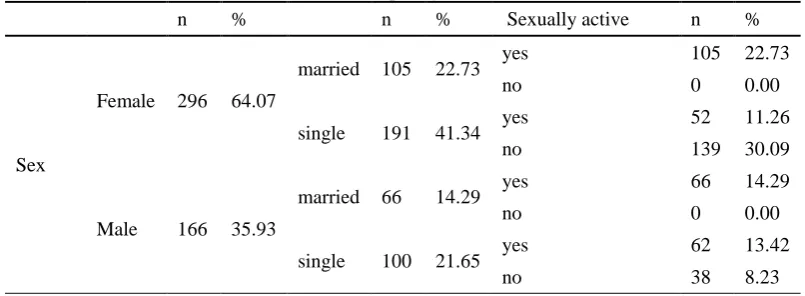
Table 2. The distribution of teachers by variables of sex, marital status, sexual activity status in percentage and frequency
n % n % Sexually active n %
Sex
Female 296 64.07
married 105 22.73 yes 105 22.73
no 0 0.00
single 191 41.34 yes 52 11.26
no 139 30.09
Male 166 35.93
married 66 14.29 yes 66 14.29
no 0 0.00
single 100 21.65 yes 62 13.42
73
J Educ Sci Environ Health
Table 2 shows the distribution of teachers by variables of sex, marital status, and sexual activity status in percentage and frequency. As shown in Table 2, all married teachers had sexual intercourse experience. However, among single teachers, 139 female teachers and 38 male teachers had no sexual intercourse experience.
Data Collection Tool
The scale used to collect data consists of two parts. The first part includes voluntary participation form and questions to determine personal characteristics of the participants. Within the sexual health information lecture given by Erten; scale of “Sexual Health Information” developed with content validity, validity and credibility studies consists of 20 items in total. It is a 5-point Likert scale and the possible score from the scale varies from 1 to 5. Cronbach’s Alpha correlation coefficient of the scale was calculated within the scope of the study and found to be 0.782.
Data Collection
Data was collected concerning the share of scale’s electronic version in the social media groups such as teachers, teacher groups, and graduate groups in Turkey. Teachers were not asked for information such as name, last name, or school’s name, which would reveal their identity.
Data Analysis
Findings regarding personal characteristics of the participants were analyzed using percentage and frequency. Resulting percentage values were used to determine the distribution of personal characteristics of the participants, whereas frequency values were used to interpret personal characteristics. It is a 5-point Likert scale and the possible score from the scale varies from 1 to 5. The following classification is obtained from the 5-point Likert scale: 1.00-1.80 : Very low knowledge level, 1.81-2.60 : Low knowledge level, 2.61-3.40 : Moderate knowledge level, 3.41-4.20 : High knowledge level, 4.21-5.00 : Very high knowledge level. The knowledge level of teachers regarding sexual health was interpreted based on this classification. The independent samples t test was used to compare two groups, whereas the one-way analysis of variance (ANOVA) was used to compare more than two groups.
Findings
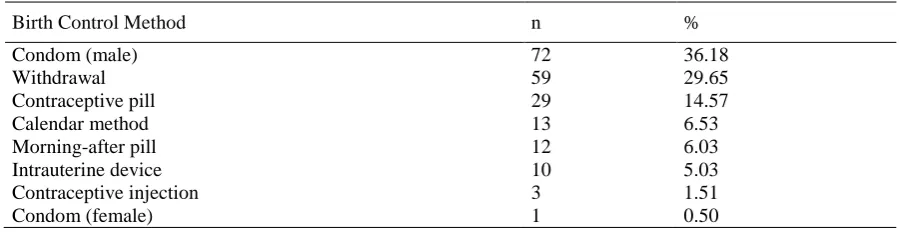
This section presents findings obtained as a result of data analysis. Table 3 shows birth control methods used by 119 out of 285 teachers with sexual intercourse experience. 36.18% of the teachers who reported more than one birth control method used “condom (male)”. Among unreliable methods, the “withdrawal” method was used by 29.65% of the teachers, while the “calendar method” was used by 6.53% of the teachers. Also, 6.03% of the teachers used the “morning-after pill”, which is not a birth control method.
Table 3. Birth control methods used by teachers
Birth Control Method n %
Condom (male) 72 36.18
Withdrawal 59 29.65
Contraceptive pill 29 14.57
Calendar method 13 6.53
Morning-after pill 12 6.03
Intrauterine device 10 5.03
Contraceptive injection 3 1.51
The sources used by the teachers, who reported more than one source, can be seen in Table 4. The most commonly used source for information regarding sexual health was written sources (78.79%) and friends (76.20%).
Table 4. Sources used by teachers to learn about sexual health
Source n %
Written sources 364 78.79
Friends 352 76.20
Mother 87 18.83
Other (Personal experiences, movies, relatives, partner,
teacher, etc.) 78 16.88
Spouse 60 12.99
Sibling 39 8.44
Father 26 5.63
Table 5 shows the average knowledge level of the teachers regarding sexual health. The average knowledge level of 462 teachers was found to be 3.78. It can be said based on this finding that the teachers had a high knowledge level regarding sexual health.
Table 5. The knowledge level of teachers regarding sexual health
n Ss
462 3.78 0.44
Table 6 shows the analysis of the knowledge level of the teachers regarding sexual health by the sex variable. 296 of the teachers were female and 166 were male. It can be said that both female teachers ( =3.81) and male teachers ( =3.72) had a “high” knowledge level regarding sexual health. t test was used to analyze whether the knowledge level of the teachers regarding sexual health varied depending on sex. As a result of the analysis, female teachers were found to have a higher knowledge level compared to male teachers.
Table 6. The analysis of the knowledge level of the teachers regarding sexual health by the sex variable
Sex n % ss t sd p
Female 296 64.07 3.81 0.42 185.94 461.00 0.00*
Male 166 35.93 3.72 0.46
TOTAL 462 100.00 3.78 0.44
p<0.05
Table 7 shows the analysis of the knowledge level of the teachers regarding sexual health by the marital status variable. 171 teachers were married and 291 were single. It can be said that both married teachers ( =3.80) and single teachers ( =3.77) had a “high” knowledge level regarding sexual health. t test was used to analyze whether the knowledge level of the teachers regarding sexual health varied depending on marital status. As a result of the analysis, married teachers were found to have a higher knowledge level compared to single teachers.
Table 7. The analysis of the knowledge level of the teachers regarding sexual health by the marital status variable
Marital status n % ss t Sd p
Married 171 37.01 3.80 0.42 185.94 461.00 0.00*
Single 291 62.99 3.77 0.45
TOTAL 462 100.00 3.78 0.44
p<0.05
Table 8 shows the analysis of the knowledge level of the teachers regarding sexual health by the sexual intercourse experience variable. 285 teachers had sexual intercourse experience and 177 had no sexual intercourse experience. It can be said that both teachers with sexual intercourse experience ( =3.82) and teachers with no sexual intercourse experience ( =3.71) had a “high” knowledge level regarding sexual health. t test was used to analyze whether the knowledge level of the teachers regarding sexual health varied depending
X
X
X
X
X
X
X
X
75
J Educ Sci Environ Health
on sexual intercourse experience. As a result of the analysis, teachers with sexual intercourse experience were found to have a higher knowledge level compared to teachers with no sexual intercourse experience.
Table 8. The analysis of the knowledge level of the teachers regarding sexual health by the sexual intercourse experience variable
Sexual Intercourse
Experience n % ss t sd p
Yes 285 61.69 3.82 0.43 47.11 461.00 0.00*
No 177 38.32 3.71 0.44
TOTAL 462 100.00 3.78 0.44
p<0.05
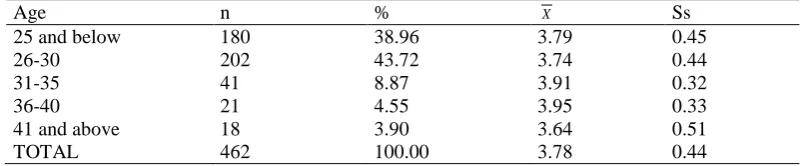
Table 9 shows the average knowledge level of the teachers regarding sexual health by the age variable. Teachers in the 36-40 age group had the highest knowledge level regarding sexual health level with 3.95 points. Teachers in the 41 and above age group had the lowest knowledge level regarding sexual health level with 3.64 points. It can be said that the teachers in all age groups had a high knowledge level regarding sexual health.
Table 9. The average knowledge level of the teachers regarding sexual health by the age variable
Age n % Ss
25 and below 180 38.96 3.79 0.45
26-30 202 43.72 3.74 0.44
31-35 41 8.87 3.91 0.32
36-40 21 4.55 3.95 0.33
41 and above 18 3.90 3.64 0.51
TOTAL 462 100.00 3.78 0.44
One-way analysis of variance was used to analyze whether the knowledge level of the teachers regarding sexual health varied depending on age. According to the analysis of variance, the knowledge level of the teachers regarding sexual health varied depending on age. Paired comparisons were made between the groups to reveal the source of variances. The LSD comparison test showed that the teachers in the 41 and above age group had a significantly lower knowledge level regarding sexual health compared to teachers in all other groups.
Table 10. ANOVA results pertaining to the relationship between the knowledge level of teachers regarding sexual health and the age variable
Source of Variance Sum Of Squares sd Variance F p
Between the groups 2.99 6.00 0.50 2.67 0.01*
Within the group 84.91 455.00 0.19
TOTAL 87.91 462.00
p<0.05
Table 11 shows the average knowledge level of the teachers regarding sexual health by the level they teach. High school teachers had the highest knowledge level regarding sexual health level with 3.82 points. Primary school teachers had the lowest knowledge level regarding sexual health level with 3.74 points.
Table 11. The average knowledge level of the teachers regarding sexual health by the level they teach
Level n % ss
Primary school 191 41.34 3.74 0.44
Middle school 169 36.58 3.81 0.44
High school 57 12.34 3.82 0.43
Not reported 45 9.74 3.75 0.39
TOTAL 462 100.00 3.78 0.44
One-way analysis of variance was used to analyze whether the knowledge level of the teachers regarding sexual health varied depending on the level they teach. According to the analysis of variance, the knowledge level of the teachers regarding sexual health did not vary depending on the level they teach.
X
X
Table 12. ANOVA results pertaining to the relationship between the knowledge level of teachers regarding sexual health and the level they teach
Source of Variance Sum Of Squares sd Variance F p
Between the groups 0.55 3.00 0.18 0.96 0.41
Within the group 87.35 458.00 0.19
TOTAL 87.91 462.00
p<0.05
Table 13 shows the analysis of the knowledge level of the teachers regarding sexual health by whether or not they took the sexual health course during their undergraduate studies. 130 teachers took the course and 332 did not. It can be said that both teachers who took the course ( =3.93) and teachers who did not take the course ( =3.72) had a “high” knowledge level regarding sexual health. T test was used to analyze whether the knowledge level of the teachers regarding sexual health varied depending on whether or not they took the sexual health course during their undergraduate studies. As a result of the analysis, teachers who took the course were found to have a higher knowledge level compared to teachers who did not.
Table 13. The analysis of the knowledge level of the teachers regarding sexual health by whether or not they took the sexual health course during their undergraduate studies
Took the sexual
health course n % ss t sd p
Yes 130 28.14 3.93 0.45 185.94 461.00 0.00*
No 332 71.86 3.72 0.42
TOTAL 462 100.00 3.78 0.44
p<0.05
Table 14 shows the analysis of the knowledge level of the teachers regarding sexual health by whether or not they received education regarding sexual health. 127 received education and 335 did not. It can be said that both teachers who received education ( =3.99) and teachers who did not receive education ( =3.70) had a “high” knowledge level regarding sexual health. T test was used to analyze whether the knowledge level of the teachers regarding sexual health varied depending on whether or not they received education.
Table 14. The analysis of the knowledge level of the teachers regarding sexual health by whether or not they received education regarding sexual health
Received education
regarding sexual health n % ss t sd p
Yes 127 27.49 3.99 0.38 185.94 461.00 0.00*
No 335 72.51 3.70 0.43
TOTAL 462 100.00 3.78 0.44
p<0.05
As a result of the analysis, teachers who received education were found to have a higher knowledge level compared to teachers who did not. The teachers who reported that they had received education regarding sexual health were asked “Where and when did you receive education regarding sexual health? Who/what institution gave the education?”. The answers included “Middle School Sexual Health Course, In-service Educational Seminars, Educational Programs held by University Health Centers, AÇEV (Mother and Child Education Foundation), Courses within the scope of Support for Mothers Program, and Educational Seminars held by TOG (Community Volunteers Foundation)”.
Discussion
36.18% of 119 teachers who reported more than one birth control method used “condom (male)”. Among unreliable methods, the “withdrawal” method was used by 29.65% of the teachers, while the “calendar method” was used by 6.53% of the teachers. Also, 6.03% of the teachers used the “morning-after pill”, which is not a
X X
X
X X
77
J Educ Sci Environ Health
birth control method. It was observed that the teachers who were found to have a “high” knowledge level regarding sexual health were not able to use their knowledge in their own lives.
For 462 teachers who reported more than one source, the most commonly used source for information regarding sexual health was written sources (78.79%) and friends (76.20%). Kaya, Serin, and Genç (2007) conducted a study to reveal approaches of prospective teachers in faculty of education regarding sexual life and examined whether they talked to their families about topics related to sexuality. 18.5% of 170 female prospective teachers reported that their families answered their questions regarding sexuality, while 19.7% reported that they could talk with their families about sexuality in detail. Bulut and Ortaylı (2004) found that the main sources of information regarding sexuality were circle of friends and written sources for males. These findings indicate that individuals turn to their friends and written sources for information regarding sexuality because sexual health is not taught in schools and parents avoid the topic in Turkey. This prevents individuals from receiving information from experts, which increases the number of wrong behaviors related to sexuality.
It is possible to say that the teachers in the study had a high knowledge level regarding sexual health with an average of 3.78. However, it should be noted that 28.14% of the teachers took the Sexual Health Course during their undergraduate studies (within the framework of formal education) and 27.49% received informal education regarding sexual health, which positively affected the general knowledge level. It was observed that teachers who took the Sexual Health course (formal education) during their undergraduate studies had a higher knowledge level compared to teachers who did not and teachers who received informal education regarding sexual health had a higher knowledge level compared to teachers who did not. These findings show the effectiveness of a sexual health education from a reliable source. It can be said that both female teachers ( =3.81) and male teachers ( =3.72) had a “high” knowledge level regarding sexual health. As a result of the analysis, female teachers were found to have a higher knowledge level compared to male teachers.
As a result of the analysis, married teachers were found to have a higher knowledge level compared to single teachers. Also teachers with sexual intercourse experience were found to have a higher knowledge level compared to teachers with no sexual intercourse experience. Siyez and Siyez (2009) performed a study with prospective teachers in faculty of education and examined their knowledge level regarding sexually transmitted diseases. The researchers found that prospective teachers with sexual intercourse experience had a significantly higher knowledge level compared to prospective teachers with no sexual intercourse experience.
Teachers in the 36-40 age group had the highest knowledge level regarding sexual health level with 3.95 points. Teachers in the 41 and above age group had the lowest knowledge level regarding sexual health level with 3.64 points. It can be said that the teachers in all age groups had a high knowledge level regarding sexual health. However, analysis showed that the teachers in the 41 and above age group had a significantly lower knowledge level regarding sexual health compared to teachers in all other groups. High school teachers had the highest knowledge level regarding sexual health level with 3.82 points. Primary school teachers had the lowest knowledge level regarding sexual health level with 3.74 points. It can be said that the teachers working at all educational levels had a high knowledge level regarding sexual health. Also, the knowledge level of the teachers regarding sexual health did not vary depending on the level they teach.
Conclusion and Recommendations
It is possible to say that there are three different approaches toward sexuality in Turkey: “suppressing, limiting, and allowing”. Considering that men are positively discriminated in these approaches, it is interesting that women have a higher knowledge level regarding sexual health compared to men. This may be due to men’s not being able talk about sexual health among each other, fear of being mocked, or not being able to admit their lack of knowledge. Sexual health educations held by medical centers are mostly aimed at women. Educations aimed specifically at men may be useful to increase the knowledge level of men. As a result of the analysis, married teachers and teachers with sexual intercourse experience were found to have a significantly higher knowledge level compared to single teachers and teachers with no sexual intercourse experience. Sexuality or sexual health are not subject that are important for those who are sexually active only, and education programs and information sources should not be prepared for these people only. Sexual health is of great importance for the individual’s happiness from birth to death, and it is necessary to provide education to all age groups starting from childhood.
The most commonly reported sources of information regarding sexual health include “friends” and “written sources”. However, the knowledge level of friends regarding sexual health is not known. Similarly, it is not
X
known whether written sources have good content and high quality or whether these were prepared by experts or not. As mentioned by Bayrak, Başgül, and Gündüz (2011), all correct and incorrect, useful and harmful, positive and negative impacts related to sexuality are included by the definition of sexual education. For this reason, it is very important to provide the right sexual education. Sexual health education cannot be trusted to friends or written sources, whose sufficiency is not known. Analysis showed that teachers who took the Sexual Health course during their undergraduate studies had a significantly higher knowledge level compared to teachers who did not and teachers who received informal education regarding sexual health had a significantly higher knowledge level compared to teachers who did not. To this end, the “Sexual Health Course” should be encouraged as an elective course in undergraduate programs. Also, education on subject may be provided for teachers within the scope of in-service training. 36.18% of 119 teachers who reported more than one birth control method used “condom (male)”. Condom use (male) is a reliable method for protection against sexually transmitted diseases as well as a good birth control method, therefore it is important to encourage condom use. Among unreliable methods, the “withdrawal” method was used by 29.65% of the teachers, while the “calendar method” was used by 6.53% of the teachers. Also, 6.03% of the teachers used the “morning-after pill”, which is not a birth control method. It was observed that the teachers who were found to have a “high” knowledge level regarding sexual health were not able to use their knowledge in their own lives. It is necessary to focus on methods used for birth control and protection against sexually transmitted diseases during educations regarding sexual health provided for teachers and they should be encouraged to use these methods in their private lives.
References
Bayhan, S. P., Artan, . (2004). Çocuk gelişimi ve eğitimi. Morpa Yayınları: stanbul.
Bayrak, G., Başgül, Ş. S. ve Gündüz, T. (2011). Ailede cinsel eğitim. Timaş Yayınları: stanbul. Bilen, M. ve Topçuoğlu, M.A. (2008). Yaşamın gizemi cinsellik. Betik Kitap: Ankara.
Bulut, A., Nalbant, H. ve Çokar, M. (2002). Ergenlerin sağlık bilincinin geliştirilmesi raporu. Ü Tıp Fakültesi, Kadın ve Çocuk Sağlığı Eğitim ve Araştırma Birimi: stanbul.
Bulut, A. ve Ortaylı, N. (2004). Bir araştırmanın düşündürdükleri: cinsel sağlık ama nasıl?. STED, 13(2). Bulut, A. (2005). Erken çocukluk döneminde cinsel eğitim. M. Sevinç (Edt.), Erken çocuklukta gelişim ve
eğitimde yeni yaklaşımlar. Morpa Yayınları: stanbul.
CSÜS. (2005). Üreme sağlığına giriş. Sağlık Bakanlığı Ana Çocuk Sağlığı ve Aile Planlaması Genel Müdürlüğü: Ankara.
Çalışandemir, F., Bencik, S. ve Artan, . (2008). Çocukların cinsel eğitimi: geçmişten günümüze bir bakış.
Eğitim ve Bilim; (33), 150.
Ergün, G. ve Çakır, C. (2015). Sağlık yüksekokulu son sınıf öğrencilerinin cinsel sağlıkla ilgili bilgi, tutum ve davranış özelliklerinin incelenmesi. Acıbadem Üniversitesi Sağlık Bilimleri Dergisi, 6(2).
Fincanoğlu, N. ve Bulut, A. (2003). Cinsel sağlık eğitimi. Ceren: Ankara.
Güler, S., Yöndem, Z.D. (2007). Ergenlik ve cinsel sağlık eğitimi ile ilgili grup rehberliğinin 6. sınıf öğrencilerinin bilgi ve tutumlarına etkisi. İlköğretim Online, 6(1). (Erişim Tarihi: 10.11.2016)
Karasar, N. (2004). Bilimsel araştırma yöntemi. Nobel: Ankara
Kaya, F., Serin, Ö. ve Genç, A. (2007). Eğitim fakültesi birinci sınıf öğrencilerinin cinsel yaşamlarına ilişkin yaklaşımlarının belirlenmesi. TSK Koruyucu Hekimlik Bülteni, 6(6).
Önder, Ö. R. (2006). Cinsel sağlık ve üreme sağlığı. Ankara.
Public Health Agency of Canada (PHAC). (2008). Canadian guidelines for sexual health education. Ottawa : Public Health Agency of Canada.
Set, T., Dağdeviren, N. ve Aktürk, Z. (2006). Ergenlerde cinsellik. Genel Tıp Dergisi;16(3):137-141.
Sexuality Information and Education Council of the United States (SIECUS). (2006). Guidelines for comprehensive sexuality education. New York: SIECUS.
Siyez, D. M. ve Siyez, E. (2009). Üniversite öğrencilerinin cinsel yolla bulaşan hastalıklara ilişkin bilgi düzeylerinin incelenmesi. Türk Üroloji Dergisi;35(1):49-55.
Vatandaş, D . (2011). Toplumsal cinsiyet ve cinsiyet rollerinin algılanışı. Sosyoloji Konferansları, (35).
Author Information
Sinan ERTENHacettepe University
Faculty of Education, Ankara, Turkey Contact e-mail: [email protected]
İrem AKÇAM YALÇIN
Hacettepe University