‘‘It doesn’t matter what you are!” Explaining social effects of agents and avatars
Astrid M. von der Pütten
a,*, Nicole C. Krämer
a, Jonathan Gratch
b, Sin-Hwa Kang
baUniversity of Duisburg-Essen, Faculty of Engineering, Department Computer Science and Applied Cognitive Science, Division Social Psychology: Media and Communication, Forsthausweg 2, 47048 Duisburg, Germany
bUSC Institute for Creative Technologies, University of Southern California, 12015 Waterfront Drive, Playa Vista, CA 90094, USA
a r t i c l e i n f o
Article history:Available online 23 July 2010 Keywords: Virtual agents Avatars Social presence Experimental study Behavioral realism Media equation
a b s t r a c t
Empirical studies have repeatedly shown that autonomous artificial entities, so-called embodied conver-sational agents, elicit social behavior on the part of the human interlocutor. Various theoretical approaches have tried to explain this phenomenon: According to the Threshold Model of Social Influence (Blascovich et al., 2002), the social influence of real persons who are represented by avatars will always be high, whereas the influence of an artificial entity depends on the realism of its behavior. Conversely, the Ethopoeia concept (Nass & Moon, 2000) predicts that automatic social reactions are triggered by sit-uations as soon as they include social cues. The presented study evaluates whether participants´ belief in interacting with either an avatar (a virtual representation of a human) or an agent (autonomous virtual person) lead to different social effects. We used a 2!2 design with two levels of agency (agent or avatar) and two levels of behavioral realism (showing feedback behavior versus showing no behavior). We found that the belief of interacting with either an avatar or an agent barely resulted in differences with regard to the evaluation of the virtual character or behavioral reactions, whereas higher behavioral realism affected both. It is discussed to what extent the results thus support the Ethopoeia concept.
!2010 Elsevier Ltd. All rights reserved.
1. Introduction
Virtual characters: we play and learn with them. We ask them for directions, receive explanations about specific topics. They supervise our fitness program. We communicate through them with our friends or plot with them against our virtual enemies. But what exactly is it that we are interacting with? An interface agent, embodied conversational agent, virtual assistant, autono-mous agent, avatar – a variety of labels are used to describe virtual characters, often synonymously. The crux of the matter lies in the control of the virtual figure. An agent is defined as an acting entity, which includes artificial intelligence that renders the control by a human dispensable (Balakrishnan & Honavar, 2001; Erickson, 1997). An avatar, by contrast, is a virtual representation of a human being, which is controlled completely by the human. Good exam-ples of avatars are those in Second Life and World of Warcraft, where the user controls not only the verbal behavior, but also ges-tures and other body movements. In contrast, the ‘‘embodied con-versational agent” (ECA) Max (Kopp, Gesellensetter, Krämer, &
Wachsmuth, 2005) does not require control by a human; it decides
which sentence it is going to say next on the basis of his artificial intelligence. Additionally, his nonverbal behavior is a product of computational algorithms. Consequently,Bailenson and Blascovich
(2004) define an avatar as ‘‘a perceptible digital representation
whose behaviors reflect those executed, typically in real time, by a specific human being”, and an agent as ‘‘a perceptible digital rep-resentation whose behaviors reflect a computational algorithm de-signed to accomplish a specific goal or set of goals” (Bailenson &
Blascovich, 2004, p. 64).
Numerous studies by different research groups show that peo-ple react socially towards both forms of representations – agents and avatars (c.f. e.g.Bailenson, Blascovich, Beall, & Loomis, 2003; Bickmore, Gruber, & Picard, 2005; Cassell et al., 2002; Gratch, Wang, Gerten, Fast, & Duffy, 2007; Reeves & Nass, 1996; Nass,
Moon, Morkes, Kim, & Fogg, 1997, seeKrämer, 2008, for an
over-view). However, it is still unclear whether people react in the same way towards agents and avatars. This question essentially distils down to gaining an understanding of why people react socially to virtual characters – even if they know that they are conversing with a machine. The current study aims to provide a theoretically and empirically grounded answer to this underlying question.
There are many theories and approaches that attempt to provide an explanation for the occurrence of social effects in human–computer interaction. For example, the innovation hypothesis states that the social reactions towards a computer are a temporal phenomenon due to the novelty of the situation. This novelty effect vanishes once the user becomes accustomed to the interaction with the technology (Kiesler & Sproull, 1997). According to the deficit hypothesis, social effects occur due to 0747-5632/$ - see front matter!2010 Elsevier Ltd. All rights reserved.
doi:10.1016/j.chb.2010.06.012
* Corresponding author. Tel.: +49 203 379 2545; fax: +49 203 379 3670. E-mail address:[email protected](A.M. von der Pütten).
Contents lists available atScienceDirect
Computers in Human Behavior
deficits on the part of the human, such as a lack of knowledge, inexperience of youth, or psychological or social dysfunctions (cf.
Barley, 1988; Turkle, 1984; Winograd & Flores, 1987). Other
authors claim that the social behavior is not directed to the agent but to the programmer behind the agent (Dennett, 1987;
Heideg-ger, 1977, andSearle, 1981). Besides these approaches there are
two more sophisticated and elaborate models regarding the occur-rence of social effects in human–agent interaction: the Ethopoeia concept by Nass and colleagues (Nass & Moon, 2000; Nass et al., 1997) and the Threshold Model of Social Influence byBlascovich
(2002), Blascovich et al. (2002). The Threshold Model of Social
Influence suggests that a human being initially only responds so-cially to another human being – or, if situated in a virtual reality, to an avatar. An agent, however, would not elicit social responses unless the behavior of the agent is so realistic that the user cannot distinguish the agent from the avatar. The Ethopoeia concept, on the other hand, assumes that it does not matter whether people interact with an avatar or an agent. As long as the situation in-cludes social cues, such as interactivity, natural speech, or the fill-ing of social roles, social scripts are triggered and automatic social behaviors are performed. This so-called mindless behavior is an automatic response to contextual social cues, which does not in-clude active processing of these cues. As these cues are presented by both avatars and agents, social responses should occur in equal measure.
The deficit hypothesis, the innovation effect and the program-mer-thought were not addressed in this study for different reasons. The deficit hypothesis, for instance, is an obsolete approach as a lot of studies with healthy adults have been conducted which were able to show social effects. Also, an examination of the innovation hypothesis is not practicable at this stage as most systems are not stable, robust or transportable enough to e.g. be placed three weeks in an ordinary household. And the assumption that people address their social reactions to a programmer behind the com-puter has already been addressed in a previous study by Nass
and Sundar (1994).
Therefore, the latter two theories, namely Ethopoeia and Threshold Model of Social Influence, are considered to provide more potential to contribute to a better understanding of the nat-ure of human–agent-interaction. In this study we aimed to system-atically test these competing theories. Therefore, both models will be explained in more detail in the following chapters.
1.1. The Threshold Model of Social Influence
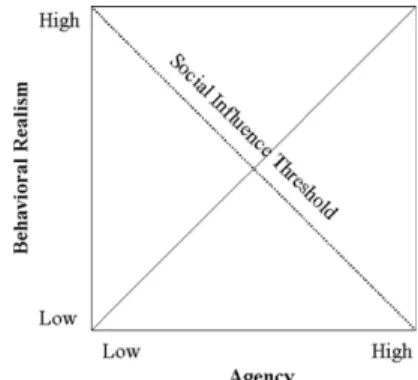
The key factor in the Threshold Model of Social Influence is the so-called ‘‘social verification”, which is ‘‘the extent to which partic-ipants in virtual groups experience interactions with virtual others in ways that verify that they are engaging in semantically mean-ingful communication with virtual others thereby experiencing shared reality” (Blascovich, 2002, p. 26). Social verification is a function of two factors: behavioral realism and agency. Both are considered to be continuous dimensions, ranging from low ioral realism and low agency (agent), respectively, to high behav-ioral realism and high agency (avatar), respectively. The authors assume a Threshold of Social Influence, which has to be crossed to evoke social reactions by the user. This is only possible when the level of social verification is sufficiently high. When the factor agency is high (i.e. when the user knows that the virtual character is a representation of a human being), then the factor behavioral realism does not have to be high in order for social verification to take place and for social effects to occur. Conversely, when the factor agency is low (i.e. when the user knows that the virtual char-acter is a mere computer program), the factor behavioral realism has to be very high to compensate for the lack of agency. In sum, it can be derived that according to the Threshold Model of Social
Influence, the social influence of real persons will always be high, whereas the influence of an artificial entity depends on the realism of its behavior. The role of agency and behavioral realism in explaining the social influence of virtual characters is still up for discussion. Although some scholars have already conducted stud-ies comparing avatars and agents (agent-avatar paradigm) the Threshold Model of Social Influence was never systematically tested by another research group. In addition, due to inconsistent results in previous studies by Blascovich, Bailenson and colleagues (see below) the Threshold Model of Social Influence requires fur-ther investigation (Fig. 1).
1.2. The Ethopoeia concept
With the term Ethopoeia, Nass and colleagues (c.f.Nass & Moon,
2000, 1997) describe the phenomenon that people automatically
and unconsciously react to computers in the same way as they do towards other humans. Nass and colleagues reject the explana-tion that people consciously anthropomorphize computers, be-cause all participants in their studies consistently denied doing so. The authors show empirically that people do not think of the programmer when they show social reactions. In fact, all partici-pants deny reacting in any social way towards computers and state that this behavior would be inappropriate. Instead, Reeves and
Nass (1996)prefer an evolutionary approach to explain this
phe-nomenon. The human brain developed at a time when only human beings were able to show social behavior, and when every person and every place was a real person and a real place. To deal success-fully with daily life, the human brain developed automatic re-sponses, which are still in use today. Therefore, people still automatically accept persons and places as real (see alsoGilbert, 1991). ‘‘When our brains automatically respond socially and natu-rally because of the characteristics of media or the situations in which they are used, there is often little to remind us that the experience is unreal. Absent a significant warning that we have been fooled, our old brains hold sway and we accept media as real people and places” (Reeves & Nass, 1996, p. 12). Nass and Moon emphasize this point of mindlessly applying social rules and expectations to computers (Nass & Moon, 2000, p. 82). Mindless-ness (Langer, 1989, 1992; Langer, & Moldoveanu, 2000) can be best understood as the failure to draw novel distinctions. These automatic responses to contextual social cues trigger scripts and expectations, making active information processing impossible. Moreover,Sundar and Nass (2000)assume that people not only re-spond mindlessly, but also have the tendency to use cognitive shortcuts and heuristics (Tversky & Kahnemann, 1974), and there-fore use the easily accessible social rules from human–human interaction (HHI) and apply them to human–computer interaction – due to the perceived functional similarity between humans and computers. Examples of this functional similarity (or social cues)
include the use of natural language (Turkle, 1984), interactivity
(Rafaeli, 1990), and the filling of social roles traditionally filled
by humans (Nass, Lombard, Henriksen, & Steuer, 1995; Mead &
Morris, 1934).
1.3. Empirical results
1.3.1. Ethopoeia and Revised Ethopoeia Model
Reeves and Nass (1996)conducted numerous studies and
pro-vide empirical epro-vidence for ‘‘How people treat computers, televi-sion, and new media like real people and places”. All studies were conducted with conventional computers without anthropo-morphic interfaces. The Computers Are Social Actors (CASA) para-digm takes findings from HHI and replicates the studies by replacing one communication partner with a computer. The authors were able to successfully replicate findings for many social rules in the areas of person perception, politeness, reciprocal self-disclosure, reciprocal assistance and in-group and out-group ste-reotypes. With regard to person perception, for instance, Nass,
Steuer, and Tauber (1994)report that a computer which criticized
the participants was rated as more competent than a computer which praised the participants. Although participants denied hav-ing gender stereotypes or behav-ing influenced by the voice of the com-puter, the execution of gender stereotypes was observed: Nass,
Moon, and Green (1997)found that computers with a female voice
were rated as more competent in the topic of love and relation-ships, and conversely, the computer with a male voice was rated as more competent with regard to computers and technology. Fur-thermore, computers which paid a compliment to the participants were rated more positively (Fogg & Nass, 1997), even when the participants knew that the compliments were assigned randomly and not intentionally. Regarding politenessNass, Moon, and
Car-ney (1999)demonstrate that people use the same politeness rules
as we know them from human–human communication. In face-to-face situations, people tend to rate their communication partner more positively and give more polite answers in order not to hurt the other person. In their study, people evaluated the performance of the computer with which they interacted more positively when the same computer inquired about its own performance compared to another computer inquiring about the performance of the inter-action computer. With regard to reciprocal self-disclosureMoon
(2000)found that participants revealed more intimate information
about themselves when the computer revealed information about itself first.
Against this background it can be assumed that similar social ef-fects will be found for anthropomorphic interfaces as was shown in the following studies: Sproull, Subramani, Kiesler, Walker, and
Waters (1996) showed that participants who interacted with a
talking-head filled out a questionnaire in a way that would present them in a better light compared to participants who did not inter-act with a talking head and thus show a clear tendency to perform impression management. This finding was affirmed by Krämer,
Bente, and Piesk (2003)who found that participants who had the
choice between a documentary about the life of Albert Einstein, a James Bond movie or the daily TV listings were more likely to choose the socially desirable documentary when they were asked by an anthropomorphic interface agent compared to participants asked by a mere text-based or speech-based interface. With regard to person perception, for instance, Rossen, Johnson, Deladisma,
Lind, and Lok (2008)showed that people apply ethnic stereotypes
to agents. Caucasian medical students with a prejudice against Afro-Americans were found to show more empathetic verbal and nonverbal behavior towards an agent with a light skin tone than to an agent with a dark skin tone. The results from the politeness study (Nass et al., 1999) were replicated in an experiment with the virtual agent MAX (Hoffmann, Krämer, Lam-chi, & Kopp,
2009). Participants evaluated MAX more positively when it itself asked for the judgment compared to an evaluation via paper-and-pencil questionnaire.
In sum, it can be stated that the results found by Nass and col-leagues with regard to conventional computers can also be ob-served in interactions with virtual agents, and indeed sometimes to an even greater extent.Nass and Moon (2000)note, however, that a direct comparison of HHI with HCI is lacking, and the authors discuss the possibility of meta-analytical comparisons within the agent-avatar paradigm. Their first study within this par-adigm showed that ‘‘with a few exceptions (seeMorkes, Kernal, &
Nass, 2000), the ‘‘human” conditions in these experiments havenot
elicited stronger social responses than the ‘‘computer” conditions”
(Nass & Moon, 2000, p. 99). In contrast, the authors concluded on
the basis of the empirical findings that agents and avatars with higher behavioral realism provide more social cues and therefore elicit more social responses. They addressed this point in the dis-cussion of their meta-analytical study addressing the avatar-agent paradigm (Morkes et al., 2000). ‘‘The results suggest both that hu-mor may enhance likability of an interface and that SRCT [Social Response to Communication Technology] theory should be re-vised.” (Morkes et al., 2000, p. 395). Against this background,Nass
and Moon (2000)encourage further research with regard to
behav-ioral realism. They assume that certain characteristics of comput-ers facilitate mindless social reactions: ‘‘the more computcomput-ers present characteristics that are associated with humans, the more likely they are to elicit social behavior [. . .]” (Nass & Moon, 2000, p.
97). This assumption that we term theRevised Ethopoeia Concept would state that is does not matter whether participants are inter-acting with an agent or an avatar, but rather how many human-like characteristics the systems provides. Although every system elicits social reactions as long as the system provides social cues (Etho-poeia Concept), a system will elicit more or stronger social reac-tions when it provides more social cues (Revised Ethopoeia Concept). Thus, higher behavioral realism should lead to more so-cial reactions by the user.
1.3.2. Threshold Model of Social Influence
Several studies have compared the effects of agents and avatars, but their results are not consistent and to some extent contradic-tory. For instance, Guadagno, Blascovich, Bailenson, and McCall
(2007)examined the effects of agency and behavioral realism on
persuasion and found some supporting results for the importance of agency. Participants in the high behavioral realism group expe-rienced more social presence and, moreover, participants in the avatar group experienced more social presence than subjects in the agent group. However, the lack of interaction effects between behavioral realism and agency suggests that the assumptions of the model cannot be supported. Hoyt, Blascovich, and Swinth
(2003)demonstrated classic effects of social inhibition when
par-ticipants were asked to perform a non-trained task in front of an avatar compared to an agent. Conversely, they did not find effects of social facilitation when participants performed well-trained tasks in front of an avatar. Supporting results for behavioral real-ism are given byBailenson, Blascovich, and Beall (2001)who dem-onstrated that behavior realism with regard to natural proximity behavior is crucial: only when a virtual agent follows the user with its eyes does the user maintain a distance that would also be ex-pected in a human–human interaction.Bailenson et al. (2003) rep-licated this finding and found additionally that – at least for female participants – the pattern expected by the threshold model emerged.
Also, other research groups varied agency or behavioral realism in their studies. They, however, did not systematically test the Threshold Model of Social Influence as they did not vary both fac-tors but either behavior, or agency in combination with e.g. static
aspects such as appearance. Nevertheless, these results relate to the crucial aspects of the Threshold Model of Social influence and shall be reported at this point. With regard to agency the following studies have to be taken into account:Nowak and Biocca (2003) conducted a study about the influence of agency and anthropomor-phism. Participants believed that they were interacting either with an agent or an avatar. Additionally, the degree of anthropomor-phism was varied from no picture (control group), abstract eyes and mouth (low anthropomorphism) to a realistic picture of a vir-tual character (high anthropomorphism). Agency showed no ef-fects on the perceived degree of co-presence or social presence, but participants reported increased social presence when con-fronted with a high anthropomorphic picture compared to a low anthropomorphic picture. In summary, the authors see their re-sults in line with the thesis of Reeves and Nass: ‘‘Although no real conclusions can be made with non-significant differences, these re-sults are consistent with several other studies that suggest that participants respond to computers socially, or in ways that are sim-ilar to their responses to other humans (Reeves & Nass, 1996).”
(Nowak & Biocca, 2003, p. 490).Aharoni and Fridlund (2007)also
investigated the influence of the factor agency. Participants in their study interacted with a standard computer with pre-recorded speech output. Participants believed that they were either interact-ing with a human interviewer or an artificial intelligent computer. The experimenters reported that participants used more silence fillers and smiled more while interacting with the human inter-viewer compared to the computer. However, the evaluation of the interviewer as well as the subjective emotional state of the par-ticipants was not affected by the factor agency. With regard to these experiments and their results, it can be summarized that there is some empirical evidence for the thesis that avatars elicit stronger social effects than agents but that it was not shown con-sistently. In contrast, the factor behavioral realism seems to be of greater importance.
1.4. Research questions
Taking these considerations on all three models into account, we aimed to systematically test the three models explaining the occurrence of social effects in human–computer interaction. We followed the agent-avatar paradigm and varied the participant’s belief of interacting with either an avatar or an agent. In order to provide a systematic test of the Threshold Model, we additionally varied dynamic behavior, namely the listening behavior of the vir-tual figure. This resulted in a 2!2 between-subjects design. We
used the Rapport Agent developed byGratch et al. (2006), which was designed to create rapport with the user by displaying appro-priate listening behavior to a human storyteller. In order to match the abilities of the listening agent, we chose a self-disclosure task for participants. Numerous studies in the field of computer-medi-ated communication, human–computer interaction and human-agent- interaction suggest that people disclose more personal inti-mate information when they feel they are in an anonymous situa-tion (e.g. alone in front of a computer) compared to a situasitua-tion where a another human being is present or mediated (for a review
seeWeisband & Kiesler, 1996andJoinson, 2001). Thus, the
Thresh-old Model of Social Influence would predict more self-disclosure in the agent condition especially when there is no behavioral realism.
Bailenson, Yee, Merget, and Schroeder (2006) as well as Moon
(2000) used a self-disclosure task in previous studies. Thus we
chose to use a task on self-disclosure in order to keep the experi-mental setup comparable. In addition, we opted for dependent variables already used in these studies as well as additional stan-dardized scales to provide a wide range of subjective and objective measurements. According to the above-described models our com-peting hypotheses are:
"H0:There will be no differences with regard to the social effects
between the four conditions. (Ethopoeia Concept).
"H1: The social effects will be higher in the condition of high
behavioral realism than in the condition of low behavioral real-ism. (Revised Ethopoeia Concept).
"H2: The social effects in the condition Agent/Low behavioral
realism will be lower than in all other conditions. (Threshold Model of Social Influence).
2. Method
2.1. Experimental design
To test our hypotheses, we used a 2!2 design with two levels of agency (AgentorAvatar) and two levels of behavioral realism (showing (feedback) behavior versus showing no behavior). Eighty-three persons (42 females and 41 males) participated in the study and were randomly assigned to the conditions (see
Ta-ble 1). The mean age was 37.27 (SD= 13.61), ranging from 18 to
65 years. Participants were recruited via www.craigslist.com from the general Los Angeles area and were compensated $20 for one hour of their participation. During the interaction, the participants were asked three personal questions of increasing intimacy by the animated character.
2.1.1. Factor agency
For the factor agency, we varied the instruction given to the par-ticipants by the experimenter. Although, in fact, all parpar-ticipants interacted with the agent, half of them were led to believe that they interacted with an avatar and half of them were instructed that they interacted with an agent. In this way, we were able to guarantee that all participants experienced the same treatment and we avoided biases resulting from different confederates.
Instruction Avatar:The instruction in the avatar condition was: ‘‘We invited two participants for this experiment to test this new communication system. You will see an animated character on this screen. The animated character will copy the head and body move-ments of another participant, who is sitting in another room. For example, if the other person nods his or her head, the animated char-acter will nod its head. The other participant will also see an ani-mated character on the screen, which represents you. Both of you have a red camera in front of you, which tracks your head and body movements. The other participant is instructed to ask you three gi-ven questions about your daily life and then listen to your answer. Please only respond to the questions and do not ask questions your-self, because the other participant is instructed not to answer.
Instruction agent:The instruction in the agent condition was: ‘‘You will see an animated character on this screen. The animated character is computer-generated. It looks and behaves like a hu-man, but is in fact a software program. The animated character can see your head and body movements via the red camera in front of the screen. It can hear what you are saying via the microphone. And you can hear the animated character through the headset. The animated character will ask you three questions about your daily life and then listen to your answer. Please only respond to the questions and do not ask questions yourself. In this experiment, we are focusing on one-way communication: you are telling a story and the animated character is listening.”
Table 1
Distribution of gender over conditions (N= 83).
Agent Avatar
Male Female Male Female
High behavioral realism 11 10 12 10
2.1.2. Factor behavioral realism
We used the Rapport Agent, which was developed byGratch
et al. (2006)at the Institute for Creative Technologies. The agent
displays listening behaviors that correspond to the verbal and non-verbal behavior of a human speaker. The Rapport Agent has been evaluated in several studies (Gratch, Wang, Gerten, et al., 2007; Gratch, Wang, Okhmatovskaia, et al., 2007; Gratch et al., 2006; Kang, Gratch, Wang, & Watts, 2008a; Kang, Gratch, Wang, & Watts,
2008b) and has proven to be capable of creating the experience of
rapport comparable with a face-to-face condition.Tickle-Degnen
and Rosenthal (1990)define rapport as conglomerate consisting
of three essential factors: mutual attention, positivity and coordi-nation. The experience of rapport is described as follows: ‘‘Interac-tants feeling in rapport with one another feel mutual friendliness and caring.” (p. 286). The Rapport Agent concentrates on the factor coordination and tries to establish coordination between the inter-actants by analysis of the user’s nonverbal behavior and in the next step by mapping of the users´ and the agent’s nonverbal behavior. For this study, we used the Rapport Agent with some adjustments described below in detail.
The Rapport Agent.To produce listening behaviors, the Rapport Agent first collects and analyzes the features from the speaker’s voice and upper-body movements via microphone and a Videre Design Small Vision System stereo camera, which was placed in front of the participants to capture their movements. Watson, an image-based tracking library developed byMorency, Sidner, and
Darrell (2005), uses images captured by the stereo camera to track
the participant’s head position and orientation. Watson also incor-porates learned motion classifiers that detect head nods and shakes from a vector of head velocities. Acoustic features are de-rived from properties of the pitch and intensity of the speech signal using a signal processing package, LAUN, developed by Morales
(Gratch et al., 2006). The animated agent was displayed on a
30-inch Apple display. A female virtual character was used in all con-ditions (seeFig. 2).
Adjustments to the system:Usually, the Rapport Agent displays behaviors that show that the animated character is ‘‘alive” (eye blinking, breathing), and listening behaviors such as posture shifts and short head nods automatically triggered by the system corre-sponding to participants´ verbal and nonverbal behavior.
For this study, however, we modified the system so that it was possible to conduct a small dialogue. The Rapport Agent still acts as
a listener, but prompts the participant’s narration through several questions. Before the interaction starts, the animated character is looking to the ground to avoid eye contact with the participant be-fore the system begins. When the system begins, indicated by a ping sound, the animated character looks up and says ‘‘Okay, I’m ready.” We did not use a text-to-speech system, but instead pre-re-corded five sentences with a female voice to create the illusion for the avatar condition that there might really be another participant in another room. The pre-recorded sentences were the following:
"Okay, I’m ready.
"What was the most special experience for you yesterday?
"Which of your characteristics are you most proud of?
"What has been the biggest disappointment in your life?
"Thank you. You are done.
We programmed two different kinds of head nods, a double head nod with higher velocity and smaller amplitude (called back-channel head nod) and a single head nod with lower velocity and larger amplitude (called understanding head nod). The double head nod was used as a back-channeling head nod and replaced the head nods normally used by the Rapport Agent. The single head nod was triggered manually at the end of the participants´ verbal contribution to one of the three questions in order to support the impression of an attentive listener. We also programmed a head shake to be able to react to questions appropriately, e.g. ‘‘Are you fake?” or ‘‘Are you stupid?” Fortunately, no such situations arose and the head shake was not used in the study. The head shake, the single head nods and the five pre-recorded utterances were implemented in an interface through which the experimenter could manually actuate every behavior. We also added the possi-bility to trigger the back-channeling head nod manually in case the system malfunctioned during interactions in the high behav-ioral realism condition. In fact, we only used the pre-recorded utterances and the single head nod.
Condition low behavioral realism.For this condition, we chose to use the breathing, eye blinking, and posture shifts, but no head nods, either double head nod or single head nod. In this way, we achieved a rather unrealistic behavior, as the Rapport Agent was simply staring at the participants and did not react to their contri-butions at all.
Condition high behavioral realism.For this condition, we used breathing, eye blinking, posture shifts and the two kinds of head nods. The back-channeling head nod was triggered automatically by the system according to the nonverbal and verbal behavior of the participants. The understanding head nod was actuated by the experimenter each time the participant finished his or her con-tribution to one of the three questions. By this the users saw a vir-tual character which displayed continuous back-channeling behavior during their utterance and a head nod at the end of their contribution indicating the virtual character understood what they said.
2.2. Dependent variables
Against the background of the empirical results on the Ethopoe-ia Model and the Threshold Model of SocEthopoe-ial Influence we decided to assess a variety of dependent variables to be able to test the two models on a broader basis including self-report measures as well as objective variables which were in part already used in the above presented studies like the self-reported experience of so-cial presence, and self-reported rapport, as well as the participants´ emotional state (PANAS) after the interaction and, the person per-ception of the virtual character. Besides these self-report measures, we also measured the following objective variables: the total num-ber of words the participants used during the interaction and the
percentage of pause-fillers and interrupted words. We also carried out a qualitative analysis of the degree of self-disclosure. In the fol-lowing, all measurements will be described in detail.
2.2.1. Quantitative measurements
In the present study, we used the Positive And Negative Affect Scale (Watson, Tellegen, & Clark, 1988) consisting of 20 items (e.g. strong, guilty, active, ashamed etc.), which are rated on a 5-point Likert scale from ‘‘very slightly or not at all” to ‘‘extremely”. The fac-torial analysis for the Positive and Negative Affect Scale resulted in three factors, namelyPositive High-Dominance, Negative High-Dom-inanceandNegative Low-Dominance(see Appendix for details).
For the person perception (of the agent), we used a semantic differential with 26 bi-polar pairs of adjectives (e.g. friendly–un-friendly, tense-relaxed), which are rated on a 7-point scale. The factor analysis for the person perception of the virtual character re-sulted in four factors, namely Negative Low-Dominance, Positive High-Dominance,Positive Low-Dominance, andNegative High-Domi-nance(see Appendix for details).
Social presence (Short, Williams, & Christie, 1976) was measured by two scales: the social presence scale (Bailenson, Blascovich, &
Beall, 2001) with five items (e.g. ‘‘I perceive that I am in the presence
of another person in the room with me”) and the Networked Minds Questionnaire (NMQ;Biocca & Harms, 2002; Biocca, Harms, &
Bur-goon, 2004; Biocca, Harms, & Gregg, 2001). Due to a very long
post-questionnaire, we concentrated on the following five aspects of the NMQ: empathy (with 4 items), mutual awareness (with 2 items), attention allocation (with 4 items), mutual understanding (with 3 items) and behavioral interdependence (with 4 items). All items from both scales were rated on a 7-point Likert scale.
To measure perceived rapport, we used a scale that had been developed for previous studies with the Rapport Agent. This scale contains ten items from the rapport construct byTickle-Degnen
and Rosenthal (1990), which were already in use in an experiment
on the effects of nonverbal signal delay in tele-psychiatry (see
Manning, Goetz, & Street, 2000). Nineteen ad hoc items were
added, which proved to measure rapport in several studies (Gratch et al., 2006; Gratch, Wang, Gerten, et al., 2007; Gratch, Wang, Okhmatovskaia, et al., 2007; Kang et al., 2008a; Kang et al.,
2008b). The resulting 29 items were measured on an 8-point Likert
scale. The factor analysis for the self-reported rapport also revealed four factors, namelyFeelings and Self-Efficiency,Rapport and Connec-tion,Evaluation of Listener, andAttention Allocation(see Appendix for details).
Verbal behavior:In addition, we analyzed the participants´ verbal behavior. We counted the total amount of words, the amount of pause-fillers (‘‘erm” ‘‘, hm”) and the amount of broken words (e.g. ‘‘I was in the bib. . .library”). From the latter two, we
calcu-lated the percentage of speech disfluencies in relation to the total amount of words.
2.2.2. Qualitative measurements
We conducted a qualitative analysis of the participants´ answers to the questions asked by the virtual character. Questions two and three (see below) were used in previous experiments on self-disclo-sure (e.g.Moon, 2000). The first question (‘‘What was the most spe-cial experience you had yesterday?”) was excluded from the analysis because of too much variance due to the weekday on which they participated. When participants took part in the experiment on a Monday, they had more possibilities to report about their activities (i.e. on Sunday) than people who took part on a Thursday. For the second question (‘‘Which of your characteristics are you most proud of?”), we counted the number of characteristics the participants revealed. For the third question (‘‘What has been the biggest disappointment in your life?”), we used a categorical cod-ing scheme (Mayring, 1996) with three categories:
(1) No answer: the subject gives no answer or uses excuses to avoid an answer.
(2) Low-intimacy answer: the disappointment (or unfulfilled wish) has not sustainably affected the private or business life of the subject.
(3) High-intimacy answers: the disappointment (or unfulfilled wish) has sustainably affected the private or business life of the subject.
The coding was processed by two coders. The inter-rater reli-ability showed substantial agreement (Cohen’s Kappa = .714). 2.3. Procedure
Upon arrival, the participants were asked to read and sign in-formed consent forms. After completing a web-based questionnaire
(Leiner, 2009) about their background including demographic data
and the questionnaires of the explanatory variables, participants re-ceived a short introduction about the equipment and were given the instructions regarding their interaction partner and the task of the experiment (see above). Then, participants took a seat in front of a 3000 screen, which displayed the Rapport Agent. They were equipped with a headset with microphone. In order to assess the participants’ verbal and nonverbal behavior, the whole session was videotaped. The camera was directed towards the participants and situated directly under the screen with the Rapport Agent in combination with the stereovision camera. Participants were in-structed to wait until the systems starts, indicating readiness by a ping sound. They were asked three questions by the Rapport Agent with increasing intimacy. After the interaction, the participants completed the second web-based questionnaire. They were fully debriefed, given $20 and thanked for their participation.
3. Results
We calculated MANOVAS with the two independent variables agency and behavioral realism and the dependent variables: three PANAS factors, four person perception factors, four rapport factors, the social presence scale, the constructs empathy, attention alloca-tion, mutual awareness, mutual understanding and behavioral interdependence from the NMQ, the total amount of words, the percentage of speech disfluencies and the number of revealed characteristics.
We identified only one main effect for agency. Participants who thought they were interacting with an artificial agent experienced more negative feelings with Low-Dominance (scared, ashamed) than those in theAvatar condition(F(1, 83) = 5.447;p= .022; partial
g
2= .064; seeTable 2).With regard to the variation of behavior, however, three signif-icant differences emerged. Concerning the person perception, par-ticipants rated the animated character higher on Negative Low-Dominance(weak, dishonest, naïve, shy) when it showed feedback behavior (F(1, 83) = 5828;p= .018; partial
g
2= .069, seeTable 3). Moreover, the feeling of mutual awareness (Social Presence) was more intense in the condition with high behavioral realism than in the condition with low behavioral realism (F(1, 83) = 4.548;Table 2
MANOVA with the independent factors agency and behavioral realism and the dependent variable subjective feeling after the interaction (N= 83).
Agent Avatar
Negative Low-Dominance
l SD l SD F g2 p
p= .035; partial
g
2= .055, seeTable 4, note that mutual awareness is loaded negatively and a lower mean value is associated with a higher feeling of mutual awareness). Additionally, the total amount of words was almost twice as high when there was feedback behavior compared to no behavior (F(1, 83) = 7.348;p= .008; par-tialg
2= .085, seeTable 5). There were no effects with regard to the self-disclosure of information (number of characteristics).We also found no interaction effects of the factors agency and behavioral realism.
As already mentioned, we carried out a qualitative analysis of the participants´ answer to question three (‘‘What has been the big-gest disappointment in your life?”) using the categorical scheme explained above. We conducted chi-square tests with the factors agency and behavioral realism. No effects were found.
3.1. Discussion
The main goal of this research was to empirically test three models which explain the occurrence of social effects in human– computer interaction: theThreshold Model of Social Influence(
Blas-covich, 2002; Blascovich et al., 2002), theEthopoeia Concept(Nass &
Sundar, 1994; Nass et al., 1997; Reeves & Nass, 1996) and the
Re-vised Ethopoeia Concept. To empirically test the models, we varied on the one hand the factor agency and made participants believe they were interacting with either an avatar or an agent. On the other hand, we varied the factor behavioral realism and created an agent with unrealistic behavior and an agent with higher behav-ioral realism. We used a wide range of dependent variables, includ-ing quantitative and qualitative behavioral data, scales previously used within the paradigm and standardized psychological mea-sures used for face-to-face interactions.
According to the Ethopoeia Concept, it can be assumed that there will be no differences with regard to the social effects be-tween the four conditions (H0). In actual fact, 14 of the dependent variables showed no effects (two PANAS factors, three person per-ception factors, four social presence factors, four rapport factors and also the qualitative self-disclosure). Although the Ethopoeia concept equals the null hypothesis and thus technically cannot be verified, this lack of significant differences suggests that it does not make a difference for either social reactions or social evalua-tions whether people believe they are interacting with another person or an artificial entity.
According to the Revised Ethopoeia Concept, a more realistic agent behavior provides more social cues and hence elicits more social effects on the part of the user. Thus, H1 stated that there will be a main effect of the factor behavioral realism, resulting in increased social effects when behavioral realism is high. In-deed, we identified three significant effects with regard to the variation of the behavior. In the high behavioral realism condi-tion, participants rated the animated character higher onNegative Low-Dominance, they experienced more feelings of mutual aware-ness, and they used more words during the interaction. In sum, H1 was supported by three main effects. The virtual character’s behavior significantly influenced participants´ subjective experi-ence as well as their actual behavior. Although these effects did not emerge for all dependent variables, the behavioral realism seems to play an important role in human–agent interaction. The assumption that ‘‘the more computers present characteristics that are associated with humans, the more likely they are to elicit social behavior” (Nass & Moon, 2000, p. 97) is confirmed in our experiment. Furthermore, the effects we observed are very plau-sible: The presence of the back-channeling behavior in the high behavioral realism condition encouraged the participants to tell longer stories and supported the feeling of mutual awareness. More surprisingly, the presence of nodding behavior caused a more negative perception of the virtual character – it was rated as rather weak and naive. However, if we take into account that the character was nodding to everything the participants said during the interaction, this result can also be explained and can be classified as a social effect. By showing only nodding behavior – which can also be interpreted as approval – the agent appeared to be very submissive. In sum, it was once more shown that the behavior of the virtual character matters (see Rickenberg &
Re-eves, 2000). Like in face-to-face interactions, the evaluation of
people is first and foremost dependent on what people do – even if it is merely subtle differences in nonverbal behavior. As has been stated previously (Krämer, Simons, & Kopp, 2007), we sug-gest that further research is required in the field of behavioral realism. With regard to the focus of the present study, it would be interesting to ascertain whether different levels of behavioral realism elicit more or fewer social effects. It has to be noted that the behavior shown by the agent in our experiment is clearly not the most elaborate and therefore realistic behavior imaginable. The fact that main effects were still found therefore suggests
Table 3
MANOVA with the independent factors agency and behavioral realism and the dependent variable evaluation of the agent in terms of person perception (N= 83).
High behavioral realism Low behavioral realism
Negative Low-Dominance l SD l SD F g2 p
.249 0.909 #.264 1.037 5.830 .069 .018
Table 4
MANOVA with the independent factors agency and behavioral realism and the dependent variable quantitative verbal behavior (N= 83). High behavioral realism Low behavioral realism
Total amount of words l SD l SD F g2 p
226 221 119 112 7.348 .085 .008
Table 5
MANOVA with the independent factors agency and behavioral realism and the dependent factor mutual awareness (N= 83). High Behavioral realism Low Behavioral realism
Mutual awareness l SD l SD F g2 p
3.670 1.553 4.334 1.242 4.548 .055 .035
the power of even subtle behavioral variations. Apart from this, another important point is what this finding implies for designing virtual agents. Although the nodding behavior encourages people to keep going within the conversation it did not contribute to a positive evaluation of the agent itself. Thus, ‘‘just adding” behav-ior cannot be a solution to design more engaging and more believable agents. Every additional behavior may cause side effects and therefore the positive and negative interactions of dif-ferent behaviors should be evaluated carefully during an iterative design process.
What emerged most clearly from our results is that the Thresh-old Model of Social Influence cannot be supported. According to the model, the social influence of real persons will always be high, whereas the influence of an artificial entity depends on the realism of its behavior. Thus, H2 stated that the condition Agent/Low behavioral realism will differ from all other conditions with regard to the occurrence of social effects. Although we identified one main effect for agency, which is that participants in the agent condition experienced more negative feelings with Low-Dominance than those in the avatar condition, we could not find any interaction ef-fects of the factors agency and behavioral realism. Therefore, H2 has to be rejected, as we did not find evidence for the Threshold Model of Social Influence. It might be criticized that effects that are in line with the threshold model did not emerge since the behavior in the high behavioral realism condition was not suffi-ciently realistic. However, even if this had been the case, the pat-tern that should have been observable to support the threshold model would be a strong main effect of the agency factor. On the other hand, the pattern we found would – given the correctness of the model – merely be able to show when participants had per-ceived high behavioral realism not only in the ‘‘high behavioral realism” condition but also in the ‘‘low behavioral realism” condi-tion – which seems highly unlikely given that there was no behav-ior at all.
3.2. Conclusions
Contributing beyond the current knowledge on explanations for social reactions towards embodied agents the present study sys-tematically tested two elaborate models explaining social effects. By this we contribute to the ongoing discussion on this highly rel-evant topic in HAI. Moreover, we looked at social effects on a broader basis and did not address merely one behavior or one self-reported measure, respectively. To sum up our conclusions, the Ethopoeia concept by Nass and Colleagues is more suitable as an approach to explain the social effects we found than the Thresh-old Model of Social Influences by Blascovich and colleagues. How-ever, as Nass himself has already suggested, the concept should be amended by the claim that for both agents and avatars, the behav-ior is crucial for the emergence and quality of social effects. Addi-tional studies should concentrate on these aspects and systematically vary the level of behavioral realism. These studies also have to target what behavioral realism includes and what in-creases the perceived realism and what does not. In this way, data will also be gained that are relevant for fundamental research on human communication and the perception of verbal and nonverbal behavior.
Acknowledgements
This study was partially funded by the German Academic Ex-change Service and by the U.S. Army Research, Development, and Engineering Command and the National Science Foundation under Grant # HS-0713603. The content does not necessarily reflect the position or the policy of the Government, and no official endorse-ment should be inferred.
Appendix A. Factor analyses
The factor analysis for the Positive and Negative Affect Scale re-sulted in three factors. (seeTable 6). The first factor,Positive High-Dominance, explains 28.24% of the variance (Cronbach’s
a
= .838). The second factor,Negative High-Dominance, explains 23.09% of the variance (Cronbach’sa
= .819), and the third factor, Negative Low-Dominance, explains 7.57% of the variance (Cronbach’sa
= .712).The factor analysis for the person perception of the virtual char-acter resulted in four factors. The first factor,Negative
Low-Domi-Table 6
Factor loadings and communalities based on a principal components analysis with varimax rotation for the 20 items of the Positive And Negative Affect Scale (N= 83).
Positive High-Dominance Negative High-Dominance Negative Low-Dominance Enthusiastic .852 Inspired .808 Active .786 Proud .786 Determined .766 Excited .739 Strong .687 Alert .676 Attentive .620 Interested .566 Hostile .804 Irritable .780 Upset .778 Guilty .655 Jittery .575 Nervous .547 Afraid .829 Scared .666 Ashamed .517 .557 Distressed .524
Note.Factor loadings <.4 are suppressed.
Table 7
Factor loadings and communalities based on a principal components analysis with varimax rotation for 26 items regarding person perception of the agent (N= 83).
Negative Low-Dominance Positive High-Dominance Positive Low-Dominance Negative High-Dominance Weak .817 Dishonest .749 Naïve .726 Mature #.713 Shy .649 Unintelligent .617 #.507 Acquiescent .539 Nervous .507 .476 Compassionate .695 Noisy .650 Involved .596 .509 Inviting .592 .426 Passive #.583 Unsympathetic #.581 Cheerful .468 .465 Modest .753 Soft .666 Permissive .602 Callous #.527 Non-conceited .464 #.407 Non-threatening #.768 Relaxed #.691 Unpleasant .573 Sleepy .542 Unfriendly #.426 .540 Proud .509
nance, explains 32.60% of the variance (Cronbach’s
a
= .852). The second factor,Positive High-Dominance, explains 11.20% of the var-iance (Cronbach’sa
= .816). The third factor, Positive Low-Domi-nance, explains 8.21% of the variance (Cronbach’sa
= .748), and the fourth factor,Negative High-Dominance, explains 5.65% of the variance (Cronbach’sa
= .792) (seeTable 7).The factor analysis for the self-reported rapport also revealed four factors. The first factor, Feelings and Self-Efficiency, explains 33.30 % of the variance (Cronbach’s
a
= .850), the second factor, Rapport and Connection, 11.73% (Cronbach’sa
= .919), the third, Evaluation of Listener, 8.38% (Cronbach’sa
= .735), and the fourth factor,Attention Allocation, explains 5.89% of the variance (Cron-bach’sa
= .689) (seeTable 8).Appendix B. Examples for the self-disclosure categorical coding scheme
(1) no answer:the subject gives no answer or uses excuses to avoid an answer (e.g. ‘‘-um-. . . I don´t know. Ith + I don’t
think I’ve had anything horrible happen to me yet. I´m lucky”);
(2) low-intimacy answer: the disappointment (or unfulfilled wish) has not sustainably affected the private or business life of the subject (e.g. ‘‘I’d like to be wealthy so I think that’s my biggest disappointment.” or ‘‘-um- Not finishing tasks that I start or not following through with things I want to follow through with.”);
(3) high-intimacy answers: the disappointment (or unfulfilled wish) has sustainably affected the private or business life of the subject (e.g. ‘‘hm. e- if I´m really looking at my entire life, I would say -would probably be- that my sister was diag-nosed with juvenile diabetes when she was four years old. [. . .] So we went through a lot during her childhood. A lot of pain. Of me not being able to share candy or things with her. [. . .], but I would say that that had pro + probably
impacted my life -um- almost more than anything else.” or ‘‘ I would say the death of an older brother -um-several years ago -um- this was related to -um- his suicide”). References
Aharoni, E., & Fridlund, A. J. (2007). Social reactions toward people vs. computers: How mere labels shape interactions. Computers in Human Behavior, 23, 2175–2189.
Bailenson, J. N., & Blascovich, J. (2004). Avatars. In W. S. Bainbridge (Ed.), Encyclopedia of human–computer interaction (pp. 64–68). Great Barrington MA: Berkshire Publishing Group.
Bailenson, J. N., Blascovich, J., & Beall, A. C. (2001). Equilibrium revisited: Mutual gaze and personal space in virtual environments.Presence: Teleoperators and Virtual Environments, 10, 583–598.
Bailenson, J. N., Blascovich, J., Beall, A. C., & Loomis, J. M. (2003). Interpersonal distance in immersive virtual environments.Personality and Social Psychology Bulletin, 29, 1–15.
Bailenson, J. N., Yee, N., Merget, D., & Schroeder, R. (2006). The effect of behavioral realism and form realism of real-time avatar faces on verbal disclosure, nonverbal disclosure, emotion recognition, and copresence in dyadic interaction.Presence: Teleoperators and Virtual Environments, 15(4), 359–372. Barley, S. R. (1988). The social construction of a machine: Ritual, superstition,
magical thinking, and other pragmatic responses to running a CT scanner. In M. Lock & D. Gordon (Eds.),Knowledge and practice in medicine: Social, cultural, and historical approaches(pp. 497–539). Hinghan, MA: Reidel.
Balakrishnan, K., & Honavar, V. (2001). Evolutionary synthesis of intelligent agents. In M. Patel, V. Honavar, & K. Balakrishnan (Eds.),Advances in the evolutionary synthesis of intelligent agents(pp. 1–26). Cambridge, MA: MIT Press.
Bickmore, T., Gruber, A., & Picard, R. (2005). Establishing the computer-patient working alliance in automated health behavior change interventions.Patient Education Counseling, 59(1), 21–30.
Biocca, F., & Harms, C. (2002). Defining and measuring social presence. Contribution to the net-worked minds theory and measure. In F. R. Gouveia & F. Biocca (Eds.), Proceedings of Presence 2002(pp. 7–36). Portugal: Porto.
Biocca, F., Harms, C., & Burgoon, J. (2004). Toward a more robust theory and measure of social presence. Review and suggested criteria. Presence: Teleoperators and Virtual Environments, 12, 456–480.
Biocca, F., Harms, C., & Gregg, J. (2001).The Networked Minds measure of social presence. Pilot test of the factor structure and concurrent validity. Paper presented at the 4th annual international workshop on Presence 2001. USA: Philadelphia.
Blascovich, J. (2002).A theoretical model of social influence for increasing the utility of collaborative virtual environments. In: Proceedings of the 4th international
Table 8
Factor loadings and communalities based on a principal components analysis with varimax rotation for 29 items regarding the perceived rapport (N= 83). Feelings and self-efficiency Rapport and Connection Evaluation of Listener Attention allocation
I felt awkward telling the story to the listener. .873
I felt uncomfortable telling the story to the listener. .836
I found it easy to tell the story. #.761
As I told the story, I felt embarrassed. .733
I found it hard to tell the story. .723
I think I did a bad job telling the story. .718
I had difficulty explaining the story. .692
I think I did a good job telling the story. #.671
Seeing the listener distracted me from telling the story. .479 I felt that the listener was bored with what I was saying. .451 I felt comfortable telling the story to the listener. #.425
I felt I had a connection with the listener. .846
I felt I was able to engage the listener with my story. .828
I think the listener and I established a rapport. .804
I felt that the listener was interested in what I was saying. .797 ,221
I felt I had no connection with the listener. #.797
I think that the listener and I understood each other. .688
The listener’s body language encouraged me to continue talking. .662
I felt I was unable to engage the listener with my story. #.623
The listener was warm and caring. .610
Seeing the listener helped me focus on telling the story. .508 .422
The listener was respectful to me. .771
The interaction was frustrating. #.639
I was able to say everything that I wanted to say. .616
The listener’s body language discouraged me from continuing talking. #.538 .408
I was more focused on myself than on the listener as I told the story. #.795
I was more focused on the listener than myself as I told the story. .760
I watched the listener as I told the story. .639
I ignored the listener as I told the story. #.326
Conference on Collaborative Virtual Environmentspp. 25–30. Bonn, Germany: ACM.
Blascovich, J., Loomis, J., Beall, A., Swinth, K., Hoyt, C., & Bailenson, J. N. (2002). Immersive virtual environment technology as a methodological tool for social psychology.Psychological Inquiry, 13, 103–124.
Cassell, J., Stocky, T., Bickmore, T., Gao, Y., Nakano, Y. & Ryokai, K., et al. (2002). MACK: Media lab Autonomous Conversational Kiosk. Proceedings of Imagina ‘02. Monte Carlo.
Dennett, D. C. (1987).The intentional stance. Cambridge: MIT Press.
Erickson, T. (1997). Designing agents as if people mattered. In J. Bradshaw (Ed.), Software Agents. AAAI Press. pp. 79–96.
Fogg, B. J., & Nass, C. (1997). Silicon sycophants: the effects of computers that flatter. International Journal of Human-Computer Studies, 46, 551–561.
Gilbert, D. T. (1991). How mental systems believe. American Psychologist, 46, 107–119.
Gratch, J., Okhmatovskaia, A., Lamothe, F., Marsella, S., Morales, M., van der Werf, R. J., et al. (2006). Virtual Rapport. In J. Gratch et al. (Eds.),IVA 2006, LNAI 4133 (pp. 14–27). Marina del Rey, CA: Springer Verlag Berlin Heidelberg.
Gratch, J., Wang, N., Gerten, J., Fast, E., & Duffy, R. (2007). Creating rapport with virtual agents. In C. Pelachaud, J.-C. Martin, E. André, G. Chollet, K. Karpouzis, & D. Pelé (Eds.),IVA 2007. LNAI 4722(pp. 125–138). Paris, France: Springer Verlag Berlin-Heidelberg.
Gratch, J., Wang, N., Okhmatovskaia, A., Lamothe, F., Morales, M., & Morency, L.-P. (2007). Can virtual humans be more engaging than real ones? In J. Jacko (Ed.), Human-Computer Interaction, Part III, HCII 2007. LNCS 4552 (pp. 286–297). Beijing, China: Springer Verlag Berlin-Heidelberg.
Guadagno, R. E., Blaskovich, J., Bailenson, J. N., & McCall, C. (2007). Virtual humans and persuasion: the effects of agency and behavioral realism.Media Psychology, 10, 1–22.
Heidegger, M. (1977).The question concerning technology, and other essays. New York: Harper and Row.
Hoffmann, L., Krämer, N. C., Lam-chi, A., & Kopp, S. (2009). Media equation revisited: Do users show polite, reactions towards an embodied agent? In Z. Ruttkay et al. (Eds.),IVA 2009. LNAI 5773(pp. 159–165). Amsterdam, Netherlands: Springer-Verlag Berlin Heidelberg.
Hoyt, C. L., Blascovich, J., & Swinth, K. L. (2003). Social inhibition in immersive virtual environments.Presence: Teleoperators and Virtual Environments, 12(2), 183–195.
Joinson, A. (2001). Self-disclosure in computer-mediated communication: The role of self-awareness and visual anonymity.European Journal of Social Psychology, 177, 192.
Kang, S.-H., Gratch, J., Wang, N., & Watts, J. (2008a).Does contingency of agents’ nonverbal feedback affect users’ social anxiety? In Proceedings of the 7th international joint conference on autonomous agents and multiagent systemspp. 120–127. Estoril, Portugal: International Foundation for Autonomous Agents and Multiagent Systems.
Kang, S.-H., Gratch, J., Wang, N., & Watts, J. H. (2008b). Agreeable people like agreeable virtual humans. In H. Prendinger, J. Lester, & M. Ishizuk (Eds.),IVA 2008. LNAI 5208(pp. 253–261). Tokyo, Japan: Springer Verlag Berlin-Heidelberg. Kiesler, S., & Sproull, L. (1997). ‘‘Social” human–computer interaction. In B. Friedman (Ed.), Human values and the design of computer technology (pp. 191–199). Cambridge: Cambridge University Press.
Kopp, S., Gesellensetter, L., Krämer, N. C., & Wachsmuth, I. (2005). A conversational agent as museum guide - design and evaluation of a real-world application. In Panayiotopoulos et al. (Eds.),Intelligent Virtual Agents. LNAI 3661(pp. 329–343). Kos, Greece: Springer Verlag Berlin-Heidelberg.
Krämer, N. C. (2008).Soziale Wirkungen virtueller Helfer. Gestaltung und Evaluation von Mensch-Computer-Interaktionen. Stuttgart: Kohlhammer.
Krämer, N. C., Bente, G., & Piesk, J. (2003). The ghost in the machine. The influence of embodied conversational agents on user expectations and user behavior in a TV/VCR application. In G. Bieber & T. Kirste (Eds.), IMC Workshop 2003, Assistance, Mobility, Applications (pp. 121–128). Stuttgart: Fraunhofer IRB Verlag.
Krämer, N. C., Simons, N., & Kopp, S. (2007). The effects of an embodied agent’s nonverbal behavior on user’s evaluation and behavioural mimcry. In C. Pelachaud et al. (eds.),In proceedings of the 7th conference on intelligent virtual agents (IVA 07)(pp. 238–251). LNAI 4722, Berlin: Springer-Verlag.
Langer, E. J. (1992). Matters of mind: mindfulness/mindlessness in perspective. Consciousness and Cognition: An International Journal, 1(4), 289–305.
Langer, E. J. (1989).Mindfulness. Reading, MA: Addison-Wesley.
Langer, E. J., & Moldoveanu, M. (2000). The Construct of Mindfulness.Journal of Social Issues, 56(1), 1–9.
Leiner, D. (2009).Ofb.msd-media.de. retrieved at 2nd of May 2009 fromhttp:// ofb.msd-media.de/.
Manning, T. R., Goetz, E. T., & Street, R. L. (2000). Signal delay effects on rapport in telepsychiatry.CyberPsychology and Behavior, 3(2), 119–127.
Mayring, P. (1996).Einführung in die qualitative Sozialforschung. Eine Anleitung zu qualitativem Denken. Weinheim: Psychologie Verlags Union.
Mead, G. H., & Morris, C. W. (1934).Mind, self, and society, from the standpoint of a social behaviorist. Berkeley, CA: University of California press.
Moon, Y. (2000). Intimate exchanges: using computers to elicit self-disclosure from consumers.Journal of Consumer Research, 26(4), 324–340.
Morency, L. P., Sidner, C., & Darrell, T. (2005).Towards context-based visual feedback Recognition for Embodied Agents. Proceedings of the Symposium on conversational Informatics for Supporting Social Intelligence and Interaction (pp. 69–72). Hatfield, UK: AISB.
Morkes, J., Kernal, H., & Nass, C. (2000). Effects of humor in task-oriented human-computer interaction and human-computer mediated communication: A direct test of SRCT theory.Human–Computer Interaction, 14(4), 395–435.
Nass, C. I., Lombard, M., Henriksen, L., & Steuer, J. (1995). Anthropocentrism and computers.Behaviour & Information Technology, 14(4), 229–238.
Nass, C., & Moon, Y. (2000). Machines and mindlessness: Social responses to computers.Journal of Social Issues, 56(1), 81–103.
Nass, C., & Sundar, S. (1994). Are programmers psychologically relevant to human-computer interaction?Paper presented at the annual meeting of the International Communication Association. San Francisco, CA.
Nass, C., Moon, Y., & Carney, P. (1999). Are respondents polite to computers? Social desirability and direct responses to computers. Journal of Applied Social Psychology, 29(5), 1093–1110.
Nass, C., Moon, Y., & Green, N. (1997). Are computers gender-neutral? Social desirability and direct responses to computers. Journal of Applied Social Psychology, 27(10), 864–876.
Nass, C., Moon, Y., Morkes, J., Kim, E.-Y., & Fogg, B. J. (1997). Computers are social actors: A review of current research. In B. Friedman (Ed.),Moral and ethical issues in human-computer interaction(pp. 137–162). Stanford, CA: CSLI Press. Nass, C., Steuer, J., & Tauber, E. R. (1994).Computers are social actors. Human factors
in computing systems: chi’94 conference proceedingspp. 72–78. New York: ACM Press.
Nowak, K. L., & Biocca, F. (2003). The effect of the agency and anthropomorphism on users’ sense of telepresence, copresence, and social presence in virtual environments. Presence: Teleoperators and Virtual Environments, 12(5), 481– 494.
Rafaeli, S. (1990). Interacting with media: Para-social interaction and real interaction. In Ruben, B.D. & Lievrouw, L.A. (Eds.), Mediation, information, and communication: Information and behavior (vol. 3, pp. 125–181). New Brunswick, NJ: Transaction.
Reeves, B., & Nass, C. I. (1996).The media equation: How people treat computers, television, and new media like real people and places. New York: Cambridge University Press.
Rickenberg, R., & Reeves, B. (2000). The effects of animated characters on anxiety, task performance, and evaluations of user interfaces.Letters of CHI, 2000, 49– 56.
Rossen, B., Johnson, K., Deladisma, A., Lind, S., & Lok, B. (2008). Virtual humans elicit skin-tone bias consistent with real-world skin-tone biases. In H. Prendinger, J. Lester, & M. Ishizuka (Eds.),IVA 2008, LNAI 5208(pp. 237–244). Tokyo, Japan: Springer Verlag Berlin Heidelberg.
Searle, J. R. (1981). Minds, brains, and programs. In D. R. Hofstadter & D. C. Dennett (Eds.),The minds I(pp. 353–372). Toronto: Bantam.
Short, J., Williams, E., & Christie, B. (1976). The social psychology of telecommunications. London: John Wiley.
Sproull, L., Subramani, M., Kiesler, S., Walker, J. H., & Waters, K. (1996). When the interface is a face.Human Computer Interaction, 11(2), 97–124.
Sundar, S. S., & Nass, C. (2000). Source orientation in human-computer interaction: programmer, networker, or independent social actor?Communication Research, 27(6), 683–703.
Tickle-Degnen, L., & Rosenthal, R. (1990). The nature of rapport and its nonverbal correlates.Psychological Inquiry, 1(4), 285–293.
Turkle, S. (1984).The second self: Computers and the human spirit. New York: Simon and Schuster.
Tversky, A., & Kahnemann, D. (1974). Judgment under uncertainty: Heuristics and biases.Science, 185, 1124–1131.
Watson, D., Tellegen, A., & Clark, L. A. (1988). Development and validation of brief measures of positive and negative affect: The PANAS scale.Journal of Personality and Social Psychology, 54, 1063–1070.
Weisband, S., & Kiesler, S. (1996). Self Disclosure on Computer Forms: Meta-Analysis and Implications. InProceedings of the SIGCHI conference on Human factors in computing systems: common ground, (pp. 3–10). British Columbia, Canada: Vancouver.
Winograd, T., & Flores, C. (1987).Understanding computers and cognition: A new foundation for design. Reading, MA: Addison-Wesley.