Procedia Computer Science 79 ( 2016 ) 351 – 358
Available online at www.sciencedirect.com
1877-0509 © 2016 The Authors. Published by Elsevier B.V. This is an open access article under the CC BY-NC-ND license (http://creativecommons.org/licenses/by-nc-nd/4.0/).
Peer-review under responsibility of the Organizing Committee of ICCCV 2016 doi: 10.1016/j.procs.2016.03.046
ScienceDirect
7th International Conference on Communication, Computing and Virtualization 2016
Feature Vector Extraction based Texture Feature using Hybrid
Wavelet Type I & II for Finger Knuckle Prints for Multi-Instance
Feature Fusion
Vandana Yadav
a, Dr.Vinayak Bharadi
b, Sunil K Yadav
ca,MEIT Student Information Technology
Thakur College of Engg & Technology,Mumbai, India
bAssociate Professor Information Technology
Thakur College of Engg & Technology,Mumbai, India
cAssistant Professor Information Technology
Shree L.R Tiwari College of Engineering,Mumbai, India
Abstract
The finger knuckle print (FKP) of a particular person is found to be unique and can serve as a biometric feature has been revealed recently by the researchers. In this research Finger Knuckle Print has been used as a biometric feature. Hybrid Wavelet Type I and Hybrid Wavelet Type II were used for feature extraction from the images in order to process it further. The important role of hybrid wavelet transform is to combine the key features of two different orthogonal transforms so that the strengths of both the transform wavelets are used. In this research the different transforms like (Discrete Cosine Transform) DCT, Haar. Hartley, Walsh and Kekre are used in combination for generation of 20 different hybrid wavelets. These hybrid wavelets are applied on the database images to generate feature vector coefficients and they are then subjected to Intra Class testing And Inter Class Testing and their performance is evaluated and compared. Proposed system has given up to 80% of EER for TAR-TRR (PI) for hybrid wavelet formed using (Discrete Cosine Transform) DCT and Kekre transform for the multimodal multi-instance implementation. © 2016 The Authors. Published by Elsevier B.V.
Peer-review under responsibility of the Organizing Committee of ICCCV 2016.
Keywords: Finger knuckle print (FKP), hybrid wavelet, region of interest (ROI), Transform, Hybrid Wavelet Type I (HWI), Hybrid Wavelet Type II (HWII).
* Corresponding author. E-mail address: [email protected]
© 2016 The Authors. Published by Elsevier B.V. This is an open access article under the CC BY-NC-ND license (http://creativecommons.org/licenses/by-nc-nd/4.0/).
1.Introduction
Biometrics deals with identifying humans by their characteristics or traits. Computer science makes use of biometrics for performing identification and access control operations. Individuals under surveillance and in groups can also be identified using their biometric features [1,3]. Biometric identifiers are distinct, measurable characteristics used to tag and describe individuals. Biometric identifiers of an individual are often categorized as their physiological and behavioral characteristics [1,2].
This system has used Finger knuckle print (FKP) a newly emerged biometric trait. The texture in the outer finger surface, also known as the dorsum of hand, is found to have the potential to do personal authentication. The texture design obtained by bending the finger knuckle of a person is distinct and thus can be used as a biometric trait. The skin pattern on the finger-knuckle is highly rich in texture due to skin folds and creases, and hence, can be considered as a biometric identifier. Texture rich features make Finger Knuckle Print (FKP) more advantageous and in addition to this it is easily accessible, contact-less image acquisition can be done, it is invariant to feelings and other behavioral aspects such as fatigue, stable features and tolerability in the society [4,5,23]. Typical Knuckle-Print image is shown in Figure 1, taken from the PolyU Hong Kong FKP database.
Fig 1: Finger Knuckle Print Database [7]
2. Existing Systems
The finger knuckle print identification system is a newly developed biometric identification system. It is based on features of the finger knuckle, texture and uniqueness of lines visible when the finger is folded. The research in [6] is based on combination of local-local information for an efficient finger-knuckle-print (FKP) based recognition system. Local information of the FKP are extracted using Scale Invariant Feature Transform (SIFT) and Speeded Up Robust features (SURF) and they are fused at matching score level. The system is evaluated for various scales and rotations of the query image. It is observed that the system performs with CRR of atleast 98:62% and EER of atmost 5:25% for query image down-scaled upto 60%and performs with CRR of 99:75% and EER of 0:925% for any orientation of query image. It only focuses on the local features.
In [12] DAISY descriptor is implemented to get the features for the finger knuckle print based authentication. The score level fusion technique is used to combine the scores of individual FKPs obtained using the DAISY features. It pays attention only towards the feature extraction methods not on the efficiency of the information retrieval [12].
The authors in [15] has proposed method that is a hybrid feature selection method of Lempel-Ziv Feature Selection and Principle Component Analysis is used for feature extraction and an artificial Neural Network based on Scaled Conjugate Gradient is used for the recognition. This process is very rigorous and time consuming. As it makes use of artificial neural science it requires lot of training samples and time. All these above methods only provide implementation of finger knuckle print recognition system using different methodologies but no comparison of these are done with respect to other methods. Due to this the efficiency of these different methods are not known [15].
The authors in [4] had extracted the FKP features using using Kekre’s Wavelet and Haar Wavelet transform. TAR-TRR analysis is performed for both Kekre‟s Wavelets and Haar Wavelet based feature vector on the database. Euclidian distance based classification was used, it was found that Haar Wavelets and Kekre‟s wavelets give same Equal Error Rate (EER) of 80% for True Acceptance Rate (TAR) Vs. True Rejection Rate (TRR) analysis. The EER for False Acceptance Rate vs. False Rejection Rate (FRR) was found to be 20% [4].
3. Proposed System
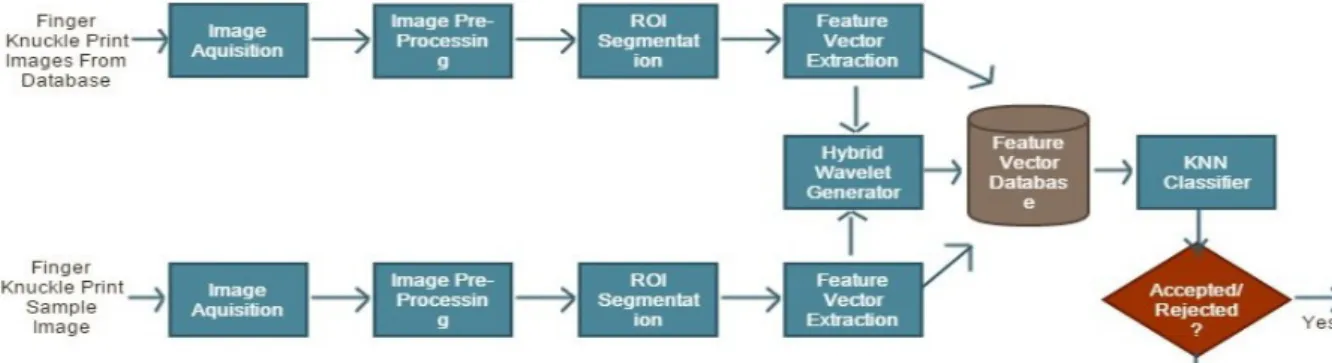
Fig.2 shows the proposed system. It has been identified recently that the different patterns on the finger knuckle of a person remains same for his lifetime and they are unique features. These features can be exploited in order to design a new biometric system. This trait is being explored by using different methods such as DAISY descriptor, fuzzy systems, neural systems etc. The idea proposed here is the implementation of Finger knuckle print identification using
Kekre’s Hybrid Wavelet transform type I and type II. This hybrid wavelet transform is new and promising methodology for image processing. Wavelet energy of the FKP Region of Interest for verification purpose will be used. The hybrid wavelet transform were used for combining the traits of two different orthogonal transforms. This helps to exploit the strengths of both the transforms. Here different transforms were used for feature vector generation and compared.
3.1 Wavelets
Wavelets are mathematical tools that can be used to extract information from many different kinds of data, including images. To analyse data fully sets of wavelets are needed. A set of "complementary" wavelets reconstructs data without gaps or overlap so that the deconstruction process is mathematically reversible and is with minimal loss. The wavelet transforms in many applications are proven to be better than respective orthogonal transforms. This paper proposes the generation of hybrid wavelets type I and type II by combining any two orthogonal transforms like Kekre transform, Walsh Transform, Hartley Transform, Haar and Discrete Cosine Transform (DCT) to obtain the feature vectors. Hybrid wavelet transform acquires the positive characteristics from both the orthogonal transforms used to generate it. The hybrid wavelet transforms are more effective than single orthogonal transforms was proved in different studies and researches [10, 22, 23, 24, 25].
3.2 Hybrid wavelet type I
In Hybrid Wavelets Type I (HWI) the image is divided into LL (Low Frequency), LH (Horizontal), and HL (Vertical), HH (Diagonal) components in the first level. Hybrid Wavelet I has nonstandard components size, this is because of the Nature of the Hybrid Wavelet Matrix, The LL component size is decided by the Low Frequency component of the Wavelet Matrix, in case of the Hybrid Wavelets the Low frequency components is first M rows of the M X P size matrix (first 64 Rows in case of 256 X 256 (64X4) Size Matrix). In case of other wavelets this is exactly half the size of the matrix. This gives different sized components. Wavelet energy based feature vector is generated from these components, generated up to 4 levels [18, 19, 22, 23].
3.3 Hybrid wavelet type II
As discussed in [18], the Hybrid Wavelet Type I have limitation of Reduced size of LL component. Hence we have to go for combined Decomposition Based Multi Resolution Analysis. To overcome this problem Hybrid Wavelets Type II (HWII) are proposed by Dr. Kekre. Here the same method discussed in [21], Only change is that, while generating the Low Frequency Component we are repeating the multiplication N Times, Hence the LL component has the size of MXN [18,19,22,23].
3.4 Feature Vector exctraction using Hybrid Wavelets type I and type II
The original database Finger Knuckle Print image is preprocessed to obtain a Region of Interest (ROI) of dimension 256x128.
(a)
(b)
Fig 3: (a) Division of FKP into three blocks (b) Three blocks of FKP
This ROI is further divided into three blocks as left, center and right of dimension 128x128 each as shown in Figure 3[4]. Hybrid Wavelets type I and type II generated using different combinations of Kekre, Walsh, Haar, DCT, Hartley transforms were applied upon each individual blocks. This generates 5x4 i.e 20 hybrid wavelets for each block. The hybrid wavelets are applied on the images to perform Multi Resolution Analysis (MRA).
Multi Resolution Analysis approach was used to generate 4 levels of Wavelet Energy based feature vector extraction. One example of wavelets generated from HWI and HWII are shown in Figure 4. Each component is divided into 4x4 (SxS) non overlapping blocks; hence for a single component (LH, HL or HH) we have 16 wavelet energy values. In a single decomposition we have 3 hence we get total 48 values in one level of decomposition.
(a) (b)
Figure 4: (a) Hybrid Wavelet I Components of FKP block (b) Hybrid Wavelet II Components of FKP block The feature vector thus extracted has total 192 coefficients for K=4 (16X3X4=240, 192 Coefficient per Components X 3 Component Per Level X 4 Levels of Components) for one block of Finger Knuckle Image. Such three blocks left, centre and right to form one complete Finger Knuckle Print, hence the final feature vector has 192 x 3 = 576 coefficients. Every decomposition level has reduced component size, hence the overall wavelet component energy goes on reducing and the value of feature vector coefficients goes on diminishing.
Fig 2. Architecture of Proposed Algorithm
Proposed Algorithm for feature vector generation is as follows:
Step 1. The Finger Knuckle Print image present in .jpeg format is read from the database and converted into grey image array of size 256 x 256.
Step 2. These images are then pre-processed to obtain the Region of Interest (ROI) consisting of the wrinkled part of the phalangeal joint. This extracted image is of size 256 x 128.
Step 3. Next the ROI is divided into three parts left, centre and right. This gives image of size 128 x 128 each and it becomes convenient to apply wavelets.
Step 4. The Finger Knuckle Print image present in .jpeg format is read from the database and converted into grey image array of size 256 x 256.
Step 5. These images are then pre-processed to obtain the Region of Interest (ROI) consisting of the wrinkled part of the phalangeal joint. This extracted image is of size 256 x 128.
Step 6. Next the ROI is divided into three parts left, centre and right. This gives image of size 128 x 128 each and it becomes convenient to apply wavelets.
Step 7. Then Hybrid Wavelet Type I and Hybrid Wavelet Type II are applied on each block of the image to extract feature vector. One block gives feature vector of size 192 and such three blocks are there for one finger knuckle image hence total feature vector of size 576 is obtained for one finger knuckle sample of one user. Step 8. To reduce the complexity of calculation composite feature vector is calculated for every user sample data.
Composite feature vector comprises of all the four image samples of one user present in database as left index, left middle, right index and right middle. Multi-Resolution analysis is performed to obtain the composite feature vector using Hybrid Wavelet Type I and Hybrid Wavelet Type II upto 4 levels.
Step 9. The different combinations of orthogonal transforms are used to generate different 20 hybrid wavelets and applied upon each sample. The resulting feature vector for every wavelet is then stored in the database. Step 10.These feature vectors of the finger knuckle print are then compared using Euclidian distance based K-NN
classifier which then are put to Intra Class Testing and Inter Class testing, which generates Genuine and Forgery results.
Finally these instances are considered for multiple instances such as left index + right index finger etc. to build a Multi-Instance Finger Knuckle Print System Finger Knuckle Print System.
4. RESULTS.
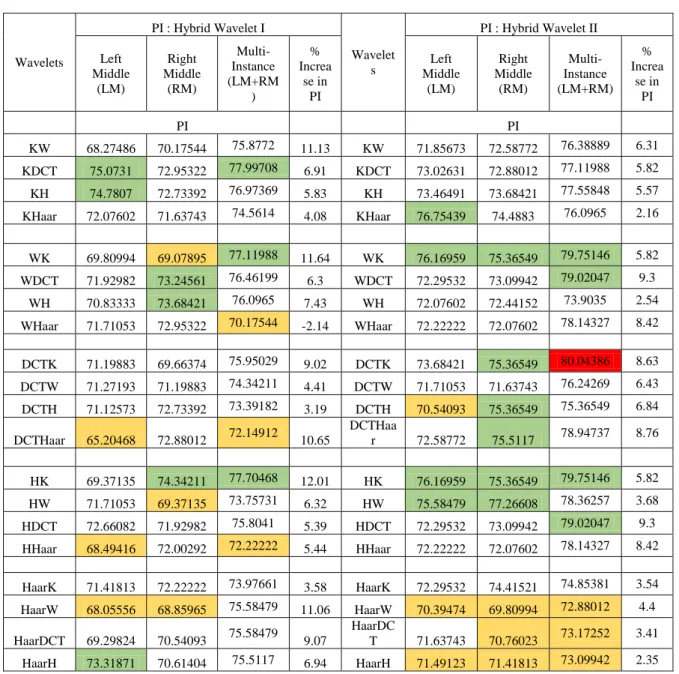
Table 1:Comparison of Performance Index (PI) by Multi Instance Analysis.
Wavelets PI : Hybrid Wavelet I Wavelet s PI : Hybrid Wavelet II Left Middle (LM) Right Middle (RM) Multi-Instance (LM+RM ) % Increa se in PI Left Middle (LM) Right Middle (RM) Multi-Instance (LM+RM) % Increa se in PI PI PI KW 68.27486 70.17544 75.8772 11.13 KW 71.85673 72.58772 76.38889 6.31 KDCT 75.0731 72.95322 77.99708 6.91 KDCT 73.02631 72.88012 77.11988 5.82 KH 74.7807 72.73392 76.97369 5.83 KH 73.46491 73.68421 77.55848 5.57 KHaar 72.07602 71.63743 74.5614 4.08 KHaar 76.75439 74.4883 76.0965 2.16 WK 69.80994 69.07895 77.11988 11.64 WK 76.16959 75.36549 79.75146 5.82 WDCT 71.92982 73.24561 76.46199 6.3 WDCT 72.29532 73.09942 79.02047 9.3 WH 70.83333 73.68421 76.0965 7.43 WH 72.07602 72.44152 73.9035 2.54 WHaar 71.71053 72.95322 70.17544 -2.14 WHaar 72.22222 72.07602 78.14327 8.42 DCTK 71.19883 69.66374 75.95029 9.02 DCTK 73.68421 75.36549 80.04386 8.63 DCTW 71.27193 71.19883 74.34211 4.41 DCTW 71.71053 71.63743 76.24269 6.43 DCTH 71.12573 72.73392 73.39182 3.19 DCTH 70.54093 75.36549 75.36549 6.84 DCTHaar 65.20468 72.88012 72.14912 10.65 DCTHaa r 72.58772 75.5117 78.94737 8.76 HK 69.37135 74.34211 77.70468 12.01 HK 76.16959 75.36549 79.75146 5.82 HW 71.71053 69.37135 73.75731 6.32 HW 75.58479 77.26608 78.36257 3.68 HDCT 72.66082 71.92982 75.8041 5.39 HDCT 72.29532 73.09942 79.02047 9.3 HHaar 68.49416 72.00292 72.22222 5.44 HHaar 72.22222 72.07602 78.14327 8.42 HaarK 71.41813 72.22222 73.97661 3.58 HaarK 72.29532 74.41521 74.85381 3.54 HaarW 68.05556 68.85965 75.58479 11.06 HaarW 70.39474 69.80994 72.88012 4.4 HaarDCT 69.29824 70.54093 75.58479 9.07 HaarDC T 71.63743 70.76023 73.17252 3.41 HaarH 73.31871 70.61404 75.5117 6.94 HaarH 71.49123 71.41813 73.09942 2.35
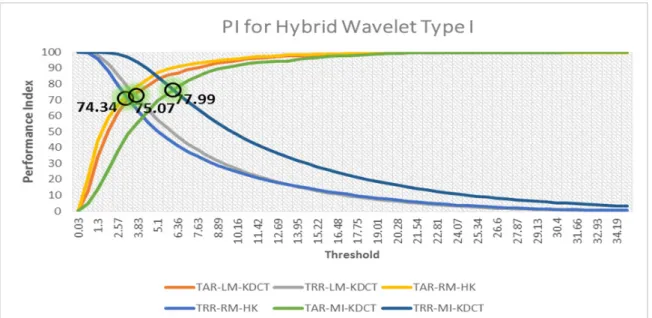
Fig 5. PI Plot for Kekre DCT Hybrid Wavelet Type I
The PolyU FKP database [7] has been used for studying the results of this proposed system. After the extraction of feature vector its intra and inter class testing is performed. The distance evaluation between two samples of the same user is ted, it is called intra-class test and with feature vectors of the different users is called the inter-class testing. Distance between feature vectors of same user should be less than that of different users in ideal case. Here for result generation the distance results of left middle and right middle fingers are combined to form a multi-instance system. Then the performance metrics like Security Performance Index (SPI) and Performance Index (PI) are calculated for comparison of results generated by different 20 hybrid wavelets.
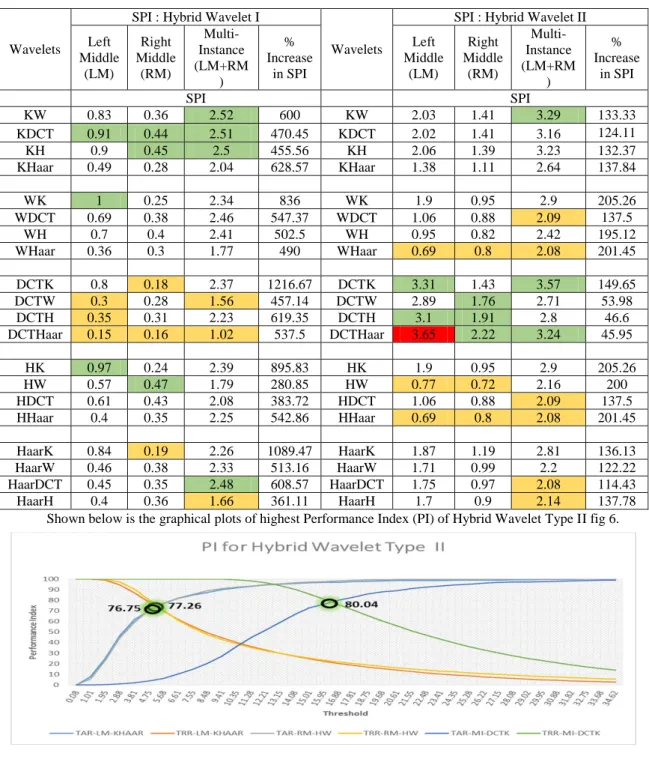
In table 1 and 2, the abbreviations K-Kekre , W-Walsh, DCT-Discrete Cosine Transform, H- Haartley and Haar-Haar transform. Both the tables show the results generated for 20 different combinations of these hybrid wavelets. The columns are highlighted by using three colors, green-highest three values, orange-lowest three values and red-most highest value.
Table 1 shows the Comparison of Performance Index (PI) by Multi Instance Analysis of the different 20 hybrid wavelets for Hybrid Wavelet type I and Hybrid Wavelet type II. Here multi-instance is formed using the Finger Knuckle Print samples of user’s left middle finger and right middle finger. 1st column i.e Wavelets shows which orthogonal transform is used to form the Hybrid Wavelet. Then followed by Performance Index given by Hybrid Wavelet type I and then by Hybrid Wavelet type II. By going for multi- instance method of result generation we got a considerable % increase in PI of 10 to 12%. From the table below it is clearly visible that the Hybrid Wavelet type II formed by Discrete Cosine Transform and Kekre transform indicated by DCTK gives the highest PI of 80.04%.
Table 2 shows the Comparison of Security Performance Index (SPI) by Multi Instance Analysis of the different 20 hybrid wavelets for Hybrid Wavelet type I and Hybrid Wavelet type II. Here multi-instance is formed using the Finger Knuckle Print samples of user’s left middle finger and right middle finger. 1st column i.e Wavelets shows which orthogonal transform is used to form the Hybrid Wavelet. Then followed by Security Performance Index given by Hybrid Wavelet type I and then by Hybrid Wavelet type II. By going for multi- instance method of result generation we got a considerable % increase in SPI of 80 to 95%. From the table below it is clearly visible that the Hybrid Wavelet type II formed by Discrete Cosine Transform and Haar transform indicated by DCTHaar gives the highest SPI of 3.65%.
Table 2: Comparison of Security Performance Index (SPI) by Multi Instance Analysis.
Wavelets
SPI : Hybrid Wavelet I
Wavelets
SPI : Hybrid Wavelet II Left Middle (LM) Right Middle (RM) Multi-Instance (LM+RM ) % Increase in SPI Left Middle (LM) Right Middle (RM) Multi-Instance (LM+RM ) % Increase in SPI SPI SPI KW 0.83 0.36 2.52 600 KW 2.03 1.41 3.29 133.33 KDCT 0.91 0.44 2.51 470.45 KDCT 2.02 1.41 3.16 124.11 KH 0.9 0.45 2.5 455.56 KH 2.06 1.39 3.23 132.37 KHaar 0.49 0.28 2.04 628.57 KHaar 1.38 1.11 2.64 137.84 WK 1 0.25 2.34 836 WK 1.9 0.95 2.9 205.26 WDCT 0.69 0.38 2.46 547.37 WDCT 1.06 0.88 2.09 137.5 WH 0.7 0.4 2.41 502.5 WH 0.95 0.82 2.42 195.12 WHaar 0.36 0.3 1.77 490 WHaar 0.69 0.8 2.08 201.45 DCTK 0.8 0.18 2.37 1216.67 DCTK 3.31 1.43 3.57 149.65 DCTW 0.3 0.28 1.56 457.14 DCTW 2.89 1.76 2.71 53.98 DCTH 0.35 0.31 2.23 619.35 DCTH 3.1 1.91 2.8 46.6 DCTHaar 0.15 0.16 1.02 537.5 DCTHaar 3.65 2.22 3.24 45.95 HK 0.97 0.24 2.39 895.83 HK 1.9 0.95 2.9 205.26 HW 0.57 0.47 1.79 280.85 HW 0.77 0.72 2.16 200 HDCT 0.61 0.43 2.08 383.72 HDCT 1.06 0.88 2.09 137.5 HHaar 0.4 0.35 2.25 542.86 HHaar 0.69 0.8 2.08 201.45 HaarK 0.84 0.19 2.26 1089.47 HaarK 1.87 1.19 2.81 136.13 HaarW 0.46 0.38 2.33 513.16 HaarW 1.71 0.99 2.2 122.22 HaarDCT 0.45 0.35 2.48 608.57 HaarDCT 1.75 0.97 2.08 114.43 HaarH 0.4 0.36 1.66 361.11 HaarH 1.7 0.9 2.14 137.78
Shown below is the graphical plots of highest Performance Index (PI) of Hybrid Wavelet Type II fig 6.
5. Conclusion
This research has performed Finger Knuckle Print recognition using 20 different hybrid wavelets for type I and type II for multi-instance combination for its left middle and right middle finger knuckle print images. The results clearly indicates that the Multimodal and Mult- Instance system gives better performance when compared to Unimodal Systems. The proposed system also shows that hybrid wavelet type II give higher results than hybrid wavelet type I.
References
1. Anil K. Jain, Arun Ross, and Salil Prabhakar, “An Introduction to Biometric Recognition”, IEEE transactions on circuits and systems
for video technology, Vol. 14, no. 1, january 2004.
2. Alfred C. Weaver, “Biometric Authentication”, IEEE Computer Society, Feb. 2006, Volume 39, No. 2, pp. 96-97.
3. Debnath Bhattacharyya, Rahul Ranjan, Farkhod Alisherov A. and Minkyu Choi, “Biometric Authentication: A Review
4. H B Kekre and V A Bharadi, “Finger-Knuckle-Print Verification using Kekre’s Wavelet Transform”, in ICWET’11, February 25–26,
2011, Mumbai, Maharashtra, India, ACM 978-1-4503-0449-8/11/02.
5. Chetana Hegde, P. Deepa Shenoy, K. R. Venugopal and L. M. Patnaik, “Authentication using Finger Knuckle Prints”,Received: 26 June
2012 / Revised: 15 October 2012 / Accepted: 1 March 2013 / Published online: 19 April 2013, in Springer-Verlag London 2013.
6. G S Badrinath, Aditya Nigam and Phalguni Gupta, “An Efficient Finger-knuckle-print based Recognition System Fusing SIFT and
SURF Matching Scores”. Department of Computer Science and Engineering, Indian Institute of Technology, Kanpur, 208016, India.
7. http://www.comp.polyu.edu.hk/~biometrics/FKP.htm
8. V A Bharadi and Pallavi Vartak, “Performance Improvement of Hyperspectral Face Recognition by Multimodal and Multi Algorithmic
Feature Fusion of Hybrid and Kekre Wavelets based Feature Vectors”,ICCUBEA,PCCOE Pune 2015.
9. V A Bharadi and Pallavi Vartak, “ Hyperspectral Face Recognition by Texture Feature Extraction using Hybrid Wavelets Type I & II
and Kekre Wavelet Transform”,ICCUBEA,PCCOE Pune 2015.
10. Loris Nanni, Alessandra Lumini, “A hybrid wavelet-based fingerprint matcher”, Received 19 June 2006; received in revised form 3
January 2007; accepted 27 February 2007, in Elsevier.
11. Abdallah Meraoumia, Salim Chitroub and Ahmed Bouridane, “Fusion of Finger-Knuckle-Print and Palmprint for an Efficient
Multi-biometric System of Person Recognition”, in IEEE ICC 2011 proceedings, 978-1-61284-231-8/11.
12. Neha Mittal, Madasu Hanmandlu and Ritu Vijay, “A Finger-Knuckle-Print Authentication System Based on DAISY Descriptor”, IEEE
2012 12th International Conference on Intelligent Systems Design and Applications (ISDA), 978-1-4673-5119-5/12.
13. G S Badrinath, Aditya Nigam and Phalguni Gupta, “An Efficient Finger-knuckle-print based Recognition System Fusing SIFT and
SURF Matching Scores”, Department of Computer Science and Engineering, Indian Institute of Technology, Kanpur, 208016, India.
14. Rui Zhao, Kunlun Li and Ming Liu, Xue Sun, “A Novel Approach of Personal Identification Based on Single Knuckle print Image”,
IEEE 2009 Asia-Pacific Conference on Information Processing, 978-0-7695-3699-6/09.
15. Mobarakol Islam, Md. Mehedi Hasan, M. M. Farhad and Tanzina Rahman Tanni, “Human Authentication Process Using Finger Knuckle
Surface with Artificial Neural Networks Based on a Hybrid Feature Selection Method”, 978-1-4673-4836-2/2012 IEEE.
16. H .B. Kekre, Tanuja Sarode and Rachana Dhannawat, “Image Fusion Using Kekre’s Hybrid Wavelet Transform”, IEEE 2012
International Conference on Communication, Information & Computing Technology (ICCICT), Oct. 19-20, Mumbai, India, 978-1-4577-2078-9/12.
17. H. B. Kekre, Archana Athawale and Dipali Sadavarti, “Algorithm to Generate Kekre’s Wavelet Transform from Kekre’s Transform”,
International Journal of Engineering Science and Technology, Vol. 2(5), 2010, 756-767.
18. H. B. Kekre, Tanuja K. Sarode and Sudeep D. Thepade, “. Inception of Hybrid Wavelet Transform using Two Orthogonal Transforms
and It’s use for Image Compression”, (IJCSIS) International Journal of Computer Science and Information Security,Vol. 9, No. 6, 2011.
19. H B Kekre, V A Bharadi, P P Janrao and V I Singh, “Face Recognition using Kekre’s Wavelets Energy & Performance Analysis of
Feature Vector Variants”, ICWET’11, February 25–26, 2011, Mumbai, Maharashtra, India ACM.
20. H B Kekre, V A Bharadi, V I Singh and A A Ambardekar, “Palmprint Recognition Using Kekre’s Wavelet’s Energy Entropy Based
Feature Vector”, ICWET’11, February 25–26, 2011 ACM., Mumbai, Maharashtra, India.
21. H B Kekre, V A Bharadi, P Roongta, S Khandelwal, P Gupta, B Nemade, V I Singh, S Gupta and P P Janrao, “Performance Comparison
of DCT, FFT, WHT, Kekre’s Transform & Gabor Filter Based Feature Vectors for On-Line Signature Recognition”, , International Journal of Computer Application (IJCA), Special Issue for ACM International Conference ICWET 2011 extended papers, February 2011.
22. Vinayak A Bharadi, Vikas Singh and R R Sedamkar, “Hybrid Wavelets based On-line Handwritten Signature Recognition”,
International Journal of Applied Information Systems (IJAIS) – ISSN : 2249-0868 Foundation of Computer Science FCS, New York, USA, Volume 2– No.2, February 2012.
23. H B Kekre and V A Bharadi, “Finger-Knuckle-Print Region of Interest Segmentation using Gradient Field Orientation & Coherence”,
Third International Conference on Emerging Trends in Engineering and Technology (ICETET 2010), Paper Published on IEEE Xplore, 19-21 November, 2010, Goa, India.
24. H B Kekre, V A Bharadi, R R Sedamkar and V Singh, “Hybrid Wavelets based Feature Vector Generation from Multidimensional Data
set for On-line Handwritten Signature Recognition”, 4th International Conference & Workshop on Advanced Computing, ICWAC 2013, TCET, Mumbai, 22nd & 23rd February 2013.
25. Bhavesh Pandya and Vinayak Bharadi ,“Multimodal Fusion of Fingerprint & Iris using Hybrid wavelet based feature vector”, 4th