Input Warping for Bayesian Optimization
of Non-Stationary Functions
The Harvard community has made this
article openly available. Please share how
this access benefits you. Your story matters
Citation
Snoek, Jasper, Kevin Swersky, Richard S. Zemel, and Ryan P.
Adams. 2014. "Input Warping for Bayesian Optimization of
Non-stationary Functions." In Proceedings of The 31st International
Conference on Machine Learning, Beijing, China, June 22-24, 2014.
Journal of Machine Learning Research: W&CP 32: 1674–1682.
Published Version
http://jmlr.org/proceedings/papers/v32/snoek14.pdf
Citable link
http://nrs.harvard.edu/urn-3:HUL.InstRepos:17491848
Terms of Use
This article was downloaded from Harvard University’s DASH
repository, and is made available under the terms and conditions
applicable to Open Access Policy Articles, as set forth at
http://
nrs.harvard.edu/urn-3:HUL.InstRepos:dash.current.terms-of-use#OAP
Jasper Snoek [email protected]
School of Engineering and Applied Sciences, Harvard University
Kevin Swersky [email protected]
Department of Computer Science, University of Toronto
Richard Zemel [email protected]
Department of Computer Science, University of Toronto and Canadian Institute for Advanced Research
Ryan P. Adams [email protected]
School of Engineering and Applied Sciences, Harvard University
Abstract
Bayesian optimization has proven to be a highly effective methodology for the global optimiza-tion of unknown, expensive and multimodal functions. The ability to accurately model distri-butions over functions is critical to the effective-ness of Bayesian optimization. Although Gaus-sian processes provide a flexible prior over func-tions, there are various classes of functions that remain difficult to model. One of the most fre-quently occurring of these is the class of non-stationary functions. The optimization of the hy-perparameters of machine learning algorithms is a problem domain in which parameters are often
manually transformeda priori, for example by
optimizing in “log-space,” to mitigate the effects of spatially-varying length scale. We develop a methodology for automatically learning a wide family of bijective transformations or warpings of the input space using the Beta cumulative dis-tribution function. We further extend the warp-ing framework to multi-task Bayesian optimiza-tion so that multiple tasks can be warped into a jointly stationary space. On a set of challeng-ing benchmark optimization tasks, we observe that the inclusion of warping greatly improves on the state-of-the-art, producing better results faster and more reliably.
Proceedings of the 31st International Conference on Machine Learning, Beijing, China, 2014. JMLR: W&CP volume 32. Copy-right 2014 by the author(s).
1
Introduction
Bayesian optimization is a strategy for the global optimiza-tion of noisy, black-box funcoptimiza-tions. The goal is to find the minimum of an expensive function of interest as quickly as possible. Bayesian optimization fits a surrogate model that estimates the expensive function, and a proxy opti-mization is performed on this in order to select promising locations to query. Naturally, the ability of the surrogate to accurately model the underlying function is crucial to the success of the optimization routine. Recent work in machine learning has revisited the idea of Bayesian opti-mization (e.g., Osborne et al., 2009; Brochu et al., 2010; Srinivas et al., 2010; Hutter et al., 2011; Bergstra et al., 2011; Bull, 2011; Snoek et al., 2012; Hennig and Schuler, 2012) in large part due to advances in the ability to effi-ciently and accurately model statistical distributions over large classes of real-world functions. Gaussian processes (GPs) (see, e.g., Rasmussen and Williams, 2006) provide a powerful framework to express flexible prior distributions over smooth functions, yielding accurate estimates of the expected value of the function at any given input, but cru-cially also uncertainty estimates over that value. These are the two main components that enable the exploration and exploitation tradeoff that makes Bayesian optimization so effective.
A major limitation of the most commonly used form of Gaussian process regression is the assumption of station-arity — that the covariance between two outputs is invari-ant to translations in input space. This assumption simpli-fies the regression task, but hurts the ability of the Gaus-sian process to model more realistic non-stationary func-tions. This presents a challenge for Bayesian optimization, as many problems of interest are inherently non-stationary. For example, when optimizing the hyperparameters of a
Input Warping for Bayesian Optimization
machine learning algorithm, we might expect the objective function to have a short length scale near the optimum, but have a long length scale far away from the optimum. That is, we would expect bad hyperparameters to yield similar bad performance everywhere (e.g., classifying at random) but expect the generalization performance to be sensitive to small tweaks in good hyperparameter regimes.
We introduce a simple solution that allows Gaussian pro-cesses to model a large variety of non-stationary functions that is particularly well suited to Bayesian optimization.
We automatically learn a bijective warping of the inputs
that removes major non-stationary effects. This is achieved by projecting each dimension of the input through the cumulative distribution function of the Beta distribution, while marginalizing over the shape of the warping. Our approach is computationally efficient, captures a variety of desirable transformations, such as logarithmic, exponen-tial, sigmoidal, etc., and is easily interpretable. In the con-text of Bayesian optimization, understanding the parameter space is often just as important as achieving the best pos-sible result and our approach lends itself to a straightfor-ward analysis of the non-stationarities in a given problem domain.
We extend this idea to multi-task Bayesian optimization (Swersky et al., 2013) so that multiple tasks can be warped into a jointly stationary space. Thus, tasks can be warped onto one another in order to better take advantage of their shared structure.
In the empirical study that forms the experimental part of this paper, we show that modeling non-stationarity is extremely important and yields significant empirical improvements in the performance of Bayesian optimiza-tion. For example, we show that on a recently introduced Bayesian optimization benchmark (Eggensperger et al., 2013), our method outperforms all of the previous state-of-the-art algorithms on the problems with continuous-valued parameters. We further observe that on four different chal-lenging machine learning optimization tasks our method outperforms that of Snoek et al. (2012), consistently con-verging to a better result in fewer function evaluations. As our methodology involves a transformation of the inputs, this strategy generalizes to a wide variety of models and al-gorithms. Empirically, modeling non-stationarity is a fun-damentally important component of effective Bayesian op-timization.
2
Background and Related Work
2.1 Gaussian Processes
The Gaussian process is a powerful and flexible prior
distri-bution over functionsf :X →Rwhich is widely used for
non-linear Bayesian regression. An attractive property of
the Gaussian process in the context of Bayesian optimiza-tion is that, condioptimiza-tioned on a set of observaoptimiza-tions, the ex-pected output value and corresponding uncertainty of any unobserved input is easily computed.
The properties of the Gaussian process are specified by
a mean function m:X →R and a positive definite
co-variance, or kernel, function K:X × X →R. Given a
finite set of training points IN = {xn, yn}Nn=1, where
xn ∈ X, yn∈R, the predictive mean and covariance un-der a GP can be respectively expressed as:
µ(x; IN) =m(X) +K(X,x)>K(X,X)−1(y−m(X)),
(1)
Σ(x,x0; IN) =K(x,x0)−K(X,x)>K(X,X)−1K(X,x0).
(2)
Here K(X,x) is the N-dimensional column vector of
cross-covariances betweenxand the setX. TheN×N
matrix K(X,X) is the Gram matrix for the set X
re-sulting from applying the covariance function K(x,x0)
pairwise over the set {xn}N
n=1. The most common
choices of covariance functions K(x,x0) are functions ofr(x,x0) =x−x0, such as the automatic relevance de-termination (ARD) exponentiated quadratic covariance
KSE(x,x0) =θ0exp(−r2) r= D X d=1 (xd−x0d) 2/θ2 d , (3)
or the ARD Mat´ern 5/2 kernel advocated for
hyperpa-rameter tuning with Bayesian optimization by Snoek et al. (2012): KM52(x,x0) =θ0 1 + √ 5r2+5 3r 2 expn−√5r2o. (4) Such covariance functions are invariant to translations along the input space and thus arestationary.
2.2 Non-stationary Gaussian Process Regression
Numerous approaches have been proposed to extend GPs to model non-stationary functions. Gramacy (2005) proposed a Bayesian treed GP model which accommodates various complex non-stationarities through modeling the data us-ing multiple GPs with different covariances. Various non-stationary covariance functions have been proposed (e.g., Higdon et al., 1998; Rasmussen and Williams, 2006). Pre-viously, Sampson and Guttorp (1992) proposed projecting the inputs into a stationary latent space using a combination of metric multidimensional scaling and thin plate splines. Schmidt and O’Hagan (2003) extended this warping ap-proach for general GP regression problems using a flexible GP mapping. Spatial deformations of two dimensional in-puts have been studied extensively in the spatial statistics
literature (Anderes and Stein, 2008). Bornn et al. (2012) project the inputs into a higher dimensional stationary la-tent representation. Snelson et al. (2003) apply a warping to the output space,y, while Adams and Stegle (2008) per-form input-dependent output scaling with a second Gaus-sian process.
Compared to these approaches, our approach is relatively simple, yet as we will demonstrate, flexible enough to cap-ture a wide variety of nonstationary behaviours. Our prin-cipal aim is to show that addressing nonstationarity is a critical component of effective Bayesian optimization, and that any advantages gained from using our approach would likely generalize to more elaborate techniques.
2.3 Multi-Task Gaussian Processes
Many problems involve making predictions over multiple datasets (we will henceforth refer to these prediction prob-lems as tasks). When the datasets share an input domain, and the mappings from inputs to outputs are correlated, then these correlations can be used to share information be-tween different tasks and improve predictive performance. There have been many extensions of Gaussian processes to the multi-task setting, e.g., Goovaerts (1997); Alvarez and Lawrence (2011). However, a basic and surprisingly effec-tive approach is to assume that each task is derived from a single latent function which is transformed to produce each output (Teh et al., 2005; Bonilla et al., 2008).
Formally, this approach involves combining a kernel over inputsK(x,x0)and a kernel over task indicesK(t, t0),t=
{1, ..., T}via a product to form the joint kernel:
K((x, t),(x0, t0)) =KT(t, t0)K(x,x0). (5)
We infer the elements ofKT(t, t0)directly using the
spheri-cal parametrization of a covariance matrix (Osborne, 2010; Pinheiro and Bates, 1996).
2.4 Bayesian Optimization
Bayesian optimization is a general framework for the global optimization of noisy, expensive, black-box func-tions (Mockus et al., 1978), see Brochu et al. (2010) or Li-zotte (2008) for an in-depth explanation and review. The strategy relies on the use of a relatively cheap probabilistic model that can be queried liberally as a surrogate in order to more effectively evaluate an expensive function of in-terest. Bayes’ rule is used to derive the posterior estimate of the true function, given observations, and the surrogate is then used to determine, via a proxy optimization over anacquisition function, the next most promising point to query. Using the posterior mean and variance of the proba-bilistic model, the acquisition function generally expresses a tradeoff between exploitation and exploration. Numerous acquisition functions and combinations thereof have been
proposed (e.g., Kushner, 1964; Srinivas et al., 2010; Hoff-man et al., 2011).
In this work, we follow the common approach, which is to use a GP to define a distribution over objective func-tions from the input space to a loss that one wishes to min-imize. Our approach is based on that of Jones (2001).
Specifically, we use a GP surrogate, and the expected
improvement acquisition function (Mockus et al., 1978).
Let σ2(x) = Σ(x,x) be the marginal predictive variance
of a GP, and define
γ(x) = f(xbest)−µ(x;{xn, yn}, θ)
σ(x;{xn, yn}, θ)
, (6)
wheref(xbest)is the lowest observed value. The expected
improvement criterion is defined as
aEI(x;{xn, yn}, θ) =σ(x;{xn, yn}, θ) (γ(x)Φ(γ(x))
+N(γ(x); 0,1)). (7)
HereΦ(·)is the cumulative distribution function of a stan-dard normal, andN(·; 0,1)is the density of a standard nor-mal. Note that the method proposed in this paper is inde-pendent of the choice of acquisition function and do not affect its analytic properties.
2.5 Multi-Task Bayesian Optimization
When utilizing machine learning in practice, a single model will often need to be trained on multiple datasets. This can happen when e.g., new data is collected and a model must be retrained. In these scenarios we can think of each dataset as a different task and use multi-task Gaussian pro-cesses to predict where to query next. In Krause and Ong (2011), this idea was applied to find peptide sequences that bind to molecules for vaccine design, while in Swersky et al. (2013) it was applied to hyperparameter optimization. In these cases it was shown that sharing information be-tween tasks can be extremely beneficial for Bayesian opti-mization. Other approaches include Bardenet et al. (2013), which finds a joint latent function over tasks explicitly us-ing a rankus-ing model, and Hutter et al. (2011) which uses a set of auxiliary task features to improve prediction.
3
Input Warping
We assume that we have a positive definite covariance func-tion K(x,˜x), where x,˜x ∈ [0,1]D due to projecting a bounded input range to the unit hypercube. In practice, when tuning the hyperparameters of an algorithm, e.g., the regularization parameter of a support vector machine, researchers often first transform the input space using a monotonic function such as the natural logarithm and then perform a grid search in this transformed space. Such an
Input Warping for Bayesian Optimization Exp on en tia l de ca y A n on -st at io na ry pe rio di c fu nct io n 0 0.2 0.4 0.6 0.8 1 0 0.2 0.4 0.6 0.8 1 0 0.2 0.4 0.6 0.8 1 0 0.2 0.4 0.6 0.8 1 0 0.2 0.4 0.6 0.8 1 0 0.2 0.4 0.6 0.8 1 0 0.2 0.4 0.6 0.8 1 0 0.2 0.4 0.6 0.8 1 0 0.2 0.4 0.6 0.8 1 0 0.2 0.4 0.6 0.8 1 0 0.2 0.4 0.6 0.8 1 0 0.2 0.4 0.6 0.8 1
Original Objective Function Warping Function Post-Warping
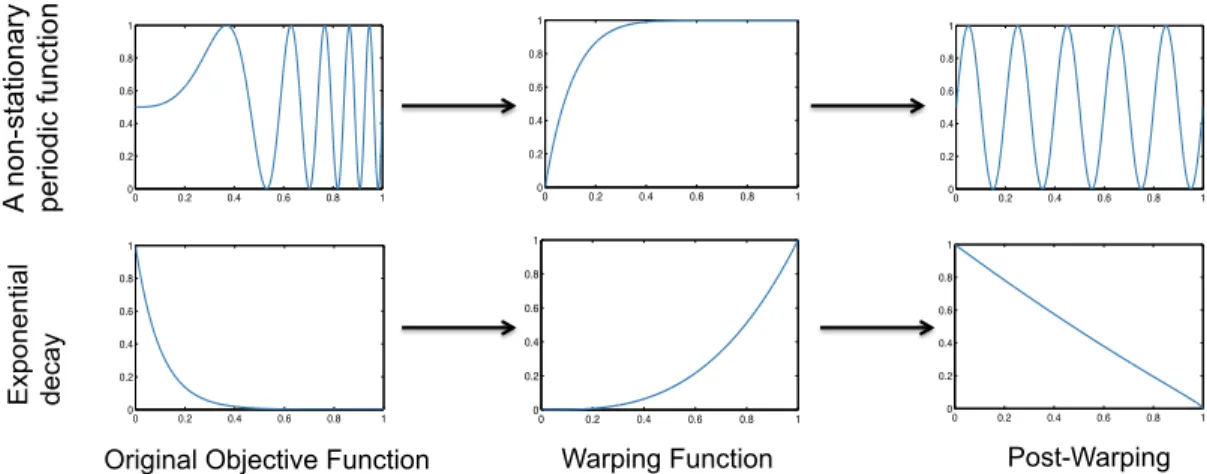
Two examples of how input warping using the Beta CDF can transform a non-stationary function into a stationary one.
Figure 1.Two examples of how input warping using the Beta CDF can transform a non-stationary function into a stationary one. The
warping function maps the original inputs on the horizontal axis to new inputs shown on the vertical axis. The effect is to stretch and contract regions of the input space in such a manner as to remove non-stationarity.
knowledge of the non-stationarity that is inherent in the in-put space. Often however, the non-stationary properties of
the input space are not knowna prioriand such a
trans-formation is generally a crude approximation to the ideal (unknown) transformation. Our approach is to instead con-sider a class of bijective warping functions, and estimate them from previous objective function evaluations. We can then use commonly-engineered transformations—such as the log transform—to specify a prior on bijections. Specif-ically, we change the kernel function to beK(w(x), w(˜x)),
wd(xd) = BetaCDF(xd;αd, βd), = Z xd 0 uαd−1(1−u)βd−1 B(αd, βd) du , (8)
where BetaCDF refers to the Beta cumulative distribution function andB(α, β)is the normalization constant. That is,
w: [0,1]D→[0,1]Dis a vector-valued function in which
thedth output dimension is a function of thedth input di-mension, and is specified by the cumulative distribution function of the Beta distribution. Each of theseD bijec-tive transformations from[0,1]to[0,1]has a unique shape, determined by parameters αd>0 andβd>0. The Beta
CDF has no closed form solution for non-integer values
of αandβ, however accurate approximations are
imple-mented in many statistical software packages.
Alternatively, one can think of input warping as applying a particular kind of non-stationary kernel to the original data. Examples of non-stationary functions and their correspond-ing ideal warpcorrespond-ing that transforms them into stationary func-tions are shown in Figure 1.
Our choice of the Beta distribution is motivated by the fact that it is capable of expressing a variety of monotonic warp-ings, while still being concisely parameterized. In general,
there are many other suitable choices.
3.1 Integrating over warpings
Rather than assume a single, explicit transformation func-tion, we define a hierarchical Bayesian model by plac-ing a prior over the shape parameters, αd andβd, of the
bijections and integrating them out. We treat the
col-lection{αd, βd}Dd=1 as hyperparameters of the covariance
function and use Markov chain Monte Carlo via slice sam-pling, following the treatment of covariance hyperparame-ters from Snoek et al. (2012). We use a log-normal distri-bution, i.e.
log(αd)∼ N(µα, σα) log(βd)∼ N(µβ, σβ), (9)
to express a prior for a wide family of desirable functions. Figure 2 demonstrates example warping functions arising from sampling transformation parameters from various in-stantiations of this prior. Note that the geometric mean or median of the zero-mean log-normal distribution for theαd
and βd corresponds to the identity transform. With this
prior the model centers itself on the identity transforma-tion of the input space. In the following empirical analysis we use this formulation with a variance of 0.75. A nice property of this approach is that a user can easily specify a prior when they expect a specific form of warping, as we show in Figure 2.
3.2 Multi-Task Input Warping
When training the same model on different datasets, certain properties, such as the size of the dataset, can have a dra-matic effect on the optimal hyperparameter settings. For example, a model trained on a small dataset will likely re-quire more regularization than the same model trained on a
0 0.2 0.4 0.6 0.8 1 0 0.2 0.4 0.6 0.8 1 (a) Linear 0 0.2 0.4 0.6 0.8 1 0 0.2 0.4 0.6 0.8 1 (b) Exponential 0 0.2 0.4 0.6 0.8 1 0 0.2 0.4 0.6 0.8 1 (c) Logarithmic 0 0.2 0.4 0.6 0.8 1 0 0.2 0.4 0.6 0.8 1 (d) Sigmoidal
Figure 2.Each figure shows 50 warping functions resulting from the Beta CDF where the shape parametersαand β are sampled
from a log-normal prior with a different mean and variance. The flexible Beta CDF captures many desirable warping functions and adjusting the prior over input warpings allows one to easily encode prior beliefs over the form of non-stationarity. For example, choosing
µα =µβ = 0andσα =σβ = 0.5expresses a prior for slight or no warping (2a). Settingµα = 0,σα = 0.25andµβ =σβ = 1
orµα=σα= 1,µβ = 0andσβ = 0.25expresses a prior for approximately exponential (2b) or logarithmic (2c) warping functions
respectively. Approximately sigmoidal (2d) warpings that contract the outer regions of the space while expanding the center can be
expressed as a prior withµα=µβ= 2andσα=σβ = 0.5. One can also express logit shaped warpings (not shown here).
larger dataset. In other words, it is possible that one part of the input space on one task can be correlated with a differ-ent part of the input space on another task. To account for this, we allow each task to have its own set of warping pa-rameters. Inferring these parameters will effectively try to warp both tasks into a jointly stationary space that is more suitably modeled by a standard multi-task kernel. In this way, large values on one task can map to small values on another, and vice versa.
4
Empirical Analyses
Our empirical analysis is comprised of three distinct exper-iments. In the first experiment, we compare to the method of Snoek et al. (2012) in order to demonstrate the effective-ness of input warping. In the second experiment, we com-pare to other hyperparameter optimization methods using a subset of the benchmark suite found in Eggensperger et al. (2013). Finally, we show how our multi-task extension can further benefit this important setting.
4.1 Comparison to Stationary GPs
Experimental setup We evaluate the standard Gaussian process expected improvement algorithm (GP EI MCMC) as implemented by Snoek et al. (2012), with and without warping. Following their treatment, we use the Mat´ern5/2
kernel and we marginalize over kernel parametersθusing
slice sampling (Murray and Adams, 2010). We repeat three of the experiments1from Snoek et al. (2012), and perform
an experiment involving the tuning of a deep convolutional neural network2on a subset of the popular CIFAR-10 data set (Krizhevsky, 2009). The deep network consists of three convolutional layers and two fully connected layers and
1See Snoek et al. (2012) for details of these experiments.
2
We use the Deepnet package from https://github.
com/nitishsrivastava/deepnet
we optimize over two learning rates, one for each layer type, six dropout regularization rates, six weight norm con-straints, the number of hidden units per layer, a convolu-tional kernel size and a pooling size for a total of 21 hy-perparameters. On the logistic regression problem we also compare to warping the input spacea prioriusing the log-transform (optimizing in log-space).
Results Figure 3 shows that in all cases, dealing with non-stationary effects via input warpings greatly improves the convergence of the optimization. Of particular note, on the higher-dimensional convolutional network problem (Figure 3d) input warped Bayesian optimization consis-tently converges to a better solution than Bayesian opti-mization with a stationary GP.
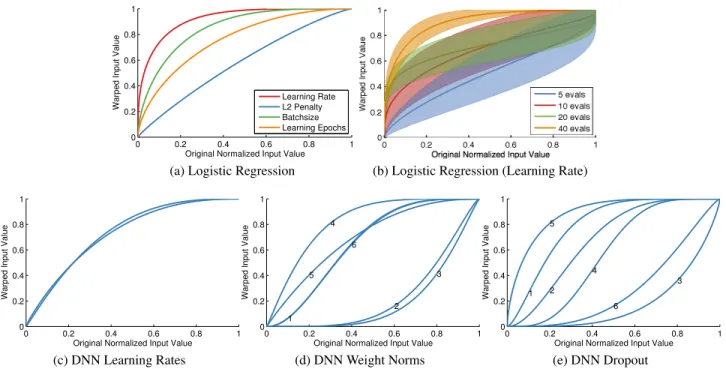
In Figure 4 we plot examples of some of the inferred warpings. For logistic regression, Figure 4a shows that our method learns different logarithmic-like warpings for three dimensions and no warping for the fourth. Figure 4b shows how the posterior distribution over the learning rate warping evolves, becoming more extreme and more cer-tain, as observations are gathered. Figure 4c shows that on both convolutional and dense layers, the intuition that one should log-transform the learning rates holds. For transfor-mations on weight norm constraints, shown in Figure 4d, the weights connected to the inputs and outputs use a sig-moidal transformation, the convolutional-layer weights use an exponential transformation, and the dense-layer weights use a logarithmic transformation. Effectively, this means that the most variation in the error occurs in the medium, high and low scales respectively for these types of weights. Especially interesting are the wide variety of transforma-tions that are learned for dropout on different layers, shown in Figure 4e. These show that different layers benefit from different dropout rates, which was also confirmed on test set error, and challenges the notion that they should just be set to0.5(Hinton et al., 2012).
Input Warping for Bayesian Optimization
Experiment # Evals SMAC Spearmint TPE # Evals Spearmint + Warp
Branin (0.398) 200 0.655±0.27 0.398±0.00 0.526±0.13 40 0.398±0.00
Hartmann 6 (-3.322) 200 −2.977±0.11 −3.133±0.41 −2.823±0.18 100 −3.3166±0.02
Logistic Regression 100 8.6±0.9 7.3±0.2 8.2±0.6 40 6.88±0.0
LDA (On grid) 50 1269.6±2.9 1272.6±10.3 1271.5±3.5 50 1266.2±0.1
SVM (On grid) 100 24.1±0.1 24.6±0.9 24.2±0.0 100 24.1±0.1
Table 1.We evaluate our algorithm on the continuous-valued parameter benchmarks proposed in Eggensperger et al. (2013). We compare
to Sequential Model Based Algorithm Configuration (SMAC) (Hutter et al., 2011), the Tree Parzen Estimator (TPE) (Bergstra et al., 2011) and Spearmint (Snoek et al., 2012). The results for SMAC, Spearmint and TPE are reproduced from Eggensperger et al. (2013). Following the standard protocol for these benchmarks, each algorithm was run ten times for the given number of evaluations, and the average validation loss and standard deviation are reported. The algorithm with the lowest validation loss is shown in bold. We note that on some of the benchmarks our algorithm converges to a solution in far fewer evaluations than the protocol allows.
0 5 10 15 20
0.1 0.15 0.2 0.25
Min Function Value
Function Evaluations GP EI MCMC − logspace GP EI MCMC − orig space Warped GP − orig space
(a) Logistic Regression
10 20 30 40 50 1265 1270 1275 1280 Function Evaluations
Min Function Value (Perplexity)
GP EI MCMC Warped GP EI MCMC (b) Online LDA 30 40 50 60 70 80 90 100 0.241 0.242 0.243 0.244 0.245 0.246 0.247 0.248
Min Function Value
Function evaluations GP EI MCMC Warped GP EI MCMC (c) Structured SVM 5 10 15 20 25 30 35 40 0.4 0.5 0.6 0.7 0.8
Min Function Value
Function evaluations GP EI MCMC Warped GP EI MCMC
(d) Cifar 10 Subset
Figure 3.An empirical comparison of Bayesian optimization following the standard Gaussian process expected improvement algorithm
(GP EI MCMC) and our strategy (Warped GP EI MCMC) for modeling input non-stationarity. The methods are compared on four challenging problems involving the optimization of the hyperparameters of popular machine learning algorithms.
It is clear that the learned warpings are non-trivial. In some cases, like with learning rates, they agree with in-tuition, while for others like dropout they yield surprising results. Given the number of hyperparameters and the va-riety of transformations, it is highly unlikely that even ex-perts would be able to determine the whole set of appropri-ate warpings. This highlights the utility of learning them automatically.
4.2 HPOLib Continuous Benchmarks
Experimental setup In our next set of experiments, we tested our approach on the subset of benchmarks over continuous inputs from the HPOLib benchmark suite (Eggensperger et al., 2013). These benchmarks are designed to assess the strengths and weaknesses of several popular hyperparameter optimization schemes. All of the tested methods perform Bayesian optimization, however the underlying surrogate models differ significantly. The SMAC package (Hutter et al., 2011) uses a random forest, the Hyperopt package (Bergstra et al., 2011) uses the tree Parzen estimator, and the Spearmint package (Snoek et al., 2012) uses a Gaussian process. For our experiments, we augmented the Spearmint package with input warping.
Results Table 1 shows the results, where all but the warped results are taken from Eggensperger et al. (2013).
Overall, input warpings improve the performance of the Gaussian process approach such that it does at least as well as every other method, and in many cases better. Further-more, the standard deviation also decreases significantly in many instances, meaning that the results are far more reli-able. Finally, it is worth noting that the number of function evaluations required to solve the problems is also drasti-cally reduced in many cases.
Interestingly, the random forest approach in SMAC also naturally deals with nonstationarity, albeit in a fundamen-tally different way, by partitioning the space in a
non-uniform manner. There are several possibilities to
ex-plain the performance discrepancy. Unlike random forests, Gaussian processes produce a smooth function of the in-puts, meaning that EI can be locally optimized via gradient methods, so it is possible that better query points are se-lected in this way. Alternatively, the random forest is not a well-defined prior on functions and there may be overfit-ting in the absence of parameter marginalization. Further investigation is merited to tease apart this discrepancy.
4.3 Multi-Task Warping
Experimental setup In this experiment, we apply multi-task warping to logistic regression and online LDA (Hoff-man et al., 2010) in a similar (Hoff-manner to Swersky et al.
0 0.2 0.4 0.6 0.8 1 0 0.2 0.4 0.6 0.8 1
Original Normalized Input Value
Warped Input Value
Learning Rate L2 Penalty Batchsize Learning Epochs
(a) Logistic Regression (b) Logistic Regression (Learning Rate)
0 0.2 0.4 0.6 0.8 1 0 0.2 0.4 0.6 0.8 1
Original Normalized Input Value
Warped Input Value
(c) DNN Learning Rates 0 0.2 0.4 0.6 0.8 1 0 0.2 0.4 0.6 0.8 1 2 3 4 5 6 1
Original Normalized Input Value
Warped Input Value
(d) DNN Weight Norms 0 0.2 0.4 0.6 0.8 1 0 0.2 0.4 0.6 0.8 1 1 2 3 4 5 6
Original Normalized Input Value
Warped Input Value
(e) DNN Dropout
Figure 4.Example input warpings learned for the logistic regression problem (Figures 4a,4b) and the parameters of the deep
convolu-tional neural network (Figures 4c, 4e, 4d). Each plot shows the mean warping, averaged over 100 samples, of each of the parameters. Figure 4b shows the warping learned on the learning rate parameter for logistic regression with different numbers of observations, along with the standard deviation. Each curve in Figures 4d and 4e is annotated with the depth of the layer that each parameter is applied to.
(2013). In the logistic regression problem, a search over hyperparameters has already been completed on the USPS dataset, which consists of6,000training examples of hand-written digits of size16×16. It was demonstrated that it was possible to use this previous search to speed up the hy-perparameter search for logistic regression on the MNIST dataset, which consists of60,000training examples of size
28×28.
In the online LDA problem, we assume that a model has
been trained on50,000documents and that we would now
like to train one on 200,000 documents. Again, it was
shown that it is possible to transfer information over to this task, resulting in more efficient optimization.
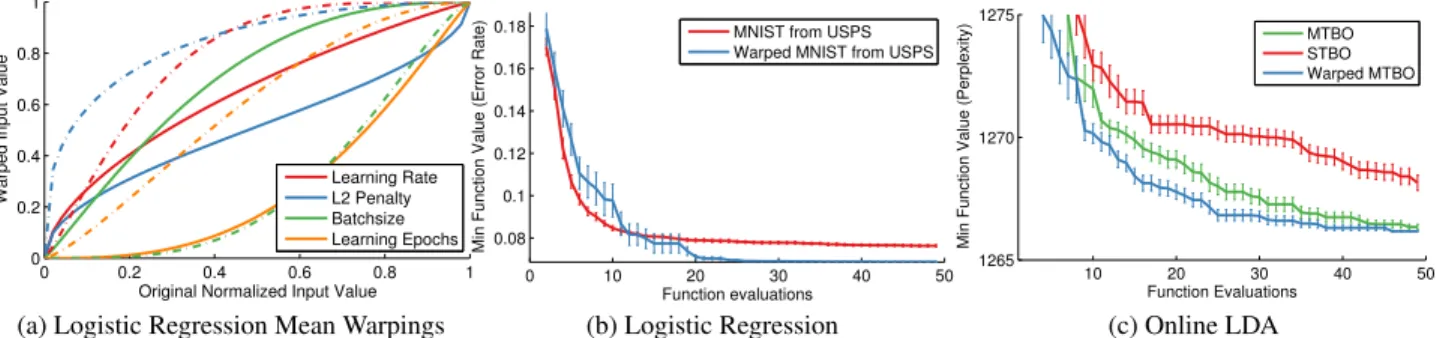
Results In Figure 5 we see that warped multi-task Bayesian optimization (warped MTBO) outperforms multi-task Bayesian optimization (MTBO) without warp-ing, and performs far better than single-task Bayesian op-timization (STBO) that does not have the benefit of a prior search. On logistic regression it appears that ordi-nary MTBO gets stuck in a local minimum, while warped MTBO is able to consistently escape this by the20th
func-tion evaluafunc-tion.
In Figure 5a we show the mean warping learned for each task/hyperparameter combination (generated by averaging
over samples from the posterior). The warping of theL2
penalty on the USPS model favours configurations that are toward the higher end of the range. Conversely, the warping on the MNIST dataset favours relatively lower penalties. This agrees with intuition that a high regularization with less data is roughly equivalent to low regularization with more data. Other observations also agree with intuition. For example, since USPS is smaller each learning epoch consists of fewer parameter updates. This can be offset by training for more epochs, using smaller minibatch sizes, or increasing the learning rate relative to the same model on MNIST.
5
Conclusion
In this paper we develop a novel formulation to elegantly model non-stationary functions using Gaussian processes that is especially well suited to Bayesian optimization. Our approach uses the cumulative distribution function of the Beta distribution to warp the input space in order to remove the effects of mild input-dependent length scale variations. This approach allows us to automatically infer a variety of warpings in a computationally efficient way. In our empiri-cal analysis we see that an inability to model non-stationary functions is a major weakness when using stationary ker-nels in the GP Bayesian optimization framework. Our
sim-Input Warping for Bayesian Optimization 0 0.2 0.4 0.6 0.8 1 0 0.2 0.4 0.6 0.8 1
Original Normalized Input Value
Warped Input Value
Learning Rate L2 Penalty Batchsize Learning Epochs
(a) Logistic Regression Mean Warpings
0 10 20 30 40 50 0.08 0.1 0.12 0.14 0.16 0.18
Min Function Value (Error Rate)
Function evaluations MNIST from USPS Warped MNIST from USPS
(b) Logistic Regression 10 20 30 40 50 1265 1270 1275 Function Evaluations
Min Function Value (Perplexity)
MTBO STBO Warped MTBO
(c) Online LDA
Figure 5.Multi-task warping applied to logistic regression and online LDA. For logistic regression, the model is trained on USPS first
and then the search is transferred to MNIST. For online LDA, the data is subsampled and the model is learned, then the search transferred to the full dataset. In both cases, the warped version substantially outperforms multi-task Bayesian optimization with no warping. In Figure 5a, we show the mean warping learned by each task for each parameter. The solid lines indicates the MNIST task, while the dashed lines indicate the USPS task.
ple approach to learn the form of the non-stationarity sig-nificantly outperforms the standard Bayesian optimization routine of Snoek et al. (2012) both in the number of eval-uations it takes to converge and the value reached. As an additional bonus, the method finds good solutions more re-liably. Our experiments on the continuous subset of the HPOLib benchmark (Eggensperger et al., 2013) shows that input warping performs substantially better than state-of-the-art baselines on these problems.
A key advantage of our approach is that the learned
trans-formations can be analyzedpost hoc, and our analysis of
a convolutional neural network architecture leads to sur-prising insights that challenge established doctrine. Post-training analysis is becoming a critical component of neu-ral network development. For example, the winning Ima-genet 2013 (Deng et al., 2009) submission (Zeiler and Fer-gus, 2013) usedpost hocanalysis to correct for model de-fects. The development of interpretable Bayesian optimiza-tion strategies can provide a unique opportunity to facilitate this kind of interaction. An interesting follow-up would be to determine whether consistent patterns emerge across ar-chitectures, datasets and domains.
In Bayesian optimization, properly characterizing uncer-tainty is just as important as making predictions. GPs are ideally suited to this problem because they offer a good bal-ance between modeling power and computational tractabil-ity. In many real world problems, however, the assumptions made by the Gaussian processes are often violated, nullify-ing many of their benefits. In light of this, many opt to use frequentist models instead, which offer minimax-type guar-antees. Our emphasis in this work is to demonstrate that it is possible to stay within the Bayesian framework and thus enjoy its characterization of uncertainty, while still over-coming some of the limitations associated with the conven-tional GP approach. In future work we intend to experi-ment with more elaborate models of non-stationarity to see
if these yield further improvements.
Acknowledgements
The authors would like to thank Nitish Srivastava for pro-viding help with the Deepnet package. Jasper Snoek is a fellow in the Harvard Center for Research on Com-putation and Society. During his time at the University of Toronto, Jasper Snoek was supported by a grant from Google. This work was funded by DARPA Young Fac-ulty Award N66001-12-1-4219, an Amazon AWS in search grant, the Natural Sciences and Engineering Re-search Council of Canada (NSERC) and the Canadian In-stitute for Advanced Research (CIFAR).
References
Michael A. Osborne, Roman Garnett, and Stephen J. Roberts.
Gaussian processes for global optimization. InLearning and
Intelligent Optimization, 2009.
Eric Brochu, Tyson Brochu, and Nando de Freitas. A Bayesian interactive optimization approach to procedural animation
de-sign. InACM SIGGRAPH/Eurographics Symposium on
Com-puter Animation, 2010.
Niranjan Srinivas, Andreas Krause, Sham Kakade, and Matthias Seeger. Gaussian process optimization in the bandit setting: no
regret and experimental design. InInternational Conference
on Machine Learning, 2010.
Frank Hutter, Holger H. Hoos, and Kevin Leyton-Brown. Sequen-tial model-based optimization for general algorithm
configura-tion. InLearning and Intelligent Optimization 5, 2011.
James S. Bergstra, R´emi Bardenet, Yoshua Bengio, and B´al´azs
K´egl. Algorithms for hyper-parameter optimization. In
Ad-vances in Neural Information Processing Systems. 2011.
Adam D. Bull. Convergence rates of efficient global
optimiza-tion algorithms.Journal of Machine Learning Research, (3-4):
Jasper Snoek, Hugo Larochelle, and Ryan P. Adams. Practical
Bayesian optimization of machine learning algorithms. In
Ad-vances in Neural Information Processing Systems, 2012.
Philipp Hennig and Christian J. Schuler. Entropy search for
information-efficient global optimization. Journal of Machine
Learning Research, 13, 2012.
Carl E. Rasmussen and Christopher Williams. Gaussian
Pro-cesses for Machine Learning. MIT Press, 2006.
Kevin Swersky, Jasper Snoek, and Ryan Prescott Adams.
Multi-task bayesian optimization. InAdvances in Neural Information
Processing Systems, 2013.
K. Eggensperger, M. Feurer, F. Hutter, J. Bergstra, J. Snoek, H. Hoos, and K. Leyton-Brown. Towards an empirical founda-tion for assessing bayesian optimizafounda-tion of hyperparameters. In
Advances in Neural Information Processing Systems Workshop on Bayesian Optimization in Theory and Practice, 2013.
Robert B. Gramacy. Bayesian treed Gaussian process models.
PhD thesis, UC Santa Cruz, 2005.
D. Higdon, J. Swall, and J. Kern. Non-stationary spatial model-ing.Bayesian Statistics, 6, 1998.
Paul D. Sampson and Peter Guttorp. Nonparametric estimation
of nonstationary spatial covariance structure. Journal of the
American Statistical Association, 87(417):108–119, 1992.
Alexandra M. Schmidt and Anthony O’Hagan. Bayesian infer-ence for nonstationary spatial covariance structures via spatial
deformations.Journal of the Royal Statistical Society Series B,
65:743–758, 2003.
Ethan B. Anderes and Michael L. Stein. Estimating deformations
of isotropic gaussian random fields on the plane. The Annals
of Statistics, 36(2):719–741, 04 2008.
Luke Bornn, Gavin Shaddick, and James V. Zidek. Modeling
nonstationary processes through dimension expansion.Journal
of the American Statistical Society, 107(497), 2012.
Edward Snelson, Carl Edward Rasmussen, and Zoubin
Ghahra-mani. Warped Gaussian processes. InAdvances in Neural
In-formation Processing Systems, 2003.
Ryan P. Adams and Oliver Stegle. Gaussian process product
mod-els for nonparametric nonstationarity. InInternational
Confer-ence on Machine Learning, 2008.
Pierre Goovaerts.Geostatistics for Natural Resources Evaluation.
Oxford University Press, 1997.
Mauricio A Alvarez and Neil D Lawrence. Computationally
effi-cient convolved multiple output gaussian processes.Journal of
Machine Learning Research, 12, 2011.
Yee Whye Teh, Matthias Seeger, and Michael I. Jordan.
Semi-parametric latent factor models. InInternational Conference
on Artificial Intelligence and Statistics, 2005.
Edwin V. Bonilla, Kian Ming A. Chai, and Christopher K. I.
Williams. Multi-task Gaussian process prediction. InAdvances
in Neural Information Processing Systems, 2008.
Michael A. Osborne.Bayesian Gaussian Processes for Sequential
Prediction, Optimisation and Quadrature. PhD thesis, Univer-sity of Oxford, 2010.
Jos´e C. Pinheiro and Douglas M. Bates. Unconstrained
param-eterizations for variance-covariance matrices. Statistics and
Computing, 6:289–296, 1996.
Jonas Mockus, Vytautas Tiesis, and Antanas Zilinskas. The
ap-plication of Bayesian methods for seeking the extremum.
To-wards Global Optimization, 2, 1978.
Dan Lizotte. Practical Bayesian Optimization. PhD thesis,
Uni-versity of Alberta, Edmonton, Alberta, 2008.
H. J. Kushner. A new method for locating the maximum point of
an arbitrary multipeak curve in the presence of noise. Journal
of Basic Engineering, 86, 1964.
Matthew Hoffman, Eric Brochu, and Nando de Freitas. Portfolio
allocation for Bayesian optimization. InUncertainty in
Artifi-cial Intelligence, 2011.
Donald R. Jones. A taxonomy of global optimization methods
based on response surfaces. Journal of Global Optimization,
21, 2001.
Andreas Krause and Cheng Soon Ong. Contextual Gaussian
pro-cess bandit optimization. InAdvances in Neural Information
Processing Systems, 2011.
R´emi Bardenet, M´aty´as Brendel, Bal´azs K´egl, and Mich`ele
Se-bag. Collaborative hyperparameter tuning. InInternational
Conference on Machine Learning, 2013.
Iain Murray and Ryan P. Adams. Slice sampling covariance
hy-perparameters of latent Gaussian models. InAdvances in
Neu-ral Information Processing Systems. 2010.
Alex Krizhevsky. Learning multiple layers of features from tiny
images. Technical report, Department of Computer Science,
University of Toronto, 2009.
Geoffrey E. Hinton, Nitish Srivastava, Alex Krizhevsky, Ilya Sutskever, and Ruslan Salakhutdinov. Improving neural
net-works by preventing co-adaptation of feature detectors. arXiv
preprint arXiv:1207.0580, 2012.
Matthew Hoffman, David M. Blei, and Francis Bach. Online
learning for latent Dirichlet allocation. InAdvances in
Neu-ral Information Processing Systems, 2010.
Jia Deng, Wei Dong, Richard Socher, Li-Jia Li, Kai Li, and Li Fei-Fei. Imagenet: A large-scale hierarchical image database. In
Computer Vision and Pattern Recognition, 2009.
Matthew D. Zeiler and Rob Fergus. Visualizing and
un-derstanding convolutional neural networks. arXiv preprint