Tom Krajn´ık, Jan ˇSv´ab, Sol Pedre, Petr ˇC´ıˇzek, Libor Pˇreuˇcil FPGA-based module for SURF extraction
Published in the Journal of Machine Vision and Applications, Heidelberg, Springer (2014). The final publication will appear at Springer via http://dx.doi.org/10.1007/s00138-014-0599-0.
Copyright notice
The copyright to the Contribution identified above is transferred to Springer-Verlag GmbH Berlin Heidelberg (hereinafter called Springer-Verlag). The copyright transfer covers the sole right to print, publish, distribute and sell throughout the world the said Contribution and parts thereof, including all revisions or versions and future editions thereof and in any medium, such as in its electronic form (offline, online), as well as to translate, print, publish, distribute and sell the Contribution in any foreign languages and throughout the world.
2(will be inserted by the editor) Tom´aˇs Krajn´ık et al.
FPGA-based module for SURF extraction
Tom´aˇs Krajn´ık · Jan ˇSv´ab · Sol Pedre · Petr ˇC´ıˇzek · Libor Pˇreuˇcil
Received: date / Accepted: date
Abstract We present a complete hardware and soft-ware solution of an FPGA-based computer vision em-bedded module capable of carrying out SURF image features extraction algorithm. Aside from image anysis, the module embeds a Linux distribution that al-lows to run programs specifically tailored for partic-ular applications. The module is based on a Virtex-5 FXT FPGA which features powerful configurable logic and an embedded PowerPC processor. We describe the module hardware as well as the custom FPGA image processing cores that implement the algorithm’s most computationally expensive process, the interest point detection. The module’s overall performance is eval-uated and compared to CPU and GPU based solu-tions. Results show that the embedded module achieves comparable disctinctiveness to the SURF software im-plementation running in a standard CPU while being faster and consuming significantly less power and space. Thus, it allows to use the SURF algorithm in applica-tions with power and spatial constraints, such as au-tonomous navigation of small mobile robots.
The EU supported this work by FP7 programme projects ICT-600623 ‘STRANDS’ and ICT-216240 ‘REPLICATOR’. The Czech Ministry of Education funded the work by projects 7AMB12AR022 and 7E08006 and Argentinean Ministry of Science supported this work by project ARC/11/11. Tom´aˇs Krajn´ık
Lincoln Centre for Autonomous Systems,
School of Computer Science, University of Lincoln E-mail: [email protected]
Jan ˇSv´ab, Petr ˇC´ıˇzek, Libor Pˇreuˇcil, Tom´aˇs Krajn´ık, Department of Cybernetics, Faculty of Electrical Engineering, Czech Technical University in Prague
Sol Pedre
Divisi´on de Rob´otica CAREM, Centro At´omico Bariloche, Comisi´on Nacional de Energ´ıa At´omica, Argentina.
1 Introduction
Low prices of digital cameras together with the increas-ing computational power of nowadays computers are causing increasing popularity of computer vision meth-ods. These methods have been successfully employed in the tasks of reactive navigation of autonomous ve-hicles [34], object recognition [19], three–dimensional reconstruction [24], and efficient mapping, localization and exploration [25, 11]. Many of these methods are based on feature extraction algorithms [18] like Scale Invariant Feature Transformation - SIFT [31], Gradient Location and Orientation Histogram - GLOH [22], Lo-cal Energy based Shape Histogram-LESH [27] or Cen-ter Surround Extremas-CENSURE [1]. However, these algorithms are computationally demanding and repre-sent a significant bottleneck in many computer vision systems, forcing researchers to focus on improvement of their speed.
Luckily, the local image feature extractors are easy to parallelize because they perform the same operations on different sets of data. This property makes these al-gorithms ideal candidates for implementation on paral-lel architectures, like graphics processing units (GPU) and field programmable gate arrays (FPGA). One of the most popular local feature extraction algorithms is the Speeded Up Robust Features (SURF) [5]. Although its graphics processing unit implementation, the GPU-SURF [10] achieves real-time performance, it requires to use an entire PC-based system, which is infeasible in ap-plications which impose restrictions on hardware power consumption, dimensions or weight. Such applications include a wide variety of embedded systems ranging from robotic navigation [32, 35], µUAV autopilot sys-tems [36, 26, 2], micro satellite sensing [37, 15], to mobile visual search in commercial cell phones [8].
1.1 Main contributions
We present a standalone FPGA-based embedded mod-ule capable of real-time extraction of the Speeded-Up Robust Features (SURF) from its camera image. The module processes roughly ten 1024×768 pixel images per second1, consumes approximately 6 W and occupies
significantly less space than a GPU-based system with a similar performance. Despite of it’s small size and low power consumption, the module’s performance is com-parable to state-of-the-art SURF implementations. To demonstrate the module’s suitability for applications with spatial and energy constraints, we show that it can be used for visual navigation of small mobile robots.
The main contributions of this work are:
– As far as we know, it is the first complete stan-dalone embedded module for the SURF algorithm, that includes all steps from image capture to data transmission while satisfying real time constraints. – The solution includes a customized baseboard with
fast SSRAM, data storage and other interfaces spe-cific for machine vision applications.
– The inclusion of an embedded processor running Linux OS that enables any user to program, com-pile and run particular applications in the embed-ded module. In this manner, real-time standalone embedded developments for many SURF-based ap-plications can be achieved with little effort, making the embedded module truly reusable.
Additionally, the work presents the complete FPGA hardware/software co-design, which gives flexibility to also add, remove or modify hardware modules for fur-ther customization.
2 Related Work
Since the Moravec operator [23] was proposed, feature detection has been a growing field in computer vision, being the underlying algorithms in many computer vi-sion systems. The first widely used feature detection algorithm was the Harris corner detection [13], which is more robust (to noise, intensity and rotation changes) than the Moravec algorithm.
Several other feature detection algorithms have been proposed. One of the most robust approaches is the Scale Invariant Feature Transform [31] that apart from detecting features proposes a descriptor that is invari-ant to scale, rotation and illumination. Fully imple-mented SIFT has a high computational cost, which has led to the proposal of its optimized variants [16, 12], GPU [38], FPGA [9, 39] and ASIC [14] designs.
1 Considering around 140 descriptors per image.
From the FPGA SIFT implementations, one of the most complete and closely related to our work is de-scribed by Bonato et al [6]. They present a complete on-chip implementation of the SIFT algorithm, using a Stratix II FPGA with a NIOS II embedded proces-sor. Using a development board with four CMOS cam-eras they have tested feasibility of their implementation for Simultaneous Localization and Mapping (SLAM). Although they achieved a good performance of 33 ms per 320×240 frame for feature detection, the NIOS II software implementation for descriptor creation takes 11.7 ms per detected feature. This restricts the possi-ble embedded applications of this solution, since to keep real-time performance, only a few features per frame can be calculated.
Another approach to achieve robust features with low computational costs is to propose different detec-tion and descripdetec-tion methods. Bay et al [5] proposed the Speeded Up Robust Features (SURF) algorithm that has since become widely used. The SURF detec-tor is based on a basic approximation of the Hessian blob detector, relying on integral images to reduce the computation time. The descriptor uses a distribution of Haar-wavelet responses within the interest point neigh-borhood, exploiting the use of integral images to achieve higher speed. Moreover, the SURF descriptor dimen-sion can be reduced to 32, lowering not only the time for descriptor computation, but also for subsequent match-ing. Comparisons of SIFT and SURF suggest that al-though SIFT features perform better than SURF fea-tures, the gain in computational cost outweighs this for many applications [4]. However, SURF is still com-putationally demanding and has been implemented on parallel architectures like GPUs [10] and FGPAs [33, 7, 28].
The first published FPGA acceleration of SURF is [33], that is the basis for our present work. Three other FPGA implementations of SURF can be found in literature. Bouris et al [7] present a programmable logic implementation of the detection and orientation assignment in a Virtex5 FPGA. They achieve 56 fps in 640×480 pixel images, but these results do not include the descriptor calculation process and the number of processed features in the orientation assignment phase is unclear. Schaeferling et al proposed Flex-Surf [28], a co-designed implementation featuring a special tile memory access to reduce memory bandwidth, one of the bottlenecks of SURF. In their approach, the detec-tor is implemented in programmable logic, while the de-scriptor is implemented in software on a PowerPC em-bedded processor. In [29] they present the use of Flex-Surf for object recognition tasks. Finally, Battezzati et al [3] presented a short paper on an SURF
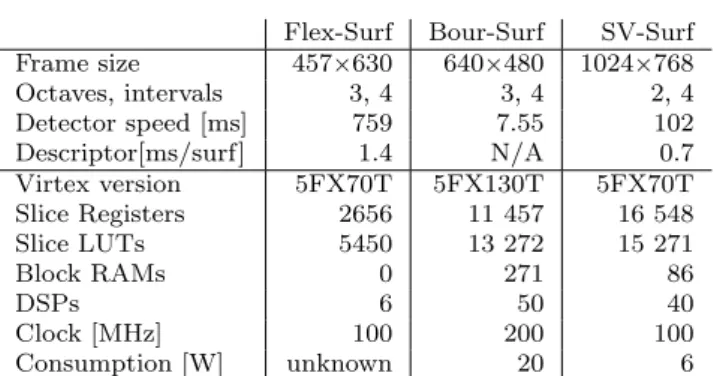
architec-Flex-Surf Bour-Surf SV-Surf Frame size 457×630 640×480 1024×768 Octaves, intervals 3, 4 3, 4 2, 4 Detector speed [ms] 759 7.55 102 Descriptor[ms/surf] 1.4 N/A 0.7 Virtex version 5FX70T 5FX130T 5FX70T Slice Registers 2656 11 457 16 548 Slice LUTs 5450 13 272 15 271 Block RAMs 0 271 86 DSPs 6 50 40 Clock [MHz] 100 200 100 Consumption [W] unknown 20 6
Table 1: FPGA SURF implementation comparison
ture for industrial applications. From this paper it can be concluded that massive parallelization of the detec-tion phase in a larger FPGA might boost the SURF algorithm speed dramatically. Table 1 shows the area consumption and performance characteristics of Flex-, Bouris- and SV- SURF implementations. All of these FPGA SURF versions are implemented in the same FPGA Family as our proposal, so speed and perfor-mance comparisons can be done. However, each of the implementations chooses a different way to deal with descriptor calculation. The Flex- and SV-SURF imple-ment the descriptor on the Xilinx PPC in fixed and floating point respectively, while the Bouris descrip-tor is wired in FPGA logic. Moreover, the SV-SURF descriptor omits the orientation assignment phase and the Bouris implements only the orientation assignment. Therefore, the descriptor speed in Table 1 is informative only and should not be used as performance measure.
The rest of the Table 1 contains detector implemen-tation details, i.e. only the IP cores relevant to detec-tor calculation are taken into account when estimat-ing FPGA area consumption. Our implementation is 16 times faster than the Flex-SURF, but occupies more of the FPGA circuitry. When comparing to Bouris-SURF, we can see that our detector is slower. However, our module processes larger images, implements descriptor calculation and consumes less power. This follows the known thumbnail rule that better throughput can be achieved through further parallelization at the cost of area and power consumption.
Note that both Flex- and Bouris-SURF methods run on multi purpose development boards. The Bouris-SURF implementation is tested by loading a reduced set of images in the Flash memory and therefore its de-ployment in real world scenarios is rather limited. The FPGA-based object recognition system [30] includes a complete processing from image grabbing to informa-tion output. However, the presented soluinforma-tion is tar-geted for a particular application, which does not im-pose a strict real-time restictions. Due to this, it
pro-cesses lower (320×240) resolution images with slightly lower framerates compared to our implementation. This would prevent the usage of the module in scenarios like visual based mobile robot navigation.
Contrary to the aforementioned solutions, our work presents a complete standalone low power module that can be easily adapted for applications that use Speeded Up Robust Features as a core algorithm. We have not only accelerated the SURF algorithm by implementing several IP cores in FPGA logic, but also built a hard-ware baseboard especially customized for machine vi-sion applications. This baseboard includes the required power supplies, a camera interface, extra SSRAM mem-ory, a SD card slot and SATA connectors for chaining several modules together for multicamera applications. Thus, the presented low power module can be used in real life applications. Moreover, we have adapted a Linux distribution so the applications using the ex-tracted features can be deployed and tested comfort-ably.
3 SURF algorithm
The SURF algorithm [5] takes a grayscale image as an input and returns a set of interest point locations along with a set of their descriptors, which are partially invari-ant to viewpoint and illumination changes. The algo-rithm relies on estimation of Gaussian and Haar wave-let filter responses by box filters. It processes the image in four consecutive stages. First, the method calculates a so-called integral imageIΣ, which is used to speed up
the following stages of the algorithm. Then, points of interest are identified by means of “Fast Hessian” blob detector, which pinpoints local brightness extrema. In the third stage, each interest point is assigned an ori-entation based on the direction of a highest brightness gradient of its neighbourhood. Finally, the method cal-culates a multidimensional descriptor from luminance gradients around the interest point.
3.1 Integral image calculation
The integral image (IΣ) is calculated from the original
imageIby means of the following equation : IΣ(x, y) = x X i=0 y X j=0 I(i, j).
The integral image allows to calculate the response of a box filter of any size by means of three additions. Exploiting this fact in the following stages of the SURF algorithm leads to a significant speedup of the entire method.
3.2 Interest point detector
The purpose of the second stage is to identify interest points, which would retain their positions in the per-ceived scene despite changes in viewpoint and illumina-tion. These points are located by finding local maxima of image Hessian determinants approximated by H(x, y, σ) = Dxx(x, y, σ)Dxy(x, y, σ) Dxy(x, y, σ)Dyy(x, y, σ) , (1)
whereDxx(x, y, σ) represents a convolution with an
ap-proximated second order derivative of a two dimen-sional Gaussian of variance σ. To achieve scale invari-ance, the algorithm uses filters with multiple sizes, cre-ating a three dimensional space of determinant results, called a “scale space”. The scale is quantized to “oc-taves”, where an octave refers to a series of “intervals” covering a doubling of scale. The SURF detector ap-proximates the Gaussian kernels with box filters (see Figure 1a), which are calculated much faster from the integral image. Once the scale space is calculated, its
(a) Gaussian and box filter kernels.
(b) Indoor scene with identified SURF points
Fig. 1: SURF detector principle and results
local maxima are found and those which pass a prese-lected threshold indicate position of the interest points. A typical result of the SURF detector is shown on Fig-ure 1b.
3.3 Orientation assignment
The interest point is then assigned a “dominant direc-tion”, which is calculated from the responses of Haar wavelet filters centered around the interest point. Since the presented module is primarily aimed for applica-tions in mobile robotics domain, we assume that its camera will be oriented horizontally. In this case, the camera rotation along its optical axis can be obtained by accelerometric measurements and rotation invari-ance is not needed. Therefore, our module does not implement the orientation assignment step.
3.4 Descriptor calculation
The final stage establishes a SURF descriptor from a square shaped interest point neighborhood. This neigh-borhood is divided in 16 equal sub-squares, which are regularly sampled by Haar wavelet filters. Horizontal
dxand verticaldy Haar wavelet responses within each
sub-square are summed to form a vector consisting of P
dx,Pdy,P|dx|,P|dy|, which describes the
particu-lar sub-square. The vectors of all subsquares are chained to form a 64 dimensional SURF descriptor, which is fi-nally normalized.
A sign of the Hessian matrix trace calculated during the detection step is included in the descriptor. Since interest points are usually found on blob-like structures, this sign distinguishes light blobs on dark background and vice versa.
4 Hardware overview
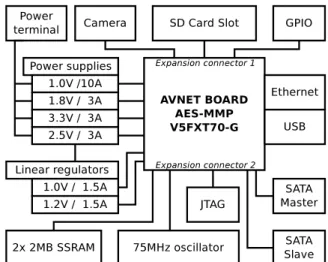
The designed module is based on Avnet AES-MMP-V5FXT70-G MiniModule Plus. This COTS module of-fers Xilinx Virtex5 FXT FPGA, 64MB DDR2 SDRAM, 32MB flash, USB 2.0, 1G Ethernet and two 120-pin expansion connectors for baseboard attachment. The baseboard has to provide a module with all required power supplies. Thus the core of our hardware solution lies in a custom-designed baseboard for this module, tailored specifically for computer vision applications. Figure 2 shows main hardware features of our module.
4.1 Generic baseboard features
The board power supplies, expansion connector, SD slot, etc. - these elements belong to a group of features that is useful in almost every embedded system design. However, our baseboard also contains two SATA con-nectors. A possible application is to connect a hard-drive to one of them and gain a noticeably large stor-age for the embedded project. But the role of the sec-ond is less obvious – it is wired as a slave port, which allows to daisy-chain two or more of our modules us-ing ordinary SATA cable. This feature provides a fast and low-power link useful e.g. for stereovision applica-tions. The two stand-offs are designed for a FPGA heat
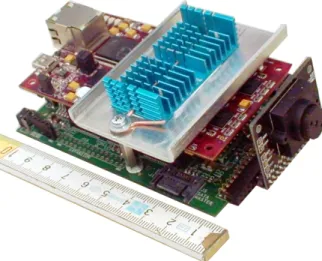
Fig. 3: The module with an attached camera.
sink, which also helps to hold the mini-module firmly attached to the baseboard. Since the module has been used for other image processing methods, which might have a higher power consumption, a large heatsink has been placed on top of the FPGA, see Picture 19. How-ever, this heatsink is not needed when the FPGA is running the method presented in this article.
4.2 Computer-vision specific baseboard features The baseboard provides several features that are tai-lored specifically for the computer vision applications. The camera connector, located in front of the mod-ule, contains 25 general purpose IOs as well as filtered 3.3V and 2.5V power supplies. Currently, it is used to communicate with the OmniVision OV9653 CMOS sen-sor. The module resolution is 1300×1028 and maximal frame rate is 120 fps. In current configuration, the
cam-era is set to 30 fps, 1024×768 pixels and YUV 4:2:2 output format.
The GS816032BGT SSRAM has been included to support demanding memory requirements. It allows the user to store 4MB of data accessible through a 32bit 200MHz synchronous interface. The most significant advantage of this memory over the DDR2 SDRAM is that its contents can be accessed in an arbitrary order without any bandwidth penalty.
5 Hardware/Software co-design solution
The algorithm to generate the SURF descriptors follows the original SURF description as closely as possible. The most time-consuming part of SURF (the interest point detection) has been selected for hardware imple-mentation using FPGA logic. The SURF descriptors are then calculated by software running on the PowerPC-440 embedded processor incorporated in the Virtex-5 FXT. The BusyBox-based Linux distribution has been created to make the module easily usable. The custom hardware-based image processing pipelines are available to the user thanks to custom-designed kernel module which controls their operation.
Since the Fast-Hessian detector is computed in hard-ware, the determinant calculation is done in integer arithmetic with a limited precision for a specific num-ber of octaves and scale intervals and limited image size. Current image size limit is 1024×1024 pixels and our IP cores are designed to calculate determinants in two octaves and four intervals per octave.
5.1 HW/SW partitioning
To decide which phase of the SURF algorithm to im-plement in hardware, we have considered the potential speed gain, complexity of implementation and depen-dencies of the individual steps. Since the desired mod-ule application scenario is visual based navigation of small mobile robots, the SURF detector and descriptor performance has been tested on a nettop PC2, which might be carried even by a small robot. The time to extract n SURF features from one 1024×768 image takes 5200 + 1.4n milliseconds for the PC’s CPU and 105 + 0.1nmilliseconds for the PC’s GPU, see Table 2. This result suggests, that if the number of features re-quired by the intended module’s application scenarios would not be too high, the most time consuming phase of the algorithm is the interest point detection. The vi-sual navigation algorithm [17] which is intended to be
2 For profiling, we used a NT330-i with Intel Atom 330 1.6GHz, 1GB RAM and nVidia ION graphics card
used with the module is reported to use about 150 land-marks. In this case, more than 97% of the CPU time is spend with interest point detection. Moreover, the speed of the GPU SURF implementation indicates that parallelizing the detector achieves a higher speedup fac-tor than parallelizing the descripfac-tor. Considering the fact, that migrating the descriptor calculation to hard-ware is at least as complex as migrating the detector, we have decided to run the descriptor calculation sim-ply on the module’s PPC.
5.2 FPGA configuration
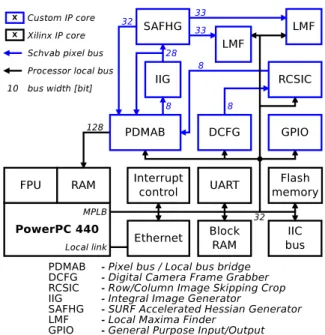
Fig. 4: Current overall PSoC architecture
The main role in the FPGA part of our design is played by several custom-designed reusable blocks de-scribed in following subsections. All of them conform to Xilinx XPS IP core specification which allows their easy integration into arbitrary PSoC design. The most commonly-used IP core is Schvab Pixel Bus (SPB), a single-master, multi-slave unidirectional bus with zero latency and a tiny logic overhead. It is basically an uni-fied interface between all data processing blocks.
Another important block is the (PDMAB) bridge. It allows user to feed data to/consume data from the SPB. Current version provides three SPB slaves and one mas-ter. This block is connected through its 128-bit PLB master to Xilinx crossbar switch and allows convenient direct access to main module memory (64MB DDR2).
Our system is based on a straightforward pipeline-like structure, that can be reconfigured for different
pur-poses. For example, using the SPB to connect the mas-ter port of the (PDMAB) to one of its slave ports creates a simple DMA engine. The following subsections describe image processing blocks - these can be daisy chained in the XPS using SPB to obtain an “image processing chain”. The chain has to have a source of image data and a sink3.
Our current design features two processing chains. The first one ( DCFG → RCSIC → PDMAB ) can grab, subsample and crop image frames from the attached camera and store them into the main memory. The sec-ond one (PDMAB→IIG→SAFHG→LMF) can take an image from main memory, calculate its integral image, calculate Fast-Hessian responses and search them for lo-cal maxima. As you can see from Figure 4, the second chain’s two branches return toPDMAB. The first branch serves to store integral image data from currently pro-cessed image into main memory for descriptor calcu-lation and the second (branch from SAFHG) serves for possible debugging ofSAFHG- it can store Fast-Hessian results into main memory for later analysis.
Some algorithm parameters – such as number of oc-taves – are given by the system and IP-core architec-ture. If the user would wish to change these, he would need to modify the FPGA design only on the system level withouth altering the IP cores.
For example the addition of two more octaves would require branching the second processing chain, subsam-pling the data stream (RCSIC) and addition of instances ofSAFHGandLMF. This addition wouldn’t slow down the detector (since the original chain would still be operat-ing in parallel on 4×larger image) but it would cost a significant amount of FPGA resources.
The run-time parameters of the image processing (such as sizes, thresholds, subsampling, memory ad-dresses) are controllable using ordinary PLB-attached register banks on appropriate processing blocks. One of important characteristics of our solution is that thanks to the DMA capabilities the CPU doesn’t have to touch the image data until it wants to calculate the descriptor or send the image through the Ethernet.
5.3 Digital Camera Frame Grabber
The Digital Camera Frame Grabber (DCFG) core is de-signed to adapt a CMOS camera interface to the SPB. This core not only transfers data, but also generates synchronization signals for the SPB from the vertical and horizontal timing signals of the camera. So far we have tested this IP with the OmniVision OV9653
era chip, which provides 16 bits per image pixel in YUV 4:2:2 format over an 8-bit data bus.
5.4 Row Column Skipping Image Crop
The Row Column Skipping Image Crop (RCSIC) core is capable of subsampling and/or cropping images going through the SPB.
Fig. 5: TheRCSICcore scheme.
The image subsampling and cropping is performed by suppressing a preset number of pixels. Due to sim-plicity of this core operation, it does not introduce any delay to the SPB. This core has been added to the de-sign to allow greater flexibility of the module, because some applications do not require a full scale image or process only part of it. For example, the visual mobile robot navigation presented in [17] requires only the up-per half of the image. However, in our exup-periments, we did not use this core to alter the image. The opera-tional parameters of this core are run-time modifiable using configuration registers.
5.5 Integral Image Generator
The Integral Image Generator (IIG) core is responsible for the integral image generation.
Fig. 6: TheIIGcore scheme.
The structure and principle of operation of this core can be seen in Figure 6. As aforementioned the result-ing integral image is sent not only to the Fast Hessian
Generator, but also to the main memory for later reuse by the descriptor calculator, see Figure. 4.
5.6 SURF Accelerator - Fast-Hessian Generator
Fig. 7: TheSAFHGcore block diagram.
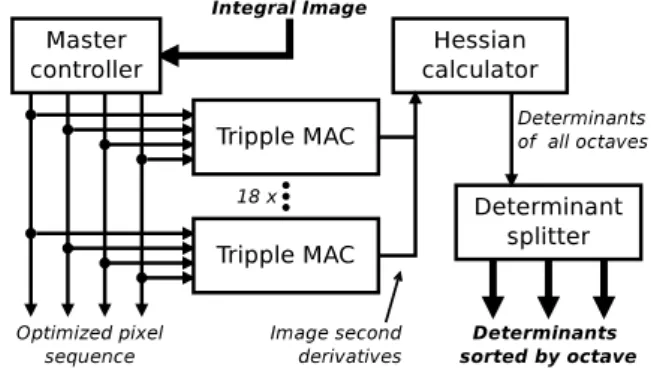
The SURF Accelerator - Fast-Hessian Generator IP core (SAFHG) (Fig. 7) is a key component of SURF de-tector acceleration. It calculates the Fast-Hessian re-sponses from the integral image and forms the entire scale space used by the detector. An important factor influencing the performance of the determinant calcu-lation is the optimization of memory access, which is performed by theMasterControllerblock. This block outputs integral image data in a parallel optimized or-der suitable for image second oror-der or-derivatives calcu-lations in the TripleMACblocks. Afterwards, the final determinant values are calculated by theHessianCalc
block. The resulting stream of determinants, which con-tains mixed values from two scale space octaves, is split by the Determinant Block Triple Splitter (DBTS) block. The following three subsections explain the key compo-nents of theSAFHGcore in more detail.
5.7 Master Controller
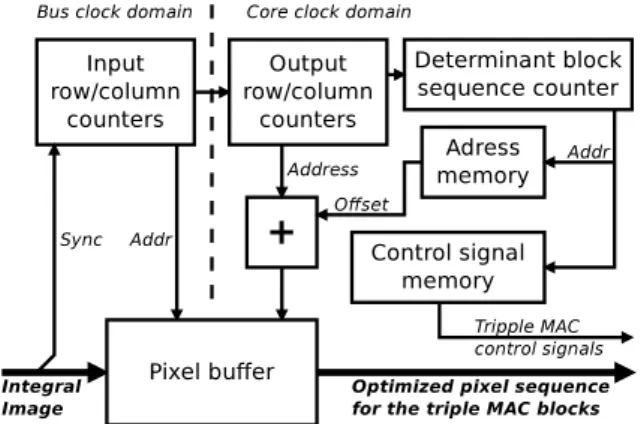
This block produces optimally ordered stream of inte-gral image data suitable for image derivatives calcu-lation by theTriple MAC blocks. Master controller
iterates through the image data in a 2×2 pixel steps – this is step referred to as a “determinant block”. One such “determinant block” requires calculation of 18 de-terminants (2×2 pixels×4 intervals for the first octave and additional 2 for the second octave). If we overlay all box filter masks (for integral image) for all deter-minants in one block and count how many times each pixel is read we can count that one determinant block
calculation requires reading of 576 integral image values on 405 unique locations inside a 52×52 pixel area. The main task ofMasterControlleris to read this data as fast as possible in an optimized order.
Fig. 8: TheMaster controller core block diagram.
ThePixelBuffer inside theMasterControllerblock contains 56 block RAMs each with the capacity of 36kb. Each block RAM contains exactly one image line, which simplifies the address calculation but imposes a con-straint on a maximum image line length4. The buffer
is divided into four quarters, each of which outputs its data to one output bus. Each TripleMAC can grab a value from one bus during one clock cycle. To prevent the need for re-reading any integral image pixel, all
TripleMACs that require the same image pixel for cal-culation of one of their determinants have to be able to store this value at the instant of its presence on one of the buses. Since every pixel of an integral image is required for derivative calculation at most 18×, at least 18 TripleMAC blocks are needed. The aforementioned architectural characteristics imposes restrictions on the integral image read order as well as on the assignment of calculated derivatives to the TripleMACblocks. To construct this reading sequence we have created a set of scripts that try to assemble an optimal read sequence which respects all aforementioned constraints. During the “placement” process (the pixels are “placed” into bus cycles) the script tries to first satisfy the pixels with higher utilization, continuing to less utilized pixels, while verifying placement conformity to the aforemen-tioned restrictions. Although the placement method is based on a relatively simple principle, its result is quite
4 Currently, the image width is limited to 1024 pixels. The BRAM usage is essentially given by the maximal box filter di-mension, since all the needed image lines must be in the buffer for this calculation. Hence, if the design would be ported to a bigger FPGA with say twice the BRAM resources, the image width could be also roughly doubled.
satisfying – only less than 10% of bus cycles are idle. This whole block represents, in fact, something like an algorithm-optimized cache memory, which plays a key role in the performance of our solution. Its architecture has been chosen as a tradeoff between logic utilization, performance and limitations to the image size.
5.8 Triple MAC
Fig. 9: TheTriple MAC core block diagram.
Calculation of an image derivativeDxx, Dyy orDxy
(see section 3.2) means addition of 8 or 16 integral im-age values multiplied by a coefficient. EachTripleMAC
core handles calculation of three image derivatives. This kind of multiplexing in combination with the nature of a multiply-accumulate task results in a delay in pro-cessing. The block needs two clock cycles to process a value with coefficient ±1 and four clock cycles to pro-cess a value with coefficient ±3. This is because coef-ficient ±3 is not implemented as a multiplication but as 3 addition/substractions. The TripleMAC block has a two position input FIFO to capture the incoming in-tegral image data when required (this FIFO makes the read sequence assembly much simpler).
5.9 Hessian Calculator
Fig. 10: TheHessian calculatorcore block diagram.
This block is responsible for the final calculation of the Fast-Hessian responses. It is activated as soon as
theMaster Controllerfinishes the determinant block data read cycle and the image derivatives are stored in TripleMAC output registers. It uses a simple state machine to run through a predetermined sequence in which it reads the image derivatives from TripleMAC
blocks and calculates the determinants. The calcula-tion is done using fixed point arithmetic and a certain degree of precision might be lost due to the necessary rounding. This is the last important block in theSAFHG
IP core, following is only a simple splitter (DBTS) that outputs Fast-Hessians to a SPB port appropriately to their octave.
5.10 Local Maxima Finder
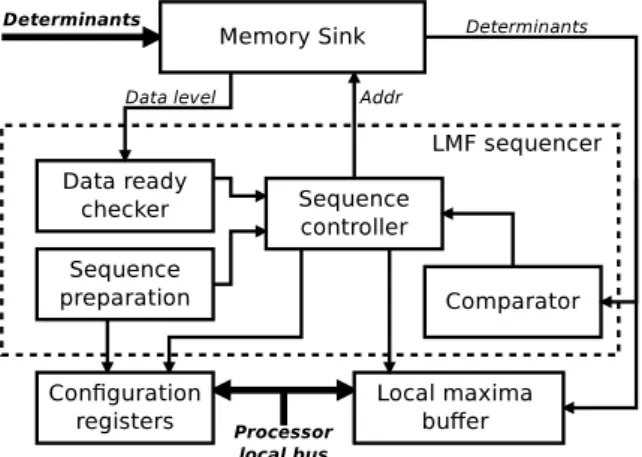
The Local Maxima Finder (LMF) is capable of perform-ing the thresholdperform-ing and non-maxima suppression on an arbitrarily organized multi–dimensional data incoming through SPB. Its purpose is to search for local maxima of the determinants calculated by the SAFHG IP core. There are two ofLMFblocks in the processing chain, one for each scale space octave. Its structure is depicted in the Figure 11.
Fig. 11: TheLMFcore block diagram.
TheMemory Sinkis essentially a FIFO specifically designed to buffer two dimensional data that are coming through SPB. Since at this point we are working with 3D scale space data and SPB contains sync signals only for 2D, we have to know the data order in advance. The order of scale space data for one pixel is constant due to a constant calculation order of the SAFHG IP core and thus we are able to always identify which value belongs to which scale.
The organization of Fast Hessian data stored in the
Memory Sink depends on the given octave. While the first octave has data pixels organized in 2×blocks, the
second octave is organized in a pixel by pixel man-ner. Thus, the first octave needs 4 different offset se-quences to go through each pixel scale-space neighbor-hood, while the second octave offset sequence is the same for every pixel. We have generated these 5 se-quences using an automation script.
These sequences are passed toLMF sequencerusing VHDL generic map – that means that user is eventually able to configure whichLMFcorresponds to which data layout (octave) using XPS IP core properties. The user of this core can also write a new offset sequence opti-mized for his particular data layout and re-use this core for different project. Hence, the role ofLMF sequencer
is to take these pre–configured sequences and apply them to data in theMemory Sink. When the running sequence discovers a neighboring data element bigger than the current comparison pilot element, it is can-celed and sequencer moves to the new pilot pixel. The same applies for the comparison with threshold – it is of course done before the sequence is started. The thresh-old is run-time adjustable using configuration registers. During the run of the comparison sequence the neigh-boring scale–space values are stored to an output buffer, which is read by the software in case the local max-ima is discovered and used for position interpolation. For convenience, theLMFIP Core generates interrupts when the output buffer contains a configurable amount of local maxima records
Aside from a quite complex offset calculation the sequencer has to watch for the data level in the buffer. Depending on the data layout we either have to store one or two complete lines of data in theMemory Sink. One line hast to be stored in the case when the data are transferred in serialized blocks corresponding to 2×2 pixel areas (1st octave) and two lines are for a case
when the data arrive only in quadruplets correspond-ing to each pixel (2nd, subsampled octave). So, during
the comparison sequence run a substantial portion of theMemory Sink has to be protected to prevent data corruption. The logic has to watch out also for image boundaries, so that data from two subsequent images are not mixed together.
5.11 HW/SW co-design summary
In this subsection we summarize the overall operation of our accelerator, focusing only on the processing chain of the SURF accelerator and including hardware-software interactions. Let’s assume we have several images stored in the main memory at arbitrary locations. First, two commands per image are written into the command queue of thePDMAB– one to set the destination of inte-gral image data and second to set the source image data
address, size and line length. Since the command queue has several positions5we can enqueue several images for
continuous processing. Once the second command is re-ceived, thePDMABstarts feeding image data into its SPB master port. These data go throughIIG, where integral image is calculated synchronously. Afterward, the data continues to the SAFHG for Fast-Hessian calculation – at this point the data flow is limited using SPB hand-shake signals. Integral image data stream is also simul-taneously taken to the PDMAB slave port, which stores them at a requested location (first PDMAB command). Fast-Hessian results travel into the LMFblocks where, if local maxima is found, a new record (maxima and its neighborhood) is stored in the output FIFO. When the FIFO fullness reaches a certain level, an interrupt is generated and the device driver reads the local maxima records. If the FIFO is not emptied quickly enough and becomes full, the operation of the processing chain is stalled – again using the SPB handshake signals. The software then performs interpolation of the local max-ima positions and calculates the SURF descriptor using the pre-stored integral image data in the main memory. When thePDMABfinishes reading one image, it auto-matically moves to another (if the commands have been entered), while the software processing of the first image is still running, i.e. the PPC is calculating descriptors of a previous image while a new image is being processed by the detector chain. The user can control this process using Linux device nodes.
6 Experiments
The purpose of the performed experiments is to evalu-ate the overall module performance and test its correct-ness and applicability in a mobile robot navigation sce-nario. The module performance is evaluated not only in terms of the features’ repeatability and distinctiveness, but also processing speed, power consumption, spatial demands and the usability in a real world scenario.
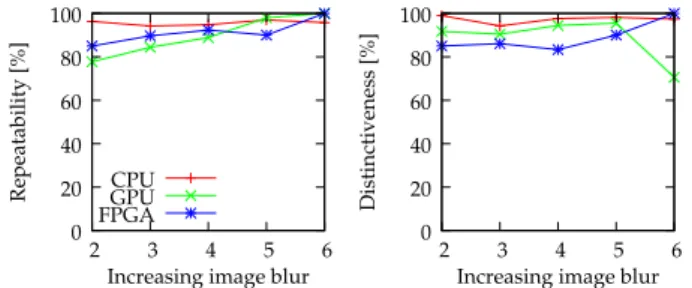
Our main concern was the impact of the changes introduced to the original SURF implementation on the algorithm ability to establish correct feature corre-spondences. This could have been severely affected due to decreased precision of the detector caused by using fixed-point arithmetics during the Fast-Hessian calcu-lation. To evaluate the impact on lowering calculation precision on algorithm efficiency, we have compared the repeatability and distinctiveness of the CPU-, GPU-and FPGA-SURF with the Mikolajczyk dataset [20].
Since one of the intended module applications is ground robot visual localization, mapping and
naviga-5 their number is set by anPDMABIP core parameter
tion, the distinctiveness of the FPGA-SURF has been measured with another, larger dataset as well. The lat-ter dataset is more typical for a mobile robot visual na-vigation scenario. In a final test, a small mobile robot has autonomously traversed 1 km long path using the module as a core component of its navigation system.
6.1 Performance with a classical dataset
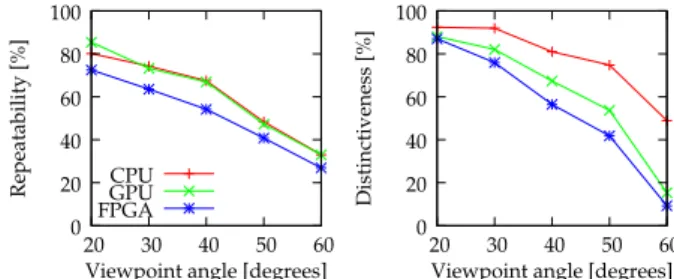
The goal of this test is to compare the FPGA-SURF to the CPU- and GPU- implementations using a well-known methodic proposed by Mikolajczyk [21]. The re-peatability calculation has been performed for the orig-inal CPU version of the detector, which uses double precision numbers, GPU implementation, which uses single precision numbers and the FPGA implementa-tion, which uses fixed point arithmetics.
Since imprecision in detector calculation might af-fect the following stages, the distinctiveness of the algo-rithms was tested as well. Both repeatability and dis-tinctiveness tests were performed on the Mikolajczyk dataset, which is available online [20] along with a set of testing scripts.
To achieve a fair comparison, we have removed the orientation assignment phase from the original imple-mentations of CPU- and GPU- implementation and set them to use the same number of octaves as the FPGA-SURF. Since the orientation assignment has been re-moved and the extractor is not rotation invariant, we have tested the repeatability and distinctiveness with relevant sequences only, i.e. sequences with varying blur, viewpoint, compression and contrast.
CPU GPU FPGA 0 20 40 60 80 100 20 30 40 50 60 Repeatability [%]
Viewpoint angle [degrees] 0 20 40 60 80 100 20 30 40 50 60 Distinctiveness [%]
Viewpoint angle [degrees]
Fig. 12: Algorithm repeatability and distinctiveness with the ‘wall’ sequence - view point change
One can see that the repeatability of the FPGA im-plementation is lower compared to the SURF versions, which use floating-point arithmetics. However, distinc-tiveness of the detector is affected only slightly com-pared to the original implementations. Note the poor distinctiveness on the ‘graffiti’ dataset, which is caused by strong rotation of the images.
CPU GPU FPGA 0 20 40 60 80 100 20 30 40 50 60 Repeatability [%]
Viewpoint angle [degrees] 0 20 40 60 80 100 20 30 40 50 60 Distinctiveness [%]
Viewpoint angle [degrees]
Fig. 13: Algorithm repeatability and distinctiveness with the ‘graffiti’ sequence - view point change
CPU GPU FPGA 0 20 40 60 80 100 2 3 4 5 6 Repeatability [%]
Increasing image blur
0 20 40 60 80 100 2 3 4 5 6 Distinctiveness [%]
Increasing image blur Fig. 14: Algorithm repeatability and distinctiveness with the ‘bikes’ sequence - variable image blur
CPU GPU FPGA 0 20 40 60 80 100 2 3 4 5 6 Repeatability [%]
Increasing image blur
0 20 40 60 80 100 2 3 4 5 6 Distinctiveness [%]
Increasing image blur Fig. 15: Algorithm repeatability and distinctiveness with the ‘trees’ sequence - variable image blur
CPU GPU FPGA 0 20 40 60 80 100 2 3 4 5 6 Repeatability [%] Decreasing light 0 20 40 60 80 100 2 3 4 5 6 Distinctiveness [%] Decreasing light
Fig. 16: Algorithm repeatability and distinctiveness with the ‘Leuven’ sequence - variable image contrast
6.2 Performance in a mobile robot navigation scenario Since the module is intended primarily for visual based localization and navigation of small mobile robots,
CPU GPU FPGA 0 20 40 60 80 100 2 3 4 5 6 Repeatability [%]
Decreasing compression quality 0 20 40 60 80 100 2 3 4 5 6 Distinctiveness [%]
Decreasing compression quality
Fig. 17: Algorithm repeatability and distinctiveness with the ‘UBC’ sequence - variable jpeg compression
other test has been performed using a dataset typical for such a task. In case of visual based mapping, the primary measure of module’s performance is its ability to track features in a sequence of images captured by its camera. This ability is closely related with the dis-tinctiveness of the feature extractor. To establish the
Fig. 18: Typical dataset images
method distinctiveness in real world conditions, we have decided to use a dataset created by a mobile robot mov-ing in a park-like environment. The dataset consists of 5000 (1024×768 pixel) images taken by the robot on-board camera during five 1 km long teleoperated runs in diverse conditions, see Figure 18. The robot onboard camera was aimed in the direction of the robot move-ment, and a picture was taken every time the robot traveled one meter or performed a sharp turn.
6.2.1 Measuring distinctiveness
To establish the method’s distinctiveness, the images were streamed through the module which was set to ex-tract 500 SURF features per image on average. For each two consecutive images, the tentative correspondences were established based on the Euclidean distances of the SURF descriptors. Using the eight-point algorithm and RANSAC, the viewpoint change (represented by the fundamental matrix) between the images was cal-culated. With the calculated viewpoint change, the va-lidity of tentative correspondences can be established
by means of epipolar geometry. To check the validity of each pair, the epipolar lines of the corresponding points were calculated using the fundamental matrix and the distance of each point from its epipolar line is calculated. If the corresponding points lie closer than 2 pixels to the epipolar lines, the correspondence is marked as valid. The ratio of valid to tentative cor-respondences of the entire dataset was then considered as a distinctiveness measure. During this test, the mod-ule has extracted over 2.5 million features (5000 images ×500 features/image) and has established over 500 000 tentative correspondences.
6.2.2 Measuring speed
To determine the computational performance of the module, its speed has been measured by the time needed to process the individual pictures of the aforementioned dataset. Such a test reflects the real performance of the module in a better way that measuring the speed of the individual parts of the algorithm in separate because it includes all the overheads, communication delays etc. For the sake of simplicity, we assume that the detec-tor speed is not significantly affected by the number of features while the time to calculate one descriptor is constant, i.e. the time t to process one image can be approximated by a linear function
t=tdet + ntdes, (2)
where tdes corresponds to the time needed to generate
one descriptor, tdet corresponds to the detector speed
and n is the number of the extracted features. To es-tablish both thetdesandtdet constants empirically, we
have measured the time needed to process the entire dataset with two different threshold valuest100andt500
that were set to obtain 100 and 500 features per image on average. Processing the dataset with thet100ort500
thresholds took 14 and 39 minutes respectively, which corresponds totdet= 100 ms andtdes= 0.7 ms/feature.
During this experiment, the module extracted over 3 million features (5000 images ×500 features/image + 5000 images×100 features/image).
6.2.3 Detector and descriptor in parallel
Note that the equation (2) allows to estimate the time it takes to process one image, i.e. the time needed from image reception to transmission of its SURF features. However, when images are streamed to the module con-tinuously, the detector processes the incoming image while the descriptor is processing the last detector out-put, i.e. the detector and descriptor are working in par-allel most of the time. In this case, the average number
of processed images per secondpcan be approximated by
p= 1
max(tdet, navgtdes)
[F P S]. (3)
where navg is the average number of features per
im-age. Equation (3) indicates that the maximal speed of the module is given by the detector performance and if number of the detected features navg is lower than tdet/tdes, the module’s performance is kept at its
maxi-mum. In Section 6.2.2, we have established thetdet and tdesto 10 ms and 0.7 ms/feature respectively, which
in-dicates that the module can extract∼140 features per frame while maintaining its maximal processing speed of 10 FPS. However, if the number of extracted features
navg exceeds 140, the module’s performance will start
to drop as navg increases (see Equation 3). E.g. while
extracting 500 features per image is possible at approxi-mately 3 FPS, extracting 1500 features takes more than one second per image. While this might seem imprac-tical, the module’s intended use, visual-based mobile robot navigation, does not require a large amount of image features [17].
6.2.4 Module performance summary
For comparison, we have measured speed and distinc-tiveness of the original CPU [5] and GPU [10] SURF implementation in the same way as described in Sec-tions 6.2. The tests have been performed on a NT330-i board with Intel Atom 1.6GHz, 1GB RAM and nVidia ION2 graphics card because of this board’s small size and low weight. Although the speed of FPGA and GPU
Platform
CPU GPU FPGA
Distinguishability [%] 98 95 95 Detector speed [ms] 5200 105 100 Descriptor speed [ms] 1.4 0.1 0.7 Consumption [W] 24 24 6 Mass [g] 850 850 210 Volume [cm3] 600 600 180
Table 2: Comparison of CPU-, GPU- and FPGA-SURF
implementations is higher than the CPU version, their distinctiveness is slightly lower. Compared to both GPU and CPU implementations, the FPGA-based solution is smaller, lighter and less power demanding.
6.3 FPGA-SURF based navigation system
The experiments described in the previous sections have been performed offline, i.e. the module has processed a
pre-collected dataset of images. Since the results in Sec-tions 6.1 and 6.2.4 indicate that the distinguishability of the FPGA- and GPU-SURF are similar, one would expect that they would perform similarly in real-world scenarios. However, the FPGA-SURF might suffer from some performance penalty that may not be captured by the tests described in Sections 6.1 and 6.2. There-fore, we have performed an additional test that veri-fies if the FPGA-SURF implementation can be used in visual-based mobile robot navigation as well as its GPU-SURF counterpart.
To test the module in a real world scenario, we have integrated it in a monocular-based mobile robot naviga-tion system. We have chosen to use the SURFNav [17] navigation method because of its ability to cope with diverse terrain, dynamic objects, obstacles, systematic measurement errors, low visibility, variable lighting con-ditions and seasonal environment changes. The original navigation method described in [17] has used the GPU-SURF algorithm that has the same distinctiveness as our FPGA-SURF implementation but needs a complete PC that makes its deployment on smaller mobile robots difficult.
To show that our solution can overcome the afore-mentioned constraint, the experimental verification was aimed at the FPGA-SURF module ability to guide a small mobile robot. The mobile robot used was based on an MMP-5 platform from The Machine Lab. Inc., equipped with a Gumstix Overo computer. The Gum-stix computer itself was running the SURFNav naviga-tion algorithm that allows the robot to autonomously navigate routes previously taught by a human operator. Since the Gumstix Overo is too slow to achieve real-time performance when extracting the SURF and the robot cannot carry a heavy PC with a sufficient com-putational power, we have equipped it with the FPGA-SURF module. The module was connected to the on-board computer via an Ethernet interface and provided it with the SURF features.
Fig. 19: MMP-5 robot with the FPGA-SURF module
To perform experimental verification, the MMP-5 robot, which was equipped with the FPGA module, has been first guided through a required path using a re-mote control, while storing the detected SURF features in its memory. The features recognized during this tele-operated run were then used to create a landmark map of the environment. Using this map the robot was able to navigate itself through the environment by matching the currently seen features to those previously mapped. A map of an approximately 100 m long indoor trail has been created and the robot has autonomously navigated this trail ten times.
Since the test has proven that the module deals with real-world conditions and FPGA-SURF distinguishabil-ity is similar to the GPU-SURF method, we can assume that a robot guided by this module would perform as well as described in [17]. However, performing experi-ments as extensive as described in [17] is beyond this paper scope.
7 Conclusion
We have presented an FPGA-based embedded module which implements the SURF image feature extraction algorithm. The presented solution, intended mainly for mobile robot navigation and mapping, offers similar distinctiveness and speed as the GPU version of the original SURF while having lower spatial and power requirements. The achieved frame rate for 1024×768 pixel images is about 10 FPS, the module dimensions are 12×8×2 cm, its mass (including camera module and heat sinks) is 210 g and it consumes less than 6 Watts. Apart from implementing the SURF algo-rithm, the module embeds a fully functional Linux dis-tribution, which allows to run applications for further processing of the acquired features. Thus, the module is comfortable to use and allows its easy customization for variety of applications, which impose spatial and com-putational constraints, but need robust invariant image feature extraction. To demonstrate the module capabil-ities, the module was used to create a navigation system for a small mobile robot and guided the robot over a 1 km long path.
The IP cores occupy about 60% of the FPGA, which leaves enough space for further module improvement and optimization. In the future, we would like to in-crease the FPGA SURF speed by implementing the de-scriptor phase of the algorithm in the FPGA logic. To achieve further speedup for most computer vision ap-plications, we also consider to add IP-cores for feature matching.
References
1. Agrawal, M., Konolige, K., Blas, M.: CenSurE: Center surround extremas for realtime feature detection and matching. In: Eur. Conf. on Computer Vision (2008) 2. Aubepart, F., El Farji, M., Franceschini, N.: FPGA
im-plementation of elementary motion detectors for the vi-sual guidance of micro-air-vehicles. In: IEEE Interna-tional Symposium on Industrial Electronics (2004) 3. Battezzati, N., Colazzo, S., Maffione, M., Senepa, L.:
SURF Algorithm in FPGA: a novel architecture for high demanding industrial applications. In: Design, Automa-tion & Test in Europe Conference & ExhibiAutoma-tion (2012) 4. Bauer, J., S¨underhauf, N., Protzel, P.: Comparing several
implementations of two recently published feature detec-tors. In: Int. Conf. on Int. and Auton. Systems (2007) 5. Bay, H., Ess, A., Tuytelaars, T., van Gool, L.:
Speeded-up robust features (SURF). Computer Vision and Image Understanding110(3), 346–359 (2008)
6. Bonato, V., Marques, E., Constantinides, G.A.: Rotation Invariant Feature Detection. IEEE Transactions on Cir-cuits and Systems for Video Technology (2008)
7. Bouris, D., Nikitakis, A., Papaefstathiou, I.: Fast and Ef-ficient FPGA-Based Feature Detection Employing the
SURF Algorithm. In: IEEE Int. Sym. on
Field-Programmable Custom Computing Machines (2010) 8. Chandrasekhar, V., et al.: Mobile Visual Search. IEEE
Signal Processing Magazine (2011). DOI 10.1109/MSP. 2011.940881
9. Chang, L., Hernandez-Palancar, J., Sucar, L., Arias-Estrada, M.: FPGA-based detection of SIFT interest key-points. Machine Vision and Applications (2013) 10. Cornelis, N., van Gool, L.: Fast scale invariant feature
detection and matching on programmable graphics hard-ware. In: IEEE International Conference on Computer Vision and Pattern Recognition (2008)
11. Davison, A.J., Reid, I.D., Molton, N.D., Stasse, O.:
MonoSLAM: Real-time single camera SLAM. IEEE
Transactions on Pattern Analysis and Mach. Int. (2007) 12. Grabner, M., Grabner, H., Bischof, H.: Fast approxi-mated SIFT. In: Proceedings of the 7th Asian conference of computer vision, pp. 918–927 (2006)
13. Harris, C., Stephens, M.: A combined corner and edge detector. In: Proceedings of the 4th Alvey Vision Con-ference, pp. 147–151 (1988)
14. Huang, F.C., Huang, S.Y., Ker, J.W., Chen, Y.C.: High-Performance SIFT Hardware Accelerator for Real-Time Image Feature Extraction. IEEE Transactions on Cir-cuits and Systems for Video Technology (2012)
15. Jorg, S., Langwald, J., Nickl, M.: FPGA based real-time visual servoing. In: Proceedings of the 17th International Conference on Pattern Recognition, vol. 1, pp. 749 – 752 Vol.1 (2004). DOI 10.1109/ICPR.2004.1334300
16. Ke, Y., Sukthankar, R.: PCA-SIFT: a more distinctive representation for local image descriptors. In: IEEE Con-ference on Computer Vision and Pattern Recognition (2004). DOI 10.1109/CVPR.2004.1315206
17. Krajn´ık, T., et al.: Simple, yet Stable Bearing-only Na-vigation. Journal of Field Robotics (2010)
18. Li, J., Allinson, N.: A comprehensive review of current local features for computer vision. Neurocomputing 71 (2008). DOI 10.1016/j.neucom.2007.11.032
19. Loncomilla, P., del Solar, J.R.: Improving SIFT-based ob-ject recognition for robot applications. In: Image Analysis and Processing (2005)
20. Mikolajczyk, K., Schmid, C.: Scale & affine invariant interest point detectors 60(1), 63–86 (2004). DOI 10.1023/B:VISI.0000027790.02288.f2
21. Mikolajczyk, K., Schmid, C.: Scale & affine invariant in-terest point detectors. Int. J. Comput. Vision60(1), 63– 86 (2004). DOI 10.1023/B:VISI.0000027790.02288.f2 22. Mikolajczyk, K., Schmid, C.: A performance evaluation of
local descriptors. IEEE Transactions on Pattern Analysis & Machine Intelligence27(10), 1615–1630 (2005). URL http://lear.inrialpes.fr/pubs/2005/MS05
23. Moravec, H.: Obstacle avoidance and navigation in the real world by a seeing robot rover. Ph.D. thesis, Robotics Institute, Carnegie Mellon University, Stanford
24. Mouragnon, E., Lhuillier, M., Dhome, M., Dekeyser, F., Sayd, P.: Real time localization and 3D reconstruction. In: IEEE Conf. on Computer Vision and Pattern Recog-nition (2006)
25. Murray, D., Little, J.J.: Using real-time stereo vision for mobile robot navigation. Autonomous Robots (2000). DOI http://dx.doi.org/10.1023/A:1008987612352 26. Price, A., Pyke, J., Ashiri, D., Cornall, T.: Real time
object detection for an unmanned aerial vehicle using an FPGA based vision system. In: IEEE Int. Conf. on Robotics and Automation (2006)
27. Sarfraz, A.S., Hellwich, O.: Head pose estimation in face recognition across pose scenarios. In: Int. Conf. on Com-puter Vision Theory and Applications (2008)
28. Schaeferling, M., Kiefer, G.: Flex-SURF: A flexible ar-chitecture for FPGA-based robust feature extraction for optical tracking systems. In: Int. Conf. on Reconfigurable Computing and FPGAs (2010)
29. Schaeferling, M., Kiefer, G.: Object recognition on a chip: A complete SURF-based system on a single FPGA. In: Int. Conf. on Reconf. Computing and FPGAs (2011) 30. Schaeferling, M., Kiefer, G.: Object Recognition on a
Chip: A Complete SURF-Based System on a Single FPGA. In: Int. Conf. on Reconfigurable Computing and FPGAs (2011)
31. Se, S., Lowe, D., Little, J.: Vision-based mobile robot localization and mapping using scale-invariant features. In: IEEE Int. Conf. on Robotics and Automation (2001) 32. Se, S., et al.: Vision based modeling and localization for planetary exploration rovers. In: International Astronau-tical Congress (2004)
33. ˇSv´ab, J., Krajn´ık, T., Faigl, J., Pˇreuˇcil, L.: FPGA-based Speeded Up Robust Features. In: IEEE Int. Conf. on Technologies for Practical Robot Applications (2009) 34. Thorpe, C., Hebert, M., Kanade, T., Shafer, S.: Vision
and navigation for the Carnegie-Mellon Navlab. IEEE Trans. on Pattern Analysis and Machine Int. (1988) 35. Tippetts, B., Lee, D.J., Archibald, J.: An on-board vision
sensor system for small unmanned vehicle applications. Machine Vision and Applications (2012)
36. Tippetts, B., et al.: FPGA implementation of a feature detection and tracking algorithm for real-time applica-tions. In: Int. Conf. on Adv. in Visual Computing (2007) 37. Williams, J., Dawood, A., Visser, S.: FPGA-based cloud detection for real-time onboard remote sensing. In: IEEE Int. Conf. on Field-Programmable Technology (2002). DOI 10.1109/FPT.2002.1188671
38. Wu, C.: SiftGPU: A GPU implementation of scale invari-ant feature transform (SIFT). URLhttp://cs.unc.edu/ ~ccwu/siftgpu
39. Yao, L., Feng, H., Zhu, Y., Jiang, Z., Zhao, D., Feng, W.: An architecture of optimised SIFT feature detec-tion for an FPGA implementadetec-tion of an image matcher. Int. Conf. on Field-Programmable Technology pp. 30–37 (2009). DOI 10.1109/FPT.2009.5377651