PLEASE SCROLL DOWN FOR ARTICLE
On: 14 December 2010Access details: Access Details: [subscription number 910948958] Publisher Routledge
Informa Ltd Registered in England and Wales Registered Number: 1072954 Registered office: Mortimer House, 37-41 Mortimer Street, London W1T 3JH, UK
Psychosis
Publication details, including instructions for authors and subscription information:
http://www.informaworld.com/smpp/title~content=t777186832
Are social phobia and paranoia related, and which comes first?
J. Rietdijka; J. van Osb; R. de Graafc; Ph. Delespaulbd; M. van der Gaagaea VU University Amsterdam, The Netherlands b Maastricht University, Maastricht, The Netherlands c Netherlands Institute of Mental Health and Addiction, Utrecht, The Netherlands d Mondriaan, Maastricht, The Netherlands e Parnassia Psychiatric Institute, The Hague, The Netherlands
To cite this Article Rietdijk, J. , van Os, J. , Graaf, R. de , Delespaul, Ph. and Gaag, M. van der(2009) 'Are social phobia and paranoia related, and which comes first?', Psychosis, 1: 1, 29 — 38
To link to this Article: DOI: 10.1080/17522430802654105
URL: http://dx.doi.org/10.1080/17522430802654105
Full terms and conditions of use: http://www.informaworld.com/terms-and-conditions-of-access.pdf
This article may be used for research, teaching and private study purposes. Any substantial or systematic reproduction, re-distribution, re-selling, loan or sub-licensing, systematic supply or distribution in any form to anyone is expressly forbidden.
The publisher does not give any warranty express or implied or make any representation that the contents will be complete or accurate or up to date. The accuracy of any instructions, formulae and drug doses should be independently verified with primary sources. The publisher shall not be liable for any loss, actions, claims, proceedings, demand or costs or damages whatsoever or howsoever caused arising directly or indirectly in connection with or arising out of the use of this material.
Psychosis
Vol. 1, No. 1, February 2009, 29–38
ISSN 1752-2439 print/ISSN 1752-2447 online © 2009 Taylor & Francis
DOI: 10.1080/17522430802654105 http://www.informaworld.com
Are social phobia and paranoia related, and which comes first?
J. Rietdijk,*a J. van Os,b R. de Graaf,c Ph. Delespaulb,d and M. van der Gaaga,eaVU University Amsterdam, The Netherlands; bMaastricht University, Maastricht, The Netherlands; cNetherlands Institute of Mental Health and Addiction, Utrecht, The Netherlands; dMondriaan, Maastricht, The Netherlands; eParnassia Psychiatric Institute, The Hague, The Netherlands
Taylor and Francis RPSY_A_365580.sgm
(Received 15 October 2008; final version received 29 November 2008)
10.1080/17522430802654105 Psychosis 1752-2439 (print)/1752-2447 (online) Research Article 2008 Taylor & Francis 00 0 0000002008 Miss JudithRietdijk [email protected]
Social phobia (SPh) and paranoid symptoms (PS) are associated. They may overlap because they share psychological and behavioural mechanisms such as selective attention for social threats and avoidance behaviour. Possibly, one leads to the other. The aim of this study is to explore the association between SPh and PS in a prospective general population sample.
Adults (7076) from the NEMESIS general population were assessed for SPh and PS using the Composite International Diagnostic Interview (CIDI) at baseline, and one and three years later. Odds ratios, dose–response relationships and confidence intervals were calculated.
Lifetime SPh and PS were associated (OR=3.08; 95% CI=2.49–3.82; p<.001), with a dose response. SPh emerging after PS was significant (OR=4.07; 95% CI=2.50–6.63; p<.001), also with a dose response, i.e. more PS symptoms yield more SPh symptoms. PS emerging after SPh was not significant.
This study confirmed the association of SPh and PS in a general population. Possibly this is caused by shared underlying psychological and behavioural processes. There was some indication that paranoid ideation precedes the development of SPh, but this must be considered with caution. Clinical implications are discussed.
Keywords: paranoid symptoms; social phobia; comorbidity; general population survey
Introduction
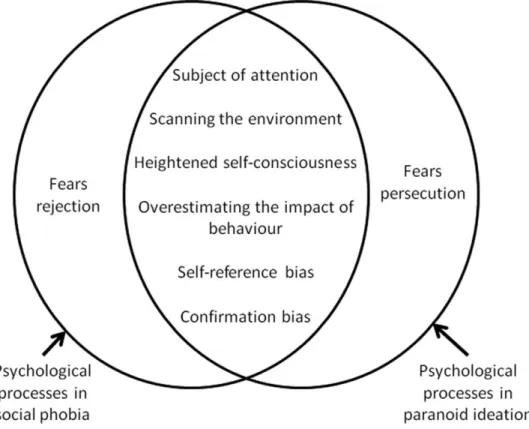
In DSM IV, social phobia (SPh) and paranoid disorders are separate disease entities. While they are regarded as non-overlapping disorders, they share psychological and behavioural mechanisms. Gilbert and colleagues found an association between paranoid ideation and social anxiety in a clinical population and suggested an overlap in psychological etiology (Gilbert, Boxal, Cheung, & Irons, 2005). Both groups of patients think that they are the object of other people’s interest and they are judged by others. They scan their environment for socially threatening information and they both have a strong self-referencing bias. Both social phobic and paranoid people easily conclude that people are talking about them (Beck, Emery, & Greenberg, 1985; Fenigstein & Vanable, 1992). They might share psychological mechanisms, but be acting on different motives. Whereas the social phobic patient is afraid of rejection, *Corresponding author. Email: [email protected]
the paranoid person is afraid of persecution. Figure 1 shows these overlapping mechanisms in SPh and PS. Other studies even suggest a relationship between social phobia and psychosis in general. Voges and Addington (2005) found that 31% of the first-episode psychosis patients met the criteria for SPh. This was confirmed by Birchwood and colleagues (2006).
Figure 1.The overlap and differences of psychological processes in social phobia and paranoid ideation.
Several explanations for the high rate of SPh in people with a psychotic disorder, and the high rate of psychosis in people with SPh, have been proposed. The first explanation is that symptom clusters overlap (Birchwood et al., 2006; Gilbert et al., 2005). The second is that SPh is a psychological reaction to psychosis. Birchwood and colleagues found that SPh emerges after the onset of psychosis. Possibly, they have more stigmatizing thoughts about their illness (Birchwood et al., 2006). A third explanation is that SPh is a co-morbid or a prodromal symptom of schizophrenia (Cassano, Pini, Settoni, & Dell’Oso, 1998; Pallanti, Quercioli, & Hollander, 2004). According to Blanchard and colleagues (1998), SPh is a stable trait that remains unrecognized because its expression is overshadowed by the negative symptoms. There is also some evidence that social or situation anxiety is a predictor of future psychosis in a genetic at-risk group (Cunningham Owens, Miller, Lawrie, & Johnstone, 2005; Tien & Eaton, 1992).
Population studies have found that psychotic-like experiences – such as suspicious-ness, hearing thoughts aloud or low-frequency hallucinatory whispering sounds – are quite prevalent (Van Os, Krabbendam, Myin-Germeys, & Delespaul, 2005). This presents the opportunity to examine the association of SPh and paranoid ideation in a
Figure 1. The overlap and differences of psychological processes in social phobia and paranoid ideation.
Psychosis 31 general population cohort. A prospective study cohort could reveal some temporal aspects of the association. The aim of this study is to explore the association between SPh and sub-clinical paranoid symptoms (PS) in a prospective general population sample. As far as we know, this is the first study of this kind. Most of the studies cited above, investigated psychotic patients (Blanchard et al., 1998; Cassano et al., 1998; Pallanti et al., 2004; Voges & Addington, 2005; Birchwood et al., 2006). The sample in the study by Cunningham Owens and colleagues was at genetic risk for schizophrenia (Cunningham Owens et al., 2005). This subgroup forms only 15% of the group which is at risk for psychosis (Yung et al., 2003) and a population cohort is therefore more representative.
Previous research in psychotic patients points to an association between SPh and PS. Can this be replicated for sub-clinical symptoms in a general population? Three hypotheses were tested:
(1) SPh and sub-clinical PS are associated;
(2) the onset of SPh emerges after the presence of sub-clinical PS; and (3) the onset of sub-clinical PS emerges after the presence of SPh.
Materials and methods
Sample
This study used the data of the Netherlands Mental Health Survey and Incidence Study (NEMESIS). NEMESIS is a prospective study of the prevalence, incidence and course of mental disorders in a representative Dutch population cohort of 7076 adults between 18 and 64 years of age. Subjects were selected by a multistage, stratified, random sampling procedure in 90 Dutch municipalities. Stratification criteria included urba-nicity and sufficient spreading over the 12 Dutch provinces. Within the municipalities, a proportional number of private households were approached, and the person with the most recent birthday was selected. Persons residing in institutions, including psychiatric hospitals, were excluded from the sample.
At baseline, 7076 individuals (response rate=69.7%) provided informed consent and completed the first interview. The research sample was representative of the Dutch population. At least one of the follow-up interviews after one or three years was completed by 5619 respondents.
For a complete description of the study design, sample procedures, quality control procedures and analyses, see Bijl, Zessen, Ravelli, Rijk, and Langendoen (1998).
CIDI interview
Respondents were interviewed by trained lay interviewers using the Composite Inter-national Diagnostic Interview (CIDI, version 1.1. computerized version; World Health Organization, 1990). The CIDI generates Axis I disorders according to DSM-III-R. The World Health Organization developed the CIDI on the basis of the Diagnostic Interview Schedule (DIS) and the Present State Examination (PSE). The CIDI is being used in epidemiological research projects all over the world. It has high inter-rater reliability, high test–retest reliability and high validity for all diagnoses, except for psychotic disorders.
When a person was suspected of psychotic symptoms, he or she was re-interviewed by a clinical psychiatrist using the Structured Clinical Interview for DSM III-R (SCID).
This interview established the presence of psychotic symptoms and the diagnoses of schizophrenia and other non-affective psychotic disorders in NEMESIS.
The CIDI psychosis section has 17 items. The first four assess paranoid ideation: (1) “Have you ever been convinced that people were spying on you?”; (2) “Has there ever been a period in which you were convinced that you were persecuted by people?”; (3) “Have you ever been convinced that you were secretly tested on or that experiments were carried out on you?”; and (4) “Have you ever been convinced that someone was conspiring against you, wanted to cause you harm or poisoning you?” For each item 6 options are possible: 1 is no symptom; 2, psychotic symptom present but not clinically relevant; 3, psychotic symptom is the result of drug use; 4, symptom is the result of disease; 5, true psychotic symptom; and 6, interviewer is in doubt because there appears to be some logical explanation for what emerges as a psychotic symptom. Presence of paranoid symptoms was broadly defined as any rating between 2 and 6 in one of the four paranoia CIDI items. The ‘present’ ratings on the CIDI psychosis items are strongly correlated (Van Os, Hanssen, Bijl, & Ravelli, 2000).
The CIDI anxiety section contains ten questions related to SPh. Because those assessments are considered valid no cross-check was done. Subjects who met the DSM criteria for SPh were recorded as such in the database.
Statistical analyses
Odds ratios (OR) and 95% confidence intervals (CI) were calculated for each hypoth-esis. The relation between PS and SPh was tested using baseline (T0) data. The second hypothesis was tested by excluding subjects with lifetime SPh at baseline and calculating the OR among those with lifetime PS at baseline for developing SPh between T0 and T2. The third hypothesis was tested by excluding subjects with life-time PS at baseline and calculating the OR among those with lifelife-time SPh at baseline for developing PS between T0 and T2.
Krabbendam and Van Os (2005) found that neuroticism was associated with psychosis as well as all anxiety disorders. Since this study aims to explore a specific association between paranoia and SPh, we controlled the ORs for the shared variance with neuroticism. Neuroticism was rated using the Groningen Scale as in other NEMESIS publications.
We used STATA statistical package, version 10 (StataCorp, 2008) to calculate the ORs, the 95% confidence intervals and the p-values.
Results
Sample
Of the original 7076 subjects at T0, 5619 persons completed the CIDI on at least one additional measurement. There were 2614 men and 3005 women. The mean age was 41 years (SD=12 years). At baseline, a total of 575 individuals (8%) reported lifetime SPh and 705 (10%) individuals reported one or more lifetime sub-clinical PS.
Hypothesis 1: Lifetime SPh and lifetime PS are associated
The odds ratio (OR) for the association between SPh and PS at baseline is shown in Table 1. At baseline, 705 subjects reported lifetime sub-clinical PS. Of this subsample,
Psychosis 33
132 (19%) subjects also reported lifetime SPh at baseline. Of the 575 subjects who reported lifetime SPh at baseline, 132 (23%) persons also reported lifetime sub-clinical PS at baseline (OR=3.09; 95% CI=2.94–3. 82; p<.001). The OR was 1.64, when controlling for neuroticism, and remained significant (p<.001). A clear dose–response relationship was found for number of PS: the OR increased from 2.30 (one symptom) to 11.41 (four symptoms). When controlling for neuroticism, the dose–response remained, but was not significant.
Hypothesis 2: The onset of SPh emerges after the presence of sub-clinical PS
To explore the relationship between sub-clinical PS at baseline and subsequently developing SPh, we excluded the data of subjects who had lifetime SPh at baseline. Eighty-four participants were unable to complete at least one of the follow-up interviews and were excluded from the analysis. Among the remaining 489 subjects who did have lifetime sub-clinical PS but no lifetime SPh at baseline, 23 subjects developed SPh (4.7%). This was significant (OR=4.07; 95% CI=2.50–6.63; p<.001). The OR remained significant after controlling for neuroticism (OR= 2.62; 95% CI=1.57–4.36; p<.001). Dose–response analysis was conducted to measure whether more sub-clinical PS resulted in higher probabilities of SPh. ORs increased from 3.22 (one paranoid symptom) to 7.62 (three symptoms) (Table 2). The dose–response relationship is weaker after controlling for neuroticism and is no longer significant in one of three steps.
Hypothesis 3: The onset of sub-clinical PS emerges after the presence of SPh
Thirty-eight subjects of those who reported SPh at baseline were lost to follow-up and were excluded from the analysis. Among the remaining 405 subjects who reported lifetime SPh at baseline, 8 (2.0%) developed sub-clinical PS after one to Table 1. The association between lifetime SPh and lifetime PS.
Not adjusted for neuroticism Adjusted for neuroticism SPh at T0 OR P 95% CI OR P 95% CI N Any sub-clinical PS at T0 3.08 <.001 2.49–3.82 1.64 <.001 1.29–2.09 132 1 Sub-clinical PS 2.30 <.001 1.78–2.98 1.40 .020 1.05–1.88 79 2 Sub-clinical PS 3.89 <.001 2.66–5.69 2.17 .001 1.40–3.35 37 3 Sub-clinical PS 3.72 <.001 1.89–7.28 1.58 .249 .73–3.44 11 4 Sub-clinical PS 11.41 <.001 3.29–39.55 1.83 .402 .44–7.57 5
Table 2. Transition to SPh from having PS at baseline.
Not adjusted for neuroticism Adjusted for neuroticism SPh at T1–2 OR P 95% CI OR P 95% CI N
Any sub-clinical PS at T0 4.07 <.001 2.50–6.63 2.62 <.001 1.57–4.36 23
1 Sub-clinical PS 3.22 <.001 1.83–5.7 2.09 .015 1.15–3.80 15 2 Sub-clinical PS 4.01 .003 1.58–10.18 3.02 .024 1.16–7.85 5 3 Sub-clinical PS 7.62 <.001 2.25–25.80 3.67 .052 .99–13.60 3
three years. The OR was non-significant (OR=2.00; 95%CI=.90–4.44; p=0.088; see Table 3).
Discussion
Many patients show co-morbid SPh and PS in clinical practice. The aim of this study was to explore the cross-sectional and temporal relationships between SPh and sub-clinical PS. We used the data of the Dutch general population study NEMESIS: a representative cohort of adults between 18 and 64 years of age. The analyses demonstrated a significant association between lifetime SPh and lifetime sub-clinical PS at baseline. This result confirms previous publications (Gilbert et al., 2005). Also the suggestion that SPh and PS share psychological processes is supported by the finding in a general population with relatively little psychopathology. The dose– response relationship provides additional support for the hypothesis that there is an association between paranoid ideation and social phobia.
Sub-clinical PS at baseline was associated with the onset of social phobia one to three years later. These results are in line with the findings of Birchwood and colleagues (2006) who found that social anxiety can be a result of a psychotic episode. A possible rationale is that patients try to hide their discomfort, confusion or ‘madness’ by withdrawing from social contact and behaving like a socially phobic subject. People monitor whether others are looking at them and become over-aware of their own behaviour. The dose–response relationship further supports the hypothesis that para-noid thoughts might lead to social phobia. Moreover, the inverse relation where social phobia leads to paranoid ideation was not significant.
This study is not addressing the association of paranoia with general pathology, but with specific aspects of social anxiety. We have tried to rule out the shared factors of psychopathology by controlling for neuroticism. Neuroticism is a higher-order construct that encompasses a broad range of emotional distress. It covers anxiety, depression and irritability that is present in 60–80% of prodromal patients before the onset of positive symptoms (Birchwood et al., 1992; Yung & McGorry, 1996). It shares variance with many disorders, and also with SPh and paranoid ideation. As expected, all the ORs decreased after controlling for neuroticism.
The hypothesis that SPh and PS are related is not new. Previous studies have demonstrated that both SPh and PS share psychological mechanisms (Beck et al., 1985; Fenigstein & Vanable, 1992; see Figure 1). Paranoid and socially phobic people both share the belief that they are subjects of other people’s attention. They both share a heightened self-consciousness, which means that they are overly aware of oneself and worry about how others will perceive their behaviour. But they act on different Table 3. Transition to PS from having SPh at baseline.
Not adjusted for neuroticism Adjusted for neuroticism Incidence of sub-clinical PS at T1–2 OR P 95% CI OR P 95% CI N SPh diagnose at T0 2.00 0.088 0.90–4.44 .89 .792 .40–2.00 8 0–5 SPh symptoms .57 .239 .22–1.45 .57 .241 .22–1.46 15 6–10 SPh symptoms .67 .701 .09–4.95 .633 .654 .09–4.65 1 11–15 SPh symptoms 7.62 .001 2.25–25.80 3.67 .052 .99–13.60 3
Psychosis 35 motives. Socially anxious people are afraid that others will judge them as incompe-tent, whereas paranoid people are afraid that others will persecute them. Fennigstein and Vanable noted that this self-consciousness in PS leads to the perception of others’ behaviour as being intentionally focused against them. This is conceptualised as the “self-as-target-bias” (Fenigstein & Vanable, 1992). Greenwald (1980) considered self-consciousness as the defining characteristic of paranoia. In his understanding of this notion, Laing (1969) argued that the self-conscious awareness of being an object of others’ awareness leads to a heightened sense of being seen. Observation by others becomes a prominent concern and is assumed more often than is actually the case. Socially anxious people are also self-consciousness (Beck et al., 1985). They think they are judged by others, just as paranoid persons do. Both groups scan the environ-ment for socially threatening information and over-estimate the impact of their own behaviour. Both have a self-reference bias and a confirmation bias, which means that they perceive trivial stimuli to be important and meaningful to the self. And once a threatening or anxious explanation occurs to them they will search for confirmation and discard disconfirmatory evidence (Beck et al., 1985; Fenigstein & Vanable, 1992).
Individual psychopathology can overlap as well (Gilbert et al., 2005). People with SPh sometimes report psychotic-like experiences. The excessive self-consciousness makes them experience their voice as coming from an external source or their self as being outside their body. This might explain why SPh with heightened self-consciousness could lead to paranoia. However, in this study the hypothesis that social phobia is a precursor of paranoid ideation was not confirmed (p=0.088) and no dose–response relationship was found. What might explain this negative finding? According to Freeman and colleagues an additional condition – also having percep-tual aberrations – is necessary for social anxiety to evolve into delusions. In those circumstances the thought that “something seems not to be right” is easily triggered (Freeman et al., 2008).
Study limitations
Firstly, the numbers in the analysis of hypotheses two and three were small. Although the original sample was large (N=7076), the analyses of the time sequenc-ing of SPh and PS required subjects with conditional incidence. One hundred and thirty-two subjects reported both lifetime SPh and sub-clinical PS at baseline and are excluded for this analysis. The subjects with either SPh or PS at baseline can develop the other condition at one of the follow-up moments. One condition clearly preceded the other in only 31 subjects. Of these, 23 developed SPh after sub-clinical PS and 8 developed sub-clinical PS after SPh. Sub-clinical PS seems to precede SPh more often and this was significant. But because of the small numbers the conclu-sions should be interpreted cautiously. It is not known whether the 132 lifetime association subjects show the same pattern of development as these 31 subjects. It is also unclear whether the exclusion of large numbers of subjects for the analyses of time sequencing patterns altered the representativeness of the sample. When we compared these subsamples on sex and age we found significant differences in gender, but not in age. Having both lifetime SPh and lifetime SP at baseline was significantly more present in woman (p=.032). To overcome these shortcomings, additional prospective research of specific populations of social phobic or paranoid patients is required.
Second, the results do not tell us whether common psychological processes are indeed involved in PS and SPh and their aetiology. The study focused on psychopa-thology in both conditions, although the descriptions of the symptoms reveal some psychological processes. While there is a clinical overlap and similarity in psycholog-ical mechanisms in SPh and PS – it is still speculation whether they explain the results in this study. More comprehensive psychological testing is necessary to further examine this hypothesis. The same is true for social avoidance behaviour. Both groups avoid all kinds of social situations but with different motives Subjects with paranoid ideation fear persecution, while subjects with SPh fear rejection and humiliation.
Third, the statistics were not adjusted for Type I error due to multiple comparison. Findings at the <.05 significance level should therefore be interpreted with caution.
Fourth, sub-clinical PS was defined by the first four items of the psychosis section of the CIDI (version 1.1). Although confirmed by a clinical psychiatrist, the scores yield no information on the frequency or severity of the paranoid thoughts. More nuances would have contributed to a better understanding of the quality or severity of the paranoid thoughts.
Finally, psychotic symptoms – e.g. paranoia – are difficult to assess reliably in a structured interview (the CIDI) conducted by trained lay interviewers. Since the subjects were only re-interviewed when they were suspected of having psychotic symptoms, we expect some false negative subjects in the NEMESIS database. Espe-cially paranoid patients may withhold information in interviews with unacquainted interviewers. It is likely that some of the paranoid subjects were not positive on the CIDI and that they were not re-interviewed with the SCID. These subjects are not in the analysis and therefore the ORs might be under-estimations.
Conclusion
This study found a significant relationship between SPh and sub-clinical PS in the general population, with a dose response. Although the items described psychological processes only indirectly, we cautiously suggest that the association may be due to an overlap in psychological mechanisms in both conditions. Furthermore, there is evidence that subjects with sub-clinical paranoid thoughts at baseline have a greater risk of developing social anxiety over the next three years. There was no significant evidence for the hypotheses that SPh precedes sub-clinical PS frequently.
The finding that in some individuals paranoid ideation results in social phobia has clinical consequences. People might try to hide their suspiciousness from others and develop a heightened awareness of their own behaviour and start scanning others to see whether they have noticed their suspiciousness. This is consistent with, and may partially account for, the “safety behaviours” that have been found to occur frequently in people experiencing paranoid delusions (Morrison, 1998). These behav-iours, first identified indeed in anxiety disorders such as social phobia, are adopted to prevent a feared outcome but are problematic in that they can prevent disconfirma-tion of beliefs about the feared outcome. Addressing these safety behaviours has become an integral component of psychological formulations of paranoia (Bentall, 2003) and of cognitive therapy for paranoid delusions (Morrison, 2004). Clinicians could benefit their patients by paying attention to both paranoid thoughts and socially phobic behaviour. Indeed, focusing on social phobia might help alleviate some of the secondary handicap caused by psychosis.
Psychosis 37
Acknowledgements
NEMESIS is being conducted by the Netherlands Institute of Mental Health and Addiction (Trimbos-instituut) in Utrecht. Financial support NEMESIS has been received from the Netherlands Ministry of Health, Welfare and Sport (VWS), the Medical Sciences Department of the Netherlands Organization for Scientific® Research (NWO) and the National Institute for Public Health and Environment (RIVM).
We also would like to thank F. Smit and R. van Minkelen for their support with the analyses.
References
Beck, A.T., Emery, G., & Greenberg, R.L. (1985). Anxiety disorders and phobias: A cognitive perspective. New York: Basic Books.
Bentall, R.P. (2003). Madness explained: Psychosis and human nature. London: Penguin. Bijl, R.V., van Zessen, G., Ravelli, A., de Rijk, C., & Langendoen, Y. (1998). The Netherlands
Mental Health Survey and Incidence Study (NEMESIS): Objectives and design. Social Psychiatry and Psychiatric Epidemiology,33, 581–586.
Birchwood, M., Macmillan, F., & Smith, J. (1992). Early intervention. In M. Birchwood & N. Tarrier (Eds.), Innovations in the psychological management of schizophrenia
(pp. 115–145). Chichester: Wiley.
Birchwood, M., Trower, P., Brunet, K., Gilbert, P., Iqbal, Z., & Jackson, C. (2006). Social anxiety and the shame of psychosis: A study in first episode psychosis. Behaviour Research and Therapy,45, 1025–1037.
Blanchard, J., Mueser, K.T., & Bellack, A. S. (1998). Anhedonia, positive and negative affect, and social functioning in schizophrenia. Schizophrenia Bulletin,24(3), 413–424.
Cassano, G.B., Pini, S., Settoni, M., & Dell’Oso, L. (1998). Occurrence and clinical of psychi-atric comorbidity in patients with psychotic disorders. Journal of Clinical Psychiatry, 59(2), 60–68.
Cunningham Owens, D.G., Miller, P., Lawrie, S.M., & Johnstone, E.C. (2005). Pathogenesis of schizophrenia: A psychopathological perspective. British Journal of Psychiatry, 186,
386–393.
Fenigstein, A., & Vanable, P.A. (1992). Paranoia and self-consciousness. Journal of Personality and Social Psychology,62(1), 129–139.
Freeman, D., Gittins, M., Pugh, K., Antley, A., Slater, M., & Dunn, G. (2008). What makes one person paranoid and another person anxious? The differential prediction of social anxiety and persecutory ideation in an experimental situation. Psychological Medicine, 38, 1121–1132.
Gilbert, P., Boxal, M., Cheung, M., & Irons, C. (2005). The relation of paranoid ideation and social anxiety in a mixed clinical population. Clinical Psychology and Psychotherapy,12,
124–133.
Greenwald, A.G. (1980). The totalitarian ego: Fabrication and revision of personal history.
American Psychologist,35, 603–618.
Krabbendam, L. & van Os, J. (2005). Affective processes in the onset and persistence of psychosis. European Archives of Psychiatry and Clinical Neuroscience,255, 185–189. Laing, R.D. (1969). The divided self. New York: Pantheon Books.
Morrison, A.P. (2004). Cognitive therapy for psychosis: A formulation based approach.
Hove, UK: Routledge.
Pallanti, S., Quercioli, L., & Hollander, E. (2004). Social anxiety in outpatients with schizo-phrenia: A relevant cause of disability. American Journal of Psychiatry,161, 53–58. StataCorp. (2008). STATA Statistical Software: Release 10.0. College Station (Version 10.0)
[Computer software]. Texas: StataCorp.
Tien, A.Y. & Eaton, W.W. (1992). Psychopathologic precursors and sociodemographic risk factors for the schizophrenia syndrome. Archives of General Psychiatry,49, 37–46. Van Os, J., Hanssen, M., Bijl, R. V., & Ravelli, A. (2000). Strauss (1969) revisited: A
psychosis continuum in the general population? Schizophrenia Research,45, 11–20. Van Os, J., Krabbendam, L., Myin-Germeys, I., & Delespaul, Ph. (2005). The schizophrenia
environment. Current Opinion in Psychiatry,18, 141–144.
Voges, M. & Addington, J. (2005). The association between social anxiety and social functioning in first episode psychosis. Schizophrenia Research,76, 287–292.
Yung, A.R., & McGorry, P.D. (1996). The prodromal phase of first-episode psychosis: past and current conceptualizations. Schizophrenia Bulletin,22, 353–370.
Yung, A.R., Phillips, L.J., Yuen, H.P., Francey, S.M., McFarlane, C.A., Hallgren, M., et al. (2003). Psychosis prediction: 12-month follow up of a high-risk (“prodromal”) group.
Schizophrenia Research,60(1), 21–32.
World Health Organization (1990). Composite International Diagnostic Interview (CIDI), version 1.0. Geneva: World Health Organization.