A Comparison of Word- and Term-based Methods for
Automatic Web Site Summarization
Yongzheng Zhang
Evangelos Milios
Nur Zincir-Heywood
Faculty of Computer Science, Dalhousie University 6050 University Avenue, Halifax, Nova Scotia, Canada B3H 1W5
{
yongzhen, eem, zincir
}@cs.dal.ca
ABSTRACT
Automatic Web site summarization is an effective means of making the content of a web site easily accessible to Web users. We demon-strate that a content-based approach to summarization, which is based on keyword and key sentence extraction from narrative text, is able to generate summaries that are as informative as human au-thored summaries. This work is directed towards summary genera-tion based onn-gram terms extracted by C-value/NC-value method. Keyterm-based summaries are compared with keyword-based sum-maries for a list of test Web sites. The evaluation indicates that the keyterm-based method is significantly better than the keyword-based method.
Keywords
automatic Web site summarization, machine learning, text classifi-cation, keyword extraction, automatic term extraction, key sentence extraction
1.
INTRODUCTION
The information overload problem on the World Wide Web has brought Web users great difficulty in information seeking. Auto-matic Web site summarization is one of the effective ways to allevi-ate the information overload problem. An automatically generallevi-ated Web site summary can help users get an idea of the key topics cov-ered in the site without spending a lot of browsing time. However, to generate summaries as coherent as human authored summaries is a great challenge.
Web document summarization techniques are derived from tradi-tional text summarization techniques. Existing text summarization systems generate summaries automatically by either “extraction” or “abstraction”. Extraction-based systems [6, 11] analyze source documents using techniques such as frequency analysis to deter-mine significant sentences based on features such as the density of keywords [22] and rhetorical relations [16] in the context. “Ab-straction” [3], on the other hand, requires a thorough understanding of the source text using knowledge-based methods and is normally more difficult to achieve with current natural language processing techniques [10].
Unlike traditional documents with well-structured discourse, Web documents are often not well-structured, and have more diverse contents than narrative text, such as bullets, short sentences, em-phasized text and anchor text associated with hyperlinks. Hence, summarizing Web documents differs from traditional text summa-rization. Research work in [22] has shown that identification of Copyright is held by the author/owner(s).
WWW2004, May 17–22, 2004, New York, NY USA. ACM xxx.xxx.
narrative text for summary generation is a key component of Web site summarization.
The aim of this paper is to extend the keyword-based method described in [22] by using automatically extracted n-gram terms in identifying key sentences in the narrative text of a Web site. Keyterms and key sentences are selected to be part of a Web site summary. The keyterm-based summaries for a list of test Web sites are experimentally compared with the keyword-based summaries [22].
The rest of the paper is organized as follows. Section 2 reviews published Web document summarization approaches, and Section 3 explains how to generate term-based summaries. Section 4 dis-cusses the design of our experiments and shows the evaluation re-sults. Finally, Section 5 concludes our work and describes future research directions.
2.
RELATED WORK
Research on Web document summarization to date has either been content-based or context-based. Content-based systems [3, 5] analyze the contents and extract the significant sentences to con-struct a summary, while context-based systems [2, 7] analyze and summarize the context of a Web document (e.g. brief content de-scriptions from search engine results) instead of its contents.
Berger and Mittal [3] propose a system named OCELOT, which applies the Expectation Maximization (EM) algorithm to select and order words into a “gist”, which serves as the summary of a Web document. Buyukkokten et al. [5] compare alternative methods for summarizing Web pages for display on handheld devices. The
Key-word method extracts keyKey-words from the text units, and the Sum-mary method identifies the most significant sentence of each text
unit as the summary for the unit. The test indicates that the com-bined Keyword/Summary method provides the best performance.
Amitay and Paris [2] propose an innovative approach, which generates single-sentence long coherent textual snippets for a target Web page based on the context of the Web page, which is obtained by sending queries of the type “link:URL” to search engines. Ex-periments show that on average users prefer this system to search engines. Delort et al. [7] address three important issues,
contextual-ization, partiality, and topicality in any context-based summarizer
and propose two algorithms, the efficiency of which depends on the size of the text content and the context of the target Web page.
Zhang et al. [22] extend single Web document summarization to the summarization of complete Web sites. The “Keyword/Summary” idea of [5] is adopted, and the methodology is substantially en-hanced and extended to Web sites by applying machine learning and natural language processing techniques. This approach gener-ates a summary of a Web site consisting of the top 25 keywords, the top 10 bigrams and the top 5 key sentences. Since Web
docu-ments often contain diverse contents such as bullets and short sen-tences, the system applies machine learning and natural language processing techniques to extract the “narrative” content, and then extracts key phrases, i.e. keywords and key bigrams, from the nar-rative text together with anchor text and special text (e.g. empha-sized text). The key sentences are identified based on the density of key phrases. The evaluation shows that the automatically generated summaries are as informative as human authored summaries (e.g. DMOZ1summaries).
3.
AUTOMATIC WEB SITE
SUMMARIZA-TION (AWSS)
In this section we first describe the keyword-based approach to automatic Web site summarization. Then we discuss how to gen-eraten-gram terms automatically and use identified keyterms to summarize a Web site based on the framework of the keyword-based approach.
3.1
Keyword-based AWSS
Zhang et al. [22] propose a content-based approach to summa-rizing an entire Web site automatically based on keyword and key sentence extraction. The system consists of a sequence of stages as follows.
3.1.1
URL Extraction
In order to summarize a given Web site, Web pages within a short distance from the root of the site, which are assumed to describe the content of the site in general terms, are collected. A Web site crawler is designed to collect the top 1000 Web pages from the Web site domain via a breadth-first search starting at the home page, namely level (depth) one. The number 1000 is based on the obser-vation that there is an average of 1000 pages up to and including depth equal to 4 after crawling 60 Web sites (identified in DMOZ). The selected depth of 4 is based on a tradeoff between crawling cost and informativeness of Web pages. For each Web site, the crawler will stop crawling when either 1000 pages have been collected, or it has finished crawling depth 4, whichever comes first.
3.1.2
Plain Text Extraction
After the URLs of the Web pages have been collected, plain text is extracted from these Web pages by the text browser Lynx2, which
was found to outperform several alternative text extraction tools such as HTML2TXT3 by Thomas Sahlin and html2txt4 by Gerald Oskoboiny. Another advantage of Lynx is that it has a built-in mechanism to segment text extracted from a Web page into text paragraphs automatically.
3.1.3
Narrative Text Classification
The Web site summary is created on the basis of the text ex-tracted by Lynx. However, due to fact that Web pages often contain tables of contents, link lists, or “service” sentences (e.g. copyright notices, webmaster information), it is important to identify rules for determining the text that should be considered for summariza-tion. This is achieved in two steps. First text paragraphs which are too short for summary generation are identified and discarded. Second, among the long paragraphs, narrative ones provide more coherent and meaningful contents than non-narrative ones, so addi-tional criteria are defined to classify long paragraphs into narrative
1http://dmoz.org 2http://lynx.isc.org
3http://user.tninet.se/∼jyc891w/software/html2txt/ 4
http://cgi.w3.org/cgi-bin/html2txt
or non-narrative. Only narrative paragraphs are used in summary generation.
3.1.3.1
Long Paragraph Classification.
The decision tree learning program C5.05is applied to generate decision tree rules for filtering out short paragraphs, which are ob-served to be too short (in terms of number of words, number of characters, etc.) for summary generation, e.g., This Web page is
maintained by David Alex Lamb of Queen’s University. Contact: [email protected].
For this purpose, a total of 700 text paragraphs is extracted from 100 Web pages (collected from 60 DMOZ Web sites). Statistics of three attributes length of paragraph, i.e. total number of characters including punctuation, number of words, and number of characters
in all words (without punctuation), are recorded for each text
para-graph. Then each text paragraph is manually labelled as long or
short, and C5.0 is used to construct a classifier, LONGSHORT, for
this task.
The training set consists of 700 instances. Each instance consists of the values of three attributes and the associated class. The result-ing decision tree is simple: if the number of words in a paragraph is less than 20, then it is a short paragraph, otherwise it is classified as long. Among the 700 cases, there are 36 cases misclassified, leading to an error of 5.1%. The cross-validation of the classifier LONGSHORT shows a mean error of 5.9%, which indicates the classification accuracy of this classifier.
3.1.3.2
Narrative Paragraph Classification.
Informally, whether a paragraph is narrative or non-narrative is determined by the coherence of its text. Analysis of part-of-speech patterns has proved to be effective in several Web-based applica-tions such as query ambiguity reduction [1] and question answering [18]. It is hypothesized that the frequencies of the part-of-speech tags of the words in a paragraph contain sufficient information to identify the paragraph as narrative or non-narrative. To test the hy-pothesis, a training set is generated as follows: First, 1000 Web pages are collected from 60 DMOZ Web sites, containing a total of 9763 text paragraphs identified by Lynx, among which 3243 para-graphs are classified as long. Then, the part-of-speech tags for all words in these paragraphs are computed using a rule-based part-of-speech tagger [4].
After part-of-speech tagging, attributes of percentage values of 32 part-of-speech tags [4] are extracted from each paragraph. Two more attributes are added to this set, number of characters and
num-ber of words in the paragraph. Then each paragraph is manually
labelled as narrative or non-narrative. Finally, a C5.0 classifier it NARRATIVE is trained on the training set of 3243 cases.
Among the 3243 cases, about 63.5% of them are following this rule: if the percentage of Symbols is less than 6.8%, and the per-centage of Preposition is more than 5.2%, and the perper-centage of
Proper Singular Nouns is less than 23.3%, then this paragraph is narrative. There are 260 cases misclassified, leading to an error of
8.0%. The cross-validation of the classifier NARRATIVE shows a mean error of 11.3%, which indicates the predictive accuracy of this classifier.
3.1.4
Key Phrase Extraction
Traditionally, key phrases are extracted from the documents in order to generate a summary. In this work, a key phrase can either be a keyword (single word) or a key bigram (two-word phrase). Based on such key phrases, the most significant sentences, which
5
best describe the document, are retrieved.
Key phrase extraction from a body of text relies on an evaluation of the importance of each candidate phrase [5]. For Web site sum-marization, a candidate phrase is considered as key phrase if and only if it occurs very frequently in the Web pages of the site, i.e., the total frequency of occurrences is very high.
As discussed before, Web pages are different from traditional documents. The existence of anchor text and special text (e.g., ti-tle, headings, italic text) contributes much to the difference. An-chor text is the text associated with hyperlinks, and it is considered to be an accurate description of the Web page linked to. A super-vised learning approach is applied to learn the significance of each category of key phrases.
3.1.4.1
Keyword Extraction.
In order to produce decision tree rules for determining the key-words of a Web site, a data set of 5454 candidate keykey-words (at most 100 for each site) from 60 DMOZ Web sites are collected. For each site, the frequency of each word in narrative text, anchor text and special text, is measured. Then the total frequency of each word over these three categories is computed, where the weight for each category is basically the same. If a word happens to appear in an anchor text, which is also italicized, then it is counted twice. This in turn, indirectly, gives more weight to this word. Moreover, a standard set of 425 stop words (a, about, above, ...) [8] is discarded in this stage.
For each Web site, at most the top 100 candidate keywords are selected. For each candidate keyword, eight features of its fre-quency statistics (e.g., ratio of frefre-quency to sum of frefre-quency, ratio of frequency to maximum frequency in anchor text) in three text categories and the part-of-speech tag are extracted. Next, each can-didate keyword is labelled manually as keyword or non-keyword. The criterion to determine if a candidate keyword is a true keyword is that the latter must provide important information about the Web site. Based on frequency statistics and part-of-speech tags of these candidate keywords, a C5.0 classifier KEYWORD is constructed.
Among the total 5454 cases, 222 cases are misclassified, leading to an error of 4.1%. The cross-validation of the classifier shows a mean error of 4.9%, which indicates the predictive accuracy of this classifier.
3.1.4.2
Key Bigram Extraction.
It is observed that bigrams which consist of two of the top 100 candidate keywords from each Web site exist with high frequency. Such a bigram could be useful as part of the description of the Web site. Thus, a similar approach to automatic keyword extraction is developed to identify key bigrams of the Web site.
The algorithm heuristically combines any two of the top 100 can-didate keywords and searches for these bigrams in collocation over narrative text, anchor text and special text. Then these bigrams are sorted by frequency and the top 30 are selected as candidate key bigrams. A C5.0 classifier KEYBIGRAM is constructed based on frequency statistics and tag features of 1360 candidate bigrams, which are extracted from 60 DMOZ Web sites. The C5.0 classifier KEYBIGRAM is similar to the KEYWORD classifier except that it has two part-of-speech tags, one for each component word.
Once the decision tree rules for determining key bigrams have been built, they are applied to automatic key bigram extraction from the Web pages of a Web site. The top 10 key bigrams (ranked by overall frequency) for each site are kept as part of the summary. Then the frequency of the candidate keywords forming the top 10 key bigrams is reduced by subtracting the frequency of the cor-responding key bigrams. Then candidate keywords of the Web
site are classified into keyword or non-keyword by applying the KEYWORD classifier. Finally, the top 25 keywords (ranked by frequency) are kept as part of the summary. It is observed that 40% to 70% of keywords and 20% to 50% of key bigrams appear in the home page of a Web site.
3.1.5
Key Sentence Extraction
Once the key phrases are identified, the most significant sen-tences for summary generation can be retrieved from all narrative paragraphs based on the presence of key phrases [6]. The signif-icance of a sentence is measured by calculating a weight value, which is the maximum of the weights for clusters within the sen-tence. A cluster is defined as a list of words which starts and ends with a key phrase and less than 2 non-key-phrases must separate any two neighboring key phrases [5]. A cluster’s weight is com-puted by adding the weights of all key phrases within the cluster, and dividing this sum by the total number of key phrases within the cluster.
The weights of all sentences in all narrative text paragraphs are computed and the top five sentences (ranked according to sentence weight) are the key sentences to be included in the summary.
3.1.6
Summary Generation
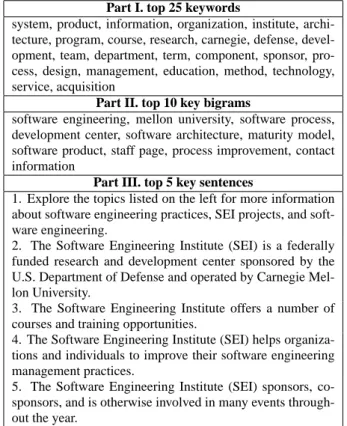
The overall summary is formed by the top 25 keywords, the top 10 bigrams and the top 5 key sentences. These numbers are ex-perimented and determined based on the fact that key bigrams are more informative than keywords and key sentences are more infor-mative than key bigrams, and the whole summary should fit in a single page. Table 1 shows the generated summary of the Software Engineering Institute (SEI) Web site6.
Table 1: An example of keyword-based summary. Part I. top 25 keywords
system, product, information, organization, institute, archi-tecture, program, course, research, carnegie, defense, devel-opment, team, department, term, component, sponsor, pro-cess, design, management, education, method, technology, service, acquisition
Part II. top 10 key bigrams
software engineering, mellon university, software process, development center, software architecture, maturity model, software product, staff page, process improvement, contact information
Part III. top 5 key sentences
1. Explore the topics listed on the left for more information about software engineering practices, SEI projects, and soft-ware engineering.
2. The Software Engineering Institute (SEI) is a federally funded research and development center sponsored by the U.S. Department of Defense and operated by Carnegie Mel-lon University.
3. The Software Engineering Institute offers a number of courses and training opportunities.
4. The Software Engineering Institute (SEI) helps organiza-tions and individuals to improve their software engineering management practices.
5. The Software Engineering Institute (SEI) sponsors, co-sponsors, and is otherwise involved in many events through-out the year.
6
3.2
Keyterm-based AWSS
The key phrase identification in [22] is based on phrase fre-quency analysis against three different categories of text, narra-tive text, anchor text, and special text. Bigrams are identified in a heuristic way, i.e., combining any two of the top 100 candidate keywords to form a candidate bigram and determining if it is a true bigram using decision tree rules. This might not work well if com-ponent words of informative terms do not appear as candidate key-words and consequently such terms fail to be extracted. Moreover, the method is unable to extract key phrases consisting of three or more component words. Since terms (phrases with two or more words) are more informative than single words, the authors aim to extractn-gram (n ≥ 2) keyterms via automatic term extraction techniques and further identify key sentences based on the density of keyterms only.
This work introduces a keyterm-based approach which applies the same process as keyword-based approach except in the key phrase extraction phase. In the keyterm-based method, n-gram terms are extracted from narrative text automatically and the top 25 keyterms are used to identify the top 5 key sentences in the nar-rative text for summary generation.
3.2.1
Automatic Term Extraction
Terms are known to be linguistic descriptors of documents. Au-tomatic term extraction is a useful tool for many text related ap-plications such as text clustering and document similarity analy-sis [17]. Traditional approaches to automatic term extraction were focused on information-theoretic approaches based on mutual in-formation in detecting collocations [15]. Recently more effective systems have been developed. Krulwich and Burkey use heuristic rules such as the use of acronyms and the use of italics to extract key phrases from a document for use as features of automatic document classification [12]. Turney proposes a key phrase extraction system GenEx which consists of a set of parameterized heuristic rules that are tuned to the training documents by a genetic program [19]. Wit-ten et al. propose a system called KEA which builds a Naive Bayes learning model using training documents with known key phrases, and then uses the model to find key phrases in new documents [21]. Both GenEx and KEA generalize well across domains, however, they are aimed towards extracting key phrases from a single docu-ment rather than a whole docudocu-ment collection.
In this work, we apply a state-of-the-art method
C-value/NC-value [9] to extractn-gram terms from a Web site automatically. This term extraction approach consists of both linguistic analysis (linguistic filter, part-of-speech tagging [4], and stop-list) and sta-tistical analysis (frequency analysis, C-value/NC-value).
Experiments in [9, 17] show that C-value/NC-value method per-forms well on a variety of special text corpora. In particular, with linguistic filter 2(Adjective|Noun)+Noun(one or more ad-jectives or nouns followed by one noun), C-value/NC-value method extracts more terms than with linguistic filter 1Noun+Noun(one or more nouns followed by one noun) without much precision loss. For example, terms such as artificial intelligence and natural
lan-guage processing will be extracted by linguistic filter 2. Hence, in
our work, we experiment with both linguistic filters to extract terms from a Web site. Finally, the resulting keyterms from each linguis-tic filter are used to extract key sentences to summarize the Web site as described in Section 3.1.5.
3.2.2
Keyterm Identification
The candidate term listC(ranked by NC-value) of a Web site generated by C-value/NC-value method contains some noun phrases (e.g. Web page), which appear frequently in Web sites. These noun
phrases are not relevant to the content of the Web sites and hence must be treated as stop words. We experimented with 60 DMOZ Web sites and identified a stop list,L, of 81 noun phrases (e.g., Web
site, home page, credit card, privacy statement, ...). The candidate
term listCis filtered through the noun phrase stop listL, and only the top 25 terms are selected as keyterms. The choice of number 25 is based on the assumption that the informativeness of the top 25 keyterms is comparable to that of 25 keywords and 10 key bigrams in the keyword-based approach.
4.
EXPERIMENTS AND EVALUATION
In this section, we discuss how to evaluate and compare the qual-ity of keyword-based and keyterm-based summaries.
4.1
KWB and KTB Summaries
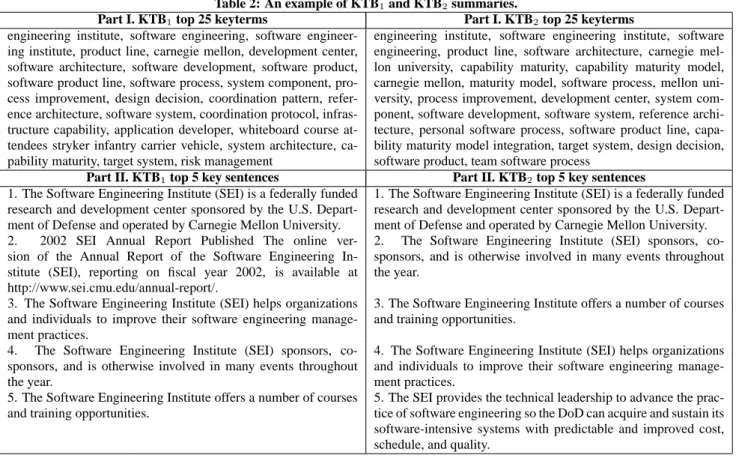
In our work, both keyword-based (KWB) and keyterm-based (KTB) approaches are used to generate summaries for 20 test Web sites used in [22]. We denote KTB summaries based on terms ex-tracted by linguistic filter 1 as KTB1and KTB summaries based on terms extracted by linguistic filter 2 as KTB2. Each KWB summary consists of the top 25 keywords, the top 10 key bigrams and the top 5 key sentences as shown in Table 1. Each KTB (KTB1or KTB2) summary consists of the top 25 keyterms and the top 5 key sen-tences. Table 2 gives an example of KTB1 and KTB2 summaries for the Software Engineering Institute Web site.
As we can see in Tables 1 and 2, the heuristic bigram extraction method can catch key phrases such as software engineering and
software architecture. However, it cannot extract terms
consist-ing of more than two words such as software engineerconsist-ing institute, which in this case is a very important term to be extracted. Another drawback is that it also extracts untrue keyterms such as staff page and contact information which will be filtered out by noun phrase stop list in automatic term extraction method.
Also it is observed that there are 19 matches out of 25 keyterms in KTB1and KTB2summaries, but the order of these keyterms is significantly different from each other according to their weights (NC-values). Among the top 5 key sentences generated based on these key phrases, there are 4 matches out of 5 between any two of the three summaries, but again the order of sentences is different due to its significance value.
4.2
Summary Evaluation
In this subsection, we describe how to compare the quality of KWB summaries with that of KTB summaries. Evaluation of au-tomatically generated summaries often proceeds in either of two main modes, intrinsic and extrinsic. Intrinsic evaluation compares automatically generated summaries against a gold standard (ideal summaries), which is very hard to construct. Extrinsic evaluation measures the utility of automatically generated summaries in per-forming a particular task (e.g., classification) [14]. In this work, however, we evaluate the quality of KWB and KTB summaries in a different way which has been extensively used in related work [13, 17, 20]. Domain experts are asked to read 20 summaries and judge the relatedness of key phrases and key sentences to the essential topics covered in the Web site as follows:
1. Browse the Web site for a sufficient time in order to extract two essential topics from each test Web site.
2. Read KWB and KTB summaries and rank each summary
item (i.e. keyword, key bigram, keyterm, or key sentence)
Table 2: An example of KTB1and KTB2summaries.
Part I. KTB1top 25 keyterms Part I. KTB2top 25 keyterms
engineering institute, software engineering, software engineer-ing institute, product line, carnegie mellon, development center, software architecture, software development, software product, software product line, software process, system component, pro-cess improvement, design decision, coordination pattern, refer-ence architecture, software system, coordination protocol, infras-tructure capability, application developer, whiteboard course at-tendees stryker infantry carrier vehicle, system architecture, ca-pability maturity, target system, risk management
engineering institute, software engineering institute, software engineering, product line, software architecture, carnegie mel-lon university, capability maturity, capability maturity model, carnegie mellon, maturity model, software process, mellon uni-versity, process improvement, development center, system com-ponent, software development, software system, reference archi-tecture, personal software process, software product line, capa-bility maturity model integration, target system, design decision, software product, team software process
Part II. KTB1top 5 key sentences Part II. KTB2top 5 key sentences 1. The Software Engineering Institute (SEI) is a federally funded
research and development center sponsored by the U.S. Depart-ment of Defense and operated by Carnegie Mellon University.
1. The Software Engineering Institute (SEI) is a federally funded research and development center sponsored by the U.S. Depart-ment of Defense and operated by Carnegie Mellon University. 2. 2002 SEI Annual Report Published The online
ver-sion of the Annual Report of the Software Engineering In-stitute (SEI), reporting on fiscal year 2002, is available at http://www.sei.cmu.edu/annual-report/.
2. The Software Engineering Institute (SEI) sponsors, co-sponsors, and is otherwise involved in many events throughout the year.
3. The Software Engineering Institute (SEI) helps organizations and individuals to improve their software engineering manage-ment practices.
3. The Software Engineering Institute offers a number of courses and training opportunities.
4. The Software Engineering Institute (SEI) sponsors, co-sponsors, and is otherwise involved in many events throughout the year.
4. The Software Engineering Institute (SEI) helps organizations and individuals to improve their software engineering manage-ment practices.
5. The Software Engineering Institute offers a number of courses and training opportunities.
5. The SEI provides the technical leadership to advance the prac-tice of software engineering so the DoD can acquire and sustain its software-intensive systems with predictable and improved cost, schedule, and quality.
• If it is pertinent to both of the two topics of the Web site, rank it good.
• If it is strongly pertinent to one of the two topics, rank it good.
• If it is pertinent to one of the two topics, rank it fair.
• If it is not pertinent to any of the two topics at all, rank it bad.
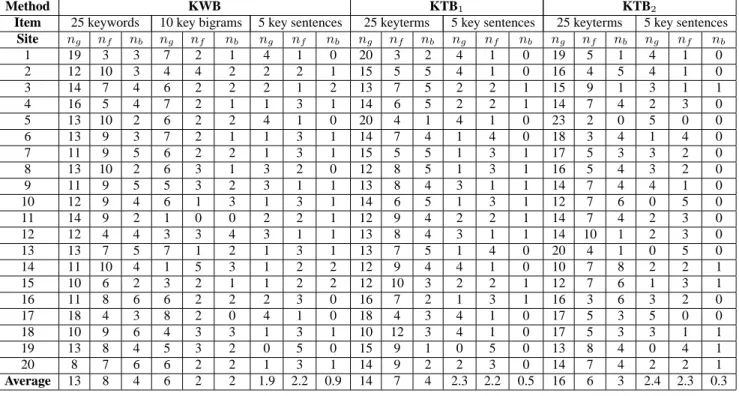
3. Count the number of good/fair/bad items in each summary. Letng,nf, andnbbe the number of good, fair, and bad sum-mary items, respectively. For example, in the sumsum-mary example shown above, the two essential topics for the Web site could be: 1) Software Engineering Institute at Carnegie Mellon University, and 2) software engineering management and practice. In the KWB summary, there are 13 good, 10 fair, and 2 bad keywords; 6 good, 2 fair, and 2 bad key bigrams; and 4 good, 1 fair, and 0 bad key sen-tences. Details of KWB, KTB1, and KTB2summary item numbers are listed in Table 3.
The average number of good, fair, and bad summary items per Web site summary is listed in the bottom line of Table 3. Related research in [20] defines acceptable terms as good and fair terms. The percentage of acceptable terms,p, is formally represented by Equation 1.
p= ng+nf
ng+nf+nb
. (1)
The values ofpin KWB, KTB1, and KTB2summaries above are 13+8+6+2 25+10 = 82.9%, 14+7 25 = 84.0%, and 16+6 25 = 88.0%, respec-tively.
Further we assign weights 1.0, 0.5 and 0 to good, fair, and bad summary items, respectively. Letkpbe the quality value of key phrases andksbe the quality value of key sentences in KWB and KTB summaries, respectively. These values are formally repre-sented by Equation 2.
kp, ks=1.0×ng+ 0.5×nf+ 0.0×nb
ng+nf+nb . (2) For example, the key phrase quality valuekpfor the KWB sum-mary above is calculated as 1.0×13+0.513+10+2+6+2+2×10+1.0×6+0.5×2 = 0.71, and the key sentence quality value is 1.0×4+0.54+1 ×1 = 0.90.
Finally letsbe the quality value of KWB and KTB summaries. We give equal weights to key phrases and key sentences when calculating the summary value, which is formally represented by Equation 3.
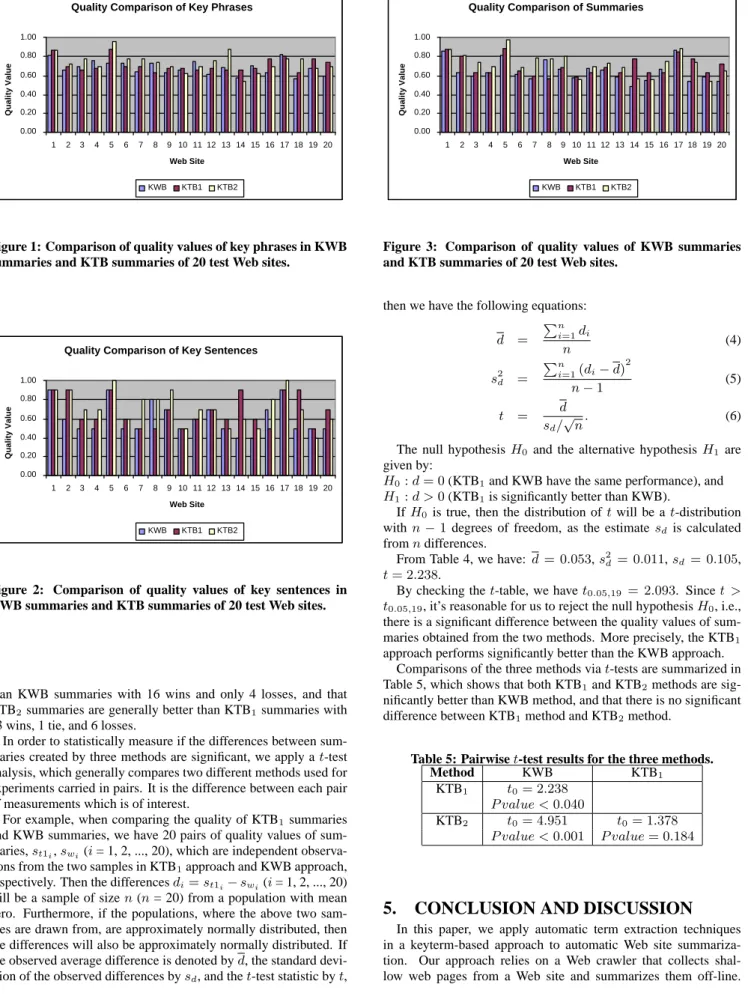
s= 0.5×kp+ 0.5×ks. (3) Table 4 summarizes the quality values of 20 Web site summaries. Figure 1 shows the quality values of key phrases from three dif-ferent approaches. As we can see, key phrases in KTB1summaries achieve higher scores than those in KWB summaries in 12 out of 20 Web sites. Key phrases in KTB2summaries achieve higher scores than those in KTB1 summaries in 12 out of 20 Web sites. This indicates that key phrases in KTB2 summary are generally better than those in KTB1summary, which are further better than those in KWB summary.
Figure 2 shows that key sentences in KTB1 summaries outper-form those in KWB summaries with 9 wins, 9 ties and only 2 losses, and that key sentences in KTB2 summaries outperform those in KTB1summaries with 9 wins, 5 ties and 6 losses.
Table 3: Details of summary item numbers.
Method KWB KTB1 KTB2
Item 25 keywords 10 key bigrams 5 key sentences 25 keyterms 5 key sentences 25 keyterms 5 key sentences
Site ng nf nb ng nf nb ng nf nb ng nf nb ng nf nb ng nf nb ng nf nb 1 19 3 3 7 2 1 4 1 0 20 3 2 4 1 0 19 5 1 4 1 0 2 12 10 3 4 4 2 2 2 1 15 5 5 4 1 0 16 4 5 4 1 0 3 14 7 4 6 2 2 2 1 2 13 7 5 2 2 1 15 9 1 3 1 1 4 16 5 4 7 2 1 1 3 1 14 6 5 2 2 1 14 7 4 2 3 0 5 13 10 2 6 2 2 4 1 0 20 4 1 4 1 0 23 2 0 5 0 0 6 13 9 3 7 2 1 1 3 1 14 7 4 1 4 0 18 3 4 1 4 0 7 11 9 5 6 2 2 1 3 1 15 5 5 1 3 1 17 5 3 3 2 0 8 13 10 2 6 3 1 3 2 0 12 8 5 1 3 1 16 5 4 3 2 0 9 11 9 5 5 3 2 3 1 1 13 8 4 3 1 1 14 7 4 4 1 0 10 12 9 4 6 1 3 1 3 1 14 6 5 1 3 1 12 7 6 0 5 0 11 14 9 2 1 0 0 2 2 1 12 9 4 2 2 1 14 7 4 2 3 0 12 12 4 4 3 3 4 3 1 1 13 8 4 3 1 1 14 10 1 2 3 0 13 13 7 5 7 1 2 1 3 1 13 7 5 1 4 0 20 4 1 0 5 0 14 11 10 4 1 5 3 1 2 2 12 9 4 4 1 0 10 7 8 2 2 1 15 10 6 2 3 2 1 1 2 2 12 10 3 2 2 1 12 7 6 1 3 1 16 11 8 6 6 2 2 2 3 0 16 7 2 1 3 1 16 3 6 3 2 0 17 18 4 3 8 2 0 4 1 0 18 4 3 4 1 0 17 5 3 5 0 0 18 10 9 6 4 3 3 1 3 1 10 12 3 4 1 0 17 5 3 3 1 1 19 13 8 4 5 3 2 0 5 0 15 9 1 0 5 0 13 8 4 0 4 1 20 8 7 6 6 2 2 1 3 1 14 9 2 2 3 0 14 7 4 2 2 1 Average 13 8 4 6 2 2 1.9 2.2 0.9 14 7 4 2.3 2.2 0.5 16 6 3 2.4 2.3 0.3
Table 4: Quality values of KWB and KTB summaries.
Site kpw kpt1 kpt2 ksw kst1 kst2 sw st1 st2 1 0.81 0.86 0.86 0.90 0.90 0.90 0.86 0.88 0.88 2 0.66 0.70 0.72 0.60 0.90 0.90 0.63 0.80 0.81 3 0.70 0.66 0.78 0.50 0.60 0.70 0.60 0.63 0.74 4 0.76 0.68 0.70 0.50 0.60 0.70 0.63 0.64 0.70 5 0.71 0.88 0.96 0.90 0.90 1.00 0.81 0.89 0.98 6 0.73 0.70 0.78 0.50 0.60 0.60 0.61 0.65 0.69 7 0.64 0.70 0.78 0.50 0.50 0.80 0.57 0.60 0.79 8 0.73 0.64 0.74 0.80 0.50 0.80 0.76 0.57 0.77 9 0.63 0.68 0.70 0.70 0.70 0.90 0.66 0.69 0.80 10 0.66 0.68 0.62 0.50 0.50 0.50 0.58 0.59 0.56 11 0.75 0.66 0.70 0.60 0.60 0.70 0.68 0.63 0.70 12 0.62 0.68 0.76 0.70 0.70 0.70 0.66 0.69 0.73 13 0.69 0.66 0.88 0.50 0.60 0.50 0.59 0.63 0.69 14 0.57 0.66 0.54 0.40 0.90 0.60 0.49 0.78 0.57 15 0.71 0.68 0.62 0.40 0.60 0.50 0.55 0.64 0.56 16 0.63 0.78 0.70 0.70 0.50 0.80 0.66 0.64 0.75 17 0.83 0.80 0.78 0.90 0.90 1.00 0.86 0.85 0.89 18 0.57 0.64 0.78 0.50 0.90 0.70 0.54 0.77 0.74 19 0.67 0.78 0.68 0.50 0.50 0.40 0.59 0.64 0.54 20 0.60 0.74 0.70 0.50 0.70 0.60 0.55 0.72 0.65 Average 0.683 0.713 0.739 0.605 0.680 0.715 0.644 0.697 0.727
Quality Comparison of Key Phrases 0.00 0.20 0.40 0.60 0.80 1.00 1 2 3 4 5 6 7 8 9 10 11 12 13 14 15 16 17 18 19 20 Web Site Quality Value KWB KTB1 KTB2
Figure 1: Comparison of quality values of key phrases in KWB summaries and KTB summaries of 20 test Web sites.
Quality Comparison of Key Sentences
0.00 0.20 0.40 0.60 0.80 1.00 1 2 3 4 5 6 7 8 9 10 11 12 13 14 15 16 17 18 19 20 Web Site Quality Value KWB KTB1 KTB2
Figure 2: Comparison of quality values of key sentences in KWB summaries and KTB summaries of 20 test Web sites.
than KWB summaries with 16 wins and only 4 losses, and that KTB2summaries are generally better than KTB1summaries with 13 wins, 1 tie, and 6 losses.
In order to statistically measure if the differences between sum-maries created by three methods are significant, we apply at-test analysis, which generally compares two different methods used for experiments carried in pairs. It is the difference between each pair of measurements which is of interest.
For example, when comparing the quality of KTB1summaries and KWB summaries, we have 20 pairs of quality values of sum-maries,st1i,swi(i= 1, 2, ..., 20), which are independent observa-tions from the two samples in KTB1approach and KWB approach, respectively. Then the differencesdi=st1i−swi(i= 1, 2, ..., 20) will be a sample of sizen(n= 20) from a population with mean zero. Furthermore, if the populations, where the above two sam-ples are drawn from, are approximately normally distributed, then the differences will also be approximately normally distributed. If the observed average difference is denoted byd, the standard devi-ation of the observed differences bysd, and thet-test statistic byt,
Quality Comparison of Summaries
0.00 0.20 0.40 0.60 0.80 1.00 1 2 3 4 5 6 7 8 9 10 11 12 13 14 15 16 17 18 19 20 Web Site Quality Value KWB KTB1 KTB2
Figure 3: Comparison of quality values of KWB summaries and KTB summaries of 20 test Web sites.
then we have the following equations:
d = Pn i=1di n (4) s2 d = Pn i=1(di−d) 2 n−1 (5) t = d sd/ √ n. (6)
The null hypothesisH0 and the alternative hypothesis H1 are given by:
H0:d= 0(KTB1and KWB have the same performance), and
H1:d >0(KTB1is significantly better than KWB).
IfH0 is true, then the distribution oftwill be at-distribution withn−1degrees of freedom, as the estimatesdis calculated fromndifferences.
From Table 4, we have:d= 0.053,s2
d = 0.011,sd = 0.105,
t= 2.238.
By checking thet-table, we havet0.05,19 = 2.093. Sincet >
t0.05,19, it’s reasonable for us to reject the null hypothesisH0, i.e., there is a significant difference between the quality values of sum-maries obtained from the two methods. More precisely, the KTB1 approach performs significantly better than the KWB approach.
Comparisons of the three methods viat-tests are summarized in Table 5, which shows that both KTB1and KTB2methods are sig-nificantly better than KWB method, and that there is no significant difference between KTB1method and KTB2method.
Table 5: Pairwiset-test results for the three methods.
Method KWB KTB1
KTB1 t0= 2.238
P value <0.040
KTB2 t0= 4.951 t0 = 1.378
P value <0.001 P value= 0.184
5.
CONCLUSION AND DISCUSSION
In this paper, we apply automatic term extraction techniques in a keyterm-based approach to automatic Web site summariza-tion. Our approach relies on a Web crawler that collects shal-low web pages from a Web site and summarizes them off-line.
It applies machine learning and natural language processing tech-niques to extract and classify narrative paragraphs from the Web site, from which keyterms are then extracted. Keyterms are in turn used to extract key sentences from the narrative paragraphs that form the summary, together with the top keyterms. We demonstrate that keyterm-based summaries are significantly better than former keyword-based summaries.
Future research involves several directions.
• Use of machine learning in setting the relative weights for keywords or key bigrams from narrative, anchor and special text.
• Hierarchical summarization of complex web sites that may include a multitude of topics, for example Web sites of large organizations (e.g., government, university).
• Application of the keyterm-based approach to summarizing the Web pages returned by a query to a search engine, after clustering the returned pages.
• Integration of keyword-based and keyterm-based methods in Web document corpus summarization.
• Refinement of the evaluation process, including extrinsic eval-uation.
Acknowledgements
This research has been supported by grants from the Natural Sci-ences and Engineering Research Council of Canada.
6.
REFERENCES
[1] J. Allan and H. Raghavan. Using part-of-speech patterns to reduce query ambiguity. In Proceedings of the 25th Annual
International ACM SIGIR Conference on Research and Development in Information Retrieval (SIGIR’02), pages
307–314, 2002.
[2] E. Amitay and C. Paris. Automatically summarising Web sites: is there a way around it? In Proceedings of the 9th
ACM International Conference on Information and Knowledge Management (CIKM’00), pages 173–179, 2000.
[3] A. Berger and V. Mittal. OCELOT: a system for
summarizing Web pages. In Proceedings of the 23rd Annual
International ACM SIGIR Conference on Research and Development in Information Retrieval (SIGIR’00), pages
144–151, 2000.
[4] E. Brill. A simple rule-based part of speech tagger. In 3rd
Conference on Applied Natural Language Processing (ANLP-92), pages 152–155, 1992.
[5] O. Buyukkokten, H. Garcia-Molina, and A. Paepcke. Seeing the whole in parts: text summarization for Web browsing on handheld devices. In Proceedings of 10th International
World Wide Web Conference, pages 652–662, 2001.
[6] W. Chuang and J. Yang. Extracting sentence segments for text summarization: a machine learning approach. In
Proceedings of the 23rd Annual International ACM SIGIR Conference on Research and Development in Information Retrieval (SIGIR’00), pages 152–159, 2000.
[7] J. Delort, B. Bouchon-Meunier, and M. Rifqi. Enhanced Web document summarization using hyperlinks. In
Proceedings of the 14th ACM Conference on Hypertext and Hypermedia, pages 208–215, 2003.
[8] C. Fox. Lexical analysis and stoplists. In W. Frakes and R.
Baeza-Yates, editors, Information Retrieval: Data Structures and Algorithms, pages 102–130, Englewood Cliffs, NJ:
Prentice Hall, 1992.
[9] K. Frantzi, S. Ananiadou, and H. Mima. Automatic recognition of multiword terms. International Journal of
Digital Libraries, 3(2):117–132, 2000.
[10] J. Goldstein, M. Kantrowitz, V. Mittal, and J. Carbonell. Summarizing text documents: sentence selection and evaluation metrics. In Proceedings of the 22nd Annual
International ACM SIGIR Conference on Research and Development in Information Retrieval (SIGIR’99), pages
121–128, 1999.
[11] J. Goldstein, V. Mittal, J. Carbonell, and J. Callan. Creating and evaluating multi-document sentence extract summaries. In Proceedings of the 9th ACM International Conference on
Information and Knowledge Management (CIKM’00), pages
165–172, 2000.
[12] B. Krulwich and C. Burkey. Learning user information interests through the extraction of semantically significant phrases. In M. Hearst and H. Hirsh, editors, AAAI 1996
Spring Symposium on Machine Learning in Information Access, Califonia: AAAI Press, 1996.
[13] W. Lu, J. Janssen, E. Milios, and N. Japkowicz. Node similarity in networked information spaces. Technical Report
CS-2001-03, Faculty of Computer Science, Dalhousie University, September 2001.
[14] I. Mani, T. Firmin, D. House, G. Klein, B. Sundheim, and L. Hirschman. The TIPSTER SUMMAC text summarization evaluation. In Proceedings of the 9th Conference of the
European Chapter of the Association for Computational Linguistics (EACL’99), pages 77–85, 1999.
[15] C. Manning and H. Schuetze. Foundations of Statistical
Natural Language Processing. MIT Press Cambridge,
Massachusetts, 1999.
[16] D. Marcu. From discourse structures to text summaries. In
Proceedings of the ACL’97/EACL’97 Workshop on
Intelligent Scalable Text Summarization, pages 82–88, 1997.
[17] E. Milios, Y. Zhang, B. He, and L. Dong. Automatic term extraction and document similarity in special text corpora. In
Proceedings of the 6th Conference of the Pacific Association for Computational Linguistics (PACLing’03), pages
275–284, 2003.
[18] D. Radev, W. Fan, H. Qi, H. Wu, and A. Grewal.
Probabilistic question answering on the Web. In Proceedings
of the 11th International World Wide Web Conference (WWW’02), pages 408–419, 2002.
[19] P. Turney. Learning algorithms for keyphrase extraction.
Information Retrieval, 2(4):303–336, 2000.
[20] P. Turney. Coherent keyphrase extraction via Web mining. In
Proceedings of the 18th International Joint Conference on Artificial Intelligence (IJCAI’03), pages 434–439, 2003.
[21] I. Witten, G. Paynter, E. Frank, C. Gutwin, and
C. Nevill-Manning. KEA: Practical automatic keyphrase extraction. In Proceedings of the 4th ACM Conference on
Digital Libraries (DL’99), pages 254–256, 1999.
[22] Y. Zhang, N. Zincir-Heywood, and E. Milios. Summarizing Web sites automatically. In Proceedings of the 16th
Conference of the Canadian Society for Computational Studies of Intelligence (AI’03), pages 283–296, 2003.