Title
Civic Participation of High School Students: The Effect of Civic Learning in School1
Authors
Frank Reichert, Faculty of Education, University of Hong Kong, Hong Kong SAR Murray Print, School of Education and Social Work, Faculty of Arts and Social Sciences, University of Sydney, Sydney, Australia
Contact
Frank Reichert, Postdoctoral Fellow, Faculty of Education, 217 Runme Shaw Building, Faculty of Education, University of Hong Kong, Pok Fu Lam Road, Hong Kong, Hong Kong SAR. Email: [email protected]
Acknowledgements
This work was supported by a postdoctoral fellowship by the Fritz Thyssen Foundation, a visiting fellowship at The University of Sydney, and an Australian Research Council grant [DP 120103057]. Parts of this research were conducted while the first author was affiliated with the Leibniz Institute for Educational Trajectories in Bamberg, Germany. The data used in this publication are sourced from the AustralianCurriculum, Assessment and Reporting Authority (ACARA) and are available from ACARA in accordance with its Data Access Protocols. The authors would also like to thank three anonymous reviewers for their thoughtful comments on an earlier version of this manuscript.
1 The published article of this accepted manuscript version should be cited as:
Reichert, F., & Print, M. (2018). Civic participation of high school students: The effect of civic learning in school. Educational Review, 70(3), 318–341. DOI:
Civic Participation of High School Students: The Effect of Civic Learning in School Abstract
Building active and informed citizens is a major part of civics and citizenship education in order to enhance and sustain democracies. Civic learning and civic action opportunities within school contexts are commonly claimed to promote an active and informed citizenry. In the present research, we examine the meaning of formal civics education and the role of students’ participation in a range of curricular and extracurricular activities. Multilevel analyses yield quite stable results across two cohorts of Australian secondary students and reveal that schools account for a surprisingly small share in students’ willingness to participate in future civic and political action. Among the influences at the student level, formal civics learning, participation in student governance activities and in the community are the most significant predictors of intended future participation, but some effects vary conditional on whether more conventional or issue-related civic participation is the focus of active citizenship. Implications of these findings for democratic policy and practice are discussed.
Keywords
Australia; citizenship; civics; civic education; civic engagement; political participation; student participation
“Democracy has to be born anew every generation, and education is its midwife.” (John Dewey, 1916b, 410) A century ago, John Dewey cogently argued for schools to serve as a key source for learning about democracy:
“[…] a government resting upon popular suffrage cannot be successful unless those who elect and who obey their governors are educated. Since a democratic society repudiates the principle of external authority, it must find a substitute in voluntary disposition and interest; these can be created only by education. But [… a] democracy is more than a form of government; it is primarily a mode of associated living, of conjoint communicated experience.” (Dewey 1916a, 101)
Clearly, democracy is not a natural condition. It has to be learnt. And where, how much, when, and in what ways it is learnt help determine a person’s understanding and practice of democracy. In Australia, civic learning and civic action opportunities within school contexts are intended to promote the development of active1 and informed democratic citizens, a major goal of Australian education (Ministerial Council on Education, Employment, Training and Youth Affairs [MCEETYA] 2008). But how can schools contribute to building citizens for whom democracy is more than a form of government but a way of life?
The question of whether and how civic learning helps to develop citizen participation is a contested one, and different studies have employed and examined different conceptual and theoretical perspectives. Typically, civic learning in schools is conceptualized as the study of civic education through school subjects such as Civics, Government, and Social Studies. Most studies of civic learning have focused on the formal curriculum, that is, civic learning activities through school subjects for which there are planned learning outcomes (Geboers et al. 2013; Niemi and Junn 1998). However, school students can also learn and practice civic action
through the informal curriculum, defined as those school curriculum learning experiences planned to achieve pre-determined outcomes that are not part of the formal curriculum (Print 2007, 2009). Informal civic learning – that is, civic learning outside school subjects, which for some scholars includes extracurricular activities that are beyond planned learning in schools – exhibits potentially powerful, sustainable education in civic values, knowledge and skills.
The present research aims to examine how formal and informal learning in school contexts contribute to Australian secondary school students’ intentions to be active in civic and political life. Using a broad understanding of participation and active citizenship (Flanagan 2009; Kahne and Sporte 2008; Print 2009; Torney-Purta 2002), which encompasses students’ contributions to their communities and political life now and in the future, this analysis examines intended participation as the outcome of formal and informal civic learning, owing to the limited opportunities that are available to students. Although intended and actual behavior are strongly and positively correlated (Ajzen 2012), we acknowledge that the relationship between both is far from perfect, which limits our study insofar as it establishes only tentative causality.
More precisely, we want to know whether schools make a difference with respect to
students’ expected participation in civic and political activities, and whether and how formal
civic learning and informal learning activities positively relate to students’ willingness to participate in civic and political activities in the future. Previous research has found differential effects of formal and informal learning on political participation, but which activities precisely relate to what type of future participation is less clear, because most prior research has either studied a limited range of activities or considered different activities in the form of aggregate measures. Knowing more about the differential effects, if any, of different civic learning activities would be extremely helpful to guide the implementation of civics and citizenship
curricula in schools. Finally, we are interested in the generalizability of our findings with respect to different time periods.
Background
The theory supporting democratic education contends that civic engagement of citizens is a necessary requirement for a sustained, successful democracy (Dalton 2004; Galston 2004; Kahne and Sporte 2008; Print and Coleman 2003; Putnam 2000). Such engaged citizens will not only appreciate their democracy but also ensure that it functions effectively through the nature of their civic engagement. The literature on building civic engagement, especially in school contexts, is substantial and on-going (Davies and Evans 2002; Flanagan 2009; Hahn 1998; Kahne and Sporte 2008; Niemi and Junn 1998; Putnam 2000; Reichert 2016a; Saha and Print 2010; Torney-Purta et al. 2001; Westheimer and Kahne 2004) and forms a theoretical base to understanding the role of schools in building democratic citizens.
Formal Civic Learning and Political Participation
Most research in this area uses the formal curriculum as either the independent or dependent variable. Niemi and Junn (1998), for instance, found that the amount and frequency of studying civic subjects correlates with political knowledge and civic engagement. Belgian students’ similarly benefited from formal civic education in that they were more likely to have participated in political activities (Quintelier 2010). In Australia, Saha (2000) showed that the study of Australian government in school is positively correlated with actual and intended normative civic behavior among secondary school students. The Youth Electoral Study likewise found that studying formal civics education is related to Australian students’ intention to vote (Print 2009).
International research using the IEA Civic Education Study (CivEd) also showed that
students intended to vote in the future (Torney-Purta et al. 2001). In its successor, the International Civic and Citizenship Education Study (ICCS), civic knowledge was positively associated with future electoral participation and legal protest, but it correlated negatively with expected active political participation and illegal protest (Ainley and Schulz 2011; Mirazchiyski, Caro, and Sandoval-Hernández 2014; Schulz, Ainley, and Fraillon 2013; Schulz et al. 2010).
Longitudinal research in the United States provided some support for the importance of school-based formal civic education, as it yielded positive effects on the likelihood to vote in half of all time points analyzed by Bachner (2010; cited in Manning and Edwards 2014). Callahan, Muller, and Schiller (2010), however, found that the number of civics courses taken in school did not increase the likelihood to vote, while course grade in social studies, probably reflecting civic knowledge and analysis skills, did. In a recent analysis of students in England, Keating and Janmaat (2016) provided further evidence that demands us to be more humble about the effects of formal learning on political participation: In their longitudinal analysis, formal civic learning had no positive effect on electoral and non-electoral participation. Yet the absence of formal civic learning in school reduced the likelihood of voting.
Other research has suggested that participatory approaches, including class voting and fieldwork, are particularly likely to engage students in aspects of democratic practice and can empower students to become more engaged (Youniss, McLellan, and Yates 1997; Niemi and Junn 1998; Hahn 1998; Print, Ørnstrøm, and Skovgaard Nielsen 2002). Keating and Janmaat (2016) further indicated that school-based participation might be a better predictor of future political participation than the formal curriculum, and it may therefore be expected that formal learning has weaker, or even no effects on future political participation of young people, compared to informal civic learning.
Informal Civic Learning and Political Participation
The informal curriculum is a potentially powerful source of building civic action amongst young people and consists of two sets of related activities. Instrumental activities, such as student governance, school papers, and student elections, can develop civic engagement and stimulate civic action (Kirlin 2002; Print, Ørnstrøm, and Skovgaard Nielsen 2002; Saha and Print 2010). Expressive activities, such as sports, clubs, and social activities, are perceived as contributing less to building civic engagement, though they fall along the same participation continuum (Keeter et al. 2002; Kirlin 2002; Print and Coleman 2003).
How Participation in School Matters: Three Perspectives
Saha and Print (2010) identified three general theories that explain why the experience of school government is related to subsequent adult political and civic engagement. These explanations are not mutually exclusive and can be extended to participation in schools more broadly. Set in broader theories of how future citizens are prepared (Print 2009) and the role of the school in educating democratic citizens (Dewey 1916a), these theories are applicable in this context.
The structural perspective emphasizes the role of social capital, which is supposed to promote political engagement (Putnam 2000). For Putnam (2000, 19), social capital “refers to connections among individuals – social networks and the norms of reciprocity and
trustworthiness that arise from them”. Social capital, in this understanding, is by and large
about the social networks acquired through membership in various organizations, foremost community organizations, and collective activities. Putnam (2000) argues that American civil society is in decline owing to changes in the structures of modern societies, but this decline, he further argues, can be stopped through institutional structures that facilitate collective action. When applied to school students, participation in schools – especially in structured forms such
as student governance –would enhance students’ social capital (Print and Coleman 2003) and,
in turn, increase “the likelihood of political engagement as an adult” (Saha and Print 2010, 23).
The participation perspective is basically a habituation paradigm arguing that participation in school civic-related activities increases knowledge and leads to future political engagement: “The exposure to these political activities while in school serves to socialize young people into patterns of political behaviour” (Saha and Print 2010, 23). Through participation in informal civic learning activities in school students develop skills, such as leadership abilities, that are helpful in influencing decision-making processes in community contexts (Hahn 1998; Niemi and Junn 1998). Through this applied learning, a commitment to a certain type of behavior is acquired, and the specific skills that are developed through informal activities in school should be related to future participation in political activities that require similar skills.
Finally, the developmental perspective, which deliberately puts itself in contrast to the structural perspective, claims that participation in schools would help building a civic identity (Saha and Print 2010; Youniss, McLellan, and Yates 1997). Theoretically, engagement in “organized norm-bearing groups” (Youniss, McLellan, and Yates 1997, 621), such as school governments and community service activities, by students means that they are part of and can contribute meaningfully to society, thus enabling them to see themselves as political actors. In this perspective, activities that increase the likelihood of future participation are characterized by organization, shared goals and cooperation. Youniss, McLellan, and Yates (1997) show that participation in school government or community service projects is associated with a higher likelihood to vote and participate in community organizations as an adult. They argue that this positive relationship is because participation in school government and community service enables students to develop a sense of agency and social relatedness, which makes them feel responsible and influential actors for the benefit of the common good.
Informal Civic Learning Matters: Empirical Evidence
The literature on the informal curriculum is broad and the activities considered in these studies are often either combined into one or two measures or not considered as distinct activities. Also, most research has not examined the role of informal learning in relation to the theoretical perspectives introduced earlier. One potential drawback, furthermore, is the frequent consideration of volunteering and service learning, which sometimes is even combined with student government activities. The latter is problematic because volunteering and service learning are at the crossroads between the formal curriculum (is it required?) and informal as well as extracurricular activities (is it voluntary service in school or volunteering outside school?) (Print 2009).
In summary, previous research shows that student participation in the informal curriculum is positively related to engaging young people in (normative forms of) later political and civic life (Ainley and Schulz 2011; Keeter et al. 2002; Kirlin 2002; McFarland and Thomas 2006; McFarland and Starmanns 2009; Mirazchiyski, Caro, and Sandoval-Hernández 2014; Youniss, McLellan, and Yates 1997). Hart et al. (2007) found that participation in the informal curriculum as well as community service were associated with higher rates of volunteering and voting in presidential elections in early adulthood. McFarland and Starmanns (2009) found the types of student councils highly variable as was the nature of student engagement, while Quintelier (2010) showed that membership in school councils and service learning were positively related to actual political participation of Flemish youths. Similarly, Kahne and Sporte (2008) found that service learning, peer support for academic achievement, and after-school activities in after-school and other clubs were positively related to students’ commitment to civic participation, above and beyond their prior commitments and classroom-based learning. Callahan, Muller, and Schiller (2010), in their study, also found that volunteering as an adolescent increased the likelihood of voting in the US presidential election. Finally, an
Australian study yielded that pupils who participated in school elections were more knowledgeable and prone to engage in political realm (Saha and Print 2010).
International research using CivEd also shows that the culture of the school and participation opportunities within schools are significant in engaging young people (Torney-Purta et al. 2001). However, participation in student councils was positively and significantly related to the intention to vote in elections as an adult only in a few countries (Amadeo et al. 2002; Torney-Purta 2002). The findings of the ICCS indicate that active civic participation at school was common and a valuable predictor of intended later civic behavior (Schulz et al. 2010). Specifically, research using the ICCS database showed that overall student participation in school was positively associated with expected engagement in normative forms of participation (Ainley and Schulz 2011; Mirazchiyski, Caro, and Sandoval-Hernández 2014), though the respective effects may be mediated by other variables such as political and civic efficacy (Schulz, Ainley, and Fraillon 2013). Interestingly, community participation was
positively correlated with students’ expectations to participate in active forms of political
participation, but not with the intention to vote (Ainley and Schulz 2011; Schulz, Ainley, and Fraillon 2013; Schulz et al. 2010). Students were also more likely to intend to participate the higher the school average of students was who were involved in school decision-making activities (Isac et al. 2014).
Limited Impact of Civic Learning in Schools?
Despite that evidence on the effect of civic learning on future civic and political participation, Lopes, Benton, and Cleaver (2009, 9) found no empirical support for the relevance of “a school’s approach to the delivery of citizenship education” among English students. That is, neither a formal nor an informal learning approach predicted ninth-grade students’ intended participation. This finding supports multilevel results that yielded no discernible disparities between students in different schools. By way of example, a study in Belgium found that
schools accounted for less than 7% of the differences in students’ political participation (Quintelier 2010), and scholars in the United States “discovered that only 2.2% of the variation in students’ commitments to civic participation was between schools” (Kahne and Sporte 2008). International comparative studies also found little variance at the school level (Isac et al. 2014; Mirazchiyski, Caro, and Sandoval-Hernández 2014). Hence, it may be more important
what students actually do in their schools, while schools’ approaches towards citizenship
education, a macro-level variable, may be of little relevance in the promotion of politically active citizens.
From their review, which excluded studies on intended participation, Manning and Edwards (2014) indeed concluded that there is little evidence for the influence of citizenship education on electoral participation. Yet they were more optimistic with respect to less institutionalized political activities. These scholars also raised major concerns about the methodological limitations and the inconsistency of the implementation of civic learning programs, though.
A review of studies in America, however, suggested that different (formal and informal) curricular activities could promote differential kinds of civic and political behavior (Lin 2015). In their comprehensive and more sophisticated, seminal meta-analysis, Geboers et al. (2013) also reported differential effects of different types of citizenship education. They distinguished between curriculum in school (i.e. formal learning in the classroom setting), curriculum out of school (e.g. organized government visits), extracurricular activities (e.g. voluntary service activities), and pedagogical climate (i.e. teacher practices that aim at influencing the organization of the classroom). They found that among adolescents aged 13 to 16 years, curriculum in school and extracurricular activities were most likely to facilitate democratic activities. However, these scholars understood student governance as part of extracurricular activities. Hence, it may be less surprising that the latter yielded no negative effects.
Conversely, curriculum out of school activities yielded more negative or no effects than positive effects, and pedagogical climate had a few more positive than no or negative effects on behavioral outcomes. The present analysis adapts and modifies the conceptualization proposed by Geboers et al. (2013), as their conceptual framework provides a reasonable way of thinking about different formal and informal civic learning opportunities.
Method
All three theoretical approaches that were introduced earlier provide valuable perspectives on the relevance of student school participation, and the present analysis aims to link these perspectives to the variety of student participation that occurs in schools. While the meta-analysis by Geboers et al. (2013) accounted for many different forms of participation at school, most individual studies focused on one specific form only. Other studies used a combined measure of a range of student activities, which makes it impossible to understand the unique role of different types of student participation. In our analysis, we examine which forms of participation in schools are most promising for future participation. Australia, as an established democracy, provides an appropriate case for this research due to recent developments in civics and citizenship education.
Specifically, there have been concerns about low levels of political literacy and active citizenship among young Australians over the past two decades (Civics Expert Group 1994; Joint Standing Committee on Electoral Matters [JSCEM] 2007). CivEd also found that Australian students’ willingness to participate in politics in adult life was comparatively low (Mellor, Kennedy, and Greenwood 2002; Torney-Purta et al. 2001). It thus comes without surprise that the public focus has shifted towards schools and how these can build active, informed citizenship amongst the young. After the end of Discovering Democracy in 2004, a large-scale policy initiative with the goal of raising the levels of political literacy and participation among Australians, public efforts on civic learning were minimal (Print 2016).
Only after 2008, when the Melbourne Declaration made the development of active and informed democratic citizens a major goal of Australian education in all states and territories (MCEETYA 2008), civic education came back to the public agenda. However, not much else happened before 2010, while the time between 2010 and 2015 was coined by the development of the first national Australian Curriculum on Civics and Citizenship ( Australian Curriculum, Assessment and Reporting Authority [ACARA] 2016). Earlier versions and a draft shape of this curriculum were discussed widely in the public, and after its endorsement in 2015, the implementation of this curriculum has begun in 2016.
Furthermore, the period since 2010 in Australia is highly special in that Australians have witnessed three changes in government that were not due to federal elections, but party leadership battles. As a consequence, we can conduct comparative analyses for two different cohorts of 10th graders to examine the stability of the (ir)relevance of different types of school participation, with one of the cohorts being surveyed at the beginning of a period of political turmoil and the other being surveyed three years later. Stability here means that the effects of the predictor variables would be insignificantly different between both cohorts.
Research Questions and Hypotheses
Three research questions guide our analysis. The first question asks what kind of civic learning – formal learning versus various informal learning activities – positively relates to students’ willingness to participate in civic and political activities in the future (research question one [RQ1]). Previous research has focused on restricted types of school participation or used aggregate measures of school participation, preventing respective insights. That is, many studies have only examined the role of participation in student government and/or volunteering and service learning activities (for a rare exception, see Kahne and Sporte 2008). Other informal activities, such as peer support, classroom voting etc. have either not been considered in addition to those activities, or a range of activities has been patched together in just one
measure that makes it impossible to examine the unique effects of distinct activities. Even Geboers et al. (2013), in their meta-analysis, considered student government not independent of other extracurricular activities, while participation in student governments arguably is more structured and organized than other forms of informal civic learning in schools, and might therefore be of more relevance for future civic participation, as argued by the developmental perspectives.
Hence, it is important to study the “net” effects of many and different civic learning activities, as an answer to RQ1 would be extremely helpful to guide the implementation of civics and citizenship curricula in schools. According to the participation perspective,
participation in school should directly influence students’ future participation. Through such
applied learning, a commitment to specific types of behavior is acquired, and the specific skills that are developed through those activities in school should be related to the types of future political activities that require similar skills. Alternatively, the developmental perspective suggests that organized forms of participation that require cooperation and enable students to develop a sense of agency and responsibility for the common good, such as in school governments and community organizations, are particularly powerful in predicting future participation. In this view, and that is the main difference to the structural perspective, the influence of student participation in organized informal learning is indirect and mediated by realizing that they can contribute meaningfully to their community, and that their participation can make a difference (“civic efficacy”). Activities that do not enable students to see themselves as agents for the common good should therefore be less influential in promoting civic efficacy and, consequently, be of limited relevance for future civic and political participation.
Secondly, we want to know whether schools make a difference with respect to students’ expected participation in civic and political activities (RQ2). Based on previous research (Isac
et al. 2014; Kahne and Sporte 2008; Lopes, Benton, and Cleaver 2009; Mirazchiyski, Caro, and Sandoval-Hernández 2014; Quintelier 2010), we may not anticipate a substantial impact of schools. However, the structural perspective emphasizes the significance of structural factors such as neighborhood and school environments. According to this perspective, we would expect that students are more likely to intend future participation if they are enrolled in schools that are more likely to provide social networks and where student participation is more common. That is, a “culture of participation in school” should be contagious, because such schools provide better networks for students, which would facilitate future participation. Although the structural perspective seems to attribute a stronger impact of participation in organized forms of student participation, the networks provided and the relatedness to others are particularly important and independent of the type of activity. The other perspectives do not emphasize aspects at the structural, school level in the prediction of future participation.
Finally, we are interested in the generalizability of our findings with respect to different time periods (RQ3). Specifically, the period between 2010 and 2013 in Australia was characterized by political turmoil with extensive media and public attention and scrutiny on Australian government. During that time the Australian Prime Minister changed twice due to party leadership battles, not elections. An internally divided Labor Party also led the first hung parliament in decades, which was constantly attacked by a strong opposition. Despite being only a short period of time, those events might have affected the role of formal and informal civic learning in students’ intentions to participate, and this gives us the opportunity to examine and elaborate on the generalizability of our research findings. In particular, it is possible that those events affected how students perceive the value of participation in school and the community (“civic efficacy”), which would imply that the predictions made by the developmental perspective could be affected. It is less clear though how the predictions of the other theoretical perspectives might be affected.
Data and Measures
The present analysis uses the Australian National Assessment Program: Civics and Citizenship (NAP-CC) data of 10th graders (most of them 15 or 16 years old). These nationally representative data were collected via paper-and-pencil testing in 2010 and online assessments in 2013 (ACARA 2011, 2014), where both cohorts completed the same questionnaire at school. In our analysis, we include only students with complete data. The small numbers of students who said a certain activity was not available at their school is also excluded, except for voting for class representatives with 16 to 18% of students who said this was not available at their school (ACARA 2011, 2014). Thus, all analyses are based on the data from 5137 students in 309 schools in 2010, and 4074 questionnaires representing 290 schools in 2013. The following briefly describes the measures used in the present research (cf. ACARA 2011, 2013, 2014, for questionnaires and assessment items).
Student Participation at School
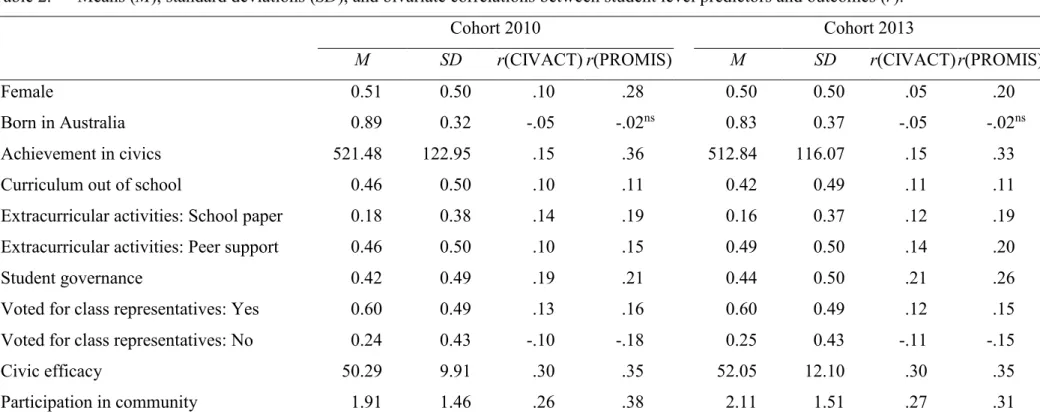
Building on previous research (Geboers et al. 2013), we differentiate between formal learning as curriculum in classrooms (“formal curriculum”) versus curriculum out of school as well as extracurricular activities (“informal curriculum”). However, we separate student governance from extracurricular activities due to the broad variety of the latter, while the former may relate more clearly to future political participation (Saha and Print 2010). Table 1 summarizes the indicators of these and all other student participation variables. The descriptive statistics of all student variables utilized in our study are given in Table 2 (higher scores reflect a higher ability, agreement, or participation in a certain activity; all binary variables are coded 0/1).
[Table 1]
These variables enable us to test the role of different types of school participation at the same time and to examine the most promising activities for future participation. Conversely to
most research, this approach enables conclusions about the relevance of specific types of school participation.
Intentions to Participate in Civic and Political Life
Two outcome variables are specified to examine the role of participation in school and in the
community for students’ future participation. Students’ intentions to engage in civic activities
in the future reflect five rather conventional activities (e.g. find information about candidates,
join a political party; Cronbach’s α2010 = 0.74, α2013 = 0.77), whereas students’ intentions to
promote important issues in the future comprise eight less conventional behaviors (e.g. take
part in a peaceful march, collect signatures for a petition; Cronbach’s α2010 = 0.85, α2013 = 0.87).
These indices allow us to examine whether distinguished types of student participation are predictive of different forms of political participation.
Control Variables
Although we focus on the role of students’ participation in schools, our analyses also control for additional variables, but we hold their number small to avoid an inflation of variables and collinearity. At the individual level, we control for gender, country of birth, and civic efficacy (five items measured agreement with statements such as: “if students act together at school they can make real change happen,” “citizens can have strong influence on government policies
in Australia;” Cronbach’s α2010 = 0.77, α2013 = 0.82). We consider the latter index as a control
and potential mediator of student participation, because students’ beliefs in the effect of civic action could be influenced by student participation and translate the latter into (future) political participation. This prediction of a mediated relationship stems directly from the developmental perspective.
At the school level, we account for school sector (Catholic school, independent school; reference category: government school) and geographic location of the school (regional,
remote; reference category: metropolitan). These are important formal school characteristics in the Australian context and possibly indicators of school landscape.
Analytical Strategy
The primary aim of this study is the examination of the role of different school participation activities if we control for participation in other activities. This requires multivariate regression analyses which are conducted in Mplus (Muthén and Muthén 2015) using hierarchical linear models. This enables us to address all research questions, as it allows us to account for individual level predictors and characteristics of the schools. Utilizing a multiple group design, we can also test whether student participation has the same effect in both cohorts or if differential correlation patterns appear in 2010 versus 2013. This is done by examining Wald z-tests for each parameter comparison and the modification indices. The reported results are based on the most constrained models that still fit the data very well (p < 0.05).
The three theoretical perspectives are addressed in three steps: First, we estimate the direct effects of student participation on the two behavioral outcomes in a two-level model with only student level variables. This informs us about the relative importance of different student activities at school, and helps us to address the participation perspective. In this analysis, our primary interest is in the prediction of students’ expected participation in the future by their prior participation. Therefore, all variables are centered at the respective school means (Enders 2013).
In a second step, we extend the first model to conduct mediation analyses with students’ civic efficacy as potential mediator. Specifically, we analyze whether students’ school participation positively relates to civic efficacy, and whether efficacy, in turn, is a positive predictor of future participation that translates the impact of school participation on future participation. If the developmental perspective holds, we should identify such mediated effects,
and this in particular with respect to participation in organized activities, such as community organizations or school governance.
Third, we examine the role of the composition of students at a school – that is, the school average of the student variables; for instance, whether the school average of students who participate in school governance activities is correlated with students’ intentions to future participation. This approach tackles the structural perspective, which turns our focus to the contextual (school) level. Therefore, we now grand mean-center all student as well as the school composition variables (Enders 2013). If the structural perspective holds, we should see a variety of composition effects, especially for organized forms of student participation.
Results
In both cohorts, all student activities and civic achievement are significantly correlated with future intentions to participate (Table 2, p < 0.05), suggesting that participation in any of the measured activities is associated with stronger intentions to get involved in civic and political activities. Although participation clearly matters, these correlations do not inform us about the relative importance of student participation and which theoretical perspective may be most suitable.
[Table 2]
For this purpose, we first inspect the multilevel null model without any predictors (data not shown). This reveals the existence of rather small amounts of variance between schools regarding both outcome variables (RQ2). Thus student variables explain most of the variation
in students’ intentions to participate in the future (similar to Isac et al. 2014; Kahne and Sporte
2008; Mirazchiyski, Caro, and Sandoval-Hernández 2014; Quintelier 2010), and we could proceed with simple student-level regressions. Specifically, schools account for 4.3% of the variation in students’ intentions to promote important issues, and less with respect to future civic action (2.5%) in 2013. The intra-class correlations are slightly higher for the 2010 cohort,
in which schools explain 4.1% of the variation in students expected civic action and 7.4% of the differences in their intentions to promote important issues.
Effects of Student Variables
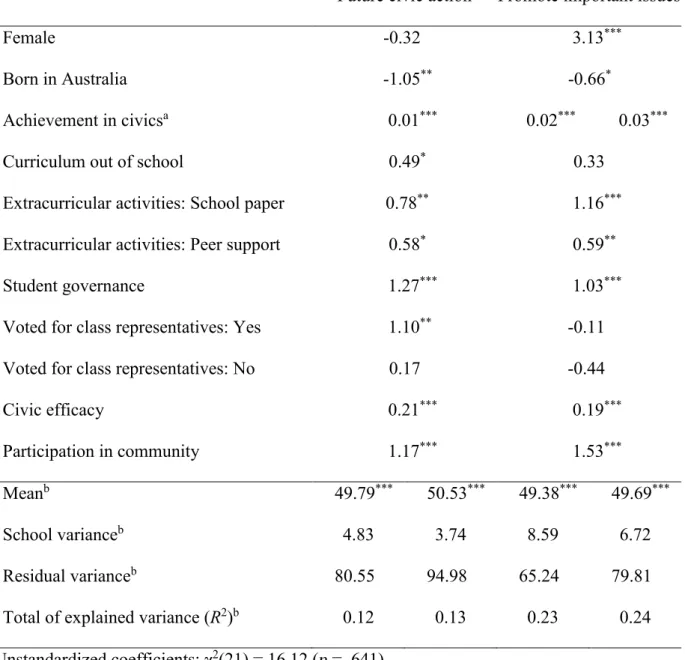
Next we include student level predictors in our analysis (RQ1). The multivariate regression in Table 3 shows that formal learning in school as measured by achievement in civics is positively associated with students’ willingness to civic action and to promote important issues. Formal learning is the only variable that has different effects in both cohorts (RQ3): Although formal learning always goes along with stronger intentions to participate in the future, students’ expected promotion of important issues is much weaker correlated with formal learning in 2013. Had we constrained this coefficient to equally affect the promotion of important issues, the model would have been significantly worse (p = 0.023).
Positive effects that are consistent across both types of future participation appear throughout for most other student participation variables, including civic efficacy. That is, participation in these activities goes along with a stronger willingness to engage in civic action and to promote important issues in the future. There are only few exceptions: First, not having voted for classroom representatives despite the availability of this activity in school is unrelated to future participation. Second, additional Wald z-tests were conducted to compare whether the predictors in Table 3 have significantly different effects on future civic action versus intentions to promote important issues (p < 0.05; data not shown). These suggested that formal learning and participation in the community are more positively associated with the promotion of important issues, whereas voting for classroom representatives has a stronger impact on future civic action. The latter reveals that for promoting important issues in the future, it does not make any difference whether students say that they may not vote, do not vote if they may vote, or actually vote for class representatives. While this can easily be inferred from Table 3, it is interesting to note that according to those z-tests, the effects of curriculum out of school do not
vary significantly between the two outcomes, which suggests that curriculum out of school activities are rather irrelevant in the prediction of future participation. For the remaining predictors, the relationships are likely to be of the same strength for both outcome variables.
[Table 3]
Civic Efficacy as a Mediating Mechanism
Although we find some activities to be more important than others in preparing students for active citizenship as a democratic adult, it may be that student participation (additionally) promotes students’ sense of collective efficacy, as suggested by the developmental perspective. Therefore, we test whether civic efficacy operates as a mediating mechanism (data not shown).2 Indeed, all student activities but curriculum out of school and not having voted for classroom representatives are significantly and positively related to civic efficacy (p < 0.05), which is an important condition for statistical mediation. The second condition, according to which the mediating variable must have a significant effect on the dependent variables, is also fulfilled (Table 3); and, third, we find mediated effects for the significant predictors of civic efficacy.
Therefore, three conclusions can be drawn: First, the effect of having voted for classroom representatives on the promotion of important issues is fully mediated, as it did not have a direct effect on this outcome variable. Specifically, voting for classroom representatives is associated with higher civic efficacy, and thus related to higher intentions of promoting important issues in an indirect way. Second, for all school participation variables with direct effects on future participation (except curriculum out of school), the direct effect may underestimate the impact of the predictor variables. The reason is that part of their actual effect
on expected participation is mediated by students’ civic efficacy, as these variables are
therefore also positively associated with our participation variables in an indirect way. Third, curriculum out of school is unrelated to the promotion of important issues once we account for
other variables. Given the mentioned results, one might say that curriculum out of school activities are least relevant for future participation.
In conclusion, by increasing civic efficacy through student participation and civic knowledge, expected participation could be promoted both in direct and indirect ways. While this may be in line with the developmental perspective, the prevailing direct effects might speak for the applicability of the simpler participation perspective.
The Role of the School Context
Extending the multivariate student level model to include contextual variables, we first examine contextual effects for each school composition variable separately (RQ2), always controlling for school location, school sector and student level variables (data not shown). These analyses reveal two significant composition effects (p < 0.05): Only the school average performance in students’ formal civics learning and the percentage of students who help to prepare a school paper at their school are suitable to explain future participation. However, further model comparisons suggest that it is appropriate to constrain most variables, such that
only students’ formal learning and the school average performance in civics have different
effects in 2010 versus 2013 (p = 0.018). Hence, the final model (Table 4) does not account for the school composition in relation to the percentage of students who help to prepare a school paper (p > 0.05).
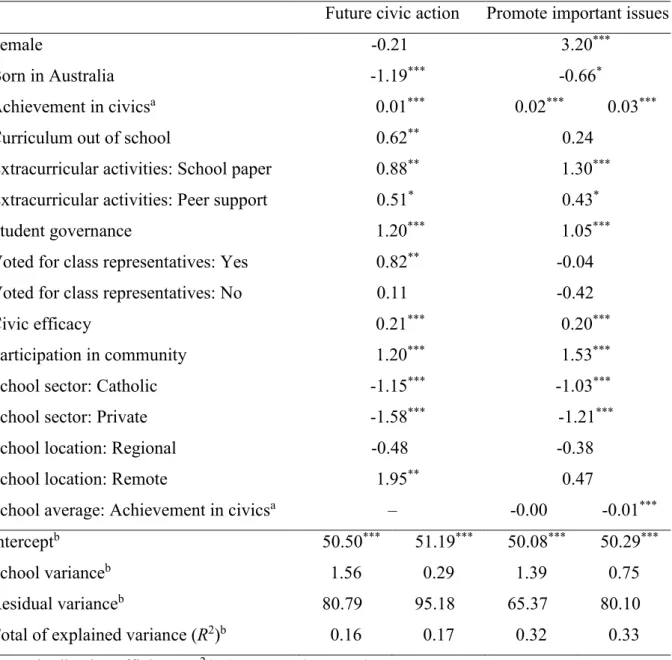
This final model yields that a schools’ performance in civics, measured as the average achievement of its students, is a significant predictor of students’ intention to promote important issues, and only in the 2013 cohort. As we grand mean-centered the predictor variables, the interpretation is not straightforward and needs to be read in conjunction with the student level predictor of formal learning, indicating a leveling effect: The negative effect reflects the expected difference in the willingness to promote important issues between students who have the same individual level of achievement in civics but attend schools that differ in
their average performance in civics (i.e. the school mean of students’ formal learning). Consequently, being knowledgeable is advantageous for expecting to promote important issues in the future if the school average performance in civics is held constant; but being surrounded by knowledgeable peers and integrated in a high-performing social context has a negative effect on this behavioral outcome when comparing two equally knowledgeable students from two different schools.
[Table 4]
Furthermore, once other predictors are taken into account as is done in this model, students in government schools are more likely to intend to participate in civic action and to promote important issues in the future than students in Catholic or independent schools. We also find that students who attend remote schools are more willing to engage in civic action, compared with students in metropolitan areas. The final model also confirms previous results in that the effects of the student level variables hold even when we compare across the entire student sample, instead of within-school comparisons (owing to grand mean-centering instead of school mean-centering).
In addition, we again tested whether the regression weights of the predictors vary significantly between future civic action and the promotion of important issues. While we find the same results as before for the student level variables, remote schools are significantly associated with future civic engagement, but unrelated with the intention to promote important issues. In conclusion, and as suggested by the small amounts of variance that are due to the schools, it seems that school context matters a little, but students’ participation and civic efficacy are far more important.
Discussion
In Australian secondary schools, students experience diverse forms of civic participation (Print 2007; Saha and Print 2010). Many also learn about civic and political issues, acquire political
reasoning skills and visit political sites as part of the formal curriculum (Print 2007, 2009). Hence, schools are unquestionably important agents in the political socialization of adolescents, and our results indeed show that student participation is associated with elements of active citizenship.
Whereas most research tends to look at a limited number of student activities at school or aggregates various activities, our study aimed to compare the effects of participation in a range of learning opportunities at school (RQ1). The analysis revealed that, given schools offer a variety of these opportunities, participation in student governance and extracurricular activities are quite likely to go in hand with increases in students’ willingness to engage in civic action and to promote important issues in the future. Moreover, the acquisition of civic knowledge and skills was positively associated with both kinds of expected participation. Other activities at school may be less relevant, and primarily associated with future civic engagement. In this regard, our findings support previous research which yielded a high significance of student governance activities (Geboers et al. 2013; Saha and Print 2010) and of formal learning in school, but a lower priority of curricular activities conducted out of school for building behavioral outcomes (Geboers et al. 2013). That is, curriculum out of school is often designed as to acquire civic knowledge, and its effects on future political participation may remain limited. Furthermore, the positive effects of community participation suggest that joint programs of schools and communities provide additional chances to increase adolescents’ willingness to participate in the future.
Three Perspectives on Participation
Although the three perspectives on the impact of student school participation on future political participation are not entirely exclusive, in our analysis we could tentatively address these perspectives. In the participation perspective, participation at a previous time is the precursor of participation in similar activities in the future: The mere participation in activities at school
may become a habit which familiarizes young people with democratic processes of decision-making and thereby increases the likelihood that students will be active participants in their communities and political life (Hahn 1998; Niemi and Junn 1998; Print, Ørnstrøm, and Skovgaard Nielsen 2002). Though participation in student governance was positively related
to students’ intentions to engage in civic action and to promote important issues, in our study
voting for class representatives was irrelevant for promoting important issues. This outcome fits well with the participation and developmental perspective, as voting for classroom representatives and future civic action tap into similar types of activities, and the former has indeed little overlap with the promotion of important issues, as measured in our study. More generally, our analyses indeed provide evidence in favor of the participation perspective, given the various positive relationships between almost any kind of student participation and both forms of future political engagement.
From our study, however, it is not possible to say clearly to what extent this supports the participation perspective in comparison to the developmental perspective. The former assumes that specific types of student participation result in future participation in similar activities. This may to some extent be due to the development of behavior-related skills, which in turn increase the likelihood of participation in activities that require similar skills. From our study, we can only speculate that student participation in a range of diverse informal civic learning activities might develop participation-related skills more broadly, which then might benefit future participation in general. Unfortunately, we had no measures of behavior-related skills owing to the infeasibility of their measurement (ACARA 2014).
At first sight, it may be surprising that formal learning showed stronger positive associations with students’ intentions to promote important issues than with their expected future civic action. One might have expected that formal learning would perhaps relate more strongly to more conventional activities. However, from psychological theory we know that
behaviorally relevant knowledge is a better predictor of behavior (Fabrigar et al. 2006; Lupia 2016). The NAP-CC assessment indeed differs from common public opinion surveys, such as the Australian Election Study (McAllister 2011), as it covers a broader range of civic knowledge that goes beyond mere knowledge about political institutions. Our finding suggests that civic knowledge and reasoning skills are important not only for more traditional forms of participation, but even more so to build issue-based political action. This is potentially because of the higher level of elaboration that is required to make a decision for or against the promotion of important issues (Barden and Tormala 2014).
In the developmental perspective, participation in organized activities at school and in community organizations becomes part of the self-concept development of students contributing to a sense of agency and relatedness, which stimulates future participation in organized activities. As we had no measure on volunteering intentions, this may be a caveat in examining the developmental perspective which would expect a link between participation in community organizations and volunteering in later life. Hence, effects on the activities that our study utilized as outcome variables could be less powerful.
The clearly positive effect of students’ civic efficacy, measured as the value of
participation in school and politics, might be interpreted as supporting evidence for the developmental perspective though: Students’ who feel that participation at school and beyond can make a difference may develop a sense of empowerment and duty actually to participate in the determination of their environment(s) (Saha and Print 2010; Schulz, Ainley, and Fraillon 2013). We found evidence for this thesis, as various student activities went along with higher civic efficacy, which in turn was associated with increases in students’ intentions to participate in politics in later life. However, only the effect of voting for classroom representatives was fully mediated with respect to students’ intentions to promote important issues. All other school participation variables (except curriculum out of school and not voting for classroom
representatives) still had direct effects when controlling for civic efficacy. Therefore, the participation perspective, which assumes a more direct link between specific types of current and future behavior, might be more suitable to explain future participation. However, evidence was in favor of both the participation and the developmental perspective, suggesting that school participation matters for building active citizenship and democracy, so that educators can play an important role in what types of active citizens develop at school by favoring and endorsing certain forms of participation against others.
Evidence for the structural perspective was limited though. Many forms of student participation require some kind of collaboration, negotiation and engagement with others, which can build social ties and networks. Yet our analyses suggest that it is primarily the direct experience of participation which is associated with political participation, and less so the inclusion in a social context where participation is the norm. This is evident by the absence of school composition effects, in addition to zero- and non-positive effects of metropolitan and non-government schools. Hence, only to a small degree may participation in schools contribute
to students’ social capital, which in turn and consistent with the structural perspective would
be beneficial in terms of future engagement in civic and political life (Putnam 2000; but see the discussion later).
Little evidence for the structural perspective also comes from a study of 31 countries: Although Isac et al. (2014) found the percentages of students reporting participation at school to matter, the average effect of school composition was very small. Others have suggested that country differences matter when explaining future political participation by students’ participation in school, and that the latter may be less powerful predictors in established democracies (Mirazchiyski, Caro, and Sandoval-Hernández 2014), such as Australia. One reason could be differences in political socialization and lower levels of intended political participation among students in new democracies (Mirazchiyski, Caro, and
Sandoval-Hernández 2014), as political socialization for active citizenship at home may be less common, or powerful, than in established democracies where considerable opportunities to participate have existed for long.
The Role of School and Societal Context
In this connection, we would like to recall that our analysis revealed only marginal differences in students expected civic and political participation that are due to differences between schools (RQ2). This has been found in other geographical contexts (Isac et al. 2014; Kahne and Sporte 2008; Mirazchiyski, Caro, and Sandoval-Hernández 2014; Quintelier 2010) and supports the general contention that within-school variations may be greater than between-school differences. Thus, the question is what and how civic and citizenship education at schools can contribute to promote active citizenship. Our results suggest that student participation at school may promote active citizenship (Geboers et al. 2013). However, it remains unclear how a school subject and school curriculum on civic and citizenship education would be most suitable to promote active citizens, while there is no doubt that it could facilitate informed citizens.
Among the formal characteristics of schools, we found that students who attend government schools reported higher willingness to future participation, compared with other students. Although the purposes and quality of student councils and participation in general may vary between schools (McFarland and Starmanns 2009), our analysis provides no indication that Australian government schools inhibit the development of active citizens. This may surprise at first, in particular as government schools are more likely to provide less advantageous social networks, if any. Yet it merely suggests that although students at independent and Catholic schools usually perform better in formal learning, this may not convey to future civic and political participation, accounting for other student and school correlates. We can speculate that the perception of injustice might be more prominent among students at government schools, ceteris paribus. In terms of social psychological theory, these
students might feel relative deprivation and could therefore choose to participate in activities that could advance the position of their disadvantaged in-group (for a meta-analysis on the effects of relative deprivation, see Smith et al. 2012).
Turning the focus on the societal context, we found differential effects only for formal civic learning (RQ3). Specifically, students’ civic knowledge was more strongly and positively correlated with their intention to promote important issues in the future if they belonged to the 2013 cohort. At the same time, the role of a school context coined by peers who are more knowledgeable and have better analytical skills in the political domain was negative in 2013, thus leveling the overall effect of formal learning. While this indicates that formal learning outcomes of individual students are more important for future participation in the younger cohort, it would be too farfetched to claim that the role of school context is getting less important. Though we could speculate that expectations to participate in the future might become more self-determined by relying on personal knowledge and skills, while decisions to participate may become less influenced by schoolmates’ arguments. Also, research has shown that peer influence is strongest in early adolescence and declines thereafter, and it is less pronounced for prosocial compared with antisocial behavior (Brown et al. 2010). As younger cohorts tend to reach biological maturity more quickly, this could suggest that the decline of peer support also starts earlier or is more pronounced among younger cohorts. Future research should monitor this development and examine whether this hypothesis applies, and more contextual data from families and peers out of school would be needed better to understand whether leveling effects can be observed and how these contexts concur.
As for the moment, it is implausible to attribute the negligible differences to the events that occurred between 2010 and 2013, even though the younger cohort of secondary school students must have been more aware of politics. This due to the political turmoil in the Australian government and the constant media scrutiny about what was going on, as well as
the development of the first national Australian Curriculum. Further research is needed, and the continued flip-flopping in Australian government as well as the nascent implementation of the civics and citizenship curriculum may provide opportunities to follow up on this, before speculating about potential effects.
Limitations and Future Research
We also need to address a few limitations of our analysis. First, we relied on cross-sectional data, owing to the lack of high-quality longitudinal data. Hence, we cannot prove that the predictors in our analyses actually cause future participation, though we may claim tentative causality. Longitudinal data certainly would be of great advantage for examining the predictions made by all three perspectives, and in particular for testing mediated relationships. Second, since adolescents’ opportunities to participate in politics are limited, we could only refer to what they expect to do in the future. Although the link between behavioral intentions and actual participation is strong (Ajzen 2012) and current participation increases the likelihood of future civic participation, there is no direct causation. Again, longitudinal studies are required to examine respective relationships by covering substantial time periods to identify long-term effects of student participation in school and the influence of the societal context. These would be particularly useful if they examined the link between civic learning in school and adult civic behavior beyond electoral participation. For this, smaller samples of youth could be followed over time using qualitative and observational designs to gain more information about the types and meanings of participation as students develop over time. Thereby, behavior-related skills could be measured more objectively (though any kind of scoring and observation has its own limitations), which is currently not feasible in large-scale assessments (ACARA 2014). This would also address the challenge that arises from the effect that social desirability can have on self-reported participation.
It is furthermore noteworthy that our analysis was restricted to the prediction of normative participation in the future, third. Other research has shown that civic knowledge and
participation at school can reduce students’ intention to participate in illegal protest (Ainley
and Schulz 2011), yet this cannot be answered for Australians with data from the NAP-CC. Fourth, we did not find much evidence in favor of the structural perspective. On a cautionary note, it is possible that community organizations and the networks and ties that are developed there might be more important in the promotion of political participation of youths. The positive influence of community participation at least indicates that, though we unfortunately had no measures to examine this assumption. In the structural perspective, neighborhood ties and parental involvement in school development are crucial in building adolescents’ social capital. Future studies could gather data about the involvement of different agents in schools – parents, teachers, community organizations etc., at least by means of a report by the school principal. Arguably, it would be much better if more information about students’ families, school neighborhoods and teacher practices were available.
This brings us to another limitation, which relates to the difficulty of assessing the quality and consistency of how civic education is implemented in schools. Although teacher-questionnaires would also rely on self-reported information, these would be a valuable complement to the NAP-CC. Finally, the small to medium amounts of explained variance (R2), in particular regarding future civic action, suggest that other variables not considered in our study are also relevant predictors of future political participation. The present analysis did not intend to provide an account of all possible predictors of expected participation, but to examine the role of students’ participation in school.
Conclusion
Our study provides a rare examination at a national level of the effects of student participation in school on intended civic and political participation in the future, as we (1) included a variety
of activities students may engage in at school and in their communities (without mixing different types of school participation as an aggregate index), (2) employed a model that accounts for characteristics of the school, and (3) conducted all analyses for two cohorts of secondary school students. The analyses presented here yielded stable results at both the student and the school level as well as across cohorts. This suggests that we may generalize the results of our study, which makes them valuable for school policy and practice.
We demonstrated that student participation at school and in the community have positive effects on their willingness to engage in civic action and to promote important issues for democracy in the future. Characteristics of the school, given comparable opportunities to participate at school, do not make a huge difference when it comes to secondary school
students’ intentions to future participation, despite existing but small differences (Isac et al.
2014; Kahne and Sporte 2008; Lopes, Benton, and Cleaver 2009; Mirazchiyski, Caro, and Sandoval-Hernández 2014; Quintelier 2010). Instead, individual participation at school and in the community have a major share in the explanation of intended future participation, although
the explanatory power of these variables is much stronger for students’ willingness to promote
important issues compared to future civic engagement. We suspect that this is caused by the nature of the activities that each of the outcome measures comprised of, because future civic engagement included some adult activities in which students cannot yet participate due to their age. In addition, research suggests that young people are less willing to engage in conventional participation but prefer informal and everyday activities or alternative forms of participation (Harris, Wyn, and Younes 2010). Similarly, de Groot, Goodson, and Veugelers (2014)
emphasized not only the importance of students’ efficacy, but also the significance “to help
(young) citizens imagine different ways in which they can have an impact, especially when they are still under 18” (163).
Clearly, schools are places where youth can trial different forms of democratic participation, and are therefore suited to help them become active, democratic citizens. Although the specific ways in which schools provide and students make use of the learning opportunities that we have discussed here vary between schools and individuals, our results provide clear evidence for the relevance of these experiences for future participation. They suggest that active and (at least partially) self-regulated learning experiences, in addition to formal civics learning at school, can help nurture active, informed citizens for democracies.
Our analysis also provides several avenues for the conception of future research. Most important are the need for an extension of the NAP-CC to enable researchers to link student responses and civic learning outcomes to the school and community environments as well as the actual learning, both quantitatively and qualitatively, that happens in schools. While we know that there is a positive effect of school experiences in civics on later civic engagement we do not know how well that effect is sustained over time and across social contexts. We therefore need robust longitudinal studies that can confirm the relationship between school experiences and longer-term political and civic engagement. This request is challenging (Manning and Edwards 2014), because unexpected and confounding factors cannot easily be controlled for in longitudinal field studies. However, this challenge needs to be tackled, and a multicohort sequence design such as it is utilized in the German National Educational Panel Study (von Maurice, Blossfeld, and Roßbach 2016) could be a reasonable middle ground that would address potential uncertainties in longitudinal research.
Challenging but badly needed is also the development of measures of applied and behavior-related skills in large-scale studies and out of the laboratory. Another important area for research is the impact of the diverse forms of the informal curriculum in schools on nurturing active, informed citizens. The potential impact of school elections on students is logical (Saha and Print 2010), but the many diverse activities within the informal curriculum
remain under-researched and their impact potentially under-valued over time, particularly if there is a cumulative effect with the formal curriculum. Finally, any data collection should be theory-driven, not only from a conceptual point of view but also considering the mechanisms behind the correlates. That would enable scholars to go beyond shallow claims and expedite the gain of empirical knowledge that should guide educational policy.
Notes
1We note that “active citizenship” is not conceptualized as a dichotomy. Although this analysis
focuses only on behavior, we would like to emphasize that a comprehensive understanding of active citizenship comprises skills development, motivated behavior and attitudes and values (Kennedy 2006; Hoskins and Mascherini 2009). Dichotomies often fail to capture the whole picture, and this applies to active citizenship. Most prominently has this been argued by Amnå and Ekman (2014), who speak of “standby citizens”; and there is recent evidence on the inappropriateness of any binary thinking of active citizenship in the Australian context (Reichert 2016b, 2016c, 2017).
2 Because the mediator was an intermediate dependent variable in this scenario, it was used in its raw metric for mediation analyses to avoid model identification issues.