BG Research Online
Efstratopoulou, M.A., Dunn, T.J., Andrzejewska, J. & Augustyniak A. (2017).
Assessing externalizing and internalizing behaviour in children: use of the
motor behaviour checklist in a typical school-age Polish sample. European
Journal of Special Education Research, 2(6), 43-59.
This is the final, published version of a document / article published by Open Access Publishing Group in its final form on September 4, 2017 at http://dx.doi.org/10.5281/zenodo.883729.
Copyright is retained by the author/s and/or other copyright holders.
End users generally may reproduce, display or distribute single copies of content held within BG Research Online, in any format or medium, for personal research & study or for educational or other not-for-profit purposes provided that:
The full bibliographic details and a hyperlink to (or the URL of) the item’s record in BG Research Online are clearly displayed;
No part of the content or metadata is further copied, reproduced, distributed, displayed or published, in any format or medium;
The content and/or metadata is not used for commercial purposes;
The content is not altered or adapted without written permission from the rights owner/s, unless expressly permitted by licence.
For other BG Research Online policies see http://researchonline.bishopg.ac.uk/policies.html.
ISSN-L: 2501 - 2428 Available on-line at: www.oapub.org/edu
Copyright © The Author(s). All Rights Reserved.
doi: 10.5281/zenodo.883729 Volume 2 │ Issue 6 │ 2017
ASSESSING EXTERNALIZING AND INTERNALIZING
BEHAVIOUR IN CHILDREN: USE OF THE MOTOR BEHAVIOUR
CHECKLIST IN A TYPICAL SCHOOL-AGE POLISH SAMPLE
Maria A. Efstratopoulou1*i, Thomas J. Dunn2, Joanna Andrzejewska3, Agnieszka Augustyniak3 1Senior Lecturer, Special Education and Inclusion,
School of Social Sciences, Bishop Grosseteste University, Longdales Road, Lincoln LN13DY, UK
2Senior Lecturer Psychology, Department of Psychology
Bishop Grosseteste University, Longdales Road, Lincoln LN13DY, UK
3MSc, Department of Pedagogy University of Walcz, 78-600 Walcz, Poland
Abstract:
The study was designed to investigate externalizing and internalizing behaviours in a typical school-aged sample of children (N=112) using the Polish version of the Motor Behaviour Checklist for Children. The instrument was translated into Polish and teachers observed and recorded the motor behaviour of their students in school settings during physical education and free play situations. Findings demonstrated a psychometrically robust application of the MBC in a Polish sample as well as gender differences in total externalizing scores. In addition, age was found to be significant correlated with internalizing scores and especially with the social interaction factor. Teachers reported boys as more inattentive and more hyperactive/impulsive than girls and more likely to display externalising symptoms connected with ADHD particularly in school settings. Findings underscore the importance of early diagnosis and have practical implications when designing behavioural management programs and educational interventions in school settings.
Keywords: motor behaviour, externalizing behaviour, internalizing behaviour, children
1. Introduction
Early identification of emotional and behavioural problems in children can help to minimize long-term harm and reduce overall healthcare burden and costs to students themselves, their families, and society as a whole (Kauffman, & Landrum, 2009). Students with attention deficits and hyperactivity experience persistent and extreme distractibility as a result to cannot screen out irrelevant stimuli in order to concentrate on tasks long enough to complete them, and do not sustain thought processes long enough to complete their schoolwork (Bennett, Dworet, & Weber, 2008).
Several factors combine to predict academic success and to explain gender differences during primary school. Girls are more responsive to social cues and to adults’ requests (Ready LoGero, Burkan & Lee, 2005) more self-disciplined (Duckworth & Seligman, 2006). Research on students’ referrals indicated that gender bias was a factor and boys are more likely to receive referrals for special education services and these gender differences have led to the suspicion that gender discrimination may be operating (Brannon, 2011).
It is not surprising that reducing the incidence of developmental problems through systematic screening and comprehensive intervention efforts is a growing area of interest to educational research (Kauffman, & Landrum, 2009; Lane, 2007; Nelson, Babyak, Gonzalez, & Benner, 2003).
One of the best ways to have a clear view of problematic behaviour in middle childhood is to observe what goes on in children’s everyday lives. In the absence of advanced verbal skills, observing children’s motor-related behaviour is the best indicator of emotional development (Efstratopoulou, 2014; Mol Lous, Wit, De Bruyn, & Riksen-Walraven, 2002). When young children’s behaviour is of interest, the most valid and reliable information is often gathered by observing a child in different settings. For example, observing how a child moves, how he or she interacts with others and how he or she deals with challenging situations or conflicts can provide the most comprehensive snapshot of a child’s development. Designed with this in mind, the MBC is a measurement tool aimed at capturing patterns of motor behaviour that have been shown to underlie developmental difficulties related to attention, conduct, learning, and mood. Research indicates that educators who observe different aspects of children’s motor-related behaviour during their lessons are able to identify with greater accuracy ‚at risk‛ groups for school adjustment problems (Flanagan, Bierman, & Kam, 2003). In addition, when examining ratings on attention from different sources there is a stronger agreement between teachers and physical educators than between parents and physical educators or between parents and teachers, suggesting that there may be
differences in raters’ frames of reference and/or that children’s behaviours vary in different settings (Efstratopoulou, Simons, & Janssen, 2011).These differences may reflect situational demands and/or differences in the salience and importance of particular child behaviours for parents and educators. It has been shown that school
adjustment problems map onto two behavioural sub-factors, externalizing and
internalising tendencies (Efstratopoulou, Janssen & Simons, 2012). Externalizing tendencies include behaviours such as verbal and physical aggression, noncompliance, and delinquent acts (Stouthamer-Loeber, & Loeber, 2002) and internalizing tendencies include depression, anxiety, and somatic complaints (Morris, Shah, & Morris, 2002).
Research studies in children’s behavioural problems indicate that ‘at risk’ students may function two or more years below grade level, in comparison with their typical peers, in reading, math, writing, and spelling skills. In addition, these deficiencies may be related to emotional disabilities as students with severe anxieties, are unable to attend, listen, and learn in school and in most cases lack social skills that are necessary for school success (Kavale, Mathur, & Mostert, 2004). Thus, it is vital that measures such as the MBC are applied across different cohorts and any valuable insights reported. For the current research, the MBC will be employed at a Polish primary educational institution where sample characteristics, internal consistency estimates, and gender and age differences will be examined.
2. Method 2.1 Sample
Data from five teachers (4 females and 1 male) from a typical primary school from Poland, who rated 112 of their students using the MBC checklist (Efstratopoulou, Janssen, & Simons, 2012), were used to assess the children’s externalizing and internalizing behaviour. The participants were 60 girls (54%) and 52 boys (46%), with an age ranged of 9 to 12 years (M=10.86 years, SD=.86) and 100% had Polish nationality. All participants’ teachers were working independently with the students in different settings. The externalizing problems scale included three clusters: rules breaking, lack of attention and hyperactivity/impulsivity. The internalizing scale included four clusters: low energy, social interaction, stereotyped behaviour and self-regulation. 2.2 Assessment Instrument
The Polish version of the Motor Behaviour Checklist for children (MBC; Efstratopoulou, Janssen, & Simons, 2012) was used to assess externalizing and internalizing behaviours in the sample (Appendix A). The MBC is a checklist designed to be completed by the
primary school teacher and/or the physical educator who knows the child well enough to rate his/her behaviour. Responders are asked to observe the child and rate each behaviour on a 5-point Likert scale ranging from ‚never‛ (0) to ‚almost always‛ (4). The MBC comprises 59 motor related behaviours and items are included in two broad factors (Externalizing and Internalizing) and seven problem scales: Rule breaking (7
items), Low energy (4 items), Stereotyped behaviours (2 items),
Hyperactivity/Impulsivity (14 items), Lack of attention (10 items), Lack of social interaction (10 items), and Lack of self-regulation (12 items). The development of the MBC items involved different phases, including items derived from teachers’ reports, established diagnostic criteria (DSM-IV, American Psychiatric Association, 2000; ICD-10, World Health Organization, 1992), and professionals’ reports. Confirmatory Factor Analyses (CFAs) suggested that the MBC for children is an instrument homogeneous in content, with high stability and high correlation agreement as tested on a Greek sample (Efstratopoulou,Janssen, & Simons, 2012a). The original version of the list is in English and has been also translated in Portuguese, Greek and Flemish for research purposes. 2.3 Assessment procedure
A back to back translation of the MBC was performed from English into Polish and a pilot study conducted using feedback from 12 teachers to ensure appropriate understanding and ease of use. Prior to data collection, singed consents of approvals for participating in the study were collected from the head teacher and the participant’s teachers. An introduction session on the list was also performed to familiarise participating educators with the scale. Written informed consent was obtained from all parents and/or legal guardians and institutional review boards approved all procedures. Teachers had a period of two weeks to fill in the MBC lists for their students.
3. Results
3.1 Reliability statistics
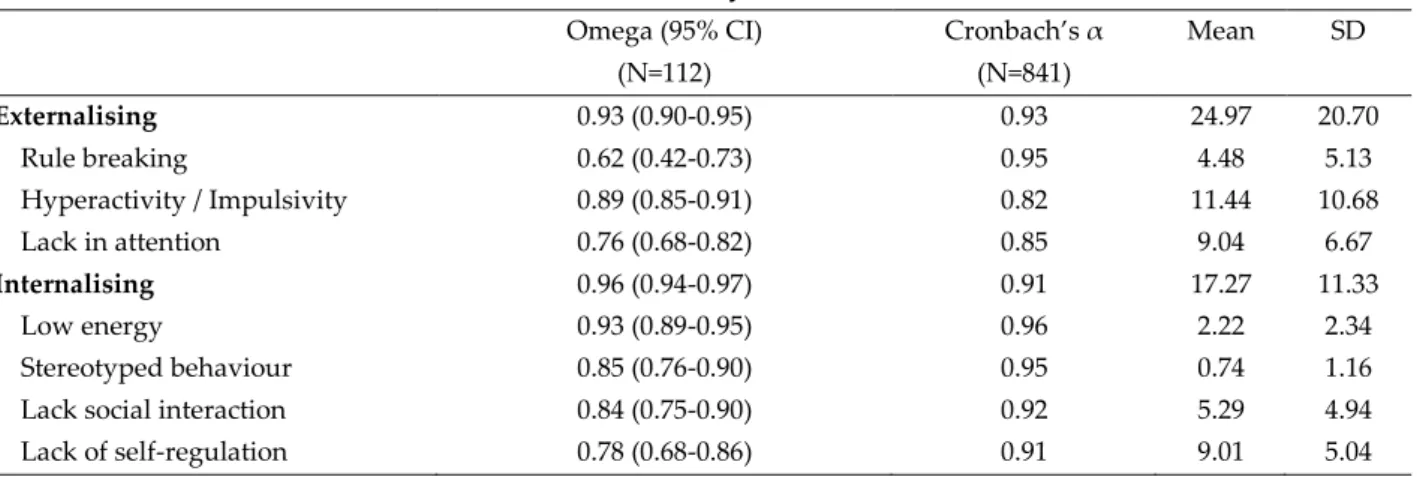
Owing to recognised problems when using Cronbach’s alpha as a metric of internal reliability (See Dunn et al., 2012), McDonlad’s Omega was calculated for both global factors (internalising & externalising) and seven sub-factors (Rule breaking, Low energy, Stereotyped behaviour, Hyperactivity, Lack of attention, Lack of social interaction, Lack of self-regulation). Results showed good internal consistency for each global factor as well as well sub-factors. The MBC demonstrates comparable levels of internal consistency as employed on the current Polish sample (N=112) as that of
previous administrations with a Greek sample (N=841). See Table 1 for all internal consistency estimates along with means and standard deviations.
Table 1: Reliability coefficients
Omega (95% CI) (N=112) Cronbach’s α (N=841) Mean SD Externalising 0.93 (0.90-0.95) 0.93 24.97 20.70 Rule breaking 0.62 (0.42-0.73) 0.95 4.48 5.13 Hyperactivity / Impulsivity 0.89 (0.85-0.91) 0.82 11.44 10.68 Lack in attention 0.76 (0.68-0.82) 0.85 9.04 6.67 Internalising 0.96 (0.94-0.97) 0.91 17.27 11.33 Low energy 0.93 (0.89-0.95) 0.96 2.22 2.34 Stereotyped behaviour 0.85 (0.76-0.90) 0.95 0.74 1.16
Lack social interaction 0.84 (0.75-0.90) 0.92 5.29 4.94
Lack of self-regulation 0.78 (0.68-0.86) 0.91 9.01 5.04
Table 2: Correlation matrix for all MBC components and Age
Rules Energy Stereo Hyper Attention Social int. Self-reg. External Internal
Rules - Energy 0.00 - Stereo 0.38** 0.27 - Hyper 0.86** -0.06 0.46** - Attention 0.71** 0.31** 0.45** 0.70** - Social interaction 0.55** 0.34** 0.45** 0.47** 0.53** - Self-regulation 0.57** 0.47** 0.49** 0.60** 0.73** 0.61** - Externalizing 0.92** 0.07 0.48** 0.96** 0.86** 0.55** 0.68** - Internalizing 0.56** 0.61** 0.59** 0.53** 0.70** 0.85** 0.90** 0.64** - Age 0.12 0.09 0.17 0.03 0.05 0.44** 0.17 0.06 0.314**
**. Significant at 0.01 level (2-tailed).
3.2 Correlation analysis
Correlation analysis was carried out for all global- and sub-factors. Results from the correlation analysis (See Table 2) revealed a significant correlation between age and Social interaction and between age and total internalizing scores. In addition, there were no significant relationships between age and the three other subscales (Low energy, Stereotyped behaviour, & Self-regulation). Correlations between global factors and corresponding sub-factors showed multiple significant correlations. All sub-factors correlated significantly with the appropriate global factor (e.g., rules breaking was correlated with externalising). However, some sub-factors correlated (albeit to a lesser extent) with the opposing global factor (e.g., lack of attention was correlated with internalising). This is somewhat in line with the MBC’s factor structured as the global factors have been shown to correlated (Efstratopoulou et al., 2013). Low energy was
significantly correlated with internalising and not externalising which is in line with previous work (Efstratopoulou et al., 2013) and makes theoretical sense.
3.3 Exploring gender difference
In order to examine any gender differences, t-tests were carried out across all global factors and subs-factors. Results showed a significant difference between gender scores in terms of externalizing behaviour (See Table 3). Although no sub-factor of externalizing behaviour reached statistical significance, each sub-factor score for males exceeded that of female’s. This suggests in the Polish sample that males tended to display more externalising motor behaviour than females.
Table 3: Mean scores on MBC externalizing problem scales by gender
Subscales Number of items Boys (SD) Girls (SD) t-value p-value Rules breaking 7 5.42 (5.15) 3.66 (5.00) 1.82 .070 Hyperactivity/Impulsivity 14 14.13 (11.02) 9.16 (10.01) 2.48 .141 Lack in Attention 10 10.30 (6.56) 7.95 (6.62) 1.88 .062 Total Externalizing 31 30.07 (20.61) 20.78 (20.08) 2.40 .018**
**. Significant at 0.01 level (2-tailed).
4. Discussion
Research in children’s psychopathology indicates that there are gender differences among children at primary school age not only on academic achievement but also on behaviour, social functioning, and coordination skills (Heptinstall & Taylor, 2002). Studies in behavioural differences between boys and girls generally agree that in typical school-aged samples boys exhibit more externalizing symptoms than girls, are more aggressive and trend to break rules more often (Efstratopoulou, 2014) and these findings are more obvious when the participants are children with mild disrupted behaviours and ADHD symptoms (Heptinstall & Taylor 2002; Abikoff, Jensen, Arnold, Hoza, Hechtman, Pollack, et al, 2002).
In this study, the Motor Behaviour for Children list (MBC) was applied in a Polish population and possible gender differences in both externalizing and internalizing behaviours among typical school-aged children were examined. Results suggested that there is a significant difference on total externalizing scores due to gender but there is no significant difference on total internalizing scores between boys and girls in our sample. Findings also indicated that teachers rated boys higher than girls at the same age on all the sub clusters of externalizing behaviour scales. Separate scores on rules breaking, hyperactivity/ impulsivity and lack of attention subscales were
higher for boys with the rules and attention scores to be very close to statistical significance. These results are in line with research studies on gender differences on children’s behaviour during elementary school which indicates that teachers rate boys as more hyperactive and less self-disciplined than girls and boys receive more teacher attention than girls but much of the attention is oriented towards boys’ misbehavior and their academic problems (Brannon, 2011). Gender differences seems to be relate more strongly to teachers’ attitudes than to achievement and more to interests and preferences than to abilities and skills. Although some schools have made gender equity a focus, these gender inequalities are not a major focus of teacher training or for most school systems.
The effect of age on children’s behaviour was examined using correlation analyses among age and the separate scores on each sub cluster of externalizing and internalizing behaviours. Findings revealed significant positive correlations between age and social interaction scores and between age and total internalizing scores, indicating that there is a strong age effect on children’s internalizing behaviour. Results with typical samples of children revealed gender differences on externalizing symptoms but no differences on externalizing behaviours when using ADHD samples suggesting that the behaviour of boys and girls with the disorder may be similar (DuPaul, Jitendra, Tresco, Vile Junod, Volpe, & Lutz, 2006; DuPaul, Jitendra, Tresco, Vile Junod, Volpe, & Lutz 2005). Inconsistent with our findings, earlier research studies of gender differences among typical children at primary school age have also found differences on prevalence, academic achievement, behaviour, social functioning, and coordination (Heptinstall & Taylor 2002). Among recent studies, there is general agreement that in typical samples boys are rated as having more externalizing symptoms and also more aggressive behaviour than girls (Heptinstall & Taylor 2002; Abikoff, Jensen, Arnold, Hoza, Hechtman, Pollack, et al, 2002). Boys with mild disabilities and externalizing symptoms are more likely to be reported by their teachers and parents as ‚running about or climbing excessively ‚and ‚leaving seat in classroom‛, whereas more girls ‚talked excessively‛ (Graetz, Sawyer & Baghurst, 2005). Although, most recent literature tends to suggest that externalizing behaviours of girls and boys with mild disabilities are more alike than they are different (Seidman, Biederman, Monuteaux, Valera, Doyle, & Faraone, 2005; Pinchen, Jong, Chung, & Chen, 2004), other studies have revealed that small differences in motor coordination and academic performance sometimes do exist between genders among typically developing students (Larson, Mostofsky, Goldberg, Cutting, Denckla & Mahone, 2007). Understanding childhood externalizing and internalizing behaviour is an important construct in the field of child and adolescent psychiatric and mental health nursing. A
better understanding of these behaviours and the risk factors underlying it is essential for learning how to prevent emotional and behavioural problems in the future. By developing a strong knowledge base on children’s behaviour, it will be possible to develop interventions to support students at risk and reduce problematic behaviour.
This study also presents the first application of the MBC in a Polish sample. Results demonstrate the MBC to be a reliable cross-cultural test of motor behaviour in children. Internal consistency estimates parallel that previously found in a large Greek sample. However, correlations between sub-factors and their corresponding global factor was less clear and requires further administration in larger samples.
5. Limitations and future research studies
The main limitation of this study is the relative small sample used (N=112) which was mainly derived from one school area in Poland and for this reason we cannot generalize the results for the whole typical primary school-aged population in the country. However, it was the first pilot study conducted using the Polish version of the Motor Behaviour Checklist for children (MBC; Efstratopoulou, Janssen, Simons, 2012) in order to assess externalizing and internalizing behaviour in typical primary students. Future research studies using bigger and more representative samples from Polish population are needed to confirm the results of this study and check further the psychometric properties (e.g. reliability, validity) of the MBC list with Polish data.
5.1 Practical Implication for the Use of MBC in School Settings
Not all students with challenging behaviour will necessarily require special education settings, it is very important that the educators and school administrators, be prepared to implement systematic assessment tools to identify students who might benefit from more focused supports (Lane, 2007). The MBC for children is a practical and useful instrument to assess externalizing and/or internalizing problems in elementary school-aged children by their teachers. From this point of view, the instrument could be used to provide valuable additional information about child’s problematic behaviour and help educators in their important decision to refer or not students for further evaluation by the diagnostic teams. Although MBC for children it is not designed to be used as a diagnostic tool in clinical settings, however, the data provided by the instrument could be useful as a complementary information during assessment procedures. Rating the child on a number of motor related behaviour, a lot of valuable information concerning the global behavioural status of the child could help paediatrics and school
psychologists, during their psychological evaluation and especially when psychomotor intervention programs and behavioural interventions are proposed to applied.
However, it is important emphasize the fact that professional’s guidelines for the diagnosis of disorders in children clearly indicate the need for much additional information including development history, academic functioning, achievement test performance, and other psychopathology factors. A further and more in depth accurate psychological assessment must follow this initial ‚screening‛ as the aim of Motor Behaviour Checklist (MBC) for children, is not to provide a clinical diagnosis, but to provide useful information about child’s problematic motor behaviour and facilitate the teaching procedure for physical educators, class teachers and education staff, in school settings (Efstratopoulou, 2014).
References
1. Abikoff, H. B., Jensen, P. S., Arnold, L.L.E., Hoza, B., Hechtman, L., Pollack, S., et al. (2002). Observed classroom behavior of children with ADHD: Relationship to gender and comorbidity. Journal of Abnormal Child Psychology, 30, 349–59.
2. Bennett, S., Dworet, D., & Weber, K. (2008). Special education in Ontario schools
(6th ed.). St. David’s, Ontario, Canada: Highland Press.
3. Brannon, L. (2011). Gender: Psychological Perspective (6th ed.). Boston: Pearson Education, Inc.
4. Duncan, A. L., & Seligman, M. E. (2006). Self-discipline gives girls the edge:
Gender in self-discipline, grades and achievement test scores. Journal of
Educational Psychology, 98, 19-208.
5. Dunn T.J., Baguley T, Brunsden V (2014). From alpha to omega: A practical solution to the pervasive problem of internal consistency estimation. British Journal of Psychology, 105, 3, 399-412.
6. DuPaul, G. J., Jitendra, A.K., Tresco, K.E., Vile Junod, R. E., Volpe, R.J., & Lutz, J.G. (2006). Children with attention deficit hyperactivity disorder: Are there gender differences in school functioning? School Psychology Review, 35, 292–308. 7. DuPaul, G. J., Jitendra, A.K., Tresco, K.E., Vile Junod, R. E., Volpe, R.J., & Lutz,
J.G. (2005). Impact of gender and age on executive functioning: Do girls and boys with and without attention deficit disorder differ neuropsychologically in preteen and teenage years? Developmental Neuropsychology, 27, 79–105.
8. Efstratopoulou, M. (2014). Working with Challenging Children: From Theory to Practice in Primary Education. New York: Nova Sciences.
9. Efstratopoulou, M., & Simons, J. & Janssen, R. (2011). Concordance among Physical Educators’, Teachers’ and Parents’ Perceptions of Attention Problems in Children. Journal of Attention Disorders, 17, 437-443
10.Efstratopoulou, M., Janssen, R. & Simons, J. (2012). Differentiating children with
Attention-Deficit/Hyperactivity Disorder, Conduct Disorder, Learning
Disabilities and Autistic Spectrum Disorders by means of their motor behaviour characteristic Research in Developmental Disabilities, 33, 196–204.
11.Efstratopoulou,M., Janssen,R., & Simons, J. (2012a). Agreement among physical educators, teachers and parents on children’s behaviors: A Multitrait-Multimethod design approach. Research in Developmental Disabilities, 33, 1343– 1351.
12.Flanagan, K. S., Bierman, K. L., & Kam, C. M. (2003). Identifying at-risk children at school entry: The usefulness of multibehavioral problem profiles. Journal of Clinical Child and Adolescent Psychology, 32, 396–407.
13.Graetz, B. W., Sawyer, M. G., & Baghurst, P. (2005). Gender differences among
children with DSM-IV ADHD in Australia. Journal of American Academy of Child
and Adolescence Psychiatry, 44, 159–68.
14.Heptinstall, E., & Taylor, E. (2002). Sex differences and their significance. In Sandberg S, editor. Hyperactivity and disorders of childhood. West Nyack, NY: Cambridge University Press
15.Kauffman, J. M., & Landrum, T. (2009). Characteristics of emotional and behavioral disorders of children and youth (8th ed.). Columbus, OH: Merrill.
16.Kavale, K.A., & Mostert, M. P. (2004). Social skills for individuals with learning disabilities. Learning Disability Quarterly, 27, 31-43.
17.Lane, K. L. (2007). Identifying and supporting students at risk for emotional and
behavioural disorders within multi-level models: Data driven approaches to conducting secondary interventions with an academic emphasis. Education and Treatment of Children, 30, 135–164.
18.Larson, J.C.G., Mostofsky, S. H., Goldberg, M. C., Cutting, L. E., Denckla, M. B.,
Mahone, E. M. (2007). Effects of gender and age on motor exam in typically developing children. Developmental Neuropsychology, 32, 543–562.
19.Mol Lous, A., Wit, C. A. M., De Bruyn, E. J., & Riksen-Walrawen, J. M. (2002). Depression markers in young children’s play: A comparison between depressed and non-depressed 3 to 6 years old in various play situations. Journal of Child Psychology and Psychiatry, 43, 1029–1038.
20.Morris, R.J., Shah, K., & Morris Y. P. (2002). Internalizing behaviour disorders. In K. Lane, F. Gresham, & T. O’Shaughnessy (Eds.), Interventions for children with a risk for emotional and behavioural disorders, 223-241.
21.Nelson, N. J., Babyak, A., Gonzalez, J., & Benner, G. J. (2003). An investigation of the types of problem behaviours exhibited by K–12 students with emotional or behavioural disorders in public school settings. Behavioural Disorders, 28, 348–359. 22.Pinchen, Y., Jong, Y. J., Chung, L. C., & Chen, C., S. (2004). Gender differences in a clinic-referred sample of Taiwanese attention-deficit/ hyperactivity disorder children. Psychiatry Clinical Neuroscience, 58, 619–623.
23.Ready, D., LoGerfo, L., Burkam, D., & Lee, V. (2005). Explaining girls’ advantage in kindergarten literacy learning: Do classroom behaviours make a difference?
Elementary School Journal, 106, 21-38.
24.Seidman, L., J., Biederman, J., Monuteaux, M., C., Valera, E., Doyle, A. E., Faraone, S. V. (2005). Impact of gender and age on executive functioning: Do girls and boys with and without attention deficit disorder differ
neuropsychologically in preteen and teenage years? Developmental
Neuropsychology, 27, 79–105.
25.Stouthamer-Loeber, M., & Loeber R. (2002). Lost opportunities for intervention: Undetected markers for development of serious juvenile delinquency. Criminal Behaviour and Mental Health, 12, 69-82.
Appendix A: Polish version of MBC
Nigdy Czasem Często Bardzo często
Prawie zawsze 1. Uczeń nie stosuje się do ustalonych reguł,
zwłaszcza podczas pracy w grupie. 0 1 2 3 4
2. Uczeń ma trudności z czekaniem na swoją
kolej wypowiedzi. 0 1 2 3 4
3. Uczeń jest nieuważny. 0 1 2 3 4
4. Uczeń okazuje zmęczenie nawet po
minimalnym wysiłku. 0 1 2 3 4
5. Uczeń okazuje stereotypowe ruchy ciała, zwłaszcza dłoni (np. klaskanie, pstrykanie palcami).
0 1 2 3 4
6. Uczeń okazuje ograniczenie w gestach, które
regulują relacje społeczne. 0 1 2 3 4
7. Uczeń okazuje ciągłe zainteresowanie
częściami różnych przedmiotów. 0 1 2 3 4
8. Uczeń stawia opór swojemu nauczycielowi. 0 1 2 3 4
9. Uczeń okazuje nadmierną ruchliwość
podczas trwania lekcji. 0 1 2 3 4
10. Uczeń ma problemy z koncentracją. 0 1 2 3 4
11. Uczeń czuje się oszołomiony, roztrzęsiony,
ma zawroty głowy bądź źle się czuje. 0 1 2 3 4
12. Uczeń okazuje powtarzający się model
aktywności. 0 1 2 3 4
13. Uczeń unika udziału w aktywnościach
społecznych odpowiednich do jego wieku. 0 1 2 3 4
14. Uczeń okazuje brak zainteresowania lekcją. 0 1 2 3 4 15. Uczeń jest agresywny względem przywódcy
grupy. 0 1 2 3 4
16. Uczeń przerywa innym np. wtrąca się w
wypowiedź kolegi/koleżanki/nauczyciela. 0 1 2 3 4
17. Uczeń ma problem z utrzymaniem uwagi na
zadaniu. 0 1 2 3 4
18. Uczeń okazuje niską aktywność. 0 1 2 3 4
19. Uczeń nie pokazuje innym przedmiotów,
które uważa za interesujące. 0 1 2 3 4
20. Uczeń okazuje wyraźny problem z komunikacją niewerbalną, taką jak utrzymywanie kontaktu wzrokowego.
0
1 2 3 4
21. Uczeń jest negatywnie nastawiony do swoich
kolegów/koleżanek z klasy. 0 1 2 3 4
gry, zabawy.
23. Uczeń nie słucha tego, co się do niego mówi. 0 1 2 3 4
24. Uczeń okazuje obniżoną aktywność. 0 1 2 3 4
25. Uczeń nie przynosi ze sobą przedmiotów,
które go interesują. 0 1 2 3 4
26. Uczeń ma zaburzony wyraz twarzy. 0 1 2 3 4
27. Uczeń obwinia innych za błąd, który on
popełnił. 0 1 2 3 4
28. Uczeń nie dba o sprzęt, wyposażenie
pomieszczenia. 0 1 2 3 4
29. Uczeń unika bądź wyraża silną niechęć do zadań, które wymagają bliskiego zgromadzenia się uczniów.
0 1 2 3 4
30. Uczeń wzbrania się kontaktów z innymi. 0 1 2 3 4
31. Uczeń nie uznaje swojego lęku, obaw jako coś
przesadnego. 0 1 2 3 4
32. Uczeń zachowuje się brutalnie,
niebezpiecznie podczas zabaw grupowych. 0 1 2 3 4
33. Uczeń przerzuca swoją uwagę z jednego
niedokończonego zadania na drugie. 0 1 2 3 4
34. Uczeń okazuje problem z koncentracją na
początku lekcji. 0 1 2 3 4
35. Uczeń okazuje brak zdolności do komunikacji
z kolegami/koleżankami z klasy. 0 1 2 3 4
36. Uczeń obawia się stania w kolejce. 0 1 2 3 4
37. Uczeń ma tendencje do zastraszania,
tyranizowania swoich kolegów/koleżanek z klasy. 0 1 2 3 4 38. Uczeń angażuje się w potencjalnie
niebezpieczne działania nie biorąc pod uwagę możliwych konsekwencji.
0 1 2 3 4
39. Uczeń ma trudność w organizowaniu zadań. 0 1 2 3 4 40. Uczeń jest izolowany przez swoich kolegów. 0 1 2 3 4 41. Uczeń wykazuje stany lękowe, które mogą
być wyrażone, poprzez płacz, napady złości, izolowanie lub przywiązanie.
0 1 2 3 4
42. Wydaje się, że uczeń jest ‚napędzany
silnikiem‛ (np. bardzo dużo mówi, bez umiaru). 0 1 2 3 4
43. Uczeń robi drobne błędy w działaniach. 0 1 2 3 4
44. Uczeń czuje się lepiej w towarzystwie
dorosłych. 0 1 2 3 4
45. Uczeń ma trudności w podejmowaniu
decyzji. 0 1 2 3 4
aranżowaniu działań w wolnym czasie. 47. Uczeń nie zwraca bacznej uwagi na
szczegóły. 0 1 2 3 4
48. Uczeń nie chce kontaktu fizycznego. 0 1 2 3 4
49. Uczeń ma problem z kontrolowaniem swoich
trosk, kłopotów, zmartwień. 0 1 2 3 4
50. Uczeń denerwuje się kiedy przegrywa. 0 1 2 3 4
51. Uczeń nie bierze aktywnego udziału w
prostych grach społecznych. 0 1 2 3 4
52. Uczeń denerwuje się gdy nie potrafi wykonać
poleconych zadań. 0 1 2 3 4
53. Uczeń przecenia swoje możliwości. 0 1 2 3 4
54. Uczeń ma problemy z organizacją
aktywności/działań. 0 1 2 3 4
55. Uczeń unika lub jest bardzo niechętny na
działania, które wymagają zaangażowania. 0 1 2 3 4
56. Uczeń wykazuje impulsywne zachowanie. 0 1 2 3 4
57. Uczeń dotyka rzeczy, których nie powinien
dotykać. 0 1 2 3 4
58. Uczeń wykazuje brak różnicowania w grze
myślowej. 0 1 2 3 4
Appendix B: Motor Behaviour Checklist per scale (Polish version) Skala uzewnętrzenia
I. Łamanie zasad II. Nadpobudliwość/ Impulsywność
III. Skupienie uwagi 1. Nie stosuje się do ustalonych
reguł, zwłaszcza podczas pracy w grupie.
8. Stawia opór swojemu nauczycielowi.
15. Jest agresywny względem przywódcy grupy.
21. Jest negatywnie nastawiony do swoich kolegów/koleżanek z klasy.
27. Obwinia innych za błąd,który on popełnił. 32. Zachowuje się brutalnie, niebezpiecznie podczas zabaw grupowych.
37. Ma tendencje do zastraszania, tyranizowania swoich kolegów lub koleżanek z klasy.
2. Ma trudności z czekaniem na swoją kolej wypowiedzi.
9. Okazuje nadmierną ruchliwość. 16. Przerywa innym np. wtrąca się w wypowiedź.
22. Przerywa innym, np. wtrąca się do gry, zabawy.
28. Nie dba o sprzęt, wyposażenie pomieszczenia.
33. Przerzuca swoją uwagę z jednego niedokończonego zadania na drugie.
38. Angażuje się w potencjalnie niebezpieczne działania nie biorąc pod uwagę możliwych
konsekwencji.
42. Jest ‚napędzany silnikiem‛ (np. bardzo dużo mówi, bez umiaru).
46. Ma trudności w udziale lub aranżowaniu działań w wolnym czasie.
50. Denerwuje się kiedy przegrywa.
53. Przecenia swoje możliwości. 56. Wykazuje impulsywne zachowanie.
57. Dotyka rzeczy, których nie powinien dotykać.
59. Traci panowanie nad sobą.
3. Jest nieuważny. 10. Ma problemy z koncentracją.
17. Ma problem z utrzymaniem uwagi na zadaniu.
23. Nie słucha tego, co się do niego mówi.
29. Unika bądź wyraża silną niechęć do zadań, które wymagają bliskiego zgromadzenia się uczniów. 34. Okazuje problem z
koncentracją na początku lekcji. 39. Ma trudność w
organizowaniu zadań. 43. Robi drobne błędy w działaniach.
47. Nie zwraca bacznej uwagi na szczegóły.
55. Unika lub jest bardzo niechętny na działania, które wymagają zaangażowania.
Suma I= Suma II= Suma III=
Skala uwewnętrznienia IV. Niski poziom
energii
V. Stereotypowe zachowanie
VI. Braki w interakcjach społecznych VII. Braki w samoregulacji 4. Okazuje zmęczenie nawet po minimalnym wysiłku. 11. Czuje się oszołomiony, roztrzęsiony, ma zawroty głowy bądź źle się czuje. 18. Okazuje niską aktywność. 24. Okazuje obniżoną aktywność. 5. Okazuje stereotypowe ruchy ciała, zwłaszcza dłoni (np. klaskanie,
pstrykanie palcami). 12. Okazuje
powtarzający się model aktywności.
6. Okazuje ograniczenie w gestach, które regulują relacje społeczne. 13. Unika udziału w aktywnościach społecznych odpowiednich do jego wieku.
19. Nie pokazuje innym przedmiotów, które uważa za interesujące. 25. Nie przynosi ze sobą przedmiotów, które go interesują. 30. Wzbrania się kontaktów z innymi. 35. Okazuje brak zdolności do komunikacji z kolegami/koleżankami z klasy.
40. Jest izolowany przez swoich kolegów.
44. Czuje się lepiej w towarzystwie dorosłych. 48. Nie chce kontaktu fizycznego. 51. Nie bierze aktywnego udziału w prostych grach społecznych. 7. Okazuje ciągłe zainteresowanie częściami różnych przedmiotów. 14. Okazuje brak zainteresowania lekcją. 20. Okazuje wyraźny problem z komunikacją niewerbalną. 26. Ma zaburzony wyraz twarzy.
31. Nie uznaje swojego lęku, obaw jako coś przesadnego.
36. Obawia się stania w kolejce. 41. Wykazuje stany lękowe. 45. Ma trudności w podejmowaniu decyzji. 49. Ma problem z kontrolowaniem swoich trosk, kłopotów, zmartwień.
52. Denerwuje się gdy nie potrafi wykonać poleconych zadań. 54. Ma problemy z organizacją aktywności/działań. 58. Wykazuje brak różnicowania w grze myślowej.
Suma IV= Suma V= Suma VI= Suma VII=
Creative Commons licensing terms
Authors will retain the copyright of their published articles agreeing that a Creative Commons Attribution 4.0 International License (CC BY 4.0) terms will be applied to their work. Under the terms of this license, no permission is required from the author(s) or publisher for members of the community to copy, distribute, transmit or adapt the article content, providing a proper, prominent and unambiguous attribution to the authors in a manner that makes clear that the materials are being reused under permission of a Creative Commons License. Views, opinions and conclusions expressed in this research article are views, opinions and conclusions of the author(s). Open Access Publishing Group and European Journal of Special Education Research shall not be responsible or answerable for any loss, damage or liability caused in relation to/arising out of conflict of interests, copyright violations and inappropriate or inaccurate use of any kind content related or integrated on the research work. All the published works are meeting the Open Access Publishing requirements and can be freely accessed, shared, modified, distributed and used in educational, commercial and non-commercial purposes under a Creative Commons Attribution 4.0 International License (CC BY 4.0).