An Exact Graph Edit Distance Algorithm for Solving
Pattern Recognition Problems
Zeina Abu-Aisheh, Romain Raveaux, Jean-Yves Ramel, Patrick Martineau
To cite this version:
Zeina Abu-Aisheh, Romain Raveaux, Jean-Yves Ramel, Patrick Martineau. An Exact Graph
Edit Distance Algorithm for Solving Pattern Recognition Problems. 4th International
Con-ference on Pattern Recognition Applications and Methods 2015, Jan 2015, Lisbon, Portugal.
2015,
<
10.5220/0005209202710278
>
.
<
hal-01168816
>
HAL Id: hal-01168816
https://hal.archives-ouvertes.fr/hal-01168816
Submitted on 26 Jun 2015
HAL
is a multi-disciplinary open access
archive for the deposit and dissemination of
sci-entific research documents, whether they are
pub-lished or not.
The documents may come from
teaching and research institutions in France or
abroad, or from public or private research centers.
L’archive ouverte pluridisciplinaire
HAL
, est
destin´
ee au d´
epˆ
ot et `
a la diffusion de documents
scientifiques de niveau recherche, publi´
es ou non,
´
emanant des ´
etablissements d’enseignement et de
recherche fran¸
cais ou ´
etrangers, des laboratoires
publics ou priv´
es.
An Exact Graph Edit Distance Algorithm for Solving Pattern
Recognition Problems
Zeina Abu-Aisheh
1, Romain Raveaux
1, Jean-Yves Ramel
1and Patrick Martineau
1 1Laboratoire d’Informatique (LI), Universit´e Franc¸ois Rabelais, 37200, Tours, France{f author, s author}@univ-tours.fr
Keywords: Graph Matching, Graph Edit Distance, Pattern Recognition, Classification.
Abstract: Graph edit distance is an error tolerant matching technique emerged as a powerful and flexible graph matching
paradigm that can be used to address different tasks in pattern recognition, machine learning and data mining; it represents the minimum-cost sequence of basic edit operations to transform one graph into another by means of insertion, deletion and substitution of vertices and/or edges. A widely used method for exact graph edit distance computation is based on the A* algorithm. To overcome its high memory load while traversing the search tree for storing pending solutions to be explored, we propose a depth-first graph edit distance algorithm which requires less memory and searching time. An evaluation of all possible solutions is performed without explicitly enumerating them all. Candidates are discarded using an upper and lower bounds strategy. A solid experimental study is proposed; experiments on a publicly available database empirically demonstrated that our approach is better than the A* graph edit distance computation in terms of speed, accuracy and classification rate.
1
INTRODUCTION
The comparison between two objects is a crucial operation in Pattern Recognition (PR). Representing objects by graphs turns the problem of object compar-ison into a graph matching one where an evaluation of structural and attributed similarity of two graphs have to be found (Vento, 2015). The similarity evaluation, called matching, is based on mapping similar vertices and similar edges of the two involved graphs.
The matching problems are allNP-complete ex-cept for graph isomorphism, for which it has not yet been demonstrated if it belongs to NP or not (Vento, 2015). The graph matching methods can be divided into two broad categories:exactgraph match-ing anderror-tolerantgraph matching. Exact graph matching addresses the problem of detecting identi-cal (sub)structures of two graphsg1andg2and their
corresponding attributes. This category assumes the existence of only noise-free objects while in reality objects are usually affected by noise and distortion. Consequently, researchers in the PR domain often shed light on the other category, i.e., inexact graph matching, for whicherror-tolerancecan be easily in-tegrated into the graph matching process.
In the context of attributed graphs, the problem of error tolerant graph matching presents a higher
complexity than exact graph matching as it takes dis-tortion and noise into account during the matching process. Indeed, the exact algorithms dedicated to solving error-tolerant graph matching are computa-tionally complex (Vento, 2015); and (M. Neuhaus and Bunke., 2006)). Consequently, lots of works have been employed to approximately solve the error-tolerant graph matching problem. Such methods are often called heuristics or approximate methods. Ap-proximate methods for the error-tolerant graph match-ing problem have been investigated based on genetic algorithm (Cross et al., 1997), probabilistic relaxation (Christmas et al., 1995), EM algorithm (Andrew D. J. Cross, 1998); (Finch et al., 1998) and neural net-works (Kuner and Ueberreiter, 1988). The aforemen-tioned techniques are expected to present a polyno-mial run-time. However, they cannot ensure the qual-ity of their solutions and are likely to output subopti-mal solutions.
Another error tolerant matching approach is achieved by a set of graph edit operations (e.g.,node insertion, node deletion, etc.). The cheapest sequence of operations needed to transform one of the two graphs into another is computed. This approach is referred to in the literature as graph edit distance. In this paper, we propose a novel graph edit distance al-gorithm for PR problems. Our contribution is
two-fold: a depth-first graph edit distance algorithm and the choice of meaningful optimization. This proposed algorithm is supported by a solid experimental study. The rest of the paper is organized as follows. Sec-tion 2 is devoted to the presentaSec-tion of some notaSec-tions and the state-of-the-art approaches for graph edit dis-tance. Section 3 describes the phases of our approach including a new tree search exploration and a pruning strategy for exploring less number of nodes. Section 4 defines the protocol for our extensive experiments. Section 5 presents the obtained results and provides some key remarks. Finally, conclusions are drawn and future perspectives are discussed in Section 6.
2
RELATED WORKS
In this section we first define our basic notations and then introduce graph edit distance and its compu-tation.
Definition 1. (Attributed Graph)
An attributed graph (AG) is represented by a four-tuple, AG =(V,E,µ,ζ), such that:
• V is a set of vertices.
• Eis a set of edges such asE⊆V×V.
• µ:V→LV is a vertex labeling function which
as-sociates labellV to vertexvi.
• ζ:E→LEis an edge labeling function which
as-sociates labellEto edgeei.
• LV and LE are vertex and edge attributes sets,
respectively. These attributes can be given by a set of integers L={1; 2; 3}, a vector space
L=RN and/or a finite set of symbolic attributes
L={x;y;z}, these sets can differ in their dimen-sions.
Definition 1 allows to handle arbitrarily structured graphs with unconstrained labeling functions.LV and
LEcan be represented by numeric (e.g.,2D/3D points
and the distances between them) and/or symbolic at-tributes (e.g.,objectOiis on top of objectOj).
2.1
Graph Edit Distance
Graph edit distance (GED) is a graph matching ap-proach whose concept was first reported in (Sanfeliu and Fu, 1983). The basic idea of GED is to find the best set of transformations that can transform graphg1
into graphg2by means of edit operations on graphg1.
The allowed operations are inserting, deleting and/or substituting vertices and their corresponding edges. Definition 2. (Graph Edit Distance)
Letg1= (V1,E1,µ1,ζ1)and g2= (V2,E2,µ2,ζ2)be
two graphs, the graph edit distance betweeng1andg2
is defined as: GED(g1,g2) = min e1,···,ek∈γ(g1,g2) k
∑
i=1 c(ei) (1)Wherecdenotes the cost function measuring the strengthc(ei)of an edit operationeiandγ(g1,g2)
de-notes the set of edit paths transformingg1intog2.
A standard set of edit operations is given by inser-tions, deletions and substitutions of both vertices and edges. We denote the substitution of two vertices u
andvby (u→v), the deletion of nodeuby (u→ε) and the insertion of nodevby (ε→v). For edges (e.g., wandz), we use the same notations as vertices. An example of an edit path between two graphsg1andg2
is shown in Figure 1, the following operations have been applied in order to transform g1 intog2: three
edge deletions, one node deletion, one node insertion, one edge insertions and three node substitutions.
u->ϵ 3 edge deletions u->ϵ Node deletion ϵ -> v Node insertion ϵ -> v Edge insertion g1 g2
Figure 1: Transformingg1intog2by means of edit
opera-tions. Note that vertices attributes are represented in differ-ent gray scales.
Many fast heuristic methods have been proposed in the literature such as (Christmas et al., 1995); (Zeng et al., 2009); (Fankhauser et al., 2012); and (Andreas Fischer, 2013). However, these heuristic algorithms can only find unbounded suboptimal val-ues. On the other hand, only few exact approaches have been proposed to postpone the graph size restric-tion (Tsai and Fu, 1979); (Justice and Hero, 2006); and (Riesen et al., 2007). Lots of exact branch and bound graph matching algorithms have been proposed in the literature. However, to the best knowledge of the authors, these works have not addressed the GED problem and cannot be easily extended to solve such a problem. For instance, a branch and bound algorithm dedicated to solving GED was proposed in (Tsai and Fu, 1979) but it was restricted to graphs that are structurally isomorphic. Afterwards, this work has been extended in (Tsai and Fu, 1983) that has taken into account insertion and deletion of nodes and edges. However, the proposed algorithm was devoted to error-correcting subgraph isomorphism.
2.2
Exact Graph Edit Distance
Computation
A widely used method for exact GED computation is based on the A* algorithm (Riesen et al., 2007),
this algorithm, referred to asA*GED, is considered as a foundation work for solving GED.A*GED ex-plores the space of all possible mappings between two graphs by means of an ordered tree. Such a search tree is constructed dynamically at run time by itera-tively creating successor nodes linked by edges to the currently considered node in the search tree.
Algorithm 1Astar GED algorithm (A*GED) Input: Non-empty attributed graphs g1 =
(V1,E1,µ1,v1) and g2 = (V2,E2,µ2,v2) where V1
={u1, ...,u|v1|}andV2={u2, ...,u|v2|}
Output: A minimum cost edit path (pmin) fromg1to
g2e.g.,{u1→v3,u2→ε,ε→v2}
1: OPEN← {φ},pmin←φ
2: For each nodew∈V2,OPEN←OPEN∪ {u1→
w}
3: OPEN←OPEN∪ {u1→ε}
4: whiletruedo
5: pmin←argmin{g(p) +lb(p)}s.t. p∈OPEN
6: OPEN←OPEN\pmin
7: ifpminis a complete edit paththen
8: Returnpminas a solution (i.e.,the minimum
cost edit distance fromg1tog2)
9: else
10: Letpmin← {u1→vi1, ...,uk→vik}
11: ifk<|V1|then
12: For eachw∈V2\ {vi1, ...,vik},OPEN←
OPEN∪ {pmin∪ {uk+1→w}}
13: pnew←pmin∪ {uk+1→ε}
14: OPEN←OPEN∪ {pnew}
15: else
16: pnew←pmin∪Sw∈V2\{vi1,...,vik}{ε→w}
17: OPEN←OPEN∪ {pnew}
18: end if
19: end if
20: end while
Algorithm 1 depicts theA*GEDcomputation. In order to determine the node which is used for further expansion of the actual mapping in the next iteration, a heuristic function added to the actual partial path cost is usually used. Formally, for a node p in the search tree,g(p)represents the cost of the partial edit path accumulated so far,lb(p)denotes the estimated costs frompto a leaf node,lb(p)must not underesti-mate the remaining cost in order to guarantee the op-timality of the final solution. Also, it should be done in a faster way than the exact computation and return a good approximation of the true future cost. The sum
g(p) +lb(p)depicts the total cost assigned to an open node in the search tree. Obviously, the partial edit pathpthat minimizesg(p) +lb(p)is chosen next for further expansion. Note that the smaller the
differ-ence betweenlband the real future cost, the fewer the expanded nodes. The choice oflbis a crucial param-eter and many lower bounds have been proposed in the literature. To the best of the authors’ knowledge, the best lower bound has been presented in (Riesen and Bunke, 2009). InA*GED,lb(p)is computed us-ing an assignment algorithm on unmapped vertices and edges yet to estimate the future costs. This is performed by an assignment algorithm (Riesen and Bunke, 2009) whose complexity isO(max{n1,n2}3).
The estimated cost certainly constitutes a lower bound of the optimal cost as this bound represents an invalid way to edit the remaining part ofg1into the remaining
part ofg2.
2.3
Deadlocks to be Released
A*GEDis a best-first search algorithm and so the list
of candidate solutions, calledOPEN, grows quickly. Such a fact leads to high memory consumption and thus is considered as a bottleneck ofA*GED. In this paper, we outperformA*GEDby getting rid of high memory consumption and the re-computation of ver-tices and nodes matching costs. We propose a novel algorithm that reduces the used memory space using a different exploration strategy (i.e.,depth-first instead of best-first). This approach also reduces the com-putation time as the unfruitful nodes are pruned by the lower and upper bounds strategy. A preprocessing strategy is included. First, edges and vertices costs matrices are constructed to get rid of re-computation when exploring nodes in the search tree. Second, the listV1is sorted to speed up the search for the best edit
path to be explored.
3
OUR PROPOSAL
In order to get rid of the high memory consump-tion and to converge faster to the optimal soluconsump-tion, we propose a depth-first GED (DF-GED). The elements of the algorithm are described in Sections 3.1 to 3.6. Moreover, a pseudo-code is presented in Section 3.7.
3.1
Structure of Search-Tree Nodes
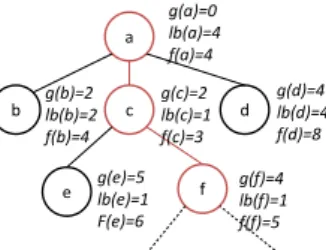
From now on, we will refer to the search-subtree rooted in node p as Partial Edit Path (p). Figure 2 illustrates an example of a partial edit path.
Each p is then identified by the following ele-ments:
• matched-vertices(p) and matched-edges(p): the
elements contained in these sets are vertices and edges that have been matched so far in both g1
a b c d e f g(a)=0 lb(a)=4 f(a)=4 g(d)=4 lb(d)=4 f(d)=8 g(c)=2 lb(c)=1 f(c)=3 g(b)=2 lb(b)=2 f(b)=4 g(e)=5 lb(e)=1 F(e)=6 g(f)=4 lb(f)=1 f(f)=5
Figure 2: An example of a partial edit pathpwhose
ex-plored nodes so far area,cand f. f(∗) =g(∗) +lb(∗).
andg2. These sets can contain substitution (u→
v), deletion (u→ε) and/or insertion (ε→v) of vertices and edges, correspondingly.
• pending-verticesi(p) and pending-edgesi(p):
these sets represent vertices and edges of both
g1 and g2 (i.e., V1, V2, E1 and E2) that are
not substituted, deleted or inserted yet where
pending-vertices1(p) and pending-vertices2(p)
represent pendingV1and pendingV2, respectively
whereas pending-edges1(p) and pending
-edges2(p) represent pendingE1 and pendingE2,
respectively.
• parent(p): the parent ofp.
• children(p): for any node p, the exploration is
achieved by choosing the next most promising vertexuiofpending-vertices1(p)and matching it
with all the elements of pending-vertices2(p)in
addition to the deletion of this node (i.e.,ui→ε). All these matchings are referred to aschildren(p).
• lb(p): the lower bound,lb, of the estimated future cost from nodepdoes not underestimate the com-plete solution. The calculation of the lower bound is described in Section 3.5.
• g(p): the cost of matched-vertices(p) and
matched-edges(p). Bothlbandg depend on the
attributes as well as the structure of the involved sub-trees. The cost functions involved with each PR dataset permit to calculate insertions, dele-tions and substitudele-tions of vertices and/or edges.
3.2
Preprocessing
Preprocessing is applied before thebranch and bound
procedure starts in order to speed up the tree search exploration. First, vertices and edges cost matri-ces are constructed. Second, vertimatri-ces-sorting is con-ducted.
3.2.1 Cost Matrices
The vertices and edges cost matrices (CvandCe) are
constructed, respectively. This step aims at speeding
up branch and bound by getting rid of re-calculating the assigned costs when matching vertices and edges ofg1andg2.
Letg1= (V1,E1,µ1,ξ1) andg2= (V2,E2,µ2,ξ2)
be two graphs with V1 = (u1, ...,un) and V2 =
(v1, ...,vm). A vertices cost matrixCv, whose
dimen-sion is(n+2)X(m+2), is constructed as follows:
Cv= c1,1 ... ... c1,m c1←ε c1→ε ... ... ... ... ... ... ... ... ... ... ... ... cn,1 ... ... cn,m cn←ε cn→ε cε→1 ... ... cε→m ∞ ∞ cε←1 ... ... cε←m ∞ ∞
wherenis the number of vertices ofg1 andmis
the number of vertices ofg2.
Each elementci,jin the matrixCvcorresponds to
the cost of assigning theithvertex of the graphg1to
the jth vertex of the graphg2. The left upper corner
of the matrix contains all possible node substitutions while the right upper corner represents the cost of all possible vertices insertions and deletions of vertices of g1, respectively. The left bottom corner contains
all possible vertices insertions and deletions of ver-tices ofg2, respectively whereas the bottom right
cor-ner elements cost is set to infinity which concerns the substitution ofε−ε.
Cecontains all the possible substitutions, deletions
and insertions of edges ofg1andg2.Ceis constructed
in the very same way asCv.
3.2.2 Vertices-Sorting Strategy
AsGEDaims at transformingg1intog2so it is
impor-tant to sortV1in order to start with the most
promis-ing vertices that will speed up the exploration of the search tree while searching for the optimal solution. The aforementioned Cv is used as an input of the
vertices-sorting phase. To sort V1, Munkres’
algo-rithm is applied. From now on, we will refer to the set of sorted vertices assorted-V1.
3.3
Branching Strategy
A systematic evaluation of all possible solutions is performed without explicitly evaluating all of them. The solution space is organized as an ordered tree which is explored in a depth-first way. In depth-first search, each node is visited just before its children. In other words, when traversing the search tree, one should travel as deep as possible from nodeito node
jbefore backtracking.
The root r of the search-tree is the node with
pending-vertices1,2(r) =V1∪V2,pending-edges1,2(r)
=E1∪E2,g(r)=∞andlb(r)=∞. Initiallyris the only node in the setOPEN i.e., the set of the edit paths, found so far. The exploration starts with the first most promising vertexu1insorted-V1in order to
generate the root’s childrenchildren(r). Then,
chil-dren(r)is added toOPEN. Consequently, a minimum
edit path (pmin) is chosen to be explored by
select-ing the minimum cost node (i.e.,min(g(p) +lb(p))) amongchildren(r)and so on. We backtrack to con-tinue the search for a good edit path by revokingpmin
(ifpminequalsφ) and trying out the next child in the
set ofchildren(r)and so on.
3.4
Reduction Strategy
As in A*GED, pruning, or bounding, is achieved thanks tolb(p),g(p)and a global upper boundU B
obtained at node leaves. Formally, for a node p in the search tree, the sumg(p) +lb(p)is taken into ac-count and compared withU B. That is, ifg(p) +lb(p)
is less thanU Bthenpcan be explored. Otherwise, the encounteredpwill be pruned fromOPENand a back-tracking is done looking for the next promising node and so on until finding the bestU B that represents the optimal solution ofDF-GED. This algorithms dif-fers fromA*GEDas at any timet, in the worst case,
OPENcontains approximately|V1|.|V2|elements and
hence the memory consumption is not exhausted.
3.5
Lower Bound
The lower boundlb(p), adapted toDF-GED, is the one used in sectionA*GED, see Section 2.2.
3.6
Upper Bound
The very first upper bound (U B) is computed by Munkres’ algorithm as it provides reasonable results, see (Riesen and Bunke, 2009) for more details. Af-terwards and while traversing the search tree,U B is replaced by the bestU Bfound so far (i.e.,a complete path whose cost is less than the currentU B). After fin-ishing the traversal of the search tree (i.e.,when pmin
equalsφand its parent isr), the bestU Bis outputted as an optimal solution ofDF-GED. Encountering up-per bounds when up-performing a depth-first traversal efficiently prunes the search space and thus helps at finding the optimal solution faster thanA*GED.
3.7
Pseudo Code
As depicted in Algorithm 2,DF-GEDstarts by a pre-processing step (line 2), then an upper boundU B
is calculated by Munkres’ algorithm (line 3). The traversal of the search tree starts by selecting a first vertex u1∈ sorted-V1 whereu1 substituted with all
vertex w in graph g2 as well as the deletion case
(u1→ε) are inserted into OPEN (lines 4 and 5). A branching step is performed in line 8 where the best child pminis selected, the backtracking is done
when there is no more children to explore in the se-lected branch and the parent node (parenttmp) is not
the root (lines 9 to 12). pminis explored by
substi-tuting the next promising node uk+1 with pending
-vertices2(pmin) and also deleting uk+1, respectively
(lines 18 to 24). Similar to A*GED, if
pending-vertices1(pmin) equalsφ,pending-vertices2(pmin) will
be inserted (line 26). U BandBest-Edit-Pathare up-dated whenever a betterU Bis encountered (line 28). Each time the next parent to be explored will be re-placed bypmin(line32). This algorithm guarantees to
find the optimal solution of GED(g1,g2). Note that
edges operations are taken into account in the match-ing process when substitutmatch-ing, deletmatch-ing or insertmatch-ing their corresponding vertices.
4
EXPERIMENTS
4.1
Environment
Evaluations are conducted on a 4-core Intel i7 proces-sor 3.07GHz and 8 GB of memory.
4.2
Compared Methods
We compare A*GED with DF-GED. Both methods return a node to node matching.
4.3
Database in Use
To the best of our knowledge, few publicly avail-able graphs databases are dedicated to graph match-ing tasks. However, most of these datasets consist of synthetic graphs that are not representative of PR problems concerning graph matching under noise and distortion. We shed light on the IAM graph repository which is a widely used repository dedicated to a wide spectrum of tasks in pattern recognition and machine learning (Riesen and Bunke, 2008). Moreover, it con-tains graphs of both symbolic and numeric attributes which is not often the case of other datasets.
The GREC database used in our experiments is a dataset in IAM which consists of a subset of the sym-bol database underlying the GREC2005 competition (Dosch and Valveny, 2006). The images of GREC represent symbols from architecture, electronics, and
Algorithm 2Depth-first GED algorithm (DF-GED) Input: Non-empty attributed graphs g1 =
(V1,E1,µ1,v1) and g2 = (V2,E2,µ2,v2) where V1
={u1, ...,u|v1|}andV2={u2, ...,u|v2|}
Output: A distanceU Band a minimum cost edit path
(Best-Edit-Path) fromg1tog2e.g.,{u1→v3,u2→ε
,ε→v2}
1: OPEN← {φ},Best-Edit-Path←φ
2: GenerateCv,Ceandsorted-V1
3: U B←Munkres(g1,g2)
4: For each nodew∈V2,OPEN←OPEN∪ {u1→
w}s.t.u1∈sorted-V1
5: OPEN←OPEN∪ {u1→ε}
6: pmin←φ,r←parent(u1),parenttmp←r
7: whiletruedo
8: pmin←bestChild(parenttmp)
9: while pmin==φandparenttmp!=rdo
10: parenttmp←backtrack(parenttmp)
11: pmin←bestChild(parenttmp)
12: end while
13: ifpmin==φandparenttmp==rthen
14: ReturnU B,Best-Edit-Path 15: end if
16: OPEN←OPEN\pmin
17: ifg(pmin) +lb(pmin)<U Bthen
18: ifpending-vertices1(pmin)!={φ}then
19: forw∈pending-vertices2(pmin)do
20: p←pmin∪ {uk+1→w} 21: If g(p) +lb(p)<U B then OPEN ← OPEN∪ {p} 22: end for 23: p←pmin∪ {uk+1→ε} 24: If g(p) +lb(p) <U B then OPEN ← OPEN∪ {p} 25: else
26: Generate a complete solutionp←pmin∪ S w∈pending−vertices2(p){ε→w} 27: ifg(p) +lb(p)<U Bthen 28: U B←g(p),Best-Edit-Path←p 29: end if 30: end if 31: end if 32: parenttmp←pmin 33: end while
other technical fields. Distortion operators are applied to the original images in order to simulate handwrit-ten symbols. To this end, the primitive lines of the symbols are divided into subparts. The ending points of these subparts are then randomly shifted within a certain distance, maintaining connectivity. Each node represents a subpart of a line and is attributed with its relative length (ratio of the length of the actual
line to the length of the longest line in the symbol). Connection points of lines are represented by edges attributed with the angle between the corresponding lines. The dataset consists of 6 classes and 30 in-stances per class. This dataset is useful as both ver-tices and edges are labeled with numeric attributes. In addition, it holds graphs whose sizes vary from 5 to 25 vertices.
Cost Function: The vertices of graphs from GREC dataset are labeled with (x, y) coordinates and a type (ending point, corner, intersection or circle). The same accounts for the edges where two types (line, arc) are employed. The Euclidean cost model is adopted accordingly. That is, for node substitutions the type of the involved vertices is compared first. For identically typed vertices, the Euclidean distance is used as node substitution cost. In case of non-identical types on the vertices, the substitution cost is set to 2τnode, which reflects the intuition that
ver-tices with different type label cannot be substituted but have to be deleted and inserted, respectively. For edge substitutions, the dissimilarity of two types is measured with a Dirac function returning 0 if the two types are equal, and 2τedgeotherwise. Bothτnodeand
τedgeare non-negative parameters. To control whether
the edit operation cost on the vertices or on the edges is more important another parameterαis integrated. In our experiments we have setτnode,τedge andαto 90, 15 and 0.5, respectively. These meta parameters’ values are taken from (Riesen and Bunke, 2010). This dataset consists of 1,100 graphs where graphs are uni-formly distributed between 22 symbols. The resulting dataset is split into a training and a validation set of size 286 each, and a test set of size 528.
GREC Decomposition: We decompose the database into subsets, each of which contains graphs that have the same size. We focus on the following subsets: (GREC5, GREC10, GREC15 and GREC20) aiming at evaluating the two methods when increas-ing the size of the involved graphs (i.e., the number of vertices). Due to the large number of matchings considered and the exponential complexity of the tested algorithms, we select 10 graphs of the train set of each subset of GREC. The train set is representa-tive of all graph distortions and the selection of only 10 graphs per subset ends up having 100 pairwise comparisons which is significant for such a kind of experiments. Furthermore, we add another subset GREC-mix that contains different number of vertices (i.e.,10 graphs with different number of vertices).
4.4
Protocol and Quality Measures
Our Protocol is two-fold. First, calculating the
dis-tance matrix under small and big time constraints.
Second, Classification test under a reasonable time constraint.
Let
S
be a graph dataset consisting ofmgraphs,S
={g1,g2, ...,gm}. LetP
={A*GED, DF-GED}be the set the compared methods. Given a method
p ∈
P
, we computed the square distance matrixMp∈
M
m(R+), that holds every pairwise compar-isonMip,j =dp(gi,gj), where the distance dp(gi,gj)
is the value returned by the method p on the graph pair(gi,gj)within a certain time and memory limits.
Hence,MA*GEDandMDF-GEDdenote distance matri-ces ofA*GEDandDF-GEDmethods, respectively.
LetGT ∈
M
m(R+)be the reference matrix that holds the best found distance for each pair of graphs. We aim at comparing the errors committed by the two methods as well as their running time under a time constraintCT and a memory constraintCMwhen
graphs’ sizes increase (i.e., on GRECk) and also on
GREC-mix. To this objective, we test the accuracy of
P
whenCT is small,e.g., CT= 350 milliseconds (ms),and whenCTis big (e.g., CT = 5 minutes).CMis set to
1GB during all the experiments. We expectA*GED
to violateCMspecially when graphs get larger.
In the following, we define the measurements used for evaluating our protocol:
Deviation: We evaluate the error committed by a method pover the reference distances. To this end, we measure an indicator called deviation and defined by the following equation:
deviation(i,j)p=|M p i,j−GTi,j| GTi,j ,∀(i,j)∈J1,mK 2 (2) WhereGTi,jis the smallest distance among all
dis-tances generated bypwhen matchinggiandgj.
Running Time: We measure the running time in milliseconds for each comparisond(gi;gj). This
value reflects the overall time for GED computation including all the inherits costs computations (i.e., g(p);lb(p); andU B).
For the classification test, we are interested in the average computation time (t) which corresponds to the average time elapsed when classifying all the test graphs of GREC and the classification accuracy (AC) which defines the error made when classifying the test graphs of GREC. Both measurements are achieved whenCT = 500ms andCM = 1GB. The classification
stage is performed by a1-NN classifier. Each test graphgt is compared to the entire training set. The
nearest neighbor’s label is assigned togt.
5
RESULTS AND DISCUSSION
Figure 3 shows the deviation results under 350 ms and 5 minutes respectively. We observe thatDF-GED
always outperformsA*GEDunder the same time con-straint. For all GED computations, DF-GEDgives the best distance (i.e., GTi,j) and so its deviation is
always 0%. In contrast withDF-GED, the deviation
of A*GED decreases whenCT = 5 minutes.
How-ever, when the size of graphs increase (e.g.,GREC15 and GREC20), the deviation starts to converge due to memory saturation where the best recently known so-lution is outputted before halting.
GREC5 GREC10 GREC15 GREC20 GREC−mix Number of vertices Mean deviation in (%) 0 20 40 60 80 100 A*GED DF−GED
GREC5 GREC10 GREC15 GREC20 GREC−mix Number of vertices Mean deviation in (%) 0 20 40 60 80 A*GED DF−GED
Figure 3: Deviation: Left (350 ms), Right (5 minutes).
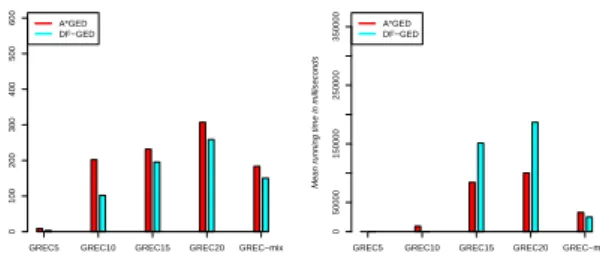
Figure 4 demonstrates the running time of both
A*GED and DF-GED. When CT = 350 ms both
running times are relatively equal on GREC15 and GREC20 and that is because non of them is able to find an optimal solution before exceedingCT. When
CT increases,DF-GEDbecomes faster as it explores
the search tree in a depth-first way (i.e.,not stopped byCM) while pruning the search tree thanks to its
up-per and lower bounds as well as the preprocessing step, see Section 3.2. On the other hand,A*GEDdoes not continue for further exploration on GREC15 and GREC20 because of the size of the involved graphs where available memory is exhausted and so the best recently known solution is given before halting.
GREC5 GREC10 GREC15 GREC20 GREC−mix Number of vertices
Mean running time in milliseconds
0 100 200 300 400 500 600 A*GED DF−GED
GREC5 GREC10 GREC15 GREC20 GREC−mix Number of vertices
Mean running time in milliseconds
0 50000 150000 250000 350000 A*GED DF−GED
Figure 4: Running Time: Left (350 ms), Right (5 minutes).
For the classification experiment, 151008 compar-isons are performed on 286 training graphs and 528 test graphs of the GREC dataset. As depicted in Table 1, results show that the classification accuracyACof
DF-GEDis 2.3 times higher under the sameCTwhere
the average timetis smaller.
Algorithms t AC
A*GED 119491.5 ms 42.23%
DF-GED 60468.7 ms 98.48 %
Table 1: Classifying graphs of GREC (CT= 500 ms).
6
CONCLUSION AND
PERSPECTIVES
In the present paper, we have considered the prob-lem of GED computation for PR. Graph edit distance is a powerful and flexible paradigm that has been used in different applications in PR. The exact algo-rithm,A*GED, presented in the literature suffers from high memory consumption and thus is too costly to match large graphs. In this paper, we propose another exact GED algorithm, DF-GED, which is based on depth-first search. This algorithm speeds up the com-putations of graph edit distance thanks to its upper and lower bounds pruning strategy and its preprocess-ing step. Moreover, this algorithm does not exhaust memory as the number of pending edit paths that are stored in the setOPEN is relatively small thanks to the depth-first search where the number of pending nodes is|V1|.|V2|in the worst case.
In the experimental section, we have proposed to evaluate sub-optimally both exact methods: A*GED
and DF-GED under some memory and time
con-straints. Experiments on the GREC database em-pirically demonstrated that DF-GED outperforms
A*GEDin terms of precision, speed and classification
rate. In future work, we aim at proposing a bench-mark to measure the quality of the solutions found by approximate methods. Both exact and approximate graph edit distance computations will be evaluated on different PR databases.
REFERENCES
Andreas Fischer, Ching Y. Suen, V. F. K. R. H. B. (2013). A fast matching algorithm for graph-based handwriting
recognition.GbRPR 2013, 7877:194–203.
Andrew D. J. Cross, E. R. H. (1998). Graph matching with
a dual-step em algorithm. IEEE Trans. Pattern Anal.
Mach. Intell., 20(11):1236–1253.
Christmas, W., Kittler, J., and Petrou, M. (1995). Struc-tural matching in computer vision using probabilistic
relaxation.Pattern Analysis and Machine Intelligence,
IEEE Transactions on, 17(8):749–764.
Cross, A. D., Wilson, R. C., and Hancock, E. R. (1997).
Inexact graph matching using genetic search. Pattern
Recognition, 30(6):953–970.
Dosch, P. and Valveny, E. (2006). Report on the second symbol recognition contest. 3926:381–397.
Fankhauser, S., Riesen, K., Bunke, H., and Dickinson, P. J. (2012). Suboptimal graph isomorphism using
bipar-tite matching.IJPRAI, 26(6).
Finch, A., Wilson, R., and Hancock, E. (1998). An energy function and continuous edit process for graph match-ing.Neural Computation, 10(7):1873–1894. Justice, D. and Hero, A. (2006). A binary linear
program-ming formulation of the graph edit distance. IEEE
Transactions on Pattern Analysis and Machine Intel-ligence, 28(8):1200–1214.
Kuner, P. and Ueberreiter, B. (1988). Pattern recognition by graph matching: Combinatorial versus continuous
optimization.International Journal in Pattern
Recog-nition and Artificial Intelligence, 2(3):527–542. M. Neuhaus, K. R. and Bunke., H. (2006). Fast suboptimal
algorithms for the computation of graph edit distance.
Proceedings of 11th International Workshop on Struc-tural and Syntactic Pattern Recognition., 28:163–172. Riesen, K. and Bunke, H. (2008). Iam graph database repos-itory for graph based pattern recognition and machine learning. pages 287–297.
Riesen, K. and Bunke, H. (2009). Approximate graph
edit distance computation by means of bipartite graph
matching. Image and Vision Computing, 27(7):950–
959.
Riesen, K. and Bunke, H. (2010).Graph Classification and
Clustering Based on Vector Space Embedding. Riesen, K., Fankhauser, S., and Bunke, H. (2007).
Speed-ing up graph edit distance computation with a bipartite
heuristic. InMining and Learning with Graphs, MLG
2007, Proceedings.
Sanfeliu, A. and Fu, K. (1983). A distance measure be-tween attributed relational graphs for pattern
recogni-tion.IEEE Transactions on Systems, Man, and
Cyber-netics, 13(3):353–362.
Tsai, W.-H. and Fu, K.-S. (1979). Error-correcting isomor-phisms of attributed relational graphs for pattern
anal-ysis. Systems, Man and Cybernetics, IEEE
Transac-tions on, 9(12):757–768.
Tsai, W.-H. and Fu, K.-S. (1983). Subgraph error-correcting
isomorphisms for syntactic pattern recognition.
Sys-tems, Man and Cybernetics, IEEE Transactions on, SMC-13(1):48–62.
Vento, M. (2015). A long trip in the charming world of
graphs for pattern recognition. Pattern Recognition,
48(2):291–301.
Zeng, Z., Tung, A. K. H., Wang, J., Feng, J., and Zhou, L. (2009). Comparing stars: On approximating graph