Mitigating the Effects of Implicit Constraints in Verbal
Insight Problem Solving through Training
Afla Ahmed
BA (Hons), MSc, C Occ Psychol
A Thesis submitted for the
Degree of Doctor of Philosophy
School o f Psychology, Cardiff University
70 Park Place
UMI Number: U584516
All rights reserved
INFORMATION TO ALL USERS
The quality of this reproduction is dependent upon the quality of the copy submitted. In the unlikely event that the author did not send a complete manuscript and there are missing pages, these will be noted. Also, if material had to be removed,
a note will indicate the deletion.
Dissertation Publishing
UMI U584516
Published by ProQuest LLC 2013. Copyright in the Dissertation held by the Author. Microform Edition © ProQuest LLC.
All rights reserved. This work is protected against unauthorized copying under Title 17, United States Code.
ProQuest LLC
789 East Eisenhower Parkway P.O. Box 1346
DECLARATION
This work has not previously been accepted in substance for any degree and is not concurrently submitted in candidature for any degree.
Signed .. ... .... (candidate) Date .t Vi.\P.Vi.}XQ.U...
STATEMENT 1
This thesis is being submitted in partial fulfilment o f the requirements for the degree o f ... (insert MCh, MD, MPhil, PhD etc, as appropriate)
Signed . l / ? \...(candidate) Date .
!V j. 1.9 . ^ . |.
3-.9.W. . . .
STATEMENT 2
This thesis is the result of my own independent work/investigation, except where otherwise stated. Other sources are acknowledged by explicit references. A bibliography is appended.
Signed .. ... (candidate) Date . 1 Lv.. .OM J.
STATEMENT 3
I hereby give consent for my thesis, if accepted, to be available for photocopying and for inter-library loan, and for the title and summary to be made available to outside organisations.
Signed .. J e f f ... (candidate) Date . .).Vh. ) .0.^.). .?rp.». \ .
STATEMENT 4: PREVIOUSLY APPROVED BAR ON ACCESS
I hereby give consent for my thesis, if accepted, to be available for photocopying and for inter-library loan, after expiry of a b a r on access previously approved by the G raduate Development Committee.
ACKNOWLEDGEMENTS
I would like to extend my warmest gratitude to my supervisor, Professor John Patrick, for his time, patience and support. He has been an excellent teacher not just during this PhD but also throughout my professional career at Cardiff University. I am
particularly grateful to him for providing me with the many opportunities that allowed me to develop my research and teaching skills.
I sincerely thank all the people who have provided assistance in some way during my research. In particular, I would like to thank the following undergraduate students: C. Brennan, B. Cotterell, M. Curry, S. Wilkinson, and R. Walker. Also, thank you to R. Chadwick, O. De Condappa, Dr. S. King, Dr. P. Morgan, T. Patrick, and V. Smy for their help in coding the verbal protocols in this thesis.
Thanks to all my ‘old’ university friends, particularly Eileen, Hazel, Laura, and Lorraine for their support. Thanks also go to Eman, Lisa, Michal and Phil. A big thank you to my childhood friend, Dr. Sheeja Joy, for her emails o f encouragement and for frequently reminding me that ‘it will be over soon’.
Thank you to my parents and siblings for their love and support throughout my academic life. Thank you especially to my mum and sister for being there for my son, Ibrahim, to enable me to have the time to write this thesis.
I would like to thank my husband, without whose encouragement, I never would have embarked on this journey. I have learnt so much from you since we started our lives together. Most o f all, thank you for showing me that anything is possible when you have the belief and determination.
Last, but certainly not least, a very big thank you to Ibrahim, my beautiful boy. This PhD became a bigger challenge once you came along! You are a constant reminder that I have so much more to learn. Thank you for helping me to see the brighter side o f life and for ending my days with a smile. I dedicate this thesis to you.
TABLE OF CONTENTS
Acknowledgements... ii
Table o f C ontents... . ... iii
List o f T ables... vii
List o f Figures... viii
SU M M A RY ... ix
CHA PTER 1 Introduction to insight problem solving... 1
1.1 What is insight problem solving and how is it different?... 1
1.2 Why is insight problem solving practically im portant?... 14
1.3 The importance o f training... 17
1.3.1 The benefits of training in different dom ains... 18
1.3.2 Theoretical approaches to transfer... 20
1.3.3 Factors that inhibit positive transfer o f train in g ... 21
1.4 Overview o f thesis layout... 23
CHAPTER 2 Review of problem solving theories relevant to achieving in s ig h t... 26
2.1 Problem Space Theory (Newell & Simon, 1972)... 26
2.2 Gestalt Theory (e.g., Kohler, 1924; Wertheimer, 1945)... 29
2.3 Representational Change Theory (Ohlsson, 1992)... 36
2.4 Restructuring Change Theory (Knoblich et al., 1999)... 42
2.5 Progress Monitoring Theory (MacGregor etal., 2 0 0 1 )... 45
2.6 Sum m ary... 51
CHAPTER 3 Review of methods th at facilitate insight problem solving... 54
3.2 Hints approach... 57
3.3 Training... 60
3.3.1 Specific training and positive transfer... 61
3.3.2 Generic training and positive transfer... 65
3.4 Sum m ary...!... 72
CHAPTER 4 Heuristic-based train in g for verbal insight p ro b lem s... 74
4.1 Heuristic-based training and transfer to verbal insight problem solving... 74
4.2 Experiment 1 ... 78
4.2.1 M ethod... 78
4.2.2 Results and Discussion... 85
4.3 Experiment 2 ... 89
4.3.1 M ethod... 91
4.3.2 Results and Discussion... 93
4.4 General D iscussion... 97
CHAPTER 5 Specific training for functional fixedness verbal insight p ro b le m s... 102
5.1 Divergent thinking and representational change in solving functional fixedness problem s... 102
5.2 Experiment 3 ... ... 107
5.2.1 M ethod... 108
5.2.2 Results and Discussion... 113
5.3 General D iscussion... 117
CHAPTER 6 Inconsistency checking as form of generic training for verbal insight problems 120 6.1 Inconsistency checking as a mechanism for representational change... 120
6.2 Experiment 4 ... 125
6.2.2 Results and Discussion... 130
6.3 Conclusions... 137
CHAPTER 7 Enhanced training in inconsistency checking for verbal insight problems ... , ... 140
7.1 An iterative process of inconsistency checking... 140
7.2 Explaining and justifying solution attempts during problem solving... 141
7.3 Experiment 4 ... 144
7.3.1 M ethod... 147
7.3.2 Results and Discussion... 150
7.4 General D iscussion... 156
CHA PTER 8 A measure of constraint activation in verbal insight problem so lv in g ... 160
8.1 Representational change during insight problem solving... 160
8.2 The Lexical Decision Task (Mayer & Schvaneveldt, 1971)... 162
8.3 Pilot stu d y ... 164 8.3.1 M ethod... 164 8.3.2 R esults... 165 8.3.3 Discussion... 166 8.4 Experiment 6 ... 167 8.4.1 M ethod... 168
8.4.2 Results and Discussion... 171
8.5 General D iscussion... 172
CHAPTER 9 General D iscussion... 176
9.1 Summary of experimental findings... >... 176
9.2 Some implications... 181
9.3 Limitations... 183
9.5 Conclusions... 186 REFERENCES... 188 APPENDICES... 203 Appendix A ... 203 Appendix B ... 205 Appendix C ... 206 Appendix D ... 207 Appendix E ... 209 Appendix F ... 211 Appendix G ... 212 Appendix H ... 213 Appendix I ... 215 Appendix J ... 216 Appendix K ... 217 Appendix L ... 218
LIST OF TABLES
CHAPTER 4
Table 4.1 Effect o f training on solution rate of problem categories (three
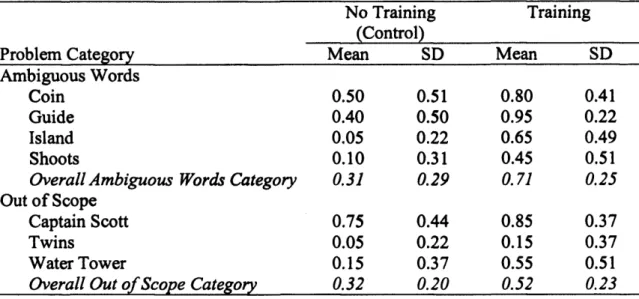
problems in each category)... 85 Table 4.2 Incorrect hypotheses generated by condition (average ran k )... 87 Table 4.3 Solution rates for test problems (as a proportion)... 96
CHAPTER 5
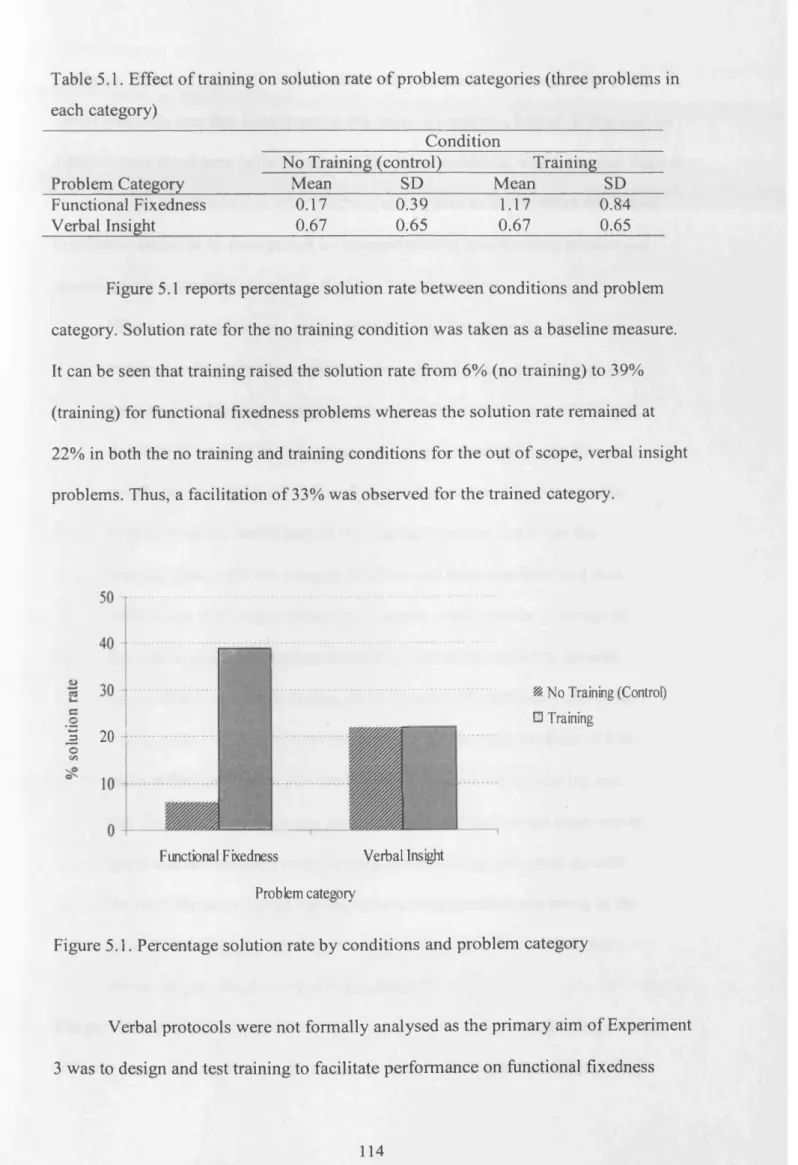
Table 5.1 Effect o f training on solution rate o f problem categories (three
problems in each category)... 114
CHAPTER 6
Table 6.1 Types o f training related behaviours in during problem solving 133 Table 6.2 Examples o f questions verbalised by trained participants that were
related to the problem statement... 134
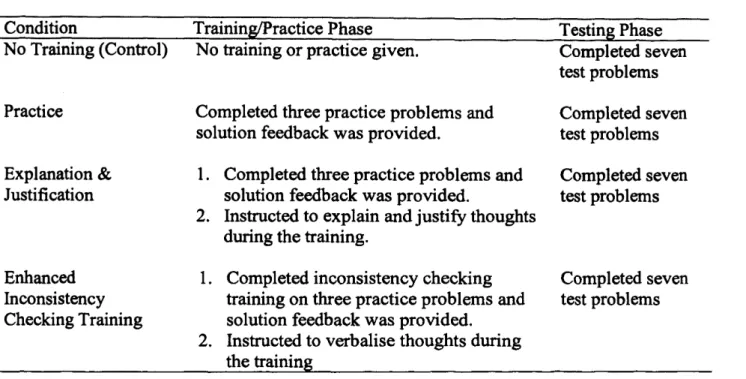
CHAPTER 7
Table 7.1 Table o f design for Experiment 5 ... 146 Table 7.2 Solution rates across conditions (out o f seven problem s)... 151 Table 7.3 Types o f hypotheses generated between conditions (across seven
problem s)... 153
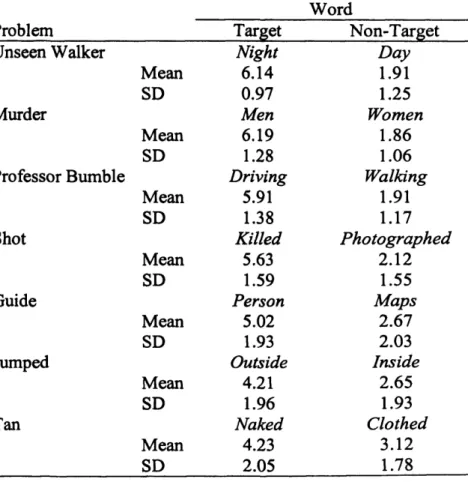
CHAPTER 8
Table 8.1 Mean and SD for target and non-target words for each problem 166 Table 8.2 Table o f design for Experiment 6 ... 170
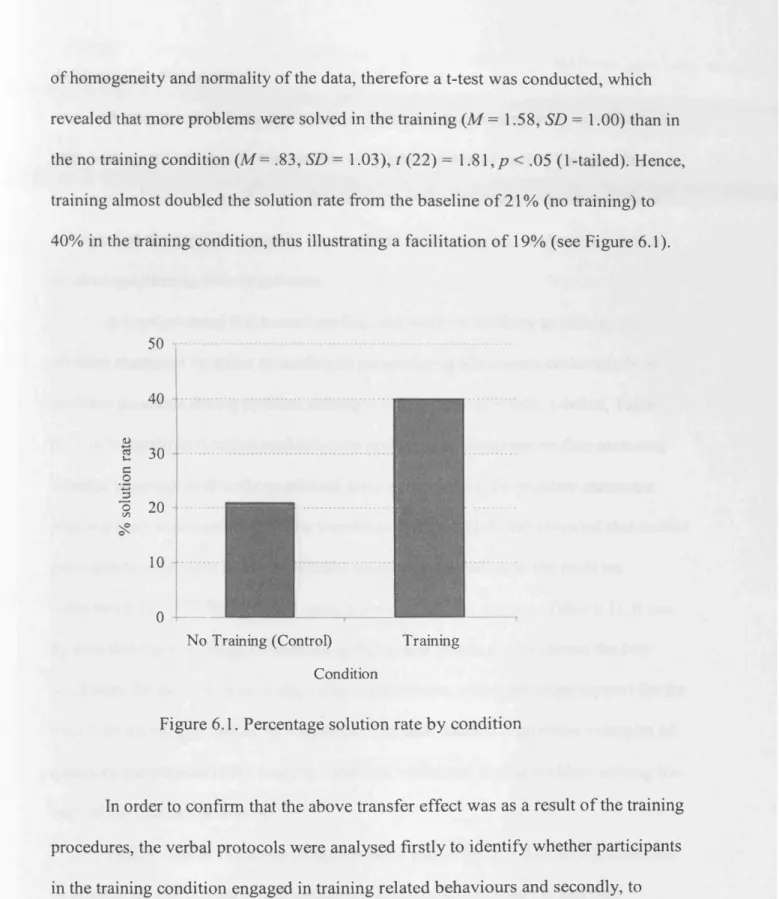
LIST OF FIGURES
CHAPTER 1
Figure 1.1 Solution to the nine-dot problem ... 6
CHAPTER 4
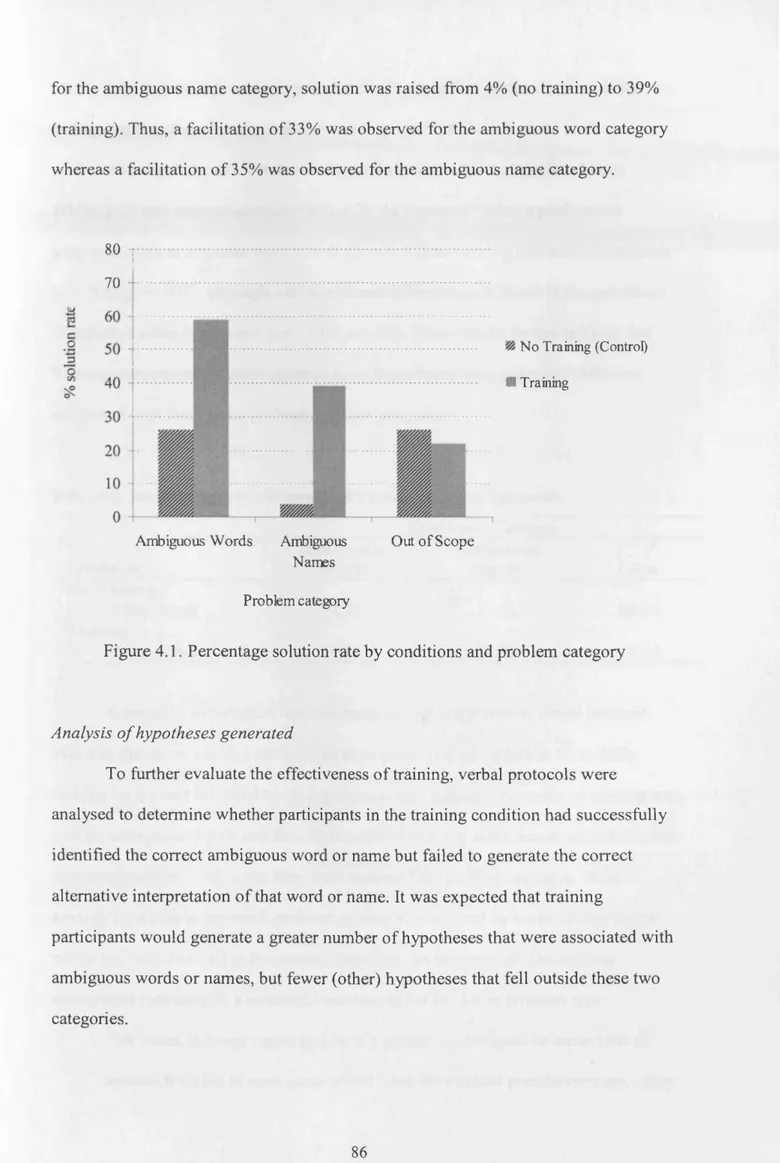
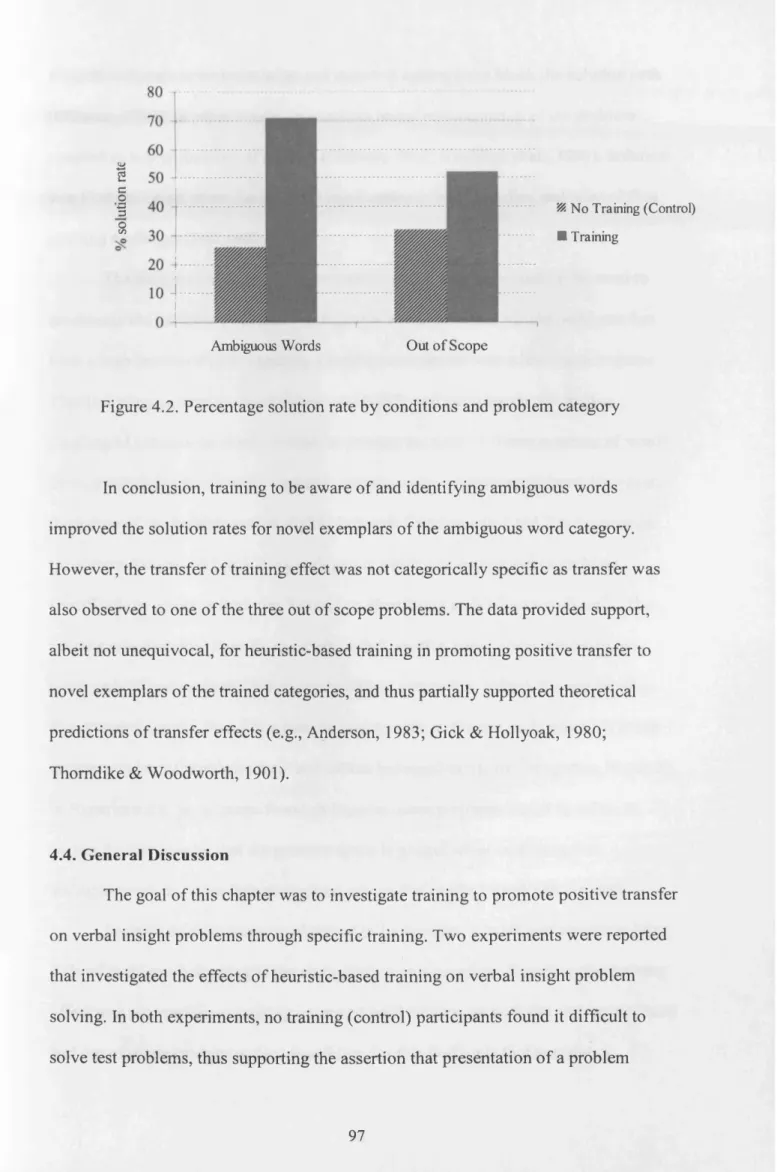
Figure 4.1 Percentage solution rate by conditions and problem category... 86 Figure 4.2 Percentage solution rate by conditions and problem category... 97
CHAPTER 5
Figure 5.1 Percentage solution rate by conditions and problem category... 114
CHAPTER 6
Figure 6.1...Percentage solution rate by conditions and problem category... 131
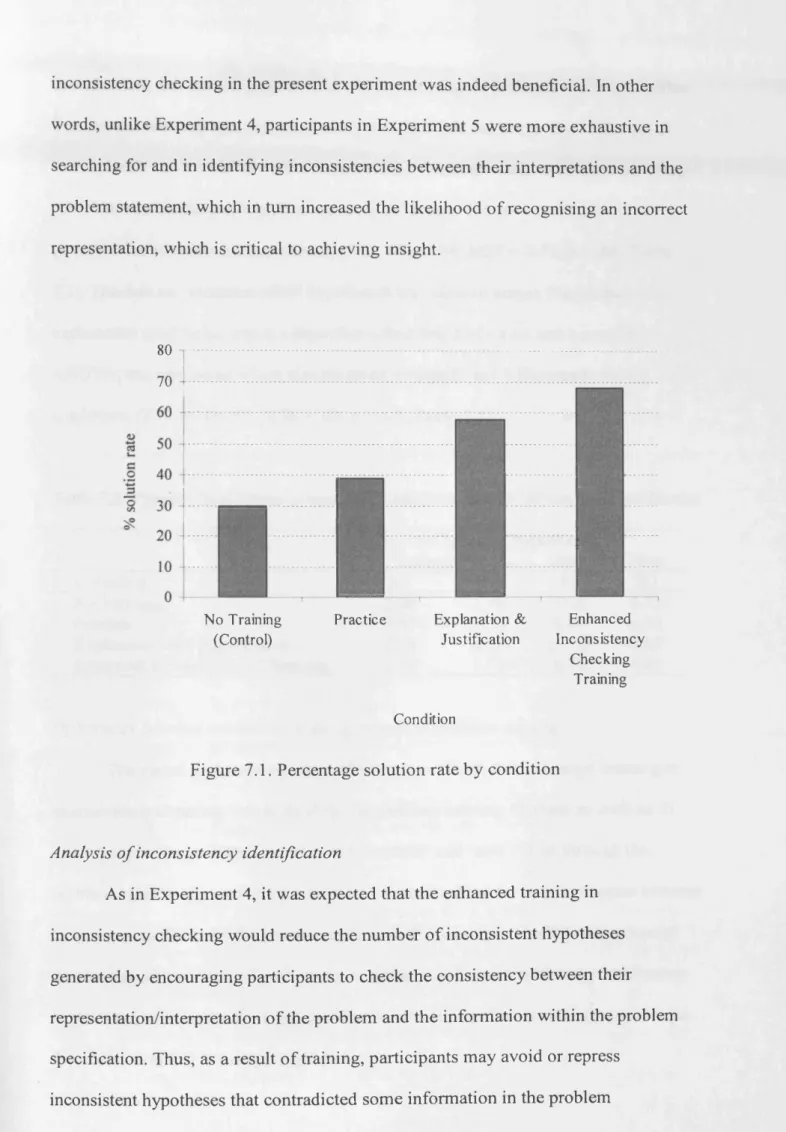
CHAPTER 7
SUMMARY
The main focus of this thesis was to design training to mitigate the effects of constraints underlying verbal insight problem solving. Concurrent verbal protocols were collected. Experiments 1 and 2 tested training that was specific to solving problems that were exemplars of trained categories. In Experiment 1, heuristic training was provided for two categories o f constraint: those with ambiguous words and those with human names that should be associated with animals. Transfer was positive for novel problems within the two trained categories but not for problems outside. Experiment 2 improved performance on problems with ambiguous words once shortcomings in Experiment 1 were addressed. Experiment 3 tested training that was specific to solving functional fixedness verbal insight problems. An iterative process of considering many functions of individual items was successful in facilitating performance but not for problems outside. Experiments 4 and 5 investigated the effectiveness of different types o f generic training in facilitating solution of novel verbal insight problems. In Experiment 4, participants were trained to identify assumptions, which they made during problem solving and were
inconsistent with the problem statement. In Experiment 5, participants were trained to iteratively consider different parts of the problem specification and to identify
inconsistencies as in Experiment 4. Solution rate was improved in both experiments although instruction to explain and justify oneself during problem solving was also sufficient in facilitating performance in Experiment 5. Finally, Experiment 6 tested a novel method for identifying when a participant was constrained by an incorrect representation during verbal insight problem solving. The results supported that there
is variability in the nature of stereotypical constraints involved and demonstrated how training can be designed to induce restructuring or a shift in representation.
CHAPTER 1
Introduction to insight problem solving
The focus of this thesis is on a special form o f problem solving entitled ‘insight problem solving’ and the overarching objective is to design training to facilitate solution o f insight problems. This chapter begins with an introduction to the nature o f insight problem solving and its importance. Next, training is discussed as a possible methodology for improving insight problem solving, which is followed by an overview o f the thesis.
1.1. What is insight problem solving and how is it different?
Any form o f problem solving entails generating novel solutions to problems that a person may never have encountered before, or has very limited or no knowledge o f what is required to reach the correct solution (Dominowski & Dallob, 1995). Some well-known general definitions of problem solving include:
‘Problem solving is defined as any goal-directed sequence o f cognitive perspectives.’ (Anderson, 1980, p. 257)
‘.. .cognitive processing directed at transforming a given situation into a goal situation when no obvious method o f solution is available to the problem solver.’ (Mayer, 1990, p. 284).
Both definitions emphasise that problem solving involves cognitive processing to reach a particular goal, i.e., the solution. Further, Mayer’s definition notes that the
However, insight problem solving is a special type o f problem solving in that the solver defaults to a high probability habitual conceptualisation that acts as a major impediment to solution leading to an impasse, a state of mind of not knowing how to progress to attain the solution (Ohlsson, 1992). In other words, knowledge that is normally activated by the problem specification or context is not relevant and has to be rejected, and information in the problem specification has to be interpreted in an unusual way in order to reach the solution (Duncker, 1945; Gick & Lockhart, 1995; Isaak & Just, 1995; Mayer, 1995; Wertheimer, 1959). Insight problems are thus ill- defined, in that both the goal and steps for its completion are unclear and the solution possibilities are endless (Chrysikou, 2006).
The definition o f insight is problematic (MacGregor & Cunningham, 2008). Some propose that insight is characterised by the sudden illumination o f the solution (Metcalfe & Wiebe, 1987) whereas others have focused on the psychological
processes involved in achieving insight, namely restructuring or representational change following an impasse (Knoblich, Ohlsson, Haider, & Rhenius, 1999;
MacGregor & Cunningham, 2008; Ohlsson, 1992). Consequently, several definitions o f insight have emerged. According to Mayer (1995, p. 3)
‘the term insight has been used to name the process by which a problem solver suddenly moves from a state of not knowing how to solve a problem to a state of knowing how to solve it.’
This definition notes that insight problem solving involves a sudden transition from not knowing to knowing the solution. However, it does not state that having insight will provide the solution to the problem; rather it places the solver on the correct
solution path. A criticism of this definition is that Mayer did not specify the process or processes that underlie what he refers to as insight.
Dominowski and Dallob (1995, p. 33) contend that
‘ Insight will be characterised as a form o f understanding (of a problem and its solution) that can result from restructuring, a change in a person’s perception o f a problem situation.’
Ansburg (2000, p. 143) proposed that
‘Insight occurs when a solver restructures a previously intractable problem such that a new understanding o f what needs to be done appears in the consciousness.’
The definitions o f Dominowski and Dallob (1995) and Ansburg (2000) are similar in that both suggest insight occurs as result o f restructuring, which may indirectly be suggesting the suddenness o f solution as Mayer (1995). Dominowski and Dallob (1995) suggest restructuring results in a new ‘form o f understanding’ but this does not necessarily mean that restructuring will result in insight. This problem is, however, avoided in Ansburg’s (2000) definition as restructuring must result ‘in a new understanding o f what needs to be done’ to reach the solution.
Ohlsson (1992, p. 10) defined insight problems as those
‘... which have a high probability o f triggering an initial representation which has a low probability of activating the knowledge needed to solve the problem.’
Ohlsson’s (1992) definition is different to the aforementioned definitions as it focuses on why insight problems are difficult. It suggests that insight problems contain certain information within their specification that triggers a misleading representation that inhibits the information needed to solve the problem. Although not mentioned in his definition, Ohlsson (1992) also suggests that restructuring o f the initial representation is required to facilitate solution.
Apart from Mayer’s (1995) and Ohlsson’s (1992) definitions, all the above definitions place importance on restructuring the faulty initial problem representation, without which solution is unattainable. This is what makes insight problem solving unique. The insight experience itself is characterised as follows: the solver is misled in his or her interpretation o f a problem; the solver continues working on the problem until they reach an impasse in which problem solving ceases; the impasse is
eventually overcome by a representational change and the solution o f a problem occurs consequently (Ansburg & Dominowski, 2000; Chronicle, MacGregor, & Ormerod, 2004; Fleck, 2008; Jones, 2003; Kaplan & Simon, 1990; Ohlsson, 1984b, 1992; Ormerod, MacGregor, & Chronicle, 2002; Segal, 2004; Sternberg & Davidson, 1995).
One type o f insight problem that has not been explicitly referred to as an insight problem is called a lateral thinking problem by DeBono (1967). This type of problem will be used extensively in this thesis and involves the requirement for representational change or restructuring to attain solution. An example is:
Anthony and Cleopatra are lying dead on the floor in an Egyptian villa. Nearby is a broken bowl. There are no marks on their bodies and they were
not poisoned. Not a person was in the villa when they died. How did they die? (Sloane, 1992, p. 13)
The above problem is difficult because the names Anthony and Cleopatra are commonly associated with humans. This high frequency response is unhelpful to finding the solution to this problem. Typically, the problem solver brings unwarranted assumptions to the problem that is based on their past experiences, which create unconscious biases that are unhelpful for problem solving (Ohlsson, 1984b). Thus, solvers draw unhelpful stereotypical inferences from the theme o f the problem or from certain words/phrases in the problem specification, which obstructs the production o f the correct, insightful solution (Ohlsson, 1984b, 1992; Weisberg & Alba, 1981). This is an example of the effect o f a negative habit (William James,
1890) or what Reason (1990) termed ‘strong but wrong rules ‘where a person tends to default to high frequency responses that are useful in most situations but can be inappropriate when applied to an unusual situation, which consequently results in an error. The solution that Anthony and Cleopatra are fish is only achieved when the unwarranted assumption that the names refer only to humans is removed (Ohlsson,
1992).
The nine-dot problem (Scheerer, 1963) is a well researched visuo-spatial insight problem that has also been used to illustrate the role o f assumptions leading to an incorrect problem representation. In this problem, nine dots are arranged in a three- by-three two-dimensional square and the goal is to link all nine dots using four
straight lines without lifting the pen off the paper or without retracing any lines. The solution (see Figure 1.1) is only achieved once the solver abandons the assumption
that they cannot go beyond the imagined square boundaries to link all dots in four straight lines (Weisberg & Alba, 1981).
Figure 1.1. Solution to the nine-dot problem
Laboratory experiments investigating ‘fixation* in insight problem solving have also suggested that habitual directions can prevent the solver from changing their representation. The role o f ‘fixation’ has been investigated using ‘functional
fixedness’ problems, which require an everyday object to be used in a novel way to attain solution (Duncker, 1945). For example, Duncker (1945) found that when participants were asked to fix a candle to a wall using a box o f drawing pins, matches and a candle, participants fixated on the typical function o f the box that blocked the generation o f a novel function for the box to be used as a candle holder. That is, solvers tended to default to, and thus fixate on, the common function for an object, which impaired problem solving.
On the whole, insight problems are difficult to solve because inappropriate reliance on past knowledge and experiences make it particularly difficult to realise that the initial representation of the problem is incorrect. In other words, our strong thinking habits can impede solution to insight problems making the ever necessary representational change psychologically difficult.
Despite our attempt to characterise the unique nature of insight problem solving, there is still much debate concerning whether insight problem solving
represents a distinct type of problem solving involving unique processes, or whether it is achieved through the same processes as those involved in solving non-insight or analytic problems (i.e., problems that are solved by working incrementally towards the solution). There are four areas in which research has attempted to identify differences between insight and non-insight problems; metacognitions (Metcalfe & Wiebe, 1987), individual differences in cognitive abilities (DeYoung, Flanders, & Peterson, 2008; Gilhooly & Murphy, 2005); the role o f working memory (Ash & Wiley, 2006; Fleck, 2008; Lavric, Forstmeier, & Rippon, 2000); and neural activity (Luo & Nicki, 2003; Jung-Beeman et al., 2004). Each o f these will be discussed briefly below.
Metcalfe and Wiebe (1987) tested whether insight and non-insight problems generate different metacognitive experiences. Participants in their study were required to give feelings o f warmth ratings at 10 second intervals to indicate how near they felt they were to the solution when solving five insight and five non-insight problems. They found that participants showed awareness when approaching the correct solution to non-insight problems but were unaware o f their progress towards the solution to insight problems until just before they reached the solution. These results were interpreted as suggesting that the solution to an insight problem occurs suddenly, as Gestalt psychologists argued, hence why solvers were poor at predicting how close they were to the solution. In contrast, non-insight problems require a more methodical approach to reach solution; therefore the solver is likely to have some knowledge concerning their progress. However, Weisberg (1992) questioned these results as raw data were used to report frequencies of insight problems whereas proportions were
used for the non-insight problems. Nevertheless, these results suggest, although do not prove, that different processes may be involved in insight and non-insight problem solving.
Many attempts have been made to identify whether success on insight versus non-insight problems is determined by individual differences in cognitive abilities (e.g. DeYoung et al., 2008; Gilhooly & Murphy, 2005). Gilhooly and Murphy (2005) investigated whether success on 24 insight (e.g., Nine-dot; Inverted pyramid, Ohlsson,
1992; Marriage, Dominowski, 1994) and 10 non-insight problems (e.g., anagrams, Gilhooly & Johnson, 1978; Hobbits and Ores, Thomas, 1974; Tower o f Hanoi, Egan & Greeno, 1974) was linked to measures o f working memory, fluid intelligence, and fluidity and flexibility o f thought. Regression analyses indicated that fluid intelligence predicted success on non-insight problems, whereas fluidity and flexibility of thought predicted success on insight problems. When insight problems were categorised into verbal and spatial problems, it was found that success on spatial insight problems was predicted by figural fluency (the ability to generate spatial interpretations, r = .41). However, success on verbal insight problems was related to flexibility o f thought (r = .32) and vocabulary scores (r = .41). Gilhooly and Murphy (2005) suggest that the latter finding is likely due to many insight problems containing verbal ambiguities that need to be identified and resolved to attain solution. An additional finding was that success on insight problems was better predicted by measures o f strategic switching and inhibition (e.g., figural fluency). Therefore, it was inferred that executive processes o f switching and inhibition play a role in solving insight
problems. That is, when the initial representation and approach lead to an impasse, a switch to an alternative approach takes place after inhibiting the unhelpful
measures of inhibition and switching did not predict success on insight problems, thus suggesting that restructuring involves spontaneous processes.
A recent study by DeYoung et al. (2008) examined whether individual differences in three cognitive abilities were associated with performance on nine verbal insight problems (e.g., Inverted pyramid, Ohlsson, 1992; Marriage, Dominowski, 1994). The three abilities were convergent thinking (i.e., moving logically and linearly toward a solution), divergent thinking (i.e., non-linearly searching through memory and recognising a pattern), and breaking frame (i.e., abandoning a faulty initial representation and searching for a new one). Convergent thinking was assessed using the Wonderlic Personnel Test o f intelligence, whereas divergent thinking was assessed using three of the Torrance Tests o f Creativity (fluency, originality in responses, and flexibility i.e., the ability to switch between perspectives). Breaking frame was assessed using the anomalous card task in which participants were presented a series of normal playing cards on a screen and asked to describe what they saw. Within the trial an anomalous playing card (a black four of hearts) was presented repeatedly and the ability to break frame was indicated by the number o f trials prior to the identification of the anomalous card. In other words, the higher the number o f trials before identification of the anomalous card, the lower the ability to break frame. Regression analyses revealed that all measures correlated significantly with insight, except for the originality index of divergent thinking. It was suggested that the ability to break frame is important to avoid persevering with an incorrect representation, while divergent thinking is necessary to generate elements of a new representation. Further, convergent thinking is helpful in identifying
shortcomings in the existing problem representation or to validate novel
support for the suggestion made by Gilhooly and Murphy (2005) regarding the
process o f switching to overcome an impasse in insight problem solving. However, as only verbal insight problems were studied, generalisability o f the results is limited.
Working memory is another individual difference variable that has been examined to differentiate insight and analytic forms o f problem solving. Working memory is critical to cognition as it is used to store and manipulate information required for cognitive tasks such as language, comprehension, learning and reasoning (Baddeley, 1992), and is broken down into verbal and spatial storage units.
Alternatively, short-term memory is used to hold a small amount o f information that is readily available for a brief period o f time. Whilst some researchers have reported working memory to be associated with analytic problems (Fleck, 2008; Gilhooly & Murphy, 2005; Lavric et al., 2000), others have reported an association with insight problems (Ash & Wiley, 2006). However, recently Gilhooly and Fioratou (2009) suggested that working memory contributes to both insight and non-insight problem solving, although insight problems that require restructuring are likely to make more demands on working memory.
Lavric et al. (2000), Gilhooly and Murphy (2005), and Fleck (2008) reported similar findings in that working memory was related to analytical problems and not insight problems. Lavric et al. (2000) found that when participants performed Dunker’s (1945) candle problem (insight) and a version o f the Watson’s Selection Task (analytical) either alone or whilst completing a working memory task that required counting the number o f tones presented, the memory task disrupted performance on the analytical problem but not the insight problem. The authors concluded that because insight problems are ill-defined with an ambiguous problem situation, little planning takes place during solution attainment. In contrast, analytic
problems have a clear defined problem space, allowing more opportunities for
planning, which is dependent on working memory. However, these results need to be interpreted with caution as only one insight and one analytical problem was used. Hence, a study by Gilhooly and Murphy (2005), discussed earlier, used a larger set of insight versus non-insight problems and found that performance on Raven’s Matrices, a measure of working memory, predicted success on non-insight problems (r = .41). More recently, Fleck (2008) found similar findings to Lavric et al. and Gilhooly and Murphy using four insight and four analytical problems. In addition, Fleck found that verbal short-term memory was associated with insight problems, but this finding was less conclusive once individual problems were analysed. As no two insight problems are the same; it seems plausible that the demand on memory is likely to vary.
In contrast to the above, Ash and Wiley (2006) reported an association between working memory and (visuo-spatial) insight problem solving, although this finding was dependent on whether an insight problem had either a large or small search space to reach the solution. A configuration of six insight move problems (e.g. eight-coin, matchstick arithmetic) were manipulated to create many move available (MMA) and few move available (FMA) problems. MMA problems had a large problem space, which the solver needed to explore before reaching an impasse that triggered restructuring. In FMA problems, the initial representation allowed few or no moves, therefore the search through the problem space was limited, which in turn enabled the solver to reach an impasse and restructuring sooner. Regression analyses revealed that measures o f working memory span (that demonstrate the ability to actively control and allocate attention) were correlated with success on insight problems with a large search space i.e., insight problems that involve a search phase
and a restructuring phase, whereas the ability to control attention did not predict success on problems that only involved a restructuring phase i.e., FMA problems.
An alternative perspective was provided by Gilhooly and Fioratou (2009) who argued that working memory should be involved in solving both insight and non insight problems because both require temporary storage o f possible solutions. They also noted that previous studies in this area have used a limited number of test
problems (Fleck, 2008) and, or, only one type o f insight problem (e.g., Ash & Wiley, 2006; Lavric et al., 2000), which limits generalisability of the findings. Gilhooly and Fioratou addressed these criticisms by using a larger set of insight (18) and non
insight (10) problems to examine the role of verbal working and visuo-spatial working memory capacities (as measured by working memory measures) in solving insight and non-insight verbal and spatial problems. It was found that verbal working memory capacity predicted success on both verbal insight and verbal non-insight problems but not to either type o f spatial problems. However, spatial working memory capacity predicted success on both spatial and verbal types o f insight and non-insight problems. A possible explanation provided for the latter finding was that verbal problems may also induce spatial short-term storage processes during problem solving, for example by triggering strategies that are based on imagery. It was concluded that the internal representation o f an insight or non-insight problem tends to be complex; therefore it needs to be held in working memory whilst the solver considers alternative interpretations or actions. Further, the key elements o f the problem that require reinterpretation are likely to be held in working memory. This is likely to be the case for insight problems as they require restructuring to overcome an impasse.
Finally, researchers have attempted to identify whether different neural activities are associated with success on insight and non-insight problems. Research suggests two important parts of the brain that are associated with insight problem solving: the hippocampus (Luo & Nicki, 2003) and the right hemisphere (Jung- Beeman et al., 2004). Luo and Nicki (2003) used functional magnetic resonance imaging (fMRI) to show that when solution to insightful Japanese riddles (that had a surprising solution) was presented to participants, stronger activation occurred in the right hippocampus. The converse was true for non-insight riddles (that did not have a surprising solution). The authors concluded that the hippocampus is involved in restructuring in insight problem solving. In particular, they proposed three possible roles for the hippocampus. First, stronger activation for insightful solutions may be due to novel representations formed among already existing concepts. Second, the hippocampus may be involved in overcoming impasse. Third, stronger activation may be due to the formation o f a new representation.
A further study by Jung-Beeman et al. (2004) demonstrated that the
hippocampus is not the only brain region that is involved in restructuring. Participants in their experiments completed remote association tasks in which three words were presented and the task was to find the target that could be combined with the three words to form a new word or phrase (e.g., the word ‘cheese’ is associated with the following three words: ‘cottage’, ‘blue’, and’ ‘mouse’). After finding the solution, participants reported whether or not it was accompanied by an ‘aha’ experience i.e., whether the solution came to them suddenly. They found that solution was preceded by greater activity in the right anterior superior temporal gyrus, a region o f the brain in the right hemisphere which is associated with making connections between information during comprehension. EEG activity was also greater in that region just
before the insight solution was reported. It was argued that this brain region is responsible for linking mental concepts in a novel way and may promote
restructuring. However, these results were based only on verbal problems which require contrasting with non-insight problems to obtain conclusive evidence that the right anterior superior temporal gyrus is in fact associated with insight problem solving.
In summary, research that has reported differences in metacognitive experiences (Metcalfe & Wiebe, 1987) during insight and non-insight problem solving is questionable due to criticisms of methodology or test problems used. However, studies o f individual differences in cognitive abilities highlight that
flexibility in thinking (Gilhooly & Murphy, 2005) or divergent thinking (DeYoung et al., 2008) is predictive o f success on insight problems. This is consistent with the notion that solution to insight problems are more likely to be attained once the solver considers alternative interpretations that go beyond the initial faulty representation. Research also suggests that working memory is linked to insight problem solving, particularly in facilitating restructuring (Ash & Wiley, 2006; Gilhooly & Fioratou, 2009), which is a prerequisite to solving insight problems. Finally, neuroscientific studies also suggest that different brain regions are associated with solving insight and non-insight problems. In conclusion, the research discussed hitherto suggests that distinct processes are indeed involved in solving insight and non-insight problems.
1.2. Why is insight problem solving practically important?
There are many practical examples where a shift in representation is imperative but difficult to initiate because solvers repeatedly default to a habitual response, which in most occasions is the correct response. However, difficulties
experienced in shifting the default response have resulted in disastrous consequences such as the David-Besse (1985) and Three Mile Island (1979) incidents. The author has research experience in the nuclear industry; therefore examples from this area are discussed below to demonstrate the detrimental effect o f habitual responses on problem solving. In particular, examples concerning incorrect assumptions regarding instrument readings and plant faults are provided. It is proposed that the study of insight problem solving has important implications for understanding everyday problem solving and even catastrophes in which a habitual mode o f representation results in assumptions that inhibit the production of the correct interpretation and solution o f the problem.
For example, operators are very good at diagnosing routine problems within the nuclear plant that often involve a single fault yet operators encounter difficulties in diagnosing unusual faults, particularly those that are unusual and involve multiple faults. One suggestion for this finding is that habitual assumptions (e.g., symptoms are caused by a single-fault or that instrument readings are always valid) interfere with diagnostic reasoning. This was tested in a field study by Patrick, Gregov, Halliday, Handley, and O’Reilly (1999). Operations personnel were presented with three fault finding scenarios in a simulator of a plant control room. The scenarios consisted of one single fault (a small leak) and two multiple-faults: a) plant fault masked by instrument failure; and b) two leaks in the secondary circuit. In the first multiple-fault scenario, participants correctly identified a fault with the plant but when they checked the instrument panel, the instrument incorrectly indicated no such fault. However, despite this contradictory information, participants chose to reject their correct hypothesis and to believe the instrument reading. It can be inferred that the habitual experience that instruments readings are nearly always correct had a strong inhibitory
effect on hypothesis generation. This is because participants generated the correct hypothesis several times due to the substantial evidence indicating a plant fault but they chose to reject it every time they viewed the instrument reading that did not corroborate their hypothesis.
The David*Besse nuclear power plant incident o f 1985 in Germany is another example in which operators incorrectly assumed that instrument readings were valid in a multiple-fault situation. A capacitor failure caused a loss o f main feedwater but the instrument incorrectly indicated that the pressure relief valve was shut when it was still open. Consequently, an operator attempted to start the emergency feedwater pumps but this error resulted in both pumps tripping. In this case it can be inferred that the operators’ action was based on the assumption that the valve reading was valid. Further, it appeared that this assumption was so strong that the operator did not attempt to validate the instrument reading by checking the pressuriser or the acoustic monitor.
Similarly, the accident at the Three Mile Island nuclear power plant in USA in 1979 was due to a combination of habitual interpretations, along with instrument failures, which resulted in a near catastrophe. Cooling water leaked as a relief valve was stuck open, which caused the core of the number two reactor to overheat.
However, instrumentation incorrectly indicated that the pressure was high. Operators were trained to reduce the flow of coolant through the core when the pressure was high. This habitual response was triggered by the incorrect instrument reading, which under normal circumstances would have been the right action, but in this case was fatal. Another example is that operators incorrectly interpreted the indicator light was showing the relief valve to be closed when in actuality the light was indicating that power had been removed from the solenoid. This suggests that the operators were
unable to overcome this wrong interpretation/representation although it conflicted with the instrument reading.
In summary, the above examples illustrate that solvers’ past experiences lead them to default to a high probability habitual response, which under normal
circumstances is correct. However, in these examples, the habitual interpretation or representation was wrong, which solvers failed to recognise, even when faced with information that was contradictory. In such situations, the solver requires insight to be able to make the switch to an alternative representation. It is argued that these
examples do not provide direct evidence that an incorrect habitual response is
responsible for errors in problem solving. However, the solvers’ resistance to change even when faced with contradictory information would suggest that habits have a strong inhibitory effect that make the much needed shift in representation difficult to execute. Therefore, research on insight problem is o f importance because it serves to inform our understanding of how the problem solver represents problems and how the generation o f novel solutions may be facilitated. Next, the importance of training is discussed in different contexts including problem solving.
1.3. Training
There has been extensive growth in training research in the last 40 years and the benefits o f training has been reported in occupational, educational, cognitive, design, military, and engineering domains to name a few (Aguinis & Kraiger, 2009; Salas & Cannon-Bowers, 2001). ‘Training’ is defined as
‘the systematic acquisition of skills, rules, concepts, or attitudes that result in improved performance in another environment.’ (Goldstein & Ford, 2002, p.l)
Therefore, training is designed to promote transfer o f learning such that a trainee is able to apply what was learnt during training to a different situation. To illustrate some of the benefits o f training, this section begins with a brief overview o f how training has benefited two different domains: organisations and aviation human factors. This is followed by a discussion o f different theoretical formulations of transfer and how they dictate the design of training. It is suggested that training is only useful when trainees are aware of the relevance o f their newly learnt skills in solving problems presented in a different context. As training has benefited a variety of domains, it is suggested insight problem solving may also be improved through training.
1.3.1. The benefits o f training in different contexts
Aguinis and Kraiger (2009) recently reviewed the training and development literature since the year 2000 and reported many benefits o f training, which
corroborates the review o f the training research literature conducted by Salas and Cannon-Bowers in 2001. That is, training works as it results in many positive benefits. This section briefly summarises some of the benefits training research has produced within organisations and aviation human factors.
The benefits o f training reported within the organisational context include increased job performance, improvement in technical skills, increased declarative knowledge (i.e., knowledge about facts, meanings of words) and procedural knowledge (i.e., how to perform behavioural skills), as well as increased strategic knowledge (knowledge when to apply a particular skill) (cf. Aguinis &Kraiger, 2009).
Training has produced additional benefits in areas such as leadership, which are not necessarily unrelated to job performance. For example, Dvir, Eden, Avolio
and Shamir (2002) conducted a longitudinal study field study, using a sample of cadets in the Israel Defense Forces, in which group leaders received transformational leadership training. A transformational leader is one that exhibits charismatic
behaviours and is able to motivate and stimulate followers as well giving followers individual consideration. Results showed that followers o f leaders who received transformational leadership training were motivated, reported increased levels of internalised moral values for the organisation, and were high in empowerment.
Another important area that has benefited from training research is aviation human factors. Air crashes such as the crash of the Boeing 737 at Kegworth (Ladkin,
1996) have consistently highlighted the need for training to reduce human error. Safety and team-based training programs in this area have resulted in a reduction in time lost in dealing with injuries as well as improving team performance, respectively (Edkins, 2002). As teamwork is critical to achieving common goals in areas such as aviation, team-based training has received much attention. In particular, Crew
Resource Management (CRM) training has been conducted using flight simulators to improve teamwork and communication. Studies that have addressed CRM training reported positive reactions to training by aircrews, increased knowledge o f teamwork principles, aircrew communication and performance, as well as increased situation awareness (O’Connor, Flin, & Fletcher, 2002; Salas, Burke, Bowers, & Wilson, 2001).
In summary, research suggests that training is useful at an individual and team level across domains and thus further confirms the importance o f training research. Research on insight problem solving have tended to focus on identifying the processes that lead to the attainment of insight with less focus on how insight problem solving
can be improved through training. The subsequent sections summarise the transfer literature and the implications for the design o f training.
1.3.2. Theoretical approaches to transfer
Transfer can either be positive (when previous habits or skills facilitate
learning) or negative (when previous habits or skills interfere with the learning o f new skills). Further, positive or negative transfer can take place during both the learning of new skills as well as during the performance o f old skills (Patrick, 1992). Transfer and training invariably go hand in hand, thus the design o f training is dictated by
theoretical approaches o f transfer, which are briefly summarised below.
Theoretical approaches to transfer consistently highlight the importance of ensuring similarities between training and test situations for positive transfer to occur. Thorndike and Woodworth (1901) proposed that transfer was determined by the extent to which two tasks shared ‘identical elements’ that were o f a cognitive nature. Thus, if two tasks shared common methods, principles, and procedures, then positive transfer was likely to occur.
Support for the theory of identical elements came from Anderson (1987) and his theory o f skill acquisition which was concerned with how procedural knowledge (knowledge about how to do something) was developed from declarative knowledge (knowledge about facts), and how it was turned into skilled performance using IF...THEN production rules. Anderson argued that the extent of positive transfer between two tasks was determined by the extent to which the production rules in the context of one task (i.e., training task) could be used in the performance o f another task (i.e., transfer task).
According to Judd’s theory o f deep structure, transfer depends on the extent to which the learner notices underlying shared causal principles between two problems (Judd, 1908). Gick and Holyoak (1987) suggested the transfer was determined by the perceived similarity between the old and new situation. In other words, positive transfer will occur when two situations are perceived similar or identical and the responses required are similar. In short, although the above transfer approaches ignore the psychological nature o f the skills required in completing tasks (Patrick, 1992), they all highlight that training and test problems must share similarities to promote positive transfer o f training.
1.3.3. Factors that inhibit positive transfer o f training
Although the above theoretical approaches suggest that positive transfer will occur between two cognitive tasks that share ‘identical elements’ or components, this is not always the case. That is, successful performance on training tasks cannot be taken to assume that a trainee will be successful on test tasks. There are primarily two reasons for the lack o f transfer between cognitive tasks, which have implications for the design o f training in general as well as for training on insight problem solving. Firstly, trainees may lack awareness of the range o f tasks or situations to which the newly learnt skill or procedure can be applied. As it was mentioned earlier, perceived similarity between two tasks is considered important in facilitating positive transfer. However, trainees may not perceive two tasks to be similar even when they actually are (Gick & Holyoak, 1987). Secondly, knowledge and skills are highly dependent on the context in which they were learnt, which make it difficult to facilitate positive transfer to another, new context (Patrick, 1992). The issue of context and transfer are discussed below.
There are many examples which have demonstrated that the context can have inhibitory effects on the transfer of training (e.g., Bassok & Holyoak, 1989; Gick & Holyoak, 1980; Schoenfeld, 1988). Examples from research on analogical problem solving (Gick & Holyoak, 1980) and mathematical problem solving (Bassok & Holyoak, 1989) are provided below to illustrate this point.
Analogical problem solving requires problem solvers to use similarities between the current problem (called the ‘target’) and a problem solved in the past (called the * source’) in attaining the solution. Gick and Holyoak (1980) employed Duncker’s (1945) radiation problem, in which a patient with a malignant tumour could only be saved by a special kind of ray. However, a ray o f high strength destroys both the tumour and healthy tissues whereas a weak ray does not destroy healthy tissues but it does not destroy the tumour either. The solution was to destroy the tumour by attacking with many low intensity rays from different directions
simultaneously. Only 10% of participants who were given the problem on its own reached the solution. Other participants were given three stories to memorise prior to completing the problem. One of these stories was structurally similar to the radiation problem in which a general captured a fortress by dispatching small platoons along many roads to attack simultaneously. When participants were given a hint i.e., that the story was relevant to solving the radiation problem, solution rate increased to 80% in contrast to 40% when no hint was provided. Thus, participants in the no hint condition tended not to make use o f the analogue. This suggests that although relevant rules or strategies may be stored in long-term memory, there is no guarantee that they will be perceived as relevant and applied when the context is changed.
Bassok and Holyoak (1989) examined transfer o f procedures learnt within an algebraic context to a physics context. They found that students who had leamt
algebra could apply their knowledge to solve an isomorphic (structurally similar) physics problem. Thus, students had recognised the similarity between the problems that enabled them to apply their algebraic knowledge to solve a new problem.
However, students who had learnt physics found it difficult apply their knowledge to solve an isomorphic algebra problem. Thus, learning to apply mathematics within the physics context did not prepare students to solve a more abstract mathematical
problem in which the physics context was removed. This suggests that even if a problem solver has the right skills to solve a given a problem, a change in the problem context is likely to inhibit performance due to the reliance on past problem solving experiences.
In summary, theoretical formulations of transfer suggest that training and test tasks that are o f a cognitive nature must share similarities in terms o f structure,
procedures, principals or method to facilitate positive transfer. However, trainees must be aware o f the relevance of their new skills to a problem presented in a new context for positive transfer to take place. In other words, trainees must be able perceive the relevance of the training to solve test problems. Given that training has resulted in many benefits across a variety of domains, training designed to improve insight problem solving is needed, which is what this thesis aims to achieve whilst addressing the above issues.
1.4. Overview of thesis layout
The primary aim o f this thesis is to make a contribution to the field of insight problem solving. This is done by examining theories o f insight problem solving advocating the importance of representational change that is relevant to how training may be designed to improve success on verbal insight or lateral thinking problems.
Also there is a lack o f qualitative analysis o f insight problem solving, which this thesis attempts to correct. Hence, the experiments reported here utilised concurrent verbalisations to gain an in-depth understanding o f the process of insight problem solving, as well as to validate the effects o f training.
The thesis is organised into nine chapters. The present chapter provided an introduction to insight problem solving, how it is different and why research in this area is o f importance. It also discussed how training may serve to improve insight problem solving, which is the focus of this thesis. Chapter 2 provides a review of the different theoretical accounts of insight problem solving whereas Chapter 3 reviews the different methods for facilitating insight.
Chapters 4 to 8 form the empirical chapters of this thesis. Specifically, Chapters 4 to 7 report experiments that attempted to overcome habitual
conceptualisations by introducing different training approaches to increase the probability of attaining the insight solution. The approach to training can either be specific or generic to test problems. That is, specific training concerns facilitating positive transfer to a particular problem for which training was designed (e.g.,
Burnham & Davis, 1969; Chronicle et al., 2001; Kershaw & Ohlsson, 2004; Weisberg & Alba, 1981), whereas generic training concerns facilitating transfer to not only the particular problem for which the training was designed but also to novel insight problems (e.g., Ansburg & Dominowski, 2000; Chrysikou, 2006; Dow & Mayer, 2004; Wicker, Weinstein, Yelich, & Brooks, 1978). Therefore, Chapters 4 and 5 focus on specific training to promote transfer to verbal insight problems as much of the research has been restricted to the consideration o f visuo-spatial problems (Burnham & Davis, 1969; Chronicle et al., 2001; Kershaw & Ohlsson, 2004;
Weisberg & Alba, 1981). Chapters 6 and 7 focus on generic training to promote transfer to a wider range o f verbal insight problems.
Chapter 8 forms the last empirical chapter in this thesis. It reports an experiment that tested a novel method to determine whether problem solving is impaired as result o f an incorrect representation, other than by asking someone to solve a problem. The aim of the experiment was to determine how powerful an incorrect representation is, and consequently, to determine the degree o f difficulty on a given verbal insight problem.
Chapter 9, which is the final chapter, summarises the findings, implications and limitations o f the thesis and makes suggestions for future research.
CHAPTER 2
Review of problem solving theories relevant to achieving insight
This chapter provides a review of problem solving theories that may serve to increase our understanding o f insight. It begins with a review o f Newell and Simon’s (1972) Problem Space Theory and how its applicability is limited to well-defined problems. This is followed by a critical evaluation o f insight problem solving theories including Gestalt Theory (Kohler, 1924; Wertheimer, 1945), Representational Change Theory (Ohlsson, 1992), Restructuring Change Theory (Knoblich et al., 1999,2001), and Progress Monitoring Theory (MacGregor et al., 2001). It is concluded that
representational change is critical to solving insight problems.
2.1. Problem Space Theory (Newell & Simon, 1972)
Newell and Simon’s (1972) Problem Space theory has been instrumental in understanding general problem solving. Although it is not a theory o f insight problem solving per se, it is o f interest to evaluate this theory in the light o f its relevance to insight problem solving. An outline of this theory is provided below followed by a discussion of the type o f problem in scope to this theory.
According to Problem Space Theory, problem solving centers around the problem space, which consists of knowledge states i.e., the initial state of the problem, the goal state, all possible mental operators or moves that can be applied to a state to change it to a different state, and all of the intermediate states o f the problem. The solver creates an internal representation o f a problem, referred to as the initial state, and problem solving entails applying operators to reduce the distance between the initial state and goal state, and a number o f intermediate states are created along the
solution path. Newell and Simon also proposed that problem solving is constrained by working memory limits, and the speed at which information is retrieved from long term memory. Hence, heuristics or rules of thumbs are used to reduce the number of alternative solutions possible during problem solving although the use of a heuristic may not always yield results.
Problem Space Theory has been used to successfully explain problem solving in well-defined problems such as the Tower o f Hanoi (Anzai & Simon, 1979) and the missionaries-cannibals (Thomas, 1974) problem. In the former problem, subjects are presented with three pegs where the first peg consists o f three discs o f decreasing size i.e., the initial state, and the solution or goal state is to pile the discs in the same order in the last peg. The rules are that only one disc can be moved at a time and a larger disc cannot be placed on top of a smaller one. In the missionaries-cannibals problem, the task is to transfer three missionaries and three cannibals across a river on a boat. The boat is small, therefore up to two people can be taken across at any one time and the boat must be accompanied by someone when returning to the other side. However, at no point can there be more cannibals than missionaries on one side o f the river or the cannibals would eat the missionaries. The rules in both problems therefore restrict the possible number o f operators that can be applied at each point o f problem solving.
There are three main differences between these problems and insight problems. Firstly, the Problem Space Theory conceptualises the Tower o f Hanoi in terms o f clear initial and goal states, which are used as a basis for planning a series of problem solving moves. Information about the states of a problem can be used by the theory to predict the size of the problem space. In contrast, for example, the verbal insight Anthony and Cleopatra problem cannot be represented in terms of well
problem is dependent on the problem solver’s representation, which is influenced by their past habits and knowledge. Secondly, the Tower of Hanoi has clear rules, which minimise the potential operators that can be applied, and thus guide problem solving. In contrast, the Anthony and Cleopatra problem is not bounded by any such rules. Finally, the Tower o f Hanoi has clearly defined operators or moves that can be
applied to reduce the distance between problem states as the solver progresses through the problem space until the goal state is reached. General heuristics can be used to reduce the possible number of alternative moves, thus directing the solver towards the goal state. However, the more ambiguous nature o f the Anthony and Cleopatra
problem makes it difficult for the solver to define a problem space that can be broken down into states that can be acted upon. There are no clear operators that can be used, particularly as success on an insight problem is dependent on the solver recognising and correcting an inappropriate problem representation.
In conclusion, the differences between insight problems and the problems in scope to Problem Space Theory suggest that this theory is more applicable to
understanding well-defined move problems that can be explicitly represented in terms of knowledge states. More importantly, the initial representation o f a well-defined problem is defined by the initial state of a problem at the outset. On the other hand, insight problems are ill-defined with no clear states, therefore what the problem solver brings in terms o f their own experiences and knowledge interacts with the
presentation of the problem, and together these two factors determine the initial representation which in turn influences subsequent problem solving. Despite the lack of applicability to insight problems, Problem Space Theory has paved the way for insight theories such as MacGregor et al.’s (2001) Progress Monitoring Theory, which is discussed in Section 2.5 in this chapter.
2.2. Gestalt Theory (e.g., Kdhler, 1924; Wertheimer, 1945)
Gestalt Theory was originally applied to understanding perception, with particular emphasis on searching for patterns and interpretations within data or elements. Gestalt psychologists (Duncker, 1945; Kohler, 1969; Wertheimer, 1945) later applied the theory to understanding human problem solving. This section will outline key distinctions made by Gestalt Theory, which was directly concerned with insight and how it might be facilitated. It will be argued that despite shortcomings, Gestalt Theory has been influential in stimulating later theories o f insight problem solving that focus on the importance of restructuring or representational change.
Gestalt Theory is based on the idea of how people organise or ‘group’ elements o f a visual stimulus in order to view it as whole (Wertheimer, 1922). The basic principle followed by Gestalt psychologists is that the whole is greater than that sum of its parts. That is, viewing something as a whole has greater meaning than viewing it by individual parts. The idea o f ‘grouping’ was used by Gestalt Theory to make two important distinctions in understanding problem solving. Firstly, the role of reorganisation or restructuring in problem solving was emphasised (e.g., Maier,
1931). A solver must reorganise how they perceive a problem or parts o f a problem in order to increase the probability of solution attainment. Secondly, a distinction was made between two types o f thinking: reproductive thinking and productive thinking (Wertheimer, 1923). Reproductive thinking entails using previous experiences or solutions to solve a new problem. However, productive thinking is considered more complex as it requires the solver to produce a new organisation (representation) of the problem elements to attain solution. That is, a novel restructuring o f the problem is required that enables the solver to perceive the problem in a way that was not considered initially in order to overcome an impasse during insight problem solving.
The Gestalt view contends that reproductive thinking may impede problem solving as the initial interpretation/representation o f a problem may result in the solver fixating on aspects o f a problem (Duncker, 1945; Luchins, 1942), thus preventing novel interpretations that might lead to a solution. As a consequence, productive thinking is required to view the problem in a novel way before progress can be made.
What also distinguishes Gestalt Theory, from other theories of insight problem solving, is the argument that insight results from the sudden reorganisation of one’s understanding of the problem, without the awareness of the solver, and that it is accompanied by the so-called ‘aha’ experience. This ‘aha’ experience is what Wallas (1926) labelled as illumination (when a creative idea suddenly emerges in one’s head), which was proposed to be the third phase in a series o f four phases o f creative problem solving.
In short, Gestalt Theory characterises insight problem solving by three criteria: firstly, a problem is solved suddenly via a ‘aha’ experience; secondly, it is solved after a period o f impasse or no progress; and thirdly, a problem must be approached in a new way that enables restructuring of the problem (Weisberg, 2006). Evidence for the ‘aha’ experience largely comes from the observation o f the apparent suddenness of the emergence o f the solution after a period o f no progress (e.g., Jung-Beeman et al., 2004; Kohler, 1925; Metcalfe & Wiebe, 1987). For example, Kohler (1925) observed that apes encountered an impasse during problem solving (e.g., attempting to reach an unreachable banana from a cage), which was followed by an apparent sudden
restructuring o f the problem, and hence achieving the solution (e.g., reaching the banana by joining two sticks together). Further support in human problem solving was reported by, for example, Maier (1931) using the two-string problem. In this problem participants were taken into a room containing several objects (e.g., poles, pliers) and
two strings that were hanging from the ceiling. The task was to tie the two strings together yet the strings were far apart such that the participant was unable to reach one string whilst holding onto another. The insightful solution was to attach pliers to one of the strings and to swing it like a pendulum, thus allowing one string to be held whilst catching the other on its upswing. Participants found this problem difficult until the experimenter appeared to accidentally brush against the string to produce a
swinging motion. Maier concluded that the participants initially reached an impasse after which the hint triggered reorganisation or restructuring o f the problem to
produce the correct solution. Furthermore, most participants who reached the solution after observing the hint reported that they had not noticed the experimenter brush against the rope.
Support for the ‘aha’ experience also comes from the previously mentioned study by Metcalfe and Wiebe (1987) who found that participants’ warmth ratings (i.e., ratings of how close they thought they were to the solution) increased as they
approached the solution to search (algebra) problems. In contrast, warmth ratings for anagrams and insight problems were stable prior to solution, at which point they increased sharply. It was concluded that this provided support for the ‘aha’ experience in insight problem solving as solution to the insight problem came suddenly to the solver, which is argued to be the result of restructuring the problem. However, although the participants did not perceive their solution to be gradual for insight problems, it does not necessarily imply that it was not. Moreover, a general criticism of this study and indeed others is that there is no direct evidence that restructuring had in fact occurred. Such evidence is problematic and it will be argued later in this thesis that some indirect evidence can be gleaned from the collection and analysis of
A later study by Weisberg and Alba (1981) used insight problems such as the nine-dot problem (Scheerer, 1963) to directly challenge the Gestalt view that solution to insight problems arises suddenly as a result o f restructuring. Gestalt psychologists contend that the nine-dot problem is difficult because people ‘fixate’ on the square formed by the dots and therefore incorrectly assume that they cannot go beyond this square. It follows that telling participants that they can go beyond the boundaries of the square should facilitate restructuring, and therefore the insight solution. Weisberg and Alba tested this hypothesis but found no training effect unless this instruction was accompanied by a hint that gave away part o f the solution e.g., giving the first line of the solution (Experiment 1). It was argued that the instruction to remove the alleged fixation, in the form o f an unwarranted assumption, was not sufficient in facilitating insight. Further, it was observed that the solutions were not sudden and direct but were preceded by a number o f failed attempts, thus contradicting the suddenness of solution proposed by Gestalt Theory. A similar argument was made by Novic and Sherman (2003) who suggested that success on the nine-dot problem was likely to occur after several (failed) attempts at drawing lines that connected the dots.
Weisberg and Alba concluded that the Gestalt terms of ‘fixation’ and ‘insight’ were unhelpful in explaining the processes involved in solving insight problems. Instead, emphasis was placed on the role of problem-specific knowledge (e.g., solution related hints) in triggering restructuring to facilitate solution success.
Durso, Bea and Dayton (1994) used the following verbal insight problem to investigate the suddenness o f solution following restructuring or representational change:
A man walks into a bar and ask for a glass of water. The bartender points a shotgun at the man. The man say ‘Thank you’ and walks out. What was going on? (Durso et al., 1994, p. 95)
The solution to this problem is that the man had the hiccups, therefore the bartender startled him with the gun which cured the hiccup. This solution is argued to occur suddenly once solvers make sense of the problem (Dayton, Durso, & Shepard, 1990). In Experiment 1, after completing the problem, participants rated the relatedness of all possible pair-wise combinations of 14 terms that were associated with the problem. Some terms were mentioned explicitly in the problem (e.g., bartender - man), some were objects found in a bar (e.g., TV - pretzel), and some were related to the solution (e.g., surprise - remedy). It was found that non-solvers rated words mentioned in the problem highly whereas solvers rated words that were related to the solution more highly. These results were interpreted to indicate that solvers had a different mental representation to non-solvers. However, as ratings were taken retrospectively, these results do not provide conclusive evidence for representational change. In particular, it was not known whether differences in the ratings were due to differences in the
solution process or due to differences in subjects’ initial representation (Ash, Cushen, & Wiley, 2009)
Subsequently, participants in Durso et al.’s Experiment 2 were asked to judge critical pairs of words, as indicated by Experiment 1, on five occasions: before and after they heard the problem, every 10 minutes during problem solving until the problem was solved, and immediately after the solution was reached. Participants judged two insight pairs (e.g., surprise - remedy, relieved - thank you), two related pairs (e.g., bartender bar, shotgun loaded), and two unrelated pairs (e.g., pretzel