The copyright of this thesis rests with the author and no quotation from it or information
derived from it may be published without the prior written consent of the author
For additional information about this publication click this link.
http://qmro.qmul.ac.uk/xmlui/handle/123456789/12915
Information about this research object was correct at the time of download; we occasionally
make corrections to records, please therefore check the published record when citing. For
more information contact [email protected]
in Musical Preference
Yading Song
PhD thesis
Thesis submitted in partial fulfilment of the requirements for the degree of Doctor of Philosophy
of the University of London
School of Electronic Engineering and Computer Science Queen Mary, University of London
United Kingdom January 2016
tion retrieval researchers and music psychologists. In the past decades, a gap exists between these two disciplines, and researchers have focused on different aspects of emotion in music. Music information retrieval researchers are concerned with computational tasks such as the classifica-tion of music by its emoclassifica-tional content, whereas music psychologists are more interested in the understanding of emotion in music. Many of the existing studies have investigated the above issues in the context of classical music, but the results may not be applicable to other genres. This thesis focusses on musical emotion in Western popular music combining knowledge from both disciplines.
I compile a Western popular music emotion dataset based on online social tags, and present a music emotion classification system using audio features corresponding to four different musical dimensions. Listeners’ perceived and induced emotional responses to the emotion dataset are compared, and I evaluate the reliability of emotion tags with listeners’ ratings of emotion using two dominant models of emotion, namely the categorical and the dimensional emotion models.
In the next experiment, I build a dataset of musical excerpts identified in a questionnaire, and I train my music emotion classification system with these audio recordings. I compare the differences and similarities between the emotional responses of listeners and the results from automatic classification.
Music emotions arise in complex interactions between the listener, the music, and the situa-tion. In the final experiments, I explore the functional uses of music and musical preference in everyday situations. Specifically, I investigate emotional uses of music in different music-listening situational contexts. Finally, I discuss the use of emotion and context in the future design of subjective music recommendation systems and propose the study of musical preference using musical features.
I, Yading Song, confirm that the research included within this thesis is my own work or that where it has been carried out in collaboration with, or supported by others, that this is duly acknowledged below and my contribution indicated. Previously published material is also ac-knowledged below.
I attest that I have exercised reasonable care to ensure that the work is original, and does not to the best of my knowledge break any UK law, infringe any third party’s copyright or other Intellectual Property Right, or contain any confidential material.
I accept that the College has the right to use plagiarism detection software to check the electronic version of the thesis.
I confirm that this thesis has not been previously submitted for the award of a degree by this or any other university.
The copyright of this thesis rests with the author and no quotation from it or information derived from it may be published without the prior written consent of the author.
Signature:
Date:
Details of collaboration and publications:
All collaborations and earlier publications that have influenced the work and writing of this thesis are fully detailed in Section 1.4.
It has been 4 years since a PhD position at Queen Mary University of London was offered to me (a massive thank to Dawn Black for motivating me). My work on this thesis is now coming to an end, and I would like to take this opportunity to thank all the people who have helped me. While working on this thesis, I was very fortunate to be part of the Centre for Digital Music (C4DM). It has been a wonderful experience, and it is definitely the highlight of my life.
First and foremost, I would like to thank my two supervisors, Simon Dixon and Marcus Pearce most sincerely, for their patience and guidance, for their firm support and faith in me, for all the delightful and inspiring conversations, for keeping me focused throughout my PhD study, as well as for allowing me to grow as a research scientist. Each one is unsurpassed as a supervisor, except by their combination. I would also like to thank my independent assessor, Professor Geraint Wiggins, for his invaluably constructive criticism and friendly advice in the past four years.
I want to express my gratitude to both of my external examiners, Professor David J. Harg-reaves and Dr. Alinka Greasley. I was very privileged to receive feedback from two experts in music psychology. Their advice has been priceless to shape the final version of my thesis.
I also would like to express my warm thanks to George Fazekas and Katerina Kosta for their zealous support on the Greek music project. I want to thank Professor Andrea Halpern and Professor Tuomas Eerola for their collaborations on the projects related to musical emotion and context respectively. It was a great honour to receive their brilliant comments and suggestions.
My sincere thanks goes to Birgitta Burger, Mart´ın Hartmann, Markku P¨oyh¨onen, Pasi Saari, Petri Toiviainen, and Anemone Van Zijl at the Finnish Centre of Excellence in Interdisciplinary Music Research at the University of Jyv¨askyl¨a, for making my stay in Finland so pleasant.
Additionally, thank you my former colleagues at Youtube, Eric, Meijie, Zack, Dominick, Justin, Sam, Sean, and Umang for offering me a fabulous and fruitful summer in California. I would like to express my heartfelt gratitude especially to Vivek and Bob for their encouragement and support, for leading my work on exciting projects. You have also been tremendous managers
for me. I am very also grateful to my mentor Luke, for his guidance and advice on my career. Good friends are hard to find, harder to leave, and impossible to forget. A special thanks to my sweetest “104 gang”: Siying, Chunyang, Tian, Shan, and Mi. I will always remember the days and evenings we spent together working, playing, and have amazing dinners. Thank you for the laughs and tears you shared with me and everything in between. Thank you for the absolute privilege of being able to attend special moments with you on wedding days, birthdays, and travelling. Also, I am very grateful to Kelly and Sally from learning development for their helpful support during my writing-up period, and to Peta for her writing tips. I appreciate my writing buddies, Pollie and Kavin, for keeping good progress of our work: they have made my writing-up so colourful and fun.
I would like to express appreciation to Emmanouil Benetos for introducing me to IEEE, sharing his truthful views on my research, and for his occasional proofreading. Thank you, Mark Plumbley, for providing all the resources to me. Many thanks to my amazing music informatics group colleagues: Magdelena Chudy, Pablo Alejandro Alvarado Duran, Sebastian Ewert, Peter Foster, Holger Kirchhoff, Robert Macrae, Matthias Mauch, Lesley Mearns, Julien Osmalskyj, Maria Panteli, and Rob Tubb, as well as my enthusiastic music cognition colleagues: Yvonne Blokland, Ioana Dalca, L´ena Delval, Miriam Kirsch, Sarah Sauv´e, JP Tauscher, Jordan Smith, and Sonia Wilkie for their assistance, dedicated involvement, and lively discussions. I also enjoyed lunch and coffee breaks, nights out, and trips together with Dimitrious Giannoulis, Steve Hargreaves, Chris Harte, Antonella Mazzoni, Dave Moffat, Giulio Moro, Madeleine Le Bouteiller, Jose J. Valero-Mas, Elio Quinton, and Bogdan Vera. Further thanks to other members and visitors of C4DM who have made my time enjoyable at QMUL: Mathieu Barthet, Chris Cannam, Alice Clifford, Brecht De Man, Lu´ıs Figueira, Shengchen Li, Zheng Ma, Laurel Pardue, Dan Stowell, and Janis Sokolovskis. I must also thank all the people who participated in my listening tests and anonymous reviewers. Without them, this thesis would have never been accomplished.
Unquestionably, my deep gratitude goes to my family, especially to my dad, mom, and my partner Mati. You are the best and most beautiful things that happened to me in this world. I will always be grateful for standing behind me and giving me your biggest support. You are always my inspiration. Thank you for believing in me and giving me your unconditional and selfless love.
Acknowledgements . . . 2
List of Figures . . . 8
List of Tables . . . 10
Glossary of Technical Terms . . . 14
List of Abbreviations . . . 16
1 Introduction . . . 18
1.1 Motivation and Aim . . . 18
1.2 Thesis Structure . . . 20
1.3 Contributions . . . 21
1.4 Associated Publications . . . 22
2 Background in Music and Emotion . . . 24
2.1 Definition . . . 24
2.2 Perception and Induction of Musical Emotions . . . 25
2.2.1 Perceived Musical Emotion . . . 26
2.2.2 Induced Musical Emotion . . . 27
2.2.3 Relationship between Emotion Perception and Induction . . . 28
2.3 Musical Emotion Representation . . . 29
2.3.1 Categorical Model . . . 29
2.3.2 Dimensional Model . . . 31
2.3.3 Domain-specific Model . . . 33
2.4 Related Work in Music and Emotion . . . 34
2.4.1 Research on Music and Emotion in Computer Science . . . 35
2.4.2 Research on Music and Emotion in Psychology . . . 37
2.5 Musical Stimuli . . . 40
2.6 Discussion . . . 41
3 Music Listening: Function, Context, and Preference . . . 43
3.1 Terminology . . . 43
3.2 Music-listening Contexts . . . 45
3.3 Emotional Uses of Music . . . 47
3.4 Functions of Music Listening . . . 50
3.5 Musical Preference . . . 52
3.6 Discussion . . . 54
4 Music and Emotion . . . 55
4.1 Emotion Data Collection for Western Popular Music . . . 56
4.1.1 Emotion Tags Provided by Last.FM . . . 56
4.1.2 Musical Excerpts Collection . . . 57
4.2 Evaluation of Musical Features for Emotion Classification . . . 58
4.2.1 Data Preprocessing . . . 59
4.2.2 Musical Feature Extraction . . . 60
4.2.3 Emotion Classification . . . 60
4.2.4 Classification Results . . . 62
4.2.5 Discussion . . . 65
4.3 Listening Experiment 1 - The Categorical Model . . . 67
4.3.1 Participants . . . 67
4.3.2 Stimuli . . . 67
4.3.3 Procedure . . . 68
4.3.4 Results . . . 70
4.3.5 Discussion . . . 77
4.4 Listening Experiment 2 - The Dimensional Model . . . 79
4.4.1 Participants . . . 79
4.4.2 Stimuli . . . 79
4.4.3 Procedure . . . 80
4.4.4 Results . . . 81
4.5 Summary of Experiments 1 and 2 . . . 89
4.5.1 Comparison of Two Models of Emotion . . . 89
4.5.2 General Discussion . . . 90
4.6 Human versus Machine Emotion Recognition . . . 94
4.6.1 Musical Example Collection Using Participants’ Suggestions . . . 94
4.6.2 Collection of Participants’ Emotional Responses . . . 95
4.6.3 Musical Feature Extraction . . . 95
4.6.4 Results . . . 96
4.6.5 Discussion . . . 100
4.7 General Discussion . . . 101
5 Functions of Music Listening and Musical Preference in Everyday Situations103 5.1 Motivation . . . 103
5.2 Method . . . 105
5.2.1 Participants . . . 105
5.2.2 Procedure . . . 106
5.3 Results . . . 107
5.3.1 How Much Does Engagement with Music Vary Across Situations? . . . . 108
5.3.2 What Are the Functions of Listening to Music? . . . 109
5.3.3 What Are the Expected Emotions from Music in Different Situations? . . 111
5.3.4 How Do Different Styles of Music Serve Different Situations? . . . 114
5.3.5 How Do Individual Differences Relate to Musical Preference? . . . 115
5.4 Discussion . . . 119
6 Emotional and Functional Uses of Music in Various Contexts . . . 123
6.1 Aims . . . 123 6.2 Method . . . 125 6.2.1 Participants . . . 125 6.2.2 Questionnaires . . . 126 6.2.3 Procedure . . . 128 6.3 Results . . . 129
6.3.1 Usage of Music Varies Across Situations . . . 129
6.3.2 Functions of Music Vary Across Situations . . . 129
6.3.4 Emotional Associations with Situations and Music . . . 135
6.3.5 Emotional Associations With and Without the Presence of Music . . . 136
6.3.6 Emotional Responses and Functions of Music Listening . . . 139
6.3.7 Musical Preference Varies Across Situations . . . 139
6.3.8 Individual Factors . . . 140
6.4 Discussion . . . 141
7 Conclusion and Future Work . . . 146
7.1 Summary . . . 146
7.2 Future Directions . . . 148
7.2.1 Continuous Emotion Prediction in Music . . . 148
7.2.2 Cultural Dependence of Perception and Induction of Emotion in Music . 148 7.2.3 Genre-informed Music Emotion Recognition System . . . 149
7.2.4 Emotional Uses of Music and Musical Preference . . . 149
7.2.5 Musical Emotions Using Psychophysiological Measurements . . . 150
7.2.6 Musical Feature Analysis of Musical Preferences . . . 150
7.2.7 The Design of Subjective Music Recommendation Systems . . . 150
References. . . 152
A Emotion Tags Retrieved from Last.FM . . . 178
B Statistics of Participants in Two Listening Experiments. . . 179
C List of Stimuli Used in Two Listening Experiments . . . 181
D Activities Involving with Music Listening and Its Purposes . . . 184
2.1 Russell’s model using direct circular scaling coordinates for 28 affect words. . . . 33
3.1 Interactions among musical emotions, functions of music listening, and musical preferences with different situations. . . 49
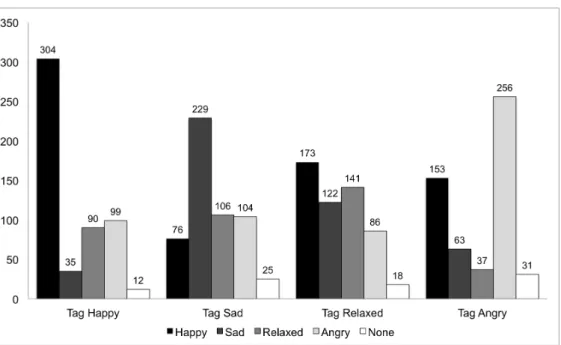
4.1 Stages of experimental procedure. . . 60 4.2 Comparison of classification results for the four classes of features. . . 63 4.3 Induced emotional response distribution for each tag. The horizontal axis shows
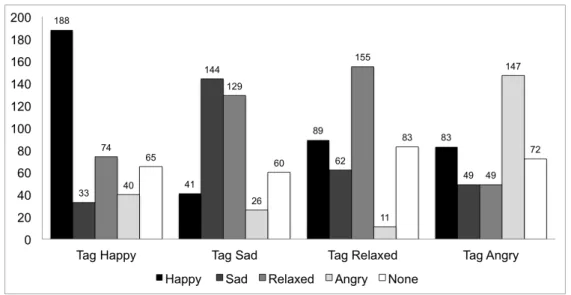
the five responses for each of the four emotion tagshappy,sad,relaxed, andangry. The vertical axis shows the number of responses. . . 74 4.4 Perceived emotion response distribution for each tag. The horizontal axis shows
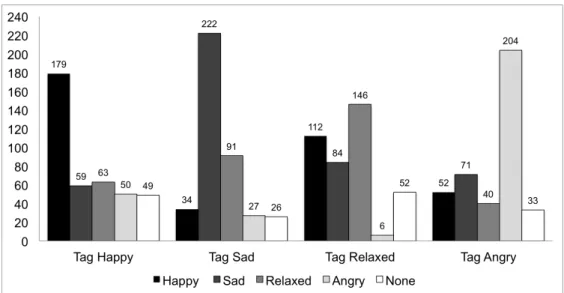
the five responses for each of the four emotion tagshappy,sad,relaxed, andangry. The vertical axis shows the number of responses. . . 75 4.5 Valence-Arousal model showing the quadrants of the four emotion tags used in
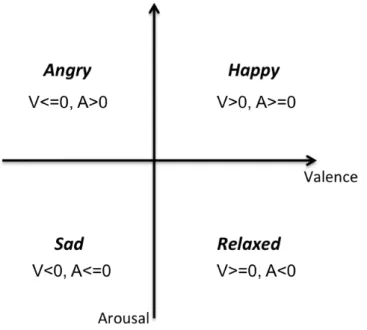
this experiment. . . 80 4.6 Perceived emotion response distribution for each tag. The horizontal axis shows
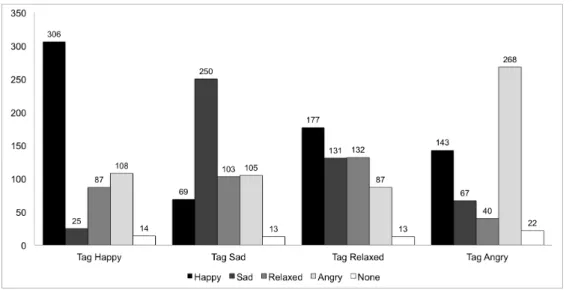
the five responses for each of the four emotion tagshappy,sad,relaxed, andangry. The vertical axis shows the number of responses. . . 86 4.7 Induced emotion response distribution for each tag. The horizontal axis shows the
five responses for each of the four emotion tagshappy, sad, relaxed, and angry. The vertical axis shows the number of responses. . . 87
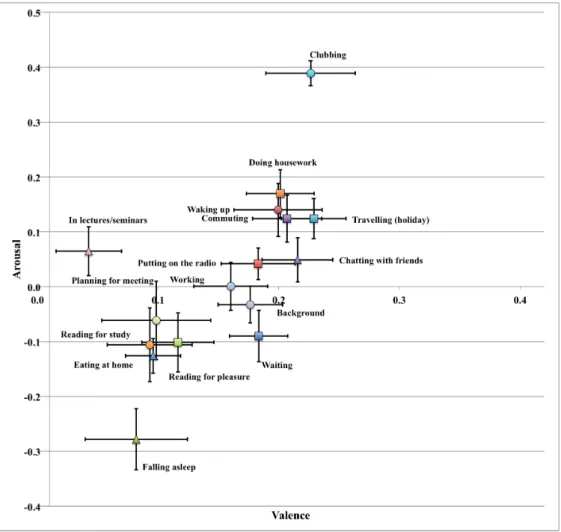
5.1 Expected felt emotion from music for each situation on a valence-arousal space. For each situation, the centroid is presented with standard error bars for both horizontal (valence) and vertical (arousal) axes. Note the difference in scale of axes. The predominant function shown in Table 5.6 is represented by circle =
energising, square =distraction, and triangle =meaning enhancement. . . 112
5.2 Summary of situations on a valence-arousal plane of emotion by dividing up the plane. . . 113
6.1 Changes of participants’ ratings of valence for situations with and without the presence of music. . . 139 6.2 Changes of participants’ ratings of arousal for situations with and without the
presence of music. . . 140 6.3 Changes in valence and arousal ratings for situations due to the presence of music. 142
2.1 The terms used to describe the two forms of emotional processes in relation to
music by grammatical subject (perspective). . . 26
2.2 Nine mood clusters proposed by Schubert (2003). . . 30
2.3 Four mood categories proposed by Thayer (1989). . . 31
2.4 Five mood clusters used in the MIREX audio mood classification task proposed by Hu and Downie (2007). . . 31
2.5 Geneva Emotional Music Scale (nine dimensions) proposed by Zentner et al. (2008). 34 3.1 Situations designed by North and Hargreaves (1996). . . 46
3.2 Categorisation of activities by Sloboda et al. (2001). . . 47
3.3 Examples of activities chosen in other studies. . . 48
3.4 Functions of music proposed by Merriam (1964). . . 52
4.1 Top 5 emotion tags returned by Last.FM for four basic emotions. . . 57
4.2 Top 5 titles and artists’ names returned with emotion tags from the “happy” category. . . 57
4.3 Top 5 titles and artist’s names returned with emotion tags from the “sad” category. 58 4.4 Top 5 titles and artists’ names returned with emotion tags from the “relaxed” category. . . 58
4.5 Top 5 titles and artists’ names returned with emotion tags from the “angry” category. 59 4.6 Summary of ground truth data collection. . . 59
4.7 The feature set used in this music emotion classification experiment. . . 61
4.8 Classification results of Experiment 1. . . 62
4.9 Comparison of classification accuracy with mean (M) and standard deviation (SD) feature values. . . 64
4.10 Classification results for combinations of feature sets. . . 65
4.11 Group allocation among participants. . . 68
4.12 Correlations between induced and perceived emotional responses. . . 72
4.13 Possible relationships between perceived and induced emotions in the categorical model. . . 73
4.14 Proportion of responses agreeing with Last.FM tag data for the corresponding song. 75 4.15 Summary of responses to 32 questions adapted from the Gold-MSI. . . 76
4.16 Consistency of participants’ responses for valence and arousal. . . 82
4.17 Possible relationships between perceived and induced emotions in the dimensional model. . . 83
4.18 Agreement of valence-arousal ratings with tag quadrants, and spread of per-song ratings (averaged over participants). . . 85
4.19 Agreement of participant ratings with the quadrant of the emotion tag for each category. . . 86
4.20 Summary of design differences between the two experiments. . . 89
4.21 The differences between “match” and “no match” cases in participants’ consistency. 90 4.22 The distribution of musical examples provided by participants. . . 95
4.23 Musical excerpts examples for each emotion category provided by participants. . 95
4.24 Audio features extracted from the musical excerpts. . . 96
4.25 Comparison of classification performance using support vector machines and ran-dom forest approaches. . . 97
4.26 Correlation between the song-wise consistency of the recognition system using the RF approach and participants’ responses. . . 98
4.27 Correlation between the responses from the MER system and participants using the categorical model. . . 98
4.28 Correlation between the responses from the MER system and participants using the dimensional model. . . 99
4.29 Examples of emotion vote distribution for the recognition system and participants’ ratings (categorical and dimensional models of emotion). . . 99
5.1 Categorisation of situations used in the Experiment. . . 104
5.2 Musical training score of participants. . . 106
5.3 Genre preferences of participants. . . 106
5.4 The mean (standard deviation) ratings for frequency (left) and importance (right), sorted in descending order. . . 108
5.5 Post-hoc analysis for functions of listening to music. . . 110
5.6 Participants’ ratings for the importance of functions of listening to music in various situations. . . 111
5.7 Correlations between and within emotion responses to music and functions. . . . 114
5.8 Counts of genres selected for various situational contexts. . . 115
5.9 Correlations between three individual factors and three aspects of music listening preference. . . 117
5.10 Relationships between the frequency of listening to music in various situations between male and female, age, and musical training (MT). . . 118
6.1 Activities (situations, contexts) used in Chapter 5 and the present study. . . 124
6.2 Participants’ musical training scores. . . 126
6.3 Musical genre preference of participants. . . 127
6.4 The mean (standard deviation) ratings of frequency and importance for music in different situations. . . 130
6.5 Mean (standard deviation) ratings of importance of functions of music for each situation. . . 131
6.6 Results of pair-wise comparison of participants’ ratings of importance for function “distraction” across situations. . . 132
6.7 Results of pair-wise comparison of participants’ ratings of importance for function “energising” across situations. . . 132
6.8 Results of pair-wise comparison of participants’ ratings of importance for function “entrainment” across situations. . . 133
6.9 Results of pair-wise comparison of participants’ ratings of importance for function “meaning enhancement” across situations. . . 133
6.10 Summary of pair-wise comparisons for four functions across situations. . . 134
6.11 Mean (standard deviation) emotional ratings for different situations without music.135 6.12 Mean (standard deviation) emotional ratings for different situations with music. 136 6.13 Results of Spearman’s rank correlation analysis and Wilcoxon signed rank test between ratings of valence (and arousal) with and without the presence of music. 137 6.14 Summary of emotional uses of music for valence and arousal. . . 141
6.15 Results of Spearman’s correlation analysis between the ratings for four functions and for two emotional dimensions. . . 141
6.16 Genre preference for each situation. . . 143
6.17 The effects of individual differences on music-listening behaviour. . . 144
E.1 Examples for Induced Emotions. . . 185
• Ground Truth refers to data which includes input data for a particular task together with the corresponding desired output. It is typically used for training (also known as learning), validation, and/or testing for models. For example, in the studies of music emotion recognition, a subjective listening test is often conducted to collect the ground truth needed for training the computational model of emotion prediction.
• Machine Learningexplores the study and construction of algorithms that can learn from and make predictions on data. Machine learning tasks are typically classified into three broad categories, depending on the nature of the learning “signal” or “feedback” available to a learning system. These are supervised learning, unsupervised learning, and reinforce-ment learning. Applications in which the training data comprises examples of the input data along with their corresponding output are known as supervised learning problems. Unsupervised learning is used when the training data consists of a set of input data with-out any corresponding with-output. The technique of reinforcement learning is concerned with the problem of finding suitable actions to take in a give situation in order to maximise a reward. Here the learning algorithm is not give examples of optimal outputs, in contrast to supervised learning, but must instead discover them by a process of trial and error.
• Support Vector Machines (SVMs) are supervised learning models with associated learning algorithms that analyse data and recognise patterns, used for classification and regression analysis. An SVM model is a representation of the examples as points in space, mapped so that the examples of the separate categories are divided by a clear gap that is as wide as possible. New examples are then mapped into that same space and predicted to belong to a category based on which side of the gap they fall on. In addition to performing linear classification, SVMs can efficiently perform a non-linear classification using what is called the kernel trick, implicitly mapping their inputs into high-dimensional feature spaces. Some common non-linear kernels include dth-degree polynomial, Gaussian radial basis, andneural network. SVMs have been used in a variety of classification tasks, such
as isolated handwritten digit recognition, speaker identification, object recognition, face detection, and vowel classification.
• k-Nearest Neighbours (k-NN)is a simple algorithm that stores all available cases and classifies new cases based on a similarity measure (e.g., distance functions). It is a non-parametric method used for classification and regression. A case is classified by a majority vote of its neighbours, with the case being assigned to the class most common amongst its K nearest neighbours measured by a distance function. If k = 1, then the object is simply assigned to the class of that single nearest neighbour. A shortcoming of the k-NN algorithm is that it is sensitive to the local structure of the data.
• Random Forests (RF)are a combination of tree predictors such that each tree depends on the values of a random vector sampled independently and with the same distribution for all trees in the forest. A Random Forest consists of an arbitrary number of simple trees, which are used to determine the final outcome. For classification problems, the ensemble of simple trees vote for the most popular class. In the regression problem, their responses are averaged to obtain an estimate of the dependent variable. Using tree ensembles can lead to significant improvement in prediction accuracy (i.e., better ability to predict new data cases).
• Deep Belief Networks (DBN) are probabilistic generative models that are composed of multiple layers of stochastic, latent variables. The latent variables typically have binary values and are often called hidden units or feature detectors. The top two layers have undirected, symmetric connections between them and form an associative memory. The lower layers receive top-down, directed connections from the layer above. The states of the units in the lowest layer represent a data vector. Deep belief networks have been used for generating and recognising images, video sequences, and motion-capture data.
AMC Audio Mood Classification
ANEW Affective Norms for English Words
APIs Application Programming Interfaces
ANOVA Analysis of Variance
BBC British Broadcasting Corporation
BOW Bag-of-Words
C4DM Centre for Digital Music
CBM Content-base Model
CF Collaborative Filtering
CM Categorical Model
DBN Deep Belief Network
DM Dimensional Model
ECG Electrocardiogram
EEG Electroencephalograph
ESM Experience Sampling Method
GEMS Geneva Emotional Music Scale
GMM Gaussian Mixture Model
Gold-MSI Goldsmiths Musical Sophistication Index
HCDF Harmonic Change Detection Function
k-NN K-Nearest Neighbour
K-S Kolmogorov-Smirnov
LIWC Linguistic Inquiry and Word Counts
MER Music Emotion Recognition
MFCC Mel-Frequency Cepstral Coefficients
MIR Music Information Retrieval
MIREX Music Information Retrieval Evaluation eXchange
MSD Million Song Dataset
MT Musical Training
OST Online Social Tags
PAD Pleasure-Arousal-Dominance
PLSA Probabilistic Latent Semantic Analysis
QBSH Query By Singing/Humming
RBF Radial Basis Function
RF Random Forests
RMS Root Mean Square
SVMs Support Vector Machines
SCR Skin Conductance Response
TF-IDF Term Frequency-Inverse Document Frequency
Introduction
This thesis is concerned with the role of emotion and context in musical preference. In this chapter, the motivations and aims of my work are described in Section 1.1. The thesis is outlined in Section 1.2, and a summarisation of contributions are presented in Section 1.3. Finally, publications associated with this thesis are listed in Section 1.4.
1.1
Motivation and Aim
With the emergence of digital music in the past two decades, the Internet has become a major source of retrieving multimedia information such as video, book, and music. The nature of music experience has changed at a fundamental level, and traditional ways of exploring and listening to music from radio stations and record stores have been partially replaced by music discovery web sites such as AllMusic1, iTunes2, Last.FM3, Pandora4, Spotify5, and Youtube6(Casey et al., 2008). Additionally, the rapid growth of portable digital devices has made music available almost everywhere. A study of recreational activities (watching television, listening to music, reading books, and watching movies) showed that people listen to music more often than any of the other activities (Rentfrow and Gosling, 2003). Due to the tremendous expansion of digital music libraries, personal collections of music can also easily exceed practical limits on the time we have to listen to them (Casey et al., 2008). For music researchers, the large collection of music recordings has also raised a major challenge for searching, retrieving, and organising musical
1http://www.allmusic.com/ 2https://www.apple.com/music/ 3http://www.last.fm/ 4http://www.pandora.com/ 5https://www.spotify.com/ 6https://www.youtube.com/ 18
content.
In the last fifteen years, music information retrieval (MIR) techniques have been developed to deal with common issues such as identification, recognition, and recommendation of music. Music recommendation systems, an effective application of discovering and filtering musical information, have been widely discussed (Celma, 2009). A good music recommendation system is capable of automatically modelling users’ musical preferences and generating playlists accordingly. The development of music recommendation systems also provides a great opportunity for industry to aggregate users who are interested in music and have similar musical preference. At present, the majority of commercial music recommendation systems are metadata-based, which provides search functionality based on the artist’s name, track title, album, and genre. In recent years, although MIR researchers have achieved relative success in content-based music recommendation systems by measuring inter-song similarity, there is still a lack of personalised design, involvement of human subjects, and user interactions with music recommendation systems.
The experience of music is highly subjective. It not only can convey and express emotion, but it can also regulate a listener’s emotion (Schubert, 2013; Eerola and Vuoskoski, 2013). People reported that their primary motivation for listening to music lies in its emotional effects (Juslin and Laukka, 2004; Juslin et al., 2008). In addition, Sloboda et al. (2009) reported that a substan-tial amount of music listening in contemporary Western society is deliberately chosen. People choose to listen to music for different reasons and to achieve various goals. Lamont and Greasley (2009) advocated that musical preferences and motivations for music listening are also context-dependent.
Companies such as Musicovery7, Songza8, and Stereomood9have attempted to integrate more subjective elements into the implementation of music recommendation systems, and have used emotional and contextual tags to help people discover music. However, these tags have been mostly manually annotated by experts. The process is very expensive and laborious. Further-more, many questions on the practicality of emotion- and context-based music recommendation systems remain unclear. The development of subjective music recommendation system is handi-capped due to the lack of empirical studies on musical emotion and music-listening context (Uit-denbogerd and Van Schyndel, 2002).
In music psychology, an extensive body of research is dedicated to the understanding of
7http://musicovery.com/
8http://daily.songza.com/
music and emotion (Schubert, 2007b; Juslin and Sloboda, 2010; Eerola and Vuoskoski, 2013). Such research in music psychology literature has highlighted the importance of context in music listening (North and Hargreaves, 1996; Sloboda et al., 2001; North et al., 2004; Juslin et al., 2008; Greasley and Lamont, 2011). It is important to combine the knowledge from these two fields, music information retrieval and music psychology, in order to further advance in our understanding.
This thesis focusses on Western popular music, and the aim of my work is to investigate music and emotion using approaches from both MIR and psychology, and explore its relationship with music-listening context, functions, and musical preference. By carrying out this research, I am hoping to bring together research in MIR and music psychology.
1.2
Thesis Structure
Chapter 2covers background knowledge for the research on music and emotion. It starts with the definitions used in this thesis and discusses different emotional processes in relation to music. The models of musical emotion, along with the advantages and disadvantages are described. Research in two different fields, music information retrieval and music psychology, is reviewed. A brief summary of stimuli used in previous research is presented, and the problems identified are discussed at the end.
Chapter 3 describes the terminology related to research of musical preference and music-listening context. A review of previous research on context is provided. Furthermore, three different aspects: emotional uses of music, functions of music listening, and musical preference are presented in detail.
Chapter 4 investigates the first element, emotion. This chapter provides the “ground truth” music emotion data collection of Western popular music. Features in four musical dimen-sions are extracted. Machine learning techniques are applied to classification of emotional content in music. I further investigate musical emotions and the reliability of social tags using two popular models of emotion, the categorical model and the dimensional model. The results of two listening tests using these two models are shown, and discussed in detail. In addition, the differences in music emotion classification accuracy between machine and human are compared.
usage of music is presented to participants. I compare the functional uses of music, musical preference, and emotional responses to music in everyday situations. Answers for the questions such as “What are the functions of listening to music?” and “How do different styles of music serve different situations?” can be found in this Chapter. For the study of emotional responses for different situations, this chapter focusses on the expected emotional responses from the impact of music. The emotion changes due to the presence of music is investigated in Chapter 6.
Chapter 6 addresses the emotional uses of music, and further discusses the relationships be-tween emotional responses and functional uses of music. Based on the activity selected in Chapter 5, thirteen activities are chosen and presented to participants. This chapter compares the emotional responses with and without the presence of music, and examines the effects of individual factors such as age, gender, and musical training on the experience of music listening. Five emotional uses of music, namely to maintain, intensify, diminish, create, and to change emotion, are also identified.
Chapter 7concludes the thesis, summarises the doctoral project, and provides ideas for future studies on music and emotion using psychophysiological measurements, musical feature analysis of musical preference, and the use of emotion and context in the design of subjective music recommendation systems.
1.3
Contributions
The following list contains the main contributions of this thesis and the chapters they appear in:
• Chapter 4: Creation of a Western popular music dataset (N = 2904) for music emotion classification using social tags “happy”, “sad”, “angry”, and “relaxed” from Last.FM.
• Chapter 4: Evaluation of audio features for music emotion classification with the collected emotion dataset.
• Chapter 4: Comparison of induced and perceived emotional responses using the categorical and the dimensional models of emotion.
• Chapter 4: Implementation of a music emotion classifier trained with a participant-suggested emotion dataset (N= 207) and comparison of human versus machine emotion recognition.
• Chapter 5: Exploration of musical preference in twenty everyday situations.
• Chapter 5: Categorisation of expected emotional responses to music for each activity on a valence-arousal space.
• Chapter 6: Investigation of functional uses of music in various contexts, and a proposal of five emotional uses of music.
1.4
Associated Publications
The research was carried out by the author between September 2011 and August 2015 in the Centre for Digital Music at Queen Mary University of London. Most of the work in the thesis has been presented at international conferences or in journals.
Peer-Reviewed Journal Articles
i (Song et al., 2015c) - Song, Y., Dixon, S., Pearce, M. T., and Halpern, A. R. (2016). Perceived and induced emotion responses to popular music: Categorical and dimensional models. Music Perception: An Interdisciplinary Journal, in press.
ii (Song et al., 2015b) -Song, Y., Dixon, S., Pearce, M. T., and Eerola, T. (2016). Functional uses of music vary across everyday situations, emotions and music preferences. In preparation.
iii (Song et al., 2015a) -Song, Y., Dixon, S., Pearce, M. T., and Eerola, T. (2016). Emotional and functional uses of music in various contexts. In preparation.
Peer-Reviewed Conference Papers
iv (Song and Dixon, 2015) - Song, Y., Dixon, S. (2015). How well can a music emotion recognition system predict the emotional responses of participants?. In Proceedings of the 12th Sound and Music Computing Conference (SMC), Maynooth, Ireland.
v (Song et al., 2013b) -Song, Y., Dixon, S., Pearce, M. T., and Halpern, A. R. (2013). Do online social tags predict perceived or induced emotional responses to music?. InProceedings of the 14th International Society for Music Information Retrieval Conference (ISMIR), pp. 89-94, Curitiba, Brazil.
vi (Kosta et al., 2013) - Kosta, K.,Song, Y., Fazekas, G., and Sandler, M. (2013). A study of cultural dependence of perceived mood in Greek music. InProceedings of the 14th Interna-tional Society for Music Information Retrieval Conference (ISMIR), pp. 317-322, Curitiba, Brazil.
vii (Song et al., 2013a) -Song, Y., Dixon, S., Pearce, M. T., and Fazekas, G. (2013). Using tags to select stimuli in the study of music and emotion. InProceedings of the 3rd International Conference on Music and Emotion (ICME), Jyv¨askyl¨a, Finland.
viii (Song et al., 2012b) -Song, Y., Dixon, S., and Pearce, M. T. (2012). Evaluation of musical features for emotion classification. InProceedings of the 13th International Society for Music Information Retrieval Conference (ISMIR), pp. 523-528, Porto, Portugal.
ix (Song et al., 2012a) - Song, Y., Dixon, S., and Pearce, M. T. (2012). A survey of music recommendation systems and future perspectives. In Proceedings of the 9th International Symposium on Computer Music Modelling and Retrieval (CMMR), pp. 395-410, London, UK.
Chapters 1 and 7 are based on some of the work published inix. Publicationsi,iv,v,vii, andviiiare the basis for Chapter 4. Articlesiiandiiiare the basis for Chapters 5 and 6. In addition to the research supervised by Simon Dixon and Marcus Pearce, for publicationvi, the author also worked with Andrea Halpern on publications i and v. During the 2-month research visit at Finnish Centre of Excellence in Interdisciplinary Music Research at University of Jyv¨askyl¨a from June to July, 2013, Tuomas Eerola supervised the project “emotional and functional uses of music in everyday life” (see publicationsiiandiii).
In publications i, ii, iii, and v, I conducted all the experiments and wrote the articles. Co-authors (Simon Dixon, Marcus Pearce, Andrea Halpern, and Tuomas Eerola) provided ideas for experimental design and data analysis. The manuscripts were also checked by co-authors throughout the submission and review process. In publication iv, Simon Dixon offered some insights into method and data analysis. In publicationvi, I proposed different hypotheses, con-ducted data analysis, and wrote results and conclusion sections. Katerina Kosta collected Greek music dataset, wrote introduction section, and helped data analysis. Gy¨orgy Fazekas worked on experimental design and wrote background and introduction sections. In publicationsvii,viii, and ix, I wrote the articles and conducted the experiments. Simon Dixon and Marcus Pearce provided their advices on writing and analysis, and Gy¨orgy Fazekas kindly assisted me with the online experiments setup.
Background in Music and Emotion
This chapter describes background knowledge for the research on music and emotion. Section 2.1 defines the concepts that are used throughout this work. Next, two forms of emotional processes in relation to music, perception and induction of musical emotions, are described in Section 2.2. Section 2.3 covers an overview of the models of emotion in music. Previous studies are then explained in Section 2.4, particularly in the fields of computer science (see Section 2.4.1) and music psychology (see Section 2.4.2). In Section 2.5, I briefly discuss the stimuli used in previous research. Finally, a review of the gap between research from different fields is presented in Section 2.6.
2.1
Definition
Given the importance of emotion in music, researchers have paid increasing attention to the study of music and emotion in the past two decades (Juslin and Sloboda, 2001, 2010; Eerola and Vuoskoski, 2013). Previous studies have used the termsemotion andmood, and sometimes they are referring to the same concept. Also when people describe their “emotional experience” in music, they may choose other words such asfeelingandaffect(Juslin and Sloboda, 2010). Scherer (2005) has stated that the definition of emotions, distinguishing them from other affective states or traits, is a notorious problem and constant challenge for emotion researchers. For exam-ple, the differences among these terms are not always stated by music information retrieval researchers (Huq et al., 2010; Yang and Chen, 2012; Watson and Mandryk, 2012), whereas the distinction is often made by psychologists (Scherer, 2004; Juslin et al., 2008; Saari and Eerola, 2014). This phenomenon causes terminological confusion. In order to avoid this problem in this work, I follow the concepts (i.e., affect, emotion, mood, and feeling) defined in the book
Handbook of music and emotion: Theory, research, applicationsby Juslin and Sloboda (2010).
i Affect: This is used as an umbrella term that covers all evaluative - states (e.g., emotion, mood, and preference) or “valences” (positive/negative). The term denotes such phenomena in general. If that is not intended, a more precise term (e.g., mood, emotion, and preference) is used instead (p. 10);
ii Emotion: This term is used to refer to a quite brief but intense affective reaction that usually involves a number of sub-components: subjective feeling, physiological arousal, expression, action tendency, and regulation, that are more or less “synchronised”. Emotions focus on specific “objects” and last minutes to a few hours (e.g., happiness, sadness) (p. 10);
iii Mood: This term is used to denote such affective states that are lower in intensity than emotions, that do not have a clear “object”, and that are much longer lasting than emotions (i.e., several hours to days). Moods do not involve a synchronised response in components like expression and physiology (e.g., gloomy) (p. 10);
iv Feeling: This term is used to refer to the subjective experience of emotions or moods. Feeling is one component of an emotion that is typically measured via verbal self-report (p. 10).
This work focusses mainly on theemotionin music. Juslin and Sloboda (2010) definemusical emotions as a short term for “emotions that were somehow induced by music”, without any further implications about the precise nature of these emotions. In this work, I use the terms
emotionandmusical emotionto represent perceived and induced emotion interchangeably.
2.2
Perception and Induction of Musical Emotions
Music can both express and evoke emotions (Krumhansl, 2002). In the study of music and emotion, one of the challenges faced by psychologists is to compare the two forms of emotional processes in relation to music, namely perception and induction of musical emotions. Gabriels-son (2002) has stated that induced emotion (also known as felt emotion, or internal locus) is the emotion experienced by the listener, whereas theperceived emotion(also known asexpressed emotion, or external locus) is the emotion recognised in the music. Schubert (2013) has sum-marised the terms used to describe these two forms of emotional processes in relation to music (see Table 2.1).
In the last ten years, research on emotions perceived in music and induced by music has gained increased attention (Eerola, 2013). The ways in which people recognise and experience emotion in music remain unclear. Generally, induced emotion is considered to be more subjective, and perceived emotion tends to be more objective (V¨astfj¨all, 2002; Kallinen and Ravaja, 2006; Evans and Schubert, 2008). Other studies have also suggested that the rating level of induced emotion is higher than the level of perceived emotion in connection with positive valence, but lower in connection with arousal, positive activation, and negative activation (Kallinen and Ravaja, 2006). TABLE 2.1
The terms used to describe the two forms of emotional processes in relation to music by gram-matical subject (perspective).
Form Locus Listener perspective Music perspective
Induction Internal Experienced, felt, own, re-activity, self
Conveys, induces, evokes, arouses, elicits, communicates
Perception External Noticed, perceived, recog-nised, sensed
Expresses, portrays, depicts, con-veys, sounds, describes, has charac-ter, “is”
2.2.1
Perceived Musical Emotion
Music can express emotions (DeNora, 1999; Juslin and Laukka, 2004). Darwin (1872) demon-strated that emotional expression serves the vital function of externalising an individual’s reaction and action propensity and of communicating this information to the social environment. This vocal communication of emotion has evolved in a phylogenetically continuous manner (Scherer, 1995). Ekman (1992, 1993) has shown that the ability to identify basic emotions (e.g., happiness, sadness, and anger) through facial expression seems to be universal among humans, and each of the basic emotions may also have associated vocal expression (Scherer and Oshinsky, 1977). Listeners judge vocal expression of emotion via acoustic cues such as pitch variation, pitch con-tour, and tempo. Similar to vocal expression (Wallbott and Scherer, 1986), music is also often regarded as an effective means of emotional communication (Gabrielsson and Juslin, 2003; Juslin and Laukka, 2003). For instance, children between age 3-12 have showed a reliable positive-major/negative-minor connotation of listening to music (Kastner and Crowder, 1990). Hunter et al. (2010) have suggested that people associate happiness with fast tempo and major key, and sadness with slow tempo and minor key. Juslin and Laukka (2003) have also compared the communication of emotion in acoustic cues between vocal expression and music performance, and have indicated that they (vocal expression and music performance) share similar cues such
as intensity (i.e., loudness of speech, loudness) and attack (i.e., rapidity of voice/tone onset), and that music performance has specific cues such as articulation (i.e., the relative proportion of sound to silence in note values) and vibrato (i.e., periodic changes in the pitch of a tone).
Previously, research showed that happiness and sadness can be expressed well and identified easily in music (Vieillard et al., 2008; Mohn et al., 2010). However, fear and anger are harder to identify than happiness and sadness (Terwogt and Van Grinsven, 1991; Kallinen, 2005). As pointed out in some studies, certain genres such as classical and popular music may express specific emotions (Eerola, 2011), and other individual differences such as culture (Fritz et al., 2009; Zacharopoulou and Kyriakidou, 2009; Thompson and Laura-Lee, 2010; Hu and Lee, 2012; Kosta et al., 2013), age (Morrison et al., 2008), musical expertise (Castro and Lima, 2014), and personality (Vuoskoski and Eerola, 2011b) may also affect the perception of emotion in music.
2.2.2
Induced Musical Emotion
People in Western culture have reported that one of the main motivations to engage in musical activities is emotional responses (Juslin and Laukka, 2004; Sch¨afer et al., 2013). It is known that music can evoke strong emotions (Gabrielsson, 2010). Emotions induced by music are often ac-companied with psychophysiological changes (e.g., heart rate, blood pressure, skin conductance, and temperature) (Nykl´ıcek et al., 1997; Khalfa et al., 2002; Gomez and Danuser, 2004; Miu and Balte, 2012). For example, compared with emotional musical excerpts of sadness, fear, and tension, happy excerpts produce the largest changes in the measures of respiration and generate more zygomatic facial muscle activity and greater skin conductance (Krumhansl, 1997; Lundqvist et al., 2008).
Comparing with studies of perceived emotion in music, there is much less research con-cerning induced musical emotions. Questions such as “What emotions can be induced by mu-sic?” (Scherer, 2004) and “How does music induce emotions?” (Juslin and V¨astfj¨all, 2008) remain unclear. Scherer and Zentner (2001) have suggested several production rules for emotion induction by music, including appraisal, memory, and empathy. In addition to cognitive appraisal (Scherer, 1999), Juslin and V¨astfj¨all (2008) have proposed six additional underlying psychological mecha-nisms by which music might be expected to evoke emotions, (i)brain stem reflexes, (ii)evaluative conditioning, (iii)emotional contagion, (iv) visual imagery, (v) episodic memory, and (vi) mu-sical expectancy. Later, a unified theoretical framework (BRECVEMA) is presented featuring two more mechanisms, namelyaesthetic judgmentandrhythmic entrainment(Juslin et al., 2010, 2014). Zentner et al. (2008) have reported some emotions (e.g., amazement, peacefulness) are
more frequently felt in response to music than in everyday life. Also, generally, emotions induced by music tend to be more positive (Juslin and Laukka, 2004; Schellenberg et al., 2008). Mean-while, individual factors such as personality (Kallinen and Ravaja, 2006; Vuoskoski et al., 2011), culture (Egermann et al., 2015), and current states (Vuoskoski and Eerola, 2011a) can also affect the musical emotion experience in response to music.
2.2.3
Relationship between Emotion Perception and Induction
People enjoy experiencing songs they perceive as sad (Vuoskoski et al., 2011), but they may also love songs which make them sad (Hunter et al., 2011; Schubert, 2012). Perceiving an expression of sadness in music without necessarily being affected oneself is mainly a perceptual-cognitive process, and it should be distinguished from listeners’ emotional response to the music (Gabriels-son, 2002). In general, music seems to evoke emotions similar to the emotional quality perceived in music (Kallinen and Ravaja, 2006). Research has shown that ratings of perceived emotion are more consistent than ratings of induced emotion (Schubert, 2007a; Hunter et al., 2010).
Separating induced emotion from perceived emotion is not straightforward, and the distinc-tion is not always observed (Eerola, 2011; Schubert, 2013; Egermann et al., 2013). Juslin and Laukka (2004) have distinguished the perception and induction of emotion in music from emo-tions induced in everyday life, yet the quantitative relaemo-tionship between the two has not been examined (Evans and Schubert, 2008). Gabrielsson (2002) has proposed and given examples of four possible relationships between perceived and induced emotion (shown below), namely pos-itive relationship, negative relationship, no systematic relationship, and no relationship. Those relationships have also been discussed by Kallinen and Ravaja (2006), and Evans and Schubert (2008).
• Positive relationshipoccurs when “the listener’s emotional response is in agreement with the emotional expression in the music” (p. 131);
• Negative relationship occurs when the “listener reacts with an emotion opposite to that expressed in the music: positive emotion in the music elicits negative emotion in the response, or negative emotion in the music elicits positive emotion in the response” (p. 134);
• No systematic relationshipoccurs when the listener stays “emotionally neutral” regard-less of the expression of the music, or experiences different emotions on different occasions (p. 136);
• No relationship occurs when there is not even a potential relationship, such as when a person feels an emotion that cannot be expressed in music (p. 136).
2.3
Musical Emotion Representation
During the past two decades, categorical (or discrete), dimensional, miscellaneous (McAdams et al., 2004; Ilie and Thompson, 2006), anddomain-specificemotion models (e.g., Geneva Emo-tional Music Scale, which is only used for induced emotion) (Zentner et al., 2008) have been proposed and used in the study of music and emotion. The categorical model and dimensional model have received empirical support (Kreutz et al., 2007; Vieillard et al., 2008; Mion and Poli, 2008) and have been commonly used (Vieillard et al., 2008; Juslin et al., 2008; Truong et al., 2009; Vuoskoski and Eerola, 2011b). Recently, Eerola and Vuoskoski (2010, 2013) have compared the use of these two models and have suggested that the categorical emotion model is less reliable than the dimensional model at predicting the rating of excerpts that are ambiguous examples of an emotion category, but they both produce highly compatible ratings of perceived emotions. In addition, to model the mapping between the categorical and the dimensional models of emo-tion, a probabilistic framework utilising a Gaussian Mixture Model (GMM) has been discussed by Wang et al. (2012).
2.3.1
Categorical Model
The categorical model (CM) assumes that an independent neural system subserves every discrete basic emotion (Eerola and Vuoskoski, 2010) and it represents all emotions as being derived from a limited number of universal and innate basic emotions such as happiness, sadness, fear, and anger (Ekman, 1992; Panksepp, 1998). Empirical support for the categorical model can be found in the research on neuropsychological and functional brain imaging studies. For instance, researchers have found that recognition of facial expressions of fear may be associated with specific neural substrates (Morris et al., 1996; Phillips et al., 1998). Apart from the basic emotions such as happiness and sadness, the categorical model may also include emotions such as tragedy, aggressiveness, and sensation (Thayer, 1989; Schubert, 2003; Hu and Downie, 2007). Previous studies have suggested that musically inappropriate categories such as disgust should be replaced with more fitting categories such as tenderness or peacefulness (Gabrielsson and Juslin, 1996; Vieillard et al., 2008).
Previously, different researchers came up with different sets of emotions, and several emo-tion taxonomies have been used (Juslin and Laukka, 2003; Bischoff et al., 2009; Hu and Lee, 2012; Yang and Hu, 2012). For example, Hevner (1935) proposed eight clusters consisting of 68 words. Later, a combination of emotional words selected from Hevner (1935), Russell (1980), and Whissell (1989) was validated by 133 musically experienced people, and Schubert (2003) refined these into nine groups consisting of 46 words, as shown in Table 2.2. Thayer (1989) on the other hand classified emotions into four groups: high energy/high stress, high energy/low stress, low energy/high stress, and low energy/low stress (see Table 2.3). Recently, five mood clusters proposed by Hu and Downie (2007) have gained popularity in music information retrieval tasks such as music emotion recognition (MER), similarity, and music recommendation (Yang and Hu, 2012; Singhi and Brown, 2014). Table 2.4 presents the five mood clusters for audio mood classification (AMC) from the annual Music Information Retrieval Evaluation eXchange (MIREX)1.
TABLE 2.2
Nine mood clusters proposed by Schubert (2003).
Cluster Examples
1 bright, cheerful, happy, joyous
2 humorous, light, lyrical, merry, playful
3 calm, delicate, graceful, quiet, relaxed, serene, soothing, tender, tranquil 4 dreamy, sentimental
5 dark, depressing, gloomy, melancholy, mournful, sad, solemn 6 heavy, majestic, sacred, serious, spiritual, vigorous
7 tragic, yearning
8 agitated, angry, restless, tense
9 dramatic, exciting, exhilarated, passionate, sensational, soaring, triumphant
The categorical model provides people an easy way to select and categorise emotion (Juslin and Laukka, 2004), and it is most frequently used in the study of perceived emotion (Eerola and Vuoskoski, 2013). More importantly for recommending music, the emotion category can be easily incorporated into metadata-based retrieval systems (e.g., keyword and tag search) (Han et al., 2009; Laurier et al., 2009). Choosing from a set of emotions has shown an advantage for emotion recognition in music, and it can clearly differentiate one emotion to another (Lu et al., 2006, 2010). In my work, I select four basic emotion classes: “happy”, “angry”, “sad”, and “relaxed”, considering that these four emotions are widely used across different cultures and cover all four
TABLE 2.3
Four mood categories proposed by Thayer (1989).
Energy Stress Examples
High High tense/anxious, angst-ridden, spooky, eerie, rowdy, fiery, angry, fierce, provocative, boisterous, hostile, aggressive, volatile, rebellious, confronta-tional, paranoid, outrageous, unsettling, brittle
High Low rollicking, exuberant, happy, sexy, exciting, energetic, party/celebratory, intense, gleeful, lively, cheerful, fun, rousing, freewheeling, carefree, pas-sionate, playful, gritty, joyous
Low Low calm/peaceful, sentimental, cathartic, soft, romantic, springlike, warm, precious, laid-back/mellow, confident, hypnotic, naive, intimate, innocent, relaxed, soothing, dreamy, smooth, gentle
Low High sad, melancholy, detached, whimsical, gloomy, ironic, snide, somber, au-tumnal, wry, wintry, plaintive, yearning, austere, bittersweet, fractured, bleak, cynical/sarcastic, bitter, acerbic
TABLE 2.4
Five mood clusters used in the MIREX audio mood classification task proposed by Hu and Downie (2007).
Cluster Examples
1 passionate, rousing, confident, boisterous, rowdy 2 rollicking, cheerful, fun, sweet, amiable/good natured 3 literate, poignant, wistful, bittersweet, autumnal, brooding 4 humorous, silly, campy, quirky, whimsical, witty, wry 5 aggressive, fiery, tense/anxious, intense, volatile, visceral
quadrants of the two-dimensional model of emotion (Laurier et al., 2008).
Although the categorical model has been dominantly used in the study of music and emotion, there exists some issues. Emotion is subjective in nature, and different people may use different words to describe the same emotions (Schuller et al., 2010). With few categories, the categorical model is inadequate to describe the richness of emotional effects of music (Yang and Chen, 2012); with many categories, the choice of emotion categories may overwhelm people (Yang and Chen, 2011).
2.3.2
Dimensional Model
The typical dimensional model (DM) represents emotions in an affective space with two di-mensions: one related to valence (a pleasure-displeasure continuum), and the other to arousal (activation-deactivation) (Russell, 1980). Emotion dimensions are found by analysing the corre-lation between emotion terms. Factor analysis techniques are applied on a large number of rating
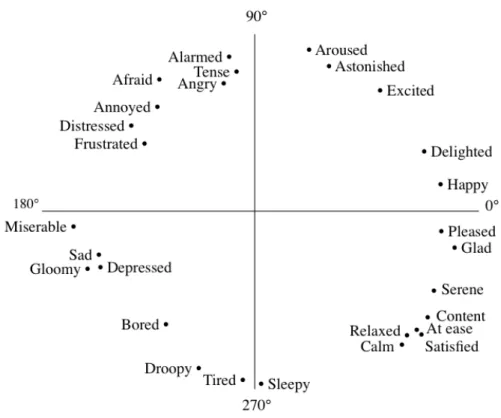
scales of affective terms to obtain a small number of fundamental factors from the correlations between the scales (Yang and Chen, 2012). Studies have shown that valence and arousal may be the most fundamental, and most clearly communicated emotion dimensions among others (Yang and Chen, 2011). Research has shown that the two-dimensional model of emotion can adequately describe self-reported symptoms of depression (Killgore, 1999). The most well-known example is the circumplex model proposed by Russell (1980), who has applied four approaches to 28 emotion terms:
1. Ross’s technique for a circular ordering of variables (see Figure 2.1);
2. A multidimensional scaling procedure based on perceived similarity among the terms;
3. A unidimensional scaling on hypothesised pleasure-displeasure and degree-of-arousal di-mensions;
4. A principal component analysis of 343 subjects’ self-reports of their current affective states.
Other studies have used a third dimension such asdominance(Pleasure-Arousal-Dominance, or PAD, Mehrabian and Russell, 1974), to explain the difference between dominant and submis-sive emotions (Ilie and Thompson, 2006; Schubert, 2007b; Collier, 2007), and interest (Leman et al., 2005), to contrast moving, exciting, pleasing, and passionate with indifferent, boring, an-noying, and restrained. Participants, however, have found it difficult to rate on thedominance
scale (Evans and Schubert, 2008). Likewise, the interest scale is sensitive to subject-related factors (Leman et al., 2005).
The typical dimensional model (Valence-Arousal, or VA) provides a reliable way for people to measure two distinct dimensions (Schuller et al., 2010; Yang and Chen, 2011; Schubert, 2014; Egermann et al., 2015). It allows representation of a more detailed range of emotion than what the categorical model can provide. These two core dimensions are often compared. For example, a study of emotion detection has suggested that arousal and valence (for high arousal states) can be differentiated using electrocardiogram (ECG). Previous research has also shown that the responses of arousal are more consistent than valence (Gomez and Danuser, 2004; Leman et al., 2005). Similarly, in the study of MER, arousal has been predicted from musical features better than valence (Schubert, 2007b; Yang et al., 2008; Huq et al., 2010).
Although the dimensional model has been widely used in the study of music and emotion (Le-man et al., 2005; Ilie and Thompson, 2006), it is not free of criticism. For example, the dimen-sional model has been criticised for its lack of differentiation when it comes to emotions that
Figure 2.1: Russell’s model using direct circular scaling coordinates for 28 affect words.
are close neighbours in the valence-activation space, which is one of the consequences of the low dimensionality of the model. Also, it has been reported that the two-dimensional model is not able to account for all the variance in music-mediated emotions (Bigand et al., 2005; Ilie and Thompson, 2006; Collier, 2007).
2.3.3
Domain-specific Model
Due to the fact that a large variety of emotions can be evoked by music (Scherer, 2004), a more sophisticated model of measuring music-induced emotion, the “Geneva Emotional Music Scale” (GEMS), has been developed by Zentner et al. (2008). The GEMS consists of 9-dimensional emotional scales -wonder,transcendence,tenderness, nostalgia, peacefulness,power,joyful acti-vation,tension, and sadness(see Table 2.5, Zentner et al., 2008). Interesting results have been obtained using the GEMS, such as neurophysiological correlates (Trost et al., 2012; Miu and Balte, 2012) and emotion prediction by feelings of entrainment (Labbe and Grandjean, 2014). Though it has been suggested that the GEMS model outperforms categorical and dimensional emotion models in accounting for induced emotions in music (Juslin and V¨astfj¨all, 2008; Zentner
and Eerola, 2009), Eerola and Vuoskoski (2010) have pointed out that these studies are limited to only familiar classical music examples.
A comparison of these three models of emotion (i.e., the categorical, dimensional, and the GEMS) has shown that low-dimensional models often suffice to account for the main emotional experiences induced by music (Vuoskoski and Eerola, 2011a). Since the nine factors proposed in the GEMS consider only the emotion induced by music, and there exists no validated version in other languages, the use of the GEMS still needs further investigation.
TABLE 2.5
Geneva Emotional Music Scale (nine dimensions) proposed by Zentner et al. (2008).
Dimension Terms
Wonder filled with wonder, dazzled, moved
Transcendence fascinated, overwhelmed, feelings of transcendence, spirituality Power strong, triumphant, energetic
Tenderness tender, affectionate, in love Nostalgia nostalgic, dreamy, melancholic Peacefulness serene, calm, soothed
Joyful activation joyful, amused, bouncy Sadness sad, sorrowful
Tension tense, agitated, nervous
2.4
Related Work in Music and Emotion
Music provides a powerful means of communication and self-expression (DeNora, 2000). A study of recreational activities (i.e., watching television, listening to music, reading books, and watching movies) among undergraduates at University of Texas at Austin indicated that they listen to music more often than do any of the other activities (Rentfrow and Gosling, 2003). The powerful emotional effects in music have attracted significant research interest not only in fields such as neuroscience of music, music psychology, musicology, and music cognition, but also in signal processing, machine learning, and computer science (for reviews, see Juslin and Sloboda, 2010; Yang and Chen, 2011; Fu et al., 2011; Eerola and Vuoskoski, 2013). On the one hand, as for MIR researchers in computer science, researchers are interested in understanding emotion in music computationally and building content-based models to solve issues such as identification, detection, recognition, and recommendation (Casey et al., 2008). On the other hand, as for music psychologists, researchers are interested in the understanding of emotion in music such as emotional responses to music, and the role of music in everyday life (Hallam et al., 2008).
Therefore, this section covers studies in signal processing and machine learning (Section 2.4.1), and in music psychology (Section 2.4.2).
2.4.1
Research on Music and Emotion in Computer Science
The rapid growth in Internet technology and portable digital devices has made vast amounts of music available. In the past decade, MIR researchers have been developing methods to search, organise, and manage millions of songs (Casey et al., 2008). One of the applications is a music recommendation system, into which emotion can be easily incorporated. Musicovery, for example, has successfully used a two-dimensional model of emotion within its recommendation system. MIR techniques have also been developed to solve problems in the research of content-based models such as genre classification (Tzanetakis and Cook, 2002; Li et al., 2003; Fu et al., 2011; Laurier, 2011), cover song identification (Ellis and Poliner, 2007; Foster et al., 2015), and query by singing/humming (QBSH) (Jang and Lee, 2008; Wang et al., 2010a). Since 2007, the annual MIREX evaluation campaign for MIR algorithms facilitates finding solutions to the problems of music classification (Hu et al., 2008).
Research on music and emotion has attracted increasing attention in the MIR community, and has been widely discussed in the past ten years (for reviews, see Kim et al., 2010; Yang and Chen, 2011). In these studies of music and emotion, significant amount of research has been carried out on MER systems (Kim et al., 2010; Yang and Chen, 2011). A typical method for emotion recognition is to classify music into different emotion categories (e.g., happy, sad, angry, and relaxed) (Trohidis et al., 2008). For classifying musical audio signals, various feature extraction toolboxes have been developed to extract features such as dynamics, rhythm, timbre, and harmony (Beveridge and Knox, 2012). However, features provided in these toolboxes are different. For example, MIRtoolbox2 provides a set of features from the statistics of frame-level features (Lartillot and Toiviainen, 2007), and Marsyas3 computes features from audio, including melody and frequency spectrum (Tzanetakis and Cook, 2000). In addition, PsySound34 creates features based on psychoacoustic models, and the Sound Description Toolbox5 gives a set of MPEG-7 standard descriptors. Classifiers are then trained using machine learning techniques (Yang and Chen, 2012). For instance, previous studies have successfully applied a regression approach to predict emotion categories and values of valence and arousal in music (Lu
2https://www.jyu.fi/music/coe/materials/mirtoolbox
3http://marsyas.info/
4http://psysound.wikidot.com/
et al., 2006; Yang et al., 2008; Eerola et al., 2009). Other common classification algorithms used in MER systems include k-Nearest Neighbour (k-NN) (Saari et al., 2011), random forests (RF) (Eerola, 2011), support vector machines (SVMs) (Laurier et al., 2007; Schmidt et al., 2010; Schuller et al., 2010), and deep belief networks (Schmidt and Kim, 2011; Schmidt et al., 2012). Pachet and Roy (2009) have proposed feature generation to improve classification results, and it can outperform approaches based on standard features in some contexts. Recently, Serra (2011) criticised MIR for being Western-specific. To meet the needs of music users in different cultures and languages, MIR researchers have also investigated cross-cultural and multilingual music information seeking behaviours (Downie and Cunningham, 2005), cross-cultural emotion classification (Yang and Hu, 2012), and development of culture specific approaches in MIR (Serra, 2012).
Apart from the audio signal analysis mentioned above, studies in computer science have also considered the linguistic aspect of songs. In fact, lyrics contain semantically rich information, which is not taken into account in audio signal analysis. Also, lyrics can provide a more explicit and objective expression of emotion (Logan and Kositsky, 2004). Juslin and Laukka (2004) have reported in a questionnaire study of everyday listening that 29% of the sample choose lyrics as the basis of their judgements of emotional expression in music. Previous studies have extracted words and characteristics of sentences from lyrics, and each song has been represented by a vector of features. The most popular approaches to analysing lyric features are using Probabilistic Latent Semantic Analysis (PLSA) (Logan and Kositsky, 2004; Laurier et al., 2008; Saari and Eerola, 2014), Bag-of-Words (BOW) (Hu et al., 2009; Lu et al., 2010), and Term Frequency Inverse Document Frequency (TF-IDF) (Van Zaanen and Kanters, 2010; Wang et al., 2011; McVicar and De Bie, 2012). Moreover, several language packages are developed to provide semantic meanings in different aspects of emotion. For example, Affective Norms for English Words (ANEW) (Bradley and Lang, 1999), WordNet (Fellbaum, 1998), and Linguistic Inquiry and Word Count (LIWC) (Pennebaker et al., 2007) have been successfully applied in computing the emotion values of valence, arousal, and dominance (Alm et al., 2005; Pettijohn and Sacco, 2009; Hu and Downie, 2010).
Both audio-based and lyric-based approaches have achieved satisfying results. Although previous research has reported conflicting results for audio and lyrics (i.e., lyrics-based approach outperforms audio-based approach, or vice versa), multi-modal emotion classification integrating these two approaches has provided a better classification accuracy (Laurier et al., 2008; Hu and Downie, 2010; Lu et al., 2010; Serra, 2011; McVicar and De Bie, 2012).