White Rose Research Online URL for this paper:
http://eprints.whiterose.ac.uk/129793/
Version: Accepted Version
Article:
Madhyastha, P., Wang, J.K. orcid.org/0000-0003-0048-3893 and Specia, L. (2018) The
role of image representations in vision to language tasks. Natural Language Engineering.
ISSN 1351-3249
https://doi.org/10.1017/S1351324918000116
[email protected] https://eprints.whiterose.ac.uk/
Reuse
Items deposited in White Rose Research Online are protected by copyright, with all rights reserved unless indicated otherwise. They may be downloaded and/or printed for private study, or other acts as permitted by national copyright laws. The publisher or other rights holders may allow further reproduction and re-use of the full text version. This is indicated by the licence information on the White Rose Research Online record for the item.
Takedown
If you consider content in White Rose Research Online to be in breach of UK law, please notify us by
c
1998 Cambridge University Press
The Role of Image Representations in Vision to
Language Tasks
Pranava Madhyastha, Josiah Wang, Lucia Specia
Dept. of Computer Science, University of Sheffield, Regent Court, 211 Portobello St., Sheffield, UK, S1 4DP
{p.madhyastha, j.k.wang, l.specia}@sheffield.ac.uk (Received 30 November 2017)
Abstract
Tasks that require modeling of both language and visual information such as image captioning have become very popular in recent years. Most state-of-the-art approaches make use of image repre-sentations obtained from a deep neural network, which are used to generate language information in a variety of ways with end-to-end neural network-based models. However, it is not clear how different image representations contribute to language generation tasks. In this paper, we probe the representational contribution of the image features in an end-to-end neural modeling framework and study the properties of different types of image representations. We focus on two popular vision to language problems: the task of image captioning and the task of multimodal machine translation. Our analysis provides interesting insights into the representational properties and suggests that end-to-end approaches implicitly learn a visual-semantic subspace and exploit the subspace to generate captions.
1 Introduction
There has been a substantial interest in multimodal tasks that combine language and vision. One such a task is Image Captioning (IC) where given an image the goal is to generate a caption that describes it (Vinyals et al., 2015; Karpathy & Fei-Fei, 2015; Kiros et al., 2014). This interest has driven the community to create a series of datasets, including IAPR-TC12 (Grubingeret al., 2006), UIUC PASCAL Sentences and Flickr8k (Rashtchian
et al., 2010), Flickr30k (Younget al., 2014) and MSCOCO (Chenet al., 2015), the largest of them all. This has also led to the very popular MSCOCO captioning challenges. The success in IC has inspired other, more advanced, vision to language problems, including Visual Question Answering (VQA) (Antolet al., 2015) and Multimodal Machine Transla-tion (MMT) (Speciaet al., 2016; Elliottet al., 2017).
Recent advances in deep learning models in the area of sequence modeling using re-current neural networks (RNN) have led to highly effective ways of learning sequential tasks (Elman, 1990). End-to-end deep neural models achieve impressive results for various tasks including language modeling (Mikolovet al., 2010) and machine translation (Bah-danauet al., 2015). For IC, most state-of-the-art models condition a deep recurrent se-quence generator (i.e., an RNN) on some image information. The image information is usually the penultimate layer of a Convolutional Neural Network (CNN) that has been
pre-trained for object classification (Karpathy & Fei-Fei, 2015; Vinyalset al., 2015). Al-ternatively, other layers in the network are used along with attention mechanisms on these representations to condition the RNN-based generator (Kiroset al., 2014; Xuet al., 2015; Wuet al., 2016). The success obtained in these tasks comes to some surprise given the differences between the representational spaces of image embeddings and the language in RNN-based models. End-to-end deep neural IC methods are able to generate captions without resorting to higher-level semantic mappings of the image space into the language space. More recent work has also investigated representations of the image in the form of attributes, such as the objects potentially appearing in it, using class-based probabilistic distributions (Yaoet al., 2017). These methods achieve even better results on standard test sets for the tasks of IC and VQA (Wuet al., 2016). In MMT, the results are less conclusive. This raises interesting questions about the informativeness of different types of represen-tations, in particular, low versus high-level information in the context of vision to language tasks. A sparse, attribute-level representation is indicative of the presence of a pre-defined, limited number of attributes (often objects) given an image. On the other hand, dense, low-or mid-level low-or the CNN activation-based image representations are expected to capture more details in the images, such as abstract scene information.
Previous work utilizes several types of image representations coupled with different ways to use them in vision to language tasks. However, it is not clear what the represen-tational contribution of these different types of image information is and why different representations lead to certain words being generated over others. In this work, we study the influence of different types of image information in a controlled setup and empirically probe the informativeness of the image representations. Our maincontributionsare:
• We study the effect of different image level representational features in the context of end-to-end IC and MMT systems.
• We show that end-to-end models conditioned on image representations mostly per-form image matching in a common image-text space to generate sentences.
• We show that a low-dimensional, sparse and interpretable vector also performs com-petitively with higher-dimensional CNN image embeddings, suggesting that such low-dimensional features may be sufficient to generate sentences in the visual-semantic subspace.
2 Background and Related Work
In this section, we first describe various approaches used to tackle IC and MMT tasks (Sections 2.1 and 2.2 respectively). We then describe recent efforts in exploring differ-ent represdiffer-entations for vision to language tasks that provide some context for our study (Section 2.3).
2.1 Image Captioning Approaches
Approaches for IC can be categorised into three primary groups: (i) pipelined approaches; (ii) retrieval approaches; (iii) end-to-end approaches.
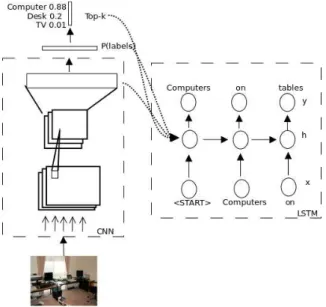
Fig. 1: RNN conditioned on different types of image representations: (a) penultimate layer; (b) posterior over object class labels; and (c) averaged word representations for the top-k
object classes.
Pipelined approaches. We call early work on IC ‘pipelined’ as it follows a sequence of steps: first, object categories are explicitly detected with visual object detectors; then the output of such detectors is used as input to generate image descriptions through a gener-ative model, such as template filling (Yaoet al., 2010; Kulkarniet al., 2011; Yanget al., 2011; Liet al., 2011; Mitchellet al., 2012; Elliott & de Vries, 2015), combining phrases from a corpus (Liet al., 2011), generating trees (Mitchellet al., 2012) or learning a statis-tical language model (Fanget al., 2015). Such methods are capable of generating captions not seen at training time, although their performance depends on the quality of the visual detectors, whose outputs form the input ‘representation’ to the caption generator.
Retrieval approaches. Retrieval approaches to IC retrieve existing captions from the train-ing set or an external dataset. These methods include projecttrain-ing images and captions onto a common representation space (Farhadiet al., 2010; Hodoshet al., 2013; Socheret al., 2014) and utilizing some image similarity measure (Ordonezet al., 2011) among other methods. For example, Hodosh et al. (2013) use Kernel Canonical Correlation Analysis to project images and their captions into a joint representation space, in which images and captions can be related and ranked to perform illustration and annotation tasks. Such retrieval methods produce image captions that are fluent and expressive (since they are ‘copied’ from human-authored captions in the training set) but cannot produce novel cap-tions. Work towards generating novel captions retrieves and combines existing text frag-ments (Kuznetsovaet al., 2012; Kuznetsovaet al., 2014) or prunes irrelevant fragments for better generalization (Kuznetsovaet al., 2013). The resulting captions, however, may still be irrelevant to the image content. On the image side, such methods mainly use a global
im-age representation (e.g., the penultimate layer of a CNN) or an intermediate representation such as a semantic tuple.
End-to-End approaches. Finally, end-to-end, deep neural network-based approaches are currently the most popular method for IC, yielding state-of-the-art results. These ap-proaches were inspired by the success shown in transferring image representations to other tasks (Razavianet al., 2014) using simple transfer learning approaches. End-to-end meth-ods will be discussed in more detail in Section 3. In general, such approaches extract image-related features using a CNN, which are then fed to an RNN caption generator. A popular and simple approach to condition the RNN on the image representation is by initializing thestartstate of the RNN with the image encoding (Karpathy & Fei-Fei, 2015; Vinyals et al., 2015) as shown in Figure 1. The CNN model used in most state-of-the-art approaches for IC (and MMT) is based on a classification model trained to optimally perform on an object classification task. The visual representation obtained as the activa-tions of the penultimate layer have been shown previously to generalize to other tasks in the framework of transfer learning (Donahueet al., 2014). Most previous approaches use pre-trained deep CNN networks, such as VGGNet (Karpathy & Fei-Fei, 2015), Inception CNN (Vinyalset al., 2015) and ResNet (Yaoet al., 2017), to obtain an image represen-tation that is fed into a continuous sequence generator. Attention mechanisms have also been used. For example, Xu et al. (2015) learns an IC model that attends to the output of a convolutional layer of a CNN.
Other ways of inducing representations in end-to-end approaches include attribute-level information. These correspond to the class-based predictions of the image network, i.e. the posterior probability distribution on a pre-defined set of classes that can correspond to objects in the image as shown in Figure 1. Wu et al. (2016) further fine-tune the pre-trained image network on a new label set. This fine-tuning helps the image network predict classes that correspond to the expected vocabulary.
Image captions generated by end-to-end systems can be novel to a certain extent depend-ing on search configurations, e.g. the beam size used durdepend-ing decoddepend-ing. In these approaches, the proportion of novel descriptions has been reported to be between 30% to 50% for op-timally trained systems (Devlinet al., 2015; Vinyalset al., 2016; Karpathy, 2016). The number of unique captions generated by such systems has also been reported to be approx-imately 30%. Humans, in contrast, rarely repeat descriptions, having a rate of 95%–99% unique descriptions reported for the MSCOCO dataset (Devlin et al., 2015; Karpathy, 2016). End-to-end systems also require a lot of parallel corpora (images with captions) for training, making it hard to adapt to different languages, styles or domains. Thus, end-to-end systems seem to predominantly ‘memorize’ parallel corpora, making it seemingly more like a ‘retrieval machine’ rather than genuinely generating image descriptions as in older pipelined approaches.
We refer readers to Bernardi et al. (2016) for an in-depth discussion on various image captioning approaches.
(a) IC
(b) Multimodal NMT
Fig. 2: Typical architecture of IC and MMT systems. In (a), the input image is encoded as a vector, and a description is decoded using an RNN. In (b), the source sentence encoding is used as decoder input, and the image embedding as input to either (or both) the source encoder or target decoder.
2.2 Multimodal Machine Translation Approaches
The task of MMT is closely related to that of IC. Most existing work focuses on end-to-end approaches, with an additional RNN used to encode the source sentence to produce a sequence of encoded vectors. Figure 2 illustrates the differences between typical IC and MMT architectures. In MMT, the visual information can be used to condition the source RNN, the target RNN, or both (Elliottet al., 2015). Most existing work obtain the best results by combining the penultimate layer of the CNN (via concatenation, summation, etc.) with the final state of the source sentence representation and using it to initialize the target RNN (Caglayanet al., 2016; Calixtoet al., 2016; Huanget al., 2016).
Recent work also explores an attention mechanism where they use lower level CNN features of the images, such as a convolutional layer, and condition the source and the target sentences on the image features (Calixtoet al., 2016; Calixtoet al., 2017). The intuition here is that the lower-level CNN features capture information about different areas of the images and an attention mechanism could learn to attend to specific regions while both encoding the source and decoding the target sentence.
Alternative approaches rely on pre-generated candidate translations for each source sen-tence from a text-only MT model, which are then reranked based on visual information (Shahet al., 2016), or use image information by pivoting on it to find relevant captions in external corpora (Hitschleret al., 2016). Approaches that exploit multi-task learning to jointly model how to translate and learn visually grounded representations showed promis-ing results (Elliott & K´ad´ar, 2017).
2.3 Studying Visual Representations
Recent work in analyzing multimodal representations include (Devlin et al., 2015; van Miltenburg & Elliott, 2017), which focus on linguistic regularities in the generated cap-tions. They are interested in comparing different IC architectures and the properties of the
produced captions. In contrast, our work focuses on studyingvisualrepresentations and their impact in vision to language tasks.
Focusing on MMT, Lala et al. (2017) show that, given reliable image information in the form of captions, an ideal MMT system would be able to significantly benefit and obtain better translations.
Vinyals et al. (2016) and Karpathy et al. (2016) present an analysis of lexical and syn-tactic properties of the generated captions. They conclude that almost 80% of the time the best caption for an image in the validation or test sets of MSCOCO can be retrieved from its training set, and that beam size often dictates the diversity in the output captions. Lebret et al. (2015) also analyzed the syntax of image captions in Flickr30k and MSCOCO and found that they comprise a simple and predictable structure.
The MSCOCO shared task (Chenet al., 2015) showed that participating systems using variants of retrieval-based approaches (Devlinet al., 2015; Kol´aˇret al., 2015) performed competitively with to-end approaches. Recent work seems to suggest that, in the end-to-end learning framework, using posterior distributions over a refined set of object classes (relevant to captions) performs better than using lower level dense image representations (Wuet al., 2016; Youet al., 2016). Vinyals et al. (2016) note that using a better image network (a network that performs better on the image classification task) results in im-provements in the generated captions.
In this paper, we concentrate on theimageside of image captioning, and systematically investigate the contribution of different types of visual representations in these tasks and study plausible reasons that drive the language generation component. We focus on the currently dominant end-to-end approaches, which represent the state-of-the-art for both IC and MMT. We acknowledge that there might be other types of approaches, e.g. Fang et al. (2015) use different architectures and also achieve strong performance, but studying these is left for future work.
3 Model Setting
We base our IC implementation on a simple end-to-end approach by Karpathy & Fei-Fei (2015), and consider most state-of-the-art systems as predominantly variants of this architecture. We use the Long Short-Term Memory (LSTM) RNN (Hochreiter & Schmid-huber, 1997; Chunget al., 2014) as our generative network, as described in Zaremba et al. (2014) for IC.
In order to use the image information, we first perform a linear projection of the image representation followed by a non-linearity as shown below:
Imf eat=σ(W·Im)
Here,Im∈ Rdis thed-dimensional initial image representation,W ∈ Rd×mis the linear transformation matrix,σis the linearity. We use exponential linear units as the non-linearity (Clevertet al., 2015) since it is faster to compute. Following Vinyals et al. (2015), we initialize the LSTM generative sequence model with the projected image information.
For MMT, we first build an attention-based, encoder-decoder framework as described in Luong et al. (2015). We explore two approaches to use image information: (i) conditioning
the encoder on image information; (ii) conditioning the decoder on image information. Both (i) and (ii) are similar to the afore-described approach for IC.
The sentence generator is trained to generate sentences conditioned on the image rep-resentation (IC and MMT), and also on the source sentence reprep-resentation for MMT. This is done by using the cross-entropy loss. That is, the sentence-level loss corresponds to the sum of the negative log likelihood of the correct word at each time step. For IC:
Pr(S|Imf eat;θ) = X
t
log(Pr(wt|wt−1..w0;Imf eat)) (1) where Pr (S|Imf eat;θ) is the sentence level loss conditioned on the image features
Imf eatandPr(wt)is the probability of the wordwtat time stept.
For MMT, given a source sentenceF and the image featuresImf eat, we obtain the negative log-likelihood of the target sentenceEas:
Pr(E|F, Imf eat;θ) = X
i
log(Pr(wt|wt−1..w0;F, Imf eat)) (2) wherePr(E|F, Imf eat;θ)is now conditioned on both the source sentenceFand the image featuresImf eatandwtare words corresponding to the sentence in the target language.
The standard maximum likelihood objective is used to train the model, with teacher forc-ing as described in Sutskever et al. (2014) where the correct word information is fed to the next state in the LSTM. Inference is usually done using approximate techniques like beam search and sampling methods (Karpathy & Fei-Fei, 2015; Vinyalset al., 2015). In this pa-per, as we are mainly interested in studying the effect of different image representations, we focus on the language output that the models can most confidently produce. Therefore, in order to isolate any other variables from the experiments, we generate captions using a greedyarg maxbased approach, i.e. no beam search.
4 Image Representations
Various representations are explored in this paper to study the representational contribution of images for both IC and MMT. We first provide an overview of the various pre-trained image networks used to obtain image features (Section 4.1), which are then used to form image representations for IC (Section 4.2) and MMT (Section 4.3).
4.1 Pre-trained Image Networks
In computer vision, CNNs became the de facto choice for image representations after the successful performance of the AlexNet CNN (Krizhevskyet al., 2012) in the 2012 Im-ageNet Large Scale Visual Recognition Challenge (ILSVRC 2012) (Russakovskyet al., 2015). Such networks are trained on the ILSVRC dataset for object classification, i.e. clas-sifying images into a set of 1,000 pre-defined categories or synsets (“is this an image of a
cat?”). Intermediate layers of the CNN are also often extracted and used as off-the-shelf features for various other vision tasks (Donahueet al., 2014; Razavianet al., 2014). For IC and MMT, it is worth noting that the object categories may not be directly relevant to the captions and vice versa (the captions may mention concepts that are not covered by the
1,000 categories). We explore the following two CNNs, both pre-trained on the ILSVRC dataset:
VGG19: VGGNet (Simonyan & Zisserman, 2015) achieved a top-5 accuracy of 92.7% in the ILSVRC 2014 challenge, making it among the top two best performing networks at the time. VGGNet is found to generalize well to different datasets and tasks, and is thus still widely used for different tasks. We use the pre-trained 19-layer version of VGGNet, which is reported to give slightly better performance in object classification over the 16-layer version, at the expense of being more complex.
ResNet152: ResNet (Heet al., 2016) reported a top-5 classification accuracy of 97.4% in the ILSVRC 2015 challenge, a significant improvement over VGGNet. The improvement resulted from drastically increasing the number of layers to 152, compared to VGGNet’s 19. We also explore using the output of the pre-trained 152-layer version of ResNet for IC and MMT to investigate whether the improvement in classification accuracy on ILSVRC helps with downstream vision to language tasks.
We also explore two other variants of ResNet152:
Places365-ResNet152: Zhou et al. (2014) trained a CNN on the Places2 dataset (Zhou
et al., 2017) to classify 365 scene categories (sky,baseball stadium, etc.). We investigate whether these networks predicting scene-specific categories are useful for IC, despite not predicting object-specific categories. We experiment with ResNet152 pre-trained solely on the Places2 dataset. Similar to the 1,000 ILSVRC categories, the scene categories may not be relevant to the captions, and some scenes mentioned in the captions may not exist in the 365 scene categories.
Hybrid1365-ResNet152: Zhou et al. (2014) also proposed training a CNN on the con-catenation of both ILSVRC and Places2 datasets, thus predicting both object and scene categories (1,365 classes). Therefore, we examine whether such a network combining both types of information can be helpful for vision to language tasks. This network is again based on the ResNet512 architecture.
4.2 Image Representations for IC
We now describe different representations explored for the task of IC. These include a lower-bound baseline (Section 4.2.1), representations derived from image classification (Section 4.2.2), and representations derived from object detectors (Section 4.2.3).
4.2.1 Lower-bound representation
Random: We condition the LSTM on a 300-dimensional vector containing random val-ues sampled uniformly between [0,1)1
. This represents a worst case image feature and provides an artificial lower bound.
4.2.2 Representations from image-level classification
We explore various representations derived from pre-trained CNNs (Section 4.1):
Penultimate layer (Penultimate): Most previous attempts for IC use the output of the penultimate layer of a CNN pre-trained on the ILSVRC data. Previous work motivates us-ing ‘off-the-shelf’ feature extractors in the framework of transfer learnus-ing (Razavianet al., 2014; Donahueet al., 2014). Such features have been often applied to IC (Maoet al., 2015; Karpathy & Fei-Fei, 2015; Gaoet al., 2015; Vinyalset al., 2015; Donahueet al., 2015) and have been shown to produce state-of-the-art results. Therefore, for each image, we extract the fc7 layer ofVGG19(4096D) and the pool5 layer for theResNet152variants (2048D) .
Class prediction vector (Softmax): We investigate higher-level image representations, where each element in the vector is an estimated posterior probability of object cate-gories. As previously noted, the categories may not directly correspond to the captions in the dataset. While there are alternative methods that fine-tune the image network on a new set of object classes extracted in ways that are directly relevant to the captions (Fang
et al., 2015; Wuet al., 2016; Yaoet al., 2017) we study the impact of off-the-shelf pre-diction vectors on the IC task. The intuition is that category prepre-dictions from pre-trained CNN classifiers may also be beneficial for IC, alongside the standard approach of using mid-level features from the penultimate layer. Therefore, for each image, we use the pre-dicted category posterior distributions of VGG19 and ResNet152 (1000objectcategories), Places365-ResNet152 (365 scene categories), and Hybrid-ResNet152 (1365 objectand
scenecategories).
Object class word embeddings (Top-k): Here we experiment with a method that utilizes the averaged word representations of top-kpredicted object classes. We first obtainSoftmax
predictions usingResNet152for1000object categories (synsets) per image. We then select the objects that have a posterior probability score>5%and use the300-dimensional pre-trained word2vec (Mikolov et al., 2013) representations2 to obtain the averaged vector over all top object categories. This is motivated by the central observation that averaged word embeddings can represent semantic-level properties and are useful for classification tasks (Aroraet al., 2017).
1
We also tried using 1,000-dimensions, but it yielded slightly poorer results.
2
4.2.3 Representations from object-level detections
We also explore representing images using information from objectdetectorsthat iden-tifyinstancesof object categories present in an image, rather than a global, image-level classification as described earlier. The output of visual detectors can help form a more interpretable and informative image representation:
• Ground truth (Gold)region annotations for instances of 80 pre-defined categories provided with MSCOCO, the dataset we use for the IC experiments. It is worth noting that these were annotated independently of the image captions, i.e. people writing the captions had no knowledge of the 80 categories and the annotations (and vice versa). As such, there is no direct correspondence between the region annota-tions and image capannota-tions.
• The state-of-the-art object detector YOLO(Redmon & Farhadi, 2017) pre-trained on MSCOCO for 80 categories (YOLO-Coco), or pre-trained on MSCOCO and ILSVRC for 9000 categories (YOLO-9k) in a weakly supervised fashion (bound-ing boxes surround(bound-ing object instances are not provided).
We explore several representations derived from instance-level object class annota-tions/detectors above:
Bag of objects (BOO): We represent each image as a sparsebag of objectsvector, where each element represents the frequency of occurrence for each object category in the image (Counts). We also explore an alternative representation where we only encode the presence or absence of the object category regardless of its frequency (Binary), to determine whether or not it is important to encode object counts in the image. These representations help us examine the importance of explicit object categories and in a sense interactions between object categories (dogandball) in the image representation. We investigate whether such a sparse and high-level BOO representation is helpful for IC. It is also worth noting that BOO is different from the Softmax representation above as it encodes thenumberof object occurrences, not the confidence of class predictions at image level. We compare BOO representations derived from theGold annotations (Gold-Binary and Gold-Counts) and both YOLO-Coco and YOLO-9k detectors (Countsonly).
Pseudo-random vectors: To further probe the capacity of IC models to make use of image representations, we experiment with noisy vectors that contain object-level information. More specifically, we examine a type of representation wheresimilar objects are repre-sented using similar random vectors. We then form the representation of the image from BOO Gold-Counts and BOO Gold-Binary; formally,Imf eat=
P
o∈Objectsf×φo, where
φo∈ Rdis an object-specific random vector andfis a scalar representing counts of the ob-ject category. We call thesepseudo-randomvectors. In the case of Pseudo-random-Counts,
f is the frequency counts from Gold-Counts. In the case of Pseudo-random-Binary,f is either0or1based on Gold-Binary. We used= 120. We investigate whether these seem-ingly random representations (but which have a latent structure) can generate reasonable captions.
4.3 Image Representations for MMT
Based on the observations from our experiments for IC, we explore the following image features for MMT:
Penultimate layer (Penultimate): As with previous successful approaches to MMT (Elliott
et al., 2015; Huanget al., 2016; Libovick´yet al., 2016), we use image information ob-tained from the penultimate layer of a pre-trained image network. Since we observed that
ResNet152-based representations were slightly better for IC, we only useResNet152 pre-trained on object classification for MMT, with representations from the penultimate layer (Pool5) of the network.
Class prediction vector (Softmax): As in IC, we also use the posterior distribution from
ResNet152(1,000 object categories) as image information.
5 Experiments and Results
To study the efficacy of vision to language models and understand the contribution of image information, we perform a series of experiments on standard datasets. We explore end-to-end approaches to IC and MMT, and make our source code and models available for replicability.
5.1 Datasets
IC: We use the most widely used evaluation setup for IC, i.e. MSCOCO (Chen et al., 2015). The dataset consists of 82,783 images for training, with five captions per image, thus totaling 413,915 captions in total. The validation set consists of 40,504 images and 202,520 captions. We perform model selection on a5000-image development set and report the results on a5000-image test set using standard, publicly available3splits of the MSCOCO validation dataset as in previous work (Karpathy & Fei-Fei, 2015).
Details about the collection of the images and captions can be found in (Chenet al., 2015). While other image captioning datasets exist (Grubingeret al., 2006; Rashtchian
et al., 2010; Younget al., 2014), we focus on MSCOCO as it is more recent and has been extensively used and evaluated in an open platform4. More information on different image captioning or image description datasets can be found in (Ferraroet al., 2015).
MMT: We use the Multi30k (Elliottet al., 2016) English-German (en-de) MMT dataset which was released as part of the WMT 2016 shared task on MMT (Speciaet al., 2016). The dataset consists of English-German sentence pairs, where the English sentence is a caption belonging to the Flickr30k dataset (Younget al., 2014) and the corresponding Ger-man sentence is a translation of this description professionally crafted. We also experiment with using the same data and flipping the translation direction, i.e. with a German-English
3
http://cs.stanford.edu/people/karpathy/deepimagesent
4
(de-en) dataset. This dataset is reasonably small, containing 29K sentence pairs for train-ing, 1K for development, and 1K for test. As in most datasets derived from IC tasks, sen-tences are very short: on average 11.9 tokens for English, and 11.1 tokens for German.
5.2 Evaluation Metrics
We evaluated system outputs using standard metrics for IC and MMT.
IC: The most common metrics for IC are BLEU (Papineni et al., 2002), Me-teor (Denkowski & Lavie, 2014) and CIDEr (Vedantamet al., 2015). All of these metrics are based on some form ofn-gram overlap between the system output and the reference captions (i.e. no image information is used). BLEU is computed from1-gram to4-gram precision scores (B-1. . .B-4); asnincreases (longer phrases) there will be less chances of ann-gram match, resulting in a decrease in the overall score from B-1 to B-4. Me-teor is anf-measure based metric that finds the optimal alignment between chunks of matched text and can incorporate semantic knowledge by allowing terms to be matched to stemmed words, synonyms and paraphrases, if such resources are available for the target language. CIDEr was developed specifically for image captioning, and measures the av-erage cosine similarity between a generated caption and a reference, each represented as TF-IDF weighted bag ofn-grams. We compare each system generated caption against five reference captions. We used the publicly availablecocoevalscript for evaluation5. Note that there are inherent weaknesses with these automatic metrics as they often do not corre-late well with human judgements (Elliott & Keller, 2014; Kilickayaet al., 2017; Anderson
et al., 2016). This is also reflected in the official MSCOCO metrics based on human judge-ments6. Other metrics have emerged in an attempt to address this issue (Andersonet al., 2016), but they have not been widely adopted.
MMT: We use the official metrics of the WMT16 MMT task –4-gram BLEU and Meteor – computed using the publicly availablemultevalscript7. Each generated caption is com-puted against one reference (human) translation. These are the mostly widely used metrics by the machine translation community for translation evaluation.
5.3 Model Settings and Hyperparameters
IC: We use a2-layer LSTM with128-dimensional word embeddings and256-dimensional hidden dimensions.
MMT: We use a single hidden layer encoder and decoder both with128-dimensional word embeddings and256-dimensional hidden dimensions. We train with dropout set to0.3for the RNNs.
For both IC and MMT, as training vocabulary we retain only words that appear at least twice. 5 https://github.com/pdollar/coco 6 http://cocodataset.org/#captions-leaderboard 7 https://github.com/jhclark/multeval
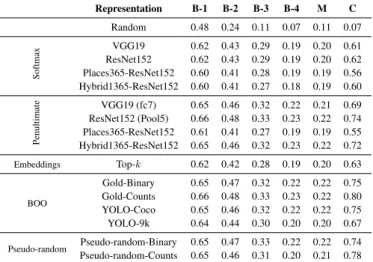
5.4 Results Representation B-1 B-2 B-3 B-4 M C Random 0.48 0.24 0.11 0.07 0.11 0.07 Softmax VGG19 0.62 0.43 0.29 0.19 0.20 0.61 ResNet152 0.62 0.43 0.29 0.19 0.20 0.62 Places365-ResNet152 0.60 0.41 0.28 0.19 0.19 0.56 Hybrid1365-ResNet152 0.60 0.41 0.27 0.18 0.19 0.60 Penultimate VGG19 (fc7) 0.65 0.46 0.32 0.22 0.21 0.69 ResNet152 (Pool5) 0.66 0.48 0.33 0.23 0.22 0.74 Places365-ResNet152 0.61 0.41 0.27 0.19 0.19 0.55 Hybrid1365-ResNet152 0.65 0.46 0.32 0.23 0.22 0.72 Embeddings Top-k 0.62 0.42 0.28 0.19 0.20 0.63 BOO Gold-Binary 0.65 0.47 0.32 0.22 0.22 0.75 Gold-Counts 0.66 0.48 0.33 0.23 0.22 0.80 YOLO-Coco 0.65 0.46 0.32 0.22 0.22 0.75 YOLO-9k 0.64 0.44 0.30 0.20 0.20 0.67 Pseudo-random Pseudo-random-Binary 0.65 0.47 0.33 0.22 0.22 0.74 Pseudo-random-Counts 0.65 0.46 0.31 0.20 0.21 0.78
Table 1: Results on the MSCOCO test split for IC, where we vary only the image repre-sentation and keep other parameters constant. The captions are generated withbeam= 1
.
5.4.1 Image Captioning
We first report results of IC on MSCOCO in Table 1, where the IC model (Section 3) is conditioned on the various image representations described in Section 4. As expected, using random image embeddings clearly does not provide any useful information and per-forms poorly. TheSoftmax representations with similar sets of object classes (VGG19,
ResNet152, and Hybrid1365-ResNet152) have very similar performance. However, the
Places365-ResNetrepresentations perform worse. We note that the posterior distribution may not directly correspond to captions as there are many words and concepts that are not contained in the set of object classes. Our results differ from those by (Wuet al., 2016; Yao
et al., 2017; Fanget al., 2015) where the object classes have been fine-tuned to correspond directly to the caption vocabulary. We posit that the degradation in performance is due to spurious probability distributions over object classes for similar looking images.
The performance of thePool5image representations shows a similar trend forVGG19,
ResNet152, andHybrid1365-ResNet152, with ResNet152showing slightly better scores. Once again, the Places365-ResNet representation performs worse. The representations from the image network trained on object classes is probably able to capture more fine-grained image details from the images, whereas the image network trained with scene-based classes captures more coarse-grained information.
The performance of the averaged top-kword embeddings is similar to that of theSoftmax
representation. This is interesting, since the averaged word representational information is mostly noisy: we combine top-ksynset-level information into one single vector. However, it still performs competitively.
The performance of theBag of Objects (BOO) sparse80-dimensional annotation vec-tor is better than all other image representations, if we consider the CIDEr scores. This is despite the fact that the annotations may not directly correspond to the semantic informa-tion in the image or the capinforma-tions. The sparse representainforma-tional informainforma-tion is indicative of the presence of only a subset of potentially useful objects. We notice a marked difference withBinaryandCount-based representations. This takes us back to the motivation that im-age captioning ideally requires information about objects, as well as interactions between objects, with attribute-level information such as number. Although our representation is re-ally sparse on the object interactions, it captures the basic concept of the presence of more than one object of the same kind, and thus provides additional information. A similar trend is observed by Yin & Ordonez (2017), although in their models they further try to learn interactions using another RNN for encoding objects.
Using objects predicted withYOLO-Cocoperforms better than using objects predicted withYOLO-9k. This is expected asYOLO-Coco was trained on the same dataset hence obtaining better object proposals. WithYOLO-9k, a significant number of objects were predicted for the test images that had not been seen in the training set (around 20%).
The most surprising result is the performance of the pseudo-random vectors. Both the
pseudo-random-Binaryand thepseudo-random-Countvectors perform almost as well as theGoldobjects. This suggests that the RNN is able to isolate the noise and learn some form of a common ‘visual-semantic’ subspace.
5.4.2 Multimodal Machine Translation
Model en-de de-en
BLEU Meteor BLEU Meteor
Pool5-enc 32.9 51.3 36.5 35.1
Pool5-dec 32.3 50.4 37.6 35.6
Softmax-enc 32.7 50.8 37.0 35.1
Softmax-dec 33.0 51.0 36.3 34.2
Caglayan et al. (2016)† 34.1 53.2 – –
Table 2: Results for en-de and de-en MMT test sets.†are best WMT16 results taken from Caglayan et al. (2016) which are generated based on a combination of statistical machine translation and re-scoring.
For MMT, we summarize the results in Table 2. Our models do not reach the perfor-mance of the top system at WMT16, but such a system is actually a combination of multi-ple strategies. We compare with one of best performing systems — Caglayan et al., (2016). Their system uses a phrase-based statistical machine translation model, plus a re-scoring strategy using language model and visual information in the form of the penultimate layer of a pre-trained VGG network. The most interesting observation is thatPool5andSoftmax
perform similarly, as in the IC task, and that the efficacy of the use of the visual information in the encoding versus decoding seems to depend on the type of visual representation and also on the dataset. In fact, no clear trend could be observed and additional experiments are needed, ideally with more realistic translation (not image captioning) data.
6 Analysis and Discussion
In what follows we further analyze the results for the IC task, for which the representations and models studied in this paper seem to show a clearer trend than for MMT.
(a) Bag of objects (b) ResNet152 Softmax (c) Places365 Softmax
(d) Hybrid1365 Softmax (e) Embeddings (f) ResNet152 Pool5
(g) Places365 Pool5 (h) Hybrid1365 Pool5 (i) Pseudo-random
Fig. 3: The cosine distance matrix between six groups: three MSCOCO categories and pairwise combinations of the three categories) from the training dataset. Each group is represented by the average image feature of 25 randomly selected images from the category or combination of categories.
6.1 Image Representations
We first compare different image representations with respect to their ability to group and distinguish between semantically related images. For this, we selected three cate-gories from MSCOCO (“dog”, “person”, “toilet”) and also pairwise combinations of these (“dog+person”, “dog+toilet”, “person+toilet”). Up to 25 images were randomly selected for each of these six groups (single category or pair) such that the images are annotated withonlythe associated categories. Each group is represented by the average image fea-ture of these images. Figure 3 shows the cosine distances between each group, for each of our image representations. TheBag of Objectsrepresentation forms the clearest clusters, as expected (e.g. the average image representation of “dog” correlates with images con-taining “dog” as a pair like “dog+person” and “dog+toilet”). TheSoftmaxrepresentations seem to also exhibit semantic clusters, although to a lesser extent. This can be observed
with “person”, where the features are not semantically similar to any other groups. The most likely reason is that there is no “person” category in ILSVRC. Also,Place365and
Hybrid1365 Softmax(Figure 3c) also showed very strong similarity for images contain-ing “toilet”, whether or not they contain “dog” or “person”, possibly because they capture scene information. On the other hand,Pool5features seem to result in images that are more similar to each other thanSoftmaxoverall.
→ (a) Pool5 → (b) Softmax → ... (c) Bag of Objects
Fig. 4: Visualization of the t-SNE projection of the initial representational space (left) vs. the transformed representational space (right).
6.2 Transformed Representations
To test the possibility that the RNN conditioned on visual information learns some sort of common ‘visual-semantic’ space, we explore the difference in representations between the initial representational space and the transformed representational space. The transfor-mation is learned jointly as a subtask of image captioning. To visualize both representa-tional spaces, we useBarnes-Hut t-SNE(van der Maaten & Hinton, 2008) to compute a 2-dimensional embedding over the test split. In general, we found that images are initially clustered by visual similarity (Pool5) and semantic similarity (Softmax,Bag of Objects). After transformation, linguistic information from the captions leads to different types of clusters.
Figure 4 highlights some interesting observations about the changes in clustering across three different representations. ForPool5, images seem to be clustered by their visual ap-pearance, for example snow scenes in Figure 4a, regardless of the subjects in the images (people or dogs). After transformation, separate clusters seem to be formed for snow scenes involving a single person, groups of people, and dogs. Interestingly, images of dogs in fields and snow scenes are also drawn closer together.
Softmax(Figure 4b) shows many small, isolated clusters before transformation. After transformation, bigger clusters seem to be formed – suggesting that the captions have again drawn related images together despite being different in theSoftmaxspace.
ForBag of Objects(Figure 4c), objects seem to be clustered by co-occurrence of object categories, for example toilets and kitchens are clustered since they share sinks. Toilets and kitchens seem to be further apart in the transformed space.
A similar observation was made by Vinyals et al. (2016) in which the authors observe that end-to-end IC models are capable of performing retrieval tasks with comparable per-formance to the task-specific models that are trained with ranking loss.
6.3 Generated Captions
In this section we provide a qualitative analysis of different image representations and gain insights into how they contribute to the IC task.Bag of Objectsled to a strong performance in IC despite being extremely sparse and low-dimensional (80D). Analyzing the test split, we found that each vector consists of only 2.86 non-zero entries on average (standard devi-ation 1.8, median 2). Thus, with minimal informdevi-ation being provided to the RNN generator, we find it surprising that it is able to perform so well.
We compare the output of the remaining models against theBag of Objects represen-tation by investigating what each represenrepresen-tation adds to or subtracts from this simple, yet strong model. We start by selecting images (from the test split) annotated with the exact sameBag of Objectsrepresentation – which should result in the same caption. For our qual-itative analysis, several sets of one to three MSCOCO categories were manually chosen. For each set, images were selected such that there is exactly one instance of each category in the set and zero for others. We then shortlisted images where the captions generated by theBag of Objectsmodel produced the five highest and five lowest CIDEr scores (ten images per set). We compare the captions sampled for each of the other representations.
Representation CIDEr (∆)
Caption
Bag of objects 2.78 (+0.00)
a bird is perched on a branch in the sun .
VGG19 softmax 3.14 (+0.36)
a owl is perched on a branch of a tree .
ResNet softmax 3.67 (+0.89)
a owl is perched on a branch in a tree .
Places365 soft-max
2.00 (-0.77)
a bear is sitting on a branch in the wilderness .
Hybrid1365 soft-max
0.01 (-2.77)
a giraffe standing in a field of grass .
VGG19 fc7 0.18 (-2.59)
a black and white image of a bird sitting on a window sill .
ResNet pool5 0.38 (-2.40)
a large black bear standing in a forest .
Places365 pool5 0.34 (-2.43)
a giraffe standing in the middle of a forest .
Hybrid1365 pool5 3.03 (+0.26)
a bird is perched on a branch in a tree .
Embeddings 2.38 (-0.40)
a bird sitting on a branch in a window .
(a) Bag of objects: bird (1)
Representation CIDEr (∆)
Caption
Bag of objects 0.09 (+0.00)
a large airplane flying through a blue sky .
VGG19 softmax 0.00 (-0.09)
a man in a baseball cap and sunglasses is holding a baseball bat .
ResNet softmax 0.00 (-0.09)
a man is holding a baseball bat in a batting cage .
Places365 soft-max
0.06 (-0.03)
a dog is standing in the grass with a ball in its mouth .
Hybrid1365 soft-max
0.00 (-0.09)
a man holding a tennis racquet on a tennis court .
VGG19 fc7 0.73 (+0.63)
a plane is sitting on a runway with a few people .
ResNet pool5 0.01 (-0.08)
a train is on the tracks in a city .
Places365 pool5 0.00 (-0.09)
a giraffe standing in a fenced in enclosure .
Hybrid1365 pool5 0.01 (-0.08)
a man holding a baseball bat standing next to home plate .
Embeddings 0.01 (-0.09)
a baseball player holding a bat on a field .
(b) Bag of objects: airplane (1)
Representation CIDEr (∆)
Caption
Bag of objects 0.01 (+0.00)
a man wearing a suit and tie standing in front of a building .
VGG19 softmax 0.04 (+0.04)
a woman in a pink wig and a pink dress .
ResNet softmax 0.00 (-0.00)
a man in a suit and tie is smiling .
Places365 soft-max
0.13 (+0.12)
a woman with a red polka dotted dress tie .
Hybrid1365 soft-max
0.06 (+0.05)
a woman in a red dress is talking on a cell phone .
VGG19 fc7 0.24 (+0.24)
a woman with a cell phone in her hand .
ResNet pool5 0.08 (+0.08)
a woman in a red shirt and tie .
Places365 pool5 0.10 (+0.09)
a woman is holding a cell phone to her ear .
Hybrid1365 pool5 0.05 (+0.04)
a woman in a dress shirt and tie holding a parasol .
Embeddings 0.00 (-0.01)
a man wearing a tie and a shirt and a tie .
(c) Bag of objects: person (1), tie (1)
Fig. 5: Example outputs from our system with different representations, the sub-captions indicate the annotation along with the frequency in braces. We also show the CIDEr score and the difference in CIDEr score relative to theBag of Objectsrepresentation.
achieved a high CIDEr score despite only being given “bird” as input, mainly by ‘guess-ing’ that the bird will be perching/sitting on a branch. The object-basedSoftmax (VGG and ResNet) models led to an even more accurate description as “owl” is the top-1 pre-diction of both representations (96% confidence for VGG, 77% for ResNet).Places365
predicted “swamp” and “forest”. The Penultimate features on the other hand struggled with representing the images correctly. In Figure 5b,Bag of Objectssuffered from lack of information (only “airplane” is given), theSoftmaxfeatures mainly predicted “chain-link fence”, Places365 predicted “kennel” (hence the dog description), and it is most likely thatPenultimatehas captured the fence-like features in the image rather than the plane. In Figure 5c,Softmaxfeatures generally managed to generate a caption describing a woman despite not explicitly containing the “woman” category. This is because other correlated categories were predicted, such as “mask”, “wig”, “perfume” and “hairspray”, and for
Places365“beauty salon” and “dressing room”.ResNetpredicted categories like “stetho-scope”, “suit”, “cloak”, where we assume that doctor roles may be male-dominated in the dataset, thus generating ‘man’.
6.4 Uniqueness of Captions Model Unique (%) BOO Gold-Counts 29.5 Top-kClass(Embeddings) 29.0 Softmax(ResNet152) 28.7 Pool5 (ResNet152) 28.8 Human 99.4
Table 3: Unique captions with beam= 1.
Challenges with IC datasets have been well explored in previous work. Karpathy et al. (2016) perform both word level and syntactic level analysis on the MSCOCO and Flickr8k datasets and concludes they both lack diversity. This means that most of the cap-tions are generic descripcap-tions and can fit multiple images. This extends directly for our experiments on the IC and MMT datasets.
We now turn to the question on the ability of representations to produce unique captions for every distinct image. We use the validation portion of the MSCOCO dataset, which contains 40,504 images, and produce captions with four types of image representations. We report the results in Table 3. We observe that in almost all cases, the produced repre-sentations are far from unique. In most cases, there is a significant portion of the captions that are repeated. This has also been observed by Devlin et al. (2015) on different test splits, but using retrieval-based and pipeline methods for IC.
7 Conclusions
Our experiments probe the contribution of various types of image representations and shed some light on the utility of image representations for vision to language tasks. We observed
that a conditional RNN-based language model is capable of making sense of noisy informa-tion and correctly clustering the noisy representainforma-tion in the projected space. However, the task datasets do not reflect the paucity of information content in the image representation and, in most cases, we obtain repeated captions for similar sets of images. Our empirical observations indicate that the direct use of lower-level image features may not be the only way to condition an RNN, and that higher-level, abstract, semantic features may also be beneficial in order to capture the semantic aspects of the images. As future work, we are interested in exploring more complex models that use attention-based architectures and those that exploit latent spaces.
Acknowledgments
This work was supported by the MultiMT project (EU H2020 ERC Starting Grant No. 678017).
References
Anderson, P., Fernando, B., Johnson, M., & Gould, S. 2016. SPICE: semantic propositional image caption evaluation.In: Proc. of the European Conference on Computer Vision (ECCV).
Antol, S., Agrawal, A., Lu, J., Mitchell, M., Batra, D., Lawrence Zitnick, C., & Parikh, D. 2015. VQA: visual question answering.In: Proc. of the IEEE Conference on Computer Vision & Pattern Recognition (CVPR).
Arora, S., Liang, Y., & Ma, T. 2017. A simple but tough-to-beat baseline for sentence embeddings.
In: Proc. of the International Conference on Learning Representations, Workshop Contributions. Bahdanau, D., Cho, K., & Bengio, Y. 2015. Neural machine translation by jointly learning to align
and translate.In: Proc. of the International Conference on Learning Representation (ICLR). Bernardi, R., Cakici, R., Elliott, D., Erdem, A., Erdem, E., Ikizler-Cinbis, N., Keller, F., Muscat, A.,
& Plank, B. 2016. Automatic description generation from images: a survey of models, datasets, and evaluation measures.Journal of Artificial Intelligence Research (JAIR),55, 409–442. Caglayan, O., Aransa, W., Wang, Y., Masana, M., Garc´ıa-Mart´ınez, M., Bougares, F., Barrault, L.,
& van de Weijer, J. 2016. Does multimodality help human and machine for translation and image captioning?In: Proc. of the Conference on Machine Translation (WMT).
Calixto, I., Elliott, D., & Frank, S. 2016. DCU-UvA multimodal MT system report.In: Proc. of the Conference on Machine Translation (WMT).
Calixto, I., Liu, Q., & Campbell, N. 2017. Doubly-attentive decoder for multi-modal neural machine translation.In: Proc. of the Association for Computational Linguistics (ACL).
Chen, X., Fang, H., Lin, T.-Y., Vedantam, R., Gupta, S., Doll´ar, P., & Zitnick, C. L. 2015. Microsoft COCO captions: data collection and evaluation server.arXiv preprint arXiv:1504.00325. Chung, J., Gulcehre, C., Cho, K., & Bengio, Y. 2014. Empirical evaluation of gated recurrent neural
networks on sequence modeling.Deep Learning and Representation Learning Workshop. Clevert, D.-A., Unterthiner, T., & Hochreiter, S. 2015. Fast and accurate deep network learning by
exponential linear units (ELUs).arXiv preprint arXiv:1511.07289.
Denkowski, M., & Lavie, A. 2014. Meteor universal: language specific translation evaluation for any target language.In: Proc. of the EACL Workshop on Statistical Machine Translation.
Devlin, J., Cheng, H., Fang, H., Gupta, S., Deng, L., He, X., Zweig, G., & Mitchell, M. 2015. Lan-guage models for image captioning: The quirks and what works. In: Proc. of the Association for Computational Linguistics (ACL).
Donahue, J., Jia, Y., Vinyals, O., Hoffman, J., Zhang, N., Tzeng, E., & Darrell, T. 2014. Decaf: a deep convolutional activation feature for generic visual recognition.In: Proc. of the International Conference on Machine Learning (ICML).
Donahue, J., Anne Hendricks, L., Guadarrama, S., Rohrbach, M., Venugopalan, S., Saenko, K., & Darrell, T. 2015. Long-term recurrent convolutional networks for visual recognition and descrip-tion.In: Proc. of the IEEE Conference on Computer Vision & Pattern Recognition (CVPR). Elliott, D., & de Vries, A. 2015. Describing images using inferred visual dependency representations.
In: Proc. of the Association for Computational Linguistics (ACL).
Elliott, D., & K´ad´ar, A. 2017. Imagination improves multimodal translation. In: Proc. of the Inter-national Joint Conference on Natural Language Processing (IJCNLP).
Elliott, D., & Keller, F. 2014. Comparing automatic evaluation measures for image description.In: Proc. of the Association for Computational Linguistics (ACL).
Elliott, D., Frank, S., & Hasler, E. 2015. Multi-language image description with neural sequence models.arxiv preprint arxiv:1510.04709.
Elliott, D., Frank, S., Sima’an, K., & Specia, L. 2016. Multi30K: multilingual English-German image descriptions.In: Proc. of the 5th Workshop on Vision and Language.
Elliott, D., Frank, S., Barrault, L., Bougares, F., & Specia, L. 2017. Findings of the second shared task on multimodal machine translation and multilingual image description.In: Proc. of the Con-ference on Machine Translation (WMT).
Elman, J. L. 1990. Finding structure in time.Cognitive science,14, 179–211.
Fang, H., Gupta, S., Iandola, F., Srivastava, R. K., Deng, L., Doll´ar, P., Gao, J., He, X., Mitchell, M., & Platt, J. C. 2015. From captions to visual concepts and back.In: Proc. of the IEEE Conference on Computer Vision & Pattern Recognition (CVPR).
Farhadi, A., Hejrati, M., Sadeghi, M., Young, P., Rashtchian, C., Hockenmaier, J., & Forsyth, D. 2010. Every picture tells a story: generating sentences from images. In: Proc. of the European Conference on Computer Vision (ECCV).
Ferraro, F., Mostafazadeh, N., Vanderwende, L., Devlin, J., Galley, M., & Mitchell, M. 2015. A sur-vey of current datasets for vision and language research.In: Proc. of the Conference on Empirical Methods in Natural Language Processing (EMNLP).
Gao, H., Mao, J., Zhou, J., Huang, Z., Wang, L., & Xu, W. 2015. Are you talking to a machine? Dataset and methods for multilingual image question. In: Proc. of the Advances in Neural Infor-mation Processing Systems (NIPS).
Grubinger, M., Clough, P., M¨uller, H., & Deselaers, T. 2006. The IAPR TC-12 benchmark: a new evaluation resource for visual information systems. In: International Workshop on Language Resources for Content-Based Image Retrieval, OntoImage’2006.
He, K., Zhang, X., Ren, S., & Sun, J. 2016. Deep residual learning for image recognition.In: Proc. of the IEEE Conference on Computer Vision & Pattern Recognition (CVPR).
Hitschler, J., Schamoni, S., & Riezler, S. 2016. Multimodal pivots for image caption translation.In: Proc. of the Association for Computational Linguistics (ACL).
Hochreiter, S., & Schmidhuber, J. 1997. Long short-term memory.Neural computation,9(8), 1735– 1780.
Hodosh, M., Young, P., & Hockenmaier, J. 2013. Framing image description as a ranking task: Data, models and evaluation metrics.Journal of Artificial Intelligence Research (JAIR),47, 853–899. Huang, P.-Y., Liu, F., Shiang, S.-R., Oh, J., & Dyer, C. 2016. Attention-based multimodal neural
machine translation.In: Proc. of the Conference on Machine Translation (WMT).
Karpathy, A. 2016.Connecting images and natural language. Ph.D. thesis, Department of Computer Science, Stanford University.
Karpathy, A., & Fei-Fei, L. 2015. Deep visual-semantic alignments for generating image descrip-tions.In: Proc. of the IEEE Conference on Computer Vision & Pattern Recognition (CVPR). Kilickaya, M., Erdem, A., Ikizler-Cinbis, N., & Erdem, E. 2017. Re-evaluating automatic metrics
for image captioning. In: Proc. of the European Chapter of the Association for Computational Linguistics (EACL).
Kiros, R., Salakhutdinov, R., & Zemel, R. S. 2014. Multimodal neural language models. In: Proc. of the International Conference on Machine Learning (ICML).
Kol´aˇr, M., Hradiˇs, M., & Zemˇc´ık, P. 2015. Technical report: Image captioning with semantically similar images.arXiv preprint arXiv:1506.03995.
Krizhevsky, A., Sutskever, I., & Hinton, G. E. 2012. ImageNet classification with deep convolutional neural networks.In: Proc. of the Advances in Neural Information Processing Systems (NIPS). Kulkarni, G., Premraj, V., Dhar, S., Li, S., Choi, Y., Berg, A. C., & Berg, T. L. 2011. Baby talk:
understanding and generating image descriptions.In: Proc. of the IEEE Conference on Computer Vision & Pattern Recognition (CVPR).
Kuznetsova, P., Ordonez, V., Berg, A., Berg, T., & Choi, Y. 2012. Collective generation of natural image descriptions.In: Proc. of the Association for Computational Linguistics (ACL).
Kuznetsova, P., Ordonez, V., Berg, A., Berg, T., & Choi, Y. 2013. Generalizing image captions for image-text parallel corpus.In: Proc. of the Association for Computational Linguistics (ACL). Kuznetsova, P., Ordonez, V., Berg, T. L., & Choi, Y. 2014. TREETALK: composition and
compres-sion of trees for image descriptions.In: Proc. of the Conference on Empirical Methods in Natural Language Processing (EMNLP).
Lala, C., Madhyastha, P., Wang, J., & Specia, L. 2017. Unraveling the contribution of image cap-tioning and neural machine translation for multimodal machine translation. The Prague Bulletin of Mathematical Linguistics.
Lebret, R., Pinheiro, P. O., & Collobert, R. 2015. Phrase-based image captioning. In: Proc. of the International Conference on Machine Learning (ICML).
Li, S., Kulkarni, G., Berg, T. L., Berg, A. C., & Choi, Y. 2011. Composing simple image descrip-tions using web-scale n-grams. In: Proc. of the SIGNLL Conference on Computational Natural Language Learning (CoNLL).
Libovick´y, J., Helcl, J., Tlust´y, M., Bojar, O., & Pecina, P. 2016. CUNI system for WMT16 automatic post-editing and multimodal translation tasks.In: Proc. of the Conference on Machine Translation (WMT).
Luong, M.-T., Pham, H., & Manning, C. D. 2015. Effective approaches to attention-based neural ma-chine translation.Proc. of the Conference on Empirical Methods in Natural Language Processing (EMNLP).
Mao, J., Xu, W., Yang, Y., Wang, J., Huang, Z., & Yuille, A. 2015. Deep captioning with multimodal recurrent neural networks (m-RNN).In: Proc. of the International Conference on Learning Rep-resentation (ICLR).
Mikolov, T., Karafi´at, M., Burget, L., Cernock`y, J., & Khudanpur, S. 2010. Recurrent neural network based language model.In: Proc. of the Annual Conference of the International Speech Communi-cation Association (Interspeech).
Mikolov, T., Sutskever, I., Chen, K., Corrado, G. S., & Dean, J. 2013. Distributed representations of words and phrases and their compositionality. In: Proc. of the Advances in Neural Information Processing Systems (NIPS).
Mitchell, M., Dodge, J., Goyal, A., Yamaguchi, K., Stratos, K., Han, X., Mensch, A., Berg, A., Berg, T., & Daume III, H. 2012. Midge: generating image descriptions from computer vision detections.
In: Proc. of the European Chapter of the Association for Computational Linguistics (EACL). Ordonez, V., Kulkarni, G., & Berg, T. L. 2011. Im2Text: describing images using 1 million captioned
photographs.In: Proc. of the Advances in Neural Information Processing Systems (NIPS). Papineni, K., Roukos, S., Ward, T., & Zhu, W.-J. 2002. BLEU: a method for automatic evaluation of
machine translation.In: Proc. of the Association for Computational Linguistics (ACL).
Rashtchian, C., Young, P., Hodosh, M., & Hockenmaier, J. 2010. Collecting image annotations using Amazon’s Mechanical Turk.In: Workshop on Creating Speech and Language Data with Amazon’s Mechanical Turk.
Razavian, A. S., Azizpour, H., Sullivan, J., & Carlsson, S. 2014. CNN features off-the-shelf: an astounding baseline for recognition. In: Proc. of the IEEE Conference on Computer Vision & Pattern Recognition (CVPR).
Redmon, J., & Farhadi, A. 2017. YOLO9000: better, faster, stronger.In: Proc. of the IEEE Confer-ence on Computer Vision & Pattern Recognition (CVPR).
Russakovsky, O., Deng, J., Su, H., Krause, J., Satheesh, S., Ma, S., Huang, Z., Karpathy, A., Khosla, A., Bernstein, M., Berg, A. C., & Fei-Fei, L. 2015. ImageNet large scale visual recognition challenge.International Journal of Computer Vision (IJCV).
Shah, K., Wang, J., & Specia, L. 2016. SHEF-Multimodal: grounding machine translation on images.
In: Proc. of the Conference on Machine Translation (WMT).
Simonyan, K., & Zisserman, A. 2015. Very deep convolutional networks for large-scale image recog-nition.In: Proc. of the International Conference on Learning Representation (ICLR).
Socher, R., Karpathy, A., Le, Q., Manning, C., & Ng, A. 2014. Grounded compositional semantics for finding and describing images with sentences.Transactions of the Association for Computational Linguistics,2, 207–218.
Specia, L., Frank, S., Simaan, K., & Elliott, D. 2016. A shared task on multimodal machine trans-lation and crosslingual image description. In: Proc. of the Conference on Machine Translation (WMT).
Sutskever, I., Vinyals, O., & Le, Q. V. 2014. Sequence to sequence learning with neural networks.
In: Proc. of the Advances in Neural Information Processing Systems (NIPS).
van der Maaten, L., & Hinton, G. 2008. Visualizing data using t-SNE.Journal of Machine Learning Research (JMLR),9, 2579–2605.
van Miltenburg, E., & Elliott, D. 2017. Room for improvement in automatic image description: an error analysis.arXiv preprint arXiv:1704.04198.
Vedantam, R., Lawrence Zitnick, C., & Parikh, D. 2015. Cider: consensus-based image description evaluation.In: Proc. of the IEEE Conference on Computer Vision & Pattern Recognition (CVPR). Vinyals, O., Toshev, A., Bengio, S., & Erhan, D. 2015. Show and tell: A neural image caption generator.In: Proc. of the IEEE Conference on Computer Vision & Pattern Recognition (CVPR). Vinyals, O., Toshev, A., Bengio, S., & Erhan, D. 2016. Show and tell: lessons learned from the 2015 MSCOCO image captioning challenge. IEEE Transactions on Pattern Analysis and Machine Intelligence,39(4), 652–663.
Wu, Q., Shen, C., Liu, L., Dick, A., & van den Hengel, A. 2016. What value do explicit high level concepts have in vision to language problems? In: Proc. of the IEEE Conference on Computer Vision & Pattern Recognition (CVPR).
Xu, K., Ba, J., Kiros, R., Cho, K., Courville, A. C., Salakhutdinov, R., Zemel, R. S., & Bengio, Y. 2015. Show, attend and tell: neural image caption generation with visual attention. In: Proc. of the International Conference on Machine Learning (ICML).
Yang, Y., Teo, C., Daum´e III, H., & Aloimonos, Y. 2011. Corpus-guided sentence generation of nat-ural images. In: Proc. of the Conference on Empirical Methods in Natural Language Processing (EMNLP).
Yao, B. Z., Yang, X., Lin, L., Lee, M. W., & Zhu, S. C. 2010. I2T: image parsing to text description.
Proc. of the IEEE Conference on Computer Vision & Pattern Recognition (CVPR).
Yao, T., Pan, Y., Li, Y., Qiu, Z., & Mei, T. 2017. Boosting image captioning with attributes.In: Proc. of the IEEE International Conference on Computer Vision (ICCV).
Yin, X., & Ordonez, V. 2017. Obj2Text: generating visually descriptive language from object layouts.
In: Proc. of the Conference on Empirical Methods in Natural Language Processing (EMNLP). You, Q., Jin, H., Wang, Z., Fang, C., & Luo, J. 2016. Image captioning with semantic attention.In:
Proc. of the IEEE Conference on Computer Vision & Pattern Recognition (CVPR).
Young, P., Lai, A., Hodosh, M., & Hockenmaier, J. 2014. From image descriptions to visual deno-tations: new similarity metrics for semantic inference over event descriptions.Transactions of the Association for Computational Linguistics,2, 67–78.
Zaremba, W., Sutskever, I., & Vinyals, O. 2014. Recurrent neural network regularization. arXiv preprint arXiv:1409.2329.
Zhou, B., Lapedriza, A., Xiao, J., Torralba, A., & Oliva, A. 2014. Learning deep features for scene recognition using Places database. In: Proc. of the Advances in Neural Information Processing Systems (NIPS).
Zhou, B., Lapedriza, A., Khosla, A., Oliva, A., & Torralba, A. 2017. Places: a 10 million image database for scene recognition.IEEE Transactions on Pattern Analysis and Machine Intelligence, PP(99), 1–1.