econ
stor
www.econstor.eu
Der Open-Access-Publikationsserver der ZBW – Leibniz-Informationszentrum Wirtschaft
The Open Access Publication Server of the ZBW – Leibniz Information Centre for Economics
Nutzungsbedingungen:
Die ZBW räumt Ihnen als Nutzerin/Nutzer das unentgeltliche, räumlich unbeschränkte und zeitlich auf die Dauer des Schutzrechts beschränkte einfache Recht ein, das ausgewählte Werk im Rahmen der unter
→ http://www.econstor.eu/dspace/Nutzungsbedingungen nachzulesenden vollständigen Nutzungsbedingungen zu vervielfältigen, mit denen die Nutzerin/der Nutzer sich durch die erste Nutzung einverstanden erklärt.
Terms of use:
The ZBW grants you, the user, the non-exclusive right to use the selected work free of charge, territorially unrestricted and within the time limit of the term of the property rights according to the terms specified at
→ http://www.econstor.eu/dspace/Nutzungsbedingungen By the first use of the selected work the user agrees and declares to comply with these terms of use.
zbw
Leibniz-Informationszentrum Wirtschaft Leibniz Information Centre for EconomicsAydin, Yaşar
Book Part
Emigration of highly qualified Turks: A critical review
of the societal discourses and social scientific
research
Provided in Cooperation with:
Hamburg Institute of International Economics (HWWI)
Suggested Citation: Aydin, Yaşar (2012) : Emigration of highly qualified Turks: A critical review of the societal discourses and social scientific research, In: Paçacı Elitok, Seçil; Straubhaar, Thomas (Ed.): Turkey, migration and the EU, ISBN 978-3-937816-94-4, Hamburg Univ. Press, Hamburg, pp. 199-227
This Version is available at: http://hdl.handle.net/10419/61499
Emigration of Highly Qualified Turks
A Critical Review of the Societal Discourses and Social Scientific Research
Yaşar Aydın
in:
Turkey, Migration and the EU:
Potentials, Challenges and Opportunities
edited by
Seçil Paçacı Elitok and Thomas Straubhaar
pp. 199–227
Hamburg University Press
Verlag der Staats- und Universitätsbibliothek Hamburg Carl von Ossietzky
Bibliographic information published by the Deutsche Nationalbibliothek
(German National Library).
The Deutsche Nationalbibliothek lists this publication in the Deutsche
Nationalbibliografie; detailed bibliographic data are available on the Internet at http://dnb.d-nb.de.
The online version is available for free on the website of Hamburg University Press (open access).The Deutsche Nationalbibliothek stores this online publication on its Archive Server. The Archive Server is part of the deposit system for long-term availability of digital publications.
Available open access in the Internet at:
Hamburg University Press – http://hup.sub.uni-hamburg.de
PURL: http://hup.sub.uni-hamburg.de/HamburgUP/HWWI5_Elitok_Migration Archive Server of the Deutsche Nationalbibliothek – http://deposit.d-nb.de ISBN 978-3-937816-94-4 (printed version)
ISSN 1865-7974 (printed version)
© 2012 Hamburg University Press, publishing house of the Hamburg State and University Library Carl von Ossietzky, Germany
The contents are available under the terms of an open content licence of the type Creative Commons “Attribution-NonCommercial-NoDerivs 2.0 Germany (CC BY-NC-ND 2.0)“(http://creativecommons.org/licenses/by-nc-nd/2.0/de). In essence, this licence allows to freely use the content, but not change it and only for non commercial purposes and only under the condition of the usual rules of citation.
This publication contains figures. If the authors of the articles are not the authors of the figures, it is necessary to seek permissions for use (licences) from third parties according to copyright.
Printing house: Elbe-Werkstätten GmbH, Hamburg, Germany http://www.ew-gmbh.de
Cover design: Benjamin Guzinski, Hamburg
List of Figures 7
List of Tables 8
Acknowledgement 9
Introduction 11
Seçil Paçacı Elitok and Thomas Straubhaar
Demography and Migration in Transition: Reflections on EU-Turkey Relations 19
Ahmet İçduygu and Ayşem Biriz Karaçay
Turkey’s “Critical Europeanization”: Evidence from Turkey’s
Immigration Policies 39
Juliette Tolay
Turkey’s New Draft Law on Asylum: What to Make of It? 63
Kemal Kirişçi
Is Migration Feminized? 85
A Gender- and Ethnicity-Based Review of the Literature on Irregular Migration to Turkey
Gülay Toksöz and Çağla Ünlütürk Ulutaş
Turkey in the New Migration Era: Migrants between Regularity and
Irregularity 113
Sema Erder and Selmin Kaşka
Causes and Consequences of the Downturn in Financial Remittances
to Turkey: A Descriptive Approach 133
Bordering the EU: Istanbul as a Hotspot for Transnational Migration 167
Barbara Pusch
Emigration of Highly Qualified Turks 199
A Critical Review of the Societal Discourses and Social Scientific Research
Yaşar Aydın
Continuity and Change: Immigration Policies in Germany from
the Sixties to the Present 229
Mehmet Okyayuz
Conclusion 259
Seçil Paçacı Elitok and Thomas Straubhaar
List of Abbreviations 271
International Workshop on Migration Potentials from and to Turkey 273
A Critical Review of the Societal Discourses and Social Scientific Research
Yaşar Aydın
Introduction: Background and Relevance of the Problem
The emigration of in Germany educated highly qualified Turks1 from Germany
to Turkey has attracted the attention of the media, politics and social sciences, and triggered controversial debates on a possible “brain drain”.2 In this
discus-sion, not only economic and scientific considerations, but also political concerns such as the involvement of highly qualified Turks in the social system and their identification with the cultural value system in Germany were included.
Three recent developments initiate to deal with the emigration of highly qualified Turks from Germany to Turkey.3 Firstly, trade associations, experts
and political actors have been complaining since at least the late 1990s that more and more top-executives, academics and other highly qualified persons emigrate from Germany.4
This can also be verified by existing statistical data.
1
Initially, it needs to be emphasized that the term “Turk” does not refer to ethnicity, but to the territory of the Turkish Republic. In this contribution, the term “Turk” refers to a person who is (a) either a citizen of the Turkish Republic, (b) was once a Turkish citizen, but then has been naturalized and became a German citizen or (c) who is a natural-born German citizen with Turkish parent/s. 2
See Jacobsen (2009), Flocke (2008). 3
Here it needs to be emphasized that this contribution is not a final work, but a work in progress. It is part of a more com-prehensive research project which is currently carried out at the HWWI (Hamburg Institute of International Economics) on behalf of the foundation Hans Böckler Stiftung. This research project aims at investigating empirically the causes and rea-sons of migration intentions and the actual migration of highly qualified Turks from Germany to Turkey. It focuses mainly on two questions: Are these highly qualified Turks “participating in two societies”? Does the emigration of highly qualified Turks mean “brain drain” (“waste of resources”) or “failure of integration”? For this purpose, semi-structured interviews are conducted. In this contribution, however, the focus is rather on the existing social scientific literature and the available data. 4
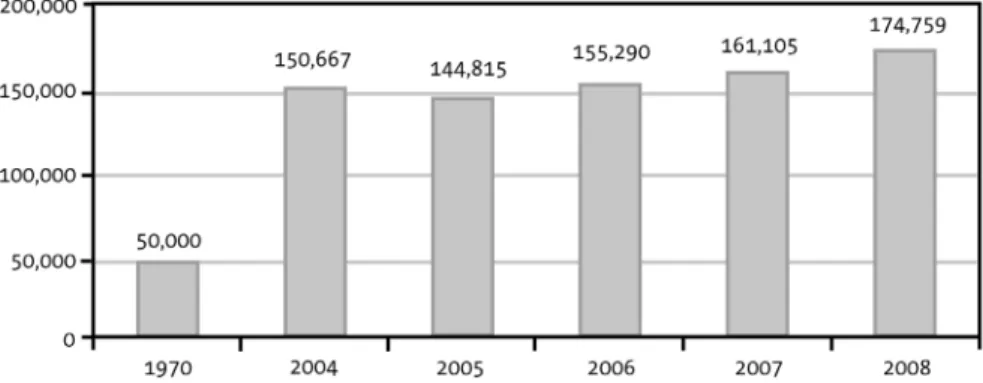
The number of the emigrants from Germany has almost increased three-fold in the first decade of the 21st century compared to the 1970s (Figure 1).
Figure 1: Emigration of Germans from Germany
Source: Migrationsbericht 2007 and 2008.
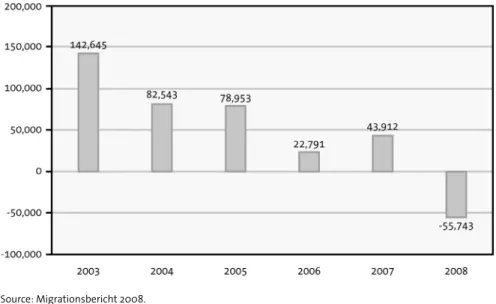
Figure 2: Emigration of Medical Doctors from Germany
Source: Migrationsbericht 2008.
Today, more and more Germans are willing to live and work abroad. The avail-able data show that German emigrants are a well-educated and a positively
se-lected group compared to the total population. Besides, in recent years there has also been a slight increase in the proportion of highly qualified emigrants. Highly qualified persons are indeed not the biggest group among German emigrants, but they make an over proportional amount. A comparison of the years between 1990 and 2000 shows that the percentage of the highly quali-fied emigrants has increased by 10 % in these ten years.5
The emigration of doctors of medicine is also on the increase (Figure 2).
In business and politics, this development is regarded as problematic for two reasons. On the one hand, it is suggested in the social scientific literature that technical revolutions and economic developments benefit from immigra-tion movements notably of highly qualified persons or specialists, while mass emigration of highly qualified persons and specialists results quite often in eco-nomic downfalls. On the other hand, in media discourses this increasing emigra-tion is interpreted as an indicaemigra-tion for the fact that Germany does not benefit enough from the international competition for highly qualified persons respect-ively specialists.6
Secondly, experts, employers’ associations and trade unions predict that, in some sectors in the medium term and in other sectors even in the short term, there will be a growing shortage of skilled workers. Due to the rapid aging population and the growing importance of a knowledge-based economy, the qualified or skilled labor shortage will worsen notably in the sectors like health and engineering as well as in various service sectors.7
Finally, the emigration of highly qualified Turks is also interpreted as an indication for a mental “turning away” of this group from the host society and for a “failure of integration”.8
It is frequently suggested that in the light of demographic trends, shortages of skilled workers and the lack of success in the recruitment of highly qualified professionals from abroad, it would be critical
5
Sauer/Ette (2000, p. 70). 6
Aus Politik und Zeitgeschichte (2009, Editorial). This volume refers to the aging of the population and the “considerable shortage of skilled labor” and projects that Germany could lose “the international competition for the ‛best minds’”, APuZ (2009, p. 2).
7
Heise-Online (2007), Fellmer/Kolb (2009). The shortage of skilled labor and the need for skilled immigration is also declar-ed in the International Migration Outlook: SOPEMI 2009 of the OECD. In this survey, it is argudeclar-ed that the “economic down-turn did not change the necessity of managing labor migration in general”. According to this survey, it is likely that in the wake of economic recovery “a stronger migration flow” will resume (SOPEMI [2009, p. 3]). It is also predicted that in 2015 in OECD countries “the number of retiring from the labor force will exceed the number those who will enter the labor mar -ket” and that this development “will continue over many years” (Ibid. [p. 1]).
8
from economic and political points of view if Germany still had to give up on a highly qualified workforce being trained in Germany.
In view of these developments and considerations, this book contribution focuses on the push factors that lead highly qualified Turks to emigrate from Germany as well as on the pull factors that lead them to migrate to Turkey. Thus, it aims at elucidating the reasons and causes of this emigration move-ment on the basis of existing research findings and statistical data. In the first part of this contribution, firstly classical and then more recent explanations on the migration of highly qualified workers will be presented systematically and discussed critically. In the second part, then, the extent and the causes of emig-ration of highly qualified Turks will be addressed.
Theoretical Explanations for the Highly Qualified Migration
Since the end of World War II, the emigration of highly qualified workers, inter-preted as “brain drain”, and their motives for emigration have attracted the at-tention not only of social scientists, but also of economists and politicians. The debate was triggered by a study conducted in Great Britain, which raised a public awareness for the weaknesses of the British education and academic system. The study called for an increase in funding.9
In the following discussions about the emigration of highly qualified per-sons, developing countries have been problematized as the main sending countries. At that time, the most important receiving country was the U.S., fol-lowed by Canada and Great Britain. Sending countries were India and other Asian, African and South American countries. Subsequently, the phenomenon was taken up also by development studies, problematized as “brain drain” and used for explaining the problem of underdevelopment. Having said that, now the question is: what is meant by “brain drain”?
Brain Drain and High Qualification
Literally, “brain drain” means emigration of intelligentsia. In economic dis-courses, the term refers to economic losses caused by the emigration of trained, skilled and especially highly qualified workers, specialists or other tal-ented people such as academics from a country or a region to another country
9
or region. In scientific literature, there is no exact definition for highly quali-fied persons. It mostly remains unclear whether the term “high qualification” means the formal qualification or the present professional activity. In this con-tribution, the adjective “highly qualified” is based on the definition, which is found in the Law on Residence, Employment and the Integration of Foreigners in Germany.10 According to Article 19(2) of this law, highly qualified people are
- Scientists with special professional knowledge,
- Teaching personnel and research assistants in high positions, and
- Specialists or executive personnel with special professional knowl-edge who get a salary at least more than the income threshold of the general pension system.11
Among the negative consequences or socioeconomic losses of “brain drain”, a number of historic examples could be given. In the first place, the migration of academics from the German Democratic Republic (East Germany) to the Ger-man Federal Republic (West GerGer-many) should be mentioned. This situation turned out to be an economical and political problem for the German Demo-cratic Republic. Previous examples consisted of, for example, the forced migra-tion of Huguenots from France to Prussia, which brought many disadvantages for France and advantages for Prussia. The omission of Jewish bankers, which was caused by the expulsions during the high Middle Ages and early modern period, cost Spain its position as Great Power in the 16th
century. Germany and Austria lost many prominent scientists and entrepreneurs with Jewish origin due to the expulsion, extermination and forced emigration of Jews and Nazi opponents in the 1930s and 1940s under Nazism.
In a nutshell, “brain drain” can be considered as either a voluntary or a forced permanent emigration of highly qualified persons. “Brain exchange” on the contrary refers to the mutual flow of highly qualified workers between a sending and a receiving country. “Brain circulation” again refers to a process of circulation like this: studying abroad – gaining professional work experience – returning to the home country.12
10
Gesetz über den Aufenthalt, die Erwerbstätigkeit und die Integration von Ausländern im Bundesgebiet (AufenthG). 11
This presently amounts approximately 64,800 EUR per year. 12
Diehl (2005, p. 1), Ladame (1970). The French migration researcher has criticized definitive assessments of migrations as a “brain drain” and pointed out the possibilities and benefits of the mobility of highly qualified elites. He argued that one day these people would return and that the “brain drain” would turn out to be a “brain gain”. To conceptualize this theoretically and describe it empirically he proposed the concept “circulation of the elite”. This term was received with great attention in social scientific discourse and is used by migration researchers with a slight modification as “brain circulation” (Hunger [2003, p. 14]).
Theories on the Mobility of Highly Qualified Workers
In social research, the mobility of highly qualified workers was initially ex-plained by two opposite grand theories. Representatives of the dependence theo-ry, on the one hand, explained the mobility of highly qualified workers by the global market structures and assessed it as a form of exploitation. Representa-tives of the modernization theory, on the other hand, assessed the mobility of highly qualified workers more positively from the perspective of a “free” global labor market.
The dependency theorists argued that the “Western” dominated world market structures are responsible for the underdevelopment because they keep the poor developing countries in the position of economic and political dependence.13
In this regard, the active “recruiting” of qualified professionals from developing countries by the rich industrialized countries was taken as the evidence of the poor “South’s” exploitation by the rich “North”. Industrial-ized countries would take advantage of the skilled labor pool of poor countries without making a contribution to the training costs. They argued that the loss of “the brightest minds” would produce and reproduce a vicious circle of under-development and poverty. As a consequence, supporters of dependency theory called for an international regulation of the mobility of highly qualified work-ers and for, at least, an enforcement of financial compensation for sending countries.14
The Indian economist Bhagwati proposed a brain drain tax, which should be paid either by receiving host countries to the sending developing countries or by the highly qualified immigrants themselves, once they are cap-able of payment.15
Modernization theorists evaluated the emigration of the elites rather positively. On the basis of the neoclassical theory, they assumed that the mi-gration of intellectuals and technical elites should be seen more in terms of a free global labor market, which follows the law of supply and demand. People should use their different skills and abilities where they are used most effi-ciently and where they find the best competition.16
In this sense, the emigra-tion of elites from developing to industrialized countries is logical and would create not only negative results. Government interventions like regulating of
13
Senghaas (1974). 14
Ghosh (1982), Thirwani (1989), Galeano (1988). 15
Bhagwati (1976 a/1983 b). 16
the mobility of highly qualified workers and financial compensation for sending countries would, according to the supporters of modernization theory, produce distortions in international competition and thus global welfare losses.17
In contrast to the representatives of dependency theory, the emigration of highly qualified workers was by the supporters of modernization theory not explained by the politics of receiving or respectively recruiting countries, but rather by the conditions in sending countries. From the perspective of mod-ernization theory, the emigration of the highly qualified workers turned out to be a consequence of the lack of operational and developmental opportunities in their country of origin. Firstly, in developing countries the job opportunities were not sufficient for the trained workforce. Second, the migration of the highly qualified workforce was also a result of the overproduction of especially scien-tific elites. In order to support the second thesis, India is cited.18
In both grand theories, namely in the modernization and dependence theo-ry, large imbalances in wage levels, vast differences in living standards and specific attracting factors such as immigration programs as well as political circumstances in sending countries were considered responsible for the migra-tion of highly qualified people. Subjective motives such as the desire for self-realization, broadening one’s own horizon, emancipation from traditional con-straints and gaining individual autonomy were hardly regarded in these two grand theories. Beside a brain drain tax and emigration control bans, no useful strategies were developed.
Discussing the mobility of the highly qualified persons only in terms of “brain drain” deserves criticism because of different reasons. Firstly, it deserves criticism because the focus is mainly on the economic aspects. The focal point of these considerations was the benefits and disadvantages that arise from the mobility of highly qualified people for the economy of a country or a region. This meant that politological and sociological aspects are obscured. Secondly, in such considerations both the “society” and “national economies” are under-stood as “close entities” in the sense of the “container model” of the society. This includes the risk of succumbing to “methodological nationalism”.19 Thirdly, the
17
Körner (1999). 18
Mount/Ford (1997). 19
Ulrich Beck describes the idea of the society as a cohesive, coherent and clear-cut unity as “container theory of society” (1997, p. 49). Following Smith (1979, p. 191), Beck characterizes the “understanding of society of the first modernity as me -thodological nationalism”. One characteristic for this perspective is the assumption of a “congruency between the society and the nation-state” (Beck [1997, p. 115]).
term “brain drain” is often an expression of fears of not being able to benefit from the international competition of highly qualified persons. Fourth, in those discussions on the mobility of highly qualified persons in terms of “brain drain”, emancipatory potentials and socio-economic advantages for the emi-grants which arise from voluntary emigration were absent. Furthermore, in such theoretical approaches and discourses, migration is understood as a uni-directional change of residence.
These aspects and issues raised in last two points are addressed system-atically in research on transnationality in which a new form of migration is stated and termed as “transnational migration”. Recent migration research based on the “transnationalism” perspective substantiate empirically that, today, international migration does not occur as a single unidirectional change of residence, but rather as a permanent mobility and as a new reality of life for a growing number of people. Transnational migration results in “transnational spaces” characterized as a “hybrid product combining identificatory and so-cio-structural elements of the region of origin and the region of arrival”.20 Based
on this perspective, international processes of deterritorialization can be inter-preted as a major driving force of the mobility of highly qualified persons. Between Germany and Turkey, similar transnational social spaces may be pre-sumed, but until now this has not been studied systematically. The concept and research approach of transnational social spaces stated that through cur-rent migration movements something new, namely a “third space”, emerges: interrelation of social life and activities which are characterized by a “ here-and-there” and a “both … and”. Between the “clear-structured” world of national, cultural and religious boundaries, “social landscapes”21
are emerging which con-nect and change regions of origin and regions of arrival. The question to what extent the emigration of highly qualified Turks gives rise to similar “social landscapes” or “transnational spaces” between Germany and Turkey has been left open in the contemporary migration research.22
Since the 1990s, following the migration researcher Ladame (1970) a third strand has been increased alongside the modernization and dependency theo-ries which considers the positive effects of migration of highly qualified
work-20
Pries (1998, p. 136). 21
Albrow (1998). 22
Although the transnational aspects of the Turkish migrants in Germany are highlighted in recent contributions and Tho-mas Faist (2000) edited a book on transnational social spaces between Germany and Turkey, empirical analysis which fo-cus on highly qualified Turks and transnational social spaces in Turkey are still rare.
ers for both the sending and the receiving countries. Contemporary research, for example, points out the emergence of diaspora-like networks,23 the return
of migrants or the combination of both phenomena, from which many possibil-ities and innovations result.24
Other studies deal with networks of scientists that were built by emig-rated scientists who bring positive effects for the sending and receiving coun-tries.25 Further publications deal with corporate networks, which emerge as a
consequence of globalization. These include, for example, the development of internal labor markets which are of great importance for the mobility of highly qualified workers. The importance of these internal labor markets varies de-pending on profession and the existing competitive situation in the respective international labor markets.26
In this respect, the following question is of great interest for this contri-bution as well as for migration research in general: does the emigration of highly qualified Turks from Germany mean a “failure of integration” as it is fre-quently stated, or does it mean rather “participating in two societies”?
Mobility of Highly Qualified Persons with Turkish Origin
In the second half of the 1980s, the topic of the mobility of highly qualified per-sons in the migration research enjoyed a worldwide renaissance. The focus was directed on the emigration of highly qualified persons from developing countries or from one industrialized to another industrialized country. In re-cent years, another group attracts the interest of the media, social sciences and economics: in Germany, educated and highly qualified Turks emigrate from Germany to Turkey, namely from a highly developed industrial society to a prospering industrial society. Questions that interest the scientific community and the public focus on the causes of the mobility of this group as well as on possible indications for a return tendency among them. In such debates, the focus is on concerns and fears about a possible “waste of human resources”27
and “failure of integration” which is frequently insinuated especially by
conser-23
Meyer (2001), Meyer et al. (2001). 24
Iredale (2001). 25
Brown (2000). 26
Beaverstock (1991), Straubhaar/Wolter (1997). For the role of international personnel consultancies, see Gould (1988), Findlay (1993).
vative politicians and the media. Prior to a further discussion of these, it is use-ful to present some key data on the life situation of highly qualified Turks in Germany.
Basic Data for Life Situation of Highly Qualified Turks in Germany
Available data on highly qualified Turks in Germany is due to two reasons in-adequate. On the one hand, in social scientific debates the term “highly quali-fied person” is used in a different way so that it is not always clear whether it refers to the formal qualification or to present professional activity. On the other hand, the existing statistical data are often imperfect due to several reasons: the statistics of the Bundesagentur für Arbeit (federal employment agency),
for example, do not consider the “migration background” so that we are not able to find out the number of active Turkish employees who are subject to so-cial security insurance.28 Nevertheless, from available empirical data and
re-search results,29 we can extract a general view about the life situation and the
degree of integration of and return tendencies among highly qualified Turks with a permanent residence in Germany.
To begin with, it was to be mentioned that 10 % of the 1.74 million Turkish citizens were in 2006 in possession of an academic diploma. Altogether, 15 % of the immigrants with a Turkish background were employed as medial and up-per white-collar professionals or even as officials.30 However, we cannot
de-termine exactly how many of these medial and upper white-collar profession-als could be categorized as highly qualified.
According to a study, carried out within the European Migration Network (Europäisches Migrationsnetzwerk), a total of 23,908 highly qualified Turkish citizens were residing in Germany (on June 30, 2005). In relation to the total number of Turkish employees subject to social security insurance (458,243), it makes 5.21 %, while in relation to total number of all highly qualified employees subject to social security insurance (5,579,752), it makes only 0.41 %. The
major-27
“Waste of resources” is also an issue of migration from non-OECD countries. Qualifications and work experiences of im-migrants are frequently regarded by employers as inferior which leads to waste of resources as well as to frustrations by the immigrants (SOPEMI 2009).
28
See Straubhaar (2006) on the problem of the reliability of statistics . 29
There are only a few studies which give information on the socio-economic background, motivations for migration and return intentions of highly qualified Turks. To be mentioned are the TASD-survey and the studies of Heß (2009), Jahr et al. (2001) and Enders/Bormann (2001).
30
ity of highly qualified Turkish employees were occupied in the health sector (11,197), followed by technicians (3,496), entrepreneurs, businessmen and sys-tems analysts accountants (1,932) and engineers (1,709).31
However, this study does not give information about the proportion of those who were educated in Germany (Bildungsinländer)32 or abroad. Moreover,
these figures refer not to formal education, but to present professional activity. It can be expected that the number of highly qualified persons in terms of formal education is possibly higher than in terms of current professionally activities. In the TASD-survey, the number of Turkish academics was estimated between 45,000 and 70,000 persons.33 It should also be mentioned that we
also do not have exact figures on the unemployment of highly qualified per-sons with Turkish backgrounds. According to an OECD-survey (2007), the pro-portion of unemployed highly qualified persons with a migration background amounts to 12.5 %, while the unemployment rate of highly qualified persons without a migration background amounts to 4.4 %. In short, the unemploy-ment rate of highly qualified persons without a migration background is ap-proximately three times lower than by highly qualified persons with a migra-tion background.
Migration of Turks
Prior to an overview about migration movements between Germany and Tur-key, some basic data on migration in general should be presented. It is worth pointing out that from 1991 to 2006 approximately 15.1 people moved in to Ger-many. In the same period 10.9 million people migrated from GerGer-many. This makes a net immigration of 4.2 million. However, since the beginning of the 21st century the migration movements are on the decrease. In 2005 the lowest
immigration (707,352) since the year 1987 was registered. In 2006 immigration to Germany dropped to 661,855 (558,467 of them were persons with foreign cit-izenship). In contrast to that, the number of emigrants rose by 1.7 % (to 639,064; 483,774 of them were foreigners) in comparison with the previous year. In recent years, the net migration balance was on the decrease, too; in 2008 there was a negative net migration balance (Figure 3).
31
Heß/Sauer (2006, p. 46). 32
“Bildungsinländer” are students or persons with foreign citizenship who have the same university entrance conditions as nationals because they completed their education in Germany.
33
Figure 3: Net Migration from Germany
Source: Migrationsbericht 2008.
Figure 4: Immigration from Germany to Turkey
Source: Migrationsbericht 2007 and 2008.
It needs also to be emphasized that the immigration from Turkey to Germany has been reduced since 1991 by more than half. In 1991, 82,818 persons emi-grated from Turkey to Germany, while in 2006 there were only 31,449 immi-grants from Turkey. A great part of the emigration from Turkey to Germany
was due to spousal immigration or family unions as well as to asylum applica-tions, which are for couple of years on the decrease, too. The migration from Germany to Turkey, in contrast, does not increase dramatically, as data for the years from 1991 to 2006 show, but remains relatively constant (Figure 4).
Nevertheless, it must be taken into account that, from these data the pro-portion of immigrants with a Turkish background or citizenship or German expa-triates, who immigrate to Turkey for the short term, is not apparent. The Migra-tionsbericht 2007 (migration survey of 2007) breaks down migration outflows according to citizenship, so that we can gain a general overview about the ex-tent of emigration of Turks. According to this, there are no dramatic develop-ments: the figure of the emigrants with Turkish citizenship remained between 1991 and 2006 constant, too. However, it must be taken into account that the citizenship of an emigrant need not coincide with the destination. That is to say, we cannot suggest that, for example, a person with Turkish citizenship who leaves Germany immigrates necessarily to Turkey. It remains therefore unclear whether these emigrants with Turkish citizenship migrate to Turkey or to another country when they leave Germany. Besides, the extent of highly qualified Turks in proportion to the total number of immigrants to Turkey is not apparent, too.
Figure 5: Emigration of Turkish Citizens from Germany
Source: Migrationsbericht 2007 and 2008.
It is possible that a great part of those who immigrate to Turkey has German citizenship. The readiness to emigrate from Germany could be higher by highly qualified persons with German Citizenship since they can return to Germany
whenever they want without any difficulties. Furthermore, German citizens with a Turkish background can make use of all rights in Turkey except the act-ive and passact-ive right to vote. This is guaranteed by the blue card (mavi kart).
According to the official statistics in Turkey, in 2000 all in all 73,736 per-sons migrated from Germany to Turkey (Türkiye İstatistik Kurumu). Noticeable is first of all a big deviation between the number of Turkish official statistics and the data of the German official migration survey.34 According to the
Ger-man migration survey in 2007, migration from GerGer-many to Turkey amounted 40,369 in the year 2000. A possible explanation for this deviation is the fact that a part of the emigration from Germany to Turkey is not registered as such by German authorities for various reasons. It is possible that many emigrants with Turkish citizenship remain registered in Germany even when they live in Turkey because they do not want to affect their insurance rights (claims) or pension entitlements. However, this is an issue that requires systematic re-search.
Relevant statistical data are also insufficient because they do not reflect the citizenship of those who migrate from Germany to Turkey. The extent of the highly qualified person in relation to the total number of emigrants is not calculated, too. In summary, the existing data on migration movements between Germany and Turkey do not provide clear statements on the emigra-tion of highly qualified persons with a Turkish background from Germany to Turkey.
Research About the Mobility of Highly Qualified People of Turkish Origin The interest of scientists, business organizations and the public in statistical data and other empirical scientific insights on the residence of highly qualified people in Germany and on the immigration of them to Germany have in-creased considerably. The study “Migration of Highly Skilled Workers from Third Countries to Germany”35 conducted by the Research Group of the Federal
Office for Migration and Refugees (Bundesamt für Migration und Flüchtlinge) provided important insights. In this research, highly qualified individuals who possess a residence permit according to Article 19 of the Law on Residence, Em-ployment and the Integration of Foreigners in Germany (AufenthG) are
inter-34
Migrationsbericht (2007). 35
viewed.36 The study attempted to gather information about the socio-economic
background, the motives for migration and intentions of return-emigration of highly qualified migrants in Germany. 959 highly qualified individuals (statisti-cal population), recruited via the Central Foreigners Register (Ausländerzen-tralregister), are from different countries: 51 people are from Turkey, 193 from the USA, 161 from the Russian Federation and 55 from China.
However, it has to be argued against this study critically that the results for the question about the satisfaction with Germany, the income and the job situation, as well as the reasons for leaving the country of origin (push factors) or for deciding in favor of Germany as a destination (pull factors), are not broken down by country of origin. Regarding the future prospects of highly qualified workers from Turkey, the study states that 73.3 % of them plan to stay for more than ten years or forever in Germany.37
However, since this study sur-veys newly arrived, high-skilled workers, the articulated intentions of remain-ing in Germany can hardly be transmitted to the rest of high-skilled workers of Turkish origin in Germany. Questions about the factors and causes of migra-tion intenmigra-tions and the actual emigramigra-tion of Turkish origin are not addressed in this study.
“Return intentions” of Turkish migrants have engaged migration research for a long time. In the 1970s or even in the 1980s, many migrants have ex-pressed their return intention during several interviews, which was evaluated as an indication of “lack of desire for integration”. Such results led to the conclu-sion that the stay of Turkish migrants has a temporary character and, thus, those comprehensive efforts for their socio-political integration would be un-necessary. Only gradually, has migration research come to the conclusion that the declaration of return intentions could rather be interpreted as a psycho-so-cial strategy, on which migrants rely in order to undermine the experienced discrimination respectively to compensate it.38
36
It is about a clearly defined group (as defined in Article 19 AufenthG), i.e. ,“about scientists with special technical know-ledge, teaching individuals with exceptional capabilities as well as specialists or managers, whose residence is in a special economic and social interest” (Hess [2009, p. 22]). For this survey, those people were interviewed who possessed a perma-nent residence permit according to Article 19 AufenthG on 30.6.2007. The interviewees were determined from the Central Aliens' Register (AZR). “These are new immigrants who entered after 2005 and who immediately received a residence per-mit according to § 19 AufenthG as well as people who previously have lived with another type of residence perper-mit in Ger-many” (Ibid.).
37
Ibid. (p. 72). 38
The central thesis of Pagenstecher, which addressed this paradox, is: “Even the return orientation will not be realised it has important social, cultural and psychological functions” (1996, p. 167). He interprets the articulation of return intentions
In these discussions on the “return intentions”, the “failure of integration” or the degree of integration of Turkish migrants, the focus was initially put on people with lower skills, lower education and poor language skills. Today, the media cares about the “return” intentions of highly qualified people. However, there is a lack of systematic study on the living conditions, attitudes, “return”, or to be more precise, migration intentions and self-assessment of highly qual-ified Turks.39
However, the TASD study, which has explored the issues just mentioned through online interviews, can be seen as an exception.40 The main objective of
this study was to determine the extent to which Turkish academics and stu-dents in Germany (hereafter TASD) identify themselves with Germany or how strongly they feel connected emotionally to Germany – the return intention served here as an indicator. The study comes to the conclusion that the vast majority of Turkish academics – men were clearly in the majority – want to leave Germany.41
Nevertheless, the study restrictively underlines that the de-clared return intention would rather display the discontent of the TASD with the professional world and everyday life in Germany than determine the read-iness to emigrate. The TASD study states that the strong will to emigrate and the “Turkey-orientation” among Turkish academics and students can be ex-plained by the failures of the German integration policy.42
Factors of Mobility of Highly Qualified Turkish Origin
What are the main factors which motivate highly qualified Turks to emigrate
from Germany? In social scientific discourse three factors are discussed.
(1) Disadvantageous career prospects: the TASD study arrived at the conclu-sion that a significant proportion of Turkish university graduates and the ma-jority of Turkish students want to migrate from Germany to Turkey due to
not only as a “defensive strategy and uncertainty” but also as a “statement of loyalty to the own minority group and to the country of origin” (Ibid. [p. 168]).
39
For the state of integration of the Turks in Germany, see Goldberg (2000) and Tucci (2008). 40
The TASD study is considered as the “most comprehensive social study” carried out until now, which for the first time ex-amines the attitudes, habits and return intentions of the Turkish “educational elite” in Germany. However, this is not a re-presentative study, because there are hardly any data about the total population of Turkish academics and students in Ger-many. This is also admitted self-critically by Kamuran Sezer, who worked on this study with the organization “future.org” (see Focus-Online [2008]).
41
Sezer/Dağlar (2009). 42
“professional reasons”.43
“Disadvantageous professional perspectives” is also highlighted as a central motive by highly skilled Turkish migrants who already moved to Turkey.44
The respondents referred to their own negative experiences during their searches for job or in job interviews.45 High unemployment
among academics with a migration background (12.5 %, almost three times higher than among academics without migration background, 4.4 %) could be read as a clear evidence for this interpretation (see OECD study, 2007). In addi-tion, the TASD study found out that migration-readiness by academics and stu-dents, who estimate their personal and the general economic situation of Ger-many as unfavorable and who are correspondingly more pessimistic about their future is higher in comparison to those who have a more optimistic as-sessment. In this sense, “bad economic situation” and “pessimistic estimate” of the own economic prospects can be considered as two important push factors.46
(2) Lack of feeling at home or lack of identification: an additional finding of the TASD study is that a lack of “feeling at home” or “reluctance” to identify one-self with Germany is a major factor related to the return intentions as well as to the actual return. To the question “Because of what reasons do you intend to move to Turkey”, 41.3 % of the online respondents answered with “lack of feel-ing at home”.47 The TASDs who express their return intention, rather see Turkey
as their true home country than Germany. Among those who perceive Ger-many as their homeland, the extent of migration intention is correspondingly low. Crucial in regard to return intentions are also family ties: with an increas-ing intensity of family or other social ties, the readiness to return decreases.48
However, this finding of the TASD study is worthy of criticism for three rea-sons. Firstly, it is not representative, since there are hardly any reliable figures about German-Turkish high-qualified workers for a representative sample. Secondly, the survey questionnaire (“Do you intend to move to Turkey in the fu-ture?”) is not precise enough. Thirdly, the diagnoses “lack of feeling at home”
and “lack of identification” are still in dispute among social scientists. Another study about attitudes of Turks towards the state and the society comes to the conclusion that Turkish migrants see the German social system as “very
posi-43
Ibid.
44 Pusch/Aydın (2011), Aydın/Pusch (2011).
45 Jacobsen (2009), Flake (2008), Ludwig (2009), Kaas/Manger (2010). 46 Sezer/Dağlar (2009, p. 23).
47
Ibid. (p. 17). 48
tive” and believe “to live in a righteous or partially just society”.49
49 % of the re-spondents would show a stronger relationship with Germany and a “high pro-portion” has “built up stable emotional bonds with Germany”.50
In another study conducted by Martina Sauer, 60 % of Turkish migrants answered the question of whether they have any return intentions with “No”. Only 33 % of the re-spondents imagine a return to Turkey.51
(3) Disadvantage and discrimination: previously “unfavourable job pro-spects” were referred to as a key motivation for both the return, or, to be more precise, emigration intentions, as well as the actual emigration. It can be stated that a large proportion of highly qualified Turks see their own professional perspective as “unfavorable” due to the restrictions caused by discrimination on the German labor market and the structural disadvantages in many areas of society. 73 % of the respondents of a study have experienced discrimination in everyday life and in the professional world.52 A face-to-face survey
conduc-ted by Ulrich Wilamowitz-Moellendorf showed that the majority (60 %) of the Turkish respondents claim “to have experienced often the feeling of discrimina-tion as a foreigner”.53 There are other research findings according to which a
large part of discrimination against immigrants goes back to negative attitudes of employers and to discrimination during the recruitment period. Andrea Janßen and Ayça Polat54
referred to gatekeepers (decision-makers), who would decide during the employment-mediation period at the Federal Employment Agency (Bundesagentur für Arbeit) as well as during the interview period for companies according to non-functional criteria such as by ethnicity or “ cultur-al characteristics”. They wrote in this regard that “the selectivity of the stereo-types by gatekeepers about Turks” is often more crucial than professional crite-ria.55 Michael Blohm and Martina Wasmer pointed out in their contribution
49 Wilamovitz-Moellendorf (2001, p. 7). 50Ibid. (p. 16).
51 Sauer (2007); see also Kaya (2005). 52 Sauer (2007 f, p. 139). 53 Wilamowitz-Moellendorf (2001, p. 9). 54 Janßen/Polat (2005). 55
Ibid. (p. 2001). For a study on discrimination against migrants in general as well as against Turks in particular, see also Ay -dın (2009), Granato/Kalter (2001). The study by Leo Kaas and Christian Manger (2010) can be seen as an exemplary case in this context. They send 528 applications of the fictional, equally well-qualified students with the names Serkan Sezer, Fatih Yıldız, Tobias Hartmann and Dennis Langer. The internship-applications with German names achieved a higher response rate as well as much more positive responses. The results of the study showed that even if a job applicant has nearly per -fect references s/he is discriminated against during the job-search period if the employer suspects a Turkish origin.
about attitudes and contacts towards foreigners that “the social distance to-wards Turks” is far greater than the social distance towards other immigrant groups.56
However, it must be noted here that experiences of discrimination or the subjective perception of a conflict as a rejection on the ground of ethnicity may not always have to match with objectively verifiable circumstances or ex-periences, but can also be influenced by expectations as well as general and in-dividual moods.
What are the key factors that lead to the emigration of high-skilled Turks
to Turkey? These can be broadly summarized into two points.
(4) Social networks: the social networks, which cover family bonds as well as the circle of acquaintance and other dense relations, are largely neglected in the research literature as possible factors of migration. Many highly skilled Turks living in Germany maintain relationships with various organizations and friends in Turkey, whereby they receive information about possible inter-nal job postings. In addition to exchange programs and the friendship net-works, family relationships and partnerships count as key factors, which have a relevant influence on mobility decisions and experiences. As demonstrated in many other studies on migration, the family influences the mobility of scien-tists significantly because family and kinship networks provide emotional sup-port and necessary assistance in everyday life (eg., child care or other supsup-ports).
(5) High economic growth: during the recent years, Turkey has succeeded in achieving a sustainable economic growth averaging around 7 %. As a result, the Turkish economy was able to overcome serious consequences of the eco-nomic crisis of 2001; besides, the high inflation rate could significantly be re-duced, as well. In 2001, the average inflation rate was still 68.5 %; however, in September 2009, the rate could be lowered to 5.3 %. Moreover, once the new direct investment law was passed (June 17, 2003), the number of newly estab-lished foreign companies increased significantly. At the end of 2007, the cumu-lative number of foreign companies reached around 18,308. The number of for-eign company formations, participations and subsidiaries increases with a growing tendency. The number of German companies in Turkey is strongly growing, too (cp. SWR International 2009), which in turn promotes the immi-gration of highly qualified Turks to Turkey. German companies in Turkey, for example, increasingly fill in key positions with young, German-Turkish aca-demics. They have an advantage over their German competitors due to their
56
bicultural background and bilingual skills. In addition to this, German citizens of Turkish origin possess the Blue Card(mavi kart), and thus avoid the restrict-ive Turkish residence and work law.57
Summary and Outlook
The aim of this contribution was approaching the emigration of highly quali-fied Turks and identifying the push-factors, which lead them to emigrate from Germany as well as the pull-factors, which lead them to immigrate to Turkey. Another important question was whether or to what extent there is a current emigration tendency among the highly qualified Turks living in Germany. In contrast to conventional grand theories (dependency and modernization theory), this contribution arrived at the conclusion that it is highly problematic to ex-plain the mobility of highly qualified people only in terms of “brain drain”. Re-garding highly qualified Turks in Germany we can talk of “brain drain” or “waste of human resources” only insofar that a part of the émigrés decide for emigration due to the experience of disadvantage and subjective perception of discrimination. However, for a significant part of the émigrés the immigration into Turkey meant personal autonomy, upgrading of personal freedom and so-cial status advancement. However, we know such examples only from the me-dia; scientific analyses (studies) have not existed hitherto. There is an exten-sive scientific literature, which highlights a number of positive effects of the emigration of highly qualified Turks from Germany to Turkey. There are stud-ies, which describe how the emigration of highly qualified people leads to “transnational social spaces”, but they take other countries and other national groups as examples. A consideration of the emigration of highly qualified Turks in terms of “brain drain” implicates the risk of losing sight of the positive aspects of this process.
It must be pointed out that the question about the emigration intentions
of highly qualified Turks cannot be answered exactly on the ground of existing statistical data or scientific insights. First, the number of the highly qualified Turks residing in Germany cannot be determined because statistical surveys meanwhile cover the immigration background, but they do not consider the country of origin, ethnic or national background. Data about the highly quali-fied Turks do not distinguish between those who posses the German
citizen-57
ship from Turkish citizens. Second, available statistics do not show the profes-sion and education level of Turkish persons who emigrate from Germany, so that the proportion of highly qualified persons is not detectable. Third, there are no systematic studies about the life conditions, attitudes and emigration tendencies of highly qualified Turks in Germany. Therefore, the question of emigration intentions refers to a desideratum in current research and data.
Further questions which also have to be left open are these: To what ex-tent is the emigration of highly qualified Turks from Germany a result of a “failure of integration” or a “lack of integration”? Are we dealing here with “ par-ticipation in two societies”, with the emergence of “transnational social spaces” or “transnational lifestyles”? These questions cannot be answered exactly on the ground of existing research and statistical data. For this purpose, relevant qualitative empirical studies such as interviews and group discussions are needed. These interviews then ought to be interpreted systematically from a multidisciplinary perspective and with the means of depth-hermeneutics in or-der to unor-derstand them in their latent significance.
In conclusion, mobility of highly qualified Turks cannot only be con-sidered from an economic perspective; caution has to be exercised particularly on account of the subjective point of views of the émigrés. Three questions would be crucial for a critical review from a subject perspective: (1) Are we dealing with a voluntary mobility? (2) Is the emigration possibly due to social discrimination or juridical political marginalization? (3) Does it result in waste of human resources?
References
Albrow, M. (1998): Abschied von der Heimat: Gesellschaft in der globalen Ära, Suhrkamp Verlag, Frankfurt/Main.
Aus Politik und Zeitgeschichte (2009): No. 44, October 26, 2009, addendum to Das Parlament, http://www.bundestag.de/dasparlament/2009/44/Beilage/ 003.html, download 10.8.2011.
Aydın, Y. (2009): Topoi des Fremden: Zur Analyse und Kritik einer sozialen Konstruktion, UVK Universitätsverlag Konstanz, Konstanz.
Aydın, Y., Pusch, B. (2011): Istanbul – Chance oder Utopie? HWWI Insights 3/2011, Hamburg, pp. 32–35.
Bade, K. J. (2002): Europa in Bewegung. Migration vom späten 18. Jahrhun-dert bis zur Gegenwart, C. H. Beck Verlag, München.
Beaverstock, J. V. (1991): Skilled International Migration: An Analysis of the Geography of International Secondments within Large Accountancy Firms, En-vironment and Planning A, 23, pp. 1133–1146.
Beauftragte der Bundesregierung (2007): 7. Bericht über die Lage der Aus-länderinnen und Ausländer in Deutschland, Die Beauftragten der Bundesre-gierung für die Migration, Flüchtlinge und Integration (eds.), Berlin.
Beck, U. (2007): Was ist Globalisierung?, Suhrkamp Verlag, Frankfurt/Main.
Beck-Gernsheim, E. (2003): Interkulturelle Missverständnisse in der Migra-tionsforschung, Leviathan, 31(1), pp. 72‒91.
Beck-Gernsheim, E. (2004): Wir und die Anderen. Vom Blick der Deutschen auf Migranten und Minderheiten, Suhrkamp Verlag, Frankfurt/Main.
Bhagwati, J. N. (ed.) (1976): The Brain Drain and Taxation: Theory and Em-pirical Analysis,North-Holland Publisher, Amsterdam and New York.
Bhagwati, J. N. (1983): International Migration of the Highly Skilled: Eco-nomics, Ethics and Taxes”, in: Feenstra, R. C. (ed): J. Bhagwati: International Factor Mobility, Essays in Economic Theory, Bd. 2, MIT Press, Cambridge/MA et al., pp. 57‒70.
Bhagwati, J. N., Partington, M. (eds.) (1976): Taxing the brain drain, North-Holland Publisher, Amsterdam and New York.
Blohm, M., Wasmer, M. (2008): Einstellungen und Kontakte zu Ausländern, in: Datenreport 2008: Ein Sozialbericht für die Bundesrepublik Deutschland
(by order of Destatis, GESIS-ZUMA, WZB und des Zentralen Datenmanage-ments), Bundeszentrale für Politische Bildung, Bonn, pp. 208‒214.
Bommes, M., Krüger-Potratz, M. (2008) (eds.): Migrationsreport 2008: Fak-ten, Analysen, Perspektiven, Campus Verlag, Frankfurt/Main and New York.
Boswell, C., Straubhaar, T. (2005): Braucht Deutschland die Zuwanderung von Arbeitskräften aus dem Ausland?, Focus Migration, Kurzdossier, No. 2, April, http://www.focusmigration.de/uploads/tx_wilpubdb/KD02_Arbeitsmigra- tion.pdf, download 18.7.2011.
Brown, M. (2000): Using Intellectual Diaspora to Reverse the Brain Drain: some useful examples, in: ECA/IDRC/IOM, United Nations Economic Commis-sion for Africa, International Development Research Centre, International Or-ganization for Migration, (ed.): Brain Drain and Capacity Building in Africa, pp. 90–106.
Bundesagentur für Arbeit (2007): Analyse des Arbeitsmarktes für Aus-länder. Analytikreport der Statistik (November), Bundesagentur für Arbeit Sta-tistik Datenzentrum, Nürnberg.
Bundesministerium des Innern (2007): Migrationsbericht des Bundesamtes für Migration und Flüchtlinge im Auftrag der Bundesregierung (2006), Berlin.
Dagevos, J. et al. (2007): Türken in Deutschland und den Niederlanden: Die Arbeitsmarktposition im Vergleich, SCP – Sociaal en Cultureel Planbureau, Den Haag.
Destatis (2008): Datenreport 2008 – Ein Sozialbericht für die Bundesrepub-lik Deutschland, i. A. des Statistischen Bundesamtes, der Gesellschaft Sozial-wissenschaftlicher Infrastruktureinrichtungen, des Zentrums für Sozialindika-torenforschung, des Wissenschaftszentrums Berlin für Sozialforschung und des Zentralen Datenmanagements, Bundeszentrale für Politische Bildung, Bonn.
Diehl, C. (2005): New Research Challenges Notion of German‚ Brain Drain, Migration Information Source, http://www.migrationinformation.org/USfo-cus/display.cfm?ID=328, download 13.1.2010.
Eder, K., Rauer, V., Schmidtke, O. (eds.) (2004): Die Einhegung des Anderen. Türkische, polnische und russlanddeutsche Einwanderer in Deutschland, VS Verlag für Sozialwissenschaften, Wiesbaden.
Elrick, T. (2008): Netzwerke und ihr Einfluss auf Migrationspolitik: Schluss-folgerungen aus dem rumänisch-spanischen Migrationsraum, focus Migration Kurzdossier, No. 11, October, http://www.hwwi.org/uploads/tx_wilpubdb/KD11_ Migrationsnetzwerke.pdf, download 18.7.2011.
Enders, J., Bornmann, L. (2001): Internationale Mobilität von bundes-deutschen Promovierten, Universität Kassel, Kassel.
Ethier, W. J. (1987): International Trade Theory and International Migration, in: Stark, O. (ed.): Human Capital and Development, London, pp. 27–74.
Faist, Thomas (ed.) (2000) Transstaatliche Räume: Politik, Wirtschaft und Kultur in und zwischen Deutschland und der Türkei, transcript Verlag, Biele-feld.
Fellmer, S., Kolb, H. (2009): EU Labor Migration: Government and Social Partner Policies in Germany, in: Galgóczi, B., Leschke, J., Watt, A. (eds.): EU La-bour Migration since Enlargement: Trends, Impacts and Policies, Ashgate Pub-lisher, Franham, pp. 127–147.
Focus-Online (2008): Leben in zwei Kulturen (30.03.2008), http://www.fo-cus.de/wissen/campus/campus/tid-9368/hochschule_aid_267265.html, down-load 8.1.2010.
Flocke, J. (2008): Der vergessene Brain Drain, in: Die Zeit, March 20, 2008, http://www.zeit.de/online/2008/13/migranten-akademiker, download 18.7.2011.
Galeano, E. (1988): Die offenen Adern Lateinamerikas, Hammer Verlag, Wuppertal.
Ghosh, B. N. (1982): Economics of Brain Migration, Deep & Deep, New Delhi.
Goldberg, A. (2000): Integration von Türken in Deutschland, in: Wendt, H., Heigl, A. (eds.): Ausländerintegration in Deutschland, BiB – Bundesinstitut für Bevölkerungsforschung, Wiesbaden.
Granato, N., Kalter, F. (2001): Die Persistenz ethnischer Ungleichheit auf dem deutschen Arbeitsmarkt: Diskriminierung oder Unterinvestition in Hu-mankapital? Kölner Zeitschrift für Soziologie und Sozialpsychologie, 53(3), pp. 97–520.
Great Britain: Committee on Manpower Resources for Science and Techno-logy, Working Group on Migration (1968): The Brain Drain, Report, London.
Heise-Online (2007): Zuzug ausländischer Fachkräfte soll erleichtert wer-den, June 16, 2007, http://www.heise.de/newsticker/meldung/Zuzug-auslaen-discher-Fachkraefte-soll-erleichtert-werden-140374.html, download 18.7.2011.
Heß, B. (2009): Zuwanderung von Hochqualifizierten aus Drittstaaten nach Deutschland. Ergebnisse einer schriftlichen Befragung, Bundesamt für Migration und Flüchtlinge, Working Paper 28, Nürnberg.
Hogrefe, J. (2002): Brain Drain: Für mehr Wachstum und Wohlstand? Ph. D. Thesis, Universität Kiel, Kiel.
Hunger, U. (2003): Brain Drain oder Brain Gain: Migration und Ent-wicklung”, in: Hunger U., Thränhardt, D. (eds.): Migration im Spannungsfeld von Globalisierung und Nationalstaat, Westdeutscher Verlag, Wiesbaden, pp. 58–75.
Iredale, R. (2001): The Migration of Professionals: Theories and Typologies, International Migration, 39(5), Special Issue International Migration of the Highly Skilled, pp. 7–24.
Jacobsen, L. (2009): Exodus von Mustermigranten: Abschied aus Almanya, in: Spiegel-Online, http://www.spiegel.de/unispiegel/jobundberuf/0,1518, 645054,00.html, download 18.7.2011.
Jahr, V., Schomburg, H., Teichler, U. (2001): Internationale Mobilität von Ab-solventinnen und Absolventen europäischer Hochschulen, Jenior Verlag, Kassel.
Janßen, A., Polat, A. (2005): Zwischen Integration und Ausgrenzung – Lebensverhältnisse türkischer Migranten der zweiten Generation, Ph. D. Thesis, Carl von Ossietzky Universität Oldenburg, Oldenburg.
Kaas, L., Manger, C. (2010): Ethnic Discrimination in Germany’s Labour Market: A Field Experiment, IZA Discussion Paper, No. 4741, Bonn.
Kaya, A. (2005): European Union, Europeanness, and Euro-Turks. Hyphen-ated and Multiple Identities, Eurozine, October 4, 2005, http://www.eurozine.com/ pdf/2005-10-04-kaya-en.pdf, download 25.8.2009.
Kinast, J. et al. (2007): Auf Fachkräfte-Fang, in: Spiegel-Online, http://wis-sen.spiegel.de/wissen/dokument/dokument.html?id=51955566&top=SPIEGEL, download 22.9.2009.
Kirişçi, K. (2003): Turkey: A Transformation from Emigration to Immigra-tion, in: Migration Information Source, http://www.migrationinformation.org/ Feature/print.cfm?ID=176, download 10.8.2011.
Körner, H. (1999): Brain Drain aus Entwicklungsländern, in: IMIS-Beiträge, 11, Institut für Migrationsforschung und Interkulturelle Studien, pp. 55–64.
Ladame, P. (1970): Contestée: La Circulation des élites, International Migra-tion Review, 1(2), pp. 39–49.
Leibold, J. (2006): Immigranten zwischen Einbürgerung und Abwander-ung: Eine empirische Studie zur bindenden Wirkung von Sozialintegration, Ph. D. Thesis, Georg-August-Universität Göttingen, Göttingen.
Ludwig, M. (2009): Die zweite Emigration, Mitbestimmung 10, pp. 43–45.
Meyer, J. B. (2001): Network Approach versus Brain Drain: Lessons from the Diaspora, International Migration, 5, Special Issue International Migration of the Highly Skilled, pp. 91–110.
Meyer, J. B., Kaplan, D., Charum, J. (2001): Scientific Nomadism and the New Geopolitics of Knowledge, International Social Sciences Journal, 168.
Migrationsbericht (2007): Migrationsbericht des Bundesamtes für Migra-tion und Flüchtlinge, (in order of the Federal Government), Berlin.
Migrationsbericht (2008): Migrationsbericht des Bundesamtes für Migra-tion und Flüchtlinge (in order of the Federal Government), Berlin.
Mountford, A. (1997): Can a Brain Drain be good for Growth in the Source of Economy? Journal of Development Economics, 53(2), pp. 287‒303.
OECD (2007): Labour Market Integration in Australia, Denmark, Germany and Sweden, Jobs for Immigrants, Vol. 1, http://www.oecd-ilibrary.org/so-cial-issues-migration-health/jobs-for-immigrants-vol-1_9789264033603-en, download 18.7.2011.
Oltmer, J., Schubert, M. (2005): Migration und Integration in Europa seit der Frühen Neuzeit. Eine Bibliographie zur Historischen Migrationsfor-schung, Institut für Migrationsforschung und Interkulturelle Studien, Osnab-rück, http://www.imis.uni-osnabrueck.de/BibliographieMigration.pdf, down-load 18.7.2011.
Pagenstecher, C. (1996): Die Illusion der Rückkehr: Zur Mentalitäts-geschichte von Gastarbeit und Einwanderung, Soziale Welt, 47, pp. 149‒179.
Pries, L. (1998): Transnationale soziale Räume, in: Ulrich, B. (ed.), Perspek-tiven der Weltgesellschaft, Suhrkamp Verlag, Frankfurt/Main, pp. 55‒86.
Pusch, B., Aydın, Y. (2011): Abwanderung von hochqualifizierten Deutschen StaatsbürgerInnen türkischer Herkunft, in: Dossier Einwanderungspolitik of Heinrich Böll Stiftung, http://www.migration-boell.de/web/migration/46_ 2872.asp, download 18.7.2011.
Sauer, M. (2007): Perspektiven des Zusammenlebens: Die Integration türkischstämmiger Migrantinnen und Migranten in Nordrhein-Westfalen, Stif-tung Zentrum für Türkeistudien, Essen.
Sauer, L., Ette, A. (2007): Auswanderung aus Deutschland Stand der For-schung und erste Ergebnisse zur internationalen Migration deutscher Staats-bürger, BiB ‒ Bundesinstitut für Bevölkerungsforschung beim Statistischen Bundesamt, Heft 123, Wiesbaden.
Sezer, K., Dağlar, N. (eds.) (2008): Wohnsituation türkischer Akademiker und Studierender in Deutschland, Futureorg Institut, Krefeld and Dortmund.
Sezer, K., Dağlar, N. (eds.) (2009): Die Identifikation der TASD mit Deutsch-land – Abwanderungsphänomen der TASD beschreiben und verstehen, Future-org Institut, Krefeld and Dortmund.
Smith, A. D. (1979): Nationalism in the Twentieth Century, New York.
SOPEMI (2009): International Migration Outlook, OECD Multilingual Sum-maries, Paris.
Statistische Ämter des Bundes und der Länder (2007): Demografischer Wan-del in Deutschland. Bevölkerungs- und Haushaltsentwicklung im Bund und in den Ländern, Heft 1, Wiesbaden.
Statistisches Bundesamt (2008 a): Datenreport 2008: Ein Sozialbericht für die Bundesrepublik Deutschland, Bundeszentrale für politische Bildung, Bonn.
Statistisches Bundesamt (2008 b): Bevölkerung und Erwerbstätigkeit aus-ländischer Bevölkerung, Ergebnisse des Ausländerzentralregisters 2007, Wies-baden.
Straubhaar, T., Wolter, A. (1997): Globalisation, Internal Labour Markets and the Migration of the Highly Skilled, Intereconomics, 32, pp. 174–180.
Straubhaar, T. (2006): Zuwanderung nach Deutschland – Wie zuverlässig ist die Statistik? Ifo Schnelldienst 14, 59. Jg.
SWR International (2009): Türkiye’de Alman Firmaları (German Companies in Turkey), http://www.swr.de/international/tr/-/id=233354/nid=233354/did= 4420628/veh8pe/index.html, download 15.1.2010.
Thirwani, R. J. (1989): Restricting Brain Drain: for Fastest Industrial Devel-opment in India, Modernising India Consultants, New Delhi.
Tucci, I. (2008): Lebenssituation von Migranten und deren Nachkommen in Deutschland, in: Datenreport 2008: Ein Sozialbericht für die Bundesrepublik Deutschland in order of Statistisches Bundesamt, Gesellschaft Sozialwis-senschaftlicher Infrastruktureinrichtungen, Zentrum für Sozialindikatoren-forschung, Wissenschaftszentrum Berlin für Sozialforschung und Zentrales Datenmanagements, Bundeszentrale für politische Bildung, Bonn, pp. 200–207.
Türkiye İstatistik Kurumu (2010): Ülkelere Göre Yurtdışından Gelen Göç, http://www.tuik.gov.tr/ VeriBilgi.do?tb_id=38&ust_id=11,26.11.2009, download 18.7.2011.
United Nations (2009): International Migration Report 2006: A Global As-sessment, Department of Economic and Social Affairs, Population Division (ed.), New York.
Wilamowitz-Moellendorf, U. (2001): Projekt Zuwanderung und Integration Türken in Deutschland – Einstellungen zu Staat und Gesellschaft, Working Pa-per of Konrad-Adenauer-Stiftung e. V., 53, Sankt Augustin.