DOI: 10.22572/mi.25.1.4 Zaprimljeno: ožujka, 2019.
Analys is and Creation of Free Sentiment
Analysis Programs
1
Josip Mihaljevi
ć
*
SUMMARY
This paper analyzes free online programs for sentiment analysis which can, on the bases of their algorithm, give a positive, negative or neutral opinion of a text. At the beginning of the paper sentiment analysis programs and techniques they use such as Naive Bayes and Recurrent Neural Networks are presented. The programs are divided into two categories for analysis. The fi rst category consists of sentiment analysis programs which analyze texts written or copied inside the user interface. The second category consists of programs for analyz-ing opinions posted on social networks, blogs, and other media sites. Programs from both categories were chosen for this research on the bases of positive re-views on computer science portals and their popularity on web search engin es such as Google and Bing. The accuracy of the programs from the fi rst category was checked by inserting the same sentence from movie reviews and comparing the results. Their additional options have also been analyzed. For the second category of programs, it was determined which social networks, blogs, and oth-er social media they covoth-er on the intoth-ernet. The purpose of this analysis was to check the overall quality and options that free sentiment analysis programs pro-vide. An example of how to create one’s own custom sentiment analyzer by using the available Python code and libraries found online is also given. Two simple programs were created using Python. The fi rst program belongs to the fi rst cat-egory of programs for analyzing an input text. This program serves as a pilot program for Croatian which gives only the basic analysis of sentences. The
* Josip Mihaljević, Institute of Croatian Language and Linguistics, assistant – PhD student Institute of Croatian Language and Linguistics, Republike Austrije 16, 10000, Zagreb 095529334, [email protected]
second program collects recent tweets from Twitter containing certain words and creates a pie chart based on the analysis of the results.
Keywor ds: sentiment analysis, social media, text processing, program creation, al-gorithms
Introduction
The Internet is a free medium which enables i t s user to state freely whatever they want (Malović et al., 2014: 116). It is possible to get multiple opinions and reviews about anything by doing a simple Internet search. Social networks also enable the inclusion of more people in the communication channel that is always active and open. People take photos and write stories about events that are shared online by their friends and friend’s friends. They become unoffi cial news reporters and push their opinion on certain topics and give support to certain things (Malović et al., 2014: 52). New Inter-net media is different from classic media such as newspapers and television because readers can communicate directly with the reporter and among themselves (Malović
et al., 2014: 57). Unfortunately, there is too much content online so it is impossible to gather and analyze everything to get a general opinion or rating on something. That is why sentiment analysis tools are being developed. They automatically collect certain content online based on search criteria and on the bases of their algorithm decide if the sentiment for a text is positive, neutral or negative (Pawar et al., 2007: 26-27). Most of these programs are not accurate because they cannot deal with the use of words in different contexts or in complex sentences (e.g. He didn’t say that he didn’t like the movie.). It is hard to make a computer program which can differentiate between all grammatical forms and semantic nuances, understand sarcasm, differentiate between many meanings of words, understand idioms or deal with misspelled words. For ex-ample in the sentence Apple is good. the word Apple can mean ‘fruit’ or ‘a famous computer company’. After analyzing other sentences in the text in which this sentence occurs, the algorithm may be able to categorize the word Apple as a fruit or a com-pany. Another problem is that people usually like to mention a lot of negative features about people, places, movies, games, etc., even if they have a generally positive opin-ion in the end. Also, the strength of the sentiment has to be accounted for. For exam-ple, in some programs, the word beautiful can be rated more positive than the word correct. Some adjectives such as virtual or physical can be diffi cult for sentiment analysis because someone can prefer the virtual world to the physical one or vice versa. That is why programs have to account for adjectives in combination with other words (mostly nouns). For example, a review of the game Deadly Premonition by Ryan Winslett (2013) on the site CinemaBlend has the title stating that this game is a
wonderful mess, which can be interpreted that the reviewer thinks that the game is good despite its problem or that the game is really bad. Because of the combination of the positive word wonderful with the negative word mess the game title received dif-ferent classifi cation by two sentiment analysis programs. One program (https://www. danielsoper.com/sentimentanalysis/default.aspx) gave the game a completely nega-tive sentiment of -100% and the other program (http://sentiment.vivekn.com/) gave the game a very positive sentiment of 94.81%. If we read the review we can see that Winslett (2013) mentions many problems connected with the game but in the end, he says that he likes it: Seemingly poor game design that would have sent me screaming from most modern offerings only sank the hooks in deeper in the case of Deadly Pre-monition. I don’t know why that is and, honestly, I don’t want to know, either. None of that stuff matters. What matters is the fact that I love this unusual gem just the way it is, imperfect blemishes and all. When the whole review was copied into the two pro-grams mentioned above both propro-grams gave a positive sentiment. However, the fi rst program (the one that gave the negative sentiment to the review title) gave a low positive sentiment for the game of 35,4%. The other program once again gave a very positive sentiment (100%). Reviewer’s rating for the game is 5/5, which means that it can be interpreted as a perfect game although Winslett (2013) mentioned many seri-ous problems such as bad gameplay, graphics, and design. Despite that, he loved the unique bizarre charm of the game and its storyline so he gave the game a very good score. His score was more connected to his feeling than to general judgment which is impossible for the computer to fi gure out with an algorithm.
Methods of Sentiment Analysis
Previously used sentiment analysis p rograms gave different scores. The reason for this is that they use two different algorithms that use different corpora as their train-ing data. The corpora can differ in size and use texts of different types. For example, there are corpora that only contain texts used for identifying mistakes that language learners usually make. There are also corpora containing only texts about sports, politics, technology, movies, games, art, education, etc. Larger corpora are usually much better for sentiment analysis because they have more examples of words in sentences, idioms, and collocations. Many programs usually use many different cor-pora so they can categorize the text better. For example, if a text has words like play, ball, and half-time, the program would automatically assume that this text is about sports and would mostly use sports corpus for analysis. For a more precise classifi -cation of texts sentiment analysis programs must have large corpora that cover all human activities and interests. Online corpora can be found and analyzed using the program Sketch Engine (https://www.sketchengine.eu/) which is free for institu-tional or academic use as access to Sketch Engine is paid for by the ELEXIS project
and will last until March 2022. The program can also be used for creating the users own personal corpus. It has more than 90 languages, including Croatian. Each lan-guage has one or more corpora. The user can search all corpora at once or choose a specifi c corpus. The program shows collocations of words so the user can see the examples of certain words being used in many different contexts. There are also other options such as generating lists and word clouds for words that are usually used with the selected word, frequency lists which take into account morphological analysis and part-of-speech tagging and word sketches which show collocations of words categorized by grammatical relations such as words that occur as an object or a subject of a selected verb, words that modify the selected word, etc. (Fig 1.). There are also options for comparing two words. So Sketch Engine offers many possibili-ties for working with corpora (Hanks et al., 2018).
Two of the most well-known algorithms for text analysis are Naive Bayes and Recur-rent Neural Network (LSTM). Naive Bayes classifi cator works on the bases of Bayes theorem of probability where entities are classifi ed according to their regular inde-pendent features (Smola and Vishwanathan, 2008: 23). For example, fruit that is red and round will be classifi ed as an apple because apple is the most popular fruit with these features. Of course, this can be a mistake because apples can also be green and there are other red and round fruits such as cherries, peaches, and raspberries. That is why Naive Bayes algorithms can sometimes make mistakes but they can improve Figure 1. Example of creating a word sketch in Sketch Engine for the Croatian word proljeće ‘spring’
Slika 1. Primjer generiranja skice riječi za riječ proljeće u programu Sketch Engine
their accuracy of classifi cation by processing more examples with a larger corpus from which they learn different keywords crucial for the analysis. The algoritams also learn which words form together different meanings in a sentence. Bayes model can also be easily implemented in many different programs or programming languages because its algorithm is available free of charge online (Bobriakov, 2017). In chapter Creating one’s own sentiment analysis program a demonstration of how to implement this algorithm in Python for sentiment analysis of Croatian texts is given. Recurrent Neural Networks algorithm is used for analyzing a sequence of data. This algorithm is used in applications such as Apple Siri and Google Voice Search. It has an internal memory that can store previously input words that can be used for analyzing and pre-dicting new inputs. This is why this algorithm is used for analyzing speech, text, fi nan-cial reports, weather reports, audio and video fi les. For example, if a user gives Big Apple as an input the algorithm can connect the word Big and Apple both written with capital letters and guess that this is a phrase meaning New York City. This feature is absent from previous Naive Bayes algorithms. However, it is much more diffi cult to implement Recurrent Neural Networks algorithm in programs than Naive Bayes algo-rithm. Nevertheless, there are still libraries and modules online that can be used free of charge for implementation in programming languages Python and Java (Donges, 2018). There are also other algorithms for text classifi cation, e.g. Convolutional neural network can be used for classifying sentiment inside images.
Previous Work on Croatian Sentiment Analysis
Mäntylä, Graziotin and Kuutila (2017: 2) mention that there is an increase in the number of papers on sentiment analysis. According to them, nearly 7,000 papers on this topic have been published and 99% of them have appeared after 2004 making sentiment analysis one of the fastest growing research areas. Mäntylä, Graziotin and Kuutila (2017: 2) also mention that citation counts on this topic have also increased along with the paper counts. Mäntylä, Graziotin and Kuutila (2017: 25) also mention that the top-cited paper on Google Scholar and Scopus on sentiment analysis exceeds the citation counts of any paper published in an older and larger research area of software engineering. Thus, sentiment analysis is also making an impact when meas-ured by the number of citations. Mäntylä, Graziotin and Kuutila (2017: 25) in the conclusion of their paper mentioned that recent papers about sentiment analysis from 2014 to 2016 focus more on social media such as Twitter and Facebook. Unfortu-nately, sentiment analysis tools and programs mostly work only for English. Preradović and Jakopović (2016: 63-82) examined the possibility for creating senti-ment analysis program using the program SentiStrenght for Croatian by analyzing user comments on Croatian news portals. Preradović and Jakopović (2016: 68) ana-lyzed user comments on media reports about organizations in the domain of
passen-ger transport – Croatia Airlines, Zagreb Electric Tram, and Croatian Railways. Based on sentiment analysis and word frequencies in user comments, Preradović and Jakopović (2016: 67) created a computer lexicon of sentiment words for the domain of transportation. Preradović and Jakopović (2016: 78-79) also identifi ed the key challenges of sentiment analysis of Croatian, but also of other morphologically rich Slavic languages, based on the comparison, correlation analysis, and measurement of the relative error of computer sentiment analysis in relation to the human sentiment analysis. Croatian has a rather small number of language resources, it has a very complex morphology, and has specifi c letter signs č, ć, š, ž, and đ. Glavaš at al. (2012: 166) have created a sentiment lexicon CroSentiLex for Croatian which consists of 1200 lemmas with a positive and negative polarity. Merkler and Agić (2013: 115) have implemented the program Sentiscop for detecting sentiment in horoscopes on news portal websites. Agić, Ljubešić and Tadić (2010: 1164-1167) presented results of the experiment dealing with sentiment analysis of Croatian texts from the domain of fi nance. Agić, Ljubešić, and Tadić (2010: 1166) created a small gold-standard corpus of newspaper articles and annotated it manually for general sentiment and polarity phrases within the text. The resource has shown that general sentiment of the articles is governed by polarity phrases contained within the articles, i.e. that articles carrying a positive overall sentiment will usually contain more positive polarity phrases than the phrases with negative polarity, making it possible to calculate over-all polarity of unseen articles by counting polarity phrases detected within them. Agić, Ljubešić and Tadić (2010: 1166-1167) also developed a prototype module for automatic detection and classifi cation of polarity phrases in an unseen Croatian text from the domain of fi nance by using a cascade of local (regular) grammars. The module performed with high precision and satisfactory recall on unseen texts. Glavaš, Korenčić and Šnajder (2013: 19-21) proposed methods for acquiring a domain-spe-cifi c opinion lexicon by using a semi-automatic method to acquire opinion clues (“good”, “bad”) and aspects (“pizza”), then aiming to pair in each sentence (“good pizza, but lasagna was terrible”) the aspects (“pizza”, “lasagne”) with the opinion clues (“good”, “terribile”) that target them (“good pizza”, “terrible lasagne”). By us-ing extracted aspects, clues, and aspect-clue pairs the overall opinion from reviews for restaurants from Pauza.hr, the largest food ordering website in Croatia, was pre-dicted. The dataset contains 3310 reviews, totaling about 100,000 tokens. In the ex-periment the model that used opinion clue features or opinionated aspect features showed better results than the basic bag-of-words model that only used (multiset) words, disregarding grammar and word order. The research confi rmed that opinion clues and opinionated aspects improve the prediction of the overall opinion of the review. The method of Glavaš, Korenčić, and Šnajder (2013: 21) showed that a su-pervised model with linguistic features can effectively assign opinions to the indi-vidual product aspects and demonstrated that opinion clues and opinionated aspects improve prediction of overall review polarity and user-assigned opinion rating.
Free Programs for Sentiment Analysis
Lin et al. (2018: 95) have analyzed fi ve sentiment analysis programs and tools by testing them with datasets from the software engineering domain. The results of their research indicate that sentiment analysis is not yet well developed for ana-lyzing texts that describe technical problems because there are not many emo-tional words present and there is still a problem with the accuracy of determining positive or negative sentiments. However, neutral sentiments are easier to predict. Texts from social networks and reviews can therefore sometimes be easier to ana-lyze than technical, professional or scientifi c texts because they are shorter and mostly use more adjectives or words with stronger positive or negative senti-ments. There is still a problem with analyzing texts written in an informal style on social media which have a lot of slang words, emoticons, idioms, mems, expres-sions of irony, and jokes that sentiment analysis has to grasp. There are other pa-pers that focus on using certain sentiment analysis programs as research tools but the comparison of these programs and options they offer has not as yet been in the focus of research papers. There are many online programs that can be used for sentiment analysis of English texts. Most of these programs are not free and they mostly collect data from social networks. Many programs have demo versions which can be used by fi lling out the forms and some programs are free for a cer-tain time period. This paper will focus on programs that are permanently free of charge. Some of the free programs such as Google Cloud Natural Language API only require registration in order to be able to use the program. In addition to comparing free sentiment analysis programs, the process of creating such pro-grams in Python will also be analyzed. This research of sentiment analysis was done for the project Croatian Online Dictionary - Mrežnik (http://ihjj.hr/mreznik/). The result of the Mrežnik project will be a free, monolingual, hypertext, searcha-ble, online dictionary of Standard Croatian with ten thousand dictionary entries compiled during the four-year period. At the end of the project 28th February 2021,
the dictionary will be available online on the domain rjecnik.hr (Hudeček and Mihaljevič, 2017: 208). The aim of the research was to check all the options that different sentiment analysis programs have in the fi eld of text processing for po-ssible implementation of some of the features of the online dictionary Mrežnik (word lists and morphological data) and application on Mrežnik data (marking of sentiments for certain entry or subentry words). As Mrežnik has many pragmatic features as well as a rich morphological base sentiment analysis could maybe be applied to it or some of its results could be useful for future sentiment analysis. There isn’t as yet any advanced algorithm for sentiment analysis of Croatian. This doesn’t mean modern language technology should not be studied and one day it should be available for implementation in other languages.
Methodology
The programs were selected for analysis on the bases of their positive reception on many IT sites such as Template.NET (https://www.template.net/business/tools/sen-timent-analysis-tool/) and talkwalker (https://www.talkwalker.com/blog/best-senti-ment-analysis-tools) and their ranking on Google searches. The programs were di-vided into two categories depending on their purpose. One category consisted of programs for analyzing texts written or pasted into the user interface and the other consisted of programs for analyzing the content of social media and blogs. That is why each of the categories of programs is analyzed in a different way. The aspects of analysis were decided after overviewing many programs and seeing many simi-larities between them and possible features they can have. To fulfi ll the aim of the research, i.e. checking all the options and possibilities that sentiment analysis pro-grams have for implementation in Mrežnik, certain questions need to be answered for each category of programs. The questions for programs belonging to the fi rst category are how accurate will the analysis be depending on the complexity of the sentence and which program seems to be the most developed taking into considera-tion the opconsidera-tions such as displaying crucial keywords, word categorizaconsidera-tion, display-ing the results through graphs and charts, and the ability to use other languages in addition to English. The questions for programs belonging to the second category are which social media they mostly cover, how do they graphically display the re-sults of the analysis, and do they display analysis for each post separately or do they only give the overall result of analysis of all posts together. All these questions will be displayed and the answers shown in the tables below.
P rograms for Analyzing Texts in the User Interface
This category consists of eight popular programs. The their features such as show-ing keywords that were crucial for analyzshow-ing, registration requirement, ability to use the program for different languages in addition to English, deciding on the category or topic of the text based on the words that were used, creating word clouds, creat-ing charts and showcreat-ing the user which words were categorized for the positive, negative or neutral sentiment were checked. There is also a short comparison of results of the analysis of modifi ed sentences2 from the review of the horror-comedy
Toxic Avenger: Though it is silly, sleazy, and graphically violent, The Toxic Avenger does hold a bit of warped charm and I love it.
Results
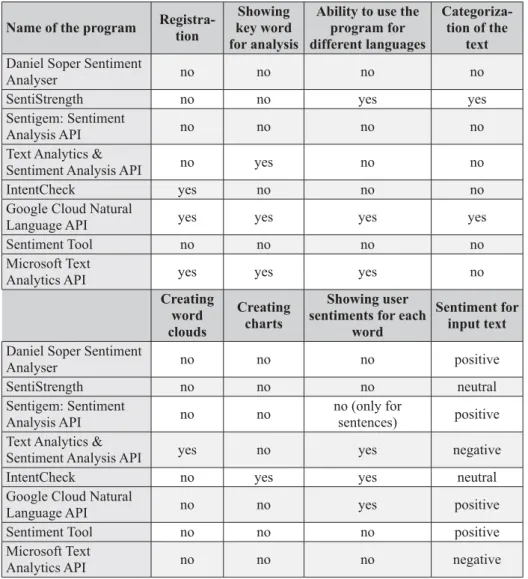
The results of this analysis show that most programs recognize the positive senti-ment for the movie. Two programs gave negative sentisenti-ments and two gave neutral sentiments. This movie has a positive review which any human can recognize when Table 1. Comparing programs – analyzing the sentiment of an input text
Tablica 1. Usporedba program za analizu sentimenta unesenoga teksta Name of the program Registra-tion
Showing key word for analysis
Ability to use the program for different languages
Categoriza-tion of the
text Daniel Soper Sentiment
Analyser no no no no
SentiStrength no no yes yes
Sentigem: Sentiment
Analysis API no no no no
Text Analytics &
Sentiment Analysis API no yes no no
IntentCheck yes no no no
Google Cloud Natural
Language API yes yes yes yes
Sentiment Tool no no no no
Microsoft Text
Analytics API yes yes yes no
Creating word clouds Creating charts Showing user sentiments for each
word
Sentiment for input text Daniel Soper Sentiment
Analyser no no no positive
SentiStrength no no no neutral
Sentigem: Sentiment
Analysis API no no no (only for sentences) positive Text Analytics &
Sentiment Analysis API yes no yes negative
IntentCheck no yes yes neutral
Google Cloud Natural
Language API no no yes positive
Sentiment Tool no no no positive
Microsoft Text
at the end of the review the reviewer says that he loved it. However, words such as sleazy and graphically violent have a very negative context which can make analyz-ing the sentence diffi cult for certain programs. It is hard to decide which of these programs is the most accurate because that would require multiple analysis of re-sults given for much larger texts from many different areas. The fact that half of the programs recognized the positive review from a complex sentence with many nega-tive words shows that accuracy for sentiment analysis tools can be of use and will hopefully improve with time.
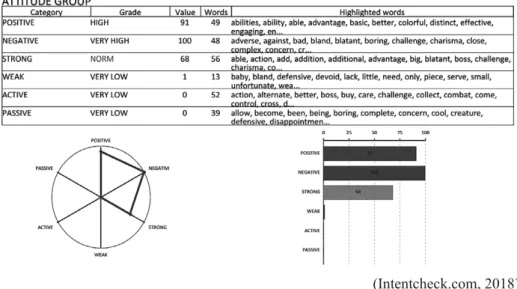
IntentCheck (https://www.intencheck.com) program has more options than most sentiment analysis tools. It also has a well designed modern interface. It uses colors to mark a certain sentiment of text and has options to export statistical results of analysis such as tables, keywords, and charts in a PDF format (Fig. 2). There is a grade for each sentiment in the text and a list of words that belong to a certain senti-ment. The attitude rendered by certain words is also being scored as strong, weak, active, and passive. Registration is needed to use this program.
Google Cloud Natural Language (https://cloud.google.com/natural-language/) API can categorize certain words from the text in many different areas (person, art, com-pany, places, etc.) and graphically show connections between the words in sen-tences which lead to the conclusion about the sentiment of the text. That is why this Figure 2. Results of analysis given by IntentCheck program
Slika 2. Prikaz rezultata analize dobivenih iz programa IntentCheck
program has higher accuracy as compared to other sentiment analysis tools ana-lyzed in this paper. It lacks some options in displaying results such as charts but supports some other languages (in addition to English) such as Chinese, French, German, Italian, Japanese, and Spanish. It only requires a Google account to use it. Compared to Google Cloud Natural Language Microsoft Text Analytics API (htt-ps://azure.microsoft.com/en-us/services/cognitive-services/text-analytics/) has many limitations such as not being able to process texts that have more than 5 000 characters. In addition to English, it can also analyze words in Spanish but not as precisely as in English. It has a very poor display of results and only shows the per-centage of the overall results and types out some key phrases of the analysis. It also isn’t as accurate as the two previously mentioned programs. Text Analytics & Senti-ment Analysis API (https://text2data.org/) have an option to create simple word clouds that consist of keywords of analysis. The drawback is that this program is also very slow. Daniel Soper Sentiment Analyser (https://www.danielsoper.com/ sentimentanalysis/default.aspx) and Sentiment Tool (http://sentiment.vivekn.com/) don’t have any extra features in addition to simple sentiment analysis. Daniel Soper Sentiment Analyser also has a very old user interface so this program is out of date in its design and functionality. From all the programs SentiStrenght (http://sentist-rength.wlv.ac.uk/) has the largest number of options for analyzing other languages such as Finnish, German, Dutch, Spanish, Russian, Portuguese, French, Arabic, Polish, Persian, Swedish, Greek, Welsh, Italian, and Turkish. This program can be confi gured for other languages and contexts by changing its input fi les. It was previ-ously mentioned that Preradović and Jakopović (2016: 69) did this when they ana-lyzed user comments on Croatian transportation sites. However, the analysis for Figure 3. Relations between words generated by the analysis in Google Cloud Natural Language API
Slika 3. Prikaz analize odnosa među riječima unutar programa Google Cloud Natural Language API
other languages is still not as developed as for English. There is also an option for downloading the program locally or implementing its algorithm in Python or Java, so this program is easily customizable. The program gives two scores. One for the negative sentiment and the other for the positive sentiment. It uses two scores be-cause research in psychology has revealed that we process positive and negative sentiments at the same time.
From this category of programs the fi rst two mentioned programs Google Cloud Natural Language API and IntentCheck seem to be the most developed. Google Cloud Natural Language API is probably more accurate and IntentCheck has better options for displaying the results of the analysis. SentiStrenght is the program that is most appropriate for analyzing texts in other languages. Other programs can also be used for analyzing texts but they do not have any outstanding or unique features. The major problem of the analyzed programs is that most sentiment analysis pro-grams only focus on English. Some can analyze some other “big” languages, i.e. languages with a large number of speakers, such as Spanish but the accuracy of the analysis is not as high as for English.
Programs for Analyzing Sentiment on Social Media
Social networks are the main source of information on opinions and sentiments to-wards different topics as many people spend a considerable amount of time on so-cial media. However, the communication on soso-cial media has many drawbacks con-nected with the fact that different reactions of different users can appear, and not all users respect the netiquette. So we can mostly fi nd criticism and sometimes very rude comments (Malović et al., 2014: 131). That is why sentiment analysis on social media can show very negative results when analyzing only user comments. The ability to analyze negative sentiments automatically, especially offensive content and hate speech, if programmed correctly, can be used in the future for blocking certain user comments.
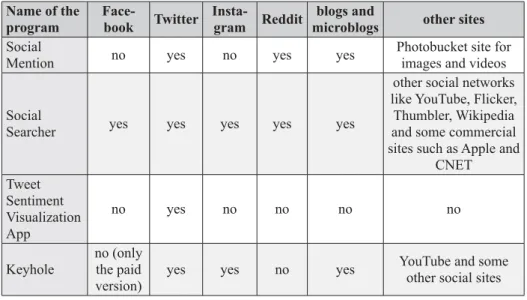
None of the programs for analyzing sentiments on social media require registration. For this analysis four programs that can collect and analyze posts from social net-works, blogs, and other social media sites have been selected. These programs cov-er diffcov-erent sites and show the results of the analysis in diffcov-erent ways. The reason why there are fewer programs in this category than in the previous one is that there aren’t many free online programs for analyzing social media. Programs that are usu-ally categorized as sentiment analyzers like BuzzSumo don’t belong to this catego-ry because they do not analyze sentiment but rather count user engagement through the number of clicks and shares. The focus of this analysis was on which social media and other news sites were covered and how the results of sentiment analysis
were displayed. For example, some programs can only show the overall sentiment for all collected posts and some show sentiment for each post separately. Some pro-grams show results using charts, tables, timelines, word clouds or even geographic maps which mark the locations of users having a certain sentiment.
Table 2. An overview of social media and news sites that programs for sentiment analysis take into account
Tablica 2. Pregled društvenih mreža i drugih obavještajnih stranica koje programi za analizu sentimenta pokrivaju
Name of the program Face-book Twitter Insta-gram Reddit blogs and
microblogs other sites
Social
Mention no yes no yes yes Photobucket site for images and videos Social
Searcher yes yes yes yes yes
other social networks like YouTube, Flicker,
Thumbler, Wikipedia and some commercial sites such as Apple and
CNET Tweet Senti ment Visua lization App no yes no no no no
Keyhole no (only the paid version)
yes yes no yes YouTube and some other social sites
Results
All of these programs cover Twitter. Sentiment analysis is mostly developed for Twitter because most of the posts are publicly available and easily searchable, which means that it is easy to collect and analyze a huge amount of posts from certain users or tweets that have certain words as hashtags #. The main reason for focusing on the Twitter profi le data is that it is possible to get quantitative information from this platform because Twitter contains authenticated accounts of politicians, which is not the case with Facebook, Instagram, and some other sites (Hasan et al., 2018:2). Twitter has also become a primary source of certain news as politicians, and celebri-ties use it for their announcements (Malović et al., 2014: 248). However, most senti-ment analysis tools also cover Instagram and Facebook. Both of these sites have hashtagging options which help in fi nding posts on certain topics from different
users. It is also interesting that Reddit is covered as well since it functions more like a forum. Most of these programs also cover sentiments of user comments on videos on YouTube and images on Flicker.
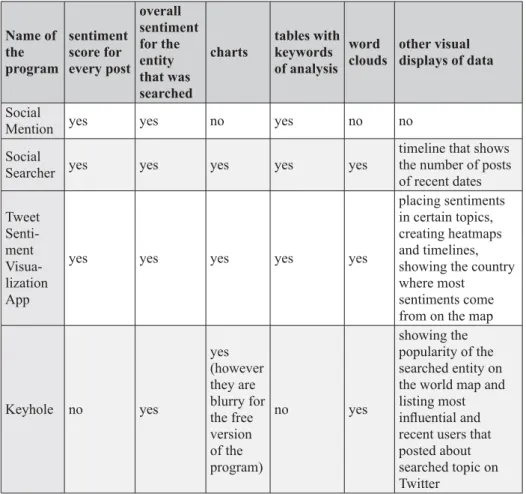
All programs except Keyhole (https://keyhole.co/) give sentiments for each post separately. Social Searcher (https://www.social-searcher.com/) is the program that covers most social media sites and has many statistical and graphical options for presenting the results (Fig. 4). Therefore it seems to be the most complete program from the list.
Table 3. Comparing options of programs for sentiment analysis on social media and other news sites
Tablica 3. Usporedba mogućnosti program za analizu sentimenta na društvenim mrežama te drugim obavještajnim stranicama
Name of the program sentiment score for every post overall sentiment for the entity that was searched
charts tables with keywords of analysis
word
clouds other visual displays of data
Social
Mention yes yes no yes no no
Social
Searcher yes yes yes yes yes
timeline that shows the number of posts of recent dates Tweet Senti-ment Visua-lization App
yes yes yes yes yes
placing sentiments in certain topics, creating heatmaps and timelines, showing the country where most sentiments come from on the map
Keyhole no yes yes (however they are blurry for the free version of the program) no yes showing the popularity of the searched entity on the world map and listing most infl uential and recent users that posted about searched topic on Twitter
Figure 4. Results of the search displayed in the Social Searcher program Slika 4. Prikaz rezultata pretraživanja u programu Social Searcher
(Social Searcher, 2018) Tweet Sentiment Visualization App (https://www.csc2.ncsu.edu/faculty/healey/ tweet_viz/tweet_app/) only concentrates on Twitter. It has a detailed statistical view of data with timelines, heatmaps, tag clouds, affi nity graphs, and a geographical map of tweets. This program is, therefore, the best option for analyzing tweets. Sen-timents are also shown in graphs that have a specter of many different emotions (Fig. 5).
Social mention (http://socialmention.com/) has only a very basic display of results without using any distinct features. It gives tables for sentiment results, keywords, top users and top hashtags. All the results from tables can be downloaded in a .CSV format which can be opened and edited in Excel for further research or creation of custom charts. The last program from the table Keyhole provides detail graphical analysis but it has sentiment charts that become blurry unless the user registers and some options require payment. Although it takes a lot of time to collect posts the advantage is that this program shows which devices the users usually use for posting like iPhones, Android devices, and desktop or laptop computers.
Creating one’s own sentiment analysis program
In addition to available free online programs, there are a lot of available algorithms that can be easily implemented in different programming languages. In this exam-ple, the process of creating one of the sentiment analysis tools will be shown. It will be created using the programming language Python that is usually used at schools for teaching programming (Brođanac et al., 2013: 10). The advantage of Python as compared to other programming languages such as C# or Java is that it has a much simpler syntax so it is not diffi cult to learn and it is well designed for text process-ing. Before writing a code for the program, one needs to have one’s own corpus of words that is used as training data for the program. Some algorithms even insist on having keywords that are important for recognizing the sentiment of a text. The fi rst program was created for analyzing tweets by using Tweepy library for Python (http://www.tweepy.org/). In order to collect Twitter posts, the user must have a Twitter account to get an API key. Then the user can search for recent tweets that contain certain words. Unfortunately, sometimes there is a limitation of the number of tweets the program can gather and analyze before it crashes. It is mostly limited to only 60 tweets per search. The results of sentiment analysis are stored in an Excel fi le. There is also an option to automatically create charts using the matplot library (https://matplotlib.org/) (Fig. 6).
Figűre 5. Tweet Sentiment Visualization App puts tweets in many different specters of emotions
Slika 5. Tweet Sentiment Visualization App svrstava tweetove u različite spektre emocija
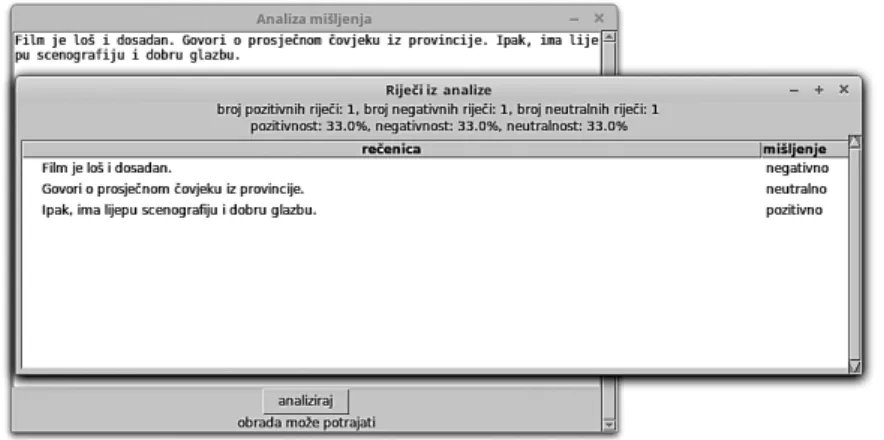
The second program was created for analyzing input texts in Croatian by using Na-ive Bayes algorithm within the TextBlob library (https://textblob.readthedocs.io/en/ dev/). In this program, the users can modify the results of analysis by adding their own positive, negative, and neutral words or sentences in .txt fi les. The program gives a table stating which sentences in the text are classifi ed as positive, negative or neutral. It also shows the overall sentiment score by counting the number of sen-tences classifi ed into each category (Fig. 7).
The program sometimes isn’t very accurate because it has a problem with recogniz-ing derivatives and morphological forms which should be listed separately in .txt fi les. Also, the accuracy of the analysis depends on the number of Croatian words and sentences inserted and classifi ed in .txt fi les. The accuracy of the program in-creases if it contains more examples of positive, negative, and neutral words and sentences. If the program doesn’t have any of the input words or sentences, it will classify the text as having the sentiment that has the most examples. This can some-times be a problem if the user has too many examples for one sentiment compared Figure 6. The program developed in Python which collects and analyses tweets and displays results in tables and pie chart
Slika 6. Program izrađen u Pythonu koji prikuplja i analizira tweetove te rezultate prikazuje u tablici i grafi konu
to the other two sentiments. In that case, the program mostly classifi es everything with that sentiment. Positive and negative words were taken from the word list of the Croatian Web Dictionary - Mrežnik (in this demo version only the module for foreigners) and annotated manually. This is a small training corpus for sentiment analysis used for the purpose of testing sentiment analyzers. It will hopefully ex-pand in the future and consequently improve the accuracy of the analysis. Positive and negative words on the list are mostly adjectives and neutral words are mostly nouns. However, certain nouns that create positive feelings such as food, holidays and family members were classifi ed as positive and nouns that usually create nega-tive feelings such as death, kill, and murder as neganega-tive. These two programs can be downloaded with their resources from the GitHub website which allows its creators to publish their work with all resources online free of charge (https://github.com/ borna12/Tweeter_analizator, https://github.com/borna12/analiza_misljenja). The programs were compiled from .py fi le to the .exe fi le for Windows operating system. There is also a simple user interface created in the Python Tkinter module so that the user doesn’t have to run command lines. While these programs are not professional like those used in sentiment analysis and can hardly be called fi nished because of their primitive options and the fact that the program occasionally crashes while col-lecting and processing data, they demonstrate that one person with some coding knowledge can create his own custom program for sentiment analysis. This means that technology used for sentiment analysis is becoming more accessible and robust. Figure 7. The program developed in Python which gives sentiment for every sentence in the text. The results of the analysis are displayed in the table.
Slika 7. Program izrađen u Pythonu koji daje sentiment za svaku rečenicu u hrvatskome tekstu. Rezultati analize za svaku rečenicu prikazani su u tablici.
Although no one has as yet created a complete sentiment analyzer that could be used for Croatian texts, with available algorithms and programs and Croatian corpora that can be searched by using Sketch Engine at least the future looks bright.
Conclusion
Posts on social media undoubtedly have become an important segment of modern society because the Internet users spread the news and their opinions faster than by the media that were used before. They also allow interactivity with the audience and give options to the readers to express their opinion. Because of a large number of posts on social networks, there is a need to collect them automatically and analyze them using available computer technology. This is why this paper analyzed many different free sentiment analysis programs for the purpose of seeing their possibili-ties and options. Programs for analyzing written texts online have mostly had rich options for displaying results of analysis through tables or lists that contain key-words of analysis, many different charts, etc. However, most of the programs only work for English and are still not accurate enough to replace human interpretation. Social network sentiment online analyzers are used more because they can gather and analyze massive data faster but they have the same problem with accuracy when analyzing posts that are generally short and use idioms, sarcasm, and slang. Accu-racy can be questionable and they only work for English. However, they have many automatic options for displaying analysis results using modern graphical trends. The major problem is that there is not enough support for other languages and senti-ment analysis for social media mostly covers popular sites such as Twitter, Face-book, and other websites in the USA. This is also a problem with many sentiment analysis libraries as they are designed for English. It is impossible to get an overall sentiment for a topic without taking into account other sites and blogs from many countries, which are sometimes written in different languages, especially when one analyzes e.g. the topic of war because if one analyzes only sites in English only one side of the story is visible. There are also a lot of algorithms and resources available for creating the user’s own sentiment analysis programs so there is a lot of potential for developing sentiment analysis for other languages. Moreover, algorithms for detecting sentiments will become more accurate.
NOTES
1 This paper is written within the research project Croatian Web Dictionary –
Mrežnik. (IP-2016-06-2141), fi nanced by the Croatian Science Foundation.
2 The sentence was modifi ed from the review on TV Guide. Accessed at: 10. 10.
2018. : https://www.tvguide.com/movies/the-toxic-avenger/review/121084/
REFERENCES
Agić, Ž. and Merkler, D. (2012) “Rule-Based Sentiment Analysis in Narrow Do-main: Detecting Sentiment in Daily Horoscopes Using Sentiscope”, 115–124. In: S. Bandyopadhyay and M. Okumura: Proceedings of the 2nd Workshop on Sentiment Analysis where AI meets Psychology. Mumbai: The COLING 2012 Organizing Committee.
Agić, Ž., Ljubešić, N. and Tadić, M. (2010) “Towards Sentiment Analysis of Finan-cial Texts in Croatian”, 1164–1167. In: Calzolari et al.: Proceedings of the Sev-enth International Conference on Language Resources and Evaluation (LREC 2010). Valletta: European Language Resources Association.
Azure.microsoft.com (2016) Text Analytics API. [online] Available at: https://azure. microsoft.com/en-us/services/cognitive-services/text-analytics/ [Accessed 26 Sep. 2018].
Bobriakov, I. (2017) Top 15 Python Libraries for Data Science in 2017. [online] Medium. Available at: https://medium.com/activewizards-machine-learning-company/top-15-python-libraries-for-data-science-in-in-2017-ab61b4f9b4a7 [Accessed 3 Jul. 2018].
Carpenter, M. (2018) The best sentiment analysis tools. [online] Talkwalker. Avail-able at: https://www.talkwalker.com/blog/best-sentiment-analysis-tools [Ac-cessed 1 Aug. 2018].
Csc2.ncsu.edu (2013) Tweet Sentiment Visualization App. [online] Available at: https://www.csc2.ncsu.edu/faculty/healey/tweet_viz/tweet_app/ [Accessed 27 Jul. 2018].
Donges, N. (2018) Recurrent Neural Networks and LSTM. [online] Towards Data Science. Available at: https://towardsdatascience.com/recurrent-neural-net-works-and-lstm-4b601dd822a5 [Accessed 3 Jul. 2018].
Glava, G., Korenčić, D. and Šnajder, J. (2013) “Aspect-Oriented Opinion Mining from User Reviews in Croatian”, 19–21. In: J. Piskorski et al.: Proceedings of the 4th Biennial International Workshop on Balto-Slavic Natural Language Pro-cessing. Sofi a: Association for Computational Linguistics.
Google Cloud (2016) Cloud Natural Language API. [online] Available at: https:// cloud.google.com/natural-language/ [Accessed 31 Sep. 2018].
Hanks, P., Frankenberg-Garcia, A., Krishnamurthy, R. and Rundell, M. (2018) Sketch Engine | language corpus management and query system. [online] Sketchengine. eu. Available at: https://www.sketchengine.eu/ [Accessed 2 Oct. 2018].
Hasan, A., Moin, S., Karim, A. and Shamshirband, S. (2018). Machine Learning-Based Sentiment Analysis for Twitter Accounts. Mathematical and Computa-tional Applications, 23(1), p.11.
Hudeček, L. and Mihaljevič, M. (2017) “A New Project – Croatian Web Dictionary MREŽNIK”, 180. U: I. Atanassova et al.: INFuture2017: Integrating ICT in Society. Zagreb: Zavod za informacijske studije Odsjeka za informacijske i ko-munikacijske znanosti Filozofskog fakulteta Sveučilišta u Zagrebu.
Ihjj.hr (2017) Hrvatski mrežni rječnik. [online] Available at: http://ihjj.hr/mreznik/ [Accessed 14 Oct. 2018].
IntenCheck (2017) Text Analysis Software. [online] Available at: https://www.inten-check.com/ [Accessed 26 Jul. 2018].
Jakopović, H. and Mikelić Preradović, N. (2016) “Identifikacija online imidža or-ganizacija temeljem analize sentimenata korisnički generiranog sadržaja na hr-vatskim portalima”, Medijska istraživanja, 22 (2), 63 – 82.
Keyhole.co (2018) Hashtag Tracking for Twitter, Instagram and Facebook. [online] Available at: https://keyhole.co/ [Accessed 28 Jul. 2018].
Lin, B., Zampetti, F., Bavota, G., Penta, M., Lanza, M. and Oliveto, R. (2018) “Sen-timent Analysis for Sofware Engineering: How Far Can We Go?”, 95. In: Crnk-ovic et al.: Proceedings of the 40th International Conference on Software Engi-neering. Gothenburg: IEEE.
Malović, S., Maletić, F., Vilović, G. and Kurtić, N. (2014) Masovno komuniciranje. Zagreb: Golden marketing-Tehnička knjiga.
Mäntylä, M., Graziotin, D. and Kuutila, M. (2017) “The evolution of sentiment analysis—A review of research topics, venues, and top cited papers”, Computer Science Review, 27, 2;25.
Matplotlib.org (2018) Matplotlib: Python plotting. [online] Available at: https:// matplotlib.org/ [Accessed 22 Oct. 2018].
Mihaljević, J. (2018) Program za analizu stava. [online] GitHub. Available at: htt-ps://github.com/borna12/analiza_misljenja [Accessed 14 Oct. 2018].
Mihaljević, J. (2018) Tweeter analizator. [online] GitHub. Available at: https:// github.com/borna12/Tweeter_analizator [Accessed 14 Oct. 2018].
Pawar, A., Jawale, M. and Kyatanavar, D. (2007) Fundamentals of Sentiment Anal-ysis: Concepts and Methodology. Basel: Springer International Publishing
Sentiment Tool. (2013). [online] Available at: http://sentiment.vivekn.com/ [Ac-cessed 1 Jul. 2018].
Sentistrength.wlv.ac.uk (2009) SentiStrength - sentiment strength detection in short texts. [online] Available at: http://sentistrength.wlv.ac.uk/ [Accessed 26 Jul. 2018]. Smola, A. and Vishwanathan, S. (2018) Introduction to Machine Learning.
Cam-bridge: Cambridge University Press.
Socialmention.com (2018) Real Time Search - Social Mention. [online] Available at: http://socialmention.com/ [Accessed 28 Jul. 2018].
Social-searcher.com. (2018) Social Searcher - Free Social Media Search Engine. [online] Available at: https://www.social-searcher.com/ [Accessed 27 Jul. 2018]. Soper, D. (2001) Free Sentiment Analyzer. [online] Danielsoper.com. Available at:
https://www.danielsoper.com/sentimentanalysis/default.aspx [Accessed 1 Jul. 2018].
Template.net (2016) 16+ Best Sentiment Analysis Tools & Softwares. [online] Avail-able at: https://www.template.net/business/tools/sentiment-analysis-tool/ [Ac-cessed 1 Aug. 2018].
Text2data.org (2014) Text Analytics & Sentiment Analysis API. [online] Available at: https://text2data.org/ [Accessed 26 Jul. 2018].
Textblob.readthedocs.io (2011) TextBlob: Simplifi ed Text Processing — TextBlob 0.15.1 documentation. [online] Available at: https://textblob.readthedocs.io/en/ dev/ [Accessed 4 Oct. 2018].
Tweepy.org (2014) Tweepy. [online] Available at: http://www.tweepy.org/ [Ac-cessed 22 Oct. 2018].
Winslett, R. (2018) Review: Deadly Premonition The Director’s Cut Is A Wonderful Mess. [online] CINEMABLEND. Available at: https://www.cinemablend.com/ games/Review-Deadly-Premonition-Director-Cut-Wonderful-Mess-55647.html [Accessed 1 Jul. 2018].
Analiza i izrada besplatnih programa za
analizu sentimenta
Josip Mihaljevi
ć
SAŽETAK
U radu se analiziraju besplatni računalni programi za analizu sentimenta (mi-šljenja, osjećaja, stava) koji mogu izraziti pozitivan, neutralan ili negativan stav o sadržaju teksta na temelju određenih kriterija unutar algoritma. Na početku rada objašnjava se što su programi za analizu sentimenta, kojim se tehnikama koriste te se iscrpno objašnjavaju dosadašnja istraživanja. Analiziraju se dvije skupine besplatnih mrežnih programa. Jedna skupina programa služi za analizu sadržaja napisanoga ili kopiranoga teksta, a druga za analizu sentimenta obja-va na društvenim mrežama, blogovima ili kojemu drugom obavještajnom tipu mrežnih stranica. Programi iz obiju skupina odabrani su na temelju recenzija s informatičkih portala te popularnosti na mrežnim tražilicama poput Googlea i Binga. Za prvu skupinu programa analizirane su tehnike koje se koriste za ana-lizu teksta, dodatne mogućnosti koje se mogu koristiti tijekom analize teksta te se pokazuje koju procjenu sentimenta programi daju za odabrani dio teksta iz recenzije i koliko ga precizno analiziraju. Za drugu skupinu programa analizira se koje društvene mreže, blogove te ostale tipove obavještajnih stranica obuhva-ćaju te na koji način prikazuju rezultate obrađene analizom. Iz analize obiju skupina programa dolazi se do zaključka o mogućnostima njihova korištenja te kvaliteti usluga. Također se prikazuje kako se može izraditi vlastiti program za analizu sentimenta s pomoću mrežno dostupnih kodova i dodataka za program-ski jezik Python. Na temelju tih dostupnih resursa napravljena su dva program od kojih prvi služi kao demoinačica za hrvatski jezik te daje informacije o stavu vezanom za upisani tekst, a drugi program dohvaća posljednje tweetove koji sadržavaju određenu riječ te izrađuje grafi kon koji prikazuje stavove u tweeto-vima koji sadržavaju tu riječ.
Ključne riječi: programi za analizu sentimenta, društv ene mreže, analiza teksta, iz-rada programa, algoritmi