Florida International University Florida International University
FIU Digital Commons
FIU Digital Commons
FIU Electronic Theses and Dissertations University Graduate School
11-7-2018
Intelligent Data Mining Techniques for Automatic Service
Intelligent Data Mining Techniques for Automatic Service
Management
Management
Qing WangFlorida International University, [email protected]
Follow this and additional works at: https://digitalcommons.fiu.edu/etd
Part of the Computer Engineering Commons
Recommended Citation Recommended Citation
Wang, Qing, "Intelligent Data Mining Techniques for Automatic Service Management" (2018). FIU Electronic Theses and Dissertations. 3883.
FLORIDA INTERNATIONAL UNIVERSITY Miami, Florida
INTELLIGENT DATA MINING TECHNIQUES FOR AUTOMATIC SERVICE MANAGEMENT
A dissertation submitted in partial fulfillment of the requirements for the degree of
DOCTOR OF PHILOSOPHY in COMPUTER SCIENCE by Qing Wang 2018
To: Dean John Volakis
College of Engineering and Computing
This dissertation, written by Qing Wang, and entitled Intelligent Data Mining Tech-niques for Automatic Service Management, having been approved in respect to style and intellectual content, is referred to you for judgment.
We have read this dissertation and recommend that it be approved.
Mark Alan Finlayson
Ning Xie
Debra VanderMeer
Shu-Ching Chen, Co-Major Professor
Sundaraja Sitharama Iyengar, Co-Major Professor
Date of Defense: Novermber 07, 2018 The dissertation of Qing Wang is approved.
Dean John Volakis College of Engineering and Computing
Andr´es G. Gil Vice President for Research and Economic Development and Dean of University Graduate School
c
Copyright 2018 by Qing Wang All rights reserved.
DEDICATION
I dedicate this dissertation work to my beloved family, my parents, Bao’an Wang and Meiqin Fan, as well as my sister, Jing Wang. Without their patience, understanding, support, or love, the completion of this work would not have been
ACKNOWLEDGMENTS
Time flies! At the beginning of my Ph.D., I thought it would be a long, struggled and painful period of my life. By the time that I am almost closed to finish it, I have to admit it is indeed full of stress, but also surprising short that makes me keep wondering: will I be given another chance to explore my interesting research topics with full freedom? It is the support from many people that brings me with the possibility to complete the dissertation for concluding my Ph.D. study.
First and foremost, I would like to express my most profound appreciation to my advisor Dr. S. S. Iyengar and my deceased advisor Dr. Tao Li, for their inimitable support, meticulous guidance, insightful advice, and for leading me immersed with an excellent research atmosphere. It is their great passion and endless patience that inspire me for my research career and provide me with countless support for almost any matters.
Second, I would like to extend my gratitude to my co-advisor, Dr. Shu-Ching Chen, who has not only provided valuable guidance to my research but also given me a constructive suggestion in developing my Ph.D. career. His rigorous research attitude will influence the rest of my life.
Third, my sincere thanks go to all my dissertation committee members: Dr. Mark Alan Finlayson, Dr. Ning Xie, and Dr. Debra VanderMeer, for their helpful advice, insightful comments on my dissertation research and future research career plans.
Fourth, I am thankful to my beloved mentors including Dr. Larisa Shwartz, Dr. Genady Ya. Grabarnik, Dr. Maja Vukovic and Dr. Nicholas Fuller of my three internships at IBM Research. The patient guidance, continuous encouragement and enlightenment from them let me accumulate valuable experience and establish my confidence in my Ph.D. study.
Moreover, I would like to extend my thanks to our department staff who always helps me during my doctoral study: Dr. Jason Liu, Olga Carbonell, Ariana Taglioret-ti, Vanessa Cornwall, Lian Zhang, Eric S. Johnson, Luis Rivera, etc.
Additionally, I’m so lucky to join the Knowledge Discovery and Research Group (KDRG) where I have built up my research experience and enhanced my professional knowledge. I am very grateful to all my colleagues of KDRG including Dr. Chunqiu Zeng, Dr. Wubai Zhou, Dr. Wei Xue, Shekoofeh Mokhtari, Wentao Wang, Ramesh Baral, Xiaolong Zhu, and Boyuan Guan.
Last but not least, I would like to express my utmost gratitude to my parents, Bao’an Wang and Meiqin Fan, as well as my sister, Jing Wang. They have been and will always be my strongest support!
ABSTRACT OF THE DISSERTATION
INTELLIGENT DATA MINING TECHNIQUES FOR AUTOMATIC SERVICE MANAGEMENT
by Qing Wang
Florida International University, 2018 Miami, Florida
Professor Sundaraja Sitharama Iyengar, Co-Major Professor Professor Shu-Ching Chen, Co-Major Professor
Today, as more and more industries are involved in the artificial intelligence era, all business enterprises constantly explore innovative ways to expand their outreach and fulfill the high requirements from customers, with the purpose of gaining a competitive advantage in the marketplace. However, the success of a business highly relies on its IT service. Value-creating activities of a business cannot be accomplished without solid and continuous delivery of IT services especially in the increasingly intricate and specialized world. Driven by both the growing complexity of IT environments and rapidly changing business needs, service providers are urgently seeking intelligent data mining and machine learning techniques to build a cognitive “brain” in IT service management, capable of automatically understanding, reasoning and learning from operational data collected from human engineers and virtual engineers during the IT service maintenance.
The ultimate goal of IT service management optimization is to maximize the au-tomation of IT routine procedures such as problem detection, determination, and resolution. However, to fully automate the entire IT routine procedure is still a challenging task without any human intervention. In the real IT system, both the step-wise resolution descriptions and scripted resolutions are often logged with their
corresponding problematic incidents, which typically contain abundant valuable hu-man domain knowledge. Hence, modeling, gathering and utilizing the domain knowl-edge from IT system maintenance logs act as an extremely crucial role in IT service management optimization. To optimize the IT service management from the per-spective of intelligent data mining techniques, three research directions are identified and considered to be greatly helpful for automatic service management: (1) efficiently extract and organize the domain knowledge from IT system maintenance logs; (2) on-line collect and update the existing domain knowledge by interactively recommending the possible resolutions; (3) automatically discover the latent relation among scripted resolutions and intelligently suggest proper scripted resolutions for IT problems.
My dissertation addresses these challenges mentioned above by designing and implementing a set of intelligent data-driven solutions including (1) constructing the domain knowledge base for problem resolution inference; (2) online recommending resolution in light of the explicit hierarchical resolution categories provided by domain experts; and (3) interactively recommending resolution with the latent resolution relations learned through a collaborative filtering model.
TABLE OF CONTENTS
CHAPTER PAGE
1. INTRODUCTION . . . 1
1.1 Background . . . 1
1.2 Motivation and Problem Statement . . . 5
1.3 Contributions . . . 9
1.3.1 Learn Human Intelligence by Domain Knowledge Base Construction . 10 1.3.2 Learn Automation Intelligence by Hierarchical Multi-armed Bandit Model 11 1.3.3 Learn Automation Intelligence by Interactive Collaborative Topic Re-gression Model . . . 12
1.4 Summary and Roadmap . . . 13
2. PRELIMINARIES AND RELATED WORK . . . 15
2.1 Related Work of Learn Human Intelligence by Domain Knowledge Base Construction . . . 15
2.1.1 Traditional Automation techniques in IT service management . . . 15
2.1.2 Ontology Modeling . . . 16
2.1.3 Knowledge Base Construction . . . 17
2.2 Related Work of Learn Automation Intelligence by Hierarchial Multi-armed Bandit Model . . . 18
2.2.1 Interactive Recommender Systems . . . 18
2.2.2 Multi-armed Bandit Problems with Dependent Arms . . . 19
2.3 Related Work of Learn Automation Intelligence by Interactive Collabora-tive Regression Model . . . 20
2.3.1 Interactive Collaborative Filtering . . . 20
2.3.2 Multi-armed Bandit Problems for Group Recommendation . . . 23
2.3.3 Sequential Online Inference . . . 24
2.4 Summary . . . 25
3. LEARN HUMAN INTELLIGENCE BY DOMAIN KNOWLEDGE BASE CON-STRUCTION . . . 26 3.1 Introduction . . . 27 3.1.1 Background . . . 27 3.1.2 Motivation . . . 28 3.1.3 Contribution . . . 33 3.2 System Overview . . . 34
3.3 Design and Implementation . . . 36
3.3.1 Phrase Extraction Stage . . . 36
3.3.2 Knowledge Construction Stage . . . 42
3.3.3 Ticket Resolution Stage . . . 45
3.4 Experiment . . . 49
3.4.2 Evaluation Metrics and Evaluation Overview . . . 49
3.4.3 Evaluating Information Inference . . . 52
3.4.4 Case Study: Resolution Recommendation Task . . . 53
3.5 Summary . . . 55
4. LEARN AUTOMATION INTELLIGENCE BY HIERARCHICAL MULTI-ARMED BANDIT MODEL . . . 56
4.1 Introduction . . . 57
4.1.1 Background . . . 57
4.1.2 Motivation . . . 58
4.1.3 Contribution . . . 61
4.2 Problem Formulation . . . 62
4.2.1 Basic Concepts and Terminologies . . . 63
4.2.2 Automation Hierarchy . . . 67
4.3 Solution & Algorithm . . . 68
4.4 Experiment Setup . . . 71
4.4.1 Baseline Algorithms . . . 71
4.4.2 Dataset Description . . . 72
4.5 Summary . . . 77
5. LEARN AUTOMATION INTELLIGENCE BY INTERACTIVE COLLABO-RATIVE TOPIC REGRESSION MODEL . . . 79
5.1 Introduction . . . 81
5.2 Problem Formulation . . . 84
5.2.1 Basic Concepts and Terminologies . . . 84
5.2.2 Modeling the Arm Dependency . . . 88
5.3 Methodology and Solution . . . 92
5.3.1 Re-sample Particles with Weights . . . 93
5.3.2 Latent State Inference . . . 95
5.3.3 Parameter Statistics Inference . . . 95
5.3.4 Integration with Policies . . . 96
5.3.5 Algorithm . . . 97
5.4 Empirical Study . . . 99
5.4.1 Baseline Algorithms . . . 99
5.4.2 Datasets Description . . . 100
5.4.3 Evaluation Method and Metrics . . . 102
5.4.4 Recommendation Evaluation . . . 104
5.4.5 A Case Study: Topic Distribution Analysis on MovieLens (10M) . . . . 106
5.4.6 A Case Study: Identify the Category of a New Automation . . . 108
5.4.7 Time Cost . . . 109
6. THE FUTURE OF AI-BASED SERVICE MANAGEMENT . . . 113
6.1 Deep Bandit Collaborative Filtering Model . . . 113
6.2 Script Generation Machine . . . 115
6.3 Summary . . . 116
BIBLIOGRAPHY . . . 117
LIST OF FIGURES
FIGURE PAGE
1.1 A typical workflow of a traditional IT routine maintenance. . . 2
1.2 A ticket example in IT service management. Ticket summary logs the specific problem symptoms. A step-wised resolution written by human engineers is recorded in ticket resolution. . . 3
1.3 A sample ticket solved by IT automation services. . . 5
1.4 Overview of research directions. . . 9
2.1 Recommendation-feedback loop in an interactive recommender system. . 18
3.1 The overview of IT service management workflow. . . 28
3.2 Ticket distribution across OS types. . . 29
3.3 Ticket distribution across components. . . 29
3.4 Ticket distribution across original severity. . . 30
3.5 Ticket distribution across severity. . . 30
3.6 A ticket in IT service management and its corresponding resolution are given. . . 31
3.7 An overview of the integrated framework. . . 35
3.8 An example of a finite state string pattern matching machine. . . 39
3.9 Distribution of length of useful phrases. . . 41
3.10 Ontology model depicting interactions amongst classes. . . 44
3.11 Ticket tagged by the Class Tagger module. . . 46
3.12 Evaluation of our integrated system in terms of precision. . . 50
3.13 Evaluation of our integrated system in terms of recall. . . 51
3.14 Evaluation of our integrated system in terms of f1-score. . . 51
3.15 Evaluation of our integrated system in terms of accuracy. . . 52
4.1 The overview of ITAS-integrated IT service management workflow. . . . 57
4.2 A sample ticket is logged in IT service management with its corresponding automaton. . . 59
4.4 Graphical model representation for bandit problem. Random variable is denoted as a circle. The circle with green color filled means the corresponding random variable is observed. Red dot indicates a hyper parameter. . . 64 4.5 An automation hierarchy defined by domain experts. . . 73 4.6 The Relative Success Rate of EpsGreedy and HMAB-EpsGreedy on the
dataset is given along each time bucket with diverse parameter settings. 75 4.7 The Relative Success Rate of TS and HMAB-TS on the dataset is given
along each time bucket with diverse parameter settings. . . 76 4.8 The Relative Success Rate of LinUCB and HMAB-LinUCB on the dataset
is given along each time bucket with diverse parameter settings. . . . 77 4.9 The comparison of category distribution on the recommended automations. 78 4.10 The exploration by HMAB-TS of a cold-start ticket case. . . 78 5.1 An example of taxonomy in IT tickets with ”Others” category. . . 80 5.2 Two different ticket problems in IT service management. . . 80 5.3 The graphic model for the ICTR model. Random variable is denoted
as a circle. The circle with filled color denotes the observed random variable. Red dot represents a hyper parameter. . . 90 5.4 The average CTR of Yahoo! Today News data is given along each time
bucket. All algorithms shown here are configured with their best pa-rameter settings. . . 105 5.5 The average rating of MovieLens (10M) data is given along each time
bucket. All algorithms shown here are configured with their best pa-rameter settings. . . 105 5.6 The relative average rating of Automation data is given along each time
bucket. All algorithms shown here are configured with their best pa-rameter settings. . . 106 5.7 An example of categorizing an automation. . . 108 5.8 Cumulative time cost of Yahoo! Today News is given along each time
bucket. . . 110 5.9 Cumulative time cost of MovieLens (10M) is given along each time bucket.110 5.10 Time cost is given with different number of particles. . . 111 5.11 Time cost is given with different number of latent feature vector dimensions.111 6.1 Neural Collaborative Filtering. . . 115
6.2 Encoder-decoder architecture for neural machine translation. An encoder learns the vector representation from an source sentence. A decoder is used to produce the translation. . . 116
CHAPTER 1
INTRODUCTION
1.1
Background
As more and more industries are involved in the age of artificial intelligence [KDF+],
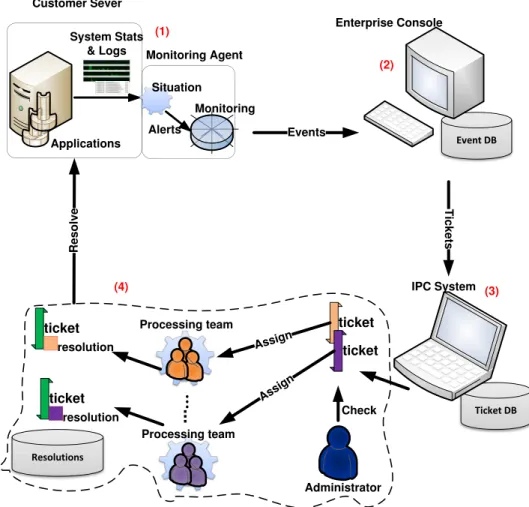
it has become essential to adopt information techniques for all business enterprises to gain a competitive advantage. Business enterprises constantly explore innovative ways of expanding their outreach and fulfill high requirements from customers. How-ever, value-creating activities cannot be accomplished without a solid and continuous delivery of IT services in this increasingly complex world. Service providers are ex-pected to focus on assisting customers in their core business areas and resolving tough problems. Also, the time spending on fixing operational issues has to be minimized as well. Therefore, intelligent data mining and machine learning techniques urgently need employing to maximize the automation of subroutine procedures such as prob-lem detection,determination, andresolution of the service infrastructure, which is an ultimate goal of IT service management, prescribed by the Information Technology Infrastructure Library (ITIL) specification [urlg]. A traditional workflow of an IT routine maintenance illustrated in Figure 1.1 includes four steps.
At the first step, anomalies are detected by the monitoring system, one of the most critical components in IT service management. Some popular monitoring systems are available in the marketplace, such as IBM Tivoli Monitoring [urlf], HP Open View [urlb], etc. A monitoring system can track the status of a system and detect various problems related to CPU utility, memory usage, network connection condition and so on. Based on the regularly collected system data, it computes the metrics situation compared with some predefined acceptable thresholds. An alert will be
Applications Customer Sever Alerts Event DB Enterprise Console Events T ic k e ts R e s o lv e ticket ticket Assig n Resolutions IPC System Ticket DB Administrator Assign Processing team Processing team ㄻ... Check ticket resolution ticket resolution System Stats
& Logs Monitoring Agent
Situation Monitoring (1) (2) (3) (4)
Figure 1.1: A typical workflow of a traditional IT routine maintenance.
raised if any violation occurred. When an anomaly persists beyond a predefined duration, the monitoring system generates an event for further inspection.
For the second step, events generated from an entire IT environment are con-solidated in an enterprise console and finally stored into an event database. Each event consists of three parts: event type, occurring timestamp, and the description. The system determines whether or not to create an incident ticket having a business impact or a business risk, also referred to as a monitoring ticket by employing rules, cases or a knowledge-based engine to analyze these events.
collect-RESOLUTION
TICKET IDENTIFIER: XXXX:APPS:LogAdapter:NALAC:STARACTUAT_6600 NODE FAILURECO
DE
ORIGINAL
SEVERITY OSTYPE COMPONET CUSTOMER XXXX UNKNOWN 4 WIN2K3 APPLICATION XXXX
TICKET SUMMARY:
STARACTUAT_6600 03/01/2014 04:30:28 STARACTUAT_6600 GLACTUA Market=CAAirMiles:Report_ID=MRF600:ReportPeriod From: 2014/02/01 to 2014/02/28:ErrorDesc=For CAAirMiles Actuate is out of balance with STAR BalanceMRF600 & MRF601 Counts. Reconcilation Difference = 2MRF600 & MRF601 Net Fee. Reconcilation Difference = 25MRF600 & MRF601 Gross Fee .Reconcilation Difference = 25 ProblemSolutionText:***** Updated by GLACTUA ******
Problem Reported : Reconciliation difference Root cause : Reconciliation was run before all reports completed. This is as per the new SLAs.
Solution provided : Reconciliation was re-run after the next set of reports completed.There was no user impact.
Closure code : WRKS_AS_DSIGND
RCADescription:***** Updated by GLACTUA ****** Problem Reported : Reconciliation difference
Root cause : Reconciliation was run before all reports completed. This is as per the new SLAs. Solution provided : Reconciliation was re-run after the next set of reports completed.There was no user impact.
Closure code : WRKS_AS_DSIGND
Figure 1.2: A ticket example in IT service management. Ticket summary logs the specific problem symptoms. A step-wised resolution written by human engineers is recorded in ticket resolution.
the ticket summary is the description of the underlying problem for further problem diagnosis, determination and resolution.
At the fourth step, human engineers start to inspect possible root causes based on the ticket summary. In general, the role of human engineers is limited to correctly inferring the possible categories (e.g., database, application, OS, etc.) of the under-lying IT problem and assigning it to the corresponding processing teams for the final problem resolution. They make the complex root cause analysis and log a step-wise resolution into the historical database after they have fixed this issue. The resolution part contains considerable domain expert knowledge seen in Figure 1.2. However, human engineers are often overcharged in this workflow by the abundant incident ticket data for problem diagnosis, determination, and resolution. Developing more
intelligent and efficient solutions is required to fully automate these processes, and thus alleviate human efforts involved in IT service management.
Recent advances in artificial intelligence have led to a new revolution in traditional IT industries. For decades, service providers have already developed various cognitive techniques to optimize the automated processes. They are trying to address the customers’ concerns about how they could quickly detect and fix problems in their infrastructure as soon as the issues occurred. With this purpose, human engineers begin with automatically resolving repetitive problems in an IT system. They identify the problem patterns from data and write the corresponding scripts, which could quickly fix specific issues in an automated way.
Then, enterprise IT automation services [urld] has been developed, where virtual engineer is incorporated as a cognitive engine for automated corrective actions (i.e., scripted resolutions or automations) and closure of incident records immediately. It includes several key components:
• Virtual engineer is a software component that uses algorithms to detect and take operational actions on problems without any human intervention.
• Patterns are identified by human engineers, which virtual engineer must follow to respond to an incident.
• Analytics is used as the gauge of the effectiveness of automation and to learn experience from new changes or root problem determination.
In this process, it logs detailed information while it executes operations. Figure 1.3 shows an example of an IT service management ticket that was automatically gener-ated by the monitoring system, and successfully fixed by IT automation services. The summary and monitoring class (i.e., an alert key) of the incident ticket provide an
automation or lack thereof. If the issue is resolved by the recommended automa-tion (i.e., a scripted resoluautoma-tion), the value of “AUTORESOVLED” will be marked non-zero. If it could not be completely resolved, this ticket problem is then directly escalated to human engineers due to the lack of the corresponding automation.
ALERT_KEY cpc_cpuutil_gntw_win_v3
CLIENT_ID HOSTNAME ORIGINAL
SEVERITY OSTYPE COMPONET
SUBCOMP OMET
136 LEXSBWS01
VH 2 WIN WINDOWS CPU
TICKET SUMMARY
AUTOMATON_NAME CPC:WIN:GEN:R:W:System Load Handler
AUTO RESOVLED
CPU Workload High. CPU 1, busy 99% time.
1
TICKET RESOLUTION
The CPU Utilization was quite reduced, hence closing the ticket.
OPEN_DTTM
2016-04-30 12:43:07
Figure 1.3: A sample ticket solved by IT automation services.
To sum up, IT service management relies on partial automation of the IT rou-tine maintenance procedure, where operations of both human engineers and virtual engineers are closely intertwined.
1.2
Motivation and Problem Statement
Optimizing the automation of IT routine maintenance procedures can significantly alleviate the involvement of human efforts, and thereby increase the IT industry’s productivity as well as efficiency, and further reduce human errors. The optimiza-tion of IT service management is urgently dictated in practice. Especially, when the systems are growing more complex, it further aggravates the difficulty in controlling the quality of delivery services and needs more human interventions in the routine maintenance procedures. As we mentioned before, artificial intelligence is dramati-cally improving traditional technologies of IT service management by empowering its cognitive capability. There are three critical areas outlined as follows [urla].
• Incident or request creation. Automated IT service management processes are designed to work well when the incident information is provided correctly. Unfortunately, many of them turn out to be ineffective due to the incorrect information provided by end-users. Incorporating AI into IT service manage-ment will enable it to interpret incidents from end-users and thereby improve the efficiency of the service management.
• Automated backend processes. Automated IT service management pro-cesses can detect anomalies and automatically open an incident ticket without any human intervention. The power of AI in IT service management would make the system capable of learning experience from past operations of human engineers and automated backend processes. In the future, automated IT ser-vice management processes will intelligently correct any issue, even if it is new to the system by learning and inferring with no human efforts.
• Knowledge management. Automated IT service management processes in-corporated AI would search for answers against the trusted knowledge databases (e.g., AI cloud) automatically. An AI-enabled system will not only recommend the proper resolution to any IT problem, but also train itself using interactive feedback to optimize the provided answers adaptively.
In recent years, data mining and machine learning techniques have been involved in addressing the practical issues in the system and service management by re-searchers [MSGL09, ABD+07, DJL09, LPG02, ABCM09, KWI+11, TLS12, TLS+13, ZLSG15a, LZJ+17, LZZ+16, LZZ+17]. In an IT system, the operational data of both human engineers and virtual engineers stores in the historical database, which has not been well exploited yet. My dissertation focuses on proposing and implementing intelligent solutions to learn domain knowledge from these valuable data and leverage
the learned or inferred domain knowledge to facilitate the automated processes of problem determination,diagnosis, and resolution.
From the perspectives of intelligent data mining techniques, three research direc-tions are identified and considered to be helpful for IT service management optimiza-tion.
1. Efficiently recommend problem resolution using a constructed do-main knowledge base. A problematic incident is logged as an incident ticket and contains the ticket summary (i.e., problem description). When such tickets are resolved, the system administrators will log the step-wise resolution descrip-tion, which is a free-form text but with valuable domain human knowledge. It is almost an impossible task to fully automate the entire IT service manage-ment without the help of domain experts. Therefore, modeling, gathering, and utilizing the domain knowledge during ticket resolution become increasingly crucial. However, both ticket summary and resolution contain domain-specific terms such as SLAs and RCA. Besides, they contain many typos and gram-matical errors. As a result, it becomes infeasible to identify useful information using only traditional Natural Language Processing (NLP) techniques without any domain expertise. All these issues pose new challenges in constructing a domain knowledge base.
2. Interactively recommend the best matching automation using a hi-erarchical multi-armed bandit algorithm. IT automation services (i.e., ITAS) has been introduced into IT service management as an engine for au-tomated corrective actions (i.e., scripted resolutions) and closure of incident records. The summary and monitoring class (i.e., an alert key) of the ticket provide an initial symptom description, which is used for automation services
recommended strategies of the automation engine, it is essential to understand how the symptoms could be mapped to the corresponding scripted resolution-s. Based on preliminary studies, three key challenges are identified. The first challenge is the well-known cold start problem [SPUP02, ZWML16] making the enterprise automation engine ineffective which translates into significant human efforts. Adaptively optimizing the recommending strategies of the enterprise au-tomation engine by utilizing the interactive feedback is the second challenge. Besides, domain experts usually define the taxonomy (i.e., hierarchy) of the IT problems explicitly. Correspondingly, the scripted resolutions (i.e., automa-tions) also contain the underlying hierarchical problems’ structure. The third challenge is how to improve the performance of a recommendation using the automation hierarchy.
3. Intelligently recommend proper scripted resolutions using an inter-active collaborative topic regression model. The reality of IT environ-ments is such that not all automations are properly set in a hierarchical structure due to the lack of sufficient information and some may fall into the unknown category. Furthermore, as a result of the imperfection of log information record-ing, a large number of tickets are logged with an error code only with no detailed symptom information, which becomes a significant challenge to infer a match between the ticket symptoms and the corresponding scripted resolutions. The mapping function could be naturally formalized as an interactive collaborative filtering problem.
Figure 1.4 summarizes my three research directions aiming to introduce a cognitive brain into the current automatic service management. This brain can intelligently and effectively understand, reason and learn from data collected from human engineers
and virtual engineers. In the next section, I briefly present the contributions of my dissertation along these research directions.
Figure 1.4: Overview of research directions.
1.3
Contributions
My dissertation addresses the challenges relevant to the research topics outlined above, by designing and developing data-driven approaches, with the purpose of help-ing system administrators better manage the system and alleviate the human efforts involved in IT service management. Notably, the main outcomes of my dissertation are highlighted as follows: (1) constructing the domain knowledge base for improving the performance of the resolution recommendation; (2) an online learning approach for a context-based automation recommendation; (3) an online interactive collabora-tive filtering model for a context-free automation recommendation. The contributions of the three research directions are carefully discussed in the reminder of Section 1.3.
1.3.1
Learn Human Intelligence by Domain Knowledge Base
Construction
Since it is a tough task to fully automate the entire IT service management with no involvement of domain experts, domain knowledge base construction becomes increasingly crucial by modeling, gathering, and utilizing the domain knowledge. An integrated framework is proposed to construct a domain knowledge base for inferring the problem resolution. In order to improve the efficiency of the problem resolution process, it is crucial to formalize problem records and discover relationships between elements of the records, the records overall and other technical information. In the proposed framework, the domain knowledge is modeled using ontology techniques, of which the key contribution is a novel domain-specific approach for extracting useful phrases that makes it possible to learn from human engineers [WZZ+17b].
1. A novel domain-specific approach, designed to analyze free-form text in both ticket summary and resolution for useful phrase extraction.
2. Utilization of the ontology modeling techniques, constructing a knowledge base by combining domain expertise with extracted useful phrases.
3. Automation improvement of IT service management, through development of a resolution recommendation component based on domain knowledge.
4. A closed feedback loop system, to facilitate learning from an outcome of reso-lution recommendation, and thus continuous extension of the knowledge base.
1.3.2
Learn Automation Intelligence by Hierarchical
Multi-armed Bandit Model
For many years, service providers have focused on developing intelligent automating processes to improve the efficiency and quality of delivered services. Recent advances in data mining and machine learning techniques have significantly powered the cog-nitive development of traditional IT industries. With this purpose, human engineers begin with automatically resolving repetitive problems in an IT system. They identify and determine the patterns and write scripts, making operational fixes from months to minutes and reducing human errors. In this work, we try to understand how the problem symptom could be mapped to the corresponding automation (i.e., a script-ed resolution). To the best of my knowlscript-edge, it is the first work to formulate the automation recommendation of IT automation services as a contextual multi-armed bandit problem, while considering the dependencies among arms in the form of hierar-chies. We develop a hierarchical multi-armed bandit model leveraging the hierarchical information, which can match the coarse-to-fine feature space of arms. [WLI+18]
The contribution mainly focuses on proposing a new hierarchical multi-armed ban-dit model to interactively learn the best mapping function between problem symptoms and automations. The key features of our contribution include:
1. A new online learning approach, designed to (1) solve the cold-start problem, and (2) continuously recommend an appropriate automation for the incoming ticket problem and adapt based on the feedback to improve the goodness of match between the problem and automation in IT automation services.
2. Utilization of the hierarchies, integrated into bandit algorithms to model the dependencies among arms.
3. Automation improvement of IT automation services, through development of an online recommendation for ticket resolution.
1.3.3
Learn Automation Intelligence by Interactive
Collabo-rative Topic Regression Model
In the practical IT system, a large number of tickets are logged with an error code only and no detailed symptoms, which means no context information about ticket problem is provided. In order to effectively infer a proper automation for ticket prob-lem as well, we propose an interactive collaborative topic regression model to solve it, which is capable of learning hidden features for ticket problems and automations, while automatically identifying automation dependencies in the form of clusters. We first provide the formulation of a general interactive recommender system used for recommending an interesting news article or a favorite movie and then a ticket au-tomation recommendation problem. We explicitly formulate item dependencies as the clusters of arms in the bandit setting, where the arms within a single cluster share the similar latent topics. In light of topic modeling techniques, we come up with a novel generative model to generate the items from their underlying topics. Furthermore, an efficient particle-learning based online algorithm is developed for inferring both latent parameters and states of our model by taking advantage of the fully adaptive inference strategy of particle learning techniques [WLI+18, WZZ+17a].
1. An online interactive collaborative filtering mode, proposed to (1) balance the tradeoff between exploration and exploitation, and (2) interactively and contin-uously recommend a proper item in the context-free mode.
mod-3. An effective online inference algorithm using particle learning, developed to solve the generative model.
4. Continual automation services improvements, through an intelligent interactive recommendation strategy.
1.4
Summary and Roadmap
Large and complex systems with a large number of heterogeneous components are difficult to monitor, manage and maintain. Traditional approaches to system man-agement mainly rely on the knowledge from the domain experts, where the domain-specific knowledge is used to compose operational rules, policies, and dependency models. However, those routine maintenance procedures are well known and experi-enced as a cumbersome, labor intensive, and error-prone processes. In the disserta-tion, focusing on optimizing the automation processes, we design and employ intel-ligent data-driven approaches applied into IT service management learning domain knowledge from human engineers and virtual engineers.
To facilitate the reading and understanding of the research problems, the organi-zation of this dissertation is outlined as follows. First, the preliminary and related works of the three research directions above are discussed in Chapter 2. To continue, we carefully study the three research problems in Chapter 3, Chapter 4 and Chapter 5, respectively. Particularly, in Chapter 3, the domain knowledge base construction is studied, where both natural language processing and ontology modeling are utilized. In Chapter 4, we mathematically formulate ticket automation recommendations as a contextual multi-armed bandit problem, where the dependencies among arms are in the form of hierarchies. In Chapter 5, we study the interactive collaborative filtering problem about how to recommend an appropriate item using only interaction data.
pendencies are formulated using topic modeling techniques. Finally, in Chapter 6, we conclude the dissertation and discuss the future work along our research. The work was supported in part by the National Science Foundation under Grant Nos. CNS-1461926 and FIU Dissertation Year Fellowship.
CHAPTER 2
PRELIMINARIES AND RELATED WORK
In the previous chapter, I have highlighted three concrete problems on the existing IT service management system. In order to make the system more intelligent and efficient, three popular research directions are proposed along with the corresponding solutions, trying to learn expert experience from both human engineers and virtu-al engineers. In this chapter, I will provide background knowledge on the research topics mentioned above and highlight the closely related state-of-art literature. Sec-tion 2.1 introduces the existing work related to the tradiSec-tional automaSec-tion techniques in IT service management and the domain knowledge base construction as well as the relevant techniques such as ontology modeling. Contextual multi-armed bandit algorithms and interactive recommender systems will be reviewed in Section 2.2. Sec-tion 2.3 discuss the related literature on the interactive collaborative filtering problem.
2.1
Related Work of Learn Human Intelligence by Domain
Knowledge Base Construction
2.1.1
Traditional Automation techniques in IT service
man-agement
The automation of IT service management is largely achieved through service-providing facilities in combination with automation of subroutine procedures such as problem detection, problem determination, and ticket resolution recommendation for the ser-vice infrastructure. Automatic problem detection is typically realized by the mon-itoring systems, such as IBM Tivoli Monmon-itoring [urlf] and HP OpenView [urlb].
In [XHF+09], Xu et al. developed the automated system runtime problem
detec-tion by analyzing console logs. Tang et al. [TLS+13] proposed an integrated
frame-work to minimize the false positive and maximize the coverage for system fault de-tection to optimize this procedure. For problem determination, significant efforts have been put on analyzing structured logs or unstructured text fields. A hierarchi-cal multi-label classification method [ZLSG14, ZZL+17] was proposed to classify the problem types in the monitoring IT tickets. In order to determine the root cause, authors [ZTL+14, ZL15, ZTZ+17, ZWML16] analyzed the historical events to reveal the underlying temporal causal relationship between these sequential data. Auto-mated ticket resolution recommendation [TLSG13] is a big challenge in IT service management since it requires vast domain knowledge about the target infrastructure. However, these studies mainly work on structured data, ignoring valuable domain-specific knowledge hidden in those unstructured text fields/logs. Therefore, we ur-gently need to develop an intelligent framework collecting the precious human knowl-edge to facilitate all the subroutine procedures. In [ZXB+17], a deep neural network ranking model was utilized for a recommendation of the best top-n matching res-olutions by quantifying the quality of each historical ticket resolution. It perfectly demonstrated the domain knowledge base is not only fundamental to the understand-ing of the system problems but also can significantly benefit those aforementioned tasks.
2.1.2
Ontology Modeling
Over the past decades, ontology technology has become common and been moving out from the realm of Artificial Intelligence [NM+01a] to desktops of domain
knowledge by specifying the classes and relations among the classes. It makes the structure of domain information sharing a common understanding and enables the domain knowledge can be reused as well. Therefore, ontology modeling has been ex-tensively investigated by many researchers due to its effectiveness and simplicity, and applied into various research domains (e.g., knowledge management, natural language processing [MN+95], recommender system [IGFH10], etc.).
2.1.3
Knowledge Base Construction
There is a fine line where the ontology ends and the knowledge base begins [NM+01a].
After ontology modeling, the great challenge lies in the knowledge base construction (KBC), which has a long history dating back to the expert systems of the 1970s. Due to the recent advances in machine learning and artificial intelligence, KBC has become perspective again by powering the AI-based knowledge system (i.e., Google Assitant, Amazon Alexa, and Apple Siri). KBC is extremely challenging due to its goal is to extract the structure information automatically from unstructured data, involving high complex subtasks including parsing, extracting, cleaning, linking and integrations.
The authors in [DHR08] analyzed natural structured English text to construct the knowledge base. In [DLT+13], the authors proposed a framework to incrementally build, maintain, and use knowledge bases from Wikipedia semi-structured articles. Lee et al. [LKKW07] adopt an episode-based ontology construction mechanism to extract domain knowledge from text documents. However, these studies build their ontology models by taking natural language text as an input. This work focuses on mining domain-specific phrases from unstructured texts with little syntax structure and mapping them onto predefined domain knowledge classes to facilitate ontology construction.
2.2
Related Work of Learn Automation Intelligence by
Hi-erarchial Multi-armed Bandit Model
2.2.1
Interactive Recommender Systems
In order to boost sales as well as improve users’ visiting experience, many practical applications in major companies (e.g., Google, Amazon, and Netflix) provide effi-cient online recommendation services to help consumers deal with the overwhelming information. Most recently, interactive recommender systems (see figure 2.1) have emerged striving to promptly feed an individual with proper items (e.g., news arti-cles, music, movies, and etc.) according to the current observable context, adaptively optimize the underlying recommendation model using the up-to-date feedback and continuously maximize his/her satisfaction in a long run [ZZW13]. To achieve this goal, it becomes a critical task for such modern recommender systems to identify the goodness of match between users’ preferences and target items. However, successful personalized recommendation prediction needs adequate observations of user’s behav-iors to learn his/her preferences, which pose a well-known cold-start problem since a significant number of users/items might be completely new to the system with no consumption history at all.
Interactive Recommender System
Recommendation
Feedback
Figure 2.1: Recommendation-feedback loop in an interactive recommender system.
us-to make a personalized recommendation based on the established profile. However, it is still time-consuming to take interviews with users. Many users have no patience let-ting the system ask them a bunch of questions, especially when most of these questions are involving the information about their privacy. Before the system established user profiles, they may have already left it. Different from previous methods, multi-armed bandit algorithms [LZ07, LCLS10, CL11, TJLL14, TJL+15, ZWML16, HNL+17] can successfully deal with this dilemma without distinguishing between the two phrases and continuously learn the user’s preference while recommending the best items.
2.2.2
Multi-armed Bandit Problems with Dependent Arms
Multi-armed bandits are widely adopted in diverse applications such as online adver-tising [ZWML16, PO07], web content optimization [ACE09, LCLS10], and robotic routing [AK08]. The core task of bandit problem is to balance the tradeoff between exploration and exploitation. A series of algorithms have been proposed to deal with this problem including-greedy[Tok10], UCB[BBG12, MRTM12], EXP3 [ACBFS02], Thompson sampling [AG13]. Contextual multi-armed bandit problem is an instance of bandit problem, where the contextual information is utilized for arm selection. Many existing multi-armed bandit algorithms have been extended to incorporating the contextual information.
In [BBG12], contextual -greedy algorithm has been introduced by extending the
-greedy strategy with the consideration of context. This algorithm chooses the best arm based on current knowledge with the probability 1−, while chooses one arm uniformly with the probability . Both LinUCB and LogUCB algorithms are con-textual bandit models [BBG12, MRTM12] by extending the UCB algorithm with context. LinUCB [LCLS10] is proposed to do personalized recommendation on news article assuming a linear regression mapping function between the expected reward
of an arm and its corresponding context. In [MRTM12], LogUCB is proposed to deal with the contextual bandit problem based on logistic regression, where the reward is a binary value (e.g.,click or not click on an ad). Thompson sampling [CL11], one of earliest heuristics for bandit problems, belongs to the probability matching family. Its main idea is to randomly allocate the pulling chance according to the probability that an arm gives the largest expected reward given the context.
However, most prior work (e.g., LinUCB [LCLS10] and Thompson sampling [CL11]) assumes independent arms, which rarely holds in reality. Since the real-world items tend to be correlated with each other, a delicate framework [PCA07] is developed to study the bandit problem with dependent arms. Pandey et al. [PACJ07] used the taxonomy structure to exploit dependencies among the arm in the context-free bandit setting. CoFineUCB approach [YHG12] utilized a coarse-to-fine feature hierarchy to reduce the cost of exploration, where the hierarchy was estimated by a small number of existing user profiles. In our work, we study the contextual bandit problem with a given hierarchical structure of arms, where the hierarchy is constructed by domain experts based on the features of items.
2.3
Related Work of Learn Automation Intelligence by
In-teractive Collaborative Regression Model
2.3.1
Interactive Collaborative Filtering
In recommender systems, collaborative filtering (CF) has gained extensive popular-ity in recent decades due to its capabilpopular-ity of identifying the user preference from the historical interactions between users and items [SFHS07, KBK+15, SKKR01, MS08, SM08, PBK17, WHS17]. The existing CF methods typically fall into two
primary categories: the memory-based methods [SKKR01, HKBR99] mainly make a recommendation by computing the similarity between items or users, while and the model-based methods [MS08, SM08] develop models using data mining and machine learning techniques to find patterns based on ratings. In addition, it handles the spar-sity better than memory-based methods such as matrix factorization [KBV09] (MF) technologies, which project both users and items into a shared low dimension latent factor space. Our proposed approaches are related to the model-based methods.
Matrix factorization (MF), one of the model-based methods gained popularity due to the Netflix Prize and other recommendation competitions. A significant variety of MF-based methods are proposed. Probabilistic Matrix Factorization (PMF) [MS08] models the ratings as products of users’ and items’ latent features considering Gaus-sian observation noise. PMF can scale linearly with a number of observations and perform well on very sparse and imbalanced data. Bayesian Probabilistic Matrix Fac-torization (BPMF) [SM08] presents a fully Bayesian treatment of the PMF model with priors controlling model complexity automatically. Notwithstanding the fac-t fac-thafac-t MF-based mefac-thods have been successfully applied fac-to various recommender systems,
However, it is still an immense challenge to effectively predict preferences for new users. This challenge typically referred to as the well-known cold-start prob-lem [BP17, Ahn08, SPUP02]. A straightforward solution to address this issue involves two separate stages, where it first explicitly figures out the user profile, then makes a further recommendation based on the established user profile [RAC+02, RKR08]. By contrast, some preliminary work, referred to as interactive collaborative filter-ing (ICF), have recently emerged as an alternative way to deal with the cold-start issue [ZZW13, KBK+15]. These works do not explicitly fulfill the two stages
and then naturally integrate the two stages together by striking a balance between exploration and exploitation. Our work is primarily relevant to this research area addressing the ICF problem.
The ICF problem is first introduced in [ZZW13], where several multi-armed bandit algorithms (e.g., Thompson sampling [CL11], UCB [BBG12]) are used for item rec-ommendation in light of the user-item rating prediction with the probabilistic matrix factorization (PMF) framework [MS08]. However, the proposed method in [ZZW13] does not work in a completely online interactive mode since the multi-armed ban-dit algorithms partially rely on the latent item feature vector distributions, which are learned with the offline Gibbs sampling in advance. In [KBK+15], an efficient
Thompson sampling algorithm named particle Thompson sampling (PTS) addresses the ICF problem with Bayesian probabilistic matrix factorization (BPMF) [SM08] in a completely online mode. To reduce the reward prediction uncertainty, Wang et al. [WWW16] incorporated the contextual features into the learned latent feature vectors for ICF problem. However, these methods assume the latent item feature vec-tors in the ICF setting are independent. Although the work in [PCA07] formulates the arm dependencies as an arm clustering problem, it fails to present an efficient online method to learn arm dependencies.
By comparison, we explicitly learn the dependent arms with a generative topic model in the ICF setting and develop an efficient online solution capable of tracking the dependencies between arms as well as addressing the online recommendation.
2.3.2
Multi-armed Bandit Problems for Group
Recommen-dation
Some recent studies explore the bandit dependencies for a group recommendation delivery by assuming that users in the same group react with similar feedback to the same recommended item [GLZ14, WWGW16, WWW17, WHLE17, STvdS16]. Most existing works utilize the contextual information for users or predefined social network to build the user dependencies. Wu et al. [WWGW16] exploit social information to find dependency among users for improving the accuracy of reward prediction. Wang et al. [WWW17] propose a context-aware collaborative bandit model, which could in-corporate mutual influence among users directly for matrix completion. In [WHLE17], an interactive social recommendation model is proposed to predict the target user’s preference using a weighted combination of a user’s preferences and his/her friends’ preferences. A context-dependent clustering of bandits algorithm [GLK+17] is
inves-tigated, where the clusters over users are based on the current item content. Our work is orthogonal to those studies since we investigate the arm (item) dependencies in a bandit model rather than the dependencies among users. Wang et al. [WLI+18]
come up with a hierarchical multi-armed bandit model leveraging the explicit tax-onomy information among items for online recommendation. Our proposed method is capable of instantly learning the item dependencies during the online interactive recommendation process without explicit context information provided.
It leverages topic modeling [BNJ03] to formulate arm dependencies and sequen-tial online inference to infer the latent states and learn the unknown parameters. Popular sequential learning methods include sequential monte carlo sampling [Hal62, DDFG01] and particle learning [CJLP10, ZWW+16].
2.3.3
Sequential Online Inference
Sequential Monte Carlo (SMC) sampling consists of a set of Monte Carlo method-ologies to solve the filtering problem [DGA00]. It provides a set of simulation based methods for computing the posterior distribution. These methodologies allow infer-ence of full posterior distributions in general state space models, which may be both nonlinear and non-Gaussian. These methods approximate the distributions using a considerable number of samples (particles). As the number of particles N increases toward∞, this converges to actual distribution. These methods allow inference of full posterior distributions in general state space models, which may be both nonlinear and non-Gaussian.
Particle filtering was first introduced in [GSS93]. Since then, they have become a very popular class of numerical methods for the solution of optimal estimation problems in non-linear non-Gaussian scenarios. It uses a genetic type mutation s-election particle algorithm for the filtering equation. Particle filters implement the prediction-updating transitions of the filtering equation directly by using a genetic type mutation-selection particle algorithm. The samples from the distribution are represented by a set of particles. Each particle has a likelihood weight assigned to it that represents the probability of that particle being sampled from the probabil-ity densprobabil-ity function. Weight disparprobabil-ity leading to weight collapse is a common issue encountered in these filtering algorithms. However, it can be mitigated including a resampling step before the weights become too uneven. Several adaptive resampling criteria can be used, including the variance of the weights and the relative entropy with respect to the uniform distribution. In the resampling step, the particles with negligible weights are replaced by new particles in the proximity of the particles with higher weights.
Particle learning provides state filtering, sequential parameter learning and s-moothing in a general class of state space models [CJLP10]. Particle learning is used to approximate the sequence of filtering and smoothing distributions in light of pa-rameter uncertainty for a wide class of state space models. The central idea behind particle learning is to create a particle directly from the approximation to the joint posterior distribution of states and conditional sufficient statistics of fixed parameters in a fully-adapted resample-propagate framework. In this paper, we leverage the idea of particle learning for both latent state inference and parameter learning.
2.4
Summary
In this chapter, I have listed all the necessary background knowledge and related work to understand the three research problems discussed in my dissertation, i.e., domain knowledge base construction, multi-armed bandit problem with dependent arms, and the interactive collaborative filtering problem.
CHAPTER 3
LEARN HUMAN INTELLIGENCE BY DOMAIN KNOWLEDGE BASE CONSTRUCTION
Recent advances in artificial intelligence have led to the renaissance of knowledge base construction (KBC) [RR18], a highly complex process involving extracting knowl-edge, understanding the knowledge structure, reasoning, and learning, which makes it possible for service providers to automatically expand services and continuously make service delivery better. In an IT system, abundant valuable domain human knowledge is contained in step-wise resolution descriptions, which are logged with the corresponding problematic incidents. Modeling, gathering, and utilizing the do-main knowledge become increasingly crucial, since dodo-main knowledge plays a critical role to fully automate the entire IT service management.
In this chapter, an integrated framework is proposed for a problem resolution. In order to improve the efficiency of the problem resolution process, it is crucial to formalize problem records and discover relationships between elements of the record-s, records overall and other technical information. In the proposed framework, the domain knowledge is modeled using ontology modeling techniques, of which the key contribution is a novel domain-specific approach for extracting useful phrases, that enables an automation improvement through a resolution recommendation utilizing the ontology modeling technique, which provides the possibility to learn domain ex-pert knowledge from human engineers.
3.1
Introduction
3.1.1
Background
Driven by the rapid changes in the economic environment, business enterprises con-stantly evaluate their competitive position in the market and attempt to come up with innovative activities to gain competitive advantage. Value-creating activities cannot be accomplished without solid and continuous delivery of IT services. The increasing complexity of IT environments dictates the usage of cognitive incident managemen-t [urlc], one of managemen-the mosmanagemen-t crimanagemen-tical processes in IT service managemenmanagemen-t [urlg, LZJ+17], resolves the incident and restores the provision of services, while relying on monitoring or human intervention.
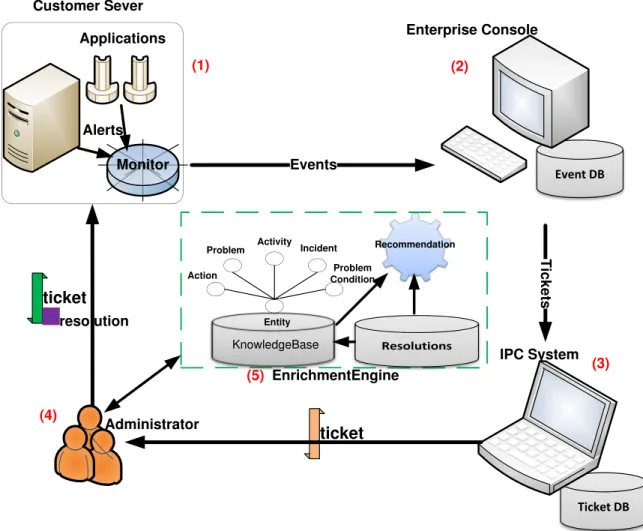
A typical workflow of IT service management is illustrated in Figure 3.1. It usu-ally involves five steps. (1) As problems detected by a monitoring agent on a server, alerts are generated, and the monitoring emits an event if the alert persists beyond a predefined duration. (2) Events coming from an IT environment are consolidated in an enterprise console, which analyzes the monitoring events and determines whether to create an incident ticket for IT problem reporting. (3) Tickets are collected by IPC (Incident, Problem, and Change) system and stored in the ticket database [urlg]. (4) The system administrators perform the problem determination, diagnosis, and reso-lution based on the ticket description. The ticket resoreso-lution part of IT service delivery workflow is often a labor-intensive process. (5) In order to alleviate human efforts and maximize the automation of IT service management, the workflow incorporates an enrichment engine which in turn uses various data mining techniques to create, maintain and apply knowledge about the underlying IT system and its possible is-sues. This chapter focuses on the construction of the knowledge base by processing
Applications Customer Sever Monitor Alerts Event DB Enterprise Console Events T ic k e ts ticket IPC System Ticket DB ticket resolution (1) (2) (3) (4) Administrator Resolutions KnowledgeBase Entity Problem Action Activity Incident Problem Condition Recommendation EnrichmentEngine (5)
Figure 3.1: The overview of IT service management workflow.
ticketing information; it outlines an integrated solution that uses obtained knowledge to optimize problem resolution.
3.1.2
Motivation
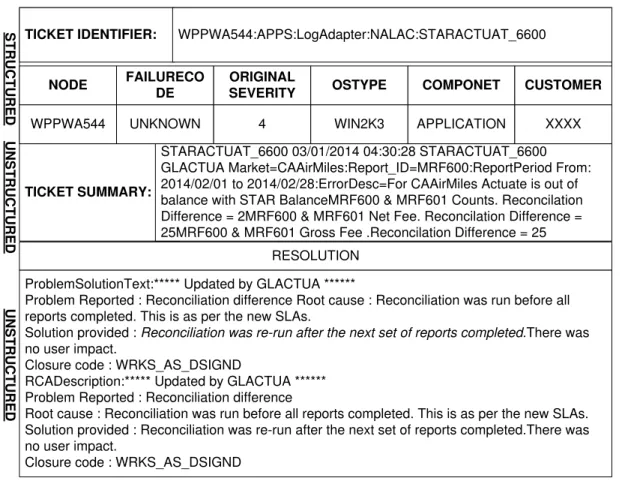
An example of an IT service management ticket is shown in Figure 3.6. It consists of both structured fields (e.g., OSTYPE, COMPONENT) and unstructured free-form text fields (i.e., SUMMARY and RESOLUTION). Note that tickets are either gener-ated automatically or reported by the system’s user. The structured fields and the
UNKNOW N
WIN2KWIN2K3WIN2K8 AIXVMWARELINUXSUNOSOS400 ZOS VIOS
0 1000 2000 3000 4000 5000 6000 7000 8000 9000 co un t OS TYPE
Figure 3.2: Ticket distribution across OS types.
UNKNOWN STORAGE NETWORK HARDWARE APPLICATION 0 2000 4000 6000 8000 10000 co un t COMPONENT
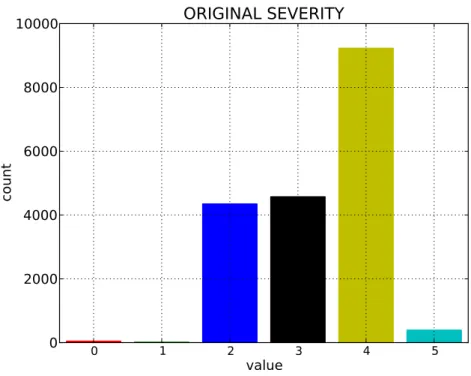
0 1 2 3 4 5 value 0 2000 4000 6000 8000 10000 co un t ORIGINAL SEVERITY
Figure 3.4: Ticket distribution across original severity.
0 1 2 3 4 5 value 0 5000 10000 15000 20000 co un t SEVERITY
RESOLUTION
TICKET IDENTIFIER: WPPWA544:APPS:LogAdapter:NALAC:STARACTUAT_6600
NODE FAILURECO DE ST R U C T U R ED ORIGINAL
SEVERITY OSTYPE COMPONET CUSTOMER
U N ST R U C T U R ED
WPPWA544 UNKNOWN 4 WIN2K3 APPLICATION XXXX
TICKET SUMMARY:
STARACTUAT_6600 03/01/2014 04:30:28 STARACTUAT_6600 GLACTUA Market=CAAirMiles:Report_ID=MRF600:ReportPeriod From: 2014/02/01 to 2014/02/28:ErrorDesc=For CAAirMiles Actuate is out of balance with STAR BalanceMRF600 & MRF601 Counts. Reconcilation Difference = 2MRF600 & MRF601 Net Fee. Reconcilation Difference = 25MRF600 & MRF601 Gross Fee .Reconcilation Difference = 25
ProblemSolutionText:***** Updated by GLACTUA ******
Problem Reported : Reconciliation difference Root cause : Reconciliation was run before all reports completed. This is as per the new SLAs.
Solution provided :Reconciliation was re-run after the next set of reports completed.There was no user impact.
Closure code : WRKS_AS_DSIGND
RCADescription:***** Updated by GLACTUA ****** Problem Reported : Reconciliation difference
Root cause : Reconciliation was run before all reports completed. This is as per the new SLAs. Solution provided : Reconciliation was re-run after the next set of reports completed.There was no user impact.
Closure code : WRKS_AS_DSIGND
U N ST R U C T U R ED
Figure 3.6: A ticket in IT service management and its corresponding resolution are given.
trators (SAs) to start ticket resolution. SAs usually record the troubleshooting steps in the resolution field as an unstructured free-form text.
In order to improve the efficiency of the problem resolution process, it is crucial to formalize the content of the ticket and, if possible, to discover a mapping between symptoms or a ticket’s summary and resolutions. This is the initial motivation of our study. After a meticulous study and detailed analysis of the problem, a number of obstacles are identified.
Challenge 1 Even in cases where the structured fields of a ticket are properly set, they either have small coverage or do not distinguish tickets well, and hence they
A subset of tickets are extracted from the historical ticket data set collected by IBM Global Services. Several fields such as OSTYPE,COMPONENT, and SEVERITY are investigated. The distributions of the field values are shown in Figures 3.2 to 3.5. As illustrated, the distributions are highly imbalanced in general. Specifically, most val-ues ofOSTYPE and COMPONENT fields are missing and labeled as UNKNOWN. We also observe that the field values such as STORAGE, NETWORK, HARDWARE, and APPLICATION only provide general information for problem type inference. Addi-tionally, we provide the distributions of both original severity values generated by the monitoring and the severity values revised by human, denoted asORIGINAL SEVER-ITY and SEVERITY, respectively. The severity values are considerably subjective since the two distributions of SEVERITY and ORIGINAL SEVERITY are extremely inconsistent.
Consequently, these structured fields are useful but by far not sufficient for precise problem inference. Thus we need to focus more on the free-form text fields in order to gain further insights into the underlying problem. The analysis of free-form text fields reveals the following.
Challenge 2 The ambiguity brought by the free-form text in both ticket summary and resolution poses difficulty in problem inference, although more descriptive information is provided.
Both ticket summary and resolution, illustrated in Figure 3.6, contain domain-specific terms such as SLAs, RCA, and WRKS AS DSIGND. In addition they contain a num-ber of typos and grammatical errors, such as ErrorDesc and ProblemSolutionText. Moreover, some text snippets may be repeated multiple times in a single ticket and resolution. An example is shown in Figure 3.6 where phrases such as Reconciliation Difference and several other sentences appear in both ticket summary and resolution.
As a result, it becomes infeasible to identify useful information for problem infer-ence using only traditional Natural Language Processing (NLP) techniques without any domain expertise. As illustrated further, our proposed integrated framework is capable of gathering domain knowledge from logs, ticketing systems, and system administrators.
Challenge 3 IT service management and particularly problem determination, diag-nosis, and resolution require a large investment of manual effort by system adminis-trators.
It is still a formidable task to fully automate the entire IT service management without the help of domain experts. Therefore, modeling, gathering, and utilizing the domain knowledge during ticket resolution become increasingly crucial.
In the proposed framework, the domain knowledge is modeled using ontology (see [BSW+08] for another application of ontology to IT Management) and organized
into a knowledge base. In order to improve IT service management by making a number of steps toward its automation, a recommendation component leveraging the domain knowledge is explored to facilitate the ticket resolution.
3.1.3
Contribution
The contribution of our work mainly focuses on proposing and implementing an inte-grated framework that significantly improves the automation of IT service manage-ment. The key features of the proposed cognitive framework include:
• A novel domain-specific approach, designed to analyze free-form text in both ticket summary and resolution for useful phrase extraction.
• Automation improvement of IT service management, through development of a resolution recommendation component based on domain knowledge.
• A closed feedback loop system, to facilitate learning from an outcome of reso-lution recommendation, and thus continuous extension of the knowledge base. The effectiveness and efficiency of our framework are verified on a large data set of tickets from IBM Global Services.
The remainder of this chapter is organized as follows. The overall framework is briefly introduced in Section 3.2. The detail design and implementation of the proposed framework is provided in Section 3.3. Section 3.4 describes an extensive empirical study conducted over the real ticket data. This chapter is summarized and concluded in Section 3.5.
3.2
System Overview
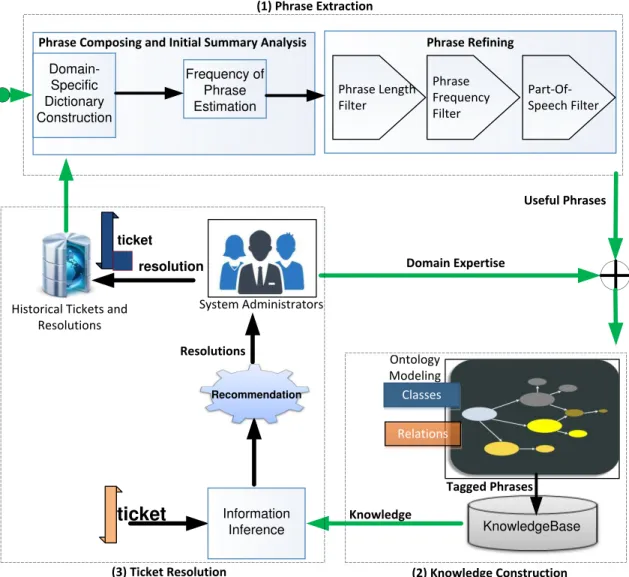
Taking the aforementioned challenges into account, an integrated framework is pro-posed. The framework is capable of constructing a knowledge base from discovered useful phrases mined from the tickets. It also incorporates the domain knowledge provided by domain experts. The framework shows how the constructed knowledge base is used to optimize the IT service maintenance. The overall architecture of the integrated framework is illustrated in Figure 3.7. Our proposed integrated framework consists of three stages: (1) Phrase Extraction, (2) Knowledge Construction, and (3) Ticket Resolution.
The entire framework starts with the stage of Phrase Extraction. The input of Phrase Extraction is a set of the historical tickets, and the output are the useful do-main knowledge phrases. The Phrase Extraction stage involves two do-main components:
(1) Phrase Extraction
Historical Tickets and Resolutions Domain-Specific Dictionary Construction Frequency of Phrase Estimation Phrase Refining Ontology Modeling KnowledgeBase Classes l O O Relations ticket System Administrators Domain Expertise Resolutions Recommendation Tagged Phrases Phrase Length Filter Phrase Frequency Filter Part-Of-Speech Filter ticket resolution Information Inference Useful Phrases
(3) Ticket Resolution (2) Knowledge Construction
Knowledge Phrase Composing and Initial Summary Analysis
Figure 3.7: An overview of the integrated framework.
Refining component. The Phrase Composition and Initial Summary Analysis com-ponent builds phrases from the unstructured text fields of tickets and estimates the frequency for each obtained phrase. The Phrase Refining component applies filters with diverse criteria (e.g., length, frequency, etc.) to refine the extracted phrases.
In the stage of Knowledge Construction, the domain expertise (e.g., the knowledge from system administrators) is utilized for ontology modeling. As usual the ontology is composed of the classes and the relations among classes. The phrases from the Phrase Extracting stage are tagged with the classes defined in the ontology and
archived for knowledge base construction. The archived knowledge is leveraged for ticket resolving in the next stage.
The incoming tickets are resolved in the stage of Ticket Resolution. The un-structured text fields of each ticket are first tagged by the Information Inference component. Provided with the tagged ticket, the Recommendation component rec-ommends a ranked list of the most relevant resolutions to the system administrators. The SAs can choose the most appropriate resolution. The ticket with the attached final resolution is archived into the historical ticket repository. The SAs accumulate more experience during ticket resolution. The newly obtained domain expertise can be used to enrich the knowledge base and facilitate learning. As a result, a closed feedback loop system is formed, and the knowledge base can be incrementally built.
In summary, the enriched knowledge base further facilitates the resolution recom-mendation, allowing the improvement of IT service management.
3.3
Design and Implementation
In this section, we explicitly describe the design and implementation for each stage.
3.3.1
Phrase Extraction Stage
This stage takes the historical tickets as input and produces useful specific domain phrases (e.g., “available disk space,” “backup client connection”) by analyzing the unstructured text fields. Intuitively, those phrases encompass the terms with high frequency as well as context information. To achieve this goal, we first extract frequent phrases, then filter out non-informative word combinations to keep only informative phrases. This stage consists of two main components: (1) Phrase Composing and