PDF hosted at the Radboud Repository of the Radboud University
Nijmegen
The following full text is a preprint version which may differ from the publisher's version.
For additional information about this publication click this link. http://hdl.handle.net/2066/175700
Please be advised that this information was generated on 2017-12-05 and may be subject to change.
Running head: Processing Mode and Creative Idea Selection 1
Creativity: Intuitive Processing Outperforms Deliberative Processing in
Creative Idea Selection
Yuxi Zhu1*, Simone M. Ritter1, Barbara C. N. Müller1 & Ap Dijksterhuis1
1 Behavioral Science Institute, Radboud University, The Netherlands
* Corresponding author at: Behavioral Science Institute, Radboud University, Montessorilaan 3, 6525 HR Nijmegen, The Netherlands.
Processing Mode and Creative Idea Selection 2
Abstract
Creative ideas are highly valued, and various techniques have been designed to maximize the generation of creative ideas. However, for actual implementation of creative ideas, the most creative ideas must be recognized and selected from a pool of ideas. Although idea
generation and idea selection are tightly linked in creativity theories, research on idea selection lags far behind research on idea generation. The current research investigates the role of processing mode in creative idea selection. In two experiments, participants were either instructed to intuitively or deliberatively select the most creative ideas from a pool of 18 ideas that systematically vary on creativity and its sub-dimensions originality and
usefulness. Participants in the intuitive condition selected ideas that were more creative, more original, and equally useful than the ideas selected by participants in the deliberative
condition. Moreover, whereas selection performance of participants in the deliberative condition was not better than chance level, participants in the intuitive condition selected ideas that were more creative, more original, and more useful than the average of all available ideas.
Processing Mode and Creative Idea Selection 3
Introduction
Creativity is one of the most important cognitive skills in our fast-changing world (Ananiadou & Claro, 2009; Geisinger, 2016), and various techniques have been designed to maximize the generation of creative ideas over the past decades. However, before creative ideas can be actually implemented, the most creative ideas must be selected from a larger pool of ideas. Although idea generation and idea selection are tightly linked in creativity theories (e.g., Basadur, 1995; Finke, Ward, & Smith, 1992; Guilford, 1967; Lubart, 2001; Maier, 1967; Newell & Shaw, 1962; Reiter-Palmon & Illies, 2004; Runco & Basadur, 1993; Runco & Vega, 1990; Sawyer, 2006; Simonton, 2003; Sternberg, 2006), research on idea evaluation and idea selection lags far behind research on idea generation (Amabile & Mueller, 2008; Herman & Reiter-Palmon, 2011; Hunter, Friedrich, Bedell, & Mumford, 2006; Kozbelt, 2007; Rietzschel, Nijstad, & Stroebe, 2010; Runco & Smith, 1992). This is unfortunate, as history is replete with cases in which creative ideas were first unwisely rejected. For example, flying, personal computers, and online shopping were first deemed to be crazy, but eventually became big successes that changed our world. In addition, the scarce research on idea selection has shown that people perform poorly at selecting creative ideas. They tend to select mainstream ideas at the expense of creative ideas (Faure, 2004; Putman & Paulus, 2009; Rietzschel, Nijstad, & Stroebe, 2006), even when they are explicitly instructed to select creative ideas (Rietzschel et al., 2010).
Thus far, few studies have been conducted to investigate creative idea selection. In comparison, idea evaluation, which is closely related to idea selection, has attracted more attention. In the literature on the creative problem-solving process, researchers have stated that idea evaluation happens after idea generation and before the selection of ideas for implementation (e.g., Amabile, 1983; Herman & Reiter-Palmon, 2011). During idea evaluation, available options are assessed against certain standards (Hunter et al., 2006) for
Processing Mode and Creative Idea Selection 4
implementation, rejection, or revision (Mumford, Lonergan, & Scott, 2002). Creativity researchers have observed errors in the evaluation of ideas, in that people tend to
underestimate the originality of ideas (Licuanan, Dailey, & Mumford, 2007). They prefer commonplace ideas but disregard original ideas (Blair & Mumford, 2007). To investigate how people’s evaluation performance can be improved, several studies have been conducted and some means have been examined to be effective. For example, Blair and Mumford (2007) found that participants are more likely to prefer original ideas when evaluation criteria are loose and time pressure is high. In another research, Mueller and colleagues (2014) found that participants with a high-level abstract construal can evaluate a creative idea more
accurately than participants with a low-level concrete construal.
Research has thus far shown that improving creative idea selection is difficult (Faure, 2004; Rietzschel, Nijstad, & Stroebe, 2014). Researchers (Faure, 2004; Putman & Paulus, 2009; Rietzschel et al., 2006) studied idea selection performance by nominal groups (in which members perform tasks individually) and interactive groups (in which members perform tasks interactively). They found that the ideas selected by both groups were only of average originality and feasibility. In other words, participants did not select better than chance. Other manipulations, such as providing instructions to select creative ideas (i.e., participants were asked to select an idea that is both original and feasible; Rietzschel et al., 2010), providing quality ratings before selection (participants had to rate the quality of
available ideas; Rietzschel et al., 2010), and using a narrow (versus broad) problem for which ideas were generated (i.e., a narrowly defined problem that is a subcategory of the overall problem; Rietzschel et al., 2014) had no effect on selection performance. Explicitly instructing participants to select the most creative (versus the best) ideas did facilitate the selection of more original ideas, but it also decreased participants’ satisfaction and the rated effectiveness (i.e., the estimated likelihood that the idea will turn out to be an improvement)
Processing Mode and Creative Idea Selection 5
of the chosen ideas (Rietzschel et al., 2010). The failure of the earlier mentioned efforts suggests that creative idea selection is still far from being well understood and needs more exploration.
Selecting truly creative ideas is difficult as there are often no prototypes or explicit criteria against which an idea can be judged. In fact, the violation of expectations with regard to the solution is often at the heart of perceiving an idea as creative (for example, see research on effective surprise; Wiggins & Bhattacharya, 2014). Intuition is a common tool for coping with ill-defined situations (Pétervári, Osman, & Bhattacharya, 2016) and hence, in the idea selection phase, intuition may help people to recognize original contributions and to judge whether an idea will be useful. Sinclair (2012) has shown that filmmaking professionals use intuitive expertise as a means to create unity amongst film crew members, and employ intuitive foresight for selecting projects and spotting talents. Eling and colleagues (2015) investigated new product idea evaluation decisions during idea generation activities, and revealed that combining intuition and rationality leads to both the highest decision quality and improved decision speed. However, empirical research on the role of intuitive and deliberative processing in the creative idea selection process is lacking. Let us have a closer look at intuition and deliberation.
According to dual-processing theories, people commonly process information by using two distinct modes: intuitive processing and deliberative processing—intuitive processing is rapid, unconscious, and automatic, while deliberative processing is slow, conscious, and analytical (Gigerenzer, 2007; Wilson & Schooler, 1991). So far, many studies have been conducted to understand and distinguish the effect of processing mode in both decision making (Phillips, Fletcher, Marks, & Hine, 2016) and creative idea generation (for reviews, see Pétervári et al., 2016; Ritter & Dijksterhuis, 2014). Intuitive processing has been shown to outperform deliberative processing in various judgment and decision-making
Processing Mode and Creative Idea Selection 6
circumstances, such as deception detection (Albrechtsen, Meissner, & Susa, 2009) and
complex decision-making (e.g., Usher, Russo, Weyers, Brauner, & Zakay, 2011). Meanwhile, intuition has also been identified to be important in idea generation of creative professionals, such as Nobel laureates (Marton, Fensham, & Chaiklin, 1994) and Michelin chefs (Stierand & Dörfler, 2016). Moreover, this beneficial role of intuition has been supported by empirical evidence, which demonstrates that intuitive individuals are able to generate solutions of higher quality and elegance (Eubanks, Murphy, & Mumford, 2010) and of higher originality (Garfield, Taylor, Dennis, & Satzinger, 2001) to specific problems than deliberative people. Moreover, an intuitive creativity technique could boost the generation of higher original and paradigm-modifying solutions than a deliberative technique (Garfield et al., 2001). However, the role of processing mode in creative idea selection, which combines decision making and creativity, has been scarcely studied (Eling, Langerak, & Griffin, 2015; Pétervári et al., 2016). Interestingly, however, in many circumstances practitioners use their intuition when searching for highly original and useful ideas (Sadler-Smith, 2016; Stierand & Dörfler, 2016). For example, angel investors, who aim to find extraordinarily profitable investments by providing capital for a business start-up, report a heavy reliance on intuition in making their decisions (Huang & Pearce, 2015). Why may an intuitive processing style be beneficial for creative idea selection?
Creative ideas are generally characterized to be both original and useful (Hennessey & Amabile, 2010; Runco & Jaeger, 2012), and when selecting creative ideas one should take both the originality and the usefulness of the ideas into consideration. However, it is likely that during creative idea selection, people do not focus on originality and usefulness
simultaneously, but follow a sequential order—they first focus on originality and, thereafter, on usefulness. Originality is viewed as the hallmark of creativity (Runco & Charles, 1993), and it is often associated with positive concepts such as intelligence (Niu & Sternberg, 2006).
Processing Mode and Creative Idea Selection 7
Therefore, it is not surprising that people value originality (Rietzschel et al., 2010) and even at an implicit level favor creativity and originality above practicality and usefulness. Using an Implicit Association Test (IAT), Mueller and colleagues (2011) showed that in conditions of low uncertainty (or when a high tolerance for uncertainty was evoked), participants
associated positive words more often with originality-related words (e.g., novel) relative to usefulness-related words (e.g., functional). Finally, original ideas are salient, and our brain gives priority to process salient, novel, and unexpected stimuli (Corbetta & Shulman, 2002). Therefore, when asked to select creative ideas, people may, at first place, intuitively focus on originality. In support of this idea, Rietzschel and colleagues (2010) have shown that when participants were instructed to select creative ideas (without mentioning its two
sub-dimensions), they relied heavily on originality.
The goal of idea selection, however, is to select an idea that is not only original but also has the potential to be implemented. Therefore, the available ideas also have to be evaluated on their usefulness. Original ideas are by definition relatively new and untested, and the more original an idea is, the higher the uncertainty (Amabile, 1996), perception of risk (Rubenson & Runco, 1995; Simonton, 1984), likelihood of social rejection (Nemeth, 1986), and doubts about whether the idea can be realized (Metcalfe, 1986). Due to the uncertainty associated with original ideas, evaluating the usefulness of original ideas may elicit deeper and more analytical processing than when evaluating the usefulness of mainstream ideas. The existing literature has identified a positive relation between
deliberative decision-making tendency and risk aversion. It has been shown that deliberative thinkers are more risk-aversive than intuitive thinkers, and that in risky and uncertain
decision making environments deliberative processing is more likely to lead to conservative and risk-aversive decisions (Butler, Guiso, & Jappelli, 2014). Therefore, during creative idea selection, deliberative thinkers may focus on evaluating the potential risks of the available
Processing Mode and Creative Idea Selection 8
ideas. As a consequence, they may overestimate highly useful ideas of average originality, while underestimating original high-quality ideas. Mueller and colleagues (2011) showed that under condition of high uncertainty or when a low tolerance for uncertainty was evoked, participants were more implicitly biased against originality relative to usefulness. Also, participants in the low-uncertainty-tolerance condition evaluated creative ideas as less creative than those in the high-uncertainty-tolerance condition. Importantly, it has been shown that manipulating reliance on intuition can reduce risk aversion (Butler, Guiso, & Jappelli, 2013). By being less risk-aversive during creative idea selection, intuitive processing may lead to a more accurate evaluation of ideas and result in the preference of high-quality original ideas relative to mainstream ideas. As creativity correlates higher with originality than with usefulness (Diedrich, Benedek, Jauk, & Neubauer, 2015), we hypothesize that intuitive processing outperforms deliberative processing in selecting creative ideas. Two experiments were designed to test this hypothesis. In both experiments participants had to select the six most creative ideas from 18 possible solutions to a problem, and selection instructions were manipulated to foster an intuitive or deliberative processing mode during idea selection (Dane, Rockmann, & Pratt, 2012).
Experiment 1
Method
Participants and Design
A total of 87 (64 female, 23 male) participants between the ages of 18 and 32 years old (M = 22.38, SD = 3.07) gave informed consent to participate in the study, which was conducted according to the principles expressed in the Declarations of Helsinki. All the participants were Dutch speaking and recruited for voluntary participation via the online
Processing Mode and Creative Idea Selection 9
research participation system (Sona) of Radboud University. Participants were given a choice of earning course credits or €5 (approximately US$5.36) for their participation.
A between-subjects design was used with processing mode (intuitive vs. deliberative) as independent variable and idea evaluation and idea selection performance as dependent variables. Participants were randomly assigned to one of two between-subjects conditions, that is, the intuitive condition (n = 44) or the deliberative condition (n = 43). In the intuitive condition, participants were instructed to intuitively select the most creative ideas, whereas in the deliberative condition, participants were instructed to select the most creative ideas on the basis of a careful analysis. Two participants in the intuitive condition were excluded from the analyses as they did not follow the task instructions. The remaining 85 participants (62 female, 23 male; 42 in the intuitive condition, 43 in the deliberative condition) had a mean age of 22.34 years (SD = 3.10).
Procedure
Participants were first greeted and then ushered to an individual cubicle. While being seated in the cubicle, the experimenter explained that all task instructions are provided on the computer screen, that the participant can contact the experimenter at any time (e.g., to ask for clarification), and that the experiment will last approximately 30 minutes. Participants were randomly assigned to either the intuitive condition or the deliberative condition by the computer program. In both conditions, participants performed two tasks—an idea evaluation and an idea selection task—and they answered several questions. Finally, participants were thanked, debriefed, and rewarded for their participation.
All parts of the experiment were identical for both conditions, except for the task instructions prior to the idea evaluation and the idea selection task. Importantly, before both tasks, that is, before the evaluation task and before the selection task, participants’ processing
Processing Mode and Creative Idea Selection 10
mode was manipulated by means of verbal instructions. In the intuitive condition, participants were instructed to intuitively evaluate and select the ideas. In the deliberative condition, participants were instructed to carefully evaluate and select the ideas.
Materials1
Idea pool.
To generate a pool of ideas from which participants in this experiment could select, a separate sample of 40 participants were asked to generate ideas to solve a problem (i.e., how to encourage more people to take the train; see De Buisonjé, Ritter, de Bruin, ter Horst, & Meeldijk, 2017). One-hundred-six ideas were collected. Overlapping ideas were trimmed and 72 ideas remained. These ideas were then evaluated by 10 creativity experts (e.g., creativity researchers, founder of a future center, and art-academy teachers) on creativity, originality, and usefulness on a 5-point scale (1 = not at all, 5 = very much). Inter-rater reliabilities were excellent (intraclass correlation coefficients are .82, .88, and .91, for creativity, originality, and usefulness, respectively). Expert ratings of creativity, originality, and usefulness were separately extracted for each idea. Finally, by using a 3 (originality: low, medium, high) by 3 (usefulness: low, medium, high) matrix, 18 ideas that systematically vary in creativity were selected for the idea selection task from the 72 ideas.
Idea selection task.
Participants had to select six ideas from the idea pool. For each of the 18 ideas in the idea pool, expert ratings of creativity, originality, and usefulness are available. Based on a 3 (originality: low, medium, high) by 3 (usefulness: low, medium, high) idea matrix, the six
1Measures and analyses that are not directly relevant to the hypothesis can be found in the
Processing Mode and Creative Idea Selection 11
most creative ideas were identified. In the selection task, participants were first informed that a creative idea has to meet two criteria—it has to be both original and useful. Thereafter, participants were presented with the problem statement and the 18 ideas simultaneously. The ideas were presented in the form of a 3 (column) by 6 (row) idea matrix where the position of the ideas was randomized. Finally, they had to select the six most creative ideas.
Idea evaluation task.
In the beginning of the evaluation task, participants were informed that a creative idea has to be both original and useful. During the evaluation task, participants were presented with the problem statement and the 18 ideas, and they had to evaluate all the ideas first on creativity, then on originality, and finally on usefulness on a 7-point scale (1 = not at all, 7 =
very much). In each evaluation session, the order of the ideas was randomized.
Questions.
Manipulation check. To check whether the manipulation was successful, an implicit
measure and an explicit measure were used. The implicit measure was the duration of the selection task. Participants in the intuitive condition were expected to make faster selections than those in the deliberative condition. The explicit measure was twofold. First, participants had to rate whether they evaluated and selected the ideas in an intuitive way or a deliberate way on a 7-point scale, ranging from 1 (very intuitive) to 7 (very deliberative). Thereafter, they had to answer five manipulation check items (e.g., “I selected ideas that felt right to me”, see Dane, Baer, Pratt, & Oldham, 2011). These items were rated on a 7-point scale, ranging from 1 (strongly disagree) to 7 (strongly agree). Responses on the five items were averaged (alpha reliability = .78). Higher scores indicate that participants used a more deliberative processing style, while lower scores indicate a more intuitive processing style.
Processing Mode and Creative Idea Selection 12
Demographics. Participants’ gender, age, and educational background were assessed.
Dependent Variables
Idea selection.
Creative idea selection performance was measured by five different variables: the
creativity of the selected ideas, the originality of the selected ideas, the usefulness of the selected ideas, the number of the optimal ideas selected, and the selection effectiveness.
The creativity of the selected ideas measures the creativity (based on expert ratings) of the six ideas that were selected as the most creative ideas. Per participant, the average creativity of the six selected ideas was calculated. In addition, per participant, the average originality and the average usefulness of the six selected ideas were calculated, resulting in the variables the originality of the selected ideas and the usefulness of the selected ideas.The
number of the optimal ideas selectedwas measured by calculating how many of the six selected ideas can be considered optimal ideas, namely, the six ideas with the highest creativity according to the expert ratings. All dependent variables were compared between conditions to examine the effect of processing mode on idea selection performance.
The selection effectiveness, that is, whether participants selected better than chance level, was tested within each condition by comparing the creativity, originality, and
usefulness of the six selected ideas with the mean creativity, originality, and usefulness of the available 18 ideas.
Idea evaluation.
Idea evaluation performance was measured by the selection-evaluation consistency. The selection-evaluation consistency examineswhether participants selected ideas that they had evaluated as the most creative, by comparing participants’ averaged creativityevaluation
Processing Mode and Creative Idea Selection 13
of the selected ideas with that of the unselected ideas. Moreover, the same comparisons on the originality and the usefulness evaluation indicate whether or not participants relied on originality or/and usefulness when selecting the six ideas out of the 18 ideas. For example, if participants evaluated the selected ideas identically original but more useful than the
unselected ideas, it means they referred to usefulness when selecting creative ideas.
Results & Discussion
Manipulation Check
The key manipulation is eliciting the intuitive versus deliberative processing mode. The manipulation-check variables include the two explicit measurements of processing tendency and the duration of the selection task. A MANOVA on these variables showed a significant effect of processing mode, F(3, 81) = 93.34, p < .001,
p= .78. Separate ANOVAs (see Table 1) revealed significant effects of processing mode on both self-report manipulation-check measurements as well as on selection latency. As shown in Table 1, compared to participants in the deliberative condition, participants in the intuitive condition reported a more intuitive selection and used less time to finish the idea selection task.Table 1
Descriptive Statistics for Manipulation Check Variables
Condition Variable Intuitive (n = 42) Deliberative (n = 43) F(1, 83) p p
Single-item manipulation check 3.26 (1.48) 5.70 (0.83) 87.78 < .001 .51 Five-item manipulation check 2.40 (0.60) 4.32 (0.49) 260.93 < .001 .76 Selection duration 42.16 (18.58) 77.68 (86.31) 6.81 .011 .076
Processing Mode and Creative Idea Selection 14
Idea Selection
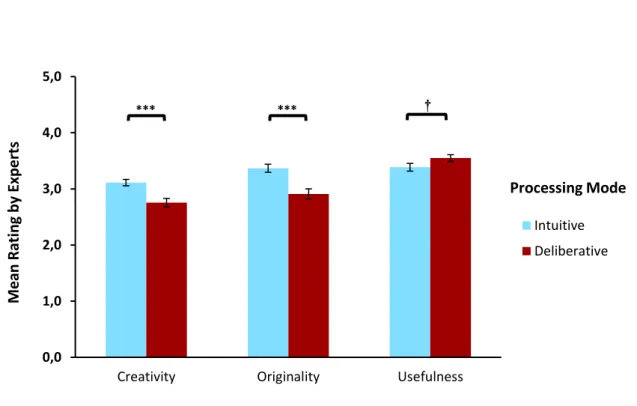
Creativity of selected ideas. An independent samples t-test on the creativity of the six selected ideas revealedthat, participants in the intuitive condition selected ideas that were more creative than participants in the deliberative condition (see Figure 1), t(83) = 3.82, p
< .001, Cohen’s d = 0.83. Furthermore, independent t-tests on the expert-rated originality and usefulness showed that participants in the intuitive condition selected ideas that weremore original (t(83) = 3.93, p < .001, Cohen’s d = 0.85), but slightly less useful (t(83) = 1.80, p
= .075, Cohen’s d = 0.39) than those in the deliberative condition.
Figure 1: Expert rating of creativity, originality, and usefulness of the six selected ideas by
processing mode. Error bars represent standard errors. ***p < .001. †p < .1 0,0 1,0 2,0 3,0 4,0 5,0
Creativity Originality Usefulness
M e an R ati n g b y Exp e rts Dependent Variable Intuitive Deliberative Processing Mode *** *** †
Processing Mode and Creative Idea Selection 15
Number of optimal ideas selected. An independent t-test on the number of the optimal ideas selected showed that, participants in the intuitive condition (M = 3.26, SD = 1.23) selected a significantly larger number of ideas from the six optimal creative ideas than participants in the deliberative condition (M = 2.35, SD = 1.41), t(83) = 3.17, p = .002, Cohen’s d = 0.69.
Selection effectiveness. To examine selection effectiveness—whether participants were able to select better than chance level—a one-sample t-test was conducted for each condition, with the average expert-rated creativity of the six selected ideas as the test variable, and the average expert-rated creativity of all the 18 ideas as the test value. The results showed that participants in the intuitive condition (M = 3.11, SD = 0.37) selected ideas that were more creative (t(41) = 6.95, p < .001, Cohen’s d = 1.07) than the total idea set (M = 2.72, SD = 0.84), whereas participants in the deliberative condition (M = 2.76, SD = 0.48) selected ideas that were not more creative (t < 1, p = .59, Cohen’s d = 0.08) than the average idea. In other words, participants in the intuitive condition selected above chance level, whereas participants in the deliberative condition did not. A one-sample t-test on originality showed that participants in the intuitive condition (M = 3.37, SD = 0.47) selected ideas that were more original (t(41) = 5.36, p < .001, Cohen’s d = 0.83) than the idea set (M = 2.98, SD
= 1.02); this difference was not significant (t < 1, p = .46, Cohen’s d = 0.11) for participants in the deliberative condition (M = 2.91, SD = 0.60). A one-sample t-test on usefulness yielded significant effects for both the intuitive condition (t(41) = 3.01, p = .004, Cohen’s d = 0.47) and the deliberative condition (t(42) = 6.19, p < .001, Cohen’s d = 0.94). Participants in both the intuitive condition (M = 3.38, SD = 0.45) and the deliberative condition (M = 3.55, SD = 0.39) selected ideas that were more useful than the average idea (M = 3.18, SD = 1.08).
Processing Mode and Creative Idea Selection 16
Idea Evaluation
Selection-evaluation consistency. Selection-evaluation consistency, namely, whether participants selected the ideas that theyhad evaluated as the most creative ones, was
examined with a 2 (Processing Mode [intuitive, deliberative]) × 2 (Average Participant-rated Creativity [of the selected ideas, of the unselected ideas]) mixed model ANOVA (see Table 2). The analysis showed a significant main effect of within-subjects factor creativity (F(1, 83) = 23.86, p < .001,
p= .22), a marginally significant main effect of between-subjects factor processing mode (F(1, 83) = 3.95, p = .050,
p= .045), but no significant creativity × processing mode interaction effect (F < 1, p = .92,
p< .001). Specifically, as shown in Table 2, participants in the intuitive condition evaluated ideas generally more creative than those in the deliberative condition. Moreover, participants in both conditions selected ideas that they evaluated more creative.Similar analyses were also conducted on originality and usefulness (see Table 2). The analysis on originality showed a significant main effect of originality (F(1, 83) = 6.70, p = .011,
p= .075), a significant originality × processing mode interaction (F(1, 83) = 5.55, p = .021,
p= .063), but no significant main effect of processing mode (F(1, 83) = 1.07, p = .30,
p= .013). Simple effects analysis showed that participants in the intuitive condition selected ideas evaluated more original (F(1, 83) = 12.08, p = .001) than the unselected ideas; this difference was not significant for those in the deliberative condition (F < 1, p = .87).The analysis on usefulness showed a significant main effect of usefulness (F(1, 83) = 6.23, p = .015,
p= .070), a main effect of processing mode (F(1, 83) = 8.61, p = .004,
p= .094), and a marginally significant usefulness × processing mode interaction (F(1, 83) =Processing Mode and Creative Idea Selection 17
3.78, p = .055,
p= .044). Simple effects analysis showed that participants in the deliberative condition selected ideas evaluated more useful (F(1, 83) = 9.97, p = .002) than the unselected ideas, however, this difference was not significant for those in the intuitive condition (F < 1, p = .70).Table 2
Descriptive Statistics for Selection-evaluation Consistency
Note. The table reports means, with standard deviations in parentheses.
The results of Experiment 1 showed that intuitive processing enhances creative idea selection performance compared to deliberative processing. Specifically, intuitive processing led to the selection of ideas that are more creative and original but slightly less useful, in comparison to deliberative processing. Moreover, by using intuitive processing, participants were able to select ideas more creative, more original, and more useful than the average idea, while deliberative mode influenced participants to select ideas merely more useful but not more creative and original than the average idea.
Condition Variable Intuitive (n = 42) Deliberative (n = 43) Creativity Selected ideas 4.55 (0.24) 4.33 (0.32) Unselected ideas 3.97 (1.12) 3.77 (0.86) Originality Selected ideas 4.91 (0.53) 4.42 (0.58) Unselected ideas 4.12 (1.33) 4.38 (0.97) Usefulness Selected ideas 4.68 (0.60) 4.69 (0.66) Unselected ideas 4.59 (1.07) 4.00 (0.97)
Processing Mode and Creative Idea Selection 18
Experiment 2
To replicate the finding of Experiment 1 that intuitive processing facilitates creative idea selection compared with deliberative processing, a second experiment was conducted. In Experiment 1, the evaluation task was placed before the selection task to increase the
ecological validity of the acquired findings, as people normally evaluate ideas before making selections in their daily lives. However, it is still questionable whether the effect of
processing mode on idea selection performance was influenced by the preceding evaluation task. To get an uncontaminated performance of creative idea selection under intuitive versus deliberative processing, the order of the tasks was changed in Experiment 2. Specifically, participants had to perform the selection task first and the evaluation task thereafter. Moreover, to investigate whether intuitive processing also outperforms deliberative
processing in the selection of the single most creative idea, we asked people to rank order the six selected ideas after they had completed the selection task.
We pre-registered our hypothesis, methods, and data analysis plan via Open Science Framework (see https://osf.io/msh6q/).
Method
Participants and Design
A total of 137 students2 from Radboud University (111 female, 26 male) aged between 18 and 39 (M = 22.30 years, SD = 3.46) took part in the experiment for course credits or money (€5).
2Based on the power analysis (for details, see the pre-registered study plan), we planned to recruit 128 participants. Considering possible exclusions, we actually recruited nine more participants than planned.
Processing Mode and Creative Idea Selection 19
As in Experiment 1, a between-subjects design was employed with processing mode as independent variable, and idea selection and evaluation performance as dependent
variables. Participants were randomly assigned to either the intuitive condition (n = 68) or the deliberative condition (n = 69). No participants were excluded from the data analyses.
Procedure
The procedure was identical to Experiment 1, except for two changes. First, the order of the evaluation and the selection task was swapped—participants in both conditions first performed the selection task and then the evaluation task. Second, instead of one phase (i.e., selecting the six most creative ideas) in the selection task, there was an additional phase— participants had to rank order the six selected ideas.
Materials
Idea pool.
In the current experiment, creative idea selection performance was measured by the same idea pool used in Experiment 1.
Idea selection task.
Unlike Experiment 1, the selection in Experiment 2 had two phases. In the first phase, participants had to select the six most creative ideas from the 18 ideas. In the second phase, they had to rank the selected ideas in order of creativity (most creative idea, second most creative idea, etc.).
Idea evaluation task.
The idea evaluation task used in the current experiment was the same task as used in Experiment 1.
Processing Mode and Creative Idea Selection 20
Questions.
All measures were the same as Experiment 1, except that we also recorded the time participants took to rank-order their choices.
Dependent Variables
Idea selection.
In the current experiment, creative idea selection performance was measured by the five variables as described in Experiment 1 as well as three additional variables, the creativity of the most creative idea, the originality of the most creative idea, and the usefulness of the most creative idea.
The creativity of the most creative idea measures the quality (based on expert ratings) of the idea that was ranked by each participant as the most creative idea in the rank-ordering phase of the idea selection task. In addition, per participant, the originality and the usefulness of the most creative idea were used as variables the originality of the most creative idea and the usefulness of the most creative idea.
Idea evaluation.
Idea evaluation performance was measured by the same variable as described in Experiment 1.
Results & Discussion
Manipulation Check
The four manipulation-check variables included the two explicit measurements and the two implicit measurements of processing tendency. A MANOVA on these variables
Processing Mode and Creative Idea Selection 21
showed a significant effect of processing mode, F(4, 132) = 48.21, p < .001,
p= .59. Separate ANOVAs (see Table 3) revealed significant effects of processing mode on both self-report manipulation-check measurements as well as on selection and rank-ordering latency. Specifically, as shown in Table 3, compared to participants in the deliberative condition, participants in the intuitive condition reported a more intuitive selection, and were faster to finish both the selection phase and the rank-ordering phase of the selection task.Table 3
Descriptive Statistics for Manipulation Check Variables Condition
Variable Intuitive
(n = 68)
Deliberative
(n = 69) F(1, 135) p p Single-item manipulation check 3.10 (1.35) 5.20 (1.04) 104.32 < .001 .44
Five-item manipulation check 2.45 (0.69) 4.38 (1.02) 166.35 < .001 .55
Selection duration 65.63 (24.22) 108.56 (72.86) 21.28 < .001 .14
Rank-ordering duration 31.05 (12.87) 50.76 (36.51) 17.67 < .001 .12
Note. The table reports means, with standard deviations in parentheses. The unit of durations is second.
Idea Selection
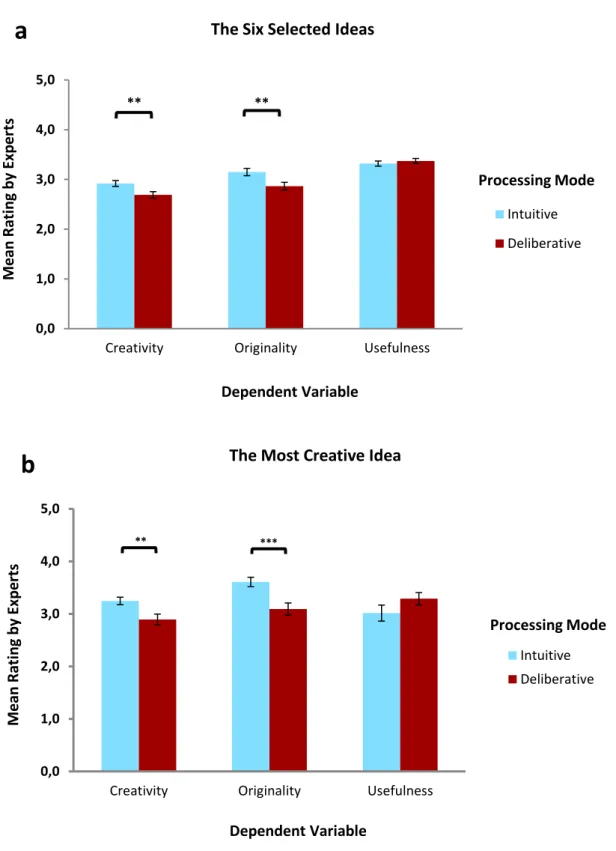
Creativity of selected ideas. An independent samples t-test on the expert-rated creativity of the selected ideas showed that, participants in the intuitive condition (compared with participants in the deliberative condition) selected ideas that were more creative, t(135) = 2.63, p= .010, Cohen’s d = 0.45, and more original, t(135) = 2.65, p = .009, Cohen’s d = 0.45. However, there was no statistically significant difference between processing modes on usefulness, t < 1, p = .47, Cohen’s d = 0.12. See Figure 2a for a plot.
Processing Mode and Creative Idea Selection 22
Creativity of most creative idea. An independent t-test on the creativity of the most creative idea showed that the-most-creative idea ranked by participants in the intuitive condition was more creative, t(135) = 2.83, p = .005, Cohen’s d = 0.48, and more original,
t(135) = 3.52, p < .001, Cohen’s d = 0.60,than that ranked by participants in the deliberative condition. However, no significant difference between the two conditions was found on the usefulness of the ranked most creative idea, t(135) = 1.43, p = .15, Cohen’s d = 0.24. See Figure 2b for a plot.
Processing Mode and Creative Idea Selection 23
Figure 2: Mean creativity, originality, and usefulness of (a) the six selected ideas and (b)
the most creative idea by processing mode. Error bars represent standard errors. **p < .01. ***p < .001. 0,0 1,0 2,0 3,0 4,0 5,0
Creativity Originality Usefulness
M ea n R ati n g b y Exp er ts Dependent Variable
The Six Selected Ideas
Intuitive Deliberative Processing Mode ** **
a
0,0 1,0 2,0 3,0 4,0 5,0Creativity Originality Usefulness
M e an R ati n g b y Exp e rts Dependent Variable
The Most Creative Idea
Intuitive Deliberative
Processing Mode
** ***
Processing Mode and Creative Idea Selection 24
Number of optimal ideas selected. An independent t-test on the number of the optimal ideas selected revealed that, participants in the intuitive condition (M = 2.90, SD = 1.58) selected more ideas from the six optimal creative ideas than the participants in the deliberative condition (M = 2.16, SD = 1.61), t(135) = 2.71, p = .008, Cohen’s d = 0.46.
Selection effectiveness. As in Experiment 1, one-sample t-tests were conducted for each condition with the average expert-rated creativity, originality, or usefulness of the six selected ideas as test variables, and the average evaluations of all the 18 ideas by experts as test values. Similar to Experiment 1, the analysis on creativity revealed that participants in the intuitive condition (M = 2.92, SD = 0.49) selected ideas that were more creative (t(67) = 3.44,
p = .001, Cohen’s d = 0.42) than the average level (M = 2.72, SD = 0.84). However, this difference was not significant (t < 1, p = .68, Cohen’s d = 0.05) for participants in the deliberative condition (M = 2.69, SD = 0.54). This means participants in the intuitive condition selected above chance level whereas participants in the deliberative condition did not. Similarly, the analysis on originality showed that participants in the intuitive condition (M = 3.15, SD = 0.61) selected ideas that were more original (t(67) = 2.31, p = .024, Cohen’s
d = 0.28) than the average level (M = 2.98, SD = 1.02); this difference was not significant
(t(68) = 1.45, p = .15, Cohen’s d = 0.18) for those in the deliberative condition (M = 2.87, SD
= 0.64). The analysis on usefulness yielded significant effects for both the intuitive condition (t(67) = 2.74, p = .008, Cohen’s d = 0.33) and the deliberative condition (t(68) = 3.81, p
< .001, Cohen’s d = 0.46). Specifically, participants in both the intuitive condition (M = 3.32,
SD = 0.42) and the deliberative condition (M = 3.37, SD = 0.42) selected ideas that were more useful than the average level (M = 3.18, SD = 1.08).
Similar analyses were conducted on the creativity, originality, and usefulness of the most creative idea. The analysis on creativity showed that the-most-creative idea ranked by participants in the intuitive condition (M = 3.25, SD = 0.59) was more creative (t(67) = 7.38,
Processing Mode and Creative Idea Selection 25
p < .001, Cohen’s d = 0.90), and that ranked by participants in the deliberative condition (M = 2.89, SD = 0.84) was slightly more creative (t(68) = 1.75, p = .084, Cohen’s d = 0.21),than the total idea set. The analysis on originality revealed that participants in the intuitive condition (M = 3.61, SD = 0.74) selected an idea that was more original (t(67) = 7.05, p
< .001, Cohen’s d = 0.85) than the average idea, however, this difference was not significant (t < 1, p = .33, Cohen’s d = 0.12) for those in the deliberative condition (M = 3.09, SD = 0.96). The analysis on usefulness yielded no significant results for both the intuitive condition (t(67) = 1.07, p = .29, Cohen’s d = 0.13) and the deliberative condition (t < 1, p = .34,
Cohen’s d = 0.12). The most-creative-idea ranked by participants in both the intuitive
condition (M = 3.01, SD = 1.26) and the deliberative condition (M = 3.29, SD = 0.97) was not significantly different from the average idea in usefulness.
Idea Evaluation
Selection-evaluation consistency. A 2 (Processing Mode [intuitive, deliberative]) × 2 (Average Participant-rated Creativity [of the six selected ideas, of the unselected ideas]) mixed model ANOVA (see Table 4) showed a significant main effect of creativity (F(1, 135) = 55.44, p < .001 ,
p= .29), but no significant main effect of processing mode (F < 1, p = .70,
p= .001) and no creativity × processing mode interaction (F(1, 135) = 2.08, p = .15,
p= .015). This means participants in both conditions evaluated the six selected ideas more creative than the unselected ideas.Similar analyses were also conducted on originality and usefulness (see Table 4). The analysis on originality showed a significant main effect of originality (F(1, 135) = 26.87, p < .001,
p= .17) and a significant originality × processing mode interaction (F(1, 135) = 13.85, p < .001,
p= .093), but no significant main effect of processing mode (F < 1, p = .51,Processing Mode and Creative Idea Selection 26
p= .003). Simple effects analysis showed that participants in the intuitive condition evaluated the selected ideas more original (F(1, 135) = 39.37, p < .001) than the unselected ideas; this difference was not significant for those in the deliberative condition (F(1, 135) = 1.08, p = .30). The analysis on usefulness showed a significant main effect of usefulness (F(1, 135) = 76.98, p < .001,
p= .36) , a significant main effect of processing mode (F(1, 135) = 4.22, p = .042,
p= .030), and a significant usefulness × processing mode interaction (F(1, 135) = 4.01, p = .047,
p= .029). Simple effects analysis showed that participants in both the intuitive condition (F(1, 135) = 22.76, p < .001) and the deliberative condition (F(1, 135) = 58.49, p < .001) evaluated the selected ideas more useful than the unselected ideas.Table 4
Descriptive Statistics for Selection-evaluation Consistency Condition Variable Intuitive (n = 68) Deliberative (n = 69) Creativity Selected ideas 5.06 (0.97) 4.82 (0.98) Unselected ideas 3.80 (1.05) 3.97 (0.87) Originality Selected ideas 5.12 (0.99) 4.69 (1.04) Unselected ideas 3.94 (0.93) 4.49 (0.78) Usefulness Selected ideas 5.22 (0.99) 5.27 (0.96) Unselected ideas 4.38 (0.84) 3.94 (0.81)
Note. The table reports means, with standard deviations in parentheses.
The results of Experiment 2 replicated the results in Experiment 1, by showing that intuitive processing improves creative idea selection compared with deliberative processing,
Processing Mode and Creative Idea Selection 27
even without a separate evaluation phase before the selection. Specifically, under intuitive processing, the six ideas and the most creative idea selected are more creative than under deliberative processing. Moreover, intuitive processing led to the selection of idea(s) more creative than the average idea, while deliberative processing influenced people to select ideas not more creative than the average idea.
General Discussion
People desire creativity but tend to select mainstream ideas for implementation (Putman & Paulus, 2009; Rietzschel et al., 2010). In the current research, we hypothesized that, compared to deliberative processing, intuitive processing improves creative idea selection. The findings from two experiments supported our hypothesis. It was shown that when instructed to select ideas intuitively, participants selected ideas that were more creative, more original, but not more useful, than when they were asked to select ideas deliberatively. Furthermore, participants in the intuitive condition chose ideas that were more creative, more original, and more useful, than the average idea; whereas participants in the deliberative condition chose ideas that were merely more useful, but not more creative and original, than the average idea.
Why does intuitive processing outperform deliberative processing in selecting
creative ideas? Our findings suggested that participants in both conditions selected ideas that they deemed to be more creative than the average idea, however, they differed significantly in which sub-dimension(s) they relied on to value idea creativity. Specifically, intuitive
processing helps people incorporate both originality and usefulness, but mainly originality, as criteria to assess creativity, while deliberative processing leads people to regard usefulness as the only criteria for judging creativity. Thus, this advantage of intuitive processing in idea evaluation may result in the better selection of creative ideas in the intuitive condition.
Processing Mode and Creative Idea Selection 28
The role of processing mode in creative idea selection may, to some extent, be compared to the dual pathway to creativity model (Nijstad, De Dreu, Rietzschel, & Baas, 2010), which states that the generation of creative ideas is a function of two qualitatively different processes—cognitive flexibility (the ability of considering different perspectives) and cognitive persistence (depth of thinking in limited perspectives). Nijstad and colleagues (2010) stated that high cognitive flexibility is associated with decreased cognitive control and enhanced distractibility, while high cognitive perseverance employs systematic and effortful search processes that require more executive control. Both high cognitive flexibility and perseverance can benefit creative ideation by leading to the generation of ideas of many categories and within a few categories respectively, both leading to increased originality of ideas. Moreover, they also showed that some traits or states can influence creative ideation through their impact on cognitive flexibility and perseverance, such as motivation, regulatory focus, and mood. Furthermore, they proposed that creative ideation may be improved by using both flexibility and perseverance, although at different times and to different degrees. Differing from creative ideation, creative idea selection benefits from the unbiased
recognition of originality and usefulness of ideas. Future research may examine whether a combined use of intuitive and deliberative processing mode can further improve creative idea selection, and whether specific traits or states, manipulations and trainings (e.g., Nijstad et al, 2010; Ritter et al., 2012; Ritter & Mostert, 2016) can influence creative idea selection.
Our study contributes to the understanding of the creativity bias—a phenomenon that people desire creativity but perform sub-optimally in selecting creative ideas (Faure, 2004; Rietzschel et al., 2010). Although researchers have been inspired to study the underlying mechanisms of the creativity bias and how creative idea selection can be improved, the bias has not been well-understood (Mueller et al., 2011), and only a few effective means have been found to facilitate creative idea selection (De Buisonjé et al., 2017; Rietzschel et al.,
Processing Mode and Creative Idea Selection 29
2014; Ritter, van Baaren, & Dijksterhuis, 2012). We suggested that processing style plays an important role in the formation of the bias. When selecting creative ideas for implementation, people intuitively desire creative ideas, but they deliberatively reject them and turn to select mainstream ideas. Therefore, following intuitions may leads to better creative idea selection performance than deliberative thinking. Moreover, as stated in the existing literature (e.g., Dörfler & Ackermann, 2012), our findings showed that selection speed is indicative of
processing style—the faster (slower) the idea selection is, the more intuitively (deliberatively) participants made make selections.
To our best knowledge, our study is the first to assess evaluation performance to elucidate the selection performance. The existing literature of creativity has stated a close link between evaluation and selection, that is, idea evaluation is the inevitable phase prior to idea selection (Amabile, 1983), and that idea selection should be based on evaluations of ideas (Eling et al., 2015). Thus, evaluation performance should predict and explain the selection performance. However, in previous research, this relation has never been examined and idea evaluation has never been combined with selection. Our findings indicated that people select ideas that were evaluated highly creative earlier. In other words, people’s evaluations of ideas provide the bedrock for the latter idea selection.
Our findings also have important practical implications. Successful corporate leaders often believe that intuition enables them to identify business opportunities and they have frequently employed intuition in practical creative decision making (Sadler-Smith, 2016). Our findings provided scientific evidence for this practical belief, by showing the beneficial effect of a simple short-term manipulation to induce intuitive processing. Merely instructing novices to rely their decisions on gut feelings significantly improves the creative idea selection performance, compared to when asking them to make decisions after careful
Processing Mode and Creative Idea Selection 30
analyses. Extending the current findings, future research may include expertise and investigate whether or not expertise can moderate the effect of intuitive processing.
The current study has several limitations. First,although the current research indicates that intuitive processing outperforms deliberative processing in creative idea selection, it is unclear whether intuitive processing improves creative ideas selection and/or deliberative processing undermines it. Previous research has shown that a natural idea selection approach (i.e., without manipulating processing mode) leads to suboptimal selection performance (i.e., not better than chance level; Faure, 2004; Rietzschel et al., 2006, 2010, 2014). The current findings suggest that intuitive processing improves creative idea selection as it helps people to select better than chance level, whereas deliberative processing leads to an average selection performance. To experimentally clarify this issue, a follow-up study could be conducted in which participants are, in a between-subjects design, instructed to select ideas by either using a natural processing mode, an intuitive processing mode, or a deliberative processing mode. Second, when developing the idea pool, the experts were instructed to evaluate the ideas on creativity, originality, and usefulness. No instructions were provided with regard to processing mode. However, we cannot rule out the possibility that the experts may have adopted an intuitive approach when evaluating the ideas, resulting in a better match in processing mode between experts and participants in the intuitive selection condition. Third, we used only one pool of ideas to solving a specific social problem to investigate the effects of processing mode. Clearly more idea pools are needed in different domains to explore the generality of our findings. Fourth, our study focuseds merely on individual selection. Future research may also examine whether intuitive processing can enhance group selection of creative ideas.In most real-world settings, many decisions are made collectively, rather than individually, by interactive groups of individuals such as committees, governing bodies, and business partners (Ambrus, Greiner, & Pathak, 2009), when the decision directly
Processing Mode and Creative Idea Selection 31
affects the group or requires group’s involvement to complete. Finally, the current study focuses on the selection of ideas generated by other people but not by selectors themselves. So far, little is known about the difference between selecting from self-generated ideas and other-generated ideas. Hence, future research may also examine the role of processing mode in selection of self-generated ideas.
Given the enormous value of creativity, governments, research institutes, and
businesses often call for creative ideas to solve problems or make profit. But meanwhile, it is poorly understood how creative ideas can be selected for implementation. Strict criteria or rigorous review processes are believed by many to guarantee that the optimal ideas would be accepted. However, this deliberative process may lead to the selection of mainstream ideas at the expense of creative ideas. We suggest that when selecting creative ideas, the role of intuition needs to be taken seriously. In addition, except for the facilitating role of intuitive processing in our study, only a few effective means have been found to enhance creative idea selection. Although many techniques (e.g., brainstorming) have been developed to improve people’s idea generation ability, the idea selection process has been neglected. Without the ability to recognize and select creative ideas for implementation, the endeavor of facilitating idea generation cannot fulfill its initial purpose. Thus, future research should turn more attention from boosting idea generation towards understanding and enhancing idea selection.
Open Practices
Experiment 2 in this article earned Open Practice Pre-registration Badge for transparent practices. The hypothesis, materials, and analysis plan for the experiment are available at https://osf.io/msh6q/.
Processing Mode and Creative Idea Selection 32
References
Albrechtsen, J. S., Meissner, C. A., & Susa, K. J. (2009). Can intuition improve deception detection performance? Journal of Experimental Social Psychology, 45(4), 1052– 1055. https://doi.org/10.1016/j.jesp.2009.05.017.
Amabile, T. M. (1983). The social psychology of creativity: A componential
conceptualization. Journal of Personality and Social Psychology, 45(2), 357–376. https://doi.org/10.1037/0022-3514.45.2.357.
Amabile, T. M. (1996). Creativity in context: Update to “the Social psychology of creativity.” (Vol. xviii). Boulder, CO: Westview Press.
Amabile, T. M., & Mueller, J. (2008). Assessing creativity and its antecedents: An
exploration of the componential theory of creativity. In Handbook of Organizational Creativity (pp. 33–64). New York, NY: Lawrence Erlbaum Associates.
Ambrus, A., Greiner, B., & Pathak, P. (2009). Group versus individual decision-making: Is there a shift? (Economics Working Paper No. 91). Institute for Advanced Study, School of Social Science. Retrieved from
http://web.stanford.edu/~niederle/Ambrusetal.pdf.
Ananiadou, K., & Claro, M. (2009). 21st century skills and competences for new millennium learners in OECD countries. OECD Education Working Papers, No. 41, OECD Publishing, Paris. http://dx.doi.org/10.1787/218525261154.
Basadur, M. (1995). Optimal ideation-evaluation ratios. Creativity Research Journal, 8(1), 63–75. https://doi.org/10.1207/s15326934crj0801_5.
Blair, C. S., & Mumford, M. D. (2007). Errors in idea evaluation: Preference for the unoriginal? Journal of Creative Behavior, 41(3), 197–222.
Processing Mode and Creative Idea Selection 33
Butler, J. V., Guiso, L., & Jappelli, T. (2013). Manipulating Reliance reliance on Iintuition Reduces reduces Risk risk and Ambiguity ambiguity Aversionaversion. CEPR Discussion Paper No.9461.
Butler, J. V., Guiso, L., & Jappelli, T. (2014). The role of intuition and reasoning in driving aversion to risk and ambiguity. Theory and Decision, 77(4), 455–484.
https://doi.org/10.1007/s11238-013-9407-y.
Corbetta, M., & Shulman, G. L. (2002). Control of goal-directed and stimulus-driven attention in the brain. Nature Reviews Neuroscience, 3(3), 201–215.
https://doi.org/10.1038/nrn755.
Dane, E., Baer, M., Pratt, M. G., & Oldham, G. R. (2011). Rational versus intuitive problem solving: How thinking “off the beaten path” can stimulate creativity. Psychology of Aesthetics, Creativity, and the Arts, 5(1), 3–12. https://doi.org/10.1037/a0017698. Dane, E., Rockmann, K. W., & Pratt, M. G. (2012). When should I trust my gut? Linking
domain expertise to intuitive decision-making effectiveness. Organizational Behavior and Human Decision Processes, 119(2), 187–194.
https://doi.org/10.1016/j.obhdp.2012.07.009.
De Buisonjé, D. R., Ritter, S. M., de Bruin, S., ter Horst, J. M.-L., & Meeldijk, A. (2017). Facilitating creative idea selection: The combined effects of self-affirmation, promotion focus, and positive affect. Creativity Research Journal, 29(2), 174–181. doi: 10.1080/10400419.2017.1303308.
Diedrich, J., Benedek, M., Jauk, E., & Neubauer, A. C. (2015). Are creative ideas novel and useful? Psychology of Aesthetics, Creativity, and the Arts, 9(1), 35–40.
Processing Mode and Creative Idea Selection 34
Dörfler, V., & Ackermann, F. (2012). Understanding intuition: The case for two forms of intuition. Management Learning, 545–564.
https://doi.org/10.1177/1350507611434686.
Eling, K., Langerak, F., & Griffin, A. (2015). The Performance Effects of Combining Rationality and Intuition in Making Early New Product Idea Evaluation Decisions. Creativity and Innovation Management, 24(3), 464–477.
https://doi.org/10.1111/caim.12128.
Eubanks, D. L., Murphy, S. T., & Mumford, M. D. (2010). Intuition as an influence on creative problem-solving: The effects of intuition, positive affect, and training. Creativity Research Journal, 22(2), 170–184.
https://doi.org/10.1080/10400419.2010.481513.
Faure, C. (2004). Beyond brainstorming: Effects of different group procedures on selection of ideas and satisfaction with the process. Journal of Creative Behavior, 38(1), 13–34. https://doi.org/10.1002/j.2162-6057.2004.tb01229.x.
Finke, R. A., Ward, T. B., & Smith, S. M. (1992). Creative cognition: Theory, research, and applications. Cambridge, MA: The MIT Press.
Garfield, M. J., Taylor, N. J., Dennis, A. R., & Satzinger, J. W. (2001). Research report: Modifying paradigms—individual differences, creativity techniques, and exposure to ideas in group idea generation. Information Systems Research, 12(3), 322–333. https://doi.org/10.1287/isre.12.3.322.9710.
Geisinger, K. F. (2016). 21st century skills: What are they and how do we assess them? Applied Measurement in Education, 29(4), 245–249.
https://doi.org/10.1016/j.jesp.2009.05.017.
Gigerenzer, G. (2007). Gut feelings : The intelligence of the unconscious. New York, NY: Viking.
Processing Mode and Creative Idea Selection 35
Guilford, J. P. (1967). The nature of human intelligence. New York, NY: McGraw-Hill. Hennessey, B. A., & Amabile, T. M. (2010). Creativity. Annual Review of Psychology, 61,
569–598. https://doi.org/10.1146/annurev.psych.093008.100416.
Herman, A., & Reiter-Palmon, R. (2011). The effect of regulatory focus on idea generation and idea evaluation. Psychology of Aesthetics, Creativity, and the Arts, 5(1), 13–20. https://doi.org/10.1037/a0018587.
Huang, L., & Pearce, J. L. (2015). Managing the unknowable: The effectiveness of early-stage investor gut feel in entrepreneurial investment decisions. Administrative Science Quarterly, 60(4), 634–670. https://doi.org/10.1177/0001839215597270.
Hunter, S., Friedrich, T., Bedell, K., & Mumford, M. (2006). Creative thought in real–world innovation. Serbian Journal of Management, 1(1), 29–39.
Kozbelt, A. (2007). A quantitative analysis of Beethoven as self-critic: Implications for psychological theories of musical creativity. Psychology of Music, 35(1), 144–168. https://doi.org/10.1177/0305735607068892.
Licuanan, B. F., Dailey, L. R., & Mumford, M. D. (2007). Idea evaluation: Error in evaluating highly original ideas. Journal of Creative Behavior, 41(1), 1–27. https://doi.org/10.1002/j.2162-6057.2007.tb01279.x.
Lubart, T. I. (2001). Models of the creative process: Past, present and future. Creativity Research Journal, 13(3–4), 295–308.
https://doi.org/10.1207/S15326934CRJ1334_07.
Maier, R. N. (1967). Assets and liabilities in group problem solving: The need for an integrative function. Psychological Review, 74(4), 239–249.
http://dx.doi.org/10.1037/h0024737.
Marton, F., Fensham, P., & Chaiklin, S. (1994). A Nobel’s eye view of scientific intuition: Discussions with the Nobel prize‐winners in physics, chemistry and medicine (1970‐
Processing Mode and Creative Idea Selection 36
86). International Journal of Science Education, 16(4), 457–473. https://doi.org/10.1080/0950069940160406.
Metcalfe, J. (1986). Feeling of knowing in memory and problem solving. Journal of Experimental Psychology: Learning, Memory, and Cognition, 12(2), 288–294. https://doi.org/10.1037/0278-7393.12.2.288.
Mueller, J. S., Melwani, S., & Goncalo, J. A. (2011). The bias against creativity: Why people desire but reject creative ideas. Psychological Science, 956797611421018.
https://doi.org/10.1177/0956797611421018.
Mueller, J. S., Wakslak, C. J., & Krishnan, V. (2014). Construing creativity: The how and why of recognizing creative ideas. Journal of Experimental Social Psychology, 51, 81–87. https://doi.org/10.1016/j.jesp.2013.11.007.
Mumford, M. D., Lonergan, D. C., & Scott, G. (2002). Evaluating creative ideas: Processes, standards, and context. Inquiry: Critical Thinking across the Disciplines, 22(1), 21– 30. https://doi.org/10.5840/inquiryctnews20022213.
Nemeth, C. J. (1986). Differential contributions of majority and minority influence. Psychological Review, 93(1), 23–32. https://doi.org/10.1037/0033-295X.93.1.23. Newell, A., & Shaw, J. S. (1962). The process of creative thinking. Contemporary
Approaches to Creative Thinking, 63–119.
Nijstad, B. A., De Dreu, C. K., Rietzschel, E. F., & Baas, M. (2010). The dual pathway to creativity model: Creative ideation as a function of flexibility and
persistence. European Review of Social Psychology, 21(1), 34–77. https://doi.org/10.1080/10463281003765323.
Niu, W., & Sternberg, R. J. (2006). The philosophical roots of Western and Eastern conceptions of creativity. Journal of Theoretical and Philosophical Psychology,
Processing Mode and Creative Idea Selection 37
Pétervári, J., Osman, M., & Bhattacharya, J. (2016). The Role of intuition in the generation and evaluation stages of creativity. Frontiers in Psychology, 7.
https://doi.org/10.3389/fpsyg.2016.01420.
Phillips, W. J., Fletcher, J. M., Marks, D., & Hine, D. W. (2016). Thinking styles and decision making: A meta-analysis. Psychological Bulletin, 142(3), 260–290. https://doi.org/10.1037/bul0000027.
Putman, V. L., & Paulus, P. B. (2009). Brainstorming, brainstorming rules and decision making. Journal of Creative Behavior, 43(1), 29–40. https://doi.org/10.1002/j.2162-6057.2009.tb01304.x.
Reiter-Palmon, R., & Illies, J. J. (2004). Leadership and creativity: Understanding leadership from a creative problem-solving perspective. The Leadership Quarterly, 15(1), 55–77. https://doi.org/10.1016/j.leaqua.2003.12.005.
Rietzschel, E. F., Nijstad, B. A., & Stroebe, W. (2006). Productivity is not enough: A comparison of interactive and nominal brainstorming groups on idea generation and selection. Journal of Experimental Social Psychology, 42(2), 244–251.
https://doi.org/10.1016/j.jesp.2005.04.005.
Rietzschel, E. F., Nijstad, B. A., & Stroebe, W. (2010). The selection of creative ideas after individual idea generation: Choosing between creativity and impact. British Journal of Psychology, 101(1), 47–68. https://doi.org/10.1348/000712609X414204.
Rietzschel, E. F., Nijstad, B. A., & Stroebe, W. (2014). Effects of problem scope and
creativity instructions on idea generation and selection. Creativity Research Journal, 26(2), 185–191. https://doi.org/10.1080/10400419.2014.901084.
Processing Mode and Creative Idea Selection 38
Ritter, S. M., & Dijksterhuis, A. J. (2014). Creativity-the unconscious foundations of the incubation period. Frontiers in Human Neuroscience, 8, 22–31.
https://doi.org/10.3389/fnhum.2014.00215.
Ritter, S. M., & Mostert, N. (2016). Enhancement of Creative Thinking Skills Using a Cognitive-Based Creativity Training. Journal of Cognitive Enhancement, 1-11. https://doi:10.1007/s41465-016-0002-3.
Ritter, S. M., van Baaren, R. B., & Dijksterhuis, A. (2012). Creativity: The role of unconscious processes in idea generation and idea selection. Thinking Skills and Creativity, 7(1), 21–27. https://doi.org/10.1016/j.tsc.2011.12.002.
Rubenson, D. L., & Runco, M. A. (1995). The psychoeconomic view of creative work in groups and organizations. Creativity and Innovation Management, 4(4), 232–241. https://doi.org/10.1111/j.1467-8691.1995.tb00228.x.
Runco, M. A., & Basadur, M. (1993). Assessing ideational and evaluative skills and creative styles and attitudes. Creativity and Innovation Management, 2(3), 166–173.
https://doi.org/10.1111/j.1467-8691.1993.tb00088.x.
Runco, M. A., & Charles, R. E. (1993). Judgments of originality and appropriateness as predictors of creativity. Personality and Individual Differences, 15(5), 537–546. https://doi.org/10.1016/0191-8869(93)90337-3.
Runco, M. A., & Jaeger, G. J. (2012). The Standard definition of creativity. Creativity Research Journal, 24(1), 92–96. https://doi.org/10.1080/10400419.2012.650092. Runco, M. A., & Smith, W. R. (1992). Interpersonal and intrapersonal evaluations of creative
ideas. Personality and Individual Differences, 13(3), 295–302. https://doi.org/10.1016/0191-8869(92)90105-X.
Runco, M. A., & Vega, L. (1990). Evaluating the creativity of children’s ideas. Journal of Social Behavior and Personality, 5(5), 439–452.
Processing Mode and Creative Idea Selection 39
Sadler-Smith, E. (2016). The role of intuition in entrepreneurship and business venturing decisions. European Journal of Work and Organizational Psychology, 25(2), 212– 225. https://doi.org/10.1080/1359432X.2015.1029046.
Sawyer, R. K. (2006). Educating for innovation. Thinking Skills and Creativity, 1(1), 41–48. https://doi.org/10.1016/j.tsc.2005.08.001.
Simonton, D. K. (1984). Artistic creativity and interpersonal relationships across and within generations. Journal of Personality and Social Psychology, 46(6), 1273–1286. https://doi.org/10.1037/0022-3514.46.6.1273.
Simonton, D. K. (2003). Scientific creativity as constrained stochastic behavior: The integration of product, person, and process perspectives. Psychological Bulletin, 129(4), 475–494. https://doi.org/10.1037/0033-2909.129.4.475.
Sinclair, M. (2012). The role of intuition in knowledge management: An emerging perspective from film making. Paper presented at the annual meeting of the International Conference on Management and Service Science, Shanghai.
Sternberg, R. J. (2006). The nature of creativity. Creativity Research Journal, 18(1), 87–98. https://doi.org/10.1207/s15326934crj1801_10.
Stierand, M., & Dörfler, V. (2016). The role of intuition in the creative process of expert chefs. Journal of Creative Behavior, 50(3), 178–185.
https://doi.org/10.1002/jocb.100.
Usher, M., Russo, Z., Weyers, M., Brauner, R., & Zakay, D. (2011). The impact of the mode of thought in complex decisions: Intuitive decisions are better. Cognitive Science, 2, 37. https://doi.org/10.3389/fpsyg.2011.00037.
Wiggins, G. A., & Bhattacharya, J. (2014). Mind the gap: An attempt to bridge computational and neuroscientific approaches to study creativity. Frontiers in Human Neuroscience, 8, 1–15. https://doi.org/10.3389/fnhum.2014.00540.
Processing Mode and Creative Idea Selection 40
Wilson, T. D., & Schooler, J. W. (1991). Thinking too much: Introspection can reduce the quality of preferences and decisions. Journal of Personality and Social Psychology, 60(2), 181–192. https://doi.org/10.1037/0022-3514.60.2.181.