Brain structure links trait creativity to openness to
experience
Wenfu Li,
1,2,* Xueting Li,
3,* Lijie Huang,
3Xiangzhen Kong,
3Wenjing Yang,
1,2Dongtao Wei,
1,2Jingguang Li,
3Hongsheng Cheng,
1,2Qinglin Zhang,
1,2Jiang Qiu,
1,2,* and Jia Liu
3,*
1Key Laboratory of Cognition and Personality (SWU), Ministry of Education, Chongqing 400715, China,2School of Psychology, Southwest
University, Chongqing 400715, China, and3State Key Laboratory of Cognitive Neuroscience and Learning, Beijing Normal University, Beijing
100875, China
Creativity is crucial to the progression of human civilization and has led to important scientific discoveries. Especially, individuals are more likely to have scientific discoveries if they possess certain personality traits of creativity (trait creativity), including imagination, curiosity, challenge and risk-taking. This study used voxel-based morphometry to identify the brain regions underlying individual differences in trait creativity, as measured by the Williams creativity aptitude test, in a large sample (n¼246). We found that creative individuals had higher gray matter volume in the right posterior middle temporal gyrus (pMTG), which might be related to semantic processing during novelty seeking (e.g. novel association, conceptual integration and metaphor understanding). More importantly, although basic personality factors such as openness to experience, extroversion, conscientiousness and agreeableness (as measured by the NEO Personality Inventory) all contributed to trait creativity, only openness to experience mediated the association between the right pMTG volume and trait creativity. Taken together, our results suggest that the basic personality trait of openness might play an important role in shaping an individuals trait creativity.
Keywords:openness to experience; trait creativity; creativity assessment packet; voxel-based morphometry
INTRODUCTION
Creativity is imperative to the progression of human civilization and is essential to cultural life. It is characterized by the formation of some-thing that is both novel and useful (Sternberg and Lubart, 1993; Jung
et al., 2013). Throughout the history of human civilization, there have been many creative individuals, such as Albert Einstein, Thomas Alva Edison, Sir Isaac Newton, or Charles Dickens, who made outstanding contributions to society. Eminent creators like these also share certain personality traits (e.g. curiosity and imagination) and creative cogni-tion (e.g. divergent thinking) that make them more creative than in-dividuals who lack of these characteristics (Oldham and Cummings, 1996; Feist, 1998; Piffer, 2012). In fact, creative potential can be sepa-rated into those aspects related to personality and those related to cognition (Rhodes, 1961; Gough, 1979; Amabile, 1996; Runco, 2007; Piffer, 2012). Thus, based on these findings, trait creativity might be a set of aptitude or personality variables that influence an individual’s creativity, whereas creative cognition refers to cognitive processes and metacognitive strategies during creative production, such as divergent thinking (Satzingeret al., 1999; Zenget al., 2009). Here, we use struc-tural magnetic resonance imaging (sMRI) to investigate the brain structures underlying individual differences in trait creativity.
As early as 1969, Williams suggested a cognitive-affective model of creativity and developed a corresponding creativity assessment packet (CAP, Williams, 1969, 1980). The CAP included a divergent thinking test [similar to the figural Torrance Tests of Creative Thinking (TTCT)] and a divergent feeling test (including four aptitude elements: imagination, risk-taking, curiosity and challenge) (Williams, 1993;
Hwanget al., 2007; Liuet al., 2011). The divergent feeling test [also known as the Williams creativity aptitude test (WCAT); Lin and Wang (1994)] is a self-report creative personality assessment that is widely used in creativity studies (Fekken, 1985; Williams, 1993; Chan, 2005;
Claxton et al., 2005; Maker and Schiever, 2005; Cai and Zhu, 2007;
Miller, 2009). Sternberg (1999) also suggested that these aptitudes (trait creativity) can have an impact on creative problem solving abil-ity. Studies of creative personality have indicated that trait creativity is associated with certain personality characteristics, such as norm doubt-ing, ambition, impulsivity, willing to take risks, autonomy, imagin-ation, hostility, curiosity and self-confidence (Davis, 1992; Eysenck, 1997; Feist, 1998; Cassandro and Simonton, 2010; Piffer, 2012). In addition, many studies have investigated the relationship between cre-ativity [as measured by divergent thinking tests, creative achievement questionnaires (CAQs) or creative personality assessments] and the five basic factors of personality [as measured by the NEO Personality Inventory: openness to experience, conscientiousness, extraversion, agreeableness and neuroticism (Costa and McCrae, 1992)]. The central finding is that openness to experience and extraversion are positive predictors of creativity, whereas neuroticism is a negative predictor of
creativity (McCrae, 1987; Aguilar-Alonso, 1996; King et al., 1996;
Dollingeret al., 2004; Chamorro-Premuzic and Reichenbacher, 2008;
Furnhamet al., 2009; Hoseinifaret al., 2011). These findings indicate that creative potential might be positively related to some basic dimen-sions of personality (e.g. openness to experience and extraversion).
Recent investigations into creativity have utilized brain imaging techniques, such as functional MRI (fMRI) and sMRI to study the neural correlates of creative cognition (for reviews, see Arden et al.,
2010; Dietrich and Kanso, 2010; Jung et al., 2013). To some extent,
previous fMRI studies have indicated that the hippocampus, anterior cingulate cortex, rostrolateral prefrontal cortex (PFC), right anterior superior temporal gyrus, parieto-temporal brain regions, precuneus and inferior occipital gyrus are associated with creative thinking
(Bowden et al., 2005; Fink et al., 2009; Ellamil et al., 2012).
However, there is little overlap in patterns of brain activation reported
Received 7 July 2013; Revised 14 February 2014; Accepted 3 March 2014 Advance Access publication 5 March 2014
This research was supported by the National Natural Science Foundation of China (31070900; 31271087), the Program for New Century Excellent Talents in University (2011) by the Ministry of Education, the Fundamental Research Funds for the Central Universities (SWU1209101) and the Key Discipline Fund of National 211 Project (TR201208-1). The authors declare no competing interests.
Correspondence should be addressed to Jiang Qiu, School of Psychology, Southwest University, Beibei, Chongqing 400715, China. E-mail: [email protected]; [email protected]
*These authors contributed equally to this work.
ßThe Author (2014). Published by Oxford University Press. For Permissions, please email: [email protected]
at MPI Psycholinguistics on September 16, 2016
http://scan.oxfordjournals.org/
by studies that employed different measures of creative cognition (Ardenet al., 2010; Dietrich and Kanso, 2010; Piffer, 2012).
Further evidence comes from sMRI studies that have explored the relationships between brain anatomy and creative cognition. These studies measured brain structure using volume, concentration and
thickness index. For example, Moore et al. (2009) found that the
score of a visuo-spatial divergent thinking task, as measured by the TTCT, was correlated negatively with the size of the splenium region of the corpus callosum. In addition, Junget al.(2010) linked the measure of divergent thinking [as scored by composite creativity index (CCI)] and CAQ to cortical thickness. Their results showed that the left lin-gual gyrus, right cuneus, right inferior parietal gyrus, right angular gyrus and fusiform gyrus were negatively correlated with CCI, whereas the right posterior cingulate was positively correlated with CCI. In addition, the right angular gyrus was associated positively with CAQ score whereas the left lateral orbitofrontal gyrus was associated
nega-tively with the CAQ score. Takeuchiet al.(2010b) also found positive
correlations between regional gray matter volume (rGMV) and indi-vidual creativity (as assessed by S-A creativity test) in the right dorso-lateral PFC (DLPFC), bidorso-lateral precuneus, bidorso-lateral caudate and right midbrain regions using voxel-based morphometry (VBM). Gansler
et al.(2011) subsequently found that creative performance on the fig-ural TTCT to be positively related to the gray matter volume (GMV) of the right parietal lobe gray matter, which might be related to global attention and visuo-spatial processing. In sum, brain structures that have been positively correlated with creativity are the right DLPFC, right posterior cingulate, right parietal lobe, bilateral caudate and right midbrain regions (Mooreet al., 2009; Junget al., 2010; Takeuchiet al., 2010b), whereas brain structures that have been inversely correlated with creativity are the left lateral orbitofrontal gyrus, lingual gyrus,
inferior parietal gyrus and fusiform gyrus (Jung et al., 2010;
Gansleret al., 2011). Thus, the anatomical correlates of creativity is not ‘limited to one lobe of the brain, nor to one hemisphere, nor to the “more is better” notion’ (Junget al., 2010). Although there have been inconsistent findings in these studies, both increased and decreased brain regions might be consistent with the high complexity of human creativity which requires diverse cognitive abilities (Dietrich,
2004; Dietrich and Kanso, 2010; Takeuchiet al., 2010b; Jung et al.,
2013).
An increasing amount of research has focused on inter-individual differences in behavior (e.g. those related to stable personality charac-teristics) and associated variations in brain anatomy using non-inva-sive sMRI (Junget al., 2010; Takeuchiet al., 2010a; Kanai and Rees, 2011). Trait creativity is likely to be relatively stable and reliable as opposed to creative thinking. The examination of anatomical features using structural imaging may be more efficacious for investigations of (stable) trait creativity than fMRI. Therefore, this study employs VBM to identify the anatomical correlates of individual trait creativity, as measured by the WCAT (Lin and Wang, 1994). In light of previous neuroscience findings on creativity (Moore et al., 2009; Jung et al., 2010, 2013; Takeuchiet al., 2010b; Gansleret al., 2011), we hypothe-sized that individual differences in trait creativity (higher trait creativ-ity) would be associated with larger volume in the DLPFC a brain region that has been linked to the inhibition of control (challenge
and risk-taking) (Takeuchiet al., 2010b) and the right posterior
su-perior temporal sulcus, which has been implicated in novelty seeking (curiosity and imagination) (Knochet al., 2006; Krainet al., 2006). In addition, higher trait creativity might be associated with decreased volume in the lateral orbitofrontal gyrus (novel goal-directed behavior; Rollset al., 2005; Junget al., 2010). We further examine which basic personality trait (e.g. openness to experience or extraversion) would be able to mediate the relationship between brain structure and trait creativity.
MATERIALS AND METHODS Subjects
In this study, 252 healthy college students (114 men, mean age¼21.65
years) from Beijing Normal University (China) participated in this study. The experimental protocol was approved by the Institutional Review Board of Beijing Normal University. Written informed consent was obtained from all participants prior to the experiment. In addition, participants were paid for their participation.
Two participants were excluded because of incomplete or erroneous questionnaire data. Four participants were omitted from further ana-lyses due to excessive artifacts or abnormal brain structure (e.g. un-usually large ventricles). Therefore, 246 of the students were included
in further analyses (112 men, aged 18–25 years, mean¼21.701.02
years; 134 women, aged 19–24 years, mean¼21.631.06 years).
Specifically, the majority of the remaining participants (n¼230) was right-handed based on their self-report on handedness and all reported no history of neurological deficits. Excluding non-right-handedness participants did not change the correlation between rGMV and SWCAT (for details, see the Results section). Thus, all the participants were included in this study.
Assessment of individual trait creativity
Trait creativity was assessed using the test of divergent feelings, which is part of the CAP developed by Williams (1980). Specifically, this study utilized the Chinese version of the scale developed by Lin and Wang (1994) known as the WCAT. This scale, which contains 50 items (e.g. an item of imagination such as: ‘If the final page of a storybook is missing, I will make up the story’s ending myself’), provides scores for imagination, curiosity, challenge and risk-taking. Subjects were asked to rate the extent to which they agree or disagree with each item on a six-point Likert scales ranging from strongly disagree to strongly agree. The total score of the WCAT (SWCAT) was calculated by adding the responses of the 50 items (the eight reverse item scores were subtracted from the seven prior in order to obtain the total score). The higher this score, the higher creative potential. The split half reliability of the WCAT is 0.41–0.92, the Cronbach alpha coefficient is 0.40–0.87, and the test–retest reliability is 0.49–0.81 (Hwang et al., 2007). The Cronbach alpha coefficient in this study was 0.88. In the GMV analysis, only the total scores were included. The scores for each individual factor were omitted from this analysis because of the high correlations among the total scores, the factor scores and inter-factor correlations.
Assessment of personality
The Revised NEO Personality Inventory (NEO-PI-R; Costa and McCrae, 1992) is a 120-item self-report questionnaire based on the five-factor model of personality (Digman, 1990; Costa and McCrae, 1995). Respondents are required to indicate (on a five-point Likert scale) the extent to which they agree or disagree with each statement (ranging from strongly disagree to strongly agree) (Ortetet al., 2012). This inventory provides summary scores for five different domains of personality: neuroticism, extraversion, openness to experience, agree-ableness and conscientiousness.
Assessment of general intelligence
We used the Raven’s Advanced Progressive Matrix (RAPM; Raven,
1998) to measure participants’ general intelligence (Takeuchi et al.,
2010a, 2011) in order to control for the influence of general
intelli-gence on brain gray matter (Colomet al., 2006; Jung and Haier, 2007;
Takeuchiet al., 2011). This scale contains 36 nonverbal items. For each item, the participant is required to select the missing piece of a 33 matrix from one of the eight alternatives (Takeuchiet al., 2010b). The
at MPI Psycholinguistics on September 16, 2016
http://scan.oxfordjournals.org/
score of this psychometric test, which is used as an index of individual intelligence, is equal to the number of correct answers given by par-ticipants within a 30 min period (Takeuchiet al., 2010a).
Data acquisition
Participants were scanned using a Siemens 3 T scanner (MAGENTOM Trio, a Tim System) with a 12-channel phased-array head coil located at the BNU Imaging Center for Brain Research, Beijing, China. sMRI images were acquired using a 3D magnetization-prepared rapid
gradi-ent-echo T1-weighted sequence (repetition time¼2530 ms; echo
time¼3.39 ms; inversion time¼1100 ms; flip angle¼78, field of
view¼256256 mm). In total, 128 contiguous sagittal slices were
acquired with 11 mm in-plane resolution and 1.33 mm slab
thick-ness for whole brain coverage.
Data preprocessing
VBM was employed to characterize the differences in GMV to deter-mine the neuroanatomical correlates of behavioral performance across participants (Ashburner and Friston, 2000). VBM was performed using Statistical Parametric Mapping version 8 (Wellcome Department of Imaging Neuroscience, London, UK), with an optimized VBM proto-col (Goodet al., 2001) on T1-weighted structural images. First, image quality was assessed by visual inspection. A total of four participants, whose images had excessive scanner artifacts or showed gross anatom-ical abnormalities, were excluded. Second, the image was reoriented manually to the anterior commissure for each participant. Third, images were segmented into four distinct tissue classes, namely gray matter, white matter, cerebrospinal fluid and everything else (e.g. skull and scalp) using a unified segmentation approach (Ashburner and Friston, 2005). Fourth, gray matter images for each participant were normalized to a study-specific template in MNI152 space using the Diffeomorphic Anatomical Registration through Exponential Lie alge-bra (DARTEL) registration method (Ashburner, 2007). The DARTEL registration involves repetitively computing the study-specific template based on the average tissue probability maps from all participants followed by warping all participants’ tissue maps into the generated template to improve the alignment. Fifth, gray matter voxel values were modulated by multiplying the Jacobian determinants derived from the normalization procedure in order to preserve the volume of tissue in each structure after warping. The modulated gray matter images were then smoothed with an 8 mm full width at half maximum isotropic Gaussian kernel. Finally, to exclude noisy voxels, the modu-lated images were masked using an absolute masking with a threshold of 0.2. The masked modulated gray matter images were used for fur-ther statistical analyses.
Statistical analysis
Behavioral data analysis
All behavioral data were analyzed using the statistical software SPSS 13.0 (SPSS Inc., Chicago, IL, USA). Pearson correlations were carried out to examine the relationships between the SWCAT (total score) and the WCAT subscale score, the SWCAT and the five NEO-PI-R subscale scores, the SWCAT and age, and the SWCAT and the RAPM score. The differences in the SWCAT, RAPM and subscales scores of NEO-PI-R between males and females were also computed.
MRI data analysis
Statistical analysis of the MRI data was conducted using a general linear model. To investigate the anatomical correlates of individual differences in creativity, the SWCAT was entered as the covariate of interest, whereas the effect of gender, age, the score of RAPM and the
total GMV (tGMV) were treated as the covariates of no interest. To perform the multiple comparisons correction, the voxel-wise inten-sity threshold was set at P< 0.005 and a cluster-level threshold was calculated using the AlphaSim program in AFNI, with Monte Carlo simulation (Cox, 1996; Ward, 2000). AlphaSim program is one of the methods for multiple comparison correction combining voxel inten-sity and cluster extent. Effects were deemed to be significant when the volume of a cluster was greater than the minimum cluster size on whole brain GMV (determined using the Monte Carlo simulation;
129 voxels, 1032 mm3), in which case the probability of a type I
error was <0.05. Finally, the results were displayed using FSLviewer (http://fsl.fmrib.ox.ac.uk/fsl/fslview/). Generally, AlphaSim is widely used in previous literatures about VBM data analysis (DeYoung
et al., 2010; Schwartzet al., 2010; Dinget al., 2012; Zouet al., 2012; Farb et al., 2013; Konget al., 2013; Yanget al., 2013). Although the results corrected by Monte Carlo simulation might have some limita-tions reported in the study of Silver et al.(2011), it can provide the appropriate cluster-level threshold to achieve the desired false-positive rate.
RESULTS
Behavioral results
The mean, standard deviation and data distribution range for age, the SWCAT, RAPM scores and NEO-PI-R scores are shown in Table 1.
As the total SWCAT was highly correlated with the WCAT subscale scores (curiosity: r¼0.88, P< 0.001; risk-taking: r¼0.81, P< 0.001; challenge: r¼0.87, P< 0.001; imagination: r¼0.76, P< 0.001), only the SWCAT was used as the measure of individual trait creativity in the VBM analysis.
There were no statistically significant differences between males and
females (Ps > 0.1) in terms of the SWCAT (mean standard deviation
for females was 199.5522.75, and for males was 203.2117.78,
P¼0.159), RAPM scores (females 26.313.60, males 25.414.83,
P¼0.106) or NEO-PI-R subscale scores (agreeableness: females
62.487.52, males 61.107.60,P¼0.156; conscientiousness: females
60.5111.20, males 59.3710.50, P¼0.411; extraversion:
fe-males 50.849.27, males 49.748.85,P¼0.342; neuroticism: females
46.2211.77, males 44.7711.65, P¼0.332; and openness: females
56.379.28, males 57.347.74,P¼0.370). Thus, differences in the
distributions of gender, age, RAPM score and NEO-PI-R subscale scores did not contribute to the gray matter analysis findings.
The Pearson correlation coefficient was calculated, respectively, be-tween intelligence, age and trait creativity as measured by WCAT. The results revealed no correlation between the SWCAT and age
(r¼ 0.03, P¼0.644) as well as between the SWCAT and the
RAPM score (r¼0.09,P¼0.179). The Pearson correlation coefficient
between the SWCAT and subscale of the NEO-PI-R was also carried out. The results showed that the scores for the dimensions of conscien-tiousness (r¼0.18,P¼0.004) and extraversion (r¼0.31, P< 0.001) were weakly but significantly positively correlated with the SWCAT. However, there was a stronger positive correlation between openness to experience and the SWCAT (r¼0.53,P< 0.001), which suggests a closer relationship between openness to experience and trait creativity as opposed to conscientiousness and extraversion as measured by the WCAT.
Structural imaging results
Correlation between rGMV and the SWCAT
We investigated the association between brain structure, measured in terms of GMV, and creativity (the SWCAT). Gender, age, the score of RAPM and tGMV of individual brains were included as covariates of no interest and regressed out. The multiple regression analysis revealed
at MPI Psycholinguistics on September 16, 2016
http://scan.oxfordjournals.org/
that the SWCAT was significantly positively correlated with rGMV in a cluster that mainly included areas in the right posterior middle tem-poral gyrus (pMTG) and extended to the inferior temtem-poral gyrus (ITG) (see Figure 1 for the peak coordination regions). In addition, significant negative correlations were found between the SWCAT and rGMV in (i) a cluster that mainly included areas in the right precentral gyrus (PCG) and extended to the posterior middle frontal gyrus (pMFG), and (ii) a cluster that mainly included regions in the left lateral orbitofrontal cortex (OFC) (Figure 2). There was no significant difference between these brain regions in terms of gender. Information regarding the regions that were (positively or negatively) correlated with the SWCAT is shown in Table 2.
Moreover, we examined these areas showing an association between rGMV and trait creativity as measured by WCAT after excluding all participants who were not right-handed (n¼16). After controlling for age, sex and score of RAPM, the regression analysis revealed that the results using data from only right-handedness were similar to those using data from all participants. The statistical values and coordinates of the peak voxel in the right pMTG positively correlated with WCAT change asx,y,z¼64,40, 10, z¼3.33. The statistical values and coordinates of the peak voxel in the PCG and the OFC that inversely correlated with WCAT were as follows:x,y,z¼44,–6,–44,z¼4.48;x,
y,z¼ 24, 22,16,z¼4.18. Although there were small variations in cluster size, significant regions were identical to those identified in the
whole sample analyses (n¼246). These results might support the view
that there was no direct relationship between right- or left-handedness and creativity (Shobeet al., 2009). In the future, the handedness-spe-cific relationship between rGMV and creativity needs to be investigated further.
Openness to experience mediated the relationship between brain structure and the SWCAT
To test our hypothesis about the relationship between personality, trait creativity and brain structure, we first examined the association be-tween personality factors (neuroticism, extraversion, openness, agree-ableness and conscientiousness) and GMV in clusters that correlated trait creativity (pMTG, OFC and PCG), with gender, age, intelligence and tGMV as covariates. As expected, we found that openness was
positively correlated with the right pMTG cluster (r¼0.22,
P< 0.001) and negatively correlated with the OFC cluster (r¼ 0.13,
P¼0.040). All other personality factors showed no significant correl-ation with these clusters. This indicated a closer associcorrel-ation among openness, trait creativity and brain structure compared with other personality dimensions.
The results above indicated that openness, trait creativity and brain structure were linked closely to one another. But the role of openness in the relationship between the rGMV in the right pMTG or OFC and
creativity remains unknown. So, as a second step, we examined the association between the GMV in the right pMTG or OFC and trait creativity while controlled openness personality factor. The results indicated that there was no significant correlation between the right
pMTG and SWCAT (P¼0.067), whereas the association between the
OFC and SWCAT did not change (P¼0.006). This indicated a partial
role of openness between the rGMV in the right pMTG and trait creativity.
To establish whether in fact this was the case, a mediation analysis was then conducted using an INDIRECT macro implemented in SPSS (Preacher and Hayes, 2008) to examine whether openness mediated the relationship between brain structure and trait creativity. While adding gender, age, the score of RAPM and tGMV of individual Fig. 2Brain regions that negatively correlated with the SWCAT. The PCG (A) and OFC (B), for which rGMV was negatively correlated with the SWCAT after adjusting for gender and tGMV. The significant cluster is shown atP< 0.05 (corrected by the AlphaSim program in AFNI with a combined threshold ofP< 0.005 for each voxel and a cluster size > 129 voxels). The corresponding partial correlation scatterplot illustrates this relationship (for display purposes only). Thex-axis of the scatterplot represents the total WCAT score and they-axis represents standardized residuals of the GMV. For standardized residual measures, gender and tGMV were regressed out. Statistical inference was based on the multiple comparison correction using the 3dClustSim (AFNI) program.
Fig. 1 Brain regions that positively correlated with the SWCAT. (A) The right pMTG in which rGMV was significantly positively correlated with the SWCAT after adjusting for gender and tGMV. The significant cluster is shown atP< 0.05 (corrected by the AlphaSim program in AFNI with a combined threshold ofP< 0.005 for each voxel and a cluster size > 129 voxels). (B) The corresponding partial correlation scatterplot illustrates this relationship (for display purposes only). Thex-axis of the scatterplot represents the total WCAT score and they-axis represents standardized residuals of GMV. For standardized residual measures, gender and tGMV were regressed out. Statistical inference was based on the multiple comparison correction using the 3dClustSim (AFNI) program.
Table 1 Participant demographics (N¼246; men¼112, women¼134)
Measure Mean s.d. Range
Age 21.66 1.04 18–25 SWCAT 201 20.67 129–276 RAPM 26 4.22 5–35 NEO-PI-R Agreeableness 62 7.57 40–86 Conscientiousness 60 10.88 32–87 Extraversion 50 9.08 24–77 Neuroticism 46 11.71 13–75 Openness to experience 57 8.61 29–86 N, number; s.d., standard deviation.
at MPI Psycholinguistics on September 16, 2016
http://scan.oxfordjournals.org/
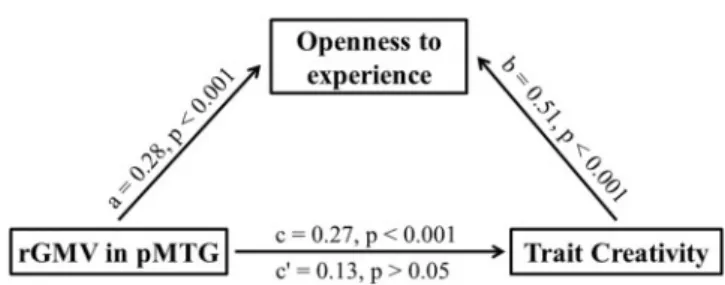
brains as covariates in the model, the mediation analysis showed that there was no significant effect of the right pMTG GMV on trait cre-ativity (¼0.13,P¼0.067) after including openness as a mediator in the model. In contrast, the direct relationship was significant (¼0.27,
P< 0.001). Bootstrap simulation (n¼10 000) further confirmed that this reduction (i.e. the indirect effect through openness) was statistic-ally significant (P< 0.05) with 95% confidence interval range from 0.07 to 0.24. That is, the mediation analysis confirmed our notion that the personality trait of openness partially mediated the correlation between the right pMTG volume and trait creativity (Figure 3).
DISCUSSIONS
In this study, we investigated the associations between brain structure and individual trait creativity as measured by the WCAT. Behavioral results showed that the total score of WCAT was related to three do-mains of personality: openness to experience, conscientiousness and extraversion. VBM results showed that the rGMV of the right pMTG/ ITG (BA21) was positively correlated with individual trait creativity, whereas the rGMV of the right PCG/pMFG (BA6) and the left lateral OFC (BA47) were inversely correlated with individual trait creativity. Interestingly, we found that openness to experience (as measured using the NEO-PI-R) partially mediated the relationship between the rGMV of right pMTG and trait creativity. These results indicate that the specific personality trait of openness to experience might play an im-portant role in shaping an individual’s trait creativity.
The relationship between creativity and personality has received a great deal of attention for a long time (Woodman, 1981; Feist, 1998; Ma, 2009). Obviously, certain cognitive ability and personality char-acteristic would modulate individual differences in creativity (Gibson
et al., 2009). Specifically, numerous studies consistently revealed that creativity had a positive association with openness to experience
(McCrae, 1987; King et al., 1996; Dollinger et al., 2004; Carson
et al., 2005; Miller and Tal, 2007). For example, Feist (1998) found that openness to experience was a distinguishing feature of creative people by contrasting scientists and nonscientists, more creative and less creative scientists, as well as artists and non-artists. In addition, conscientiousness had a positive relationship with scientific perform-ance and a negative one with artistic performperform-ance (Feist, 1999). As early as 1987, McCrae (1987) investigated the associations between creativity as measured by Creative Personality Scale (CPS; Gough, 1979) and personality and found a stronger relation between CPS score and openness than between CPS score and
extraversion/con-scientiousness. Moreover, Kinget al.(1996) found individual creative
ability as measured by TTCT verbal test also positively correlated with openness and extraversion. In this study, the strong correlation be-tween SWCAT and openness (0.53) was also consistent with these previous findings (Feist, 1998), and indicated that conscientiousness
and extraversion might indeed be important personality variables that influence an individual’s creativity.
It is suggested that increased rGMV in the right pMTG/ITG may contribute to higher trait creativity (e.g. curiosity and imagination) through ‘semantic processing’ functions that are associated with this
region (Dronkers et al., 2004; Binder et al., 2009; Turken and
Dronkers, 2011). That is, greater rGMV in the right pMTG in subjects with higher SWCAT might aid the generation of novel, unique con-nections between ideas. Many previous studies have indicated that the lateral temporal cortex (including the right pMTG) might play key roles in semantic processing such as metaphor understanding (the right posterior middle/superior temporal gyrus) (Goel and Dolan,
2001; Cardillo et al., 2012), semantic representation and control
(Badre et al., 2005; Whitneyet al., 2011), conceptual integration and comprehension (pMTG) (Hickok and Poeppel, 2004; Turken and Dronkers, 2011), and novel association (the right posterior superior temporal sulcus) (Jung-Beeman et al., 2004; Kro¨geret al., 2012). In
addition, Abraham et al. (2012) have recently stated that divergent
thinking could involve brain regions implicated in declarative memory and semantic cognition, such as the lateral inferior temporal cortex (BA 20/21), hippocampus and medial PFC (Cappa, 2008; Binder et al., 2009). Thus, our results indicate that individual differ-ences in trait creativity (e.g. curiosity and imagination) might be linked with rGMV variations in the right pMTG.
In 2005, Kaasinen et al. (2005) showed a positive correlation
be-tween rGMV in the temporal, parietal and frontal cortices, and self-transcendence as measured using the Temperament and Character Inventory. High scores on self-transcendence are related to open, un-usual and divergent thoughts, which might be similar to curiosity and imagination (novelty seeking), and their results suggested that high self-transcendence might be associated with relatively greater rGMV
in the middle temporal region (Kaasinen et al., 2005). Cha´vez-Eakle
et al. (2007) also found that subjects with high creative performance (originality, fluency and flexibility) showed greater cerebral blood flow in the ITG. In addition, investigations of word-generation found that the posterior temporal cortex might be related to object-concept rep-resentations and object category retrieval (novel ideas generation; Martin and Chao, 2001; Dobbins and Wagner, 2005). Moreover,
Whitneyet al.(2011) also indicated that the right posterior temporal
gyrus might be related to semantic representation and control during ambiguous semantic associations. Based on these findings, and our own results, we suggest that higher trait creativity (e.g. curiosity and imagination) might be associated with enhanced semantic processing skills (e.g. novel association and conceptual expansion), which may be positively correlated with the rGMV in the pMTG.
Moreover, lower rGMV in the PCG/pMFG (BA 6) and OFC (BA 47) in subjects with higher trait creativity might be associated with reduced response inhibition and increased intuitive thinking, leading to chal-lenge and risk-taking, which are two characteristics of trait creativity. Table 2 Brain regions significantly correlated with the SWCAT
Brain regions H BA Peak coordination (MNI) Cluster volume (mm3)
Z
x y z
Positive correlation
Middle temporal gyrus/ITG R 21 64 38 10 1176 3.59 Negative correlation
PCG/middle frontal gyrus R 6 44 6 44 1720 4.00 OFC/inferior frontal gyrus L 47 24 22 16 1064 4.03
H, hemisphere; L, left; R, right; BA, Brodmann area.
Fig. 3 Mediation analysis: the personality trait of openness to experience partially mediated the correlation between the rGMV of right pMTG and trait creativity.
at MPI Psycholinguistics on September 16, 2016
http://scan.oxfordjournals.org/
The PCG/pMFG (sometimes named the ‘inhibitory motor area’) (Kreitzer and Malenka, 2008; Brass et al., 2009; Kozasa et al., 2012) has been implicated in tasks that require stimulus-response
associ-ations. Westerhausen et al. (2010) also provided evidence that the
PCG/pMFG might be involved in the top-down control of attention processes (e.g. conflict-resolution, top-down and bottom-up process-ing bias integration) (Dwyeret al., 2009; Hill and Miller, 2010; Gautam
et al., 2011). The MFG might also play a role in working memory during the manipulation of actively maintained information (Bunge and Zelazo, 2006; Woodwardet al., 2006; DeYounget al., 2010). These findings suggest that the reduced rGMV in the PCG/pMFG revealed in this study might be associated with reduced inhibition control, which may be associated with particular characteristics of higher trait creativ-ity such as challenge and risk-taking. Additionally, a recent study found that the premotor region was a critical region for goal-directed actions (Gremel and Costa, 2013). Other fMRI studies also indicated that the premotor cortex is involved in diverse creative activities (Bengtssonet al., 2007; Cha´vez-Eakleet al., 2007; Aziz-Zadeh et al.,
2012). In addition, Mostofskyet al.(2002) found that boys with
at-tention-deficit/hyperactivity disorder (ADHD), which were known for being excessively impulsive, hyperactive and off-task (inattentive), had decreased volume in the premotor cortex. That is, decreased GMV in the PCG/pMFG might be associated with challenge and risk-taking actions during goal-directed process.
The OFC has been found to be related to the motivational control of goal-directed behavior (OFC activity signaled the expected rewards/
punishments of a choice) (Decety et al., 2004; Schoenbaum et al.,
2009; Plassmann et al., 2010), reversal learning (brain activations in the OFC reflected the disparity between the expected reward/punish-ment and the actual reward/punishreward/punish-ment) (Schoenbaum and Roesch,
2005; Rudebeck and Murray, 2008; Tsuchidaet al., 2010), and
auto-nomic function (inhibitory and excitatory) regulation (Cavada and Schultz, 2000). For example, some disorders of executive functioning
and impulse control, such as obsessive–compulsive disorder and
tri-chotillomania, may be affected by dysregulation within the OFC
(Tekin and Kircaali-Iftar, 2002; Menzies et al., 2008; Chamberlain
et al., 2009). In addition, Junget al.(2010) found that higher creative achievement (as measured using the CAQ) was associated with lower left lateral orbitofrontal volume, which might be related to novel goal-directed behavior (Rollset al., 2005). Recently, Takeuchiet al.(2012) also found that an individual’s need for uniqueness (associated with the intrinsic satisfaction derived from the individual’s perception of themselves as different from the masses) was correlated with smaller rGMV in the right inferior frontal gyrus and the ventral part of the PCG, which might be related to reduced response inhibition function. In fact, the OFC projects to the inferior frontal gyrus (Area 47) and belongs to the ventro-lateral PFC (VLPFC). Many previous studies have observed that the VLPFC is critical for creativity (Goel and Vartanian, 2005; Qiuet al., 2010). Specifically, the VLPFC is a brain region extending from the anterior premotor cortex (BA 6) to the posterior frontal pole (BA 10), which had been implicated in cogni-tively controlled access to relevant information from semantic memory (Petrides and Pandya, 2002; Croxsonet al., 2005). Together, our results and those of previous studies suggest that reduced rGMV in the PCG/ pMFG and the OFC might be associated with increased intuitive think-ing and risk-takthink-ing actions (reduced response inhibition and novel goal-directed behavior), and disrespect for social customs and rules.
Interestingly, this study found that openness to experience (a di-mension of the NEO-PI-R) can partially mediate the relationship be-tween the rGMV of the right pMTG and trait creativity (as measured using the WCAT). However, this mediation effect was not observed for the other factors of personality, such as extraversion and conscien-tiousness, which were also correlated with the SWCAT. Many previous
studies have indicated that openness to experience is a stable person-ality factor and that is strongly related to creativity in the real world (Funder, 2001; Huet al., 2011; Takiet al., 2013). For example, Soldz and Vaillant (1999) found that openness to experience scores were significantly correlated across 45 years in a sample of men. Our be-havioral data also showed that the score for openness to experience had a strongly significant correlation with the SWCAT. Based on previous findings (Graziano and Ward, 1992; Fleeson, 2001; Leeet al., 2005), we suggest that openness to experience might induce some particular pat-terns of cognitive processing associated with intuition, imagination, curiosity and fantasy through ‘semantic processing’ functions related to the right pMTG (Dronkerset al., 2004; Binderet al., 2009; Turken and Dronkers, 2011). That is, the basic personality features related to the trait of openness to experience might play an important role in shaping an individual’s trait creativity. Although we cannot determine the direction of causation between openness to experience, trait cre-ativity (based on the SWCAT) and the right pMTG volume, it might be hypothesized that the openness to experience capacity (which is stable and enduring in healthy adults) is associated with characteristics of trait creativity (e.g. curiosity, imagination and intuitive thinking), which enhances creative thinking and creative achievement. On the basis of this hypothesis, one could infer that the cultivation of the basic personality features of openness to experience in children and adolescents may increase an individual’s trait creativity and, thereby, facilitate divergent thinking and creative achievement.
CONCLUSION
This study used VBM to identify the GMV correlates of individual trait creativity as measured by the WCAT. We found a positive correlation between rGMV in the right pMTG and the SWCAT. In addition, rGMV in the PCG/pMFG and the OFC were negatively correlated with the SWCAT. These results indicate that higher trait creativity might be related to enhanced curiosity, imagination, challenge and risk-taking facilitated by semantic processing skills and reduced inhib-ition control. In addinhib-ition, we found that openness to experience par-tially mediated the relationship between the right pMTG volume and trait creativity. This specific personality trait may therefore play an important role in shaping an individual’s trait creativity. However, because we used young healthy college students with a high-level of education and mainly included right-handedness, our interpretations may have some limitations. In addition, we cannot determine the dir-ection of causation between openness to experience, trait creativity and the right pMTG volume. The implementation of longitudinal or inter-vention studies may help to elucidate the complex relationships be-tween openness to experience, trait creativity and brain structure further.
REFERENCES
Abraham, A., Pieritz, K., Thybusch, K., et al. (2012). Creativity and the brain: uncovering the neural signature of conceptual expansion.Neuropsychologia,50(8), 1906–17. Aguilar-Alonso, A. (1996). Personality and creativity.Personality and Individual Differences,
21(6), 959–69.
Amabile, T.M. (1996).Creativity in Context. New York: Westview.
Arden, R., Chavez, R.S., Grazioplene, R., Jung, R.E. (2010). Neuroimaging creativity: a psychometric view.Behavioural Brain Research,214(2), 143–56.
Ashburner, J. (2007). A fast diffeomorphic image registration algorithm.Neuroimage,
38(1), 95–113.
Ashburner, J., Friston, K.J. (2000). Voxel-based morphometrythe methods.Neuroimage,
11(6), 805–21.
Ashburner, J., Friston, K.J. (2005). Unified segmentation.Neuroimage,26(3), 839–51. Aziz-Zadeh, L., Liew, S.L., Dandekar, F. (2013). Exploring the neural correlates of visual
creativity.Social Cognitive and Affective Neuroscience,8(4), 475–480.
Badre, D., Poldrack, R.A., Pare-Blagoev, E.J., Insler, R.Z., Wagner, A.D. (2005). Dissociable controlled retrieval and generalized selection mechanisms in ventrolateral prefrontal cortex.Neuron,47(6), 907–18.
at MPI Psycholinguistics on September 16, 2016
http://scan.oxfordjournals.org/
Bengtsson, S.L., Csı´kszentmiha´lyi, M., Ulle´n, F. (2007). Cortical regions involved in the generation of musical structures during improvisation in pianists.Journal of Cognitive Neuroscience,19(5), 830–42.
Binder, J.R., Desai, R.H., Graves, W.W., Conant, L.L. (2009). Where is the semantic system? A critical review and meta-analysis of 120 functional neuroimaging studies.Cerebral Cortex,19(12), 2767–96.
Bowden, E.M., Jung-Beeman, M., Fleck, J., Kounios, J. (2005). New approaches to demys-tifying insight.Trends in Cognitive Sciences,9(7), 322–8.
Brass, M., Wenke, D., Spengler, S., Waszak, F. (2009). Neural correlates of overcoming interference from instructed and implemented stimulus–response associations. The Journal of Neuroscience,29(6), 1766–72.
Bunge, S.A., Zelazo, P.D. (2006). A brain-based account of the development of rule use in childhood.Current Directions in Psychological Science,15(3), 118–21.
Cai, X., Zhu, Y. (2007). The correlation of adolescent’s creative inclination, intelligence and academic achievement.Psychological Development and Education,23(2), 36–41. Cappa, S.F. (2008). Imaging studies of semantic memory.Current Opinion in Neurology,
21(6), 669–75.
Cardillo, E.R., Watson, C.E., Schmidt, G.L., Kranjec, A., Chatterjee, A. (2012). From novel to familiar: tuning the brain for metaphors.Neuroimage,59(4), 3212–21.
Carson, S.H., Peterson, J.B., Higgins, D.M. (2005). Reliability, validity, and factor structure of the creative achievement questionnaire.Creativity Research Journal,17(1), 37–50. Cassandro, V.J., Simonton, D.K. (2010). Versatility, openness to experience, and topical
diversity in creative products: an exploratory historiometric analysis of scientists, phil-osophers, and writers.The Journal of Creative Behavior,44(1), 9–26.
Cavada, C., Schultz, W. (2000). The mysterious orbitofrontal cortex. Foreword.Cerebral Cortex,10(3), 205–205.
Chamberlain, S.R., Hampshire, A., Mu¨ller, U., et al. (2009). Atomoxetine modulates right inferior frontal activation during inhibitory control: a pharmacological functional mag-netic resonance imaging study.Biological Psychiatry,65(7), 550–5.
Chamorro-Premuzic, T., Reichenbacher, L. (2008). Effects of personality and threat of evaluation on divergent and convergent thinking.Journal of Research in Personality,
42(4), 1095–101.
Chan, K.W. (2005).Creative Teaching and Learning. Hong Kong: Infolink Publishing Ltd. Cha´vez-Eakle, R.A., Graff-Guerrero, A., Garcı´a-Reyna, J.-C., Vaugier, V., Cruz-Fuentes, C. (2007). Cerebral blood flow associated with creative performance: a comparative study.
NeuroImage,38(3), 519–28.
Claxton, A.F., Pannells, T.C., Rhoads, P.A. (2005). Developmental trends in the creativity of school-age children.Creativity Research Journal,17(4), 327–35.
Colom, R., Jung, R.E., Haier, R.J. (2006). Distributed brain sites for the g-factor of intel-ligence.NeuroImage,31(3), 1359–65.
Costa, P.T., McCrae, R.R. (1992).Professional Manual: Revised NEO Personality Inventory (NEO-PI-R) and NEO Five-Factor Inventory (NEO-FFI). Odessa, FL: Psychological Assessment Resources.
Costa, P.T., McCrae, R.R. (1995). Domains and facets: hierarchical personality assessment using the Revised NEO Personality Inventory.Journal of Personality Assessment,64(1), 21–50.
Cox, R.W. (1996). AFNI: software for analysis and visualization of functional magnetic resonance neuroimages.Computers and Biomedical Research,29(3), 162–73. Croxson, P.L., Johansen-Berg, H., Behrens, T.E., et al. (2005). Quantitative investigation of
connections of the prefrontal cortex in the human and macaque using probabilistic diffusion tractography.Journal of Neuroscience,25(39), 8854–66.
Davis, G.A. (1992).Creativity Is Forever,3rd edn. Dubuque, IA: Kendall/Hunt. Decety, J., Jackson, P.L., Sommerville, J.A., Chaminade, T., Meltzoff, A.N. (2004). The
neural bases of cooperation and competition: an fMRI investigation. Neuroimage,
23(2), 744–51.
DeYoung, C.G., Hirsh, J.B., Shane, M.S., Papademetris, X., Rajeevan, N., Gray, J.R. (2010). Testing predictions from personality neuroscience: brain structure and the Big Five.
Psychological Science,21(6), 820–8.
Dietrich, A. (2004). The cognitive neuroscience of creativity. Psychonomic Bulletin & Review,11(6), 1011–26.
Dietrich, A., Kanso, R. (2010). A review of EEG, ERP, and neuroimaging studies of cre-ativity and insight.Psychological Bulletin,136(5), 822–48.
Digman, J.M. (1990). Personality structure: emergence of the five-factor model.Annual Review of Psychology,41(1), 417–40.
Ding, H., Qin, W., Jiang, T., Zhang, Y., Yu, C. (2012). Volumetric variation in subregions of the cerebellum correlates with working memory performance.Neuroscience Letters,
508(1), 47–51.
Dobbins, I.G., Wagner, A.D. (2005). Domain-general and domain-sensitive prefrontal mechanisms for recollecting events and detecting novelty. Cerebral Cortex,15(11), 1768–78.
Dollinger, S.J., Urban, K.K., James, T.A. (2004). Creativity and openness: further validation of two creative product measures.Creativity Research Journal,16(1), 35–47. Dronkers, N.F., Wilkins, D.P., Van Valin, R.D., Jr, Redfern, B.B., Jaeger, J.J. (2004). Lesion
analysis of the brain areas involved in language comprehension. Cognition,92(1–2), 145–77.
Dwyer, L., Edwards, D., Mistilis, N., Roman, C., Scott, N. (2009). Destination and enter-prise management for a tourism future.Tourism Management,30(1), 63–74.
Ellamil, M., Dobson, C., Beeman, M., Christoff, K. (2012). Evaluative and generative modes of thought during the creative process.NeuroImage,59(2), 1783–94.
Eysenck, H.J. (1997). Creativity and personality. In: Runco, M., editor.The Creativity Research Handbook. Cresskill, NJ: Hampton Press, pp. 41–6.
Farb, Norman A. S., Grady, Cheryl L., Strother, Stephen, Tang-Wai, David F., Masellis, Mario, Black, Sandra, et al. (2013). Abnormal network connectivity in frontotemporal dementia: Evidence for prefrontal isolation.Cortex,49(7), 1856–73.
Feist, G.J. (1998). A meta-analysis of personality in scientific and artistic creativity.
Personality and Social Psychology Review,2(4), 290–309.
Feist, G.J. (1999). The influence of personality on artistic and scientific creativity. In: Sternberg, R.J., editor. Handbook of Creativity. Cambridge, UK: Cambridge University Press, pp. 273–96.
Fekken, G.C. (1985). Barron-Welsh Art Scale. In: Sweetland, D.J.K.R.C., editor. Test Critiques, Vol. IV. Kansas City, MO: Test Corporation of America, pp. 58–67. Fink, A., Graif, B., Neubauer, A.C. (2009). Brain correlates underlying creative thinking:
EEG alpha activity in professional vs. novice dancers.NeuroImage,46(3), 854–62. Fleeson, W. (2001). Toward a structure- and process-integrated view of personality: traits
as density distribution of states.Journal of Personality and Social Psychology,80(6), 1011–27.
Funder, D.C. (2001). Personality.Annual Review of Psychology,52, 197–221.
Furnham, A., Crump, J., Batey, M., Chamorro-Premuzic, T. (2009). Personality and ability predictors of the “Consequences” Test of divergent thinking in a large non-student sample.Personality and Individual Differences,46(4), 536–40.
Gansler, D.A., Moore, D.W., Susmaras, T.M., Jerram, M.W., Sousa, J., Heilman, K.M. (2011). Cortical morphology of visual creativity.Neuropsychologia,49(9), 2527–32. Gautam, S., Sood, A.D., Puri, R.K., Aichelin, J. (2011). Sensitivity of the transverse flow to
the symmetry energy.Physical Review C,83(3), 034606.
Gibson, C., Folley, B.S., Park, S. (2009). Enhanced divergent thinking and creativity in musicians: a behavioral and near-infrared spectroscopy study. Brain and Cognition,
69(1), 162–9.
Goel, V., Dolan, R.J. (2001). The functional anatomy of humor: segregating cognitive and affective components.Nature Neuroscience,4(3), 237–8.
Goel, V., Vartanian, O. (2005). Dissociating the roles of right ventral lateral and dorsal lateral prefrontal cortex in generation and maintenance of hypotheses in set-shift prob-lems.Cerebral Cortex,15(8), 1170–7.
Good, C.D., Johnsrude, I., Ashburner, J., Henson, R.N.A., Friston, K.J., Frackowiak, R.S.J. (2001). Cerebral asymmetry and the effects of sex and handedness on brain structure: a voxel-based morphometric analysis of 465 normal adult human brains.NeuroImage,
14(3), 685–700.
Gough, H.G. (1979). A creative personality scale for the Adjective Check List.Journal of Personality and Social Psychology,37(8), 1398.
Graziano, W.G., Ward, D. (1992). Probing the Big Five in adolescence: personality and adjustment during a developmental transition.Journal of Personality,60(2), 425–39.
Gremel, C., Costa, R. (2013). Premotor cortex is critical for goal-directed actions.Frontiers in Computational Neuroscience,7, 110.
Hickok, G., Poeppel, D. (2004). Dorsal and ventral streams: a framework for understanding aspects of the functional anatomy of language.Cognition,92(1–2), 67–99.
Hill, K.T., Miller, L.M. (2010). Auditory attentional control and selection during cocktail party listening.Cerebral Cortex,20(3), 583–90.
Hoseinifar, J., Siedkalan, M.M., Zirak, S.R., et al. (2011). An investigation of the relation between creativity and five factors of personality in students. ProcediaSocial and Behavioral Sciences,30, 2037–41.
Hu, X., Erb, M., Ackermann, H., Martin, J.A., Grodd, W., Reiterer, S.M. (2011). Voxel-based morphometry studies of personality: issue of statistical model specificationeffect of nuisance covariates.Neuroimage,54(3), 1994–2005.
Hwang, W.Y., Chen, N., Dung, J., Yang, Y. (2007). Multiple representation skills and creativity effects on mathematical problem solving using a multimedia whiteboard system.Educational Technology and Society,10(2), 191.
Jung, R.E., Haier, R.J. (2007). The parieto-frontal integration theory (P-FIT) of intelligence: converging neuroimaging evidence.Behavioral and Brain Sciences,30(2), 135–54. Jung, R.E., Mead, B.S., Carrasco, J., Flores, R.A. (2013). The structure of creative cognition
in the human brain.Frontiers in Human Neuroscience,7, 330.
Jung, R.E., Segall, J.M., Jeremy Bockholt, H., et al. (2010). Neuroanatomy of creativity.
Human Brain Mapping,31(3), 398–409.
Jung-Beeman, M., Bowden, E.M., Haberman, J., et al. (2004). Neural activity when people solve verbal problems with insight.PLoS Biology,2(4), e97.
Kaasinen, V., Maguire, R.P., Kurki, T., Bru¨ck, A., Rinne, J.O. (2005). Mapping brain structure and personality in late adulthood.Neuroimage,24(2), 315–22.
Kanai, R., Rees, G. (2011). The structural basis of inter-individual differences in human behaviour and cognition.Nature Reviews Neuroscience,12(4), 231–42.
King, L.A., Walker, L.M., Broyles, S.J. (1996). Creativity and the five-factor model.Journal of Research in Personality,30(2), 189–203.
Knoch, D., Gianotti, L.R.R., Pascual-Leone, A., et al. (2006). Disruption of right prefrontal cortex by low-frequency repetitive transcranial magnetic stimulation induces risk-taking behavior.The Journal of Neuroscience,26(24), 6469–72.
at MPI Psycholinguistics on September 16, 2016
http://scan.oxfordjournals.org/
Kong, L., Chen, K., Womer, F., et al. (2013). Sex differences of gray matter morphology in cortico-limbic-striatal neural system in major depressive disorder.Journal of Psychiatric Research,47(6), 733–9.
Kozasa, E.H., Sato, J.R., Lacerda, S.S., et al. (2012). Meditation training increases brain efficiency in an attention task.Neuroimage,59(1), 745–9.
Krain, A.L., Wilson, A.M., Arbuckle, R., Castellanos, F.X., Milham, M.P. (2006). Distinct neural mechanisms of risk and ambiguity: a meta-analysis of decision-making.
Neuroimage,32(1), 477–84.
Kreitzer, A.C., Malenka, R.C. (2008). Striatal plasticity and basal ganglia circuit function.
Neuron,60(4), 543.
Kro¨ger, S., Rutter, B., Stark, R., Windmann, S., Hermann, C., Abraham, A. (2012). Using a shoe as a plant pot: neural correlates of passive conceptual expansion.Brain Research,
1430, 52–61.
Lee, K., Ogunfowora, B., Ashton, M.C. (2005). Personality traits beyond the Big Five: are they within the HEXACO space?Journal of Personality,73(5), 1437–63.
Lin, C., Wang, M. (1994).The Creativity Assessment Packet. Taipei, Taiwan: Psychological Publishing.
Liu, M.-J., Shih, W.-L., Ma, L.-Y. (2011). Are children with Asperger syndrome creative in divergent thinking and feeling? A brief report.Research in Autism Spectrum Disorders,
5(1), 294–8.
Ma, H.H. (2009). The effect size of variables associated with creativity: a meta-analysis.
Creativity Research Journal,21(1), 30–42.
Maker, C.J., Schiever, S.W. (2005).Teaching Models in Education of the Gifted. Austin, TX: PRO-ED, Incorporated.
Martin, A., Chao, L.L. (2001). Semantic memory and the brain: structure and processes.
Current Opinion in Neurobiology,11(2), 194–201.
McCrae, R.R. (1987). Creativity, divergent thinking, and openness to experience.Journal of Personality and Social Psychology,52(6), 1258.
Menzies, L., Chamberlain, S.R., Laird, A.R., Thelen, S.M., Sahakian, B.J., Bullmore, E.T. (2008). Integrating evidence from neuroimaging and neuropsychological studies of ob-sessive-compulsive disorder: the orbitofronto-striatal model revisited.Neuroscience & Biobehavioral Reviews,32(3), 525–49.
Miller, A.L. (2009). Cognitive processes associated with creativity scale development and validation. (Doctoral dissertation, Ball State University).
Miller, G.F., Tal, I.R. (2007). Schizotypy versus openness and intelligence as predictors of creativity.Schizophrenia Research,93(1–3), 317–24.
Moore, D.W., Bhadelia, R.A., Billings, R.L., et al. (2009). Hemispheric connectivity and the visual–spatial divergent-thinking component of creativity.Brain and Cognition,70(3), 267–72.
Mostofsky, S.H., Cooper, K.L., Kates, W.R., Denckla, M.B., Kaufmann, W.E. (2002). Smaller prefrontal and premotor volumes in boys with attention-deficit/hyperactivity disorder.Biological Psychiatry,52(8), 785–94.
Oldham, G.R., Cummings, A. (1996). Employee creativity: personal and contextual factors at work.Academy of Management Journal,39(3), 607–34.
Ortet, G., Iba´n˜ez, M.I., Moya, J., Villa, H., Viruela, A., Mezquita, L. (2012). Assessing the five factors of personality in adolescents the junior version of the Spanish NEO-PI-R.
Assessment,19(1), 114–30.
Petrides, M., Pandya, D.N. (2002). Association pathways of the prefrontal cortex and functional observations. In: Stuss, D.T., Knight, R.T., editors.Principles of frontal lobe function. New York, NY, US: Oxford University Press, pp. 31–50.
Piffer, D. (2012). Can creativity be measured? An attempt to clarify the notion of creativity and general directions for future research.Thinking Skills and Creativity,7(3), 258–64. Plassmann, H., O’Doherty, J.P., Rangel, A. (2010). Appetitive and aversive goal values are encoded in the medial orbitofrontal cortex at the time of decision making.The Journal of Neuroscience,30(32), 10799–808.
Preacher, K.J., Hayes, A.F. (2008). Asymptotic and resampling strategies for assessing and comparing indirect effects in multiple mediator models.Behavior Research Methods,
40(3), 879–91.
Qiu, J., Li, H., Jou, J., et al. (2010). Neural correlates of the “Aha” experiences: evidence from an fMRI study of insight problem solving.Cortex,46(3), 397–403.
Raven, J., Raven, J.C., Court, J.H. (1998).Manual for Raven’s Progressive Matrices and Vocabulary Scales. Section 4: The Advanced Progressive Matrices. San Antonio, TX: Harcourt Assessment.
Rhodes, M. (1961). An analysis of creativity.The Phi Delta Kappan,42(7), 305–10. Rolls, E.T., Browning, A.S., Inoue, K., Hernadi, I. (2005). Novel visual stimuli activate a
population of neurons in the primate orbitofrontal cortex.Neurobiology of Learning and Memory,84, 111–23.
Rudebeck, P.H., Murray, E.A. (2008). Amygdala and orbitofrontal cortex lesions differen-tially influence choices during object reversal learning.The Journal of Neuroscience,
28(33), 8338–43.
Runco, M.A. (2007).Creativity: Theories and Themes: Research, Development, and Practice. Amsterdam: Elsevier Academic Press.
Satzinger, J.W., Garfield, M.J., Nagasundaram, M. (1999). The creative process: the effects of group memory on individual idea generation.Journal of Management Information Systems,15(4), 143–60.
Schoenbaum, G., Roesch, M. (2005). Orbitofrontal cortex, associative learning, and expec-tancies.Neuron,47(5), 633–6.
Schoenbaum, G., Roesch, M.R., Stalnaker, T.A., Takahashi, Y.K. (2009). A new perspective on the role of the orbitofrontal cortex in adaptive behaviour. Nature Reviews Neuroscience,10(12), 885–92.
Schwartz, D.L., Mitchell, A.D., Lahna, D.L., et al. (2010). Global and local morphometric differences in recently abstinent methamphetamine-dependent individuals.NeuroImage,
50(4), 1392–401.
Shobe, E.R., Ross, N.M., Fleck, J.I. (2009). Influence of handedness and bilateral eye move-ments on creativity.Brain and Cognition,71(3), 204–14.
Silver, M., Montana, G., Nichols, T.E. (2011). False positives in neuroimaging genetics using voxel-based morphometry data.NeuroImage,54(2), 992–1000.
Soldz, S., Vaillant, G.E. (1999). The Big Five personality traits and the life course: a 45-year longitudinal study.Journal of Research in Personality,33(2), 208–32.
Sternberg, R.J. (1999).Handbook of Creativity. New York: Cambridge University Press. Sternberg, R.J., Lubart, T.I. (1993). Investing in creativity.Psychological Inquiry,4(3),
229–32.
Takeuchi, H., Sekiguchi, A., Taki, Y., et al. (2010a). Training of working memory impacts structural connectivity.The Journal of Neuroscience,30(9), 3297–303.
Takeuchi, H., Taki, Y., Hashizume, H., et al. (2011). Failing to deactivate: the association between brain activity during a working memory task and creativity.NeuroImage,55(2), 681–7.
Takeuchi, H., Taki, Y., Nouchi, R., et al. (2012). A voxel-based morphometry study of gray and white matter correlates of a need for uniqueness.NeuroImage,63(3), 1119–26. Takeuchi, H., Taki, Y., Sassa, Y., et al. (2010b). Regional gray matter volume of
dopamin-ergic system associate with creativity: evidence from voxel-based morphometry.
NeuroImage,51(2), 578–85.
Taki, Y., Thyreau, B., Kinomura, S., et al. (2013). A longitudinal study of the relationship between personality traits and the annual rate of volume changes in regional gray matter in healthy adults.Human Brain Mapping,34(12), 3347–53.
Tekin, E., Kircaali-Iftar, G. (2002). Comparison of the effectiveness and efficiency of two response prompting procedures delivered by sibling tutors.Education and Training in Mental Retardation and Developmental Disabilities,37(3), 283–99.
Tsuchida, A., Doll, B.B., Fellows, L.K. (2010). Beyond reversal: a critical role for human orbitofrontal cortex in flexible learning from probabilistic feedback.The Journal of Neuroscience,30(50), 16868–75.
Turken, A.U., Dronkers, N.F. (2011). The neural architecture of the language comprehen-sion network: converging evidence from lecomprehen-sion and connectivity analyses.Frontiers in Systems Neuroscience,5, 1.
Ward, B.D. (2000). Simultaneous inference for fMRI data. AFNI 3dDeconvolve Documentation. Medical College of Wisconsin [cited; Available from: http://afni.nimh. nih.gov/pub/dist/doc/manual/AlphaSim.pdf.
Westerhausen, R., Moosmann, M., Alho, K., et al. (2010). Identification of attention and cognitive control networks in a parametric auditory fMRI study.Neuropsychologia,
48(7), 2075–81.
Whitney, C., Jefferies, E., Kircher, T. (2011). Heterogeneity of the left temporal lobe in semantic representation and control: priming multiple versus single meanings of am-biguous words.Cerebral Cortex,21(4), 831–44.
Williams, F.E. (1969). Models for encouraging creativity in the classroom by integrating cognitive–affective behaviors.Educational Technology,9(12), 7–13.
Williams, F.E. (1980).Creativity Assessment Packet (CAP): manual. Buffalo, New York: DOK Publishers.
Williams, F.E. (1993).Creativity Assessment Packet Examiner’s Manual. Austin, TX: PRO-ED.
Woodman, R.W. (1981). Creativity as a construct in personality theory.The Journal of Creative Behavior,15(1), 43–66.
Woodward, T.S., Cairo, T.A., Ruff, C.C., Takane, Y., Hunter, M.A., Ngan, E.T.C. (2006). Functional connectivity reveals load dependent neural systems underlying encoding and maintenance in verbal working memory.Neuroscience,139(1), 317–25.
Yang, F.-C., Chou, K.-H., Fuh, J.-L., et al. (2013). Altered gray matter volume in the frontal pain modulation network in patients with cluster headache.Pain,154(6), 801–7. Zeng, L., Salvendy, G., Zhang, M. (2009). Factor structure of web site creativity.Computers
in Human Behavior,25(2), 568–77.
Zou, L., Ding, G., Abutalebi, J., Shu, H., Peng, D. (2012). Structural plasticity of the left caudate in bimodal bilinguals.Cortex,48(9), 1197–206.
at MPI Psycholinguistics on September 16, 2016
http://scan.oxfordjournals.org/