thesis, University of Nottingham.
Access from the University of Nottingham repository:
http://eprints.nottingham.ac.uk/10292/1/DSK-PhDThesisComplete.pdf
Copyright and reuse:
The Nottingham ePrints service makes this work by researchers of the University of
Nottingham available open access under the following conditions.
·
Copyright and all moral rights to the version of the paper presented here belong to
the individual author(s) and/or other copyright owners.
·
To the extent reasonable and practicable the material made available in Nottingham
ePrints has been checked for eligibility before being made available.
·
Copies of full items can be used for personal research or study, educational, or
not-for-profit purposes without prior permission or charge provided that the authors, title
and full bibliographic details are credited, a hyperlink and/or URL is given for the
original metadata page and the content is not changed in any way.
·
Quotations or similar reproductions must be sufficiently acknowledged.
Please see our full end user licence at:
http://eprints.nottingham.ac.uk/end_user_agreement.pdf
A note on versions:
The version presented here may differ from the published version or from the version of
record. If you wish to cite this item you are advised to consult the publisher’s version. Please
see the repository url above for details on accessing the published version and note that
access may require a subscription.
Turn It This Way: Remote Gesturing in Video-Mediated
Communication
David Stanley Kirk, BSc (Hons), MSc
Thesis submitted to the University of Nottingham
for the degree of Doctor of Philosophy
Collaborative physical tasks are working tasks characterised by workers „in-the-field‟ who manipulate task artefacts under the guidance of a remote expert. Examples of such interactions include paramedics requiring field-surgery consults from hospital surgeons, soldiers requiring support from distant bomb-disposal experts, technicians inspecting and repairing machinery under the guidance of a chief engineer or scientists examining artefacts with distributed colleagues. This thesis considers the design of technology to support such forms of distributed working. Early research in video-mediated communication (VMC) which sought to support such interactions presumed video links between remote spaces would improve collaboration. The results of these studies however, demonstrated that in such tasks audio-video links alone were unlikely to improve performance beyond that achievable by simpler audio-only links. In explanation of these observations a reading of studies of situated collaborative working practices suggests that to support distributed object-focussed interactions it is beneficial to not only provide visual access to remote spaces but also to present within the task-space the gestural actions of remote collaborators. Remote Gestural Simulacra are advanced video-mediated communication tools that enable remote collaborators to both see and observably point at and gesture around and towards shared task artefacts located at another site. Technologies developed to support such activities have been critiqued; their design often fractures the interaction between the collaborating parties, restricting access to aspects of communication which are commonly used in co-present situations to coordinate interaction and ground understanding.
This thesis specifically explores the design of remote gesture tools, seeking to understand how remote representations of gesture can be used during collaborative physical tasks. In a series of lab-based studies, the utility of remote gesturing is investigated, both qualitatively, examining its collaborative function and quantitatively exploring its impact on both facets of task performance and collaborative language. The thesis also discusses how the configuration of remote gesture tools impacts on their usability, empirically comparing various gesture tool designs. The thesis constructs and examines an argument that remote gesture tools should be
designed from a „mixed ecologies‟ perspective (theoretically alleviating the problems engendered by „fractured ecologies‟) in which collaborating partners are given access to the most salient and relevant features of communicative action that are utilised in face-to-face interaction, namely mutual and reciprocal awareness of commonly understood object-focussed actions (hand-based gestures) and mutual and reciprocal awareness of task-space perspectives. The thesis demonstrates experimental support for this position and concludes by presenting discussion of how the findings generated from the thesis research can be used to guide the design of future iterations of remote gesture tools, and presents directions for areas of further research.
At the time of submission, several sections of work from this thesis have previously appeared (or are scheduled to appear) in peer-reviewed publications as long papers. In the following list the full references for these publications are given.
Kirk, D. S., Rodden, T. & Stanton Fraser, D. (2007) Turn It This Way: Grounding Collaborative Action with Remote Gestures. In Proceedings of CHI Conference on Human Factors in Computing Systems, 28th April-3rd May, ACM: San Jose, CA, pp. 1039-1048
Kirk, D. S., & Stanton Fraser, D. (2006) Comparing Remote Gesture Technologies for Supporting Collaborative Physical Tasks. In Proceedings of CHI Conference on Human Factors in Computing Systems, 22-27 April, ACM: Montreal, Canada, pp. 1191-1200
Kirk, D. S., Crabtree, A., & Rodden, T. (2005) Ways of the Hand. In Proceedings of the Ninth European Conference on Computer-Supported Cooperative Work (ECSCW), 18-22 September 2005, Springer: Paris, France, pp. 1-21
Kirk, D. S., & Stanton Fraser, D. (2005) The Impact of Remote Gesturing on Distance Instruction. 1 In Proceedings of the International Conference on Computer Supported Collaborative Learning (CSCL) 2005,LEA: Taipei, Taiwan, pp. 301-310
The research results of this thesis are presented through chapters 4 – 7. The experimental comparison of remote gesturing versus non-gesturing communication (chapter 4, section 4.2) is highlighted in Kirk, Rodden and Stanton Fraser (2007). The analysis of the learning effects of remote gesture system use (chapter 4, section 4.3) is discussed in Kirk and Stanton Fraser (2005). The analytical comparison of differing gesture formats and locations in gesture systems (chapter 5, section 5.3) is presented in Kirk and Stanton Fraser (2006). The role of hand gestures in remote collaboration (chapter 6) is detailed and discussed in Kirk, Crabtree and Rodden (2005) and the impact of remote gesturing on collaborative language (chapter 7) forms the main focus of Kirk, Rodden and Stanton Fraser (2007).
1
There are several people I would like to acknowledge who have helped me in various ways whilst I completed this thesis. First off I would like to thank the Mixed Reality Lab for hosting me for three and a half years and for giving me the space to work when I needed to take over chunks of the lab to run experiments. I would also very much like to thank the Equator IRC for giving me the funding to pay for these experiments, to do the research generally and to fly around the world presenting the results.
Academically, I would like to thank Dr. Mike Fraser, for pointing me in the direction of some useful literature in the very early days, and for uknowingly letting me use his thesis for three
years as a general guide on „how to write a phd‟. I‟d also like to thank Dr. Andy Crabtree for
broadening my horizons by introducing me to different perspectives on my work and also for introducing me to stellar terminology such as „phenomenal coherence‟.
There are however, two academics to whom I owe particular thanks. Firstly, I wish to thank Dr. Danaë Stanton Fraser for being my first supervisor and getting me started in my research, and for keeping up an interest in me and my work even after the move to Bath, the new projects, the promotions and the new family. She has been a very supportive supervisor. Secondly, I wish to thank my principal supervisor Prof. Tom Rodden, truly the smartest man I know, who has helped me in inumerable ways. He has taught me what it means to be an academic and a researcher, gifted me with a strong set of research ethics and without his
advice, encouragement, discussion of critical concepts and timely „critique‟ of the work, this
thesis would not be what it is now.
Personally, I wish to thank my family for always being there for me, in particular my Mum and Dad, who may not have always understood what I was doing but were always keen to see me do well none-the-less, in part this thesis is for them.
Lastly and most importantly I wish to thank Lizzy, my wife-to-be, for putting up with me for soo long. She knew far better than me when I should actually be doing some work, and perhaps more importantly at times, when I should actually stop. Without her encouragement and making me plan I would probably have gone mad and simply never have managed to finish this thesis. To her I owe everything.
Abstract i Published Works ii Acknowledgements iii Contents iv Detailed Contents vi List of Figures x
List of Tables xiii
Chapter 1 – Introduction
1.1 Introduction 1
1.2 Research Background 4
1.3 Problem Statement and Research Hypothesis 7
1.4 Thesis Overview 8
1.5 Thesis Contributions 10
Chapter 2 – Literature Review
2.1 Introduction 12
2.2 Ecologies of Communication in the Workplace 12
2.3 Studies of Video-Mediated Communication (VMC) 14
2.4 Shared Visual Spaces 27
2.5 Collaborative Design 31
2.6 Designing Remote Gesture Tools for Collaborative Physical Tasks 43
2.7 Summary and Conclusions 65
Chapter 3 – Research Methodology and Disposition
3.1 Introducing Mixed Ecologies of Communication 68
3.2 Research Questions 69
3.3 A Choice of Research Methodologies 72
3.4 Frameworks of Data Analysis 75
3.5 A Remote Gesture Technology for Experimentation 77
3.6 Chapter Summary 87
Chapter 4 – Some Effects of Remote Gesturing
4.1 Introduction 89
4.2 Comparing Remote Gesture vs. Voice Only Communication 92
Chapter 5 – How Best to Construct Remote Gestures
5.1 Introduction 117
5.2 Gesture Orientations 119
5.3 Gesture Format and Location 128
5.4 Discussion 142
5.5 Chapter Summary 146
Chapter 6 – The Communicative Functions of Gesturing
6.1 Introduction 148
6.2 Study Methodology 149
6.3 Functions of Hand-Based Gesturing 151
6.4 Functions of Hands and Sketch Gesturing 162
6.5 Functions of Sketch Only Gesturing 172
6.6 The Nature of Remote Gesture – Some Conclusions 176
6.7 Chapter Summary 181
Chapter 7 – How Gesture Interacts with Language
7.1 Introduction 182
7.2 Understanding Common Grounding and Remote Gesture 182
7.3 Study Methodology 186 7.4 Results 188 7.5 Discussion 204 7.6 Chapter Summary 208 Chapter 8 – Conclusions 8.1 Introduction 209
8.2 Re-Stating the Problem 209
8.3 Reflecting on Mixed Ecologies 211
8.4 Implications for the Design and Deployment of Remote Gesture Tools 218
8.5 A Program of Future Work 224
References 228
Abstract i Published Works ii Acknowledgements iii Contents iv Detailed Contents vi List of Figures x
List of Tables xiii
Chapter 1
–
Introduction
1.1 Introduction 1
1.2 Research Background 4
1.3 Problem Statement and Research Hypothesis 7
1.4 Thesis Overview 8
1.5 Thesis Contributions 10
Chapter 2
–
Literature Review
2.1 Introduction 12
2.2 Ecologies of Communication in the Workplace 12
2.3 Studies of Video-Mediated Communication (VMC) 14
2.3.1 Technologies for VMC 14
2.3.2 Analytical approaches to VMC 19
2.3.2.1 Experimental studies 20
2.3.2.2 Living with technology 23
2.3.2.3 Field studies ` 23
2.3.2.4 Hybrid approaches 25
2.3.3 Conflicts and conclusions for VMC 26
2.4 Shared Visual Spaces 27
2.5 Collaborative Design 31
2.5.1 Observation studies of design teams 31
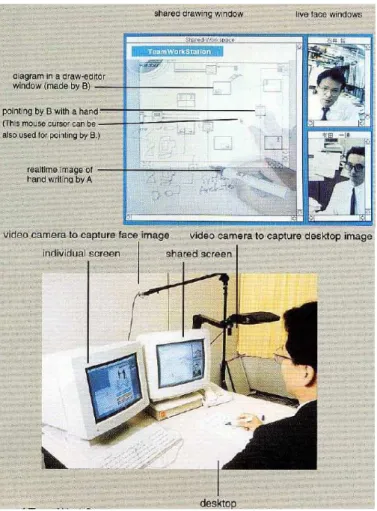
2.5.2 Commune 33 2.5.3 VideoDraw 35 2.5.4 TeamWorkStation 36 2.5.5 VideoWhiteboard 38 2.5.6 Clearboard 39 2.5.7 The DigitalDesk 40
2.5.8 VideoArms, Digital Arm Shadows and Mixed presence Groupware 41 2.5.9 Conclusions from collaborative design technologies 42 2.6 Designing Remote Gesture Tools for Collaborative Physical Tasks 43
2.6.1 Developing the GestureMan 43
2.6.2 Developing the WACL (Wearable Active Camera/Laser) 52 2.6.3 Developing DOVE (Drawing Over Video Environment) 53 2.6.4 Developing collaborative augmented reality and TUIs 64
2.7 Summary and Conclusions 65
Chapter 3
–
Research Methodology and Disposition
3.1 Introducing Mixed Ecologies of Communication 68
3.2 Research Questions 69
3.3 A Choice of Research Methodologies 72
3.4 Frameworks of Data Analysis 75
3.5 A Remote Gesture Technology for Experimentation 77
3.5.1 Basic system set-up 77
3.5.2 System re-configurations 81
4.2 Comparing Remote Gesture vs. Voice Only Communication 92 4.2.1 Study methodology 92 4.2.1.1 Experimental design 92 4.2.1.2 Participants 92 4.2.1.3 Equipment 93 4.2.1.4 Materials 93 4.2.1.5 Procedure 93 4.2.1.6 Problems encountered 94 4.2.1.7 Statistical analysis 94 4.2.2 Results 95 4.2.2.1 Performance times 95
4.2.2.2 Mental workload analysis 100
4.2.3 Results summary 106
4.3 The Effects of Remote Gesturing on Distance Instruction 108
4.3.1 Study methodology 108 4.3.1.1 Experimental design 108 4.3.1.2 Participants 108 4.3.1.3 Equipment 108 4.3.1.4 Materials 108 4.3.1.5 Procedure 109 4.3.1.6 Problems encountered 109 4.3.1.7 Statistical analysis 109 4.3.2 Results 110 4.3.3 Results summary 114 4.4 Discussion 114 4.5 Chapter Summary 115
Chapter 5
–
How Best to Construct Remote Gestures
5.1 Introduction 117 5.2 Gesture Orientations 119 5.2.1 Introduction 119 5.2.2 Study methodology 120 5.2.2.1 Experimental design 120 5.2.2.2 Participants 120 5.2.2.3 Equipment 120 5.2.2.4 Materials 120 5.2.2.5 Procedure 121 5.2.2.6 Problems encountered 121 5.2.2.7 Statistical analysis 121 5.2.3 Results 121 5.2.4 Results summary 126
5.3 Gesture Format and Location 128
5.3.1 Introduction 128 5.3.2 Study methodology 129 5.3.2.1 Experimental design 129 5.3.2.2 Participants 130 5.3.2.3 Equipment 130 5.3.2.4 Materials 130 5.3.2.5 Procedure 130 5.3.2.6 Problems encountered 131 5.3.2.7 Statistical analysis 131 5.3.3 Results 131
5.3.3.1 Performance times analysis 131
5.3.3.2 Final stage analysis 134
5.4.1 Gestural orientation 143
5.4.2 Gesture format 143
5.4.3 Gesture location 144
5.4.4 Implications 145
5.5 Chapter Summary 146
Chapter 6
–
The Communicative Functions of Gesturing
6.1 Introduction 148 6.2 Study Methodology 149 6.2.1 Experimental design 149 6.2.2 Participants 149 6.2.3Equipment 149 6.2.4Materials 149 6.2.5Procedure 149
6.2.6 Analysing the gestures 149
6.3 Functions of Hand-Based Gesturing 151
6.3.1 The „Flashing Hand‟ 151
6.3.2 The „Wavering Hand‟ 152
6.3.3 The „Negating Hand‟ 154
6.3.4 The „Drawing Hand‟ 155
6.3.5 The „Mimicking Hand‟ (with one or two hands) 156
6.3.6 The „Inhabited Hand‟ 158
6.3.7 „Parked Hands‟ 159
6.3.8 The „Fluid Hands‟ 161
6.4 Functions of Hands and Sketch Gesturing 162
6.4.1 Sketches to highlight 163
6.4.2 The use of arrows 164
6.4.3 The use of drawn shapes 165
6.4.4 Presenting alpha-numerics 168
6.4.5 Delineating areas 169
6.4.6 Problems encountered 169
6.5 Functions of Sketch Only Gesturing 172
6.5.1 Observed forms of digital sketch 173
6.5.2 Problems encountered with digital sketching 176
6.6 The Nature of Remote Gesture – Some Conclusions 176
6.6.1 A taxonomy of remote gestures and gestural use 177
6.6.2 The construction of sketched objects 178
6.6.3 The strengths of hand –based gesturing 179
6.7 Chapter Summary 181
Chapter 7
–
How Gesture Interacts with Language
7.1 Introduction 182
7.2 Understanding Common Grounding and Remote Gesture 182
7.3 Study Methodology 186 7.3.1 Experimental design 186 7.3.2 Participants 186 7.3.3Equipment 186 7.3.4Materials 186 7.3.5Procedure 186
7.3.6 Analysing the language 187
7.3.7 Problems encountered 187
7.3.8 Statistical analysis 188
7.4 Results 188
7.6 Chapter Summary 208
Chapter 8
–
Conclusions
8.1 Introduction 209
8.2 Re-Stating the Problem 209
8.3 Reflecting on Mixed Ecologies 211
8.3.1 The how and why of remote gesturing 211
8.3.2 What creates fractured ecologies? 214
8.3.2.1 Commonly understood but richly complex object 215 focussed actions
8.3.2.2 Mutual and reciprocal awareness of task-space 216 perspectives
8.4 Implications for the Design and Deployment of Remote Gesture Tools 218
8.4.1 Design 218
8.4.2 Deployment (situating the technology) 221
8.5 A Program of Future Work 224
8.5.1 A technical program 225
8.5.2 An experiential program 226
References 228
Figure 2.1 Hydra system (taken from Sellen, 1992) 16
Figure 2.2 the DVC prototype of Isaacs and Tang (1993) 17
Figure 2.3 A media space (showing two connected nodes) 18
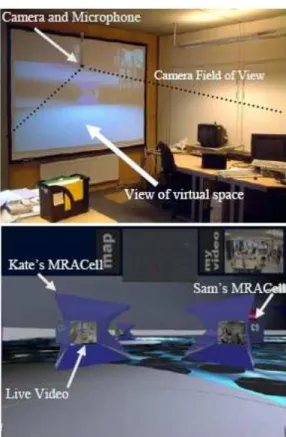
Figure 2.4 Mixed Reality Architecture (Boundary – from Schnadelbach et al 19 2006)
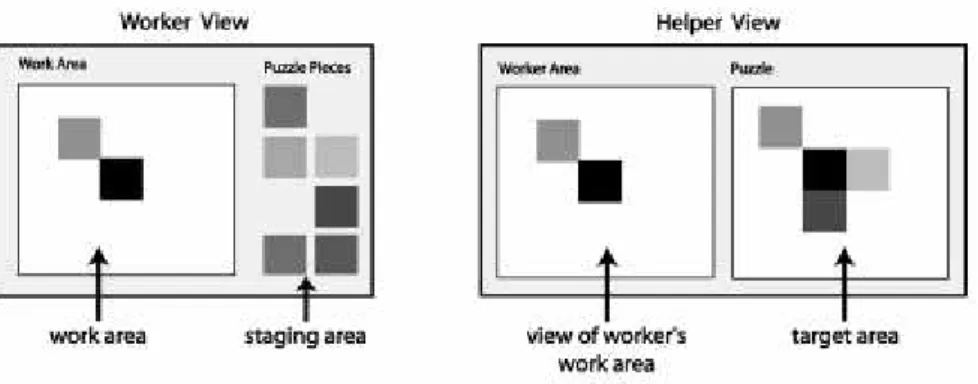
Figure 2.5 The Puzzle task developed by Darren Gergle (from Gergle et al 2006) 28 Figure 2.6 Commune Drawing surface from Bly and Minneman (1990) (left – 34
equipment, right – resultant sketch appearing on surface)
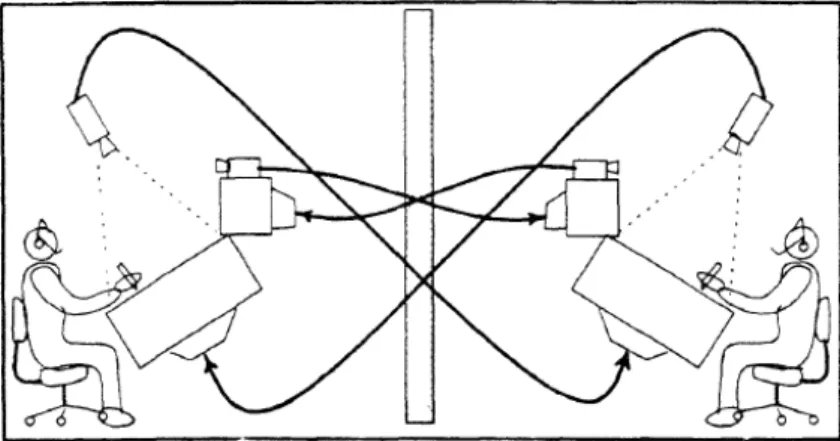
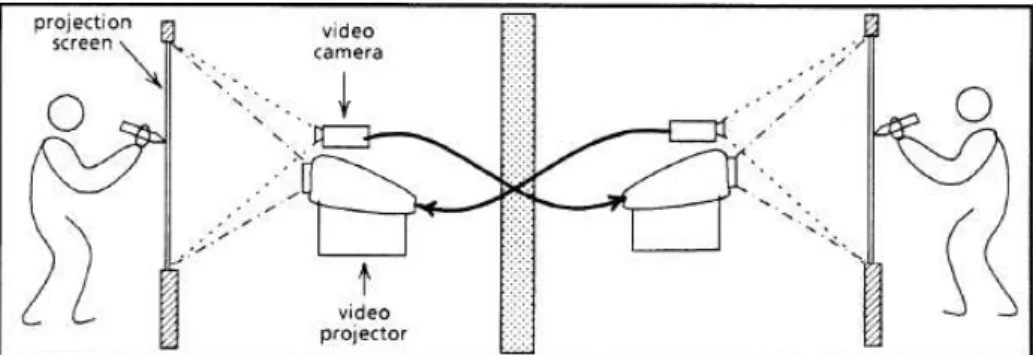
Figure 2.7 Schematic of VideoDraw system from Tang and Minneman (1991a) 35 Figure 2.8 The TeamWorkStation of Ishii and Miyake (1991) 37 Figure 2.9 Schematic of VideoWhiteboard from Tang and Minneman (1991b) 38 Figure 2.10 ClearBoard in use from Ishii, Kobayashi and Grudin, (1993) 39 Figure 2.11 VideoArms from Tang, Neustaedter and Greenberg, (2004) 41 Figure 2.12 Digital Arm Shadows from Tang, Boyle and Greenberg, (2004) 41
Figure 2.13 SharedView system from Kuzuoka (1992) 44
Figure 2.14 Schematic of GestureCam System from Kuzuoka et al (1994) 45 Figure 2.15 Schematic of Agora System from Kuzuoka et al (1999) 47 Figure 2.16 GestureLaser mounted on GestureLaser Car from Yamazaki et al 47
(1999)
Figure 2.17 GestureMan from Kuzuoka et al (2004) 49
Figure 2.18 The Drawing Over Video Environment (DOVE) from Ou et al 58 (2003a,b)
Figure 3.1 Voice + Projected Hands 78
Figure 3.2 Voice Only Communication (Helper retains visual access to external 78 workspace)
Figure 3.3 Frame 2 80
Figure 3.4 Frame 1 (left) and the back of Frame 2 (right) 80
Figure 3.5 Gesture Projection System in use 80
Figure 3.6a Video presented Hands (schematic) 83
Figure 3.6b Video presented Hands (screen capture) 83
Figure 3.7 Projected Hands & Sketches 84
Figure 3.8 Video presented Hands & Sketches 84
Figure 3.9 Projected (left) and Video (right) presented Hands & Sketches (in 84
each case image captured from Helper‟s TV view)
Figure 3.10a Projected Sketches only (schematic) 85
Figure 3.10b Projected Sketches only (screen capture) 85
Figure 4.3 Change in performance time between first and second trials 97
Figure 4.4 Time to complete first 3 stages of each model 99
Figure 4.5 Performance times by model and communication condition 99
Figure 4.6 Mental workload comparisons 101
Figure 4.7 Un-weighted workload sub-scales by communication condition 103 Figure 4.8 Differences in physical demand and effort scores by helper/worker 104
condition
Figure 4.9 Physical demand scores by communication condition for Helpers and 105 Workers
Figure 4.10 Effort scores by communication condition for Helpers and Workers 106
Figure 4.11 Time to complete model in each of three phases 111
Figure 4.12 The numbers of mistakes made in each experimental phase 111
Figure 4.13 Worker‟s perception of task and Instructor 113 Figure 4.14 Responses to two statements by Instruction communication group 114 Figure 5.1 Relative orientations of Helper‟s and Worker‟s hands 119
Figure 5.2 Preferences when asked „Which orientations was easiest to use?‟ 125 Figure 5.3 Preferences when asked „Which orientation did you find most 126
confusing?‟
Figure 5.4 Comparing Embedded and Externalised Gesture Locations 128 (GestureMan from Kuzuoka et al 2000, DOVE from Ou et al 2003b)
Figure 5.5 A graph comparing effect on performance time of gesturing in various 133 formats
Figure 5.6 A graph comparing performance times by gesture output condition 133 Figure 5.7 A graph showing final stage of completion after 10mins by gesture 135
format and output condition
Figure 5.8 A graph showing final stage of completion after 10mins by gesture 135 output condition
Figure 5.9 A graph showing final stage of completion after 10mins by gesture 135 format
Figure 5.10 A graph showing percentage accuracy of models by gesture format 137 and location
Figure 5.11 A graph showing percentage accuracy of models by gesture format 138 Figure 5.12 A graph showing percentage accuracy of models by gesture output 138
location
Figure 6.1 The Flashing Hand Gestural Phrase 152
Figure 6.2 The „Wavering Hand‟ Gestural Phrase 153
Figure 6.6 The „Mimicking Hand‟ Gestur
Figure 6.7 The „Inhabited Hand‟ Gestural Phrase 158
Figure 6.8 The Parked Hands Gestural Phrase 160
Figure 6.9 The Fluid Hands 161
Figure 6.10 Sketches used to highlight objects 164
Figure 6.11 Uses of Sketched Arrows 165
Figure 6.12 Observed Forms of Workspace Drawing 166
Figure 6.13 Iterative Development of a Complex Drawn Structure 167
Figure 6.14 Use of alpha-numerics to annotate sketches 168
Figure 6.15 Sketching to delineate areas 169
Figure 6.16 Misinterpretations of sketches 170
Figure 6.17 Cluttered over-sketched screen 171
Figure 6.18 Redundant sketched information 172
Figure 6.19 Forms of digital sketch 173
Figure 6.20 Digital Sketch Drawings 174
Figure 6.21 Referring to a catalogue of sketched items 174
Figure 6.22 Sketches express more than words 175
Figure 6.23 Difficulties finding cursor 176
Figure 7.1 Time to complete first 3 stages of model by trial order 185 Figure 7.2 Relative percentage of total words for Helper (H) and Worker (W) by 191
trial
Figure 7.3 Percentage of overlapped turns 201
Figure 8.1 Possible system design alternatives for remote gesture tools 219 Figure 8.2 Compal Projector Phone exhibited at 3GSM 2006 Barcelona 224
Table 3.1 Comparison of possible gesture locations and formats 82
Table 4.1 Time in seconds to complete first three stages 95
Table 4.2 Time in seconds to complete first three stages for the First and Second 97 trials
Table 4.3 Time in seconds to complete first three stages for each model in each 98 condition
Table 4.4 Mental workload scores for Helpers vs. Workers, first trial vs. second 100 trial and voice only vs. voice and gesture conditions
Table 4.5 Average mental workload sub-scale scores for voice only and voice 102 and gesture conditions
Table 4.6 Average Physical Demand and Effort sub-scale scores for Helpers and 103 Workers
Table 4.7 Average Physical Demand sub-scale scores for Helpers and Workers 104 by Voice only or Voice and Gesture conditions
Table 4.8 Average Effort sub-scale scores for Helpers and Workers Voice only 105 or Voice and Gesture conditions
Table 4.9 Time taken and number of Mistakes made during model construction in 110 three phases, Instruction, 1st Self Assembly and 2nd Self Assembly, by
Instruction communication condition
Table 4.10 Change in time taken to complete model after 10 minutes and then 112 after 24 hours by Instruction communication condition
Table 5.1 Average final stage of assembly for each of the three orientation 122 conditions
Table 5.2 Time to reach required stage of assembly (in seconds) for each of the 122 three orientation conditions
Table 5.3 Number of pairs to complete (within 10mins) the required stage for 123 analysis in each of the three orientation conditions
Table 5.4 Number of pairs to assemble their model (up to last completed stage) 124 correctly or with mistakes in each of the three orientation conditions
Table 5.5 Number of respondents to choose each of the three orientation 124
conditions when asked „Which orientation was easiest to use?‟
Table 5.6 Number of respondents to choose each of the three orientation 125
conditions when asked „Which orientation did you find most confusing?‟
Table 5.7 Average stage of construction at 5mins 132
Table 5.8 Average Total Seconds taken to reach specified stage of model by 132 Gesture Condition group
Condition group
Table 5.10 Average response to questions by gesture format, gesture output 140 condition and participant role (Helper or Worker)
Table 5.11 Showing the relative preferences for gesture output condition amongst 141 participants
Table 5.12 Showing the relative preferences for gesture output condition by 142 gesture format group
Table 6.1 Functions of Sketching 177
Table 6.2 Functions of Hand-based Gesturing 178
Table 7.1 Average numbers of various elements of language use during 1st 5mins 189 of interaction (from 2 trials), split by gesture communication conditions.
Table 7.2 Average numbers of various elements of language use during 1st 5mins 190 of interaction (from 2 trials), split by gesture communication condition
and trial
Table 7.3 T-test significances (two-way independent-measures T-tests) comparing 191 first and second trials for various measures of language use,
split by gesture communication condition
Table 7.4 Average numbers of Questions and Questions per various Word counts 193 asked during 1st 5mins of interaction (from 2 trials), split by gesture
communication conditions
Table 7.5 Average numbers of Questions asked during 1st 5mins of interaction 194 (from 2 trials), split by gesture communication condition and trial
Table 7.6 The statistical significance (two-way independent-measures T-tests) 195 comparing first and second trials for average numbers of questions asked
and proportions of questions per various measures of words
Table 7.7 Average numbers of various measures of deictic referencing split by 198 communication condition and trial order
Table 7.8 T-test significance scores for deixis use data comparisons of gesture 199 conditions and trial order
There was speech in their dumbness, language in their very gesture.
The Winter's Tale (First Gentleman at V, ii)
Shakespeare
Chapter 1
–
Introduction
1.1 Introduction
The pervasive nature of information and communications technology means that we are living in an increasingly networked world. Consequently the sphere of influence of any individual is increasing exponentially, at any given time a person can be present in some form at multiple global locations and advances in telecommunications technologies allow that sense of presence
to be felt in richer and more diverse ways. A worker‟s regular environment, their „working ecology‟ or „Activity Landscape‟ (as Kirsh, 2001, frames it) is now likely to include
telecommunication and computing devices that will link disparate people, spaces and resources to support the proliferation of knowledge and expertise within global enterprises. A necessity for common current working practices (Hinds and Kiesler, 2003).
That the development of communication devices should be towards making remote interactions richer, increasing a sense of remote presence, sits well with an understanding of human communication from an information theory perspective. Referring to „An Ecology of Communication‟ the information theorist Abraham Moles (1920-1992) originally defined communication as:
“The action of making an organism or system located at given point R partake in the experiences (Erfahrungen) and stimuli of the environment of another individual or system located in another place and time, by using the items of
knowledge they have in common.” (Moles, 1975, p. 49) He also stated that:
“To transmit a message is to make more complex the space-time surrounding the point of reception; it is to produce a micro-replica of the complexity created at the origin of transmission.” (Moles, 1966, p.196-197)
Such a view of communication is supported by more recent work which has explored the situated nature of communicative behaviours in co-located interactions (Hutchins, 1995, Robertson, 1999). This body of work has clearly demonstrated the importance to shared activity of a whole host of contextually embedded physical representations of non-verbal behaviours and artefact manipulations used in conjunction with speech. These actions can embody and imply a plethora of system state properties and communicative intentions, forming an integral part of the collaborative development of task-focussed situational awareness, and becoming crucial for smooth interaction and common understanding.
The intuitive belief that visual access to others was important for helping to understand them was perhaps then the driving force behind the development of Video-Mediated Communication technologies. The benefits of these technologies, which are increasingly
becoming part of our „Activity Landscapes‟, have however been demonstrated to be
inconsistent at best, with different studies showing different advantages and limitations of the technologies (Finn, Sellen and Wilbur, 1997). For example, Williams (1997) demonstrated that visual access improves understanding when collaborators come from different linguistic
backgrounds and a raft of studies of „media-space‟ video communications arrangements have suggested that visual access can provide for new forms of interaction and increase sense of presence between remote sites, with positive outcomes (see Dourish and Bellotti, 1997 for overview). However, experimental studies of video-mediated communication have demonstrated that video access between remote spaces does always positively enhance task outcome (Sellen, 1997). In certain situations video-based communication devices are inadequate. Consider for example the scenario below.
--- A Collaboration Scenario
The Paramedic arrives at the scene of the accident; jumping out of the ambulance he tries to survey the scene. The air is filled with an obscuring oily smoke making it hard to make out what lies ahead. As the Paramedic advances he notices twisted car wreckage littering the highway, occasionally illuminated by small patches of burning fuel. Already, there are Fire crews frantically running between the wrecks dealing with the fires and trying to deal with the mounting tide of casualties. Up-ahead a Firefighter pulls a person from the wreckage of a car, laying them on the grass at the side of the road. The Paramedic runs to the Firefighter and the patient to see if he can help. The patient is bleeding heavily from an open chest wound. The Paramedic knows from experience that pressure or dressings will not stem the tide of blood and the patient will bleed to death in a matter of minutes unless there is something they can do. There is something that could be done. If the Paramedic could only open the chest wound slightly and locate the ruptured arterial structure and then clamp it, they could keep the patient alive for long enough to get them to a hospital for more significant surgical intervention. The
Paramedic‟s training however did not cover such a complicated invasive procedure; they need
a consult from a surgeon. Logistically it makes most sense for the surgical team to stay in the hospital and receive incoming patients rather than travelling themselves to the site of the accident. So the question becomes, how can the surgeon be in two places at once?
Existing practice in such a scenario might find the Paramedic talking to a Surgeon via mobile
phone technology. The Surgeon will have to use the Paramedic‟s eyes to survey the situation
and she will have to talk to the Paramedic to guide both his eyes and hands. Increasing development of technology has however meant that high-bandwidth, streaming video-enabled phones, can give the Surgeon remote eyes, letting her see the situation for herself. This may or may not help depending on how good at describing the Paramedic already is, and depending on environmental factors which might make the video image less than clear. But in this situation the real problem arises when the Paramedic must use the clamp. The rupturing has
occurred to the underside of one of several closely located branches of the exposed arterial structure. In the confusion the Surgeon must carefully use the Paramedic, she might have
visual access to the patient but this doesn‟t necessarily help to guide the Paramedic‟s actions. The Surgeon‟s instructions must be precise, easily interpreted and quick; mistakes at this point in the process could be fatal. Unsure of the instructions and unable to understand the correct alignment for applying the clamp the Paramedic loses valuable time systematically moving the
clamp through various orientations asking „do you mean insert it like this? Or like this?‟
waiting for the Surgeon‟s confirmation or feedback, all the time the patient is bleeding and
fading more. Finding the slow progress frustrating the Surgeon wishes that rather than having to reiterate her instructions she could get the Paramedic to move the clamp as she intends by
merely saying „Turn it this way‟ whilst confidently and observably motioning with her hand to show the correct angle.
---
The scenario above is just one form of collaborative task for which the use of communication focussed on artefacts in the real world and the manipulation of those physical artefacts are the overriding concerns. Other relevant examples could include bomb disposal experts receiving external support and advice, scientists in-the-field examining finds or specimens with the aid of remote colleagues or maintenance staff repairing intricate equipment and machinery with the support of an expert engineer. The common ground between all of these collaborations is the fact that whilst one worker is in situ with the task artefacts, the collaborative colleague is elsewhere and in many of the situations given above the person who is remote to the task space is the possessor of expert knowledge about the task or artefacts. A principle component of these tasks however, is that they possess an inherently physical nature, they are not software based tasks and therefore mutual and concurrent access to the artefacts for manipulation cannot be granted, there is an inherent asymmetry to the interaction that is created by the very corporeality of the task artefacts and the distributed nature of the working arrangement. And as the scenario presented above demonstrates, this poses certain difficulties for current technologies when it comes to adequately supporting communication. Whilst a video link can provide visual access it falls short of projecting the forms of situated and embedded communicative non-verbal behaviours which have been shown to be of such importance in co-located interactions.
The work of this thesis then, set to explore such forms of interaction and the design of technologies to support them, is situated within the sphere of Computer-Supported Cooperative Work (CSCW), an area of research within computing and the social sciences which has traditionally striven to understand how technology can be designed to adequately support collaborative endeavour (Baecker, 1993). More specifically within this field this thesis is concerned with the study of Video-Mediated Communication, and in particular adds to the body of work seeking to explore how Video-Mediated Communication systems can be
improved upon to support distributed interactions in specifically collaborative physical tasks. This thesis is an exploration of how to develop technology that will support the forms of interaction described above, studying the design and potential implementation of technologies which allow for the remote representation of non-verbal behaviours and artefact focused actions in addition to providing visual access between spaces.
The rest of this chapter provides the research background and context of the thesis. It discusses
remote gesturing technologies as tools to support collaborative physical tasks, introducing the current state-of-the-art systems and briefly highlighting criticisms of their design. On the basis of these criticisms and the perceived failings of current approaches a research problem is
constructed and the thesis‟s hypothesis for resolution of that problem is outlined. The rest of the thesis is then sketched out detailing the structure for the remaining chapters, explaining how they address the central research questions and the chapter concludes by detailing the
thesis‟s contributions.
1.2 Research Background
The experimental work of Chapanis (1975) and Kraut et al (1996) systematically investigated the performance effects of varying communication media used by dyads engaged in collaborative physical tasks. These investigations presented the somewhat counter-intuitive findings that audio-video links are rarely more effective in terms of collaborative task outcomes than audio-only links between remote sites. And intriguingly neither form of technology-mediated communication between spaces can replicate the efficiency and fluency of natural face-to-face interactions. The inherent problems of video links have been consistently demonstrated in relation to the construction of collaborative physical action (see Heath and Luff, 1992 and Gaver et al, 1993). The conclusions drawn from this research usually suggest that the great failing of video technology in supporting collaboration over physical artefacts is its inability to adequately represent naturally occurring deictic (pointing) behaviours. The classic example of this is an observation made during the MTV (Multiple Target Video) study by Gaver et al (1993). In this study the experimenters noticed that whilst watching and directing action in another room over a video link, participants would continually (unconsciously) point at items on their video screen, whilst using deictic pronouns
to refer to objects such as „this one here‟, when trying to direct the attention of a remote collaborator. Of course the remote collaborator was unaware of what the other was pointing at, as they had no visual access to the pointing behaviour. That humans express such a strong desire to use non-verbal communication comes as no surprise when one considers that studies of collaborative working practices have revealed the subtle ways in which highly situated communicative behaviours are used to structure interaction and guide task awareness (Hutchins and Palen, 1997). In many working situations gesturing behaviour is used in communication as it allows participants to construct simpler sentences (Clark and Brennan,
1991), which in conjunction with the expressive nature of the gesture itself aids the development of common understanding and the grounding of conversational references (McNeill, 1992, Clark, 1995).
Research has therefore been conducted to extend the functionality of video-mediated communication systems so as to adequately support collaborative physical tasks, by facilitating the remote representation of gestures during interaction. These new remote gesture tools have been developing along differing lines in different research labs but all conform to the central tenet of supporting the generation, and embedding, of some form of gestural simulacra within remote task spaces, increasing the presence of remote collaborators within those spaces. Some of these remote gesture tools are discussed further below.
Growing out of, and enriched by, a developing body of work concerned with understanding the construction and use of collaborative shared visual environments (e.g. Krauss and Fussell, 1991, Fussell et al 2000, Kraut et al 2003, Gergle et al 2004) one significant strand of research (see Ou et al, 2003 and Fussell et al, 2004) is the development of the Drawing Over Video Environment (DOVE) at CMU. This remote gestural simulacrum allows a remote expert‟s
sketches to be pasted over a live video feed of a worker‟s task space. Research has demonstrated that such remote gesture tools can significantly improve performance in collaborative tasks over that achievable by audio-video only links (Fussell et al, 2004). However, these benefits have not always been replicable, even with the same system (Kramer et al, 2006). When critically considered, the DOVE system, has certain features which would arguably limit its benefits. The system uses a digital pen-based representation of gesture which potentially has a lower bandwidth for the expression of non-verbal communication than the use
of hands for gesturing. Also, the DOVE system‟s output of gestures, provides the remote
worker with a view (a separate VDU display) of a mixed reality environment, situated externally to the immediate task space. Through this view the worker can see a representation of what the remote expert sees of the working task space, and they can see the expert‟s gestures being sketched over this live video feed. Whilst this approach ensures that the worker is implicitly aware of the remote expert‟s perspective on the task space, the worker has the difficulty of perceiving gestures drawn over a video view of their work space which is potentially at a subtly different orientation to their own perspective on the space. The Worker must then have to record and translate this information, making it relevant to their perspective rather than the representation of it, a translation process which arguably carries with it a performance cost. The relative impact of these issues on performance has not yet been established.
Another strand of research has witnessed the construction of increasingly novel technological solutions to the remote gesturing problem, including GestureCam, GestureCar, GestureMan and GestureMan with a Pointing Stick (see Kuzuoka et al, 2000, & 2004). These systems all utilise human-proxy robots, physically located in a remote working space, carrying and
embodying the video link to the remote expert. They facilitate remote gesturing by allowing the expert to remotely operate a laser pointer attached to the robot that allows a remote gestural simulacrum to be physically embedded in the actual working task space. Whilst these technological solutions in themselves have been inherently interesting they make certain assumptions about the success of the technologies without empirical support, they have yet to demonstrate any actual performance benefits of their approach. Again a critical review of the systems would highlight the use of a laser dot pointer as the primary gestural representation. This must have the lowest bandwidth for representation of gestural information out of any of the currently used techniques, given its small presence, artificiality (we are at least relatively used to using pen drawn lines to annotate and guide attention) and lack of permanence within the task space. The Kuzuoka work has however managed to make the interactions far more mobile than any systems such as DOVE, which is possibly important given the possible applications of such devices. Later developments of the laser pointer approach such as the WACL system (Sakata et al 2003) have begun to explore the true value of mobile and light-weight remote gesturing systems, but have still been constrained by the limited use that can be derived from such a simple representation of remote gesture. Again, the relative ability of such low-bandwidth expressions of gesture to adequately support collaboration has not been evaluated.
Critiques of the effectiveness of remote gesture technologies in supporting artefact-centred interactions have focussed on the concept of fractured ecologies (e.g. Luff et al 2003, Kuzuoka et al 2004 and Kirk et al 2005), in some respect acknowledging the role of remote gesture
representations in establishing „ecologies of communication‟ which exist between distributed working partners. This concept postulates that key aspects of the design of remote gesture tools create unsurpassable barriers to a coherent understanding of intentionality and obscure the projectability of action between remote collaborators, fracturing the process of interaction between them.
As discussed previously, with DOVE style systems that promote the use of externalized
VDU‟s, the site of gestural interaction is removed from the site of artefact manipulation, thus
causing a fracture as the Worker is required to resolve the discrepancies between gestural instruction and their own task perspectives. Whilst laser pointer systems have traditionally avoided this problem, by projecting into the task-space, they are themselves fracturing interaction by the limited bandwidth capacity they have for the adequate expression of
intention through gesture. Understanding of an Expert‟s orientation to and gestures toward
task-artefacts is severely impaired by such systems. It is clear therefore that remote gesture tools as currently constructed are not without their problems, and despite the proposal that they should improve performance in collaborative physical tasks beyond that achievable with standard forms of video-mediated communication, this has not yet been proven conclusively. Equally the myriad design options for constructing such systems have not been adequately
compared and in the face of significant criticism it is clear that re-design is potentially necessary.
1.3 Problem Statement and Research Hypothesis
This thesis therefore seeks to address the problems highlighted in the previous section. The fundamental research question can be phrased as - how can technologies be built to improve remote collaborations for physical tasks, that don‟t fracture ecologies between remote spaces, but make the interactions as close to the presumed optimal standard of face-to-face communication as possible? Specifically, this research question can be broken down into several sub-issues, which the thesis seeks to address. Firstly, it seeks to understand and evaluate how and why remote gesture tools can benefit performance in collaborative physical tasks, exploring the ways in which such communication devices might be superior to standard video-mediated communications. The thesis also seeks to understand what creates a „fractured
ecology‟ of communication, exploring how interaction breaks down and how remote gesture
tools influence this process. The thesis also strives to explore the relative benefits of the various system design choices that can be made, assessing whether location of gestural output or format of gestural representation influences the efficacy of the system. In doing this the thesis also develops a fuller understanding of the role of remote gestural action in collaboration addressing the issue of how communicative behaviours influence task performance.
In addressing these issues a research hypothesis is proposed and evaluated. Previous research has argued that the presence of dichotomous ecologies in such working collaborations is inevitable (Kuzuoka et al 2004), and the role of communication tools is to mediate between the ecologies without fracturing interaction. Referring back to the quotes of Abraham Moles (page 1), this thesis rejects such a notion. Moles‟ conception of communication argued that for
effective communication one must make another „partake in the experiences (Erfahrungen) and stimuli of the environment of another‟ and that to do this one must „make more complex the space-time surrounding the point of reception‟, it is with these points in mind that this thesis
proposes the notion of the „mixed ecology‟. A mixed ecology approach to communication
device design assumes that rather than linking and mediating between spaces the technology should seek to construct a unified environment in which both parties can collaborate.
When collaborators are remotely engaged in communicative acts concerning some object-focussed interaction it is hypothesised that their performance will be optimised if they communicate using a mixed or shared ecology communications arrangement. The mixed or shared ecology supports communication by using technology to give collaborating partners access to the most salient and relevant features of communicative action that are utilised in face-to-face interaction (thereby conforming to Moles‟ desires for communication), namely mutual and reciprocal awareness of commonly understood, yet richly complex object-focussed actions (hand-based gestures) and mutual and reciprocal awareness of task-space perspectives.
It is proposed that a mixed ecology therefore has more ability to successfully relay those contextually embedded physical representations which have been shown to be of importance to collaboration in shared ecologies.
1.4 Thesis Overview
The following thesis chapters address the research problem discussed above. The ensuing section briefly outlines the content of each of these chapters demonstrating how they evaluate the design of remote gesture tools, explore the role of gesture in remote communications and how they consecutively build an argument for a mixed ecologies approach to designing communications support for collaborative physical tasks.
Chapter 2 [Literature Review] focuses on reviewing previous research in this area, taking the study of workplace communication, and in particular video-mediated communication, as a starting point, and drawing out the development of remote gesture tools within this context. The chapter describes in detail the state-of-the-art in remote gesture tools and discusses the evaluatory studies that have been performed with them. The chapter reveals that these studies have eventually lead to the realisation that remote gesture representation and shared access to views on task-spaces is important but have also highlighted that attempts to provide these things do not always work and can lead to a fracturing of the interaction between collaborators. Observations from this literature review are used to articulate areas for further research which form the basis for the specific research questions of the thesis.
Chapter 3 [Research Methodology and Disposition] forms a hypothesis on the basis of evidence from the literature review that the best way to support collaborative physical tasks is to create mixed ecologies, which are environments that project key features of face-to-face interaction, mutual and reciprocal awareness of hand-based gestures and mutual and reciprocal awareness of task-space perspectives. The chapter highlights the specific research questions which must be addressed to evaluate this hypothesis and discusses the appropriate methodologies for approaching the subject. The chapter concludes by presenting and
discussing the „mixed ecology‟ remote gesturing prototype which formed the basic system used for the experimental studies reported in later chapters.
Chapter 4 [Some Effects of Remote Gesturing] presents two experiments which demonstrate how remote gesturing can improve aspects of performance in collaborative physical tasks when compared to standard video-mediated communication links. The first experiment examines base performance metrics, including task completion time and cognitive effort, whilst the second experiment demonstrates the positive impact on learning of gesturing during remote instruction. Taken together the studies also demonstrate some subtle effects of remote gesturing on the relative perceptions of first time collaborators. The studies in particular highlight that the use of views of the hands embedded in the task space seems beneficial as a
gestural representation, discussing this in terms of a mixed ecologies approach but stressing the need for direct comparison with other methods of representing and locating gestures.
Chapter 5 [How Best to Construct Remote Gestures] presents two further experiments which address the issues of how to locate and represent gestures during remote collaboration, evaluating the relative benefits of the differing system configurations employed by current systems. The first study examines the impact of changing orientation on gesture insertion into a space, demonstrating that this counter-intuitively has minimal impact on collaboration. The second experiment addresses the issues of gross gesture location (presented within the task space or external to it) and gesture format (digital sketch vs. unmediated view of hands vs. hands and sketch). The studies demonstrate support for a mixed ecologies approach and highlight a key issue of designing for reciprocal views of tasks spaces which is discussed in detail.
Chapter 6 [The Communicative Functions of Gesturing] moves the argument of the thesis onto the examination of exactly how gestural representations influence collaborative performance. By performing a fine-grained video-analysis of scenes of interaction from the earlier experiments a praxiological account of gestural representations is revealed. A qualitative understanding of the gestural phrases used is developed and the varying methods of gestural communication, for each specific medium (hands and sketches), is elaborated, creating a taxonomy of gestures and gestural uses. Through a comparative critique of alternative gestural representations the strengths of using unmediated views of hands as the gestural representation are articulated.
Chapter 7 [How Gesture Interacts with Language] extends the analysis of the functions of gestural interaction to investigate how gesture use affects collaborative language. Again utilising fine-grained analysis of video data from previous trials, this time utilising a conversation analytic strategy combined with quantitative analysis of language patterns, earlier work is re-examined. The analysis reveals both the various means by which gesturing aids the achievement of grounding during collaborative discourse and also its role in structuring the interactions. This further reveals the importance of remote gesturing in collaborative physical tasks and provides important evidence of how gesturing influences the temporal course of grounding behaviours. This influence of gesturing on the time course of interactions is discussed in detail as it has significant implications for any future deployments of remote gesture technologies.
Chapter 8 [Conclusions] concludes the thesis by summarizing and evaluating the evidence for a mixed ecologies approach to designing support for collaborative physical tasks and presents answers to the research questions posed. It then discusses the implications of this for the design, deployment and development of remote gesturing technologies, articulating a program of future work to address issues raised by the thesis research.
1.5 Thesis Contributions
Having articulated the structure of the rest of the thesis and discussed how the thesis will address the research area it is pertinent to conclude this introductory chapter by detailing the overall contributions that the thesis makes. The main contribution of this thesis is a thorough understanding of human factors as they relate to the design and use of remote gesture tools. Specific contributions include:
A thorough discussion of the requirements of studying remote gesture tools, including an evaluation of appropriate methodologies
A set of guidelines for deploying remote gesture tools, covering environmental, task-focused and participant-oriented factors
A set of guidelines for designing remote gesture tools, focusing on the identification of key criteria for collaboration, and the elimination of fractures in interaction
A set of experimental comparisons of different remote gesture tool designs, illustrating relative impact on both physical performance and communication
A taxonomy of remote gestures (in various media) and their communicative uses A deeper understanding of the (potential) role of remote gestures in collaborative
physical tasks, focussing on their integration with naturally occurring collaborative speech patterns
A discussion and evaluation of a mixed ecologies rationale for designing communications devices
Indication of areas of further importance for future research and development
These thesis contributions have directly extended the body of research in the design and development of remote gesture tools. In a continuing process the work has been disseminated to a wider audience through presentation and publication.
The thesis work has thus far been presented for discussion at:
The Doctoral Consortium of the 9th European Conference on Computer-Supported Cooperative Work (ECSCW) 2005 (Paris, France)
A conference workshop entitled „Giving Help at a Distance: Ubiquitous Computing to Support Problem-Solving‟ at Ubicomp 2004 (Nottingham, UK)
An agenda setting workshop on „Collaboration, Co-Laboratories and e-Research‟ as part of the UK e-Social Science program (invited talk)
University of Bath, Department of Psychology, Seminar Series (invited talk)
And the work has also been published in peer-reviewed conference proceedings at (see Published Works section before acknowledgements for full references):
The Conference on Computer-Supported Collaborative Learning (CSCL 2005) (Kirk and Stanton Fraser, 2005)
The European Conference of Computer-Supported Cooperative Work (ECSCW 2005) (Kirk, Crabtree and Rodden, 2005)
The ACM Conference on Human Factors in Computing Systems (CHI 2006, 2007) (Kirk and Stanton Fraser, 2006 and Kirk, Rodden and Stanton Fraser 2007)
The publications are based directly on the key study findings taken from various sections of the ensuing thesis chapters.
Chapter 2
–
Literature Review
2.1 Introduction
The purpose of this literature review is to provide some background to the ensuing discussions and investigations concerned with the development of remote gesture tools. The chapter begins by first highlighting a growing concern for the understanding of how collaborative environments are constructed to represent embodied collaborative actions and then continues by describing what other research has been performed in efforts to support communication and in particular communication around collaborative physical tasks. In doing this the chapter presents the evolution of remote gesture tools from their basis in simple extensions of video-mediated communication through to the state-of-the-art systems that are currently being explored. The evaluation of these presented studies highlights the areas of inadequacy of current approaches to remote gesture tool design. The discussion highlights current critiques of these systems and begins the process of articulating where and why existing literature is lacking, in turn suggesting areas for further research, in an effort to raise answerable research questions in chapter 3.
2.2 Ecologies of Communication in the Workplace
There is a growing body of research work which takes as its focus the uncovering of the fine-grained processes of interaction and coordination that take place in modern workplaces. Old models of work-flow and task analysis have been marginalised as they have rightly been critiqued for their lack of applicability owing to their failure to engage with and represent actual lived in working practices as they occur in actual working contexts (Bannon, 1991). From diverse disciplines there is a growing concern to understand how the embodied practices and actions of workers as they are physically presented in a collaborative working environment
constitute a communicative act that is at once both a fundamental aspect of a worker‟s own
activity and a resource for the development and manipulation of collaborative task awareness. Although the language used to describe these activities may differ by the disciplinary orientation of study authors, the principles of understanding the situated nature of embodied cognition and its relevance to collaborative work remain the same. Examples of relevant works
include Suchman‟s (1996) study of an airline‟s operations control room, Heath and Luff‟s (1996) study of the London Underground control rooms and Nardi et al‟s (1997) study of the
practices of neurosurgery teams. Additionally, of particular importance is the work of Ed Hutchins in developing the concept of distributed cognition (Hutchins, 1991, 1995), which as a framework sought specifically to redress the imbalance of traditional cognitive science paradigms which focused purely on cognitive processes as internal phenomena. Through his discussion of distributed cognition Hutchins attempted to develop the notion of cognitive
processes as being embedded in task artefacts, state representations and collaborative actions. The studies in Hutchins (1995) of ship navigation teams and Hutchins and Klausen (1997) of airplane cockpit crews supported the growing understanding that the processes of communication in a collaborative physical task are far more subtle and complex than might otherwise be presumed. Hutchins and Palen (1997) studied training sessions in an aircraft
simulator and after observing the complexity of the communicative ecology of the „cockpit‟
remarked:
“Gestures and the space inhabited by speakers and listeners are normally thought
of as providing context for the interpretation of speech…. space, gesture and
speech are all combined in the construction of complex multilayered representations in which no single layer is complete or coherent by itself.” (pp. 23-24)
And added further that, awareness of physical embodiments and cognitive representations within the space
“…demonstrates the creation of a complex representational object that is
composed through the superimposition of several kinds of structure in the visual and auditory sense modalities. Granting primacy to any one of the layers of the
object destroys the whole.” (pp. 38-39) For Hutchins and Palen (1997):
“Communicative behaviors are the representations by which a socially
distributed cognitive system does its work.” (p. 24)
This belief in the development of multi-layered communicative environments which embody cognitive processes resonates strongly with the embodied cognition work of Toni Robertson (1997a, 1997b) and her study of the embodied practices of working design teams. Robertson demonstrated that the very physicality of the designers, embodied within the workspace, was a cultural and communicative artefact of the workspace, awareness of which was of primary
importance to collaborators‟ understanding of current task progress and communicative intent.
The work of Robertson is particularly interesting as her motivation is the desire to support these design activities remotely, her taxonomy strives to articulate those embodied practices which are critical to supporting the design process. Efforts to successfully design tools to support collaborative physical tasks in other domains (such as those presented under the scope of this thesis) would do well then to consider which aspects of embodied practices it is sapient to support in distributed working arrangements.
The following sections of this chapter explore some of the avenues that have been investigated in efforts to construct exactly these kinds of richer communicative environments.
2.3 Studies of Video-Mediated Communication (VMC)
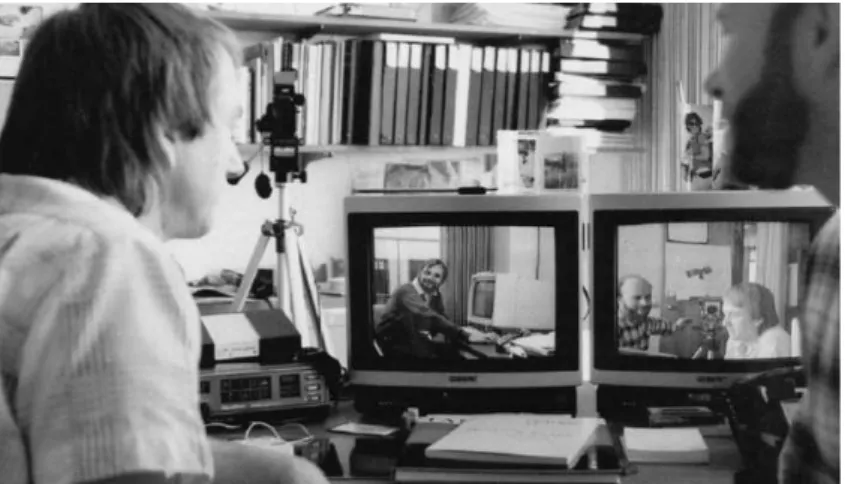
The bedrock of this thesis is an exploration of Video-Mediated Communication (VMC), as this is an integral aspect of most remote gesture tools, and to a certain extent remote gesture tools could be referred to as an advanced form of VMC2. In essence VMC technologies are tools that provide collaborators with visual access to remote spaces. The technologies of VMC have been iteratively developed over many years, with the earliest explorations occurring in the
early 1970‟s (e.g. Chapanis et al, 1972). A good overview of the research in the area is
provided by Finn (1997), itself a chapter within the definitive work on VMC by Finn, Sellen and Wilbur (1997) which presents studies from the leading strands of research within the field. This section of literature review attempts to provide a brief overview of the technologies encountered in the field, and the analytical approaches to evaluating them that have been adopted, discussing some of the conflicting findings that work within the area has generated and attempting to distil some conclusions about the overall efficacy of VMC as a tool for supporting groupwork.
2.3.1 Technologies for VMC
A pertinent point to start this overview of VMC is to familiarize oneself with the technologies used to provide the visual access to spaces. Angiolillo et al (1997) provide an in-depth study of the technical components in VMC systems, briefly discussing how technological factors may impinge on their usability. But rather than focus specifically on the technological requirements, as given the exponential growth in processing power of computers, they rapidly alter, it is perhaps more sapient to consider the general technological forms of VMC.
There are roughly six approaches to VMC which have evolved thus far and been evaluated in research studies (the first five are discussed in Finn, 1997), showing a natural progress and development over time. These forms are:
Fixed line, CCTV (closed caption TV) based systems (used primarily for experimental purposes in early studies of VMC)
Video-conferencing systems (supporting formal group meetings)
Desktop based video-conferencing systems (supporting both formal and informal contact through video links presented on one‟s desktop)
Media-spaces (which incorporated multiple reconfigurable video links between distributed people, spaces and resources)
2
This is not to say that all remote gesture tools are based entirely on the principle of using video technology, as some clearly use non video-based methods for the remote presentation of gestures. However, a video feed of the remote task space will always be included in the apparatus for the Expert to view what is happening at the remote site and to guide their own gestural actions, so there is at least an asynchronous video link between spaces.