Automatic SIMD Vectorization
of SSA-based
Control Flow Graphs
Dissertation zur Erlangung des Grades des
“Doktors der Ingenieurwissenschaften”
der Naturwissenschaftlich-Technischen Fakult¨
aten
der Universit¨
at des Saarlandes
vorgelegt von
Ralf Karrenberg, M.Sc.
Dekan / Dean:
Prof. Dr. Markus Bl¨aser, Universit¨at des Saarlandes, Saarbr¨ucken, Germany
Betreuender Hochschullehrer / Supervisor:
Prof. Dr. Sebastian Hack, Universit¨at des Saarlandes, Saarbr¨ucken, Germany
Pr¨ufungsausschuss / Committee:
Prof. Dr. Christoph Weidenbach (Vorsitzender / Chairman) Prof. Dr. Sebastian Hack (Gutachter / Reviewer)
Prof. Dr. Dr. h.c. mult. Reinhard Wilhelm (Gutachter / Reviewer) Dr. J¨org Herter (Akad. Mitarbeiter / Research Assistant)
Eingereicht am / Thesis submitted: 17. Juli 2014
Tag des Kolloquiums / Date of the colloquium: 30. September 2014
Universit¨at des Saarlandes Fachrichtung 6.2 - Informatik Im Stadtwald - Building E1.1 66123 Saarbr¨ucken
Foreword
I first met Ralf four years ago on stage at the magnificent “Le Majestic” congress center in Chamonix, France. This was in April 2011, and we switched connections at the podium as Ralf completed his talk on Whole-Function Vectorizationat CGO 2011 and I was about to start my talk. Four years later, it is a pleasure to write this foreword to Ralf’s PhD thesis on this subject, which significantly extends and builds upon his earlier works. Ralf’s works have already attracted attention and inspired research and development in both academia and industry, and this thesis will undoubtedly serve as a major reference for developers and researches involved in the field. Ralf’s originalAutomatic Packetization Master’s thesis from July 2009 has inspired early OpenCL tools such as theIntel OpenCL SDK Vectorizer
presented by Nadav Rotem at LLVM’s November 2011 Developer’s Meet-ing. Ralf Karrenberg and Sebastian Hack’s CC 2012 paper onImproving Performance of OpenCL on CPUsfurther extended their CGO 2011 paper. Recently, Hee-Seok Kim et al. from UIUC refer to the aforementioned papers in their CGO 2015 paper on Locality-centric thread scheduling for bulk-synchronous programming models on CPU architectures, which effectively maximizes the vectorization factors for kernel functions where possible and profitable. In addition, Yunsup Lee et al. from UC Berkeley and NVIDIA also refer to the aforementioned papers in their recent Micro-47 paper on
Exploring the Design Space of SPMD Divergence Management on Data-Parallel Architectures, which compares software and hardware techniques for supporting divergence on GPU architectures. These recent publications exemplify the contributions Whole-Function Vectorization already has in spurring additional research and development, and will surely continue to have, harnessing new potentials of future SIMD architectures.
Among the new vectorization challenges and opportunities presented in this thesis, the use of Whole-Function Vectorization to handle explicit and partially vectorizable loops, as explained in Section 8.4, are particularly noteworthy. It effectively complements the classical approach of distributing loops to isolate their vectorizable parts. Such opportunities are expected to become applicable to more general-purpose language extensions such as OpenMP starting from its recent 4.0 release. This is in addition to the
data-parallel and shading languages such as OpenCL which it originally targets effectively, as Sections 8.2 and 8.3 demonstrate. Another direction forward aims to leverage the techniques of this thesis within the standard C language, as we argue in our upcoming PLC 2015 paper onStreamlining Whole Function Vectorization in C using Higher Order Vector Semantics.
Heuristics and possibly machine-learning techniques are among the sug-gested future work directions listed in Chapter 10, striving to navigate the tradeoffs involved in linearization and specialization transformations efficiently. Indeed, the innovative foundations of Rewire Target Analysis and Partial CFG Linearization laid clearly in Chapters 5 and 6 pose new interesting optimization challenges potentially involving code duplication. Moving forward, extending the scope of vectorization analyses and transfor-mations across control flow and inter-procedural boundaries as presented in this thesis, will most likely continue to have direct impact on compilation tools and programming environments.
Finally, it is worth noting the deliberate and constructive use of state-of-the-art open source software in demonstrating and disseminating the techniques of Whole-Function Vectorization. Namely, using the LLVM Compiler Infrastructure with its SSA vector intermediate representation, as presented at LLVM’s April 2012 Developer’s Meeting. Doing so provides a valuable and practical implementation that complements this research thesis. It also facilitates artifact evaluation, something which the Compiler Design Lab at Saarland University has excelled at, and is yet to become standard practice in our community.
Acknowledgement
First and foremost, I want to express my gratitude towards my advisor Prof. Dr. Sebastian Hack. Not only did he give me the opportunity to pursue a PhD in his group, he also gave me all the necessary freedom, boundaries, and advice to finally succeed.
Furthermore, I would like to thank Prof. Dr. Dr. h.c. mult. Reinhard Wilhelm for reviewing this thesis, and Prof. Dr. Christoph Weidenbach and Dr. J¨org Herter for serving on my committee.
I also want to offer my special thanks to Prof. Dr. Philipp Slusallek. He first introduced me to working in research during my undergraduate studies and since then has accompanied—with his typical, contagious enthusiasm—most of the projects that I have been involved in.
Another special thanks go to Dr. Ayal Zaks for a lot of valuable feedback and for the honor of writing the foreword.
It is a pleasure to thank the following people that I met during my time at university: Marek Koˇsta, Thomas Sturm, Roland Leißa, Marcel K¨oster, Dmitri Rubinstein, Thomas Schaub, and Simon Moll for great team work; Christoph Mallon, for his help with too many problems to write down any-where; Sven Woop and Heiko Friedrich, my first advisors at university during my time at the computer graphics chair; Fred, Peter, Wadim, Helge, Michel, and Billy (in order of appearance) for the countless hours of beachvolleyball during lunch break; Flo for all the non-beachvolleyball lunch breaks.
I would also like to extend my thanks to Thomas Schaub, Kevin Streit, Roland Leißa, Viola Bianco, and Christoph Mallon, who helped to improve this thesis by proof-reading and giving feedback.
Finally, I am indebted to all my friends, in Saarbr¨ucken as much as in Oberh¨ochstadt, San Francisco, Paris, or anywhere else; and to my parents Ilse and Bernhard and my sister Sonja. I could never have gotten to the point of even starting a PhD without you providing friendship, support, and distraction from work.
Most importantly, however, I owe my deepest gratitude to my wife Inge: For your support, your unlimited source of confidence in me, and all the time I was and will be fortunate to spend with you.
Abstract
Applications that require the same computation to be performed on huge amounts of data play an important role in today’s computing landscape: Particle simulations, stock option price estimation, and video decoding are some examples for such data-parallel programs. Languages like OpenCL and CUDA facilitate their development. They allow to write a scalar function that is executed on different input values in parallel by a runtime system. To unleash the full parallel potential of modern processors, the compiler and runtime system of these languages then have to make use of all available cores as well asSIMD instructions: These allow to efficiently execute a single operation on multiple input values at once per core.
This thesis presentsWhole-Function Vectorization (WFV), an approach that allows a compiler to automatically exploit SIMD instructions in data-parallel settings. Without WFV, one processor core executes a single instance of a data-parallel function. WFV transforms the function to execute multiple instances at once using SIMD instructions.
For simple, straight-line code, the transformation is easily applied and delivers drastically improved performance. However, problems such as particle simulations or shading in computer graphics exhibit more complex code. We show that in such scenarios, a na¨ıve WFV approach will often not improve performance or even slow down execution. The focus of this thesis is to present an advanced WFV algorithm that includes a variety of analyses and code generation techniques that help to improve the generated code.
An implementation of WFV has been evaluated in different settings: First, in a stand-alone OpenCL runtime system. Second, in a compiler for domain-specific languages used in real-time ray tracing. Third, in a compiler that performs classic loop vectorization upon request by the user. In all scenarios, WFV improves performance compared to state-of-the-art approaches. The performance of the OpenCL implementation is on par with the proprietary Intel driver, and faster than any other available CPU driver.
Kurzfassung
Anwendungen wie Partikelsimulationen oder die Optionspreisbewertung an Aktienm¨arkten, die gleiche Berechnungen auf eine Vielzahl von Daten an-wenden, sind ein wichtiger Aspekt der heutigen Informatik. Um das Erstellen solcher Anwendungen zu vereinfachen wurden datenparallele Programmier-sprachen wie OpenCL und CUDA entwickelt. Diese erm¨oglichen es, ein skalares Programm zu schreiben, das von einem Laufzeitsystem parallel f¨ur verschiedene Eingabewerte ausgef¨uhrt wird. Um das vollst¨andige Po-tenzial heutiger Prozessoren auszunutzen, m¨ussen der ¨Ubersetzer und das Laufzeitsystem sowohl alle verf¨ugbaren Kerne als auchSIMD Befehle verwen-den: Letztere f¨uhren dieselbe Operation effizient f¨ur mehrere Eingabewerte gleichzeitig aus.
Die vorliegende Arbeit beschreibtWhole-Function Vectorization (WFV), einen Ansatz, der es dem ¨Ubersetzer erlaubt, in einem datenparallelen Kon-text automatisch SIMD Instruktionen zu verwenden. Ohne WFV wertet jeder Prozessorkern eine einzelne Instanz einer Funktion aus. WFV transformiert die Funktion so, dass sie mit Hilfe von SIMD Befehlen mehrere Instanzen auf einmal auswertet. Diese Transformation ist f¨ur einfachen, verzweigungsfreien Programmcode leicht durchzuf¨uhren und bringt drastische Laufzeitverbesse-rungen. Probleme wie Partikelsimulationen jedoch verwenden komplexeren Code. H¨aufig verbessert dann ein naiver WFV Ansatz die Laufzeit nicht oder verschlechtert sie sogar. Die vorliegende Arbeit beschreibt einen Algorithmus f¨ur WFV, der neue Analysen und Techniken zur Codeerzeugung verwendet, die die Performanz des Programms verbessern.
WFV wurde in unterschiedlichen Anwendungsgebieten evaluiert: Erstens in einem OpenCL Laufzeitsystem. Zweitens in einem ¨Ubersetzer f¨ur dom¨ anen-spezifische Sprachen f¨ur Echtzeit-Ray-Tracing. Drittens in einem ¨Ubersetzer, der klassische Schleifenvektorisierung durchf¨uhrt. In allen drei Szenarien zeigt die Auswertung Verbesserungen der Laufzeit bei Verwendung von WFV im Vergleich mit dem neuesten Stand der Technik. Das OpenCL Laufzeitsystem steht auf einer Stufe mit dem ¨aquivalenten Produkt von Intel und ist effizienter als jeder andere CPU-basierte Ansatz.
Contents
Foreword V
1 Introduction 1
1.1 Contributions . . . 8
1.2 Publications . . . 10
2 Foundations & Terminology 11 2.1 Basic Block . . . 11
2.2 Control Flow Graph (CFG) . . . 11
2.3 Dominance and Postdominance . . . 12
2.4 Loops . . . 13
2.5 Static Single Assignment (SSA) Form . . . 14
2.5.1 LCSSA Form (LCSSA) . . . 15
2.6 Control Dependence . . . 15
2.7 Live Values . . . 15
2.8 Register Pressure . . . 16
2.9 LLVM . . . 16
2.9.1 Intermediate Representation (IR) . . . 17
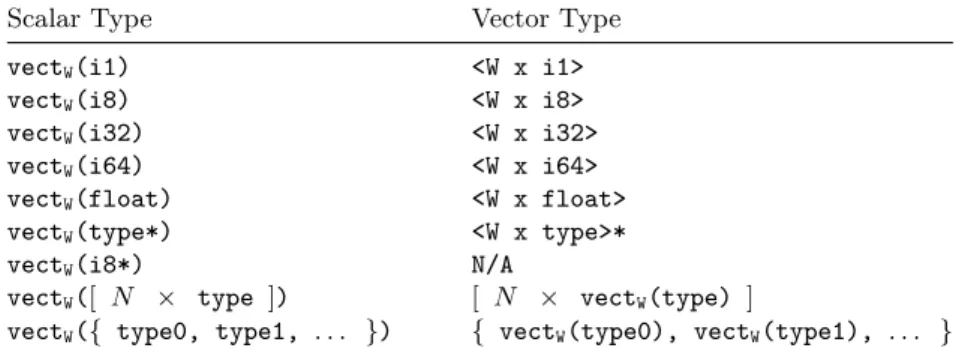
2.9.2 Data Types . . . 18
2.9.3 Important Instructions . . . 18
2.10 Single Instruction, Multiple Data (SIMD) . . . 21
3 Overview 23 3.1 Whole-Function Vectorization (WFV) . . . 23
3.2 Algorithmic Challenges . . . 24
3.3 Performance Issues of Vectorization . . . 25
4 Related Work 31 4.1 Classic Loop Vectorization . . . 31
4.2 Superword Level Parallelism (SLP) . . . 32
4.3 Outer Loop Vectorization (OLV) . . . 32
4.4 Auto-Vectorizing Languages . . . 33
4.5 SIMD Property Analyses . . . 35
4.6 Dynamic Variants . . . 36
4.7 Summary . . . 38
5 SIMD Property Analyses 39 5.1 Program Representation . . . 40
5.2 SIMD Properties . . . 41
5.2.1 Uniform & Varying Values . . . 41
5.2.2 Consecutivity & Alignment . . . 42
5.2.3 Sequential & Non-Vectorizable Operations . . . 43
5.2.4 All-Instances-Active Operations . . . 43
5.2.5 Divergent Loops . . . 44
5.2.6 Divergence-Causing Blocks & Rewire Targets . . . 44
5.3 Analysis Framework . . . 45
5.4 Operational Semantics . . . 46
5.4.1 Lifting to Vector Semantics . . . 47
5.5 Collecting Semantics . . . 48 5.6 Vectorization Analysis . . . 49 5.6.1 Tracked Information . . . 49 5.6.2 Initial State . . . 51 5.6.3 Instance Identifier . . . 53 5.6.4 Constants . . . 54 5.6.5 Phi Functions . . . 54 5.6.6 Memory Operations . . . 57 5.6.7 Calls . . . 60 5.6.8 Cast Operations . . . 61
5.6.9 Arithmetic and Other Instructions . . . 62
5.6.10 Branch Operation . . . 65
5.6.11 Update Function for All-Active Program Points . . . . 65
5.6.12 Update Function for Divergent Loops . . . 66
5.7 Soundness . . . 67
5.7.1 Local Consistency . . . 67
5.8 Improving Precision with an SMT Solver . . . 72
5.8.1 Expression Trees of Address Computations . . . 72
5.8.2 Translation to Presburger Arithmetic . . . 73
5.8.3 From SMT Solving Results to Code . . . 76
5.9 Rewire Target Analysis . . . 78
5.9.1 Running Example . . . 79
5.9.2 Loop Criteria . . . 80
Contents XV
5.9.4 Application in Partial CFG Linearization . . . 82
6 Whole-Function Vectorization 85 6.1 Mask Generation . . . 85
6.1.1 Loop Masks . . . 90
6.1.2 Running Example . . . 92
6.1.3 Alternative for Exits Leaving Multiple Loops . . . 93
6.2 Select Generation . . . 95
6.2.1 Loop Blending . . . 96
6.2.2 Blending of Optional Loop Exit Results . . . 98
6.2.3 Running Example . . . 100
6.3 Partial CFG Linearization . . . 102
6.3.1 Running Example . . . 105
6.3.2 Clusters of Divergence-Causing Blocks . . . 106
6.3.3 Rewire Target Block Scheduling . . . 107
6.3.4 Computation of New Outgoing Edges . . . 111
6.3.5 Linearization . . . 112
6.3.6 Repairing SSA Form . . . 120
6.3.7 Branch Fusion . . . 120
6.4 Instruction Vectorization . . . 121
6.4.1 Broadcasting of Uniform Values . . . 121
6.4.2 Consecutive Value Optimization . . . 122
6.4.3 Merging of Sequential Results . . . 122
6.4.4 Duplication of Non-Vectorizable Operations . . . 123
6.4.5 Pumped Vectorization . . . 124
6.5 Extension for Irreducible Control Flow . . . 124
7 Dynamic Code Variants 127 7.1 Uniform Values and Control Flow . . . 128
7.2 Consecutive Memory Access Operations . . . 130
7.3 Switching to Scalar Code . . . 131
7.4 WFV-SLP . . . 131
7.5 Instance Reorganization . . . 134
7.6 Skipping All-Inactive Paths . . . 138
8 Evaluation 141 8.1 Benchmark Setup and Reproducibility . . . 141
8.2 WFVOpenCL . . . 141
8.2.1 WFV Integration . . . 143
8.2.3 Continuation-Based Barrier Synchronization . . . 145
8.2.4 Experimental Evaluation . . . 147
8.2.5 SMT-Based Memory Access Optimization . . . 154
8.3 AnySL: Efficient and Portable Shading for Ray Tracing . . . 156
8.3.1 WFV Integration . . . 157
8.3.2 Experimental Evaluation . . . 158
8.4 Noise: On-Demand Loop Vectorization . . . 160
8.4.1 WFV Integration . . . 162
8.4.2 Loops with Loop-Carried Dependencies . . . 163
8.4.3 Experimental Evaluation . . . 166
9 Conclusion 171
1 Introduction
Data-parallel applications play an important role in today’s computing land-scape, especially in the High-Performance Computing (HPC) area. Particle simulations, stock option prediction, medical imaging, or video encoding and decoding are just a few problems that can be formulated in a data-parallel way: They each require to do similar computations for large amounts of input data, with no or only limited dependencies between the computations of different inputs.
Due to the amount of data that needs to be processed, the performance of the application code is critical. To reach maximum performance, the available data-parallelism needs to be exploited. The best possible results can always be achieved by manually tuning an application to a specific target architecture. However, this usually comes at the cost of development time, error-freedom, maintainability, and portability.
To balance these aspects without sacrificing too much performance, do-main-specific languages (DSLs) are used. Well-known examples are shading languages like RenderMan in computer graphics or data-parallel languages like OpenCL and CUDA. In particular, the latter two aim to provide porta-bility alongside an easy-to-use programming model by abstracting from the concrete hardware: The user writes a scalar function, a so-calledkernel, and the runtime system executes it many times with different input data. The choice of how to best execute theseinstances of the function on a given ma-chine is left to the runtime system and compiler. The data-parallel semantics explicitly allow to run instances in parallel, with only few restrictions to allow for synchronization when required. Listing 1.1 shows an example for a kernel that computes an image of the Mandelbrot set. 1
To exploit the full parallel potential of modern processors, a runtime system has to use both multi-threading andvector instructions: instructions that allow to execute an operation on multiple sets of input values at once. Because of this property, they are also calledSIMD instructions, for “Single Instruction, Multiple Data.” Such an operation requires the same amount of time as its scalar counterpart would require for a single set of input values.
Listing 1.1 Kernel function for a Mandelbrot application (OpenCL). The loop exit conditions were moved to the body to show the connection with the control flow graph of Figure 1.1. Letters in comments denote basic blocks of this graph. _ _ k e r n e l v o i d M a n d e l b r o t (_ _ g l o b a l i n t* image , c o n s t f l o a t scale , c o n s t u i n t maxIter , c o n s t i n t w i d t h ) { /* a */ i n t t i d = g e t _ g l o b a l _ i d( 0 ) ; i n t i = t i d% w i d t h ; i n t j = t i d/ w i d t h ; f l o a t x0 = (( i * s c a l e ) - (( s c a l e / 2) * w i d t h ))/ w i d t h ; f l o a t y0 = (( j * s c a l e ) - (( s c a l e / 2) * w i d t h ))/ w i d t h ; f l o a t x = x0 ; f l o a t y = y0 ; f l o a t x2 = x * x ; f l o a t y2 = y * y ; f l o a t s c a l e S q = s c a l e * s c a l e ; u i n t i t e r =0; f o r ( ; ; ) { /* b */ if ( i t e r >= m a x I t e r ) { /* e */ b r e a k; } /* c */ if ( x2 + y2 > s c a l e S q ) { /* f */ b r e a k; } /* d */ y = 2 * x * y + y0 ; x = x2 - y2 + x0 ; x2 = x * x ; y2 = y * y ; ++ i t er ; } /* g */ i m a g e [t i d] = 2 5 5 * i t e r / m a x I t e r ; }
1 Introduction 3
The number of inputs that can be processed in parallel is described by the
SIMD widthS. The value forS is derived from the number of single-precision (32 bit) floating point values that can be stored in one vector register of the specific SIMD instruction set. We say that such a SIMD register hasS
SIMD lanes. S is currently 4, 8, or 16 for most CPUs and 32 or 64 for GPUs. For example, Intel’s SSE instruction set provides vector registers of 16 bytes, yielding a SIMD width of 4. For applications that use only single-precision operations, exploiting SIMD instructions can provide a speed up factor of up toS. This huge performance potential has traditionally been used mostly in manual vectorization of compact, performance-critical parts of code and automatic loop vectorization of simple loops.
This thesis presentsWhole-Function Vectorization (WFV), a compiler-based, automatic approach to exploit SIMD instructions in data-parallel settings. Without WFV, one processor core would execute a single instance of a data-parallel function, relying solely on multi-threading to exploit inter-core parallelism. WFV transforms the function to execute aSIMD group of W instances at once. W is thevectorization factor, and is usually a multiple of the SIMD width S. The values of each of theW instances are kept in one SIMD lane. This way, each processor core executesW instances, exploiting the intra-core parallelism provided by SIMD instruction sets in addition to multi-threading. IfW is larger thanS, or if a value is larger than 32 bit, multiple SIMD registers are required for the grouped instances.
To illustrate how the algorithm operates, consider the example in Fig-ure 1.1. The control flow graph (CFG) on the left represents theMandelbrot kernel shown in Listing 1.1. It is applied to four different inputs in parallel. This results in four different execution traces as shown in the table on the right. For example, instance 1 executes the blocksa b c d b c d b e g while instance 3 executes the blocksa b c f g.
Divergent control flow makes SIMD execution more complicated: In-stances 1, 2, and 4 iterate the loop again while instance 3 leaves it directly at block b. Also, instances 1 and 4 leave the loop from block b, whereas the other two instances take the exit at blockc. Hence, the instances also execute different blocks after they left the loop. SIMD execution of all instances grouped together is not possible because the loop is either left or iterated again. The usual solution is that the SIMD program iterates loops as long as any of the instances that entered would, executesbothexit blocks, and compensates for the unwanted effects: Instance 3 ignores all iterations of the loop, instance 2 ignores the last iteration, instances 1 and 4 ignore the computations of blockf, and so on. This is calledpredicated execution [Park & Schlansker 1991].
a b e c f d g Instance Trace 1 a b c d b c d b e f g 2 a b c d b c d b e f g 3 a b c d b c d b e f g 4 a b c d b c d b e f g
Figure 1.1: The control flow graph of theMandelbrotkernel from Listing 1.1 and four execution traces. A greyed out block denotes that the corresponding instance is inactive if all instances are executed together in SIMD fashion.
In practice, this behavior is implemented in different ways. GPUs perform predicated execution implicitly in hardware: Each instance of the data-parallel program is mapped to a scalar core in a multi-core processor. Groups of W instances are executed together, i.e., the entire group executes one instruction before the control jumps to the next one. This so-calledlock step
execution is a key aspect of data-parallel execution in general: Compared to sequential or fully concurrent execution of the program, it improves memory access and cache behavior and is more energy efficient due to requiring only one instruction dispatch for the entire group. A central control unit stalls a processor on code regions where its instance is inactive.
The Whole-Function Vectorization algorithm is designed to map data-parallel languages onto processors that require explicit vectorization via SIMD instructions. To use SIMD instructions in the presence of divergent control flow as shown above, the code has to be transformed to allow for predicated execution. This is achieved by replacing all control flow by data flow [Allen et al. 1983]. The information which instances are active or inactive in which part of the code is obtained through predicates(also called
masks). These hold one bit of information for each instance. If the bit is set during execution of some code, the corresponding instance is active and results are valid. If the bit is not set, all results for this instance have to be discarded and side effects prevented.2 For code without loops, this is commonly called if conversion. For example, consider the function f in Listing 1.2 and its version without control flow f df. The functionselect 2Note that in the setting of data-parallel execution, elapsed time is not considered a
1 Introduction 5
Listing 1.2 A scalar function with control flow (f). The same function with control flow replaced by data flow and optimized predication (f df). A vector implementation of the latter using SSE intrinsics (f sse).
f l o a t f(f l o a t a , f l o a t b ) { f l o a t r ; if ( a > b ) r = a + 1; e l s e r = a - 1; r e t u r n r ; } f l o a t f _ d f(f l o a t a , f l o a t b ) { b o o l m a s k = a > b ; f l o a t s = a + 1; f l o a t t = a - 1; f l o a t r = s e l e c t( mask , s , t ); r e t u r n r ; } _ _ m 1 2 8 f _ s s e(_ _ m 1 2 8 a , _ _ m 1 2 8 b ) { _ _ m 1 2 8 m = _ m m _ c m p g t _ p s( a , b ); _ _ m 1 2 8 s = _ m m _ a d d _ p s( a , _ m m _ o n e ); _ _ m 1 2 8 t = _ m m _ s u b _ p s( a , _ m m _ o n e ); _ _ m 1 2 8 r = _ m m _ b l e n d v _ p s( mask , s , t ); r e t u r n r ; }
chooses, dependent on the mask value, eithersort. We also call theselect a blend operation, since in the vector program it blends two vectors to form a new one. The function f sse in Listing 1.2 shows how a C/C++ programmer would implement a vectorized variant of the same code using intrinsics for Intel’s SSE instruction set.
Operations that may have side effects deserve additional attention during vectorization: The SIMD function is required to produce the same side effects asW applications of the scalar function. However, the order of occurrence of these side effects may be different: WFV preserves the order of side effects per operation, but not between operations. This means that the side effect of instructionafor instance 0 will be observed before the side effect of afor instance 1. However, due to lock step execution, the side effects of instructiona ofall instances will be observed before the side effects of any subsequent instruction. An implication of this is that race conditions may appear between different instances of the same function. Data-parallel languages such as OpenCL and CUDA explicitly allow such behavior to enable the compiler to be more aggressive. If desired, synchronization thus has to be enforced on a higher level of abstraction (more on this in Section 8.2).
There exist several approaches that convert control flow into data flow to perform vectorization (Chapter 4 discusses related work in further detail).
Those approaches typically originate from the parallel computing community where parallelization is performed early in the compilation process; often already at the source level. Because this has two major disadvantages, we argue that vectorization should be performed late in the compilation process: 1. By transforming control flow to data flow too early, all analyses and optimizations in the compiler that make use of control flow information are rendered useless. These analyses (for example conditional constant propagation or loop invariant code motion) would need to be rewritten to be able to analyze the predicated vector code.
2. Modern compiler infrastructures use virtual instruction sets as a code exchange format (for example LLVM bitcode [Lattner & Adve 2004] or Nvidia’s PTX3) to decouple front ends from code generators. Those representations commonly use control flow graphs of instructions to represent the code. Performing control-flow to data-flow conversion already in the front end destroys the portability of the generated code for two reasons: First, the transformation would need to be undone to use the code for architectures that do not require control-flow to data-flow conversion such as GPUs. Second, even if the target architecture requires control-flow conversion, the front end would need to address architectural parameters like the SIMD width and details about the implementation of predicated execution.
Whole-Function Vectorization performs control-flow to data-flow conver-sion on code represented in modern intermediate representations such as LLVM bitcode. More specifically, WFV is a program transformation on control flow graphs in Static Single Assignment (SSA) form.
Coming back to Figure 1.1, one can observe that SIMD execution requires overhead to maintain correct behavior of the data-parallel program. As long as any instance is active, the loop has to keep iterating, and all inactive instances do nothing. We say that such a loop isdivergent because not all instances leave at the same time and/or over the same exit.4 In this example withW = 4, only 33 out of 44 block executions do work that contributes to the final results of the instances. Compared to the sequential execution, this still translates to a significant performance improvement: Assume, for simplicity, that execution of each block takes equally long. Then, the SIMD code is 3 times faster, since it exhibits a cost of 11 instead of 33.
3docs.nvidia.com/cuda/parallel-thread-execution
4Note that a divergent loop in the SIMD context refers to a loop in which different instances may choose different exits and/or iteration counts, not a loop that never terminates.
1 Introduction 7
However, it is possible to improve this situation. For diverging loops, the reduced efficiency due to inactive instances cannot be avoided unless some mechanism reorders the instances that are grouped together (discussed further in Section 4.6 and Chapter 7). Nonetheless, looking at the loop exit conditions of theMandelbrot kernel, we can see that if iter reaches a threshold, the loop will be left in blockb. This threshold is the same for all instances, so we know thatif this exit is taken, it is taken byall
instances that are still active. For the traces in Figure 1.1, this does not make a difference, since there are instances that leave over both edges, so both blocks have to be executed. However, if the loop is left from the other exit in blockc, blockedoes not have to be executed. This is because no instance can have left from blockb, otherwise all instances would have left there. In Chapter 8, we show that this has indeed a noticeable impact on performance.
In general, such cases occur if the condition of a branch only depends on values which are the same for all grouped instances. We call such a value
uniform, whereas a value that holds different values for different instances is
varying. One way to exploit this is to inject code into the vector program that testsdynamicallywhether all instances evaluate a condition to the same value [Shin 2007]. If so, the corresponding code part can be bypassed by a branch, trading a reduction of the amount of executed code for the overhead of the dynamic test. Unfortunately, this does not solve all problems related to divergent control flow, as is detailed in Chapter 5. Also, the dynamic test introduces additional overhead, so a carefully crafted heuristic is required for this approach to work well.
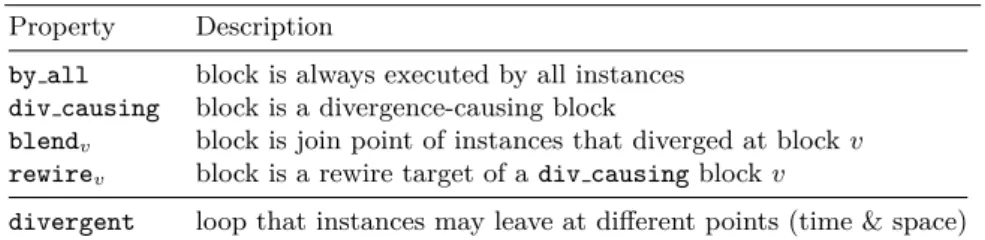
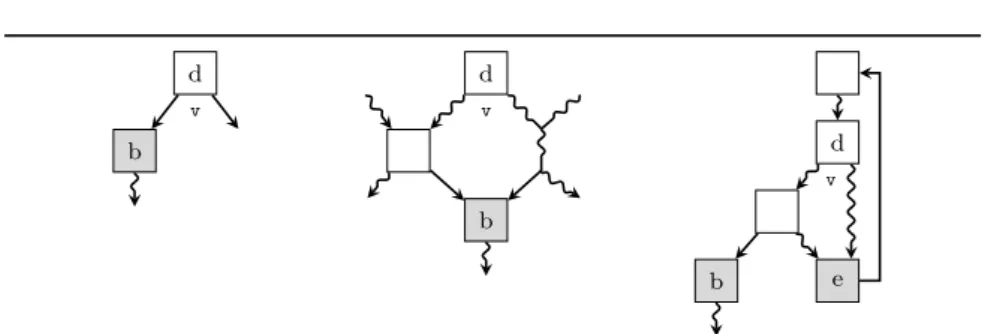
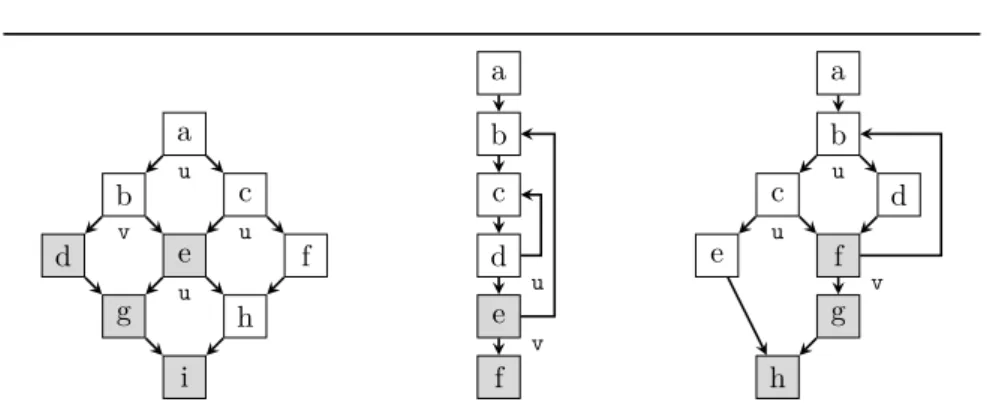
This thesis introduces the notion ofdivergence-causing blocksandrewire target blocksthat capture the behavior of control flow in a SIMD context. We further present a static analysis that determines the rewire targets of each divergence-causing block in a CFG, and an improved,partial control-flow to data-flow conversion algorithm that makes use of this information. The presented approach is an overapproximation, i.e., it cannot cover as many cases as a dynamic approach because some occurrences of non-diverging control flow can be caused by input data. However, since the algorithm only uses static information, it never impacts performance negatively in contrast to the dynamic test.
1.1 Contributions
In summary, this thesis makes the following contributions:
• We present Whole-Function Vectorization (WFV), a transformation of control flow graphs in SSA form for processors with SIMD instructions. Existing vectorization approaches are tied to the source language and often also to the target platform. A CFG in SSA form is an intermediate representation that abstracts fromsource language andtarget machine. Thus, WFV improves portability and maintainability.
• WFV generates predicated code forarbitrarycontrol flow on architectures without hardware support for predicated execution by carefully placing
selectoperations. This includes nested loops, loops with multiple exits,
and exits leaving multiple loops. Therefore, WFV allows to vectorize a larger class of applications than state-of-the-art approaches, which are usually restricted to structured or non-cyclic control flow.
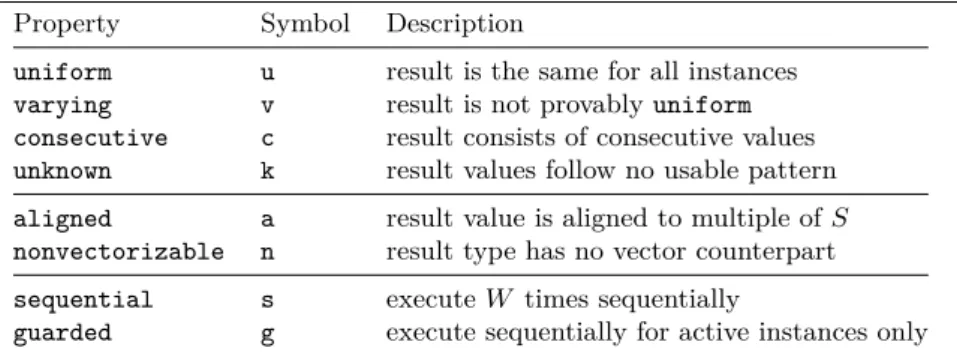
• We present a static analysis that identifies certain constraints on the values of variables in different parallel instances: ThisVectorization Analysis
determines which values are the same for all parallel instances, which values require sequential execution (e.g. due to side effects), which program points are always executed by all instances, which loops may have instances leaving in different iterations or over different exits, and classify memory access patterns.
• We introduce an extension to this analysis that improves the precision of the determined memory access patterns. The extension formulates the problem whether a memory operation accesses consecutive memory locations as a set of equations in Presburger Arithmetic. An SMT solver is used to solve the equations.
• We present a static analysis that identifies certain constraints on the behavior of control flow in a SIMD context: ThisRewire Target Analysis
determines which parts of the control flow graph must never be skipped to ensure correct results during SIMD execution. Implicitly, this describes parts of the CFG which can be left untouched.
• The results of the Rewire Target Analysis are leveraged by a novel,partial control-flow to data-flow conversion algorithm. This algorithm keeps regions of the control flow graph intact in which instances never diverge. Existing approaches either linearize the entire CFG, or at most employ
1.1 Contributions 9
simple optimizations such as retaining diamond-shapedifstatements if the branch condition is uniform. Our approach is able to determine on a per-edge basis which parts of the CFG do not have to be linearized, even for unstructured control flow. For example, it can retain uniform exits of divergent loops and parts of nested and overlapping regions. This reduces the amount of code that has to be executed by every call to the generated function.
• We present a set of extensions to WFV that exploit dynamic properties of a function. This is achieved using dynamic tests and separate, optimized code paths where the tested property is used to generate better code. • We implemented WFV using the LLVM compiler infrastructure and
evaluated it in three practically relevant scenarios. First, we integrated it into a compiler for the RenderMan shading language, a computer graphics DSL that is widely used for visual effects in the movie industry, and performed experiments with a real-time ray tracer. Second, we developed a prototypical OpenCL runtime system that uses WFV to execute multiple work items at once per core. The implementation also includes a novel, software-based scheme for barrier synchronization. Third, we implemented a classic loop vectorization phase on top of WFV. We evaluated it in a compiler that allows the user to define which optimizations to run on what parts of the code. The loop vectorization employs a novel method for handling arbitrary loop-carried dependencies, which includes schemes commonly calledreductions. We show an average speedup of 3.8 for the ray tracer, speedups between 0.8 and 3.8 for different OpenCL applications, and speedups of 1.2 and 1.45 for applications tuned with the custom compiler on a machine with S= 4.
1.2 Publications
The analyses and transformations presented in this thesis build on the following publications:
• Whole-Function Vectorization
Ralf Karrenberg and Sebastian Hack
InProceedings of the 9th Annual IEEE/ACM International Symposium on Code Generation and Optimization, pages 141–150, Washington, DC, USA, 2011. IEEE Computer Society.
[Karrenberg & Hack 2011]
• Improving Performance of OpenCL on CPUs
Ralf Karrenberg and Sebastian Hack
In Proceedings of the 21st International Conference on Compiler Con-struction, pages 1–20, Berlin, Heidelberg, 2012. Springer-Verlag.
[Karrenberg & Hack 2012]
• Presburger Arithmetic in Memory Access Optimization for Data-Parallel Languages
Ralf Karrenberg, Marek Koˇsta, and Thomas Sturm
In Frontiers of Combining Systems, Volume 8152 of Lecture Notes in Computer Science, pages 56–70, Berlin, Heidelberg, 2013. Springer-Verlag.
[Karrenberg et al. 2013]
• AnySL: Efficient and Portable Shading for Ray Tracing
Ralf Karrenberg, Dmitri Rubinstein, Philipp Slusallek, and Sebastian Hack
InProceedings of the Conference on High Performance Graphics, pages 97–105, Aire-la-Ville, Switzerland, 2010. Eurographics Association. [Karrenberg et al. 2010]
2 Foundations & Terminology
This thesis builds on a few key developments in the field of compiler construc-tion that we briefly introduce in this chapter. More detailed explanaconstruc-tions are given, for example, by Aho et al. [2006] and Kennedy & Allen [2002].
2.1 Basic Block
A basic block consists of a list of instructions that have to be executed in order. This implies that any operation that can influence which instruction is executed next, i.e., any branch instruction, may only occur at the end of a block.
2.2 Control Flow Graph (CFG)
A CFG is a directed, possibly cyclic graph with a dedicated entry node. It represents the structure of a function by expressing instructions or basic blocks as nodes and their successor relations as edges. We consider CFGs with basic blocks as nodes. If the function code at one point allows multiple different code paths to be executed next, the corresponding block in the CFG has multiple outgoing edges. This is the case for explicit control flow constructs like if statements or loops, but can also occur in other circumstances, e.g. for operations that can throw an exception. If previously disjoint paths merge again, the corresponding block has multiple incoming edges, e.g. behind a source-levelifstatement. Figure 2.1 shows the CFG that corresponds to theMandelbrotexample in the introduction.
Critical Edges. An edge of a CFG is said to becritical if its source block has multiple outgoing edges and its target block has multiple incoming edges. For example, the edgea→cin Figure 2.2 is critical. Such edges are usually not desired, and can be easily removed by splitting the edge and placing an additional block at the split point. All algorithms presented in this thesis can handle critical edges. The Partial CFG Linearization phase (Section 6.3) in some cases performs implicit breaking of critical edges.
a b
e c
f d
g
Figure 2.1: The CFG that corresponds to theMandelbrotfunction in List-ing 1.1. Special loop blocks accordList-ing to Section 2.4: Blockais the entry block and at the same time the preheader of the loop that consists of blocksb,c, andd. Blockbis the header of this loop,dis a loop latch. The blocksbandc
are loop exiting blocks,eandf the corresponding exit blocks. Blockgis the final block that holds areturnstatement.
2.3 Dominance and Postdominance
A basic block a dominates another block b if a is part of every possible path from the entry block of the function to b [Lowry & Medlock 1969]. In particular, the entry block of a function dominates all reachable blocks. Also, according to the definition in Section 2.4, a header of a loop dominates all blocks in the loop. A basic block a strictly dominates a block b if a dominatesb andaandb are distinct blocks. A basic blockais the unique
immediate dominator of a block b if a strictly dominates b and does not strictly dominate any other strict dominator ofb.
The immediate dominance relation of basic blocks induces a tree structure, thedominator tree. Thedominance frontier of a blockais the set of nodesB of which a predecessor of each block in B is dominated byabut each block in B is not strictly dominated by a. The iterated dominance frontier of blocksa1, . . . , an is the limit of the increasing sequence of sets of nodesD, whereD is initialized with the dominance frontiers ofa1, . . . , an, and each iteration step increases the set with the dominance frontiers of all nodes ofD [Cytron et al. 1991].
A basic blockbpostdominatesanother blockaifbis part of every possible path fromb to the function exit block.1 As an example, if there is exactly 1If the function has multiple exit blocks and/or non-terminating loops, we assume a
2.4 Loops 13
one edge in a loop that jumps back to the header, the source block of that edge is a postdominator of all blocks in the loop (see Section 2.4). The termsstrict postdomination,immediate postdominator,postdominator tree,
postdominance frontier, and iterated postdominance frontier are defined analogously.
Various algorithmic approaches exist to efficiently compute dominance, dominance frontiers, and dominator trees [Cytron et al. 1991, Lengauer & Tarjan 1979, Ramalingam 2002].
Note that these definitions are straightforward to extend from basic blocks to SSA values: If two values are defined in the same basic block, the upper one in the list of instructions strictly dominates the lower one. Otherwise, the dominator relation of their parent blocks is the dominator relation of the values.
2.4 Loops
A loop is a strongly connected component of blocks in a CFG. The blocks that are enclosed in such a region are called thebody of the loop. In addition, we use the following definitions [Ramalingam 2002]:
• Aheader is a block of a loop that is not dominated by any other block of the loop.
• Apreheader is a block outside the loop that has an unconditional branch to a loop header.
• Aback edge is an edge that goes from a block of a loop to a loop header. • A latchis a block of a loop that has a back edge as one of its outgoing
edges.
• Anexiting block of a loop is a block inside the loop that has an outgoing edge to a block that is outside the loop.
• Anexit block of a loop is a block outside the loop that has an incoming edge from a block that is inside the loop.
Note that, by definition, an exiting block has to end with a conditional branch, since otherwise it would not be part of the loop itself. Figure 2.1 exemplifies these terms at the example of theMandelbrotCFG.
If not mentioned otherwise, we consider onlyreducible loops, which are the vast majority of loops found in real-world programs. In a reducible loop, the header dominates (Section 2.3) its source, the latch [Hecht & Ullman 1972]. This implies that a reducible loop may not have more than one header, i.e., it is a loop with a single entry. The single header then also dominates
all blocks of the loop. Note that, if required, irreducible control flow can be transformed into reducible control flow using node splitting [Janssen & Corporaal 1997]. However, this can result in an exponential blowup of the code size [Carter et al. 2003].
In addition, we consider all loops to besimplified, i.e., they have exactly one preheader and one latch, and all exits have a unique successor block that has no other incoming edges. This does not impose any restrictions on the source code. This simplified definition allows to determine a tree-shaped hierarchy of nested loops for every CFG:2 A loopL
n is nested in another loop Lp if the header ofLn is part of the loop body ofLp. In such a case, we callLpthe outer looporparent loop, andLn theinner looporchild loop. We also say thatLn is at anesting level that is one level deeper than Lp. Multiple loops may be nested in one loop, but a loop may not be nested in multiple loops. Note that this definition allows exit edges to leave multiple loops at once, going up multiple nesting levels. However, an entry edge may not enter a loop of a nesting level deeper than the one below its own nesting level.
2.5 Static Single Assignment (SSA) Form
Static Single Assignment form [Alpern et al. 1988], short SSA form, is a program representation in which each variable has exactly one static definition. To transform a given program into SSA form, an SSA variable is created foreach definition of a variable. Figure 2.2 shows an example for the transformation of a normal CFG into a CFG in SSA form. To represent situations where multiple definitions of the same original variable can reach a use, so-calledφ-functions have to be inserted at dominance frontiers [Cytron et al. 1991]. Aφ-function has an incoming value for every incoming edge. The operation returns the value that corresponds to the edge over which its basic block was entered. This is required to ensure that the original relations between definitions and uses are preserved while maintaining the SSA property that every use has exactly one definition.
2Note that this definition requires the detection of nested SCCs, which can be achieved by ignoring back edges.
2.7 Live Values 15 x ← · · · y ← · · · a x ← · · · b · · · ← x+y c x1 ← · · · y1 ← · · · a x2 ← · · · b x3 ← φ(x1, x2) · · · ← x3+y1 c
Figure 2.2:A CFG and its SSA counterpart
2.5.1 LCSSA Form (LCSSA)
We consider all CFGs to be in LCSSA form, an extension to SSA form that was first introduced by Zdenek Dvorak3 in the GCC compiler.4 LCSSA guarantees that for a value that is defined in a loop, every use that is outside the loop is aφ-function in the corresponding loop exit block. This simplifies handling of loop result values during the different phases of the WFV algorithm.
2.6 Control Dependence
A statementy is said to becontrol dependent on another statementxif (1) there exists a nontrivial path fromxtoysuch that every statementz6=xin the path is postdominated byy, and (2)xis not postdominated byy[Kennedy & Allen 2002].
This definition implies that there can be no control dependencies within a basic block. Thus, it makes sense to talk about control dependence relations of basic blocks. For example, in Figure 2.1, blocks e and c are control dependent onb, and blocksb,f, anddare control dependent onc. Note that blocks can have multiple control dependencies, e.g. in nested conditionals.
2.7 Live Values
The classic definition of alive variable in a non-SSA context is the follow-ing [Kennedy & Allen 2002]: A variablexis said to beliveat a given points
3http://gcc.gnu.org/ml/gcc-patches/2004-03/msg02212.html 4gcc.gnu.org
in a program if there is a control flow path fromsto a use ofxthat contains no definition ofxprior to the use. Most importantly, this includes program points where the variable is not yet defined. In our context, we are only interested in the live values that are already defined at program point s: An SSA value v is said to be live at a given point s if there is a control flow path fromv tosand there is a control flow path fromsto a use of v that contains no definition of v. For example, in the CFG on the right of Figure 2.2, y1 is live in blockb.
2.8 Register Pressure
Every processor has a fixed set of registers where values are stored. For convenience, programming languages usually abstract from this by providing an unlimited set of registers to the user. The compiler then has to determine how to best map the used registers to those available in hardware. This is called register allocation.
Register pressure describes the number of registers that are required for a given program. If there are not enough registers, values have to bespilled, i.e., stored to memory, and reloaded later when they are used again. This has implications for the performance of the program: register access is much faster than accessing memory. Thus, it is desirable for a compiler to optimize the usage of registers and minimize the number of spill and reload operations and their impact on performance. Especially in a GPU environment, register pressure is a critical variable: Since the available registers are shared between threads, the number of registers used by a function determines how many threads can execute it in parallel.
In consequence, if a code transformation increases register pressure, this may result in decreased performance even if the resulting code itself is more efficient. As will be discussed in Section 3.3, this is an important issue for SIMD vectorization.
2.9 LLVM
The compiler infrastructureLLVM [Lattner & Adve 2004] forms the basis for our implementation of the Whole-Function Vectorization algorithm. Amongst other tools and libraries, the framework includes:
• a language and target independent, typed, intermediate representation in the form of a control flow graph in SSA form,
2.9 LLVM 17
• a front end (Clang) for the C language family (C/C++/ObjC),5 • various back ends, e.g. for x86, ARM, or PTX, and
• a just-in-time compiler.
Our implementation works entirely on LLVM’s intermediate representation (IR), which allows to use it independently of the source-language and the
target-architecture.
2.9.1 Intermediate Representation (IR)
Throughout the next chapters, we show examples in the human-readable representation of the LLVM IR, which we briefly describe in the following. The LLVM IR is a typed, low-level, assembler-like language. There are neither advanced language features like overloading or inheritance nor control flow statements such asif-then-elsestatements or explicit loops. Instead, the control flow of a function is represented by a CFG whose edges are induced by low-level instructions such as conditional or unconditional branches. The nodes of the CFG are basic blocks with lists of instructions. Each instruction corresponds to exactly one operation and usually also represents an SSA value. The only exception to this are values with return typevoid, such as
branch, call, and store operations. Every other value has a name that
starts with “%” which is referenced everywhere that value is used. A typical instruction looks like this:
% r = fa d d <4 x f l o a t > % a , % b
The example shows the LLVM IR equivalent for the SSE2 vector addition intrinsicADDPS (_mm_add_ps(__m128 a, __m128 b)in C/C++). The left-hand
side of the expression is the name of the value. On the right hand side, the operation identifier is followed by its operands, each with its type preceding the name. If types are equal, they can be omitted for all operands after the first.
The following code defines a functionfoowith return type float and argument typesintand float:
d e f i n e f l o a t @ f o o( int % a , f l o a t % b ) { e n t r y :
% x = fs u b f l o a t % b , 1 . 0 0 0 0 0 0 e +01
ret f l o a t % x }
The labelentrymarks the only basic block which is followed by the instruc-tions of that block.
2.9.2 Data Types
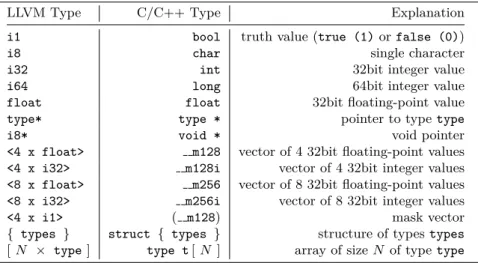
The LLVM IR supports a large set of different data types. Table 2.1 shows examples for the most important types and their typical C/C++ counter-parts.
Table 2.1 Examples for the most important LLVM data types and their C/C++ counterparts. Note that this list only shows typical C/C++ types, since types likeintare machine dependent.
LLVM Type C/C++ Type Explanation
i1 bool truth value (true (1)orfalse (0))
i8 char single character
i32 int 32bit integer value
i64 long 64bit integer value
float float 32bit floating-point value
type* type * pointer to typetype
i8* void * void pointer
<4 x float> m128 vector of 4 32bit floating-point values
<4 x i32> m128i vector of 4 32bit integer values
<8 x float> m256 vector of 8 32bit floating-point values
<8 x i32> m256i vector of 8 32bit integer values
<4 x i1> ( m128) mask vector
{ types } struct { types } structure of typestypes
[N × type] type t[N ] array of sizeN of typetype
2.9.3 Important Instructions
Most instructions of the IR are standard instructions that can be found in most assembly languages and need not be described in detail. However, there are a few that require additional explanations:
• Phi
Thephiinstruction is the equivalent to theφ-function described in Sec-tion 2.5. It chooses a value depending on which predecessor block was executed:
% r = phi f l o a t [ % a , % b l o c k A ] , [ % b , % b l o c k B ]
The value of ris set to aif the previously executed block wasblockAor tobif the previously executed block wasblockB.
2.9 LLVM 19
• Select
Theselectinstruction returns either its second or third operand
depend-ing on the evaluation of its condition:
% r = s e l e c t i1 % c , f l o a t % a , f l o a t % b
The value of ris set toa if condition cis true and tob otherwise. If the select statement has operands of vector type, a new vector is created by ablend operation that merges the two input vectors on the basis of a per-element evaluation of the condition vector (see Section 6.2). The terms “select” and “blend” are thus used interchangeably for the same operation.
• GetElementPointer (GEP)
TheGetElementPointer instruction returns a pointer to a member of a
possibly nested data structure. It receives the data structure and a list of indices as inputs. The indices denote the position of the requested member on each nesting level of the structure. In the following example, the GEPinstruction (%r) creates a pointer to the float element of the struct of typestruct.Bthat is nested in the struct%Aand stores 3.14 to that location:
% s t r u c t . A = t y p e { i8* , i32, % s t r u c t . B } % s t r u c t . B = t y p e { i64, float, i32 } ...
% r = g e t e l e m e n t p t r % s t r u c t . A * % A , i32 0 , i32 2 , i32 1
s t o r e f l o a t 0 x 4 0 0 9 1 E B 8 6 0 0 0 0 0 0 0 , f l o a t* % r , a l i g n 4
The first index is required to step through the pointer, the second index references the third element of the struct (which is the nested struct) and the third index references the second element of that nested struct. It is important to note that a GEPonly performs an address calculation and does not access memory itself.
• InsertElement / ExtractElement
The InsertElement and ExtractElement instructions are required if
single elements of a vector have to be accessed:
% p2 = i n s e r t e l e m e n t <4 x f l o a t > % p , f l o a t % elem , i32 1 % res = e x t r a c t e l e m e n t <4 x f l o a t > % p2 , i32 1
The first instruction inserts thefloatvalueelemat position1into vector p, yielding a new vector SSA value. The second instruction extracts the
• Comparison Operations
The ICmp and FCmp instructions allow to compare values of the same integer or floating point types and return a truth value. If the values are of vector type, the result of the comparison is stored component-wise as a vector of truth values<W x i1>.
• “All-false” Vector Comparison
In vector programs, one often needs to take a branch ifall elements of a mask vector (e.g. <4 x i1>) arefalse. Since that requires a single truth value to base the decision upon, one cannot employ a vector comparison operation, which returns a vector of truth values. As of LLVM 3.3, the most efficient solution to this is the following IR pattern: Given a vector condition of type<W x i1>, sign extend it to<W x i32>, bitcast
toi(W*32), and compare to zero. For example, when targeting SSE with
a target SIMD width of 4, the following IR is recognized by the x86 back end:
% ext = s e x t <4 x i1 > % c o n d to <4 x i32 > % bc = b i t c a s t <4 x i32 > % ext to i 1 2 8 % t e s t = i c m p ne , i 1 28 % bc , 0
br i1 % test , % blockA , % b l o c k B
The resulting assembly is an efficient PTEST followed by a conditional jump.
In addition, we define two special instructions that do not actually exist in LLVM IR, but help us keep code in listings more compact:
• Merge
Themergeinstruction creates a new vector from a set of input values:
% v = m e r g e f l o a t % a , % b , % c , % d
This is equivalent to the following IR:
% v0 = i n s e r t e l e m e n t <4 x f l o a t > undef , f l o a t % a , i32 0 % v1 = i n s e r t e l e m e n t <4 x f l o a t > % v0 , f l o a t % b , i32 1 % v2 = i n s e r t e l e m e n t <4 x f l o a t > % v1 , f l o a t % c , i32 2 % v = i n s e r t e l e m e n t <4 x f l o a t > % v2 , f l o a t % d , i32 3
• Broadcast
Thebroadcastinstruction creates a new vector of the given type where
each element is a copy of the single operand:
2.10 Single Instruction, Multiple Data (SIMD) 21
This is equivalent to a special case of merge:
% v = m e r g e f l o a t % a , % a , % a , % a
Note that the broadcast in LLVM IR can also be done with an
insert-elementoperation followed by ashufflevectorinstead:
% av = i n s e r t e l e m e n t <4 x f l o a t > undef , f l o a t % a , i32 0 % v = s h u f f l e v e c t o r <4 x f l o a t > % av , <4 x f l o a t > undef ,
<4 x i32 > z e r o i n i t i a l i z e r
2.10 Single Instruction, Multiple Data (SIMD)
Single Instruction, Multiple Data(SIMD) describes an execution model that executes a single operation onvectorsof input values, yielding a result vector, whereas traditional operations only receive single,scalar values and produce a scalar result. Most of today’s CPUs—even processors of mobile devices such as smartphones—have special SIMD instruction sets. Common examples for such instruction sets are, in order of consumer market appearance at the time of writing:• Intel MMX (64 bit registers, since 1996)
• AMD 3DNow! (128 bit registers, since 1998)
• Intel Streaming SIMD Extensions (SSE, 128 bit, since 1999)
• Freescale/IBM/Apple AltiVec (also VMX, 128 bit, since 1999)
• ARM NEON (128 bit, since 2005)
• Intel Advanced Vector Extensions (AVX, 256 bit, since 2011)
• Intel Larrabee New Instructions (LRBni, 512 bit, since 2013).
• Intel AVX-512 (512 bit, expected 2015).
These instruction sets operate on SIMD registers that are two to sixteen times larger than a standard, single-precision value of 32 bit. However, the vector instructions only require approximately the same time for execution as their scalar counterparts. Thus, if used efficiently, they can increase performance of an application significantly. In addition, they are more energy efficient since only one instruction fetch and decode has to be performed.
We use the following terms to refer to properties of SIMD instructions and vectorization: TheSIMD width S of an architecture is the number of 32 bit values that can be stored in a single SIMD register. Such an architecture thus hasS SIMD lanes, where thei-th lane refers to the element at position iof the vector. Data-parallel vectorization is achieved by executing an instance of the program in a single SIMD lane and combining S instances into a
3 Overview
In this chapter, we present an overview of the basicWhole-Function Vec-torization algorithm, the challenges faced when vectorizing real-world code, and the most important performance implications of the transformation. In Chapter 5, we give a detailed description of the analyses involved, followed by the actual presentation of the WFV algorithm in Chapter 6.
3.1 Whole-Function Vectorization (WFV)
The algorithm transforms a given functionf into its SIMD equivalentfW that performsW executions off in parallel. It consists of five main phases: 1. An analysis phase determines a variety of properties of the function under data-parallel semantics (Chapter 5). For example, it has to be determined which instructions cannot be vectorized and thus have to be replaced by multiple scalar operations instead of a vectorial one. Also, the subsequent phases can produce much more efficient code if operations could be proven to always produce the same result for all grouped instances or whether a memory operation accesses consecutive locations.
2. Masks are computed for every edge of the control flow graph (Section 6.1). They store information about the flow of control in the function. 3. Select instructions that discard results of inactive instances are introduced
where necessary (Section 6.2). These operations blend together values from disjoint paths that were executed by different instances.
4. Those parts of the control flow graph where the grouped instances may take different paths are linearized (Section 6.3). This means that, in such regions, all branches except for loop back edges are removed and code of originally disjoint paths is merged into one path.
5. Now that control flow has been transformed to data flow, every instruction is replaced by its vector counterpart or is split intoWsequential operations (Section 6.4).
3.2 Algorithmic Challenges
The WFV algorithm is designed to vectorize code for a large class of lan-guage features. This includes arbitrary control flow, nested data structures, operations with side effects, and operations without vector equivalent. In general, the algorithm is able to transform any function, but possibly with significant overhead.
Arbitrary Control Flow. The control-flow to data-flow conversion that will be presented in the following sections can convert any kind of control flow, including loops with multiple exits, nested loops, and exits that leave multiple nesting levels. Section 6.5 also presents an extension for irreducible control flow. Vectorization of arbitrary control flow requires to generate mask code that tracks which instances are active at any point of the function. Furthermore, we do not want to discard results of inactive instances after each operation, since that would introduce far too much overhead. Placing only as manyblend operations as required, however, is a non-trivial task in the presence of complex loop structures. To our knowledge, WFV is the only vectorization approach that can vectorize arbitrary control flow. Partial Linearization of Control Flow. The Partial CFG Linearization phase is able to retain some of the original structure of the CFG using static information. This includes the preservation of arbitrarily shaped, nested regions for which the instances that are executed in SIMD fashion do not diverge into different paths of the CFG. Also, some loop exits can be retained even if instances may diverge inside the loop and leave it over different exit edges and in different iterations. To our knowledge, WFV is the only vectorization approach that can do partial CFG linearization without hard-coded pattern matching.
Operations with Side Effects. The WFV algorithm handles any kind of side effect by duplicating the scalar operation W times and guarding each operation by conditional execution (see Section 6.4.4).1 This guard tests the mask value of the corresponding instance and only allows execution of the operation if the instance is active. This way, for a given operation, the vectorized function also preserves the order of occuring side effects as
1Byduplicationwe do not refer to creatingWexact duplicates but to creatingW scalar instructions that operate on those elements of their input values that correspond to their instance. We also call thissplitting.
3.3 Performance Issues of Vectorization 25
compared to sequential execution. However, note that this does not hold for multiple operations with side effects within a function: Because execution happens in lock step, the vectorized function executes the first operation with all active instances before executing the second operation with all active instances. During sequential execution of the instances, on the other hand, each instance would execute both operations before the next instance would execute both. This exemplifies how WFV relies on data-parallel language semantics that specify that instances are considered independent and thus allow such a change of observable behavior.
Operations without Vector Equivalent. The algorithm can also handle operations without vector equivalent. For example, an operation may return a value whose return type is not vectorizable, or the operation itself does not have a vector equivalent. Similar to operations with side effects, the vectorized function uses W duplicates of the scalar operation. In general, however, no guards have to be introduced for these operations, since there is no effect observable from the outside. Thus, values of inactive instances will be discarded by later select operations just like vector elements.
3.3 Performance Issues of Vectorization
There are a number of issues that can potentially reduce the performance of the vector code.
Overhead of Mask and Select Operations. If the target architecture does not support predicated execution (such as most of today’s SIMD instruction sets including SSE, AVX, and NEON), overhead has to be introduced in the form of instructions that compute and update masks and blend vectors together. The mask and select generation phases of WFV are designed to minimize the number of mask and blend operations that are introduced (see Sections 6.1 and 6.2).
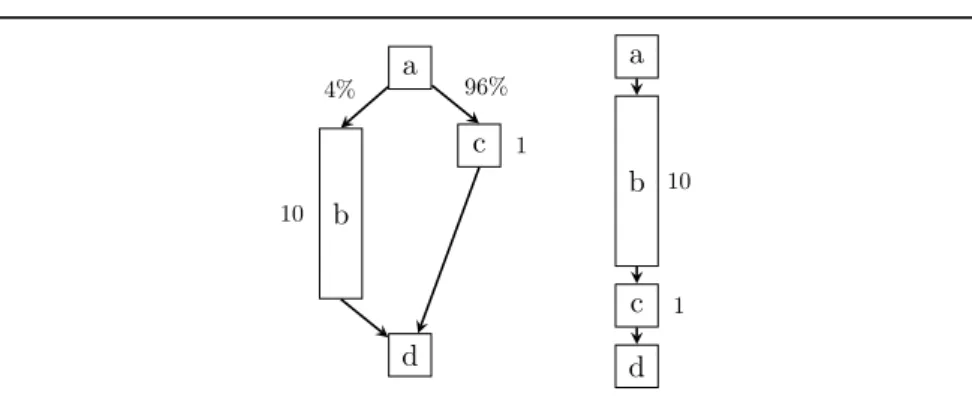
Critical Path Extension. Full linearization of control flow by definition results in longer critical paths: Instead of taking either thethenor theelse branch of an ifstatement, both paths are executed, thus increasing the amount of executed code. As described in the introduction, this results in inactive instances that do not contribute to the final result. In the worst case, some code may be executed withoutany active instance, i.e., all its results will be thrown away. As Figure 3.1 shows, this inefficiency becomes
a b c d 10 1 4% 96% a b c d 10 1
Figure 3.1: Pathological example for how linearization increases the amount of executed code. Percentages on edges represent execution frequencies, numbers next to blocks represent the cost of the block. Assuming 100 executions, the vectorized CFG on the right atW = 4 would yield a slowdown of 2×compared to a scalar execution of the CFG on the left ((100/4)∗11 = 275 vs. 96∗1+4∗10 = 136). If the branch can be retained, the vector variant is improved by a factor of 8.1 ((96/4)∗1 + (4/4)∗10 = 34, 4×faster than scalar).
even more problematic in cases where one of the two paths is much more expensive than the other but only rarely executed. If the linearized paths are in a loop the negative impact on performance is amplified even more. The Partial CFG Linearization phase of WFV reduces this problem by statically retaining parts of the control flow graph (see Section 6.3).
Register Pressure Increase. Linearization of control flow may also increase
register pressure. Consider the example CFGs in Figure 3.2, where the variables that are live from blockato bare disjoint from those live froma toc. The vectorized code on the right has a higher register pressure than the sequential variant on the left. This is because all values that are live on edge a→care now live throughoutb, increasing its register pressure. Likewise, all values that are live on edgeb→dare now live throughout c, increasing the register pressure in this block as well. The increased register pressure in turn can lead to additional spilling, which can severely impact performance. By preventing linearization of parts of the control flow graph, WFV does not increase register pressure to the same extent in the first place.
Uniform Operations. Often, instructions will use values that are the same for different instances. For example, a constant function argument is always