Proactive Vulnerability Discovery and Assessment in
Smart, Connected Systems Through Systematic Problem
Analysis
by Qi Chen
A dissertation submitted in partial fulfillment of the requirements for the degree of
Doctor of Philosophy
(Computer Science and Engineering) in the University of Michigan
2018
Doctoral Committee:
Professor Z. Morley Mao, Chair Professor Henry X. Liu
Professor Atul Prakash
Assistant Professor Zhiyun Qian, University of California, Riverside Professor Michael K. Reiter, University of North Carolina, Chapel Hill
Qi Chen [email protected] ORCID iD: 0000-0003-0316-9285
c
To my parents, Professor Jianhua Chen and Mingxiu Ma, and my love, Yu Stephanie Sun.
ACKNOWLEDGEMENTS
Getting a Ph.D. is quite a long and tough journey. Looking back at the past six years, I find myself constantly making mistakes, getting rejected, and questioning about whether I am really that talented to become a competent researcher in the end. The only reason that gets me this far is the tremendous help and support from so many people along the way.
First and foremost, I would like to thank my advisor, Professor Z. Morley Mao. She is always willing to make herself available whenever I need her guidance, no matter for research, work, or life. Her consistent passion about research and her encouragement when I stuck are no doubt the most important reason why I am able to overcome so many hurdles in my Ph.D. journey. I especially admire her endless energy and resilience in pursuing higher standards in research and career, making her a perfect role model for my upcoming faculty career. I am extremely fortunate to have her being my advisor.
Next, I want to thank my girlfriend, Yu Stephanie Sun, for accompanying me for more than 7 years since we were both undergraduate students in Nanjing University. Without her unconditional love and support, I don’t think I can even have the courage to take on the challenge of pursuing a Ph.D. degree. Having her alongside me is the best thing that ever happened to me in my whole life.
I am very much grateful to my dissertation committee, Professor Atul Prakash, Pro-fessor Mike Reiter, ProPro-fessor Zhiyun Qian, and ProPro-fessor Henry Liu for their valuable feedback and help in refining the dissertation. I would like to especially thank Zhiyun for closely working with me on various research projects. His guidance is of tremendous help to me, especially at the early stage of my Ph.D. study.
I appreciate the collaboration opportunity with Dr. Eric Osterweil and Matt Thomas at Verisign Labs starting from my internship in May 2015. They taught me how to per-form network measurement and data-driven research, which becomes a core skill set in my following research. I have been fortunate enough to have them being my mentors.
I would also like to thank Professor Henry Liu and Dr. Yiheng Feng for collaborating with me so successfully in the last two years of my Ph.D. study. They taught me so much about the transportation field, without which it’s impossible to finish my last project – in my option, the most exciting one – about smart transportation security. The challenges I overcame in this highly interdisciplinary research collaboration will absolutely have a long lasting benefit in my upcoming career.
I also want to thank my colleagues and friends in Ann Arbor. I would like to first thank Dr. Yihua Guo and Haokun Luo. We three came to Michigan at the same year and became best friends ever since. I have highly enjoyable interaction with them both academically and socially throughout my Ph.D. study. We did tons and tons of funny (or silly) things together, for example the special interest group of foosball (SIGFOOS) and the player ranking system [112], and the “car-breaking” midnight chat with Yihua (please check out his dissertation for more details [210]). I also had lots of happy time with Dr. Earlence Fernandes, who started the Ph.D. program at the same year with me and also worked in the computer security research field. We were almost always roommates when travelling to security conferences and workshops, and shared nearly every piece of achievements and milestones in our Ph.D. study.
Also many thanks to my former group members, Dr. Qiang Xu, Dr. Junxian Huang, Dr. Sanae Rosen, and Mark Gordon, who helped me through tough times at the beginning of my Ph.D. study. In addition, I have enjoyed working on research projects together with Dr. Yunhan Jack Jia, Yuru Shao, Professor Ding Zhao, Professor Amir Rahmati, Professor Harsha Madhyastha, Professor J. Alex Halderman, Yucheng Yin, Yulong Cao, Shengtuo Hu, Jeremy Erickson, Chao Kong, Yikai Lin, David Ke Hong, Dr. Ashkan Nikravesh,
Jason Ott, Jie You, Shiqi Wang, Shihong Huang, Xiaochen Yu, EJ Lin, Rob Levy, and industry researchers Dr. Jie Hui, Aaron Drake, Dr. Kevin Lau, and Karthik Iyer. I also had a lot of fun with Yuanyuan Zhou, Professor Feng Qian, Professor Roya Ensafi, Dr. Mehrdad Moradi, Tom Andrews, Shichang Xu, Xiao Zhu, Lei Ruan, Deepak Kumar, Pro-fessor Michael Bailey, Dr. Yunjing Xu, Dr. Jing Zhang, Dr. Yue Liu, Dr. David Bild, Jiecao Yu, Shikai Li, Dongyao Chen, Dr. Yu-Chih Tung, Dr. Fei Li, Xianzheng Dou, Dr. Zhe Wu, Zhiqiang Sui, Professor Kassem Fawaz, Arun Ganesan, Mert Pese, Nishil Talati, Kevin Eykholt, Dr. Denis Foo Kune, Dr. David Devecsery, Dr. Michael Chow, Andrew Quinn, Dr. Sara Rampazzi, Tim Trippel, Ofir Weisse, Zhongjun Jin, Wai Wong, Xiaochi Li, Professor Eric Wustrow, Professor Zakir Durumeric, Travis Finkenauer, Ben VanderSloot, Matt Bernhard, and many others.
Finally, I want to thank my parents, Professor Jianhua Chen and Mingxiu Ma, for their guidance and support in both my life and career. Thanks again to Stephanie who has always been sources of love and support. This dissertation is dedicated to them.
TABLE OF CONTENTS
DEDICATION . . . ii
ACKNOWLEDGEMENTS . . . iii
LIST OF FIGURES . . . x
LIST OF TABLES . . . xii
ABSTRACT. . . xv
CHAPTER I. Introduction . . . 1
1.1 Network Stack: Systematic Detection of Packet Injection Vulner-abilities in Network Communication . . . 7
1.2 Network Stack: Discovery and Systematic Analysis of Name Col-lision Vulnerabilities in Network Service Discovery . . . 8
1.3 Smart Control: Systematic Discovery and Analysis of Algorithm-level Vulnerabilities in Next-generation Smart Transportation . . . 9
1.4 Dissertation Organization . . . 10
II. Background and Related Work . . . 11
2.1 Problem Domain 1: Network Communication Protocol Security . . 11
2.1.1 Related Work . . . 11
2.2 Problem Domain 2: DNS System Security in the New gTLD Era . 13 2.2.1 Background: DNS Ecosystem . . . 13
2.2.2 Background: Internal DNS Namespace and iTLD Usage 15 2.2.3 Background: DNS-based Service Discovery . . . 16
2.2.4 Background: Server Authentication Mechanisms . . . . 17
2.2.5 Related Work . . . 17
2.3 Problem Domain 3: Software Security in Next-generation Smart Transportation . . . 20
2.3.1 Background: CV Technology and Recent Advances . . . 20
2.3.2 Related Work . . . 22
III. Systematic Detection of Packet Injection Vulnerabilities. . . 24
3.1 Introduction . . . 24
3.2 Attack Threat Model . . . 27
3.3 Illustrative Example . . . 28
3.3.1 Packet Injection Attack for TCP . . . 28
3.3.2 Attacker-controlled Implicit Information Leaks . . . 30
3.4 PacketGuardian Overview . . . 32
3.4.1 Analysis Steps . . . 32
3.4.2 PacketGuardian Design . . . 34
3.5 Taint-based Summarizer . . . 36
3.5.1 Taint Analysis Engine . . . 36
3.5.2 Function Summary . . . 39
3.6 Path Construction and Vulnerability Analysis . . . 42
3.6.1 DFS Path Construction and Analysis Framework . . . . 42
3.6.2 Accept Path Analysis . . . 44
3.6.3 Leakage Path Analysis . . . 45
3.7 Evaluation . . . 48
3.7.1 Tool Effectiveness and Accuracy . . . 49
3.7.2 Tool Efficiency . . . 52
3.7.3 Result analysis . . . 52
3.8 Limitation and Future Work . . . 60
3.9 Summary . . . 61
IV. Discovery and Systematic Analysis of WPAD Name Collision Attack . 62 4.1 Introduction . . . 62
4.2 The WPAD Service Discovery Protocol . . . 65
4.3 Threat Model and Attack Surface . . . 66
4.3.1 Threat Model . . . 67
4.3.2 Attack Surface . . . 69
4.3.3 Dataset . . . 70
4.4 WPAD Query Leakage Characterization . . . 72
4.4.1 Quantification of Leaked Queries . . . 72
4.4.2 Leak Cause Analysis . . . 74
4.4.3 Result Summary and Highly-vulnerable ASes . . . 80
4.5 Attack Surface Quantification . . . 80
4.5.1 Quantification Method . . . 80
4.5.2 Evaluation . . . 82
4.6 Attack Surface and Exploit Status Characterization . . . 84
4.6.1 Attack Surface Characterization . . . 86
4.6.3 Exploit Status . . . 93
4.7 Remediation Strategy Discussion . . . 93
4.8 Summary . . . 99
V. Systematic Analysis and Detection of Client-side Name Collision Vul-nerability. . . 101
5.1 Introduction . . . 101
5.2 Client-side Name Collision Vulnerability . . . 105
5.2.1 Threat Model . . . 105
5.2.2 Vulnerability Definition . . . 107
5.3 Exposed Service Characterization . . . 108
5.3.1 Methodology . . . 108
5.3.2 Exposed Services . . . 113
5.4 Vulnerability Analysis . . . 115
5.4.1 Methodology . . . 115
5.4.2 Service Discovery Usage Scenarios . . . 119
5.4.3 Vulnerability Analysis . . . 121
5.4.4 Discussion . . . 126
5.5 Exploitation Case Study . . . 127
5.5.1 MitM Attack . . . 127
5.5.2 Malicious Library Injection . . . 129
5.5.3 Document Leakage . . . 131
5.5.4 Credential Theft . . . 132
5.5.5 Phishing Calls and Messages . . . 133
5.5.6 Phishing Contacts & Calendar Events . . . 135
5.6 Defense Discussion . . . 136
5.6.1 Service Level Defense Discussion . . . 136
5.6.2 DNS Ecosystem Level Defense Discussion . . . 138
5.7 Summary . . . 139
VI. Systematic Discovery and Analysis of Algorithm-level Vulnerabilities in Next-generation Smart Transportation . . . 140
6.1 Introduction . . . 140
6.2 The I-SIG System . . . 145
6.3 Threat Model . . . 150
6.4 Analysis Methodology Overview . . . 151
6.4.1 Attack Goals . . . 152
6.4.2 Analysis Methodology Overview . . . 153
6.5 Data Spoofing Strategy . . . 155
6.5.1 Attack Input Data Flow and Direct Spoofing Strategy . . 155
6.5.2 Spoofing Strategy For The Transition Period Only . . . 156
6.6 Vulnerability Analysis . . . 158
6.6.2 Attack Effectiveness Quantification . . . 159
6.6.3 Congestion Attack Analayis . . . 161
6.6.4 Personal Gain and Safety Attacks . . . 168
6.7 Exploitation Case Study: Congestion Attack . . . 172
6.7.1 Exploit Construction . . . 172
6.7.2 Attack Evaluation . . . 177
6.8 Defense Discussions . . . 182
6.9 Summary . . . 185
VII. Conclusion and Future Work. . . 186
7.1 Conclusion . . . 186
7.2 Future Work . . . 189
LIST OF FIGURES
Figure
3.1 Packet injection attack threat model in§III. . . 27 3.2 An illustrative code example of a simplified implementation for handling
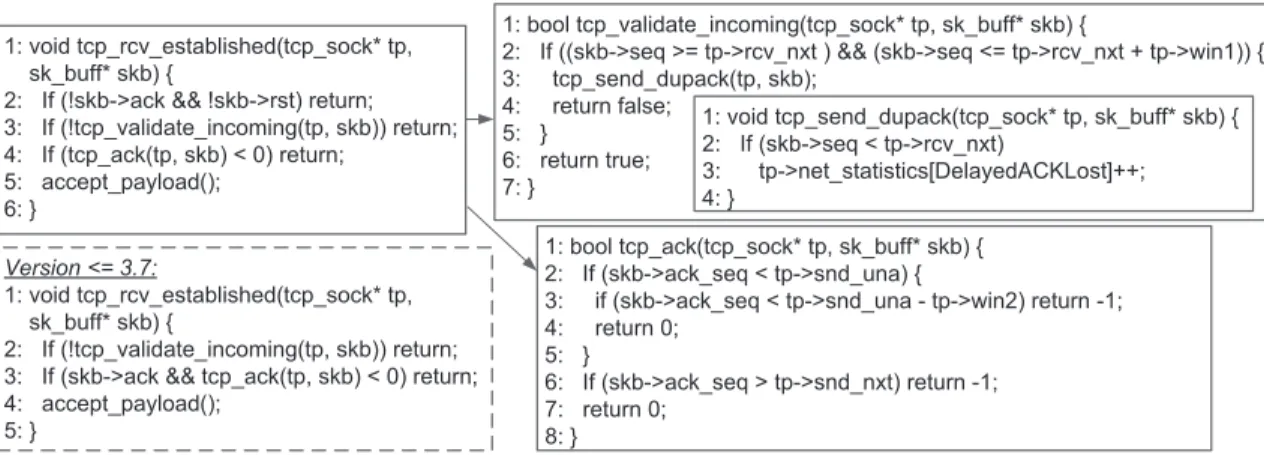
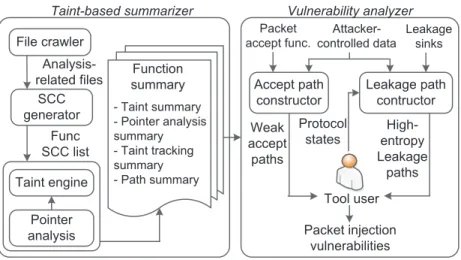
an incoming TCP packet in Linux kernel 3.15. . . 28 3.3 PacketGuardian design overview. . . 33 3.4 Path analysis process in DFS path construction and analysis framework. . 42 3.5 Code snippet for conditions of entering TCP fast path. . . 54 3.6 Leakage of snd nxt through sinkTCPChallengeACK. . . 55 3.7 False positive causes for RTP-VLC accept path analysis. . . 57 4.1 Illustration of the WPAD name collision attack. If an internal namespace
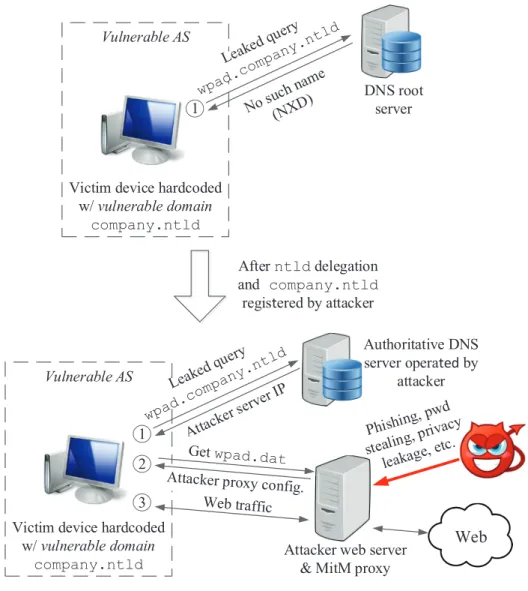
TLD is delegated as a new gTLD, internal namespace WPAD query leaks can be easily exploited using MitM attack from anywhere on the Internet. 67 4.2 The most popular first labels in root NXD traffic. . . 72 4.3 The most popular delegated new gTLDs observed in root NXD WPAD
queries. . . 73 4.4 Countries ranked by WPAD query leak percentage. The figure inset
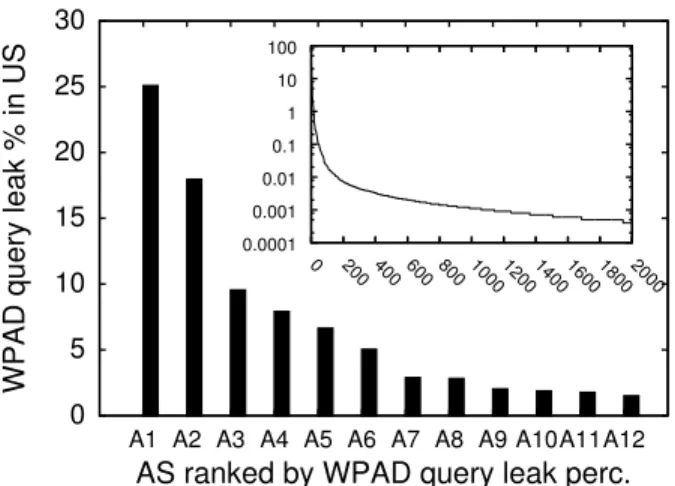
shows the complete probability distribution, illustrating the long tail. . . . 74 4.5 ASes ranked by WPAD query leak percentage in US. . . 75 4.6 ASes ranked by their domain suffix entropy scores. Home access
net-works with top leak query volume (Table 4.2) are also high-entropy ASes. A13 is the only exception that did not appear in the top 12 WPAD query leak ASes. . . 77 4.7 Relationship of attack surface query ratio and period lengthp. . . 82 4.8 Relationship of attack surface query ratio and persistence duration n.
Since the 6 new gTLDs have different delegation dates, the data range for the curves are different. . . 83 4.9 CDF of attack surface query ratio in TLD percentage and TLD leaked
WPAD query traffic percentage. . . 84 4.10 CDF of attack surface period number in TLD percentage and TLD leaked
WPAD query traffic percentage. . . 85 4.11 Attack surface size distribution for new gTLDs delegated as of 2015/08/25. 87 4.12 Breakdown of new gTLDs in the leftover part in cross AS attack surface
4.13 Attack surface domain registration percentage for new gTLDs in the top
vulnerable AS A1. . . 89
4.14 Linear fitting results for the estimation time for a new gTLD to have all attack surface domains fully-registered. . . 89
4.15 Protected leaked WPAD query percentage CDF for partial deployment of new gTLD registry level defense. The figure inset lists the top 18 new gTLDs which can protect 80% of total leaked queries if the defense is deployed. . . 95
4.16 Filtered leaked WPAD query percentage CDF for partial deployment of AS level defense. The figure inset shows the CDF for the top 524 ASes. . 95
5.1 The generalized name collision attack threat model. . . 106
5.2 Automatic labeling results for the top 300 non-registered service string candidates. . . 114
5.3 Illustration of usage scenario U1 and U2 of DNS-based service discovery (§5.4.2) in our service client collection. . . 120
6.1 The blocking effect created by our congestion attack on a real-world intersection map with real traffic demand. Due to the attack from one single attack vehicleparking nearby, in the northbound and southbound approaches the vehicles in the left-turn lanes spill over their lanes and directly block the entire approaches, causing massive traffic jams. . . 144
6.2 The operation scenario for the I-SIG system. . . 147
6.3 Illustration of a signal plan. Number 1 to 8 are phases. . . 148
6.4 The I-SIG system design. . . 149
6.5 The data flow of spoofed vehicle driving data in the I-SIG system. PR means penetration rate. . . 155
6.6 Illustration of the last vehicle advantage. By exploiting it, even the spoofed data from a single attack vehicle can significantly influence the signal planning. . . 165
6.7 Percentage of snapshots vulnerable to the last vehicle advantage and the estimated COP solving time with two to eight planning stages. . . 165
6.8 Relative differences between the average delay increase percentages us-ing the three exploits with limited trial budgets and those by tryus-ing all possible options. . . 176
6.9 Average vehicle delay every one minute with and without attack. The repeated blocking effects start at around second 1125. . . 182
LIST OF TABLES
Table
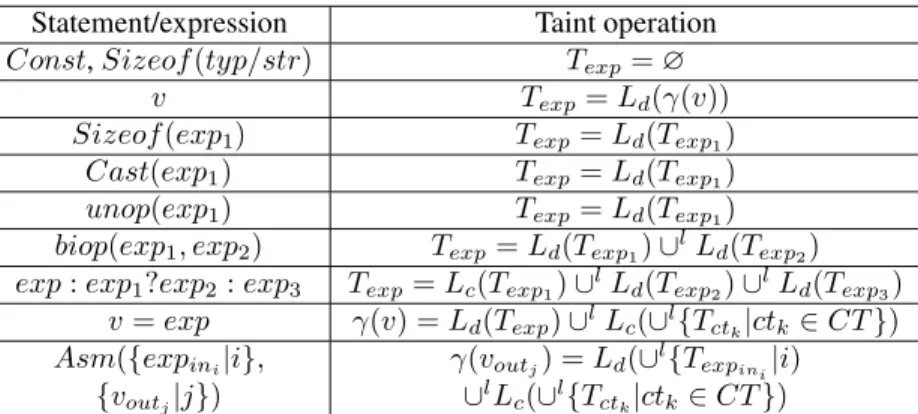
3.1 Categorization of implicit information leaks and position of the work in§III. 31 3.2 Taint value calculation and propagation logic for intra-procedure
propa-gation. CT includes the constraints that the current statement is control dependent on. . . 37 3.3 Statistics for the 6 code bases in our evaluation. . . 49 3.4 Evaluation of accumulative improvement usingrcv nxtleakage in
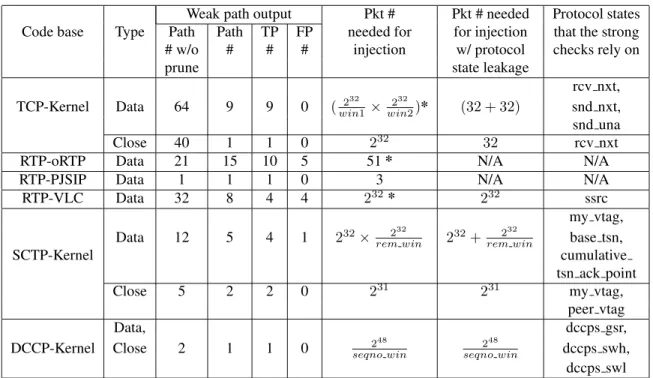
TCP-Kernel. . . 49 3.5 Summary of vulnerability analysis results. Number labeled with “*”
in-dicates that it can be smaller under special channel conditions.win1and
win2is usually between214to220,rem winis less than 4096 by default,
andseqno winis 100 during default initialization. . . 50 3.6 Protocol state leakage analysis result. Ssrc for RTP-VLC and
my/peer vtag for SCTP-Kernel is not included since our tool does not output any high-entropy leakage for them. . . 53 4.1 Popular OSes and browsers that support WPAD. . . 66 4.2 AS code names (used in Fig. 4.5 and Fig. 4.6) of the top 12 WPAD query
leak ASes in the U.S., accounting for 85% of total leak queries. We anonymize the AS names for privacy consideration. . . 76 4.3 Top domain suffixes of the leaked WPAD queries in home access
net-work AS A1. For privacy consideration, we anonymize some company or institution names with their business types in brackets. . . 76 4.4 Common OS configurations that can cause a device to mistakenly issue
internal queries when the device is used outside internal network. . . 79 4.5 Attack surface domain characteristics (as of 2015/09/26). . . 85 4.6 Attack surface domain registration status (as of 2015/09/26). . . 85 4.7 Registration ratio of legacy gTLD string for some registrants, showing
potential blind attack attempts. The email addresses are anonymized for privacy reason. . . 90 4.8 Effectiveness and deploy number estimation for remediation strategy at
new gTLD registry, victim AS, and end user levels. “Not evaluated” means that we cannot evaluate its effectiveness using current dataset. . . . 94
5.1 Functionality characterization of the exposed internal network services and the potential security implications. Circled numbers are the ranges of the average daily query leak volumes:①>100,000,②10,000 – 100,000,
③1,000 – 10,000,④100 – 1,000,⑤10 – 100. N denotes non-registered
service. Documentations for individual services are in Table 5.2 and Ta-ble 5.3. . . 109 5.2 Descriptions and documentations of the exposed internal network
ser-vices (Part 1). N denotes non-registered service. . . 110 5.3 Descriptions and documentations of the exposed internal network
ser-vices (Part 2). N denotes non-registered service. . . 111 5.4 Services in the exposed service dataset without sufficient information for
us to perform service design characterization. Numbers in circle denote the range level of the average daily query leak volume: ①>100,000,②
10,000 – 100,000,③ 1,000 – 10,000, ④ 100 – 1,000, ⑤ 10 – 100. NR
denotes non-registered service names. . . 115 5.5 Vulnerability analysis results for the collected client implementations of
the exposed services. “q” and “r” denote query-side and response-side mixing in domain discovery (detailed in§5.4.3). “*” means that the vul-nerability status depends on user decisions. . . 116 5.6 Services excluded in the client-side name collision vulnerability analysis.
NR denotes non-registered service. . . 117 5.7 Exploitation case studies for the identified client-side name collision
vul-nerabilities. V1 to V4 are detailed in§5.4.3. . . 128 6.1 Vulnerability analysis results for congestion attacks in full deployment
period and transition period with 75% penetration rate. PR is short for penetration rate. Two-stage planning and five-stage planning in the COP algorithm configuration are denoted as 2-S and 5-S respectively, with the former being the default choice. . . 161 6.2 Vulnerability analysis results for congestion attacks in transition period
with 50% and 25% penetration rates. PR is short for penetration rate. Two-stage planning and five-stage planning in the COP algorithm config-uration are denoted as 2-S and 5-S respectively, with the former being the default choice. . . 162 6.3 Vulnerability analysis results for personal gain attack and safety attack.
PR is short for penetration rate. Two-stage planning and five-stage plan-ning in the COP algorithm configuration are denoted as 2-S and 5-S re-spectively, with the former being the default choice. For the transition period, we only show the results for 75% PR since the results for 50% and 25% PRs are very similar to those for 75% PR. . . 169 6.4 Practical exploit effectiveness for congestion attacks. PR is short for
pen-etration rate. Two-stage planning and five-stage planning in the COP algorithm configuration are denoted as 2-S and 5-S respectively, with the former being the default choice. . . 174
6.5 Evaluation results for the practical exploits. PR is short for penetration rate. Two-stage planning and five-stage planning in COP are denoted as 2-S and 5-S, with the former being the default choice. . . 179
ABSTRACT
The world is increasingly connected through a series of smart, connected systems such as smartphone systems, smart home systems, and emerging smart transportation and au-tonomous vehicle systems. While leading to improved services, such transformation also introduces new security challenges. To address these challenges, in contrast to existing defense mechanisms that are mostly ad hoc and reactive, my dissertation research is dedi-cated to developing systematic problem analysis approaches that can proactively discover and assess new security problems in smart, connected systems.
To achieve this goal, my dissertation focuses on two most fundamental capabilities in any smart, connected system: network stack and smart control, and demonstrates that static/dynamic program analysis and network measurement can be used to systematically identify new code-level and network-level security challenges in smart, connected systems, and gain insights about problem severity to address design trade-offs in the defense solu-tions. More specifically, my research is able to leverage these techniques to discover a new attack vector (US-CERT alert TA16-144A) that is unexpectedly brought by the recent expansion in the DNS system, and new algorithm-level security vulnerabilities in the next-generation smart transportation systems. For these discoveries, systematic vulnerability cause analysis is performed subsequently to uncover the associated new network-level and code-level security challenges. On the defense side, these techniques are also used in my dissertation research to build the first automated detection tool for packet injection vulner-ability, a recurring problem in network communication protocols, and define more useful attack surface to balance the design trade-off in name collision attack defenses.
CHAPTER I
Introduction
The world is entering a new era of transformational change: both ourselves as humans and our physical living environments are becoming increasingly connected by smart tech-nologies. Such revolution starts from the popularization of smartphones, which are now connecting more than 2.5 billion individuals to the Internet and others on the move [86]. Soon after that, physical objects such as door locks, cars, and traffic lights are increas-ingly computerized [14, 55, 46], forming numerous Cyber-Physical Systems (CPS), and then further become ubiquitously interconnected with the recent advances of the Internet of Things (IoT) technology [102, 10, 52, 131]. The resulting systems from such transforma-tion, which we callsmart, connected systems, includesmart, connected end systemssuch as smartphones, IoT devices, and emerging autonomous vehicles, and smart, connected distributed systemssuch as smart home and emerging smart transportation systems.
These smart, connected systems feature more ubiquitous network-based access and in-formation sharing, and more functionality rich and usable control platforms, leading to new opportunities for innovation, improved services, and enhanced quality of life. However, such transformation also introduces new security challenges. First, the newly-introduced system capabilities, e.g., network connectivity and smart control, inevitably increase the at-tack surface and also the problem complexity, making security analysis and defense design more challenging than before. Second, to fully utilize the new system capabilities, new
sys-tem operation models (e.g., machine learning based perception and control in autonomous driving [138, 49, 60]) and new user interaction methods (e.g., voice control [4, 53, 44]) are typically created. This inherently introduces new security requirements, with which a secure and robust design can be fundamentally challenging. Third, even if these challenges at the design level are fully solved, challenges still remain at the implementation level. As repeatedly discovered in my dissertation research (e.g., for network protocols in §III and smart control algorithms in §VI), the actual implementation of security-critical features may not always conform to the design due to various reasons ranging from development mistakes to deployment-time constraints.
In this dissertation, my research focuses on the manifestation of these three security challenges in two most basic features in any smart, connected system:
(1) Network stack. Network connectivity is the most basic capability in smart, con-nected systems to enable more advanced sensing, actuation, and control. However, adding network-based access into previously isolated physical objects largely increases the attack surface, making remote compromise possible. For example, the widespread security weak-nesses in today’s IoT devices have already be remotely exploited and caused a series of massive Distributed Denial of Service (DDoS) attacks [81]. Wireless communication ser-vices in modern vehicles, e.g., Bluetooth and cellular connections, were found to have various vulnerabilities that allow remote attackers to have long distance vehicle control and location tracking [171]. To solve these problems, not only the design of the network proto-cols but also their implementations need to be secure, which are both challenging research problems today [250, 234, 152, 121, 266]. In addition, even with effective security features carefully designed and correctly implemented, it also requires the users of the protocols, e.g., developers at higher layers, to avoid misuses of these features, which is also shown to a common source of security vulnerabilities in practice [184, 196].
(2) Smart control. In smart, connected systems, the system controller is the key en-abler of the advanced and intelligent services by making more optimized use of the network
connectivity and system capabilities, e.g., enabling autonomous driving based on a variety of machine learning algorithms [138, 49, 60], and enabling more intelligently traffic light control based on more optimized traffic control algorithms [82]. Like discussed earlier, a secure and robust design for these new system control features can be fundamentally chal-lenging and in many cases even requires multidisciplinary research efforts to address. For example, it is found that the machine learning models used in smart, connected systems such as smart homes and autonomous vehicles are generally vulnerable to adversarial in-put and can be deliberately tricked into making wrong control decisions in autonomous driving [167, 247], voice assistants [165, 283], and face recognitions [263]. At this point, how to generate a sufficiently robust machine learning model is still an open problem that requires joint research efforts from both machine learning and security communities to solve [166, 233]. In my research, we find similar problems in smart traffic signal control algorithms, which we believe also requires joint research efforts from both transportation and security communities to solve (detailed later in§VI).
To address these security challenges, existing defense mechanisms are mostly ad hoc and reactive, creating case-by-case solutions to fix exposed vulnerabilities, many times evenafterthey have been actively exploited in practice, such as the recent Mirai botnet and WannaCry ransom attacks [81, 137]. These solutions can neither systematically address the exposed problems in existing smart, connected systems, nor be applied to future smart, connected systems to prevent similar problems. With the transformation to smart, con-nected systems becoming increasingly faster and pervasive, this situation only deteriorates and becomes more favorable to attackers.
Research goal. To win this arms race, my research aims at developing systematic pro-gram analysis approaches that canproactivelydiscovery and assess new security challenges in existing and future smart, connected systems. More specifically, these approaches sys-tematicallylook for vulnerabilities using rigorous techniques such as static/dynamic pro-gram analysis for code-level vulnerabilities and network measurement for network-level
vulnerabilities, and thus lead to design improvements that are more systematic than before. Thus, even for future smart, connected systems in different application domains, most of the methodology and solution design can be adapted and evolved.
To achieve this goal, my research leverages three types of analysis techniques to achieve high rigorousness:
• Static program analysis.Static program analysis is capable of automatically analyz-ing the behaviors of computer programs based on their source code or binaries with-out executing them. Before the analysis, the targeted program behaviors usually need to be precisely defined at the code level. Thus, static program analysis is most useful in detecting and analyzing known classes of vulnerabilities. With the main benefit in automation, it has been applied to address various security problems including detecting vulnerabilities such as buffer overflow [182] and cross-site scripting [275], detecting privacy leakage [203, 158], detecting and analyzing malware [268], etc. Due to the lack of run-time information, tools built upon static program analysis techniques tend to overestimate a program’s vulnerability status and thus have high false positive rates [262, 158].
• Dynamic program analysis. Dynamic program analysis analyzes a computer pro-gram by generating test inputs to trigger the behaviors of interest. Compared to static program analysis, dynamic program analysis techniques do not require access to the source code or binaries of the target programs, and thus can more conveniently han-dle situations where the binaries are obfuscated [278], or running remotely, e.g., on a remote server [170]. Also, since it executes the program, it can provide run-time information and handle dynamic program language features, and thus does not suffer from false positives. In addition, such analysis can have generic analysis metrics, e.g., code coverage in fuzz testing [5], instead of pre-defined vulnerability patterns, and thus may help discover new classes of vulnerabilities. However, it is very diffi-cult to efficiently generate test inputs that can ensure a high code coverage, and thus
usually have high false negative rates [115]. Thus, it is complementary to static anal-ysis techniques, and sometimes they are used in combination to balance the trade-off between efficiency and effectiveness [160, 289].
• Network measurement. Since static and dynamic program analysis techniques target computer program behaviors, they are applicable to vulnerabilities at the code level but not those at the network level, e.g., those caused by configuration, policies, or inter-dependencies in networked systems. For the latter, network measurement is an effective method to systematically discover new network-level vulnerabilities [193], analyze vulnerability status [192, 244], analyze vulnerability causes [172], monitor vulnerability patching status [252], etc. In such network measurement based analy-sis, it needs to first define the network traffic patterns of interest, e.g., a vulnerability related traffic signature, which is similar to the program behavior used in static and dynamic program analysis. Since connectivity is the most basic capability in smart, connected systems, network measurement is a necessary vulnerability analysis tech-nique when studying the network-level security problems in these systems.
These three analysis techniques are thus generally applicable for systematically discov-ering and characterizing security problems that can manifest as patterns in source code, run-time system behavior, or network traffic. When applying these techniques, it’s usually necessary to address various design challenges due to the need for balancing different prop-erties of the solution systems, e.g., efficiency, effectiveness, scalability, etc. For example, one program analysis technique, symbolic execution, is capable of creating inputs to all ex-ecution paths in a program, but suffers from severe scalability limitations and can hardly be applied to important real-world code bases such as the Linux kernel [254]. Thus, care must be exercised to choose appropriate analysis techniques and creatively define analysis targets in the solution system design to solve a problem in practice. In this dissertation, one com-mon strategy my research uses is to first understand the different levels of problem severity and then design the solution system to target the most severe subset of the problem. For
example, my work in§III is able to identify a subset of packet injection vulnerabilities that has the highest exploitability in practice and then design the vulnerability detection system to prioritize them, which is found to effectively reduce false alarms without compromising vulnerability detection effectiveness.
In this dissertation, my research demonstrates thatstatic/dynamic program analysis and network measurement can be used to systematically identify new code-level and network-level security challenges in smart, connected systems, and gain insights about problem severity to address design trade-offs in the defense solutions. More specifi-cally, my dissertation research is able to leverage these analysis techniques to (1) build the first system to automatically detect packet injection vulnerability, a recurring problem in network communication protocols; (2) discover a new attack vector (US-CERT alert TA16-144A [127]) that is unexpectedly brought by the recent expansion in the DNS system, and perform subsequent systematic analysis at both network and software levels for its defense, and (3) perform the first security analysis of the next-generation Connected Vehicle (CV) smart transportation system, which discovers new security vulnerabilities at the level of the traffic control algorithm.
Research impact. My dissertation research has impact in both academia and in-dustry in the form of research papers in top-tier security conferences, media coverage in The Register, SC Magazine, Security Week, Naked Security, Bleeping Computer, etc. [56, 125, 143, 140, 111, 88, 117, 126, 142], vulnerability disclosures such as a US Department of Homeland Security (DHS) US-CERT Alert [127], and industry discussions and responses [136, 100].
1.1
Network Stack
: Systematic Detection of Packet Injection
Vulnera-bilities in Network Communication
In the network stack of smart, connected systems, off-path packet injection attacks remain a serious threat to communication integrity, causing attacks such as phishing and malicious script injection. Current solution is to apply case-by-case patches, but due to the complex nature of the problem, new variants of packet injection vulnerabilities are still emerging in recent years, targeting critical protocols such as TCP. We argue that such recurring problems need a systematic solution. In my dissertation research, we design and implement PacketGuardian, a precise static taint analysis tool that comprehensively checks the packet handling logic of various network protocol implementations [173]. The analysis operates in two steps. First, it identifies the critical paths and constraints that lead to accepting an incoming packet. If paths with weak constraints exist, a vulnerability may be revealed immediately. Otherwise, based on “secret” protocol states in the constraints, a subsequent analysis is performed to check whether such states can be leaked to an attacker. In the second step, observing that all previously reported leaks are through implicit flows, our tool supports implicit flow tainting, which is a commonly excluded feature due to high volumes of false alarms caused by it. To address this challenge, we propose the concept of attacker-controlled implicit information leaks, and prioritize our tool to detect them, which effectively reduces false alarms without compromising tool effectiveness. We use PacketGuardian on 6 popular protocol implementations of TCP, SCTP, DCCP, and RTP, and uncover new vulnerabilities in Linux kernel TCP as well as 2 out of 3 RTP implementa-tions. We validate these vulnerabilities and confirm that they are indeed highly exploitable. Detailed results are summarized on our project website [87].
1.2
Network Stack
: Discovery and Systematic Analysis of Name
Colli-sion Vulnerabilities in Network Service Discovery
Besides network communication, another important network function in smart, con-nected systems is service discovery, which helps an end system automatically configure network services. We find that Web Proxy Auto-Discovery (WPAD), a popular service dis-covery protocol based on domain name system (DNS), has significant DNS query leakage problem and can be exploited to launch Man in the Middle (MitM) attacks from anywhere in the Internet. We call this newly-exposed MitM attack vectorWPAD name collision at-tack, and perform the first systematic vulnerability study [172]. We first characterize the query leakage problem to understand the fundamental problem cause, and then use attack surface definition and quantification to systematically study the vulnerability status in the wild. Our results show that 10% of highly-vulnerable domains have already been registered and their exploitation can start at any time, showing real threat to Internet users. Based on our analysis, we propose and empirically evaluate a set of remediation strategies. Due to the significant impact on corporate and end users, the U.S. Department of Homeland Secu-rity (DHS) released a US-CERT alert based on our work Various DNS operators contacted us to obtain the list of highly-vulnerable domains [127]. Domain name company Verisign also acknowledged the attack severity [136].
While we have shown that the name collision problem is a real threat today, our un-derstanding of its impact on the internal services is limited to the WPAD service. In fact, over 600 services are registered to support DNS-based service discovery, and thus the name collision problem may have much broader impact than the WPAD service alone. Thus, we then generalize the WPAD exploit to a new class of attacks on DNS-based service discov-ery, and perform a systematic study of the affected services under name collisions [175]. We find that the name collision problem broadly breaks common security assumptions made in todays service software, and nearly all of the affected services expose
vulnerabil-ities in popular clients. To demonstrate the severity, we construct exploits and find many new name collision attacks including another MitM attack vector, document leakage, mali-cious library injection, and credential theft. Leveraging the insights from our analysis, we propose multiple service software level solutions. We have performed responsible disclo-sure and got email acknowledgement from Apple, Microsoft and Comcast on the identified vulnerabilities.
1.3
Smart Control
: Systematic Discovery and Analysis of
Algorithm-level Vulnerabilities in Next-generation Smart Transportation
As discussed earlier, smart control is another fundamental capability in smart, con-nected systems besides network connectivity. Thus, I also perform vulnerability analysis on system controllers, by focusing on the emerging Connected vehicle (CV) based smart transportation systems. In such systems, vehicles and the transportation infrastructure are connected through wireless communication, which is an ongoing effort of the U.S. De-partment of Transportation (USDoT) to dramatically improve the transportation systems in mobility, safety, environmental impact, and public agency operations [129]. Having demonstrated the potential to greatly improve transportation mobility efficiency, such dra-matically increased connectivity also opens a new door for cyber attacks. In this work, we perform the first detailed security analysis of the next-generation CV-based transportation systems [176]. As a first step, we target the USDOT (U.S. Department of Transportation) sponsored CV-based traffic control system, which has been tested and shown high effective-ness in real road intersections. In the analysis, we target a realistic threat, namely CV data spoofing from one single attack vehicle, with the attack goal of creating traffic congestion. We first analyze the system design and identify data spoofing strategies that can poten-tially influence the traffic control. Based on the strategies, we perform vulnerability anal-ysis by exhaustively trying all the data spoofing options for these strategies to understand
the upper bound of the attack effectiveness. For the highly effective cases, we analyze the causes and find that the current signal control algorithm design and configuration choices are highly vulnerable to data spoofing attacks from even a single attack vehicle. These vulnerabilities can be exploited to completely reverse the benefit of the CV-based signal control system by causing the traffic mobility to be 23.4% worse than that without adopt-ing such system. We then construct practical exploits and evaluate them under real-world intersection settings. The evaluation results are consistent with our vulnerability analysis, and we find that the attacks can even cause a blocking effect to jam an entire approach. In the jamming period, 22% of the vehicles need to spend over 7 minutes for an original half-minute trip, which is 14 times higher. We also discuss promising defense directions leveraging the insights from our analysis.
1.4
Dissertation Organization
This dissertation is structured as follows. Chapter II describes background and related work for the problem domains studied in my dissertation research. In Chapter III, we describe our design and implementation of the first automated detection tool for packet injection vulnerability, a recurring problem in network communication protocols. In Chap-ter IV, we describe our discovery of a new attack vector, WPAD name collision attack, that was unexpectedly brought by the recent expansion in DNS, and our subsequent systematic cause analysis and vulnerability assessment. Chapter V then describes our generalization of the WPAD name collision attack and the first systematic analysis of the vulnerability sta-tus at the service level under this generalized class of attacks. In Chapter VI, we describe the first security analysis of next-generation smart transportation and the discovery of new algorithm-level security vulnerabilities. In Chapter VII, we conclude this dissertation and discuss potential future directions.
CHAPTER II
Background and Related Work
In this chapter, we describe the background and related work for the three problem domains studied in my dissertation research: network communication protocol security, DNS system security in the new gTLD era, and software security in next-generation smart transportation.
2.1
Problem Domain 1: Network Communication Protocol Security
2.1.1 Related Work
Network protocol analysis. To detect protocol design vulnerabilities, prior work has used formal methods such as model checking and specification languages to perform rigorous protocol specification testing [163, 162]. However, these cannot prevent vulnerabilities due to weak implementations. For implementation-level vulnerabilities, static analysis has been applied to identify system DoS vulnerabilities [169], on-path protocol manipulation attacks [225], and protocol interoperability problems [248]. However, none focused on the off-path packet injection vulnerability studied in this paper. In addition, due to the unique vulnerability pattern (detailed in§3.3.2), our work needs to support implicit data flow analysis and address the associated challenge of high false positive rates, which is not handled by previous work.
Side-channel attack and detection. Recently years witness a rise in the discovery of new side channels. For storage channels, it has been found that proc file systems can be abused as side channels to infer keystrokes [285], webpage [215], and system state [174]. In particular, Qian et al. [250, 251] used proc file packet counters to infer TCP sequence number. Another popular channel istiming channel, including code path [222], data [155], and cache-access timing channel [282, 209]. In network protocol attacks, some header fields are also found to be useful for inferring sequence number [204]. In comparison, our goal is not to report new side channels but focuses on designing an automated tool to systematically detect side channels.
In contrast to new side channel discovery, automated detection of side channels has been less explored. Dynamic analysis such as black-box testing has been used to find side channels in web application [170], and timing side channels in SSL/TLS implementa-tion [237]. To overcome the limitaimplementa-tion of dynamic analysis in the analysis completeness, static analysis tools are also developed to detect web application and cache side chan-nels [284, 188]. In comparison, our work focuses on storage side chanchan-nels for network protocol states, which is not covered by existing tools. In addition, our work identifies and prioritizes the detection of a new category of highly-exploitable implicit information leaks calledattacker-controlled implicit information leaks (detailed in§3.3.2), which is also not discussed in previous work.
Static analysis for taint-style vulnerability. For taint-style vulnerabilities, static analysis tools have been designed to detect buffer overflow [182], format string vulnerabilities [261], and SQL injection and XSS [216, 220, 271]. Recently, Yamaguchi et al. [281] propose to use code property graph to effectively mine such vulnerabilities in large amounts of code. Different from them, our analysis targets packet injection instead of code injection, which requires handling much more and also diverse checks due to header field semantics. Moreover, we have a follow-up leakage analysis which is not included in previous tools.
years, especially for privacy leakage in Android system [158, 203, 208]. However, these tools exclude implicit flow tainting due to its low-entropy in leakage and the problem of high FPs [221]. In comparison, our tool taints implicit flows as required by our analysis goal, and proposes to target attacker-controlled implicit information leaks to mitigate the FP problem while maintaining high accuracy.
Quantitative information flow for side channel assessment. Quantitative information flow (QIF) is an approach to estimate the capacity, e.g., the entropy, of information leaks [230, 181]. Previous work used QIF to quantify the information leaks from cache side channels [189] and from network traffic of web applications [284, 170, 177]. In com-parison, our work focuses on research challenges in detecting information leaks in network protocols, instead of the challenges in quantify them. Following up our work, Zhou et al. design a framework for more scalable and flexible side-channel leakage assessment in software, which is able to quantify the storage side channels studied in this paper [292].
2.2
Problem Domain 2: DNS System Security in the New gTLD Era
2.2.1 Background: DNS Ecosystem
DNS (Domain Name System) [238] is a distributed system which translates domain names to network service identifiers (such as IP addresses for computers in the Inter-net or a private Inter-network). Domain names are a set of labels separated by dots, for ex-ample www.example.com, and are organized in hierarchical subdomains of the DNS
root domain. The first level of domain name labels under the root domain are the TLDs [123], including gTLDs such as.com, and country code Top-Level Domains such
as .us. Directly below TLDs are Second-Level Domains (SLD) [104], e.g., example
inwww.example.com. In this dissertation, the term domain is defined to be any DNS
name, and TLDs and SLDs are specific types of domains.
set of DNS domain names that are contiguous in the DNS tree hierarchy, and which are ad-ministered by the same authority. The DNS root zone is the canonical top of the DNS tree. It is the authoritative zone for all of DNS’ TLDs. The structure and contents of the DNS root zone are determined by an organizational role called the Internet Assigned Numbers Authority (IANA), which is performed by the Internet Corporation for Assigned Names and Numbers (ICANN). The DNS root zone’s actual operational and authoritative main-tainer is a role called the Root Zone Mainmain-tainer (RZM), which is currently performed by Verisign. ICANN delegates the management of its subdomains, the TLDs, to TLD registry operators. Under TLDs, SLDs are registered in the process of domain name registration.
Domain name registration. A domain name registration is the delegation of the ad-ministration of an SLD and its subdomains under a TLD, which usually involves 3 parties: TLD registry operators, registrars, and registrants [246]. At a high level, registry operators manage TLDs, registrars conduct the daily business of transacting with clients for SLDs, and registrants pay to receive administrative authority to run SLDs. Once a domain is reg-istered by a registrant, the registrar submits certain information to the corresponding TLD registry operators, and the WHOIS database [141] then maps the registered domain name to the registrant details.
Domain name resolution. In the domain name resolution process, end hosts rely on recursive DNS resolvers, usually configured by network providers, e.g., corporate net-work administrators and home netnet-work providers. Using the cached results whenever possible, the resolvers query the name servers following the DNS domain label hierar-chy, getting either the corresponding IP address, or an NXDomain response (rcode 3in
RFC1035 [239], NXD for short), indicating that no such domain name exists.
The New gTLD Program. In the history of DNS, the set of TLDs has remained rel-atively small and stable, with only 66 new TLDs added in 14 years before 2013 [245]. In 2011, with the goal of enhancing competition and consumer choice, ICANN approved the launch of the New gTLD Program [146], which in less than 2 years has added over 700
new gTLDs as of 2015/08/25. To differentiate these new gTLDs from the legacy ones such as .com, in this dissertation they are also referred to as nTLDs. This enormous wave of
new gTLD delegation raised name collision concern in the domain name industry [245], and in this dissertation, we perform the first systematic study of one of the consequences of this problem in the wild.
2.2.2 Background: Internal DNS Namespace and iTLD Usage
The DNS ecosystem described above is the public DNS namespace for domain names visible to the Internet. Similarly, a local area network, e.g., a corporate network, can also set up an internal DNS namespace with private domain names. This helps control the access to internal confidential information, and can operate despite any external network connectivity disruption, making it a common practice for companies.
To create an internal DNS namespace, internal name servers are used to serve the zone files for a customized internal domain, and the resolvers are configured to query these servers instead of the DNS servers in public namespace. To make the internal domain name easy to reference and also to prevent confusion between internal and public namespaces, some administrators in the past used TLD strings that have not been delegated (in the public DNS namespace) as iTLDs.
The use of iTLDs implicitly assumes that these TLD strings will not be delegated in the public namespace; however, with the launching of the New gTLD Program, many of the popular iTLD strings have already been delegated today and are open for public regis-teration [151]. This breaks the implied assumption that previously undelegated iTLDs will never be delegated. As a side effect, the leaked internal queries to these iTLD strings that were previously benign now expose issuers to the MitM attacks studied in this dissertation.
2.2.3 Background: DNS-based Service Discovery
The WPAD proxy configuration belongs to a general class of DNS-based service covery processes that utilize named and structured DNS records to facilitate service dis-covery in a disdis-covery domain. The traditional approach for the disdis-covery issues A or AAAA DNS queries with the service name prepended to the discovery domain. A more advanced approach is to use SRV records [1]. To discover service svc over transport
protocol prot (e.g., TCP or UDP) in domain comp.ntld, the SRV query format is
svc. prot.comp.ntld. From the response, the client obtains the server’s domain
name and the port number. Subsequent A or AAAA queries are then issued to obtain the server’s IP address.
This DNS-based discovery process is formally defined in RFC 6763 [40], named the DNS-based Service Discovery or DNS-SD. In the discovery process, a DNS PTR query is first issued to retrieve a list of available service instance names. For each instance name, an SRV query is then issued to locate the server name and port. Like the traditional SRV-based discovery process, the PTR and SRV queries in DNS-SD all use the format
svc. prot.comp.ntld. DNS-SD is compatible with both unicast DNS and
multi-cast DNS (mDNS) [179]. When used with mDNS, DNS-SD can provide Zeroconf [144], which can discover services on nearby devices in local link without setting up unicast DNS servers. A popular Zeroconf implementation is the Apple Bonjour [22], which is built-in with the latest macOS [23].
My dissertation research considers the general concept of DNS-based service discov-ery including both the standard DNS-SD procedure and the traditional approach. For the query format, we refer to the queries in the form of svc. prot.comp.ntldas
stan-dard queries and others as non-standard queries. To standardize the discovery process, the official use of certain service names are registered in the Internet Assigned Numbers Authority (IANA) service name registry [65]. In this dissertation, we refer to the service names in the IANA registryregisterednames and others asnon-registerednames.
2.2.4 Background: Server Authentication Mechanisms
To prevent connecting to an unintended server, the service client can perform server authentication to validate the server identity before performing the designed service func-tionality. When TLS is used, the client can use the server’s TLS certificate to certify the server’s ownership of the requested name subject, e.g., the domain name. In the validation process, the certificate chain is inspected to check if the certificate is issued by a trusted certification authority (CA). For the public Internet, a set of trusted third-party CAs are pre-installed in popular OSes or browsers. For an internal network, the network administrators typically use self-signed local CAs [24], which are installed into the end user systems be-forehand.
Another popular authentication approach is to use a PSK distributed to the client and the server. PSK-based authentication methods can be used for client authentication only, for example by sending the key in plain text or hashed format to the server. Some methods can provide both client and server authentications called mutual authentication, e.g., Ker-beros [73] and DIGEST-MD5 [134]. In my dissertation research, we perform a systematic vulnerability analysis to understand whether the clients with server authentication support are robust enough under the name collision threat model.
2.2.5 Related Work
DNS spoofing attacks. Like the WPAD name collision attack studied in §IV in this dis-sertation, some previous DNS spoofing attacks also try to deceive victims using malicious DNS response. One attack category assumes that the attacker is MitM and thus replies forged response when observing a query. This can be achieved through attacking the net-work configurations of the victim devices. For example, prior net-work [269, 59] show that scripts on web pages can change home routers’ DNS configurations and point the client resolver IP to attacker’s servers. Another category of attacks assumes that the attacker is off path. One such example is DNS cache poisoning attack [267, 240], which corrupts the
resolver’s cache with spoofed DNS responses, causing all downstream devices to be redi-rected to the attacker’s IP addresses. These previous attacks exist since the victim cannot determine whether the received DNS responses are legitimate or manipulated, which can be solved by DNSSEC protocol [157, 156]. Compared to them, the attacker in the WPAD name collision attack is actually authoritative for the request domains. This means that she can legitimately give malicious response and launch MitM attack without the need of spoofing, making it exploitable even if DNSSEC is used.
Attack on DNS and DNS-based service discovery. To attack end systems using ma-licious DNS responses, previous attacks require the attacker to be either on the resolving path [190], or off the path but physically inside the targeted network [267]. Compared to these attacks with tight attack placement and timing requirements, the name collision at-tack studied in this dissertation only needs a domain registration to exploit users from all over the world, which are thus easier to launch and also of larger scale. Recently, Lever et al. proposed the concept of residual domain trust abuse in the public DNS namespace, and used DNS traffic to characterize such abuse [227]. In comparison, residual trust exploita-tion is for the same domain in a single namespace triggered by domain re-registraexploita-tion, but the trust exploitation in this work is for domains across namespaces triggered by the name collision problem. Besides, our work also performs vulnerability analysis at the service software design level, which is not discussed in previous work.
Besides DNS systems, there has also been work on studying the security problems in using DNS-SD. K¨onings et al. analyzed the mDNS traffic in a university network to study the privacy leakage [223]. Xing et al. studied the major Zeroconf frameworks, and found popular apps such as AirDrop are vulnerable to MitM attacks [159]. Compared to these local network attacks, our work considers the name collision attack threat model, which are more powerful, of larger scale, and easier to launch (discussed in§5.2.1). Due to such threat model difference, our analysis covers not only the local-link discovery usage scenario targeted in these previous work, but the unicast DNS domain discovery usage scenario as
well.
New TLD delegation study. The addition of new gTLDs into the DNS root zone usually requires considerable debate about the extent to which new TLDs will actually serve a real need. Before the New gTLD Program, the growth of gTLD set maintained a very slow and steady rate. Some previous work studied the impact of certain early gTLD delegation, e.g., for.biz[213] and.xxx[212], and recently Halvorson et al. perform the first study
targeting the New gTLD Program [211]. These studies mostly focus on characterizing the registration intent; in comparison, our work targets newly-discovered security problems specifically introduced by the new gTLD delegation.
Name collision from new gTLD delegation. Before our work, concerns from the domain name industry have already been raised about potential name collision problem from new gTLD delegation [243]. Several studies have measured the leaked DNS queries to the DNS root servers and shown the potential risks of information leakage, denial of service, and MitM attack [245, 265]. The discussions resulted in a name collision management frame-work from ICANN in 2013 [68], which allows the majority of new gTLD strings to be delegated by following an Alternate Path to Delegation (APD). In APD, the new gTLD registries are required to block large numbers of high-risk SLDs according to measurement of DITL (Day in the Life of the Internet) dataset. Later on in 2014 a new framework allows releasing these blocked names after a 90-day period called “controlled interruption” for testing and resolving name collision problem [67]. However, previous studies have shown that the block list is ineffective due to the statistical limitation of DITL dataset [270]. In addition, the controlled interruption period is unlikely to change anything for problems sim-ilar to the WPAD name collision attack, since the victim machines automatically perform the vulnerable operations even without user awareness [265]. This indicates the lack of a systematic approach to understand and find effective solutions for the newly-exposed name collision problem. Our work uses in-depth cause analysis and attack surface quantification to fill this critical research gap.
Vulnerability in server authentication usage. Previous work uncovered a series of security problems in server authentication in TLS, e.g., certificate validation vulnerabili-ties due to incorrect use of TLS APIs [196, 200]. In comparison, my dissertation research uncovers additional usage that is not incorrect or weak by itself, but only becomes vulner-able under the name collision attack threat model. For PSK-based authentications, some methods are known to be weak due to the lack of server authentication, e.g., Basic and NTLM [61, 30]. Instead of finding new security problems in these authentication mecha-nism, our work focuses on characterizing thevulnerable useof these weak methods in the network service clients, which is found to be a common vulnerable design choice under name collision attacks.
2.3
Problem Domain 3: Software Security in Next-generation Smart
Transportation
2.3.1 Background: CV Technology and Recent Advances
Connected vehicle (CV) technology uses wireless communications to connect vehicles and the infrastructure with the goal of dramatically improving the transportation systems in mobility, safety, environmental impact, and public agency operations [129]. Due to the high data transmission requirement in the transportation scenario, the DSRC (Dedicated Short Range Communications) protocol is specifically designed for the CV communica-tion scenarios with dedicated band allocated by the Federal Communicacommunica-tions Commission (FCC) [43].
The communication in the CV environment has two categories: vehicle-to-vehicle (V2V) communication, and vehicle-to-infrastructure (V2I) communication. To support them, both the vehicle and the infrastructure sides need to install DSRC devices, which are called On-Board Units (OBUs) and Road-side Units (RSUs) respectively. In such CV environment, vehicles use OBUs to periodically broadcast Basic Safety Messages (BSM)
including its real-time trajectory data, e.g., location and speed, to the surrounding vehicles and infrastructure. This enables a series of safety functions on the vehicle side, e.g., blind spot and lane change warnings, and also enables the traffic infrastructure to leverage the real-time traffic data to improve traffic control performance.
Recent advances in the CV deployment. With the DSRC standard becoming ma-ture [219], OBUs and RSUs products are already on market today [28]. USDOT estimates that equipping the OBUs would cost around $341 to $350 per vehicle in 2020 [130]. This makes the CV technology a very cost-effective option to increase transportation system performance in practice, and the USDOT has already proposed to mandate all new light-duty vehicles to equip OBUs [128]. The market penetration rate will gradually increase after such mandate [135], and in our analysis we call the vehicles with and without OBUs
equipped vehiclesandunequipped vehiclesrespectively.
To foster the development of CV-based transportation systems, in 2010 the USDOT launched the Dynamic Mobility Applications (DMA) research program and developed nearly 70 such systems, or CV applications [35]. To encourage service providers, re-searchers, and application developers to participate, these applications are open sourced and are available free to the public [89]. Built on the success of the DMA program, on September 1, 2016, the USDOT awarded $45 million to start small-scale deployment of these systems, called the CV Pilot Deployment Program, in three sites including New York [129]. In my dissertation research, we perform the first security analysis of such CV-based transportation systems as a timely study to understand the potential security problems and challenges at the design level before large-scale deployment.
Security and Credential Management System (SCMS). As one of the most impor-tatnt infrastructure, the transpiration systems are highly security and safety critical. Thus, to enhance the communication security in the CV environment, the USDOT will deploy the Security and Credential Management System (SCMS) on both the vehicle and infrastruc-ture sides [133]. It is a Public-Key Infrastrucinfrastruc-ture (PKI) system that requires every BSM
messages to be signed by the sender’s digital certificates issued beforehand, and thus the receivers can verify the signature before acting on it [133, 276].
2.3.2 Related Work
Data spoofing attack in the CV environment. Similar to our work, previous work also identifies data spoofing as a realistic attack vector in the CV environment. Amoozadeh et al. studied the V2V-based automated vehicle platoon system, and found that spoofed attacks can cause rear-end collision or significant instability [153]. A more recent work summarizes a comprehensive list of data spoofing attack sources including not only DSRC but also other sensors such as GPS [187]. While these work focus on data spoofing attacks on the vehicle side through V2V, our work is the first study that exposes concrete data spoofing attacks on the transportation infrastructure side through V2I. In addition, com-pared to V2V attacks that can at most affect one lane of vehicles at a time, V2I attacks can affect all vehicles in an intersection as concretely shown in our evaluation, and thus are able to cause much wider impact on the transportation system.
Critical infrastructure security. Several studies have investigated the security of criti-cal infrastructure and facilities, e.g., smart grid [154, 229]. These studies highlight the secu-rity challenges and the severe consequences brought by introducing connectivity into these previously isolated critical systems, which is also concretely shown in this work for the next-generation CV-based transportation. Closer to our work, Ghena et al. performed the first publicly available security analysis of a deployed traffic infrastructure system [202]. Their work found that the traffic controllers uses weak credentials and can be remotely controlled by the attacker. In comparison, our work targets the next-generation CV-based traffic control instead of the traditional one. In addition, the weak credential problem they discovered is a known problem across many embedded network devices [183], and can be fixed using state-of-the-art authentication mechanisms [202]. In comparison, our study as-sumes that such problem has already been solves, and targets new security problems at the
traffic control algorithm level.
Traffic control algorithm security. Prior to our study, very few studies explored the security problems in the traffic control algorithms. Laszka et al. performed a theoretical analysis to estimate the potential congestion an attacker can create assuming that she can arbitrarily compromise multiple signal controllers [226]. A follow-up study was then per-formed for the same attack goal but with a weak assumption, in which the attacker can only compromise the sensors that collects traffic flow information [201]. In comparison, neither of these work analyzes the CV-based signal control scenario targeted in our work. In addition, compared to their thread model that assumes the ability of compromising ar-bitrary numbers of infrastructure-side devices, our threat model, data spoofing from one signal attack vehicle, is much more realistic (§6.3).
CHAPTER III
Systematic Detection of Packet Injection Vulnerabilities
3.1
Introduction
The encryption coverage on today’s Internet is unfortunately still poor: only 50% in 2017 [58]. Thus, off-path packet injection attacks remain a serious threat to network se-curity. Recently a number of such attacks and their variants have been reported includ-ing off-path TCP packet injection [250, 251, 204, 205] and DNS cache poisoninclud-ing at-tacks [267, 240]. These atat-tacks jeopardize the integrity of network communication, and lead to serious damage where personal data from unsuspecting users can be leaked when visiting a web site. Despite application-layer encryption support (e.g., SSL and TLS), net-work connections are still vulnerable. For instance, for HTTPS connections, the initial request sent by the browser may still be an unencrypted HTTP request, and the server sub-sequently redirects the client to the HTTPS site. As shown in a recent study [250], an off-path attacker can inject a legitimate response to the very first HTTP request. Further-more, such packet injection attacks can result in DoS, e.g., by injecting a reset (RST) packet with an inferred TCP sequence number.
To combat such threats, the network stacks typically implement stringent checks on various fields to verify if an incoming packet is valid. In fact, a number of RFCs like RFC 5961 [253] are dedicated to this purpose. However, two problems remain. First, the design of an RFC may not be formally verified to be secure. Second, even if the design
is secure, the actual implementation may not always conform to the design. In fact, the implementation is generally much more complex and difficult to get right. For instance, it has been shown that TCP implementations on Linux and FreeBSD are significantly weaker than what the RFC recommends regarding the mitigation against off-path attacks [251]. This calls for a systematic approach to verify protocol implementations.
In this work, we fulfill this very need by developing an effective and scalable static program analysis tool,PacketGuardian, which can systematically evaluate the robustness (e.g., the level of security strength) of a network protocol implementation against off-path packet injection attacks. To ensure effectiveness and accuracy, our tool uses a precise context-, flow-, and field-sensitive static taint analysis with pointer analysis support. To address the scalability challenge caused by such high analysis sensitivity, we choose a data flow analysis of summary-based approach, which is known to be more scalable compared to other frameworks [258], and is demonstrated to scale to very large code base like the Linux kernel [280].
At a high level, the tool operates by performing analysis in two steps: (1) Find all paths leading to the program execution point of accepting an incoming packet. This helps iden-tify the critical checks that a protocol implementation relies on to prevent packet injection, and may directly reveal a packet injection vulnerability if any check is weak. (2) Motivated by the observation that strong checks typically rely on certain hard-to-guess or “secret” communication protocol state, e.g., TCP sequence numbers, or RTP source IDs, we per-form a subsequent analysis to check whether such secret states can be leaked to an attacker through side channels.
In network protocol implementations, these “secret” protocol states are unlikely to be leaked directly through explicit flows, and all previously reported leakage has been through implicit flows [250, 251, 204]. Therefore, PacketGuardian supports implicit flow tainting, which is known to be of much less value compared to explicit flow tracking (implicit flow usually leaks at most 1 bit of information) and at the same time cause large numbers of