Sérgio Augusto Oliveira da Silva* Rodrigo Augusto Modesto** Lúcio dos Reis Barbosa***
* Universidade Norte do Paraná (UNOPAR). Universidade Tecnológica Federal do Paraná (UTFPR).
** Universidade Estadual de Londrina (UEL). *** Universidade Norte do Paraná (UNOPAR).
Universidade Estadual de Londrina (UEL).
A Three-Phase Line Interactive UPS system with active power line conditioning using SRF method
Um sistema UPS Line-Interactive trifásico com condicionamento ativo de potência usando o
método SRF
Abstract
This paper presents an application of an active compensation method, applied to a three-phase line-interactive uninterruptible power supply (UPS) system with series and parallel active power line conditioning capabilities. The control strategy, employed to achieve the reference currents for the UPS system, is based on the synchronous reference frame (SRF) method. The reference currents, obtained from the SRF algorithm, are used to compensate the reactive power and to eliminate harmonic currents generated from non-linear loads. The reference currents of the SRF-based controller does not have the task of compensating fundamental zero sequence component of the neutral current, due to unbalanced loads or unbalance source voltages conditions. Thus, the efficiency of the three-phase UPS system is increased when it is feeding unbalanced single-phase non-linear loads. Besides, a mode to control the active power flow through the series and parallel active power filters of the UPS system is presented.
Keywords: UPS. Harmonics. Active power flow. Active power filter. Resumo
Este trabalho apresenta a aplicação de um método de compensação ativa, aplicado a um sistema de energia ininterrupta (SEI) line-interactive trifásico, com capacidade de condicionamento ativo de potência série e paralelo. A estratégia de controle, empregada para a obtenção das referências de corrente do SEI, é baseada no sistema de referência síncrona (SRF). As referências de corrente obtidas a partir do algoritmo SRF, são usadas para compensar a potência reativa e eliminar harmônicos gerados por cargas não lineares. As correntes de referência do controlador SRF, não possuem a tarefa de compensar a componente fundamental de seqüência zero da corrente de neutro, presentes no sistema devido a cargas ou tensão da rede elétrica desequilibradas. Assim, a eficiência do SEI trifásico é aumentada quando a mesma alimenta cargas não lineares monofásicas desequilibradas. Além disso, é apresentado um modo para controlar o fluxo de potência ativa através dos filtros ativos de potência série e paralelo do SEI.
Palavras-chave: SEI. Harmônicos. Fluxo ativo de potência. Filtro ativo de potência.
1 Introduction
The use of non-linear loads by residential, commercial and industrial customers has contributed to reduce the power factor and to increase the THD (Total Harmonic Distortion) of the input line voltages. The problem increases when single-phase non-linear loads are connected in three-phase, four-wire systems. In this case, even perfectly balanced single-phase loads, a very large
third component and its multiples can flow through the
neutral wire. Besides, the neutral current amplitude can
exceed the amplitude of the line currents (GRUZS, 1990). The excessive neutral current can cause damage both in
the neutral conductor and in the transformer to which the
non-linear loads are connected (QUINN; MOHAN, 1992).
Now, if non-linear loads are unbalanced, the neutral current will contain both the fundamental and harmonic components.
Active Power Filters (APF) have been used to compensate the currents drawn from utility Quinn and
Mohan (1992); Quinn; Mohan and Mehta (1993); Thomas,
et al. (1996). Uninterruptible Power Supply (UPS) systems
have enabled the improvement of power source quality, providing clean and uninterruptible power to critical loads such as industrial process controls, computers, medical equipment, data communication systems, and protection against power supply disturbances or interruptions (SILVA et al., 2002; 2003, 2004).
In Silva et al., (2002), the UPS system has been used for three-phase, three-wire system and in Silva et al. (2004), the UPS system has been used for three-phase, four-wire system. In both Silva et al. (2002; 2004), the source currents have been controlled to be sinusoidal and balanced providing negative and zero sequence components compensation.
In this paper a three-phase line-interactive UPS system is used to feed single-phase non-linear loads. The implemented algorithm generates the reference currents to compensate the reactive power and to eliminate harmonic currents generated from non-linear loads, without the function of compensating fundamental
zero sequence component of the neutral current, due to unbalanced loads or unbalance source voltages
conditions. Thus, the efficiency of the three-phase UPS
system is increased when it is feeding unbalanced single-phase non-linear loads. Besides, a mode to control the
active power flow through the UPS system is presented.
2 Operation of the Line-Interactive UPS Topology
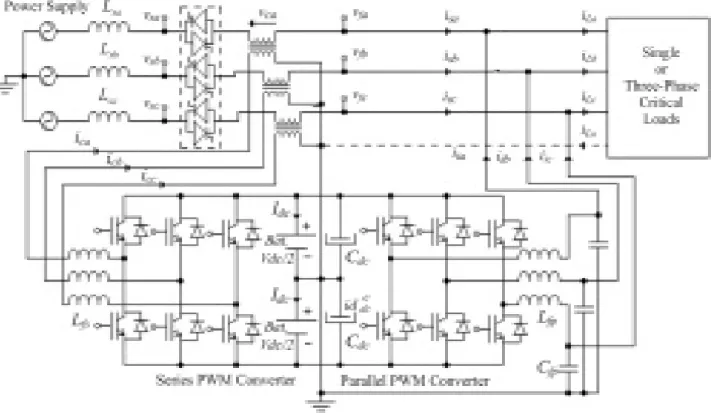
The topology of the line-interactive UPS system is shown in Figure 1. Two PWM converters, coupled with a common dc-bus, are used to perform the series activefilter and parallel active filter functions. The series active filter is connected in series with the line and the load
through three single-phase linking transformers.A battery bank is placed in the dc-bus and a static switch ‘sw’ is incorporated to the circuit to provide a fast disconnection between the UPS system and the power supply when an occasional interruption of the incoming power occurs.
The series active power filter acts as a sinusoidal
current source. It has high impedance, which is enough to isolate the line from the load with respect to harmonic currents. An SRF-based controller is used to control the
series active power filter making the line currents (isa, isb, and isc) sinusoidal with low THD.
The parallel active power filter acts as a sinusoidal
voltage source with constant rms output voltages (vfa, vfb, and vfc) and low THD. It has low impedance, which is enough to absorb the harmonic currents of the load.
The output UPS voltages and the line currents are individually controlled to be in phase with respect to the line voltages (vsa, vsb, and vsc) respectively. Both the pa-rallel
and the series filter use three independent controllers
acting on half-bridge inverters. In this line-interactive UPS system, an effective power factor correction is carried out.
Figure 1.
Line-interactive UPS system topology.
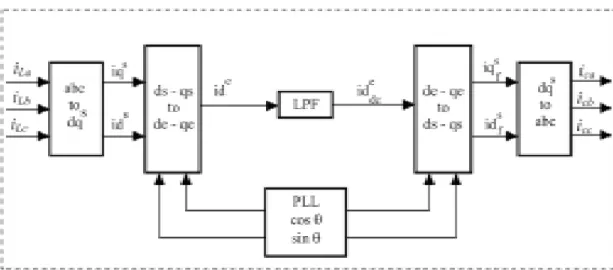
A. SRF-Based Controller for Current Compensation
(Standby Mode)
transformation (1). Then, these quantities are transformed from a two-phase stationary reference frame (dq)s into a
Figure 2. Block Diagram of the Current SRF Based Controller (Conventional strategy).
Now, only the dc component current of the synchro-nous rotating reference frame must be transformed into the stationary reference frame (dq)s to obtain the
fundamental references currents
Thus, the reactive and harmonic components of the load currents were eliminated. As the currents
are balanced, the compensation of the negative and zero sequence components has been performed.
The inverse transformation matrix from two-phase
synchronous reference frame to two-phase stationary
reference frame is given by (3). The matrix that provides
the linear transformation from two-phase system to three-phase stationary reference frame system is given by (4).
B. SRF-Based Controller Applied to Unbalanced
Loads
The previous presented synchronous reference frame method generates balanced reference currents because it is based on the consideration of balanced three-phase loads. Thus, additional power rate must be handled through the converters to perform the current
compensation, decreasing the efficiency of the series
and parallel converters.
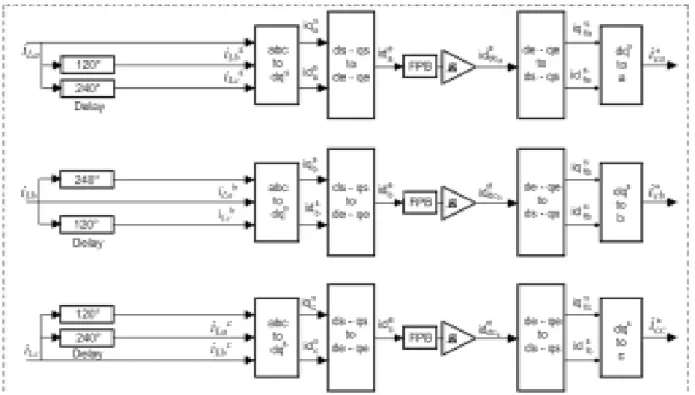
Applying a single-phase strategy, in which each phase is treated separately, is possible to get three-phase load currents by the acquisition of only one of them, as shown in Figure 3. By software implementation, the acquired load current is phase delayed by 120 and 240 degrees, producing the other two load currents.
As can be waited, the phase delays introduced by the algorithm produce an increasing in the transient time and the dynamic response is slower than the response obtained from the conventional method. However, the dynamic response can be improved by using the stra-tegy presented in (OLIVEIRA et al., 2001), in which the
conventional filtering of the synchronous reference frame
method can be suppressed.
Based on SRF method applied to a single-phase strategy shown in Figure 3, the new reference currents can be achieved by (5). Now the currents
are unbalanced, thus the compensation of the negative and zero sequence components has not been performed.
Figure 3. SRF-Based Controller applied to a single-phase strategy.
3 Active Power Flow of the Three-Phase UPS System
Depending on the difference between the utility voltage
and the output voltage, the active power flow of the UPS
system can change its direction. When the rms utility voltage Vs is greater than the rms output voltage Vf , the
active power flows from the power supply to the dc-bus
via series converter and from the dc-bus to the load via parallel converter, as shown in Figure 4 (a). When Vs is less than Vf , the active power flows from the power supply
to the dc-bus via the output of the parallel converter and from the dc-bus to the line via series converter, as shown in Figure 4 (b). Therefore, controlling the amplitudes of the series reference currents
the dc-bus furnishes and absorbs power to make the “balance” of the active power. If the line voltage Vs is equal to the output voltage Vf and the UPS is feeding
a linear resistive load, there isn’t any active power flow
through both the series and the parallel converters, as shown in Figure 4 (c).
The direction of the power flow of the UPS system
must be taking into account when the reference currents are been calculated. Therefore, the amplitude of them will be ever changing.
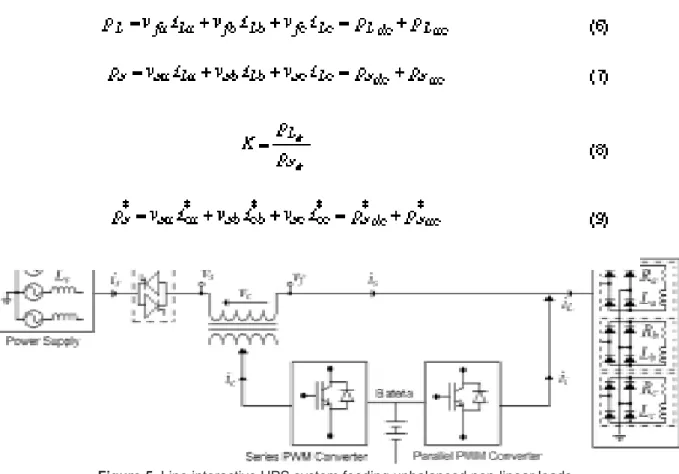
Although power compensation can be performed us-ing a dc bus controller, an alternative algorithm can be implemented applying a constant “k” in the SRF algorithm
Figure 5. Line interactive UPS system feeding unbalanced non-linear loads. Fundamental unbalanced voltages of ±15% and
har-monic contents have been included in the input voltages as shown in Figure 6 (a). Figure 6 (b) shows the controlled
output voltages of the line interactive UPS system. They are balanced and have low harmonic contents.
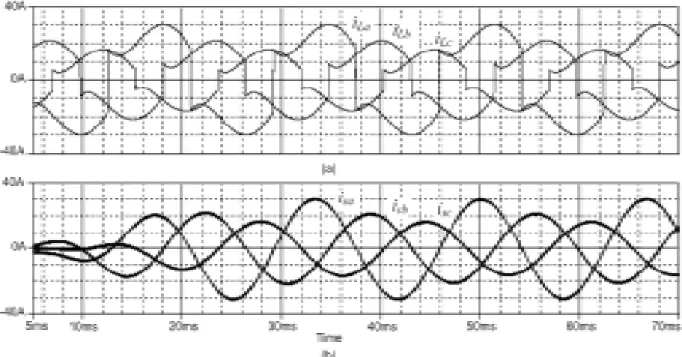
The uncompensated non-linear load currents , , and
are shown in Figure
7 (a). The com-pensated line currents , , and that follow the reference currents , , and obtained from the current SRF-based controller of Figure 3, are shown in Figure 7 (b). The implemented algorithm generates the re-ference currents to compensate the reactive power and to eliminate the harmonic currents generated by non-linear loads. As can be noted the fundamental zero sequence components of the neutral current were not compensated.In Figure 8 the transition modes from the standby mode to backup mode (40ms) and from backup to standby mode (65ms) are shown. The phase “a” output voltage ( ) is shown in Figure 8 (a) and the compensated input current ( ) is shown in Figure 8 (b). In Figure 8 (c), phase “a” parallel inverter current ( ) is shown.
It can be noted that the parallel active filter is providing
compensation harmonic of the load currents when the UPS is operating in the standby mode until 40ms. After 40ms the parallel converter assumes the full power to feed the load.
Seamless voltages transitions from the standby mode to backup mode (40ms) and vice-versa (65ms) are obtai-ned as can be observed in the Figure 8 (a).
Figure 9 (b) shows the compensation constant k
cal-culated from equation (8). This constant is used in the
current SRF controller of Figure 3 to control the amplitude of the reference currents so that the dc value of the input power and the dc value of the output power
become equals, as shown in Figure 9 (a). Therefore,
controlling the amplitudes of the currents ( ), ( ), and ( ), the dc-bus can furnishes and absorbs power to make the “balance” of the active power.
Additional simulations are realized considering three single-phase unbalanced resistive loads as can be shown by Figures. 10 (a) and 11 (a). In Figure 10 (b) the conven-tional strategy is used to calculate the balanced reference currents using the algorithm of Figure 2. As can be noted the compensation of the fundamental zero sequence component is realized by the active parallel converter,
shown by Figure 10 (c), decreasing its efficiency. Figure
11 shows the single-phase strategy using the algorithm of Figure 3. As can be seen the reference currents of Figure 11 (b) are unbalanced, but the compensation currents of Fig. 11 (c), are null in steady state. Thus, the fundamental zero sequence components of the load currents are not compensated by the parallel converter and its efficiency
is increased. Figure 12 shows the instantaneous active powers of the load (p), parallel converter with conventional strategy ( ) and parallel converter with single-phase strategy ( ), respectively.
5 Conclusions
An application of an SRF-based method, applied to a three-phase line-interactive uninterruptible power supply system with series and parallel active power line conditioning capabilities has been presented.
The reference currents, obtained from the SRF-based controller, can be used to compensate only the reactive power and to eliminate harmonic currents generated from non-linear loads.
Applying a single-phase strategy, in which each phase is treated separately, was possible to get three-phase load currents from the acquisition of only one single-phase load current.
Thereby, negative and zero sequence components at fundamental frequency of the three-phase system were despised. Thus, the power rate of the series and
paral-lel converters decreases and the efficiency of the UPS
system increases when it is feeding unbalanced single-phase non-linear loads. Besides, a mode to control the
active power flow through the UPS system was presented.
References
GRUZS, T. M. A Survey of neutral currents in three-phase
computer power systems. IEEE Transactions on Industry
Applications, v. 26, n. 4, p. 719-725, Jul./Aug. 1990.
OLIVEIRA, L. et al. Improving theddynamic response of active power filters based on the synchronous reference
frame method. In: PROCEEDINGS OF THE 6TH BRA
-ZILIAN POWER ELECTRONICS CONFERENCE, 2001
QUINN, C. A.; MOHAN, N. Active filtering of harmonic cu
-rrents in three-phase, four-wire systems with three-phase and single-phase non-linear loads. In: APPLIED POWER
ELECTRONICS CONFERENCE AND EXPOSITION,
1992, Boston. APEC'92. Conference Proceedings 1992.
Boston, 1992. p. 829-836.
QUINN, C. A.; MOHAN, N.; MEHTA, H. A four-wire, current-controlled converter provides harmonic neutralization in three-phase, four-wire systems. In: APPLIED POWER ELECTRONICS CONFERENCE AND EXPOSITION,
1993, San Diego. APEC'93. Conference Proceedings
1993. San Diego, CA, 1993. p. 841-6.
SILVA, S. A. O. et al. A three-phase line-interactive UPS system implementation with series-parallel active power-line conditioning capabilities. IEEE Transactions on
Indus-try Applications, v. 38, n. 6, p. 1581-1590, Nov./Dec. 2002.
______. et al. Performance analysis of three-phase line-interactive UPS system with active power-line condition-ing. In: ANNUAL CONFERENCE OF THE IEEE INDUS-TRIAL ELECTRONICS SOCIETY, 29., 2003. IECON'03. Roanoke, Virgínia: IEEE Industrial Electronics Society, 2003. v. 1, p. 353-60.
______. et al. A line-Interactive UPS system implemen-tation with series-parallel active power-line conditioning for three-phase, four-wire systems. Electrical Power and
Energy Systems, v. 26, n. 6, p. 399-411, 2004.
THOMAS, T. et al. Performance evaluation of three-phase
three and four wire active filters. In: CONFERENCE
RECORD OF THE IEEE INDUSTRY APPLICATION
SOCIETY, 31., 1996, San Diego. IAS'96, 1996 Annual
Sérgio Augusto Oliveira da Silva*
Doutor em Engenharia Elétrica pela Universidade Federal de Minas Gerais (UFMG). Docente do Curso de Engenharia da Computação da Universidade Norte do Paraná (UNOPAR) e do Curso de Engenharia Elétrica da Universidade Tecnológica Federal do Paraná (UTFPR).
e-mail: <[email protected]> Rodrigo Augusto Modesto
Tecnólogo em Automação Industrial pela Universidade Tecnológica Federal do Paraná (UTFPR). Mestrando em Engenharia Elétrica na Universidade Estadual de Londrina (UEL).
e-mail: <[email protected] > Lúcio dos Reis Barbosa
Doutor em Engenharia Elétrica pela Universidade Federal de Uberlândia (UFU). Docente do Curso de Engenharia da Computação e Engenharia Elétrica da Universidade Norte do Paraná (UNOPAR). Docente do Curso de Engenharia Elétrica da Universidade Estadual de Londrina (UEL).