Marshall University
Marshall Digital Scholar
Theses, Dissertations and Capstones
2016
Education All A'Twitter: Twitter's Role in
Educational Technology
Rikki Elaine McCormick Lowe Marshall University, [email protected]
Follow this and additional works at:http://mds.marshall.edu/etd
Part of theCurriculum and Instruction Commons, and theEducational Methods Commons
This Dissertation is brought to you for free and open access by Marshall Digital Scholar. It has been accepted for inclusion in Theses, Dissertations and Capstones by an authorized administrator of Marshall Digital Scholar. For more information, please [email protected],
Recommended Citation
Lowe, Rikki Elaine McCormick, "Education All A'Twitter: Twitter's Role in Educational Technology" (2016).Theses, Dissertations and Capstones. 1022.
EDUCATION ALL A’TWITTER:
TWITTER’S ROLE IN EDUCATIONAL TECHNOLOGY
Rikki Elaine McCormick Lowe Marshall University
College of Education and Professional Development
Dissertation submitted to the Faculty of the Marshall University Graduate College
in partial fulfillment of the requirements for the degree of
Doctor of Education in
Curriculum and Instruction
Committee Chair, Lisa A. Heaton, Ph.D. Elizabeth Campbell, Ph.D.
Edna Meisel, Ed.D. Kimberly Sigman, Ed.D.
South Charleston, West Virginia, 2016
Keywords: educational technology, instructional strategies, personal learning networks, professional development, social media, Twitter
ii
APPROVAL OF DISSERTATION
I hereby affirm that the following project meets the high academic standards for original
scholarship and creative work established by my discipline, college, and the Graduate College of Marshall University. With my signature, I approve the manuscript for publication.
Project Title: Education All A’Twitter: Twitter’s Role in Educational Technology Student’s Name: Rikki Elaine McCormick Lowe
Department:
Curriculum & Instruction
College: College of Education and Professional Development
Lisa A. Heaton
Committee Chairperson4-28-2016
Dateiii
DEDICATION
At 24 years old, I taught my first college class at West Virginia State Community and Technical College (WVSCTC). Over the next nine years, the name of the college changed from WVSCTC to Kanawha Valley Community and Technical College to BridgeValley Community and Technical College. Hundreds of students flowed in and out of my classes, and with every course taught, I learned from them as well. This dissertation is dedicated to my former students and to Antonia Hall Vaughn—without you all, I would never have opened Twitter to see if it could connect us to D/deaf culture. And without that experience, this dissertation would never have been written.
iv
ACKNOWLEDGEMENTS
“The light at the end of the tunnel is not a train!” I chuckle as I recall all the times I said, or posted, that very phrase as I have worked through this doctoral journey. Now, as I enter the final keystrokes to the dissertation, I am reminded of all those who have walked, hand in hand, with me along the way.
Choosing a doctoral chair was not an easy process for me. Without knowing what I wanted to do with my doctorate, other than getting it, I kept finding closed doors when attempting to establish my chair. Dr. Teresa Eagle, knowing me since birth, suggested I meet with Dr. Lisa Heaton during a fall seminar. I figured I would meet with her, but then, as had happened before, I would be told that she was full and would not be able to take on any more students at that time. What I had thought to be a short conversation turned into most of the afternoon, and by the end of our conversation, Dr. Heaton agreed to be my chair. Over the semesters, she believed in me, kept faith in me, pushed me, listened to me, guided me, and became the perfect fit to my doctoral journey. Words will never adequately express my gratitude and thankfulness I had for her guidance and listening ear. She saw me at my worst and at my best, and yet, never doubted by ability to finish. For that, I am forever thankful.
To my committee members, Dr. Elizabeth Campbell, Dr. Edna Meisel, and Dr. Kimberly Sigman—thank you for taking a chance on me. My research has been anything but conventional and predictable, and I am so thankful that you were willing to allow me to go where my research led. Also, to an original committee member, Dr. Amy Cottle—I am thankful for your support as well—it was because of you that I did my first professional development session on my own at Evans Elementary.
v
Although not on my committee, I must express thanks to Dr. Eric Lassiter. Although I enjoyed all my courses from Dr. Lassiter, and he did oversee my Ed.S. thesis, it was the Writing for Publication course that was pivotal in my journey. I entered that course fearful of being transparent, wishing to always sound like someone else, and I left that course with a voice—a voice I was no longer afraid for people to hear—and for that, I will always be grateful.
Within Introduction to Doctoral Studies (back when we met at night once a week…), we were warned about not changing jobs during this process. Life, however, sometimes has other plans. I moved to three different schools, and then to a new county! There were coworkers along the way that made each transition smooth—they were supportive in their words and actions— reading papers, proofreading, listening to presentations, and offering support. Thank you Rebecca Meadows, Lisa Lewis, April McConihay, Kristi Gillispie, Pat Homberg, Tiffany Fellure, Paula Null, Lynn Yost, Becki Farley, Susan Cottrill, Ann Hutchison, Cindy Cloxton, Charlie McCormick, Melanie Kearns, Vic Donalson, Charlie Hartley, Derek Pauley, Amy Adkins, and Conrae Lucas-Adkins for your unwavering support and guidance—and the occasional Sheetz run. Without you all, there are times I would have surely failed.
I grew not only as a doctoral student during this journey, but as a professional, as well. My opportunities through the Marshall University Summer Enrichment Program became a guiding force in shaping who I was as a professional. Thank you, Dr. Joyce Meikamp and Dr. Sandra Stroebel, for the opportunity to be a part of the program. I would be a very different teacher and administrator if not for you both. Within the program, several people influenced me as a person and a professional, and I am thankful for them: Carla Donahue, Dr. Isaac Larison, Richard Tench, Kaycee McCormick, Joey Warner, Chris Shinn, and Ryan Hughes.
vi
Dr. Heaton, in helping me expand my experiences in education, recommended me for a special education iPad training at the West Virginia Center for Professional Development. From that training, Mike McCormick and Dave DeStefano became my tech “amigos” creating
hashtags for just about everything! They have taught me about teaching and technology…and more than once, I have used them as a sounding board for my research. I know I am a better teacher and a better “techie”—thank you!
This dissertation would not have reached completion without the support of my friends and family. When I was an undergrad at Concord University, I took vows to an everlASTing sisterhood—“I am thankful for these friends and for these sisters who are more than friends.” Within the last six years, I have faced several personal and professional challenges, as well as triumphs. These sisters of mine have held my hand, wiped my tears, shared my joy, and pushed me on. Heather Adams, Jessica Exline, Shannon Drown, Brandi Wright, Laura Kirk, and Mollie Ferguson—we are forever in the bond of sisterhood.
Thank you to my parents for instilling in me the love of learning, a strong work ethic, and determination. Without those three attributes, I would have never reached this point. Gee—my partner, you being proud of me is the greatest gift. I love you. Sean, thank you for understanding how important this degree is to me. I could promise that we will eat less takeout now that this is done, but we both know that is not true. Allison, Morgan, and Michael—never give up on your dreams. Even if your dreams change, they are always worth fighting for. You three are the light of my world—I love you to the moon and back!
One of my friends sent me this thought: “When writing the story of your life, don’t let anyone else hold the pen.” That is the greatest lesson learned on this journey. As this part of my
vii
journey reaches its end, another one is bound to begin. I am ready to hold the pen, forge my way, and see what happens.
viii
TABLE OF CONTENTS
APPROVAL OF DISSERTATION ... ii
DEDICATION ... iii
ACKNOWLEDGEMENTS ... iv
LIST OF TABLES ... xii
LIST OF FIGURES ... xiii
ABSTRACT ... xiv
CHAPTER 1: INTRODUCTION ...1
Background ... 2
Technology in Our Schools ... 2
Twitter ... 4
Problem Statement ... 7
Purpose of the Study ... 8
Research Questions ... 8
Nature of the Study ... 9
Operational Definitions ... 9
Study Assumptions ... 10
Significance of the Study ... 10
CHAPTER TWO: REVIEW OF LITERATURE ...12
Technology in Schools ... 12
Social Media ... 14
Social Media in West Virginia Public Schools ... 18
ix Twitter ... 25 Personal Uses ... 27 Professional Uses ... 29 Instructional Strategies... 34 Professional Development ... 43
Personal Learning Networks ... 44
Summary ... 46
CHAPTER THREE: METHODS ...47
Introduction ... 47
Research Design... 47
Population and Sample ... 48
Instrumentation ... 49
Instrument Reliability and Validation ... 50
Data Collection Procedures ... 51
Data Analysis Procedures ... 53
Limitations ... 55
CHAPTER FOUR: FINDINGS ...56
Demographics ... 58
Major Findings ... 63
Research Question 1: Instructional Strategies ... 63
Research Question 2: Professional Development ... 66
Research Question 3: Personal Learning Networks... 70
x
Ancillary Findings ... 75
CHAPTER FIVE: SUMMARY AND DISCUSSION ...80
Introduction ... 80
Summary of Purpose ... 80
Summary of Population ... 80
Summary and Discussion of Related Literature ... 81
Research Question 1: Instructional Strategies ... 82
Research Question 2: Professional Development ... 84
Research Question 3: Personal Learning Networks... 85
Research Question 4: Barriers and Challenges ... 87
Ancillary Findings ... 88
Implications for Action ... 89
Recommendations for Future Research ... 91
Summary ... 92
REFERENCES ...94
APPENDIX A: TWITTER JARGON ...108
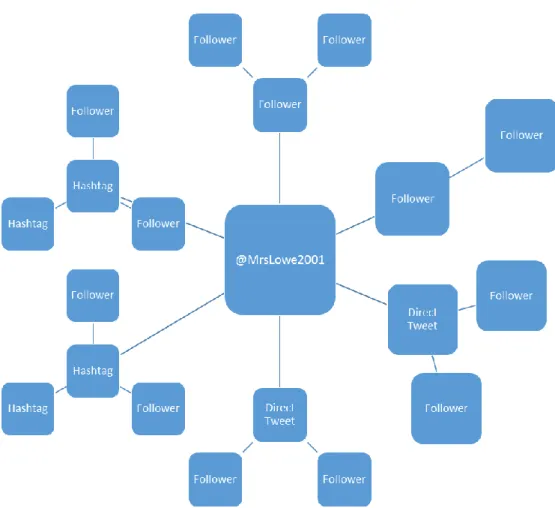
APPENDIX B: ORGANIZATIONAL CHART ...110
APPENDIX C: CASE STUDY ...111
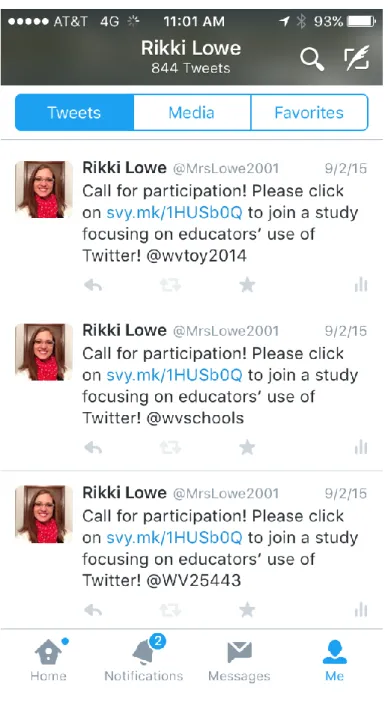
APPENDIX D: CALL FOR PARTICIPATION TWEETS...116
APPENDIX E: IRB APPROVAL LETTER ...117
APPENDIX F: PRE-COLLECTION SURVEY ...118
APPENDIX G: INTERVIEW QUESTIONS ...120
xi
APPENDIX I: CODING ANALYSIS SUMMARY ...127 CURRICULUM VITAE ...128
xii
LIST OF TABLES
Table 1: Emerging Themes of Educational Twitter Use ... 33
Table 2: Demographics of Survey Participants ... 59
Table 3: Demographics of Content Analysis Participants ... 60
Table 4: Demographics of Interview Participants ... 61
Table 5: Self-Reported Twitter Use for Instructional Strategies ... 63
Table 6: Observed Use of Instructional Strategies through Content Analysis ... 64
Table 7: Self-Reported Twitter Use for Professional Development ... 67
Table 8: Observed Use of Professional Development through Content Analysis ... 67
Table 9: Self-Reported Twitter Use for Personal Learning Networks ... 70
Table 10: Observed Use of Personal Learning Networks through Content Analysis ... 71
Table 11: Observed Other Educational Use through Content Analysis ... 77
Table 12: Self-Reported Twitter Use for Non-Educational Use ... 78
xiii
LIST OF FIGURES
Figure 1: Twitter feed sample. ... 5
Figure 2: Snowball sampling. ... 52
Figure 3: Instructional strategies Wordle. ... 65
Figure 4: Professional development Wordle... 69
Figure 5: Personal learning networks Wordle ... 72
Figure 6: Other educational uses Wordle. ... 75
Figure 7: Examples of tweets classified as Other educational use. ... 77
xiv
ABSTRACT
The purpose of this mixed methods study was to examine whether current uses of Twitter by educators correlate with the literature on the uses and advantages of using Twitter in education through an examination of United States educators and West Virginia educators. Data was obtained from responses to the online survey, Education All A’Twitter: Twitter’s Role in
Educational Technology, content analysis of public Twitter feeds, and semi-structured interviews that were sorted, coded, organized, and analyzed to identify emergent themes. The study had a population that included 97 survey responses, 78 Twitter feeds, and 8 semi-structured interviews. There were survey respondents from West Virginia and 26 other states in the United States, as well as international respondents. The study determined to what extent West Virginia and United States educators used Twitter for instructional strategies, professional development, and personal learning networks, as well as identified barriers and challenges educators face when attempting to employ the use of Twitter educationally. In addition, there were four ancillary findings that emerged through the study. As triangulation of the data supported the current literature, this study has several implications for current educators, policymakers, and researchers.
1
CHAPTER 1: INTRODUCTION
Teachers can no longer be concerned only with what occurs within the four walls of the classroom. From kindergarten on, there is an element of global consciousness that must be taught and learned in order to be successful in our technology-driven, global society (Partnership for 21st Century Skills, n.d.). The National Education Association (n.d.) in Preparing 21st
Century Students for a Global Society: An Educator’s Guide to the “Four Cs” established “The 4 C’s: Critical Thinking and Problem Solving, Communication, Collaboration, and Creativity and Innovation,” to clearly define the skills needed for 21st Century learning. In published educator guides by both the National Education Association and the Partnership for 21st Century Skills, technology has been embedded as an essential tool to accomplish the teaching and
learning of each skill. Socioeconomic demands (Blankenship, 2011), social constraints (Hodges, 2010), and technophobia (Dixon, 2012), however, often hinder attempts to immerse our students in the technological world around them, even when there are free technological tools available for use.
Since its launch in 2006, Twitter continues to grow as one of the most used social-networking platforms; as of 2016, it is the world’s largest microblogging platform. Limited to 140 characters per message (known as a Tweet), Twitter allows for concise interaction among users, no matter the geographical location or social status. Businesses and celebrities use Twitter to interact with consumers, promote products, and advertise with great success. But what does all of this mean, if anything, for education?
2
Background Technology in Our Schools
We expect our educational system to be multi-faceted: “Schools are expected not only to conserve our values and standards but to be dynamic, reflecting the fact that the world around us is constantly changing” (Bowers, 1990, p. 1). As the world around us continues to change in the field of technology, “public schools must develop a built-in mechanism for incorporating such rapid and far-reaching changes into the curriculum and into the instructional technology which imparts that curriculum” (Bowers, 1990, p. 1). Educational change occurs to help schools, teachers, and students to accomplish their goals and objectives more readily (Fullan, 1982), and we see change often occur in the field of educational technology.
Technology is any element that makes a task easier for users. In his book, The Shallows: What the Internet Is Doing to Our Brains, Nicholas Carr (2011) looked at different technologies throughout history to see whether people’s behavior changed in response to the technology. He found that it had. For example, Friedrich Nietzsche, a 19th century German philosopher, had physical ailments that forced him to give up his pen-and-paper writings. Falling into depression, he ordered a typewriter, a new technological advancement in his time. He resumed his writing, but, as his audience discovered, his writing began to change. His “prose became…tighter, more telegraphic” (p. 18). When questioned, Nietzsche replied, “Our writing equipment takes part in the forming of our thoughts” (p. 19). Even the ideas of the alphabet, reading, and writing, are technologies. Before the invention of written alphabets, we were oral societies. Carr (2011) explained that “knowledge is what you can recall, and what you recall is limited to what you can hold in your mind” (p. 56). With the invention of alphabets, and subsequently reading and writing, we no longer had to train our brains and commit all to memory; we could write down
3
what we wanted or needed to remember and we no longer had to tax our brains for all vital information. However, Carr continued, we must be cautious because “once technologized, the word cannot be de-technologized” (p. 77). As new technologies appear, our brains will continue to route and re-route new pathways to conform to new technologies (Carr, 2011). We adopt new technologies because they are new, and we strive to make our lives easier. What we do not realize, however, is that we cannot return to former ways of doing things as a society and we must remain vigilant as to whether or not our adoption of these new technologies helps us or hinders us.
It is now commonplace to go into any school and see various forms of technology. What we do not do, however, is question how those pieces of equipment got there. California State University at Long Beach (n.d.) summarized how technology began to be integrated into the American school system. Digital technologies in our schools began to be integrated in 1958 when the National Defense Education Act introduced new items of technology into vocational education schools during the Cold War. In 1965, the Elementary and Secondary Education Act (ESEA) brought technology into all schools, although most were used for administrative purposes. This trend continued until 1981 when the first educational drill software programs were developed for personal computer use. By 1986, schools were buying computers for use on all levels; by 1994, one computer per classroom became the norm. By 1997, computers, and eventually the Internet, were integrated within teacher lesson plans. Since that time, we have seen the continual abundance of technology within our school systems.
In the pedagogical move to make classrooms more learner-centered, rather than content-centered, technology was often touted as a key element in that process (Brown, D., 2003). The elements of a learner-centered classroom—such as using differentiated instruction (Brown, K.,
4
2003) and experience-based education, focusing on each learner’s unique characteristics, involving the emotions, and creating an environment free from fear (Henson, 2003)—were not directly hinged on the use of technology within the classroom; however, using technology to achieve the ideal learner-centered environment was an accepted, encouraged, or even mandated practice. The question then remains, what technology do we use?
Teachers and professors regularly look for free software that can help them connect their students to the world outside of the classroom. Twitter, for some, has been the platform through which this can occur. As Evans (2010) stated, “because of its highly fluid and distributed nature, the short posts that define Twitter are actually interlinked conversations” (p. 148). Twitter, a microblogging application, sends “tweets”—messages no more than 140 characters long— virtually around the globe (Twitter, 2014a). Twitter defines a tweet as “an expression of a moment or idea” (Twitter, 2014b, ¶1) of either professional or personal content with text, links, and pictures (see Figure 1). Tweets are automatically published to a timeline of all tweets called a “Twitter-feed.” Tweets also appear on any feed that is “following” a particular user. In
addition, a user can use the “@” symbol plus username, the name each Twitter user has selected for his account, for a tweet to appear on another person’s feed, whether the recipient is a follower of the author or not. For example, to send a direct tweet to Scholastic, the tweet must contain @Scholastic within the 140 characters. In order to have conversations, or chats, a hashtag, (i.e. #education), is used so that someone can follow the thread. For example, a search for #education will bring up all the recent tweets that have mentioned #education. (For more specific instances of Twitter jargon, please see Appendix A.)
5 Figure 1: Twitter feed sample.
Users can also interact with tweets on Twitter. When a user finds a tweet of interest, there are four options available to interact with the tweet. First, the user can reply to the tweet. By clicking the arrow, the user will respond directly to the author of the tweet. Second, the user can retweet the tweet. By clicking the two arrows shaped like a square, the user automatically sends that tweet to everyone on her feed. Retweeting enables a tweet to reach more feeds than the original tweet alone. Any retweeted tweet can reach thousands of users that may not be followers of the original tweet (Kwak, Lee, Park, & Moon, 2010). Third, the user can quote the tweet. By holding the retweet button, an option appears to quote the tweet. Here, the user will see the exact tweet within her application and then can add to the original tweet. Finally, the user can
designate the tweet as a favorite. When clicking the star, the tweet will show up in a user’s favorites list (Twitter, 2014b).
Since Twitter’s public launch on April 19, 2007, the program has grown tremendously (Saeed & Sinnappan, 2011; Twitter, 2014a). At the time of this writing (2015) there were over 271 million active monthly Twitter users with over 500 million tweets sent daily (Twitter,
6
2014a). Twitter has become the fastest-growing social networking platform (Mansfield, 2009) on a global scale, with 77% of Twitter accounts being outside of the United States (Twitter, 2014a). Twitter allows users to use other social networks, live searching, and link-sharing to immerse themselves in the interactive Web 2.0 interface (Johnson, S., 2009).
Twitter’s Niche in Education. This dissertation’s review of literature (see Chapter 2), identified three main areas in which educators have used Twitter for educational purposes: instructional strategies, professional development, and personal learning networks.
Twitter has a variety of options when using the platform for instructional strategies. Professional and scholarly articles regularly identify and explain specific instances of Twitter use in the classroom, but one emerging theme is clear: instructors who use Twitter find that the platform’s benefits go beyond their expectations. The benefits include connecting online and on-campus students (Billiot, 2011), sharing ideas after the class is dismissed (Miners, 2009), simplifying course management (Cochrane, 2010; Silver, 2011), increasing teacher-student interaction (Ezarik, 2009), receiving donated equipment (Davis, M., 2010), and service-learning projects (Crews & Stitt-Gohdes, 2012). Overall, Cox (2010) wrote, “Twitter creates the
opportunity to expand what we mean by educational conversation in our school libraries and classrooms” (p. 52). It allows the educator to truly engage in the active listening process by monitoring and detecting, routing and responding, and then reviewing and tracking the students’, parents’, and community’s responses, questions, and sentiments about the school (Evans, 2010).
Demski (2010) listed worthwhile professional development as one of the strengths of Twitter’s use educationally. Although teaching may conjure the idea of one adult in a room with children, teachers are urged to collaborate with other teaching professionals in order to refine skills, gather new ideas, and generate more knowledge (National Education Association, n.d.).
7
Carpenter and Krutka (February 2014) explained that one way Twitter has encouraged this type of collaboration is through chats. Chats occur on Twitter in real-time, although by using the hashtag to search, anyone can view the timelines of the chats at any point in time. Different states, levels, and subject areas have their own #edchats, a specific day and time in which educators across the globe meet and discuss ideas, issues, and solutions for what they are facing in education (Davis, M., 2010).
There are over 150 educationally-oriented chats in multiple categories; general education, content area, grade level, state, job type/role, topical, and organization-sponsored are just a few examples (Carpenter & Krutka, February 2014). Participation in the various EdChats is one way educators are creating their own professional development.
Educators have the option to take this collaboration further in the creation of personal learning networks. A review of literature reveals that there is no single, best way to create a personal learning network; all personal learning networks center on the idea of collaboration. Marin, Negre, and Perez (2014) has defined collaboration as a “learning strategy based on working in heterogeneous groups of people with similar knowledge levels to achieve communal goals and carry out tasks together, with there being a positive interdependence between them” (p. 36). To begin collaborating on Twitter, a user can respond to educational leaders, build partner networks, and begin conversations (Dixon, 2012).
Problem Statement
Currently, there is no research specific to the use of Twitter by West Virginia educators. The researcher has hypothesized that there is a possible disconnect between the research in using Twitter in education and the practice of West Virginia educators for two main reasons. First, some forms of social media are blocked on the West Virginia Department of Education’s server,
8
including Facebook, YouTube, and Pinterest. Twitter has been blocked in the past, but is
currently allowed on the state server. Second, although policies encourage the use of technology, and even social media, to promote 21st century learning, there is not support in the reviewed acceptable use policies to do so (see Chapter 2). Since the literature suggests that the use of Twitter has merit in education, to what extent are United States educators and West Virginia educators using Twitter for educational purposes in networking, professional development, and instructional strategies?
Purpose of the Study
The purpose of this study is to examine whether current uses of Twitter by educators correlate with the literature on the uses and advantages of using Twitter in education through an examination of United States educators and West Virginia educators.
Research Questions
To determine the extent United States and West Virginia educators are using Twitter for educational purposes, the following four research questions guided the study:
1. To what extent are US and WV educators using Twitter to employ instructional strategies?
2. To what extent are US and WV educators using Twitter to facilitate their own professional development?
3. To what extent are US and WV educators using Twitter to create their own personal learning networks?
4. What are the barriers and challenges facing US and WV educators when attempting to employ the use of Twitter professionally?
9
Nature of the Study
This study incorporated a mixed-methods approach that gave a deeper insight into the research questions. A pre-collection survey to obtain permission through informed consent had three questions for participants to answer regarding their perceptions of their Twitter use in education. Then, this study used content analysis facilitated by an organizational chart (see Appendix B) to categorize the nature of the tweets sent by the chosen educators. Finally, there were follow-up interviews (through FaceTime or telephone) to delve more deeply into the “how” and “why” derived from the quantitative data. Numbers and words worked together to provide a more complete picture of the research study and the results. In addition, use of multiple methods opened more paths of research that might not have been considered in using only a qualitative or quantitative approach.
Operational Definitions
For the purpose of this study, the following words and phrases are used in the following manner:
To what extent: Based on a pre-collection survey, organizational chart (see Appendix B), and semi-structured interviews, an educator’s tweets will be categorized to see the percentage of use that is dedicated to instructional strategies, professional development, and personal learning networks.
US educators: Self-identified educators from across the United States, excluding West Virginia, who are established Twitter users and self-selected for this study.
WV educators: Self-identified educators from West Virginia who are established Twitter users and self-selected for this study.
10
Instructional strategies: Any tweet sent from an educator’s account that can be directly identified as used with students for instructional purposes, based on triangulation of the self-reported survey, content analysis, and semi-structured interviews.
Professional development: Any tweet sent from the educator’s account that can be directly identified as participation in virtual professional development (i.e., specific #edchat hashtags, specific conference hashtags, question/answer designations), based on triangulation of the self-reported survey, content analysis, and semi-structured interviews. Personal learning networks: Any tweet sent from the educator’s account that can be
directly identified as communication with other professionals outside of a professional development session, based on triangulation of the self-reported survey, content analysis, and semi-structured interviews.
Barriers and challenges: Perceptions as to why educators are not using Twitter, based on the responses received from the semi-structured interviews.
Study Assumptions
The main assumption of this study was that technology within the classroom is a valuable practice. While there is no definitive, existing evidence of the profitable nature of using
technology in the classroom, it is an accepted practice, nonetheless. Since the practice of using technology is accepted or even mandated, technological tools that have purposeful application should be reviewed for their uses and applicability.
Significance of the Study
This study is useful for a variety of audiences. First, study results may be used by teachers as an example of best practice to foster relationships with students and other teachers; collaborate and communicate with students, parents, and other professionals; design their own
11
professional development; and network with other professionals and professional organizations. County and state boards of education could use the findings to create policies that support proper and effective implementation of Twitter, to offer professional development to use the tool within the classroom, and ensure that the firewalls and bandwidth allow use of the Twitter platform. Technology coordinators on the county, state, and Regional Education Service Agency (RESA) levels as well as the West Virginia Center for Professional Development could use the
information presented to offer training and support (e.g., hardware, software, troubleshooting, best practices) to those using and wanting to use the Twitter platform.
Additionally, educational organizations may gain insight on how best to connect with potential teachers as well as network with current teachers. The state legislature could use this study to add to its knowledge base when creating laws and policies concerning education and the use of technology and social media in education. The U.S. Department of Education could potentially use this study as a reason to continue using Twitter to communicate and network directly with students and teachers. Professors of higher education and educational technology could use this study to learn current uses of Twitter in the field, expose current and future
teachers to uses within the classroom, explain how use fits into current pedagogical frameworks, and explore benefits that classroom teachers may encounter. Finally, future doctoral students and researchers interested in the use of Twitter could use this study as an example of research in paving the way for Twitter as an accepted educational technology.
12
CHAPTER TWO: REVIEW OF LITERATURE
Focusing on Twitter’s niche in education required the researcher to examine a broader view of technology in the schools, as well as Twitter’s use among accountholders, so that a focus on education is understood within context. This review of literature considered technology in schools, social media’s integration in education, social media in West Virginia public schools, as well as challenges and concerns of using social media in the classroom, Twitter as a
technological platform, and personal and professional ways Twitter can be used. In reviewing the professional uses of Twitter, this chapter examined instructional strategies, professional
development, and personal learning networks.
A review of dissertations in ProQuest discovered only three with a focus on Twitter in education: Kerry Davis’s (2012) Learning in 140 Characters: Teachers’ Perceptions of Twitter for Professional Development, W.H. Deyamport’s (2013) An Implementation of a Twitter-Supported Personal Learning Network to Individualize Professional Development, and Orit Hirsh’s (2012) The Relationship of Twitter Use to Students’ Engagement and Academic
Performance in Online Classes at an Urban Community College. These dissertation studies have been assimilated within the literature review based on the focus of each study.
Technology in Schools
Although use of educational technology is an accepted, encouraged, and mandated practice, the question must be asked: does technology improve student achievement? Larry Cuban (2015), a professor of education at Stanford University, declared that “the fact is that no substantial basis in research findings or existing data on the academic effectiveness of classroom technology warrant the boom-town spread of classroom devices” (¶1). Considering the
13
current trend. His proof for this assumption is that test scores have shown little to no
improvement when using new hardware or software. Cuban speculated that this result could reflect how teachers use these devices and programs. The use ranges from creative to
unimaginative and from daily use to almost-never use. In addition, many forms of technology found in classrooms are still used for teacher-dominated rather than learner-centered approaches to learning. Finally, within the argument that technology use in the classroom prepares the future workforce, software that students learned to use in 1985 was obsolete five years later; that trend continues to repeat itself.
A study by Ravitz, Mergendoller, and Rush in 2002 is used as evidence for Cuban’s (2015) claims. This study explored whether there was a positive or negative relationship between student computer use and achievement, and whether results varied by the amount of school and/or home computer use. There were 31,000 students studied across 300 schools in which their levels of achievement were ascertained from the Iowa Test of Basic Skills and the Test of
Academic Proficiency. Eighth and eleventh graders also completed a self-reporting instrument describing their competency with educational computer use. The researchers found a “negative relationship between use of computers by students at school and school wide achievement” (p. 3). Furthermore, “patterns of school achievement are positively related to home computer use and family income and inversely related to school computer use” (p. 3). The researchers found that students who performed better on the standardized achievement tests were those students who used computers more often at home, rather than at school. Finally, using the self-reporting instrument and correlated achievement data, Ravitz et al. concluded that “students who have higher software capability not only score higher on tests, but they also gained more, on average, from 1999 to 2000” (p. 7).
14
There is no evidence that suggests educational technology is beneficial as a curriculum; educational technology is a tool. For technology to be valuable to our schools, teachers, and students, technology must be “perfectly suited to the task” (Pinker, 2015, ¶11). When examining chosen technology tools, some educators have found merit in social media, specifically Twitter, to reach their millennial learners (Bahner et al., 2012).
Social Media
Social media within education finds itself following the history of technology-based education. Williams and Goldberg (2005) in “The Evolution of E-Learning”and Hiltz and Turoff (2005) in “Education Goes Digital: The Evolution of Online Learning and the Revolution in Higher Education”succinctly explained the transformation e-learning has undergone through the past several decades. The authors explained that when technology was first used to facilitate online learning, courses were self-taught by the use of a CD-ROM or a specific set of floppy disks. No Internet was needed for these courses; assignments were often mailed to an instructor. From there, distance learning and web-based training surfaced. In distance learning, the educator would be at one geographical location while the student(s) were in another. Although real-time instructing was scheduled, technical issues and limited interaction were downfalls of this method. Web-based training, which could be facilitated through the Internet, became more common than distance learning. It allowed the student to complete the course from anywhere, but self-motivation was required in order to successfully complete the course because there could be little to no interaction with the professor. Online courses have continued to be used, and in the last few years, social media has been introduced in conjunction with the web-based course. Students are no longer simply consumers within their online coursework; now they have also become publishers of their own input and information. Shim, Dekleva, Guo, and Mittleman
15
(2011) explained in their article “Twitter, Google, iPhone/iPad, and Facebook (TGIF) and Smart Technology Environments: How Well Do Educators Communicate with Students via TGIF?” that when social media is used within courses, students and educators can actively contribute throughout the course so that the information presented can meet the needs of individual students.
Social media can be defined as “an Internet-based tool for sharing and discussing information among users” (Schachter, 2011, p. 28). Different forms of social media include wikis (e.g. Wikipedia), blogs (e.g. Blogger), video (e.g. YouTube, Vine), pictures (e.g. Instagram, Flikr), ratings (e.g. Polls Everywhere), Internet forms (e.g. Topix), podcasts (e.g. iTunesU), social bookmarking (e.g. Delicious, Pinterest), microblogging (e.g. Twitter), and networking (e.g. Facebook, LinkedIn). Many forms of social media are free, or can operate on a free version, and have mobile applications in addition to desktop websites. Children, teens, and young adults flock to forms of social media and social networking because they provide new ways to present, learn, construct relationships, and manage privacy (Huffman, 2013).
Uses of social media in education, however, must be evaluated. Social media tools “can be both powerful allies and enemies in educating youth” (Huffman, 2013, p. 154). In his article “Asking the Right Questions: What Does Research Tell Us About Technology and Higher Learning?,”Ehrmann (1995) found four areas of technology within the classroom, and in essence social media, that must be analyzed so that valuable instruction with technology can occur.
First, “if you are headed in the wrong direction, technology won’t help you get to the right place” (Ehrmann, 1995, ¶10). If teachers are not teaching the right material for the objectives of the course and are not grading appropriately for the goals of the course, throwing
16
different forms of technology into teaching will not change the direction in which the teachers are heading. Neither should teachers expect that technology alone could change the direction of their courses. Technology is a tool that may be used to enhance the current teaching and learning occurring in the classroom. Technology will not change what is being taught or the concepts the students are learning.
Second, as Marshall McLuhan has often declared, “the medium isn’t the message” (Ehrmann, 1995, ¶10). There are many different tools that can be used to teach content. Many factors contribute to why a teacher chooses one tool over another, including comfort with certain types of technology, accessibility, time, and students’ familiarity with the tool. Ehrmann used the following analogy: “There are several tools that can be used to turn a screw, but most tools can’t do it, and some that can are better for the job than others” (¶28). Choosing technology for technology’s sake will not enhance teaching within a classroom. Often, Ehrmann continued, technology is used, but it is “single pieces of software for only a few hours” (¶44), meaning one or two days out of a semester the students will use a specific program, but when the program is shut off, so is the students’ use and application of the tool.
Third, there is a misconception that “software that isn’t designed for instruction can’t be good for learning” (Ehrmann, 1995, ¶42). Technology does not have to be designed for
education to have educational value. At the writing of Ehrmann’s article, the term “wordware” was used to describe any type of software (such as word processing, email, and the Internet) that was not initially designed for education but had educational value. Although social media did not exist at the time, different forms of social media could also be added to the list of applicable software.
17
Finally, Ehrmann (1995) stated that the strategies used by teachers are what matter most. Ehrmann explained that technology must be used in conjunction with, and as a complement to, effective teaching in order to create a positive effect. The American Federation of Teachers (2012a) explained that when used effectively, social media allows relationships and
communication to grow within the school by fostering greater connections between teachers, students, and communities. When this usage occurs, they argue, “schools with high levels of collaboration and strong professional communities have higher student achievement” (p. 4).
Overall, the educator has to determine why she wants to use social media and then choose a platform that best suits her needs and the needs of her students. In addition, teachers must be cognizant that “there is nothing innate about knowing how to apply those acquired skills to the processes of civil society, scientific or scholarly innovation, or economic production”
(Rheingold, 2008, p. 2). Teachers must first teach students how to use the tools appropriately, as well as model the correct behavior (Abe & Jordan, 2013; Dunlap & Lowenthal, 2009b). Social media is not a single faceted program that should be used haphazardly because “social media continue[s] therefore to ask us to engage with a new research agenda, to continue to work creatively with new pedagogies appropriate to these novel digital spaces, and to engage with some far-reaching challenges relating to the literacies and assessment practices we bring to bear when we take education online” (Hemmi, Bayne, & Land, 2009, ¶73). Social media must be explicitly taught and explicitly used for a specific purpose.
Dr. Brian Dixon, author of Social Media for School Leaders (2012) explained that social media, when used appropriately, can engage families, increase student enrollment, create a collaborative school culture, and facilitate community support through awareness, feedback, collaboration, and advocacy. Schools achieve awareness through posting updates, sharing links,
18
displaying quotes, and retweeting other tweets. Feedback occurs when posting @replies, sending direct messages, asking questions, and providing links to surveys. Schools collaborate when they build networks, engage mentors, and converse with hashtags. Advocacy is displayed through retweeting, distributing content, and engaging followers (Dixon, 2012). When schools are seen on the Internet through self-publishing platforms, the credibility of the schools is increased (Dixon, 2012) by the transparency the platforms create.
Social Media in West Virginia Public Schools
Despite the literature that supports the use of social media in education, there is a disconnect between research and policy in the West Virginia public school system. In West Virginia public schools, policies and procedures concerning social media are first created by the West Virginia State Board of Education. Pinterest and Facebook are currently blocked by the West Virginia State Board of Education’s server; YouTube is permitted only through a login given by the state board of education (called WebTop); and Twitter, although currently unblocked, has been blocked in the past (B. McCoy and J. Ratliff, personal communication, January 9, 2015). Each county in West Virginia must abide by the West Virginia State Board of Education’s (2012) State Policy 2460, “Educational Purpose and Acceptable Use of Electronic Resources, Technologies, and the Internet,” but the counties have the option of creating their own acceptable use policies (AUP). These county AUPs can impose greater restrictions on Internet use, but cannot lessen those expressed in Policy 2460.
Policy 2460 (West Virginia State Board of Education, 2012) has expressed support in the use of technology in education, not only in classroom use, but for professional development as well. The following quote from the policy provides an accurate representation of the West Virginia State Board of Education’s position on educational technology:
19
3.2 Students of all ages and educators as lifelong learners require the necessary skills and access to technology tools to take responsibility for their own learning, to be actively involved in critical thinking and problem solving, to collaborate, cooperate, and to be productive citizens. West Virginia students must develop proficiency in 21st century content, technology tools, and learning skills to succeed and prosper in life, in school, and on the job.
3.3 Technology must be interwoven with educational improvement and personalized learning to accomplish educational goals, increase student achievement and educator efficacy, and provide increased opportunities for lifelong learning.
3.8 Teachers should integrate technology resources to personalize learning, enhance instruction, implement multiple technology-based learning strategies, implement high quality digital content and assessment, and utilize digital resources, technologies, and the Internet in the classroom.
3.9 Technology will enable educators to participate in online professional development, access digital resources and platforms, utilize educational data, and deliver instruction through blended learning and other virtual options. The acceptable use policy of digital resources and devices is necessary to support a personalized learning landscape and other district and state educational policies. (West Virginia State Board of Education, Policy 2460, 2012)
In addition to recognizing the value of the Internet within the classroom, Policy 2460 (West Virginia State Board of Education, Policy 2460, 2012) also recognized the need for
20
and teachers will be provided professional development in the use and application of electronic sources, technologies, and the Internet.”
Although it is noted within the policy (West Virginia State Board of Education, Policy 2460, 2012) that school personnel must maintain a professional relationship with students at all times, school personnel have been encouraged to use social media and other forms of electronic communication:
5.8.a Collaboration, resource sharing, and student/teacher, student/student, and teacher/parent dialogue can all be facilitated by the use of social media and other electronic communication. Such interactivity outside of the school walls can greatly enhance face-to-face classes. However, it is imperative that a clear line be drawn between personal social networking and professional/educational networking to protect the safety of the students and the integrity of educational professionals and service staff. (West Virginia State Board of Education, Policy 2460, 2012)
However, under “Unacceptable Use,” section 6.3.e.17 declared that unacceptable use includes “downloading, installing, and/or executing non-educational gaming, audio files, video files or other applications (including shareware or freeware) without permission or approval” (West Virginia State Board of Education, Policy 2460, 2012). This could cause an educator to consider if wordware applications such as Twitter are appropriate for use.
In reviewing county AUPs, one from each of the eight Regional Education Service Agencies (RESA) in West Virginia, none explicitly said not to use forms of social media with students, but the language was strong in its discouragement. A policy from RESA III noted that “Regardless of the type of social media or electronic communication, inside or outside school, all employees shall maintain a professional relationship with students. Therefore, all employees are
21
discouraged from using any social media to establish non-professional interaction with students” (Kanawha County Schools, 2012, p. 7). In addition, the student’s AUP that must be signed before Internet access can be permitted states, “I will only use school-sponsored blogs, wikis, web 2.0+ tools, social networking sites and online groups as part of any educational activity” (Kanawha County Schools, 2012, p. 11).
A county from RESA II has made specific instructions for the use of social media in regards to staff:
An employee’s personal or private use of social media, such as Facebook, Twitter, MySpace, blogs, etc., may have unintended consequences. While the Board respects its employees’ First Amendments rights, those rights do not include permission to post inflammatory comments that could compromise the County’s mission, undermine staff relationships, or cause a substantial disruption to the school environment. This warning includes staff members’ online conduct that occurs off school property including from the employee’s private computer. Postings to social media should be done in a manner
sensitive to the staff member’s professional responsibilities. (Logan County Schools, 2012a, p. 6)
The same county’s (RESA II) AUP for students’ notes:
Students shall not access social media for personal use from the Board’s network, but shall be permitted to access social media for educational use in accordance with their teacher’s approved plan for such use. Based upon the acceptable use and safety
guidelines outlined in WVDE Policy 2460, the State Superintendent, the WVDE and the WVNET system administrators will determine what is appropriate use, and their decision
22
is final. Also, the system administrator and/or local teachers may deny user access at any time. (Logan County Schools, 2012b, p. 5)
A county from RESA VI also has described responsibilities of employee use of social media within Chapter 6 of its policy handbook:
6.13.11 School personnel will maintain a professional relationship with all school
students, both inside and outside the classroom and while using any form of social media and other electronic communication.
School employees and students are not peers or friends, the former having a duty to model moral, ethical, and professional conduct for the latter at all times.
Employees have certain rights under State and Federal law to express themselves in the media of their choosing, albeit with certain limitations as concerns their employment by a governmental employer such as the Board.
School employees have a special responsibility to demonstrate responsible citizenship by maintaining a high standard of conduct, self-control, and moral/ethical behavior with respect to their interactions and communications with students, whether the same occur during or after school hours, on school grounds or off school grounds.
One effect of interactions and communications between students and school employees on social networking websites is to obscure the boundary line between appropriate school employee-student relationships and inappropriate school employee-student relationships. It is the intent of this policy to create a bright boundary line not to be crossed by school employees. (Marshall County Schools, 2012, p. 7)
23
Overall, language regarding use of social media as an instructional strategy, or even as a networking or professional development tool if done on the school’s network, has tones of warning and discouragement within the technology policies of West Virginia counties.
Challenges and Concerns
When educators are asked why they are hesitant to use social media or refuse to try a platform, they give several reasons including that the technology is unreliable and continually changing, that learning how to use the application (in addition to how to use it professionally) takes too much time, that they are fearful that they will make a mistake or break something (Dixon, 2012), and that the students, as well as faculty, may not want to interact on a social platform (Hodges, 2010).
Next, “blocking technology tools is a common practice” (Dixon, 2012, p. 5). In “The Social Media Dilemma” published in District Administration (Schachter, 2011), Michael Smith, superintendent of Mt. Vernon Township High School District in Oakland, Illinois, summed up the dilemma by indicating that just saying no is easier than learning to use a new tool. Smith observed that many adults do not know how to deal with social media platforms, so their solution is to block them. Smith also mentioned that his colleagues do not “want to give parents and community members any more access to school business than they already have” (Schachter, 2011, p. 32). Many states have also created laws that prohibit “friending”, (the process of accepting users on personal sites on Facebook) students or that require documentation on every interaction between teachers and students on non-school-issued devices (Davis, M., 2010).
Even if the above challenges are resolved, there is the persistent concern that not every student has access to computers and smartphones (Blankenship, 2011). This concern, however, can be resolved in different ways. Some examples include using classroom computers, having a
24
student or assistant type in responses written on paper, and soliciting donations for a classroom set of computers or smartphones. Even companies such as Comcast, at times, provide Internet access at a discounted rate to families that may not be able to afford it otherwise (Stamatis, 2011).
In addition, there are concerns regarding privacy, cyber-bullying, appropriate content, and copyright issues (Huffman, 2013), as well as permanence of posted content, time used to facilitate social networking tools, and the acceptance of social media as a worthwhile educational tool (Abe & Jordan, 2013). For example, in regards to privacy, educators on Twitter can set up specific accounts for courses, and each user can set account settings to “Protect My Tweets,” ensuring only approved followers can view the tweets (Forgie, Duff, & Ross, 2013).
There are also concerns about having students and teachers interact and use social media. Ignoring current societal trends does not make these trends disappear, and “while it would be easy to stick heads in the proverbial sand, it is not appropriate” (Huffman, 2013, p. 160) because social media has made itself a mainstay in today’s society. Being proactive within using social media is first establishing guidelines and expectations for the use of social media as an
instructional strategy. Arkansas’s Professional Licensure Standards Board has outlined five guidelines that could guide any district in the implementation and use of social media within the classroom:
1. To the extent possible, use the social-networking tools provided through school accounts rather than tools available through your own personal accounts;
2. Provide parents/guardians and appropriate school officials a written explanation of your reasons/purposes for using each tool;
25
4. Regularly check for inappropriate material on any tool site that you use to which your students and/or the public can post; and,
5. Report any inappropriate material to your school’s administration. (Arkansas Professional Licensure Standards Board, 2010, p. 1)
Dr. Brian Dixon (2012), founder of the Mentorship Academy, offered six safety steps to help students stay safe. First, start small. Begin learning the features of one technology tool at a time and ask questions as the learning continues about the capabilities of the program. Second, get trained. By building a partner network with the local sheriff’s department, Internet safety nonprofits, experts in the field, and locating training resources, each person utilizing the platform will feel competent in his/her use. Third, hire great faculty and staff. Hiring faculty and staff who “understand the value of student-centered learning, whereby students are using real-world
technology in authentic ways” (p. 244) helps to ensure the faculty and staff will model and lead the appropriate use of all forms of technology. Fourth, teach parents about the use of the different technological platforms being used through seminars, article sharing, and answering questions as they arise. Fifth, use group policing. It is impossible for one person to police all posts originating from the school, directed towards the school, or made by students, so empower the faculty, form a student technology team, and use an AUP to help know what is going on through social media. Finally, build a culture of collaboration by embracing project-based learning (PBL), celebrate student work, and provide frequent teacher training and support.
Grosseck and Holotescu (2008) and the creators of Profile Rehab (2010) explained how Twitter started as an in-house application and grew to become the world’s largest microblogging platform. These sources explained that Twitter began in 2006 when Odeo, a podcasting company
26
began working on new ideas to keep up with the ever-changing technology scene. Employee Jack Dorsey came up with the idea of creating a short-message-service (SMS, similar to texting) that could be sent to groups of people. From this initial idea, Twitter began as an internal service for the Odeo Company. Twitter had its public launch in July 2006. From the public launch, Jack Dorsey, Biz Stone, and Evan Williams, along with other employees from Odeo, formed the Obvious Corporation. From the creation of Obvious Corporation, Twitter became its own company in April 2007.
According to Dixon (2012), “Wireless connectivity, now enabled through mobile devices, has profoundly shifted the way we are able to communicate” (p. 166). Twitter has become the first line of communication for most social media users (Evans, 2010). Although Twitter is only part of the social interaction for businesses, organizations, and public figures, it is a way to meet the needs of consumers that are not met through another format or platform
(Evans, 2010). When the mainstream media news stations announced in May 2011 that the President of the United States was going to hold a press conference, many users went to Twitter to attempt to discover what was going to be said. Thirty minutes before the President took the platform, it was confirmed, through Twitter, that Osama Bin Laden had been killed (Dixon, 2012).
Twitter has become a reference point for breaking news, current events, and societal trends. All tweets have been recorded, and tweets do not disappear even when deleted; the Library of Congress digitally archives all public tweets (Forgie et al., 2013; McKenzie, 2014). The reason the Library of Congress started the archives was explained by Gayle Osterberg, the Library’s Director of Communications, “As society turns to social media as a primary method of communication and creative expression, social media is supplementing, and in some cases
27
supplanting, letters, journals, serial publications and other sources routinely collected by research libraries” (McKenzie, 2014, p. 355-356).
Personal Uses
When asked, “How do you use Twitter?,” answers have varied from “complaints against companies, sharing ideas, forwarding interesting material, documenting events, conversing and flirting” (Lenhart & Fox, 2009, p. 4). When examining large scale incidents, Twitter has been used to “organize and disseminate information…for the 2008 California wildfires, the recent American elections, the Mumbai massacre and even the January 2009 crash of US Airways Flight 1549 into the Hudson River” (Lenhart & Fox, 2009, p. 4). Twitter is one place where news sources broadcast information on current and breaking events (Moody, 2010).
As “Twitter was designed and used as a vehicle to have a conversation and share ideas,” (Forgie et al., 2013, p. 8), personal uses of Twitter range from pictures of breakfast, quotes, or questions like asking what new flavor from Starbucks should be tried. When looking at the uses of Twitter, both Java, Song, Finin, and Tseng (2006) and Bollen, Pepe, and Mao (2009) found that there are four main categories of tweets: daily chatter, sharing information or URLs,
reporting news, and conversation. Daily chatter allows users to keep up with those whom they do not encounter in day-to-day activities, or at all, for face-to-face contact (Zhao & Rosson, 2009). Within a specific sample (137,063 public tweets from 53,197 users), a quarter of the tweets were to share information or URLs (Hughes & Palen, 2009). Within the element of conversation, a study by Honeycutt and Herring (2009) found that direct tweets (using the @ plus username) received a response within one hour 31% of the time. This rate was determined by gathering public tweets through the use of an application, Twitter Scraper, at four separate intervals. The
28
tweets were then analyzed for content. In making connections and/or conversation, Twitter can supply the means to do so.
More and more public figures are turning to Twitter because it gives them a 24-hour platform to interact with fans (Janowitz, n.d.). Chad Ochocinco, NFL football player, responded that “Twitter gives us our leverage back. Before it, the only side of athletes people saw was the one the media presented. Now we can show fans who we truly are. People respond to that” (Janowitz, n.d., p. 78). Although many fans will never have the chance to meet stars, athletes, or other public figures face-to-face, interaction on Twitter allows them to feel as if they have (Janowitz, n.d.). For most public figures, emails are filtered, there are answering systems for phone calls, and all snail mail is screened and shredded. However, Twitter accounts are usually handled by the public figures themselves (Dixon, 2012).
While Twitter has been used as a platform for political debate (Tumasjan, Sprenger, Sandner, & Welpe 2010), politicians are also using Twitter to communicate with the public, introduce bills, and publicize visits. These are not just national politicians, but state and local politicians as well. A study by Kidwai and Imperatore (2011) examined the use of Twitter and social media on a local level at a Social Media Advocacy Day and found that Twitter was the most active social media network for that day. In this study, they identified specific criteria to determine the use of Twitter, Facebook, and blogs within the Social Media Advocacy Day. They found that there were 475 original tweets and retweets, 42 Facebook status updates, and 12 blog posts made in conjunction with the event.
There have been presumptions that using Twitter to consume information is not academic, professional, or even sufficient for any information other than daily chatter, and “research continues to show that people who read linear text comprehend more, remember more,
29
and learn more than those who read text peppered with links” (Carr, 2011, p. 127). Still, writer Whitney Mountain (2009) explained the consumption of Twitter this way:
Is this new technology any different from a student leafing through a paper copy of The New York Times, reading the headlines, and occasionally clicking her eyes down to an article that sounds particularly interesting? She might look more sophisticated in the coffee shop, but the behavior is the same. (¶7)
Many have decided to take to Twitter for a professional slant, rather than only a personal one.
Professional Uses
Social media allows professionals to network and communicate in a quick and efficient way. As with the four main categories of personal use, Veletsianos (2011) explained that
educators use Twitter in seven main ways: sharing information, resources, and media relating to their profession; sharing information about their classroom and/or students; requesting assistance or offering suggestions to others; engaging in social commentary; engaging in digital identity and impression management; seeking to network with others; and highlighting participation in other areas. Social media also enables professionals to organize efficiently. In Wisconsin and Ohio, for example, social media was instrumental in coordinating American Federation of Teacher members for meetings and other events (American Federation of Teachers, 2012b). Even healthcare professionals have been able to use Twitter in their profession. Forgie et al. (2013) wrote that healthcare professionals could use Twitter for “epidemiological surveys, disaster alerts, adverse event reporting, reporting of critical lab values, booking patient’s appointments and appointment reminders, and large scale tracking of antibiotic resistant organisms” (p. 8).
30
When looking for a productive way to facilitate evaluations, a study by Stieger and Burger (2010) found that Twitter’s data management and ease of use, along with a little
administrative effort, is a very useful tool in a formative evaluation of a course. Through a small study of 26 participants, the researchers found that although the formative assessments
(facilitated through Twitter) and summative assessments (traditional course evaluations facilitated both online and offline) differ in the results of the assessments, the formative assessments facilitated through Twitter offered insights that were not demonstrated in the summative assessments. Continual, i.e. weekly, formative assessments through Twitter can thus offer an instructor information that might not be known otherwise.
Simply the use of Twitter has been hypothesized to teach users “how to communicate with brevity and depth” (Forgie et al., 2013, p. 11). By limiting the interactions to only 140 characters at a time, the user must relay information clearly and succinctly. For some educators, using Twitter is more efficient than using other technological tools such as blogs or wikis. Unlike blogs and wikis, where each student page may be a different webpage that must be opened, students can view all tweets under a specific topic/hashtag on one page, a feature that makes the twitter “conversation” more conducive to ongoing discussions (Park, 2013).
Twitter can also be used to determine the culture and climate of a school. Members of a school community expect more than newsletters and once-a-year open houses; they want updates, communication, and collaboration (Dixon, 2012). Through this communication, the culture and climate of a school can be ascertained and changed. Studies by Bollen et al. (2010) and Pak and Paroubek (2010) found that changes in the public mood could be tracked by examining the content of tweets. If moods can be tracked on a large scale, a focused feed of tweets from the school and community could give an indication of the culture and climate of the
31
school. Bollen et al. (2010) analyzed 9,853,498 public tweets between February 28, 2008 and December 19, 2008, from 2.7 million users. These tweets were classified and analyzed in a three-step process using mood-assessment tools and causality analysis within a previously determined neural network. In their study, Pak and Paroubek (2010) examined over 300,000 tweets to classify them as positive, negative, or neutral emotions and then used a linguistic analysis to build a sentiment classifier. They concluded that Twitter would be a reliable source for opinion mining and sentiment analysis. Along the theme of these studies, there are web applications, like Tweetdeck, that provide a real-time Twitter analysis of tweets when users search for that topic (Evans, 2010).
Evans, in his 2010 book Social Media Marketing, found that by using Twitter to create a customer service program, Comcast was able to engage its customers in the platform where the customers were making complaints and concerns. Communicating with the customers through Twitter, CEO Brian Roberts asserts, “has changed the culture of our company” (Evans, 2010, p. 227). If the culture of a national business can be changed through Twitter, could a school’s culture also be changed?
Some have declared that students do not want to communicate with colleges and universities through Twitter, as the study by Abe Gruber, director of marketing at Bloomfield College, found when he surveyed 200 prospective freshmen and 70 admission offices (Truong & Parry, 2010). Universities have, for several years, however, used Twitter to connect to future and current students. In his article, “Twitter Goes to Class: Tweeting for the Old U.,” Doran (2009) described how Fairfield University first used social media platforms to engage potential students. The vice president of marketing and communication at Fairfield University, Rama Sudhakar, explained the concept this way: “Students want to participate and engage others in their learning