Systems: An Exploratory Study
of the Dialectics of Change
DANIEL ROBEY, JEANNE W. ROSS, AND MARIE-CLAUDE BOUDREAU
DANIEL ROBEY is Professor and John B. Zellars Chair of Information Systems at Georgia State University, holding a joint appointment in the Departments of Com-puter Information Systems and Management. He earned his doctorate in Administra-tive Science in 1973 from Kent State University. Professor Robey is editor in chief of Information and Organization and serves on the editorial boards of Organization Science, Information Technology & People, and the John Wiley series on Information Systems. His current research includes empirical examinations of the effects of a wide range of technologies on organizational structure and pattems of work.
JEANNE W. ROSS is Principal Research Scientist at the MIT Center for Information Systems Research. Her research focuses on the management of the information tech-nology (IT) unit, particularly on the management of the IT infrastructure and on changes in management demanded by new technologies and new organizational forms. Much of her work involves development of case studies that describe the human, technology, and IS-business relationship resources of firms that have successfully implemented technology-based changes. Her current research focuses on the man-agement of technology infrastructures that enable organizational transformations and on the discussion of IT value between IT and business management. Dr. Ross has served on the faculty at Worcester Polytechnic Institute and St. Norbert College.
MARIE-CLAUDE BOUDREAU is an Assistant Professor of MIS at the University of Geor-gia. She received a Ph.D. in Computer Information Systems from Georgia State Uni-versity, a Diplome d'Enseignement Superieur Specialise from l'Ecole Superieure des Affaires de Grenoble, and an M.B.A. from l'Universite Laval in Quebec. Dr. Boudreau has conducted research on the implementation of integrated software packages, nizational change induced by information technology, organizational leaming, orga-nizational culture, and research methodologies. Her teaching interests include the design and management of databases, programming languages, and globalization of IS.
ABSTRACT: This paper reports on a comparative case study of 13 industrial firms that implemented an enterprise resource planning (ERP) system. It compares firms based on their dialectic leaming process. All firms had to overcome knowledge barriers of two types: those associated with the configuration of the ERP package, and those associated with the assimilation of new work processes. We found that both strong core teams and carefully managed consulting relationships addressed configuration knowledge barriers. User training that included both technical and business processes, along with a phased implementation approach, helped firms to overcome assimilation knowledge barriers. However, all firms in this study experienced ongoing concems Journal of Management Information Systems/Summer 2002,Vol. 19, No. l,pp. 17—46.
© 2002 M.E. Sharpe. Inc. 0742-1222 / 2002 $9.50 + 0.00.
with assimilation knowledge barriers, and we observed two different approaches to address them. In n piecemeal approach, firms concentrated on the technology first and deferred consideration of process changes. In a concerted approach, both the technol-ogy and process changes were undertaken together. Although most respondents clearly stated a preference for either piecemeal or concerted change, all firms engaged in practices that reflected a combination of these approaches.
KEY WORDS AND PHRASES: dialectics of change. Enterprise Resource Planning, infor-mation technology implementation, organizational leaming, process theory.
ENTERPRISE RESOURCE PLANNING (ERP) software packages have become popular means for both large and medium-sized organizations to overcome the limitations of fragmented and incompatible legacy systems. ERP systems are designed as integrated sets of software modules linked to a common database, handling basic corporate functions such as finance, human resources, materials management, sales, and distri-bution [61]. Most ERP packages also provide mulfiple language and currency capa-bilities, enabling integrafion of global operadons. The popularity of ERP is documented in a study that showed that nearly 19 percent of organizations across all industry sectors have installed ERP software, with the manufacturing sector leading the trend [11]. The study also showed that ERP's popularity continues to rise, with 34 percent of the surveyed organizafions investigating, pilofing, or implementing ERP pack-ages. Davenport characterized ERP as "the most important development in the corpo-rate use of information technology in the 1990s" [14, p. 122].
The growing interest in ERP packages may be explained by their proclaimed ben-efits. ERP systems permit companies to implement fully integrated systems to re-place legacy systems, which are notoriously difficult to maintain because of their age, size, mission-critical status, and frequent lack of documentation. ERP systems are beneficial because they are integrated instead of fragmented, embed allegedly best business practices within software routines, and provide direct access to real-time information [53]. ERP projects are often associated with more fundamental organiza-tional improvement efforts, such as business process reengineering. Indeed, the pri-mary benefits of an ERP installation may result from new business processes, organizational structures, human resource skill requirements, and knowledge man-agement [13, 37].
Realizing the high promise of ERP systems comes at a potentially high cost, as the transition to ERP is neither easy nor quick. The out-of-pocket costs of software, con-sultants, and staff training are considerably higher for ERP than for most system projects. It is common for companies to spend more than $100 million to implement an ERP system [17, 24, 42, 60], especially when they implement multiple modules across multiple divisions. Moreover, ERP investments are risky because organiza-tions often adjust slowly to ERP's inherently complex software. ERP projects often experience escalating budgets [57], and approximately one-half of all ERP projects
fail to achieve anticipated benefits because managers underestimate the efforts in-volved in managing change [1]. Many organizations, including AeroGroup [32], Nash Finch [64], Boeing [65], FoxMeyer [16], Siemens [58], Panasonic [72], and Bruno Magli [63], have failed to implement ERP packages as intended, either departing significantly from their original design specifications or missing project deadlines. The consequences of ERP failures are considerable, given the amount of resources that ERP projects consume.
Given the growing significance and risk of ERP projects, it is essential that research focus on ways to improve ERP implementation. The research reported in this article employed a comparative case study methodology to explore the processes by which 13 large industrial companies implemented ERP systems supplied by a variety of vendors. Drawing upon Van de Ven and Poole's [69] theoretical analysis of organiza-tional change, we viewed ERP implementation as a dialectic process involving forces promoting and opposing change. From this analysis, we report findings about knowl-edge barriers in ERP implementation and ways that they may be overcome.
Prior Research on ERP
ALTHOUGH ERP ENIOYS WIDE COVERAGE in the trade press, academic research has appeared only recently [23]. To organize our review of academic research on ERP, we used Mohr's [44] distinction between variance and process research. Variance research seeks to explain variation in outcome variables by associating those outcomes with antecedent conditions and predictor variables. By contrast, a process approach seeks to explain outcomes by examining sequences of events over time. Both approaches offer insights into organizational changes enabled by information technologies [33].
Variance Research on ERP
The bulk of academic research on ERP has adopted a variance approach. Two par-ticular streams can be distinguished: studies of ERP's critical success factors, and studies of ERP's effects. The former stream focuses on the antecedent conditions that predict or explain ERP success, whereas the latter group focuses on the outcomes of ERP implementation.
Studies of ERP's Critical Success Factors
Research on critical success factors tends to define success in terms of either tradi-tional project management metrics (such as meeting project deadlines, working within budget, and sustaining a harmonious relationship among the project participants) or business benefits (such as reduced inventory, decreased labor costs, and faster finan-cial closings). Although project management metrics are intermediate indicators of success, they are relevant because ERP systems must be implemented before they can generate benefits, and many ERP projects have failed to meet project management
goals. In general, these studies revealed factors that have historically been associated with project management success; top management support of the ERP project, an effective project team staffed full time with top business and information technology people, and organization-wide commitment [6, 10, 12, 28, 45, 46, 54, 56, 66, 70].
Critical success factors that generate business value from an ERP include: using metrics that clarify managerial objectives for ERP, developing processes and struc-tures for managing cross-functionally, investing in organizational change, and as-signing accountability for benefits [ 15,51,54]. Firms can also benefit from recognizing and addressing misalignments between organizational structures and ERP packages [62]. Like the critical success factors for project management, these factors are not unique to ERP systems.
In sum, studies of ERP's critical success factors offer few insights beyond conven-tional wisdom. Most studies lack a theoretical framework that adequately explains why the investigated project and business outcomes occur.' Thus, their contribution to understanding ERP implementation is limited.
Studies of ERP's Effects
Research on ERP's effects has revealed that some effects are immediate whereas others are delayed, and some effects are positive whereas others are negative. For example, some firms begin to see improvements in inventory levels and deliveries soon after implementation, but others do not see such improvements for more than one year following implementation. Firms have discovered that poor data quality hindered potential process improvements [21, 52] and that users were unhappy with at least some system features [30]. Research has also identified contradictory effects from ERP. For example, Pawlowski and her colleagues [47] observed tbat ERP was associated witb greater job flexibility by expanding individual awareness, creativity, and innovation. However, ERP systems were also seen as less flexible than the legacy systems that they replaced. These findings support Davenport's [14] observation that ERP systems can empower users by equipping them with real-time data, but that ERP systems also demand organizational discipline and strict adherence to standardized processes. Like the literature on ERP's critical success factors, studies of ERP's ef-fects offer little in the way of theoretical explanations for reported findings.
Process Research on ERP
Unlike variance research, which speculates about the processes connecting anteced-ents with outcomes, process research seeks to explain how change emerges, devel-ops, and diminishes over time [33, 68]. In process research on ERP, implementation is typically conceived as a sequence of stages. Researchers have described ERP tran-sition with models having three [5,15], four [34], five [52],^ and six stages [22]. Each of these models recognizes that firms have a planning stage, an implementation stage, a stabilization phase, and a stage in which new systems are maintained and improved, whereas old systems are retired. Despite their focus on processes that explain ERP
outcomes, stage models offer more description than explanation. Stage theories allow participants to anticipate future challenges, but they do not provide an understanding of the underlying process. As a family of theory, stage models of processes tend to assume that stages follow a necessary sequence. In particular, the process models mentioned above assume that organizational changes follow, rather than precede, ERP implementation, even though either sequence appears to be possible.
The stage models used in ERP research share implicit assumptions about the nature of social change. While applying different metaphors, the stage models all match what Van de Ven and Poole called a life cycle mechanism contained within the entity undergoing change. In the life cycle, "the developing entity has within it an underly-ing form, logic, program, or code that regulates the process of change and moves the entity from a given point of departure toward a subsequent end that is prefigured in the present state" [69, p. 515]. Since not all ERP projects necessarily progress through the same life cycle stages, alternative theoretical mechanisms underlying ERP imple-mentation should also be considered.
In sum, both variance and process research on ERP has been mostly descriptive. Little attention has been paid to developing a compelling theoretical explanation of ERP implementation, which is needed to explain contradictory findings and to permit generalization of findings to related phenomena. It seems appropriate, therefore, to investigate ERP implementation using alternative theoretical assumptions. The re-search reported in this paper adopts a process theory perspective with dialectic as-sumptions about the mechanisms that generate change.
Theoretical Foundation
VAN DE VEN AND POOLE identified four types of mechanisms, or "motors," that could drive organizational change: life cycle, dialectic, teleological, and evolutionary. Our interest is in the dialectic motor, which emphasizes a "pluralistic world of colliding events, forces, or contradictory values that compete with each other, for domination or control" [69, p. 517]. The dialectic interplay between two or more opposing enti-ties was the basis for Robey and Boudreau's [48] proposed "logic of opposition" to explain the diversity of organizational consequences of information technology, and dialectics could potentially explain the diversity of outcomes observed in ERP re-search. Using dialectics, researchers are not tied to a preordained sequence of devel-opmental stages such as those represented in a life cycle model. Rather, all implementation projects would be expected to manifest both forces promoting change and forces opposing change. Rather than being determined by antecedent conditions— that is, critical success factors—ERP's consequences are treated as indeterminate in a dialectic analysis, which potentially explains a greater variety of outcomes.
Several theories implicate a dialectic motor of change [48]. For example, organiza-tional politics emphasizes relationships between social groups with opposing interests and social power [4]. A dialectic motor can also be invoked in theories of organiza-tional and naorganiza-tional culture. In the case of organizaorganiza-tional culture, dialectics may de-scribe the tension between established cultural practices and requirements for new
practices [36, 50]. Following an ERP installation, for example, an established work culture based on functional specialties may oppose new work practices based on pro-cess integration. In the case of national culture, technology-enabled change initiatives may not fit with cultural values relative to social change. For example, radical changes associated with process reengineering are received differently in Chinese and Ameri-can cultures. In comparison to Western culture, broadly speaking, Chinese culture is more past-oriented, reactive, and reluctant to change established social relationships such as those targeted by organizational transformation efforts [38].
Theories of organizational leaming may also be cast as a dialectic between old memory and new knowledge [2]. When an ERP package is rolled out, organizational members must acquire complex new knowledge and simultaneously unlearn what they already know. They must leam to overcome knowledge barriers related to ERP and the organizational changes that implementation carries with it. However, knowl-edge barriers are not easy to overcome, even where formal training is available. Users may be unable to acquire the knowledge necessary to work effectively with an ERP, they may leam at an unexpectedly slow pace, or they may leam to work around an ERP's requirements by devising improvised practices and "reinventions" of the tech-nology [8]. Thus, the outcomes of leaming processes are likely to reflect the signs of dialectic forces: old memory and new knowledge combined in unusual ways as people cope with the requirements of new systems that they only partially understand.
The identification of a theory based on dialectic forces may be an a priori choice or it may be induced during data analysis [7]. If a researcher, for example, wishes to examine ERP implementation as a political contest, he or she could design research to identify opposing political interests. Altematively, a researcher could operate more inductively by looking for evidence of any opposing forces, not necessarily political opposition. For example, Soh and her colleagues [62] attributed the misalignments observed in an ERP implementation to dialectic opposition between structures em-bedded in ERP software and stmctures emem-bedded in the organization. Pawlowski and her colleagues [47] also examined the dialectic interplay between the characteristics of an ERP package and the work of ERP users.
For this research, we selected dialectics because of its potential to explain a wider variety of process outcomes. However, we did not specify an a priori theoretical per-spective, choosing to let the content of theory be suggested by the data.^
Method
Sample and Data Collection
THIS STUDY EMPLOYED A COMPARATIVE CASE STUDY DESIGN. Yin defined a case study as a research strategy "that attempts to examine: (a) a contemporary phenomenon in its real-life context, especially when (b) the boundaries between phenomenon and context are not clearly evident" [71, p. 59]. Our interest in the process of ERP imple-mentation clearly justifies a case study strategy since ERPs can only be implemented in real-life contexts, and the boundaries between ERP systems and their contexts of
implementation are quite difficult to draw. Although case studies often report phe-nomena observed in a single case, multiple cases offer greater analytical leverage because phenomena can be compared across cases [18,19]. Although some richness of detail may be sacrificed with additional cases, the ability to compare phenomena across different contexts is enhanced. Specific methodologies, such as the "case clus-ter method" [39], have been proposed to take advantage of multiple case compari-sons. Even in studies of single cases, comparisons across time or between subunits are essential when building theory [19].
The research sample consists of 13 North American manufacturing firms or divi-sions that had implemented one of four major ERP packages. One of the authors studied 16 sites as part of a larger investigation of ERP implementation [15]. To be included in the study a company needed to be: (1) a North American-based manufac-turing firm that (2) had completed a major implementation of ERP software from SAP, Oracle, Baan, or PeopleSoft, and that (3) included manufacturing as well as other modules. The original sample was also selected to include firms with revenues exceeding $500 million, but that criterion was later relaxed in order to include more companies adopting ERP solutions from vendors other than SAP. The researcher so-licited three of the sites because of their known interest in ERP research, and the research sponsors (Deloitte Consulting and Benchmarking Partners) selected the re-maining firms. Three of the 16 firms yielded insufficient data to allow analysis for this study; accordingly, 13 firms were used for this research. Characteristics of firms in the sample are described in Table 1.
Data collection consisted of structured telephone interviews with three people at each company: a project sponsor, a project manager, and a line manager whose op-erations had been affected by ERP implementation. Due to difficulty in contacting potential respondents, three interviews were completed at only nine ofthe 13 firms. Two interviews were conducted at three of the remaining firms, and one interview was conducted at the remaining firm. Interviews were conducted in August and Sep-tember of 1998.
The interview protocol included questions about the scope and motivation for the implementation, outcomes, major challenges and issues, and future expectations. (See the Appendix for a list of areas covered by the protocol). The interviews were not tape-recorded. Immediately following each interview, the interviewer wrote a detailed summary from notes taken during the interview, including quotes or near quotes. Al-though the length of a telephone interview poses a potential disadvantage [59], this limitation is mitigated where respondents are more interested in the topic [20]. Be-cause the implementation of ERP was of major importance to all of the people we contacted, their interest was high, and none of our interviews lasted less than one hour.
Analysis
The two authors not involved in data collection separately examined each case for evidence related to the company's motivation for the ERP project, the process of ERP implementation, outcomes, and future plans. This evidence was summarized
c •a o S u T3 "a. C/5 O -a OH Oi M 3 C > a Q. O U c CO c o a. Q. c CO x: o Q. 3 o CO CO 3 c c 'co 'cO .c .c o o . > • .>> Q. Q. Q. Q. 3 3 CO en D) U> c (0 o C •(0 o ^ _>. CL Q. Q. Q. 3 3 » (0 O) O) O) O)
•i i i i .c i -g c
3 2 3 3 C 0 3 3 C 0 o t S t j t j - S ' o ' G o CO CO CO CO CO CO . ^g i l l t g i t
eo eo CO eo 9 . CO CO O) c Q. E E 5 O) ci
3 C CO c c CO (5 .c .c CJ CJ Q . Q . Q. _ CO CO d) d) c c^ I
J5 .2 3 3 c c CO CO E E cO co CO CO CO 'i.-co en en CO en I CO CO g CO CO 0} CO en i-^ CO CO a) CO CO >- CO CO ce c eo 1. J. ce . CO c LL ce . c CO c LL ce . c CO c LL ce . c CO c LL fa c 1 CO ce . c CO c 11 ce . c en c 11 ce . en c II '8 0 r en c-II c CO F .r n [-en r II CD F-1 r n c en r II eD r m c-II o c o o c o g . 2 c = g s = 2 = .= = 2 E 1 E E 1 E 1 E 1 c o o o o o " ? w O w c .y c 0 = 0 -" o -" c\j in CO o = c c = c .^ Q. Q. C CO .2 .2 =^ ^ S
1- T- i nTable 2. Evidence Included in the Analysis Matrix
Type of evidence Information captured Examples
Antecedent condition Demographic
Implementation process Process outcome Motivation Process of overcoming barriers to implementation Dialectic forces Sequence of events
Resulting benefits and problems
Future endeavors
Description of the company. Description of the ERP project.
Motivation for implementing an ERP
Success and difficulties in overcoming obstacles to ERP implementation. Issues posed by ERP
implementation.
Dialectic forces at play within the process of the ERP implementation.
Timing of ERP implementation relative to changes in organizational processes. Timing and extent of
customization of the ERP package.
Outcomes resulting from ERP implementation.
Expectations following ERP implementation.
Plans for upgrades and future modifications.
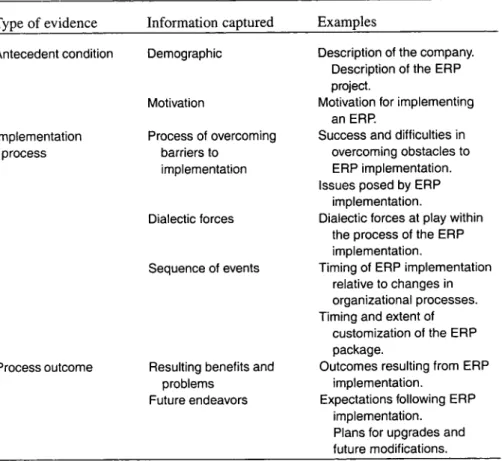
and entered into a matrix created for the purpose of intermediate qualitative data analysis [40]. The format for the matrix is shown in Table 2. For each case, the authors recorded information about antecedent conditions (such as, company demo-graphics, project motivation), the implementation process (such as, overcoming ob-stacles, dialectic forces, sequences of events), and outcomes (such as, benefits, future endeavors). Each of the two authors prepared an analysis matrix for each company and then met to combine their matrices into a single matrix, resolving discrepancies between each other's entries through discussion, references back to the interview reports, and consultation with the third author. The final matrix was used to identify similarities and contrasts among the cases.
Results
Motivations for ERP Implementation
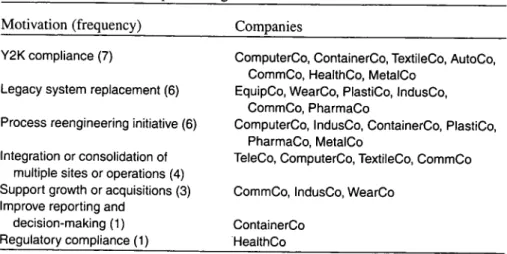
USING THE ROWS OF THE ANALYSIS MATRIX we sought contrasts among groups of companies based on their antecedents, processes, and outcomes. Comparing anteced-ents revealed seven distinct motivations for pursuing ERP, summarized in Table 3.
Table 3. Motivation for Implementing an ERP
Motivation (frequency) Companies
Y2K compliance (7)
Legacy system replacement (6) Process reengineering initiative (6) Integration or consolidation of
multiple sites or operations (4) Support growth or acquisitions (3) Improve reporting and
decision-making (1) Regulatory compliance (1)
ComputerCo, ContainerCo, TextileCo, AutoCo, CommCo, HealthCo, MetaICo
EquipCo, WearCo, PlastiCo, IndusCo, CommCo, PharmaCo
ComputerCo, IndusCo, ContainerCo, PlastiCo, PharmaCo, MetaICo
TeleCo, ComputerCo, TextileCo, CommCo CommCo, IndusCo, WearCo
ContainerCo HealthCo
The most common motivations were to make systems "Y2K compliant" and to re-place legacy systems. Clearly, these two objectives may overlap, although each was mentioned as a separate motivation. The pressure to become Y2K compliant in the late 1990s can be considered a unique and temporary motivation, although many companies used the excuse of Y2K to address more enduring needs. The most com-mon of these included ERP as part of a process reengineering initiative and integrat-ing disparate sites or operations. Several of the firms had acquired or merged with other firms, and they sought to implement standard business processes across sites, especially global sites, so that operations could become integrated. Standardization and integration are similar to another objective, supporting corporate growth, which was cited as a motivation by three companies. The only other motivations mentioned were the general desire for improved reporting and decision-making and a need to comply with a specific regulatory requirement. The total frequency count exceeds the size ofthe sample (13) because some companies had multiple motivations, as shown by the multiple entries in the second column of Table 3.
Companies with similar motivations were grouped together to see if associations could be made between motivation and either process or outcome. However, the dif-ferent reasons for implementing an ERP did not appear to result in difdif-ferent imple-mentation processes or outcomes.
Outcomes of ERP
Grouping companies by outcome proved to be difficult because many companies were still experiencing near-term, post-implementation adjustments. Respondents described a mixture of positive and negative effects resulting from their ERP imple-mentation, but most said that it was "too early to tell" what ultimate benefits might result. Performance improvements included greater efficiency within supply chains, improved financial accounting, greater data visibility and analysis capability, and
more process-centered thinking. Negative outcomes included problems of data inac-curacy, loss of reporting capabilities, resistance by users, strained relationships with customers, and loss of skilled people. Indeed, almost every case exhibited some com-bination of positive and negative outcomes, making our goal of assessing those out-comes difficult. Post-implementation dips in performance are common with ERP systems [34, 52], and the respondents in our sample were candid about both benefits and problems. They expressed hope that more substantial benefits would result once the adjustment period was over, but we were unable to gauge their ultimate outcomes.
ERP Implementation Process
Given the mixed antecedents and unstable outcomes among firms in the sample, we decided to focus on the process of implementation. Our dialectic perspective drew attention to the obstacles encountered during implementation and the manner in which obstacles were overcome. A variety of theories potentially supply the constructs that operate in dialectic fashion [8, 69]. Eor example, theories of organizational politics explain organizational change with reference to the social power of opposing interest groups who pursue their separate agendas. In the context of ERP, politics might be useful to explain the resistance by plant managers to a system that imposes standard processes on local operations. The implementation barriers encountered in a political analysis might be overcome through negotiation or the assertion of power. Those favoring ERP and those opposing it would thus be engaged in a dialectic political process producing future outcomes.
Although politics and other theories, such as organizational culture and institu-tional theory, all incorporate a dialectic "logic of opposition" [8], the respondents in our study made little mention of political motives or actions. Rather, aside from brief mentions of organizational culture, most of the language used refiected a concem with leaming and knowledge." To respondents, the primary obstacle to implementing ERP was the firm's knowledge of existing systems and business processes. In the language of organizational leaming, "organizational memory" was viewed as a bar-rier to acquiring new knowledge [9,27,29,49]. Managers trying to comprehend ERP systems and new business processes enabled by ERP needed to reconcile the de-mands for new knowledge with their knowledge of old systems and procedures. To explore the role of organizational leaming in ERP implementation, we conducted a detailed analysis of the cases based on this dialectic conception of organizational leaming.
Knowledge Barriers
Barriers to leaming ERP were mentioned frequently. For example, at CommCo, a respondent said that instead of leaming newly introduced processes, individuals tried to reinstate "what they had done in the past, including workarounds." Another spondent from AutoCo remarked that users were adept at working around the re-quirements of ERP software. He considered pulling data off the system for analysis
using desktop software, instead of querying the ERP database directly, to be a workaround with potentially disastrous results. "Microsoft is the toughest legacy sys-tem to replace," he said. In order to decrease the reliance on established organiza-tional memory, HealthCo hired college students, who "leam easily because they're not constrained hy the old way of doing things." In contrast to workers who knew the old processes, student recruits would not need to unleam the way things were done in the past.
Respondents noted that the obstacles to leaming new systems and processes were not mere resistance to change. Rather, individuals struggled with understanding how to do their jobs. For example, a PlastiCo respondent noted that practicing on sample data did not prepare employees for live implementation: "It's like turning out the lights; people didn't know where they were going." Several respondents observed that it was difficult for users to understand how their actions affected other people in the organization. For example, factory workers at WearCo could not understand the value of entering data that were not used within the factory. Some firms tried to change reward systems to motivate leaming of new systems and processes. At IndusCo, for example, line managers had formerly been rewarded for achieving bottom-line re-sults, regardless of the methods used. With the new ERP, many tried to achieve these results by "beating the system," a behavior learned during the legacy system years. With their ERP system, however, rewards would come to those who exercised disci-pline instead of creativity. This led one IndusCo respondent to remark, "These guys [line managers] have a lot of unlearning to do, and it's painful." WearCo also recog-nized this issue and offered incentives to plants that used the ERP system accurately. In a number of cases, respondents not only commented on leaming requirements but also made reference to dialectic forces. The most direct such reference was to the "countervailing forces" at PlastiCo. Many companies also acknowledged the tension between the effort to implement an ERP system and the ongoing obligation to run the business. TeleCo, ComputerCo, PlastiCo, AutoCo, and PharmaCo all made explicit mention of the conflict between learning the new world of ERP and extracting busi-ness benefits from existing systems. Each of these firms saw major trade-offs be-tween acquiring new knowledge and exploiting what they already knew.
Overcoming Knowledge Barriers
According to respondents, ERP implementation challenged established knowledge in two ways. First, the software was packaged and allowed customization only through tables that the firm needed to configure to refiect its particular business rules. This was a formidable leaming task because the software was complex, extensive, and tightly integrated. Second, as ERP replaced existing legacy systems, it also replaced the processes supported by those systems with new standardized processes that cut across functional applications. This required firms to assimilate new business pro-cesses and new management structures. Our analysis focused on the practices used to overcome both configuration and assimilation knowledge barriers.
Overcoming Configuration Knowledge Barriers. As part of implementation, every firm configured its ERP software to specify the business mles that described its own operations. Configuration involved populating at least hundreds, and usually thou-sands, of tables with values that reflected the business rules. The complexity of ERP created significant knowledge barriers that were acknowledged by respondents. To overcome configuration knowledge barriers, firms used core teams and consultants. Table 4 shows specific practices involving core teams and consultants used by firms in our sample. Both effective and ineffective practices are included in the table.
In most firms a core team assumed responsibility for configuring the system. In dialectic terms, the core teams operated as forces promoting new knowledge against the knowledge barriers of existing organizational memory. Companies found various ways to ensure that core teams overcame the complexity and novelty of configuring software. In particular, they staffed core teams with respected business and technol-ogy managers, thus providing needed business and technical expertise. Both TeleCo and PlastiCo reported that they put their "best people" on the core team, and HealthCo's core team of ten technology and business managers included eight "high perform-ers." Firms also sought ways to energize and reward core teams. Both MetalCo and ComputerCo noted that leaming among team members was fostered by a strong ca-maraderie cultivated by locating team members in a common, separate area. At ComputerCo, team members were rewarded for staying with the team, and teams at HealthCo and MetalCo received large bonuses for completing configuration signifi-cantly ahead of schedule and under budget. Consistently, firms with strong core teams that embodied both business and technical knowledge reported that they were able to configure systems successfully.
By contrast, where core teams were small, weak, or too narrowly focused, firms typically reported difficulty overcoming configuration knowledge barriers. Both EquipCo and PharmaCo had small core teams staffed with technology experts who did not provide business process leadership. ContainerCo's core team experienced high tumover because technical members left to join its ERP vendors. Despite the presence of strong functional and business experts, ContainerCo's configuration suf-fered due to a lack of technical expertise. AutoCo's core team provided an overall model for configuration, but handed it off to less skilled local teams that had diffi-culty applying the model to meet configuration needs in their specific areas. WearCo's core team included 20 technology people, business users, and consultants, yet they experienced difficulty with configuration because of high tumover. One WearCo re-spondent mentioned inadequate technical expertise and poor design, and another noted that system configuration was planned without recognizing cross-functional processes. In sum, firms whose core teams lacked diverse expertise or failed to accumulate and disseminate knowledge about both the business process and technical aspects of con-figuration were less eflFective in overcoming concon-figuration knowledge barriers.
The second practice used to overcome configuration knowledge barriers was to hire consultants with software expertise gained through formal training and prior experience. Consultants applied their knowledge by either configuring the software
mer s CO 0 0 -a now l c _o i-OJO Con t E o O o ractice s a. Tab l u E rc o o o c D
1
D 0 0 Know l o o crt ie i e ba n 0 0 /le d o c Stra i cn CD 0) 0) O O<u N itom i o o o c (U u •> T3 CO i2 c
s
• 5 c 8 'Q. 0 0 m . < « u O ) c ul t cn c 0 0 CD "o S 0 Q. E 0 CO CD .C . Q . B) 0 O ) c ul t c 0 u Q ' ^ Q) D> - Q "0 c Q . 0 CO • c 3 cn 0 CJ 0 cn CD 0) E 0 le t CO • d) cn Q.55
CD a>11
s 3 &' b 1 1 2 cn Jo O cn .£ E 8 t " § E c a cn cthemselves or by working with the firms' core teams. For example, a TextileCo re-spondent described its consultants as "a crackerjack team that did a super job on the technology." Both PlastiCo and TeleCo brought in consultants to address specific problems and then let them go. TeleCo's consultants were "phased out" before imple-mentation was completed, but TeleCo expected to recall them to help with software upgrades. MetalCo expressed a desire to learn from their consultants, yet quickly became independent of them. Even where consultants were regarded as being in the "driver's seat," as they were at ComputerCo, respondents noted that they were able to avoid overdependence and ensure knowledge transfer. IndusCo also emphasized the importance of transferring knowledge from the consultants to the company.
Consulting was less effective in overcoming configuration knowledge barriers when companies depended either too little or too much on consultants. EquipCo ignored their consultants' cautions against heavy customization during software configura-tion. "We tried a few [consultants] but they said things we didn't want to hear, so we sent them away," reported an EquipCo respondent. Only later did EquipCo realize deficiencies in the work processes that the software had been customized to fit, so they changed their business processes to fit the standard software. Both AutoCo and PharmaCo budgeted 60 percent of their project costs for consultants. A respondent from PharmaCo said that the company was like "the baby at the mother's breast"— totally dependent on the consultants and unable to care for itself
Overcoming Assimilation Knowledge Barriers. The second kind of knowledge bar-rier was associated with the assimilation of new work processes and organizational designs. Assimilation was a challenge not only for users, but also for core team mem-bers and other stakeholders such as customers. Before users could use an ERP system effectively, they needed to learn the business processes that were revised following system implementation. Firms addressed the need for users to learn new systems by providing formal training for users and by taking an incremental approach to sys-tems implementation. Table 5 shows specific practices involving formal training and incremental implementation used by firms in our sample. Both effective and ineffec-tive practices are included in the table.
Although all firms cited user training as a key requirement for ERP implementa-tion, they differed in the kind and amount of training provided. Training budgets ranged from 1 to 20 percent of the total project budget. All firms that spent more on training (TextileCo, IndusCo, and HealthCo) included education beyond procedural training. For example, HealthCo and TeleCo provided education on new processes, and ComputerCo, TeleCo, and TextileCo all addressed change management issues in their training. ComputerCo's user respondent described their change management training as a series of workshops designed to ensure that people met their perfor-mance objectives. "Don't underestimate the change management work. This is big," he reported. At TextileCo, ERP implementation was regarded as "massive cultural change," and a portion of their large training budget (20 percent ofthe project budget) was allocated to address "organizational/cultural change."
rrier s a PQ 0 0
"S
ow l c io n I C3 mi l c/l c/l <D E o CD o c/l OJ CJ 'rac t lab l E o CJ f\\ 0V ( o c rrie i 03 X ) le d Kno w D O ove r rie i CO X I 0 0 vie d o c 0 0 Stra i g rai r 1 • D) "O rojec t D. B C • • 0 ~ 0 CO O. J5 c\j Q. . CO CO 0 3 X I •5 c co" •= CO 0 •D CO g foc u .s 2 • b 0 E E 0 0 en c 'c :ra ii
3n t o f 1 CJ1
T — • 0 c 2 >, 0 equa t fel t in a m Q 0 ^ CO CO ID | > • ^ 0 JO g • D 0 3 CO 0 O) c 'c 'co .^^ CO CO 0 Q fo r p r 0 lonsib i CO 2 1 ainin g es t i n 0 (^ .g 9. 0 cr 0 c 1 train i CO il for m lini r • ro "D 0 o jjI
B c Es
2 X CO 0 CO 3 CU Q . 3 CO O c CO 0 0 3 CO E ro c 0 E ro 0 08
1
v,^ iZ 3 " • C ^^ "^^ CEl'lolpt
ro ,9 .2 i? p E ro CO •- . ^ . U . cl a
II
•53 o •D S 3 3 .Q — . _ 3 o o o "o CM < . b rn CO C ? CO ro f— c ^ ro roI'EI
=3 S. E X) g> aj ro — c E "^ S 0 ? b 0 g ' c O Q. ro 0 1)5 CO •o c ro CO CO o o 0 CO CO1
CO CO O) g •g 'ro roi o XI o O) c •£ 0 ro I CO » - — c 0 rosi
w -2 D) b 2 E X CO c o 0 0 E 'Sis
E ^ Q • " CO o 0 • « o CO o 0 'w E CO 0 JO 3 O) 0^ E
ro • = 2 -D Q. gli
I S
0 0 d o ( ^ " S l ^ o O i 5 . £ OO O § ro S c 9 « 0 ^ E b , 9 0 0 U Q. CO _0 CO c oI
ro £ S c '£ g 0 S b 0J
iiS
0 . i D> •V ^ 0 ^ CL C O 0 0 -Q . O) §)!£ 'co CO CO ^ un i CO 0 CO — CO O ) ..0c o -^ '6 O CO D) •§ m 0 C •5 .2 ro c 0 0 nc r c g ta t c 0 E 0 mp lBy contrast, PlastiCo's training budget was only 2 percent of the project budget, and it was limited to training users on the procedures for using the new system. Ac-cording to one respondent, PlastiCo did not give users the "education" that was needed to leam new business processes. The culture at CommCo, which spent only I percent of its project budget on training, was described by one respondent as based on the principle of "just do it and get it done." In this context, training was not valued. Respondents reported that when training was complete, "we looked at each other and said 'we're trained,'" but it was clear that the users had not learned what they needed to know. Although some change management material was included in CommCo's training, it was considered to be at "too high a level" to be beneficial. At both WearCo and EquipCo, minimal emphasis was placed on training.
Although ERP is often associated with radical change, our results suggest that as-similation knowledge barriers were overcome more effectively when change was in-troduced incrementally. Most firms looked for ways to "break up" the huge implementation effort by choosing one site at a time or by limiting the number of modules they implemented initially. An incremental approach allowed project par-ticipants and users to recover from the stress and strain of implementing an ERP and to acquire leaming that could be applied to subsequent implementations. PlastiCo, AutoCo, and IndusCo sent a single core team to each of its multiple sites so they could leverage the leaming from each implementation. At PlastiCo, this approach created a momentum that one respondent described as being "on a roll, kicking butt" in implementing new sites. ComputerCo upgraded its ERP software on a continuous basis, taking "small bites instead of a big one," according to one respondent. At TeleCo, business units assigned full-time people to test and enhance the ERP system on an ongoing basis. These efforts provided members of the respective organizations with opportunities to acquire and share knowledge about the new system and its processes. In contrast to the practice of applying continuing incremental support, several firms struggled with knowledge barriers because they discontinued support efforts follow-ing implementation. At CommCo, for example, only four of 20 project team mem-bers became the envisioned "super users" who were intended to support ERP efforts following implementation. The remainder either left the company or retumed to their previous positions. As a result, respondents at CommCo concluded that they did not have "as much system and organizational knowledge supporting the systems as needed." At PharmaCo, the core team failed to roll ERP out to intemational sites because the team was small and lacked intemational representation. "People thought we were about as helpful as a hemorrhoid," suggested one respondent from PharmaCo. Even large core teams became less effective when they experienced tumover. WearCo found that high tumover limited the sharing of knowledge across its implementa-tions. In each of these cases, teams lost momentum and were unable to disseminate knowledge important to ongoing needs.
In sum, the practices for overcoming knowledge barriers differed across compa-nies. Where companies supported the core implementation team and managed their relationships with consultants well, they reported that they had configured a system
that they were able to implement across the organization. Where they invested wisely in training and adopted an incremental approach to organizational change, they re-ported that they had satisfactorily disseminated knowledge about effective use of the system across the organization.
Piecemeal and Concerted Change Processes
In describing their leaming challenges, most respondents clearly understood their relative success in overcoming configuration knowledge barriers. However, the as-similation of new work processes and organizational changes posed more complex challenges with ongoing implications. To better understand how firms coped with assimilation knowledge barriers, we explored the sequence in which the two major events of implementing ERP software and implementing changes to organizational processes occurred. Some firms preferred to implement the software first and focused later on process changes. Miller and Friesen [41] referred to this type of change as piecemeal because fewer changes are undertaken at one time. It may also be consid-ered an example of loose coupling between technical and organizational change [43]. Other firms intended to change business processes at the same time that they imple-mented the technology. In this approach, members of an organization must not only learn to use new systems, but they must also learn new ways of performing their jobs. This type of change has been called concerted change [41] because more things change at once, and it is an example of tight coupling between technical and organizational change [43].
The eight companies that adopted a piecemeal approach (TeleCo, HealthCo, MetaICo, WearCo, PlastiCo, CommCo, AutoCo, and EquipCo) considered ERP pri-marily as a replacement for a patchwork of incompatible legacy systems, and they intended to defer consideration of changes in their business processes. Respondents at these firms expressed doubts about their ability to handle more than one major change at a time. As one respondent from MetaICo explained, "you can't weight lift at the same time you replace your nervous system." For MetaICo, replacing the ner-vous system came first, followed by a slowly paced redesign of business processes. At EquipCo, the commitment to avoid reengineering was so strong that management modified the ERP package in order to make it conform closely to existing organiza-tional processes.
The remaining five firms (ComputerCo, TextileCo, IndusCo, ContainerCo, and PharmaCo) pursued a concerted change approach, focusing on business process re-design along with ERP implementation. In most of these companies, ERP was seen as a component of a larger reengineering or transformation initiative rather than a sys-tems replacement project. For example, at TextileCo, teams of employees reviewed 500 existing processes and redesigned 300 of them prior to configuring the ERP package. In a similar manner, ContainerCo redesigned its supply chain processes, and PharmaCo established a set of standard processes that would be implemented across its 13 different sites.
Firms that adopted the. piecemeal approach would seem to have an easier time over-coming knowledge barriers than firms that adopted a concerted approach. For ex-ample, PlastiCo's piecemeal implementation was undertaken with the recognition that a more concerted effort might further exhaust the organization, which had al-ready experienced "constant deadlines and the dual responsibilities of implementing [ERP] and running the business," In deferring leaming, however, these firms also deferred much of the potential benefit from their ERPs. When asked about their fu-ture plans, most of these respondents confessed that the real challenges lay ahead, when their companies would begin leveraging their ERPs to produce greater business value. Although they had implemented a few required process changes at the time of implementation, most felt that achieving the potential benefits of an ERP would re-quire more extensive attention to process reengineering in the future. Some respon-dents were apprehensive about the prospect of deferring process changes because they recognized that configuration decisions made in the present would limit longer-term options for process changes, A respondent from AutoCo explained that an ERP system was like poured concrete: "Both [ERP and concrete] are easy to mold when first put in, but nearly impossible to change after the fact."
Despite their desire to defer process change, firms adopting the piecemeal approach discovered that ERP required some concurrent changes in business processes be-cause of its integrated design. For example, ERP systems required more coordination between business processes in different functional areas. Thus, those firms that wanted to change in piecemeal fashion found it necessary to implement some new processes simultaneously with systems changes. In no case was a firm able to restrict its focus exclusively to system implementation. The one firm (EquipCo) that attempted to cir-cumvent process change by customizing program code to force the system to fit its existing processes experienced extraordinary technical problems as a result of its modifications. System performance was so poor even 18 months after implementa-tion that EquipCo had to limit the number of users on the system at one time. In addition, it was clear that the processes that had been designed into the system failed to leverage the capabilities of the ERP and severely limited the firm's ability to use system data effectively.
By contrast, firms pursuing a concerted change approach took on the challenge of changing systems and processes simultaneously, which created greater leaming re-quirements. These firms believed that they needed to "drive for benefits" from their ERP investment, which implied concurrent process redesign. Typically, these firms designed their processes prior to system configuration and implemented the new pro-cesses as the system was implemented, accepting the risk that the software might not support the newly designed processes. By pursuing change in this fashion, they creased the amount of leaming required of members. For example, PharmaCo in-tended to drive for benefits by reengineering processes while implementing ERP, but one respondent estimated that it could take about three years to fully understand the software and its capabilities, "At first, you use about 15 percent of [the ERP's] func-tionality, but over time, you find more and more useful capabilities," he estimated. At ContainerCo, functional managers were expected to use the ERP to redesign their
business processes. However, ContainerCo actually implemented its ERP modules into traditional functional departments, foregoing the advantages associated with pro-cess integration. By leaving the design of potentially integrative changes such as sup-ply chain management to the discretion of its business units, ContainerCo faced difficult future issues. As a ContainerCo manager said, "They did the redesign on paper and said they would change, but it's another thing to really do it." IndusCo also adopted a concerted approach and consolidated sites and reduced head count a few months after implementation. However, IndusCo's customers and managers had difficulty assimi-lating the company's new business processes. Frequent attempts to "beat the system" by working around it were evidence of the "painful unlearning" at IndusCo.
All of the firms pursuing a concerted approach had long traditions of business unit autonomy, and ERP was regarded as dismantling not only existing business processes but also the understanding of how work ought to be structured. At PharmaCo, the "culture of autonomy" was seen as a threat to standardizing business processes across divisions. Although standard business processes were part of the corporate model for the first ERP implementation, fears were that divisions would modify their individual processes later. At TextileCo, one respondent told the story of a division manager who purportedly argued: "No goddamn computer is going to tell me how to run my busi-ness." Clearly, these statements indicate the presence of barriers that require substan-tial efforts to overcome. Eventually, firms pursuing the concerted approach gave in to the forces opposing the learning requirements of concerted change and adopted prac-tices that mimicked the behaviors of firms that professed to take a piecemeal approach. In sum, although the piecemeal and concerted groups outlined different approaches to implementing ERP, both experienced the requirement to implement new systems and processes simultaneously. Both groups also experienced the need to spread their attention to technical and organizational challenges over longer periods of time. Con-sequently, the distinctions between the piecemeal and concerted approaches to imple-menting ERP were easier to espouse than to execute. In practice, regardless of the intended approach, implementing an ERP forced some concurrent changes in busi-ness processes as it enabled future process change. Most respondents believed that their firms could eventually recoup the cost of their ERP investments through the process improvements that ERP enabled. However, many were unsure of their firms' ongoing commitments to the learning challenges associated with assimilating new business processes.
Discussion
The Dialectic of Organizational Learning
TAKEN AS A WHOLE, OUR HNDINGS SUPPORT the idea of a dialectic of learning during ERP implementation. The most fundamental dialectic occurs between, on one hand, the old knowledge embedded in business processes and practices associated with legacy systems and, on the other hand, the new business processes and practices that ERP is designed to support. Where older processes are deeply ingrained into organizational
memory, they represent formidable barriers to the implementation of new knowledge associated with ERP. In many cases, organizational memory is supported by organiza-tional structures in which division managers tradiorganiza-tionally enjoyed great autonomy and were held accountable only for bottom-line performance. ERP tends to be associ-ated with integrassoci-ated, process-centered models of organization. Thus, ERP systems typically require organizations to forget large portions of what they already know about technical infrastructures and business processes. Implementing ERP systems can therefore be understood as a dialectic of leaming.
Although we approached our research with a dialectic assumption about change, we did not impose the vocabulary and constructs of leaming a priori. Rather, the constructs of leaming were drawn inductively from the interviews, which contained numerous references to leaming, leaming curves, and knowledge. These were men-tioned not only in the context of formal training but also to describe the overall pro-cess of ERP implementation. Moreover, frequent reference to the dialectic relationship between past and future practices surfaced in many of the interviews.
We position the learning process at the organizational level because the issues dis-cussed in the interviews clearly transcended individual leaming. Although people described individual adjustments to ERP's technical complexity and changes in jobs, leaming was not concentrated at the individual level. Rather, the structures and pro-cesses of entire divisions needed to change, and occasional references to cultural change reflected the organizational scope of the leaming process. Caches of organi-zational memory formerly guarded by division managers became transparent in the world of ERP, and enduring assumptions about responsibility, accountability, and the formulas for success were challenged. In addition, ERP implementations chal-lenged established assumptions about the role of information technology. Whereas most firms had once built information systems to support existing operational pro-cesses, they now used ERP packages to change their business processes. These new demands required substantial organizational learning, and the firms in our sample used a variety of means for overcoming knowledge barriers associated with ERP implementation.
Overcoming ERP Knowledge Barriers
To deal with the knowledge barriers connected with ERP configuration, the firms in our sample used core teams and consultants. Core teams acted as the primary force promoting change in the dialectic process of leaming. The effectiveness of core teams depended on their size, representation, and their ability to avoid tumover of key mem-bers. Core teams that stayed together and were motivated by incentives to finish the project were very instrumental to overcoming configuration knowledge barriers. Not only did core teams become a key repository of new knowledge, but they also helped to distribute knowledge throughout organizations as they came into contact with user areas. Sustaining an effective core team was not easy. As repositories of ERP knowl-edge, members of core teams became valuable to other organizations, especially con-sulting companies, which regularly extended lucrative offers that could triple
compensation for an ERP-knowledgeable person. To prevent this sort of "brain drain," firms in our sample embarked on programs to retain good people. Such programs incorporated financial packages that included bonuses and ownership options for good performance.
Consultants operated as intermediaries who facilitated organizational leaming by bringing in extemal knowledge [3, 49]. However, the most successful firms in our sample limited their dependence on consultants and took measures to ensure the transfer of extemal knowledge to the organization. Although the consultants' role was key, that role had to be carefully managed by the client firm. Firms that were less success-ful in the management of their consultant relationships made one of two mistakes: they were either too dependent on consultants' advice, or they distrusted them. Be-cause ERP technology was so new and complex at the time of this study, it was diffi-cult for a company to embark on such an endeavor without external knowledge. However, effective use of consulting required a firm to remain in control of the con-sultant-client relationship.
To overcome knowledge barriers associated with the assimilation of new work pro-cesses, firms relied on formal training and incremental pacing. Formal training is an obvious choice for overcoming knowledge barriers [6], but several of the firms in our sample spent very little effort on training. These same firms experienced the most difficulty in getting users to assimilate change. Other firms spent as much as 20 per-cent of their project budgets on training. It was also important to have training ad-dress broader change management issues and teach the concepts of process-orientation rather than focus strictly on software procedures. Previous research confirms the im-portance of conceptual training in addition to procedural training [55]. Many firms in our sample leamed about this distinction painfully when they realized that their em-ployees knew how to navigate the ERP system but that they had not assimilated the basic concepts of integration and process orientation.
An incremental approach to ERP implementation also proved to be an effective means to overcome the knowledge barriers associated with the assimilation of new business processes. An incremental strategy breaks the implementation effort into smaller pieces, allowing project participants and users to avoid mental and physical bumout. Firms using an incremental strategy used different tactics: implementing one site at a time, limiting the initial number of modules implemented, and upgrading the package in small increments. In doing so, they applied the leaming from one implementation to the next. Firms that used these tactics thought that they were help-ful in facilitating the assimilation of new business processes.
Our findings also showed that firms differed in the way that they approached ERP implementation. Most of the firms we studied adopted a piecemeal approach, which focused on implementing the software first, and intended to focus on redesigning processes after the firm had absorbed the new system. Although this approach was adopted to separate the systems and process leaming requirements, the software re-quired some business processes to change concurrently. Thus, firms seeking the piece-meal approach were unable to execute it as they hoped. Many respondents candidly doubted that business changes would follow the ERP implementation because of
resistant organizational memory in the operating divisions. Having expended effort to overcome the configuration knowledge barriers, these firms still faced the more formidable barriers associated with user acceptance and adaptation.
Firms adopting a concerted approach to ERP implementation sought to change their business processes while implementing ERP, Miller and Friesen [41] found that con-certed change was more effecfive than piecemeal change because it confronted poten-tial sources of resistance and forced issues rather than leaving them unaddressed. Their findings imply that firms implementing ERP may not have the luxury to proceed in piecemeal fashion, even though many of them tried. Despite the enormous leaming challenges it creates, some degree of concerted change is unavoidable because of ERP's integrated nature. Many older business processes simply cannot be performed on new software. Moreover, firms adopfing both piecemeal and concerted approaches faced a future of ERP upgrades and new software releases [26], and few firms re-garded their implementations as complete when an installed version was running.
Conclusion
Implications for Practice
THIS RESEARCH HAS SIGNIHCANT IMPLICATIONS for firms that have implemented or are about to implement ERPs, It identifies two categories of knowledge barriers that firms are likely to encounter: configuration and assimilation knowledge barriers. The configuration challenges demand a core team that is carefully selected, motivated with incentives, and empowered to act, as well as an effectively managed consulting relationship. Assimilation barriers demand intensive employee education and an in-cremental pace of implementation. Assimilation barriers are so significant that firms cannot exclusively pursue either a piecemeal or a concerted approach to implementa-tion. Firms in our sample found it necessary to engage in practices that gave their employees time to absorb and share their knowledge gained through experience, but they also acknowledged the benefits of changing business processes when they imple-mented their new systems.
Future Research
These conclusions are consistent with the findings of prior research on complex tech-nologies and with the conventional wisdom of consulting practice. However, future research should investigate additional methods for overcoming knowledge barriers. In a recent review of information technology and organizational learning, Robey and his colleagues [49] identified action research and situated leaming as two means for overcoming knowledge barriers in addition to formal training and the use of consult-ant intermediaries. Action research would seem to have potential applicability to the problem of increasing leaming during ERP implementation. The goals of action re-search—to provide a scientifically sound basis for improving an organization's prac-tices—are consistent with the objective of improving ERP implementation. Indeed,
many of the companies in our sample referred to preparation of business cases and establishment of metrics to assess their success with ERP that could have been used in an action research program. Whether facilitated by intemal or extemal "scien-tists," action research could potentially contribute valuable knowledge to organiza-tions both engaged in a specific ERP implementation and leaming vicariously from others' experiences.
Leaming situated in social contexts, or communities of practice, is another means for overcoming knowledge barriers [31 ]. In contrast to formal training, situated leaming relies on participation in a community of practice in which novice members leam by observing and listening to more experienced participants. Because our study relied on interviews with senior executives, we had no direct access to the phenomenon of situated leaming. However, some companies reported plans to distribute members of their core teams into user groups, where they would play the role of "super users," passing on valuable knowledge about working with ERP. Other research has shown that situated leaming operates in an ERP context [8]. Future research might usefully take an ethnographic approach to studying how knowledge about ERP is communi-cated within communities of users.
The dynamics of leaming is another area for future research. Research suggests that organizations modify their uses of information technology as they gain experi-ence, but that modifications are not spread evenly over time [25]. Rather, organiza-tions adapt to technologies during brief periods following their introduction or later in response to breakdowns or dismptions [67]. Once these "windows of opportunity" are closed, leaming is likely to stop as new routines become established. Applied to ERP systems, these findings suggest that deferred process changes may never occur as planners hope they will. None of the 13 firms from our sample displayed any sense of mastery over ERP following implementation, and most respondents believed that it would take years to assimilate the technology's full potential. Research on technol-ogy adaptation suggests that the window does not remain open forever, and it would be valuable to study post-implementation adaptations to ERP for this reason. Future research can also examine the dynamics of piecemeal and concerted strategies for ERP implementation. By tackling the technical challenges before changing organiza-tional processes, piecemeal strategies appear less risky and allow incremental leam-ing to occur [35]. Concerted change, which combines technical and process leamleam-ing, may increase risks, but may also increase benefits [35]. Empirical research that is guided by appropriate theory can shed light on such important practical questions.
Our focus on the dialectic of organizational leaming draws attention to the forces opposing as well as those promofing organizational change. Although ERP systems are often regarded as powerful technical forces designed to transform business prac-tice, our study reveals many barriers that must be overcome before ERP's expected benefits can be realized. In simple terms, implementing an ERP means that organiza-tions must leam to function in radically different ways, and their ignorance is readily understandable. Yet, despite the strength of the forces opposing new organizational practices, firms have identified mechanisms that begin to overcome the barriers. As we progress in our understanding of knowledge barriers and means for overcoming