AN ANALYSIS OF ARGUMENTATIVE TEXT BY USING TOULMIN MODEL OF ARGUMENTATION A THESIS Intended to fulfill one the requirements for the award of sarjana degree in English language teaching and education By ANDI EKA HARYATI NPM : 056310254 ENGLISH DEPARTMENT TEACHERS TRAINING AND EDUCATION FACULTY ISLAMIC UNIVERSITY OF RIAU PEKANBARU 2009
ABSTRACT
Andi Eka Haryati, 2009. An Analysis of Argumentative Text by Using Toulmin Model of Argumentation.
Key Words: Toulmin Model, Argumentative, Text Analysis
This study was aimed to analyze the argumentative text written by the authors related to Toulmin model analysis concept which consisted of claim, data, warrant, backing, rebuttal and qualifiers. By using Toulmin model, the reader can easily understand a message of an argument, and it can be a new way for students or readers to be critical reader and increase their reading skill. This study belongs to text analysis. It is an approach of analysis the structural characteristic of text, as coherence, hierarchical organization, concept load or destiny, etc. The population of this study includes the texts of argument that the writer took in internet. Given the fact, the size of population is extremely large, thus, the writer took the general issues that always become a topic in life. The writer decided to take three arguments from educational, medical and social genres, they are about Home schooling, Cigarette smoking and Abortion that has a criteria between 10002000 words.
The writer took the text argument in internet where the text will be analyzed by using Toulmin model that consists of claim; qualifier and exception, reason, data; example, statistic data, expert opinion, warrant; explicitly or implicitly, backing; additional support for warrant, rebuttal; refute the opposing view, and qualifiers of all the statements in argument; “some”, “many”, “most”, “probably”, “sometimes”, etc. From the analysis, the writer found that two of three arguments made by the authors had fulfilled all of these components. They are educational text genre and medical text genre (Home schooling: is it a good idea? By: Admin and Cigarette smokingwho is to blame? By: James boss). Based on finding of the analysis the writer concludes that the authors’ argumentative text had fulfilled all of the components needed of an argument based on Toulmin model and the writer could argues that text argument has complete components and easier to analyze by the readers.
ACKNOWLEDGEMENT
Firstly, the researcher would like to carry out glory and honor to the Almighty God, ALLAH S.W.T, for giving her such blessing that she could finish this thesis which submitted to fulfill a partial requirement for getting an S1 degree from English Study Program of FKIPIslamic University of Riau.
The researcher would like to express her sincere gratitude to Dra. Betty Sailun, M.Ed, as her first advisor and Yulianto, S.Pd, as her second advisor, who have guided and given their advices, corrections, suggestions in accomplishing this thesis. And her gratitude also goes to the chairman of the English Study Program, Johari Afrizal, S.Pd.,M.Ed and to all the lecturers who have supported her to finish the thesis.
Moreover, the researcher would like to thank to her beloved parents, her father (Andi Arifin) and her mother (Andi Farida) who has given dedication to pray and raised her up when she weaker, and for all her sisters; Andi Asnawati, SE, Andi Fitriyanti, SE, and Andi Susi Astuti. And for her brother in law; Taufik Ridho, ST and Eriadi Fahmi, SP, who have raised her with full of love, provided her with physical, material and spiritual support and also have prayed for her to finish this thesis.
And special thanks also to her beloved friends X’Club (Yola, Ija, Wie, Yuli, Tiex, Tika, Lina and Yani) and for all her classmates in B class who have support and help her during her study. Only ALLAH. SWT can pay back your all kindhearted.
Finally, the researcher believes that this thesis is still far from being perfect. Thus, the researcher welcomes constructive suggestions from the reader.
Pekanbaru, November 2009
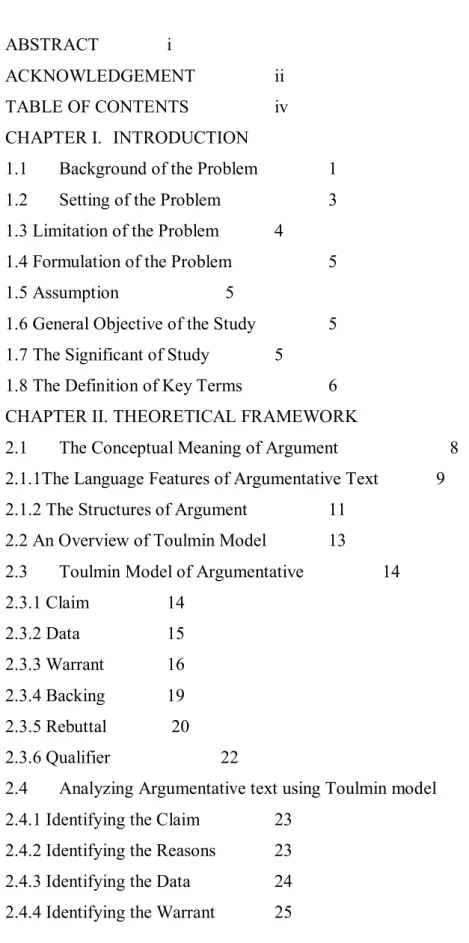
TABLE OF CONTENTS ABSTRACT i ACKNOWLEDGEMENT ii TABLE OF CONTENTS iv CHAPTER I. INTRODUCTION 1.1 Background of the Problem 1 1.2 Setting of the Problem 3 1.3 Limitation of the Problem 4 1.4 Formulation of the Problem 5 1.5 Assumption 5 1.6 General Objective of the Study 5 1.7 The Significant of Study 5 1.8 The Definition of Key Terms 6 CHAPTER II. THEORETICAL FRAMEWORK 2.1 The Conceptual Meaning of Argument 8 2.1.1The Language Features of Argumentative Text 9 2.1.2 The Structures of Argument 11 2.2 An Overview of Toulmin Model 13 2.3 Toulmin Model of Argumentative 14 2.3.1 Claim 14 2.3.2 Data 15 2.3.3 Warrant 16 2.3.4 Backing 19 2.3.5 Rebuttal 20 2.3.6 Qualifier 22 2.4 Analyzing Argumentative text using Toulmin model 23 2.4.1 Identifying the Claim 23 2.4.2 Identifying the Reasons 23 2.4.3 Identifying the Data 24 2.4.4 Identifying the Warrant 25
2.4.5 Identifying the Backing 25 2.4.6 Identifying the Rebuttal 25 2.4.7 Identifying the Qualifiers 25 2.4.8 Drawing Conclusion from Toulmin analysis 25 2.5 General Components of an argument 27 2.6 Critical Reading 29 2.7 Writing an Argument 31 2.8 An Overview of Discourse Analysis 33 2.9 Some Related Methods of Text Argument Analysis Compared with Toulmin Model 35 CHAPTER III. RESEARCH METHODOLOGY 3.1 Research Design 39 3.2 Population and Sample 39 3.3 Location and Time of the Research 40 3.4 Research Instrument 41 3.5 Data Collection Technique 41 3.6 Data Analysis Technique 42 CHAPTER IV. THE PRESENTATION OF THE RESULT OF THE STUDY 4.1 Data Description 44 4.2 Data Analysis 46 4.2.1 Analysis of the first argument 46 4.2.2 Analysis of the second argument 54 4.2.3 Analysis of the third argument 64 4.3 The Interpretation of data 72 4.3.1 The first argument’s analysis 72 4.3.2 The second argument’s analysis 75 4.3.3 The third argument’s analysis 78 CHAPTER V. CONCLUSIONS AND SUGGESTIONS 5.1 Conclusions 82 5.1.1 Theoretical Conclusions 82 5.1.2 Finding Conclusions 83
5.2 Suggestions 84 BIBLIOGRAPHY APPENDIX LIST OF TABLE CHAPTER III Table 3.3 The Writer’s Activities ... 40 CHAPTER IV Table 4.3.1 The first argument’s analysis ……….. 73 Table 4.3.2 The second argument’s analysis ……….. 76 Table 4.3.3 The third argument’s analysis……….. 79
CHAPTER I INTRODUCTION
1.1. Background of the Problem
An argumentation is a statement, and it is a part of our life. Everyday people make argument in prospect the others. The word “argument” often used to mean a verbal dispute or disagreement. This is not the way this word is usually in philosophy. However, the two uses are related. Normally, when two people verbally disagree with each other, each person attempts to convince the other that his or her viewpoint is the right one. Unless he or she merely result to name calling or threats, he or she typically present an argument are those statements a person makes in the attempt to convince someone or something, or present reason for accepting a given conclusion.
Argumentation always made by people if they want to debated a topic. There is a topic that can be a problem and it logically follows that there must be something to argue about. Topic or source consists of parts experience that can be a unit that turns the proposition for an argument. It means that the fact about a topic can be formed in the fact statements that rewind our perception that must have a fact. If the propositions can received by the others whether listener or reader, it can be a power to make them receive the fact from our argument.
Argumentation can be divided into two forms; there are oral and written arguments. In this study, the writer carries out topic about analyzing argumentative text because usually argumentative text more complete and easier to analyzed.
A good argument actually does not have to be right. We can argue wrongly very well, and that is a key for anyone who likes to argue, or debate, because sometimes situations mean that we have to argue for something that is ‘wrong’. Similarly one of the most difficult skills to develop is being able to argue what we believe.
Actually there are many ways that we can choose in analyze an argument, such as analyze based on the criteria of argument, the structures, and the components needed of an argument. In this study, the writer chooses to analyze an argument based on the components needed of an argument according to Toulmin model. In 1958, Stephen Edelston Toulmin a philosopher and logician identified 6 elements for analyzing an
argument; there are claim, data, warrant, backing, rebuttal and qualifier. The writer chooses Toulmin model because these 6 elements are more specific and complete to identify an argument. The Toulmin model, in short, is an effective way of getting to the how and why levels of the arguments we read. It is a type of textual "dissection" that allows us to break an argument into its different parts (such as claim, reasons, and evidence) so that we can make judgments on how well the different parts work together. When learning written argument, it is always helpful to observe how others argue effectively or ineffectively. The Toulmin method, based on the work of philosopher Stephen Toulmin, is one way of analyzing a text that we read, with an eye toward responding to that particular argument (as in a writing assignment that asks us to respond) and, ultimately, toward analyzing and improving the arguments we ourselves make. In analyzing an argument, there are some problems that always faced by the readers. Many of them did not know what actually the criteria of good argument, so that they got difficulties to classified which one the strong or weak argument. In the other cases, the readers did not have knowledge to identify the structure and the components needed of an argument. Actually these problems can be handled by the readers if they want to learn about how to be a good reader, especially in read an argumentation. Based on the explanation above, the writer is interested to carrying out a research entitled “An Analysis of Argumentative Text by Using Toulmin Model of Argumentation”. 1.2. Setting of the Problem Analyzing an argument is not easy work. As a reader, he or she must be able to mastery all of the criteria, structures and components needed in an argumentation. There are many texts argument that we can found and analyze. Such as: educational text, medical text, social text, economical text, political text, etc. All of the texts have different contain, but they have same criteria, structures and language features.
In general, analyzing text argument has many weaknesses. For example, there is a reader that analyzed a text argument only based on the structures and the language features of an argument. The reader only talks about where the right structure and whether or not the text included the language feature. That was not enough for us as a reader to get the satisfy result or to understand the message from the author. Another example, there is a
way in analyzing a text argument based on the criteria of good argument. A reader wants to see whether or not the argument has fulfilled the criteria. He or she just talks about the strong or weak argument. It is also not enough for us as a reader to get detail analysis, moreover there are many kinds of texts that we will be analyzed.
In this study, the writer shows Toulmin model as one of the best way for reader to analyze an argumentative text. Toulmin model is an effective way of getting to the ‘how’ and ‘why’ levels of the argument we read, whether the educational text, medical, social, economical or political text. Toulmin provides 6 components in analyze an argument; they are claim, data, warrant, backing, rebuttal and qualifiers. Toulmin model has detail analysis, because it analyzed every statement in an argument. It is also more specific, so that the reader will be easy to understand the message conveyed by the author in an argument.
1.3. Limitation of the Problem
Based on the explanation above, it is important to limit the problems in this research. It is impossible to carry out the entire texts genre that can be analyzed in this research. Such as: educational text, medical text, social text, economical text, political text, etc. Therefore, the writer wants to take three texts argument that come from educational, medical and social text genre that will be analyzed by using Toulmin model that consist of : Claim, Data, Warrant, Backing, Rebuttal and Qualifiers. 1.4. Formulation of the Problem The writer formulates the problem of the research as in the following: “Do the authors’ argumentative texts had fulfilled the components needed of an argument based on Toulmin model?” 1.5. Assumption
Argumentative text is more complete in giving statements and has more evidences, so that the writer assumes that it is possible that the authors had fulfilled the components needed of an argument according to Toulmin model in their argument. The writer also
develops basic assumption regarding the Toulmin model of the argumentative text is organized in a good way and can be interpreted and understood by the reader easily.
1.6. The Objective of the Study
The purpose of the research is to investigate and analyze an argument in conveying the intended message of the authors by using Toulmin model.
1.7. The Significant of Study
It is hoped that this research will give useful contribution to the authors (debaters), the educational of UIR, English lecturer, and English students as well.
For the authors, this research will give them valuable contribution in the end that they will be more aware to use the good components in writing an argument, so that the reader are easier to interpret what is actually the intended message conveyed and in the hoped that the reader themselves are getting involved to interact within the argument as well as take in mind the exactly message in the arguments text.
For the lecturer, especially debate subject lecturer it is extremely expected that they will be conscious of the useful contribution of the argument text as teaching materials as well as analyzing that argument by using Toulmin model. In that, this research will give them more information regarding the components needed in an argument according to Toulmin; claim, data, warrant, backing, rebuttal and qualifier.
Furthermore for the students, this research is expected to persuade and even encourage them to enhance comprehensive knowledge of write an argument and the most important thing is to motivate them to make or write an argument in order to increase their English skill. Especially to increase their new knowledge about current issue as a topic and last the students are able to use the components needed in an argument based on Toulmin model in their argument.
1.8. The Definition of Key terms
In order to avoid misunderstanding about the title of this research, the definitions of the terms are given bellow:
Argumentation: Argumentation means a statement that consists of using both facts and opinions as evidence in the logical analysis of a proposition to enable judges to arrive at a decision. In this study, the writer focuses on the argumentative text made by the authors. Toulmin Model: Toulmin model is one way of analyzing a text that we read, with an eye toward responding to that particular argument (as in a writing assignment that asks us to respond) and, ultimately, toward analyzing and improving the arguments we ourselves make. Toulmin identified 6 elements needed of an argument; claim, data, warrant, backing, rebuttal, qualifier.
Author: Author is people who write or made an article, book, journal, thesis, etc. In this study, author is a people who write an argument (or arguer) in form of text.
Reader: Reader is people who read a book, articles, text, journal, thesis, etc. In this study, reader is people who read and analyze the argumentative text.
CHAPTER II
THEORETICAL FRAMEWORK
2.1. The Conceptual Meaning of Argumentation
Argument is a group of propositions (that is true or false statement). The word argument calls up a number of impressions. For some peoples an argument is a fight. For others it is a discussion, and for still others an argument is something to be avoided or won. Stephen E. Toulmin has said that an argument is a claim on our attention and belief a view that would seem to authorize treating, say, propaganda posters as arguments.
From Aristotle to the Renaissance of the fifteenth and sixteenth centuries, argumentation is placed in the centre of the oratory discourse, as a technique to change the opinions of the others and to express our points of view. Argumentation is an operation closely related to Rhetoric, which is the art of persuasion, very important within the fields of law and politics. In this way, argumentative texts are intended to persuade and convince the audience in terms of communicative functions. But, on the other hand, the term “argumentation” is used to define the operation of justifying an opinion or thesis through the reasoning (or argument), with the aim of changing the views of other person or merely communicating our own ideas. Argumentative texts can occur both in spoken and written language, and they take place between an addresser who sends a message (a view or opinion) to an addressee.
The meaning of argumentative text it self, is an argument or statement that made by the author in order to express their ideas or opinions. They delivering messages, opinions whether agree or disagree with a topic to the reader. They also give information with supported by the evidence like example, fact or another ground, with purpose is to take a position on some issues and justify it. Vincent Barry, in his book stated that the purpose of argumentative text is to win assent, that is, acceptance of a contention.
2.1.1. The Language Features of Argumentative Text
The language features mean that the characteristic of an argument. The Language Features of an argument are:
The argument is written in the timeless present tense. This might change to the past if historical background to the issue was being given. If predictions are being made the tense might change to the future.
The writer uses repetition of words, phrases and concepts deliberately, for effect.
Verbs are used when expressing opinions, e.g. I think ___ are the best! We believe students should not be stopped from eating junk food.
Strong effective adjectives are used.
Thought provoking questions are used. These may be asked as rhetorical questions. (Rhetorical questions: a question asked only for effect, not for information, e.g. would you give your prescholar matches to play with?) Use of passive verbs to help structure the text. Written in the timeless present tense. Use of pronouns (I, we, and us) is used to manipulate the reader to agree with the position argued. E.g. we all know that smoking causes cancer so we do not smoke. Use of emotive language i.e. words that will appeal to the reader's feelings, e.g. concern, unreasonable, should.
Use of passive voice i.e. verbs in which the subject is acted upon and not doing the action. This helps structure the text, e.g. we would like to suggest that an enquiry be held into the running of the steel mills. Water is being polluted.
Conjunctions that can exemplify and show results they are usually used in concluding statements to finalize arguments.
Actually, there are two kinds of argumentation; Strong and weak argument. According to LeBeau, Harrington, Lubetsky (2000), a strong argument has the following qualities: 1. It logically supports the opinion. The support consists of evidence. The four of evidence are: Example: from the students’ experience or from what they heard or read. Common Sense: things that the students believe everybody knows. Expert Opinion: the opinion of experts, this comes from research. Statistics: numbers, this also comes from research. 2. It is specific and states the ideas clearly. 3. It is convincing to a majority of people.
To make good arguments, we also need some ways for develop our arguments and critical thinking process, such as: Learn theories of argumentation We can develop our critical thinking skills with regard to logic and appropriate use of evidence We can develop our writing, oral presentation, and critiquing arguments. 2.1.2. The Structures of an Argument Adopted from Vincent Barry (1983) in his book, “Good Reason For writing”, There are some structures in an argument, and the structures as in following: Premises and Conclusions
Argument expresses a point of view that is supported. Arguments tell not only what speakers believe but also why they believe it. In the study of argument, what speaker advocate is termed the conclusion of the argument? The conclusion of argument is the statement that is held to follow from the premises. The premises of an argument are the statement that is held to entail the conclusion. Premises are the reason, evidence, or consideration that supports the conclusion.
An argument is a connected series of statements or propositions, some of which are intended to provide support, justification or evidence for the truth of another statement or proposition. Argument consists of one or more premises and a conclusion. The premises are those statements that are taken to provide the support or evidence; the conclusion is that which the premises allegedly support.
2. Signal Words
A signal words indicates the presence of a premise or conclusion. In English, we have an array of premise signals, among which are since, as, because, for, inasmuch as, for the reason that, moreover, also, and but, in addition to, and the like. Similarly, we also have many conclusion signals, such as so, thus, it follows that, therefore, consequently, as a result, hence, and finally. Although all arguments have premises, the premises are not always explicit. Sometimes they go unexpressed. Moreover, the arguments we commonly come across and formulate sometimes offer support for premises.
An unexpressed premises, then, is an assumption ; that is, it is a judgment or opinion that a person takes to be true, even though the person is not certainand perhaps can never be certain. Unexpressed premises play an important in advancing an argument.
4. Premise support
Premise support is crucial in argument, because it underpins the premises, which, in turn, support the conclusion. If the premise support is inadequate, then the premises that undergird the conclusion collapse, and so does the conclusion itself. To a large degree, then, evaluating and formulating sounds arguments depend on the strength of premise support.
2.2. An Overview of Toulmin Model
When learning written argument, it is always helpful to observe how others argue effectively or ineffectively. The Toulmin method, based on the work of philosopher Stephen Toulmin, is one way of analyzing a text that we read, with an eye toward responding to that particular argument (as in a writing assignment that asks us to respond) and, ultimately, toward analyzing and improving the arguments we ourselves make. Thorough analysis requires us to go beyond the kinds of "gutlevel" responses we undergo when reading. To respond analytically to an argument is to do much more than state a basic agreement or disagreement with it; it is to determine the basis of our agreement or disagreement. In other words, analysis is a process of discovering how the argumentative strategies an author employs (the how and why levels of an argument) lead us to respond to the content (the “what” level) of that argument in the way that we do. Sometimes, too, such analysis can cause us to change our minds about our judgment of how effective or ineffective an argument is.
The Toulmin method, in short, is an effective way of getting to the how and why levels of the arguments we read. It is a type of textual "dissection" that allows us to break an argument into its different parts (such as claim, reasons, and evidence) so that we can make judgments on how well the different parts work together. Most argumentation research has employed, as a basis of analysis, schemes which refer directly or indirectly
to Toulmin framework. However, a number of studies challenged the applicability of Toulmin model to reallife arguments, mainly on the basis of the clarity as well as of the differentiation between the various elements entailed in his model of argumentation structure. For instance, Ball (1994) suggested that Toulmin model is useful in analyzing simple arguments, rather than arguments of realistic complexity. Other researchers have advocated that the components of an argumentative structure, as proposed by Toulmin, are present in people’s ordinary argumentation (e.g. Dunn, 1981). There have also been some argumentation critics who have challenged altogether the usefulness of Toulmin’s framework for the description of reallife argumentative texts (e.g. Willard, 1976; Freeman, 1991). The most frequent criticisms concern the difficulty of differentiating in practice between (a) data and warrants and (b) warrants and backings. The problematic differentiation between these elements can be illustrated when looking at the way in which the latter were defined by Toulmin (1958).
2.3. Toulmin Model of Argumentative Text
Toulmin model identified elements of a persuasive argument. These give useful categories by which an argument may be analyzed. In “The uses of Argument” (1958), Toulmin proposed a lay out containing six interrelated components for analyzing arguments. The components as in following;
2.3.1. Claim
A claim is a statement that we are asking the other people to accept. This includes information we are asking them to accept as true or actions we want them to accept and enact. In the other words, the claim is assertion that the argument backs up. It is what we want to prove.
For Example:
You should use a hearing aid.
Many people start with a claim, but then find that it is challenged. If we just ask the people to do something, they will not simply agree with what we want. They will ask why they should agree with us. They will ask us to prove our claim. This is where data or grounds become important.
2.3.2. Data (Evidence)
The data (grounds) is the basis of real persuasion and is made up of data and hard facts, plus the reasoning behind the claim. It is the ‘truth’ on which the claim is based. Data may also include proof of expertise and the basic premises on which the rest of the argument is built. Data or evidence is support our claim that the audience accepts without further proof; the specific example, the statistic, the fact, the next logical step, the quotation, or a premise that allows the conclusion expressed by the claim. If the premises are adequate, we can logically infer the claim. The facts we appeal to as a foundation for the claim. The actual truth of the data may be less that 100%, as all data are based on perception and hence there are some elements of assumption about it. It is critical to the argument that the data are not challenged because if they are, they may become a claim, which we will need to prove with even deeper information and further argument. For Example: Over 70% of all people over 65 years have a hearing difficulty.
Information is usually a very powerful element of persuasion, although it does affect people differently. Those who are dogmatic, logical or rational will more likely to be persuaded by factual data. Those who argue emotionally and who are highly invested in they own position will challenge it or otherwise try to ignore it. It is often a useful test to give something factual to the other person that disproves they argument, and watch how they handle it. Some will accept it without question. Some will dismiss it out of hand. Others will dig deeper, requiring more explanation. This is where the warrant comes into its own. 2.3.3. Warrant A warrant links data and other grounds to a claim, legitimizing the claim by showing the grounds to be relevant. The warrant may be explicit or unspoken and implicit. It answers the question ‘why does that data mean our claim is true?’ A warrant holds the argument together, linking the evidence to the claim. Sometimes, it is not expressed, only implied. It is the background assumption that implicitly completes the statement “This evidence supports this claim because…”
In the other words, the statement authorizing our movement from the data to the claim. In order to move from the data established in data to the claim, the person must supply a warrant to bridge the gap between claim and data.
For Example:
A hearing aid helps most people to hear well.
The warrant may be simple and it may also be a longer argument, with additional sub elements such as logos (logic), ethos or values that are assumed to be shared with the listener. In many arguments, warrants are often implicit and hence unstated. This give space for the other person to question and expose the warrant, perhaps to show it is weak or unfounded.
Warrants/General Strategies of Argument
Warrants are chains of reasoning that connect the claim and evidence/reason. A warrant is the principle, provision or chain of reasoning that connects the grounds/reason to the claim. Warrants operate at a higher level of generality than a claim or reason, and they are not normally explicit.
Example: “Needle exchange programs should be abolished [claim] because they only cause more people to use drugs.” [Reason] The unstated warrant is: “when you make risky behavior safer you encourage more people to engage in it.”
There are 6 main argumentative strategies via which the relationship between evidence and claim are often established. They have the acronym “GASCAP.” Generalization Analogy Sign Causality Authority Principle These strategies are used at various different levels of generality within an argument, and rarely come in neat packages typically they are interconnected and work in combination.
1. Argument based on Generalization A very common form of reasoning. It assumes that what is true of a well chosen sample is likely to hold for a larger group or population, or that certain things consistent with the sample can be inferred of the group/population.
2. Argument based on Analogy
Extrapolating from one situation or event based on the nature and outcome of a similar situation or event. Has links to 'casebased' and precedentbased reasoning used in legal discourse. What is important here is the extent to which relevant similarities can be established between 2 contexts. Are there sufficient, typical, accurate, relevant similarities?
3. Argument via Sign/Clue
The notion that certain types of evidence are symptomatic of some wider principle or outcome. For example, smoke is often considered a sign for fire. Some people think high SAT scores are a sign a person is smart and will do well in college.
4. Causal Argument
Arguing that a given occurrence or event is the result of, or is effected by, factor X. Causal reasoning is the most complex of the different forms of warrant. The big dangers with it are:
Mixing up correlation with causation
Falling into the post hoc, ergo propter hoc trap. Closely related to confusing correlation and causation, this involves inferring 'after the fact, therefore because of the fact').
5. Argument from Authority
Does person X or text X constitute an authoritative source on the issue in question? What political, ideological or economic interests does the authority have? Is this the sort of issue in which a significant number of authorities are likely to agree on?
6. Argument from Principle
Locating a principle that is widely regarded as valid and showing that a situation exists in which this principle applies. Evaluation: Is the principle widely accepted? Does it accurately apply to the situation in question? Are there commonly agreed on exceptions? Are there 'rival' principles that lead to a different claim? Are the practical consequences of following the principle sufficiently desirable?
2.3.4. Backing
The backing (or support) for an argument gives additional support to the warrant by answering different question. Backing shores up a warrant. When we can not assume our audience will accept that our warrant is true, we need to prove it. To do this, we treat the warrant as a claim that needs evidence. Credentials designed to certify the statement expressed in the warrant, backing must be introduced when the warrant it self is not convincing enough to the readers or listeners.
For Example:
Hearing aids are available locally
2.3.5. Rebuttal
Despite the careful construction of the argument, there may still be counterarguments that can be used. These may be rebutted either through a continued dialogue, or by pre empting the counterargument by giving the rebuttal during the initial presentation of the argument. At All stages of the argument that might be made against our position. Whenever these arguments appear strong, we might want to acknowledge them explicitly, so that we can refute them. In the other words, the statements recognizing the restrictions to which the claim may legitimately be applied. For Example: There is a support desk that deals with technical problems. Any rebuttal is an argument in itself, and thus may include a claim, warrant, backing and so on. It also, of course can have a rebuttal. Thus if we are presenting an argument, we can seek to understand both possible rebuttals and also rebuttals the rebuttals. Rebuttals and Main/Faulty/Return Paths
Unlike many forms of writing, academic arguments will often include discussions of possible objections and counterarguments to the position being advanced. Academic arguments typically take place in disciplinary communities in which a variety of competing or divergent positions exist. When preparing to 'speak' to the communities by writing an argument, writers are aware of the arguments against which they must build their claims, and of the counterarguments which are likely to emerge. Dealing with
counterarguments and objections is thus a key part of the process of building arguments, refining them, interpreting and analyzing them. There are several main reasons for introducing counterarguments and objections.
1. It demonstrates that the author is aware of opposing views, and is not trying to 'sweep them under the table'. It thus is more likely to make the writer's argument seem 'balanced' or 'fair' to readers, and as a consequence be persuasive.
2. It shows that the writer is thinking carefully about the responses of readers, anticipating the objections that many readers may have. Introducing the reader to some of the positions opposed to your own, and showing how you can deal with possible objections can thus work to 'inoculate' the reader against counterarguments.
3. By contrasting one's position with the arguments or alternative hypotheses one is against, one clarifies the position that is being argued for. When dealing with objections or counterarguments, authors tend to take one of 3 approaches.
a. Strategic concession: acknowledgment of some of the merits of a different view. In some cases, this may mean accepting or incorporating some components of an authors' argument, while rejecting other parts of it.
b. Refutation: this involves being able to show important weaknesses and shortcomings in an opponent's position that demonstrate that his/her argument ought to be rejected.
c. Demonstration of irrelevance: showing that the issue in question is to be understood such that opposing views, while perhaps valid in certain respects, do not in fact meet the criteria of relevance that you believe define the issue.
2.3.6. Qualifier
The qualifier indicates the strength of the leap from the data to the warrant and may limit how universally the claim applies. They include words or phrases expressing the speaker’s degree or force or certainly the claim. Such words or phrases include ‘most’, ‘usually’, ‘always’, ‘sometimes’ and also words ‘possible’, ‘probably’, ‘impossible’, ‘certainly’, ‘presumably’, ‘necessarily’, ‘as far as the evidence goes’. Arguments may
thus range from strong assertion to generally quite floppy or largely and often rather uncertain kinds statement. For Example: Hearing aids help most people. Another variant is the reservation, which give the possibility of the claim being incorrect. Unless there is evidence to the contrary, hearing aids do no harm to ears.
Qualifiers and reservation ore much used by advertise who are constrained not to lie. Thus they slip ‘usually’, ‘virtually’, ‘unless’, and so on into their claim.
2.4. Analysis Argumentative Text using Toulmin Model 2.4.1. Identifying the Claim
Firstly, think of the claim in an argument as the most general statement in that argument. It may not be a particularly general statement all by itself, and some for arguments are very narrow indeed. But the claim is like the umbrella statement that all other part of an argument has to fall under. It is the uppermost level of our "house of cards." There are three steps in analyzing claim in an argument; examining the claim for qualifiers and examining the claim for exception and identifying the reason.
Examining the claim for qualifiers
Qualifiers are words like some, most, many, in general, usually, typically and so onlittle words whose value to an argument is immeasurable. Oftentimes, an author will specifically exclude from an argument certain cases or situations.
Examining the claim for exceptions
Such exceptions serve to restrict a claim, so that it is understood to apply in some situations but not in others.
2.4.2. Identifying the Reasons
For reason, why does a writer believe the claim s/he makes? The reasons a writer gives are the first line of development of any argument. To use our "house of cards" image again, reasons comprise the second level of an argument, without which the uppermost level (the claim) cannot remain balanced (or, in the language of argument, "effective"). How can we tell if reasons are strong? In other words, how can we determine whether or not they are sturdy enough to support the claim?
2.4.3. Identifying the Data (Evidence) The next step is identifying the data (or evidence) in an argument. We would all probably like to believe that the people we argue with will accept our claims and reasons as perfect and complete by themselves, but most readers are unlikely to do that. They want evidence of some sortfacts, examples, statistics, and expert testimony, among othersto back up our reasons. If this level of the house of cards is either unstable or absent, neither of the two levels it supports (the reasons and claim) can be effective. To be believable and convincing, evidence should satisfy three conditions. It should be sufficient, credible, and accurate.
Determining the Sufficiency of Evidence
The evidence include sufficient, if the writer provides more one pieces of evidence in her/his argument. Determining the Credibility of Evidence The evidence include credible, if the writer shows the source of the evidence. Determining the Accuracy of Evidence. The accuracy of the evidence depends on the credibility of the evidence. If the evidence include credible, we could argue that the evidence accurate. 2.4.4. Identifying the Warrant
Warrant is like a statement or underlying assumption that connects between claim and data. It can be implicit or explicit in an argument. 2.4.5. Identifying the Backing Backing is a statement that can be additional support the warrants, it can be evidence that convince the other person. 2.4.6. Identifying the Rebuttal The fifth is identifying the rebuttal. Once a writer identifies counterarguments opponents might make, it would be selfdefeating to announce those counterarguments and not argue against them. People refute the opposing view.
“People, who say X is wrong, because…” 2.4.7. Identifying the Qualifiers
A statement that limit how universally the claim applies. They includes words; “most,” “usually,” “possible,” “probably,” “always,” “some,” “many,” “sometimes,” “in general,” “typically.”
2.4.8. Draw Conclusions from a Toulmin Analysis
After completing the Toulmin analysis, the next step is determine how to interpret the result. In other words, how do we take what we have discovered about the argument through analysis and translate it into formal response to that argument? Once we have completed a Toulmin analysis of an argument, our task is to collect our "results" into an overall, coherent statement about the effectiveness of that argument. In other words, if we are attempting to respond to that argumentwhether in a formal response essay or in an arguing essay where we are using the argument as evidence or as opposing evidenceyou will need to shape our Toulmin results into a coherent, defensible, narrow claim of our own.
Collecting Results
The first step in drawing conclusions is to collect the results of our analysis. To do this, we go back to our responses on the different levels of our "house of cards": claim, reasons, evidence, and anticipated objections/rebuttal.
Is the argument compelling to you?
The first question you might ask yourself when "interpreting" the results of your analysis is a very general (and emotionallybased) question: Does this argument appeal to me? If it does appeal, then why and how does it appeal? In other words, how do the responses we made about the claim, reasons, evidence, etc. reinforce (or contradict) our "gutlevel" response to the argument we have read?
What is the overall effectiveness/ineffectiveness of the argument?
In looking at the results of your analysis, it is important to notice how effective or ineffective the argument is based on the strengths or weaknesses you have noticed in the different parts of that argument. This is the part of interpretation which demands that you go beyond your gutlevel responses to acknowledge (as "objectively" and as truthfully as possible) the parts of the argument which achieve their purpose effectively, and the parts which do this less effectively.
Writing a claim The last stage of our analysis (and the first stage of writing a response to the essay) is to formulate a claim of our own, based on our analytical reading of the argument. 2.5. General Components of an argument There are some components that we can found in an argument, such as: 2.5.1. Argument A related series of statements that are made in attempt to persuade the reader or listener to believe that the conclusion is true. The conclusion is the “what” or the point that is supported by the premises. Example: We have had very little rain this season. Consequently, water will have to be rationed. 2.5.2. Premises The statement that provides the support for a conclusion (reasons). Example of unstated premise; (Premise) You can not check books out of the library without an ID card. (Conclusion) Bill won’t be able to check any books out. Unstated premise must be Bill has no ID card. 2.5.3. Assumption
Statement for which no proof or evidence is offered. Can be either stated or unstated (Implied).
2.5.4. Qualifiers
A constraint or restriction on the conclusion. It states the conditions under which the conclusion is supported.
Example:
It is important that we have some indicators of what and how much students are learning in college. (1). for this reason, a national collegelevel testing program is needed (2). However, if the national assessment is not related to the subjects taught in the college curriculum, then it will not be a valid measure of collegelevel learning (3).
2 is the conclusion 1 is the Premise An unstated assumption is that a national collegelevel testing program is a good way to indicate what students are learning. 3is a qualifier (limiting condition) 2.5.5. Counterarguments The set of statement that refute a particular conclusion. 2.5.6. Diagramming
The conclusion is at the top of the diagram and the premises are below holding up the conclusion. Example: You really should consider becoming a physic major (1). The topic is interesting (2) and there are plenty of good jobs available (3). The reason (we have so many juvenile delinquents) 1 is that (there are too many working mothers.)2 2.6. Critical Reading
In analyzing an argument, we must have good ability in reading and become a better critical reader. Critical reading is a vital part of the writing process. In fact, reading and writing processes are alike. In both, we make meaning by actively engaging a text. As a reader, we are not a passive participant, but an active constructor of meaning. Exhibiting an inquisitive, "critical" attitude towards what we read will make anything we read richer and more useful to us in our classes and our life. In read a text also, there are some strategies for us for reading more critically. Most successful critical readers do some combination of the following strategies: 2.6.1. Previewing Previewing a text means gathering as much information about the text as you can before you actually read it. You can ask yourself the following questions: What is my Purpose for Reading? What can the Title Tell Me about the Text? Who is the Author? How is the Text Structured?
2.6.2. Annotating
Annotating is an important skill to employ if you want to read critically. Successful critical readers read with a pencil in their hand, making notes in the text as they read. Instead of reading passively, they create an active relationship with what they are reading by "talking back" to the text in its margins. You may want to make the following annotations as you read: Mark the Thesis and Main Points of the Piece Mark Key Terms and Unfamiliar Words Underline Important Ideas and Memorable Images Write Your Questions and/or Comments in the Margins of the Piece Write any Personal Experience Related to the Piece Mark Confusing Parts of the Piece, or Sections that Warrant a Reread Underline the Sources, if any, the Author has Used 2.6.3. Summarizing Summarizing the text you've read is an valuable way to check your understanding of the text. When you summarize, you should be able to find and write down the following things from the text: The Thesis and Main Points of the Piece.
2.6.4. Analyzing
Analyzing a text means breaking it down into its parts to find out how these parts relate to one another. Being aware of the functions of various parts of a piece of writing and their relationship to one another and the overall piece can help you better understand a text's meaning. To analyze a text, you can look at the following things: Analyzing Evidence Analyzing Assumptions Analyzing Sources Analyzing Author Bias 2.6.5. Rereading
Rereading is a crucial part of the critical reading process. Good readers will reread a piece several time, until they are satisfied they know it inside and out. It is recommended that you read a text three times to make as much meaning as you can. The First Reading The Second Reading The Third Reading 2.6.6. Responding Responding to what you read is an important step in understanding what you read. You can respond in writing, or by talking about what you've read to others. Here are several ways you can respond critically to a piece of writing: Writing a Response in Your Writer's Notebook Discussing the Text with Others. 2.7. Writing an Argument Actually, a good argument does not have to be right. We can argue wrongly very well, and that is a key skill for anyone who likes to argue, or debate, because sometimes situations mean that we have to argue for something that is ‘wrong’. Similarly on of the most difficult skills to develop is being able to argue against what we believe. There are some steps that can be used by the author in writing an argument; 1. State the conclusion. The first step is to be clear about the conclusion you are heading for wherever you put it in argument, you need to know from the start. This may seem obvious but it is no good having an argument if no body knows what you are arguing for or against. You don not have to state this at the beginning or at the end, just so long as it is stated clearly somewhere. You can choose to have a strong or a weak conclusion. This is not a better or worse situation. A weak conclusion is less specific, and will help you if you know less about the topic. A strong conclusion is specific and helps if you have in depth knowledge on one area.
2. Keep a close link between your reason and conclusion. Don’t wander into talking about another argument just because that is what you know lost about. This step often cuts out a lot of the flaws. And remember, the more reason the better, as long as they are
strong reason. Use intermediate conclusion to build the argument in layers, this mean give two reasons that lead to a conclusion, and then that conclusion and another separate reason can add up to the conclusion.
3. Include examples and evidence. Another advantage of fitting your argument into a structure is that it is then much easier to include evidence or examples that start to make the argument ‘real’. Every reason can have a piece of evidence or an example to go with it. The result is a more realistic argument which contains the necessary elements of a strong argument in an organized and structured form.
4. Responding to other arguments (Using Counterargument). Argument, of course, arises because of a difference of opinion on a particular topic. This means we may want to argue against a particular point of view by showing it is in some way incorrect or flawed. To do this, you should describe the counterargument and then try to show that it is wrong, and ultimately help prove own point of view.
5. Responding to other argument (Using CounterAssertion). A more straightforward variation of this type of approach is to start your argument with a counter assertion (or counterreason). These are usually introduced with ‘although’ because this is the idea that you are about to argue again.
2.8. An Overview of Discourse Analysis
Actually, analyzing argumentative text include discourse analysis. Discourse analysis is a qualitative method that has been adopted and developed by social constructionists. Discourse analysis is away of understanding social interactions. A discourse is a particular theme in the text, especially those that relate to identities, for example such as a statement that reiterates a view or claim that men find weddings dull, and so on.
There is no agreement as the use of them term discourse in that some use in reference to text, while others claim it denotes which is for instance illustrated by the following definition ; “Discourse is a continuous stretch spoken language larger than a sentence, often constituting a coherent unit such as a sermon, argument, joke, or narrative. (Crystal 1992: 25). On the other hand, Dakowska, being aware of differences between kinds of discourse indicates the unity of communicative intentions as a vital
element of each of them. Consequently she suggests using terms ‘text’ and ‘discourse’ almost interchangeably betokening the former refers to the linguistics product, while the latter implies the entire dynamics of the process (Dakowska 2001 : 81). Not only is discourse difficult to define, but it is also not easy to make a clear cut division of discourse as such. Therefore, depending on the form linguists distinguish various kinds of communicative product. A type of discourse might be characterized as a class of either written or spoken text, which is frequently production specified, recognition of which aids its perception, and consequently production of potential response (Cook 1990 : 156). According to Brown and Yule (1984), discourse Analysis of written text might include a study of topic development and cohesion across the sentences, while an analysis of spoken language might focus on these aspects plus turn talking practice, opening and closing sequences of social encounters, or narrative structures. In this study, the writer does not use discourse analysis technique, because the writer just focuses on Toulmin method in analyzing the argumentative text. 2.9. Some Related Models in Analyzing Argumentative Text Compared with Toulmin’s Model There are many models that we can found in analyzing an argumentative text. In this section, the writer would like to shows some related models in analyzing argumentative text that can be comparison with Toulmin model. It can be a reason and a proved which is the best way that we can use as a detailed analysis in analyzing an argument.
Analyzing an Argument Based on Halpern’s Model
According to Halpern, an argument is one or more statements that support a conclusion. The statements are called reasons or premises. In 1996, Halpern identified some steps in analyzing an argument:
Step 1: Make sure it is an argumentneeds to have premises and a stated or implied conclusion.
Step 2: Diagram the argument, identifying premises and their relationship to the conclusion(s), plus any counterarguments, qualifiers, and assumptions. Counterarguments are statements that refute the conclusion the author favors. Qualifiers indicate restrictions on the conclusionconditions under which the conclusion is or is not supported. Assumptions are statements (may be stated or implied) for which no support is offered. Multiple Premises may be arranged in a convergent or a chained structure. If chained, premises support other premises. Weak links undermine the whole chain.
Step 3: Evaluate whether the premises are acceptable (seem to be true), consistent with one another, and relevant to the conclusion.
Step 4: If premises appeal to authority or experts, evaluate the credibility of these experts. Are they biased? Expert in the field? Evaluate the credibility of any evidence (such as research results) that is presented.
Step 5: Ask: What is missing? What counterarguments have not been considered? Analyzing an Argument Based on AWS Method
AWS is Analysis Writing Section that can be a way in analyzing an argument. This section tests our logical reasoning and writing skills. It requires us to evaluate the logical soundness of the argument stated and write a critique of it.
a. Identify the underlying assumptions, evidences and the conclusion stated in the argument. Find out how well the evidence supports the conclusion.
b. Figure out flaws in the logic on which the argument is based and argue it with strong reasoning and examples. Cite evidences that might strengthen or weaken the claims made in the argument.
c. What additional evidences would make the argument stronger?
Step I: Read the argument carefully: and identify the assumptions and the evidences presented to figure out the logical fallacies in the argument. Fallacies in an argument are the elements of faulty reasoning that make the argument weak or invalid. Step II: Plan for the response: Think of the alternative explanations that could account for
the evidence presented.
Step III: Composing an essay:
Give a brief introduction about what the argument claims.
End your paragraph like
The statistics does not provide enough information for... However this conclusion seems unwarranted....
Paragraph 2:
State the assumptions made in the argument.
Paragraph 3:
State the argument that the author has failed to address.
Paragraph 4:
State the important evidence that has been omitted in the argument. Provide 12 supporting evidence for each of the details mentioned in Paragraph 2 4.
Paragraph 5: Conclusion:
Restate the thesis and provide solution that could have made the argument stronger. Step IV: Proofread your essay for 5 minutes to check for spelling, punctuation,
grammatical mistakes.
Step V: Scoring of Analytical Writing Section:
Two experts will rate each essay on a scale of 6. If the scores differ by more than one point, the third reader is called in. Finally the two essay scores are averaged and rounded
off to a nearest half point.
Example: Issue Task (Reader 1) 4.5 (Reader 2) 5.0 Avg = 5.25 Argument Analysis (Reader 1) 5.0 (Reader 2) 5.25 Avg = 4.75 Avg = (4.75 + 5.25)/2 = 10 = 5.0 (FINAL SCORE).
CHAPTER III.
RESEARCH METHODOLOGY
3.1. Research Design
This research belongs to text analysis. It is an approach in analysis of the structural characteristic of text, as coherence, hierarchical organization, concept load or destiny, etc. This research just has one variable and the variable is argumentative text. In the other words, the writer would analyze how the argumentative text made by the author, the writer especially wants to see whether or not the authors had fulfilled the components needed of an argument based on Toulmin model in their arguments.
3.2. Population and Sample 3.2.1. Population
The population is the subject of the research and sample is a number of populations which have been selected through certain procedure to who research activities are addressed.
Gay (1987:1020) states that Population is a group of which a research would like the result to be generalized. Population of this research is the argumentative text. The writer selected the argument were from current raised by the authors.
3.2.2. Sample
For sample in this research, the writer takes three arguments that classified into 1000 until 2000 words as the criteria. They are from educational text (‘home schooling’), medical text (‘cigarette smoking’), and social text (‘Abortion’).
3.3. Location and Time of Research
Because the writer needs argument in form of text, so the writer decides to conduct the research in internet which is located in Marpoyan, Pekanbaru. The research is conducted in July until August 2009. In order to see the writer’s activities, it will be describes as in the table below: Table 3.3: The Writer’s Activities No Activities Month June July August Sept Oct Nov 1 Seminar Examination
2
3
4
5
3.4. Research Instrument
This research is a kind of documentary research. The instrument of this research is text argument that divided into three genres, they are: educational text genre, medical text genre and social text genre.
3.5. Data Collection Technique
In collecting the data, the way the writer used was observing the data that is related to the internet in order to found out the text of argument.
Firstly, the writer hunts the data (argument) in Google (www.Google.co.id). Afterwards, the data will be selected by the writer based on the criteria of the sample; it is 1000 until 2000 words for each argument. The writer starts for reading the text argument being selected and try to classify the data with uses some steps;
The writer try to determine the passage contains an argument. There are be at least one premise (or reason) and at least one conclusion.
Identify all the stated and unstated component parts (or general component of an argument); premises, conclusion, assumptions, qualifiers and counterarguments.
And the last, the argument being selected by using some steps above will be analyzed by the writer based on the components needed in analyzing an argument according to Toulmin model.
3.6. Data Analysis Technique
In analyze the text of argument, the writer uses Toulmin model. Where based on Toulmin model, there are 6 components needed in analyzing an argument. And these components will be described as in the following
1. Identifying the Claim
a. Examining the claim for qualifiers b. Examining the claim for exceptions 2. Identifying the Reasons