A Novel Second-Order All-Pass Filter
Using Square-Root Domain Blocks
Saziye SURAV YILMAZ
1, Abdullah T. TOLA
2, Remzi ARSLANALP
2 1 Dept. of Electronics and Computer Education, Pamukkale University, Denizli, Turkey 2Dept. of Electrical and Electronics Engineering, Pamukkale University, Denizli, Turkey[email protected], [email protected], [email protected]
Abstract. In this study, a new second order all-pass filter is synthesized in the square-root domain by using the state-space method. The proposed second order all-pass filter is constituted by current mirrors, current sources, current-mode square-root circuits and capacitors. The pole fre-quency of the filter can be tuned electronically by varying the values of the current sources of this circuit. The filter is simulated in PSpice using 0.35m CMOS technology pa-rameters. Quality factor of the circuit is selected as 5 and supply voltage is set to 2.7 V. The simulation results show that the proposed circuit has the merits of electronic tun-ability. We also performed noise, THD and Monte-Carlo analyses. Various simulation results are presented to show the effectiveness of the proposed circuit.
Keywords
Square-root domain filter, second order all-pass filter, translinear circuits.
1.
Introduction
Nowadays, many researchers are interested in trans-linear filter circuits. Transtrans-linear circuits have some advan-tages, i.e. low voltage, low power and large dynamic range [1], [2]. Additionally, these filters are highly linear, i.e. produce low distortion, and can be electronically tunable [1], [3], [4].
Square-root domain (SRD) filters are a subclass of translinear circuits. These filters use the idea of the com-panding signal processing method [5], [6]. This feature uses the nonlinear current-to-voltage characteristics of MOS or bipolar transistors in order to achieve reduced voltage swings at internal nodes, thus allowing large dy-namic ranges at low supply voltages.
SRD filters use MOS transistor devices in the strong inversion region of operation. These filters are based on the quadratic relationship between gate-to-source voltage and drain current of MOS transistors [6]. SRD circuits have been designed by using different synthesis methods. One of them is the state-space synthesis method. The state-space synthesis method for designing SRD filter was proposed in 1996 [7]. Then other systematic synthesis methods, e.g.
block diagram method, for designing SRD filters have been introduced in the literature [8], [9]. Although many differ-ent types of SRD filters were designed so far, unfortu-nately, the proposed circuits cannot satisfy a high quality factor and electronic tunable all-pass characteristics together in second order [2], [6], [9], [10].
All-pass filter is a very popular processing block in analog signal operations in order to obtain time delays for the input signal while keeping the amplitude of the input signal constant for all frequencies [11]. Designed many all-pass filters employ active devices such as current-con-trolled conveyors [12], operational transresistance ampli-fiers (OTRA) [11], log domain integrators [13] and SRD block structures [10].
Many all-pass filters have been proposed in the lit-erature; that use voltage mode synthesis methods and cur-rent mode synthesis methods [14], [11], [12]. Second order voltage mode all-pass filter with high input impedance pro-perty is proposed by Yuce et al. in 2008 [14]; however, the circuit has four passive elements including resistors and ca-pacitors, has a low quality factor and it requires matching. First order voltage mode all-pass filter was proposed by Salawu [15]; this circuit has three resistors and a grounded capacitor, but it has not high input impedance. Another voltage mode cascadable first order all-pass filter with high input impedance was proposed in 2009 [16]. The filter is using single current conveyor and three passive elements; besides it has not capability of electronically tunable. First order voltage mode all-pass filter was proposed in 2008 [17]. The filter designed resistorless was electronically tun-able. In 2010 voltage-mode all-pass filter was proposed by Biolek et al. [18]. The filter is using one active element, voltage differencing-differential input buffered amplifier (VD-DIBA), and one grounded capacitor. The filter opera-tion is not determined by any matching constraint.
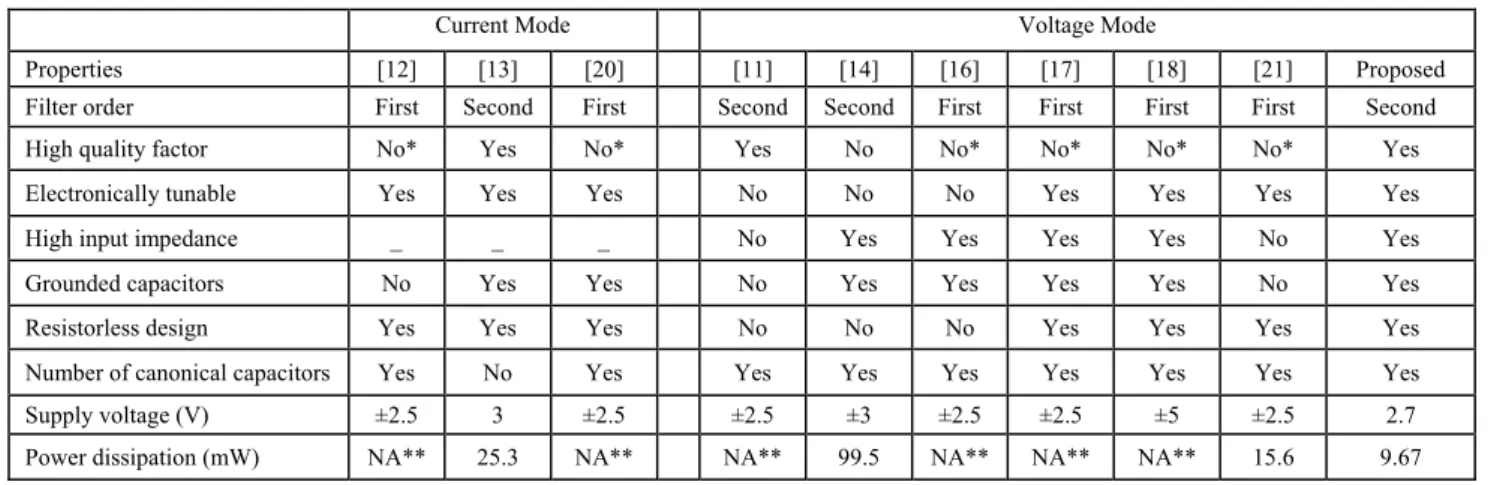
First order current mode all-pass filter was designed in 2003 [12].That filter has an electronically adjustable pole frequency but it requires a floating capacitor; which is not favorable for integrated circuit implementation [19]. Electronic tunable high frequency second order all-pass filter is presented in 2009 [13]. This filter, however, has not canonical number of capacitors. In Tab. 1 the proposed filter is compared with previously published first order and second order all-pass filters.
Current Mode Voltage Mode
Properties [12] [13] [20] [11] [14] [16] [17] [18] [21] Proposed Filter order First Second First Second Second First First First First Second High quality factor No* Yes No* Yes No No* No* No* No* Yes Electronically tunable Yes Yes Yes No No No Yes Yes Yes Yes High input impedance _ _ _ No Yes Yes Yes Yes No Yes Grounded capacitors No Yes Yes No Yes Yes Yes Yes No Yes Resistorless design Yes Yes Yes No No No Yes Yes Yes Yes Number of canonical capacitors Yes No Yes Yes Yes Yes Yes Yes Yes Yes Supply voltage (V) ±2.5 3 ±2.5 ±2.5 ±3 ±2.5 ±2.5 ±5 ±2.5 2.7 Power dissipation (mW) NA** 25.3 NA** NA** 99.5 NA** NA** NA** 15.6 9.67
Tab. 1. Comparison of the proposed filter with other first and second order all-pass filters. *If cascaded to obtain second order all-pass filter
**Not available
In this paper, second order all-pass SRD filter circuit is designed by using the state-space synthesis method. The proposed circuit has high quality factor, high input imped-ance, only two grounded capacitors and electronic tunable pole frequency. The proposed filter does not require critical passive element matching. The paper is organized as fol-lows: In section 2, the design method and architecture of the proposed second order all-pass SRD filter circuit is explained. Performance of the designed filter circuit is presented in section 3 by using PSpice simulation program. Obtained time domain and frequency domain responses as well as THD, Monte-Carlo and noise analysis results are given in this section. Finally, some conclusions are given in the last section.
2.
Circuit Design
In this paper, second order SRD all-pass filter is de-signed by using the state-space synthesis method. The state-space synthesis method is more generally powerful and efficient approach. It defines not only input and output variables but also internal state variables. This allows us to observe and control all internal variables. Therefore, we can obtain the status of internal variables simply by using dynamic state-space equations.
A general second order all-pass filter’s transfer func-tion is given in (1), where ω0 is the pole frequency and Q is
the quality factor of the filter.
2 2 0 0 2 2 0 0 / H(s)= / out in V y s Qs V u s Qs . (1)
According to the space synthesis method, state-space equations can be obtained from the transfer function by using several methods [22], [23], [24]. In this study, we use the modified companion method [24], [25] for state-space representation of (1). State-state-space representation of the proposed all-pass filter obtained by using this technique is expressed as (2). u u Q u y y Q y 2 0 0 2 0 0
, , 1 1 y ru x (2) u r x x2 1 2 0
where u is input, y is output, x1 and x2 are the state vari-ables, r1and r2 are coefficients depending on the pole fre-quency and quality factor and these coefficients are given in (3). 0 1 2 2 1 ; r r Q . (3)
Then some adjustments are applied to (2) and the state-space representation of the system is obtained as (4).
0 0 1 1 0 0 2 2 0 2 1 2 2 0 2 1 1 0 0 x x Q u x x Q Q x y u x (4)In this work, second order SRD all-pass filter is de-signed by using only current mode square-root blocks, current mirrors and two grounded capacitors. Therefore, the circuit equations must be formed only square-rooting terms. In order to design this filter in SRD, DC input u2 is added to the system. For this purpose state-space equations are organized as follows (5).
0 0 1 0 1 1 2 0 0 2 2 0 2 0 2 1 2 2 0 2 1 1 0 0 k x x Q u u x x k Q Q x y u x (5)where u2 is DC input, k1 and k2 are coefficients depending on the quality factor. The coefficients are given in (6).
2 1 2 2 2 2 ; Q Q Q k k Q Q . (6)
The state-space design procedure is based on non-linear transformation of input and state variables while maintaining linear relationship through input to output. In this study, MOS transistors are utilized. Nonlinear square-root transformation is shown in (7) for MOS transistor characteristics. 2 1 2 1 1 2 2 2 ; ; th th u u th th I I x v V x v V I I u V u V (7) where 0 2 ox C W L .
Nonlinear mapping shown in (7) is applied to the state-space equations of (5). Obtained circuit equations are given in (8). 2 2 2 1 0 0 1 0 1 2 2 0 0 2 0 2 0 1 2 1 2 u u u u I I I v k Q I I I I v k Q Q y v u (8)
Equation (9) is derived from (8) by multiplying each side by C(= C1 = C2) coefficient. Then 02C2
is assumed to
be equal to DC current source If values.
2 2 1 1 2 1 2 2 1 2 2 2 1 2 1 2 f f u f u f f f u f u C v I I I I k I I Q C v I I I I I I k I I Q Q y v u (9)
In (9), C v1 1 and C v2 2 are regarded as the time vary-ing current through two capacitors C1 and C2 connected between v1 and ground and between v2 and ground, respec-tively. In these equations; v1, v2, u and u2 are gate-source voltages of MOS transistors operating in the saturation region and their drain currents are defined as I1, I2, Iu and
Iu2 respectively.
Fig. 1. Current mode square-root circuit block diagram.
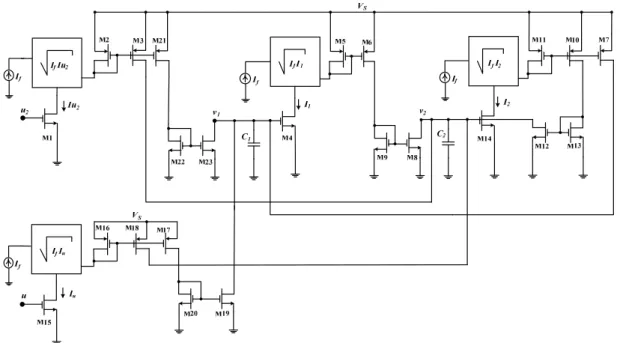
Second order SRD all-pass filter can be realized using (9). According to (9) the proposed all-pass filter is designed
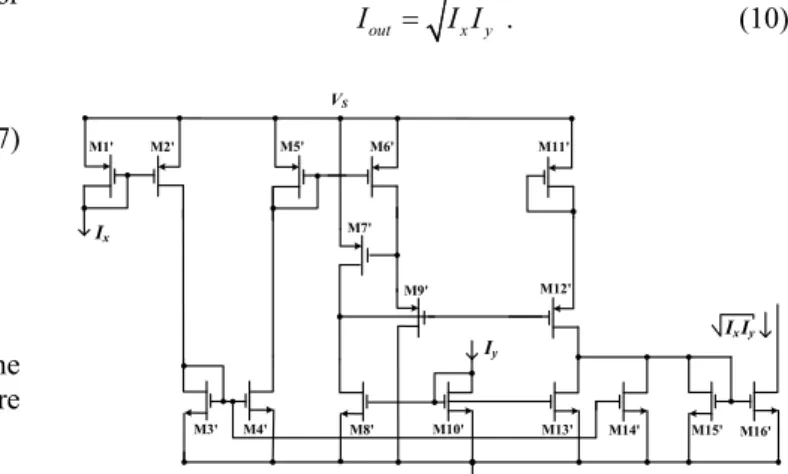
by using square-root blocks, current mirrors, current sources and grounded capacitors. In these equations, each square-root term can be designed using a square-root block diagram with two input currents shown as in Fig. 1.
Block diagram in Fig. 1 is realized by using MOS transistors as shown in Fig. 2 [26]. That circuit operates as a square-root circuit since its output is the square-root of two input currents Ix and Iy. This expression is formulated as shown in (10). out x y I I I . (10) VS M3' M5' M6' M1' M2' M4' M7' M8' M9' M10' M11' M12' M13' M14' M15' M16' Ix Iy Iy Ix
Fig. 2. Current mode square-root circuit derived from [26]. In this paper the proposed second order SRD all-pass filter circuit is designed as seen in Fig. 3.
3.
Simulation Results
The second order all-pass filter consists of four square-root circuit blocks, current mirrors, current sources and two grounded capacitors. The designed circuit has been simulated using TSMC 0.35µm CMOS model parameters in PSpice program. The circuit supply voltage is selected to be 2.7 V. The values of two capacitances of the circuit are chosen to be 15 pF. The bias current of circuit If is set to be 50 µA. Input voltage of the proposed circuit u is set to 0.75 V DC and 50 mV AC values. Added DC voltage u2 is set to 1 V. The gain of the filter is chosen as 1 and quality factor Q is chosen as 5. Dimensions of transistors in the proposed filter circuit are given in Tab. 2.
Transistor W (m) L (m) Transistor W (m) L (m) M1, M4, M8, M9, M13, M14, M15, M20, M22 6 0.7 M2, M5, M6, M7,M10, M11, M21 20 0.7 M12 1.2 0.7 M3 22.4 0.7 M18 2.8 0.7 M16, M17 36 0.7 M19 2.4 0.7 M23 3.6 0.7 M3', M4', M8', M10', M15', M16' 6 0.7 M1', M2', M5', M6', M7', M9' 20 0.7 M13', M14' 3 0.7 M11', M12' 40 0.7
Tab. 2. Dimensions of the MOS transistors for square-root circuit in Fig. 2 and 3.
Fig. 3. Proposed second order SRD all-pass filter circuit diagram.
The designed all-pass filter circuit’s pole frequency is obtained about 1.69 MHz. The filter is analyzed in PSpice for frequency response. Obtained gain and phase responses of the filter are shown in Fig. 4.
Fig. 4. Second order all-pass filter gain and phase response. Fig. 5 shows the transient analysis response of the proposed all-pass filter in Fig. 3 while applying a 50mV sinusoidal wave with frequency of 1.69 MHz at the input. Input and output voltages of the proposed filter are given as in Fig. 5.
Next simulation is performed for frequency response of the circuit by tuning the pole frequency electronically. The quality factor of filter is set to Q = 5. The simulations are performed to tune the pole frequency by varying the values of the current sources. Varying the values of the current sources, from 15 µA to 150 µA, the pole frequency of the filter is tuned. The resulting frequency response for all-pass filters is plotted in Fig. 6.
Total harmonic distortion values are calculated through PSpice simulation program for input voltage
amplitude values from 10 mV to 100 mV. The obtained results are plotted in Fig. 7. THD analysis results show that; when input voltage amplitude is below 10 mV, THD is less than 0.4 %; THD is below than 4 % for input voltage amplitude is below 100 mV.
Fig. 5. Second order all-pass filter time domain response.
Fig. 6. Electronically tunable second order all-pass filter phase response.
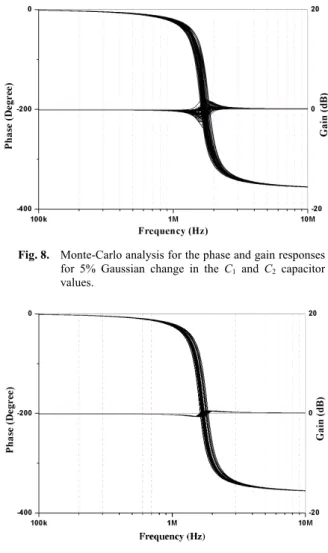
Fig. 7. Total harmonic distortion for various input voltages. Statistical analysis of the proposed circuit was also performed by using PSpice program. Simulation results of Monte-Carlo analysis for 5% Gaussian change in the C1
and C2 capacitor values and 10% Gaussian change in the If current sources value are given in Fig. 8 and 9 respectively.
Fig. 8. Monte-Carlo analysis for the phase and gain responses for 5% Gaussian change in the C1 and C2capacitor
values.
Fig. 9. Monte-Carlo analysis for the phase and gain responses for 10% Gaussian change in the If’s current source
values.
Monte-Carlo analysis is also applied to MOS transis-tor process parameters. According to this simulation 0.5%
Gaussian change in the zero-bias threshold voltage (VTO) and transconductance coefficient (KP) are applied to all NMOS and PMOS transistors in the circuit at the same time. Obtained phase and gain responses of the filter are given in Fig. 10.
Fig. 10. Monte-Carlo analysis for the phase and gain responses for 0.5% Gaussian change in the process parameters of all transistors.
In the proposed circuit, MOS transistors’ variation is also studied by using PSpice program. According to analy-sis results, dimensions (W) of all NMOS trananaly-sistors are changed 1% in the circuit and the obtained phase and gain responses are given in Fig. 11.
Fig. 11. Gain and Phase responses when all NMOS transistor dimensions (W) are changed 1%.
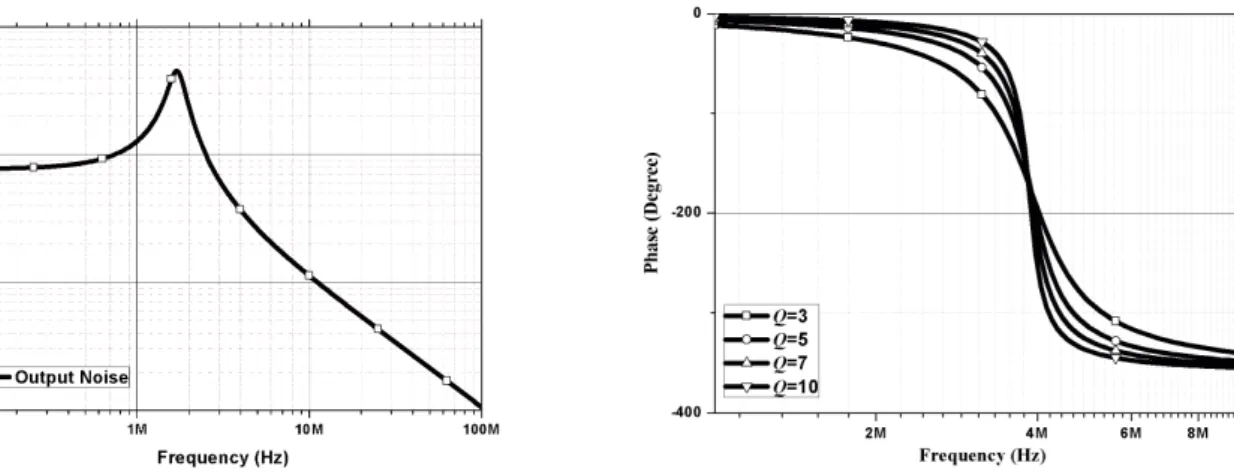
Noise analysis of the proposed circuit is performed for Q = 5. Obtained output noise performance is given in Fig. 12. Also the proposed filter’s total power dissipation is calculated as 9.67 mW.
The proposed second order all-pass filter is operated for different quality factor, by changing dimensions of transistors M3, M12, M13, M16, M17, M18, M19 and M23. Dimensions of those are given in Tab. 3 for different quality factors between 3 and 10. The filter is analyzed in PSpice for pole frequency of 3.9 MHz. Obtained phase responses are given in Fig. 13.
Fig. 12. Output noise of second order all-pass filter. Fig. 13. Phase response of Fig. 3 for different quality factors. Quality Factor Q= 3 Q = 5 Q = 7 Q = 10 Transistor W(µm) L(µm) W(µm) L(µm) W(µm) L(µm) W(µm) L(µm) M3 22.2 0.7 22.4 0.7 22 0.7 21.6 0.7 M12 2 0.7 1.2 0.7 1.7 0.7 1.2 0.7 M13 6 0.7 6 0.7 12 0.7 12 0.7 M16 36 0.7 36 0.7 36 0.7 70 0.7 M17 36 0.7 36 0.7 36 0.7 70 0.7 M18 8 0.7 2.9 0.7 1.5 0.7 1.4 0.7 M19 4 0.7 2.4 0.7 1.7 0.7 1.2 0.7 M23 2 0.7 3.6 0.7 4.3 0.7 4.8 0.7
Tab. 3. Dimensions of the MOS transistors in Fig. 3 for different quality factors.
4.
Conclusions
In this paper, a second order SRD all-pass filter circuit is designed. The proposed filter is synthesized by using the state-space method and by adopting translinear circuits. The proposed SRD circuit has following advan-tages: (a) Pole frequency of the filter can be changed elec-tronically by adjusting the values of DC current sources only. (b) The circuit has canonical number of capacitors which are grounded. (c) The filter does not suffer from disadvantages of use of resistors in IC process. (d) The filter has high quality factor. Only analysis results for Q = 5 are given. It can be operated for different high quality fac-tors by changing dimension of any transisfac-tors. (e) The filter has high input impedance. The filter is simulated in PSpice for transient, AC, Monte-Carlo, noise and THD analysis. Obtained results show that the measured total harmonic distortions are less than 4% and total power dissipation is 9.67 mW. Obtained results are sufficient for analog inte-grated circuit design.
Acknowledgement
This work was supported by Pamukkale University
Scientific Research Projects fund with the project code 2011FBE090.
References
[1] MULDER, J., WOERD, A. C., SERDIJN, W. A., ROERMUND, H. M. General current-mode analysis method for translinear filters. IEEE Transactions on Circuits and Systems I: Fundamental Theory and Applications, 1997, vol. 44, no. 3, p. 193-197.
[2] YU, G. J., LIN, Y. S.Low voltage tunable square-root domain band-pass filter with translinear loop technique in biomedical engineering. Life Science Journal-Acta Zhengzhou University Overseas Edition, 2010, vol. 7, no. 1, p. 30-33.
[3] FREY, D. R. Log-domain filtering: an approach to current-mode filtering. IEE Proceedings-g, 1993, vol. 140, no. 6, p. 406-416. [4] FREY, D. R. Exponential state space filters: A generic current mode
design strategy. IEEE Transactions on Circuits and Systems I: Fundamental Theory and Applications, 1996, vol. 43, p. 34-42. [5] SEEVINCK, E. Companding current mode integrator: A new circuit
principle for continuous-time monolithic filters. Electronics Letters, 1990, vol. 26, no. 24, p. 2046-2047.
[6] ESKIYERLI, M. H., PAYNE, A. J. “Square root domain” filter design and performance. Analog Integrated Circuits and Signal Processing, 2000, vol. 22, p. 231-243.
synthesis of biquads based on the MOSFET square law. In IEEE International Symposium on Circuits and Systems, 1996, vol. 1, p. 321-324.
[8] LOPEZ-MARTIN, A., CARLOSENA, A. Systematic design of companding systems by component substitution. Analog Integrated Circuits and Signal Processing, 2001, vol. 28, no. 1, p. 91 to 106. [9] PSYCHALINOS, C., VLASSIS, S.A systematic design procedure
for square-root domain circuits based on the signal flow graph approach. IEEE Transactions on Circuits and Systems, 2002, vol. 49, no. 12, p. 1702–1712.
[10] OLMEZ, S., CAM, U.A novel square-root domain realization of first order all-pass filter.Turkish Journal of Electrical Engineering and Computer Sciences, 2010, vol. 18, no. 1, p. 141-146.
[11] CAKIR, C., CAM, U., CICEKOGLU, O. Novel allpass filter configuration employing single OTRA. IEEE Trans. Circuits Syst. II, Analog Digit. Signal Process., 2005, vol. 52, no. 3, p. 122 -125. [12] MAHESHWARI, S., KHAN, I. A. Simple first-order translinear-C
current mode all pass filter section. International Journal of Electronic, 2003, vol. 90, p. 79-85.
[13] TOLA, A. T., ARSLANALP, R., SURAV YILMAZ, S. Current mode high-frequency KHN filter employing differential class AB log domain integrator. International Journal of Electronics and Communications (AEÜ), 2009, vol. 63, p. 600-608.
[14] YUCE, E., PAL, K., MINAEI, S. A high input impedance voltage-mode all-pass/notch filter using a single variable gain current conveyor. Journal of Circuits, Systems, and Computers (JCSC), 2008, vol. 17, no. 5, p. 827-834.
[15] SALAWU, R. I. Realization of an all-pass transfer function using the second-generation current conveyor. In Proc. Inst. Elect, Electron. Engrs, 1980, vol. 68, no. 1, p. 183–184.
[16] METIN, B., CICEKOGLU, O. Component reduced all-pass filter with a grounded capacitor and high-impedance input. Internaional Journal of Electronics, 2009, vol. 96, p. 445-455.
[17] KESKIN, A. Ü., PAL, K., HANCIOGLU, E. Resistorless first-order all-pass filter with electronic tuning. International Journal of Electronics and Communications (AEÜ), 2008, vol. 62, p. 304 to 306.
[18] BIOLEK, D., BIOLKOVA, V. First-order voltage-mode all-pass filter employing one active element and one grounded capacitor. Analog Integrated Circuit Signal Processing, 2010, vol. 65, p. 123 to 129.
[19] BHUSAN, M., NEWCOMB, R. W. Grounding of capacitors in integrated circuits. Electronic Letters, 1967, vol. 3, p. 148–149. [20] LAHIRI, A., CHOWDHURY, A. A novel first-order current-mode
all-pass filter using CDTA. Radioengineering, 2009, vol. 18, no. 3, p. 300-305.
[21] HERENCSAR, N., KOTON, J., VRBA, K., METIN, B. Novel voltage conveyor with electronic tuning and is application to resistorless all-pass filter. In The 34th International Conference on Telecommunications and Signal Processing (TSP). Budapest (Hungary), 2011, p. 265-268.
[22] FREY, D. R. State-space synthesis and analysis of log-domain filters. IEEE Transactions on Circuits and Systems II: Analog and Digital Signal Processing, 1998, vol. 45, no. 9, p. 1205-1211. [23] ARSLANALP, R., TOLA, A. T. Electronically tunable square-root
domain filter circuit. In IEEE 15th Signal Processing and Communications Applications Conference. Eskisehir (Turkey), 2007.
[24] ARSLANALP, R., TOLA, A. T. State space representation for log domain filtering synthesis. Indian Journal of Pure & Applied Physics, 2009, vol. 47, p. 745-752.
[25] ARSLANALP, R., TOLA, A. T. ELIN Filtrelerin Genel Sentez Teorisi ve Gerçeklenme Şartları’. Pamukkale University Journal of Engineering Science, 2007, vol. 13, no.1, p. 47-56.
[26] YU, G. J., HUANG, C. Y., LIU, B. D., CHEN, J. J.Design of square-root domain filters. Analog Integrated Circuits and Signal Processing, 2005, vol. 43, p. 49–59.
About Authors ...
Saziye SURAV YILMAZ was born in Izmir, Turkey, in 1981. She received the B.Sc. and M.Sc. degrees in Electri-cal and Electronics Engineering from Pamukkale Univer-sity, Denizli, Turkey in 2001 and 2005, respectively. She has been working as a Research Assistant at Pamukkale University, Denizli, Turkey. Her main research interest include square-root domain filtering, log domain filtering, electronic circuit design, and nonlinear circuit and system theory.
Abdullah T. TOLA was born in Ankara, Turkey, in 1967. He received the B.S. and M.S. degrees in Electrical and Electronics Engineering from Dokuz Eylul University, Izmir, Turkey and Ph.D. degree in Electrical Engineering from Lehigh University, PA, USA in 1989, 1993, and 2000, respectively. He has been working as an Associate Professor at Pamukkale University. His main research interests include log domain filtering, square-root domain filtering, differential type Class AB filters, electronic cir-cuit design, nonlinear circir-cuit and system theory, analog filters, and database systems.
Remzi ARSLANALP was born in Manisa, Turkey, in 1977. He received the B.S., M.S. and Ph.D. degrees in Electrical and Electronics Engineering from Pamukkale University, Denizli, Turkey in 1999, 2003, and 2011, re-spectively. He has been working as an Assistant Professor at Pamukkale University since 2011. His main research interests include log domain filtering, circuit design, and nonlinear circuit and system theory.