Finance and Accounting Degree
FINAL
PROJECT
DEGREE
A
CTIVITY
B
ASED
C
OSTING
S
YSTEM
(ABC):
IMPLEMENTATION IN A SUPERMARKET
Student: SARA MORELLO DIAZ
Tutor: MIGUEL MARTÍNEZ RAMOS
ABSTRACT
The current high level of competence requires any organization to dispose of an optimum cost control. The Activity-Based Costing (ABC) System enables creating a strategic planning in the firm and in the cost management and it also offers adjusted cost computing.
In this project we present an ABC cost model for a supermarket, adapting such model to the characteristics of the sector and the firm by analyzing its cost structure and specifying the daily activity in the store. This is made with a view to create a cost management system adapted to the needs of the firm that will allow it to optimize costs and make strategic decisions.
TABLE OF CONTENTS
1. INTRODUCTION TO THE FINAL PROJECT ... 1
1.1. INTRODUCTION ... 1
1.2. OBJETIVE OF THE PROJECT ... 2
1.3. METHODOLOGY USED ... 3
2. ACTIVITY- BASED COSTING SYSTEM (ABC) ... 4
2.1. BACKGROUND ... 4
2.2. NOTION OF THE ABC SYSTEM ... 5
2.3. CONTRAST BETWEEN ABC SYSTEM AND A TRADITIONAL COST SYSTEM5 2.4. PROS AND CONS OF THE ABC SYSTEM ... 8
2.5. NOTION OF ‘ACTIVITIES’ ... 9
2.6. ACTIVITIES MEASUREMENT ... 10
2.7. ASSIGNATION STAGES OF THE ABC SYSTEM ... 10
3. IMPLEMENTING AN ABC SYSTEM IN MERCADONA ... 12
3.1. JUSTIFICATION OF THE ABC SYSTEM IN THE FOOD SERVICE INDUSTRY ... 12
3.2. OBJECTIVES OF IMPLEMENTING THE ABC SYSTEM IN A SUPERMARKET ... 13
3.3. BUSINESS SUBJECT OF IMPLANTING ... 14
3.3.1 MAIN FEATURES ... 14
3.3.2. MISSION AND VISION ... 15
3.3.3. OBJECTIVES OF THE FIRM ... 16
3.3.4. SITUATION OF THE FIRM IN THE INDUSTRY ... 16
3.3.5. EVOLUTION OF THE FIRM ... 18
3.4.6. LIMITATIONS ... 19
3.3.7. SCOPE OF APPLICATION OF THE ABC MODEL PRESENTED ... 20
3.3.8. ORGANIZATION CHART AT A BUSINESS UNIT LEVEL ... 21
3.4. IMPLANTING PROCESS OF THE ABC SYSTEM IN THE SUPERMARKET ... 23
3.4.1. IDENTIFICATION OF THE ACTIVIES ... 24
3.4.3. ACTIVITIES DICTIONARY ... 26
3.4.4. IDENTIFYING THE FINAL COSTS OBJECTS ... 35
3.4.5. IDENTIFYING AND LOCALIZING THE COST ELEMENTS ... 37
3.4.6. DETERMINING COST DRIVERS ... 39
3.4.7. ASSIGNING THE INDIRECT COST ELEMENTS TO THE PRINCIPAL AND AUXILIARY ACTIVITIES ... 40
3.4.8. CALCULUS OF THE PRINCIPAL AND AUXILIARY ACTIVITIES COST ... 42
3.4.9. LOCALIZING THE AUXILIARY ACTIVITIES WITHIN THE PRINCIPAL ACTIVITIES ... 44
3.4.10 ASSINING THE AUXILIAR ACTIVITIES COST TO THE PRINCIPAL ACTIVITIES ... 46
3.4.11. DETERMINING THE PRINCIPAL ACTIVITIES TOTAL COST ... 48
3.4.12. ASSIGNATION OF THE PRINCIPAL ACTIVITY COST TO THE SECTIONS ... 49
4. CONCLUSIONS ... 51
Sara Morello Diaz
1
1. INTRODUCTION TO THE FINAL PROJECT
1.1. INTRODUCTION
According to the Asociación de Industrias de Alimentación (Food Industry Association) in Aragón (Spain), the 16.38 % of the total industrial production and the 14.71 % of labor, make the food and beverages industry, the first sector in the manufacturing industry.
After Spain’s integration in the European Union, its food industry has tripled the investments in order to avoid delaying its development. Food companies seek to strengthen the prestige of its brand and the excellence of the product. Therefore, they seek to strengthen its quality by improving both management and effectiveness.
Furthermore, as companies in this industry face internal and external competence pressure, they are in need of continuous and quick answers. Thus, they demand investments aimed at the development of new products and at the continuous training of their workers. Conversely, the market’s high competitiveness demands more and more training tools to alleviate part of the uncertainty on decision-making situations. In order to answer the questions raised earlier, in this project we are going to present the design of a cost system model, and, specifically, the activity-based costing (ABC) system for the firm Mercadona; who is seeking to strengthen the prestige of its own brand by offering maximum price-quality correlation. Therefore, the design of the model is being presented so that the directors of this company can obtain an optimum management from their processes and, above all, an absolute control of the costs through collection of accurate information. Since the profit margin worked within the food distribution industry is very low, the cost management is a necessity in order to make sure that there is profitability.
The ABC model presented enables directors to control the total cost of the supermarket activities, as well as the total cost of the sections. This way, the decision-making process related to the elimination or changes in the daily activities organization will be easier. Moreover, it will generate a higher direct and indirect cost control and it will allow the directors to minimize them to the largest extent possible.
Sara Morello Diaz
2
However, the present project is just a model, and it could be used as a template to the computation of such costs; since due to the confidentiality of the company’s data we cannot know the value of the indirect costs and no computation of activities or sections has been done. Instead, we have left that part prepared, so that by entering the pertinent data such costs would be obtained.
1.2. OBJETIVE OF THE PROJECT
The main objective of the present project is to design a determination model for activity-based costs (ABC) adapted to the characteristics of a supermarket, in order to elaborate an analysis of the cost structure that enables the achievement of the following specific criteria:
Describing the development of the ABC system implementation in a
supermarket.
Implementing a model that allows obtaining a major precision in the
determination of the final cost object; which In this case are the supermarket sections.
Determining the cost of the activities performed in the store and the total cost of
the sections.
Improving the understanding of costs in order to enable the directors to make
efficient decisions.
Enabling the company to control and minimize costs by removing or
reorganizing activities that do not add value.
The scope of application of this system will be centered in the business unit, since as we will see hereinafter; the supermarket chosen for the implementing of the system has logistical centers and a high number of stores. The essential activities in the daily routines of the supermarket will be analyzed and we will also calculate each one in order to obtain the cost of the sections later.
Sara Morello Diaz
3
The objective of this study does not contemplate figuring out the final cost of the products due to their vast variety. However, a deeper analysis could be performed in order to obtain this computation.
Given that the targeted company for the implantation counts on a high number of supermarkets, where the day-to-day activities organization is very similar, it is safe to say that the presented model can be used in any of the chains' supermarket by doing the appropriate changes.
1.3. METHODOLOGY USED
In order to conduct the following study in the supermarket and to create a task and organization order of the developed study, a series of stages have been followed to present the model:
1. Selection of the investigated firm
In this stage different firms have been considered for the project development. We evaluated information availability and access to it, as well as the possibility of offering useful data that contributes to the value of the firm.
2. Investigation preparation
Both the firm and the industry have been analyzed in order to know what kind of company the project is aimed at. Apart from that, an explanation of the ABC system has been developed and compared with the traditional cost system.
3. Data collection
At this stage data has been collected, especially data concerning the firm and the daily activities organization. The most used sources have been the firm’s website and interviews with the floor coordinator of the supermarket, as well as my own contribution of knowledge related to the firm, since I am a staff member.
4. Sequence of information and development of the model:
In this stage we have developed the ABC system for the supermarket. The process selected to its implantation has been the one developed in 3.4.:
Sara Morello Diaz
4
1. Identification of the activities.
2. Classification of the activities in principal and auxiliary. 3. Creation of an activities dictionary.
4. Identification of the final cost objects.
5. Identification and localization of the cost elements. 6. Identification of cost-drivers.
7. Assignation of indirect cost elements to principal and auxiliary activities. 8. Calculus of the principal and auxiliary activities cost.
9. Localization of auxiliary activities within the principal activities. 10. Assignation of auxiliary activities cost to the principal activities. 11. Determination of the principal activities cost.
12. Assignation of principal activities cost to the sections.
2. ACTIVITY- BASED COSTING SYSTEM
(ABC)
2.1. BACKGROUND
According to Rodríguez González and Macarro Heredia (1996), in the mid-1980s, different studies directed in the United States brought to light the mismatch in the traditional cost systems; especially in the direct costing system as a base for the information aimed at the adoption of certain management decisions. Particularly in the determination of the real cost of products and in the evaluation of efficiency.
After the appearance of more complex cost structures and the difficulty of identifying some costs as direct or indirect components, the need of searching for new management cost models more relevant to the needs of information about the new environment of the firm arose. Given this need, professors Robin Cooper and Robert Kaplan designed the activity-based cost system. They determined that the cost of the products must cover the raw material cost, but also the cost of the activities needed to produce and sell the product.
Sara Morello Diaz
5
Therefore, the ABC system arose to fulfill the need of an innovative cost system and it compounds a model for business excellence. It was originally designed for manufacturing companies, but due to its good results, its application spread to service corporations.
This model allows assigning indirect costs according to the activities that have been performed by identifying the origin of the activity cost both in its production and in its distribution and sales. In this model, the resources have been assigned to activities and these activities to the cost objects –if they have consumed activities. Besides it helps to make decisions and it measures the firm activities extent, cost and performance.
2.2. NOTION OF THE ABC SYSTEM
This system has different definitions made by different authors. Hereafter we describe two of them:
According to Mallo Rodríguez (1994), the activity-based cost system intends to establish all the actions aimed at the creation of business value through the consumption of alternative resources that find in this connection its imputation causal relationship.
According to Cárdenas Nápoles (1995), it is a management process helping in the administration of the activities, in the processes of the business, and in the strategic and operational decision-making.
2.3. CONTRAST BETWEEN ABC SYSTEM AND A
TRADITIONAL COST SYSTEM
Traditional cost-accounting systems do not supply all the information needed by the direction to make proper decisions (Castelló Taliani and Lizcano Álvarez, 1994).
This is due to the increase of the proportion of direct costs non-related to the volume of production in companies. Therefore, the use of assignation criteria based on the
Sara Morello Diaz
6
volume of production or in direct costs –like in traditional systems– can create mistakes in the decision-making process and in the valuation of goods.
However, the ABC system allows the direction to make correct decisions, since when distributing the indirect costs among the activities and taking into account that they are the ones which consume costs, this system allows knowing beforehand the resources that will be consumed by activities. Besides, the ABC system helps organizations to obtain more information about processes and activities, allowing them to improve efficiency and decision-making processes without making any serious mistakes or creating distortions in the products valuation.
The following table shows some other differences that define both cost systems:
TABLE 1: TRADITIONAL COST-SYSTEM VS. ACTIVITY-BASED COST SYSTEM
TRADITIONAL COST SYSTEM ABC COST SYSTEM
Products consume costs. Activities consume costs and products
consume activities. Measures the productivity of a certain
factor.
Measures the global activity productivity.
In order to assign a cost to the product it uses measures related to volume, labor, materials, etc.
In order to assign a cost to the product it uses the activities hierarchy and cost generators that may or not be related with the volume.
It is cost management oriented. It is activity management oriented and the
cost of each one can be computed along with its added value.
It is more focused on the presentation of financial results.
It is focused in the real activities that have caused the financial results arising.
Assignation of indirect costs:
1ST - A organizational unit (department,
production plan, etc.).
2ND - A products.
Assignation of indirect costs:
1ST - A activities that generate cost.
2ND - A products, sections, projects,
clients, etc.
Functional organization oriented. Transversal organization oriented.
Internal control tool oriented. External control tool oriented.
Sara Morello Diaz
7
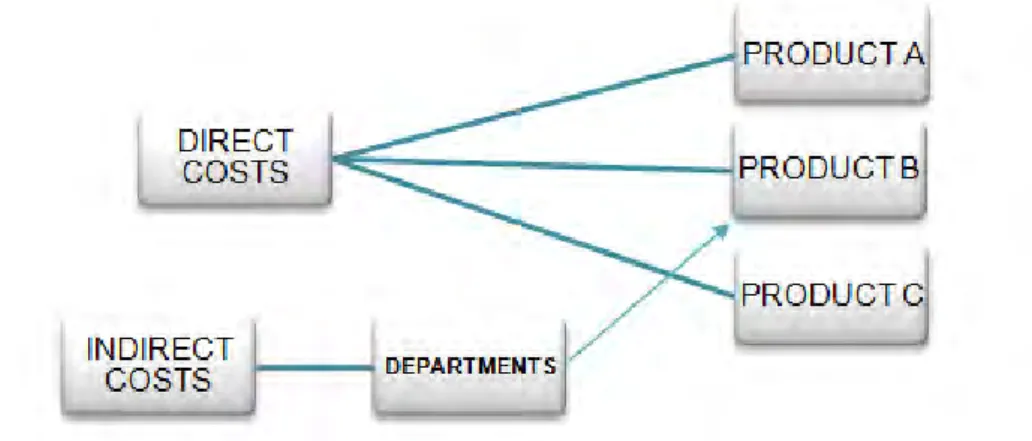
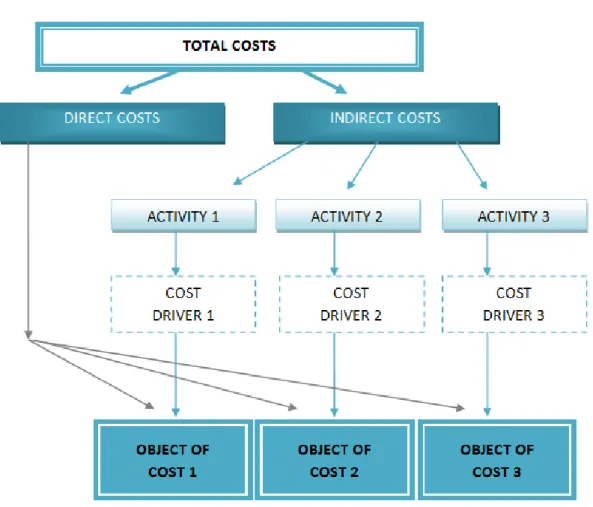
As we can see in figures 1 and 2, both models impute the indirect cost to products. The difference is that in the traditional system, the costs are assigned on a department work unit basis whereas in the activity-based cost system, the costs are assigned based on the activities units of measure.
ILLUSTRATION 1: COMPUTATION OF COSTS IN A TRADITIONAL SYSTEM
Source: compiled by the author
ILLUSTRATION 2: COMPUTATION OF COSTS IN AN ACTIVITY-BASED COST SYSTEM (ABC)
Source: compiled by the author
Ultimately, activity-based cost systems are considered an improvement of the traditional systems because it gives more importance to the indirect costs in the business activity. This lead to a change in the information systems in favor of the necessity to look after the new productive and competitive environment in today’s companies.
Sara Morello Diaz
8
2.4. PROS AND CONS OF THE ABC SYSTEM
The implementation of an ABC system on any company is a difficult task and it needs a pros and cons evaluation. After analyzing some sources, we show in table 2 the pros and cons considered to be the most relevant:
TABLE 2: PROS AND CONS OF IMPLEMENTING AN ABC SYSTEM
PROS CONS
- It identifies the goods and services
that contribute the most or the least to the business.
- It computes the costs more
accurately, which gives more control of indirect costs.
- It renders information to make
possible strategic decision-making.
- It is applicable to all kinds of
organizations.
- It allows costs to be related with its
cause.
- It measures the performance of both
workers and departments.
- It enables creating financial
projections.
- The cost of addressing the information
is higher than in other systems.
- There is a difficulty in defining
cost-drivers.
- Even though it is an improvement of
other processes, it needs primary cost sharing.
- Even though the cost is more
accurate, the exact cost is not obtained since there are unforeseen expenses.
- It is focused in costs optimization,
leaving aside the systematic vision of the organization.
Sara Morello Diaz
9
2.5.
NOTION OF ‘ACTIVITIES’
As described previously, the ABC system was an improvement of traditional cost systems. One of the improvements was the introduction of the ‘activity’ concept.
An activity is a set of tasks carried out by an individual or a machine that generates a cost and are oriented to the achievement of the necessary output for the general activity of the company. The activities are different on every company and they are necessary in all of them to satisfy their clients.
The tasks must be done homogenously, so that all of them are aimed at obtaining the good or service that the company offers. Besides, they must be able to be quantified in the same unit of measure.
The process of implementing an ABC system implies identifying the activities carried out by the company taking into account its characteristics, which are –among others– the following:
It consumes resources (both cost and time).
Each activity is linked to individuals that are responsible for its execution.
Its goal is to obtain output.
There are conditions for its performance: limited time, quality-of-service, etc.
There must be a relationship between the resource used and the obtained
output.
A task in one company can represent an activity in another company and
Sara Morello Diaz
10
2.6. ACTIVITIES MEASUREMENT
When identifying and describing the activities to be performed in any process, various related factors must be taken into account. Each activity must be measured establishing a relationship between costs incurred to develop the activity and the obtained output. These relations are measured through the cost-drivers.
Cost-drivers are considered as the factors that cause or generate the cost and that influence the volume of execution of the activities. Therefore, they establish a causal relationship between the obtained outputs and the consumed activities.
In order to select them, aspects like ease of activity measurement, cost of measurement, correlation degree and the effect that it may have in the behavior of the individual must be considered.
ILLUSTRATION 3: MEASUREMENT OF ACTIVITIES FROM COST-DRIVERS
Source: compiled by the author
2.7. ASSIGNATION STAGES OF THE ABC SYSTEM
The identification of the cost in the products based on the ABC system is performed in a process consisting of various stages. Different authors like Mallo Rodríguez (1993) or Margarida Sanz (2003) describe different stages when assigning the ABC system to a company. However, all of them lead to the same goal, which is why, taking into account some sources and the structure of the presented model, as well as the characteristics
Sara Morello Diaz
11
of the activities of the supermarket; our own conclusions about the implementing stages of the ABC system are drawn in the following figure:
ILLUSTRATION 4: ASSIGNATION STAGES OF DIRECT AND INDIRECT COSTS TO THE COST OBJECTS
Sara Morello Diaz
12
3. IMPLEMENTING AN ABC SYSTEM IN
MERCADONA
3.1. JUSTIFICATION OF THE ABC SYSTEM IN THE FOOD
SERVICE INDUSTRY
Castro Albornoz, J.J. (2009: 589) claims that the fact that supermarkets do not use cost systems may be due to the established paradigm which supports that merchandise are the goods they sell. And while they keep maintaining the criteria of treating the product as merchandise instead of as a facilitator good, it will not make any economic sense to use cost systems configured to other kinds of business.
Regardless of the previous statement, the importance of implementing a cost management system in the food service industry should be kept in mind given the fact that in this industry the profit margin is very low, and that, in order to ensure profitability, managing costs is fundamental since somewhat these costs determine the viability of the business. This is why any organization needs trustable and exact information about the cost of its activities, goods, etc.
Besides, many managers are forced to request cost investigations, especially when there are variations and they want to know the reason. Thus, by having an internal cost system, the cost of the goods or services can be computed at any time, allowing making important decisions for the survival of the company.
Why the ABC system?
Even though it is recommended to companies with a small variety of goods, the ABC system is applicable to all kinds of organizations. In every organization, it is important to know the costs of the activities the company is performing. In the food service industry, a great deal of activities is performed until the final consumer purchases the products. These activities generate important costs that should not be applied to the products in the same proportion, since not every product consumes the same resources. This is the reason why we consider that activities should be the ones consuming costs, and products the ones consuming activities, which is why the ABC system adapts better to this industry than the traditional cost system.
Sara Morello Diaz
13
Furthermore, it has been mentioned that the ABC cost system is an improvement of the traditional systems because it adds more importance to indirect costs. In this industry, there is a high quantity of indirect costs that are necessary to be able to develop the company’s activity. These costs must be imputed to the goods or services. On the other hand, the ABC system allows linking the costs to its root and knowing with more reliability in which way can the organization of the business can be optimized in order to reduce costs.
3.2. OBJECTIVES OF IMPLEMENTING THE ABC SYSTEM
IN A SUPERMARKET
The main objective of implementing the ABC system in a particular supermarket is obtaining more reliable and specific information concerning the costs that each cost
center –each section– generates, since afterwards, a deeper analysis could be
performed imputing these costs to the products. Another of the objectives is to enable the company to detect such products or sections that contribute in a higher or lower proportion to the business, and allow managers to make strategic decisions facilitating the cost control and management.
Moreover, another important goal of applying this system is that it allows the detections of those activities that do not add any value or that generate unnecessary working hours –that imply higher costs– and therefore, being able to eliminate them. Similarly, another of the objectives is that this system enables to acquire a wider view regarding daily activities of the organization of the company and detecting improvements to save time and costs, allowing, in addition, to increase productivity.
Sara Morello Diaz
14
3.3. BUSINESS SUBJECT OF IMPLANTING
3.3.1 MAIN FEATURES
ILLUSTRATION 5: LOGO OF MERCADONA
Source: Mercadona
Mercadona is a family-owned supermarket company whose capital is 100 % Spanish. It can be found in 48 provinces that belong to 17 Spanish autonomous communities. In total, the firm counts with 1523 supermarkets whose average surface is around 1500 square meters.
The firm was created in 01/18/1997. The aim was exploiting a food supermarket chain. Its activity is classified in the following CNAE codes:
TABLE 3: MERCADONA CNAE CODE
Specifically, Mercadona distributes and sells food, personal hygiene, and cleaning products, as well as branded or own-branded products related with pets; being most of them own-branded products.
Sara Morello Diaz
15
The most noteworthy own-branded products are:
TABLE 4: MERCADONA OWN BRANDS
Since 1993 Mercadona’s management model is based on Total Quality. This model
must be followed by suppliers and internal workers for managing day-to-day operations. With this model the firm endeavors to satisfy all the components that compose the firm equally and following a sequential order in satisfying them. The components and the order are the following:
1. “The Boss”, as Mercadona calls its customers.
2. The employee. 3. Supplier. 4. Society. 5. Capital.
The company currently counts on 74,000 staff members, all with long-term, quality jobs. Besides, it bets on a human resources management model based on offering mainly ongoing training, labor equality, and wages above average in comparison to its industry.
3.3.2. MISSION AND VISION
Mercadona’s mission is based on the satisfaction of all its interest group’s1 needs, and
achieving the maximum profitability by a differentiation in price and quality, specializing in own-branded products sales.
1
Sara Morello Diaz
16
Mercadona’s vision is leading supermarkets in Spain by distributing and selling food, hygiene and cleaning own-branded products, achieving being a sustainable agro-food chain, and making society want its presence in the market and being proud of it.
3.3.3. OBJECTIVES OF THE FIRM
Mercadona’s main objective is to fully satisfy the food and beverages, cleaning, personal hygiene and pet care needs of its customers.
In order to fully satisfy its clients, the firm has five objectives when selling its products. They are all equally important and there is no order in their realization. The five objectives are the following:
1. Selling maximum quality products.
2. Offering the maximum variety of products.
3. Offering the maximum service by having adequate facilities and dealing with customers with respect and kindness.
4. Offering the lowest budget, since customers look for the highest quality at the
lowest cost possible. The slogan Siempre Precios Bajos (Always Low Prices), SPB,
is included in this objective. It means that there are no offers, as its prices are low all year long.
5. Offering the minimum time for shopping, meaning offering closeness of the supermarkets to the homes and parking lot to avoid that its customers have to look for a parking space.
3.3.4. SITUATION OF THE FIRM IN THE INDUSTRY
In the last few years, Mercadona has gained a leading position in Spain’s food service industry.
Market share of Spain’s main supermarkets and hypermarkets is presented in the figures to come. All foods and beverages, drugstore, perfumery, baby and pet products are included in said market share.
Sara Morello Diaz
17
TABLE 5: MARKET SHARE OF THE MAJOR SUPERMARKETS AND HYPERMARKETS OPERATING IN SPAIN
As we can see in table 5, Mercadona leads the food and beverages industry with a market share higher than the other firms’, showing as well a slow-growing form, due in part to the opening of new stores.
Besides, Mercadona counts with a 24.9 % customer loyalty, a very high rate and an important data, given the fact that customer loyalty ensures future income to the firm. According to Ponce, J.J. (2013), with the thinking of Magdaleno, director of the Distribution and Fuels in Kantar Worldpanel, clients’ loyalty in Mercadona is not comparable to any other chain.
Even though the analyzed period only reaches as far as 2013, to this day, Mercadona is still the firm in the Spanish food industry with the highest market share.
Sara Morello Diaz
18
3.3.5. EVOLUTION OF THE FIRM
Mercadona’s history begins in 1977 when the family-owned company Cárnicas
Roig was founded by the father of the current president of Mercadona, Juan
Roig. In this year it was decided that the butchery would be turned into a
grocery. A couple of years later, changes in the company aimed at building a
sustainable and shared growth that would satisfy the five components are
made. An overview of what Juan Roig store’s warehouse current president of
Mercadona– explains as the way to achieve this goal, can be extracted from the
seventh edition of his book
El modelo de calidad total
(Total Quality Model) as
the following:
Sara Morello Diaz
19
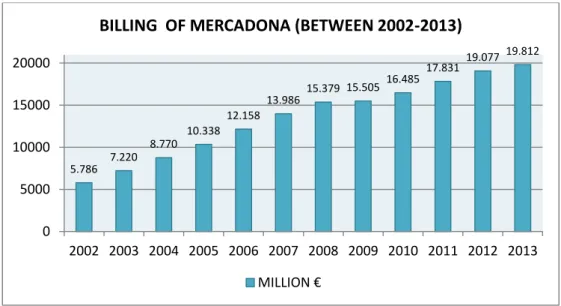
In financial terms the company has submitted a turnover with a positive evolution throughout all the years. In the following figure we can observe how since 2002 until 2013 it has managed to slowly increase the levels of turnover until getting to the amount of 19812 Euros.
GRAPHIC 1: BILLING OF MERCADONA, EVOLUTION
Source: compiled by based on data of Mercadona
Such turnover volumes have been managed by opening new stores and incrementing the level of sales by square meter in the existing stores. This is due to the trust of 4.8 million homes that do the shopping in these supermarkets.
3.4.6. LIMITATIONS
A lot of information could be obtained related to Mercadona’s politicies, the managing model they use, their goals, and the information that characterizes the firm. However, even though this information would be extremely useful to this project, the company does not provide it since it is considered confidential.
There are some companies that have documents containing information their activities and their execution process, easing the task of identifying, classifying, and measuring the activities. Thanks to the fact that I work for the company, with effort, I have been able to identify all the activities. The task has been laborious, as I did not know how all
5.786 7.220 8.770 10.338 12.158 13.986 15.379 15.505 16.485 17.831 19.077 19.812 0 5000 10000 15000 20000 2002 2003 2004 2005 2006 2007 2008 2009 2010 2011 2012 2013
BILLING OF MERCADONA (BETWEEN 2002-2013)
Sara Morello Diaz
20
the sections work, so acknowledging all the tasks performed in each section has been onerous in time and method.
Another faced difficulty has been not being able to obtain any information regarding the cost management system that the company currently uses. Not only did I search information but also requested it directly to Mercadona. I was informed that this kind of information is confidential, which is a limitation for one of my initial goals in this analysis, which was comparing the result of implanting the cost management system that I present with the one that is currently being used in the company.
However, it is possible that the company does not use any cost system, since as mentioned before in the justification of implanting the ABC system in the food service industry, Castro Albornoz, J. J. (2009: 589) states that supermarkets do not use cost systems.
3.3.7. SCOPE OF APPLICATION OF THE ABC MODEL PRESENTED
Applying the activity-based costing system in a big company like Mercadona is complex due to the great variety and quantity of products sold by the firm, and to the quantity of indirect costs that must be imputed to them. As seen before, this company has 1523 supermarkets and a high volume of sales with a very important market share in the industry. Apart from the supermarkets, Mercadona has headquarters and logistics centers, which is why all the costs generated should be imputed directly and indirectly to the products taking into account where they are sold.
Given the complexity of applying this system at a corporate level, in this project we are going to implement the ABC system at a business unit level, that is to say, in just one of the 1523 supermarkets of the company, specifically the one in Tavernes Blanques (Valencia). Besides, we should underline that the presented model is designed for the current organization of the store. However, the design can be adapted to organizational changes and implemented in the same way in the remaining 1522 supermarkets by doing the necessary adaptations in the store organization.
Sara Morello Diaz
21
3.3.8. ORGANIZATION CHART AT A BUSINESS UNIT LEVEL
As per Mercadona’s collective agreement (2014) the tasks organization, its planning, classification, and distribution among the different areas of the company, and the general conditions of labor are in power of the corporate management.
Furthermore, as described in the agreement, the staff is classified according to the professional demands, training and general content of the service, and on a regulatory basis, in some of the professional groups defined below:
Manager A: performs his/her duties under instructions with hierarchy dependence and total functionality.
Manager A plus: performs his/her duties under instructions with hierarchy dependence and total functionality. He/She substitutes Manager B in his/her absence for vacation or for being off work.
Manager B: performs qualified duties with a certain degree of autonomy. He/She can help in the coordination of some basic tasks.
Manager C: performs his/her activities with a high degree of autonomy, initiative and responsibility. He/She takes part in the definition of the objectives to be met in the supermarket in which he/she is Manager C.
Given that we are going to proceed with the application of the cost system at a business unit level, knowing the organization of the analyzed store is fundamental for being able to describe its cost-drivers.
The supermarket is organized taking into account the different necessary tasks to achieve that activities are performed efficiently by employees, who are classified in different categories considering their responsibilities. In the organization chart below, we can see the hierarchy in the different employees’ classifications:
Sara Morello Diaz
22
Manager C
Managers B
Managers A Manager A
plus
Source: compiled by the author
The total staffing complement in this store is made up by 45 employees. There are three shifts: morning shift, evening shift and night shift. The total staff is made up by the following Managers:
A Manager C: morning and evening shift.
Two Managers B: one in the morning shift and another in the evening shift.
A Manager A plus: rotating shift (morning and evening).
Forty-one Managers A: thirty-nine of them with rotating shift (morning and evening) and two of them in the night shift.
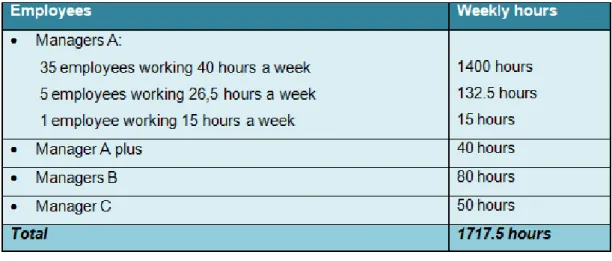
With this amount of employees, the store has 1717.5 weekly working hours distributed in the following way:
Sara Morello Diaz
23
TABLE 7: DISTRIBUTION OF WEEKLY WORKING HOURS
3.4. IMPLANTING PROCESS OF THE ABC SYSTEM IN THE
SUPERMARKET
For the purpose of understanding the ABC model presented for the supermarket, it is necessary to remember that the main objective of implementing the ABC system in the present project is to prepare a model that enables to know the costs of the activities performed in the store, and impute such costs to the different areas that generate them.
Besides, we must underline that all the data obtained and the computing made are for a weekly period. This is basically due to the fact that the organization of the supermarket is made according to the weekly hours that each employee works. Therefore, the weekly schedules in which the working hours and tasks of each employee are made according to that. In addition, all the computing is also made weekly in order to obtain regular information about the costs.
Sara Morello Diaz
24
3.4.1. IDENTIFICATION OF THE ACTIVIES
In order to implement the ABC system it is mandatory to identify the set of activities performed in the company. In this case, it is essential identifying every activity needed so that the products are acquired by the clients.
Being a part of the company has been very useful to identify them. This way, I perfectly knew many of the activities. I have managed to identify other activities related with the perishable products handled in different sections of the supermarket by meeting the floor coordinator; who has explained in detail the functioning of each section of the store. The information provided includes important aspects of the activities such as:
Definition and objective
Tasks that involve each activity
Order for performing the tasks
Staff necessary to perform them
Time for performing each one
Inputs consumed for its performance
Outputs obtained
On the basis of the information collected, the basic daily activities performed in the
supermarket are the following:
1. Unloading the freight 2. Cleaning the store 3. Product replacement
4. Aligning the products so that the brand is shown to the customer. 5. Placing orders.
6. Making inventory. 7. Maintenance activities 8. Cutting foods.
9. Packaging and delivering 10. Serving clients
11. Invoicing
Sara Morello Diaz
25
13. Doing returns 14. Home delivery 15. Organizing the store
In the activities dictionary created in the point 3.4.3., the basic activities identified are detailed along with the set of tasks they involve.
3.4.2. CLASSIFICATION OF PRINCIPAL AND AUXILIARY ACTIVITIES
A clarification regarding the classification of principal and auxiliary activities is essential. Principal activities are those directly related with the cost objectives, while auxiliary activities are the ones related with support and maintenance, and they do not have a relationship so direct with cost objectives. However, the cost of auxiliary activities must be distributed among the principal activities, since these are the ones consuming the cost.
Principal activities are the following:
PI: Product replacement.
PII: Aligning the products so that the brand is shown to the customer. PIII: Cutting foods.
PIV: Packaging and delivering.
PV: Placing orders.
PVI: Making inventory. PVII: Serving clients. PVIII: Invoicing. PIX: Home delivery.
PX: Organizing the store.
These activities have been numbered with an initial P that indicates that it is a principal activity. Also, the auxiliary activities have been numbered with an initial A that indicates they are the auxiliary ones.
Sara Morello Diaz
26
Auxiliary activities are those consumed by different activities, and they are the following:
AI: Unloading the freight.
AII: Cleaning the store. AIII: Doing returns.
AIV: Collecting shopping carts from the parking lot.
AV: Maintenance activities.
Activity PX, organizing the store, is consumed by different principal and auxiliary activities. Nevertheless, it is considered as principal because it is one of the most important activities.
3.4.3. ACTIVITIES DICTIONARY
The activities dictionary created for the supermarket collects fifteen tables –one for
each activity- where the named activity is briefly defined along with its objective and its corresponding codification. In each table the tasks of said activity are named. Finally, it
is detailed how many employees do them in a weekly period2.
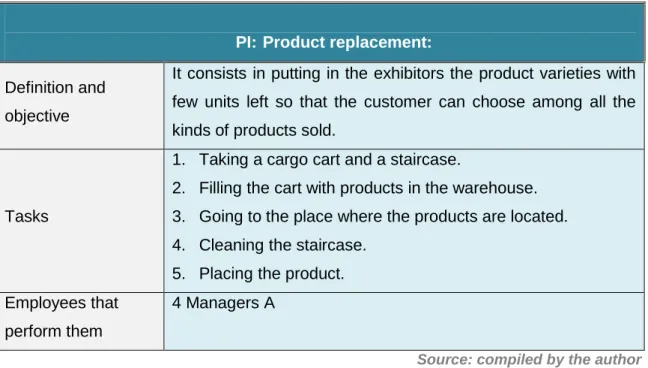
TABLE 8: PRINCIPAL ACTIVITY I
PI: Product replacement:
Definition and objective
It consists in putting in the exhibitors the product varieties with few units left so that the customer can choose among all the kinds of products sold.
Tasks
1. Taking a cargo cart and a staircase.
2. Filling the cart with products in the warehouse. 3. Going to the place where the products are located. 4. Cleaning the staircase.
5. Placing the product. Employees that
perform them
4 Managers A
Source: compiled by the author
2
Data for a weekly period has been identified by me and the floor coordinator as a result of the average of several weeks.
Sara Morello Diaz
27
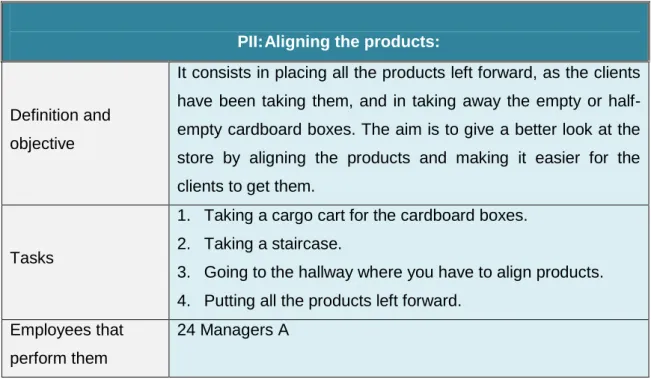
TABLE 9: PRINCIPAL ACTIVITY II
PII: Aligning the products:
Definition and objective
It consists in placing all the products left forward, as the clients have been taking them, and in taking away the empty or half-empty cardboard boxes. The aim is to give a better look at the store by aligning the products and making it easier for the clients to get them.
Tasks
1. Taking a cargo cart for the cardboard boxes. 2. Taking a staircase.
3. Going to the hallway where you have to align products. 4. Putting all the products left forward.
Employees that perform them
24 Managers A
Source: compiled by the author
TABLE 10: PRINCIPAL ACTIVITY III
PIII: Cutting foods:
Definition and objective
It consists in dividing a piece of a perishable food (such as meat or fish) into pieces or fillets and in deboning or removing scales. This depends on what the customer requested in order to satisfy his/her needs.
Tasks
1. Asking the client about the kind of product and the weight he/she wants to purchase.
2. Taking the product.
3. Taking the knife or the slicer.
4. Preparing the product according to the demand. 5. Putting the products in a package.
Employees that perform them
12 Managers A
Sara Morello Diaz
28
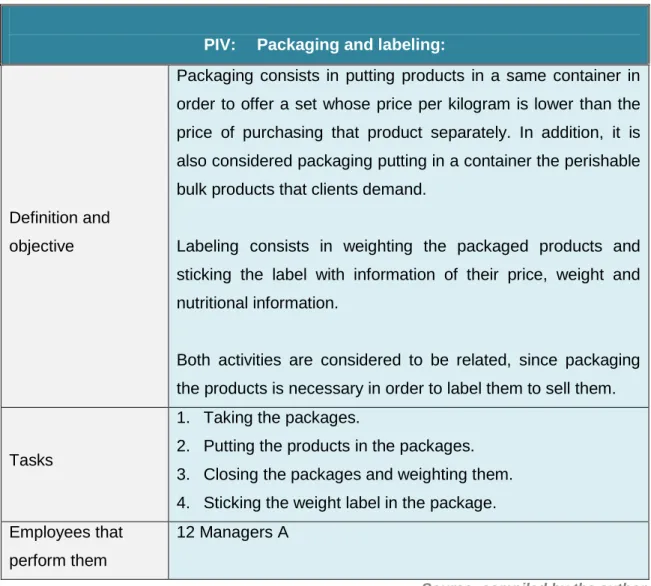
TABLE 11: PRINCIPAL ACTIVITY IV
PIV: Packaging and labeling:
Definition and objective
Packaging consists in putting products in a same container in order to offer a set whose price per kilogram is lower than the price of purchasing that product separately. In addition, it is also considered packaging putting in a container the perishable bulk products that clients demand.
Labeling consists in weighting the packaged products and sticking the label with information of their price, weight and nutritional information.
Both activities are considered to be related, since packaging the products is necessary in order to label them to sell them.
Tasks
1. Taking the packages.
2. Putting the products in the packages. 3. Closing the packages and weighting them. 4. Sticking the weight label in the package. Employees that
perform them
12 Managers A
Source: compiled by the author
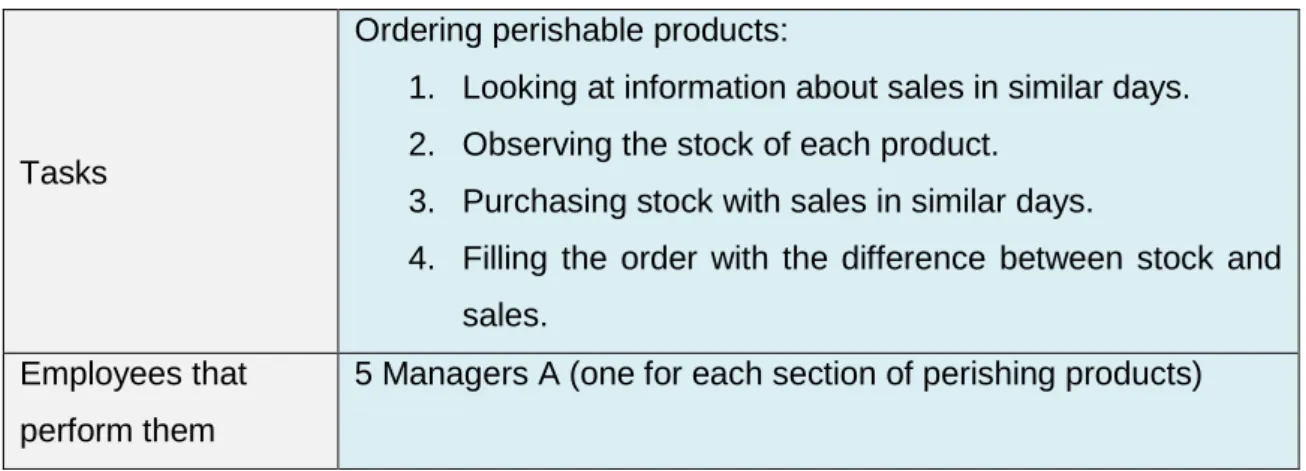
TABLE 12: PRINCIPAL ACTIVITY V
PV: Placing orders:
Definition and objectives
Orders are only made manually for the perishable goods section. For these goods the activity consists in ordering the amount of product that the supermarket is planning on selling, taking into account the sales of similar days. For dry goods the orders are made automatically through the computer, so in this
case the performance of the activity is not necessary –with the
Sara Morello Diaz
29
Tasks
Ordering perishable products:
1. Looking at information about sales in similar days. 2. Observing the stock of each product.
3. Purchasing stock with sales in similar days.
4. Filling the order with the difference between stock and sales.
Employees that perform them
5 Managers A (one for each section of perishing products)
Source: compiled by the author
TABLE 13: PRINCIPAL ACTIVITY VI
PVI: Making inventory:
Definition and objective
Consists in counting the available units of each product in the displays and in the store’s warehouse in order to control the stock. In other words, to compare the units that should be available according to the books with the actual stock calculating its value.
Tasks
1. Taking a data terminal.
2. Introducing in the data terminal the product code for each variety of products.
3. Comparing the stock that the terminal shows there should be with the actual stock.
Employees that perform them
Managers B
Sara Morello Diaz
30
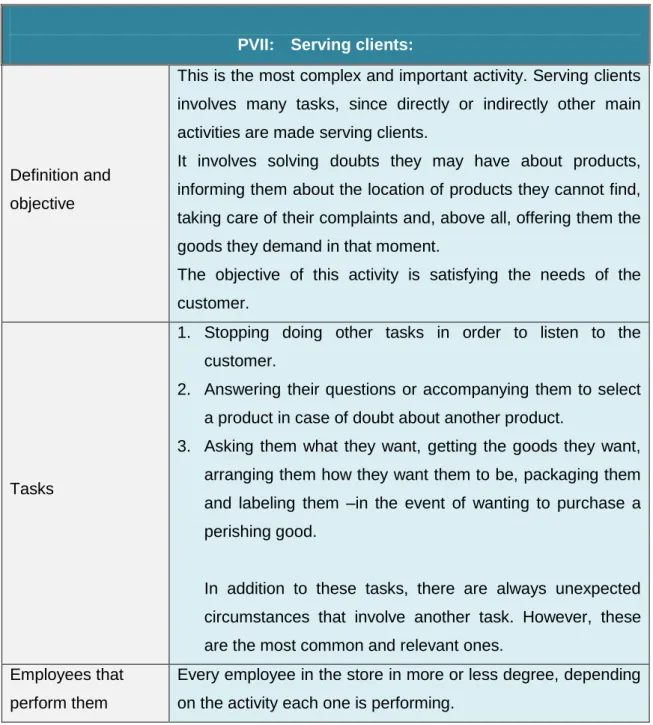
TABLE 14: PRINCIPAL ACTIVITY VII
PVII: Serving clients:
Definition and objective
This is the most complex and important activity. Serving clients involves many tasks, since directly or indirectly other main activities are made serving clients.
It involves solving doubts they may have about products, informing them about the location of products they cannot find, taking care of their complaints and, above all, offering them the goods they demand in that moment.
The objective of this activity is satisfying the needs of the customer.
Tasks
1. Stopping doing other tasks in order to listen to the customer.
2. Answering their questions or accompanying them to select a product in case of doubt about another product.
3. Asking them what they want, getting the goods they want, arranging them how they want them to be, packaging them
and labeling them –in the event of wanting to purchase a
perishing good.
In addition to these tasks, there are always unexpected circumstances that involve another task. However, these are the most common and relevant ones.
Employees that perform them
Every employee in the store in more or less degree, depending on the activity each one is performing.
Sara Morello Diaz
31
TABLE 15: PRINCIPAL ACTIVITY VIII
PVIII: Invoicing:
Definition and objective
It consists on scanning every product the customer is purchasing through the scanner in the cash register in order to charge them and register the sales. This is the activity that allows a major control of the employee’s production, since the registers are connected to an information system that indicates the products registered by any employee per minute.
Due to this activity and its information system, the quantity sold of each product is known at any moment and, because of that, improving the efficiency in orders and understanding inventory shrinkage is possible.
Tasks
1. Going to the cash register and identifying as an employee. 2. Scanning every product the client wants to purchase. 3. Helping the client bag the products.
4. Informing about the price of the purchase and accepting cash, credit or debit.
5. Charging the purchase and giving the receipt to the client.
Employees that perform them
7 employees
Source: compiled by the author
TABLE 16: PRINCIPAL ACTIVITY IX
PIX: Home delivery:
Definition and objective
Home delivery consists in transporting the client’s purchase to his/her house by an employee of the supermarket.
The objective of this service is to satisfy the client by taking the purchase to his/her house.
Sara Morello Diaz
32
Tasks
1. Invoicing the purchase to the client without collecting the fee.
2. Putting the purchase and the lifting machine into the van.
3. Driving to the client’s house.
4. Entering the purchase in the client’s house.
5. Charging the invoiced amount. 6. Going back to the store. Employees that
perform them
2 Managers A
Source: compiled by the author
TABLE 17: PRINCIPAL ACTIVITY X
PX: Organizing the store:
Definition and objective
This activity consists in organizing the needed employees for each moment of the day and for the different sections by planning the schedules and controlling the activities performed by each employee. It also consists in solving contingencies that may occur in the store.
The objective of this activity is to count on any moment with the employees needed in order to perform the activities properly.
Tasks
1. Observing the sales in similar days.
2. Thinking in the needed employees to perform the activities. 3. Distributing the employees among the different sections
and activities.
4. Arranging time schedules so that there are always employees in the store.
5. Solving contingencies, if any. Employees that
perform them
Manager C and Managers B.
Sara Morello Diaz
33
TABLE 18: AUXILIARY ACTIVITY I
AI: Unloading the freight:
Definition and objective
It consists in moving the freight ordered or sent automatically from the truck that delivers it to the store’s warehouse in order to have more stock and to replace products.
Tasks
1. Getting the fenwick.
2. Getting off the pallets one by one.
3. Bringing the pallets to the store’s warehouse. Employees that
perform them
2 Managers A
Source: compiled by the author
TABLE 19: AUXILIARY ACTIVITY II
AII: Cleaning the store:
Definition and
objective
It consists in removing dirt from the supermarket and in disinfecting the perishable products displays in order to give a clean image and to eliminate any bacteria or dirt that may affect the quality of the food.
Tasks
1. Preparing the cleaning trolley. 2. Sweeping the store.
3. Cleaning dust.
4. Setting on the floor cleaning machines.
5. Cleaning the bathrooms and the windowpanes. 6. Scrubbing and disinfecting display trays.
Employees that
perform them
6 Managers A
Sara Morello Diaz
34
TABLE 20: AUXILIARY ACTIVITY III
AIII: Doing Returns:
Definition and objective
It consists in taking back to its original place all the products that customers have left in the cash register zone instead of buying them. The aim of this activity is that the items are in their respective place and that there are no mistakes when making inventory.
Tasks
1. Taking a cart or a trolley where all the products have been placed.
2. Walking through all the corridors putting the products in their respective places.
Employees that perform them
2 Managers A
Source: compiled by the author
TABLE 21: AUXILIARY ACTIVITY IV
AIV: Collecting Shopping Carts from the Parking Lot:
Definition and objective
It consists in getting into the store the shopping carts that the customers have left in the parking lot after finishing their shopping. The aim of this activity is to avoid shopping cart thefts as well as making the task of taking a cart more comfortable for the customer, as they do not have to go to the parking lot to get them, they will have them inside the store.
Tasks
1. Taking a special key that allows you to separate shopping carts.
2. Going to the parking lot. 3. Getting a shopping cart line.
4. Going back into the store and leave them in their place. Employees that
perform them
2 Managers A
Sara Morello Diaz
35
TABLE 22: AUXILIARY ACTIVITY V
AV: Maintenance Activities:
Definition and objective
It consists in repairing any broken machine, shelf, display, etc., that does not allow that the activities are performed naturally. The aim is to be able to perform the activities correctly and maintaining the store in good shape.
Tasks
1. Observing the damage.
2. Taking the appropriate tools to repair the damage. 3. Repairing the damage.
Employees that perform them
1 employee
Source: compiled by the author
3.4.4. IDENTIFYING THE FINAL COSTS OBJECTS
After identifying the activities and the tasks that involve them, the final cost objects in the supermarket have been analyzed, identifying, thus, seven sections –the ones that provoke the necessity to perform those activities. However, there are some activities that are not performed in a specific section, thus they are considered as general activities, since their performance affects directly or indirectly every section in the supermarket.
By saying that an activity affects directly a section in the supermarket we mean that, for instance, a maintenance activity can be performed on any section depending on the broken machinery and on the moment. Likewise, by saying that it affects indirectly a section, we mean that they are not performed in a specific section, but should this task not be performed, the products could not be sold. For instance, the invoicing activity is absolutely needed so that any product finally lands on the customer’s hands.
Regardless of an activity affecting directly or indirectly a section, the cost of performing it, must be computed in order to be able to impute lately the cost of performing them to the corresponding products.
Sara Morello Diaz
36
The identified sections are the following:
ILLUSTRATION 7: SECTIONS IN THE SUPERMARKET
Source: compiled by the author
The initial S before the numeration of the sections indicates that it is a section.
As we can see in figure 7, the seven identified sections are related with the kind of product offered on each one. Section 7 products (dry goods) are all the products that are not sold on any other section: dairy products, dried fruits, sodas, etc.
S1. Fruits and vegetables S2. Sea food S3. Bakery S4. Perfumery S5. Meats counter S6. Charcuterie S7. Dry goods
Sara Morello Diaz
37
3.4.5. IDENTIFYING AND LOCALIZING THE COST ELEMENTS
In order to achieve the goals of the firm a series of resources are needed to develop the activities. Identifying the indirect cost elements is fundamental since they are essential to determine the cost of the delivered services. Besides, the direct labor cost is very relevant in the computation of the activities, since, as we have seen, there are numerous weekly working hours and the direct labor cost will be high.
This is the reason why the total cost of each activity will consist of:
1. Direct labor cost. This cost will be computed multiplying the employees working hours by cost per hour.
2. Cost of indirect cost elements that involve the activity.
The identified indirect cost elements in the supermarket are the following:
TABLE 23: IDENTIFICATION OF INDIRECT COST ELEMENTS
Sara Morello Diaz
38
The initial C before the numeration of cost elements indicates that it stands for cost.
Hereupon we present the identified cost elements among the different activities in order to subsequently impute the activities cost to the sections.
For interpretation in the content of table 24 a little explanation is needed: in the upper
line, the different activities –principal and auxiliary– code is shown and in the first
column we can see the cost elements. The cells marked with the X symbol indicate that a cost element intervenes in the activity.
TABLE 24: LOCALIZATION OF INDIRECT COST ELEMENTS
Sara Morello Diaz
39
3.4.6. DETERMINING COST DRIVERS
As we have mentioned before in the description of the ABC system, we must be capable of measuring each activity through cost drivers that establish a causal relationship between incurred costs and the obtained output.
The cost-driver of each activity –both principal and auxiliary– is detailed in the following table:
TABLE 25: COST DRIVERS
Principal activities Cost-driver Total /week
PI: Product replacement.
PII: Aligning the products so that
the brand is shown to the costumer.
PIII: Cutting foods.
PIV: Packaging and delivering.
PV: Placing orders.
PVI: Making inventories.
PVII: Serving clients.
PVIII: Invoicing.
PIX: Home delivery.
PX: Organizing the store.
Hours/person Hours/person Hours/person Hours/person Hours/person Hours/person Hours/person Hours/person Hours/person Hours/person 120 18 260 200 30 6 443.5 400 60 88 Auxiliary Activities Units of measure Total / week
AI: Unloading the freight.
AII: Cleaning the store.
AIII: Doing returns.
AIV: Collecting shopping carts from
the parking lot.
AV: Maintenance activities.
Hours/person Hours/person Hours/person Hours/person Hours/person 20 30 3 9 30
Sara Morello Diaz
40
After identifying cost-drivers, we must underline that the reflected hours are an
average of the weekly hours dedicated to each activity in the establishment. This is because depending on the completed sales and on the contingencies that may appear; the hours dedicated to each activity may vary each week.
The calculus of the weekly hours has been done by me and my floor coordinator taking into account the variations in sales and in the performance of all the activities every moment or day of the week.
We can appreciate that for the totality of the activities, the units of measure are hours/person. This has been chosen as the only unit of measure for several reasons:
- The most important person in charge, the floor coordinator, has explained that the
organization of the activities in the supermarket is done through the calculus of needed hours. By doing so, every need is met and we can afterwards assign the needed employees to perform them.
- The unit of measure is easy and inexpensive to measure.
- These are service activities, which is why they are not uniformly done every day.
Depending on the sales, more or less time is dedicated to their performance.
3.4.7. ASSIGNING THE INDIRECT COST ELEMENTS TO THE PRINCIPAL
AND AUXILIARY ACTIVITIES
After identifying and localizing the cost elements in the different activities, table 26 shows the assignation estimate percentages of such elements to all the activities based on cost-drivers, that is, based on hours/person.
Sara Morello Diaz
41
Source: compiled by the author
The percentages reflected on the previous table have been computed based on the hours/person dedicated to each activity. For instance, for element C1 and activity PI:
Total hours: 1.177,5 100%
PI activity: 120 x x= 6,99%
On account of ignoring the values of cost elements and of preserving the privacy of the firm, the total cost to be assigned to each one is not reflected. However, by way of example, if we assume that the value of the element C1 for a week is 50,000 Euros, 6.99 % would be assigned to the activity PI, that is, 3,495 Euros.
TABLE 26: PERCENTAGE OF THE COST ELEMENTS IMPUTED TO THE ACTIVITIES DEPENDING ON COST-DRIVERS
Sara Morello Diaz
42
3.4.8. CALCULUS OF THE PRINCIPAL AND AUXILIARY ACTIVITIES COST
In order to know the total cost of each activity it is necessary to know the cost of the
hours per employee depending on the category, since as we have seen, there are activities performed by employees with different categories. The result is collected in the following table:
TABLE 27: COST PER HOUR OF EMPLOYEES
The cost per hour for the firm in table 27 is approximate. The calculus has been done with information provided by both the floor coordinator and the information found in the company’s website about salaries for each category. To this calculus we have added the cost that faces the company in the public administration for each employee.
By knowing the distribution of the cost elements, the weekly hours/person for each activity and the cost per hour of employees depending on their category, we already know all the necessary factors to compute the activities cost.
However, the value of the cost elements remains unknown; therefore, values are not
reflected in table 28. This table reflects how the weekly cost of the principal and
Sara Morello Diaz
43
TABLE 28: TOTAL COST OF PRINCIPAL AND AUXILIARY ACTIVITIES
ACTIVITIES COST
Principal activities Product replacement.
Aligning the products so that the brand is shown to the costumer. Cutting foods.
Packaging and delivering. Placing orders.
Making inventory. Serving clients. Invoicing. Home delivery. Organizing the store.
Auxiliary activities Unloading the freight. Cleaning the store. Doing returns.
Collecting shopping carts from the parking lot.
Maintenance activities.
Source: compiled by the author
The calculus of the total cost for each of the activities would be done by obtaining the result of the following expression:
Activity cost = (Hours/person * cost per hour) + total of indirect costs3
3
The indirect costs of each activity would be the sum of all the cost elements assigned to each one of them.
Sara Morello Diaz
44
3.4.9. LOCALIZING THE AUXILIARY ACTIVITIES WITHIN THE PRINCIPAL
ACTIVITIES
As we said before, the activities considered as auxiliary are the ones that do not have such a direct relationship with cost objectives. However, it is mandatory to distribute the cost of these activities among the principal activities, since these are the ones consuming services, and therefore, costs.
Before going on with this model, we must make a clarification: apart from the fact that principal activities consume the auxiliary ones, there are also direct consumers
between principal activities –like maintenance activities. For instance, in some
occasions, the cleaning machine breaks down and it is necessary to repair it, which is why the maintenance activity affects the cleaning auxiliary activity.
In table 29 we can observe the process of distributing auxiliary activities which has
been done making sure that there is correlation among the different activities. In order to understand the table, a small clarification must be done. In the upper side of the table the auxiliary activities whose cost is about to be distributed are shown. Whereas in the first column the principal and the auxiliary activities that consume costs are located. However, the order used until now to enumerate the auxiliary activities changes to the laddering method, since in order to proceed, the activities have been organized in a decreasing order regarding the provision of services of other activities.
Sara Morello Diaz
45
Sara Morello Diaz
46
3.4.10 ASSINING THE AUXILIAR ACTIVITIES COST TO THE PRINCIPAL
ACTIVITIES
After locating the auxiliary activities, it is important to know in which proportion they do, that is, assigning the cost of auxiliary activities to the principal and auxiliary activities taking into account the consumption of both types. Given assignation will be done depending solely on the cost drivers, that is, hours/person; since the calculus of units
per activity4 cannot be done for the lack of values of the total cost of each activity. If the
numbers of the activities cost were known, the ratio among the cost of each activity and the hours dedicated to perform them would be done, resulting in the activity units. With this data, it would be calculated for each activity the multiplication of activity units times the hours dedicated to each one, and so, we would obtain the cost.
Since due to the characteristics of the presented model the distribution cannot be made in this way, the percentages to assign the costs have been computed taking into account only the cost-drivers. It has been done as follows:
As computed in previous points, the total amount of dedicated hours to all the activities is 1717.5 hours. However, not all auxiliary activities serve other activities, just some of them. For this reason, in order to distribute the cost of each auxiliary activity, all the hours/person of those activities to which auxiliary activities serve have been added up. For instance, the maintenance activity cost will be distributed among the rest of activities counting 485 hours instead of 1717.5, since 485 hours is the sum of hours/person of the activities to which this auxiliary activity renders a service.
This way, if the replacing products activity occupies 120 hours:
Total hours: 485 100%
PI activity: 120 x x= 24,74%
The percentage 24.74 % indicates that, from the total cost of the maintenance activity, 24.74 % must be assigned to the activity of replacing products. For instance, if in the point 3.4.8. a weekly cost for the maintenance activity was determined at 3000 euros,
4
Sara Morello Diaz
47
the 24.74 % of this amount would be imputed to the maintenance activities, meaning 742.2 Euros.
Table 30 shows the results of the distribution: