FRBR
object-oriented definition and
mapping to FRBR
ER
(version 1.0)
International Working Group on FRBR and CIDOC CRM Harmonisation
supported by Delos NoE
Editors:
Chryssoula Bekiari
Martin Doerr
Patrick Le Bœuf
Contributors:
Trond Aalberg, Jérôme Barthélémy, Guillaume Boutard, Günther Görz,
Dolores Iorizzo, Max Jacob, Carlos Lamsfus, Mika Nyman, João
Oliveira, Christian Emil Ore, Allen H. Renear, Pat Riva, Richard
Smiraglia, Stephen Stead, Maja Žumer
Index
INDEX ... 2
FOREWORD ... 8
1 INTRODUCTION ... 9
1.1 Purposes ... 10
1.1.1 A common view of cultural heritage information... 10
1.1.2 A verification of FRBR’s internal consistency... 10
1.1.3 An enablement of information interoperability and integration ... 10
1.1.4 An opportunity for mutual enrichment for FRBR and CIDOC CRM ... 10
1.1.5 An extension of the scope of FRBR and the CIDOC CRM... 11
1.1.6 Sources ... 11
1.1.7 Understanding the attributes and relationships... 11
1.1.8 Transforming attributes into properties ... 11
1.1.9 By-product 1: Re-contextualising bibliographic entities ... 12
1.1.10 By-product 2: Adding a bibliographic flavour to CIDOC CRM... 12
1.2 Differences between FRBRER and FRBROO... 12
1.2.1 Introduction of temporal entities, events and time processes ... 12
1.2.2 Refinement of group 1 entities ... 13
1.2.3 Analysis of creation and production processes... 15
2 DESCRIPTION OF THE MODEL... 17
2.1 Graphic Overview of the Object-Oriented Definition of FRBR... 17
2.2 Naming conventions ... 23
2.3 Property Quantifiers ... 24
2.4 Presentation conventions ... 25
2.5 Class & Property Hierarchies ... 25
2.5.1 FRBRoo Class Hierarchy ... 27
2.5.2 FRBRoo Class Hierarchy aligned with (part of) CIDOC CRM Class Hierarchy... 28
2.5.3 FRBRoo Property Hierarchy ... 31
2.5.4 FRBRoo Property Hierarchy aligned with (part of) CIDOC CRM Property Hierarchy... 33
2.6 FRBRoo Class Declaration ... 35
F1 Work... 36
F2 Expression ... 36
F3 Manifestation Product Type ... 37
F4 Manifestation Singleton ... 38 F5 Item ... 39 F6 Concept ... 39 F7 Object ... 39 F8 Event ... 40 F9 Place ... 40 F10 Person... 41 F11 Corporate Body ... 41 F12 Name ... 42 F13 Identifier... 42 F14 Individual Work ... 43 F15 Complex Work ... 43
F16 Container Work ... 44 F17 Aggregation Work... 44 F18 Serial Work ... 45 F19 Publication Work... 45 F20 Performance Work ... 46 F21 Recording Work ... 46 F22 Self-Contained Expression ... 47 F23 Expression Fragment... 47 F24 Publication Expression ... 48 F25 Performance Plan ... 49 F26 Recording ... 49 F27 Work Conception ... 50 F28 Expression Creation ... 50 F29 Recording Event... 50 F30 Publication Event ... 51 F31 Performance ... 51
F32 Carrier Production Event... 52
F33 Reproduction Event... 52
2.7 FRBR Property Declaration... 54
R1 is logical successor of (has successor) ... 55
R2 is derivative of (has derivative)... 55
R3 is realised in (realises)... 55
R4 carriers provided by (comprises carriers of) ... 56
R5 has component (is component of) ... 56
R6 carries (is carried by) ... 57
R7 is example of (has example)... 57
R8 consists of (forms part of) ... 57
R9 is realised in (realises)... 58
R10 has member (is member of) ... 58
R11 has issuing rule (is issuing rule of)... 58
R12 is realised in (realises)... 59
R13 is realised in (realises)... 59
R14 incorporates (is incorporated in) ... 60
R15 has fragment (is fragment of)... 60
R16 initiated (was initiated by)... 61
R17 created (was created by)... 61
R18 created (was created by)... 61
R19 created a realisation of (was realised through)... 62
R20 recorded (was recorded through) ... 62
R21 created (was created through) ... 63
R22 created a realisation of (was realised through)... 63
R23 created a realisation of (was realised through)... 63
R24 created (was created through) ... 63
R25 performed (was performed in) ... 64
R26 produced things of type (was produced by) ... 64
R27 used as source material (was used by) ... 65
R28 produced (was produced by) ... 65
R29 reproduced (was reproduced by)... 65
R30 produced (was produced by) ... 66
R31 is reproduction of (has reproduction)... 66
CLP2 should have type (should be type of)... 66
CLP43 should have dimension (should be dimension of) ... 67
CLP45 should consist of (should be incorporated in)... 67
CLP46 should be composed of (may form part of) ... 67
CLP57 should have number of parts ... 68
CLP104 subject to (applies to) ... 68
CLP105 right held by (right on) ... 69
CLR6 should carry (should be carried by)... 69
3.1 Introduction ... 70
3.2 Explanation of types used in the mapping... 70
3.3 List of Mappings... 71
4 REFERRED CIDOC CRM CLASSES AND PROPERTIES... 85
4.1 List of Referred CIDOC CRM Classes: ... 85
4.2 List of Referred CIDOC CRM Properties:... 87
4.3 Referred CIDOC CRM Classes ... 89
E1 CRM Entity ... 89 E3 Condition State... 89 E4 Period ... 90 E7 Activity ... 91 E11 Modification... 92 E12 Production ... 92
E18 Physical Thing... 93
E21 Person... 94
E24 Physical Man-Made Thing... 94
E27 Site ... 94
E28 Conceptual Object... 95
E29 Design or Procedure... 95
E30 Right... 96
E33 Linguistic Object... 96
E35 Title ... 96
E37 Mark... 97
E39 Actor ... 97
E41 Appellation... 98
E42 Identifier... 98
E44 Place Appellation ... 99
E47 Spatial Coordinates ... 99
E49 Time Appellation ... 99
E50 Date ... 100 E52 Time-Span... 100 E53 Place... 101 E54 Dimension ... 101 E55 Type ... 102 E56 Language... 102 E57 Material ... 103 E60 Number... 103
E61 Time Primitive ... 104
E62 String... 104
E65 Creation... 104
E66 Formation ... 104
E67 Birth ... 105
E69 Death ... 105
E72 Legal Object... 106
E73 Information Object ... 106
E74 Group ... 107
E82 Actor Appellation... 107
E84 Information Carrier ... 108
E89 Propositional Object... 108
E90 Symbolic Object... 109
4.4 Referred CIDOC CRM Properties ... 110
P1 is identified by (identifies)... 110
P3 has note... 111
P4 has time-span (is time-span of)... 111
P7 took place at (witnessed) ... 111
P12 occurred in the presence of (was present at)... 112
P14 carried out by (performed)... 112
P15 was influenced by (influenced) ... 113
P16 used specific object (was used for)... 113
P31 has modified (was modified by) ... 113
P33 used specific technique (was used by)... 114
P43 has dimension (is dimension of)... 114
P44 has condition (condition of)... 114
P45 consists of (is incorporated in) ... 115
P46 is composed of (forms part of) ... 115
P49 has former or current keeper (is former or current keeper of) ... 115
P50 has current keeper (is current keeper of) ... 116
P51 has former or current owner (is former or current owner of) ... 116
P57 has number of parts ... 116
P59 has section (is located on or within) ... 117
P65 shows visual item (is shown by)... 117
P72 has language (is language of) ... 117
P74 has current or former residence (is current or former residence of) ... 118
P75 possesses (is possessed by)... 118
P78 is identified by (identifies)... 118
P82 at some time within ... 118
P87 is identified by (identifies)... 119
P94 has created (was created by)... 119
P95 has formed (was formed by)... 119
P98 brought into life (was born)... 120
P100 was death of (died in) ... 120
P102 has title (is title of)... 120
P103 was intended for (was intention of) ... 120
P104 is subject to (applies to)... 121
P105 right held by (has right on) ... 121
P106 is composed of (forms part of) ... 121
P108 has produced (was produced by) ... 122
P125 used object of type (was type of object used in)... 122
P128 carries (is carried by)... 122
P129 is about (is subject of) ... 122
P130 shows features of (features are also found on) ... 123
P131 is identified by (identifies)... 123
P138 represents (has representation) ... 123
P148 has component (is component of)... 124
5 APPENDIX: MODELLING OF IDENTIFIER CREATION ... 125
5.1 Introduction ... 125
5.2 Description of the model ... 125
5.3 Analysis of Procedures of the Cataloguing Process... 125
5.3.1 Class Hierarchy of the FRBROO Identifier Creation Model aligned with CIDOC CRM... 128
5.3.2 FRBRoo Identifier Creation Model Class declaration... 130
F1 Work... 130
F2 Expression ... 130
F4 Manifestation Singleton ... 130
F40 Identifier Assignment ... 130
F41 Representative Manifestation Assignment ... 131
F42 Representative Expression Assignment... 131
F43 Identifier Rule ... 132
F44 Bibliographic Agency... 132
5.3.4 FRBRoo Identifier Creation Model Property declaration... 135
R40 has representative expression (is representative expression for)... 135
R41 has representative manifestation product type (is representative manifestation product type for) ... 135
R42 is representative manifestation singleton for (has representative manifestation singleton) ... 136
R43 carried out by (performed) ... 137
R44 carried out by (performed) ... 137
R45 assigned to (was assigned by) ... 138
R46 assigned (was assigned by) ... 138
R47 used constituent (was used in) ... 139
R48 assigned to (was assigned by) ... 139
R49 assigned (was assigned by) ... 139
R50 assigned to (was assigned by) ... 140
R51 assigned (was assigned by) ... 140
R52 used rule (was the rule used in)... 140
R53 assigned (was assigned by) ... 141
5.4 Referred CIDOC CRM Classes and Properties: ... 142
5.4.1 Referred CIDOC CRM Classes... 142
E13 Attribute Assignment ... 142
E24 Physical Man-Made Thing... 143
E28 Conceptual Object... 143
E29 Design or Procedure... 143
E73 Information Object ... 143
5.4.2 Referred CIDOC CRM Properties... 144
P14 carried out by (performed)... 144
P16 used specific object (was used for)... 144
P33 used specific technique (was used by)... 144
P37 assigned (was assigned by)... 144
P128 carries (is carried by) (see section 4.4) ... 144
P130 shows features of (features are also found on) ... 144
P140 assigned attribute to (was attributed by)... 144
P141 assigned (was assigned by)... 145
BIBLIOGRAPHY:... 146
Index of Figures
FIGURE 1...13 FIGURE 2...14 FIGURE 3...15 FIGURE 4...16 FIGURE 5...16 FIGURE 6...17 FIGURE 7...19 FIGURE 8... 20Foreword
This document contains a comprehensive description of the object-oriented definition of FRBR, a model in the form of a formal ontology interpreting FRBR for specific purposes, as analysed below. The document comprises the following sections:
• Section 1, The Introduction, describes the rationale, history and methodology of the development of this model.
• Section 2, The Description of the Model, explains the model in context from a functional perspective with the help of a comprehensive graphical representation of all constructs, describes the format conventions for the formal specifications and lists the complete class and property definitions that make up the model. Whereas the first serves an overall understanding, the second is the reference for the individual declarations. Here a first reading may stop.
• Section 3 describes the mapping of the entity-relationship model of FRBR to the object-oriented one. This section defines the transition from one form to the other, and serves as information for further understanding of the intended meaning of the oriented definition. It is also a proof that the object-oriented form is an alternative view of FRBR, and a proof of completeness of the object-object-oriented form with respect to the original.
• Since the object-oriented model reuses, wherever appropriate, large parts of ISO21127, the CIDOC Conceptual Reference Model, section 4 provides a comprehensive list of all constructs used from ISO21127, together with their definitions following the version 5.0.1 maintained by CIDOC. Some of these constructs appear only in the mapping in section 3 and not in section 2, because they are generic in nature.
• Section 5 contains an extension of the object-oriented model that gives an account of the identifier creation processes in cataloguing practice. It goes beyond FRBR, but the authors found it particularly useful to reflect cataloguing practice and the bibliographic notion of identity in context with the FRBR concepts. A generic part of it is going to be proposed as amendment to ISO21127.
1 Introduction
This document is the draft definition of FRBR1 (object-oriented version, harmonised with CIDOC CRM), hereafter referred to as FRBROO, a formal ontology intended to capture and represent the underlying semantics of bibliographic information and to facilitate the integration, mediation, and interchange of bibliographic and museum information. Such a common view is necessary to provide interoperable information systems for those users interested in accessing common or related content. Beyond that, it results in a formalisation which is more suited for the implementation of FRBR concepts with object-oriented tools, and which facilitates the testing and adoption of FRBR concepts in implementations with different functional specifications and different environments. It applies empirical analysis and ontological structure to the entities and processes associated with works, to their properties, and to the relationships among them. Thereby it reveals a web of interrelationships, which is also applicable to information objects in non-bibliographic arenas2, and is useful to
justify the need of information elements in different environments.
The FRBR model was originally designed as an entity-relationship model by a study group appointed by the International Federation of Library Associations and Institutions (IFLA) during the period 1991-1997, and was published in 1998. The original entity-relationship definition of FRBR is referred to hereafter as FRBRER.
Quite independently, the CIDOC CRM3 model was being developed from 1996 under the auspices of the
ICOM-CIDOC (International Council for Museums – International Committee on Documentation) Documentation Standards Working Group. The definition of the CIDOC CRM model has now become ISO standard 21127.
The idea that both the library and museum communities might benefit from harmonising the two models was first expressed in 2000, on the occasion of ELAG’s (European Library Automation Group) 24th Library Systems Seminar in Paris, with Nicholas Crofts and Dan Matei drafting on the spot a preliminary object-oriented representation of the FRBR model entities roughly mapped to CIDOC CRM classes. This idea grew up in the following years and eventually led to the formation in 2003 of the International Working Group on FRBR/CIDOC CRM Harmonisation, that brings together representatives from both communities with the common goals of: a) Expressing the IFLA FRBR model with the concepts, tools, mechanisms, and notation conventions provided by the CIDOC CRM, and: b) Aligning (possibly even merging) the two object-oriented models thus obtained.
The International Working Group on FRBR/CIDOC CRM Harmonisation, chaired by Martin Doerr (ICS FORTH, Greece) and Patrick Le Bœuf (BnF, France), is affiliated at the same time to the IFLA FRBR Review Group and the CIDOC CRM Special Interest Group (CRM-SIG). The present definition of FRBROO was
developed through email exchange among members of the Working Group, and more importantly during the following series of meetings:
– Meeting #1: 2003, Nov. 12-14, Paris;
– Meeting #2: 2004, March 22-25, Heraklion, Greece;
– Meeting #3: 2005, February 14-16, London; – Meeting #4: 2005, July 4-6, Heraklion, Greece;
– Meeting #5: 2005, November 16-18, Nuremberg, Germany; – Meeting #6: 2006, March 27-29, London;
– Meeting #7: 2006, June 26-29, Trondheim, Norway;
– Meeting #8: 2006, October 25-27, Heraklion, Greece; – Meeting #9: 2007, March 14-16, Paris;
– Meeting #10: 2007, July 9-10, Edinburgh, Scotland;
– Meeting #11: 2007, December 4-7, Nuremberg, Germany; – Meeting #12: 2008, May 12-15, Heraklion, Greece;
– Meeting #13: 2008, November 5-7, London; – Meeting #14: 2009, May 20-22, London.
More information on the activities of the Group can be found on
http://archive.ifla.org/VII/s13/wgfrbr/FRBR-CRMdialogue_wg.htm and on http://cidoc.ics.forth.gr/frbr_inro.html.
1 “FRBR” stands for: “Functional Requirements for Bibliographic Records,” after the name of the IFLA Study
Group that developed the model. However, current use and understanding of the FRBR model go well beyond that, and the term “FRBR” has now turned to a noun in its own right, used without particular intention to refer to “functionalities,” nor to “requirements,” but rather to the semantics of bibliographic records. The Final Report on Functional Requirements for Bibliographic Records published in 1998 contained both a study on functional
requirements for bibliographic records, and a description of the model known today as “FRBR.”
2 Coleman, Anita S. 2002. Scientific models as works.
Cataloging & classification quarterly 33n3/4: 129-59.
3 “CIDOC CRM” stands for “Comité international de documentation [= International Committee on
Documentation] Conceptual Reference Model,” which, when isolated from any context, is not particularly meaningful (CIDOC is affiliated to ICOM, the International Council of Museums). Just like FRBR, the acronym, rather meaningless by itself, has now turned to a noun in its own right.
We express our gratitude to the European funded Project DELOS NoE for providing financial help for several of these meetings.
1.1 Purposes
This model attempts to represent FRBR by modelling in a sufficiently consistent way the conceptualisation of the reality behind library practice, as it is apparent from or implicit in FRBR. It is important to keep in mind that the aim is not to transform the IFLA FRBR model into something totally different or better, nor of course to reject it or replace it – but to express the conceptualisation of FRBR with the object-oriented methodology instead of the entity-relationship methodology, as an alternative. Nor is it the intention to force museums’ concerns and viewpoints into the bibliographic universe, or libraries’ concerns and viewpoints into the museum universe. Rather, the point is to identify the common ground in the universe both sides share and to ensure mutual benefit by pursuing the following objectives.
1.1.1 A common view of cultural heritage information
The main goal is to reach a common view of cultural heritage information with respect to modelling, standards, recommendations, and practices. Libraries and museums are memory institutions – both strive to preserve cultural heritage objects, and information about such objects, and they often share the same users. Besides, the boundary between them is often blurred: libraries hold a number of museum objects and museums hold a number of library objects; the cultural heritage objects preserved in both types of institutions were created in the same cultural context or period, sometimes by the same agents, and they provide evidence of comparable
culturalfeatures. It seems therefore appropriate to build a common conceptualisation of the information gathered
by the two types of organisations about cultural heritage.
1.1.2 A verification of FRBR’s internal consistency
Expressing the FRBR model in a different formalism than the one in which it was originally developed provides a means to evaluate the model in terms of its internal consistency. It is also a good opportunity to correct some semantic inconsistencies or inaccuracies in the formulation of FRBR that may be regarded as negligible when FRBRER is only used in a library catalogue context, but that prove to be quite crucial from the moment one
strives to design an overall model for the integration of cultural heritage related information.
1.1.3 An enablement of information interoperability and integration
Mediation tools and Semantic Web activities require an integrated, shared ontology for the information accumulated by both libraries and museums for all the collections that they hold, seen as a continuum from highly standardised products such as books, CDs, DVDs, etc., to raw materials such as plants or stones4, through
“in-between” objects such as draft manuscripts or engraving plates. In addition, such typical “library objects” as books can be about museum objects, and museum objects can represent events or characters found in books (e.g., ‘Ophelia’s death’) and descriptions of museum objects in museum databases may contain references to
bibliographic resources that mention those museum objects: such interrelationships should be either integrated in common information storage, or at least virtually integrated through mediation devices that allow a query to be simultaneously launched on distinct information depositories, which requires common semantic tools such as FRBROO plugged into CIDOC CRM. Besides, CIDOC CRM is explicitly compatible in formalism with the World
Wide Web Consortium’s Resource Description Framework (RDF), which can only be beneficial for FRBR.
1.1.4 An opportunity for mutual enrichment for FRBR and CIDOC CRM
The CIDOC CRM model is influenced by the process of FRBR’s re-formulation as well. Modelling bibliographic information highlights some issues that may have been overlooked during the development of CIDOC CRM, and the way such issues were addressed in FRBROO resulted in some cases in making changes in
4 Natural history museums also are witnesses of “cultural features.” A frog in a museum is not a testimony of
the CIDOC CRM model. These changes are so significant that an anticipated revision of the ISO standard 21127 was required.
1.1.5 An extension of the scope of FRBR and the CIDOC CRM
The harmonisation between the two models is also an opportunity to extend the scope of the CIDOC CRM to bibliographic information, which paves the way for extensions to other domains and formats, such as EAD, TEI, MPEG7, just to name a few. Consequently, it also extends the scope of FRBR to cultural materials, since FRBR inherits all concepts of the CIDOC CRM, and opens the way for FRBR to benefit from further extensions of the scope of CIDOC CRM, such as the scientific heritage of observations and experiments.
1.1.6 Sources
The main source for the task of translating FRBR into the object-oriented formalism was, quite naturally, the IFLA Final Report that contains the complete definition of FRBRER itself:
IFLA Study Group on the functional requirements for bibliographic records.
Functional requirements for bibliographic records: final report [printed text].
Munich, Germany: K. G. Saur, 1998. Also available online from World Wide Web:
<http://www.ifla.org/en/publications/functional-requirements-for-bibliographic-records>.
Common awareness of the Definition of the CIDOC Conceptual Reference Model provides the required
conceptual and technical background:
ICOM/CIDOC Documentation Standards Group; & CIDOC CRM Special Interest Group. Definition of the CIDOC Conceptual Reference Model: version 4.0, April
2004 [electronic resource]. [Heraklion, Greece]: [ICS-FORTH], 2004. Available online at: <http://cidoc.ics.forth.gr/docs/cidoc_crm_version_4.0.doc>, or:
<http://cidoc.ics.forth.gr/docs/cidoc_crm_version_4.0.pdf>.
All drafts of the FRAD model (“Functional Requirements for Authority Data”) that the IFLA FRANAR Group made publicly available on IFLANET were also used to establish the present document. However, a formal mapping from FRAD to FRBROO will be undertaken only once the FRAD model has been officially approved and
published by IFLA.
IFLA Working Group on Functional Requirements and Numbering of Authority Records. [Web page] [electronic resource]. [The Hague, Netherlands]. Available
online from World Wide Web: <http://archive.ifla.org/VII/d4/wg-franar.htm>.
When the FRSAR model (“Functional Requirements for Subject Authority Records”) has been developed, it will also be incorporated in FRBROO.
IFLA Working Group on Functional Requirements for Subject Authority Records. [Web page] [electronic resource]. [The Hague, Netherlands]. Available online from
World Wide Web: <http://archive.ifla.org/VII/s29/wgfrsar.htm>.
1.1.7 Understanding the attributes and relationships
The methodology consisted in a thorough examination of all attributes and relationships declared in FRBRER. During its meetings, the International Working Group on FRBR/CIDOC CRM Harmonisation strove to
extract their semantics as accurately as possible, to express them as “properties” in the sense of CIDOC CRM, and to compare them with possibly existing CIDOC CRM properties. Entities, or classes in the terminology adopted by the CIDOC CRM, play a nearly secondary role as the maximal sets of things for which a property is applicable.
1.1.8 Transforming attributes into properties
The CIDOC CRM model declares no “attributes” at all (except implicitly in its “scope notes” for classes), but regards any information element as a “property” (or “relationship”) between two classes. The semantics extracted from FRBRER attributes are therefore rendered in FRBROO as properties, according to the same
1.1.9 By-product 1: Re-contextualising bibliographic entities
The process of interpreting the precise semantic value of each individual attribute declared in FRBRER and
expressing that semantic value in CRM-like structures resulted also in two by-products.
The first by-product was that it proved necessary to explain and model the general context within which the bibliographic entities isolated in FRBRER come into being. FRBRER envisions bibliographic entities as static,
ever-existing things that come from nowhere, and overlooks the complicated path from the initial idea for a new work in a creator’s mind to the physical item in a user’s hands through the dramatically important decision-making on behalf of publishers, as this complicated path is not explicitly reflected in data actually stored in bibliographic databases and library catalogues, which constituted the domain of reference of the FRBR Study Group. As a matter of fact, bibliographic records do contain some implicit information about that complicated path and the
relationships it implies between and among bibliographic objects; FRBROO digs that implicit information out of
bibliographic structures, e.g. the precise meaning of “date of publication”.
1.1.10 By-product 2: Adding a bibliographic flavour to CIDOC CRM
The second by-product was that the analysis provided for bibliographic processes in FRBROO paved the
way to the introduction of refinements into CIDOC CRM, so that the museum community’s model could give a better account for mass production phenomena (such as the printing of engravings, for instance), or the relation between creating immaterial content and physical carrier. Further, it introduces a basic model of intellectual conception and derivation applicable to all art forms, which the museum community has been hesitating so far to formally analyse.
1.2 Differences between FRBR
ERand FRBR
OO1.2.1 Introduction of temporal entities, events and time processes
Temporal entities (i.e., phenomena, “perdurants” in philosophy) play a central role in the CIDOC CRM model, as they are the only means to relate objects (either conceptual or physical) to time-spans, locations, and agents. Since FRBROO borrows structures from the CIDOC CRM to express the concepts declared in FRBRER,
‘temporal entities’ had inevitably to be introduced into FRBROO. Besides, some FRBR commentators had already
made the point that time issues are insufficiently addressed in FRBRER5; the task of harmonising FRBR with the
CIDOC CRM was an opportunity to fix that. Temporal entities were introduced into FRBROO by declaring some
of the classes of FRBROO as subclasses of the following classes from CIDOC CRM: E65 Creation, E12
Production, and E13 Attribute Assignment.
Figure 1 show how the classes F27 Work Conception and F28 Expression Creation serve to link an E39 Actor, a E52 Time and a E53 Place to the F1 Work, F2 Expression and F4 Manifestation Singleton that are created by those processes. In the lower part of the figure the work elaboration process is shown along a time axis. First, the activity F27 Work Conception produces an idea, then the F28 Expression Creation activity produces simultaneously an F2 Expression and its first manifestation (in the form of a F4 Manifestation Singleton), which together realise a work (F1).
5 HEANEY, Michael.
Time is of the essence: some thoughts occasioned by the papers contributed to the
International Conference on the Principles and Future Development of AACR [on line]. Oxford: Bodleian Library, 1997 [cited 19 January 2008]. Available from World Wide Web:
<http://www.bodley.ox.ac.uk/users/mh/time978a.htm>.
LAGOZE, Carl. Business unusual: how “event-awareness” may breathe life into the catalog?. In: Conference on bibliographic control in the new millennium [on line]. Washington: Library of Congress, October 19, 2000 [cited
19 January 2008]. Available from Internet: <http://lcweb.loc.gov/catdir/bibcontrol/lagoze_paper.html>.
FITCH, Kent. ALEG Data Model. Inventory [on line]. [Brisbane]: AustLit Gateway, revised 27 July 2000 [cited
26 March 2004]. Available from World Wide Web: <http://www.austlit.edu.au:7777/DataModel/inventory.html>. DOERR, Martin; HUNTER, Jane; LAGOZE, Carl. Towards a core ontology for information integration. In:
Journal of Digital Information [on line]. 2003-04-09, Vol. 4, No. 1 [cited 19 January 2008]. Available from World
Work conception Expression creation Work elaboration
produces a work
produces an idea Produces (simultaneously) an
Expression and a Manifestation-Singleton F28 Expression Creation F27 Work Conception F1 Work E39 Actor E52 Time-Span E53 Place F2 Expression F4 Manifestation Singleton R16 initiated (was initiated by)
P14 carri ed out by (performed
)
P4 has time-span (is time-span of)
P7…
R17 created (was created by
) R18 created
(was created by)
P4… P7 took place at (witnessed) P14 carried out by (performed) R19 created a realisation of (was realised through)
time
Work and Time
Figure 1
1.2.2 Refinement of group 1 entities
The text of FRBRER in some cases admits of multiple interpretations which introduce some logical
inconsistencies, in particular with regard to its “Group 1 entities,” those entities that account for the content of a catalogue record.
The Work entity such as defined in FRBRER seemed to cover various realities with distinct properties.
While the main interpretation intended by the originators of FRBRER seems to have been that of a set of concepts
regarded as commonly shared by a number of individual sets of signs (or “Expressions”), other interpretations were possible as well: that of the set of concepts expressed in one particular set of signs, independently of the materialisation of that set of signs; and that of the overall abstract content of a given publication. FRBROO retains
the vague notion of “Work” as a superclass for the various possible ways of interpreting the FRBRER definitions:
F14 Individual Work corresponds to the concepts associated to one complete set of signs (i.e., one individual instance of F22 Self-Contained Expression); F19 Publication Work comprises publishers’ intellectual contribution to a given publication; and F15 Complex Work is closer to what seems to have been the main interpretation intended in FRBRER. Additionally, a further subclass is declared for F1 Work: F16 Container Work, which
provides a framework for conceptualising works that consist in gathering sets of signs or fragments of sets of signs, of various origins (“aggregates”). Just like any product of the human mind, a Work necessarily begins to exist in the material world at a given point in time (even if it is a recollection of a Platonic form); this is the reason why FRBROO introduces the notion of F27 Work Conception. It makes the meaning of the FRBRER attribute ‘4.2.3
date of Work’ explicit. This class is not intended to convey any other meaning than the following: any instance of F1 Work begins to exist at a given point in time. That point in time is not necessarily documented in databases; indeed, it is very rarely precisely known, and creators themselves are often unable to say exactly when they first had the initial idea for a novel, a painting, a symphony, etc. However, one can always point to some temporal boundaries. F27 Work Conception is indispensable for the internal logical consistency of the model.
The Expression entity is relatively clear in FRBRER, at least from a purely conceptual point of view.
However, the need was felt for a distinction between expressions that convey the complete idea of the work they realise, and expressions that convey only a fragment of it: that is, between instances of F22 Self-Contained Expression and instances of F23 Expression Fragment.
The Manifestation entity was defined in FRBRER in such a way that its definition could be interpreted as
covering something physical and conceptual at the same time: it was defined in turn as the “physical embodiment” of an expression of a work and as an entity that represents all the physical objects that bear the same
characteristics. Discussion with members of the original FRBR Study Group6 showed that the Manifestation entity
was actually meant as an entity all instances of which are sets; and sets, in the mathematical sense of the term, can
have more than one member, or just one member (in which case they are called singletons). For the sake of clarification, the Working Group felt the need to split the Manifestation entity into two distinct classes, corresponding to the two possible ways of interpreting the ambiguous definition provided for Manifestation in FRBRER, namely F3 Manifestation Product Type and F4 Manifestation Singleton. Whereas F3 Manifestation
Product Type is declared as a subclass of the CIDOC CRM class E55 Type, and therefore as a subclass, too, of the CIDOC CRM class E28 Conceptual Object (a merely abstract notion), F4 Manifestation Singleton is declared as a subclass of the CIDOC CRM class E24 Physical Man-Made Thing, and therefore as a subclass, too, of the CIDOC CRM class E18 Physical Thing.
The Item entity did not pose any particular problem in FRBRER; but splitting Manifestation into F3
Manifestation Product Type and F4 Manifestation Singleton obliged the Working Group to rethink the articulation between F4 Manifestation Singleton and F5 Item.
All in all, here is a picture of how original FRBRER entities relate to the classes declared in FRBROO:
Figure 2
Figure 2 shows how the original FRBRER entities relate to the classes declared in FRBROO, particularly the
“split” of the FRBRER Manifestation entity into F3 Manifestation Product Type and F4 Manifestation Singleton. In
addition, the figure also shows how FRBROO makes explicit the publisher’s intellectual contribution, which is not
modelled in FRBRER. Manifestation Product Type embodies a Publication Expression, which in turn comprises
both the author’s Expression and the realisation of a Publication Work.
In figure 3 the FRBROO model of the realisation of a work by an expression is illustrated with a specific
example. The overall work is Walt Whitman’s Leaves of grass (an instance of F15 Complex Work), which has as
a member the “deathbed edition,” itself an instance of F15 Complex Work. The F14 Individual Work which corresponds to the abstract content of the French translation by Leon Bazalgette of that edition is in turn a member of the F15 Complex Work of the “deathbed edition.” The F28 Expression Creation event which produced the translation simultaneously created a realisation of that translation and created the instance of F22 Self-Contained Expression which is the text of that translation.
6 Tom Delsey and Beth Dulabahn participated in the Working Group’s first meeting in Paris in 2003. Author’s Context Work Publication Work Publication Expression Manifestation Product Type Item = FRBR Work = FRBR Expression = FRBR Manifestation = FRBR Item Publisher’s Context Manifestation Singleton = FRBR Manifestation Self-Contained Expression
F15 Complex Work Walt Whitman’s Leaves of grass
F15 Complex Work Walt Whitman’s Leaves of grass
“deathbed edition”
F14 Individual Work
Abstract content of translation Walt Whitman’s Leaves of grass “deathbed edition” into French by Leon Bazalgette
F22 Self-Contained Expression Text of the French translation of Walt Whitman’s
Leaves of grass “deathbed edition” by Leon Bazalgette
F28 Expression Creation Translation Walt Whitman’s Leaves of grass “deathbed edition” into French by Leon Bazalgette
R10 has member (is member of)
R10 has member (is member of)
R19B was realised through (created a realisation of)
R17 created (was created by) R3 is realized in
(realises)
R9 is realised in (realises)
Work Realisation example
Figure 3
1.2.3 Analysis of creation and production processes
It proved necessary to analyse creation and production processes, in order to enable a better understanding of interrelations and temporal order.
In particular, the notion of “first externalisation” of a set of signs or expression (and, through the expression, the first externalisation of the individual work realised in the expression) is fully modelled in FRBROO.
It is regarded at the same time as a subclass of the creation of something conceptual, and the production of something physical, because the creation of an expression inevitably also affects the physical world, as the recording of the expression causes a physical modification of the object on which it is being recorded. The spatio-temporal circumstances under which the expression is created are necessarily the same spatio-spatio-temporal circumstances under which the carrier of the newly created expression is produced. This double phenomenon of conceptual creation/physical production can be represented by the schema presented in figure 4. F28 Expression Creation, which is a subclass of E65 Creation, produces, on the conceptual level, an F14 Individual Work through the property R19 created a realisation of, and through R17 created, the F22 Self-Contained Expression which realises that work. Operating simultaneously on the physical level, F28 Expression Creation, a subclass of E12 Production, produces, through R18 created, the F4 Manifestation Singleton which P128 carries the F22 Self-Contained Expression.
F4 Manifestation Singleton F28 Expression Creation (or first externalisation) P128B is carried by R18 created (was created by)
E12 Production
F14 Individual Work
R17 created (was created by) R19 created a realization of E65 Creation F22 Self Contained Expression R9 is realised in (realises)
Conceptual level Physical level
Figure 4
Another topic that is modelled in FRBROO is the distinction that has to be made between the process of
physical publishing and the process of electronic publishing which is illustrated in figure 5. The F5 Items created through physical publishing are the results of an industrial process. As such they are produced by an F32 Carrier Production Event and carry an F24 Publication Expression, yet are also examples of an F3 Manifestation-Product Type which CLR6 should carry the F24 Publication Expression. In electronic publishing, in contrast, the F5 Items,
which are copies on local carriers, still carry the F24 Publication Expression and are produced by an F32 Carrier Production Event without there being any F3 Manifestation-Product Type involved in the process. The instances of E29 Design or Procedure involved in the two processes differ: for physical publishing it can be characterised as “how to produce” while for electronic publishing as “how to download.”
Physical Publishing
Electronic Publishing
Physical - Electronic Publishing
F24 Publication Expression
F32 Carrier Production Event F5 Item CLR6 should carry
(should be carried by)
R7 is example of (has example) R27B was used by (used as source material) F30 Publication Event “Result of an industrial process” R28 produced
(was produced by) R26 produced
things of type (was produced by) makes accessible: “how to produce” “copy on local carrier” R24 created(was created through) R6 carries (is carried by)
E29 Design or Procedure
P16B was used for P94B was created by
makes accessible: “how to download”
F3 Manifestation-Product Type
F24 Publication Expression
F32 Carrier Production Event F5 Item R27B was used
by (used as source material)
F30 Publication Event
R28 produced (was produced by) R24 created(was
created through)
R6 carries (is carried by)
E29 Design or Procedure
P16B was used for P94B was created by
Figure 5
2 Description of the Model
This section explains the model in context from a functional perspective with the help of a comprehensive graphical representation of all constructs, describes the format conventions for the formal specifications, and lists the complete class and property definitions that make up the model. The graphical representation (section 2.1) serves an overall understanding, while the list of definitions (sections 2.6 and 2.7) is the reference for the individual declarations.
2.1 Graphic Overview of the Object-Oriented Definition of FRBR
In this section, FRBROO is presented in a sequence which follows the intellectual work from Work through
Expression to Manifestation. In contrast to FRBRER, a dynamic view of the respective processes of Expression
Creation and of the Publication Work is also presented. Finally, the dimension of intellectual contributions made by incorporating parts of an Expression in another one is demonstrated using the example of the performing arts. This dimension is only marginally analysed in FRBRER.
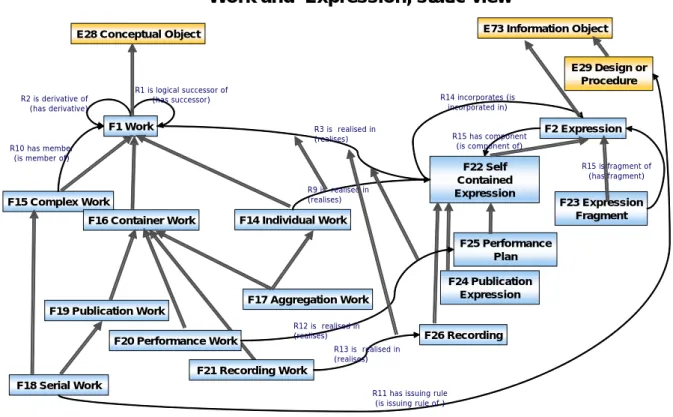
F25 Performance Plan F1 Work F15 Complex Work F14 Individual Work F2 Expression F22 Self Contained Expression R1 is logical successor of (has successor) R2 is derivative of (has derivative) F20 Performance Work F21 Recording Work F26 Recording F16 Container Work F18 Serial Work F17 Aggregation Work R3 is realised in (realises) F23 Expression Fragment R15 has component (is component of) R14 incorporates (is
incorporated in)
R10 has member (is member of)
E28 Conceptual Object E73 Information Object
R15 is fragment of (has fragment)
Work and Expression, static view
F19 Publication Work
F24 Publication Expression
E29 Design or Procedure
R11 has issuing rule (is issuing rule of ) R9 is realised in (realises) R12 is realised in (realises) R13 is realised in (realises) Figure 6
Figure 6 shows the relations that exist between “works” and “expressions” and the subclasses of both concepts, independently from any dynamic aspects involving the activities of creation and modification. It shows an analysis of the original FRBRER concepts Work and Expression into the more detailed ones that appear only
indirectly in FRBRER via attributes that are specific to these detailed concepts rather than to Work and Expression
in general. The reader may find the actual relation of these concepts to the FRBRER attributes in section 5.3 below.
In detail:
– The concepts that make up a work are realised as complete sets of signs. This fact is modelled as: F1 Work R3 is realised in (realises) F22 Self-Contained Expression.
– A set of signs may not convey the complete concept of a work; it may just be a fragment of a larger set of signs. This fact is modelled as: F23 Expression Fragment R15 is fragment of (has fragment) F2
Expression.
– A complete set of signs may be a structural part of a larger set of signs. This fact is modelled as: F2 Expression R15 has component (is component of) F22 Self-Contained Expression.
– A work can present itself as a “continuation” of some other work. This fact is modelled as: F1 Work R1 is logical successor of (has successor) F1 Work.
– A work can present itself as “derived” from another work, in many possible ways. This fact is modelled as: F1 Work R2 is derivative of (has derivative) F1 Work R2.1 has type E55 Type [of derivation].
– The notion of “work” is actually a vague one, which covers three more specific notions:
o The sum of concepts conveyed by just one complete set of signs. This is modelled as: F14
Individual Work is a F1 Work, and F14 Individual Work R9 is realised in (realises) F22
Self-Contained Expression.
o The concept of re-using some already existing material or of using some event (either
natural or involving human activity) in order to produce some new creation. This is modelled as: F16 Container Work is a F1 Work, F1 Work R3 is realised in (realises) F22
Self-Contained Expression, and (unless a natural event is being used) F22 Self-Contained Expression R14 incorporates (is incorporated in) F2 Expression.
o The conceptual unity observed across a number of complete sets of signs, which makes it
possible to organise publications into “bibliographic families.” This is modelled as: F15 Complex Work is a F1 Work, and F15 Complex Work R10 has member (is member of) F1
Work.
modelled as: F15 Complex Work is a F1 Work, and F15 Complex Work R10 has member (is member of) F1 Work.
– Works that re-use some already existing material or use some event, either natural or involving human activity (i.e., instances of F16 Container Work), are further subdivided into:
o Works that aggregate already existing expressions of other works. This is modelled as: F17
Aggregation Work is a F16 Container Work, F17 Aggregation Work is a F14 Individual
Work, F14 Individual Work R9 is realised in (realises) F22 Self-Contained Expression, and
F22 Self-Contained Expression R14 incorporates (is incorporated in) F2 Expression.
o Works that consist in establishing all the features of recordings of sounds and/or images
(either natural or involving human activity). This is modelled as: F21 Recording Work is a
F16 Container Work, F21 Recording Work R13 is realised in (realises) F26 Recording, and
F26 Recording is a F22 Self-Contained Expression.
o Works that consist in establishing all the features of a performance. This is modelled as:
F20 Performance Work is a F16 Container Work, F20 Performance Work R12 is realised in (realises) F25 Performance Plan, and F25 Performance Plan is a F22 Self-Contained
Expression.
o Works that consist in establishing all the features of a publication. This is modelled as: F19
Publication Work is a F16 Container Work, F19 Publication Work R3 is realised in (realises) F24 Publication Expression, and F24 Publications Expression is a F22
Self-Contained Expression.
o Works that consist in establishing all the features of serials are a specific case of the latter;
but serials have particular constraints as to their frequency of issuance, numbering pattern, etc. This is modelled as: F18 Serial Work is a F19 Publication Work, and F18 Serial Work R11 has issuing rule (is issuing rule of) E29 Design or Procedure [a CIDOC CRM class].
E65 Creation
F27 Work Conception R16 initiated F1 Work
(was initiated by)
F2 Expression
F22 Self Contained Expression F28 Expression Creation
R17 created (was created by)
R19 created a realisation of (was realised through)
From Work to Expression, dynamic view
E28 Conceptual ObjectF29 Recording Event
F26 Recording F21 Recording Work
R22 realised (was realised through)
F24 Publication Expression F16 Container Work F14 Individual Work
R21 created (was created by)
E5 Event R20 recorded (was recorded though) F25 Performance Plan F20 Performance Work F19 Publication Work F30 Publication Event R23 created a realisation of (was realised through)
F31 Performance E7 Activity
R25 performed (was performed in)
R24 created (was created through)
F4 Manifestation Singleton R18 created
(was created by)
Figure 7
Figure 7 shows the dynamic process through which products of the mind come into being.
– An instance of F1 Work begins to exist from the very moment an individual has the initial idea that triggers a creative process in his or her mind. This is modelled as: F27 Work Conception R16 initiated (was initiated by) F1 Work. (Note however that the F27 Work Conception class is not necessarily meant
to be implemented in any system; it was declared only because it was needed in the model from a logical point of view and because sometimes there exist historical sources documenting such facts. Library catalogues and bibliographies typically would not store any information about the circumstances under which, for instance, a writer had the initial sparkle for a new novel).
– Unless a creator leaves at least one physical sketch for his or her work, the very existence of that instance of F1 Work goes unnoticed, and there is nothing to be catalogued. At least one instance of F2 Expression that R3B realises the instance of F1 Work has to be created. This is modelled as: F28
Expression Creation R19 created a realisation of (was realised through) F1 Work, and F28 Expression
Creation R17 created (was created by) F2 Expression. Except for oral tradition and recording in human
memory, this very first instance of the respective F2 Expression would be created simultaneously on a
physical carrier, typically as a unique item or as an electronic file on a specific computer. This is modelled as: F28 Expression Creation R18 created (was created by) F4 Manifestation Singleton, as
detailed in Figures 8 and 9.
– Sound recordings and moving images are particular cases of expressions, in that they involve both external events (the “things” being recorded, either performances of works or just natural events) and decisions made by one or more than one individual (sound engineer, movie director…). This is modelled as: F29 Recording Event R20 recorded (was recorded through) E5 Event, F29 Recording Event R22 realised (was realised through) F21 Recording Work (i.e., the artistic and technical decisions made
about the recording material to be used, the location of microphones and/or cameras, the use of filters, lighting, framing, etc.), and F29 Recording Event R21 created (was created by) F26 Recording (i.e., the
set of either analogue or digital signs that are inevitably infixed on a carrier at the time they are produced – just like any other kind of expression – but are likely to be conveyed on any other carrier without losing their identity as a distinct expression).
– Publishers make decisions about all the features of a new product, and determine the complete set of signs that will be found on it. This is modelled as: F30 Publication Event R23 created a realisation of (was realised through) F19 Publication Work (i.e., a publisher’s concept of a given publication), and
F30 Publication Event R24 created (was created through) F24 Publication Expression (i.e., the set of all the signs present on a given publication, including book cover, title page, page numbers, copyright
statement, CD liner notes, text found on a DVD container, etc.).
– Performers make decisions about all the features their performance should display (whether it is an improvisation or it involves some pre-existing work such as a play or a musical composition), and may express these decisions as explicit instructions. This is modelled as: F31 Performance (i.e., the performing activity itself) R25 performed (was performed in) F25 Performance Plan (i.e., the set of
instructions for a specific performance, which R14 incorporates the text of a play, the content of a
F4 Manifestation Singleton F28 Expression Creation R6 carries (is carried by) R18 created
(was created by)
F24 Publication Expression E12 Production
From Expression to Publication
E70 Thing F2 Expression F3 Manifestation Product Type R9 carriers provided by (comprises carriers of ) F5 Item R7 is example of (has example) F32 Carrier Production Event R26 produced things of type (was produced by )
R27 used as source material (was used by )
R28 produced (was produced by)
F33 Reproduction Event
R17 created (was created by)
R29 reproduced (was reproduced by)
E84 Information Carrier
R30 produced (was produced by)
R14 incorporates (is incorporated in)
Figure 8
Figure 8 shows how products of the mind are communicated among human beings through physical carriers that eventually become part of the cultural heritage preserved in memory institutions such as libraries, archives, and museums.
Authorial output:
– A creator elaborates an expression (it can be a text, a musical score, a drawing, a map, etc.). This process is modelled as: F28 Expression Creation R17 created (was created by) F2 Expression.
– The creator externalises that expression by transforming bits of the physical world into physical carriers of his or her creation. This is modelled as: F28 Expression Creation R18 created (was created by) F4
Manifestation Singleton (e.g., a draft manuscript). Editorial product:
– A publisher elaborates the overall content of a new publication: F30 Publication Event R24 created (was created through) F24 Publication Expression (see Figure 2).
– That overall content incorporates the authorial expression such as that found, for instance, on a manuscript provided by the author: F24 Publication Expression R14 incorporates (is incorporated in) F2
Expression. Printing/manufacturing:
– The publisher sends to a manufacturer the overall content of the publication (a mechanical or paste-up, or, most often nowadays, desktop publishing files), along with instructions as to how exemplars of the publication should be manufactured: F32 Carrier Production Event R27 used as source material (was used by) F24 Publication Expression.
– As a consequence, all exemplars of the publication are supposed to be similar, i.e., can be identified as belonging to the same type: F32 Carrier Production Event R26 produced things of type (was produced by) F3 Manifestation Product Type.
– As a consequence, both the author’s expression and the publisher’s expression are to be found on all exemplars belonging to that type: F2 Expression R9 carriers provided by (comprises carriers of) F3
Manifestation Product Type.
– The manufacturing process results in physical objects, the exemplars themselves: F32 Carrier Production Event R28 produced (was produced by) F5 Item.
– Any exemplar is representative for the publication of which it is an exemplar: F5 Item R7 is example of (has example) F3 Manifestation Product Type.
– Under normal conditions, any exemplar should display the same overall content defined by the publisher: F5 Item R6 carries (is carried by) F24 Publication Expression.
Reproduction:
– Any information carrier can be reproduced by processes that render a similar item to the original used: F33 Reproduction Event R29 reproduced (was reproduced by) E84 Information Carrier. This should not
be confused with resuming the actual production process itself.
– This process results in a new instance of E84 Information Carrier: F33 Reproduction Event R30 produced (was produced by) E84 Information Carrier.
F3 Manifestation Product Type
E55 Type
CLP2 should have type (should be type of)
F2 Expression R4B comprises carriers of(carriers provided by)
E54 Dimension CLP43 should have dimension
(should be dimension of)
E57 Material
CLP45 should consist of (should be incorporated in) CLP46 should be
composed of (may form part of)
E60 Number E30 Right CLP57 should have number of parts (should be number of parts of) CLP104 subject to (applies to) E39 Actor F24 Publication Expression CLR6 should carry (should be carried by)
CLP105 right held by (right on) F5 Item F4 Manifestation Singleton F28 Expression Creation R18 created (was created by)
R7 is example of (has example)
R22 created (was created by)
Expression and Manifestation
E73 Information Object
P128 carries (is carried by)
E24 Physical Man-Made Thing
Figure 9
Figure 9 shows how FRBROO renders the meaning of the FRBRER Manifestation entity and its attributes.
Manifestation is split into F4 Manifestation Singleton (a unique, physique object) and F3 Manifestation Product Type (a publication, i.e., an abstract notion only recognisable through its physical exemplars).
Every time a writer drafts a new expression on paper (or on the hard disk of a computer, etc.), that process results simultaneously in the creation of a new information object and the production of a new physical man-made thing: F28 Expression Creation R22 created (was created by) F2 Expression, and F28 Expression Creation R18 created (was created by) F4 Manifestation Singleton. (Not all manuscripts, however, are necessarily produced by
an instance of F28 Expression Creation: a perfect copy of a brief text, made by a highly trained scribe from an original, and checked several times with the original to contain no alteration of the text, could be regarded as just the result of an instance of E12 Production; but as a rule, no two mediaeval manuscripts carry exactly the same text).
Once an authorial expression has been published, the publishing process has created a type of physical objects
that carry that authorial expression: F2 Expression R4 carriers provided by (comprises carriers of) F3
Manifestation Product Type.
As an abstraction, a publication cannot be said to have such physical characteristics as the material it “consists of” or its “number of pages”; these physical characteristics are found by a cataloguer on one of its exemplars, and the cataloguer extrapolates this to all other exemplars of that publication which will normally display the same physical characteristics. This is modelled in FRBROO as a series of “CLP” properties, i.e., “class properties” or
F3 Manifestation Product Type CLP45 should consist of (should be incorporated in) E57 Material, CLP57 should have number of parts E60 Number, etc.
R22 realised ( was realised through)
R12 is realised in (realises)
R21 created (was created by)
F14 Individual Work Henry IV part 1 Adaptation F28 Expression Creation Expression creation of Adaptation of Henry IV part 1 R19 created a realisation of (was realised through)
F22 Self-Contained Expression Henry IV part 1 Adaptation
Text
R17 created (was created by)
F28 Expression Creation Expression creation of Henry IV part 1
mise-en-scene
F20 Performance Work Henry IV part 1 idea of
mise-en-scene
R19 created a realisation of (was realised through)
F25 Performance Plan Henry IV part 1
“mise-en-scene”
R17 created (was created by)
F29 Recording Event Recording Performance 25/12/07 R20 recorded (was recorded though) R63 incorporates (is incorporated in) R25 performed
(was performed in)
F26 Recording DVD Henry IV part 1 Play 25/12/07 F31 Performance Performance 25/12/07 F21 Recording Work Henry IV part 1 recording work R13 is realised in (realises) R14 incorporates (is incorporated in)
F15 Complex Work Henry IV
R10 has member (is member of)
F16 Container Work R9 is realised in (realises) F15 Complex Work Henry IV part 1 R2 is derivative of (has derivative) F15 Complex Work Henry IV part 2 R10 has member (is member of)
Performing Arts : Added Value Chain
R10 has member (is member of)
Figure 10
Figure 10 lingers on the way FRBROO models live performing arts. In contrast to the other figures, it makes
use of a concrete example. It demonstrate how successive intellectual processes incorporate Expressions from previous ones, add new elements of different natures, and thereby “add value” to the previous steps. In this sense, the performance adds movement and sound to a text, the recording adds points of view or ways of seeing. In a detailed example:
Shakespeare’s Henry IV is a play in 2 parts: each part is itself an autonomous play, but form nevertheless
parts of a larger overall F15 Complex Work.
The text of Henry IV Part 1 is adapted in order to be performed; this process results in a new text, an instance
of F22 Self-Contained Expression.
The text of this adaptation is incorporated in the stage director’s instructions for performance, which realise his or her concept of a mise-en-scène of Henry IV.
The play is performed on December 25, 2007. That performance is filmed.
The resulting recording, which in turn incorporates some aspects of the stage director’s performing instructions, in addition to the adapted text of Henry IV Part 1, is infixed on a DVD.
Similar considerations hold for the contributions of an editor, illustrator and graphics designer to a manuscript, or the compiling of a collection of poems to the texts selected.
Figure 10 demonstrates three fundamental relationships between instances of F1 Work: • Continuation or completion of a topic (such as Henry IV part 1 and part 2)
• Derivation of an existing Expression in an alternative form (such as original and adaptation)
• Incorporation of an unaltered part of the contents of an Expression (such as play text and performance recording).
2.2 Naming conventions
All the classes declared were given both a name and an identifier constructed according to the conventions used in the CIDOC CRM model. For classes that identifier consists of the letter F followed by a number.
Resulting properties were also given a name and an identifier, constructed according to the same conventions. That identifier consists of the letter R followed by a number, which in turn is followed by the letter “B” every time the property is mentioned “backwards”, i.e., from target to domain. “F” and “R” are to be understood as the first two letters of “FRBR” and do not have any other meaning. They correspond respectively to letters “E” and “P” in the CIDOC CRM naming conventions, where “E” originally meant “entity” (although the CIDOC CRM “entities” are now consistently called “classes”), and “P” means “property”. Whenever CIDOC CRM classes are used in FRBROO, they are named by the name they have in the original CIDOC CRM. A number of properties are
identified by the letters “CLP” and a number; “CLP” stands for “CLass Property” and such properties are taken from Meta-CRM; all of them have F3 Manifestation Product Type as domain, and they indicate that all the exemplars of a given publication “are supposed to” or “should” display the features of the publication they belong to. The publication itself, being an abstract notion, cannot have physical qualities such as, for instance, a given number of pages, but meta-properties are a mechanism borrowed from CIDOC CRM and Meta-CRM that makes it possible to express that a publication is characterised by the number of pages that all of its exemplars, under “ideal” conditions, “should have.”
All classes and properties that were borrowed directly from the CIDOC CRM are named as in CIDOC CRM, i.e., with an identifier beginning with either “E” if it is a class, or “P” if it is a property, and with the original appellation for the class or property in CIDOC CRM.
The choice of the domain of properties, and hence the order of their names, are established in accordance with the following priority list:
Temporal Entity and its subclasses
Thing and its subclasses
Actor and its subclasses
Other
2.3 Property Quantifiers
Quantifiers for properties are provided for the purpose of semantic clarification only, and should not be treated as implementation recommendations. Therefore the term “cardinality constraints” is avoided here, as it typically pertains to implementations.
The following table lists all possible property quantifiers occurring in this document by their notation, together with an explanation in plain words. In order to provide optimal clarity, two widely accepted notations are used redundantly in this document, a verbal and a numeric one. The verbal notation uses phrases such as “one to many”, and the numeric one, expressions such as “(0:n,0:1)”. While the terms “one”, “many” and “necessary” are quite intuitive, the term “dependent” denotes a situation where a range instance cannot exist without an instance of the respective property. In other words, the property is “necessary” for its range.
many to many
(0:n,0:n) Unconstrained: An individual domain instance and range instance of this property can have zero, one or more instances of this property. In other words, this property is optional and repeatable for its domain and range.
one to many
(0:n,0:1) An individual domain instance of this property can have zero, one or more instances of this property, but an individual range instance cannot be referenced by more than one instance of this property. In other words, this property is optional for its domain and range, but repeatable for its domain only. In some contexts this situation is called a “fan-out”.
many to one
(0:1,0:n) An individual domain instance of this property can have zero or one instance of this property, but an individual range instance can be referenced by zero, one or more instances of this property. In other words, this property is optional for its domain and range, but repeatable for its range only. In some contexts this situation is called a “fan-in”.
many to many, necessary (1:n,0:n)
An individual domain instance of this property can have one or more instances of this property, but an individual range instance can have zero, one or more instances of this property. In other words, this property is necessary and repeatable for its domain, and optional and repeatable for its range.
one to many, necessary (1:n,0:1)
An individual domain instance of this property can have one or more instances of this property, but an individual range instance cannot be referenced by more than one instance of this property. In other words, this property is necessary and repeatable for its domain, and optional but not repeatable for its range. In some contexts this situation is called a “fan-out”.