Abstract Imperatives may be interpreted with many subvarieties of directive force, for example as orders, invitations, or pieces of advice. I argue that the range of meanings that imperatives can convey should be identified with the variety of interpretations that are possible for non-dynamic root modals (what I call ‘priority modals’), including deontic, bouletic, and teleological readings. This paper presents an analysis of the relationship between imperatives and priority modals in discourse which asserts that, just as declaratives contribute to the Common Ground and thus provide information relevant to the interpre-tation of epistemic modals in subsequent discourse, imperatives contribute to another component of the discourse context, the addressee’s To-Do List, which serves as a contextual resource for the interpretation of priority modals. This analysis predicts that the interpretation of imperatives and modals in discourse is constrained in surprising ways; these predictions are borne out.
Keywords ImperativesModality
1 Overview
1.1 Clause types and modals
Complete the analogyImperatives are to deontic modals as declaratives are to what? The answer, of course, isepistemic modals. In this paper, I will argue that this analogy is a very strict one. That is, I claim that we should analyze the relationship between imperatives and deontic modals in a way parallel to how
P. Portner (&)
Department of Linguistics, Georgetown University, Washington, DC 20057, USA
e-mail: [email protected] DOI 10.1007/s11050-007-9022-y
Imperatives and modals
Paul PortnerPublished online: 13 November 2007
we currently think about the relationship between declaratives and epistemic modals.
I don’t believe there’s much controversy concerning the relationship between declaratives and epistemic modals (though people may prefer to express it in terms of different terminologies or frameworks of dynamic semantics). If a declarative is used to make an assertion, as it canonically is, and this assertion is accepted in the conversation, the proposition it expresses becomes part of the Common Ground. What’s in the Common Ground must be used—counted as factual—in the interpretation of a subsequent epistemic modal. For example (I use A and B to label speakers in a conversation):
(1) A: The floor is all wet.
B: It must be raining outside then.
In this example, A’s utterance causes the proposition that the floor is wet to become part of the Common Ground. After this, this proposition is among the facts which determine the truth conditions of B’s sentence. (There are of course debates in the literature about precisely which propositions are rele-vant to the interpretation of an epistemic modal, but I think all experts on this topic would agree that propositions in the Common Ground are among them.)
If the analogy is correct, our uncontroversial analysis of (1) implies that there is something parallel to the Common Ground to mediate the rela-tionship between imperatives and deontic modals. The concept of a To-Do List will do the job.1 According to Portner (2004) the To-Do List of an agent a is a set of properties, and the participants in the conversation mutually assume thata will try to bring it about that he or she has each of these properties. Typically the properties correspond to actions (e.g., [kwkx.
x goes to the store in w]), and so if we are willing to be a bit imprecise, we can say that the To-Do List represents the actions that a is committed to taking.2 The argument, then, is that the relationship between imperatives and
deontic modals should be explained as follows: imperatives contribute to a To-Do List, in particular the To-Do List of the addressee. To-Do Lists are 1 The notion of To-Do List is similar to those of ‘sphere of permissibility’ (Lewis 1979) and ‘plan
set’ (Han 1998). However, these have not been worked out in terms of the type of ordering semantics proposed for To-Do Lists (see Sect. 2 below).
2 A To-Do List may also have properties like [kwkx.x is happy in w] or even [kwkx.there is world
peace in w]. Which actions one needs to undertake to make these properties true of oneself is less clear than in the case of [kwkx. x goes to the store in w], but nevertheless one can be publicly committed to trying. Because of properties like these, the name ‘‘To-Do List’’ is a bit inaccurate; it would be more accurate to call it the ‘‘To-Make-True-of-Me List’’, as pointed out to me by Craige Roberts (p.c.). But ‘‘To-Do List’’ is more evocative of its pragmatic function.
Note that I’m not taking a stand on whether actions are properties; they may only correspond to properties. As far as I can tell, properties do the work we need in making sense of the notion of a To-Do List, and so for purposes of this paper I don’t need to worry about a formal reconstruction of actions separate from properties. See Segerberg (1990) and Lascarides and Asher (2003) for approaches to imperatives which make crucial use of actions.
one of the contextual resources which contribute to the interpretation of a deontic modal. An example parallel to (1) is the following:
(2) A: Go present this proposal to our bankers today! B: I should take the 7 a.m. flight to New York then.
If this way of looking at imperatives is correct, we may be able to better understand them by making some imperatives interact in discourse with modals and then thinking about these modals in terms of a sophisticated theory of modality. As we will see in detail in Sect. 3.1, in terms of the theory of modality of Kratzer (1981) we can say that To-Do Lists help determine the ordering source for the interpretation of a class of modals which includes deontic modals. For now, we may think of this relationship as follows: at any point in a conversation, there is a contextually salient deontic conversational backgroundOsuch that, for each propertyPon the addresseea’s To-Do List and eachwcompatible with the Common Ground,PðaÞis inOðwÞ. Moreover,Ois very likely to be used in the interpretation of any deontic modal in the local stretch of discourse.
This link between the To-Do List and interpretation of deontic modals is analogous to the relationship between the Common Ground and the interpretation of epistemic modals, but there is an interesting difference. The Common Ground helps determine the modal base—not the ordering source—for epistemic modals. (Actually, the Common Ground helps determine the modal base for non-epistemic modals too, as we’ll see in Sect. 3.4.) This leads to the picture in Table 1. Such a view of the relationship between discourse semantics and modal semantics is attractive in that it gives grammar a foothold in the conception of the ordering source. That is, whereas Kratzer thinks of the ordering source (like the modal base) as something which brings information from outside of grammar into semantics, we can think of it as at least sometimes created by grammatical means. Speakers have an explicit way to affect the ordering source for a deontic modal: they just have to utter an imperative.3
If the relationships suggested in Table 1 are correct, we have a canonical mechanism for building up the modal base (declaratives) and a canonical mechanism for building up the ordering source for deontic modals (impera-tives); it would provide a nice symmetry if we could find a grammatical mechanism for helping to determine the ordering source for epistemic modals as Table 1 Data sources for modal interpretation
Modal base Ordering source
Deontic modal Common Ground + other contextual information
To-Do Lists + other contextual information
Epistemic modal Common Ground + other contextual information
Contextual information (+other?)
well. Though this is not the topic of the present paper, I speculate that evidentials serve this function. To see why, consider Kratzer’s (1981) discussion of the following example:
(3) Das mu die Burgermeister-Wei€ -Strae sein. this must the Burgermeister-Wei€ -Strae be ‘This must be the B€urgermeister-Wei-Strae.’
The use of ‘must’ here signals that the ordering source is not empty (since otherwise the sentence would be stronger than the corresponding one without the modal). The ordering source in question contains information which is held as less reliable by the speaker, for example ‘‘the route description of a friend, a tourist guide, or my own vague memories from years ago’’ (Kratzer 1981: 57). From this description, it seems that it’s the source of information, i.e., the evidential category, which renders such conversational backgrounds less than fully reliable, and so as appropriate for the ordering source rather than the modal base. At a more abstract level, just as we use deontic modals to combine information about what is the case (modal base) with information about what is preferable (ordering source), we use epistemic modals to combine information we’re committed to (modal base) with information that we consider more or less likely (ordering source), and evidentials encode information that helps us judge in which category a particular proposition fits.
1.2 Varieties of modal meaning
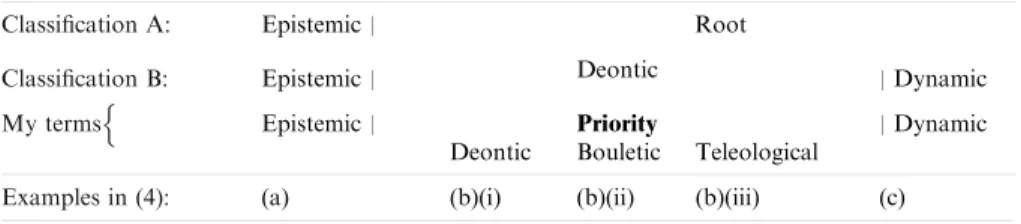
There are many ways to classify modals, but in the literature we commonly find one or both of the following: (A) a two-way distinction between epistemic and root modals, or (B) a three-way distinction among epistemic, deontic, and dynamic modals. I give examples in (4) and a summary of the classifications in Table 2:
(4) (a) It must be raining.
(b) (i) John must be sent to prison. (The law says so.)
(ii) Mary should try this brand of chocolate. (She loves dark chocolate.) (iii) Susan should quit her day job. (It’s the only way she’ll realize her
dream of becoming a successful yoga teacher.) (c) Dogs can swim.
Table 2 Terminology for categories of modals
Classification A: Epistemic | Root
Classification B: Epistemic | Deontic | Dynamic
My termsn Epistemic | Priority | Dynamic
Deontic Bouletic Teleological
Both of these systems of terminology are imperfect for my purposes. The epistemic/root distinction groups together all non-epistemic modals, and this is not useful because dynamic modals have no interesting relation to imperatives. The epistemic/deontic/dynamic classification groups modals in the right way, since the deontic group is precisely the one which I want to talk about (the one with an interesting relation to imperatives), but the term ‘‘deontic’’ is unfor-tunate, because the term is used not only for (4b) as a whole, but also for the subclass of modals relating to laws, rules, morality and the like, as in (4b)(i). This makes it difficult to talk about the subclasses of expressions which fall into the ‘‘deontic’’ class, broadly construed. In particular, when we say ‘‘deontic modals’’, do we mean all of (4b) or just (4b)(i)? Thus, I need a new term. I will call the entire class of non-dynamic root modalsPRIORITY MODALS, covering the same cases as the ‘‘deontic’’ category of the three-way classfication B. The idea behind the term ‘‘priority’’ is that some choice is given priority over another. As I will use the terms, priority modality can be divided into deontic, bouletic, teleological, and perhaps other subtypes.
1.3 Varieties of imperative meaning
Our primary data for exploring the relationship between imperatives and modals consists in the varieties of meaning displayed by imperatives, for example orders, invitations, and suggestions:
(5) Sit down right now! (order) (6) Have a piece of fruit! (invitation)
(7) Talk to your advisor more often! (suggestion/advice)
I don’t want to spend time trying to define terms like order, invitation, and suggestion. As Davies (1986: 34) says:
While it is often convenient to use labels, like these, it is perhaps worth pointing out that we should not expect to find complete agreement as to how they should be applied, what precisely is to be called a plea, what an exhortation, and so on. The brief survey which follows is sufficient to show that among linguists and philosophers the same terms have been used in very different ways.
Nor do I think that there’s any good way to say what their common ‘‘directive’’ meaning is other than the theory presented below in Sect. 3. Rather, I want to talk about the meaning of specific examples with the goal of answering three questions:
1. What gives rise to the variation in meaning among imperatives? 2. What is the correct way to make precise their meanings? 3. How does the theory of imperatives relate to that of modality?
One might think that we should simply assign imperatives a general directive interpretation, and allow the subvarieties to emerge from pragmatic reasoning
of the communicative-intentional sort. That is, the speaker counts on the addressee to be able to determine his/her intention in uttering an imperative, and this will involve figuring out what subvariety of directive force must be intended. While this type of Gricean reasoning certainly plays a role, it cannot be the whole story. A key piece of evidence for this point concerns the ‘‘psycho boss’’. You’re being sent out of town to a meeting, and your boss says: (8) Be there at least two hours early.
By itself, (8) can be taken as an order, and if your boss is that kind, you might well understand it that way. Next the boss says:
(9) Then, have a bite to eat.
If (8) was taken as an order, (9) is bizarre. You have to take it as an order too, and your boss must be crazy to order you around at that level of detail. Of course it makes sense to interpret (9) as a suggestion, but then you have to interpret (8) as a suggestion too. Why can’t (8) be understood as an order and (9) as a suggestion? You might think it’s just socially impossible to switch from being the ordering-boss to being the suggesting-boss so abruptly, but a parallel sequence with overt operators wouldn’t be odd in the same way as (8)–(9): (10) a. You are ordered to be there at least two hours early.
b. Then, I suggest you have a bite to eat.
I am going to propose an extension of the model of discourse semantics for imperatives given by Portner (2004) and a slight modification of the theory of modals of Kratzer (1981) which accounts for these facts. The analysis empha-sizes the connections between the semantics of imperatives and the semantics of modals.
1.4 Other topics
At the end of the paper, I will briefly discuss two quite disparate topics concerning imperatives in other languages:
1.Modal particles in Badiotto imperatives4
Non-negative imperative sentences in Badiotto must contain one of four particles. I will discuss the pragmatic contribution of two of them:
4 Badiotto is a Romance variety spoken in the val Badia, Italy. Study of this variety was undertaken
initially by Raffaella Zanuttini and Cecilia Poletto (Poletto and Zanuttini 2003), and later in col-laboration with the author. The descriptions of the pragmatic contexts in whichmaandmocan be used are based on interviews with speakers from several towns within the valley, and represent our analysis of what all uses of these particles (within this particular dialect) share. There are two other particles which may be used in imperatives, but their interpretations appear to vary more than those ofmaandmoamong the various parts of the valley, and are not discussed here.
(11) Imperatives withmaexpress advice, invitation, or permission. You need to eat well, so you can grow up to be big and strong: Mange-l ma!
eat-it ma
(12) Imperatives withmoexpress an order.
We can’t let the food go to waste. You have to finish it, even if you don’t want to:
Mange-l mo! eat-it mo
2.Embedded imperatives in Korean
Korean allows embedded imperatives, and the theory outlined here will help us better understand their relationship to the verbs that embed them. An example (Miok Pak, p.c.):
(13) Inho-ka Sooni-ekey cip-ey ka-la-ko malha-ess-ta. Inho-NOM Sooni-to home-to go-IMP-COMP say-PAST-DEC ‘Inho said to Sooni to go home.’
Also possible are many other matrix verbs, includingceyanhata(‘propose’), ceysihata (‘suggest’), myenglyenghata (‘order’), yokwuhata (‘request’), and cwungkohata (‘advise’).
2 Background on imperative semantics
The Common Ground is a set of propositions representing the information that is mutually presupposed by participants in a conversation (Stalnaker 1974, 1978). The canonical function of declaratives is to add the proposition they denote to the Common Ground. Parallel to this, others have proposed that interrogatives contribute to another discourse component, what Ginzburg calls the ‘Question Under Discussion Stack’ (Ginzburg 1995a, 1995b; Roberts 1996). Along the lines of Lewis (1979), Han (1998), Potts (2003) and Roberts (2004), Portner (2004) proposes that imperatives are interpreted as contributing to a third discourse component, the TO-DOLIST.
(14) Pragmatic function of imperatives (preliminary version)
a. The To-Do List functionTassigns to each participantain the conversation a set of propertiesTðaÞ.
b. The canonical discourse function of an imperative clause /impis to add½½/imptoTðaddresseeÞ. WhereCis a context of the form
hCG;Q;Ti:
Portner (2004) fits this analysis of the meaning of imperatives into a broader view of the nature of clause typing. Specifically, he argues that the relation between/imp and TðaddresseeÞ does not need to be written down anywhere is
the grammar because it follows from two facts:
1.TðaÞ is a set of properties, for any participanta. Imperatives denote prop-erties. Therefore the natural way to use/imp to updateCis to add it to some
a’sTðaÞ.
2. As a result of the semantics of imperative subjects,5/
imp expresses a property
which can only be true of the addressee:
(15) ½½Sit down!¼ ½kwkx:x¼addresseeC:x sits down in w
Therefore, it would not be sensible to add½½/imptoTðaÞfor anyaother than
the addressee.
For purposes of this paper, it does not matter whether the fact that an imperative is added to the addressee’s To-Do List follows from general prin-ciples, as argued by Portner (2004), or is stated explicitly in the form of (14b). The To-Do List functions to impose an ordering on the worlds compatible with the Common Ground, and this ordering determines what actions an agent is committed to taking (Portner 2004):
(16) Partial ordering of worlds:
For anyw1;w22 \CGand any participant i;w1<iw2 iff for some P2TðiÞ;Pðw2ÞðiÞ ¼1 and Pðw1ÞðiÞ ¼0, and for allQ2TðiÞ;if Qðw1ÞðiÞ ¼1;thenQðw2ÞðiÞ ¼1.
(17) Agent’s commitment:
For any participant i, the participants in the conversation mutually agree to deemi’s actions rational and cooperative to the extent that those actions in any worldw12 \CGtend to make it more likely that
there is no w22 \CG such that w1<iw2.
This analysis is closely related to that of Lewis (1979). In particular, the Common Ground corresponds to Lewis’ sphere of accessibility and the worlds ranked as ‘‘best’’ by the To-Do List correspond to his sphere of permissibility. The theories differ in that the To-Do List does not simply define a set of worlds, like the sphere of permissibility, but rather an ordering. See Portner (2004, to appear) for arguments that an ordering semantics is superior.
5 On the properties of imperative subjects, see for example Schmerling (1975), Platzack and
The Common Ground and To-Do List are both formally and intuitively parallel to the modal base and ordering source, respectively, in Kratzer’s semantics for modals. In Kratzer (1981), the modal base delimits the set of possible worlds which are relevant to the interpretation of a modal, while the ordering source orders them according to some standard (e.g., laws, desires, etc.). This is just what the Common Ground and To-Do Lists do at the public, mutually presupposed discourse level. The set of worlds compatible with the Common Ground are those which will be treated as candidates for reality within the interaction, and the To-Do List of each individual will rank those worlds according to how successful that individual is in bringing about what he or she is committed to bringing about. One way of seeing the point of this paper is as saying that this parallel between sentence-level modal semantics and discourse-level clause-type semantics is a deep one, and not an accidental technical similarity.
3 The relationship between imperatives and modals
The idea that imperatives should have something to do with the interpretation of deontic modals is extremely intuitive. Without any concern for formal the-ories of discourse, one could accept the following description of language use: In some cases, the utterance of an imperative imposes an obligation on the addressee, and once one has acceptedP as an obligation ofa, one will have to judgemustðPðaÞÞtrue (provided thatmusthas the relevant reading, of course, i.e., ‘‘in view of a’s obligations’’). That is, any contextual parameters which determine the truth conditions for sentences withmustwill have to be adjusted so as to guarantee mustðPðaÞÞ’s truth. In this section we’ll work towards a formal model of this relationship between imperatives and modals. In Sects. 3.1–3.4, we’ll develop a better understanding of the range of empirical facts that need to be explained; then in Sect. 3.5, I will sketch a precise theory. 3.2 Imperative subtypes
The variety of subtypes of imperative clauses parallels the range of interpre-tations of modal verbs, in particular, priority modals. Because the meanings of modals and imperatives can be subclassified indefinitely, all that one can do to argue that this parallel is general is to show many motivational examples. Here are a few; more will appear throughout the rest of the paper:
(18) Sit down right now! (order)
Noah should sit down right now, given that he’s been ordered to do so. (deontic)
(19)a. Have a piece of fruit! (invitation)
b. Noah should have a piece of fruit, given that it would make him happy. (bouletic)
(20)a. Talk to your advisor more often! (suggestion)
b. Noah should talk to his advisor more often, given that he wants to finish his degree. (teleological)
Note that the (b) sentences have uses which don’t just report something Noah should do, but which in fact create an obligation/invitation/suggestion. That is, the (b) sentences can be used in ways which are rather similar to the (a) sen-tences. These ‘‘performative’’ uses of modals are discussed in Sect. 3.3, but for the present they are not relevant. Our goal in this section is to compare the semantics of modal sentences as analyzed within possible worlds semantics with the pragmatic function of imperatives. On its own, possible worlds semantics just delivers truth conditions. Thus, for the time being, it is important to read the modal sentences only as assertions which could be judged true or false.
In terms of the system of modal interpretation proposed by Kratzer (1981), the deontic interpretation of (18b), the bouletic interpretation of (19b), and the teleological interpretation of (20b) are due to the choice of ordering source. All three have realistic (circumstantial) modal bases, but the ordering source of (18b) is a set of requirements, that of (19b) is a set of desires, and that of (20b) is a set of goals. The ordering source ranks the worlds compatible with the modal base, and (simplifying somewhat) the sentences with should are true iff the prejacent is true in all of the best-ranked worlds among those compatible with the modal base. This explains the variety of flavors of modal interpretation for the (b) sentences.
Given the parallel between the meanings of imperatives and the subtypes of priority modals, I would like to suggest that To-Do Lists also come in a variety of flavors in the same way that ordering sources do. We can think of this in terms of each participant in a conversation having multiple To-Do Lists or (as I prefer) in terms of To-Do Lists being organized into sections. Speaking roughly, (18a) goes onto a part of the addressee’s To-Do List which represents orders, (19a) goes onto a part which represents desires,6 and (20a) goes onto a part which represents goals. An utterance of (18a) is an attempt by the speaker to get the property of sitting down right now added to the addressee’s ‘‘deontic To-Do List’’ similarly for (19a) (‘‘bouletic To-Do List’’) and (20a) (‘‘teleological To-Do List’’).
There is some evidence in English for the grammatical reality of distinct categories of imperative interpretation. It has been noted by Potsdam (1996)
6 Wilson and Sperber (1988) suggest that permission imperatives are simply imperatives
repre-senting something the addressee desires. More recently, Schwager (2005a) has made more or less this same proposal in terms of a modal semantics for imperatives. This idea seems right to me. I will not discuss permission sentences in this paper, since they are such a difficult topic as to require 40 pages on their own. I speculate, though, that the difference between invitations, discussed here, and permissions is whether it is presupposed that the speaker has the authority to prohibit the act in question.
that English imperatives with an overtyou subject signal the authority of the speaker over the addressee7:
(21)a. Pass the salt! b. You pass the salt! (22)a. Don’t move!
b. Don’t you move!
There is a clear difference between the (a) and (b) sentences here. The semantic effect ofyoucan be described in terms of the present theory by proposing that youis only possible with a particular subvariety or subpart of a To-Do List, namely a deontic one representing the properties which are on the addressee’s To-Do List on the authority of the speaker. Better evidence, based on data from Badiotto, that subvarieties of To-Do Lists can be grammatically marked will be presented in Sect. 4.1 below.
While I want to emphasize the similarities between imperatives (e.g., (18a)) and modal sentences (e.g., (18b)), note that I am not saying that their semantics is the same. The parallel is in the fact that (18a) and (18b) both have to do with ‘‘the rules’’. The difference is that the modal (18b) says that sitting down follows from the rules, while (18a) is used to make it one of the rules. But the two things are connected. If, as I will argue below, the deontic To-Do List is a subset of the deontic ordering source used subsequently in the same unit of discourse, a successful utterance of (18a) will lead to the truth of (18b), provided that the imperative is consistent with everything else in the ordering source and modal base.8
3.2 Imperatives and modals in discourse
We saw in Sect. 1.3, examples (8)–(9), that a pair of imperatives in discourse very strongly tends to get a single subvariety of imperative meaning. In light of the parallelism between the semantics of imperatives and that of priority modals, we can now see that this phenomenon is more general, and applies to
7 Example (21b) is odd without the right kind of annoyed or angry intonation. It’s important not to
allow a pause betweenyouand what follows, since this would give rise to a vocative interpretation ofyou.
8 There is a long history of relating different subtypes of imperatives to notions like the speaker’s
desires, goals, and so forth; see Davies (1986) for an overview. More recently, Han (1999) and Schwager (2007) connect this intuition to the ordering source. Han says that imperatives contribute to the ordering source, while Schwager claims that subtypes of imperatives are distinguished by the type of ordering source they employ. Both of their ideas are similar to those presented here. However, their approaches differ in that they claim that imperatives contain a modal operator, whereas I draw the link more abstractly, through the notion of To-Do List and its connection to ordering sources of overt modals; I will argue against their approach in Sect. 3.3 below.
modals as well. A sequence of priority modal sentences shows a similar restriction to a sequence of imperatives. For example:
(23)a. You should give more of your income to the poor. b. And you should try this single malt scotch.
(23a) by itself is naturally read with a deontic (moral) interpretation, while (23b) by itself is naturally read as an invitation in view of your desire for pleasure; but in sequence, the two must get the same kind of interpretation. In particular, the latter is interpreted in terms of the same kind of modality as the former, leading a rather odd implication that one is morally required to try the scotch.
A sequence with an imperative followed by a modal, or a modal followed by an imperative, is similar as well. Both sentences in the following examples have ordering interpretations, even though the (b) sentences would naturally be interpreted as suggestions if they weren’t produced in combination with the (a) sentences. This leads to some degree of strangeness for the (b) examples. (24)a. You must be there at least two hours early.
b. Then have a bite to eat in that cute little place on the corner. (25)a. Be there at least two hours early.
b. Then you must have a bite to eat in that cute little place on the corner. The following ones are interpreted as advice (‘‘in view of your desire to grad-uate’’), as makes sense given the content of the (a) examples, even though the (b) examples are strange on this interpretation:
(26)a. You should talk to your advisor more often. b. And read some comic books.
(27)a. Talk to your advisor more more often. b. And you should read some comic books.
The pattern here is that once a particular subvariety of meaning is selected for an imperative, it has a strong tendency to carry over onto subsequent imperatives and priority modals, and once a particular subvariety of interpretation is selected for a priority modal, it carries over onto subsequent priority modals and imperatives. That there is a tendency of this kind should not be surprising. It accords with the intuition that if we’re reasoning or planning in terms of a particular kind of priority (to lead a moral life, to enjoy lunch, to escape graduate school with a Ph.D., or whatever), we should focus on that particular priority until we’re done with it. The priority itself is a topic, in some very loose sense.
I give an account of these patterns in Sects. 3.4 and 3.5. This account is based on the idea that the semantics of imperatives and that of priority modals are related; in particular, the ordering sources used to interpret priority modals are linked to the To-Do Lists used to represent the meaning of imperatives. My main goals in this paper are to show that such a link exists and to understand what the semantic analysis of modals and imperatives must be like if we are to
give a precise account of it. It’s not crucial to this paper what the exact status of the link itself is—whether it is the result of a principle of discourse semantics (like the management of the reference time through a discourse, perhaps) or of a communicative strategy motivated by some general notion of orderliness (something like the conventions of film editing). However, I think that the evidence favors the perspective that it’s a semantic matter, since it’s clear that the pattern has to do with imperatives and modals in particular, not with just any sentences concerning what we are ordered to do, what furthers our desires, and so forth. This point is made clear by the fact that (10) is not odd. See Sect. 3.5 for additional discussion.
3.3 Why imperatives aren’t modal sentences
Given the similarity between imperatives and priority modal sentences, why don’t we just assume that imperatives contain covert modals (as in, for example, Han (1999) and Schwager (2005, 2007))? That is, why don’t we analyze (18a) as something very similar to (18b)? The first challenge such an approach needs to get past is certainly familiar: Modal sentences like (18b) can be called ‘‘true’’ or ‘‘false’’, while imperatives intuitively cannot. In terms of the proposal here, this is because a modal sentence is proposed for addition to the Common Ground, while an imperative is proposed for addition to the addressee’s To-Do List.9 Thus, (18b) will be judged false if the rules fail to imply that he sits down. Of course, (18b) has a use which imposes a requirement on Noah, a point which is more clear in sentences with a second person subject.
(28) You should sit down right now.
We do need to analyze this ‘‘performative’’ use of (28), since it’s not immediately captured by standard semantic analyses of modals. With such an analysis in place, we might then say that imperatives contain a modal which can only have a performative use, whereas regular modals can have either a performative or a non-performative use. This seems to be the intuition behind Han’s and Schwager’s proposals.
The basic problem with this way of looking at things is that once we have come to understand what the performative use accomplishes over and above the truth-conditional semantics of the modal, we see that this additional meaning is just what we need in order to analyze imperatives. The basic, truth-conditional semantics of the modal doesn’t contribute at all, and might as well be left out of our analysis of imperatives. A revealing way of seeing this point comes from the recent work of Ninan (2005). He argues that puzzles concerning the interpre-tation of deonticmustin root clauses show that it has a performative, imper-ative-like component of meaning in addition to its ordinary truth-conditional, modal meaning. This means that our ordinary semantics for modals is not 9 The idea that imperatives denote properties is also relevant here, since properties could not be
added to the Common Ground. But I don’t want to insist on this difference in type between modal declaratives and imperatives in this section, in order to focus on the more important arguments that imperatives are not modal sentences.
going to provide us with an analysis of the function of imperatives. Rather, it’s the other way around: we need to study how imperatives work, and then this can help us understand the performative uses of modals.
Let us look at Ninan’s claims in a bit more detail. He provides two argu-ments that sentences withmusthave an imperative-like component of meaning. The first argument is based on data like the following (Ninan 2005, (4)–(6)): (29)a. #Sam must go to confession, but he’s not going to.
b. #You must go to confession, but you’re not going to. c. #I must go to confession, but I’m not going to.
Ninan claims that the sentences in (29) may be true, but they are never asser-table. They are not assertable because they actually impose the obligation that they report. One cannot felicitously utter a sentence with the intention to impose an obligation if one knows that obligation will not be met. Thus (29b) is parallel to (30) (Ninan 2005, (11)):
(30) #Go to confession! You’re not going to go to confession.
Examples containingmustin (29) contrast with those containingshouldin (31) (based on Ninan 2005, (1)–(3)).
(31)a. Sam should go to confession, but he’s not going to. b. You should go to confession, but you’re not going to. c. I should go to confession, but I’m not going to.
Must and should contrast because must imposes an obligation as part of its conventional meaning, whileshoulddoes not (though if the context is right, it may do so via implicature). That is, in (29a) by saying Sam must go to confession the speaker attempts to impose on Sam the obligation to go to confession, and this conflicts withhe’s not going to. In contrast, while in isolationSam should go to confessionmight be used to impose an obligation on Sam via implicature, this implicature cannot arise in (31a) because it would conflict withbut he’s not going to.
The second puzzle is based on the following data (Ninan 2005, (7) and (8))10:
10 Example (i) is OK and clearly has a deontic meaning.
(i) Sam must have gone to confession by the time I get back.
I believe that (33) can have a deontic meaning as well, if the context makes clear that a reading is intended on which the event time is in the future, along the lines of ‘‘by the time I get back’’. Ninan’s explanation for the unacceptability of (33) involves the proposal that perfect have in modal sentences is uniformly interpreted as a past tense. However, in light of (i), this proposal is untenable. Instead, the perfect form has its aspectual meaning in this example, whatever that is (see Portner 2003 for a recent discussion). The problem with (33) is that it is difficult to get a reading in which the event time follows the speech time, and given this, the sentence is unacceptable because one cannot impose an obligation concerning the past (just as Ninan says). In contrast, with the adverbialby the time I get back, or in the right kind of context, it is possible for the event time to follow the speech time, and thus the deontic reading is acceptable. There is a puzzle as to why it is extremely difficult to have the event time follow the speech time in the absence of an adverbial, but this turns out to be a general issue with the semantics of the perfect. See Portner (2003) for discussion.
(32) Sam should/ought to have gone to confession. (Deontic reading available.)
(33) Sam must have gone to confession. (Epistemic reading mandatory, deontic reading unavailable.)
This pattern is explained because one cannot impose an obligation concerning the past. If Sam went to confession, there’s no point in imposing the obligation, and if he didn’t, there’s still no point.
Moreover, Ninan argues that these properties of must only apply to unembedded occurrences. Embedded must contributes to the compositional semantics of the sentence it’s a part of by means of traditional modal truth conditions.11
(34) Since John must go to confession, he should find a church soon. This shows that must has truth conditions, though they are obscured in unembedded contexts.
Since it seems thatmusthas an obligation-imposing function, in addition to a traditional truth-conditional semantics, as part of its conventional meaning, the next question is what the nature of this obligation-imposing reading is. Ninan proposes to model it in terms of the notion of To-Do List (Portner 2004). Thus, he explains (29a) as follows: uttering the sentence places the property of going to confession on Sam’s To-Do List. But one cannot place a requirement on some-one’s To-Do List while at the same time asserting that it will not be met, and therefore the sentence is anomalous. What’s important here is that the ordinary, truth-conditional semantics for the modal does not play a role in explaining the patterns in (29) and (30). Rather, the independent imperative-like meaning does
11 The contrast between unembedded and embedded deonticmustis probably related to the puzzles
concerning the interpretation of epistemicmust. There are arguments that epistemicmustis an evidential and/or doesn’t contribute truth conditions (e.g., Halliday 1970; Lyons 1977; Drubig 2001; Bennett 2003); see von Fintel (2003) for general discussion and especially the point that these arguments seem to fail in light of the fact that embedded occurrences of epistemicmustclearly do contribute to truth conditions. I suspect that unembedded occurrences of deontic and epistemic mustare special in precisely the same way, adjusting for the differences between deontic and epistemic modals. The crucial questions are then: (a) in what way they are special, and (b) why only unembedded occurrences are special in this way. In light of my suggestion above that evidential categories can be used to determine the ordering source used for epistemic modality, we could answer (a) by saying thatmustin a root clause always performs a special speech act with the clause it takes as argument. In a deontic example, this speech act is imperative-like, as proposed by Ninan. In an epistemic example, the speech act would relate to evidentiality. A lot of work remains to be done to turn this intuition into an analysis. See Lyons (1977), von Fintel (2003), Papafragou (2006), Swanson (2006), Portner (2007, to appear), among others, for more on the idea that epistemic modals have a complex analysis at the level of speech acts.
the job. We cannot get away without a method of representing what it means to impose an obligation, with the To-Do List or some similar notion.12;13
The lesson of this section is that it is not helpful to analyze imperatives as modal sentences which only have a performative use. A modal which only had a performative use might as well not be called a modal at all. The performative aspect of its meaning, modeled as the addition of its prejacent to the To-Do List or in some other way, would explain everything that needs to be explained about its meaning. In addition there are no overt modals whose sole function is to update a To-Do List (even must has modal truth conditions as well, as demonstrated by its use in embedded contexts). For these reasons, we’re better off simply saying that an imperative’s only role is to add to the To-Do List. 3.4 The relationship between To-Do Lists and conversational backgrounds
3.4.1 General discussion
Before we attempt to improve the formal model of imperative interpretation, there are a couple of questions that must be addressed:
1. How do the subtypes of To-Do Lists relate to one another? Are they separate, or are they extracted out of a unified To-Do List which combines requirements of various kinds?
12 Ninan discusses a problem which arises for his proposal with the following, his (22):
(i) The Pope must change his position on contraception.
How can I utter (i) if I’m in no position to impose an obligation on the Pope? His intuition is that in uttering (i), I impose (perhaps rhetorically) an obligation on myself, or on myself and my addressee(s), to do something to get the Pope to change his position. It has the feeling of the beginning of a manifesto or a rallying-cry. I think that Ninan’s idea concerning (i) becomes more plausible if we relate it to (19a) or (20a). It seems thatmustshifts to a bouletic or teleological meaning here, just as an imperative or a sentence withshouldcan. To my mind, (i) is most plausibly understood with a teleological meaning:in view of the goal of protecting women’s health in poorer countries..., or some such conversational background.
13 Schwager (2007) sketches a modal analysis of imperatives which aims to deal with their performative
character. As mentioned above, she proposes that imperatives are modal sentences which only have a performative use. In explaining why they only have a performative use, she places three requirements on the conversational backgrounds used by the hypothesized imperative modal. The first is that the speaker has exhaustive knowledge about each of these conversational backgrounds. This point does not seem plausible, as it implies that the speaker has exhaustive knowledge of the addressee’s preferences, goals, and desires. The second and third are described in a single sentence each (p. 9 in online version):
Second, we require that the ordering source is preference related, in order to rule out ordering sources likewhat the speaker takes to be most plausible, etc.
Third, the speaker has to affirm the ordering source incas a good maxim for acting in the given scenario.
While the second point is unproblematical, the third is both crucial and difficult to understand. What is ‘‘a good maxim for acting in the given scenario’’? (I don’t think ‘maxim’ means Gricean maxim here, but neither does the dictionary definition seem appropriate.) I suspect that if this notion is developed in a more precise way, it will amount to treating the ordering source as a To-Do List.
2. What is the relationship between the subtypes of To-Do Lists and the conversational backgrounds that can function as ordering sources?
As for question #1, I think it makes more sense to have a unified To-Do List and select out relevant subsets of it when necessary. At the heart of imperative semantics is the definition of when an agent is behaving rationally and coop-eratively, relative to their commitments and the Common Ground. This is what I attempt to formalize in (17). More concretely, by doing things this way we can make clear why it’s odd to give conflicting imperatives even when they are of different subtypes (unless you have changed your mind, of course), as shown in example (35). This pair of sentences cannot be coherently uttered by a single speaker; in contrast, the corresponding pair of modal sentences, (36), is perfectly fine (though (36) reports an unfortunate situation):
(35) Stay inside all day! (order)
#Since you enjoy the nice weather, go out and play a little bit. (suggestion)
(36) In view of your obligations, you ought to stay inside all day. But in view of what you want, you ought to go out and play a little bit.14
I would explain (35) by saying that it results in an inconsistent To-Do List. However, one might also look at it as showing (once again) that it’s hard to shift from an ordering imperative to a suggesting imperative. That is, the argument here is only good to the extent that the second sentence in (35) can have a suggestion reading in the context of the first sentence issuing an order. Though two imperatives uttered in sequence strongly prefer to get the same variety of meaning, a change is of course possible if enough time intervenes: (37) [Morning] Write up a report on your trip to New York! (order)
[Time spent working; friendly chat over water cooler; etc.] [Lunch time] Have a cookie! (suggestion)
Even imagining a situation in which the first sentence of (35) is uttered in the morning and the second in the afternoon, so that the first is an order and the second a suggestion, the pair can only be taken to imply that the speaker has changed his or her mind. Otherwise, it is odd because the speaker has given inconsistent imperatives, and the difference between an order and a suggestion seems not to reduce the sense of inconsistency.
14 The pattern with modal auxiliaries is interesting, somewhere in between imperatives andought to:
You should/must stay inside all day. . .:But in view of what you want, you ?should/*must go out and play a little bit.The fact that the examples withmustare bad follows from Ninan’s (2005) analysis.
3.4.2 Declarative—Common Ground—epistemic modal
A question parallel to #2 is what the relationship is between the Common Ground and an epistemic conversational background. As far as the dynamics of conversation go, one is committed to treating everything in the Common Ground as part of the epistemic conversational background when evaluating an epistemic modal. Thus the following is odd:
(38) A: The book is not in the library.
B: Yes. #Maybe it’s on the fourth floor of the library.
However, one is not committed to supplying every proposition relevant to the interpretation of an epistemic statement to the Common Ground:
(39) A: The book must be in the library.
B: Why do you say that? I couldn’t find it there.
A: I can’t say more, but trust me, it must be in the library.
I conclude that the Common Ground should be a subset of any epistemic conversational background.
3.4.3 Declarative—Common Ground—priority modal
The situation is parallel when we look at the relationship between the Common Ground and the realistic (circumstantial) modal base used with priority modals. Here are some examples involving a teleological reading of
should:
(40) A: The book is not in the library.
B: Yes. #You should look for it on the fourth floor of the library. (41) A: You should look for the book on the fourth floor of the library.
B: Why do you say that? I couldn’t find it there.
A: I can’t say more, but trust me, you should look there.
3.4.4 Imperative—To-Do List—priority modal
Now we turn to the relationship between an imperative and the ordering source for a priority modal. We’ll focus on a deontic case; the bouletic and teleological examples work similarly. There is a wide variety of deontic con-versational backgrounds modeling obligations in view of the law, tradition, morality, etc. Therefore, we expect that patterns like the ones we’ve been looking at should be unacceptable if the modal uses an ordering source which matches the interpretation given to the imperative, and acceptable with other
kinds of ordering sources. Our first expectation is borne out; example (42) is bad as expected.15
(42) A: Pay your taxes!
B: OK. #Should I pay my taxes?
(OKhere is meant to indicate that B accepts what A said.) As we’ve seen in Sect. 1.3, it is very difficult to switch to an ordering source for the modal which does not match the interpretation of the imperative. That is, if the imperative is seen as representing the law, for example, the modal very strongly prefers a reading based on what’s necessary in view of the law; if the imperative is seen as representing what’s morally correct, the modal strongly prefers a parallel interpretation. Because of this, examples (43) and (44) are nearly as bad as (42) even though the difference in kind between the To-Do List and the ordering source is explicit and the contrast is overtly marked.
(43) A: Pay your taxes!
B: OK. #But in view of my moral obligations, should I pay? (44) A: Pay your taxes!
B: OK. ?#But in view of myMORALobligations, should I pay?
If the imperative has an explicit phrase indicating the subvariety of directive force it has, the sequence becomes more acceptable:
(45) A: Given that you’ll go to jail if you don’t, pay your taxes! B: OK. ?But in view of myMORAL obligations, should I pay?
It seems that thegiven thatphrase in A’s utterance somehow indicates that the life-span of the particular variety of directive force used by the imperative is restricted to the sentence itself. For reasons of space, I don’t develop a theory of phrases like those introduced bygiven that orin view of in this paper, but I think one should be able to get the right effect by treating them as local operators on the modal parameters of interpretation, likeif-clauses.16
If we don’t use a modal auxiliary but rather form our modal sentences with
have toorneed to, the examples are generally better: (46) A: Pay your taxes!
B: OK. #Do I need to pay my taxes? (47) A: Pay your taxes!
B: OK. ?But in view of my moral obligations, do I need to pay? 15 If the individual to whom the obligations are relevant is changed, there are no restrictions:
(i) A: Pay your taxes!
B: OK. Does everyone need to pay their taxes?
16 One might also try to explain this effect in terms of a hypothesized need for a symmetric
contrastive focus in this context: the imperative must contain something overt forMORALto contrast with, and this element must itself be focused.
(48) A: Pay your taxes!
B: OK. ?But in view of my MORALobligations, do I need to pay?
It seems that modal auxiliaries are in some way more closely tied to the To-Do List than periphrastic expressions likehave toandneed to. I’m not sure what to make of this contrast, but I would note that in general modal auxiliaries seem to be more closely tied to discourse-level interpretive processes than periphrastic expressions of modality. The discourse function ofmust, adding a property to the To-Do List, is an extreme example of this pattern.17In the rest of this paper, I will
continue to focus on the relationship between imperatives and modal auxiliaries. The pattern outlined above suggests the following generalization:
(49) Within a sequence of sentences in a conversation, the To-Do List strongly tends to be a subset of any deontic ordering source focusing on the same individual.
We can view this pattern as arising from two factors:
1. The To-Do List of a particular variety (e.g., my legal obligations) must be a subset of any deontic ordering source of the same variety. (This is parallel to the relationship between the Common Ground and an epistemic/realistic modal base.)
2. Within a sequence of sentences, it is difficult, and sometimes downright impossible, to employ a To-Do List of one variety and a deontic ordering source of another variety. (This is simply a restatement of the observation in Sect. 3.2 that within a sequence of sentences all of the imperatives and priority modals strongly tend to have the same subvariety of meaning.) The facts discussed in this section show that we need a way of talking about To-Do Lists and ordering sources which allows us to state precise constraints on their natures and the relationships between them.
3.5 An extension of the model of imperative interpretation
In this section, we’ll develop a formal model of imperative interpretation which, in combination with a slighly adjusted version of the semantics for modals presented by Kratzer (1981), provides an explanation of the facts discussed so far. Here are some concepts we’ll use:
(50) A conversational backgroundcbis a function from worlds to sets of propositions (Kratzer 1977, 1981).
(51) A To-Do List functionTassigns a set of propertiesTðaÞto any participant in the conversationa.
17 The discourse orientation of modal auxiliaries is probably what descriptive linguists have in mind
when they talk about the ‘‘subjectivity’’ of modals. See Palmer (2001) and Portner (to appear) for a discussion of subjectivity in deontic modals.
At a particular world, a conversational background gives us a set of proposi-tions. We’re going to need to select out subsets of these sets:
(52) A selection functionfis a (possibly partial) function taking two arguments, a worldwand a set of propositionsS, and returning a subset ofS.
(53) A parameterized selection functionhis a (possibly partial) function taking narguments (n>2), namelyn2 individuals, a world, and a set of propositionsS, and returning a subset ofS.
We can describe a selection function as deontic if it meets the following description:
(54) For any worldwand set of propositionsS, ifdeonticðw;SÞis defined,
deonticðw;SÞ ¼ fp: p2S^pexpresses an obligation inwg
Note thatdeonticðw;SÞmay be partial. We do not insist that it is able to select the obligations from any arbitrary set of propositions. Rather, in order to be useful for present purposes, it is sufficient that it be able to select the obligations from the kinds of sets that it encounters in the course of interpretation. In particular,
deonticðw;SÞmust be defined whenwis a world compatible with the Common Ground andS is the result of applying a conversational background tow.18
18 A reviewer asks a question related to the partiality of selection functions. He or she points out
that if ‘‘pexpresses an obligation inw’’ is taken as a primitive predicate, we might think we could give the semantics formust pas follows:must pis true inwiffpexpresses an obligation inw. This would render our entire complex modal semantics unnecessary. However, my intention is not to suggest that we have an understanding of a function that can determine (without any recourse to modal semantics) whether an arbitrary proposition is an obligation inwor not. Rather, we can grasp a function which selects, from the kind of setscbðwÞwhich arise in the course of semantic interpretation, those members ofcbðwÞwhich are obligations inw.
For example, in a conversation about where we should park, the context might determine a cbðwÞwhich has among its members some of the parking regulations which apply to our car in this town. Our understanding of the situation is sufficient to allow us to select out these regulations using deontic. The meaning ofWe must not park on the sidewalkwould then involve this set, but for familiar reasons it cannot be reduced to checking whetherp(i.e.,We do not park on the sidewalk) is one of the propositions in the set. Indeed, it is unlikely thatpis a member ofcbðwÞ, since the town’s parking regulations probably don’t mention us in particular, and may only preclude sidewalk parking indirectly and in certain circumstances, through the interaction of a number of interrelated definitions, regulations, and exceptions. The meanings which we assign to modal expressions, involving logical relations like entailment and the interaction between modal base and ordering source, are designed to squeeze the right consequences out of this set.
Thus, with regard to the issue raised by the reviewer, selection functions have the same status as conversational backgrounds within Kratzer’s theory. For example, in her system the conversational background indicated byin view of what the law providesdoes not include every proposition which expresses a legal requirement. That would be too much to ask of a contextual parameter. Rather, it just gives a set of laws. In fact, one could recast my proposal by replacing selection functions with conversational backgrounds of a special sort. Such a conversational backgroundhwould return a set of propositions and properties at each worldw, andhðwÞwould be intersected withTðaÞor cbðwÞ.
In this paper, the real work is going to be done by parameterized selection functions. Here are some examples:
(55) For any individual x, worldw, and set of propositionsS: a. if it is defined,deonticxðw;SÞ ¼ fp:p2S^p expresses an
obligation ofxin wg
b. if it is defined,bouleticxðw;SÞ ¼ fp:p2S^pexpresses a
desire ofxin wg
c. if it is defined,teleoxðw;SÞ ¼ fp:p2S^pexpresses a goal
ofxin wg
Selection functions will be used to interpret both modals and imperatives. Therefore, because I’m assuming that a To-Do List is a set of properties, not a set of propositions, we’ll need to allow selection functions to select from sets that include properties or propositions:
(56) For any individual x, worldw, and set of propositions or propertiesP: a. if it is defined,deonticxðw;PÞ ¼ fy2P:yexpresses an obligation
of xinw_yðxÞexpresses an obligation ofx inwg
b. if it is defined,bouleticxðw;PÞ ¼ fy2P:y expresses an desire
of xinw_yðxÞexpresses an desire ofxin wg
c. if it is defined,teleoxðw;PÞ ¼ fy2P:y expresses an goal
of xinw_yðxÞexpresses an goal ofxinwg
When it is used to interpret an imperative, the individual argument of a parameterized selection function is always the addressee. I will refer to parameterized selection functions, for example deonticx, as ‘‘selection
func-tions’’ too. I typically usehas a meta-logical variable over selection functions. Thus, depending on context,h could refer to a simple selection function (e.g.,
deontic), a parameterized selection function (deonticx), or a selection function
formed from a parameterized selection function and its individual argument (deonticaddressee).
Of course, in the end we will need to define many more finely grained selection functions thandeonticx,bouleticx, andteleologicalx; for example, the
discussion of overt you subjects of imperatives suggests that we need to rec-ognize a subvariety of deontic selection function which picks out those prop-ositions which are on the addressee’s To-Do List by virtue of the authority of the speaker (approximately, ‘‘orders’’). But because my goal in this paper is to develop a framework for imperative semantics that lets us understand variation in imperative meaning and the relationship between imperatives and modals in discourse, and not to develop a comprehensive classification of imperative meanings, I will not spend time trying to describe particular selection functions in a precise way. Rather, I’ll frame this discussion mostly in terms of general categories like deontic, bouletic, and telelogical. (Section 4.1 examines precisely which selection functions we need to understand grammatically marked sub-types of imperatives in Badiotto.)
With these resources in mind, we are now ready to improve upon our formalization of the pragmatic function of imperatives. Intuitively, an
imperative updatesTðaddresseeÞ, and the property expressed by the imperative is selected byhðw;TðaddresseeÞÞfor the salient selection functionh. This update potential is defined in (57):
(57) Pragmatic function of imperatives
The canonical discourse function of an imperative clause/impis as follows.
WhereCis a context of the formhCG;Q;T;hi:
a. Cþ/imp is defined only ifhaddresseeðw;TðaddresseeÞÞis defined, for
everyw2TCG.
b. Provided that it is defined,Cþ/imp¼ hCG0;Q;T0;hi, where: (i)T0is just likeTexcept thatT0ðaddresseeÞ ¼
TðaddresseeÞ [ f½½/impg; and
(ii)CG0¼CG[ ffw2 \CG:for any set of propertiesS, if
haddresseeðw;SÞis defined,½½/imp 2haddresseeðw;SÞgg.
A brief aside concerning the precise way in which (57) has been formulated: point (57b)(ii) defines the part of the conversational update which ensures that the property expressed by the imperative is selected by the selection function. It accomplishes this by restrictingTCGto worlds such thathaddresseeðw;SÞselects
½½/imp. An alternative approach would be to change the selection function h
directly, updating h to h0 where h0 is defined as being just like h except that
h0addressee selects½½/imp. Suppose that we have a selection functionhappropriate
for defining orders, and as a result /imp is used to give an order. These two
approaches differ fundamentally in the status they assign to the fact that½½/imp
is subsequently an obligation (of the ‘‘order’’ subtype). The approach in (57) views it as a fact about the world; this is why I can make sure that½½/imp is
selected by restricting the set of relevant worlds: these are worlds in which½½/imp
is in fact an obligation of the right sort. The alternative approach views it as a fact about language, in particular the structures we build up in the discourse model. On this latter approach, the selection function doesn’t identify inde-pendently existing obligations; rather, the fact that it selects a property is what makes that property an obligation.
Some analogies might be useful. When I use language to give an order, is this like:
1. The fact that a person has a given name—a social fact which can be brought about by a speech act (We name this baby‘‘Benjamin.’’)?
–or–
2. The fact that a discourse referent exists and is accessible—a language fact which is true because of the properties of the discourse model?
I believe that the first option is correct. In order to formalize the second approach, the discourse model would have to incorporate a specific set of selection functions as part of its basic structure: one modeling obligations in
general, another modeling orders, a third modeling advice, and so forth. Only then would we have a place in the discourse model in which to represent the precise status of½½/imp. But the range of interpretations we can distinguish for
modals and imperatives cannot be specified in advance as a grammatical matter, as pointed out by Kratzer (1977) in the case of modals. Nevertheless, though I think the approach in (57b) is correct, as far as the main goals of this paper go either approach will do, and readers are free to consider in the place (57b) an alternative definition which relies on modifyingh.
In light of the definition of the pragmatic function of imperatives in (57), we can represent the differences among the following sentences in terms of the selection functions they may most plausibly be used with19:
(58)a. You sit down right now!
!h¼deonticaddressee
b. Have a piece of chocolate!
!h¼bouleticaddressee
c. Talk to your advisor more often!
!h¼teleoaddressee
If the addressee accepts any of (58), the property expressed becomes a commitment in the sense that it becomes a member of his or her To-Do List. Moreover, it becomes pragmatically presupposed that the property is selected by the selection function. For example, (58a) will result in a context in which sitting down right now is on the addressee’s To-Do List, and in which it is pragmatically presupposed that sitting down right now is an obligation of the addressee.
In order to analyze the relationship between imperatives and priority modals in discourse, we will use selection functions to interpret modals as well. I will follow the approach laid out in Kratzer’s work, and so context must provide two conversational backgrounds, f and g. Thus, a context is of the form
hCG;Q;T;h;f;gi. The basic idea is that we will implement the modal semantics of Kratzer (1981) usingf as the modal base and½kw:hðw;gðwÞÞas the ordering source. More accurately, when the selection function is parameterized, it must take an individual argument, and this function in combination withgforms the ordering source. In many cases this individual is the referent of the subject, and then the selection function should be formed by letting ahtake the referent of
19 In the interest of expository vividness, we can make up some terminology for fine-grained
selection functions which gives a sense of exactly how these examples are interpreted: (i) (58a):h¼speaker-authority-deonticaddressee
(ii) (58b):h¼short-term-pleasure-bouleticaddressee (iii) (58c): h¼career-goal-teleoaddressee
the modal’s subject as argument, as h½½subject, reflecting the fact that it’s this
individual’s obligation which is at issue.20 Thus the ordering source is
½kwh½½subjectðw;gðwÞÞ. In these terms,shouldmay be analyzed as follows (based
on Kratzer 1981: 47–48):
(59) ½½shouldC¼ ½kPkxkw : f is a realistic conversational background, and
g is a prioritizing conversational background . for allu2 \fðwÞ, there is av2 \fðwÞsuch that
(i)vhxðw;gðwÞÞu, and
(ii) for allz2 \fðwÞ:Ifzhxðw;gðwÞÞv, thenz2PðxÞ.
(A ‘prioritizing’ conversational background is one appropriate to a priority modal, that is, one which speakers use to assign priority to one action or situation over another. It includes deontic, bouletic, and teleological back-grounds.)Shoulduses a realistic modal base and a pragmatically salient subset of a prioritizing conversational background as ordering source; some likely candidates would be the subject’s obligations or desires. For example, in (60) we probably initially think of an interpretation that usesdeonticJohnas the selection
function:
(60) John should leave.
It is also possible to use bouleticJohn and teleoJohn as selection functions here
(among others), given the right contexts.
20 It is an open issue in the literature whether non-epistemic modals take their subjects as an
argument. Moreover, it is frequently assumed that if they take their subject as an argument, they should be described as control predicates, and that if they do not, they should be described as raising predicates. See for example Ross (1969), Jackendoff (1972), Brennan (1993), Bhatt (1998), Wurmbrand (1999), Hacquard (2006), Portner (to appear).
The formulation ofshould’s semantics in the text is based on the assumption thatshouldhas a meaning on which it takes its subject as an argument. It clearly also has a reading on which it does not, as shown be availability of expletive subjects:
(i) There should be less poverty in the world.
In the literature on deontic modality, several distinctions have been made which are relevant to the question of whether priority modals sometimes take their subject as argument: First we have the difference between ‘ought-to-do’ and ‘ought-to-be’ deontic modals (e.g., Feldman 1986; Brennan 1993). Ought-to-do deontics are said to describe an obligation of their subject, while ought-to-be deontics are said to describe a situation as simply better or preferable. And second, we have a distinction between imperative-like/performative deontics of the kind discussed in Sect. 3.3 and other deontics (Ninan 2005; Hacquard 2006; Portner to appear). Hacquard identifies the ought-to-be deontics with the imperative-like ones; however, this may ought-to-be problematical as (i) seems to ought-to-be an ought-to-be deontic, but doesn’t have an imperative-like character. The natures of and relationship between these two distinctions is not yet fully understood. See Portner (to appear) for further discussion. In this paper, I cannot address the range of issues concerning the syntax and argument structure of priority modals. If some priority modals take their subjects as argument, the correct semantic representation is like the one given in the text. If some are imperative-like, the selection function should take the addressee, rather than the subject, as its argument. If there exist non-imperative-like modals which don’t take their subject as argument, they should use a non-parameterized selection function, e.g.,deontic, rather thandeonticx.
We are now in a position to see an explanation of the relationship between imperatives and deontic modals in a sequence of sentences. We need the following two principles21:
(61) ‘Conversational backgound contains To-Do List’
Given a context of the form hCG;Q;T;h;f;gi, for all participants in the conversationa, for allP2TðaÞ;and for allw2 \CG;PðaÞ 2gðwÞ: (62) ‘Same selection function’
The selection function strongly tends to remain the same through a unit of discourse.
I don’t know how to define a ‘‘unit’’ of discourse for the purposes of (62), but two-sentence sequences and exchanges like those in examples like (23)–(27) and (42)–(48) would count as a unit by anyone’s definition. A few comments are in order concerning the status of the principles in (61) and (62). Are they gram-matical principles or some kind of less rigid tendencies (communicative strat-egies, in some sense)? The answer to this question in the end depends on two matters. First, the data: does the link between the interpretation of an imper-ative and a priority modal in discourse show a sensitivity to discourse structure akin to that displayed by ostensibly grammatical phenomena like the accessi-bility of discourse referents, or does it hold only to the extent that it serves the communicative interests of the participants in the conversation? And second, can one or both of these principles be motivated by considerations external to grammar? That is, if they are strategies, they should be deducible from the pragmatic principles which describe how speakers strategize in general. In any case, it is not crucial to this paper to decide on the status of (61) and (62). My goal has been to develop the theories of imperative and modal semantics in such a way that the relevant principles can be stated.
I will illustrate how the principles in (61) and (62) serve to explain the data by looking at some examples. We begin with (43), repeated below as (63). According to (61), the proposition that you pay your taxes must be part of the conversational background forshould.
(63) A: Pay your taxes!
B: OK. #In view of my moral obligations, should I pay?
To interpret A’s utterance, B had to be able to figure out what selection function was intended, and B’sOKsignals that she thinks she was able to figure it out. At this point, if B intends to use the same selection function for the interpretation ofshould, there is no point in adding the in view ofphrase. It would be redundant. If, in contrast, B intends to use a different selection 21 I’m leaving aside consideration of the ordering sources used by epistemic modals. I don’t think
that this principle applies to them, and so ultimately we may want the context to contain three conversational backgrounds:hCG;Q;T;h;f;gpri;gepisi.