Montgomery County
Computer Aided Dispatch Roadmap Study
March 23, 2009
Prepared for
Montgomery County Government Department of Technology Services
Rockville, MD 20850
Prepared by
Tetra Tech, Inc. 10306 Eaton Place, Suite 340
Montgomery County Computer Aided Dispatch Roadmap Study
Contents
1. Executive Summary ... 1
2. Introduction ... 2
3. Background and Methodology ... 3
3.1 Interviews ... 3
3.2 Sit-Alongs ... 3
3.3 Ride-Alongs ... 3
3.4 Site Visits to Partner Agencies ... 3
3.5 Request for Information (RFI) ... 3
4. Business and Operational Requirements ... 4
4.1 PSCC Requirements... 4
4.2 Field Requirements ... 7
4.3 Mapping Requirements ... 8
4.4 Keeping the CAD System Operational ... 8
4.5 Using PS2000 Infrastructure ... 9
4.6 Take Advantage of New Technology ... 9
5. State of the Current Public Safety Dispatch Operations System ... 9
5.1 Major CAD Interfaces... 10
Paging and Messaging ... 11
EMD, EFD, and EPD Protocol Systems ... 11
False Alarm Reduction System ... 11
Law Enforcement Records Management Systems ... 11
Fire and EMS Records Management Systems ... 12
5.2 County and Commercial Communications Infrastructure ... 12
800 MHz Public Safety Radio System ... 12
Commercial Wireless Systems (CDMA) ... 12
802.11 Wireless Systems ... 12
5.3 Continuity of Operations (COOP) and Disaster Recovery ... 13
6. State-of-the-Art CAD Technology ... 13
6.1 Next Generation 9-1-1 Telephone System ... 13
6.2 Regional CAD Systems ... 15
6.2.1 What is a CAD-to-CAD Interface? ... 16
6.2.2 How does it work? ... 16
6.3 Future CAD ... 16
6.4 Intergraph Advanced Features ... 16
6.4.1 Dashboards ... 16
6.4.2 Plume Analysis ... 16
6.4.3 I/Mobile PDA ... 17
6.4.4 Remote CAD access ... 17
6.4.5 I/Question and Answer (I/QA) ... 18
6.5 Tiburon Advanced Features ... 19
6.5.1 AVRR ... 19
6.5.2 CAD Playback ... 19
6.5.3 On-Call Resources/Volunteer Fire Resources Management ... 20
6.5.4 Cross-Staffed Units ... 20
6.6 TriTech Advanced Features ... 20
6.6.2 Camera Monitoring ... 20
6.6.3 Mapping ... 21
6.7 Motorola Advanced Features ... 21
7. Future CAD System Cost Analysis ... 22
8. Recommendations ... 22
8.1 Requirements for the Next CAD System ... 22
8.2 New CAD System Project Change Management ... 23
8.3 New CAD System Project Management and Timing ... 23
8.4 New CAD System Architecture ... 24
8.5 County Resources Necessary for a New CAD Project ... 25
8.6 Disposition of the Current CAD System ... 25
8.7 Strategies for Keeping the Current CAD System Functional Until It Is Replaced ... 26
9. Best Practices ... 27
10. Lessons Learned from PS2000 ... 29
Appendix A. Interviewees ... 31
Appendix B. RFI Questions ... 33
Appendix C. Pricing from Three CAD Vendor s RFIs ... 35
Intergraph Sample Pricing ... 35
Tiburon Sample Pricing ... 36
TriTech Sample Pricing ... 37
Figures
Figure 1. Example of plume analysis in I/Dispatcher ... 18Figure 2. I/NetViewer main screen. ... 19
Figure 3. Detailed mapping and routing examples from TriTech ... 21
Montgomery County Computer Aided Dispatch Roadmap Study
Acronyms and Abbreviations
AECC Alternate Emergency Communications Center ALS Advanced Life Support
APCO Association of Public-Safety Communications Officials AVL Automatic Vehicle Location
AVRR Automated Vehicle Routing Recommendation BPR Business Process Reengineering
CAMEO Computer-Aided Management of Emergency Operations CDMA Code Division Multiple Access
CAD Computer Aided Dispatch
COOP Continuity of Operations Planning ECC Emergency Communications Center EFD Emergency Fire Dispatch
EMD Emergency Medical Dispatch EMS Emergency Medical System EPD Emergency Police Dispatch E911 Enhanced 9-1-1
FD Fire Department HBA Host Bus Adapters
LEITSC Law Enforcement Information Technology Standards Council MPD Metropolitan Police Department
MDC Mobile Data Computer NYPD New York Police Department NG 911 Next Generation 9-1-1 PD Police Department PS2000 Public Safety 2000
PSAP Public Safety Answering Point PSCC Public Safety Communications Center PSCS Public Safety Communications System PSDS Public Safety Data System
RAC Real Application Cluster RMS Records Management System
RAID Redundant Array of Independent Disks RFI Request for Information
RFP Request for Proposal SOW Statement of Work
1. Executive Summary
The Department of Technology Services (DTS), Montgomery County retained Tetra Tech to evaluate the current Computer Aided Dispatch (CAD) system and provide a roadmap for moving forward.
This analysis had three major points of focus.
1. Identifying and documenting business needs that are not being met by the current system,
2. Making recommendations for replacing the current CAD system and enumerating the best practices for implementing a new CAD system, and
3. Providing guidance for extending the useful life of the current CAD system until a new CAD system is operational.
This study has determined that the current CAD system (Altaris CAD) does not meet several current business needs and is not capable of meeting emerging business needs stemming from advances in 9-1-1 and consumer communications. The county must begin the process of selecting and implementing a next generation CAD immediately. Later sections of this report detail the steps that need to be followed and an estimated timeline. The Tetra Tech team, through numerous interviews and review of the system documentation has compiled a comprehensive list of the deficiencies inherent in the current CAD system. This system is based on out-dated software technologies and is running on hardware that is near, and in some cases already reached the end of its useful life.
The current CAD system was proposed and designed in the late 1990 s, but was not put into service until July 2003. Some of the user expectations of the system have never been realized. Contributing to the systems limitations and issues identified since its implementation is the fact that the system is based on old technology that has not kept pace with changes in the industry. The study also found that the ability of the current CAD support vendor, Northrop Grumman, as evidenced by the long development cycles for software bug-fixes, upgrades necessitated by changes in legal requirements, and the requirement to maintain interoperability with inter-dependant systems,, does not meet the needs of the county in providing this mission critical public safety service. This further increases the importance of the county moving expeditiously to a new CAD system. The county should look for a modular (plug & play), standards-based solution to establish the capability to adopt and implement new technologies as needed. The county also needs to dedicate the resources to ensure that the replacement selection and implementation process is completed in a timely manner, to maximize its Return on Investment (ROI) across the full useful life cycle of the new system.
The county has already begun planning and acquiring replacement hardware. It is imperative that the county follow through with these plans to ensure continued operations of the current CAD system until a next generation CAD system can be implemented. Later sections of this report describe the steps necessary to maximize the usefulness of the current system. An in-depth review of the original system architecture was also done, and recommendations are made to rectify single points of failure. Finally, through research and information gathered from four of the top CAD vendors, this report presents the latest features offered in state-of-the-art CAD systems.
Information was gathered through a brief Request for Information (RFI) that was sent to four of the top CAD vendors. The RFI responses along with the information contained on their respective Web sites demonstrates that they all provide advanced features to assist in making the call-taking and dispatch functions more efficient. A rigorous Request for Proposal (RFP) process will be required to determine which approach to
Montgomery County Computer Aided Dispatch Roadmap Study
2. Introduction
After a competitive RFP process, Montgomery County selected Tetra Tech, Inc., in September 2008 to conduct a study of issues related to the Current CAD system and provide a road map for its replacement. The following is from the RFP that Montgomery County published for this work:
Introduction:
Montgomery County has a need to initiate the process of developing a replacement plan for the Montgomery County Computer Aided Dispatch (CAD) System.
The consultant is tasked with the development of a strategic roadmap and recommendations for replacement of the CAD system for public safety first responders that will guide the county in procurement of the system as well as defining interim steps to maintain and extend the serviceability of the current system.
The Public Safety 2000 (PS2000) project resulted in significant infrastructure upgrades and the replacement of five primary systems within Public Safety: 9-1-1 Telephone System; Public Safety Voice Communication System; Public Safety Wireless Data Communications System; Public Safety Dispatch Operations System; Law Enforcement Records Management Systems, and Fire and EMS Records Management Systems. The current Montgomery County CAD system became operational in July 2003. The core server hardware and Oracle 8i data base engine is projected to reach an end of life status within the next two years. The CAD application is based on 1990 s technology and is not easily upgradeable, or capable of meeting the emerging requirements for processing next generation 9-1-1 data, video, text and/or images. Additionally, the current CAD system did not meet the operational business requirements for component mapping and Automated Vehicle Routing Recommendation (AVRR) functions.
Project Scope:
1. The strategic roadmap must consider and recommend solutions that include systems integration with current and/or planned:
County and Commercial FiberNet and Wireless Communications Systems 9-1-1 Next Generation Telephone System
Paging and Messaging
EMD, EFD, and EPD Protocol Systems 800 MHz Public Safety Radio System Commercial Wireless Systems (CDMA) 802.11 Wireless Systems
False Alarm Reduction System
Law Enforcement Records Management Systems Fire and EMS Records Management Systems Regional CAD Systems
Consumer Input Solutions text messages; static and video images COOP and Disaster Recovery
2. The consultant must include as part of the roadmap:
The core system requirements developed as part of the PS2000 project - lessons learned The state of the current Public Safety Dispatch Operations System
Industry best practices, paying particular attention to recent procurements of similar systems by counties of comparable size; most notably Fairfax County, Virginia
3. The consultant must recommend the most efficient approach to replacement of the CAD system including defining strategies, tasks, timelines, and resource requirements to implement the system.
4. The consultant must provide a projected lifecycle cost model for the recommended solutions that includes projected maintenance, upgrades, and enhancements.
Montgomery County Computer Aided Dispatch Roadmap Study
3. Background and Methodology
In early 1997, Montgomery County selected TRW as the integrator for its PS2000 project. This ambitious project included a new digital trunked 800 MHz radio system, a new Emergency Communications Center (ECC) facility, new CAD, Mobile Data Computer (MDC) system, Automatic Vehicle Location (AVL GPS in vehicles), Mapping, Field Reporting, and a new Records Management System (RMS). The Altaris CAD and 800 MHz radio systems went live in July 2003.
The Tetra Tech team studied the current CAD system from both the user and support perspective. The methodology used for this process was as follows:
3.1 Interviews
The team interviewed DTS personnel; training and operations personnel: and representatives from other public safety agencies within Montgomery County. Interviewees were selected for many reasons, such as expertise, known experience with PS2000, or to get their views on how they are served by the current CAD system. Interviewees were asked about experiences, operational uses, advantages and disadvantages, and obstacles to achieving their goals within the current system. The study team completed 64 such interviews (Appendix A).
3.2 Sit-Alongs
The team conducted sit-alongs at the ECC. A project team member sat next to staff within the Public Safety Answering Point (PSAP) and listened in on calls and radio traffic for both fire and police. When time permitted, the study team members would ask about operational details, experiences, issues, and technology.
3.3 Ride-Alongs
The team conducted ride-alongs with both fire and police operations personnel. Team members had an in-depth discussion of the positive and negative aspects of the system and observed the methods used in practical applications.
3.4 Site Visits to Partner Agencies
There are several municipalities that partner with the county to use its CAD/MDC systems. The study team contacted each of the below-listed agencies to discuss how the system was being used, how well it was working, and what (if any) changes they would like to see in a new system.
Rockville City Police Department Gaithersburg Police Department Chevy Chase Village Police Takoma Park Police
Maryland National Capital Park Police Montgomery County Sheriff s Office
3.5 Request for Information (RFI)
An RFI containing 31 basic questions (Appendix B) covering a wide variety of issues was sent out to four of the top CAD vendors (Intergraph, Motorola, Tiburon, and TriTech). RFI responses were too large to include in this document (they are included as separate files). A review of the information contained in the RFI
Montgomery County Computer Aided Dispatch Roadmap Study
They all provide advanced features to assist in making the call-taking and dispatch functions more efficient. A rigorous RFP process will be required to determine which approach to these features best meet the county s needs.
4. Business and Operational Requirements
A CAD system is a tool designed to assist in the efficient and effective handling and response to calls for service concerning public safety. As our tools evolve, so too must our method of deploying them. One of the mistakes often made when a new CAD system is implemented is to customize the new system in an attempt to make it function like the old system. In so doing, an opportunity is missed to both use the new system s technological advances and streamline the business processes within the ECC. The introduction of new or improved information technology often requires changes to the policy and procedures within the agency to take full advantage of the efficiencies created by the technology. A business process review in conjunction with new software implementation will prevent spending time and money to automate an inefficient or unnecessary process. Applying information technology is not (and should not be) simply automating a process. It is using technology where it makes sense and brings about greater efficiencies. 1
The county, in searching for a new CAD system that is highly configurable must weigh the need versus the cost regarding some of its requirements. In some cases, the below requirements might not provide a sufficient return on investment to warrant the customization necessary to obtain them.
4.1 PSCC Requirements
This section details requirements to correct specific deficiencies with the current CAD system. It is not intended to be a fully specified requirements list for the CAD system, such as is required by an RFP. (See the Fairfax County List of Requirements and the Statement of Work [SOW] from Northrop Grumman.)
1. Dispatch complement recommendations must be processed accurately and efficiently.
a. The recommendations generated by the system must be trusted without manual verification. b. The CAD system must be fully integrated with the AVRR and other subsystems to make the
recommendations reliable.
The dispatch recommendations should be displayed within seconds of selection by the dispatcher to have a reasonable call processing time (phone to pending plus pending to dispatch). National Fire Protection Association (NFPA) Standard 1221 states that ECC call-taking, call processing, and dispatch should require no more than one minute.2 Likewise, the response time model employed by the Montgomery County Fire Rescue Service assumes one minute for this process.
c. The CAD system should automatically and quickly build new unit recommendations for incidents upon receipt of additional or clarifying information. This should include the ability to automatically generate additional events across multiple agencies.
2. The CAD system must take into account and be able to dynamically adjust personnel and assets assigned to units to ensure that automated unit recommendations are accurate without the need for a manual check. This is especially true for EMS dispatches due to the requirements of various federal, state, and local standards.
1
National Law Enforcement and Corrections Technology Center. March 2001A Guide for Applying Information Technology in Law Enforcement. National Law Enforcement and Corrections Technology Center
2
National Fire Protection Association. 2007. NFPA 1221: Standard for the Installation, Maintenance, and Use of Emergency Services Communications Systems. 2007 Edition. National Fire Protection Association
Montgomery County Computer Aided Dispatch Roadmap Study
3. The CAD system must efficiently interface with many sub-systems which are themselves subject to technological changes. An example is fire station alerting.
The county is using MosCad as its fire station alerting system; however, the ECC is attempting to move to the WestNet system.
The MosCad system is no longer in production or supported by the manufacturer and must be replaced. All county fire stations need reliable receiving equipment, which is no longer available using MosCad. The tone generator takes a significant amount of time to activate all the tones for a multi-company response, which delays completion of the voice transmission regarding the nature and location of the call to responding units. Units at the front end of the alerting tones know they have a call but do not know what or where it is until the dispatcher is able to once again talk on the radio when the tone generation has stopped.
4. CAD geofiles should be in true ESRI (Environmental Systems Research Institute) format.
a. The GIS (Geographic Information System) files from the county should be integrated into the CAD system without conversion.
b. The CAD geofiles should be easily updated within the application to support real-time temporary data updates. These updates should then be easily passed on to the county s GIS office for inclusion in the master GIS layers.
CAD geofiles are not in true ESRI format; therefore, the county must convert GIS files before loading them into the system (this takes 8 days of processing on the CAD system to accomplish and slows the system down). The preparation process has many steps that are labor intensive and therefore the county can only accomplish public safety system GIS updates quarterly.
5. The CAD system must have complete test and backup components.
There are currently four instances of CAD: ECC (live); AECC (backup); Training and Test. All CAD instances should have interconnectivity to all interfaces, either actual or simulated. Only the ECC (live) has all the interfaces (Table 1 page 11); therefore, the county cannot completely test changes until they are installed on live. This can result in problems not being identified until they effect live operations where it can be least afforded. In some cases, the new code has been backed out after a problem was identified and then had to be reinstalled when it was fixed.
6. The CAD data should be mirrored at the AECC.
If the ECC must be evacuated, up-to-date data should be available in the AECC to continue
processing existing calls without going manual. When it is safe to return to the ECC, there should be no need to do manual data entry to catch up.
When the county moves to the AECC (as is done routinely for testing/training purposes) it currently uses the servers at the PSCC. If the servers at the AECC needed to be used, it would require
restoration of data from tape backups before the system activation at the AECC. This would require an extended period of time before the AECC would be fully functional during a real emergency. To rectify this situation, the ECC and AECC servers should have near real time data replication.
Montgomery County Computer Aided Dispatch Roadmap Study
7. The CAD system must have the ability to interface and accept, store, and pass Next Generation 9-1-1 (NG 911) data to include text, photos and video.
With the proliferation of cellular telephones with texting, photo and video capability, the need for 9-1-1 to accept this data and pass it on to field units is vital. A new NG 9-9-1-1 national standard is forthcoming.
8. The CAD system should allow the operator to sort events and units in the display windows in various ways. There should be full graphical user interface capabilities on all input and output screens.
a. Sort by selecting column
b. Sort by multi-factors selected by the user c. Add/modify inputs by drag and drop
d. Modify system recommendations by drag and drop e. Visual field entry capacities and warnings
f. Search
The current CAD does not have the ability to sort stacked calls by call category, then time. It also cannot multi-factor sort for stacked calls, by area/priority/type/time. This is a constraint on the dispatchers who must use different criterion depending on the circumstances.
9. The CAD system must be capable of tracking times (and providing reports) for every stage of a call from the time it comes into the ECC until it is closed, and from various sources, both in the ECC and from field units. . 9-1-1 Phone System data and time stamps should automatically and without user action transfer into the CAD system generating a new event for every call that is received.
The county cannot easily or systematically track the time from 9-1-1 ring to answer, answer to transfer to the Fire Department (FD), and FD call taker answer (they estimate 21 seconds on every call).
The county should make a concentrated effort to ensure that every unit has a working MDC loaded with a robust mobile CAD client that meets all of the dispatch and response operational needs of First Responders.
10. Interoperability of CAD systems in the region is vital. The ability for every agency in the region to view each other s available units will increase the effective and efficient use of resources. There should also be defined and published interfaces for data transfers to other systems (internal and external to the county).
There is currently no method for Montgomery County to efficiently (or automatically) share resources (mutual aid) with surrounding jurisdictions. Resources in the area might be available, but a lack of CAD interoperability inhibits a coordinated response of those resources. When an incident occurs near
the border with another jurisdiction, the dispatcher must contact each agency by telephone and request assistance. If that agency is not available, the dispatcher must then move on to the next until he or she obtains the necessary resources.
11. The CAD Infrastructure should include the following:
a. An infrastructure that follows the county information technology architecture
b. A server infrastructure that maximizes availability (sufficient redundancies and minimized vulnerabilities)
c. A server infrastructure that maximizes performance at all times (optimized for peak loads and no adverse impacts from routine maintenance such as daily backups)
d. A database infrastructure designed to allow rapid transfer of operations to the AECC and then back to the Public Safety Communications Center (PSCC)
e. A compartmentalized infrastructure to protect core systems
f. A re-architected mobile infrastructure (allowing evolution of the mobile data computers into mobile offices)
g. A mobile infrastructure capable of supporting high-bandwidth applications (allowing all system updates to be done remotely, new functionality such as video streaming)
12. The following features do not exist in the current CAD system, requiring a manual work-around that potentially decreases efficiency and accuracy. The addition of these features would greatly increase efficiency and accuracy within the ECC.
a. Ability to configure masks and validation checks for all data entry fields
b. Ability to set process priorities for commands or tasks (places other functions on hold or pause those functions while the priority processes complete)
c. Ability to configure response plans based on geographic area
Incorporating specific response plans into the automated CAD process will eliminate the need to have large binders of information at each dispatch station. The ability to display Standard Operational Procedures (SOPs) and diagrams for a specific call type will enhance the timely dissemination of critical information to the field.
d. Ability to track and assign resources on the basis of response plans, accounting for resources already chosen, including the specific capabilities (i.e., ALS) of personnel assigned to units, for the incident
e. Workstation messaging aware of active/inactive workstations (avoid unnecessary messages and workstation startup delays)
The message switch should not send messages to workstations or MDCs that are not currently logged on. In the current system, the CAD operator is forced to read through and delete all the messages sent to the workstation while it was not in use. This can cause serious delays and distractions. Those messages sent to a specific person should still be stored until logon. f. Ability to change assets associated with a unit without having to log the unit off
In those cases where assets are reassigned during a shift, the current system requires that the unit be logged off for the change to take effect. This should be automatic without any user intervention.
g. Ability to clone a call, duplicating all data including remarks
4.2 Field Requirements
1. The MDC should poll the CAD system when it establishes a connection (either initial logon or reestablished after being out of range) to determine if there are any calls for service currently assigned to the unit.
Dispatchers cannot resend a dispatch to an MDC that is turned off or out of coverage; they must close and reopen the call to send it. This action results in wasted time and skewed statistics.
2. When a notation is placed into the CAD system regarding a hazardous situation at a specific location, the information should be easily maintained and prominently displayed to the operators.
Montgomery County Computer Aided Dispatch Roadmap Study
When the Hazard is entered it requires an expiration date. When that date arrives, there is no warning given that the Hazard has expired.
There should be some notification before expiration with the option to renew the Hazard if it is still applicable. On the MDCs a Hazard attached to a call does not stand out there is a Y in the Hazard box. This is not sufficient notification for a unit en-route to a call.
3. The call details showing the address should never be automatically moved to the background by new data received as a pop-up.
Currently, any new information received (supplements, tag queries, messages, and such) pops up on top of the call screen requiring the operator to navigate back to read the call details/address while responding to the call. The new information is routine and not vital to the call in most cases.
4.3 Mapping Requirements
1. Road closures (both short and long term) should be easily entered into the CAD system to provide current and relevant recommendations and routing. The historical (expired) data on closures should be stored and easily accessed (list, sort, and search).
In the current system, entering these changes is very cumbersome and imprecise (personnel use an ADC map book and a mileage pen to compute them).
2. Pictometry should be available at every workstation in the ECC.
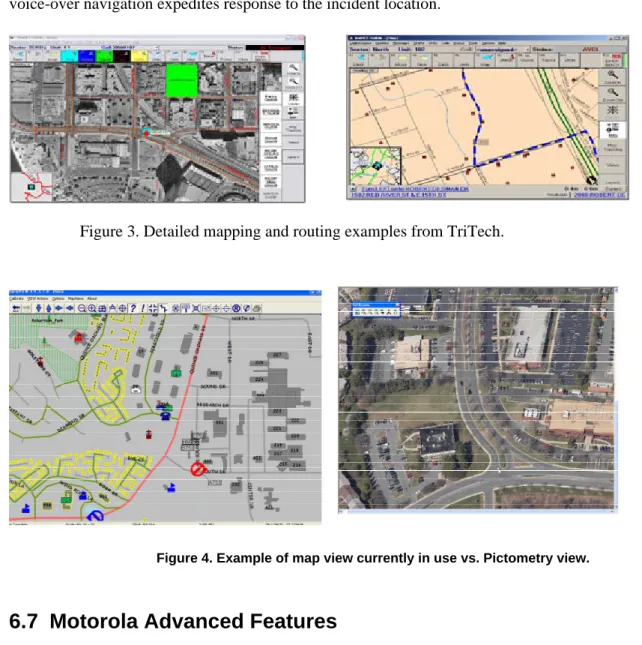
Pictometry (the overlay of satellite photos onto a street map) is not available to public safety because of old hardware/software. This tool might be invaluable under certain circumstances (see Figure 4 in Section 6.6.3). In those instances where a command post must be set up and resources deployed quickly, Pictometry is unsurpassed.
3. A mapping system with built in configurable interfaces (enabling features such as pop up information as in Google Maps).
4. A mapping system with interfaces to open standards mapping systems such as Google Maps (allowing potential access to devices, data and functions available from other sources). 5. A mapping system able to track all active public safety units (Using a combination of
GPS/Triangulation) from either cell phones/air cards or digital public safety radios to display those units on both CAD dispatch workstations and mobile data computers in real time or near real time. 6. MDC should display emergency vehicle proximity on the map, locations on scene. The location on
scene is an excellent tool to assist with resource allocation and placement.
4.4 Keeping the CAD System Operational
There are several changes to the CAD system planned for the near future. The update to the application (Build 112) will address a number of current issues. Planned builds for CAD database updates and a new paging system interface are essential.
A comprehensive approach that includes the recommendations in this study will help the county keep its ECC functional until a replacement is in place.
4.5 Using PS2000 Infrastructure
The Tetra Tech team s recommendations have taken into consideration the existing infrastructure, especially that which was installed as a part of the PS2000 project. An in-depth examination of those systems as they relate to CAD is presented in Section 5.
4.6 Take Advantage of New Technology
As a part of the comprehensive plan, the county should begin taking advantage of new hardware and database technology. This in turn will prepare the ECC to benefit from new CAD technology on the market. An overview of some of the new CAD features is presented in Section 6.
The county should conduct a Business Process Reengineering (BPR) effort as part of the implementation of a new CAD system to identify, and using newer technologies, ensure inefficiencies are realized.
5. State of the Current Public Safety Dispatch
Operations System
The current PSDS has reached a critical juncture because of the aging hardware and software a system upgrade must be undertaken immediately. The existing hardware is nearing the end of its life cycle, and the software is not compatible with new hardware. Simultaneously, the county should begin the process to replace the current CAD system because it is not capable of meeting the needs of the county going forward. This section is provided to assist in understanding the state of the current system and the need for timely action.
This section addresses interfaces that exist and must remain viable in a new CAD system. These are all standard interfaces that any of the top CAD vendors can provide.
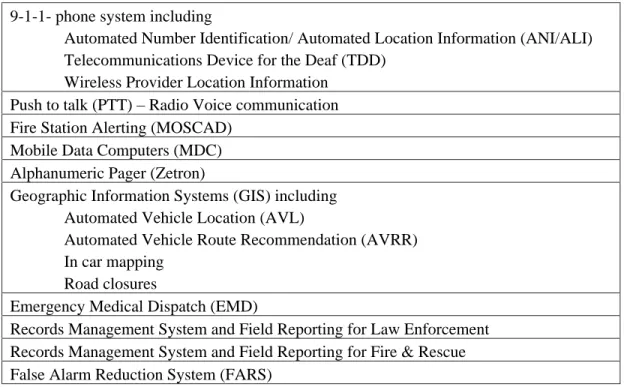
One issue that was voiced time and again is that the county has expected too much of the CAD system. The core function of any CAD system is to receive the initial 9-1-1 call, recommend an appropriate response assignment by the call type of the event, and aid the dispatcher in alerting assigned response units while tracking the status of response resources. The CAD system must interface with ten major systems via various communications infrastructure to execute many of its expected vital functions.
Montgomery County Computer Aided Dispatch Roadmap Study
9-1-1- phone system including
Automated Number Identification/ Automated Location Information (ANI/ALI) Telecommunications Device for the Deaf (TDD)
Wireless Provider Location Information Push to talk (PTT) Radio Voice communication Fire Station Alerting (MOSCAD)
Mobile Data Computers (MDC) Alphanumeric Pager (Zetron)
Geographic Information Systems (GIS) including Automated Vehicle Location (AVL)
Automated Vehicle Route Recommendation (AVRR) In car mapping
Road closures
Emergency Medical Dispatch (EMD)
Records Management System and Field Reporting for Law Enforcement Records Management System and Field Reporting for Fire & Rescue False Alarm Reduction System (FARS)
Table 1. Major CAD interfaces
5.1 Major CAD Interfaces
9-1-1 Phone System, GIS, MDCs
The interface with the 9-1-1 PSAP system and the ANI/ALI is essential in obtaining the information on caller location and telephone number. The interface with the county s GIS is critical to maintain a current CAD geographic database of the road network and addresses assigned to properties in the county because response assignments are based on address location. The interface with the Zetron paging system alerts volunteer firefighters so they can quickly respond. The MDCs provide a useful tool for both fire and police units responding to calls for service and reduce radio traffic on routine activities.
All the CAD data is eventually ported over into the RMS to help the county with resource allocation, crime analysis, and investigative leads. The county personnel must understand that the CAD system is not meant to be the repository of historically accurate information. This is relevant because the CAD system is often confused with the RMS.
In most agencies, there is a definite linkage between CAD and RMS, but they are not the same thing. The CAD system contains information as to what the caller perceived to be happening; the actions that the call takers, dispatchers, first responders and support units took; and their abbreviated disposition of the call. Such basic event data must then be transferred into an RMS where the factual information gathered by the
responding units is entered and subsequent queries and analyses are done.
In Montgomery County s case, personnel expected the CAD system s management information system feature to do much of the work of an RMS because of the delay in implementing an RMS system. The implementation of the E*Justice System, an RMS system, is expected to resolve many of those issues.
Paging and Messaging
Fire Rescue station and personnel alerting is accomplished through an interface with a third-party station alerting application (currently MosCad), but the ECC is attempting to move to the WestNet system. The MosCad system is no longer in production or supported by the manufacturer and must be replaced. New stations coming online need receiving equipment that is no longer available for the MosCad system. The tone generator takes a significant amount of time to activate all the tones for a multi-company response, which delays completion of the voice transmission regarding the nature and location of the call to responding units. Units at the front end of the alerting tones know they have a call but do not know what or where it is until the dispatcher is able to once again talk on the radio when the tone generation has stopped.
The tone generation causes delay in vocalizing the incident response data because the dispatcher cannot speak while the tone generation is occurring, and the units in the field operating on Alpha cannot hear the tones being generated over the 450 470 MHz band radio channel. This results in confusion and delays to the dispatch process.
Text messages about the nature, location, and resources responding are transmitted to alert career and volunteer command personnel using a modem interface from CAD that connects to commercial service providers. There is often an unacceptable delay of several minutes in those text messages being received because of the volume of other subscriber messages being processed by the commercial carriers. One possible solution to reduce system processing time is to build out a county-owned network to carry those critical messages.
EMD, EFD, and EPD Protocol Systems
The Montgomery County Fire Department is using Priority Dispatch s ProQA as its Emergency Medical Dispatch (EMD) software. This application runs in the background on the call taker and dispatch consoles in the ECC.
Although this software meets Fire Department s requirements and state mandates, the time it takes to process calls using the multi-question format to arrive at an appropriate call type is reported to slow down the call-taking process. Whether this results from the other issues endemic in this CAD system or is characteristic of ProQA has not been determined.
There has been some discussion regarding the use of EFD dispatch protocols; however, no decisions have been made in this regard. Using the appropriate tools to guarantee complete and consistent information as well as having a quality control component is essential to adequately defend the county in case of litigation.
False Alarm Reduction System
The county s False Alarm Reduction System is not expected to be replaced in the foreseeable future. Nevertheless, it is important to be mindful of this CAD interface going forward.
Law Enforcement Records Management Systems
The county is in the process of going live with its new E*Justice System. This will replace the legacy Mainframe CJIS system. It is crucial that the CAD to E*Justice interface is written to port all CAD data with each closed record.
Montgomery County Computer Aided Dispatch Roadmap Study
Fire and EMS Records Management Systems
The Fire RMS (Firehouse) is not expected to be replaced in the foreseeable future. An electronic patient care reporting (ePCR) system is under consideration and could be instituted. If the ePCR system is instituted, the CAD system must be capable of transferring basic incident data to the ePCR.
5.2 County and Commercial Communications Infrastructure
A combination of fire station alerting systems, alphanumeric and conventional wireless paging systems provide notice to fire station and other personnel that a call has been dispatched. Normal operational voice and data are transmitted using the county s 800 MHz radio system and commercial CDMA data networks. The 800 MHz radio communications system provides 288 talk groups over 22 radio channels for command and control for ongoing and concurrent incidents as well as regional interoperability.
The county FiberNet system connects the ECC to the majority of the county s public safety locations. Data dissemination and exchange across the network has not been a problem.
The county wireless (800 MHz) system, on the other hand, has proven to be a bottleneck to adequate information sharing with the MDCs. The solution to this quandary was to move to Code Division Multiple Access (CDMA) through a commercial carrier (Sprint). Short of the county building its own countywide wireless network, this seems to be the solution for the foreseeable future. This transition is in process.
800 MHz Public Safety Radio System
Voice dispatches of calls for service are simulcast over the 7Alpha talk group in the 800 MHz band and over a conventional UHF radio channel in the 450 470 MHz public safety band to operate the station paging
systems. Fire station dispatch and Minitor radio paging alerting tones are transmitted over the UHF radio frequency (450 MHz) to activate fire station speakers and portable radio receivers so that subsequent voice dispatch messages can be heard.
While the 800 MHz frequencies are not capable of the throughput necessary for data needs, they have proven to be extremely reliable for voice communications and invaluable in an emergency that overwhelms the commercial system.
The PTT interface with the CAD system is functional as far as it goes. However, with the advances in technology, this functionality could be expanded to include features such as the activation of the radio s emergency button when the airbags are deployed, as GPS and AVL get incorporated.
Commercial Wireless Systems (CDMA)
The county has contracted with Sprint for the data transmission needs of its MDCs. The original plan of using the 800 MHz frequencies through RD-Lap worked for simple data strings to dispatch CAD calls and provide Maryland Information Law Enforcement System (MILES) and National Crime Information Center (NCIC) responses. However, with the additional burden of field reporting, the throughput limitations were
insurmountable in this medium. With the expected addition of sending/receiving photographs, video clips, and other mobile office type applications, there does not appear to be a cost-effective alternative to the commercial network in the near future.
802.11 Wireless Systems
The county has deployed 802.11 access points at various facilities throughout the county. These are used primarily to push updates out to the MDCs. As these access points are expanded it might be feasible to
Montgomery County Computer Aided Dispatch Roadmap Study
provide the option to upload Packetwriter reports and download large data files from the county network directly rather than through the commercial network.
5.3 Continuity of Operations (COOP) and Disaster Recovery
COOP is an endeavor to ensure that the capability to function continues during an emergency (either with or without warning). Among the objectives of a viable COOP plan are the following:3
1. Ensuring the performance of the agency s essential functions/operations during a COOP event 2. Reducing or mitigating disruptions to operations
3. Ensuring that the agency has an alternative facility from which it can continue to perform its essential functions during a COOP event
4. Achieving a timely and orderly recovery from an emergency and reconstitution of normal operations that allows resumption of essential functions for both internal and external clients
These core COOP objectives relevant to the operations of the ECC are already contained in the joint Fire and Police ECC Emergency Action and Evacuation Plan as well as the departments respective SOPs. These will not be altered by the recommendations in this document.
The Disaster Recovery Document, maintained by DTS, provides a formal framework for the failover of server-sets and infrastructure from the ECC to the AECC. This document was originally developed by the vendor as a systems deliverable and is no longer current or comprehensive. DTS is writing an update.
6. State-of-the-Art CAD Technology
It is easy these days to be overwhelmed by the latest technology. With faster, more powerful computers and vast amounts of information being collected everywhere; we can easily fall into the information overload trap. It is important not to lose sight of the core function of a CAD system.
The matter of best practices for a PSAP is normally relegated to basic standards related to call answer times, dispatch times, and basic CAD functionality. Because policies and procedures vary significantly from state to state and agency to agency, it is difficult to characterize one practice as better than another. The key is to routinely revisit the agency s SOPs and business practices and reconcile them with available technology to constantly streamline the 9-1-1 center.
Employing the latest technology that helps efficiently handle 9-1-1 calls and the safety of first responders must be the ultimate goal. With this goal in mind, Montgomery County should keep in mind the following CAD and public safety communications features and trends when planning the future CAD system and public safety communications infrastructure.
6.1 Next Generation 9-1-1 Telephone System
During the past 5 years, technological advancements have created new challenges for delivering Emergency 9-1-1 services. Wireless devices are no longer the exception, and additional trends, such as number
portability, create added layers of concern.
Nationally, Enhanced 9-1-1 (E9-1-1) telephone technology is migrating from analog to Internet Protocol (IP)-based technology. This vision is known as next-generation (NG) 9-1-1.
Montgomery County Computer Aided Dispatch Roadmap Study
NG 9-1-1 platforms4 need to enable emergency call centers to receive 9-1-1 calls from nearly any IP-based device. This includes the support for non-voice Emergency 9-1-1 calls, such as text messages, photos and video from camera telephones as well as telemetric and sensor systems. Within the communications center, NG 9-1-1 needs to allow calls to be transferred between centers along with caller information, such as the caller s location and telephone number.
The mission of PSAPs remains the same within an NG 9-1-1 system to receive emergency calls from the public; ascertain the nature, status, and location of the emergency; and relay the call to the appropriate public safety dispatchers for response to the emergency.
The call-related expectations of the PSAPs also remain the same calls should be delivered to the proper PSAP within seconds and arrive in formats that can be readily processed.
Although some aspects of PSAP call taking will change, it is unclear as to what the affect will be on call taker workload. The growth of the wireless phone market in the mid 1990s led to an increase in 9-1-1 call volume. This was primarily because of the phenomena of multiple calls for some types of emergencies. For example, it is not unusual for a PSAP to receive 50 or more calls for a single motor vehicle crash.
Although NG 9-1-1 will permit many more ways to call 9-1-1, this will not necessarily result in more calls per emergency beyond what would already occur because of virtual ubiquity of landline and wireless phones. In this context, NG 9-1-1 could foster a replacement of some calls from one communication medium to another medium.
As with the current E9-1-1 system, proper operation of NG 9-1-1 system components and interfaces is vital to an effective emergency response service. As a mission-critical system, the NG 9-1-1 system must provide near 100 percent uptime. This can be accomplished effectively by building multiple levels of redundancy within the network and the system components. NG 9-1-1 system components should have backups and be hot swappable. In addition, there should be redundant network links that automatically failover in the case of failure or can be used for additional bandwidth in case of catastrophic events such as natural disasters or terrorist attacks.
During a widescale emergency, call traffic abnormally increases, creating a spike and stressing the capacity of the network. Designing scalability into an emergency response network is imperative for handling these situations, which, though unplanned, must be addressed. In an emergency response network, both the network and system components should be able to handle an additional call load and dynamically scale according to need.5
Given the importance of 9-1-1 emergency response for public safety, national security, and disaster relief purposes, it is critical that 9-1-1 systems continue to evolve with technology and public demands.6
Nationwide, several agencies have begun to accept photographic, video and text messages from the public. In every case, this information is sent to a separate unit that has been created for that purpose and not to their 9-1-1 center. The NYPD police operators in the 9-1-1 call center have been trained to enter a special code in the internal communications system every time callers offer photographs or videos in connection with their
4
National Emergency Number Association. Technical presentation given February 17, 2007. National Emergency Number Association
5
U.S. Department of Transportation. March 2008. NG 9-1-1 Data Acquisition and Analysis Plan. U.S. Department of Transportation,Washington, DC.
6
U.S. Department of Transportation. Next Generation 9-1-1 System Preliminary Concept of Operations. U.S. Department of Transportation,Washington, DC.
Montgomery County Computer Aided Dispatch Roadmap Study
emergencies. The operators have also been trained to inform callers that a detective will be contacting them directly. The coded entry into the communications system automatically alerts the center and provides the 9-1-1 caller s telephone number. A detective from the Real Time Call Center calls the victim or witness and provides a Web address to which the photograph or video can be sent.7
Critical issues that must be addressed to enable the deployment of NG 9-1-1 capabilities include funding, governance, and open standards. The nature and capabilities of new technologies raise the issue of a paradigm shift for NG 9-1-1 such as the number of PSAPs needed, combining emergency call-taking and alerting responsibilities, and ultimately, the need for a new definition of 9-1-1. A determination must be made regarding the length of time the agency will store data for retrieval for investigative and court purposes. This will dictate the amount of storage maintained for this purpose.
Toward this end the U.S. Senate recently passed the New and Emerging Technologies 9-1-1 (NET 911) Improvement Act of 2008 (HR 3403). This 59-page document covers a range of topics from network security to accessible formats.
6.2 Regional CAD Systems
The concept of a regional CAD system has steadily gained strength in recent years. As agencies entered into Memoranda of Understanding and began to achieve radio interoperability, they soon saw the need for CAD data exchange as well. However, a true regional CAD system in which all agencies are using the same software is not pragmatic.
The key to regional data sharing is to interface disparate CAD systems. Recognizing this growing trend in 1999 Association of Public-Safety Communications Officials (APCO) began Project 36 to create a standard for CAD to CAD interfaces.
The Law Enforcement Information Technology Standards Council (LEITSC) took up that effort in 2002 through funding by the U.S. Department of Justice, Bureau of Justice Assistance. The mission of this group is to, foster the growth of strategic planning and implementation of integrated justice systems through the development and implementation of information technology standards. The result of this effort was published in 2007 as Standard Functional Specifications for Law Enforcement Computer Aided Dispatch (CAD) Systems. This standard has encouraged the creation of APIs (application program interfaces) and CAD-to-CAD interfaces by most of the top CAD vendors. Although CAD interoperability has not reached the level of radio interoperability fostered by APCO 25 (the nationally accepted radio interoperability standard), it is progressing rapidly in that direction.
Once fully implemented, regional interoperability should provide, at a minimum, the following functions and features:8
CAD call creation and forwarding to one or more agencies
Real-time resource availability and status changes of all participating agencies Ability to request specific units based on the type of incident
Premise information on hazards Assistance requests (mutual aid)
Automation of the county mutual aid plan Messaging between PSAPs and field units
7
Montgomery County Computer Aided Dispatch Roadmap Study
Ability to view run-time information for calls in other jurisdictions
Ability to share multi-casualty or other major incident information in real time
6.2.1
What is a CAD-to-CAD Interface?
The CAD-to-CAD interface is designed to allow the bidirectional transfer of defined incident and unit
information between two or more CAD systems as well as providing a messaging tool between multiple CAD systems by using text message functionality.
6.2.2
How does it work?
A connection between a remote CAD system and local CAD system is established when initializing the CAD-to-CAD interface. Typically, this connection is via a TCP/IP socket connection. Once the connection is made between a local CAD system and a remote CAD system, the CAD-to-CAD interface listens to all local CAD system activity messages. If certain messages are received (such as creating a new incident, incident status changes, incident edits, and so on), and the CAD-to-CAD interface has been configured to trigger the transfer of an incident or other incident updates, the CAD-to-CAD interface validates the trigger criteria and sends the data to the remote CAD.
6.3 Future CAD
The Ontario (Canada) Association of Fire Chiefs, Ryerson University, York University, and CriSys have teamed up to develop an artificially intelligent CAD system to manage responses to building fires. The smart software product will have expert-level human reasoning skills incorporating the wisdom and experience of the best and brightest fire fighters in the region. The real-time expert system will have unique, self-learning, adaptive reasoning capabilities.
Its interface will recognize plain language, allowing it to interpret a caller s comments and propose an
appropriate vehicle response within 10 seconds. The system will also document decisions and outcomes while learning from exceptional situations.9
6.4 Intergraph Advanced Features
The following are features currently available in this vendor s CAD product offering.
6.4.1
Dashboards
Using business intelligence tools, centers can now access and analyze critical data on 9-1-1 calls, run reports in just minutes with a single click, and monitor department performance faster than ever before with easy-to-visualize dashboards and reports. ECCs need to access critical 9-1-1 dispatch call information quickly. However, creating reports from the CAD system can require many steps (if a system even has that ability).10
6.4.2
Plume Analysis
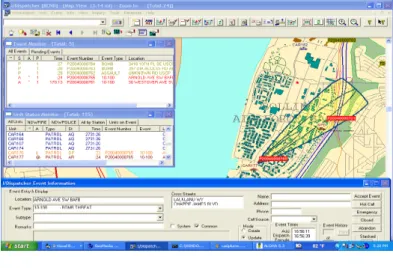
Intergraph CAD provides a mapping software solution used in the creation and analysis of plume data within the CAD environment. Using CAMEO, ALOHA, or HPAC databases, plume models can be generated to evaluate the effect of toxic materials related to a natural or man-made disaster in geographic areas. The results
9
Mission Critical Communications Magazine. October 2008.
10
of the analysis can be fed into the CAD system to help direct automated routing routines around the impact zone and to allow for reverse 9-1-1 calls to the affected areas.
The resulting analysis helps emergency personnel make better and faster operational decisions during a major crisis. These tools can be available to the dispatchers and to personnel in the field where incident command is of utmost importance and accurate information is needed and must be timely.
To complement the mapping solution, Intergraph can provide I/Incident Analyst. This provides an intuitive, user-friendly environment that allows for both spatial and temporal analysis of incident records.
I/Incident Analyst uses the positional attributes present in all incidents to spot trends in frequency, based on geography. The resulting analysis allows decision makers to target resources or adjust deployment plans in response to the patterns revealed.
Figure 1. Example of plume analysis in Intergraph s I/Dispatcher.
6.4.3
I/Mobile PDA
I/Mobile PDA provides support for mobile handheld devices in conjunction with I/CAD. The device can be used as a standalone unit or in conjunction with I/Mobile as an extension to the primary device used by the mobile unit. When used as an extension, all messages sent to the primary device are also sent to the handheld devices.
I/Mobile PDA provides a limited subset of the functionality available in I/Mobile. In particular, it provides the ability to initiate I/Informer queries, and view the responses, short text messaging, dispatch reports, unit status updates, and officer emergency requests. I/MobilePDA does not provide a map display or map functionality.
6.4.4
Remote CAD access
Intergraph s I/NetViewer provides access to live operational CAD data via Microsoft Internet Explorer. It provides secure access to this data by validating users through CAD security to determine which
agency/dispatch groups a user is allowed to see, as well as which operations the user is allowed to execute. Security is further ensured using Secure Sockets Layer technology that encrypts data (128-bit encryption) as it passes between the client and server.
Montgomery County Computer Aided Dispatch Roadmap Study
Positions with I/NetViewer access are provided with the capability to display information on units and their status, as well as pending and active events. Unit and event information can also be displayed on an
interactive map for a visual summary of current activity throughout the agency.
If the operator wants more detailed information about a specific unit or an event, he or she retrieves it with a mouse click.
In addition to providing a view of the agency s resources and workload, I/NetViewer provides the capability to accomplish a number of other tasks. For example, the browser interface can be used to display historical information, such as listing a unit s activity for the past week or the number of traffic accidents reported during a month. I/NetViewer also permits the operator to search operational information such as the personnel who are on duty, special equipment in their vehicles, and any specific skills (for example, foreign languages, EMT, and such). I/NetViewer also enables the user to initiate limited activities in the CAD system.
Using a browser, the user can create a call for service, place a unit in or out of service, update personnel lineups, and send a message to any user on the system, including mobile users.
Figure 2. I/NetViewer main screen.
6.4.5
I/Question and Answer (I/QA)
The I/QA software provides a utility designed to help users develop scripted series of questions and answers that support call takers and dispatchers in the process of collecting information. By scripting question and
answer trees, the I/QA product allows call takers or dispatchers to enhance their ability to quickly assist a caller or to make decisions regarding the disposition of a call. This function is native to Intergraph CAD and can be configured with local SOP questions, or not, as the customer wishes.
Predefined lines of questions can be manipulated (inserted, changed, or deleted) and answers have an associated action, such as setting the event type or raising the priority of the selected incident. I/QA provides a robust graphical user interface using built-in icons, buttons, and comment boxes to assist the operator. Using I/QA, operators follow a hierarchical set of questions that, when responded to, rapidly records pertinent information concerning an incident. Each response entered determines the next question to be asked. For example, a Yes response to Question 4 could cue the system to ask Question 5, but a No response could cue the system to skip to Question 9.
This treed or conditional branching logic is useful for calls where, for example, a burglary is in progress and the operator is immediately prompted to pursue a line of questions specifically designed to determine from the caller if the suspect is armed. This vital information can then be relayed to a dispatched police unit.
As the questions are asked and answered, I/QA automatically date and time-stamps each entry to the I/CAD database. Later, the user can query a report that lists each question in the order asked, with the corresponding Yes or No answer and any comments recorded.
I/QA interfaces with the database in real-time and updates the records as information is entered. In addition, I/QA s flexibility ensures that it can be tailored to any specific requirement. I/QA can be configured to automatically run with each call or can be started at the operator s discretion. Questions that are responded to with a Yes can require that a comment be added if configured differently, a comment can be entered as an option.
6.5 Tiburon Advanced Features
The following are features currently available in this vendor s CAD product offering.
6.5.1
AVRR
CommandCAD along with Tiburon's integrated CAD Status Map provides a unit recommendation based on a Calculated Routing solution. Using costs associated with street segments, a routing algorithm determines the least expensive (and thereby quickest) route from one location to another. The cost used is the time to traverse the street segments. This allows for a number of different factors to be considered, such as speed limit, traffic density, route type, and more. Routing uses costs (impedance factors or distance), closed streets and one-way streets to determine the shortest route. Recommendation and routing can be configured to consider alternate routes depending on the time of day. For example, during rush hour, a given segment of highway might have an average time of 20 minutes, but when it is not rush hour, it might only be 5 minutes. Additionally, street closures can be scheduled to represent streets that are routinely closed, or for one-time closures because of construction, a parade, or a traffic incident. Once a street is closed, it is displayed on all CAD status maps and is no longer considered in the unit recommendation and routing process unless there is no other possible route.
NOTE: Each of the vendors offers this feature in some form.
6.5.2
CAD Playback
Tiburon offers historical playback of CommandCAD screens so a supervisor can go back and view exactly what the dispatcher was looking at during a specific time.
Montgomery County Computer Aided Dispatch Roadmap Study
6.5.3
On-Call Resources/Volunteer Fire Resources Management
The on-call and volunteer resources management function allows resources to be configured as always available without regard to staffing assignments.
In the case of volunteer fire organizations, required apparatus that is available from a given quarter will always be recommended until the dispatcher is notified that the organization is unable to staff additional resources for a given incident. The function also gives priority to any staffed resources. On-call resources can be included in the resource recommendations for any incident type and can be configured to be included in the dispatch recommendation according to client-defined response plans.
6.5.4
Cross-Staffed Units
This CommandCAD feature is a configuration option that can be used when the same staff resources can respond using one or more available units. For example, when the same crew of fire fighters staffs an engine and a brush rig, they can operate only one at a time.
When one unit that is cross-staffed with another unit leaves its home quarters, the cross-staffed unit automatically becomes unavailable for dispatch until the out-of-quarters unit returns to its home quarters.
6.6 TriTech Advanced Features
The following are features currently available in this vendor s CAD product offering.
6.6.1
AVRR
In 2004 VisiCAD was integrated with the Austin Department of Transportation s Traffic Management System via wide area network to provide up-to-the-minute status on the highway road network throughout the area. Installed road sensors allow for monitoring traffic slowdowns, construction, and traffic accidents. The road sensor technology and integration with VisiCAD Command s Mapping Engine provides real-time information to the call-taker/dispatcher who can then monitor the road network before dispatching an appropriate unit. VisiCAD will modify response recommendations accordingly to minimize response times when units are dispatched along the road network.
The innovative product has been reported to reduce response times by up to 1.5 minutes off the 5 6 minute average. Since it was first implemented, this interface has proven to be a valuable part of Austin s Combined Transportation, Emergency and Communications Center vision for improving public safety and reducing response times to emergency situations.
6.6.2
Camera Monitoring
TriTech is also looking into a partnership with a North Carolina Company called True Systems. It has a CAD interface that will connect cameras and camera analytics to automatically generate a CAD event when certain conditions in the field of view exist, i.e., lane slowdown or lane closure, someone entering a restricted area such as a parking area for county vehicles outside normal business hours, monitoring fences around a county jail or detention facility. This is proven technology designed to take multiple camera feeds and eliminate the need for dispatch to closely monitor every feed.
Montgomery County Computer Aided Dispatch Roadmap Study
6.6.3
Mapping
Detailed mapping layers provide visual representation for enhanced situational awareness and strategic resource allocation. Detailed routing instruction with visual map overlay, turn-by-turn text directions and voice-over navigation expedites response to the incident location.
Figure 3. Detailed mapping and routing examples from TriTech.
Figure 4. Example of map view currently in use vs. Pictometry view.
6.7 Motorola Advanced Features
The following are features currently available in this vendor s CAD product offering.
Photographs, video and other multimedia files from an incident record can be stored for future reference.
Supervisor dashboard provides real-time views into dispatch center operations.
Automatic searching for previous vehicles, persons and incidents enables a more informed response Instant AVL playback is directly accessible from the dispatcher map.
Montgomery County Computer Aided Dispatch Roadmap Study
Chat Service The administrator can assign chat privilege levels that define the actions the users are allowed to perform after signing on to the PremierOne CAD client. Once logged in, users can view the chat rooms of which they are members.
Users with appropriate privileges can create, modify, or delete chat rooms. Users can join chat rooms, and invite other users and groups to chat rooms. Authorized users can remove users or groups from chat rooms. All conversations are tracked, and reports can be run on chat room activity.
PremierOne CAD supports the following types of Chat Rooms.
a. Temporary Public Chat Rooms are available to all authorized users of the chat service. The chat rooms are automatically deleted when the last member of the chat leaves.
b. Permanent Public Chat Rooms are available to all authorized users of the chat service. This type of chat rooms persists even if no users are in the chat.
c. Private Chat Rooms are created by an authorized user to have private conversation with other users that can only join the chat through invitation. Users can send chat invitations by
selecting any of the following items: User ID, Unit ID in Unit Status, Unit ID in Incident Summary list, or the source or destination list of a message. They can also select an area on a map and initiate a chat. All users in the selected area can be invited to the chat.
The PremierOne CAD can be configured to automatically send pages as part of dispatching an incident, and when notifications are issued. The administrator can define the specific data elements that can be sent in auto- or manually generated pages.
7. Future CAD System Cost Analysis
While it is difficult to estimate the cost of acquiring, implementing, and maintaining a new CAD system without providing very specific and detailed information in an RFP, Tetra Tech can look at the cost estimates for comparable systems as a starting point. From the four RFIs sent out, three vendors provided estimated cost information. Two of the vendors (Tiburon and Intergraph) provided estimates that are based on recent similar projects, while TriTech provided an estimate that is based on the information in the RFI. The fourth vendor (Motorola) refused to provide any pricing information. The initial acquisition estimates (including the first year s maintenance) ranged from an aggressive $8 million to a conservative $16 million with the subsequent maintenance ranging from $500,000 to $800,000 per year on an escalating scale (Appendix C).
8. Recommendations
The county should immediately begin the process of defining, finding, and implementing a new CAD system. Because this process will take some time to complete, the county must also continue with its planned server hardware and mobile replacement programs and continue to address issues with the current system as they arise.
8.1 Requirements for the Next CAD System
One lesson was repeatedly driven home in the interviews and discussions with those that worked through the implementation of the current CAD system. The contract with the vendor must very specifically detail all the requirements for the new system and have performance penalties if the vendor does not meet those
requirements. An excellent example of system requirements is provided under separate cover (from Fairfax County, Virginia). This document demonstrates the time and involvement necessary to create a
comprehensive list of requirements for the new system. The county should expect to spend 6 months and commit resources from every affected department and unit to ensure that the requirements are detailed and