University of Huddersfield Repository
Snowden, Michael, Ellwood, Fiona, McSherry, Rob, Halsall, Jamie and Hough, Donna
Mentoring and You
Original Citation
Snowden, Michael, Ellwood, Fiona, McSherry, Rob, Halsall, Jamie and Hough, Donna (2016)
Mentoring and You. Dental Nursing, 12 (7). pp. 386391. ISSN 17496799
This version is available at http://eprints.hud.ac.uk/29002/
The University Repository is a digital collection of the research output of the
University, available on Open Access. Copyright and Moral Rights for the items
on this site are retained by the individual author and/or other copyright owners.
Users may access full items free of charge; copies of full text items generally
can be reproduced, displayed or performed and given to third parties in any
format or medium for personal research or study, educational or notforprofit
purposes without prior permission or charge, provided:
•
The authors, title and full bibliographic details is credited in any copy;
•
A hyperlink and/or URL is included for the original metadata page; and
•
The content is not changed in any way.
For more information, including our policy and submission procedure, please
contact the Repository Team at: [email protected].
http://eprints.hud.ac.uk/
Mentoring and You
Michael Snowden, Senior Lecturer University of Huddersfield; Fiona Ellwood, visiting lecturer and External Examiner Trinity College Dublin and University College Cork; Rob McSherry, Professor of Nursing; Teesside University; Jamie Halsall, Senior Lecturer University of Huddersfield; Donna Hough, Head of Dental Education and Workforce: Health Education England, North West.
Corresponding Author:
Michael Snowden, Senior Lecturer, University of Huddersfield, Queensgate Huddersfield, HD1 3DH, [email protected]
INTRODUCTION:
This research based case study explores and illustrates the benefits of mentoring and the place of clinical governance in enhancing dental care practice.
INTRODUCTION
The importance of ensuring safety, quality and governance in health and social care continues to be highly topical given the media and public outcry following numerous scandals highlighting neglectful and harmful care. For example, the Public and Independent inquiries into the Mid Staffordshire National Health Service Foundation Trust and The Winterbourne Care Home. Some questions arising from such scandals are as follows: How is it possible that such situations are continually occurring when clinical governance was introduced into the NHS in 1997 with the sole purpose of keeping patients safe by improving quality of care, services and standards by reducing risks? (McSherry et al, 2013, McSherry and Pearce 2011). Mentors are deemed to be highly experienced custodians and advocates of safe, quality and compassionate care providing effective role modelling, guidance, supervision and support to less experienced and aspiring practitioners. Is there a relationship between the role of the mentor and clinical governance within practice?
Recognising the paucity of research exploring mentorship and clinical governance in dental health care, the broad aim of this research was to explore the effectiveness and impact of mentoring in dental care practice, its influence on clinical governance and to examine what dental care professionals perceive to be effective characteristics of the successful mentor.
Whilst there is little doubt that mentorship will contribute positively to personal growth and development, there has been scant attention to the impact it has upon successful learning and health care practice. Success is largely assumed rather than demonstrated; Paglis et al (2006), Allen, Eby, O’Brien and Lentz (2008), Gopee (2008) and more recently Huybrecht et al (2010) Andrews and Clark (2011), indicate that there is no conclusive evidence to suggest that mentoring adds value to
1
This document is the Accepted Manuscript version of a Published Work that
appeared in final form in Dental Nursing, copyright © MA Healthcare, after peer
review and technical editing by the publisher. To access the final edited and
published work see http://www.dental-nursing.co.uk/cgi-bin/go.pl/library/
contents.html?uid=5464;journal_uid=23
2
outcomes or indeed therefore to improving quality and safety through clinical governance. However, Holt and Ladwa (2008), Snowden and Hardy (2012), Snowden and Halsal (2014), Dawson (2010), Elwood (2016) allude to the potential benefits of mentorship on performance and learning for mentees and mentors, suggesting that mentorship can enhance performance.
Darling (1985) continues to be cited as the “seminal” work when researchers explore the characteristics of the mentor. However, it is widely accepted that there has been a significant shift in the socio cultural dimension of mentoring practice during the past 30 years. This research project explored those dimensions reported by Darling and assessed their relevance to contemporary UK dental care practice, and providing the opportunity to identify what characteristics and what dimensions of the mentor are significant in today’s dental care practice. The research also provided the opportunity to explore the relationship of clinical governance in DCP and establish any relationship to the mentoring process and how this may influence safety, quality and clinical governance.
It is widely accepted that mentoring enhances the learning experience for all participants, (Darwin 2004, Megginson and Clutterbuck, 2009, Andrews and Clarke, 2011 and Dawson 2014, Elwood 2016) and is characterised by a process where an experienced, successful and knowledgeable person facilitates growth, development, and supports a colleague or peer through a mutually beneficial relationship.(Clutterbuck and Lane, 2004). Defining mentorship is complex, due in part to the multi-faceted nature of the role and the plethora of definitions that have attempted to define the role in a precise way. However, it is recognised (Colley, 2002; Clutterbuck and Lane, 2004) that definitions, and consequently the role of the mentor should reflect the social context of implementation. For the purpose of mentoring within this project, the definition offered by Snowden and Hardy (2012), who draw upon Anderson and Shannon’s (1997) notion of nurture was utilised to guide the mentoring process, a mentor should be an experienced peer who is able to provide guidance and support to the mentee by adopting strategies to allay anxieties, encourage, motivate and promote familiarization of professional life. Engagement with the process of mentoring within the context of dental care enables the mentee to access to the inside knowledge that the mentor has developed over their professional life course; distinctly, the mentor is able to translate reality, and help the mentee inhabit their own patterns of reasoning, insight and the application of knowledge and skill, (Snowden and Halsall 2014) This enables development of a learning landscape where, as Alred and Garvey suggest is characterised by:
• The acquisition of subject matter expertise and skill directly related to the scope of target competence.
• Learning to solve problems by using domain specific expertise.
• Developing reflective and critical thinking skills conducive to locating paths leading to new knowledge and its application.
3
• Securing communication skills that provide access to the knowledge network of others and those that enrich the learning environment.
• Procur skills that regulate motivation and affections related to learning. • Promote stability to enable specialisation, cohesion and integration. • Causing creative turmoil to instigate improvement and innovation. (Alred and Garvey, 2000: 264).
The benefits of successful mentorship and subsequent contribution to business, education and enterprise are well documented Foster-Turner (2006), Gopee (2008); Holt and Ladwa (2008) Connor and Pokora (2012) Garvey et al (2013), The nature of employability is becoming increasingly complex; health and social care agencies, community development, business and enterprise agencies are all seeking to employ staff with key skills, knowledge and abilities associated with successful “helping” and “enabling.” There is significant evidence to suggest that the demand for mentorship across the professions is growing at an ever increasing rate, confirmed recently by Megginson (2013), findings and recommendations from the Chartered Institute of Personnel and Development (2013), and more recently by the European Mentoring and Coaching Council (2014) who call upon organisations and institutions to develop more mentoring focussed programmes of study to support the development of mentoring within UK society.
Mercer, Bailey and Cook (2007) conducted a survey of attitudes of general dental practitioners (GDP’s) and dental nurses to continuing education. Whilst identifying that dental nurses felt that they would benefit from continuing education that was practice focussed and practice based learning was the preferred mode of delivery the obvious link to the purported benefits of mentoring has not been made. Whilst Holt and Ladwa (2009) allude to the benefits of developing mentoring strategies for the dentist, primarily as a quality assurance tool for the dentist, little attention has been placed upon the potential benefits of mentoring within dental care. This study, provides an opportunity to explore those benefits.
METHOD
This case study, comprised of a group of five DCP’s acting as mentors whilst participating in a twelve week mentoring course funded by NHS England. The DCP’s where participating and interacting within a peer mentorship programme, and formed mentoring dyads. Each dyad consisted of an experienced DCP who acted as a mentor to lesser experienced DCP. Each mentor was supported by the course tutor who also adopted the role of mentor to the DCP mentors, firmly establishing the tri partite relationship proposed by Snowden and Halsall (2015).
Rationale
The aim in case study research Yin (2014) asserts, is to gain insight into the meaning behind the actions and knowledge of the participants, each participant constructs meaning according to their own context, thus enabling the exploration of the learning landscape. Case study research can play an
4
important role in the process of systematic enquiry as a mechanism for examining the complex process by which innovations, change and research evidence are adopted in organisations. As Yin (2014) observes, case study research helps to answer the “how” and ‘why’ questions associated with the adoption of new practices, in this case:
What are the key characteristics of the mentor from the perspective of the Dental Care Professional (DCP).
How aware of mentorship and clinical governance are DCPs
Why and what factors influence mentorship relationship and the application of Clinical governance within the dental setting
Sample
A convenience sample drawn from participants of a Mentoring CPD training event that took place during the period September 2015-November. Mentors from this cohort who expressed an interest in being interviewed were provided with a participant information sheet for the interview component of the study and a consent form. Ethical procedures were in place that conformed with British Educational Research Association and potential participants were asked to confirm their consent forms before taking part in the study.
Data Collection:
Robson (2011) asserts that triangulation in data collection is an essential tool in real world enquiry to promote rigour, advocating that similar patterns of findings from different data gathering tools increases confidence and trustworthiness in their validity. By seeking clarification through a range of data sources, the validity of a study, ‘the case’ is increased. The data sources in this study complemented each other and enabled the collection of rich data for analysis and included questionnaire and focus group interviews.
Questionnaire
A mixed methods design was adopted, firstly a researcher designed and validated survey questionnaire incorporating Darling’s(1985) Measuring Mentor Potential scale and Darwin’s (2004) Dimensions of Mentoring, and the Clinical Governance Awareness Questionnaire (McSherry and Pearce 2011) was used and contained a mixture of fixed response likert scales and open-ended questions.
Focus Group interview
A focus group was used to explore the participants experiences of mentoring and clinical governance, The key feature of a focus group is the interaction of the group its relationship with the participants, providing the opportunity to explore and clarify views in a much more accessible and less intimidating way than one to one interview.
5
Five out of the total group size of 8 agreed to participate in the interview. The digitally recorded Interview lasted approximately 45 minutes and was guided by a semi-structured interview schedule. The interview schedule contained questions relating to their motivations to become a mentor, their experiences of undertaking this role, and any perceived advantages and disadvantages of the role and exploration of Clinical governance
Data analysis
Quantitative survey data were analysed using descriptive statistics and qualitative survey data were analysed using thematic analysis. The focus group interview transcript was anonomysed and initially coded for themes relating to participants’ motivations for, and experiences of, using the mentoring scheme.
Themes that emerged from the data included: • Benefits
• Relationships
• Structure and Challenge • Clinical Governance
FINDINGS:
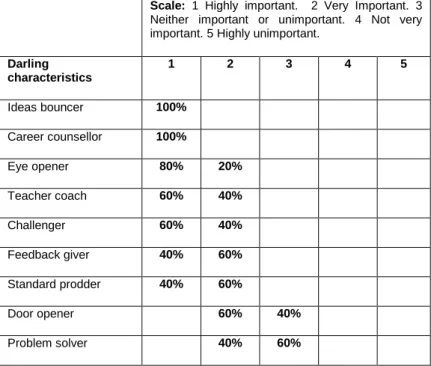
1. Darling’s (1985) Characteristics of the successful mentor:
Darling’s (1985) nine feature characteristics of the mentoring role were ranked by the participant on a five point likert scale from less important to very important (See table one).
Table one Summary of frequency of Darling’s (1985) Characteristics:
Scale: 1 Highly important. 2 Very Important. 3 Neither important or unimportant. 4 Not very important. 5 Highly unimportant.
Darling characteristics 1 2 3 4 5 Ideas bouncer 100% Career counsellor 100% Eye opener 80% 20% Teacher coach 60% 40% Challenger 60% 40% Feedback giver 40% 60% Standard prodder 40% 60% Door opener 60% 40% Problem solver 40% 60%
6
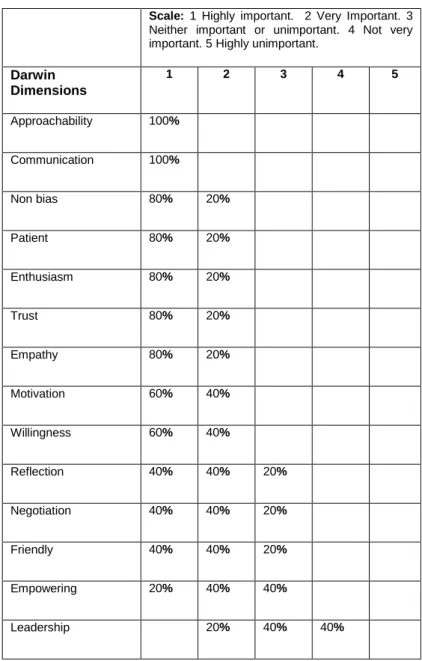
Similarly participants also ranked using a five point likert scale based upon Darwin’s dimensions of the mentoring personality (Table two): Table two: Summary of frequency of Darwin’s (2004) Dimensions
Scale: 1 Highly important. 2 Very Important. 3 Neither important or unimportant. 4 Not very important. 5 Highly unimportant.
Darwin Dimensions 1 2 3 4 5 Approachability 100% Communication 100% Non bias 80% 20% Patient 80% 20% Enthusiasm 80% 20% Trust 80% 20% Empathy 80% 20% Motivation 60% 40% Willingness 60% 40% Reflection 40% 40% 20% Negotiation 40% 40% 20% Friendly 40% 40% 20% Empowering 20% 40% 40% Leadership 20% 40% 40%
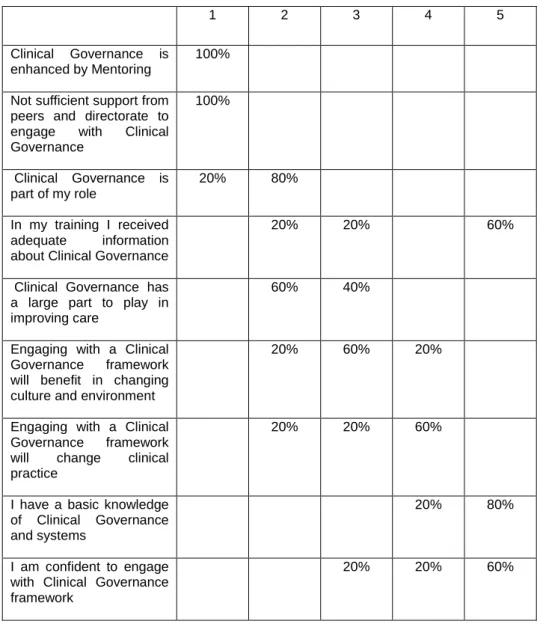
3. Clinical Governance Awareness Questionnaire
Participants were also asked to rate key aspects of McSherry and Pearce’s (2011) clinical governance perceptions questionnaire on a five point likert scale rating from strongly agree to strongly disagree (table three).
Table Three: Summary of responses from open ended questions in survey
Scale:1 Strongly agree. 2 Agree. 3 Neither agree or disagree. 4 Disagree. 5 Strongly disagree.
7
1 2 3 4 5
Clinical Governance is enhanced by Mentoring
100%
Not sufficient support from peers and directorate to engage with Clinical Governance 100% Clinical Governance is part of my role 20% 80% In my training I received adequate information about Clinical Governance
20% 20% 60%
Clinical Governance has a large part to play in improving care
60% 40%
Engaging with a Clinical Governance framework will benefit in changing culture and environment
20% 60% 20%
Engaging with a Clinical Governance framework will change clinical practice
20% 20% 60%
I have a basic knowledge of Clinical Governance and systems
20% 80%
I am confident to engage with Clinical Governance framework
20% 20% 60%
4.
Focus Group thematic summary
:
The following table illustrates the four main themes and provides exemplars of quotes from the participants:
Table four Thematic summary
Theme one: Benefits Example comments:
Think about things differently – Helicopter view
“taking part in this course has really helped me to look at thing differently” (3) “it’s like a helicopter view of things”
Reflective “With my mentee it was good to look back at what things she had done” “not only did it help the mentee to reflect but also me” (2)
“It helps you take a step back”
Confidence (wings!) “My mentee really grew in confidence”, “she (mentee) said that I gave her the wings to fly” this also helped my confidence, knowing that I was doing a good job” “I can now mentor “senior” colleagues, I couldn’t have even
8
thought about this before”
Guide and knowledge and practice “An important aspect to my role was helping here (mentee) to develop her knowledge, I saw my role as guiding her to gain knowledge and safe practice” “I agree this was what I really enjoyed, knowing that you helped them improve”
Reciprocity “to be honest I think I got as much out of this (mentoring) as me my mentee” yes I also learned a lot, it helped me become more confident and definitely more assertive in the practice” “yes, I really enjoyed it gave me to be honest a bit of “buss” it made me feel important”
Informed practice/ Passed on knowledge
“in class we had talked about the importance of passing on new knowledge, but this want just to my mentee but also other colleagues in the practice listened and shared knowledge” “yes even the dentist said he could learn form this (mentoring)” my mentee really did learn a lot…she told me how she started to understand many of the things he had just out of a bit without really thinking about them”
Nurture “in some ways I felt like the her sister or parent,…helping my mentee to grow and develop” yes, I think xxx talked about nurturing this is what is is…mentoring that is…” “nurture, yes I agree
Career “mentoring has helped my mentee progress on, she’s moved on and got promoted at another practice” “its made me think about my career and how I can develop
Best practice “it was good because it really helped me t think about practice, always ensuring that I was doing my best…setting an example” we shared discussions about how we would do things…this helped us both to think about how things could be done better.
Skill I’m a much better mentor now that I’ve done the course and also ad some practice doing it” “my skills as a DCP has improved because of it and certainly my mentee’s has.” “Yes my mentee as defo improved her skills”
Theme two: Relationships Example comments
Helps development professional and “normal” life
One thing I didn’t think would happen its helped me in my personal life…I’m more organised and defo more confident” its helped me think about what’s important and how I can use this to make my life better” Its helped me to decide what it is I want to do” its even helped me in my normal life
Changed developed on-going “friendship
At the start our relationship was very “professional” now though we’re more like friends” “I include my mentee as my friend now”
“Yes we get on really well. Its surprising really”
Theme three: Structure challenges
Example comments
Mentors need mentor “I dot think it (mentoring) would have worked as well if we dint have XXX to call on as out mentor” its really hard at first and you really do need mentor to help you to be a good mentor, and to talk about all the things you don’t understand” “its hard all the time as you really do need to know that you can go to someone…your mentor”
Support (system) Spokes” needed I think it would be a good idea to have like a network of mentors who can help each other… “yes like that what we talked about in class, like a wheel with someone (a mentor) at the centre when we could talk to her and we could also talk to each other ye that would be good a “go to person” I know that we all did this in our own time and we knew tis before we started, but it would be really good to have some time set aside at work for this” “we used our lunch time and often met after work”
9
Theme Four: ClinicalGovernance
Example comments:
Policies and procedures (everyone/practice manager)
“this is all about policies and procedure, it’s our manager who looks after this” “I think because this is practice we should be more involved and as mentors we should” “yes it’s all about policies” I think we should have more training on this
Informs practice “it does help and should guide what we do, that’s why its important” I don’t think we pay enough attention to it especially as it is supposed to guide what we do…
DISCUSSION
Darwin (2004) conducted a comprehensive study investigating people’s perceptions of their mentors that identified eight categories, or “dimensions” for mentoring were identified that were associated in varying degrees with the successful mentorship. However, the sample was drawn from the general population and thus had little applicability to health care, especially dental care practice. This study provided the opportunity to explore those characteristics and their relationship with the dental care mentor; DCP’s identified that “approachability and communication were the most significant; non-bias, patience, enthusiasm, trust and empathy were also significant. Of less significance were the characteristics of leadership and empowerment. These reflect Darwin’s findings, approachability and effective communication was closely linked to the notion of nurture. A key feature of this project’s definition of the mentor and congruent with the notion of a developing profession.
Darling (1984) features of “ideas bouncer,” “career counsellor” “eye opener” and “standard prodder” were identified and the most significant, of much less significance was the characteristics of “door opener” and “problem solver.” The data here suggests that the DCP’s view the mentor very much as someone with whom mentees could “bounce ideas” off in a safe and provide career focussed guidance, emphasising the view that approachability and communication are key characteristics of the successful mentor as highlighted in the responses to the Darling questionnaire.
There is a plethora of literature (Clutterbuck 20012; Garvey et al 2013) that emphasises that in order to achieve a full, and productive relationship that mentee and mentor are matched on the basis of agreeableness and “similarity.” Additionally Colley (2004) alludes to the importance of context in contributing to successful mentoring, roles are socially constructed based upon shared values, constructs and purpose consequently the notion of need of the mentee should be acknowledged, suggesting that effective mentors for DCP’s should be those who fit the requirements of Darlings ideas bouncer,” “career counsellor” “eye opener” and “standard prodder and also Darwin’s characteristics associated with approachability and communication. In order to achieve this, the notion and purpose of the mentoring relationship should be confirmed at the outset of the relationship.
10
It is clear that DCP’s in this study viewed that mentoring could enhance clinical governance, and viewed clinical governance as part of their role. However, somewhat disconcertingly DCP’s received very little training and had only a basic knowledge, predominantly indicating that they lacked confidence in its application.
Focus group discussion
The focus group discussion identified four main themes (see table four):
Benefits:
It is clear that the mentoring process was beneficial, not only to the mentee but also distinctly the mentor. Whilst there is a distinct absence of mentoring literature that explores the notion of reciprocity in dental care, Zachary and Fischler (2009), Snowden and Hardy (2012) allude to this very powerful aspect of the mentoring relationship. Mentors benefit equally from participation; however there is little evidence to say in what ways. Here the participants expressed increased confidence and assertiveness, improved negotiation skills and the desire to succeed and promote excellence in practice.
Relationships:
It was evident from the discussion that the nature of their relationship with the mentee changed over the relationship course, this reflects the nature of the evolving relationship, where increased formality and structure is gradually replaced over the life course by informality and less structure.
Structure and Challenge:
Whilst the mentoring process was exceptionally well evaluated it was clear that the participants recognised the value and emphasised the importance of having a “go to” person for them. It was envisaged that for truly effective mentoring then the process should be based on a tri partite relationship that is based upon growth and nurture. Time, access and availability are crucial components of this perceived structure that was likened to a hub and spoke model. Participants suggested that time should be allocated during the working week for mentoring, and perhaps other forms should be available to supplement this. For example e-mentoring using skype and other electronically based forum were suggested. The value of this, clearly associated with increased accessibility to support and guidance.
Clinical Governance
It was clear that DCP’s in this study had knowledge of the notion of clinical governance, however they did emphasise that the mentor they lacked confidence in its application. They placed emphasis on the observation that their mentees needed significant support to develop their understanding of this aspect of their role yet very little time and training was allocated to this. None the less the mentors proposed that with further education and training they viewed themselves as having great potential for
11
enhancing governance. The felt strongly that as part of the dental team they should be active participants in clinical governance processes.
CONCLUSION AND RECOMMENDATION:
This study demonstrates that mentoring is beneficial, that the relationship is reciprocal and that successful mentoring promotes professional and personal development. There are key characteristics and features associated with the successful DCP mentor: a successful mentor is someone who is approachable, a good communicator and an “ideas bouncer;” “career counsellor;” “eye opener;” and “standard prodder.”
Connor and Pokora (2007 p6) assert mentoring is about colleagues supporting each other for professional, personal growth and development and consequently has a positive impact on proactive development, this study support this view. The best fit tool for supporting the quality of performance of dentist is mentoring, suggest Holt and Ladwa (p145 2008). They explain how there has been a drive for quality across health care and that clinical audit and clinical governance are two of the quality assurance tools that have been developed. The most important actor in the quality of care they assert is the dentist, and that dentists are given support and encouragement by their peers. However this study illustrates that this may not be the case; as McSherry and Pearce (2013) assert team working, continuous learning and sharing are required to demonstrate excellence in practice and is not simply the prerogative of a single professional.
Whilst it is recognised that this study is small in nature, and that the findings are based on a small sample, none the less this study reflect much of what is known about the value of mentoring in other health care professions. Mentoring is potentially a powerful instrument in developing practice; however, it is clear that additional resources, training of mentors, time, materials need to be made available and that the value of mentoring needs to be recognised. Certainly further research and exploration in this field is to be encouraged.
References
Allen, T.D. & Eby, L. T., O’Brien, K.E., & Lentz, E. (2008). The state of mentoring research: A qualitative review of current research methods and future research implications. Journal of Vocational Behavior, 73(3), 343‐357
Alred, G. and Garvey, B. (2000) Learning to produce knowledge – the contribution of mentoring, Mentoring and Training, 8, (3), 261-277.
Andrews, J. Clark, R. (2011) Peer Mentoring Works! How Peer Mentoring Enhances Student Success in Higher Education. Birmingham. Aston University
Anderson, E. M. and Lucasse Shannon, A. (1995) Towards a conceptualisation of mentoring. In Kerry, T. and Mayes, S. (Eds) Issues in Mentoring, London, Routledge.
12
Chartered Institute of Personnel and Development (2014) available at: accessed 24th November 2014
Clutterbuck, D. and Lane, G. (2004) The situational Mentor: An international review of competencies and capabilities in mentoring. Aldershot. Gower.
Colley, H. (2002) A rough guide to the History of Mentoring from a Marxist Feminist Perspective, Journal of Education for Teaching, 28, (3), 257-273.
Connor, M; Pokora J. (2012) Coaching and Mentoring at work: Developing Effective practice. 2nd
Edition Maidenhead. OUP
Darwin, A. 2004 Characteristics ascribed to mentors by their protégés. In Clutterbuck, D. and Lane G. 2004 The Situational Mentor: An international review of competencies and capabilities in mentoring. Aldershot. Gower..
Darling, L. (1984) What do nurses want in a mentor? Journal in Nurse Educator. 10 (1) 18-20
Dawson, T (2010) Dental Nursing 6 (12) 720–725
Elwood, F. (2016) Life through a different Lens Dental Nursing 12 (4) 214
Fachin-Lucas, K. (2001) The social construction of Mentoring roles, Mentoring and Tutoring, 9, (1), 23-47
Garvey, R, Stokes, P, Megginson, D. (2014) Coaching and Mentoring: Theory and Practice 2nd
Edition. London. Sage.
Foster-Turner, J (2006) Coaching and Mentoring in Health and Social Care: The essentials of practice for professionals and organisations. Oxford. Radcliffe Publishing
Gopee, N. (2008) Mentoring and Supervision in Health Care. London. Sage.
Holt, VP; Ladwa R 2008 Mentoring a quality assurance tool for dentist: part 1 the Need for Mentoring in Dental Practice Primary Dental Care October p141-146
Huybrecht S, Loeckx W, Quaeyhaegens Y, De Tobel D & Mistiaen W (2011) Mentoring in nursing education: Perceived characteristics of mentors and the consequences of mentorship. Nurse Education Today, 31, 274-278
McLean, M, (2004) Does the curriculum matter in Peer Mentoring? From mentee to mentor in problem based learning: A unique case study, Mentoring and Tutoring, 12, (2), 173-186
McSherry R, Pearce P. (2011) Clinical Governance A Guide to Implementation for Healthcare Professionals. Oxford: Wiley-Blackwell.
McSherry R, Pearce P (2013) What are the effective ways to translate clinical leadership into health care quality improvement? Journal of Health Care Leadership, 8, 11-17.
Megginson, D (2013) The Ridler Report trends in the use of executive coaching. Accessed at: http://www.associationforcoaching.com/media/uploads/RIDLER-REPORT-2013.pdf 28th November 2015.
Megginson, D Clutterbuck D(2009) Further Techniques for Coaching and Mentoring Oxford Elseiver Paglis, L.L. Green, S.G and Bauer, T.N. (2006) Does Adviser Mentoring add Value? A longitudinal study of Mentoring and doctoral student outcomes. Research in Higher Education, 47, (4), 451-476.
13
Parsloe, E. Wray, M.J. (2000) Coaching and mentoring: practical methods to improve learning, London, Kogan Page.
Roberts, A. (2000) Mentoring revisited: a phenomenological reading of the literature. Mentoring and Tutoring, 8, (2), 145-170.
Robson, C. (2011) Real World Research. A Resource for Social Scientists & Practitioner-Researchers,3rd Edition, Oxford, Blackwell.
Snowden, M Halsall, J (2014) Community Development: A Shift in Thinking Towards Heautagogy International Journal of Multidisciplinary Comparative Studies 1 (3) 8-25.
Snowden, M; Hardy T. (2012) Peer Mentorship: Yes! It Does Have a Positive Effect on Student Retention and Academic Success for Both Mentor and Mentee. Journal of Widening Participation and Lifelong Learning 19 (2) 64-78
Yin, R.K. (2014) Case study Research: Design and Methods 5th Edition London Sage
Zachary, L.J; Fischler, L.A. (2009) The Mentee's Guide: Making Mentoring Work for You. San Francisco. Bossey-Joss