An Introduction to (Hybrid)
Probabilistic Logic
Programming
Luc De Raedt
Overview
•
Part I : An introduction to Prob. Logic Programming and
the relation to alternative frameworks
•
Part II : Inference
•
Part III: Learning
•
Part IV: Dynamics & Continuous distributions for
Relational Tracking (in Robotics)
codes for gene protein pathway cellular component homologgroup phenotype biological process locus molecular function has is homologous to participates in participates in is located in is related to refers to belongs to is found in subsumes, interacts with is found in participates in refers to Biomine database @ Helsinki
Networks of Uncertain
Information
4 http://biomine.cs.helsinki.fi/Biomine
network
Biomine Network
presenilin 2
Gene
EntrezGene:81751
Notch receptor processing
BiologicalProcess
GO:GO:0007220
-participates_in
0.220
BiologicalProces
Gene
6Phenetic
l Causes: Mutations l All related to similar
phenotype
l Effects: Differentially expressed
genes
l 27 000 cause effect pairs
l Interaction network: l 3063 nodes l Genes l Proteins l 16794 edges l Molecular interactions l Uncertain
l Goal: connect causes to effects
through common subnetwork
l = Find mechanism l Techniques:
l DTProbLog
l Approximate inference
[De Maeyer et al., Molecular Biosystems 13, NAR 15]
7
Can we find the mechanism connecting
causes to effects?
DT-ProbLog
Example:
Information Extraction
8
NELL: http://rtw.ml.cmu.edu/rtw/
instances for many
Graphs & Randomness
ProbLog, Phenetic, Prism, ICL, Probabilistic
Databases, ...
•
all based on a “random graph” model
Stochastic Logic Programs, ProPPR, PCFGs, ...
•
based on a “random walk” model
•
connected to PageRank
Probabilistic Logic
Programming
Distribution Semantics [Sato, ICLP 95]:
probabilistic choices + logic program
→ distribution over possible worlds
e.g., PRISM, ICL, ProbLog, LPADs, CP-logic, ...
multi-valued
switches
probabilistic
alternatives
probabilistic
facts
annotated
disjunctions
causal-probabilistic
laws
0.4 :: heads.
0.3 :: col(1,red); 0.7 :: col(1,blue) <- true.
0.2 :: col(2,red); 0.3 :: col(2,green);
0.5 :: col(2,blue) <- true.
win :- heads, col(_,red).
win :- col(1,C), col(2,C).
annotated disjunction
: second ball is red with
probability 0.2, green with 0.3, and blue with 0.5
logical rule
encoding
background knowledge
ProbLog by example:
A bit of gambling
h
•
toss (biased) coin & draw ball from each urn
•
win if (heads and a red ball) or (two balls of same color)
probabilistic fact
: heads is true with
probability 0.4 (and false with 0.6)
annotated disjunction
: first ball is red
with probability 0.3 and blue with 0.7
probabilistic choices
consequences
Questions
•
Probability of
win
?
•
Probability of
win
given
col(2,green)
?
•
Most probable world where
win
is true?
0.4 :: heads.
0.3 :: col(1,red); 0.7 :: col(1,blue) <- true.
0.2 :: col(2,red); 0.3 :: col(2,green); 0.5 :: col(2,blue) <- true. win :- heads, col(_,red).
win :- col(1,C), col(2,C).
marginal probability
conditional probability
MPE inference
Possible Worlds
H
W
R×
0.3
0.4 :: heads.0.3 :: col(1,red); 0.7 :: col(1,blue) <- true.
0.2 :: col(2,red); 0.3 :: col(2,green); 0.5 :: col(2,blue) <- true. win :- heads, col(_,red).
win :- col(1,C), col(2,C).
×
0.3
0.4
Possible Worlds
W
R RH
W
R R G×
0.3
0.4 :: heads.0.3 :: col(1,red); 0.7 :: col(1,blue) <- true.
0.2 :: col(2,red); 0.3 :: col(2,green); 0.5 :: col(2,blue) <- true. win :- heads, col(_,red).
win :- col(1,C), col(2,C).
×
0.3
0.4
(1
−
0.4)
×
0.3
×
0.2
(1
−
0.4)
×
0.3
×
0.3
G
All Possible Worlds
W
R RH
W
R BH
W
R GH
W
R R R G R BH
W
B BH
B GH
W
R B B R G BW
B B0.024
0.036
0.060
0.036
0.054
0.090
0.056
0.084
0.084
0.126
0.140
0.210
15P(win)=
W
R RH
W
R BH
W
R GH
W
R R R G R BH
W
B BH
B GH
W
R B B R G BW
B B0.024
0.036
0.060
0.036
0.054
0.090
0.056
0.084
0.084
0.126
0.140
0.210
∑
?
=0.562
Probability
Marginal
16=P(win
∧
col(2,green))/P(col(2,green))
P(win|col(2,green))=
=0.036/0.3=0.12
W
R RH
W
R BH
W
R GH
W
R R R G R BH
W
B BH
B GH
W
R B B R G BW
B B0.024
0.036
0.060
0.036
0.054
0.090
0.056
0.084
0.084
0.126
0.140
0.210
∑
?
/
∑
Conditional
Probability
17Most likely world
where
win
is true?
W
R RH
W
R BH
W
R GH
W
R R R G R BH
W
B BH
B GH
W
R B B R G BW
B B0.024
0.036
0.060
0.036
0.054
0.090
0.056
0.084
0.084
0.126
0.140
0.210
MPE Inference
18MPE Inference
Most likely world where
col(2,blue)
is false?
W
R RH
W
R BH
W
R GH
W
R R R G R BH
W
B BH
B GH
W
R B B R G BW
B B0.024
0.036
0.060
0.036
0.054
0.090
0.056
0.084
0.084
0.126
0.140
0.210
19Distribution Semantics
(with probabilistic facts)
20 [Sato, ICLP 95]
P
(
Q
) =
X
F
[
R
|
=
Q
Y
f
2
F
p
(
f
)
Y
f
62
F
1
p
(
f
)
query
subset of
probabilistic
facts
Prolog
rules
sum over possible worlds
where Q is true
probability of
possible world
weight(skis,6). weight(boots,4). weight(helmet,3). weight(gloves,2). P::pack(Item) :- weight(Item,Weight), P is 1.0/Weight. excess(Limit) :- ... not excess(10). pack(helmet) v pack(boots).
cProbLog: constraints
on possible worlds
[Fierens et al, PP 12; Shterionov et al]
constraints
as FOL formulas
treat as evidence
sbhg
e(10)
e(10)
sb g
e(10)
sbh
sb
s hg
e(10)
s
g s h
s
bhg b g bh
b
hg
g
h
distribution
over
all
possible
worlds
normalized distribution
over
restricted
set of
possible worlds
Alternative view:
CP-Logic
22
[Vennekens et al, ICLP 04]
throws(john).
0.5::throws(mary).
0.8 :: break <- throws(mary). 0.6 :: break <- throws(john).
probabilistic causal laws
John throws
Window breaks
Window breaks
Window breaks
doesn’t break
doesn’t break
doesn’t break
Mary throws
Mary throws
doesn’t throw
doesn’t throw
1.0
0.6
0.4
0.5
0.5
0.5
0.5
0.8
0.8
0.2
0.2
P(break)=0.6
×
0.5
×
0.8+0.6
×
0.5
×
0.2+0.6
×
0.5+0.4
×
0.5
×
0.8
CP-logic [Vennekens et al. ]
E.g., “
throwing
a rock at a glass
breaks
it with
probability
0.3
and
misses
it with probability
0.7
”
(
Broken(G)
:
0.3
)
∨
(
Miss
:
0.7
)
←
ThrowAt(G).
Note that the actual non-deterministic event (“rock flying at glass”) is implicit
Semantics
(
Broken(G)
:
0.3
)
∨
(
Miss
:
0.7
)
←
ThrowAt(G)
.
I
{
M iss
}
Probability tree is an execution model of theory iff:
•
Each tree-transition
matches
causal law
•
The tree cannot be extended
•
Each execution model defines the same probability
distribution over final states
Slides CP-logic courtesy Joost Vennekens
I
[
{
M iss
}
I
[
{
Broken
(
G
)
}
•
0.3
0.7•
•
I
|
=
T hrowAt
(
G
)
0.5::weather(sun,0) ; 0.5::weather(rain,0). 0.6::weather(sun,T) ; 0.4::weather(rain,T) :- T>0, Tprev is T-1, weather(sun,Tprev). 0.2::weather(sun,T) ; 0.8::weather(rain,T) :- T>0, Tprev is T-1, weather(rain,Tprev).
ProbLog by example:
Rain or sun?
day 00.5
0.5
day 10.6
0.4
day 20.6
0.4
day 30.6
0.4
day 40.6
0.4
day 50.6
0.4
day 60.6
0.4
0.8
0.2
0.8
0.2
0.8
0.2
0.8
0.2
0.8
0.2
0.8
0.2
infinite
possible worlds! BUT: finitely many partial
worlds suffice to answer any given ground query
26 day 0
0.5
day 10.6
day 20.4
?- weather(rain,2). day 00.5
day 1 day 20.4
0.2
day 00.5
day 10.4
day 20.8
day 00.5
day 1 day 20.8
0.8
Possible worlds
P1=0.12
P=P1+P2+P3+P4
P2=0.16
P3=0.04
P4=0.32
•
Discrete- and continuous-valued random variables
Distributional Clauses (DC)
length(Obj) ~ gaussian(6.0,0.45) :- type(Obj,glass). stackable(OBot,OTop) :-
≃length(OBot) ≥ ≃length(OTop), ≃width(OBot) ≥ ≃width(OTop).
ontype(Obj,plate) ~ finite([0 : glass, 0.0024 : cup,
0 : pitcher, 0.8676 : plate, 0.0284 : bowl, 0 : serving, 0.1016 : none])
:- obj(Obj), on(Obj,O2), type(O2,plate).
[Gutmann et al, TPLP 11; Nitti et al, IROS 13]
random variable
with Gaussian distribution
comparing
values of
random variables
random variable
with
discrete distribution
27
Defines a generative process (as for CP-logic)
Tree can become infinitely wide Sampling
•
Defines a generative process (as for
CP-logic)
•
Tree can become infinitely wide
•
Sampling …
•
Well-defined under reasonable assumptions
28
•
probabilistic
choices
+ their
consequences
•
probability distribution over
possible worlds
•
how to efficiently answer
questions
?
•
most probable world (MPE inference)
•
probability of query (computing marginals)
•
probability of query given evidence
ProbLog
•
input database: ground facts
•
probabilistic facts
•
annotated disjunctions
•
flexible probabilities
•
Prolog clauses
person(bob). 0.5::stress(bob). 0.5::stress(X) :- person(X). 0.4::a(X); 0.3::b(X); 0.2::c(X); 0.1::d(X) :- q(X). 0.5::weather(sun,0) ; 0.5::weather(rain,0). P::pack(Item) :- weight(Item,W), P is 1.0/W.smokes(X) :- influences(Y,X), smokes(Y). excess([I|R],Limit) :- \+pack(I), excess(R,Limit).
Summary: ProbLog Syntax
Probabilistic Logic
Programming
Distribution Semantics [Sato, ICLP 95]:
probabilistic choices + logic program
→
distribution over possible worlds
e.g., PRISM, ICL, ProbLog, LPADs, CP-logic, ...
multi-valued
switches
probabilistic
alternatives
probabilistic
facts
annotated
disjunctions
causal-probabilistic
laws
Probabilistic databases
select x.Product, x.Company
from ProducesProduct x, HeadquarteredIn y
where x.Company=y.Company and
y.City=‘san_jose’
32[Example from Suciu et al 2011]
programming versus database query language
different types of queries
Probabilistic Programs
•
Distributional clauses / PLP similar in spirit
•
to e.g. BLOG, ... but embedded in existing
logic and programming language
•
to e.g. Church but use of logic instead of
functional programming ...
•
natural possible world semantics and link
with prob. databases.
(define win (or win1 win2))
(define heads (mem (lambda () (flip 0.4))))
Church by example:
A bit of gambling
h
•
toss (biased) coin & draw ball from each urn
•
win if (heads and a red ball) or (two balls of same color)
34
(define color1 (mem (lambda () (if (flip 0.3) 'red 'blue)))) (define color2 (mem (lambda ()
(multinomial '(red green blue) '(0.2 0.3 0.5))))) (define redball (or (equal? (color1) 'red) (equal? (color2) 'red))) (define win1 (and (heads) redball))
Markov Logic
Key differences
•
programming language
•
Pro(b)log uses least-fix point semantics
•
can express transitive closure of relation
•
this cannot be expressed in FOL (and Markov
Logic), requires second order logic
Inference in PLP
•
As in Prolog and logic programming
•
proof
-based
•
As in Answer Set Programming
•
model
based
•
As in Probabilistic Programming
Inference
program
queries
evidence
marginal
probabilities
conditional
probabilities
MPE state
Given:
Find:
?
possible worlds
inf
easible
logical reasoning
probabilistic inference
data structure
1. using proofs
2. using models
38knowledge
compilation
Proofs in
ProbLog
0.8::stress(ann). 0.6::influences(ann,bob). 0.2::influences(bob,carl). smokes(X) :- stress(X). smokes(X) :- influences(Y,X), smokes(Y). influences(bob,carl)&influences(ann,bob)&stress(ann) ?- smokes(carl). ?- stress(carl). ?- influences(Y,carl),smokes(Y). ?- smokes(bob). ?- stress(bob). ?- influences(Y1,bob),smokes(Y1). ?- smokes(ann). ?- influences(Y2,ann),smokes(Y2). ?- stress(ann).Y=bob
Y1=ann
probability of proof = 0.2
×
0.6
×
0.8 = 0.096
39influences(bob,carl) & influences(ann,bob) & stress(ann)
Proofs in
ProbLog
0.8::stress(ann). 0.4::stress(bob). 0.6::influences(ann,bob). 0.2::influences(bob,carl). smokes(X) :- stress(X). smokes(X) :- influences(Y,X), smokes(Y). ?- smokes(carl). ?- stress(carl). ?- influences(Y,carl),smokes(Y). ?- smokes(bob). ?- stress(bob). ?- influences(Y1,bob),smokes(Y1). ?- smokes(ann). ?- influences(Y2,ann),smokes(Y2). ?- stress(ann).Y=bob
Y1=ann
influences(bob,carl) & stress(bob)0.2
×
0.6
×
0.8
= 0.096
0.2
×
0.4
= 0.08
proofs overlap!
cannot sum probabilities
infl(bob,carl) & infl(ann,bob) & st(ann) & \+st(bob) infl(bob,carl) & infl(ann,bob) & st(ann) & st(bob) infl(bob,carl) & \+infl(ann,bob) & st(ann) & st(bob) infl(bob,carl) & infl(ann,bob) & \+st(ann) & st(bob) infl(bob,carl) & \+infl(ann,bob) & \+st(ann) & st(bob) ...
Disjoint-Sum-Problem
influences(bob,carl) & stress(bob)
influences(bob,carl) &
influences(ann,bob) & stress(ann)
possible worlds
sum of proof probabilities: 0.096+0.08 = 0.1760
0.0576
0.0384
0.0256
0.0096
0.0064
∑
= 0.1376
41Binary Decision Diagrams
i(b,c)0
1
i(a,b) s(a) s(b) influences(bob,carl) &influences(ann,bob) & stress(ann) influences(bob,carl) & stress(bob)
•
compact graphical
representation of
Boolean formula
•
automatically
disjoins proofs
•
popular in many
branches of CS
[Bryant 86]
Current Approach
(ProbLog2)
Find relevant ground
program for queries &
evidence
use weighted model
counting / satisfiability
Weighted CNF
0.4::heads(1). 0.7::heads(2). 0.5::heads(3). win :- heads(1). win :- heads(2), heads(3). win :- heads(1).win :- heads(2), heads(3).
h(1)
→
0.4
¬h(1)
→
0.6
h(2)
→
0.7
¬h(2)
→
0.3
h(3)
→
0.5
¬h(3)
→
0.5
win
↔
h(1)
⋁
(h(2)
⋀
h(3))
(¬win
⋁
h(1)
⋁
h(2))
⋀
(¬win
⋁
h(1)
⋁
h(3))
⋀
(win
⋁
¬h(1))
⋀
(win
⋁
¬h(2)
⋁
¬h(3))
win
use
standard
tool
[Fierens et al, TPLP 14] 43may require
loop-breaking
ProbLog
→
CNF
0.8::stress(ann). 0.4::stress(bob). 0.6::influences(ann,bob). 0.2::influences(bob,carl). smokes(X) :- stress(X). smokes(X) :- influences(Y,X), smokes(Y). ?- smokes(carl).•
Find relevant ground rules by backward reasoning
•
Convert to propositional logic formula
•
Rewrite in CNF (as usual)
smokes(carl) :- influences(bob,carl),smokes(bob). smokes(bob) :- stress(bob). smokes(bob) :- influences(ann,bob),smokes(ann). smokes(ann) :- stress(ann).
sm(c)
↔
(i(b,c)
⋀
sm(b))
⋀
sm(b)
↔ (
st(b)
⋁
(i(a,b)
⋀
sm(a)))
⋀
sm(a)
↔
st(a)
44may require
loop-breaking
Weighted Model Counting
propositional formula in conjunctive normal form (CNF)
interpretations (truth
value assignments) of
propositional variables
weight
of literal
given by ProbLog program & query
possible worlds
for p::f,
w(f) = p
w(not f) = 1−p
45P
(
Q
) =
X
F [R|=QY
f2Fp
(
f
)
Y
f62F1
p
(
f
)
W M C
( ) =
X
I
V|
=
Y
l
2
I
Vw
(
l
)
WMC using d-DNNFs
46
[Figure: Fierens et al, TPLP 14]
1. represent formula as d-DNNF
2. transform into arithmetic circuit
3. evaluate bottom-up
Current Approach
(ProbLog2)
Find relevant ground
program for queries &
evidence
use weighted model
counting / satisfiability
Weighted CNF
0.4::heads(1). 0.7::heads(2). 0.5::heads(3). win :- heads(1). win :- heads(2), heads(3). win :- heads(1).win :- heads(2), heads(3).
h(1)
→
0.4
¬h(1)
→
0.6
h(2)
→
0.7
¬h(2)
→
0.3
h(3)
→
0.5
¬h(3)
→
0.5
win
↔
h(1)
⋁
(h(2)
⋀
h(3))
(¬win
⋁
h(1)
⋁
h(2))
⋀
(¬win
⋁
h(1)
⋁
h(3))
⋀
(win
⋁
¬h(1))
⋀
(win
⋁
¬h(2)
⋁
¬h(3))
win
use
standard
tool
[Fierens et al, TPLP 14] 47may require
loop-breaking
Inference for
DC
Likelihood Weighting
SLD- Resolution
n
∼
uniform([1, 2, 3, 4, 5, 6, 7, 8, 9, 10]).
color(X)
∼
uniform([grey, blue, black])
←
material(X)
∼
= metal.
color(X)
∼
uniform([black, brown])
←
material(X)
∼
=wood.
material(X)
∼
finite([0.3:wood,0.7:metal])
←
n
∼
=N,between(1,N,X).
drawn(Y)
∼
uniform(L)
←
n
∼
= N, findall(X, between(1, N, X), L).
size(X)
∼
beta(2, 3)
←
material(X)
∼
= metal.
Sampling
•
P( query ) ?
query holds
query does
not hold
P(query)
≈
# query holds
Rejection Sampling
•
P( query | evidence ) ?
Rejection Sampling
•
P( query | evidence ) ?
evidence
holds
evidence does
not hold
Rejection Sampling
evidence
holds
evidence does
not hold
query holds
query does
not hold
P(query | evidence)
≈
# query & evidence holds
Likelihood Weighting
•
P( query | evidence) ?
Likelihood Weighting
•
P(query | evidence) ?
56
can cope with evidence like color(1) = color(2) and size(1) = 0.356, size(1)=size(2), …
Thanks!
http://dtai.cs.kuleuven.be/problog
Parameter Learning
class(Page,C) :- has_word(Page,W), word_class(W,C).
class(Page,C)
:- links_to(OtherPage,Page),
class(OtherPage,OtherClass),
link_class(OtherPage,Page,OtherClass,C).
for each
CLASS1, CLASS2
and each
WORD
?? :: link_class(Source,Target,
CLASS1
,
CLASS2
).
?? :: word_class(
WORD
,
CLASS
).
60
Sampling
Interpretations
Parameter Estimation
62
p(
fact
) =
count(
fact
is true)
Learning from partial
interpretations
•
Not all facts observed
•
Soft-EM
•
use
expected count
instead of
count
•
P(Q |E) -- conditional queries !
Learning from single
facts / entailment
•
Only true facts are given; e.g. as in HMM
•
key setting in PRISM, also in ProbLog
•
EM-based, variations exist
•
use
expected count
instead of
count
•
P(Q |E) -- conditional queries !
Bayesian Parameter
Learning
•
Learning as inference (e.g., Church)
•
Prior distributions for parameters
Information Extraction in NELL
66
NELL: http://rtw.ml.cmu.edu/rtw/
instances for many
Rule learning in NELL
•
Original approach
•
Make probabilistic data deterministic
•
run classic rule-learner (variant of FOIL)
•
re-introduce probabilities on learned
Probabilistic Rule Learning
•
Learn the rules directly in a PLP setting
•
Generalize relational learning and inductive logic
programming directly towards probabilistic setting
•
Traditional rule learning/ILP as a special case
•
Apply to probabilistic databases like NELL
•
Approach in PPR (Cohen et al) and in ProbLog
(IJCAI-15)
NELL
16 Luc De Raedt, Anton Dries, Ingo Thon, Guy Van den Broeck, Mathias Verbeke
6.1 Dataset
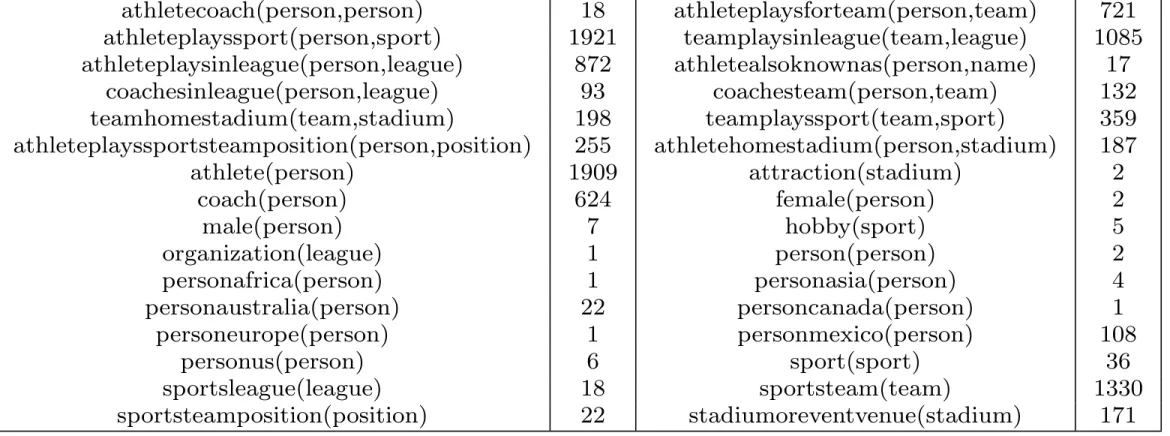
In order to test probabilistic rule learning for facts extracted by NELL, we used the NELL athlete dataset8, which has already been used in the context of meta-interpretive learning of higher-order dyadic Datalog [36]. This dataset contains 10130 facts. The number of facts per predicate is listed in Table 5. The unary predicates in this dataset are deterministic, whereas the binary predicates have a probability attached9.
Table 5: Number of facts per predicate (NELL athlete dataset)
athletecoach(person,person) 18 athleteplaysforteam(person,team) 721 athleteplayssport(person,sport) 1921 teamplaysinleague(team,league) 1085 athleteplaysinleague(person,league) 872 athletealsoknownas(person,name) 17 coachesinleague(person,league) 93 coachesteam(person,team) 132 teamhomestadium(team,stadium) 198 teamplayssport(team,sport) 359 athleteplayssportsteamposition(person,position) 255 athletehomestadium(person,stadium) 187 athlete(person) 1909 attraction(stadium) 2 coach(person) 624 female(person) 2 male(person) 7 hobby(sport) 5 organization(league) 1 person(person) 2 personafrica(person) 1 personasia(person) 4 personaustralia(person) 22 personcanada(person) 1 personeurope(person) 1 personmexico(person) 108 personus(person) 6 sport(sport) 36 sportsleague(league) 18 sportsteam(team) 1330 sportsteamposition(position) 22 stadiumoreventvenue(stadium) 171
Table 5 also shows the types that were used for the variables in the base declarations for the predicates. As indicated in Section 4.5, this typing of the variables forms a syntactic restriction on the possible groundings and ensures that arguments are only instantiated with variables of the appropriate type. Furthermore, the LearnRule function of the ProbFOIL algorithm is based on mFOIL and allows to incorporate a number of variable constraints. To reduce the search space, we imposed that unary predicates that are added to a candidate rule during the learning process can only use variables that have already been introduced. Binary predicates can introduce at most one new variable.
6.2 Relational probabilistic rule learning
In order to illustrate relational probabilistic rule learning with ProbFOIL+ in the context of NELL, we will learn rules and report their respective accuracy for each binary predicate with more then 500 facts. In order to show ProbFOIL+’s speed, also the runtimes are reported. Unless indicated otherwise, both the m-estimate’s m value and the beam width were set to 1. The value of p for rule significance was set to 0.9. The rules are postprocessed such that only range-restricted rules are obtained. Furthermore, to avoid a bias towards to majority class, the examples are balanced, i.e., negative examples are added to balance the number of positives. Anton: negative examples are removed?
8 Kindly provided by Tom Mitchell and Jayant Krishnamurthy (CMU).
athleteplaysforteam
Inducing Probabilistic Logic Programs from Probabilistic Examples? 17
(a) (b)
(c) (d)
Fig. 5: Histogram of probabilities for each of the binary predicates with more then 500 facts: (a) athleteplaysforteam; (b) athleteplayssport; (c) teamplaysinleague; and, (d) athleteplaysinleague.
6.2.1 athleteplaysforteam(person,team)
athleteplaysforteam(A,B) :- coachesteam(A,B).
0.875::athleteplaysforteam(A,B) :- teamhomestadium(B,C), athletehomestadium(A,C).
0.99080::athleteplaysforteam(A,B) :- teamhomestadium(B, ), male(A), athleteplayssport(A, ).
0.75::athleteplaysforteam(A,B) :- teamhomestadium(B, ), athleteplaysinleague(A,C), teamplaysinleague(B,C), athlete(A).
0.75::athleteplaysforteam(A,B) :- teamplayssport(B,C), athleteplayssport(A,C), coach(A), teamplaysinleague(B, ). 0.97555::athleteplaysforteam(A,B) :- personus(A), teamplayssport(B, ).
0.762::athleteplaysforteam(A,B) :- teamplayssport(B,C), athleteplayssport(A,C), personmexico(A), teamplaysinleague(B, ).
0.52571::athleteplaysforteam(A,B) :- teamplayssport(B,C), athleteplayssport(A,C), athleteplaysinleague(A, ), teamplaysinleague(B, ), athlete(A), teamplayssport(B,C).
0.50546::athleteplaysforteam(A,B) :- teamplayssport(B, ), teamplaysinleague(B,C), athleteplaysinleague(A,C), athleteplayssport(A, ).
0.50::athleteplaysforteam(A,B) :- teamplayssport(B, ), teamplaysinleague(B,C), athleteplaysinleague(A,C).
0.52941::athleteplaysforteam(A,B) :- teamplayssport(B, ), teamhomestadium(B, ), coach(A), teamplaysinleague(B, ). 0.55287::athleteplaysforteam(A,B) :- teamplayssport(B, ), teamplaysinleague(B,C), athleteplaysinleague(A,C),
athlete(A).
0.46875::athleteplaysforteam(A,B) :- teamplayssport(B, ), teamplaysinleague(B, ), coach(A), teamhomestadium(B, ).
Dynamics: Evolving Networks
•
Travian
: A massively multiplayer real-time strategy game
•
Commercial game run by TravianGames GmbH
•
~3.000.000 players spread over different “worlds”
•
~25.000 players in one world
[Thon et al., MLJ 11, ECML 08]
World Dynamics
border border border border Alliance 2 Alliance 3 Alliance 4 Alliance 6 P 2 1081 895 1090 1090 1093 1084 1090 915 1081 1040 770 1077 955 1073 804 1054 830 942 1087 786 621 P 3 744 748 559 P 5 861 P 6 950 644 985 932 837 871 777 P 7 946 878 864 913 P 9Fragment of world with
~10 alliances
~200 players
~600 cities
alliances color-coded
Can we build a model
of this world ?
Can we use it for playing
better ?
[Thon, Landwehr, De Raedt, ECML08]
World Dynamics
border border border border Alliance 2 Alliance 4 Alliance 6 P 2 904 1090 917 770 959 1073 820 762 946 1087 794 632 P 3 761 961 1061 607 988 771 924 583 P 5 951 935 948 938 867 P 6 950 644 985 888 844 875 783 P 7 946 878 864 913Fragment of world with
~10 alliances
~200 players
~600 cities
alliances color-coded
Can we build a model
of this world ?
Can we use it for playing
better ?
[Thon, Landwehr, De Raedt, ECML08]
World Dynamics
border border border border Alliance 2 Alliance 4 Alliance 6 P 2 918 1090 931 779 977 835 781 958 1087 808 701 P 3 838 947 1026 1081 833 1002 987 827 994 663 P 5 1032 1026 1024 1049 905 926 P 6 986 712 985 920 877 807 P 7 895 959 P 10 824Fragment of world with
~10 alliances
~200 players
~600 cities
alliances color-coded
Can we build a model
of this world ?
Can we use it for playing
better ?
[Thon, Landwehr, De Raedt, ECML08]
Causal Probabilistic
Time-Logic (CPT-L)
[Thon et al, MLJ 11]
how does the
world change
over time?
0.4::conquest(Attacker,C); 0.6::nil <-
city(C,Owner),city(C2,Attacker),close(C,C2).
if
cause
holds at time T
one of the
effects
holds at time T+1
Limitations CPT-L
Inference slow / scalability
•
uses knowledge compilation method
•
compile formula for
•
exponential in number of time steps
No continuous distributions
•
needed for robotics / relational tracking
applications
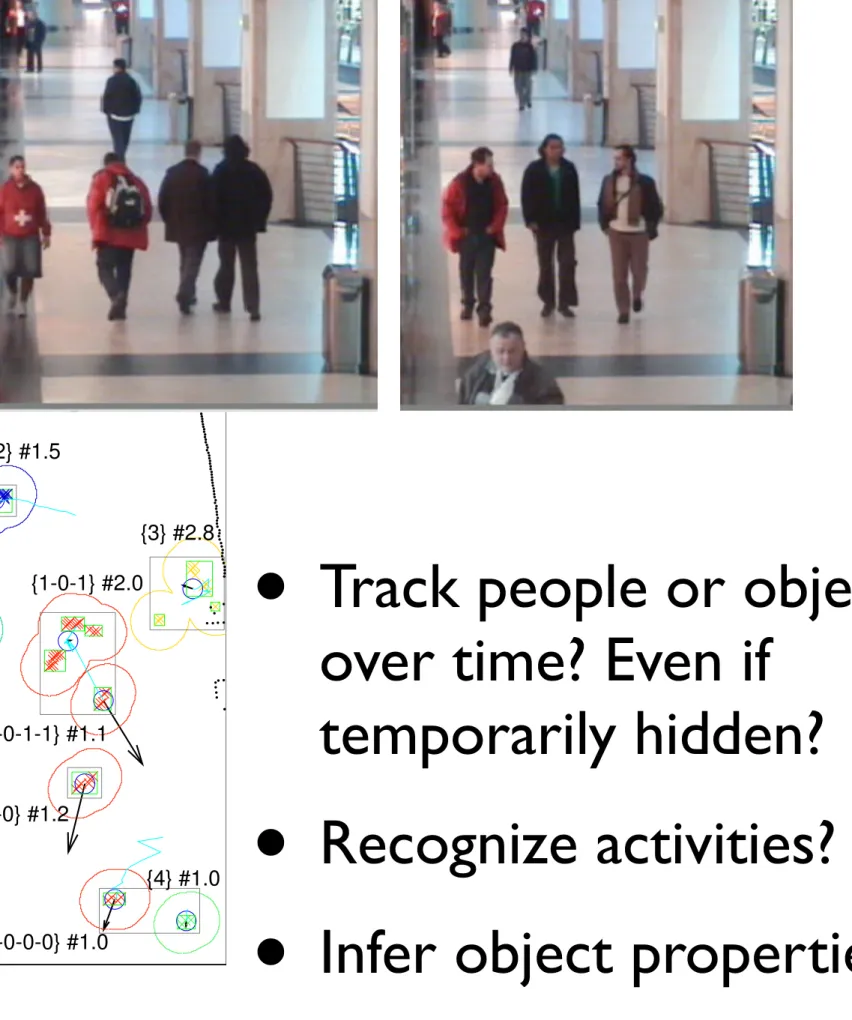
Relational
Tracking
•
Track people or objects
over time? Even if
temporarily hidden?
•
Recognize activities?
•
Infer object properties?
Fig. 4. Tracking results from experiment 2. In frame 5, two groups are present. In frame 15, the tracker has correctly split group 1 into 1-0 and 1-1 (see Fig. 3). Between frames 15 and 29, group 1-0 has split up into groups 1-0-0 and 1-0-1, and split up again. New groups, labeled 2 and 3, enter the field of view in frames 21 and 42 respectively.
Six frames of the current best hypothesis from experiment 2 are shown in Fig. 4, the corresponding hypothesis tree is shown in Fig. 3. The sequence exemplifies movement and formation of several groups.
A. Clustering Error
Given the ground truth information on a per-beam basis we can compute the clustering error of the tracker. This is done
by counting how often a track’s set of points P contains too
many or wrong points (undersegmentation) and how often P
is missing points (oversegmentation) compared to the ground truth. Two examples for oversegmentation errors can be seen in Fig. 4, where group 0 and group 1-0 are temporarily oversegmented. However, from the history of group splits and merges stored in the group labels, the correct group
0 0.1 0.2 0.3 0.4 0.5 0.6 0.5 1 1.5 2 2.5 3 3.5
Error rates per track and frame
Clustering distance threshold dP (m)
w/o tracking Overs. + Unders. Oversegm. Undersegm. 0 0.2 0.4 0.6 0.8 1 0 4 8 12 16 20
Avg. cycle time (sec)
Number of people in ground truth Group tracker
People tracker
Fig. 5. Left: clustering error of the group tracker compared to a memory-less single linkage clustering (without tracking). The smallest error is achieved for a cluster distance of 1.3 m which is very close to the border of personal and social space according to the proxemics theory, marked at 1.2 m by the vertical line. Right: average cycle time for the group tracker versus a tracker for individual people plotted against the ground truth number of people.
relations can be determined in such cases.
For experiment 1, the resulting percentages of incorrectly clustered tracks for the cases undersegmentation, overseg-mentation and the sum of both are shown in Fig. 5 (left),
plotted against the clustering distance dP . The figure also
shows the error of a single-linkage clustering of the range data as described in section II. This implements a memory-less group clustering approach against which we compare the clustering performance of our group tracker.
The minimum clustering error of 3.1% is achieved by the
tracker at dP = 1.3 m. The minimum error for the
memory-less clustering is 7.0%, more than twice as high. In the more complex experiment 2, the minimum clustering error of the tracker rises to 9.6% while the error of the memory-less clustering reaches 20.2%. The result shows that the
group tracking problem is a recursive clustering problem that
requires integration of information over time. This occurs when two groups approach each other and pass from opposite directions. The memory-less approach would merge them immediately while the tracking approach, accounting for the velocity information, correctly keeps the groups apart.
In the light of the proxemics theory the result of a minimal clustering error at 1.3 m is noteworthy. The theory predicts that when people interact with friends, they maintain a range of distances between 45 to 120 cm called personal space. When engaged in interaction with strangers, this distance is larger. As our data contains students who tend to know each other well, the result appears consistent with Hall’s findings.
B. Tracking Efficiency
When tracking groups of people rather than individuals, the assignment problems in the data association stage are of course smaller. On the other hand, the introduction of an additional tree level on which different models hypoth-esize over different group formation processes comes with additional computational costs. We therefore compare our system with a person-only tracker which is implemented by inhibiting all split and merge operations and reducing the
cluster distance dP to the very value that yields the lowest
error for clustering single people given the ground truth. For
Box scenario
•
object tracking even
when invisible
•
estimate spatial relations
Relational State Estimation
over Time
80 [Nitti et al, IROS 13]
Magnetism scenario
•
object tracking
•
category estimation
81
82
Magnetic scenario
●
3 object types: magnetic, ferromagnetic, nonmagnetic
●Nonmagnetic objects do not interact
●
A magnet and a ferromagnetic object attract each other
●Magnetic force that depends on the distance
84
DC Particle Filter (DCPF)
Dynamic Distributional ClausesDCPF
Particle FilterFlexible (relational) state representation
Fast inference (state estimation) in general models
Goal
“A particle filter for hybrid relational domains” IROS 2013
D. Nitti, T. De Laet, L. De Raedt
Dynamic Distributional
Clauses
Prior distribution p(x
0
)
State transition model p(x
t
|x
t-1,
u
t
)
Measurement model p(z
t
|x
t
)
Other rules: p(x’
t
|x’'
t
)
21
Dynamic Distributional Clauses
hidden state
observation timeu
t-1u
tactions
●Prior distribution p(x
0) or p(x
1|z
1)
●
State transition model p(x
t
|x
t-1,u
t)
●
Measurement model p(z
t
|x
t)
●
Other rules: p(x'
86
Magnetic scenario
●
3 object types: magnetic, ferromagnetic, nonmagnetic
●2 magnets attract or repulse
●
Next position after attraction
type(X)
t~ finite([1/3:magnet,1/3:ferromagnetic,1/3:nonmagnetic])
←
object(X).
interaction(A,B)
t~ finite([0.5:attraction,0.5:repulsion])
←
object(A), object(B), A<B,type(A)
t= magnet,type(B)
t= magnet.
pos(A)
t+1~ gaussian(middlepoint(A,B)
t,Cov)
←
near(A,B)
t, not(held(A)), not(held(B)),
interaction(A,B)
t= attr,
c/dist(A,B)
t2> friction(A)
t.
88
Classical Particle Filter vs DCPF
●
Classical PF
–
Fixed set of random variables
–
Update the entire state
●
DCPF
–
Adaptive state
(particle): the number of facts / sampled
random variables can change over time
–
Particles are partial interpretations
–
Expressive language
1.1 2.3 10.3 1.2 2.1 10.5x
t+1
(i)x
t
(i) Pos(1)=(0, 3) Pos(2)=(0, 1) right(X,Y) near(X,Y) interaction(X,Y) type(X) ~ [1/3:magnet,...] [...]89
Optimized inference: partial state
Pos(1)=(0, 3) Pos(2)=(0, 1) right(X,Y) near(X,Y) interaction(X,Y) type(X) ~ [1/3:magnet,...] [...] Pos(1)=(0, 2) Pos(2)=(0, 1) near(1,2)=true type(1)=nonmagnetic right(X,Y) near(X,Y) interaction(X,Y) type(X) ~ [1/3:magnet,...] [...] Pos(1)=(0, 3) Pos(2)=(0, 1) near(1,2)=false near(2,1)=false interaction(1,2)=none type(1)=nonmagnetic type(2)=nonmagnetic [...] Pos(1)=(0, 2) Pos(2)=(0, 1) near(1,2)=true near(2,1)=true interaction(1,2)=none type(1)=nonmagnetic type(2)=nonmagnetic [...]
Classical particle filter
Distributional Clauses Particle Filter (DCPF)
Sampled
Inference in DCPF
Two steps:
Query p(z
t+1|x
t+1) (weighting + part of sampling step)
Query p(x
t+1|x
t
, u
t+1) (to complete the sampling step)
using the DC inference
particles are partial interpretations
bel(x
t) fully represented by {x
t(i)}
∪
Program
History {x
0:t-1(i)} not necessary
91
Experiments
●
Particles are partial state, remaining variables are
marginalized
Ongoing Work
•
Online parameter learning [Nitti, ICRA 2014]
•
Integrate with planning [Nitti, ECML
15,EWRL 15]
•
Applications in robotics (also to learn
affordances)
Learning relational affordances
Learn probabilistic model
From two object interactions
Generalize to N
Shelf push Shelf tap Shelf graspMoldovan et al. ICRA 12, 13, 14
Occluded Object
Search
94
•
Models of objects and their spatial arrangement
•
different types of objects suitable for different tasks
•
shelves with objects of different shape and size
•
given a task, find an object to perform that task
ProbLog for ac+vity recogni+on from video
Thanks!
http://dtai.cs.kuleuven.be/problog
Vaishak Belle Maurice Bruynooghe Bart Demoen Anton Dries Daan Fierens Jason Filippou Bernd Gutmann Manfred Jaeger Gerda Janssens Kristian Kersting Angelika Kimmig Theofrastos Mantadelis Wannes Meert Bogdan Moldovan Siegfried Nijssen Davide Nitti Joris Renkens Kate Revoredo Ricardo Rocha Vitor Santos Costa Dimitar ShterionovIngo Thon Hannu Toivonen
Guy Van den Broeck
Mathias Verbeke
Jonas Vlasselaer 96
•
PRISM
http://sato-www.cs.titech.ac.jp/prism/
•
ProbLog2
http://dtai.cs.kuleuven.be/problog/
•
Yap Prolog http://www.dcc.fc.up.pt/~vsc/Yap/ includes
•
ProbLog1
•
cplint
https://sites.google.com/a/unife.it/ml/cplint
•
CLP(BN)
•
LP2
•
PITA
in XSB Prolog http://xsb.sourceforge.net/
•
AILog2
http://artint.info/code/ailog/ailog2.html
•
SLPs
http://stoics.org.uk/~nicos/sware/pepl
•
contdist
http://www.cs.sunysb.edu/~cram/contdist/
•
DC
https://code.google.com/p/distributional-clauses
•
WFOMC
http://dtai.cs.kuleuven.be/ml/systems/wfomc
PLP
Systems
971
References
Bach SH, Broecheler M, Getoor L, O’Leary DP (2012) Scaling MPE inference for constrained continuous Markov random fields with consensus optimization. In: Proceedings of the 26th Annual Conference on Neural Information Processing Systems (NIPS-12)
Broecheler M, Mihalkova L, Getoor L (2010) Probabilistic similarity logic. In: Pro-ceedings of the 26th Conference on Uncertainty in Artificial Intelligence (UAI-10)
Bryant RE (1986) Graph-based algorithms for Boolean function manipulation. IEEE Transactions on Computers 35(8):677–691
Cohen SB, Simmons RJ, Smith NA (2008) Dynamic programming algorithms as products of weighted logic programs. In: Proceedings of the 24th International Conference on Logic Programming (ICLP-08)
Cussens J (2001) Parameter estimation in stochastic logic programs. Machine Learning 44(3):245–271
De Maeyer D, Renkens J, Cloots L, De Raedt L, Marchal K (2013) Phenetic: network-based interpretation of unstructured gene lists in e. coli. Molecular BioSystems 9(7):1594–1603
De Raedt L, Kimmig A (2013) Probabilistic programming concepts. CoRR abs/1312.4328
De Raedt L, Kimmig A, Toivonen H (2007) ProbLog: A probabilistic Prolog and its application in link discovery. In: Proceedings of the 20th International Joint Conference on Artificial Intelligence (IJCAI-07)
De Raedt L, Frasconi P, Kersting K, Muggleton S (eds) (2008) Probabilistic Induc-tive Logic Programming — Theory and Applications, Lecture Notes in Artificial Intelligence, vol 4911. Springer
Eisner J, Goldlust E, Smith N (2005) Compiling Comp Ling: Weighted dynamic programming and the Dyna language. In: Proceedings of the Human Language Technology Conference and Conference on Empirical Methods in Natural Lan-guage Processing (HLT/EMNLP-05)
Fierens D, Blockeel H, Bruynooghe M, Ramon J (2005) Logical Bayesian networks and their relation to other probabilistic logical models. In: Proceedings of the 15th International Conference on Inductive Logic Programming (ILP-05) Fierens D, Van den Broeck G, Bruynooghe M, De Raedt L (2012) Constraints
for probabilistic logic programming. In: Proceedings of the NIPS Probabilistic Programming Workshop
Fierens D, Van den Broeck G, Renkens J, Shterionov D, Gutmann B, Thon I, Janssens G, De Raedt L (2014) Inference and learning in probabilistic logic programs using weighted Boolean formulas. Theory and Practice of Logic Pro-gramming (TPLP) FirstView
Getoor L, Friedman N, Koller D, Pfe↵er A, Taskar B (2007) Probabilistic relational models. In: Getoor L, Taskar B (eds) An Introduction to Statistical Relational Learning, MIT Press, pp 129–174
Goodman N, Mansinghka VK, Roy DM, Bonawitz K, Tenenbaum JB (2008) Church: a language for generative models. In: Proceedings of the 24th Con-ference on Uncertainty in Artificial Intelligence (UAI-08)
Gutmann B, Thon I, De Raedt L (2011a) Learning the parameters of probabilis-tic logic programs from interpretations. In: Proceedings of the 22nd European
2
Conference on Machine Learning (ECML-11)
Gutmann B, Thon I, Kimmig A, Bruynooghe M, De Raedt L (2011b) The magic of logical inference in probabilistic programming. Theory and Practice of Logic Programming (TPLP) 11((4–5)):663–680
Huang B, Kimmig A, Getoor L, Golbeck J (2013) A flexible framework for prob-abilistic models of social trust. In: Proceedings of the International Conference on Social Computing, Behavioral-Cultural Modeling, and Prediction (SBP-13)
Jaeger M (2002) Relational Bayesian networks: A survey. Link¨oping Electronic
Articles in Computer and Information Science 7(015)
Kersting K, Raedt LD (2001) Bayesian logic programs. CoRR cs.AI/0111058 Kimmig A, Van den Broeck G, De Raedt L (2011a) An algebraic Prolog for
rea-soning about possible worlds. In: Proceedings of the 25th AAAI Conference on Artificial Intelligence (AAAI-11)
Kimmig A, Demoen B, De Raedt L, Santos Costa V, Rocha R (2011b) On the im-plementation of the probabilistic logic programming language ProbLog. Theory and Practice of Logic Programming (TPLP) 11:235–262
Koller D, Pfe↵er A (1998) Probabilistic frame-based systems. In: Proceedings of
the 15th National Conference on Artificial Intelligence (AAAI-98)
McCallum A, Schultz K, Singh S (2009) FACTORIE: Probabilistic programming via imperatively defined factor graphs. In: Proceedings of the 23rd Annual Con-ference on Neural Information Processing Systems (NIPS-09)
Milch B, Marthi B, Russell SJ, Sontag D, Ong DL, Kolobov A (2005) Blog: Proba-bilistic models with unknown objects. In: Proceedings of the 19th International Joint Conference on Artificial Intelligence (IJCAI-05)
Moldovan B, De Raedt L (2014) Occluded object search by relational a↵ordances.
In: IEEE International Conference on Robotics and Automation (ICRA-14) Moldovan B, Moreno P, van Otterlo M, Santos-Victor J, De Raedt L (2012)
Learn-ing relational a↵ordance models for robots in multi-object manipulation tasks.
In: IEEE International Conference on Robotics and Automation (ICRA-12) Muggleton S (1996) Stochastic logic programs. In: De Raedt L (ed) Advances in
Inductive Logic Programming, IOS Press, pp 254–264
Nitti D, De Laet T, De Raedt L (2013) A particle filter for hybrid relational do-mains. In: Proceedings of the IEEE/RSJ International Conference on Intelligent Robots and Systems (IROS-13)
Nitti D, De Laet T, De Raedt L (2014) Relational object tracking and learning. In: IEEE International Conference on Robotics and Automation (ICRA), June 2014
Pfe↵er A (2001) IBAL: A probabilistic rational programming language. In:
Pro-ceedings of the 17th International Joint Conference on Artificial Intelligence (IJCAI-01)
Pfe↵er A (2009) Figaro: An object-oriented probabilistic programming language.
Tech. rep., Charles River Analytics
Poole D (2003) First-order probabilistic inference. In: Proceedings of the 18th International Joint Conference on Artificial Intelligence (IJCAI-03)
Richardson M, Domingos P (2006) Markov logic networks. Machine Learning 62(1-2):107–136
Santos Costa V, Page D, Cussens J (2008) CLP(BN): Constraint logic
3
Sato T (1995) A statistical learning method for logic programs with distribution semantics. In: Proceedings of the 12th International Conference on Logic Pro-gramming (ICLP-95)
Sato T, Kameya Y (2001) Parameter learning of logic programs for symbolic-statistical modeling. J Artif Intell Res (JAIR) 15:391–454
Sato T, Kameya Y (2008) New advances in logic-based probabilistic modeling by prism. In: Probabilistic Inductive Logic Programming, pp 118–155
Skarlatidis A, Artikis A, Filiopou J, Paliouras G (2014) A probabilistic logic pro-gramming event calculus. Theory and Practice of Logic Propro-gramming (TPLP) FirstView
Suciu D, Olteanu D, R´e C, Koch C (2011) Probabilistic Databases. Synthesis Lectures on Data Management, Morgan & Claypool Publishers
Taskar B, Abbeel P, Koller D (2002) Discriminative probabilistic models for rela-tional data. In: Proceedings of the 18th Conference on Uncertainty in Artificial Intelligence (UAI-02)
Thon I, Landwehr N, De Raedt L (2008) A simple model for sequences of rela-tional state descriptions. In: Proceedings of the European Conference on Ma-chine Learning and Knowledge Discovery in Databases (ECML/PKDD-08)
Thon I, Landwehr N, De Raedt L (2011) Stochastic relational processes: Efficient
inference and applications. Machine Learning 82(2):239–272
Van den Broeck G, Thon I, van Otterlo M, De Raedt L (2010) DTProbLog: A decision-theoretic probabilistic Prolog. In: Proceedings of the 24th AAAI Con-ference on Artificial Intelligence (AAAI-10)
Van den Broeck G, Taghipour N, Meert W, Davis J, De Raedt L (2011) Lifted probabilistic inference by first-order knowledge compilation. In: Proceedings of the 22nd International Joint Conference on Artificial Intelligence (IJCAI-11) Vennekens J, Verbaeten S, Bruynooghe M (2004) Logic programs with annotated
disjunctions. In: Proceedings of the 20th International Conference on Logic Pro-gramming (ICLP-04)
Vennekens J, Denecker M, Bruynooghe M (2009) CP-logic: A language of causal probabilistic events and its relation to logic programming. Theory and Practice of Logic Programming (TPLP) 9(3):245–308
Wang WY, Mazaitis K, Cohen WW (2013) Programming with personalized pager-ank: a locally groundable first-order probabilistic logic. In: Proceedings of the 22nd ACM International Conference on Information and Knowledge Manage-ment (CIKM-13)