Efficient and Provable Secure Ciphertext-Policy
Attribute-Based Encryption Schemes
Luan Ibraimi1, Qiang Tang1, Pieter Hartel1, Willem Jonker1,2 1
Faculty of EWI, University of Twente, the Netherlands 2
Philips Research, the Netherlands
Abstract. In a ciphertext-policy attribute-based encryption (CP-ABE) scheme, the data is encrypted under an access policy defined by a user who encrypts the data and a user secret key is associated with a set of at-tributes which identify the user. A user can decrypt the ciphertext if and only if his attributes satisfy the access policy. In CP-ABE, since the user enforces the access policy at the encryption phase, the policy moves with the encrypted data. This is important for data storage servers where data confidentiality must be preserved even if the server is compromised or un-trusted. In this paper, we provide an efficient CP-ABE scheme which can express any access policy represented by a formula involving∧and∨ boolean operators. The scheme is secure under Decision Bilinear Diffie-Hellman assumption (DBDH). Furthermore, we extend the expressivity of the scheme by includingof (threshold) operator in addition to∧and∨ operators. We provide a comparison with existing CP-ABE schemes and show that our schemes are more efficient. Especially, the computational work done by the decryptor is reduced.
1
Introduction
Public-key cryptography is an asymmetric scheme that uses a pair of keys for encryption - a private key which is kept secret and a public key which is widely distributed. If Alice wants to send a confidential message to Bob, she can encrypt the message with the public key of Bob and only Bob can decrypt the message using his private key. In a Public-Key Infrastructure (PKI), a public key must be obtained from, or at least be certified by the Trusted Third Party (TTP) of the PKI. In Identity-Based Encryption (IBE) any string (for [email protected]) can be used to generate a public key without involvement of the TTP [6,18,10]. IBE thus creates a degree of flexibility that a PKI cannot offer. However, if Alice does not know the identity of her party, but instead she only knows certain attributes of the recipient, then neither a PKI nor IBE will work. For example imagine that Alice wishes to communicate with her former classmates, but she does not know their email address.
The solution to this problem is provided by Attribute-Based Encryption (ABE), which identifies a user with a set of attributes [16]. In their seminal paper Sahai and Waters use biometric measurements as attributes in the follow-ing way. A secret key based on a set of attributes ω, can decrypt a ciphertext
encrypted with a public key based on a set of attributesω0, only if the setsωand
ω0overlap sufficiently as determined by a threshold valuet. In the sequel we will refer to the Sahai and Waters scheme as the SW scheme. A more general policy to decide which attributes are required to decrypt a message is provided by an access tree. For example the access treeτ=class1978∧mycollege∨myteacher
states that all students with the attributeclass1978 who studied atmycollegeas well as the teacher possessing the attributemyteacherwould satisfy the policy. There are two variants of ABE: Key-Policy based ABE (KP-ABE) [12] and Ciphertext-Policy based ABE (CP-ABE)[3,9]. In KP-ABE, the ciphertext is as-sociated with a set of attributes and the secret key is asas-sociated with the access tree. The encryptor does not define the privacy policy and has no control over who has access to the data except by defining the set of descriptive attributes necessary to decrypt the ciphertext. The trusted authority who generates user’s secret key defines the combination of attributes for which the secret key can be used. In CP-ABE, the idea is reversed: now the ciphertext is associated with the access tree and the encrypting party determines the policy under which the data can be decrypted, while the secret key is associated with a set of attributes.
Related Work. Pirreti et al. [15] give a construction and implementation of a modified SW scheme, which, compared to the original SW scheme, drastically re-duces computational overhead in the Encryption and the Key Generation phase. The Pirreti et al. [15] scheme is secure in the random oracle model, which, is weaker than the security of the SW scheme since the security of the cryptosystem depends on the security of the hash function and there is no real implementation of a true random oracle. Goyal et al. [12] introduce the idea of KP-ABE where the secret key associated with the access tree controls which ciphertext a user is able to decrypt. In the Goyal et al. scheme, when a user makes a secret key request, the trusted authority determines which combination of attributes must appear in the ciphertext for the user to decrypt. The Goyal et al. scheme is an extension of SW scheme where instead of using the Shamir [17] secret shar-ing technique in the private key, the trusted authority uses a more generalized form of secret sharing to enforce a monotonic access tree. Chase [8] constructs a multi-authority ABE scheme, which allows multiple independent authorities to monitor attributes and distribute secret keys. A related work to KP-ABE is a predicate encryption paradigm or searching on encrypted data [13,1,5,7]. Predi-cate encryption has the advantages of providing ciphertext anonymity by hiding the access structures, however, the system is less expressive compared to schemes which leave the access structures in the clear. Smart [19] gives an access control data scheme which encrypts data to an arbitrary collection of identities using a variant of the Boneh-Franklin IBE scheme. However, the problem of resisting attack from colluding users is not addressed.
The first CP-ABE scheme proposed by Bethencourt et al.[3] uses threshold secret sharing to enforce the policy in the encryption phase. We will henceforth refer to this scheme as the BSW scheme. The main drawback of the BSW scheme is that it requires polynomial interpolation to reconstruct the secret, thus many expensive pairing and exponentiation operations in the decryption phase are
required. The scheme is secure in the generic group model, which model pro-vides evidence to the hardness of the problem, without giving security proof which reduces the problem of breaking the scheme to a well-studied complexity-theoretic problem. The CP-ABE proposed by Cheung and Newport [9] does not use threshold secret sharing but uses random elements to enforce the policy in the encryption phase. We will henceforth refer to this scheme as the CN scheme. The CN scheme has two drawbacks. Firstly, the CN scheme is not sufficiently expressive since it supports only policies with logical conjunction. Secondly, the size of the ciphertext and secret key increases linearly with the total number of attributes in the system. This makes the CN scheme inefficient. Goyal at el. [11] give a ”bounded” CP-ABE construction. The disadvantage of their scheme is that the depth of the access trees dunder which messages can be encrypted is defined in the Setup phase. Thus, the user who wants to encrypt a message is restricted to use only an access tree which has the depthd0≤d.
Contribution.In this paper we focus on the efficiency of the CP-ABE scheme having a security proof based on a standard complexity-theoretic assumption. Previous CP-ABE systems could either support only∧nodes in the access struc-tures [9], or have a security proof only in the generic group model [3] or specify the depth of the access tree in the Setup phase [11]. We propose two schemes which are (1) more efficient, and (2) at least as expressive as the BSW and CN schemes. Our contribution is twofold:
– We present a new technique for realizing Ciphertext-Policy ABE systems which does not use threshold secret sharing. We first show how to achieve this construction which we will refer to it as a basic CP-ABE scheme. In the scheme the encryptor defines the privacy policy through an access tree which is n-ary tree represented by ∧ and/or ∨ nodes. Realizing a scheme which does not use threshold secret sharing is important for resource constraint devices since calculating polynomial interpolations to construct the secret is computationally expensive.
– Next, we extend the basic CP-ABE scheme and provide a second CP-ABE scheme which uses Shamir’s (k, t) threshold secret sharing technique [17]. The access tree is an n-ary tree represented by∧,∨andof(threshold) nodes. We compare the efficiency of our scheme with the BSW scheme and show that our scheme requires less computations in the key generation, encryption and decryption phase.
Organization. The sequel of the paper is organized as follows. In section 2 we review concepts of the access structure, secret sharing, CP-ABE and bilinear pairing. In section 3 we introduce our new basic CP-ABE scheme which is secure under DBDH assumption. In section 4 we provide an extensions of the basic CP-ABE scheme. We extend the expressivity of the scheme by includingof operators in addition to∧and∨operators. In section 5 we discuss how to update the user attribute set and the access policy, and how to achieve anonymous CP-ABE scheme. The last section concludes the paper.
2
Background
First, we give definition for an access structure. Next, we give background infor-mation on secret sharing, specifically for unanimous consent control by modular addition scheme and the Shamir’s secret sharing scheme. Then we give the for-mal security definition of the ciphertext-policy attribute-based encryption (CP-ABE) scheme. Finally, we give background information on bilinear maps and the Decision Bilinear Diffie-Hellman (DBDH) assumption.
2.1 Access Structures
Definition 1. (Access Structure [2]). Let {P1, P2, ..., Pn} be a set of
par-ties. A collection A ⊆ 2{P1,P2,...,Pn} is monotone if ∀B, C : if B ∈
A and
B ⊆C then C ∈A. An access structure (respectively, monotone access struc-ture) is a collection (respectively, monotone collection) Aof non-empty subsets of {P1, P2, ..., Pn}, i.e., A⊆2{P1,P2,...,Pn} \ {∅}. The sets in A are called the authorized sets, and the sets not inAare called the unauthorized sets.
In CP-ABE, instead of parties we use attributes and the access structureAwill
contain the set of authorized attributes.
2.2 Secret Sharing Schemes
In designing our CP-ABE schemes we will make use of two different secret-sharing schemes: unanimous consent control by modular addition scheme and the Shamir secret sharing scheme.
Unanimous Consent Control by Modular Addition Scheme
In a unanimous consent control by modular addition scheme [14], there is a dealer who splits a secretsintotshares in a such way that all shares are required to re-construct the secrets. To share the secrets, 0≤s≤p−1 for some integerp, the dealer generates at−1 random numberssisuch that 1≤si ≤p−1, 1≤i≤t−1
andst=s−P t−1
i=1simod p. The secretsis recovered by:s=P t
i=1si. Sharessi,
1≤i≤t are distributed to partiesPi, 1≤i≤t. For each party Pi, 1≤i≤t,
the shares are random numbers between 0 and p−1, thus no party has any information aboutsexcept the dealer.
Shamir’s Secret Sharing Scheme
In Shamir’s secret sharing technique [17] a secret s is divided into n shares in a such way that any subset oftshares, wheret≤n, can together reconstruct the secret; no subset smaller thantcan reconstruct the secret. The technique is based on polynomial interpolation where a polynomialy=f(x) of degree t−1 is uniquely defined bytpoints (xi, yi). The details of the scheme are as follows:
1. Setup. The dealer D wants to distribute the secrets >0 amongt users. 1)D chooses a primep > max(s, n), and definesa0=s.
2)Dselectst−1 random coefficientsa1, ...., at−1,0≤aj ≤p−1, and defines
the random polynomial overZp,f(x) =Σjt−1=0ajxj.
3)D computessi=f(i)mod p, and sends securely the sharesi to userpi
together with the public indexi.
2. Pooling of shares. Any group of t or more users pool their distinct shares (x, y) = (i, si) allowing computation of the coefficients aj of f(x) by
La-grange interpolation,f(x) =Σit=0−1lj(x) wherelj(x) =Π1≤j≤t,j6=i x−xj xi−xj. The
secret isf(0) =a0=s.
2.3 Ciphertext-Policy ABE
CP-ABE schemes consist of four algorithms: [3]:
– Setup(k). The setup algorithm takes as input a security parameter k and
outputs the public parameterspk and a master keymk.
– Keygen(ω, mk).The algorithm takes as input the master key mk and a set
of attributesω. The algorithm outputs a secret keyskω associated withω.
– Encrypt(m, τ, pk). The encryption algorithm takes as input the public key
pk, a messagem, and an access treeτ representing an access structure. The algorithm will return the ciphertext cτ such that only users who have the
secret key generated from the attributes that satisfy the access tree will be able to decrypt the message.
– Decrypt(cτ, skω). The decryption algorithm takes as input a ciphertext cτ,
a secret keyskω associated with ω, and it outputs a message mor an error
symbol⊥.
Using Attributes for Encryption.We assume that the Trusted Author-ity (T A) is responsible for publishing the attribute set Ω. For instance, in a healthcare domain, T AHealthcare may be responsible for defining the attribute
setΩHealthcare, which may contain attributes such as: doctor, nurse, HIV patient
etc, and in a university domainT AU niversitymay be responsible for defining the
attribute set ΩU niversity, which may contain attributes such as: job position,
age, research interest etc. We assume that the process of obtaining a secret key
skω associated to a set of attributesωis straightforward. The user has to go to
the TA to apply forskω and ”prove” that he/she indeed possess the attribute
setω.
Security Model for CP-ABE.Semantic security under chosen-plaintext attack (CPA) is modelled by an IND-sAtt-CPA game. The game is carried out between a challenger and an adversary A, where the challenger simulates the protocol execution and answers queries from A. Specifically, the game is as fol-lows:
1. Init. The adversary chooses the challenge access treeτ∗ and gives it to the challenger.
2. Setup. The challenger runsSetupto generate (pk, mk) and gives the public keypkto the adversaryA.
3. Phase1.Amakes a secret key request to the Keygenoracle for any attribute
set ω = {aj|aj ∈ Ω}, with the restriction that aj 6∈ τ∗. The challenger
returnsKeygen(ω, mk).
4. Challenge. A sends to the challenger two messages m0, m1.The challenger
picks a random bitb∈ {0,1} and returnscb=Encrypt(mb, τ∗, pk).
5. Phase2. A can continue querying Keygen with the same restriction as in
Phase1.
6. Guess.Aoutputs a guessb0 ∈ {0,1}.
Definition 2. A CP-ABE scheme is said to be secure against an adaptive chosen-plaintext attack (CPA) if any polynomial-time adversary has only a negligible advantage in the IND-sAtt-CPA game, where the advantage is defined to be =|Pr[b0 =b]−1
2|.
Note: The above game between the challenger andAcan be easily extended to handle chosen-ciphertext attacks by allowing decryption queries in Phase1
andPhase2.
Our scheme is proved secure in the selective-attribute (sAtt) model, in which the adversary must provide the challenge access tree he wishes to attack before he receives the public parameters from the challenger. Suppose, that the adversary in theInitphase chooses the challenge access treeτ∗= (A∧B)∨C. InPhase1, the adversary can make secret key requests to Keygen oracle for any attribute set ω with the restriction that attributes A, B, C 6∈ ω. The selective-attribute (sAtt) model can be considered to be analogous to the selective-ID (sID) model [4] used in identity-based encryption schemes, in which the adversary commits ahead of time theID∗ it will attack, and where the adversary can make secret key requests toKeygenoracle for anyID such thatID6=ID∗.
2.4 Review of Pairing
We briefly review the basis of bilinear pairing. A pairing (or, bilinear map) satisfies the following properties:
1. G0 andG1are two multiplicative groups of prime orderp. 2. gis a generator ofG0.
3. ˆe:G0×G0→G1is an efficiently-computable bilinear map with the following properties:
– Bilinear: for allu, v∈G0 anda, b∈Z∗p, we have ˆe(ua, vb) = ˆe(u, v)ab.
– Non-degenerate: ˆe(g, g)6= 1.
G0 is said to be a bilinear group if the group operation inG0 can be com-puted efficiently and if there exists a group G1 and an efficiently-computable bilinear map ˆeas defined above.
Decision Bilinear Diffie-Hellman Assumption
The Decision Bilinear Diffie-Hellman (DBDH) problem is defined as follows. Given g, ga, gb, gc ∈
G0 as input, the adversary must distinguish a valid tuple ˆ
a(g, g)abc∈
G1from the random elementZ ∈G1. An algorithmAhas advantage
in solving the Decision Bilinear Diffie-Hellman (DBDH) problem inG0 if:
|Pr[A(g, ga, gb, gc,eˆ(g, g)abc) = 0]−Pr[A(g, ga, gb, gc, Z) = 0]| ≥.
Here the probability is over the random choice ofa, b, c∈Z∗p, the random choice
of Z ∈ G1, and the random bits of A (the adversary is a nondeterministic algorithm).
Definition 3. We say that the(t, )-DBDH assumption holds if no t-time algo-rithm has advantage at least in solving the DBDH problem in G0.
3
Basic Construction
In this section, first, we give a description of the structure of the access policy used in our basic construction, and later we present the construction of the en-cryption scheme.
Policy Representation
In our scheme the access tree is a n-ary tree, in which leaves are attributes and inner nodes are∧and∨boolean operators. Intuitively, the access tree is a policy which specifies which combination of attributes can decrypt the cipher-text. Consider the following example where a patient wants to specify access restrictions on his medical data. The patient can enforce the access policy in the encryption phase. Each member from the medical staff who has enough at-tributes should be able to decrypt the encrypted message. For instance, a patient wants to allow his data to be seen by Doctor A who works at Department A or by Doctor B who works at Department B. Using boolean operators the patient defines the following access policy:τData= (Doc.A∧Dep.A)∨(Doc.B∧Dep.B).
To decrypt the ciphertext which is encrypted according to theτData access
tree, the decryptor must possess a secret key, which is associated with the at-tribute set which satisfies τData. To decide whether an access tree is satisfied
we interpret each attribute as a logical variable. Possession of the secret key for the corresponding attribute makes the logical variabletrue. If the decryptor does not possess the attribute, the variable is false. For the policy above there are several different sets of attributes that can satisfy the access tree, such as: the secret key associating with the attribute set{Doc.A, Dep.A}, the secret key associating with the attribute set{Doc.B, Dep.B}, or the secret key associating with all attributes defined in the access tree.
We now present our version of the four CP-ABE algorithms:
1. Setup(k) : On input of the security parameter k, this algorithm generates
the following.
(a) Generate a bilinear group G0 of prime order p with a generatorg and bilinear map ˆe:G0×G0→G1
(b) Generate the attribute setΩ={a1, a2, . . . an}, for some integern, and random elementsα, t1, t2. . . tn∈Z∗p.
Let y = ˆe(g, g)α and Tj = gtj (1 ≤ j ≤ n). The public key is pk =
(ˆe, g, y, Tj(1≤j ≤n)) and the master secret key ismk= (α, tj(1≤j≤n)).
2. Keygen(ω, mk) : The algorithm performs as follows.
(a) Select a random valuer∈Z∗p and computed0=gα−r. (b) For each attributeaj inω, computedj=grt
−1
j .
(c) Return the secret keyskω= (d0,∀aj∈ω:dj)
3. Encrypt(m, τ, pk) : To encrypt a messagem∈G1the algorithm proceeds as
follows:
(a) First level encryption: Select a random element s ∈ Z∗p and compute
c0=gsand
c1=m·ys=m·eˆ(g, g)αs
(b) Second level encryption: Set the value of the root node of τ to be s, mark all child nodes as un-assigned, and mark the root node assigned. Recursively, for each un-assigned non-leaf node, do the following:
– If the symbol is∧and its child nodes are marked un-assigned, we use a unanimous consent control by modular addition scheme to assign a value to each child node. To do that, for each child node except the last one, assign a random valuesi where 1≤si ≤p−1, and to
the last child node assign the value st=s−P t−1
i=1si modp. Mark
this node assigned.
– If the symbol is ∨, set the values of each child node to be s. Mark this node assigned.
Values of the leaves ofτ are used to produce ciphertext components. (c) For each leaf attributeaj,i∈τ, computecj,i=Tjsi wherei denotes the
index of the attribute in the access tree. The index values are uniquely assigned to leave nodes in an ordering manner for a given access struc-ture.
(d) Return the ciphertextcτ = (τ, c0, c1,∀aj,i∈τ:cj,i).
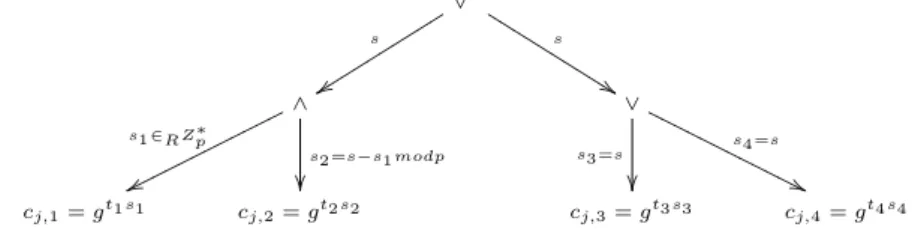
Figure 1 is an example of assigning secret sharessi to the access tree.
∨s s yy ssssss ssss s %% K K K K K K K K K K ∧ s2 =s−s1modp s1∈R Zp∗ ww oooooo oooooo ∨ s3 =s s4 =s '' O O O O O O O O O O O O cj,1=gt1s1 cj,2=gt2s2 cj,3=gt3s3 cj,4=gt4s4
Fig 1. Assigning secret shares to each leaf node in the access treeτ= (T1∧T2)∨(T3∨T4)
4. Decrypt(cτ, skω) : Ifω does not satisfyτ, return⊥, otherwise the algorithm
chooses the smallest set ω0 ⊆ ω (we assume that this can be computed efficiently by the decryptor) that satisfiesτ and performs as follows: (a) For every attributeaj ∈ω0, compute
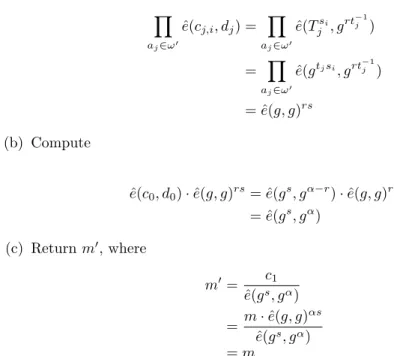
Y aj∈ω0 ˆ e(cj,i, dj) = Y aj∈ω0 ˆ e(Tsi j , g rt−1j ) = Y aj∈ω0 ˆ e(gtjsi, grt−1j ) = ˆe(g, g)rs (b) Compute ˆ e(c0, d0)·eˆ(g, g)rs= ˆe(gs, gα−r)·eˆ(g, g)rs = ˆe(gs, gα) (c) Returnm0, where m0 = c1 ˆ e(gs, gα) =m·eˆ(g, g) αs ˆ e(gs, gα) =m
We briefly discus security properties of our scheme. A full security proof is given in Appendix A.
Collusion Resistent.The most important property that every CP-ABE scheme must have is to prevent collusion. This means that different users can not com-bine their secret keys and decrypt a ciphertext that the colluding users should not have access to. To prevent collusion, the KeyGen algorithm of our scheme generates a different random valuer for each user, keys generated for different users can not be combined since they are randomized. To decrypt the message the attacker must know how to recover ˆe(g, g)αs. To do that the attacker must
first recover ˆe(g, g)rs, which would require the attacker to have the secret key
blinded with the same random valuer.
3.1 Efficiency Analysis
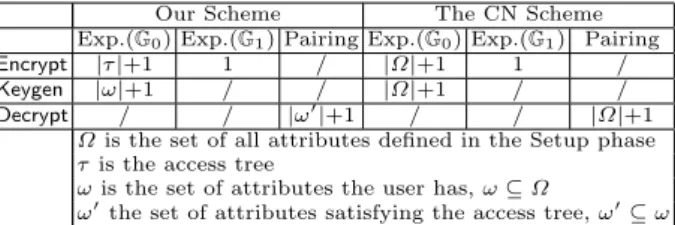
The number of calculations in the Encryption algorithm depends on the number of attributes in the access treeτ. Encryption requires|τ|+ 1 exponentiations in
G0 and one exponentiation inG1. The number of calculations in the KeyGen algorithm depends on the number of attributes in the set ω that the user has.
Our Scheme The CN Scheme Exp.(G0) Exp.(G1) Pairing Exp.(G0) Exp.(G1) Pairing Encrypt |τ|+1 1 / |Ω|+1 1 / Keygen |ω|+1 / / |Ω|+1 / / Decrypt / / |ω0|+1 / / |Ω|+1
Ωis the set of all attributes defined in the Setup phase
τis the access tree
ωis the set of attributes the user has,ω⊆Ω
ω0the set of attributes satisfying the access tree,ω0⊆ω
Table 1.Comparison of our basic CP-ABE scheme with CN scheme
KeyGen requires|ω|+ 1 exponentiations in G0. The number of calculations in the Decryption algorithm depends on the number of attributes in the attribute setω0 . Decryption requires|ω0|+ 1 pairing operations. Decryption also requires
|ω0|multiplications but no exponentiations inG1.
In Table 1 we compare our CP-ABE scheme with the CN scheme. We count the number of calculations in the Encryption, Key Generation, and Decryption phases. Compared to the CN scheme, our scheme requires fewer computations in the Encryption, Key Generation and Decryption phase.
4
Extension of the Expressivity
In the basic scheme the access tree is a n-ary tree represented by∧and∨nodes. This allows the user who performs encryption to express any privacy policy using boolean formulas. Ideally, we would like to have an n-ary access tree which supports of (threshold) operators, similar to the BSW scheme. The essential idea is to allow the encryptor to define the minimum number of attributes from a given list of attributes that the decryptor has to posses in order to decrypt the message. For instance, to decrypt the ciphertext encrypted under the policy
τ =2of (class1978, mycollege, myteacher), the decryptor must have at least two out of three attributes.
We can extend the basic CP-ABE scheme to supportof nodes as follows:
1. Setupis same as in basic CP-ABE scheme.
2. KeyGenis same as in basic CP-ABE scheme.
3. Encrypt(m, τ, pk) : To encrypt a messagem∈G1the algorithm proceeds as
follows:
(a) First level encryption: Select a random element s ∈ Z∗p and compute
c0=gsand
c1=m·ys =m·eˆ(g, g)αs
(b) Second level encryption: Set the value of the root node to bes, mark all child nodes as un-assigned, and mark the root node assigned. Recursively, for each un-assigned non-leaf node, do the following:
– If the symbol is of (threshold operator), and its child nodes are marked un-assigned, the secret sis divided using (t, n) Shamir’s se-cret sharing technique wheret6=n, andnis the total number of child nodes and t is the number of child nodes necessary to reconstruct the secret. To each child node a share secret si =f(i) is assigned.
Mark this node assigned.
– If the symbol is∧, and its child nodes are marked un-assigned, the se-cretsis divided using (t, n) Shamir’s secret sharing technique where
t=n, andnis the number of the child nodes. To each child node a share secretsi=f(i) is assigned. Mark this node assigned.
– If the symbol is∨, and its child nodes are marked un-assigned, the se-cretsis divided using (t, n) Shamir’s secret sharing technique where
t = 1 andnis the number of the child nodes. To each child node a share secretsi=f(i) is assigned. Mark this node assigned.
Values of the leaves ofτ are used to produce ciphertext components. (c) For each leaf attribute aj,i∈τ, computecj,i=Tjsi, wherei denote the
index of the attribute in the access tree.
(d) Return the ciphertext:cτ = (τ, c0, c1,∀aj,i∈τ:cj,i).
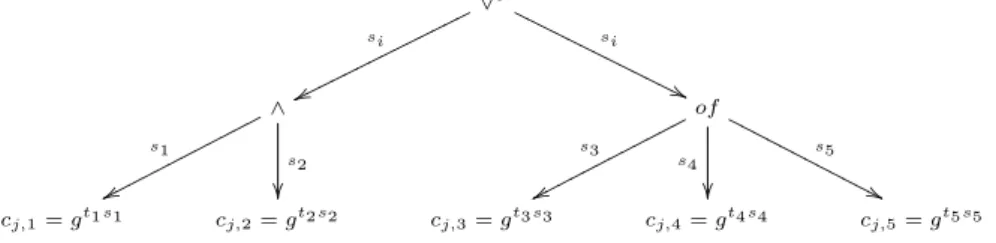
Figure 2 is an example of assigning secret sharessi to the access tree.
∨s si ww oooooooo oooooo si '' O O O O O O O O O O O O O ∧ s2 s1 ww pppppp pppppp of s3 ww pppppp pppppps4 s5 '' O O O O O O O O O O O O cj,1=gt1s1 cj,2=gt2s2 cj,3=gt3s3 cj,4=gt4s4 cj,5=gt5s5
Fig 2. Assigning secret shares to each leaf node in the access treeτ= (T1∧T2)∨2of (T3, T4, T5)
4. Decrypt(cτ, skω) : Ifω does not satisfyτ, return⊥, otherwise the algorithm
chooses the smallest setω0 ⊆ω that satisfies τ and performs as follows: (a) For every attributeaj ∈ω0, compute
Y aj∈ω0 ˆ e(cj,i, dj)li(0)= ˆe(Tjsi, g rt−1j )li(0) = Y aj∈ω0 ˆ e(gtjsi, grt−1j )li(0) = Y aj∈ω0 ˆ e(g, g)rsili(0) = ˆe(g, g)rs
li(0) is a Lagrange coefficient and can be computed by everyone who
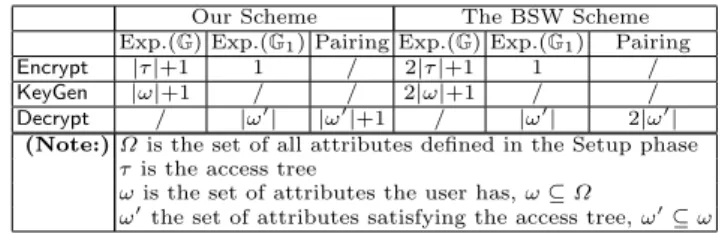
Our Scheme The BSW Scheme Exp.(G) Exp.(G1) Pairing Exp.(G) Exp.(G1) Pairing Encrypt |τ|+1 1 / 2|τ|+1 1 / KeyGen |ω|+1 / / 2|ω|+1 / / Decrypt / |ω0| |ω0|+1 / |ω0| 2|ω0|
(Note:)Ωis the set of all attributes defined in the Setup phase
τis the access tree
ωis the set of attributes the user has,ω⊆Ω
ω0the set of attributes satisfying the access tree,ω0⊆ω
Table 2.Comparison of our extended CP-ABE scheme with BSW scheme
(b) Compute ˆ e(c0, d0)·eˆ(g, g)rs= ˆe(gs, gα−r)·eˆ(g, g)rs = ˆe(gs, gα) (c) Returnm0, where m0 = c1 ˆ e(gs, gα) =m·eˆ(g, g) αs ˆ e(gs, gα) =m
A full security proof is presented in Appendix B. In Table 2 we give a com-parison of the efficiency of our extended CP-ABE scheme with BSW scheme. Compared to the BSW scheme, our scheme requires fewer computations in the Encryption, Key Generation and Decryption phase.
5
Discussion
Updating the Attribute Set. In CP-ABE granting or revoking an attribute from the user is a challenging task. Revocation is difficult since there is no way to prevent the user from not using the issued attribute secret key, since the attribute is not connected solely with one user. Pirretti et al. [15] propose to use time framed attributes where each attribute would be valid for a specific time frame. However this would require the trusted authority to update the list of attributes regularly.
Granting additional attributes is less difficult than revoking. There are two options for granting attributes. One option is to keep a list of users and the corre-sponding random valuesrgenerated during Key Generation phase. The trusted authority needs the random variablerto update the attribute set for each user, since for each attributeaj theKeyGen algorithm computesdj =grt
−1
j . Another
option, which would not require maintaining a list of users, is to do everything from the beginning, issue again secret keys for each attribute for the updated
user set.
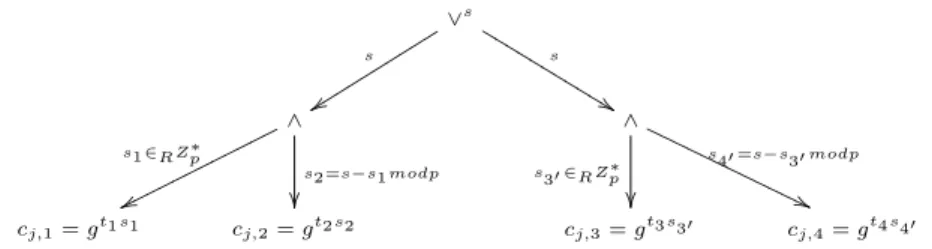
Updating the Access Policy. In a CP-ABE scheme the message encryptor may update his access policy without entirely decrypting the ciphertext. Since in the scheme, the user defines the access policy using an access tree, the change of the policy means the change of the access treeτ. Suppose the user wants to up-date his privacy policy by updating the access tree fromτ= (T1∧T2)∨(T3∨T4) represented in Fig 1. to a different access treeτ0= (T1∧T2)∨(T3∧T4) represented in Figure 3. ∨s s yy ssssss ssss s %% L L L L L L L L L L L ∧ s2 =s−s1modp s1∈R Zp∗ ww
ooooooooo
ooo ∧ s30 ∈R Zp∗ s40=s−s30modp '' P P P P P P P P P P P P cj,1=gt1s1 cj,2=gt2s2 cj,3=gt3s30 cj,4=gt4s40
Fig 3. Assigning secret shares to each leaf node in the access treeτ0= (T1∧T2)∨(T3∧T4)
Recall from section 3. To encrypt a messagem∈G1 under τ = (T1∧T2)∨ (T3∨T4) the Encrypt algorithm selects a random element s ∈ Z∗p in the first
level encryption, then it sets: c1 = m·ys = m·eˆ(g, g)αs and c0 = gs. The second level encryption is based onτ. The algorithm sets:∀aj,i∈τ :cj,1=T1s1,
cj,2 =T2s2, cj,3 =T3s3, cj,4=T4s4. The final ciphertext iscτ = (τ, c0, c1,∀aj,i∈
τ :cj,1, cj,2, cj,3, cj,4).
To update the privacy from τ to τ0, there is no reason to modify the first level encryption, since the second level encryption enforces the policy. Therefore, to update the policy over the encrypted data the user has to update only the second level encryption. The new ciphertext will be different only at cj,3 and
cj,4 therefore the updates are made only at cj,3 and cj,4. The new ciphertext elements are:∀aj,i∈τ0 :cj,1=T1s1,cj,2=T2s2,cj,3=T
s30
3 ,cj,4=T
s40
4 . The new final ciphertext iscτ0 = (τ0, c0, c1,∀aj,i∈τ0:cj,1, cj,2, cj,3, cj,4).
Updating the privacy policy without totally decrypting the ciphertext, re-quires the user to know the random valuesused in the Encryption phase. This is a trade-off for the encryptor since it has to keep a list of the random variables used during each encryption.
Achieving Anonymous CP-ABE. In CP-ABE, when a message sender encrypts a message, along with the encrypted message, the sender specifies in clear text the policyτ used to encrypt the message. However, the policy may reveal some sensitive information about the message being encrypted. Suppose, Alice en-crypts the message under the policyτ=P sychiatrist∧N eurologists. From the policy, an adversary may conclude that Alice has a mental disorder. The ideal solution to prevent the adversary or unintended decrypter to learn some infor-mation about the message being encrypted is to removeτ from the cipehertext.
Therefore, to decrypt the ciphertext, Bob must try all possible setsω0 untilτ is satisfied. Although this can be computationally inefficient, it ensures that if Bob does not posses the right attributes he learns almost nothing about the policyτ
which controlls access to the message. Moreover, he doesn’t learn what attribute he would need to obtain from trusted authority in order to decrypt the message.
6
Conclusion and Future Work
We have shown how to improve the efficiency of a CP-ABE scheme. Firstly, we present a new technique to construct a CP-ABE scheme which does not use threshold secret sharing. The encryptor specifies the policy in the encryption phase using an n-ary tree which consists from∨and∧nodes. Our main result is less computation in the encryption, key generation and decryption phase. Then, we show a modified version of the first scheme which is more expressive compared to the basic scheme but uses threshold secret sharing. In the extended version the policy is expressed as an n-ary tree access tree which consists of∨,∧andof
nodes. For future work, it would be interesting to construct an efficient anony-mous collusion-resistent CP-ABE which would allow the decryptor to decrypt the ciphertext without incorporating the access treeτ in the ciphertext.
Acknowledgments
We thank Asim Muhammad and Peter Van Liesdonk for their suggestions and comments.
References
1. M. Abdalla, M. Bellare, D. Catalano, E. Kiltz, T. Kohno, T. Lange, J. Malone-Lee, G. Neven, P. Paillier, and H. Shi. Searchable Encryption Revisited: Consistency Properties, Relation to Anonymous IBE, and Extensions. Journal of Cryptology, 21(3):350–391, 2008.
2. A. Beimel. Secure Schemes for Secret Sharing and Key Distribution. Phd The-sis,Israel Institute of Technology, Technion, Haifa, Israel, 1996.
3. J. Bethencourt, A. Sahai, and B. Waters. Ciphertext-Policy Attribute-Based En-cryption.Proceedings of the 2007 IEEE Symposium on Security and Privacy, pages 321–334, 2007.
4. D. Boneh and X. Boyen. Efficient selective-ID secure identity based encryption without random oracles. LNCS, 3027:223–238, 2004.
5. D. Boneh, G. Di Crescenzo, R. Ostrovsky, and G. Persiano. Public Key Encryption with Keyword Search. LNCS, pages 506–522, 2004.
6. D. Bonehl and M. Franklin. Identity-Based Encryption from the Weil Pairing. Advances in Cryptology-Crypto 2001: 21st Annual International Cryptology Con-ference, Santa Barbara, California, USA, August 19-23, 2001, Proceedings, 2001. 7. X. Boyen and B. Waters. Anonymous Hierarchical Identity-Based Encryption
8. M. Chase. Multi-authority Attribute Based Encryption. LNCS, 4392:515, 2007. 9. L. Cheung and C. Newport. Provably secure ciphertext policy ABE. Proceedings
of the 14th ACM Conference on Computer and Communications Security, pages 456–465, 2007.
10. C. Cocks. An Identity Based Encryption Scheme Based on Quadratic Residues. LNCS, pages 360–363, 2001.
11. V. Goyal, A. Jain, O. Pandey, and A. Sahai. Bounded Ciphertext Policy Attribute Based Encryption. LNCS, 5126:579–591, 2008.
12. V. Goyal, O. Pandey, A. Sahai, and B. Waters. Attribute-based encryption for fine-grained access control of encrypted data.Proceedings of the 13th ACM Conference on Computer and Communications Security, pages 89–98, 2006.
13. J. Katz, A. Sahai, and B. Waters. Predicate encryption supporting disjunctions, polynomial equations, and inner products. LNCS, 4965:146, 2008.
14. A. Menezes, P. Van Oorschot, and S. Vanstone.Handbook of Applied Cryptography. CRC Press, 1997.
15. M. Pirretti, P. Traynor, P. McDaniel, and B. Waters. Secure attribute-based sys-tems.Proceedings of the 13th ACM Conference on Computer and Communications Security, pages 99–112, 2006.
16. A. Sahai and B. Waters. Fuzzy identity-based encryption.Advances in Cryptology– Eurocrypt, 3494:457–473, 2005.
17. A. Shamir. How to share a secret. Communications of the ACM, 22(11):612–613, 1979.
18. A. Shamir. Identity-based cryptosystems and signature schemes. Proceedings of CRYPTO 84 on Advances in Cryptology, pages 47–53, 1985.
19. N. Smart. Access control using pairing based cryptography. Proceedings of The Cryptographer’s Track at RSA Conference (CT-RSA 2003), pages 111–121, 2003.
A
Security Proof for the basic CP-ABE scheme
We prove the following theorem.Theorem 1. Suppose the DBDH assumption holds. Then no polynomial adver-sary can break the basic scheme of section 3 with a challenge access treeτ∗ Suppose the adversaryAcan win the IND-sAtt-CPA game with a non-negligible advantage. We show how to use the adversaryAto build a simulatorβ that is able to solve the DBDH assumption with advantage/2. Before the game starts, the challenger sets the groupsG0 andG1, a generatorgof groupG0, a mapping function ˆe, and selects at random:a, b, c, θ∈Z∗p. The challenger flips a coinµand
sets Zµ = ˆe(g, g)abc ifµ= 0 andZµ = ˆe(g, g)θ otherwise. The challenger gives
to the simulator β the DBDH challenge: (g, A, B, C, Zµ) = (g, ga, gb, gc, Zµ). β
will act asA’s challenger in the IND-sAtt-CPA game as follows:
Init.The adversary chooses the challenge access treeτ∗ and gives it to the sim-ulator.
Setup.The simulator selects at randomx0∈Zp and implicitly setsα=ab+x0
by letting ˆe(g, g)α= ˆe(g, g)abˆe(g, g)x0. For allaj ∈Ω, (1≤j≤n), it chooses a
randomkj ∈Zp and setsTj =B1/kj (thustj =b/kj) ifaj 6∈τ∗or Tj =gkj if
aj∈τ∗(thustj =kj). The simulator,β, sends the public parameters toA.
Phase1. Amakes secret key requests for any set of attributesωj={aj|aj ∈Ω}
with the restriction thataj 6∈τ∗. On each request the challenger chooses a
ran-dom variabler0(j)∈
Z∗pand setsd0=gx
0−r0jb
. Thus, implicitly it setsr=ab+r0b
since: d0=gx 0 −r0jb =gα−ab−r0jb =gα−(ab+r0jb)
For eachaj ∈ωj the simulator has to construct secret key components of the
form dj =grt
−1
j . Since the simulator implicitly sets r=ab+r0b and t
j =b/kj
for each aj 6∈ τ∗, the valid form of the secret key component would be dj =
g(ab+r0b)kj/b. For each a
j ∈ωj the simulator sets dj =Akjgkjr
0
. This is a valid secret key component and can be computed by the simulator since:
dj=g(ab+r
0b)k
j/b
=gakjigkjr0
=Akjgkjr0
Challenge. A submits two messages m0, m1 ∈ G1. The simulator flips a fair binary coin b, and returns the encryption of mb. The encryption ofmb is done
as follows:
1. First level encryption:
c0=gc and c1=mbeˆ(g, g)αc =mbeˆ(g, g)(ab+x 0)c =mbeˆ(g, g)abcˆe(gc, gx 0 ) =mbZµˆe(gc, gx 0 )
2. Second level encryption: Set the value of the root node ofτ∗to be gc, mark all child nodes as un-assigned, and mark the root node assigned. Recursively, for each un-assigned non-leaf node do the following.
– If the symbol is ∧ and its child nodes are marked un-assigned, for each child except the last one the simulator chooses hi where 1 ≤
hi ≤ p−1, and assigns ghi to them, and to the last child it assigns
ght=gc/Pt−1
i=1g
hi. Mark this node assigned.
– If the symbol is∨, set the values of each child node to begc. Mark this node assigned.
3. For every aj,i∈τ∗, computecj,i=ghikj.
The ciphertext cτ∗ = (τ∗, c0, c1,∀aj,i ∈ τ∗ : cj,i) is sent to A as a ”challenge ciphertext”.
Phase2.Acan continue secret key requests with the same restriction as inPhase1.
Guess.Aoutputs a guessb0∈ {0,1}.
Ifb0 =b, the simulatorβ will guess thatµ= 0 andZµ=e(g, g)abc, otherwise
will guess thatµ= 1 and Zµ =e(g, g)θ. When Zµ =e(g, g)abc the simulator β
gives the perfect simulation andcτ∗is a valid ciphertext. Therefore the advantage of the adversary is:
Pr[b0 =b|Zµ =e(g, g)abc] =
1 2+
Ifµ= 1 thenZµ =e(g, g)θ andcτ∗ is random ciphertext for the adversary, and the adversary does not gain information aboutmb. Hence we have:
Pr[b0 6=b|Zµ=e(g, g)θ] =
1 2
Since the simulator β guessesµ0 = 0 when b0 =b and µ0 = 1 when b0 6=b, the overall advantage ofβ to solve DBDH assumption is:
1 2Pr[µ 0 =µ|µ= 0] +1 2Pr[µ 0 =µ|µ= 1]−1 2 = 2
B
Security Proof for the extended CP-ABE scheme
The security proof from appendix A can be applied to the extended CP-ABE scheme from section 4 as well. The game played between the simulatorβand the adversary Ais the same as in section A with a small difference in the genera-tion of the challenge ciphertext components where the simulator uses a different approach to assign shares to leave nodes in the second level encryption. This is necessary because the access tree contains an additional operator, of (thresh-old) operator, compared to the basic scheme in section 3. The simulation of the second level encryption will be as follows:The simulator β sets the value of the root node of τ∗ to be gc, it marks all child nodes as un-assigned, and marks the root node assigned. Recursively, for each un-assigned non-leaf child node do the following:
– If the symbol is of (threshold operator), and its child nodes are marked un-assigned, the simulator choosesgf(i) for each child node, wheref(i) is a polynomial of degreet−1,tis the number of child nodes to reconstruct the secret,iis the index (order) of the attributes inτ∗andf(0) =c. Mark this node assigned.
– If the symbol is∧, and its child nodes are marked un-assigned, the simulator choosesgf(i)for each child node, wheref(i) is a polynomial of degreen−1,n is the total number of the child nodes,iis the index (order) of the attributes inτ∗ andf(0) =c. Mark this node assigned.
– If the symbol is∨, and its child nodes are marked un-assigned, the simulator chooses gf(i) for each child node, where f(i) is a polynomial of degree 0, i
is the index (order) of the attributes in τ∗ and f(0) = c. Mark this node assigned.
For each leaf attribute aj,i∈τ, computecj,i=gf(i)kj.
As in section A, the advantage of the simulatorβto solve DBDH assumption is: