Dual coding of siRNAs and miRNAs by plant
transposable elements
JITTIMA PIRIYAPONGSA and I. KING JORDAN
School of Biology, Georgia Institute of Technology, Atlanta, Georgia 30332-0230, USA
ABSTRACT
We recently proposed a specific model whereby miRNAs encoded from short nonautonomous DNA-type TEs known as MITEs evolved from corresponding ancestral full-length (autonomous) elements that originally encoded short interfering (siRNAs). Our miRNA-origins model predicts that evolutionary intermediates may exist as TEs that encode both siRNAs and miRNAs, and we analyzedArabidopsis thalianaandOryza sativa(rice) genomic sequence and expression data to test this prediction. We found a number of examples of individual plant TE insertions that encode both siRNAs and miRNAs. We show evidence that these dual coding TEs can be expressed as readthrough transcripts from the intronic regions of spliced RNA messages. These TE transcripts can fold to form the hairpin (stem–loop) structures characteristic of miRNA genes along with longer double-stranded RNA regions that typically are processed as siRNAs. Taken together with a recent study showing Drosha independent processing of miRNAs from Drosophila introns, our results indicate that ancestral miRNAs could have evolved from TEs prior to the full elaboration of the miRNA biogenesis pathway. Later, as the specific miRNA biogenesis pathway evolved, and numerous other expressed inverted repeat regions came to be recognized by the miRNA processing endonucleases, the host gene-related regulatory functions of miRNAs emerged. In this way, host genomes were afforded an additional level of regulatory complexity as a by-product of TE defense mechanisms. The siRNA-to-miRNA evolutionary transition is representative of a number of other regulatory mechanisms that evolved to silence TEs and were later co-opted to serve as regulators of host gene expression.
Keywords: transposable elements; miRNA; siRNA; arabidopsis; rice
INTRODUCTION
The phenomenon of RNA-mediated gene regulation was originally discovered in plants (Matzke and Matzke 2004). Plant biologists found that post-transcriptional gene silenc-ing (PTGS) seemed to involve RNA or DNA sequence interactions between transgenes, or transgenes and homol-ogous plant genes, which led to sequence-specific RNA degradation (Napoli et al. 1990; van der Krol et al. 1990; de Carvalho et al. 1992; van Blokland et al. 1994). It soon became apparent that plant RNA viruses could also stim-ulate PTGS. Transgenic tobacco plants that expressed a truncated form of a viral coat gene recovered from initial infection with the virus and ultimately became resistant (Lindbo et al. 1993). This resistance was found to be
con-ferred through degradation of viral RNA. Subsequently, PTGS was shown to serve as a natural mechanism em-ployed by plants to defend against viral infection (Covey et al. 1997; Ratcliff et al. 1997). Ultimately, these findings led to the notion that a number of plant gene silencing mech-anisms initially evolved as defense mechmech-anisms against invading genetic elements (Matzke et al. 2000).
The broader significance of RNA-mediated gene regula-tion became widely apparent only later, when the specific role of double-stranded RNA (dsRNA) in RNA interference (RNAi) was elucidated forCaenorhabditis elegans(Fire et al. 1998). RNAi inC. elegans was related to genome defense mechanisms by studies showing that RNAi deficient mu-tants lost the ability to silence Tc1 transposable elements (TEs) in the germline (Ketting et al. 1999; Tabara et al. 1999). The mechanism behind RNAi-based silencing of C. elegansTEs was found to be based on the production of dsRNAs from the terminal inverted repeat (TIR) sequences found at the ends of Tc1 elements (Sijen and Plasterk 2003). This work demonstrated that RNAi is initiated by read-through transcription of full-length Tc1 elements, Reprint requests to:I. King Jordan, School of Biology, Georgia Institute
of Technology, 310 Ferst Drive, Atlanta, GA 30332-0230, USA; e-mail: [email protected]; fax: (404) 894-0519.
Article published online ahead of print. Article and publication date are at http://www.rnajournal.org/cgi/doi/10.1261/rna.916708.
which then fold into ‘‘snap-back’’ structures with the complementary sequences of the TIRs bound as dsRNA (Fig. 1). These dsRNA TIR sequences are processed by the RNAi enzymatic machinery to yield short interfering RNAs (siRNAs) that silence expression via mRNA degradation of the transposase gene required for Tc1 transposition. The sequence specificity of the mRNA degradation is caused by binding of the TIR-derived single-stranded siRNAs to complementary sequences of the transposase encoding mRNA. Later, TE-encoded siRNAs were shown to silence the highly active MuDR TE family in maize (Slotkin et al. 2005). In light of the ability to defend against viral infection and TE mobilization, RNAi has been considered as an immune system for the genome (Plasterk 2002).
As described above, the connection between the siRNA molecules that mediate RNA-based gene silencing and TEs, or viruses, has been appreciated since PTGS and RNAi were first studied. MicroRNAs (miRNAs) are a related class of short RNA molecules with an analogous functional role in RNAi (Ambros 2004; Bartel 2004). miRNAs are processed from the dsRNA regions of short,z70–90 base pairs (bp), stem–loop (hairpin) RNA structures by the same endonu-clease, Dicer (or Dicer-like in plants), which cleaves siRNAs from longer dsRNA sequences. A connection between TEs and miRNAs was more recently established when a number of miRNA genes were found to be derived from TE se-quences (Mette et al. 2002; Smalheiser and Torvik 2005; Borchert et al. 2006; Piriyapongsa and Jordan 2007; Piriyapongsa et al. 2007).
In the human genome, a group of related miRNA genes was found to be derived from the Made1 family of TEs (Piriyapongsa and Jordan 2007). Made1 elements (Morgan 1995; Oosumi et al. 1995; Smit and Riggs 1996) are
members of a specific class on DNA-type TEs known as miniature inverted-repeat transposable elements (MITEs) (Bureau and Wessler 1992, 1994). MITEs are short non-autonomous derivatives of full-length DNA-type elements (Feschotte and Mouches 2000; Feschotte et al. 2002). Full-length DNA-type elements are, typically, several kilobases in length and contain a single open reading frame, which encodes the transposase enzyme that catalyzes transposi-tion, flanked by two TIR sequences on either end of the elements (Fig. 1A). As is the case with the Tc1elements of C. elegans, full-length transcripts of DNA-type elements can fold into snap-back structures with the two TIRs forming a dsRNA region (Fig. 1B). This dsRNA region can be processed to yield siRNAs that silence expression of the elements. MITEs are shorter sequences of z80–500 bp, which lack the internal ORF of full-length elements but retain the TIRs (Fig. 1C). So MITEs are closer to being palindromes, and read-through transcription of MITEs will lead to RNA sequences that can fold into hairpin structures reminiscent of the pre-miRNA sequences processed by Dicer to yield mature miRNAs (Fig. 1D).
The relationship between full-length DNA-type elements and siRNAs, on the one hand, and MITEs and miRNAs, on the other, led us to propose a specific model for how miRNAs could have evolved from siRNA encoding TEs in a step-wise manner (Piriyapongsa and Jordan 2007). As illustrated in Figure 1, our model posits that siRNAs were first processed from the two TIRs of full-length elements bound as dsRNA. Later, as derivative MITEs evolved from full-length elements and proliferated in the genome, the same RNA endonucleolytic processing machinery cleaved the dsRNA from the hairpin stem regions, yielding mature miRNA sequences. A corollary prediction of our model holds that evolutionary intermediates may exist as TE sequences that encode both siRNAs and miRNAs. We tested the prediction of dual coding siRNA–miRNA TEs using a computational analysis of genome sequences, anno-tation and expression data from the plants Arabidopsis thalianaandOryza sativa(rice).
RESULTS
We searched Arabidopsis and rice genome sequence and expression data (see Materials and Methods) to determine whether there are individual TE insertions that encode both siRNA and miRNA sequences. The Arabidopsis and rice genome sequences, along with their functional genomic data sets, afford several specific advantages for this kind of search. Both model species have been studied extensively, particularly by biologists interested in TEs, and accordingly their TEs are relatively well characterized. In addition, RNA expression levels for Arabidopsis and rice genes have been extensively characterized using the high-throughput mas-sively parallel signature sequencing (MPSS) technique (Brenner et al. 2000a,b). The original MPSS technique FIGURE 1. Model for the TE-based siRNA-miRNA evolutionary
transition. (A) Full-length DNA-type element with terminal inverted repeats (TIRs) flanking a long open reading frame. (B) Snap-back secondary structure of the full-length element with TIRs bound as dsRNA. (C) MITE, a non-autonomous derivative of a full-length DNA-type element, containing TIRs and a small internal region. (D) Hairpin (stem–loop) secondary structure formed by a MITE RNA.
was later modified to characterize small RNA sequences such as siRNAs and miRNAs (Lu et al. 2006). MPSS for short RNAs yields many thousands of sequence tags that can be unambiguously mapped to the Arabidopsis or rice genomes to determine where mature siRNAs and miRNAs are encoded.
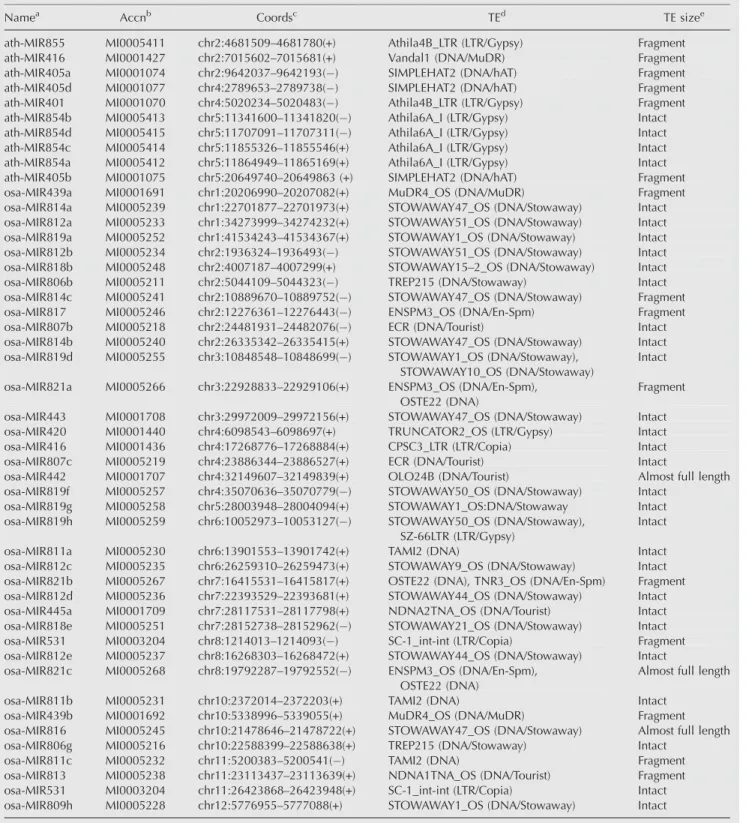
The miRBase Sequence Database (Griffiths-Jones et al. 2006) contains genome annotations for experimentally characterized miRNA gene sequences from a number of species, including Arabidopsis and rice. Release 10.0 of miRBase contains 184 Arabidopsis and 231 rice miRNAs. We compared the genomic locations of these miRNAs to the locations of TEs annotated using the RepeatMasker program. Twelve Arabidopsis miRNAs (6.5%) and 83 rice miRNAs (35.9%) were found to be colocated with TE sequences (Supplemental Table 1). Ten out of 12 TE colocated Arabidopsis miRNA sequences and 38 out of 83 TE colocated rice miRNA sequences share 100% of their sequences with TEs (Supplemental Fig. 1). The TE se-quences were all annotated based on RepeatMasker scores well above the threshold for false positives (average SW score = 20,357). In other words, these data represent unequivocal cases of plant miRNA genes that have been derived from TE sequences (Table 1). These miRNAs are derived from members of a variety of TE sequence families, including gypsy- and copia-like LTR retroelements, but the vast majority are encoded by the short nonautonomous DNA-type TEs known as MITEs. MITE-derived miRNAs are particularly enriched in rice consistent with the geno-mic abundance of MITEs in this species (Jiang et al. 2004). miRBase was used to count the number of orthologs for eachArabidopsis and rice miRNA. TE-derived miRNA genes in Arabidopsis and rice have fewer orthologs on average (0.07), i.e., they are less evolutionarily conserved, than nonrepetitive miRNAs (3.0), and the difference is highly significant (Student’st-test;t= 18.8, df = 13,P= 2e-57). This is similar to what is seen for many mammalian TE-derived miRNAs (Piriyapongsa et al. 2007) and is con-sistent with the fact that TEs represent the most lineage-specific and rapidly evolving sequences in eukaryotic genomes (Marino-Ramirez et al. 2005). On the one hand, this may suggest that caution is warranted when evaluating TE-derived plant miRNAs since they are not conserved (Ambros et al. 2003). However, there are a number of bona fide miRNAs that are not evolutionarily conserved (Bentwich et al. 2005). The low conservation of TE-derived miRNAs can be taken to imply that the regulatory effects exerted by TE-derived miRNAs may be relevant for species-specific differences in gene expression (Piriyapongsa et al. 2007).
In addition to using miRBase to characterize TE-derived miRNAs, we searched the literature to confirm TE-derived plant miRNA genes with documented effects on the ex-pression of host genes. There are five TE-derived miRNAs uncovered here (Table 1, ath-MIR854a–ath-MIR854d,
ath-MIR855), including a repetitive family derived from dispersed LTR sequences, with experimentally character-ized effects on the regulation ofArabidopsisgenes (Arteaga-Vazquez et al. 2006). First of all, mature ath-MIR854 sequences were found to be absent in plants with mutant alleles for three genes critical to miRNA biogenesis: Dicer-like1(dcl1),Hyponastic leaves1(hyl1), andHUA Enhancer1 (hen1). However, ath-MIR854 expression was found in mutants of the RNA-dependent RNA polymerase2 gene, which is required for siRNA processing. Together, these results indicate that ath-MIR854 is processed specifically as an miRNA. The mature sequences of MIR854 and ath-MIR855 have multiple binding sites in the 39-untranslated region (UTR) of the oligouridylate binding protein1b gene (UBP1b), which encodes a heterogeneous nuclear RNA binding protein. The UBP1b 39-UTR mRNA–miRNA interactions resemble those that lead to translational repression and/or mRNA cleavage in mammals. The ability of these TE-derived miRNAs to repress expression of UBP1bwas demonstrated by using the 39-UTR of the gene in a reporter protein expression assay. Mature ath-MIR854 and ath-MIR855 sequences are expressed in rosette leaves and flowers but absent in cauline leaves. Accordingly, the 39-UTR of UBP1bcan repress protein reporter expression in rosette leaves and flowers not in cauline leaves. Further-more, comparison of mRNA versus protein expression for the reporter indicated that the ath-MIR854a–ath-MIR854d and ath-MIR855 genes exert their effects at the translational level.
We used expression data taken from the Arabidopsis MPSS Plus (Meyers et al. 2004) and Rice MPSS Plus (Nobuta et al. 2007) databases to evaluate whether any of the TEs that encode miRNA genes are also processed to yield siRNA sequences. The siRNA MPSS sequence tags were unambiguously mapped, using 100% tag-TE sequence identity, to the TEs that were found to encode miRNAs. Eight of theArabidopsisTEs that encode miRNAs and 13 of the miRNA encoding rice TEs were found to encode siRNA sequences as well (Table 1).
We also explored the possibility that TE-derived miRNAs and siRNAs are passively transcribed as part of longer host gene RNA messages. To do this, genome-wide EST and mRNA maps for Arabidopsis and rice were examined to look for cases where dual coding miRNA–siRNA TE se-quences are located within the start and stop coordinates of spliced transcripts. We were able to find several examples of such cases, one forArabidopsisand two for rice (Fig. 2).
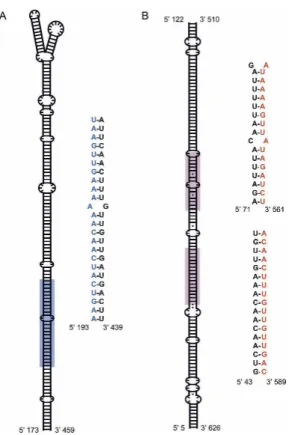
Finally, all of the miRNA–siRNA dual coding TE sequences were folded to predict their secondary structures (Supplemental Fig. 2). The predicted secondary structures show long double-stranded regions that correspond to the locations of mapped siRNA sequence tags along with stem–loop regions characteristic of known miRNA gene structures. The MITE encoded secondary structures are par-ticularly striking in the sense that they form long, almost
TABLE 1.Plant miRNA genes derived from TEs
Namea Accnb Coordsc TEd TE sizee
ath-MIR855 MI0005411 chr2:4681509–4681780(+) Athila4B_LTR (LTR/Gypsy) Fragment
ath-MIR416 MI0001427 chr2:7015602–7015681(+) Vandal1 (DNA/MuDR) Fragment
ath-MIR405a MI0001074 chr2:9642037–9642193( ) SIMPLEHAT2 (DNA/hAT) Fragment ath-MIR405d MI0001077 chr4:2789653–2789738( ) SIMPLEHAT2 (DNA/hAT) Fragment ath-MIR401 MI0001070 chr4:5020234–5020483( ) Athila4B_LTR (LTR/Gypsy) Fragment ath-MIR854b MI0005413 chr5:11341600–11341820( ) Athila6A_I (LTR/Gypsy) Intact ath-MIR854d MI0005415 chr5:11707091–11707311( ) Athila6A_I (LTR/Gypsy) Intact ath-MIR854c MI0005414 chr5:11855326–11855546(+) Athila6A_I (LTR/Gypsy) Intact ath-MIR854a MI0005412 chr5:11864949–11865169(+) Athila6A_I (LTR/Gypsy) Intact ath-MIR405b MI0001075 chr5:20649740–20649863 (+) SIMPLEHAT2 (DNA/hAT) Fragment osa-MIR439a MI0001691 chr1:20206990–20207082(+) MuDR4_OS (DNA/MuDR) Fragment osa-MIR814a MI0005239 chr1:22701877–22701973(+) STOWAWAY47_OS (DNA/Stowaway) Intact osa-MIR812a MI0005233 chr1:34273999–34274232(+) STOWAWAY51_OS (DNA/Stowaway) Intact osa-MIR819a MI0005252 chr1:41534243–41534367(+) STOWAWAY1_OS (DNA/Stowaway) Intact osa-MIR812b MI0005234 chr2:1936324–1936493( ) STOWAWAY51_OS (DNA/Stowaway) Intact osa-MIR818b MI0005248 chr2:4007187–4007299(+) STOWAWAY15–2_OS (DNA/Stowaway) Intact osa-MIR806b MI0005211 chr2:5044109–5044323( ) TREP215 (DNA/Stowaway) Intact osa-MIR814c MI0005241 chr2:10889670–10889752( ) STOWAWAY47_OS (DNA/Stowaway) Fragment osa-MIR817 MI0005246 chr2:12276361–12276443( ) ENSPM3_OS (DNA/En-Spm) Fragment osa-MIR807b MI0005218 chr2:24481931–24482076( ) ECR (DNA/Tourist) Intact osa-MIR814b MI0005240 chr2:26335342–26335415(+) STOWAWAY47_OS (DNA/Stowaway) Intact osa-MIR819d MI0005255 chr3:10848548–10848699( ) STOWAWAY1_OS (DNA/Stowaway),
STOWAWAY10_OS (DNA/Stowaway)
Intact osa-MIR821a MI0005266 chr3:22928833–22929106(+) ENSPM3_OS (DNA/En-Spm),
OSTE22 (DNA)
Fragment osa-MIR443 MI0001708 chr3:29972009–29972156(+) STOWAWAY47_OS (DNA/Stowaway) Intact osa-MIR420 MI0001440 chr4:6098543–6098697(+) TRUNCATOR2_OS (LTR/Gypsy) Intact osa-MIR416 MI0001436 chr4:17268776–17268884(+) CPSC3_LTR (LTR/Copia) Intact osa-MIR807c MI0005219 chr4:23886344–23886527(+) ECR (DNA/Tourist) Intact
osa-MIR442 MI0001707 chr4:32149607–32149839(+) OLO24B (DNA/Tourist) Almost full length osa-MIR819f MI0005257 chr4:35070636–35070779( ) STOWAWAY50_OS (DNA/Stowaway) Intact
osa-MIR819g MI0005258 chr5:28003948–28004094(+) STOWAWAY1_OS:DNA/Stowaway Intact osa-MIR819h MI0005259 chr6:10052973–10053127( ) STOWAWAY50_OS (DNA/Stowaway),
SZ-66LTR (LTR/Gypsy)
Intact
osa-MIR811a MI0005230 chr6:13901553–13901742(+) TAMI2 (DNA) Intact
osa-MIR812c MI0005235 chr6:26259310–26259473(+) STOWAWAY9_OS (DNA/Stowaway) Intact osa-MIR821b MI0005267 chr7:16415531–16415817(+) OSTE22 (DNA), TNR3_OS (DNA/En-Spm) Fragment osa-MIR812d MI0005236 chr7:22393529–22393681(+) STOWAWAY44_OS (DNA/Stowaway) Intact osa-MIR445a MI0001709 chr7:28117531–28117798(+) NDNA2TNA_OS (DNA/Tourist) Intact osa-MIR818e MI0005251 chr7:28152738–28152962( ) STOWAWAY21_OS (DNA/Stowaway) Intact osa-MIR531 MI0003204 chr8:1214013–1214093( ) SC-1_int-int (LTR/Copia) Fragment osa-MIR812e MI0005237 chr8:16268303–16268472(+) STOWAWAY44_OS (DNA/Stowaway) Intact osa-MIR821c MI0005268 chr8:19792287–19792552( ) ENSPM3_OS (DNA/En-Spm),
OSTE22 (DNA)
Almost full length
osa-MIR811b MI0005231 chr10:2372014–2372203(+) TAMI2 (DNA) Intact
osa-MIR439b MI0001692 chr10:5338996–5339055(+) MuDR4_OS (DNA/MuDR) Fragment osa-MIR816 MI0005245 chr10:21478646–21478722(+) STOWAWAY47_OS (DNA/Stowaway) Almost full length osa-MIR806g MI0005216 chr10:22588399–22588638(+) TREP215 (DNA/Stowaway) Intact
osa-MIR811c MI0005232 chr11:5200383–5200541( ) TAMI2 (DNA) Fragment
osa-MIR813 MI0005238 chr11:23113437–23113639(+) NDNA1TNA_OS (DNA/Tourist) Fragment osa-MIR531 MI0003204 chr11:26423868–26423948(+) SC-1_int-int (LTR/Copia) Intact osa-MIR809h MI0005228 chr12:5776955–5777088(+) STOWAWAY1_OS (DNA/Stowaway) Intact
aMiRBase database miRNA names. b
MiRBase database miRNA accessions.
cGenomic location coordinates of colocated TE sequences. d
Name, class, and family of the TE sequences.
eSize of TE sequences that encode miRNA genes: intact (full-length element), almost full-length ($80% of full-length element consensus
sequence), and fragment (<80% of full-length element consensus sequence).
perfect hairpins possessing extensive double-stranded re-gions (Fig. 3; Supplemental Fig. 2). These folding patterns are based on the sequence complementarity between the TIRs encoded by this class of TEs.
DISCUSSION
Our analysis ofArabidopsisand rice genomic data revealed the existence of TE sequences that encode both siRNAs and miRNAs. We believe that the dual coding capacity for small regulatory RNAs by plant TEs reflects an evolutionary connection between related mechanisms of RNAi. This notion is based on the recent discovery of a family of human miRNA genes derived from MITEs, which led us to propose a step-wise model for the evolution of miRNAs from TEs that originally encoded siRNAs (Piriyapongsa and Jordan 2007). The expression of siRNAs from auton-omous DNA-type elements is known to be based on read-through transcription of full-length elements (Sijen and Plasterk 2003), and our model is based on read-through transcription of shorter nonautonomous MITEs (Fig. 1). MITEs retain the TIR sequences of autonomous DNA-type elements but do not encode any open reading frame between the TIRs. As such, MITEs are made up mostly of TIR sequences; i.e., they are palindromic, and when expressed as read-through transcripts, they will fold to form hairpin structures similar to those of miRNA genes (Bartel 2004). Apparently, these MITE-derived hairpins can be processed to yield functionally relevant mature miRNA sequences (Piriyapongsa and Jordan 2007; Piriyapongsa
et al. 2007). Consistent with this model, our results demonstrate that several of the siRNA–miRNA encoding TEs found in plants are in fact expressed as read-through transcripts by virtue of their presence in the introns of spliced RNA messages (Fig. 2, ESTs/mRNAs). After TE-containing introns are spliced from the mRNAs, they can fold to form the kinds of structures recognized by the endonucleases involved in RNAi (Fig. 3; Supplemental Fig. 2).
In addition to their palindromic sequence-structure characteristics, MITEs are also distinguished by their prefer-ence for insertion into gene rich regions (Mao et al. 2000; Zhang et al. 2000). Taken together with their genomic abun-dance (Jiang et al. 2004), this means that thousands of MITEs will be ex-pressed as read-through transcripts as required by our model. The particular enrichment of MITEs in plant gene regions has been taken to suggest that they play some functional role for their host genomes. Our results, and our model of miRNA evolution via the autonomous TE-to-MITE transition, suggest that the host relevant function of MITEs is related, at least in part, to RNA-mediated gene regulation.
There is recent evidence fromDrosophilain support of the notion that miRNAs can be processed from the introns of expressed genes in a manner similar to that which we propose for TE-derived miRNA genes (Ruby et al. 2007). Spliced introns that can fold into pre-miRNA-like struc-tures and be cleaved to yield mature miRNA sequences are called ‘‘mirtrons.’’ Interestingly, the processing of mirtrons to yield mature miRNAs does not rely on the RNA endonuclease Drosha. Drosha, or its plant functional analog Dicer-like1, is the enzyme that cleaves the longer pri-miRNA sequence near the base of the stem region in the nucleus to yield the pre-miRNA hairpin, which is then cleaved by Dicer to liberate the mature miRNA. Similar to the processing of mirtrons, PTGS via siRNAs does not require Drosha since dsRNAs are processed by Dicer alone to yield siRNAs (Bartel 2004). Thus, the work of Ruby et al. (2007) indicates that miRNAs can arise in any organism that possesses both spliceosomal introns and PTGS via siRNAs; this was taken to suggest that miRNAs may have emerged in ancient eukaryotes prior to the evolution of the complete miRNA biogenesis pathway. Our model points to MITEs as a potential source for the evolution of such ancient miRNAs, processed by Dicer (or Dicer-like1) alone, from full-length TEs that previously encoded siRNAs only. Consistent with an ancient origin of miRNAs from TEs, full-length DNA-type elements and MITEs are widely FIGURE 2. Genomic structure and expression of TE-derived miRNAs. The schematic
dia-grams representing the colocation between miRNA genes, TEs, and EST/mRNAs (see legend) are shown for (A) osa-MIR439a, (B) osa-MIR422, and (C) ath-MIR405b.
distributed among eukaryotes (Feschotte et al. 2002), indicating that they were likely to be present in ancestral eukaryotic species. In addition, a recent phylogenetic analysis of the miRNA biogenesis enzymes indicates that Dicer is the more ancient of the endonucleases involved the processing of mature miRNAs, with Drosha having evolved more recently along the animal evolutionary lineage (Cerutti and Casas-Mollano 2006).
dsRNA sequences are processed to yield multiple siRNAs from a given stretch of sequence, while pre-miRNA hair-pins are cleaved into a single distinct mature miRNA sequence (Bartel 2004). This may be related to the steric hindrance entailed by the substantially shorter hairpin structures that are processed to yield miRNAs. Over evolu-tionary time, once the endonucleolytic machinery became tuned to the structural characteristics, and limited spacing, of the MITE-encoded hairpins, then it would have been able to recognize any number of hairpin structures that are
formed when genomic sequences with inverted repeats are expressed as read-through transcripts. Indeed, this has been shown to be important inArabidopsis, where miRNA genes evolved via local inverted duplication events, which gener-ated sequences capable of folding back into hairpin struc-tures when expressed (Allen et al. 2004). In this way, MITEs could have stimulated the RNAi biogenesis enzymes to pro-cess non-TE-related hairpin structures to yield miRNAs with host gene regulatory functions.
Relatively ancient siRNA sequences originally evolved as defense mechanisms against genomic invaders, such as viruses and TEs, and genome defense appears to remain the primary function of this class of regulatory sequence. On the other hand, miRNAs are evolutionarily emergent regulators, and accordingly they function primarily to regu-late host genes. The siRNA-to-miRNA evolutionary tran-sition is one of a growing number of examples (Yoder et al. 1997; Matzke et al. 2000; Lippman et al. 2004; McDonald et al. 2005) of gene silencing mechanisms that were originally employed to defend against TE proliferation and were later co-opted to serve the regulatory needs of the host organism (Piriyapongsa et al. 2007).
MATERIALS AND METHODS
TheA. thalianagenomic sequence was obtained from the National Center for Biotechnology (NCBI) genome assembly/annotation projects ftp site (ftp://ftp.ncbi.nih.gov/genomes/Arabidopsis_ thaliana). TheO. sativa(rice) genomic sequence was taken from release 4.0 of The Institute for Genomic Research (TIGR) rice genome annotation database (Ouyang et al. 2007; ftp://ftp.tigr. org/pub/data/Eukaryotic_Projects/o_sativa/annotation_dbs/pseudo molecules/). The genome locations of different classes of TEs in Arabidopsis and rice genomes were identified by using the RepeatMasker program (Smit et al. 2004) to compare genomic sequences against the species-specific Repbase libraries (Jurka 2000; Jurka et al. 2005) of TE consensus sequences. The Smith– Waterman (SW) algorithm (Smith and Waterman 1981) was used with RepeatMasker to do local pairwise comparisons of genome-against-TE consensus sequences and to score the resulting align-ments. The genome locations and identities of experimentally characterized Arabidopsis and rice miRNA gene sequences were taken from release 10.0 of the miRBase database (Griffiths-Jones et al. 2006; http://microrna.sanger.ac.uk/sequences/).
Arabidopsisand rice MPSS small RNA signatures were down-loaded from the ArabidopsisMPSS Plus database (Meyers et al. 2004; http://mpss.udel.edu/at/) and the Rice MPSS Plus database (Nobuta et al. 2007; http://mpss.udel.edu/rice/). The signatures matching to tRNAs, rRNAs, snRNAs, or snoRNAs were not included in the data set we used. Only the small RNA signatures of size 17–25 bp were chosen for the analysis. For each species, the small RNA signatures were divided into two groups: miRNA signatures and siRNA signatures according the organism-specific MPSS database annotations.
The genome locations of TEs and miRNAs were compared to identify the co-located TEs and miRNA gene sequences in both species. Post-processing of RepeatMasker annotations was done such that the continuous TE sequences of the same family, which FIGURE 3. RNA secondary structure and sequences of an siRNA–
miRNA dual encoding MITE sequence. Partial predicted secondary structures of a read-through transcript of a MITE encoding both siRNA and miRNA sequences are shown for the rice miRNA gene osa-MIR821b. (A) A schematic of the miRNA stem–loop region along with the miRNA mature sequence. The location of the miRNA mature sequence in the stem–loop is indicated with blue shading, and the mature miRNA sequence residues are shown in blue. (B) A schematic of the double-stranded RNA region that is cleaved to yield siRNAs. The locations of the siRNA signatures in the sequence are indicated with red shading, and the siRNA signature sequences are shown in red. Note that the entire secondary structure for this MITE is shown in Supplemental Figure 2R.
www.rnajournal.org 819
are oriented in the same direction on the genome, were counted as the same TE sequence. TE sequences that encoded entire miRNA gene sequences were searched for the presence of small RNA signatures using the vmatch program (Abouelhoda et al. 2004) demanding 100% sequence identity between the TE sequences and siRNA tags. The TE sequences that completely covered miRNA gene sequences and contained siRNA signatures outside the miRNA gene regions were chosen for further analysis. These TE sequences were folded using the program RNAfold from the Vienna RNA package (Hofacker et al. 1994), and their secondary structures were visualized by xrna program (http://rna.ucsc.edu/ rnacenter/xrna/xrna.html). The potential of TE-derived miRNAs and siRNAs to be processed from read-through transcripts was assessed via the analysis of EST and mRNA data. EST and mRNA sequences mapped to theArabidopsisgenome sequence were ob-tained from NCBI genome assembly/annotation projects (ftp:// ftp.ncbi.nih.gov/genomes/Arabidopsis_thaliana/GNOMON). Mapped rice EST, full-length cDNA sequences, and transcript assem-blies were obtained from TIGR rice genome annotation database (Ouyang et al. 2007).
SUPPLEMENTAL DATA
Supplemental material can be found at http://www.rnajournal.org. Received November 10, 2007; accepted February 15, 2008.
REFERENCES
Abouelhoda, M.I., Kurtz, S., and Ohlebusch, E. 2004. Replacing suffix trees with enhanced suffix arrays.J. Discrete Algorithm2:53–86. Allen, E., Xie, Z., Gustafson, A.M., Sung, G.H., Spatafora, J.W., and
Carrington, J.C. 2004. Evolution of microRNA genes by inverted duplication of target gene sequences inArabidopsis thaliana.Nat. Genet.36:1282–1290.
Ambros, V. 2004. The functions of animal microRNAs.Nature431: 350–355.
Ambros, V., Bartel, B., Bartel, D.P., Burge, C.B., Carrington, J.C., Chen, X., Dreyfuss, G., Eddy, S.R., Griffiths-Jones, S., Marshall, M., et al. 2003. A uniform system for microRNA annotation.RNA9:277–279.
Arteaga-Vazquez, M., Caballero-Perez, J., and Vielle-Calzada, J.P. 2006. A family of microRNAs present in plants and animals.Plant Cell18:3355–3369.
Bartel, D.P. 2004. MicroRNAs: Genomics, biogenesis, mechanism, and function.Cell116:281–297.
Bentwich, I., Avniel, A., Karov, Y., Aharonov, R., Gilad, S., Barad, O., Barzilai, A., Einat, P., Einav, U., Meiri, E., et al. 2005. Identifica-tion of hundreds of conserved and nonconserved human micro-RNAs.Nat. Genet.37:766–770.
Borchert, G.M., Lanier, W., and Davidson, B.L. 2006. RNA poly-merase III transcribes human microRNAs.Nat. Struct. Mol. Biol. 13:1097–1101.
Brenner, S., Johnson, M., Bridgham, J., Golda, G., Lloyd, D.H., Johnson, D., Luo, S., McCurdy, S., Foy, M., Ewan, M., et al. 2000a. Gene expression analysis by massively parallel signature sequencing (MPSS) on microbead arrays.Nat. Biotechnol.18:630– 634.
Brenner, S., Williams, S.R., Vermaas, E.H., Storck, T., Moon, K., McCollum, C., Mao, J.I., Luo, S., Kirchner, J.J., Eletr, S., et al. 2000b. In vitro cloning of complex mixtures of DNA on micro-beads: Physical separation of differentially expressed cDNAs.Proc. Natl. Acad. Sci.97:1665–1670.
Bureau, T.E. and Wessler, S.R. 1992. Tourist: A large family of small inverted repeat elements frequently associated with maize genes. Plant Cell4:1283–1294.
Bureau, T.E. and Wessler, S.R. 1994. Stowaway: A new family of inverted repeat elements associated with the genes of both mono-cotyledonous and dimono-cotyledonous plants.Plant Cell6:907–916. Cerutti, H. and Casas-Mollano, J.A. 2006. On the origin and functions
of RNA-mediated silencing: From protists to man.Curr. Genet. 50:81–99.
Covey, S.N., Al-Kaff, N.S., La´ngara, A., and Turner, D.S. 1997. Plants combat infection by gene silencing.Nature385:781–782. de Carvalho, F., Gheysen, G., Kushnir, S., Van Montagu, M., Inze, D.,
and Castresana, C. 1992. Suppression ofb-1,3-glucanase transgene expression in homozygous plants.EMBO J.11:2595–2602. Feschotte, C. and Mouches, C. 2000. Evidence that a family of
miniature inverted-repeat transposable elements (MITEs) from theArabidopsis thalianagenome has arisen from a pogo-like DNA transposon.Mol. Biol. Evol.17:730–737.
Feschotte, C., Zhang, X., and Wessler, S.R 2002. Miniature inverted-repeat transposable elements (MITES) and their relationships to established DNA transposons. In Mobile DNA II (eds. N. Craig et al.), pp. 1147–1158. American Society for Microbiology Press, Washington, DC.
Fire, A., Xu, S., Montgomery, M.K., Kostas, S.A., Driver, S.E., and Mello, C.C. 1998. Potent and specific genetic interference by double-stranded RNA in Caenorhabditis elegans. Nature 391: 806–811.
Griffiths-Jones, S., Grocock, R.J., van Dongen, S., Bateman, A., and Enright, A.J. 2006. miRBase: MicroRNA sequences, targets, and gene nomenclature. Nucleic Acids Res. 34: D140–D144. doi: 10.1093/nar/gkj112.
Hofacker, I., Fontana, W., Stadler, P., Bonhoeffer, S., Tacker, M., and Schuster, P. 1994. Fast folding and comparison of RNA secondary structures.Monatsh. Chem.125:167–188.
Jiang, N., Feschotte, C., Zhang, X., and Wessler, S.R. 2004. Using rice to understand the origin and amplification of miniature inverted repeat transposable elements (MITEs).Curr. Opin. Plant Biol.7: 115–119.
Jurka, J. 2000. Repbase update: A database and an electronic journal of repetitive elements.Trends Genet.16:418–420.
Jurka, J., Kapitonov, V.V., Pavlicek, A., Klonowski, P., Kohany, O., and Walichiewicz, J. 2005. Repbase Update, a database of eukaryotic repetitive elements.Cytogenet. Genome Res.110:462– 467.
Ketting, R.F., Haverkamp, T.H., van Luenen, H.G., and Plasterk, R.H. 1999. Mut-7 ofC. elegans, required for transposon silencing and RNA interference, is a homolog of Werner syndrome helicase and RNaseD.Cell99:133–141.
Lindbo, J.A., Silva-Rosales, L., Proebsting, W.M., and Dougherty, W.G. 1993. Induction of a highly specific antiviral state in transgenic plants: Implications for regulation of gene expression and virus resistance.Plant Cell5:1749–1759. Lippman, Z., Gendrel, A.V., Black, M., Vaughn, M.W., Dedhia, N.,
McCombie, W.R., Lavine, K., Mittal, V., May, B., Kasschau, K.D., et al. 2004. Role of transposable elements in heterochromatin and epigenetic control.Nature430:471–476.
Lu, C., Kulkarni, K., Souret, F.F., MuthuValliappan, R., Tej, S.S., Poethig, R.S., Henderson, I.R., Jacobsen, S.E., Wang, W., Green, P.J., et al. 2006. MicroRNAs and other small RNAs enriched in theArabidopsis RNA-dependent RNA polymerase-2 mutant.Genome Res.16:1276–1288.
Mao, L., Wood, T.C., Yu, Y., Budiman, M.A., Tomkins, J., Woo, S., Sasinowski, M., Presting, G., Frisch, D., Goff, S., et al. 2000. Rice transposable elements: A survey of 73,000 sequence-tagged-con-nectors.Genome Res.10:982–990.
Marino-Ramirez, L., Lewis, K.C., Landsman, D., and Jordan, I.K. 2005. Transposable elements donate lineage-specific regu-latory sequences to host genomes.Cytogenet. Genome Res. 110: 333–341.
Matzke, M.A. and Matzke, A.J. 2004. Planting the seeds of a new paradigm.PLoS Biol.2:E133. doi: 10.1371/journal.pbio.0020133. Matzke, M.A., Mette, M.F., and Matzke, A.J. 2000. Transgene
silencing by the host genome defense: Implications for the evolution of epigenetic control mechanisms in plants and verte-brates.Plant Mol. Biol.43:401–415.
McDonald, J.F., Matzke, M.A., and Matzke, A.J. 2005. Host defenses to transposable elements and the evolution of genomic imprinting. Cytogenet. Genome Res.110:242–249.
Mette, M.F., van der Winden, J., Matzke, M., and Matzke, A.J. 2002. Short RNAs can identify new candidate transposable element families inArabidopsis.Plant Physiol.130:6–9.
Meyers, B.C., Lee, D.K., Vu, T.H., Tej, S.S., Edberg, S.B., Matvienko, M., and Tindell, L.D. 2004. Arabidopsis MPSS. An online resource for quantitative expression analysis.Plant Physiol. 135:801–813.
Morgan, G.T. 1995. Identification in the human genome of mobile elements spread by DNA-mediated transposition.J. Mol. Biol.254: 1–5.
Napoli, C., Lemieux, C., and Jorgensen, R. 1990. Introduction of a chimeric chalcone synthase gene into petunia results in reversible co-suppression of homologous genes in trans.Plant Cell2:279– 289.
Nobuta, K., Venu, R.C., Lu, C., Belo, A., Vemaraju, K., Kulkarni, K., Wang, W., Pillay, M., Green, P.J., Wang, G.L., et al. 2007. An expression atlas of rice mRNAs and small RNAs.Nat. Biotechnol. 25:473–477.
Oosumi, T., Belknap, W.R., and Garlick, B. 1995. Mariner trans-posons in humans.Nature378:672.
Ouyang, S., Zhu, W., Hamilton, J., Lin, H., Campbell, M., Childs, K., Thibaud-Nissen, F., Malek, R.L., Lee, Y., Zheng, L., et al. 2007. The TIGR Rice Genome Annotation Resource: Improvements and new features. Nucleic Acids Res. 35: D883–D887. doi: 10.1093/nar/ gkl976.
Piriyapongsa, J. and Jordan, I.K. 2007. A family of human microRNA genes from miniature inverted-repeat transposable elements.PLoS ONE2:e203. doi: 10.1371/journal.pone.0000203.
Piriyapongsa, J., Marino-Ramirez, L., and Jordan, I.K. 2007. Origin and evolution of human microRNAs from transposable elements. Genetics176:1323–1337.
Plasterk, R.H. 2002. RNA silencing: The genome’s immune system. Science296:1263–1265.
Ratcliff, F., Harrison, B.D., and Baulcombe, D.C. 1997. A similarity between viral defense and gene silencing in plants.Science 276: 1558–1560.
Ruby, J.G., Jan, C.H., and Bartel, D.P. 2007. Intronic microRNA precursors that bypass Drosha processing.Nature448:83–86. Sijen, T. and Plasterk, R.H. 2003. Transposon silencing in the
Caenorhabditis elegans germ line by natural RNAi. Nature 426: 310–314.
Slotkin, R.K., Freeling, M., and Lisch, D. 2005. Heritable transposon silencing initiated by a naturally occurring transposon inverted duplication.Nat. Genet.37:641–644.
Smalheiser, N.R. and Torvik, V.I. 2005. Mammalian microRNAs derived from genomic repeats.Trends Genet.21:322–326. Smit, A.F. and Riggs, A.D. 1996. Tiggers and DNA transposon fossils
in the human genome.Proc. Natl. Acad. Sci.93:1443–1448. Smit, A.F., Hubley, R., and Green, P. 2004. RepeatMasker Open-3.0.
http://www.repeatmasker.org/.
Smith, T.F. and Waterman, M.S. 1981. Identification of common molecular subsequences.J. Mol. Biol.147:195–197.
Tabara, H., Sarkissian, M., Kelly, W.G., Fleenor, J., Grishok, A., Timmons, L., Fire, A., and Mello, C.C. 1999. The rde-1 gene, RNA interference, and transposon silencing inC. elegans.Cell99:123– 132.
van Blokland, R., van der Geest, N., Mol, J.N.M., and Kooter, J.M. 1994. Transgene-mediated suppression of chalcone synthase expression in Petunia hybrida results from an increase in RNA turnover.Plant J.6:861–877.
van der Krol, A.R., Mur, L.A., Beld, M., Mol, J.N., and Stuitje, A.R. 1990. Flavonoid genes in petunia: Addition of a limited number of gene copies may lead to a suppression of gene expression.Plant Cell2:291–299.
Yoder, J.A., Walsh, C.P., and Bestor, T.H. 1997. Cytosine methylation and the ecology of intragenomic parasites.Trends Genet.13:335– 340.
Zhang, Q., Arbuckle, J., and Wessler, S.R. 2000. Recent, extensive, and preferential insertion of members of the miniature inverted-repeat transposable element family Heartbreaker into genic regions of maize.Proc. Natl. Acad. Sci.97:1160–1165.