Procedia - Social and Behavioral Sciences 102 ( 2013 ) 86 – 91
1877-0428 © 2013 The Authors. Published by Elsevier Ltd.
Selection and/or peer-review under responsibility of Professor Dr Mohd. Zaidi Omar, Associate Professor Dr Ruhizan Mohammad Yasin, Dr Roszilah Hamid, Dr Norngainy Mohd. Tawil, Associate Professor Dr Wan Kamal Mujani, Associate Professor Dr Effandi Zakaria. doi: 10.1016/j.sbspro.2013.10.717
ScienceDirect
6th International Forum on Engineering Education (IFEE 2012)
Student Performance Early Indicator using Mathematics and
Engineering Fundamental Test
Norhana Arsad
a,b,*,Noorfazila Kamal
b,Nizaroyani Saibani
a,c, Afida Ayob
a,b, Hafizah
Husain
a,baCentre for Engineering Education Research bDepartment of Electrical, Electronic & Systems Engineering
cDepartment of Mechanical & Materials Engineering
Faculty of Engineering & Built Environment Universiti Kebangsaan Malaysia 43600 UKM Bangi, Selangor DarulEhsan
MALAYSIA
Abstract
accomplished at the school and pre-university levels do not warrant similar results when they are at the university.
superb academic performance can actually be retained if they can be monitored as early as their first year of study at the university. Therefore, a method to identify whether the student performance is affected by lack of mathematics and electric & electronic engineering fundamentals is introduced. The students are required to sit for a basic assessment test at the early semester. The results of the test are then made as a yardstick to be compared with the results that they obtain after first semester. The comparative results for both tests show that majority of student weak performance is caused by their lack of fundamentals in mathematics and electric & electronic engineering.
© 2013 The Authors. Published by Elsevier Ltd.
Selection and/or peer-review under responsibility of Mohd Zaidi Omar, Ruhizan Mohammad Yasin, Roszilah Hamid, Norngainy Mohd. Tawil, Kamaruzaman Yusoff, Mohamad Sattar Rasul
Keywords:Student identification; problematic students; academic performance,;basic assessment.
1. Introduction
According to Seminar Pendidikan Kejuruteraan & [1], student achievement in
Department of Electric, Electronic and System (JKEES) are declined and some students have been laid off from
*Corresponding author. Tel.: +603-89216320
E-mail address: [email protected] © 2013 The Authors. Published by Elsevier Ltd.
Selection and/or peer-review under responsibility of Professor Dr Mohd. Zaidi Omar, Associate Professor Dr Ruhizan Mohammad Yasin, Dr Roszilah Hamid, Dr Norngainy Mohd. Tawil, Associate Professor Dr Wan Kamal Mujani, Associate Professor Dr Effandi Zakaria.
Open access under CC BY-NC-ND license.
the program [2]. Furthermore, the number of students who obtain CGPA (Cummulative Grade Point Average)n less than 3.00 at the JKEES is increasing. This issue has raised a concern to the department. Such a phenomenon is not supposed to happen as the students comprise of those who used to obtain excellent results during the pre-university and secondary school stages. Additionally, the student selection scheme predetermined by the university requires results that are highly qualified, not only in the academic field but also in the area of co-curriculum. According to Falsafah Pendidikan Negara [3], education in Malaysia is an effort that develops further continued direction comprehensively and integrated individual potential to create insane that is balanced and harmonious from intellectual aspect, spiritual, emotion and physical based on belief to God. Hence, every individual, such as student or lecturer is required play therole in producing society and developed nation. A poor academic performance among university graduates is also a serious issue because the community hopes they can be individuals who are knowledgeable and able to handle current development problems in the society [4].
According to Rancangan Malaysia Kesepuluh (RMK-10) [5], public university must be responsible on achievement and performance achieved, as most financial requirements are funded by public allocation. Therefore, it is necessary to monitor JKEES students from time to time. One of the most important skills that need to be controlled by UKM students is learning skills [6]. It is also one of the factors which can influence their performance in academic. In order to improve the teaching and learning skills, the main cause of student declining performance have to be determined. In this work, an early test is introduced to determine whether the student performance is affected by lack of Mathematics and Electric & Electronic Engineering fundamentals. 2. Methodology
57 of first year JKEES students who are registered in 2011/2012 academic session took a short test to evaluate atthe early stage of their study. This basic evaluative test contains 10 questions that are divided into three parts, which are Part A, B and C. Part A requires the students to reflect on themselves in English. This part tests the s
in Mathematics, engineering concept, Electrical & Electronic E
general knowledge. For basic mathematics, two questions on integral and differentiation are chosen as both theories are commonly used in Electrical & Electronics and Mathematical analysis. The test questions can be referred in Figure 1. All questions need to be answered in the form of essay and must be completed in 60 minutes.
Section A: Self-ff assessment
1. Describe yourself. Why do you choose engineering? Please explain in English.
Section B: Basic Knowledge
2.
3. What is the function of a capacitor and resistor? What are the importance of these devices in the electronics field?
4. What is meant by frequency (f)? What is the relationship between frequency (f) and time (t)?
5. Differentiate between electrical and electronics?
6. Differentiate between volts and current?
7. What is meant by differentiation and integration? Explain the application of both methods in science and technology.
Section C: General Knowledge
9.
10. Using your own words and perception, what do you think about nuclear crisis in Japan? (BM/BI)
Fig. 1 Early Test Questions
The aim of this work is to identify whether lack of Mathematics and basic Electrical & Electronic Engineering fundamentals effect the student performance in the department. Therefore, we only concentrate on Mathematics and basic Electrical & Electronic engineering knowledge, which are from questions 2 and 7 for Mathematics, and questions 3, 4, 5 and 6 for basic Electrical & Electronic Engineering. Total marks from these 6 questions are mapped to GPA (Grade Point Average) system that is applied in the university, and then compared with
GPA for semester 1. The mapping calculation is given by
GPA early test = (Marks/6) × 4. (1)
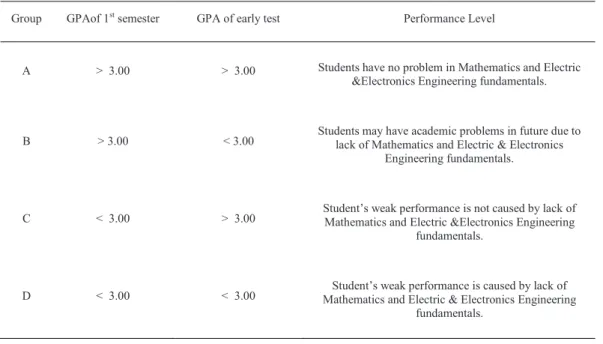
Student classification based on early test and semester 1 GPA is summarized in Table 1. Students are divided into four groups depending on their performance, namely Group A, B, C and D. Group A is students who have obtained GPA 3 and above for both, semester 1 and early test. Group B is students who have got GPA 3 and above for semester 1, but their early test GPA is less than 3.Group C is students who have scored GPA less than 3 for semester 1, but their early test GPA is 3 or higher, and Group D is students who have attained GPA less than 3 for both semester 1 and early test.
Table 1 The division method of the student performances according to semester 1 and early test GPA
Group GPAof 1st semester GPA of early test Performance Level
A > 3.00 > 3.00 Students have no problem in Mathematics and Electric
&Electronics Engineering fundamentals.
B > 3.00 < 3.00 Students may have academic problems in future due to lack of Mathematics and Electric & Electronics Engineering fundamentals.
C < 3.00 > 3.00 Mathematics and Electric &Electronics Engineering
fundamentals.
D < 3.00 < 3.00 Mathematics and Electric & Electronics Engineering fundamentals.
3. Results
Comparison has been made ester and early test results based on
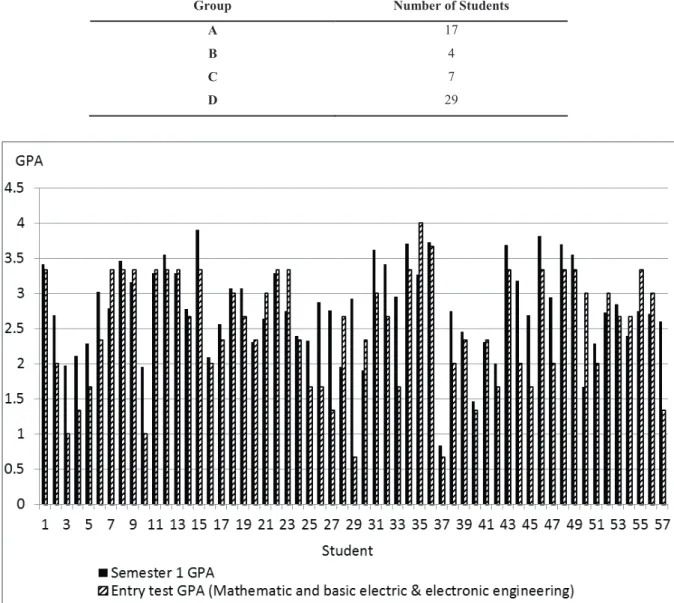
Mathematics and basic Electric & Electronics Engineering only. The comparison is shown in Figure 2. Total of 57 students were selected for the test and each student was represented by a number from 1 to 57. A summary of the results is presented in Table 2.
Table 2 Distribution of Students According To Basic Assessment and 1stSemester Test Results
Group Number of Students
A 17
B 4
C 7
D 29
According to the graph, only 17 out of 57 students were in Group A, showed that both early test and semester 1 GPA was 3 and above. Students in this group have no problem in academic as they have strong fundamental in Mathematics and Electric & Electronics Engineering. In Group B, there were only four students who obtained GPA higher than 3 in the semester 1, however less than 3 in the early test. These students may have problems in their study in the following semester due to lack of engineering fundamentals. While Group C has seven students were identified, where their early test GPA was higher than 3, but their semester 1 results was less than 3. Weak performance achieved by this group of students was not caused by lack of engineering fundamental, but may affect by their attitude and problems in adapting with university environment study, which was different from previous school environment. Lastly, Group D consists of 29 students who have attained GPA less than 3 for both early test and semester 1 results. These weak students weak were caused by lack of Mathematics and Electric & Electronics engineering fundamentals.
Based on results obtained from early test, more than half of enrolled students at the department have problems in Mathematics and Electric & Electronics Engineering fundamental. This problem leads to a weak performance during their study. Therefore, teaching and learning practice in the department should be improved to accommodate these students weaknesses, hence improve their performance.
4. Recommendations
Based on the discussion, there are many actions that can be planned at the early stage by the committees of student affairs and mentors at the Department of Electric, Electronics and System Engineering. In addition, some performance, interests to continue their studies in engineering at UKM and finish the study accordingly.
The mentors and the student affair committees can plan a strategy to make sure all students can be graduated on time with good results. This is to make sure our graduates can get a job easily and highly hired by the industrial and other employers in other countries. A series of motivation talks, career talks, competition, tutorial and other useful activities need to be implemented so that students will full of good activities rather than involve in not beneficial activities such as playing games, chatting and so on
Another strategy is to appoint senior students to share their learning experiences and lifestyle to the first year student. The senior must have characteristics that could attract interest of junior as their role model such as excellent academic background, good personality, good communication and be able to influence the junior students.
5. Conclusion
The poor students tend to dropout in the middle of the study if no actions taken by the department throughout their study. The early detection on the poor students are important as the data can be used to help them to get better results at the end of their study. There are few factors, such as attitude or poor of basis knowledge can demotivate these students to continue their excellence at the highest level. Hence, in this work, new enrolled students are given an entry test to determine whether their performances are affected by lack of Mathematics and Electric & Electronic Engineering fundamentals. So that measures and recommendations can be outlined to help the students in their life at university and also achieved success later.
Acknowledgements
This research is funded by Universiti Kebangsaan Malaysia (UKM) under Action Research Grant for funding this research (PTS-2012-102 & PTS-2013-013) and DPP-2013-062. The authors would like to thank the committees of JPPel (Jawatankuasa Pembangunan Pelajar) JKEES.
References
[1] Pelajar JKEES. .
[2] Hafizah, H., Norbahiah, M., Norhana, A., Wan Mimi Diyana, W.Z., & Sarifah Nurhanum, S.S. ((2011). AnalisisKuantitatifPencapaianAkademik
[3] Falsafah Pendidikan Kebangsaan, Matlamat dan Misi Kementerian Pendidikan Malaysia. Kementerian Pendidikan Malaysia. Kuala Lumpur
[4] NorhaniBakri, Noor ZainabAbdRazak, Hamidah Ab Rahman dan Aminah Hj Ahmad Khalid. 2005. Punca Prestasi Pembelajaran Yang Lemah Di kalanganPelajarFakultiPengurusandan Pembangunan Sumber Manusia, UTM, JurnalTeknologi.UTM.43(E):29-44
[5] Rancangan Malaysia Kesepuluh (RMK-10).MembangundanMengekalkan Modal InsanBertarafDunia. 5:194-251
[6] Mohamed Amin Embi. 2010. Bimbingan Kemahiran Belajar. Pengalaman Pembelajaran Di UKM. Pengalaman Pembelajaran Di UKM 4:57-67.