SFB 649 Discussion Paper 2007-036
Yxilon – A Client/Server
Based Statistical
Environment
Wolfgang Härdle*
Sigbert Klinke*
Uwe Ziegenhagen*
* Humboldt-Universität zu Berlin, Germany
This research was supported by the Deutsche
Forschungsgemeinschaft through the SFB 649 "Economic Risk". http://sfb649.wiwi.hu-berlin.de ISSN 1860-5664
S
FB
6
4
9
E
C
O
N
O
M
I
C
R
I
S
K
B
E
R
L
I
N
Yxilon – A Client/Server Based
Statistical
Environment
∗
May 30, 2007
Wolfgang H¨
ardle, Sigbert Klinke, Uwe Ziegenhagen
Humboldt-Universit¨
at zu Berlin
School of Business and Economics
Unter den Linden 6
10099 Berlin, Germany
haerdle/sigbert/[email protected]
Keywords
e-learning, statistical software
JEL classification
C88
Along with many others, we agree that a modern education in statistics needs to
incorporate the practical analysis of real datasets, which are usually more complex than
the common examples found in standard textbooks.
The software used in the teaching of statistics includes standard spreadsheet environments
such as OpenOffice and Excel and dedicated commercial and non-commercial packages
such as R, Minitab or SPSS. With the freely available Yxilon environment we add
another package and proliferate the statistical programming language XploRe, using a
modern client/server based architecture. This architecture has the capabilities of serving
∗This research was supported by the Deutsche Forschungsgemeinschaft through the SFB 649 ”‘Economic
statistical results in a variety of flavors for different groups of users. In this paper we
describe the general setup of the Yxilon environment and present selected technical
details.
1 From XploRe to Yxilon
Following the requirements we gave in H¨
ardle, Klinke & Ziegenhagen (2004), the value
of a statistical software environment does not only depend on general features such as
stability of the software and the set of available methods, but also on the way it allows an
efficient interaction with the user. Nowadays the user operates statistical software either
via character input in a terminal or mouse. Well-known packages for the former method
are R and Matlab, for the latter Minitab and SPSS, which also allows the extension of
its methods via VisualBasic.
XploRe, the predecessor of Yxilon and its scientific fundament, belonged to the category
of language-operated statistical packages. The codes, the so-called
quantlets
, were written
in a C-style programming language, which was then evaluated by XploRe. Details of
the XploRe syntax can be found in H¨
ardle, Klinke & M¨
uller (2000). XploRe included
more than 1500 quantlets, covering especially non- and semiparametric methods and the
statistics of financial markets. The internal design of XploRe was monolithic, which means
that a large proportion of components was tied closely together in one executable. This
made the maintenance of the code complicated and led us to the decision to reimplement
the XploRe language in the Yxilon project, using a simplified and modular client/server
approach with two tiers. On the one hand this allows the easier adding of new modules,
on the other hand existing modules can easily be maintained or exchanged.
2 The Client
The Yxilon environment is operated by the user through the client. In contrast to the
server which was written in C++, it was implemented in Sun Microsystems’ Java. For our
purpose Java offers various advantages if compared with other programming languages.
Compiled Java code can be run on any platform for which a Java Runtime Environment
(JRE) is available, it offers a large set of methods for internet-related techniques (TCP/IP,
XML, SOAP), it can be embedded into HTML pages and is supported by a large user
community.
The client satisfies different needs: It hides the technical implementation of the
com-munication and offers an test platform for the implementation of new functions. The
current version does not only offer basic editing and the exchange of code and results
with the server but provides advanced editing features such as the highlighting and
autocompletion of code and database connectivity.
When the user presses the connect button, the client reads the communication settings
from a textfiles and exchanges information with the server, e.g. login and password.
After this handshake process the user edits his sourcefiles and sends them to the server.
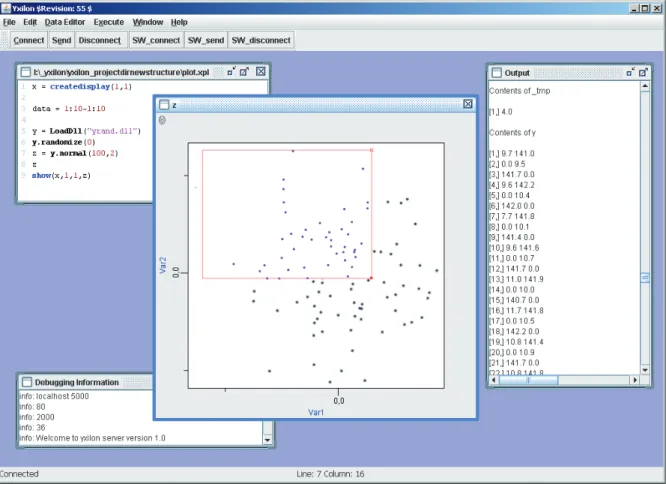
Figure 1: Yxilon Java client
For the display of graphics under Java there are different solutions. We have chosen the
Jaspplot library (Yamamoto, Nakano, Fujiwara & Kobayashi 2004), a library explicitly
designed for the display of statistical graphics. This library can easily be embedded into
Yxilon and offers a wide range of statistical plots. It furthermore allows the linking of
different plots, so selected (brushed) observations in one plot are automatically highlighted
in another.
Figure 1 depicts a screenshot of the Yxilon client, showing relevant windows of the
interface. In the topleft corner the editor window with the Yxilon code needed to produce
the scatterplot, in the bottom left the ’Debug’ window, which shows selected information
about the communication packages sent an received, and the output window used for
the display of numerical results. Furthermore the client also contains a database wizard,
which allows to connect to different databases such as MySQL, MS Access or Oracle via
the Java Database Connector (JDBC).
3 The Server and the Communication Protocol
For the communication between a server and its client there are numerous ways to
exchange information. We evaluated common techniques such as
Remote Procedure Calls
(RPC) and
Remote Method Interaction
(RMI) but finally decided to develop our own
binary protocol. This approach had the disadvantage that a significant amount of time
had to be spent on low-level network programming but provided the advantage that we
kept the complete control of the communication, which resulted in a very small overhead,
therefore in a very fast communication.
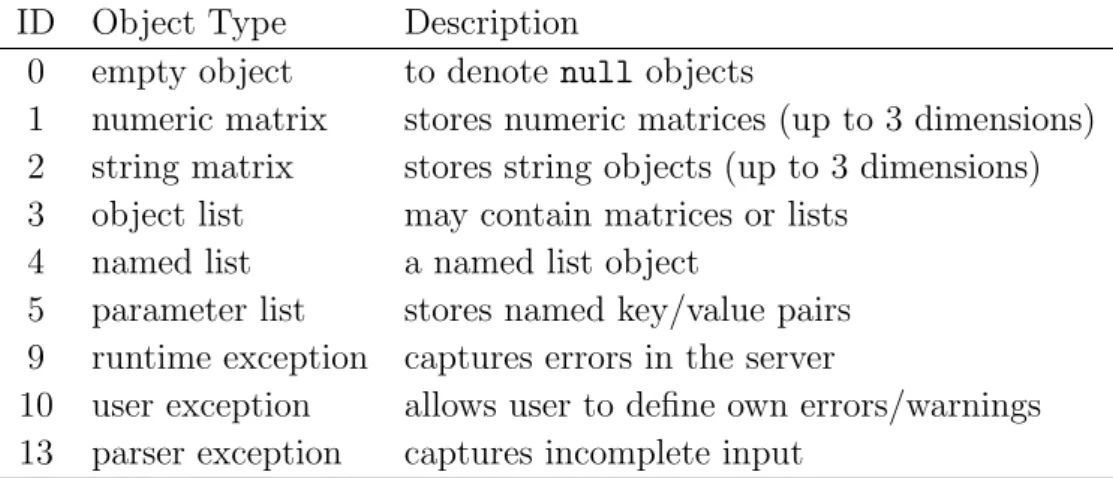
Table 1 gives an overview about different types of objects currently used for the
commu-nication. There are ten types of objects; different types of lists, numeric and character
matrices as well as a different types of exceptions. These exceptions are extremely useful
when the code submitted by the user is incomplete or erroneous since they contain
detailed information about the location and type of the error. A runtime exception is
usually caused by errors in the evaluation of syntactically correct programs, e.g. when a
dll could not be loaded properly. User exceptions are defined in the Yxilon code. Their
task is to give feedback in form of warnings, if for example conditions concerning the size
and values of matrices are not met. The parser exception is the third type, capturing
incomplete input. Here the user receives a message that the input, he or she submitted,
had syntactical errors.
When the server executable is started, it reads the necessary settings from a textfile, e.g.
the network port it binds to, the paths for the dlls and quantlets and the login/password
needed for clients to connect. After the successful loading of these settings a TCP/IP
server port is opened. From now on clients can connect.
ID
Object Type
Description
0
empty object
to denote
null
objects
1
numeric matrix
stores numeric matrices (up to 3 dimensions)
2
string matrix
stores string objects (up to 3 dimensions)
3
object list
may contain matrices or lists
4
named list
a named list object
5
parameter list
stores named key/value pairs
9
runtime exception
captures errors in the server
10
user exception
allows user to define own errors/warnings
13
parser exception
captures incomplete input
Table 1: Overview of Communication Objects
When Yxilon objects are sent from the server to the client as a serialized data stream,
the first information transmitted is the object type. Based on this type identification
the client reads the remaining bytes and generates the necessary objects as matrices and
lists which are then used e.g. to generate a statistical graphics or character output.
The server component of Yxilon is currently available for Microsoft Windows only,
however we will provide versions for Linux and Solaris in the future. Due to the concept
of modularity and exchangable parts the server itself has only very limited functionality,
such as the management of objects, basic calculations and the communication stack.
All computational functionality above the level of simple algebra and basic matrix
manipulations has been sourced out to dynamic link libraries (DLLs). Listing 1 illustrates
the simple structure of one of these libraries.
Following the initial import statements we define in the
LibMain
function a set of
variables such as the author and the version of the DLL. These information, accessible
also from Yxilon code, provide valuable information in the development process, e.g. to
ensure that a required dynamic link library has a certain version level. The current list of
available libraries for Yxilon contains the handling of matrices, mathematical functions
and the generation of various random numbers, further libraries are planned.
1 #include <LibInclude.hpp> 2 #define CExtObj CExpCompObject 3
4 EXPORT LibMain(CExtLibrary *pLib){
5 pLib->setAuthor(L"Sheldon Kelly"); 6 pLib->setVersion(L"1.0"); 7 pLib->setName(L"Mathematical Functions"); 8 pLib->addFunction(L"abs", L"Yabs"); 9 pLib->addFunction(L"ceil", L"Yceil"); 10 pLib->addFunction(L"floor", L"Yfloor"); 11 pLib->addFunction(L"cos", L"Ycos"); 12 };
Listing 1: Example of C++ code for a dynamic link library
4 Conclusion
The Yxilon project is our attempt to proliferate the ideas and concepts of the XploRe
language in a modern, modular environment. By using innovative user features together
with a fast and reliable communication protocol we want to provide an easily learnable
environment especially suitable for the education of students. The next steps on the
agenda include the further integration of statistical graphics into the client and the
conversion of existing XploRe code to Yxilon. We highly appreciate feedback from
interested students and scientists, more information and downloads can be found online
at
http://www.quantlet.org
.
REFERENCES
H¨
ardle, W., Klinke, S. & M¨
uller, M. (2000), XploRe Learning Guide, Springer-Verlag
Heidelberg.
H¨
ardle, W., Klinke, S. & Ziegenhagen, U. (2004), Yxilon – Designing The Next Generation,
Vertically Integrable Statistical Software Environment.
in
Proceedings of the 36
thSyposium on the Interface, Baltimore
Yamamoto, Y., Nakano, J., Fujiwara, T. & Kobayashi, I. (2004), A mixed User Interface
for a Statistical System,
in
Computational Statistics, 17:379–393.
SFB 649 Discussion Paper Series 2007
For a complete list of Discussion Papers published by the SFB 649,
please visit http://sfb649.wiwi.hu-berlin.de.
001 "Trade Liberalisation, Process and Product Innovation, and Relative Skill Demand" by Sebastian Braun, January 2007.
002 "Robust Risk Management. Accounting for Nonstationarity and Heavy Tails" by Ying Chen and Vladimir Spokoiny, January 2007.
003 "Explaining Asset Prices with External Habits and Wage Rigidities in a DSGE Model." by Harald Uhlig, January 2007.
004 "Volatility and Causality in Asia Pacific Financial Markets" by Enzo Weber,
January 2007.
005 "Quantile Sieve Estimates For Time Series" by Jürgen Franke, Jean-Pierre Stockis and Joseph Tadjuidje, February 2007.
006 "Real Origins of the Great Depression: Monopolistic Competition, Union Power, and the American Business Cycle in the 1920s" by Monique Ebell and Albrecht Ritschl, February 2007.
007 "Rules, Discretion or Reputation? Monetary Policies and the Efficiency of Financial Markets in Germany, 14th to 16th Centuries" by Oliver Volckart, February 2007.
008 "Sectoral Transformation, Turbulence, and Labour Market Dynamics in Germany" by Ronald Bachmann and Michael C. Burda, February 2007. 009 "Union Wage Compression in a Right-to-Manage Model" by Thorsten
Vogel, February 2007.
010 "On σ−additive robust representation of convex risk measures for unbounded financial positions in the presence of uncertainty about the market model" by Volker Krätschmer, March 2007.
011 "Media Coverage and Macroeconomic Information Processing" by Alexandra Niessen, March 2007.
012 "Are Correlations Constant Over Time? Application of the CC-TRIGt-test
to Return Series from Different Asset Classes." by Matthias Fischer, March 2007.
013 "Uncertain Paternity, Mating Market Failure, and the Institution of Marriage" by Dirk Bethmann and Michael Kvasnicka, March 2007.
014 "What Happened to the Transatlantic Capital Market Relations?" by Enzo Weber, March 2007.
015 "Who Leads Financial Markets?" by Enzo Weber, April 2007. 016 "Fiscal Policy Rules in Practice" by Andreas Thams, April 2007.
017 "Empirical Pricing Kernels and Investor Preferences" by Kai Detlefsen, Wolfgang Härdle and Rouslan Moro, April 2007.
018 "Simultaneous Causality in International Trade" by Enzo Weber, April 2007.
019 "Regional and Outward Economic Integration in South-East Asia" by Enzo Weber, April 2007.
020 "Computational Statistics and Data Visualization" by Antony Unwin, Chun-houh Chen and Wolfgang Härdle, April 2007.
021 "Ideology Without Ideologists" by Lydia Mechtenberg, April 2007.
022 "A Generalized ARFIMA Process with Markov-Switching Fractional Differencing Parameter" by Wen-Jen Tsay and Wolfgang Härdle, April 2007.
SFB 649, Spandauer Straße 1, D-10178 Berlin http://sfb649.wiwi.hu-berlin.de
SFB 649, Spandauer Straße 1, D-10178 Berlin http://sfb649.wiwi.hu-berlin.de
023 "Time Series Modelling with Semiparametric Factor Dynamics" by Szymon Borak, Wolfgang Härdle, Enno Mammen and Byeong U. Park,
April 2007.
024 "From Animal Baits to Investors’ Preference: Estimating and Demixing of the Weight Function in Semiparametric Models for Biased Samples" by Ya’acov Ritov and Wolfgang Härdle, May 2007.
025 "Statistics of Risk Aversion" by Enzo Giacomini and Wolfgang Härdle,
May 2007.
026 "Robust Optimal Control for a Consumption-Investment Problem" by Alexander Schied, May 2007.
027 "Long Memory Persistence in the Factor of Implied Volatility Dynamics" by Wolfgang Härdle and Julius Mungo, May 2007.
028 "Macroeconomic Policy in a Heterogeneous Monetary Union" by Oliver Grimm and Stefan Ried, May 2007.
029 "Comparison of Panel Cointegration Tests" by Deniz Dilan Karaman
Örsal, May 2007.
030 "Robust Maximization of Consumption with Logarithmic Utility" by Daniel Hernández-Hernández and Alexander Schied, May 2007.
031 "Using Wiki to Build an E-learning System in Statistics in Arabic Language" by Taleb Ahmad, Wolfgang Härdle and Sigbert Klinke, May 2007.
032 "Visualization of Competitive Market Structure by Means of Choice Data" by Werner Kunz, May 2007.
033 "Does International Outsourcing Depress Union Wages? by Sebastian Braun and Juliane Scheffel, May 2007.
034 "A Note on the Effect of Outsourcing on Union Wages" by Sebastian Braun and Juliane Scheffel, May 2007.
035 "Estimating Probabilities of Default With Support Vector Machines" by Wolfgang Härdle, Rouslan Moro and Dorothea Schäfer, June 2007.
036 "Yxilon – A Client/Server Based Statistical Environment" by Wolfgang Härdle, Sigbert Klinke and Uwe Ziegenhagen, June 2007.