USING MOVEMENT ECOLOGY TO UNDERSTAND FLIGHT BEHAVIOR IN SOARING BIRDS
A Dissertation
Presented to the Faculty of the Graduate School of Cornell University
In Partial Fulfillment of the Requirements for the Degree of Doctor of Philosophy
by
James Todd Mandel August 2009
USING MOVEMENT ECOLOGY TO UNDERSTAND FLIGHT BEHAVIOR IN SOARING BIRDS
James Todd Mandel, Ph.D. Cornell University 2009
Understanding the process by which animals make decisions based on cues in their environment is a central challenge in behavioral ecology. We focus here on the process by which soaring migrant birds use landscape and weather features to make decisions during various aspects of flight. We examined how Tree Swallows weigh safety against speed in
obstacle-avoidance trials; how Turkey Vultures use artificial thermals to extend foraging past dusk; the movement ecology of migration in Turkey Vultures, including energetics, route choice, and use of surface features, turbulence, and winds; how migrating vultures vary in their use of these features according to whether they live in mountainous, flat, coastal, or inland environments; and how
vultures vary in their use of weather features according to the time of year, and whether they are breeding, over-wintering, or migrating. To examine these questions, we employed a variety of experimental, computational, and statistical techniques. Birds were released in flight tunnels for obstacle avoidance trials, while vultures were implanted with heart rate loggers and tracked via satellite-based GPS to study movements. Weather variables were drawn from the North American Regional Reanalysis, a regional-scale
meteorological model. In obstacle avoidance trials, we found no evidence that swallows exhibit side-bias to promote quick decision making. We found that,
in nature, Turkey Vultures will forage past their normal daily activity period when presented with both an artificial food source and an artificial thermal, in the form of a methane-vent. A heart rate analysis of a migrating turkey vulture suggests that the act of migration is not energetically costly for soaring
migrants. An analysis of movement paths in relation to turbulence, horizontal winds, terrain ruggedness, and other descriptors such as heat flux and
boundary layer height shows that movement and navigation correlates with a variety of external factors, most notably turbulent kinetic energy, horizontal winds, and surface ruggedness. We found that the way in which vultures use weather features depends on the time of year, biological motivation, the presence of mountain ranges, and the way in which these variables interact with each other.
iii
BIOGRAPHICAL SKETCH
James Todd Mandel was born and raised in Corona del Mar, California. He attended Princeton University from 1998-2002, where he majored in Ecology and Evolutionary Biology. His undergraduate thesis explored the life-history of a large, long-lived, yet ultimately suicidal, tropical tree, Tachigalia versacolor. While at Princeton, James had the opportunity to work, study and research in the tropics, both in Belize and Panama. After graduation, this work lead to a job in Panama, where he was the first Systems Manager for the Automated RadioTelemetry System on Barro Colorado Island, Panama. It was during this job that James first became acquainted with the massive soaring migrations that funnel through Central America every fall, and resolved to study how such a long-distance, unpowered flight took place. Excited about this project,
James applied to Cornell University to explore this question as a doctoral dissertation, which is what you’re now reading, 6 years later. After finishing his dissertation, James will work for McKinsey and Company as a consultant, and will continue working with Advanced Conservation Strategies, a non-profit environmental consultancy and research agency, on market-based
approaches to environmental problems. James lives in Philadephia, PA with his wife, Abigail.
iv
I’d like to dedicate this work to my wife, Abby, my supportive family and friends, Hawk Mountain (and all the other small, nature and science loving community organizations like it), and to all of the birds who decided to feed on
a slightly suspicious carcass and ended up with a scary story to tell their bird friends, with the wing tags to prove it.
v
ACKNOWLEDGMENTS
I received a lot of support along the way. I’d like to thank people who helped me in the field, including Melissa Bowlin and Tonia Robb on the swallow study, and David Barber, Stuart Houston, Karen Machin, Geoffrey Wright, Brandon Breene, Bill Cochran, Laurie Goodrich, and Marc Bechard for help with the vulture work. My committee, both official and unofficial, including David Winkler, Keith Bildstein, Gil Bohrer, Nelson Hairston, Jed Sparks, and Kim Bostwick. Roni Avissar, Martin Wikelski, and Ran Nathan all provided critical insight and guidance as well. David Barber, David Cerasale, Giles Hooker, Keith Jenkins, and Martin Otte all provided technical support. Hawk Mountain provided invaluable support across so many aspects. They and I were supported financially in the vulture work by Sarkis Acopian. The National Science Foundation and Cornell University also provided financial support.
vi TABLE OF CONTENTS Biographical Sketch……….iii Dedication……….iv Acknowledgements………..v Table of Contents………..……..vi List of Figures……….………..…...viii List of Tables………ix Dissertation Introduction……….1 Chapter 1………...…7 Introduction………...8
Methods and Materials………..10
Results……….…13
Discussion………...……16
References………..20
Chapter 2……….…...23
Introduction……….23
Methods and Materials………..…24
Results……….25
Discussion………...26
References………...29
vii
Introduction……….31
Results………..….….35
Discussion………...43
Methods and Materials………..…46
References………..…...55
Chapter 4………....59
Introduction……….60
Methods and Materials………..64
Results……….71
Discussion………...77
References………...81
Chapter 5………...83
Introduction……….84
Methods and Materials………..87
Results……….90
Discussion………...95
References………...100
viii LIST OF FIGURES Figure 1.1………14 Figure 1.2………15 Figure 2.1………27 Figure 3.1………....36 Figure 3.2………38 Figure 4.1………70 Figure 4.2………..……….72 Figure 4.3………...………….74 Figure 4.4………..……….……...76-77 Figure 5.1………...…91 Figure 5.2………..92-94
ix LIST OF TABLES Table 3.1………39-40 Table 4.1………...…………..67 Table 4.2……….73 Table 4.3……….76 Table 5.1……….95
1 Introduction
Ecology has been defined as “the science by which we study how organisms interact in and with the natural world”.1
The study of movement is central to this challenge, since it is critical to understanding the spatial distributions of organisms and how they respond to changes in their environment. Individual models of animal movement within the natural environment have accelerated with advances in computational strength and remote sensing. Specifically within bird flight, there is an abundance of data on movement patterns, which have been growing since the advent of bird
banding in 1899.2 Furthermore, scientific banding has been augmented by individual telemetry.3 This combination of banding and tracking has lead to the recognition of a diversity of patterns of bird movement, and spawned a body of theory in underlying movement process. It is fairly common to see in the
scientific literature studies on movement patterns in birds, and a wealth of papers on “optimal movements” 4,5
for behaviors like foraging, predator avoidance, and migration. Within this optimality literature, several variables have been suggested for optimization; chief among these is time-minimization and energy-minimization. When to use different optimality criteria, and how to relate these optimalities to broad patterns of movement, is a challenging problem, but a critical one to understanding how birds move. Some of the
1
Ricklefs RE (1996). The economy of nature. WH Freeman and Company. New York.
2
Spencer R (1985). Marking. In Campbell B, Lack E (eds) A dictionary of birds. British Ornithologists’ Union. London. pp 338-341.
3
Cochran WW, Lord RD (1963). A radio-tracking system for wild animals. J Wildlife Manag. 27:9-24.
4
Pennycuick CJ (1989). Bird flight performance. A practical calculation manual. Oxford University Press. Oxford.
5
Hedenstrom A, Alerstam T (1995). Optimal flight speed of birds. Phil Trans Roy Soc B. 348:471-487.
2
challenges in this effort are 1) addressing the large scale of movements in organisms that routinely cross continents, 2) developing estimates of internal and external states of the animals that are sufficiently standardized to apply across all of the scales relevant to the animal, and 3) developing appropriate methodologies to relate differences in movement to changes in state, and then relating this back to fundamental theory.
In this dissertation, I relate movement patterns to external conditions across a range of scales, geographies, and biological motivations, and use these relationships to infer underlying movement processes. It is my hope that understanding the relationship between process and pattern will ultimately help inform the underlying models that give us our understanding of how and why birds move.
In the first chapter, I explore the relevance of optimal movement theory in obstacle-avoidance behavior during flight in tree swallows. In predator or obstacle avoidance, optimal movement suggests that time-minimization should be the dominant criterion. In many species, this leads to movement
handedness; an organism has pre-programmed avoidance direction and movement behavior. However, there is an implied trade-off between response time and predictability of movement, such that animals must be both fast and unpredictable to avoid capture. Many species have solved this challenge through density-dependent “handedness”. In a population, all organisms have a preferred direction, but for a minority of these individuals, the direction is the exact opposite of the majority. Even though every individual will always avoid in the same way, a predator will not know which direction this is. In flight, aerial predation and obstacle avoidance is quite common, and the need for quick responses is enhanced by the high speeds of flight. However, the complexity
3
of maintaining stable flight, and the need for symmetrical musculature for energy minimization, implies that there is a trade-off within the individual. Using an experimental design within a flight tunnel, we tested this trade-off and found that the solution of handedness does not seem to apply for birds that fly most of their waking hours.
The second chapter presents the results of an observational study in which another soaring bird, the turkey vulture, employs a novel behavior to overcome a natural ecological constraint. Turkey vultures are commonly known to be “late risers”, to go to roost when thermals dissipate, and be strongly obligate thermal soaring birds. As a result, they are strongly diurnal, with a relatively restricted activity period. Given that they can get plenty of food in a short amount of time from a single carcass, this is generally not a problem. However, anthropogenic changes in the environment can cause novel challenges: at garbage dumps and landfills, food is both abundant and consistent, but so is competition. Vultures seem to spend much more energy competing over food, and some of them ultimately seem to spend much longer times waiting for access to carcasses. This puts pressure on vultures to
extend their daily foraging past the periods when natural thermals are readily available for easy flight. The observed “solution”, for birds to start using methane vents as artificial thermals to fly efficiently at night, yields a host of interesting questions about pattern and process in soaring flight. It reveals a behavioral plasticity that is somewhat surprising, as well as suggesting that atmospheric dynamics restrict, and likely determine, movement in this species.
This indication that turkey vultures are both behaviorally plastic and that atmospheric dynamics are likely a key determinant of movement makes them an ideal species for studying how movement process leads to a diversity of
4
movement patterns. They are the only vulture that makes long-distance,
intercontinental migrations and they span a behavioral range from non-migrant through partial migration to long-distance obligate migration. In addition to being an appropriate species behaviorally, the availability of detailed and standardized databases of a large variety of weather phenomena and the ability to collect detailed movement trajectories using GPS technology made such a study feasible. In chapter 3, I set out to create a detailed description of the movement processes that underlie long-distance soaring migration within a movement ecology framework. We were able to capture the key dynamics of both movement and navigation, which relied in large part on the interactions of turbulence regimes, surface heterogeneity, and horizontal winds. Implanted heart rate sensors showed little change in energy expenditure as a function of distance, suggesting that birds do not spend more energy to go longer
distances in a set amount of time. Combined with observations that show extremely low flapping rates, this suggests that energy-minimization plays a role during fall migration.
The models developed for chapter 3 created an excellent basis for asking some fundamental ecological questions. In chapter 4, I extend this initial description of migration to see how well it supports predictions of migration over varying geography and of different migratory intensity. Sampling vultures from three locations that varied in terrain ruggedness and migratory intensity (one mountainous long-distance migrant, one mountainous short-distance migrant, and one long-distance plains migrant), I applied the same movement ecology model to see how vultures handled the challenge presented by weather. I found that migratory intensity did not predict the use of weather nearly as much as did terrain type. The results suggest the existence of two
5
distinct migratory systems: the migrants that lived near mountains used both slope-soaring and thermal soaring, while the plains migrants relied solely on thermal-soaring. The key to this difference was encapsulated in their opposite response to horizontal winds. Using the navigational component of the
movement ecology model, I saw that migrants in hilly terrain changed course in a way that optimized the use of slope-soaring with horizontal winds, while plains migrants reduced distances and compensated for wind-drift. The birds in hilly terrain had altered their movement and navigational styles to use their surroundings most efficiently.
The two studies of fall migration in turkey vultures revealed a variety of strategies based on surroundings, all broadly falling within the context of energy minimization: thermal turbulence is relied upon and slope-soaring is used when mountains are available. Birds adjust their path differently
depending on the availability of rugged terrain for slope-soaring. It is not clear, however, that energy-minimization should apply year round. In chapter 5, I applied movement ecology models to the rest of the annual cycle: spring migration, breeding period, and wintering periods. I found a signature of time-minimization during spring migration: birds engage less in slope-soaring, and increase their activity period. On the breeding grounds, energy minimization appears not to apply at all. During this period, birds do not alter their course for any weather or terrain phenomena. It is likely that, during this food rich but energetically demanding period, they focus on providing food to young without regard to route optimization.
This dissertation lays a foundation for advancing studies of movement by incorporating weather and landscape models that are standard tools in meteorological studies of climate change, and that, for the first time, allow
6
comparisons of flight conditions between birds across a continental scale. Understanding how movement decisions relate to a birds environment allows for a deeper understanding of the process by which animals move; connecting these relationships between environment and movement with regional scale models that are used in forecasting should allow us to generate predictions about how soaring flight patterns might change as atmospheric conditions change.
7 CHAPTER 1
LATERALITY AND FLIGHT: CONCURRENT TESTS OF SIDE-BIAS AND OPTIMALITY IN FLYING TREE SWALLOWS
Mandel JT, Ratcliffe JM, Cerasale DJ, Winkler DW (2008).
Laterality and flight: concurrent tests of side-bias and optimality in flying tree swallows. PLoS ONE 3(3): e1748.
Abstract
Behavioural side-bias is a result of hemispheric specialization and is advantageous because it can improve response times to sudden stimuli and efficiency in multi-tasking. It has been observed in many vertebrates, including birds. However, behavioural side-bias can lead to morphological asymmetries resulting in reduced performance for specific activities. For flying animals, wing asymmetry is particularly costly and it is unclear if behavioural side-biases will be expressed in flight; the benefits of quick response time afforded by side-biases must be balanced against the costs of less efficient flight due to the morphological asymmetry side-biases may incur. Thus, competing constraints could lead to context-dependent expression or suppression of side-bias in flight. In repeated flight trials through an outdoor tunnel with obstacles, tree swallows (Tachycineta bicolor) preferred larger openings, but we did not detect either individual or population-level side-biases. Thus, while observed behavioural side-biases during substrate-foraging and copulation are common in birds, we did not see such side-bias expressed in obstacle avoidance
behaviour in flight. This finding highlights the importance of behavioural context for investigations of side-bias and hemispheric laterality and suggests
8
both proximate and ultimate trade-offs between species-specific cognitive ecology and flight biomechanics.
Introduction
Hemispheric specialization, the division of neural processing tasks between the left and right hemispheres of the brain, is generally agreed to be
responsible for sensoribehavioral side-biases in reptiles, birds, and mammals (Rogers, 2000; Rogers, 2002; Vallortigara, 2006). Hemispheric specialization and resultant perceptual side biases may provide animals with a hard-wired rubric for life-preserving decisions. One hypothesis suggests that lateralization of cognitive and visual processing minimizes response time (e.g.,
light-exposed chicks, Gallus gallus domesticus, always use the left eye for predator recognition when given a choice, and show longer habituation times to visual patterns when forced to use the right eye; Rogers, 2000; Dharmaretnam and Rogers, 2005). In three species of toads (Bufo spp.) side-bias is expressed when individuals are confronted with predators; escape responses are faster when predator models are introduced from their left side than from the right, and the type of response (sideways vs. forward jumps) varies with side of presentation (Lippolis et al., 2002). Hemispheric specialization, and associated perceptual biases and asymmetrical motor responses, appears to be highly conserved in vertebrates (Vallortigara and Rogers, 2005; Robins and Rogers, 2006).
In birds, chicks (Dharmaretnam and Rogers, 2005; Vallortigara et al., 1996; Deng and Rogers, 1997), pigeons, Columba livia (Deng and Rogers, 1997; Prior et al., 2002; Prior et al., 2004), and black-winged stilts, Himantopus himantopus (Ventolini et al., 2005), have been shown to favour one
9
hemisphere over the other for making specific decisions. Whatever the underlying mechanisms, brain lateralization is positively correlated with
efficient neural processing and multitasking (Rogers, 2000; Vallortigara, 2006; Rogers et al., 2004). Selection for such decision-making should lead to quicker response times, and might explain the apparent ubiquity of hemispheric
specialization and side-bias in vertebrates (Ventolini et al., 2005; Rogers et al., 2004).
However, there are putative disadvantages to lateralization; stereotypical behaviours are by definition easily predicted. Prey with perceptual side-biases should exhibit slower response times to attacks coming from one side versus the other, and such a weakness may well be exploited by predators (Rogers, 2002; Lippolis et al., 2002; Ventolini et al., 2005). Behavioural side-bias can also cause developmental asymmetries in the skeleton and musculature (Adam et al., 1998). For fast-flying birds, wing asymmetry will reduce flight performance (Thomas, 1993; Moller and Swaddle, 1997; Swaddle and Witter, 1997), increase predation-risk (Moller and Nielsen, 1997), and negatively impact fitness (Birkhead and Moller, 1992). Asymmetrical musculature could likewise be assumed to negatively affect flight performance. Assuming cognitive systems can drive the evolution of behaviours (Dukas, 2004), selection should act to reduce the expression of behavioural side-bias when consequences are disadvantageous (Vallortigara and Rogers, 2005), such as when it will lead to wing or muscular asymmetry. Thus, a behavioural side-bias may be expressed when advantageous and masked when not.
Here, we examine laterality and the expression of side-bias in the broader context of competing constraints. We do this using an aerial hawking,
10
behavioural side biases in copulatory behaviour on the ground (Peterson et al., 2001) and strong stabilizing selection has been suggested to preserve wing symmetry (Balmford et al., 1993; Brown and Bomberger-Brown, 1998). We implement an experimental design in which a bird escapes through a tunnel containing an obstacle varying in size and position. Because fast response times should be favoured during escape, we expected behavioural side-bias might be expressed under our experimental conditions for obstacle-avoidance behaviour. However, given the potential cost of behavioural side-bias in wing and muscular asymmetry (and reduced overall flight
performance), we also expected behavioral side-biases might instead be masked. To our knowledge, this is the first study to consider the potential conflict between selection for wing symmetry and selection for side-bias in flying birds.
Materials and Methods
(a) Birds, field site and flight tunnel
Experiments were conducted at the Cornell University Experimental Ponds Facility in Ithaca, New York, U. S. A. (42 30’ N, 76 28’ W). Twenty-four female tree swallows were captured from their nest boxes during incubation between 24 May and 31 May 2006. Birds were aged by plumage (Pyle, 1987), and right and left tarsi and flattened wing lengths were measured (+-0.1 mm). During experiments (see below), birds were released individually into an outdoor plywood flight tunnel (1.22 * 1.22 * 9.75 m long) from a lightproof box centred on top of the southwest end. The walls and ceiling of the tunnel were painted matte white and the floor covered with white limestone pebbles in an effort to minimize unintended perceptual asymmetries. The tunnel was
11
illuminated by ten lights distributed equally along the two long walls (for further details of tunnel and study site see Bowlin and Winkler, 2004). Within the tunnel, 3.22 m from the southwest end, the lower half (h61*w122 cm) was blocked using a light blue Styrofoam sheet (2.5 cm thick). The upper half was partially blocked using sheets 61 cm in height and of various widths (see Figure 1.1). Each bird flew through the tunnel and was caught at the end of the tunnel in a mist net a total of four times, and was then released at point of capture.
(b) Experiment 1
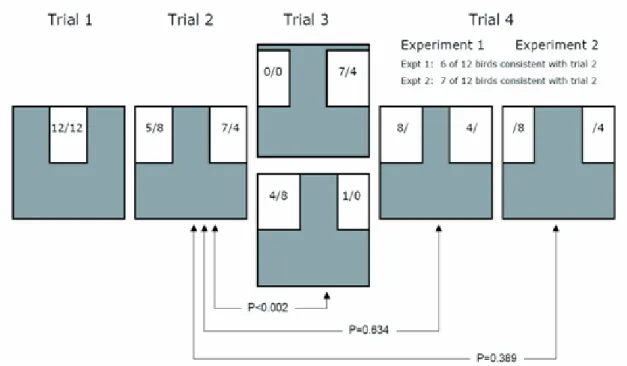
Twelve swallows served as subjects in experiment one. These animals did not serve as subjects in experiment two. The purpose of this experiment was to determine whether birds would demonstrate a side-bias while escaping the tunnel or, would make an optimal choice when presented with obstacles within the tunnel: in this case, a larger opening that would be easier to navigate. First, two light blue h 61 * w 41 cm Styrofoam sections were put into place above the lower sheet flush with the sides of the tunnel, creating a h 61 * w 41 cm centred opening in the upper-half of the obstacle (Figure 1.1, trial 1). This trial was used to acclimate the bird to the tunnel. In the second trial, a single sheet was positioned such that two equal sized openings (h 61*w 41 cm) exist on either side (Figure 1.1, trial 2). The bird was released and scored as having used either the right or left opening. In the third trial, this centre section was moved 7.5 cm towards the side the bird had flown through on the previous trial (Figure 1.1, trial 3). The bird was released, scored as either having made an optimal decision (large opening (h61*w48.5 cm), opposite of side chosen in trial one) or a non-optimal decision (small opening (h61*w33.5 cm), same side
12
as chosen in trial one), and caught. In the fourth and last trial, the off-center upper section used in trial three was removed. A wider section (h61*w56 cm) was positioned in the opening, leaving two equal sized openings (h61*w33.5 cm) on either side (Figure 1.1, trial 4). The bird was scored as having used either the same or the opposite opening as used in trial two.
(c) Experiment 2
Twelve swallowsserved as subjects in experiment two. The purpose of this experiment was similar to that of the first experiment, but also controlled for a potential confounding variable in the experimental design: that a bird’s
preference for small or large openings might mask the test of side-bias. Experiment two was identical to experiment one with the following exception: in the fourth and last trial, rather than use the wide section, a narrow section (h61*w33.5cm), creating two openings the size of the larger opening (h61*w48.5 cm) in trial three was used.
(d) Statistical analyses
Using the program R v. 2.3.1 (Ihaka and Gentleman, 1996), we ran custom randomization tests to determine if (a) the swallows exhibited a population-level side-bias by testing if the right or left side was chosen on trial two more often than expected by chance (results from two experiments pooled), (b) the optimal side was chosen by individuals more often than expected if both openings had been of equivalent size (results from two experiments pooled; trial 2 vs. trial 3), and (c) individuals exhibited a side-bias by testing if the side chosen in trial two was chosen more often than predicted by chance in trial four (tested separately between experiments). The absolute difference in wing
13
and tarsus length between each appendage relative to the average of both appendages was measured. Paired t-tests were used to compare the
magnitude of asymmetry (i.e. absolute value) between tarsi and wing lengths.
G-tests of goodness of fit were used to test for a consistent direction of
asymmetry (or lack thereof) in the tarsi and wings of individual birds and to test whether such direction of asymmetry in both tarsus and wings was related to side chosen in trial 2 of experiments 1 and 2.
Results
Seven females were second year, nine were >3 years and 8 were adults (> 1 yr.) of indeterminate age. All 24 birds flew from the release box to the
opposite end of the tunnel for all trials. When the repeated decisions of
individual birds are examined, 13 of 24 birds chose the same side in trial 4 as they had in trial 2; both of these trials involved symmetrical openings (Figure 1.1). 23 of 24 birds chose the larger opening in trial 3, which was always placed opposite to their choice in trial 2 (Figure 1.1).
14
Figure 1.1. Schematic of the tunnel from the point of view of a bird entering the tunnel. Actual statistics for birds choosing a path is presented in the format x/y, where x represents the 12 birds from experiment one, and y represents the 12 birds from experiment two. In trial three, the side of the optimal choice depended on a bird’s choice in trial two. To control for any initial size
preference not related to optimality, half of the birds (Experiment 1) were given symmetrical, narrow openings in trial four, while half (Experiment 2) were given symmetrical, wide openings. The comparison of trial two to trial three is a test of optimality, while the comparison of trial two to trial four is a test of side-bias.
We failed to detect evidence of laterality; we found no predominance of side bias in trial two of the experiments pooled (500 permutations; actual
statistic=11; p>0.75). The sides chosen in trials two and three were
significantly different (500 permutations; actual statistic=1; p<0.002), indicating that the swallows chose the optimal side in almost all instances. There was also no evidence of functional asymmetry at the individual level; the side chosen between trials two and four did not differ significantly for either
15
experiment one (500 permutations; actual statistic=6; p=0.634) or experiment two (500 permutations; actual statistic=7; p=0.389).
Tarsus measurements exhibited significantly greater asymmetry than did wing measurements (paired t-test; p=0.002, Figure 1.2). We found no significant directionality at the population-level in either tarsus or wing
asymmetries, and the direction of an individual’s side choice in trial 2 was not related to either the direction of that same individual’s asymmetry for their wings or tarsi (4 G-tests, p>0.3 for all). We also found no significant correlation between tarsus and wing asymmetries Pearson test (r=-.06, p=0.74).
Figure 1.2. Bar graph showing the means and standard error of asymmetry proportions for both wing and tarsus measurements. The tarsi were
16 Discussion
The results of our experiments suggest that tree swallows do not express functional asymmetries or laterality during obstacle-avoidance in escape-flight and suggest constraints imposed by selection for morphological symmetry are responsible. Tree swallows chose the larger opening in trials 2 and 3 of both experiments; because tunnel experiments involve collisions with the sides of the tunnel when flying through small openings (DJC and DWW, unpublished data), we define the larger opening as the less risky, and optimal, choice. However, as evidenced by the results of trial four in experiment one, the smaller opening was not so small as to prevent birds from flying through it. Tree swallows failed to respond in a consistently lateral manner to symmetrical obstacles in trials 2 and 4, suggesting that these birds do not express
functional asymmetry during in-flight escape behaviours at a level of strength detectable by this study.
However, it is possible that with increased overall sample size and a revised experimental protocol that increases trials by individual birds, more subtle expressions of side bias could be found. An exploration of other in-flight behaviours such as predator avoidance, hunting, and conspecific approach could also yield an expression of side bias not seen here in our obstacle-avoidance trial. A third possibility is that swallows approach and evade obstacles in a way that avoids the negative consequences of side bias. Moreover, an individual’s behaviour during flight might be a combination of expressed side bias and flight movements that counteract side bias.
Although there are strong links in birds and mammals between brain
lateralization and behavioural lateralization (in pigeons, Prior et al., 2002; Prior
17
critical for anatomical, biomechanical, and energetic features of flight (Norberg, 1990; Hambly et al., 2004). In tree swallows, both side-bias (Peterson, et al., 2001) and morphological asymmetry in tarsus, bill, and primary feather lengths (Teather, 1996) has been reported. However,
repetitious behavioural side-bias can cause morphological asymmetry (Adam,
et al., 1998) and conservation of wing symmetry is likely at odds with the expression of laterality and behavioural side-biases in flight. This is supported by comparison of our anatomical and behavioural results, first, asymmetries in individual tarsus lengths varied an order of magnitude more than did those found for individual wing lengths (Figure 1.2), and, second, these relatively small intra-individual differences in wing length did not predict either initial side choice or side preference in the tunnel (Figure 1.1).
Ground and aerial hawking foraging strategies are likely subject to different regimes of selective forces. Within flight, different behaviours might also warrant differing expressions of side-bias; predator avoidance, in which the risks are much higher, or conspecific approaches, in which detailed perceptual evaluation is necessary, might carry an expression of side bias. Over
evolutionary time, we expect trade-offs between flight performance and hemispheric specialization; for substrate-based activities, we expect, similar trade-offs should be less extreme. Our results suggest that hemispheric
specialization, as expressed through side-biases, may not be tightly correlated under all sensoribehavioral conditions. In birds, chicks (Dharmaretnam and Rogers, 2005; Vallortigara et al., 1996; Deng and Rogers, 1997), pigeons (Deng and Rogers, 1997; Prior et al., 2002; Prior et al., 2004), Australian magpies (Rogers and Kaplan, 2006) and stilts (Ventolini et al., 2005) all show behavioural lateralization in at least some substrate-borne activities (e.g.,
18
copulation, substrate-borne foraging). Pigeons have clear structural and functional asymmetry of the brain and show behavioural lateralization (Gunturkun and Kesch, 1987; Buschmann et al., 2006). Additionally, they show functional asymmetries of cue use and homing behaviour while flying (Prior et al., 2004). However, it is expected that, like the swallow, this and other species will not show a strongly lateralized motor response to avoid obstacles in flight due to context dependent costs associated with flying. Studies using guppies (Poeceliid spp.) and other fish, in similarly designed escape/avoidance trials, report both functional asymmetries and laterality (Bisazza et al., 2000). Side preference varied with the type of obstacle, maintenance of visual contact with the goal, and phylogeny. We suggest that the difference between these results from swimming fish and those from our study using flying tree swallows supports our contention that competing constraints unique to behavioural context and to powered flight leads to the lack of functional asymmetry in obstacle avoidance trials.
Degree of lateralization and coordination of functional asymmetry at the population-level both vary with gregariousness in fishes (Bisazza et al., 2000). Tree swallows fly in large flocks and roost communally when not breeding (Winkler, 2006); however, in contrast to European starlings, Sturnus vulgaris
and other birds, flocks do not exhibit any group level polarity of direction
(Robertson et al., 1992). In order to separate the existence of laterality from its expression in flying birds, as well as the strength and context of an effect, further research is required. Limiting visual pathways (Gunturkun and Kesch, 1987; Prior et al., 2004) during a flying obstacle avoidance trial might lead to the expression of a masked trait. In addition, varying the scope of the trial or the placement and type of visual cues (Bissazza et al., 1997) could further
19
define the contexts under which laterality will be expressed or masked. Additionally, future research could try to tightly couple equivalent substrate-born decisions with an in flight decisions of side bias; establishing such comparable experiments in quite different contexts would be challenging but worthwhile.
Research into laterality often uses side-bias as a means of detecting hemispheric specialization (Ventolini et al., 2005). However, in situations where expression of laterality is disadvantageous, masking could occur. We suggest that a potentially rewarding avenue for future research consider information acquisition and decision-making in light of potential trade-offs between the behavioural and morphological outcomes of these processes and pervasive vertebrate hemispheric specialization and expressed or masked side-biases under a broad range of ecological contexts and contingencies.
20
REFERENCES
Adam A, De Luca CJ, Erim Z (1998). Hand Dominance and motor unit firing behaviour. J Neurophysiol. 80: 1373-1382.
Balmford A, Jones IL, ALR Thomas (1993). On avian asymmetry: evidence for natural selection. Proc Roy Soc B. 252: 245-251.
Birkhead TR, Møller AP (1992). Sperm competition and sexual selection. New York: Academic Press.
Bisazza A, Cantalupo C, Capocchiano M, Vallortigara G (2000). Population lateralization and social behaviour: a study with 16 species of fish. Laterality. 5: 269-284.
Bisazza A, Pignatti R, Vallortigara G (1997). Laterality in detour behaviour: interspecific variation in poeciliid fish. Animal Behav. 54: 1273-1281. Bowlin MS, Winkler DW (2004). Natural variation in flight performance is related to timing of breeding in the tree swallow (Tachycineta bicolour) in New York. Auk. 121: 345-353.
Brown CR, Bomberger-Brown M (1998). Intense natural selection on asymmetry. Evolution. 52: 1461-1475.
Buschmann JF, Manns M, Güntürkün O (2006). “Let There be Light!” pigeon eggs are regularly exposed to light during breeding. Behav Proc. 73:62-67. Deng C, Rogers LJ (1997). Differential contributions of the two visual
pathways to functional lateralization in chicks. Behav Brain Res. 87: 173-182. Dharmaretnam M, Rogers LJ (2005). Hemispheric specialization and dual processing in strongly versus weakly lateralized chicks. Behav Brain Res. 162: 62-70.
Dukas R (2004). Evolutionary biology of animal cognition. Ann Rev Ecol Evol Syst. 35: 347-374.
Güntürkün O, Kesch S (1987). Visual lateralization during feeding in pigeons.
Behav Neurosci. 101: 433-435.
Hambly C, Harper EJ, Speakman JR (2004). The energetic costs of variations in wing span and wing asymmetry. J Exp Biol. 207: 3977-3984.
21
Ihaka R, Gentleman R (1996). R: a language for data analysis and graphics. J Comput Graph Stat. 5: 299-314.
Lippolis G, Bisazza A, Rogers LJ, Vallortigara G (2002). Lateralisation of predator avoidance responses in three species of toads. Laterality. 7: 163-183. Møller AP, Nielsen JT (1997). Differential predation cost of a secondary sexual character: sparrowhawk predation on barn swallows. Anim Behav. 54: 1545-1551.
Møller AP, Swaddle JP (1997). Asymmetry, developmental stability and evolution. Oxford: Oxford University Press.
Norberg UM (1990). Vertebrate flight: Mechanics, physiology, morphology, ecology and evolution. Heidelberg: Springer-Verlag.
Peterson A, Lombardo MP, Power HW (2001). Left-sided directional bias of cloacal contacts during tree swallow copulations. Anim Behav. 62: 739-741. Prior H, Lingenauber F, Nitschke J, Güntürkün O (2002). Orientation and lateralized cue use in pigeons navigating a large indoor environment. J Exp Biol. 205: 1795-1805.
Prior H, Wiltschko R, Stapput K, Güntürkün O, Wiltschko W (2004). Visual lateralization and homing in pigeons. Behav Brain Res. 154: 301-310. Pyle P (1987). Identification guide to North American passerines: a
compendium of information on identifying, ageing, and sexing passerines in the hand. Bolinas: Slate Creek Press.
Robertson RJ, Stutchbury BJ, Cohen RR (1992). Tree Swallow (Tachycineta bicolour). The Birds of North America Online (A. Poole, Ed.). Ithaca: Cornell Lab of Ornithology.
Robins A, Rogers LJ (2006). Lateralized visual and motor responses in the green tree frog, Litoria caerulea. Anim Behav. 72: 843-852.
Rogers LJ (2000). Evolution of Hemispheric Specialization: advantages and disadvantages. Brain Lang. 73: 236-253.
Rogers LJ (2002). Lateralization in vertebrates: its early evolution, general pattern, and development. Adv Study Behav. 31: 107-135.
Rogers LJ, Kaplan G (2006). An eye for a predator: lateralization in birds, with particular reference to the Australian magpie. In Behavioral and Morphological
22
Asymmetries in Vertebrates. Malashichev Y, Keckel W, eds. Landes Bioscience.
Rogers LJ, Zucca P, Vallortigara G (2004). Advantages of having a lateralized brain. Proc R Soc B (Suppl.). 271: S420-S422.
Swaddle JP, Witter MS (1997). The effects of molt on the flight performance, body mass and behaviour of European Starlings (Sturnus vulgaris). Can J Zool. 75: 948-953.
Teather K (1996). Patterns of growth and asymmetry in nestling tree swallows.
J Avian Biol. 27: 302-310.
Thomas ALR (1993). The aerodynamic costs of asymmetry in the wings and tails of birds: asymmetric birds can’t fly round tight corners. Proc R Soc B. 254: 181-189.
Vallortigara G (2006). The evolutionary psychology of left and right: costs and benefits of lateralization. Dev Psychobiol. 48: 418-427.
Vallortigara G, Regolin L, Bortolomiol G, Tomassi L (1996). Lateral asymmetries due to preferences in eye use during visual discrimination learning in chicks. Behav Brain Res. 74: 135-143.
Vallortigara G, Rogers LJ (2005). Survival with an asymmetrical brain: Advantages and disadvantages of cerebral lateralization. Behav Brain Sci. 28:575-633.
Ventolini N, Ferrero EA, Sponza S, Chiesa P (2005). Laterality in the wild: preferential hemifield use during predatory and sexual behaviour in the black-winged stilt. Anim Behav. 69: 1077-1084.
23 CHAPTER 2
TURKEY VULTURES USE ANTHROPOGENIC THERMALS TO EXTEND THEIR DAILY ACTIVITY PERIOD
Mandel JT, Bildstein KL (2007). Wilson Journal of Ornithology. 119:102-105.
Abstract
We describe predictable nocturnal soaring flight in Turkey Vultures
(Cathartes aura) feeding at a landfill in eastern Pennsylvania. Birds feeding at the landfill returned to their roosts each evening by gaining altitude while soaring in thermals above flared methane vents at the site. Our results highlight behavioral plasticity in this species, which, in part, may explain why Turkey Vultures are so common throughout much of their extensive range.
Introduction
Turkey Vultures (Cathartes aura) are energy minimizers like most avian scavengers (sensu Schoener, 1971; Ruxton and Houston, 2002). Individuals at rest maintain low metabolic rates for their body mass and reduce their core body temperature at night in apparent efforts to conserve energy (Heath, 1962; Wasser,1986). Turkey Vultures in flight usually soar and glide when flying between roosts and previously located food, when searching for new sources of food, and during migration (Pennycuick, 1972; Mundy et al., 1992; Kirk and Mossman, 1998; Ferland-Raymond et al., 2005). At times, the
species engages in intermittent flapping flight, particularly when departing from and descending into their roosts. This behavior is generally rare except when updrafts are unpredictable or weak. Our observations, assisted by radio tracking, indicate that lack of sufficient assisted lift can ground individuals
24
several days or more (J. Mandel, pers. observ.). Turkey Vultures have long been known as “late risers” (Ludlow Griscom in Bent, 1937) that usually
restrict their daily activities to mid morning to late afternoon when thermal- and slope-soaring are possible (Kirk and Mossman, 1998).
Anecdotal and possibly disturbance-induced nocturnal flight has been reported in the species (Tabor and McAllister, 1988) but regular nocturnal flight is unknown. Here, we report regular nocturnal flight in Turkey Vultures returning to their roosts in the evening after soaring in anthropogenic thermals created by flared methane at a landfill in eastern Pennsylvania.
Methods
We watched Turkey Vultures on 120 non-rainy days from 12 July to 5 November 2004, and from 20 June to 17 July 2005, at a 45-ha Waste Management, Inc. landfill in Pen Argyl, Northampton County, Pennsylvania (40° 52’ N, 75° 15’ W). Birds were observed continually from 0730 to 2315 hrs EST, with a three-hour break from 1300 to 1600 hrs EST. Observations were from an unused hilltop on landfill property, with the farthest roost being ~300 m. Adequate artificial lighting at the site permitted nocturnal observation without special equipment. Prior to the observations detailed here, we observed vultures at three communal roosts near the landfill for 20 days in June 2004 and for 47 days in July and August 2003. Our roost-site
observations, which were conducted from dawn until dusk, and included both unmarked individuals and radio-marked birds, are used here to establish a temporal baseline for vulture behavior in the area.
Methane is vented at two sites at the landfill. One site, the “big flare,” consists of a group of three 10-m-high vent pipes. The other site, the “little
25
flare,” consists of a single 10-m vent pipe. At both sites methane is flared continuously, around-the-clock, 365 days a year.
Observations
Between 30 and 90 Turkey Vultures fed at the landfill daily. On more than 70% of the days, 10 to15 individuals fed until 2100 to 2300 hrs EST, or approximately 90 to 210 min after local sunset. We do not know whether the late-feeding birds were the same individuals each day, or whether a larger subset of the population engaged in late feeding on an occasional basis. Vultures that fed in farmlands, woodlands, and suburban areas near the landfill returned to their roosts before 2000 EST or, at most, 30 min after the local sunset.
Turkey Vultures that left the landfill used both natural thermals and anthropogenic thermals at the methane vents throughout the day to gain lift before departing the site. When natural thermals were no longer available after sunset, vultures that left the landfill initially approached the vents in flapping flight, and then circle-soared to approximately 100-200 m in thermals above the vents before gliding in the direction of nearby roosts. On most days, 10 to 30 vultures arrived at the landfill before 0800 hrs EST, soared above the vents for several minutes, and then departed, presumably for more distant feeding sites.
Turkey Vultures feeding at the site roosted in three communal roosts within 4 km of the landfill. Two of the roosts contained 30-50 Turkey Vultures and 5-10 Black Vultures (Coragyps atratus). A third roost contained 10-15 Turkey Vultures. Black Vultures at times fed at the landfill but none remained as late in the day as Turkey Vultures, and none soared in thermals above the vents.
26 Discussion
Thermals created by flared methane appeared to be considerably stronger and hotter than nearby “natural” thermals. Vultures soaring above the vents ascended more rapidly than those soaring in nearby natural thermals, and many appeared to have difficulty maintaining level flight while doing so. Most of the birds that flew within vent thermals did so intermittently, and rather than circle-soaring radially about the center of the thermal while ascending
constantly, circle-soared tangentially within the thermal for brief periods and then circle-glided outside the thermal for longer periods (Figure 2.1). We believe that individuals did so because they were not able to soar continually within the vents. Workers at the site reported finding Turkey Vulture carcasses at and near the bases of the vents, suggesting that in addition to providing soaring opportunities for vultures, the anthropogenic thermals at the vents also killed them, most likely either by scorching or suffocating individuals. Thus, the vents may have created an “ecological trap” for the birds that used them (Schlaepfer, 2002).
27
Figure 2.1. The “big flare,” the main methane vent facility at the Waste Management, Inc., landfill in Pen Argyl, Pennsylvania. Vultures soaring with the thermal created by the flared methane at the vents do so tangentially, rather than radially.
That Turkey Vultures, but not Black Vultures, soar in vent thermals at this site may be due several factors. First, many vultures that roosted nearby searched for carrion in the surrounding landscape rather than for food refuse at the landfill, suggesting that food was limited at the landfill. We tested this hypothesis by placing a road-killed deer (Odocoileus virginianus), a road-killed raccoon (Procyon lotor), and a butchered chicken (Gallus domesticus) at visible locations at the site to examine the extent of competition for food. Up to six Black and Turkey vultures fed upon the chicken simultaneously, and up to 14 individuals fed simultaneously upon the deer. Black Vultures dominated Turkey Vultures at feeding sites, suggesting the former may be able consume sufficient food without prolonging the length of their feeding day. Second, Turkey Vultures typically hold their wings in a pronounced dihedral when flying
28
low over the landscape, a self-righting aerodynamic “design” that stabilizes their flight in turbulent air (Mueller 1972), whereas as Black Vultures do not. The relatively turbulent nature of thermals above the vents may have
precluded their use by Black Vultures.
That Turkey Vultures are able to lengthen their daily activity periods via use of anthropogenic thermals suggests considerable behavioral flexibility in the species. This may help explain its large range and relative abundance.
29
REFERENCES
Bent AC (1937). Life histories of North American birds of prey. Part 1. U.S. National Museum Bulletin, Number 167. Smithsonian Institution, Washington, D.C., USA.
Ferland-Raymond B, Bachand M, Thomas D, Bildstein K (2005).
Flapping rates of migrating and foraging Turkey Vultures (Cathartes aura) in Costa Rica. Vulture News. 53: 1-5.
Heath JE (1962). Temperature fluctuations in the Turkey Vulture. Condor. 64: 234-235.
Kirk DA, Mossman MJ (1998). Turkey Vulture (Cathartes aura). The Birds of North America, Number 339.
Mueller HC (1972). Zone-tailed Hawk and Turkey Vulture: mimicry or aerodynamics? Condor. 74: 221-222.
Mundy P, Butchart D, Ledger J, Piper S (1992). The vultures of Africa. Academic Press, London, United Kingdom.
Pennycuick CJ (1972). Soaring behaviour and performance of some East African birds, observed from a motor glider. Ibis. 114: 178-218.
Ruxton GD, Houston DC (2002). Modeling the energy budget of a colonial bird of prey, the Ruppell’s Griffon Vulture, and consequences for its breeding ecology. Afr J Ecol. 40: 260-266.
Schlaepfer M A, Runge MC, Sherman PW (2002). Ecological and evolutionary traps. Trends Ecol Evol. 17: 474-480.
Schoener TW (1971). Theory of feeding strategies. Ann Rev Ecol Syst. 2: 369-404.
Tabor SP, McAllister CT (1988). Nocturnal flight by Turkey Vultures (Cathartes aura) in south-central Texas. J Raptor Res. 22: 91.
Wasser JS (1986). The relationship of energetics of falconiform birds to body mass and climate. Condor. 88: 57-62.
30 CHAPTER 3
THE MOVEMENT ECOLOGY OF MIGRATION IN TURKEY VULTURES Mandel JT, Bildstein KL, Bohrer G, Winkler DW (2008). PNAS. 105:
19102-19107
Abstract
We develop individual-based Movement Ecology Models (MEM) to explore Turkey Vulture (Cathartes aura) migration decisions at both hourly and daily scales. Vulture movements in 10 migration events were recorded with satellite-reporting GPS sensors, and flight behavior was observed visually, aided by on-the-ground VHF radio-tracking. We used the North American Regional Reanalysis dataset to obtain values for wind speed, turbulent kinetic energy (TKE), and cloud height, and employed a digital elevation model for a measure of terrain ruggedness. A Turkey Vulture fitted with a heart-rate logger during 124 hours of flight during 38 contiguous days showed only a small increase in mean heart rate as distance traveled per day increased, confirming that soaring flight is passive and that flight mode does not become progressively more active with distance. Data from 10 migrations for 724 hourly segments and 152 daily segments showed that vultures depended heavily upon high levels of TKE in the atmospheric boundary layer to increase flight distances and maintain preferred bearings at both hourly and daily scales. We suggest how the MEM can be extended to other spatial and temporal scales of avian migration. Our success in relating model-derived atmospheric variables to migration indicates the potential of using regional reanalysis data, as here, and potentially other regional, higher resolution, atmospheric models in predicting
31
changing movement patterns of soaring birds under various scenarios of climate and land use change.
Introduction
Traditionally, bird migration has been treated separately relative to other movements within an individual’s life history (Bildstein, 2006; Newton, 2008). Although long-distance migration operates on different scales and produces different patterns than those of other movement types in a bird’s life cycle, there are also many similarities (cf. Dingle, 1996). As in other biotic
movements, migration involves the assessment of internal state of the
organism, external factors, and past behavior in order to make decisions about motion and navigation (Nathan et al., 2008).
One significant challenge of migration research is measuring the extent to which migratory routes and schedules of individual migrants are influenced by external factors, including wind direction and speed (Thorup et al., 2003; Thorup et al., 2006), food availability and habitat (Newton, 2008), and the behavior of other migrants (Bildstein, 2006; Pennycuick, 1998). One important axis of variation among migratory birds is the extent to which environmental factors act as facilitators of, as opposed to barriers to, movement. Determining the effects of environmental factors is particularly important for soaring birds, whose movements rely upon environmental factors such as deflection updrafts and thermal convection as their principle means of propulsion. Whereas those using primarily flapping flight are, in principle, not directly dependent on
environmental forces for lift. Although we recognize that this categorization can be overly simplistic (see, for example, Liechti and Schaller, 1999) and that other categorizations based on ecological function exist (Hedenstrom and
32
Alerstam, 1995; Alerstam and Hedenstrom, 1998), the dichotomy of soaring versus flapping migration can play a useful role in understanding the internal costs of movement, flexibility of migration timing, and the ability to adopt new routes (Bildstein, 2006; Newton, 2008; and references therein).
Diurnal migrants are an excellent group in which to explore this issue, as they span the full range from soaring migrants (e.g. many raptors, Bildstein, 2006) to flapping fliers (e.g. shorebirds, Piersma et al., 2005). Some migrants, including swallows (Winkler, 2005), raptors (Bildstein, 2006), and bee-eaters (N. Sapir, pers. comm.), switch between flapping and soaring flight modes based on atmospheric conditions. Turkey Vultures are obligate soaring
migrants (sensu Bildstein, 2006). They rarely travel long distances without the aid of thermals and updrafts, and anthropogenic night-time thermals can increase their daily activity period (Mandel and Bildstein, 2007). Because Turkey Vultures seasonally undertake long-distance movements within an ecological group (i.e., avian scavengers) that traditionally does not, we feel they can be used as a test case, against which future studies of this dichotomy in species that use both strategies can be compared.
Here, we set out a test case to assess the role of external factors and internal state on movement and navigation decisions. We seek to test the hypotheses that a) specific route choices are determined to a large extent by wind, topography, and availability of turbulent uplift. b) The movement ecology framework can be used to formulate a movement equation that describes movement in terms of measurable proximal variables, including environmental variables and lagged distances and bearing deviations, and that this model can be fitted to the data using mixed and linear statistical models and autocorrelation functions; and c) that atmospheric regional-scale-modeling
33
data can be effectively used to approximate the environmental conditions that affect migration flights. The Movement Ecology framework (Nathan et al., 2008) guides the decomposition of complex movement phenomena into
specific behavioral and environmental components. This provides a framework for the combination of meteorological and geographical data and direct
observations of migrating birds to elucidate the proximate mechanisms driving vulture migration and to formulate hypotheses about the ultimate
(evolutionary) factors driving bird migration.
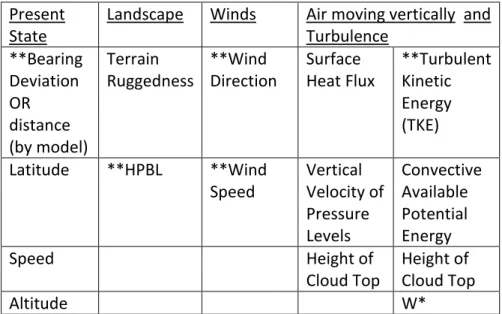
We focus on estimating the movement decision functions using external factors, internal state, and past behavior by fitting movement and navigation equations; we use weather data from a regional-scale observation-model reanalysis product and digital elevation model to estimate important components of the external factors, and measure heart rate to estimate internal state. Additionally, we evaluate how characteristics of present and preceding movements, such as previous distance, direction, altitude, speed, and autoregressive components of movement, influence subsequent
movement.
Defining a Movement Ecology Model (MEM) for migration requires that we “de-compose” migration into different scales of movement: (1) A micro-scale (mm-meters, seconds-minutes), which represents the size of turbulent eddies around the bird and the instantaneous conditions which the bird perceives, and where many decisions about movement take place. Unfortunately, due to the chaotic nature of turbulent flows and the limitations of current computation and measurement ability, it is impossible to know the exact micro-scale
conditions that determine a bird’s movement. (2) A coarser scale (tens of km and few hours), which provides a convenient source of information, as data
34
from regional atmospheric models and miniature measurement devices are available at this regional scale. Some tactical decisions about migration
movement are probably made at the coarser scale when perceived information is aggregated (e.g. Pennycuick et al., 1979; Shamoun-Baranes et al., 2003; Thorup et al., 2007). For convenience, we refer to this coarser scale as the “hourly scale,” and we use the hourly scale as a surrogate to the
micro-mechanistic scale to determine how appropriate and useful information at this resolution can be to study migration movement. (3) A daily scale, in which decisions about re-fueling, route choice, and distance to be traveled are set (for example, Hake et al., 2003; Haines et al., 2003; Alerstam et al., 2006). (4) An annual scale, in which birds (or other organisms) assess the success of previous migratory choices and decide on movements accordingly (Fryxell et al., 2008). (5) A life-history scale where broad decisions such as when and where (or if, in the case of facultative migrants) to migrate are set (for example McNamara et al., 1998). (6) And finally, a long-term evolutionary scale in which natural selection on aspects of migration takes place (Berthold et al., 1992). Understanding larger-scale phenomena requires mechanistic
understanding at smaller scales. We focus on the hourly and daily scales where empirical data allow direct analysis.
The MEM framework provides an explicit guide to data analysis. Here, we parameterize, at two scales, the MEM controlling the migratory movements of Turkey Vultures. By fitting empirical data to the MEM, we set out explicitly to assess the relative roles of external-factor variables (turbulence, horizontal winds, and topography), internal state (heart rate), and the role of present state (altitude, speed) and past behavior (auto-regressive components of movement) in determining the navigation and movement of a soaring migrant.
35
Here, we assess navigation at two scales by looking for deviations from a local axis of movement (established based on the previous hours or days of
movement); we infer that smaller deviations from a movement axis reflect a more direct route to local goals. Movement is assessed by looking at straight-line flight distances at two scales of movement, hourly and daily. We trapped 12 Turkey Vultures at carcasses in northeastern Pennsylvania and on nests in Saskatchewan, Canada, between August 2003 and November 2006. Of these, seven birds were fitted with GPS satellite tracking tags (Microwave Telemetry, Inc.). A subset of the GPS birds was fitted with inter-peritoneal data loggers that recorded heart rate at 2-second intervals (Biometistics, UK). GPS data on movements were collected at hourly intervals on all birds via the ARGOS satellite network. We were able to record hourly movements in 10 one-way migratory journeys in the seven GPS-fitted birds. These journeys totaled 724 hourly migratory movement segments that met our data quality criteria
(described in the Methods below) as well as 152 daily movements. We used close proxies and representative variables to assess the effects of internal state, the role of past behavior, the initial state at each movement leg, and external factors. Mixed-effect linear models were used to fit these data to the MEM at both the hourly and daily scale of migration.
Results
We began with the general MEM (Nathan et al., 2008), and adapted it to address external, internal, and temporal variables in a specific way (see Methods). Essentially, we assumed that a linear combination of the three classes of variables and their interactions would inform a movement decision
36
function, as well as a navigation-decision function. We then tested these variables statistically.
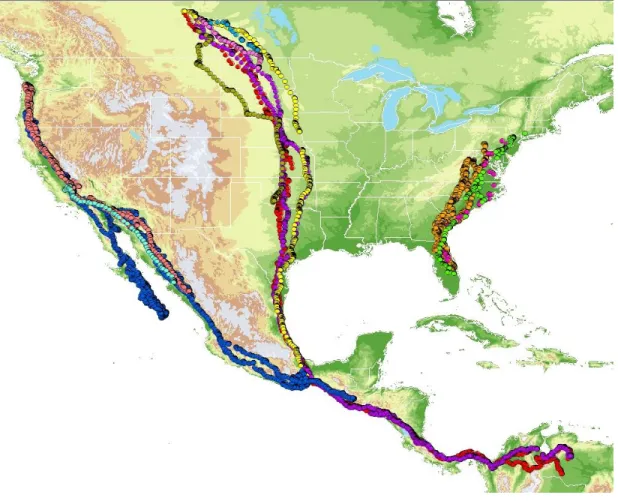
Ten migration events were successfully recorded in seven birds, including 6 southbound movements in fall and 4 northbound movements in spring. Turkey Vultures caught in Pennsylvania migrated along the east coast of the US, principally to Florida and other areas of the southeast (Figure 3.1). Two vultures caught in Saskatchewan, Canada did not complete migrations, but traveled through the central US before their accidental deaths. All birds were adults (3rd year). For all seven birds, the longest straight-line distance traveled in a day was 327 km, and the longest straight-line hourly movement was 68 km. Birds did not migrate on 15 of the 152 days (10%). The straight-line distances between successive GPS observations grossly underestimate the total distances traveled, as visually tracked individuals revealed circuitous flight paths.
Figure 3.1. A map of the migratory movements. The final panel shows the two migratory tracks that originated in Saskatchewan, while the first three panels show the migrations of Turkey Vultures that were captured in Pennsylvania.
37
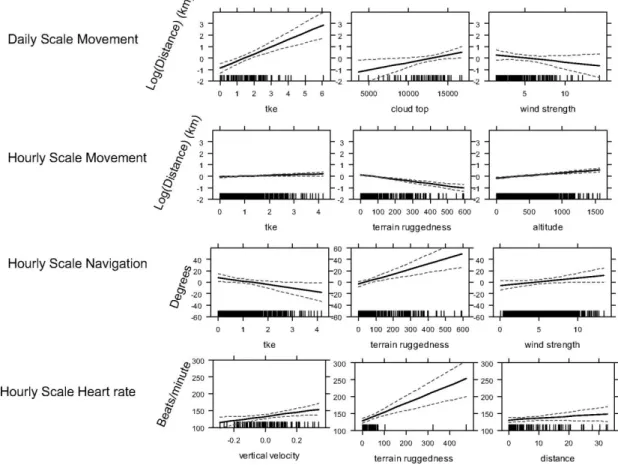
We measured field heart rate successfully in 1 bird during 38 days of southbound migration. An analysis of the heart rate (Figure 3.2) showed it to be determined in only small part by distance; this suggests that, unlike
flapping, soaring flight does not lead to greatly increasing metabolic costs with distance. Much more important in predicting heart rate were the vertical
movements of air (as measured by the vertical movement of pressure levels in the model; VVEL), and the ruggedness of the terrain. As mentioned below, rugged terrain can change the spatial structure and consistency of thermals, and this could lead to a less efficient use of atmospheric energy. We
hypothesized that movement (both motion and navigation) is an
autoregressive process: across scales, distances and turning angles are likely to be dependent on previous movements. We fit the distances and bearing deviations at both the hourly and daily scale to autoregressive integrated moving average models to test the degree and magnitude of any
autoregressive components in these time series (Box and Jenkins, 1970). At all scales, movement vectors fit the ARIMA(1,0,0) class of models, which can be interpreted conceptually as a correlated random walk; distances and
turning angles were influenced significantly only by the movement immediately preceding. Coefficients of autoregressivity are listed in Table 3.1. Future work, using higher resolution data sources (e.g. Fryxell et al., 2008), may improve the information resulting from autoregressive integrated moving average approaches and bridge the gap between these simple approaches and other movement models such as Lévy walks (Bartumeus and Levin, 2008). In any event, we suggest that appropriate null distributions for the relation to previous states be evaluated as an important part of the analysis of movements.
38
Figure 3.2. Effects plots of the major findings in our statistical analysis. Effects of external factors on daily scale movement, hourly scale movement, hourly scale navigation, and hourly scale heart rate are shown. Plots were generated from the mixed effects linear models summarized in Table 1.
Next, we set out to test the role of external factors (Table 3.1) in
determining the distance and turning angles of migration. We used turning angles as an indirect proxy for navigation, and measured this as an angular deviation from an axis of movement established by the previous 7 hours of movement (hourly scale) or week of movement (daily scale). These two scales were chosen to assess the relative roles of scale in studying movement; the hourly scale is the smallest scale that was feasible for us to measure and record standardized data, while the daily scale is a common scale in studies of movement and especially migration. For some birds, we had more than one “migratory event,” which we defined as the collection of all daily and hourly
39
movements in a given (fall or spring) migration season. Mixed effect models were run with random effects for individual movement events nested within migratory events, which were in turn nested within birds. There were no significant random effects for birds or migratory events at the scales we examined (p>0.5).
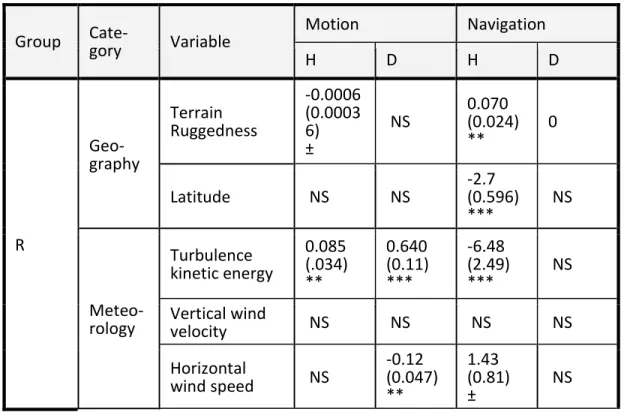
Table 3.1. Summary of observed effects. Variables are divided into three categorical groups: external factors (r); temporal factors (ut); and their
interaction (r x ut). Motion is measured using distance as a dependent
variable, and navigation is measured using angular deviation from a local mean. The influence of past positions was assessed through auto-regressive integrated moving average modeling for the correlation structure. All other variables were independent main effects. Angle models used degrees, and negative coefficients indicate less deviation and thus a straighter path. All two way interactions within and between the external effects and temporal
variables were tested. The only significant interaction was between Terrain Ruggedness and TKE. Information is organized as follows: parameter
estimate (standard error) significance, where NS : not significant; ± : p<0.1; * : p<0.05; ** : p<0.01; *** : p<0.001.
Group Cate-gory Variable Motion Navigation
H D H D R Geo-graphy Terrain Ruggedness -0.0006 (0.0003 6) ± NS 0.070 (0.024) ** 0 Latitude NS NS -2.7 (0.596) *** NS Meteo-rology Turbulence kinetic energy 0.085 (.034) ** 0.640 (0.11) *** -6.48 (2.49) *** NS Vertical wind velocity NS NS NS NS Horizontal wind speed NS -0.12 (0.047) ** 1.43 (0.81) ± NS
40 Figure 3.1 (Continued) Horizontal wind direction NS NS NS NS Cloud top height NS 0.0001 (0.0000 5) ** NS NS Food avail-ability Inferred by EM approach NS -4.3 (0.81) *** NS 3.01 0.52 *** T Motion Navi- gation Effects Distance (Motion) -0.657 (0.179) *** 0.13 (0.055) ** Bearing deviation (Navigation) -0.0018 (0.0004 4) *** 0.234 (0.089) ** Past be-havior Altitude at start 0.00036 (0.0000 9) *** NS NS NS Speed at start 0.0068 (0.001) *** NS NS NS Auto-regressi vity Past position – AR(1) correlation coefficient 0.48 0.33 0.32
R:T Inter-actions Terrain Ruggedness:TK E -0.00068 (0.0002 2) ** NS NS NS
Bearing deviations, our proxy for navigation decisions, were included as a variable in movement models, and movement (log distance) was included as a variable in navigation models. Bearing deviation had a negative association with distance traveled at an hourly scale and a positive association at the daily scale. This suggests that, hour-to-hour, birds are less likely to travel far if they