7.0
RISK MANAGEMENT
7.1
Introduction
Risk management is an important element in the development and management of assets. For asset management planning to be robust and sustainable it must be integrated with other corporate risk management processes and that this encompass strategies for Council’s most critical assets, provide for the effects of asset failure and be integrated with disaster recovery plans and business continuity plans.
7.1.1 BACKGROUND
Risk management is an important element in the development and management of Council assets. Council has recognised that for its asset management planning to be robust and sustainable it must be integrated with other corporate risk management processes and that this encompasses strategies for Councils most critical assets, provide for the effects of asset failure and be integrated with disaster recovery plans and business continuity plans. Such integration will enhance Councils ability to optimise id decision making process for the betterment of the communities it serves.
Council has previously adopted in 1999 a Risk Management Charter for the organisation. A fundamental aspect of the Charter is the use of a control self assessment methodology for the management of organisational risk. Council determined its overall policy would be to develop a Risk Management System that reflects best practice. Key objectives are:
“to provide a logical and systematic method for identifying and managing risk within the organisation that will assist the organisation to meet its goals and objectives
efficiently and effectively. This achieved by aligning key organisational objectives, risks and mitigating controls,
to minimise losses and maximise opportunities – Risk Management is an much about defining opportunities as avoiding and mitigating losses
to improve the decision-making capabilities of staff recognising that the greatest knowledge and capacity for management of risks often rests with those”
Overarching strategies for managing risk within Council are:
Council’s Chief Executive Officer will establish and implement a Risk Management system that is relevant to the organisation and which reflects the provisions of Council’s Charter. The overarching objective of that Risk Management system will be to identify, and where feasible, mitigate risk factors that might prevent Council achieving its
objectives. Risk Management systems established within Council will reflect prevailing best practice including relevant industry standards – especially AS/NZS Risk
Management Standard 4360.
The ongoing effectiveness of Councils Risk Management systems and compliance with them by employees will be demonstrated by appropriate reporting to council and its appropriate Committees.
7.1.1.1 Current Risk Management Status
Council has a Risk Manager to manage the implementation of a Risk Management Programme within the Taupo District Council. Risk Management is in the process of being integrated into Councils culture, philosophy, practices, activities and plans rather than being viewed or practised as a separate programme.
The accountability for the management of risk is not removed from the specific activity managers and Divisional Heads or those responsible for the management of assets.
Initial work has commenced on risk identification in certain Council operations as part of the initial implementation of Councils Risk Management Charter and the methodology of Control Self Assessment and also incorporating the recently revised standard AS/NZS 4360, 2004. 7.1.1.2 Control Self Assessment
Control self assessment (CSA) ensures that there is a systematic approach to risk
management being applied consistently across the organisation and that responsibility for managing operational risks remains with the operational managers. CSA in short provides a process that enables:
Managers to confirm the operation of controls
The identification and communication of non functioning or poorly functioning controls Implementation of process or control improvements
Training to be targeted at increasing managers ability to effectively implement controls Reporting of the effectiveness of the organisations system of control
At its’ most basic CSA is a review checklist or checklists for a particular operation or activity that is completed (self assessed) by the respective manager. These are then consolidated, analysed and results produced on a corporate basis. The CSA risk factors and controls are reviewed and updated as required annually.
Managers with responsibilities for asset management will have those specific responsibilities included in the CSA programme when fully developed so as there is a regular, auditable and transparent reporting mechanism that will reflect the status of Council’s asset management plans both corporately and operationally at any given time.
7.2
Risk Management Process
The risk management process is an integral part of good management practice. It is an iterative process of continuous improvement that is embedded into existing practices or business improvement.
The main elements of the risk management process to be used at the Taupo District Council are as follows and reflect the risk management standard AS/NZS 4360:2004.
a) Communicate and consult
Communicate and consult with internal and external stakeholders of Council as appropriate at each stage of the risk management process and concerning the process as a whole.
b) Establish the context
Establish the external, internal and risk management context in which the rest of the process will be undertaken. Criteria against which risk will be evaluated should be established and the structure of the analysis defined.
c) Identify risks
Identify where, when, why and how events could prevent, degrade, delay or enhance the achievement of asset’s objectives.
d) Analyse risks
Identify and evaluate existing controls. Determine consequences and likelihood and hence the level of risk. This analysis should consider the range of potential consequences and how these could occur.
e) Evaluate risks
Compare estimated levels of risk against pre – established criteria and consider the Balances between potential benefits and adverse outcomes. This enables decisions to be made about the extent and nature of treatments required and about priorities.
f) Treat risks
Develop and implement specific cost effective strategies and action plans for increasing potential benefits and reducing potential costs
g) Monitor and review
It is necessary to monitor the effectiveness of all steps of the risk management process. This is important for continuous improvement. Risks and the effectiveness of treatment measures need to be monitored to ensure changing circumstances do not alter priorities.”
7.3
Council Funding for Risk
Council looks to provide funding for disaster recovery through a separate reserve. It appropriates funding each year to a Disaster Recovery Fund reserve to enable access to ready cash in the event of a natural disaster. This is intended to assist reinstatement and to finance any short term needs in the time between any disaster and the recommencement of services. As at 30 June 2011, the reserve fund had a balance of approximately $1,732,823
Secondly the TEL Fund was established in September 1995 when TDC sold its investments in Taupo Electricity Ltd and Taupo Generation Ltd. The use of that sale capital and subsequent investment income generated each year are included in Council’s Treasury Management Policy. One requirement of that policy is that the portfolio and funds are managed in a manner that reflects their potential utilisation as a disaster recovery fund in the event of a natural disaster within the Taupo district. The value of the fund as at 30th June 2011 is approximately $53.6 million.
With these two funding mechanisms in place Council considers it is prudently but effectively managing the risk of being able to fund both short and long term needs with respect to potential natural disaster and subsequent recovery operations in the district.
7.4
Lifelines Risk Assessment
TDC has been involved in the lifelines project being developed by Environment Waikato. This process has identified components within the TDC Stormwater network that may be vulnerable to seismic, flood or volcanic events and the impact of failure of these assets. The critical assets identified include roads and bridges. (See discussion under critical assets)
7.5
Risk Register
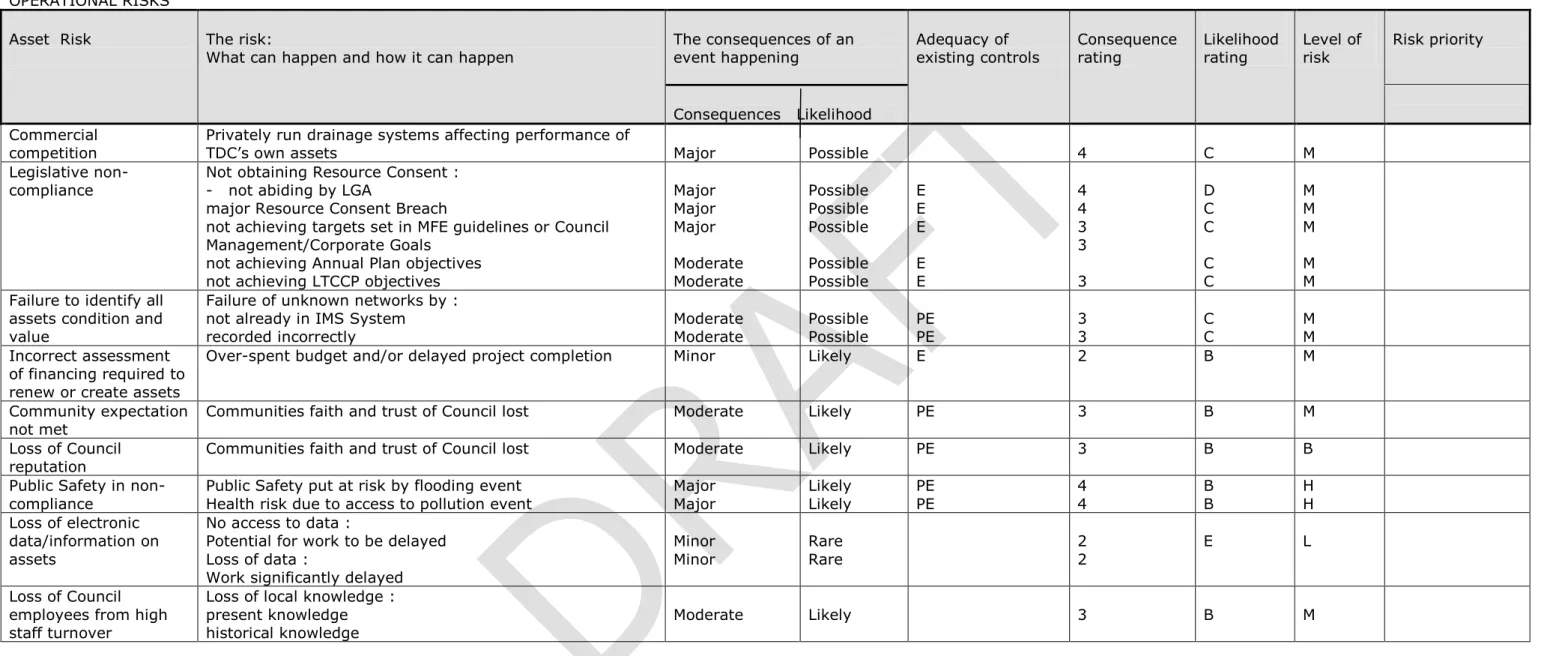
The risk register (see following) identifies risks, the consequence of the risk, the existing controls in place, treatment options and the level of risk to the asset as assessed and updated by Council Officers. A possible improvement to the register is to provide each treatment options with an associated cost and added to the risk register; however these are yet to be costed by TDC.
7.6
Risk Classification Matrices
7.6.1 LIKELIHOOD
Likelihood scale for consideration based on ANZS 4360 is as follows.
Level A B C D E N Descriptor Almost Certain Likely Possible Unlikely Rare Almost Impossible
Damage / Failure Indicative Frequency Once per year or more frequently
Once every three years Once every ten years Once every thirty years Once every 100 years Once in 10,000 years Table 1: Risk Likelihood
7.6.2 CCONSEQUENCE
A consequence scale as a result of a risk event occurring based on ANZS 3460 is shown for
consideration as follows. Level 5 4 3 2 1 N Descriptor Catastrophic Major Moderate Minor Insignificant Negligible / Nil Description
Extreme Impact of damage or failure High impact of damage or failure Medium impact of damage or failure Low impact of damage or failure Very little impact of damage or failure Assessment is Nil
Table 2: Risk Consequence
7.6.3 RISK RATING MATRIX
With both likelihood and consequence scales in place a qualitative risk analysis matrix/level of risk can be determined.
Likelihood A B C D E N Consequences N N N N N N N 1 L L L L L N 2 M M L L L N 3 H M M L L N 4 E H M M L N 5 E E H H M N Table 3: Risk Matrix
The rating legend for the matrix, in this example, can be summarized as follows E = Extreme risk
H = High risk M = Moderate risk L = Low risk
N = Negligible risk approaching nil / no risk
7.6.4 RISK MITIGATION MEASURES
High to Extreme risk would normally involve more detailed studies, action plans and management responsibility specifically assigned.
Moderate risk would be managed by monitoring or response procedures and management responsibility specified.
7.6.4.1 Summary of Identified High Risks
This is a summary of the high risks; the complete list is included as table 7-5.
Asset Risk The Risk Mitigation Measures
Public safety non-compliance / occupational health and safety non-compliance
Public safety and workers’ safety are put at risk due to, Exposure to open manholes, Leaking pipes, Inadequate wastewater treatment, Contaminant discharges to the environment (immediate environs and the Lake), Inadequate training on operation of machines and other devices or Inadequate occupational health and safety trainings
Public Health Risk Mgt Plans, appropriate signage on hazard areas, upgrade of the WWTP and LDS, spill to environment procedure in place for both river and lake, adequate training provided, adequate PPE for staff) Table 7-4: Identified High Risks
7.7
Critical Assets
The Stormwater AMP does have some overlap with the transportation AMP when it comes to identifying and providing for overall risk. The transportation AMP has allowed for the risk associated with culverts and stormwater assets in the rural environment while this AMP provides risk analysis for urban stormwater assets.
Flooding has been identified as the highest risk from the break down of stormwater asset delivery. To counter this risk Council is in the process of undertaking an overland flow path
study which will identify the path stormwater will take once the stormwater network is full. Council has also recently increased the design size for new networks to allow for climate change, this increase in capacity provides greater protection to property and our unique environment from the effects of major rainfall events.
The overland flow path identification will also allow council to protect areas where water will travel overland and enable Council to plan building envelopes on properties so as to mitigate flooding risk.
Council has also identified that with the advent of stormwater treatment at source Council will see an increase in the use of ephemeral gullies as well as pond based systems, the public should be made aware of the Health and safety risks and be prevented access if appropriate. Council will also continue to risk assess the numerous inlet and outlet structures to determine if they should be grated to restrict in most cases children climbing into them.
This assessment also has to take into account the risks of debris being caught in grate and thus causing flood damage.
Through Levels of Service monitoring and continuous condition assessment while
implementing the Stormwater Maintenance Contract, critical risks will be effectively controlled. With the granting of the district wide comprehensive stormwater consents, Council is now responsible for degradation of receiving environments due to stormwater discharge. Council will endeavour, through the use of education and enforcement to make sure that contaminants are not disposed of into the stormwater system which would lead to contamination of the receiving environment and a breach of Resource Consent. This can also be undertaken by introducing stormwater quality devices into the network.
The Stormwater management plan which is a requirement of Councils comprehensive
stormwater discharge consent identifies a number of “High Risk” sites (high risk facility sites are defined as Commercial and industrial sites as listed in Section 3.5.12 of the Waikato regional Plan). These high risk sites relate directly to their environmental harm potential from the commercial businesses that operate within their catchment, Council is progressively working through these sites to provide on going maintenance and enforcement and to provide stormwater quality improvement devices where applicable.
Council is also building a register of quality improvement devices located within the district, these devices are critical in reducing the effects of stormwater on the districts receiving environments, they are maintained on a regular basis.
From an overall risk perspective, it is imperative that Council continues to develop its overland flow study to determine overland flows after either asset failure or assets reaching their design capacity as this study will enable Councils regulatory arm to prevent development in these areas.
In the Taupo district, Council does have a number of gully systems that can be utilised as stormwater flow paths, it is also important that gullies are maintained in Council ownership so that development in them is prevented and also so that they can be planted and maintained appropriately.
Stormwater Asset Management Plan Risk Register
Division : Assets Compiled by : Brent Aitken Date : 20/10/2010
Asset : Stormwater & Land Drainage Reviewed by : Date :
NATURAL RISKS
Asset Risks The risk:
What can happen and how it can happen The consequences of an event happening Adequacy of existing controls Consequence rating Likelihood rating Level of risk Risk priority
Consequences Likelihood Earthquake Stormwater & Land Drainage network damaged due to
earthquake due to : Pipe Fracture
Earth slip failure
Access to network, due to roading system failure
Surrounding environment flooded due to network failure, not able to access network
Land subsidence causing changes of grade in pipe network Blocking of inlet and outlet structures
Moderate Major Major Major Moderate Unlikely Unlikely Unlikely Unlikely Unlikely E E 3 4 4 4 3 D D D D D L M M M L Volcanic Eruption Drainage network fails as a result :
- Blockage of inlet systems from debris Major Unlikely E 3 D L
Ash fall Blockage of pipes due to sediment from ash or debris, constricting flows
- Access to network blocked
Major Moderate Rare Rare E 2 3 E E L L Lahar Failure of outlets at streams and rivers
through silting of river or stream bed from
Lahar mud Minor Rare E 2 E L
Flooding Failure of primary and secondary network by : Blockage from debris
Access to network blocked, contracting staff cannot remedy
- - Silting of primary pipe network by debris and silt - - Damage to private property
Moderate Moderate Moderate Moderate Unlikely Unlikely Likely Likely E E E E 3 3 4 3 3 D D D D C L L M L M Tsunami Damage to Lake outlet structures from debris and
instability caused via waves Minor Rare E 1 E L
Fire Drainage secondary network failure affected by : Reduction in vegetative cover causing erosion and instability in gullies
- Greater debris in open watercourse’s
Primary Drainage network affected by hazardous substance fire or explosion from pollution spill :
causing structural damage to pipe and manhole network Damage at outlet from system
Major Moderate Possible Possible E 4 3 4 C C C M M M
High winds Potential for structural damage outlet structures from high winds causing :
Damage to structural integrity of outlets Silting of pipes
Silting of water channels
Minor Minor Unlikely Almost certain E 2 2 D A L M Land slip/slide Silting of primary and secondary network caused from slip,
blocking network Moderate Possible E 3 C M
Tomos Failure of primary network as a result of loss of support for
pipe system or manhole Moderate Likely NC 3 D L
Geothermal activity Failure of primary network as a result of :
loss of support for pipe system or manhole by way of geothermal activity
reduction in life assets as a result of geothermal activity
Moderate Major Possible Likely NC NC 3 4 C C M M PHYSICAL RISKS
Asset Risk The risk:
What can happen and how it can happen The consequences of an event happening Adequacy of existing controls Consequence rating Likelihood rating Level of risk Risk priority Consequences Likelihood
Inadequate design, construction or maintenance of asset
Failure of network as a result of : Damage to network causing flooding
Pollutants entering the surrounding environments Major major Possible Possible E E 4 4 C C M M
EXTERNAL RISKS
Asset Risk The risk:
What can happen and how it can happen The consequences of an event happening Adequacy of existing controls Consequence rating Likelihood rating Level of risk Risk priority Consequences Likelihood
War Failure or primary network as a result :
damage to network by war events
- access to maintain network denied as result of war. Major Major Almost impossible NC NC 4 4 N N N N Terrorism Failure of network as a result of :
damage caused by act of terrorism
use of network by terrorists for destructive purposes. - access to maintain network denied
Minor Minor Moderate Rare Rare Rare NC NC NC 2 3 3 E E E L L L Protest/Riots Failure of drainage network as a result of :
blockage by debris
effect of flooding during a protest Moderate Moderate Rare Rare NC PE 3 3 E E L L
Vehicle accident Failure of network due to pollution from vehicle accident - likelihood of accident due to failure of system from
flooding events Moderate Likely E 3 B L
Contractual obligations not fulfilled by external parties
Delayed works programme potentially resulting from :
network failing and causing flooding
- increased potential for pollution to reach receiving environment as a result of lack of maintenance, contravention to RC’s. Minor Major Almost certain Unlikely E E 2 4 A D M M Excessive costs to Excessively high maintenance and construction costs due :
Lack of contractors to
carry out works Loss of competitive rates and increased contract rates due to having to import contractors from outside the District Moderate Unlikely E 3 D L
OPERATIONAL RISKS
Asset Risk The risk:
What can happen and how it can happen The consequences of an event happening Adequacy of existing controls Consequence rating Likelihood rating Level of risk Risk priority Consequences Likelihood
Commercial
competition Privately run drainage systems affecting performance of TDC’s own assets Major Possible 4 C M
Legislative
non-compliance Not obtaining Resource Consent : - not abiding by LGA major Resource Consent Breach
not achieving targets set in MFE guidelines or Council Management/Corporate Goals
not achieving Annual Plan objectives not achieving LTCCP objectives
Major Major Major Moderate Moderate Possible Possible Possible Possible Possible E E E E E 4 4 3 3 3 D C C C C M M M M M Failure to identify all
assets condition and value
Failure of unknown networks by : not already in IMS System
recorded incorrectly Moderate Moderate Possible Possible PE PE 3 3 C C M M
Incorrect assessment of financing required to renew or create assets
Over-spent budget and/or delayed project completion Minor Likely E 2 B M
Community expectation not met
Communities faith and trust of Council lost Moderate Likely PE 3 B M
Loss of Council
reputation Communities faith and trust of Council lost Moderate Likely PE 3 B B
Public Safety in
non-compliance Public Safety put at risk by flooding event Health risk due to access to pollution event Major Major Likely Likely PE PE 4 4 B B H H Loss of electronic
data/information on assets
No access to data :
Potential for work to be delayed Loss of data :
Work significantly delayed
Minor Minor Rare Rare 2 2 E L Loss of Council employees from high staff turnover
Loss of local knowledge : present knowledge
historical knowledge Moderate Likely 3 B M