Experimental study and effect of particulate interference on the microhardness, wear
and microstructural properties of ternary doped coating
O. S. I. Fayomi, A. P. I. Popoola, O. O. Joseph, A. O. Inegbenebor, and D. O. Olukanni
Citation: AIP Conference Proceedings 1758, 020017 (2016); doi: 10.1063/1.4959393 View online: http://dx.doi.org/10.1063/1.4959393
View Table of Contents: http://scitation.aip.org/content/aip/proceeding/aipcp/1758?ver=pdfcov Published by the AIP Publishing
Articles you may be interested in
Effect of pulse frequency on microstructural, nanomechanical, and wear properties of electrodeposited Ni–TiN composite coatings
J. Appl. Phys. 116, 234302 (2014); 10.1063/1.4904190
Experimental study the effect of speeds in wear using fourball tribotester AIP Conf. Proc. 1440, 226 (2012); 10.1063/1.4704221
Magnetic properties and microstructure of FePt / Ag 2 Te particulate films J. Appl. Phys. 107, 09A713 (2010); 10.1063/1.3337641
Microstructure and microhardness study of laser bent Al-2024-T3 J. Laser Appl. 13, 32 (2001); 10.2351/1.1340339
Reptation effects in particulate systems. II. Experimental studies J. Appl. Phys. 73, 6656 (1993); 10.1063/1.352546
Experimental Study and Effect of Particulate Interference
on the Microhardness, Wear and Microstructural Properties
of Ternary Doped Coating
O. S. I. Fayomi
1, 2*, A. P .I. Popoola
1, O. O. Joseph
2,
A.O Inegbenebor
2D.O. Olukanni
31Department of Chemical, Metallurgical & Materials Engineering, Tshwane University of Technology, Pretoria, South Africa
2Department of Mechanical Engineering, Covenant University, P.M.B. 1023, Canaanland, Ota, Nigeria 3Department of Civil Engineering, Covenant University, P.M.B. 1023, Ota, Ogun State, Nigeria
Abstract.This paper studies effects of the composite particle infringement of ZnO/Cr2O3 on zinc rich ternary based
coating.The corrosion-degradation property in 3.5% NaCl was investigatedusing polarization technique. The structural characteristics of the multilayer produce coatings were evaluated by scanning electron microscope (SEM) equipped with an energy dispersive spectrometer (EDS). The mechanical response of the coated samples was studied using a diamond base Dura –Scan) micro-hardness tester and a MTR-300 dry abrasive wear tester. The combined effect of the coatings gave highly-improved performance on microhardness, corrosion and wear damage. This also implies that protection of wind-energy structures in marine environments can be achieved by composite strengthening capacity.
INTRODUCTION
The challenge of component during service as a result of mechanical degradation and chemical deterioration is no news a concern to materials expert, in such a way that it affects both the domestic, industrial and national development [1]. Corrosion scientists and engineers are continually seeking for techniques and methods to effectively combat corrosion by learning the phenomenon and its control with the aim of finding better ways of using engineering materials
.
The failure of this materials are majorly in application like construction, aerospace, automobile, solar cells, ship building, and energy conservative. With the increasing way to oppose this catastrophic, promising methods of mitigation had been employed ranging from vapour deposition, laser coating, cold spray coating and so on. Surface enhancement of engineering materials is necessary for preventing service failures and corrosion attack in industry [1, 2].Electrodeposition technique had been proved to give superior advantages due to cost effectiveness, processing and nature of characteristics. Zinc coatings add corrosion resistance to steel in several ways [4]. As a barrier layer, a continuous zinc coating separates the steel from the corrosive environment. The sacrificial properties of zinc can be seen in a galvanic series where the potential of zinc is less noble than steel in most environments at ambient temperatures. Zinc, like all metals, corrodes when exposed to the atmosphere. Infringement of particulate into bath rich such as zinc-composite had been seen as a promising way of getting better performance in term of corrosion protection, wear resistance and other metallurgical properties [5-7]. Hence, this paper focuses on the effects of Cr2O3 particulates on the morphology of the composite coatings. The hardness andEXPERIMENTAL SECTION
Preparation of substrate
Flat steel specimens of dimension (30 mm x 20 mm x 1 mm) sheet were used as the substrate and zinc sheets of (40 mm x 30 mm x 2 mm) were prepared as the anodes. The initial surface preparation was performed using progressively finer grades of emery paper, as described in our earlier publications [3, 4]. The samples were properly cleaned with sodium carbonate, pickled and activated with 5% HCl at ambient temperature for 10 seconds, followed by instant rinsing in deionized water. The specimens were obtained from Metal Sample site, Nigeria. The chemical composition of the sectioned samples analyzed on a spectrometer were C 0.15%, Mn 0.45%, Si 0.18%, P 0.01%, S 0.031%, Al 0.005%, Ni 0.008%, Fe Balance.
Formation of deposited coating
The prepared Zn-ZnO-Cr2O3 composite bath was heated for 2hrs and stirred intermittently to obtain a clear
solution before it was prepared for electrolytic deposition on the steel. The prepared cathode and anodes were connected to the D.C. power supply through a rectifier as described by [3, 4]. Deposition was carried out at varying applied current density around 1.0A/cm2 for 15 minutes. The distance between the anode and the cathode and the immersion depth were kept constant. Thereafter, the samples were rinsed in water and then dried. The formulated design plan for the coating is described in Table 1.
TABLE 1: Formulated designed bath composition ofZn-ZnO-Cr2O3
Structural characterization of the coatings
The structural studies and elemental analysis of the fabricated alloy samples were verified using a high-tech TESCAN scanning electron microscope with an attached energy dispersive spectrometer (SEM/EDS).
RESULTS AND DISCUSSION
Surfacemorphology
Figure 1a and b shows the structural properties of Zn-8ZnO and Zn-8ZnO-16gCr2O3 composite coating respectively. The EDS pattern of the composite coating confirms the crystalline phase of the film as identified in Figure 2. The nano particulates were found to be agglomerated when analyzed by scanning electron microscopy (Figure 1a) studies. This is due to the high surface energy of the particles. In general it can be seen that the coating on the mild steel plate resulted into a good appearance, better plating and good adhesion. The nature of the surface morphology and orientation in Figure 1b revealed the non- homogeneous appearance but good dispatches as expected. There are no pores and cracks at the interface, which shows that the interface bonding is firm. But the observed improvement may not be far from the possibility that the deposition behaviour and the adhesion strength of any particular plating often based on the current density, potential, plating time and strengthening effect of the grain present in the matrix [5] Figure 2 revealed the morphology of the coating, indicate fine grain size, uniform arrangementandcrystalgrowthfortheZn-8ZnO-16gCr2O3 coating.UnliketheZn-8ZnO depositionwheregood
surfacedeposition was achieved but irregularor inhomogeneous dispersion of deposit wasobserved.
Sample order Matrix Sample Time of deposition
(min) Current density(A/cm
2)
1 Zn-8ZnO 15 1.0
2 Zn-8ZnO-16Cr2O3 15 1.0
FIGURE1.SEM images of the a) Zn-8ZnO and b) Zn-8ZnO-16gCr2O3 composite coating
FIGURE 2. Energy Dispersive Spectral Zn-8ZnO-16gCr2O3 hybrid
Wear and Microhardness property
Figure4showsthewearlossofZn -ZnO coating andZn-ZnO-Cr2O3composite coatings with differentCr2O3 contents.Itis
obviousthat the wearresistance ofthe compositecoatings is morethanthatof Zn -ZnO coating. Thoughthe wearresistance of the compositecoatings did not increasewith increase inthe Cr2O3 particlescontent, as it can be seen
that Zn-ZnO-8Cr2O3 displayed the optimum wear resistance, but the addition of Cr2O3 in the matrix has immensely
contributed to the wear resistance. The thermal deformations were observed in 250oC for 4hrs and mechanical
responses of the coated samples were investigated. A goodincrease inthemicro hardnessvaluewasobservedintheZn-ZnO-Cr2O3composite coating even before heattreatment asshowninFigure3.The microhardness valuefor theZn
-ZnOmaterialwas134.0 HVN and almost doubled for the value ofZn-8ZnO-8Cr2O3compositecoating (which was the
increasinghardnessof the matrix. The tendency of Zn-ZnO-Cr2O3composite coatings for plastic
deformationislessthan Zn - ZnO coating. The resultssuggestthatthewearresistancewas improvedby the addition of Cr2O3 particles. According to [7], the embeddedCr2O3 particles cansignificantlyimprove thetribological
performanceof Zn-ZnO-Cr2O3composite coatings.
Figure 3 show the Microhardness variation of the nano-composite coating before heat treatment. The increase inhardnessof the Zn-ZnO-Cr2O3composite coated specimens was dueto thepresenceof theCr2O3as reinforcement
additive, despite the fact that the increase in the quantity has limit.
125 130.5 0 20 40 60 80 100 120 140 Zn-8ZnO Zn-8ZnO-16Cr2O3 M ic roha rdne ss (H V N ) Coating Matrixes Average
FIGURE 3.Variation ofhardness propertywith coating matrix.
0.018 0.008 0 0.005 0.01 0.015 0.02 0.025 Zn-8ZnO Zn-8ZnO-16Cr2O3 We ar ( g/ m in ) Coating Matrixes Average
FIGURE 4.Variation ofwear rate with time.
Polarization measurements
The values of Ecorr, jcorr, corrosion rate (CR) and polarization resistance (RP) of the samples before heat-treatment are
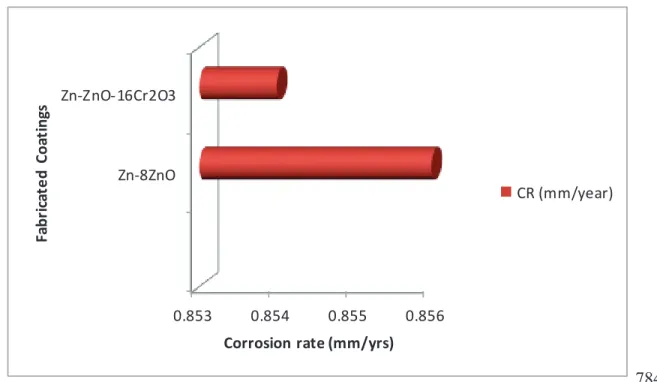
extrapolated from tafel slope as presented in Table 2. The results revealed the corrosion resistance behaviour of the coatings in 3.65% NaCl static solution. From the polarization curves of Zn-ZnO-Cr2O3 composite coating in Figure
5, it was found that the addition of Cr2O3 altered the shape of the polarization curve but causes a considerable
increase in the value of the Ecorr. The features from the linear polarization test (Figure 5) indicate that an increase in additive concentration intensifies this process. However, the optimal value for the coating with least corrosion rate was Zn-8ZnO-8Cr2O3, which implies that addition of Cr2O3 gives better effect of corrosion resistant property.
According to [9], this could be attributed to the nature and tenacity of the passive film produced by Zn-8ZnO-8Cr2O3 on the surface of the coated steel and the drop in the potential thereafter could be traced to slight passivity
breakdown experienced when the concentration of Cr2O3 was further increased, which is in line with [8].
0.853
0.854
0.855
0.856
Zn-8ZnO
Zn-ZnO-16Cr2O3
Corrosion rate (mm/yrs)
Fa
br
ic
at
e
d
C
oa
ti
ng
s
CR (mm/year)
784
FIGURE 5.Potentiodynamic polarization curves o Zn-ZnO-Cr2O3 composite coating on mild steel in 3.65%NaClsolution.
TABLE2: Polarization data extrapolated from Tafel slope for matrix Zn-ZnO-Cr2O3 composite coating.
Samples No Ecorr,Obs (V) jcorr (A/cm²) CR (mm/year) Rp (Ω) 1. Zn-8ZnO -1.3067 0.003029 0.854270 23.583 2.Zn-ZnO-16Cr2O3 -1.3706 0.003102 0.856890 20.390
CONCLUSIONS
The following conclusions were drawn from the study:
1. Composite coatings consisting of Zn-ZnO and Zn-ZnO-Cr2O3particles weresuccessfully prepared by means
of an electro-depositiontechniqueonto carbon steel substrates.
2. The plating of Zn with incorporation ZnO and Cr2O3in the coating was confirmedby the EDS and XRD.
3. The co-deposition of nano-sized Cr2O3 particles in a metal deposit modified the surface morphology of the
substrate.
4. The developed composite coating was mechanically and thermally stable.
5. The presence of Cr2O3 particles in the matrix of the coating system increased adhesion, corrosion resistance
and micro-hardness of the surface, compared to that of plain carbon steel.
ACKNOWLEDGEMENT
This material is based upon work supported financially by the National Research Foundation. The authors acknowledge the support from Surface Engineering Research Centre, (SERC) Tshwane University of Technology Pretoria, South Africa.
REFERENCES
1. M. J. Rahman,S. R. Sen, M. Moniruzzaman and K. M. Shorowordi, J. Mech. Eng. 40, 9-14 (2009).
2. B. M. Praveen, T. N. Venkatesha, Y. ArthobaNaik, and K. Prashantha, Surf. Coat. Tech. 201, 5836-5842 (2007).
3. A. P. I. Popoola, O. S. I. Fayomi and O. M. Popoola, Int. J. Electrochem. Sci. 7, 4898–4917 (2012).
4. O. S. I. Fayomi, V. R. Tau, A. P. I. Popoola, B. M. Durodola, O. O. Ajayi, C. A. Lotoand O. A. Inegbenebor, J. Mater. Environ. Sci.3, 271-280 (2011).
5. L. E. Umoru, I. A. Fawehinmiand A. Y. Fasasi, J. Appl. Sci. Res. 2, 200-204 (2006). 6. E. A. Noor and A. H. Al-Moubaraki, Int. J. Electrochem. Sci. 3, 806-818 (2008). 7. A. P. I.PopoolaandO. S. Fayomi, Int. J. of thePhy.Sci. 6, 2447-2454 (2011).
8. O. S. I. Fayomi, A. P .I. Popoola, C. A. Loto and S. T. Adedokun, Protection of Metals and Physical Chemistry of Surfaces. 52, 238–243 (2016).
9. J. Winiarski, A. Leśniewicz, P. Pohl and B. Szczygieł, Surface & Coatings Technology.299, 81–89 (2016).