Lean Techniques for Optimizing the Supply Chain Introduction
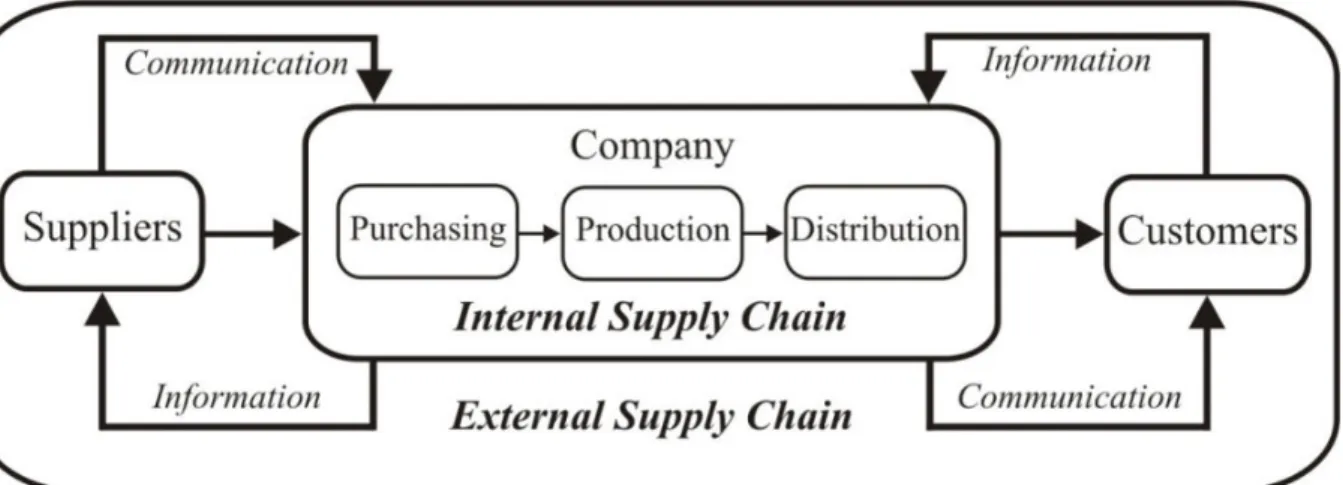
Supply chain management entails supervision of movement of products information as well as finances from the producer to the retailer through the supplier, manufacturer and wholesaler as well as retailer right to the consumers. This flow is very crucial in any given industry. Production would be of no use and unprofitable if there were no consumption. Thanks to supply chain for the role it plays in bridging production and consumption. Supply chain management entails the coordination and integration of flow of commodities, information and finances among and within firms. According to Hayes (2004) and Mentzer (2001) a good supply chain will ensure that consumers obtain products and services on demand. Global supply chain management is a very important concept for businesses across the world due to offshore sourcing and globalization. Global supply chain takes into account the worldwide interests of companies. Global supply chain involves several companies and it is normally associated with many difficulties that increase with time. Therefore, in order to have an effective global supply chain, it is imperative to deal with these challenges that face global supply chain as they come. Time is very crucial in supply chain management and any factor that tends to interfere with time will impact several other operations. There is normally, little attention accorded supply chain management from outside, especially during normal times. Entities outside supply chain management realize the significance global supply chain when a tragedy strikes. The figure below presents internal and external supply chain from suppliers to customers.
Source: IBIMA Publishing, 2011. Achieving a competitive advantage by SCM. Available at: http://www.ibimapublishing.com/journals/IBIMABR/2011/957583/957583.html [Accessed 26 July 2011].
Internal Supply Chain
In manufacturing enterprises, a supply chain is the total of all the stages involved in delivering a product to a client or customer. Designing a supply chain is one of the most sensitive challenges to a company. Walsh and Wellman (2000) believe that automation is the answer to improving the task of designing a supply chain. The ideal model to base a supply chain on should include certain issues. Firstly, it is important to note that it is imperative to know who an agent is in a supply chain. An agent is a computer entity that handles one or more tasks within the supply chain. One issue to be assimilated in the model is resource contention between agents. A scarcity of a particular resource may arise especially if more than one agent requires it. The model should be able to resolve this conflict by ensuring that the agents involved do not operate jointly. Another issue arises from this, which is the value of an agent. To address a sub-issue the model has to look at value from a three dimensional perspective. The first dimension is the monitory cost of the agent, that is, is it justifiable. The second dimension is time taken by the agent to accomplish a particular task. The third dimension is the quality of work being done by the agent. The second issue the model should weigh is hierarchical subtask decomposition. Hierarchical subtask decomposition is a property that enables the agents in a supply chain to accomplish tasks that are complex in nature. This is because specialization is the central feature in the agents. When a task is complex, an agent breaks it down into segments and then distributes them to other agents who in turn might repeat the process again until the task is done (Wisner, Tan and Leong, 2008). Another issue to be looked at is uncertainty, which is the direct eventuality of intended or unintended failures. For instance, an agent might opt to de-commit to take hold of a better deal elsewhere. The effect of such like failures and others is the disruption of the supply chain, which can result in huge losses. The final issue to be assimilated in the model is decentralization of the agents. Decentralization within the supply chain means assigning all the agents with decision-making privileges. Thus, no one agent has all the necessary information to carry out or control the supply chain on its own. In such a context, it is useful for the model to come up with a strategic interaction scheme.
The rate at which competition increases in the world is alarming. Competition is currently based on price of commodities and services. Entities have turned price to be the battle ground where they seek lowest possible cost source. Zylstra (2006, pp.1) states “Low cost sourcing is creating and extending supply chains across the globe making distributing products more challenging than ever. There is just no room for error when planning and moving products across complex, global supply chain”. It is therefore expected that distribution during times when price has become sensitive has to change to cope with the prevailing situation. Previously distribution was based on customer order forecasts with an aim of finding cost-effective plan (Harrison, Lee and Neale, 2005). However, distribution based on the same customer order forecast has proved to be quite illusive of late (Kerber and Dreckshage, 2011). Forecast that is pegged on plans are not reliable anymore and as a result such efforts make reduction of cost of both products and services quite illusive; hence the need of lean techniques for optimizing the supply chain.
The Lean Production System
The main reason why there is need to embrace lean techniques for optimizing the supply chain, especially in production is to do away with wastage a much as possible in every single step or process in functions of enterprises (Sezen and Erdogan, 2009). Lean production is said to have originated from Toyota production system that was investigated by a US an institution called Massachusetts Institute of Technology (Sezen and Erdogan, 2009). Thus, the genesis of the term lean production system can be traced this far (Sezen and Erdogan, 2009). The term lean was used to present a contrast between production system of Toyota and Western mass production system (Sezen and Erdogan, 2009). Sezen and Erdogan (2009, pp. 68) states “Lean is a systematic approach to enhancing value to customer by identifying and eliminating waste through continuous improvement, by flowing the product at the pull of the customer, in pursuit of perfection”.
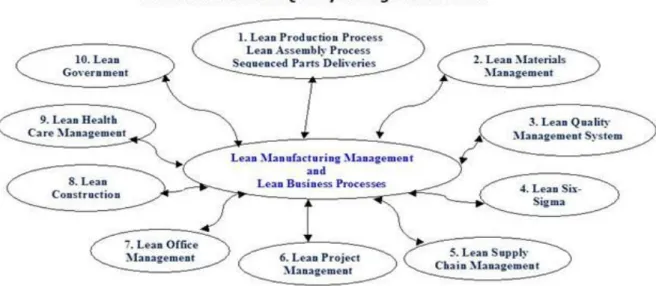
Figure 2: Lean management
Source: ESTG. (2009). Lean Manufacturing, management and lean business principles. Available at: http://estginc.com/LeanPractices.aspx [Accessed 28 June 2011].
Sezen and Erdogan (2009, pp. 69) argue that lean production is currently a well-known philosophy that is aimed at eliminating waste of resources in firms. Lean strategies are totally consumer-centric and focus on what is beneficial to the consumer. Cohen and Roussel (2005) argue that any other process, activity or resources which are deemed unnecessary are not adopted or used. Organizations more or less adopt lean strategies and techniques in the factory at the manufacturing level (Hugos, 2011). They have not yet assimilated the new integrated lean management styles that are being propagated. American companies have gone lean in a major way though the debate on what results lean strategies should beget is still on. Lean manufacturing calls for an integrated process that simultaneously deals with and addresses quality issues, vendor management and monitoring, and other management tools such as ‘just in time’(JIT) stock and supplies, and reducing or eliminating waste (Simchi-Levi, Karminsky and Simchi-Levi, 2004). Just in time management practices involves the reduction of stock and inventory to the point where it is delivered only when required during the manufacturing process. This has been a key driver in helping companies adopt lean manufacturing strategies. It now encompasses eliminating unnecessary acquisition or utilization of assets. Besides just in time and
other techniques, lean manufacturing needs an open communication system across the entire company, its suppliers, and vendors (Branch, 2009). It also needs to have a smooth flow of goods and supplies with no bottlenecks. Flow management techniques like limited or small production runs or taking just enough lots at one time helps keep management costs and resources in check. It also helps reduce organizing costs and resource allocation as fewer suppliers and vendors have to be dealt with (Trent, 2008). This is because so much of the waste in companies is locked up in cultural and organizational barriers that cannot be removed without a fundamental change in the leadership. Sezen and Erdogan (2009, pp. 68) states “For the implementers, lean production principles are the way that enables to reduce costs and with a little effort improves the efficiency and quality, which is the core meaning of the lean”. In order for the fruits of lean production system to be realized, it is imperative to extend it down to entire supply chain. It is advisable to allow all stakeholders to play their respective roles in order to reduce cost and to improve both profit and quality of products and services. Many scholars alongside practitioners argue that lean production system is a type of philosophy that has been employed in companies and organization strategic supply chain management.
Techniques of optimizing lean supply chain Lean Manufacturing
Tools and techniques are the indispensable factors in lean manufacturing. Often, lean tools when applied and implemented systematically bring about much clarity to the process and also cut down sources of waste in definite ways (Herstatt, 2007). Lean Tools and techniques are very useful in different circumstances–value stream mapping, jidoka, 5S, kanban , lean metric, JIT, Total Productive Maintenance, inventory turnover rate and many others help organizations benefit greatly from lean manufacturing transformations. Lean tools are best used in an integrated way rather than when applied in isolation (Zylstra, 2006). Lean thinking principles have exclusively accepted by many manufacturing operations (Ackerman, 2007). These are further applied successfully established in various disciplines. On the contrary, there are many researchers and relevant practitioners who have studied on lean manufacturing and commented that it is very difficult to find a particularly concise definition. For different authors there are different definitions on distinctive grounds. Sezen and Erdogan (2009) argues that approaches on lean manufacturing are frequently associated with particular elimination of seven important
wastes in order to ameliorate the determined effects of variability in supply, added by processing time or relevant demand. Lean manufacturing can be best declared as an approach for delivering upmost value to customer by means of eliminating waste through process and selected human design elements. Lean manufacturing is an integrated system that has been composed of highly inter-related elements added by wide variety of management practices. Lean manufacturing needs understanding of technical questions with existing relationships between areas of manufacturing and other areas of firm that needs to be examined well as per other factors that are external to the firm (Zylstra, 2006). Being an integrative concept, its adoptions get characterized by collective set areas or factors. These set of areas encompass wide ranged array of practices that are supposed to be critical for its implementation. These areas and factors are - inventory, scheduling, equipment, work processes, employees, quality, layout, customers, suppliers, product design, management and culture, safety and ergonomics and tools and techniques. These areas are subjects of investigation in this particular study and they will be reviewed and described accordingly.
Work processes in terms of value stream needs importance in lean manufacturing. Various processes should be performed through minimum non-value that is added to activities to reduce waiting time, moving time, queuing time and other delays (Sezen and Erdogan, 2009). Apart from that, standardization of work processes need facilitate efficient, added by enough safe work methods and the systematic modes of eliminating wastes, at the same time, maintaining quality. There is a kind of assurance of consistent performance and that creates a foundation for managing continuous improvement (Harris and Streeter, 2011). In the current status, high quality product is prerequisite for all kinds of manufacturers. Quality is the main focus in lean manufacturing as poor quality management can lead to many wastes like scraps and rejects (Mortimer, 2006). By right kind of quality management, control a manufacturing process can get managed, and this reduces the sector of “safety” buffers as well as exposes quality issues. Relevant reduction of “safety” buffers can lead to reduction of inventories. Employees who are empowered and motivated are essential as people are core element in lean manufacturing. For Japanese, people as assets as they are going to solve problems as well as improve production processes. Appropriate phrase “No one knows the job better than those who do it” declares that experienced people in their respective job are most likely to have better understanding on it. By task rotation there is the cross-trained as well as multi-tasked employees. This enables them in
making faster responses to changes in products and various processes (Gill, Lopus and Camelon, 2011). Moreover, work teams are critical all through the process of implementation of lean manufacturing Lean manufacturing also depends on layout that illustrates the arrangement of facilities led in a factory. By a poor layout there are possibilities of several deteriorating effects like excessive work-in-process inventories, high material handling costs and unbalanced or low equipment utilization.
Consistent flow of inventory and its replacement is an important part of inventory management. Therefore, layouts causing its accumulation and interrupting the process flow must be removed (Frazelle, 2002). Lean manufacturing requires layouts that are more flexible and cut down movement of materials and labor, reduce material handling losses, and also avoid dumping of inventories between stations. External resources also tend to affect the success (or lack of it) of lean manufacturing. For example, suppliers are a critical factor for lean manufacturing to succeed. In fact, much attention has been given to the role of suppliers by many researchers Suppliers play a crucial role in the production process. For this reason, encouraging suppliers is particularly important if one wants to create a near-perfect JIT production capability as well as JIT delivery. After all, these qualities are the ones that enhance long-term competitiveness that enables individuals to have an edge over their competitors. Good synergy between manufacturers and suppliers and a genuine interest in waste reduction and cost-cutting are very important factors for successful lean manufacturing.
Another important aspect of lean manufacturing is the relationship with customers (Taylor and David, 2001). Customers are clear about what, how, and when they are going to buy a particular product. The value of the product is also the customer’s decision depending on the degree of their need. It is therefore very important to develop a good customer relationship since this helps the organization get more in sync with the needs of its customers (Gill, Lopus and Camelon, 2011). This also helps to meet the present demands of the customers, predict, and subsequently meet their future needs. The ultimate motive of every economic activity is to achieve a good balance between market demands and its production flows. Lean manufacturing has safety and ergonomics as a combined area (Lambert, 2008). Safety is one of the basic requirements of every activity and lean manufacturing is no exception. Ergonomics brings humans together to improve their productivity, cut down the scope of injuries and fatigues. Using ergonomic features
eliminates unnecessary motions and thus also decreases wastage to a great degree. The quality of the end-product is naturally enhanced by the reduction of human errors. Management and culture are the key areas of this study. The top management has to understand and gives its full support to maintain leanness in the production process. Smooth inter-departmental communication and open channels of communication between senior managers and employees is required to attain the vision and mission of lean manufacturing. There is evidence that the support of the management is an important driving factor in the lean manufacturing process.
Value Creation in Lean supply Chain
Lean thinking in supply chain entails creating value by embracing lean principles that enhance value creation. Lean techniques or thinking enhance value creation through: striving to eliminate and reduce waste on a continuous basis; pulling, parts, information and materials as well as products from customers; putting in place necessary flow with processes in supply chain; identifying value from consumers’ perspective; lining up value and determining a value system. In order to competently identify a value system, there is need to map the value system, identify necessary steps required for value creation and challenge all steps in the supply chain by being critical (Thomes and Press, 2005). There are a number of activities in the value stream that need to design, order and to provide products and services, which is then delivered to consumers. In order to effectively develop value stream map, product family as well as collecting process information need to be adopted accordingly.
Waste Reduction
Supply chain characterized by lean thinking and techniques contribute quite considerably in reducing waste in one way or another. Waste can be limited in supply chain by stopping defective products right at their source of production; adjusting the flow processes or changing the accordingly; eliminating useless process steps; eliminating handling of excess materials and reducing the amount of time that is spent in waiting for information, orders, and parts as well as people. One of the key attributes to lean supply chain management is elimination of waste in the production process. Many have associated waste reduction with cost reduction; but one does not mean the other. Waste reduction leads to lower supply chain cost and this is quite beneficial to forms since when more products are produced at lower cost, it implies that the business will
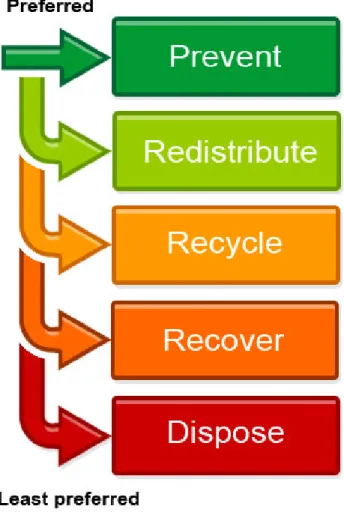
realize more economic return as well as competitive advantage. Firms therefore need to modify as well as to adopt necessary policies and procedures that limit wastes. Basu and Wright (2007, pp. 205) state “Waste reduction is often a good place to start in the overall effort to create a lean supply chain because it can often be done with little or no capital investment. One popular area of waste in processes is excess inventory”. The waste reduction in firms is achieved by identifying as well as implementing efficient means of completing operations in the supply chain in a firm. According to IGD (2011) the hierarchy of waste reduction in supply chain entails waste prevention, waste redistribution, recycling, recover and dispose in that order as presented in the diagram below.
Figure 3: Waste Reduction Hierarchy
According to Murray (2011), waste reduction is possible using processes such as product design, resource management, using of scarp material and improving quality. Companies need to
redesign their products in order to enhance waste reduction. With regards to resource management Murray (2011, pp. 1) states “Each production process should be examined to minimize the waste of raw materials. In manufacturing operations processes that waste material that cannot be recycled or reused must be redesigned”. In the manufacturing process companies can reduce waste by using advance technology to reclaim waste materials. Using scrap metals also plays a very crucial role in reducing cost of production quite remarkably.Murray (2011, pp. 1) states “Quality management … minimizing waste of raw materials as well as producing a quality product. Improving the overall quality of a company’s manufacturing process will reduce waste overall as it will increase the quantity of finished goods that pass quality inspection”. Benefits of lean Supply Chain
Lean supply chain has several benefits ranging from enhanced competiveness, improved customer satisfaction, reduced costs and reduced inventories to high level of responsiveness to the consumers. According to Blanchard (2007), lean supply chain facilitates alignment of companies with one another, which enhances coordination of continuous efforts of improvement in the institutions with regards to quality products production and distribution. As a result, small enterprises are capable of actively participating in the benefits of lean efforts initiated in a given industry or market. According to Monczka, Handfield, Guinipero, Patterson and Walters (2010), some of the most important concepts in the market that make entities become prosperous can only be attained through embracing of lean supply chain. Leadership and competitive advantage are quite instrumental in improving performance of both companies and organization and the concepts are obtainable in the environment of lean supply chain. In addition lean supply chain plays a very crucial role in improving customer satisfaction. By enabling production of products at reduced expenses and time lean concepts plays a very significant role in supply chain since it present products to the consumers at relatively shorter period of time (Wang and Nee, 2009). This enhances consumer satisfaction in the sense that consumers are able to access products on demand and the fact that the concept improves the value of the products quite considerably. In the contemporary society, companies consider inventory wastage, hence, lean supply chain tends to reduce as much as possible the inventory.
Conclusion
The concept of lean thinking and technique has been applied in organizations and companies processes to improve supply chain with an aim of maximizing production and profitability. For instance, a case study of Matsushita logistics highlights how lean thinking is effective in improving supply chain by maximizing profitability and production. The integration of logistics and distribution subsidiaries into Matsushita logistics was to reduce the cost associated with operating as a single entity. The decision by different subsidiaries agreed on a grand design would make them to reduce a lot of cost in the supply chain since management would be centralized. In addition the facilities and different talents of the subsidies would be used for a common purpose. This would enable the business to reduce cost of production and maximize on productivity and economic return. According to Plenert (2007), supply chain that is characterized by lean techniques have been established to produce exactly what is needed where there are needed; thereby reducing chances of wastage. Since lean techniques in the supply chain focus in producing more products by using fewer resources while providing consumers with exactly what they require, economic return is enhanced because wastage is minimized in the process and at the same time customer satisfaction and customer loyalty are enhanced. It is therefore advised that organizations and companies that intend to use lean techniques in optimizing supply chain need to determine those activities that tend to create value and the activities that are wasteful. This important because in order to optimize supply chain wastage should be eliminated and at the same time value should be enhanced since lean does not only entails elimination of wastage but also enhancing value. Therefore, an optimized supply chain should apply lean techniques in different components of supply chain. Consequently, organizations and companies should have lean suppliers, lean procurement, lean manufacturing, lean ware housing, lean transportation and lean customers (Tompkins, n.d.). Lean systems in supply chain enhances speed and responsiveness to consumers, lead to reduced inventories, reduce costs, enhance customer satisfaction and lean systems make supply chain a competitive weapon.
References
Ackerman, K. (2007).Fundamentals of Supply chain management. North Attleboro: DC Velocity Books/
B2B Practices. (2008).Supply chain Management software. Available at:
http://www.improvedb2b.com/supply-chain-management-software [Accessed 28 June 2011].
Basu, R. and Wright, N. (2007).Total Supply Chain Management. UK: Butterworth-Heinemann. Blanchard, D. (2007).Supply management best practices. Canada: David Blanchard.
Branch, A. (2009).Global supply chain management and international logistics. New York: Routledge.
Childerhouse, P. and Towill, D. (2000). 'Engineering supply chains to match customer requirements':Logistics Information Management,13(6), pp.337-345.
Cohen, S. and Roussel, J. (2005).Strategic supply chain management. USA: McGraw-Hill Companies.
ESTG. (2009).Lean Manufacturing, management and lean business principles. Available at: http://estginc.com/LeanPractices.aspx [Accessed 28 June 2011].
Frazelle, E. (2002). USA: McGraw-Hill Companies.
Gill, H., Lopus, M. and Camelon,Supply chain strategyK., 2011.Applying lean manufacturing principles to optimize the supply chain. Available at:
http://www.sdcexec.com/web/online/Decision-Support-Trends/Applying-Lean-Manufacturing-Principles-to-Optimize-the-Supply-Chain/16$10965 [13 June 2011]. Harris, R. and Streeter, C. (2011).Lean supplier development. New York: Taylor and Francis
Group.
Harrison, T., Lee, H. and Neale, J. (2005).The practice of supply chain management. USA: Springer.
Hayes, I., 2004.Optimizing the e-supply chain: the final frontier. Available at:
http://www.clarity-consulting.com/optimizing_the_supply_chain.htm [13 June 2011]. Herstatt, C. (2007).Key factors for successful logistics. Germany: Erich Schmidt Verlag GmbH
& Co.
Hugos, M. (2011).Essentials of supply chain management. USA: John Wiley and sons. IGD, 2011. Supply chain waste prevention guide. Available at:
http://www.igd.com/index.asp?id=1&fid=5&sid=43&tid=158&foid=127 [Accessed 29 July 2011].
Kerber, B. and Dreckshage, B. (2011).Lean supply chain management essentials. USA: Taylor and Francis Group.
Lambert, D. (2008).Supply chain management. USA: Supply chain management Institute. Mentzer, J. (2001).Supply chain management. London: Sage Publications.
MIME Solutions. (2007).What is lean six sigma?Available at:
http://www.mimesolutions.com/Pages/Lean%20Six%20Sigma.htm [Accessed 28 June 2011].
Monczka, R., Handfield, R., Guinipero, L. Patterson, J. and Walters, D. (2010).Purchasing and supply chain management. USA: Cengage.
Murray, M., 2011. Reducing waste in the supply chain. Available at:
http://logistics.about.com/od/greensupplychain/a/reduce_waste.htm [Accessed 29 July 2011].
Plenert, G. (2007).Reinventing Lean. UK: Elsevier Inc.
Sezen, B. and Erdogan, S., 2009. Lean philosophy in strategic supply chain management and value creating. Available at:
http://www.isma.info/dosyalar/221768-73_LEAN_PHILOSOPHY_IN_STRATEGIC_SUPPLY_CHAIN_MANAGEMENT_A ND_VALUE_CREATING.pdf [13 June 2011].
Simchi-Levi, D., Karminsky, P. and Simchi-Levi. (2004).Managing the supply chain. America: McGraw-Hill Companies, Inc.
Taylor, D. and David, B. (2001).Manufacturing operations and supply chain management. UK: Thomson Learning.
Thomes, H. and Press, L. (2005).Lean roadmap. USA: Howard M. Thomes. Tompkins, B., n.d.Lean thinking for the supply chain. Available at:
http://www.tompkinsinc.com/publications/competitive_edge/articles/06-04-Lean_Supply_Chain.asp [Accessed 28 June 2011].
Trent, R. (2008).End-to-end lean management. USA: Robert Trent.
Wang, L. and Nee, A. (2009).Collaborative design and planning for digital manufacturing. USA: Springer.
Walsh, W. and Wellman, M., 2000.Modelling Supply Chain Formation in Multiagent Systems. USA: University of Michigan.
Wisner, J., Tan, K. and Leong, G. (2008).Principles of supply chain management. USA: Cengage.
Zylstra, K., 2006.Lean distribution: applying lean manufacturing to distribution, logistics and supply chain. Canada: John Willey & Sons, Inc.