j Raptor Res. 38 (1) :55-61
¸ 2004 The Raptor Research Foundation, Inc.
PARTIAL MIGRATION AND WINTERING USE OF
FLORIDA BY OSPREYS
M)am S. 1V[_ARTELL 1
The Raptor Center at the University of Minnesota, 1920 Fitch Avenue, St. Paul, MN 55108 U.S.A.
MICHAEL A. MCMILLIAN
Archbold Biological Station, 300 Buch Island Ranch Road, Lake Placid, FL 33852 U.S.A.
MATHEW J. SOLENSKY
The Raptor Center at the University of Minnesota, 1920Fitch Avenue, St. Paul, MN 55108 U.S.A.
BmAN K. MEALE• 2
Falcon Batchelor Bird of Prey Center,, 3280 S. Miami Avenue, Miami, FL 33129 U.S.A.
ABSTRACT.--We used satellite-monitored radiotelemetry to track 14 Ospreys (Pandion haliaetus) breeding on three study areas in southern Florida and four Ospreys breeding along the coast of Maine. Seven birds (50%) migrated from Florida to South America and one was tracked along its migration route and at its nonbreeding season destination in successive years. Four (29%) moved from their breeding areas, but stayed in Florida. Two birds (14%) remained in their breeding areas year round. One bird died (7%) before meaningful data could be collected. Ospreys migrating to South America left their nesting grounds 16 July-27 August and arrived on South American nonbreeding areas 31 July-ll Sep- tember. The seven Ospreys spent between 142-180 d in South America and initiated northward migra- tion 10-31 January. On average they traveled 4105 km, taking 25 d (N = 7), with a mean speed of 178 km/d (N = 5). Ospreys that remained in Florida departed nesting areas 13 May-20 July. Departure from Florida nonbreeding areas was between 28 October and 9 December (N = 4). Mean time spent on nonbreeding areas in Florida was 154 d (N = 3). From Maine, two birds went to Florida (St. Lucie and Indian River counties) and two went to the Caribbean (Haiti and Jamaica). These data show that some southern Florida breeding Ospreys migrate to South America, and some northern breeding Os- preys winter in Florida.
KEY WORDS: Osprey; Pandion haliaetus; Florida; migration; satellite telemetry; wintering area.
MIGRACI(SN PARCIAL Y USO INVERNAL DE LA FLORIDA POR •GUILAS PESCADORAS
RESUMEN.--Usamos el monitoreo via radiotelemetria satalite para seguir 14 aguilas pescadoras (Pandion haliaetus) que anidaron en tres areas de estudio en el sur de Florida y 4 •tguilas pescadoras que anidaron a lo largo de la costa de Maine. Siete aves (50%) emigraron de Florida a Sudam6rica y una fue seguida a lo largo de su ruta de migraci6n y a su lugar de destino durante la temporada no reproductora en aftos sucesivos. Cuatro aguilas (29%) se movieron de sus areas de reproducci6n, pero permanecieron en la florida. Dos aves (14%) permanecieron en sus areas reproductivas todo el afio. Un ave muri6
(7%) antes de que algfin dato significativo pudiera ser colectado. Las aguilas pescadoras que emigraron a Sudam6rica dejaron sus territorios de anidaci6n entre 16julio-27 de agosto y arribaron a Sudam6rica a sus areas de invernaci6n del 31 de julio al 11 septiembre. Las siete aguilas pasaron entre 142-180 dias en Sudam6rica e iniciaron su migraci6n hacia el norte entre el 10 y el 31 de enero. En promedio viajaron 4105 km, tomando 25 dias (N = 7), con una velocidad media de 178 km/dia (N = 5). Las figuilas pescadoras que permanecieron en la Florida se marcharon de sus fireas de anidaci6n entre el 13 mayo-20 julio. La partida de las aguilas de sus areas no reproductivas en la Florida fue del 28 de
Present address: Audubon Minnesota, 2357 Ventura Dr., Suite 106, St. Paul, MN 55125 U.S.A.; e-mail address. [email protected]
Present address: Institute of Wildlife Sciences, 10910 Cameron Ct., Suite 103, Davie, FL 33324 U.S.A.
56 ]VI_ARTELL ET AL. VOL. 38, NO. 1
octubre al 9 de diciembre (N = 4). E1 tiempo promedio que pasaron en las fireas no reproductivas en la Florida fue 154 dias (N = 3). Desde Maine, dos aves fueron a la Florida (St. Lucie y los condados de Indian River) y dos al Caribe (Hait• y Jamaica). Estos datos muestran que las •guilas pescadoras que anidan al sur de la Florida migran a Sudam•rica, y que algunas que anidan en el norte pasan su invierno
en la Florida.
[Traducci6n de C•sar M•rquez]
Ospreys (Pandion haliaetus) nest from southern Florida north into Canada along the Atlantic and Gulf Coasts of North America (Poole 1989, Hough- ton and Rymon 1997). While most North Ameri- can Ospreys winter in Latin America (Henny and Van Velzen 1972, Poole 1989), biologists have com- monly believed that south Florida Ospreys do not migrate, and remain near their breeding grounds year-round (Poole 1989). Also, Florida has not been thought of as a wintering area for more northerly-breeding individuals.
Recent advances in satellite-monitored telemetry have allowed study of migratory patterns of birds large enough to carry the radios. Studies have re- vealed patterns of movement, timing, and winter- ing areas of a number of avian species, including Ospreys in Europe (Kjellen et ah 1997, Hake et al. 2001) and North America (Martell et al. 2001, Rod- riquez et al. 2001).
We report here on: (1) the migratory move- ments of Ospreys breeding in Florida, (2) local movements of Florida breeding Ospreys, and (3)
the winter use of southern Florida by Ospreys that breed in the northern United States.
METHODS
Study Areas. We studied Ospreys in three study areas in southern Florida (27.5o-25 ø N latitude): Lake Istok- poga in Highlands County, Buoy Key Island in Everglades National Park, and Sanibel Island in Lee County (Fig. 1). Lake Istokpoga has one of the highest concentrations of breeding Ospreys in the world with a population of near- ly 250 pairs nesting around an 11207 ha lake. Annual population monitoring and banding of nestlings has been ongoing since 1991. The population in Florida Bay, Everglades National Park is less dense and consists of ca. 80 nesting pairs (O. Bass pers. comm.). Studies of this population have been conducted since the 1960s (Ogden 1977). Sanibel Island Ospreys have been monitored since 1978 with over 350 chicks banded and a current popu- lation of ca. 100 pairs (M. Westall pers. comm.). In Maine we tagged birds with satellite transmitters on Sutton Is-
land, located at ca. 44ø16'N, 68ø15'W, near Acadia Na-
tional Park on the Atlantic coast. The most recent esti-
mates place Maine's Osprey population between 13 000- 18000 nesting pairs with the densest concentrations along the coast (Houghton and Rymon 1997).
Satellite Telemetry. From 1999-2001, we attached 30--
Tampa
Bay
Indian River Count•
Lake
Istokpoga
•.•
_•St. Luci.
Count•
Lake
Okeechobee
Sanibel_
Island
••
Lee
Count•
•
Buo•
Ke•
Figure 1. Study areas (triangles), non-breeding season areas of southern Florida Ospreys (circles), and wintering areas of northern breeding Ospreys (squares).
MARCH 2004 FI•OP.m^ OSPREY MIGRATION 57
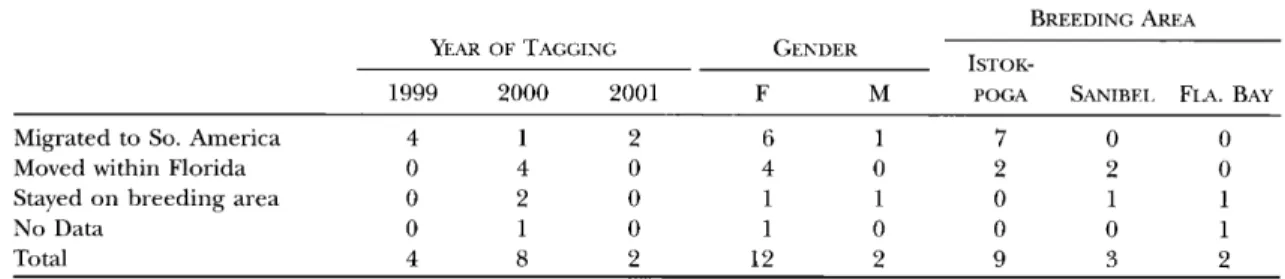
Table 1. Movement patterns of Florida breeding Ospreys, by year of trapping, gender, and breeding area.
BREEDING AREA YEAR OF TAGGING GENDER
ISTOK-
1999 2000 2001 F M POGA SANtaFeL Ft&. BAY
Migrated to So. America 4 1
Moved within Florida 0 4
Stayed on breeding area 0 2
No Data 0 1 Total 4 8 2 6 1 7 0 0 0 4 0 2 2 0 0 1 1 0 1 1 0 1 0 0 0 1 2 12 2 9 3 2
35 g battery or solar-powered satellite linked radiotelem- etry units (PTTs; Microwave Telemetry, Columbia, MD) to 14 adult Ospreys in Florida (12 females and two males, no members of the same breeding pair), and two breed- •ng pairs of adult Ospreys in Maine. PTTs were attached w•th Teflon ribbon (Bally Mills, Bally, PA) using a back- pack method (Martell et al. 2001).
Birds were trapped using a noose carpet on the nest. All trapped and tagged birds were banded with standard U S. Geological Survey aluminum leg bands and an al- pha-numeric coded color leg band. From 1995-2001, M. McMillian fitted 600 nestling Ospreys on Lake Istokpoga with standard USGS bands, and a unique combination of color bands. Since 1993, B. Mealey banded 153 Osprey chicks in Florida Bay. Long-term studies were not con-
ducted in Maine.
Satellite data were mapped and plotted using ArcView (GIS; Geographic Information System ESRI, Redlands, CA). We calculated distances by connecting "best of day" points along the route using an orthographic projection (Martell et al. 2001). Band recovery distances were mea- sured as straight lines between banding and recovery points using ArcView GIS orthographic projection.
RESULTS
Florida Breeding Ospreys. One (7%) radio from Buoy Key stopped working after 14 wk, precluding collection of meaningful data; we suspect this bird died. Seven birds (50%), six females and one male, all from Lake Istokpoga, migrated out of Florida to South America (Table 1, Fig. 2). One bird with a radio that transmitted into a second season re- used its migration route and nonbreeding season destination.
Four (29%) birds moved off their breeding area, but stayed in Florida. From Lake Istokpoga, one bird moved east to St. Lucie County on the Atlantic
coast, while a second moved south to Lake Okee-
chobee (Fig. 1), both in two successive years. From Sanibel Island one bird moved north to the Tampa Bay area (in 2 successive years), while a second moved east across the state to St. Lucie County. Two birds (14%) remained on their breeding areas
(on Sanibel and Florida bays, respectively) year round.
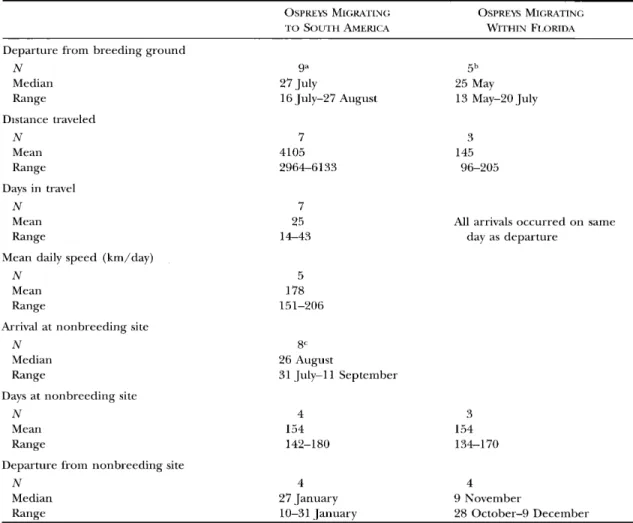
Timing and Distance. Florida Ospreys migrating to South America left their nesting grounds later, and traveled longer and farther than Ospreys that migrated within Florida (Table 2). Two South American migrants tracked in successive years de- parted within 6-7 d of the same date in both years.
We have full return migration data for only two birds. One traveled from Venezuela in 2001 and 2002 in 7 d (averaging 389 km/d) and 10 d (272 km/d), respectively. Compared to post-breeding movements to South America, return trips during spring were 10 d (2001) and 5 d (2002) shorter. The return route was shorter (by a mean of 310 km; see routes below) and flown more quickly (a difference of 109 km/d in 2001 and 72 km/d in 2002). The second bird also traveled from Vene- zuela in 2001, but took 1 d more and averaged 28 km/d less on the return flight than going south.
Migratory Routes and Non-breeding Areas. Mi- grants leaving for South America flew south from Lake Istokpoga, along the Florida Keys, then across the ca. 200 km expanse of the Florida Straits to the
Bahia de Santa Clara area of Cuba, ca. 200 km east
of Havana. The birds continued southeast across Cuba, to Hispaniola, then across the Caribbean. Landfall in South America was between Lake Ma- racaibo, Venezuela and the mouth of the Magda- lena River in Colombia. From there the birds con- tinued to their respective wintering grounds (Fig. 2). Spring and fall routes were similar with one notable exception. One bird used Hispaniola on the southward journey in both 2000 and 2001, but took a more westerly route on the northward jour- ney, avoiding Haiti and staying over water from Ve- nezuela to Cuba.
58 M2kRTELL ET AL. VOL. 38, No. 1
Figure 2. lng areas).
Migratory routes of Florida breeding Ospreys (circles = locations during migration, triangles = nonbreed-
ica from 3.4øN to 16.70øS and 51.6øW to 68.5øW in
Venezuela (3 birds), Brazil (2 birds), Golombia (1 bird), and Bolivia (1 bird) (Fig. 2). All Ospreys tracked more than 1 yr (N = 4) returned to the same nonbreeding area in successive years.
Ospreys that stayed in Florida appeared to take the most direct route to their wintering area. Birds from Sanibel went to Tampa on the western side of the state and also St. Lucie Gounty on the east- ern side of the state. One bird from Lake Istok- poga went to St. Lucie Gounty (Fig. 1).
Band Returns. There have been 20 recoveries of birds banded as nestlings on Lake Istokpoga. Three juvenile Ospreys and one 2-yr-old were re- covered in South America (20%); two juveniles and one 3-yr-old bird were recovered in the Florida Keys south of the study area (15 %); three juveniles, two 2-yr-old, and two 3-yr-old birds were recovered on the Gulf or Atlantic coasts of Florida and Geor- gia (35%); and one juvenile and five 2-5-yr-olds were recovered from central Florida near Lake Is- tokpoga (30%). Four Ospreys banded as nestlings
MARCH 2004 FLORIDA OSPREY MIGRATION 59
Table 2. Timing, distance, and daily progress of migration by Florida breeding Ospreys.
OSPREYS MIGRATING OSPREYS MIGRATING
TO SOUTH AMERICA WITHIN FI,ORIDA Departure from breeding ground
N 9 • 5 b
Median 27 July 25 May
Range 16 July-27 August 13 May-20 July
D•stance traveled N 7 3 Mean 4105 145 Range 2964-6133 96-205 Days in travel N 7
Mean 25 All arrivals occurred on same
Range 14.43 day as departure
Mean daily speed (kin/day)
N 5
Mean 178
Range 151-206
Arrival at nonbreeding site
N 8 c
Median 26 August
Range 31 July-11 September
Days at nonbreeding site
N 4 3
Me an 154 154
Range 142-180 134.170
Departure from nonbreeding site
N 4 4
Median 27 January 9 November
Range 10-31 January 28 October-9 December
Includes two birds leaving 6 and 7 d apart respectively in successive years.
Includes two birds leaving 3 and 30 d apart, respectively, in successive years.
Includes one bird that arrived 8 d apart in successive years.
in Florida Bay were recovered on the east coast of Florida (two as juveniles, one 1-yr-old, and one 4- yr-old).
Northern Ospreys Wintering in Florida. Two of four Ospreys tagged in Maine, a male and female not from the same nesting pair, and a male from Shelter Island, NY (reported in Martell et al. 2001) wintered in Florida. Both males wintered in the St. Lucie/Indian River County area on the Atlantic Coast, while the female wintered in Lee County, near Sanibel Island (Fig. 1). The male from Maine used its Florida wintering area in two successive years, spending 183 and 165 d from October-
March. The second male spent 163 d from 8 Oc- tober-19 March. The female from Maine spent 188 d from 30 September-6 April.
DISCUSSION
Our telemetry and banding data show conclu- sively that the Osprey population breeding in southern Florida is partially migratory with some individuals migrating long distances, others mi- grating shorter distances within the state, and a third group that does not leave their breeding grounds. To our knowledge this is the first docu- mentation that some south Florida Ospreys are mi-
60 MARTELL ET AL. VoI,. 38, NO. 1
gratory (see Poole 1989). Also, our documentation of northern-breeding birds wintering in Florida shows that Ospreys present in southern Florida during the nonbreeding season cannot be pre- sumed to be local, year-round residents. Ospreys use southern Florida for both breeding and win- tering and during spring and fall as a migratory route to and from Latin America (Martell et al. 2001).
Our data on Florida birds was heavily biased to- ward females (12 females versus two males) and breeders from Lake Istokpoga (9/14 tagged birds). Satellite telemetry studies done on Ospreys from the northern United States showed gender-specific differences in timing and wintering locations (Mar- tell et al. 2001). It is possible that south Florida Ospreys would also show gender-based differences with a larger sample size of male birds.
Fifty percent of the satellite-tracked birds we studied, and 20% of the band recoveries from Lake Istokpoga, showed complete migrations to South America. These Florida birds are true migrants, showing both similarities and differences in their migration patterns when compared to other North American Ospreys. Birds in this study used the same routes through the Caribbean and South America as Ospreys from northern states (Martell et al. 2001), and they also showed the same multi- year fidelity to routes and wintering areas. Florida Ospreys spent a similar amount of time on their South American wintering areas (146 d, Table 2) when compared with Ospreys migrating from New York and New Jersey (153 d) or Minnesota (160 d; Martell et al. 2001). However, Florida Ospreys ar- rived on their South American territories between the beginning of August and mid-September, ahead of the more northerly breeding birds that are just beginning their fall migration at this time. Moreover, Florida Ospreys began their return mi- gration in January, which is well before any north- ern breeding Ospreys initiate northward move- ments (Martell et al. 2001).
Not all southern Florida Ospreys migrate to South America. Some move off their breeding ar- eas to nonbreeding sites in Florida, while others remain on their breeding areas year round. Partial migration occurs in other avian species (Gristol et al. 1999) including some where the ratio of mi- grants to non-migrants changes with latitude (Hen- ny 1972). No other Osprey population along the eastern seaboard appears to be non- or partially
migratory (Henny and Van Velzen 1972; Poole and Agler 1987).
Many questions remain regarding the migrating habits of South Florida Ospreys including possible differences between genders, age groups, and the effects of successful versus unsuccessful breeding. Data from other Osprey populations suggest that migratory behavior remains constant from year to year, but further observation of this population is warranted to determine if the same holds true •n Florida. The extent to which northern breeders use Florida also needs to be examined in more de- tail, especially with respect to interactions of win- tering birds, with local breeders.
ACKNOWLEDGMENTS
We acknowledge the financial and logistical assistance provided by Wallace and Mary Lee Dayton, Doug Dayton, Dan and Polly Pierce, MacArthur Agro-ecology Research Center, Archbold Biological Station, Cypress Isle Fish Camp, The Batchelor Foundation, The Ghingos Foun-
dation, Miami Museum of Science, and the International
Osprey Foundation. Assistance in the field was provided by Lourdes M. Rojas, Harrison Tordoff, Roy Dennis, Car- los M. Pages, Greta M. Parks, and Mark Westall. Insightful comments byJim Belthoff, Robert Bennetts, Michael Col- lopy, and Charles Henny greatly improved the final man- uscript.
LITERATURE CITED
CRISTOL, D.A., M.B. BAKER, AND C. CARBONE. 1999. D•f-
ferential migration revisited: Latitudinal segregation by age and sex class. In V. Nolan, E.D. Ketterson, and C.F. Thompson [EDS.], Current Ornithology. Vol. 15.
Kluwer Academic/Plenum, New York, NY U.S.A.
HAKE, M., N. KJELLEN, AND T. ALERSTAM. 2001. Satelhte tracking of Swedish Ospreys Pandion haliaetus autumn migration routes and orientation. J. Avian Biol. 32:47-
56.
HENNY, CJ. 1972. An analysis of the population dynamics of selected avian species. Wildlife Research Report 1, USDI-Fish and Wildlife Service, Washington, DC
U.S.A.
--AND W.T. VAN VELZEN. 1972. Migration patterns and wintering localities of American Ospreys. J. Wildl. Manage. 36:1133-1141.
HOUGHTON, L.M. AND L.M. RYMON. 1997. Nesting distri- bution and population status of U.S. Ospreys 1994 J Raptor Res. 31:44-53.
KIELLEN, N., M. H•XKF•, AND T. At,ERSTAM. 1997. Strategies of two Ospreys Pandion haliaetus migrating between Sweden and tropical Africa as revealed by satellite tracking. J. Avian Biol. 28:15-23.
MARTELL, M.S., CJ. HENNY, P.E. NYE, AND MJ. SOLENSKY 2001. Fall migration routes, timing, and wintering sites of North American Ospreys as determined by sat- ellite telemetry. Condor 103:715-724.
MARCH 2004 FLORIDA OSPREY MIGRATION 61
OGDEN, J. 1977. Preliminary report on a study of Florida Bay Ospreys. Pages 143-151 inJ. Ogden [ED.], Trans-
actions of the North American Research Conference,
U.S. Natl. Park Service, Williamsburg, VA U.S.A. POOLE, A.F. 1989. Ospreys: a natural and unnatural his-
tory. Cambridge Univ. Press, Cambridge, UK. -- AND B. AGLER. 1987. Recoveries of Ospreys band-
ed in the United States, 1914-1984. J. Wildl. Manage. 51:148-155.
RODRIQUEZ, F., M.S. MARTELL, P.E. NYE, AND K.L. BILD-
STEIN. 2001. Osprey migration through Cuba. Pages 107-117 in K.L. Bildstein and D. Klem, Jr. [EDs.], Hawkwatching in the Americas. Hawk Migration As- sociation of North America, North Wales, Pennsylva-
nia, PA U.S.A.
Received 2 December 2002; accepted 1 November 2003 Associate Editor: James R. Belthoff