www.sciencemag.org/cgi/content/full/312/5782/1880/DC1
Supporting Online Material for
Collaborative Ecological Restoration
Warren Gold,* Kern Ewing, John Banks, Martha Groom, Tom Hinckley, David Secord, Daniela Shebitz
*To whom correspondence should be addressed. E-mail: [email protected]
Published 30 June, Science312, 1880 (2006) DOI: 10.1126/science.1128088
This PDF file includes: SOM Text Fig. S1
Tables S1 to S3 References
Collaborative Ecological Restoration
W. Gold, K. Ewing, J. Banks, M. Groom, T. Hinckley, D. Secord, D. Shebitz SUPPORTING ONLINE MATERIAL
This supplement contains: SOM text
Fig. S1
Tables S1, S2, S3 References
Definitions of Ecological Restoration
"all those activities which seek to upgrade damaged land or to recreate land that has been destroyed and to bring it back to beneficial use, in a form in which the biological potential is restored” (S1) “the process of assisting the recovery and management of ecological integrity. Ecological integrity includes a critical range of variability in biodiversity, ecological processes and structures, regional and historical context, and sustainable cultural practices” (S2)
Additional evidence for student success
A. Examples of what capstone students have done
One student has begun a restoration / education program for K-20 students in Costa Rica. A number of students are employed with local environmental consulting firms that work on
restoration projects, one of which became a UW-REN client after the student joined their restoration team.
At least 2 are presently in graduate studies in restoration; others have stated such intentions but we have not had sufficient resources to track many of them.
A number of students are employed in local government agencies (e.g., planning, parks) that address restoration.
B. Additional student quotes
“It has been nearly a year since I completed the UW-REN Capstone project but my experience seems to continue with my daily activities. There were many challenges to develop a successful project and diversity within a team was an essential element to our project’s success. The belief that everyone had something to contribute was paramount to moving forward as a team. Being a team can be a challenge, melding the different views and abilities potentially can create chaos, which at times there was,
however this diversity is what gave the team strength in moving forward. Having everyone with the same skills and ideas would be like rowing a boat with one oar, the boat would not move forward just go in circles. Three things made this course stand out from many of my college classes. First, the need for students to immerse themselves into the course for consecutive quarters, this brings ownership and emotional involvement to what one is doing. Second, the team work and third, we made a real impact on our society and environment, which for me out weighed just writing a paper, where the only impact would be on my grade.”
“In restoration, as with all things, practical, hands-on field experience is ultimately the only way for a student to learn. Due to the trial and error nature of restoration ecology, the learning curve is great. The UW-REN Capstone provides students with and ideal opportunity to minimize that curve under the helpful but not overbearing guidance of the teachers and guest experts, and by interaction and
cooperation with public and private agencies. Knowledge and experience that would otherwise take years of individual field work and experimentation is gained in just nine short months. The quality of the education and the long-term outlook of the program produce tangible results not only on work-sites but also in the students.”
“The REN program was a valuable experience for my collegiate and professional careers in several different ways. As far as the academic benefits of the REN program, it provided me with much knowledge about how ecosystems work, how to restore a disturbed ecosystem, and the common challenges we face with the success of a restored ecosystem.
Professionally, the REN program gave me six months of experience of working with a team, working for a client, meeting goals and objectives, and meeting deadlines. The REN program also introduced me into the processes and components of restoration work that is found in real life. Furthermore, the REN program provided me with valuable experience in dealing with communication between several different stakeholder groups that all have different goals, objectives, time schedules, and expectations of me. This was very helpful because this type of communication experience cannot be taught in the classroom or be found in a textbook.
I plan to pursue a career at an environmental consulting firm, and the REN program gave me a great deal of knowledge and experience that is directly related to my career field. The REN program is an excellent interdisciplinary course that not only crosses boundaries between collegiate disciplines, but also intertwines the academic and professional worlds.”
Quotes from Clients
“It is an incredibly valuable program. So much was accomplished; we would never have been able to complete all that was done on our project in such a short time. The students were easy to work with. They provided us with information that will help us to carry on the project. I think it is so important for educational programs to be involved in real work, applying what they are learning. The partnership between an Elementary/Middle school and the University was also a valuable connection. Our students learned quit a bit from the UW students.
The actual restoration work that was completed has greatly improved the wetland area and I think we can already see some positive affects towards some of the initial goals. Citizen initiated restoration projects can be difficult to coordinate or get started because of the lack of expertise, time to research proper restoration techniques, and money to pay a consultant. The UW REN program provides real learning for the college students and the type of coordination that a citizen's group needs. I would definitely use the UW REN program again given the opportunity. I can also think of other projects which would greatly benefit from such a program.” - Client at a local K-8 school
“I enjoyed it [working with UWREN students] very much. I believe they [students] worked
enthusiastically and hard. It involved my neighbors and got them to see the beauty of the native plants and naturalized landscaping. My next-door neighbors are now working with a landscape consultant who specializes in native landscaping for the rest of their property. A neighbor the next ravine over plans to work with her neighbors on their ravine restoration. I am looking forward continuing the
restoration process in the rest of the ravine. I hope to use it as a demonstration site for other Mercer Island residents.” – Client from Friends of Fern Hollow
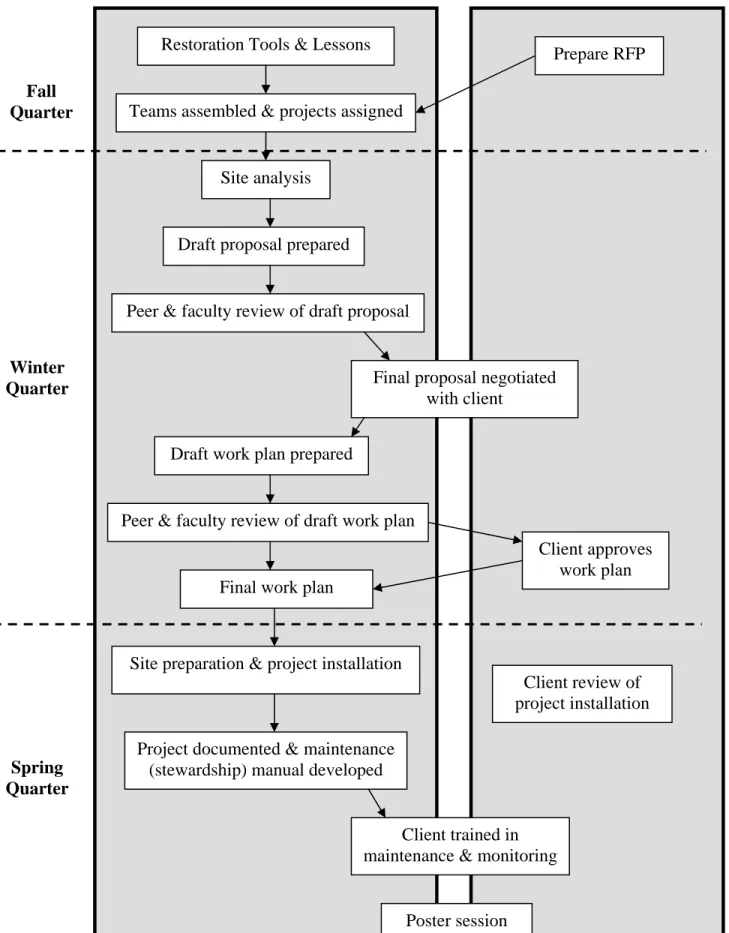
Figure S1. Flow chart of the UW-REN capstone experience.
Students Client
Prepare RFP Restoration Tools & Lessons
Teams assembled & projects assigned
Site analysis
Draft proposal prepared
Peer & faculty review of draft proposal
Final proposal negotiated with client
Final work plan Draft work plan prepared
Peer & faculty review of draft work plan
Client approves work plan
Site preparation & project installation
Project documented & maintenance (stewardship) manual developed
Client trained in maintenance & monitoring
Client review of project installation Fall Quarter Winter Quarter Spring Quarter
Table S1. UW-REN capstone clients (2000 – 2006). Client type
Number of
projects Examples Local Government 9 Cities of Bothell, Woodinville, Redmond,
Seattle; Snohomish County K-12 Schools / Environmental
Education facilities 2
Evergreen School; Islandwood Environmental Education Center
Public Utilities 1 Tacoma Power & Light
Colleges 8 Tacoma Community College; University
of Washington Non-Profit Organizations;
Private landowners 13
Nature Consortium; Friends of Licton Springs; Earth Sanctuary
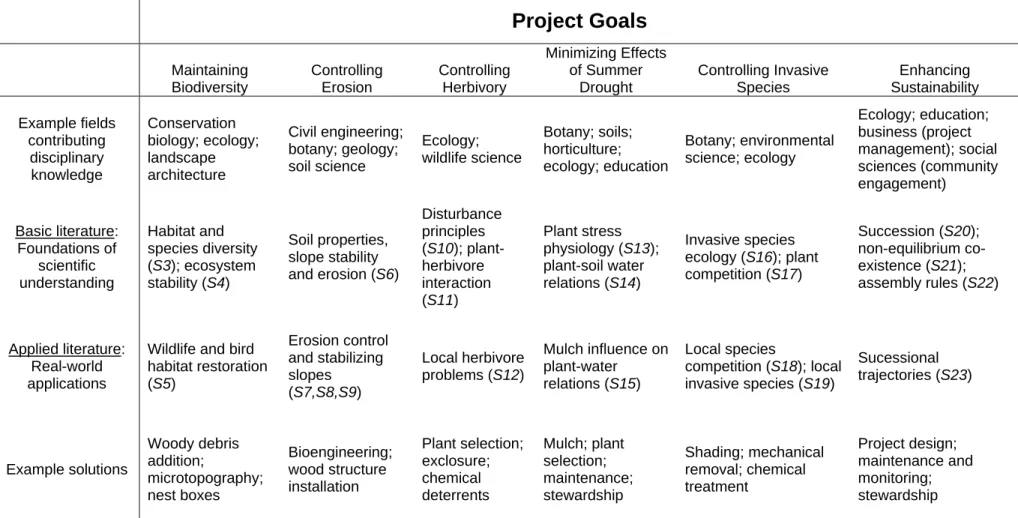
Table S2. Creating solution through scientific knowledge. Expanded version of Table 1 in published paper. Examples of the knowledge connections students make between project goals and possible solutions. Solutions must be grounded in knowledge from different disciplines through basic and applied literature. A few examples of knowledge and literature areas are provided for each goal.
Project Goals
Maintaining Biodiversity Controlling Erosion Controlling Herbivory Minimizing Effects of Summer Drought Controlling Invasive Species Enhancing Sustainability Example fields contributing disciplinary knowledge Conservation biology; ecology; landscape architecture Civil engineering; botany; geology; soil science Ecology; wildlife science Botany; soils; horticulture; ecology; education Botany; environmental science; ecology Ecology; education; business (project management); social sciences (community engagement) Basic literature: Foundations of scientific understanding Habitat and species diversity (S3); ecosystem stability (S4) Soil properties, slope stability and erosion (S6) Disturbance principles (S10); plant-herbivore interaction (S11) Plant stress physiology (S13); plant-soil water relations (S14) Invasive species ecology (S16); plant competition (S17) Succession (S20); non-equilibrium co-existence (S21); assembly rules (S22) Applied literature: Real-world applicationsWildlife and bird habitat restoration (S5) Erosion control and stabilizing slopes (S7,S8,S9) Local herbivore problems (S12) Mulch influence on plant-water relations (S15) Local species competition (S18); local invasive species (S19) Sucessional trajectories (S23) Example solutions Woody debris addition; microtopography; nest boxes Bioengineering; wood structure installation Plant selection; exclosure; chemical deterrents Mulch; plant selection; maintenance; stewardship Shading; mechanical removal; chemical treatment Project design; maintenance and monitoring; stewardship
Table S3. Student participants in the capstone by major field of study (2000 – 2005).
Major or Department Number of Students
Environmental Science 49
Forest Sciences / Conservation 40 Landscape Architecture,
Architecture & Urban Planning 15
Biology 14
Environmental Studies 10
Social Sciences, Arts &
Humanities 5
Education 5 Geology / Earth Science &
Engineering 3
Supporting References
S1. A.D. Bradshaw, M.J. Chadwick, The Restoration of Land (Blackwell Sci., Oxford, 1980).
S2. Society for Ecological Restoration, The SER Primer on Ecological Restoration (Society for Ecological Restoration Science and Policy Working Group 2002, www.ser.org).
S3. D. Tilman, Ecology 75, 2 (1994). S4. D. Tilman, Ecology 77, 350 (1996).
S5. T.L. George, S. Zack, Rest. Ecol. 9, 272 (2001).
S6. S.G. Whisenant, Repairing Damaged Wildlands: A Process-Orientated, Landscape-Scale Approach. (Cambridge Univ. Press, Cambridge, 1999).
S7. R.P.C. Morgan, R.J. Rickson, Eds., Slope Stabilization and Runoff Control: A Bioengineering Approach (Taylor & Francis, London, 1994).
S8. A.D. Bradshaw, Ecol. Eng. 8, 255 (1997).
S9. K. Simon, A. Steinemann, J. Urb. Plan. Dev. 126, 89 (2000).
S10. P.S. White, S.T.A. Pickett, in The Ecology of Natural Disturbance and Patch Dynamics, S.T.A. Pickett, P.S. White, Eds. (Academic Press, New York, 1985), pp. 3-13 .
S11. R.S. Fritz, E.L. Simms, Eds., Plant Resistance to Herbivores and Pathogens. Ecology, Evolution, and Genetics (Univ. Chicago Press, Chicago, 1992).
S12. W.F. Andelt, K.P. Burnham, J.A. Manning, J. Wild. Mgmt. 55, 341 (1991). S13. C.B. Osmond et al., Bioscience 37, 38 (1987).
S14. J.B. Passioura, in Physiological Plant Ecology II: Water Relations and Carbon Assimilation, O.L. Lange, P.S. Nobel, C.B. Osmond, H. Ziegler, Eds. (Springer-Verlag, Berlin, 1982) pp. 5-33.
S15. A.L. Cahill, L. Chalker-Scott, K. Ewing, Ecol. Rest. 23, 212 (2005).
S16. M. Williamson, Biological Invasions (Chapman and Hall, New York, 1996).
S17. J.B. Grace, in Perspectives on Plant Competition, J.B. Grace, D. Tilman, Eds. (Academic Press, San Diego, 1990) pp. 51-65.
S19. F.M. Kilbride, F.L. Paveglio, Wild. Soc. Bull. 27, 292 (1999).
S20. L.R. Walker, R. del Moral, Primary Succession and Ecosystem Rehabilitation (Cambridge Univ. Press, Cambridge, 2003).
S21. S.T.A. Pickett, Bull. Torr. Bot. Club 107, 238 (1980).
S22. V.M. Temperton, R.J. Hobbs, T. Nuttle, S. Halle, Eds., Assembly Rules and Restoration Ecology: Bridging the Gap between Theory and Practice (Island Press, Washington DC, 2004).