Automatic Generation of SQL/XML Views
Vânia Maria Ponte Vidal1, Marco Antonio Casanova2, Fernando Cordeiro Lemos1
1Department of Computing – UFC
Fortaleza – CE – Brazil
2Department of Informatics – PUC-Rio
Rio de Janeiro – RJ – Brazil
[email protected], [email protected], [email protected]
Abstract. This paper proposes an approach to generate XML views of rela-tional data, using SQL/XML. The paper first specify the conditions for a set of correspondence assertions to fully specify the view in terms of the relational schema and, if so, we show that the mappings defined by the view correspon-dence assertions can be expressed as SQL/XML view definition. This paper fo-cuses on an algorithm that automatically generates the SQL/XML query from the view correspondence assertions.
1. Introduction
XML has emerged as the standard information exchange format for Internet-based busi-ness applications. However, since most busibusi-ness data is currently stored in relational database systems, the problem of publishing relational data in XML format has special significance. A general and flexible way to publish relational data in XML format is to create XML views of the underlying relational data.
The exported view may be either virtual or materialized. Materialized views im-prove query performance and data availability, but they must be updated to reflect changes to the base source [12]. In the case of virtual views, the data still persists in re-lational databases, while applications may access the data in XML format through the XML view [1]. Exporting virtual XML views of relational data raises the problems of defining the XML view and evaluating an XML query posed over the view. The XML query is translated into SQL by composing it with the view definition.
The publication of relational data through a virtual XML view has been ad-dressed, for example, in XPeranto [3] and SilkRoute [6]. In both works, the XML view is defined as an XQuery over the canonical XML view that represents the database ta-bles and their attributes. This query specifies the view schema and the mapping knowl-edge, describing how the schema is related to the canonical view. The evaluation of an XML query over the view is performed using a middleware on top of relational data-base. The middleware translates the XML query into equivalent SQL queries. Then, the SQL results are tagged to produce the resulting XML document. In these systems, effi-cient query processing is not guarantee.
In the DB2 XMLExtender [2] and in SQL Server [11], the mapping knowledge is
stored within annotated schemas [11]. In both cases, the mapping definition is very
complex. Moreover, SQL Server provides the FOR XML clause to provide modes to transform query results into XML. The mapping knowledge is defined at access time and not stored in any way, which violates the mapping transparency.
With the introduction of the XML datatype [1] and the SQL/XML standard [4] as part of SQL:2003 [4], users may resort to the SQL/XML publishing functions to cre-ate virtual XML views over base relational schemas. Oracle [1] was the first DBMS to support, with its XML DB module [1], the creation of XML Views as SQL/XML que-ries over the relational data. The advantages of this approach rely on the use of a stan-dard to publish relational data and on the capacity to process the SQL/XML publish functions within the SQL statements, which represents a gain in performance [9]. Thus, XML Query rewrite can be performed inside the DBMS [8], as opposed to non-integrate mid-tier solution.
However, creating SQL/XML view definitions demands advanced knowledge of SQL/XML and is time consuming. Moreover, users will have to redefine the XML view whenever the base relational schema changes. Therefore, tools that facilitate the task of XML view creation and the maintenance should be developed.
We propose in this paper an approach where the SQL/XML view definition is derived from view correspondence assertions, which specify relationships between the view schema and the relational schema. In the case of materialized views, as we shown in [12], all rules required to maintain the view can be automatic generated based on the view correspondence assertions.
This paper has three major contributions. First, we propose the use of corre-spondence assertions [10][12] for specifying the mapping between an XML view schema and a base relational schema. We formally specify the conditions under which a set of correspondence assertions fully specifies the XML view in terms of the relational source and, if so, we show that the mappings defined by the view correspondence asser-tions can be expressed as an SQL/XML query view definition. Second, we propose an algorithm that, based on the view correspondence assertions, generates the SQL/XML query that constructs the XML view elements from the relational tuples. Third, we pro-pose the XMLView-By-Assertions (XVBA) tool that facilitates the task of XML view creation and maintenance. We note that the mapping formalisms used by other schema mapping tools are either ambiguous [7] or require the user to declare complex logical mapping [14].
This article is organized as follows. Section 2 discusses XML Views and the SQL/XML standard. Section 3 presents our mapping formalism. Section 4 discusses how to specify XML view using correspondence assertions. Section 5 presents the algo-rithm that automatically generates the SQL/XML view definition from the correspon-dence assertions. Finally, Section 6 presents the conclusions.
2. XML Views
With the introduction of the XML datatype and the SQL/XML standard, users may cre-ate a view of XML type instances over relational tables using SQL/XML publishing functions [1], such as XMLElement(), XMLConcat(), etc.
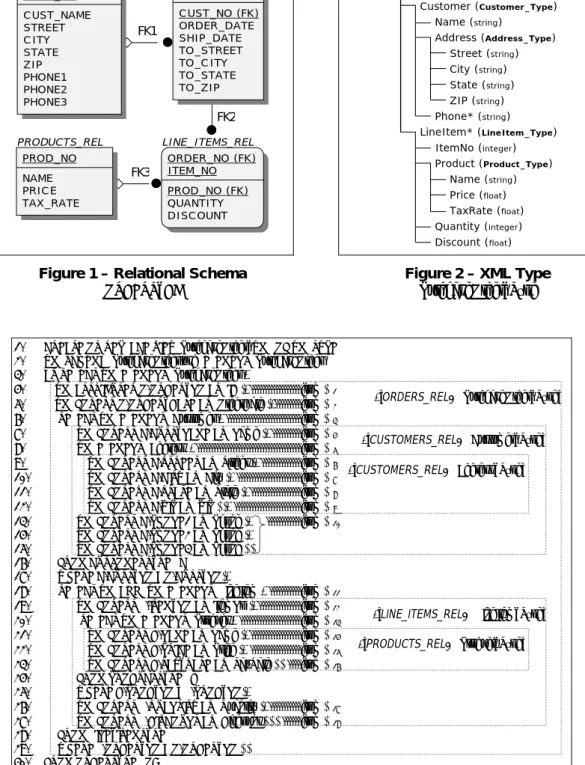
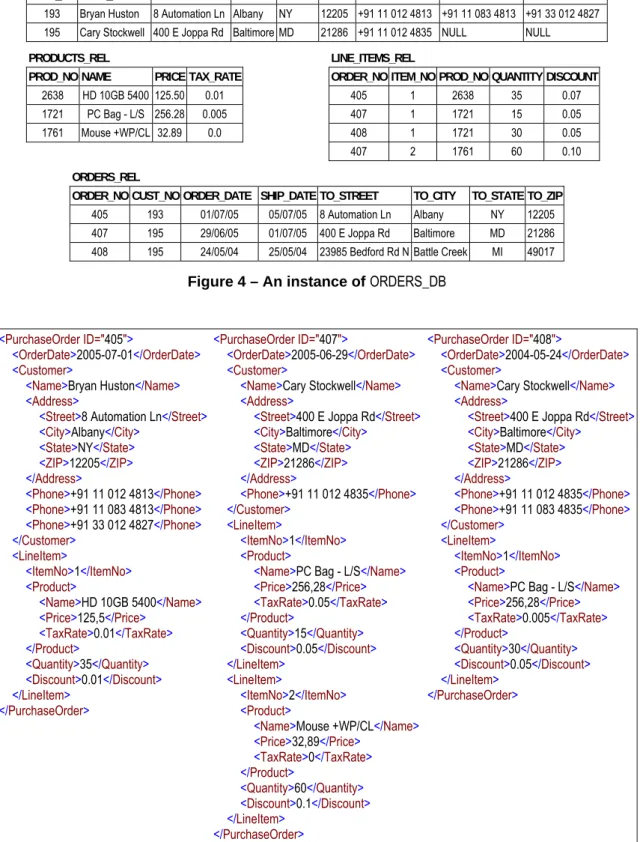
Consider, for example, the relational schema ORDERS_DB and the XML type PurchaseOrder_Type, whose graphical representations are shown in Figure 1 and 2 re-spectively. To generate instances of PurchaseOrder_Type from ORDERS_DB, we create the SQL/XML view PurchaseOrder_XML shown in Figure 3. As illustrated in Figures 4 and 5, for each tuple in table ORDERS_REL, the XML view uses the SQL/XML standard publishing functions to construct an instance of the XMLType PurchaseOrder_Type.
FK1 FK3 FK2 CUSTOMERS_REL CUST_NO CUST_NAME STREET CITY STATE ZIP PHONE1 PHONE2 PHONE3 ORDERS_REL ORDER_NO CUST_NO (FK) ORDER_DATE SHIP_DATE TO_STREET TO_CITY TO_STATE TO_ZIP LINE_ITEMS_REL ORDER_NO (FK) ITEM_NO PROD_NO (FK) QUANTITY DISCOUNT PRODUCTS_REL PROD_NO NAME PRICE TAX_RATE PurchaseOrder_Type @ID (integer) OrderDate (date) Customer (Customer_Type) Address (Address_Type) Street (string) City (string) ZIP (string) Phone* (string) LineItem* (LineItem_Type) ItemNo (integer) Product (Product_Type) Price (float) TaxRate (float) Quantity (integer) Name (string) State (string) Name (string) Discount (float)
Figure 1 – Relational Schema
ORDERS_DB Figure 2 – XML Type PurchaseOrder_Type
1. CREATE OR REPLACE VIEW PurchaseOrder_XML OF XMLTYPE 2. XMLSCHEMA "PurchaseOrder.xsd" ELEMENT "PurchaseOrder" 3. AS SELECT XMLELEMENT("PurchaseOrder",
4. XMLATTRIBUTES(O.ORDER_NO AS "ID"), ...from Ψ1
5. XMLFOREST(O.ORDER_DATE AS "OrderDate"),...from Ψ2
6. (SELECT XMLELEMENT("Customer", ...from Ψ3
7. XMLFOREST(C.CUST_NAME AS "Name"), ...from Ψ4
8. XMLELEMENT("Address", ...from Ψ5
9. XMLFOREST(C.STREET AS "Street"), ...from Ψ6
10. XMLFOREST(C.CITY AS "City"), ...from Ψ7
11. XMLFOREST(C.STATE AS "State"), ...from Ψ8
12. XMLFOREST(C.ZIP AS "ZIP") ), ...from Ψ9
13. XMLFOREST(C.PHONE1 AS "Phone"), ...from Ψ10
14. XMLFOREST(C.PHONE2 AS "Phone"), 15. XMLFOREST(C.PHONE3 AS "Phone") ) 16. FROM CUSTOMERS_REL C
17. WHERE C.CUST_NO = O.CUST_NO),
18. (SELECT XMLAGG( XMLELEMENT("LineItem", ...from Ψ11
19. XMLFOREST(L.ITEM_NO AS "ItemNo"), ...from Ψ12
20. (SELECT XMLELEMENT("Product", ...from Ψ13
21. XMLFOREST(D.NAME AS "Name"), ...from Ψ14
22. XMLFOREST(D.PRICE AS "Price"), ...from Ψ15
23. XMLFOREST(D.TAX_RATE AS "TaxRate") ) ...from Ψ16
24. FROM PRODUCTS_REL D 25. WHERE D.PROD_NO = L.PROD_NO),
26. XMLFOREST(L.QUANTITY AS "Quantity"), ...from Ψ17
27. XMLFOREST(L.DISCOUNT AS "Discount") ) ) ...from Ψ18
28. FROM LINE_ITEMS_REL L
29. WHERE L.ORDER_NO = O.ORDER_NO ) ) 30. FROM ORDERS_REL O;
Figure 3 – PurchaseOrder_XML View
τ[ORDERS_REL→ PurchaseOrder_Type]
τ[CUSTOMERS_REL→ Customer_Type]
τ[CUSTOMERS_REL→ Address_Type]
τ[LINE_ITEMS_REL→ LineItem_Type]
CUSTOMERS_REL
CUST_NO CUST_NAME STREET CITY STATE ZIP PHONE1 PHONE2 PHONE3
193 Bryan Huston 8 Automation Ln Albany NY 12205 +91 11 012 4813 +91 11 083 4813 +91 33 012 4827 195 Cary Stockwell 400 E Joppa Rd Baltimore MD 21286 +91 11 012 4835 NULL NULL
PRODUCTS_REL
PROD_NO NAME PRICE TAX_RATE
2638 HD 10GB 5400 125.50 0.01 1721 PC Bag - L/S 256.28 0.005
1761 Mouse +WP/CL 32.89 0.0
LINE_ITEMS_REL
ORDER_NO ITEM_NO PROD_NO QUANTITY DISCOUNT
405 1 2638 35 0.07 407 1 1721 15 0.05 408 1 1721 30 0.05 407 2 1761 60 0.10
ORDERS_REL
ORDER_NO CUST_NO ORDER_DATE SHIP_DATE TO_STREET TO_CITY TO_STATE TO_ZIP
405 193 01/07/05 05/07/05 8 Automation Ln Albany NY 12205
407 195 29/06/05 01/07/05 400 E Joppa Rd Baltimore MD 21286
408 195 24/05/04 25/05/04 23985 Bedford Rd N Battle Creek MI 49017
Figure 4 – An instance of ORDERS_DB
<PurchaseOrder ID="405">
<OrderDate>2005-07-01</OrderDate> <Customer>
<Name>Bryan Huston</Name> <Address>
<Street>8 Automation Ln</Street> <City>Albany</City>
<State>NY</State> <ZIP>12205</ZIP> </Address> <Phone>+91 11 012 4813</Phone> <Phone>+91 11 083 4813</Phone> <Phone>+91 33 012 4827</Phone> </Customer> <LineItem> <ItemNo>1</ItemNo> <Product> <Name>HD 10GB 5400</Name> <Price>125,5</Price> <TaxRate>0.01</TaxRate> </Product> <Quantity>35</Quantity> <Discount>0.01</Discount> </LineItem> </PurchaseOrder> <PurchaseOrder ID="407"> <OrderDate>2005-06-29</OrderDate> <Customer>
<Name>Cary Stockwell</Name> <Address>
<Street>400 E Joppa Rd</Street> <City>Baltimore</City>
<State>MD</State> <ZIP>21286</ZIP> </Address> <Phone>+91 11 012 4835</Phone> </Customer> <LineItem> <ItemNo>1</ItemNo> <Product>
<Name>PC Bag - L/S</Name> <Price>256,28</Price> <TaxRate>0.05</TaxRate> </Product> <Quantity>15</Quantity> <Discount>0.05</Discount> </LineItem> <LineItem> <ItemNo>2</ItemNo> <Product>
<Name>Mouse +WP/CL</Name> <Price>32,89</Price> <TaxRate>0</TaxRate> </Product> <Quantity>60</Quantity> <Discount>0.1</Discount> </LineItem> </PurchaseOrder> <PurchaseOrder ID="408"> <OrderDate>2004-05-24</OrderDate> <Customer>
<Name>Cary Stockwell</Name> <Address>
<Street>400 E Joppa Rd</Street> <City>Baltimore</City>
<State>MD</State> <ZIP>21286</ZIP> </Address> <Phone>+91 11 012 4835</Phone> <Phone>+91 11 083 4835</Phone> </Customer> <LineItem> <ItemNo>1</ItemNo> <Product>
<Name>PC Bag - L/S</Name> <Price>256,28</Price> <TaxRate>0.005</TaxRate> </Product> <Quantity>30</Quantity> <Discount>0.05</Discount> </LineItem> </PurchaseOrder>
In more detail, consider the instance (or database state) of ORDERS_DB shown in Figure 4. The corresponding instance of PurchaseOrder_XML is shown in Figure 5. This view instance contains a sequence of <PurchaseOrder> elements of type PurchaseOr-der_Type, which are the primary elements of the view. Each <PurchaseOrder> element is constructed from a tuple of the ORDERS_REL table by using the SQL/XML publishing function XMLElement(). Function XMLElement() takes as arguments an element name, an optional collection of attributes, and zero or more additional arguments that make up the element content.
The sub-elements and attributes of a <PurchaseOrder> element are constructed by using SQL/XML sub-queries. For example,
- attribute ID is constructed using the subquery in line 4. Function XMLAttributes() produces, from its arguments, the attributes of its owner XMLElement() function. These arguments are value expressions to be evaluated, with optional aliases. The datatype of an attribute value expression cannot be an object type or a collection. If an attribute value expression evaluates to NULL, then no corresponding attribute is created.
- sub-element <Date>is constructed using the subquery in line 5. Function XMLForest() produces a forest of XML elements from its arguments, which are expressions to be evaluated, with optional aliases. If an expression evaluates to NULL, then no corresponding element is created.
- sub-element <LineItem> is constructed by the subquery in lines 18 to 29. Function XMLAgg() is an aggregate function that produces a forest of XML elements from a collection of XML elements where NULL arguments are dropped from the result. In lines 18 to 29, we have that, for each tuple in ORDERS_REL table, the relevant tuples of the LINE_ITEMS_REL table are retrieved and converted into a sequence of <LineItem> elements.
3. Basic Definitions
In this section, let R, R1,...,Rn be relation schemes of a relational schema S. Let R, R1,...,Rn
be relations over R, R1,...,Rn, respectively.
Definition 1: Let fk be a foreign key of R1 that references R2. Then, we say that:
i) fk is a link from R1 to R2.
ii) fk -1, the inverse of a fk , is a link from R2 to R1.
Definition 2:
i) Let l be a link from R1 to R2 of the form R1[a1,...,am] ⊆R2[b1,...,bm]. Let r1 be a tuple
of R1. Then, r1/l = { r2∈R2 | r1.ai = r2.bi, for 1≤i≤m }.
ii) Let l be a link from R2 to R1 of the form R1[a1,...,am] ⊆R2[b1,...,bm]. Let r2 be tuple of R2. Then, r2/l = { r1 ∈R1 | r1.ai = r2.bi, for 1≤i≤m }.
Definition 3: Let l be a link from R1 to R2, and r1 and r2 be tuples of R1 and R2,
respec-tively. Then, we say that:
i) r1references r2throughl iff r2 ∈r1 /l.
ii) l has single occurrence iff a tuple of R1 can reference at most one tuple of R2
Definition 4: Let l1,... ,ln be links. Assume that:
i) l1 is a foreign key of R of the form R[a1l1,...,am1l1] ⊆R1[b1l1,...,bm1l1] or the inverse of
a foreign key of R1 of the form R1[b1l1,..., b m1l1] ⊆R[a1l1,...,am1l1]
ii) li is a foreign key of Ri-1 of the form Ri-1[a1li,..., amili] ⊆Ri[b1li,...,bmili] or the inverse of
a foreign key of Ri of the form Ri[b1li,.., b mili] ⊆Ri-1[a1li, ..., amili], for 2≤i≤n.
Then, we say that:
i) ϕ = l1. ... .ln is a referential path from R to Rn.
ii) the tuples of Rreferencetuples ofRnthroughϕ.
iii) ϕhas single occurrence iff li has single occurrence, for 1≤i≤n-1; otherwise, ϕhas multiple occurrence.
Definition 5: Let ϕ = l1. ... .ln be a referential path from R to Rn. Let r be a tuple of R.
Then,
r / ϕ = { rn ∈Rn | (∃r1 ∈R1)... (∃rn-1 ∈Rn-1 ) (r.akl1 = r1.bkl1, for 1≤k≤m1)
and (ri-1.akli = ri.bkli, for 1≤k≤mi and 2≤i≤n ) }.
Definition 6: A path of R is an expression of one of following forms:
i) NULL
ii) a, where a is an attribute of R.
iii) {a1,...,an}, where a1,...,an are attributes of R.
iv) ϕ.a, where ϕ is a referential path from R to R’ and a is an attribute of R’.
v) ϕ.{a1,...,an}, where ϕ is a referential path from R to R’ and a1,...,an are attributes of R’.
Definition 7: Let r be a tuple of R. i) r/NULL = {r}.
ii) r/a = { v | v =r.aand v ≠NULL }, where a is an attribute of R.
iii) r/ {a1,...,am} = { v | v =r.ai with 1≤i≤m and v≠NULL }, where a1,...,an are attributes of R.
iv) r/ϕ.a = { v | ∃r’∈r/ϕ and v ∈r’/a }, where ϕ is a referential path from R to R’, a is an attribute of R’ and r’ is a tuple of R’.
v) r/ϕ.{a1,...,am} = { v | ∃r’∈r/ϕ and v ∈r’/ {a1,...,am} }, where ϕ is a referential path from R to R’, a1,...,an are attributes of R’ and r’ is a tuple of R’.
We say that an XML Schema complex type T is restricted iff T is defined using
the complexType and sequence constructors only, and the type of its attributes is an
XML simple type.
In the rest of this section, let T be a restricted XML Schema complex type, and let R and R’ be relation schemes of a relational schema S.
Definition 8: A correspondence assertion(CA) is an expression of the form [T/e] ≡ [R/δ]
where e is an element or an attribute of T, with type Te, and δ is a path of R such that:
i) If e is an attribute or a single occurrence element and Te is a simple type, then δ has
one of the following forms:
- a, where a is an attribute of R whose type is compatible with Te;
- ϕ.a, where ϕ is a referential path from R to R’ such that ϕ has single occurrence, and a is an attribute of R’ whose type is compatible with Te.
ii) If e is a multiple occurrence element and Te is an simple type, then δ has one of the
following forms:
- ϕ.a, where ϕ is a referential path from R to R’ such that ϕ has multiple occurrence and a is an attribute of R’, whose type is compatible with Te;
- {a1,...,an}, where a1,...,an are attributes of R such that the type of ai is compatible
with Te, for 1≤i≤ n;
- ϕ.{a1,...,an}, where ϕ is a referential path from R to R’ such that ϕ has single
occur-rence, and a1,...,an are attributes of R’ such that the type of ai is compatible with Te,
for 1≤i≤ n.
iii) If e is a single occurrence element and Te is a complex type, then δhas one of the
following forms:
- ϕ, where ϕ is a referential path from R to R’ such that ϕ has single occurrence; - NULL
iv) If e is a multiple occurrence element and Te is a complex type, then δ is a path from R to R’ such that δ has multiple occurrence.
Definition 9: Let A be a set of correspondence assertions. We say that A fully specifies T in terms ofR iff
i) For each element or attribute e of T, there is a single CA of the form [T/e] ≡ [R/δ] in
A, called the CA foreinA.
ii) For each assertion in A of the form [T/e] ≡ [R/δ], where e is an element of complex
type Te and δ is a referential path from R to R’, then A fully specifies Te in terms of R’.
iii) For each assertion in A of the form [T/e] ≡ [R/NULL], where e is an element of
com-plex type Te, then A fully specifies Te in terms of R.
Definition 10: Let A be a set of correspondence assertions such that A fully specifies T
in terms of R. Let R be a relation over R.
i) Let S1 be a set of elements that are instances of an XML simple type T. Let S2 be a
set of values of an SQL scalar data type. We say that S1≡AS2iff $t∈S1 iff there is v∈S2 such that $t / text() = f (v)
where f is a function that maps an SQL value to an XML value [10].
ii) Let S1 be a set of values of an XML simple type. Let S2 be a set of values of an
SQL scalar data type. We say that S1≡AS2iff
v1∈S1 iff there is v2∈S2 such that v1 = f(v2)
where f is a function that maps an SQL value to an XML value [10].
iii) Let S1 be a set of elements of an XML Schema complex type T. Let S2 be a set of
tuples of R. We say that S1≡AS2iff
$t∈S1 iff there is r∈S2 such that $t ≡A r.
iv) Let r be a tuple of R and let $t be an instance of T. We say that $t≡A r iff, for each
element e of T such that [T/e] ≡ [R/δ] is the CA for e in A (which exists by assump-tion on A), then $t/e ≡Ar/δ, and, for each attribute a of T such that [T/a] ≡ [R/δ] is the
CA for a in A (which exists by assumption on A), then DATA($t/@a) ≡Ar/δ.
4. Specifying XML Views
We propose to specify an XML view with the help of a set of correspondence assertions [12], which axiomatically specify how the XML view elements are synthesized from tuples of the base source. Let S be the base relational schema. An XML view, or simply,
a view overS is a quadruple V=< e, T, R, A>, where:
(i) e is the name of the primary element of the view; (ii) T is the XML type of element e;
(iii)R is a relation scheme or a relational view scheme of S;
(iv)A is a set of path correspondence assertions that fully specifies T in terms of R.
We say that the pair <e,T> is the view schema of V and that R is the pivotrelation scheme of the view.
Consider, for example, the view PurchaseOrder_XML, whose primary element
<PurchaseOrder> has type PurchaseOrder_Type, and whose pivot relation scheme is
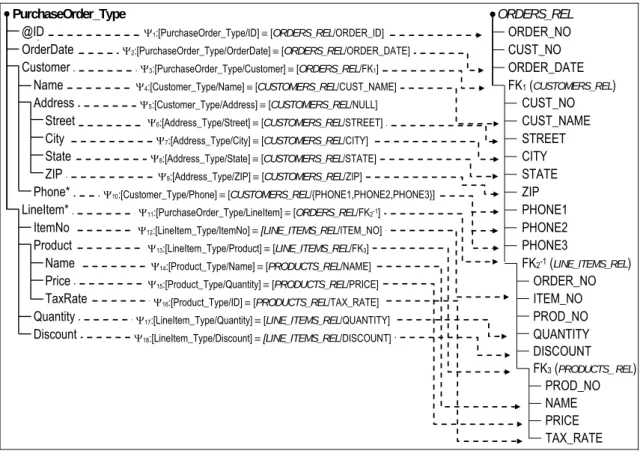
ORDERS_REL. Figure 3 shows an SQL/XML specification of PurchaseOrder_XML and Figure 2 depicts a graphical representation of PurchaseOrder_Type. Figure 6 shows the correspondence assertions of PurchaseOrder_XML, which fully specifies PurchaseOrder_Type in terms of ORDERS_REL.
We developed a tool, called XML View-By-Assertions (XVBA), to support the definition of view correspondence assertions. XVBA features a simple graphical interface which allows the user to navigate to related tables. The process starts with the user
ORDERS_REL CUST_NO ORDER_DATE FK1 (CUSTOMERS_REL) CUST_NO CUST_NAME STREET CITY STATE ZIP FK2-1 (LINE_ITEMS_REL) ORDER_NO ITEM_NO PROD_NO QUANTITY DISCOUNT FK3 (PRODUCTS_ REL) PROD_NO NAME ORDER_NO PHONE1 PHONE2 PHONE3 PRICE TAX_RATE PurchaseOrder_Type @ID OrderDate Customer Address Street City ZIP Phone* LineItem* ItemNo Product Price TaxRate Quantity Name State Name Discount
Ψ1:[PurchaseOrder_Type/ID] ≡ [ORDERS_REL/ORDER_ID]
Ψ2:[PurchaseOrder_Type/OrderDate] ≡ [ORDERS_REL/ORDER_DATE]
Ψ3:[PurchaseOrder_Type/Customer] ≡ [ORDERS_REL/FK1]
Ψ4:[Customer_Type/Name] ≡ [CUSTOMERS_REL/CUST_NAME]
Ψ5:[Customer_Type/Address] ≡ [CUSTOMERS_REL/NULL]
Ψ6:[Address_Type/Street] ≡ [CUSTOMERS_REL/STREET]
Ψ7:[Address_Type/City] ≡ [CUSTOMERS_REL/CITY]
Ψ8:[Address_Type/State] ≡ [CUSTOMERS_REL/STATE]
Ψ9:[Address_Type/ZIP] ≡ [CUSTOMERS_REL/ZIP]
Ψ10:[Customer_Type/Phone] ≡ [CUSTOMERS_REL/{PHONE1,PHONE2,PHONE3}]
Ψ11:[PurchaseOrder_Type/LineItem] ≡ [ORDERS_REL/FK2-1]
Ψ12:[LineItem_Type/ItemNo] ≡[LINE_ITEMS_REL/ITEM_NO]
Ψ13:[LineItem_Type/Product] ≡ [LINE_ITEMS_REL/FK3]
Ψ14:[Product_Type/Name] ≡ [PRODUCTS_REL/NAME]
Ψ15:[Product_Type/Quantity] ≡ [PRODUCTS_REL/PRICE]
Ψ16:[Product_Type/ID] ≡ [PRODUCTS_REL/TAX_RATE]
Ψ17:[LineItem_Type/Quantity] ≡ [LINE_ITEMS_REL/QUANTITY]
Ψ18:[LineItem_Type/Discount] ≡[LINE_ITEMS_REL/DISCOUNT]
loading a source and view schemas into XVBA. The user can then graphically connect elements or attributes of the XML type with attributes or paths of the pivot relation.
The correspondence assertions of PurchaseOrder_XML are generated by: (1) matching the elements and attributes of PurchaseOrder_Type with attributes or paths of
ORDERS_REL; and (2) recursively descending into sub-elements of PurchaseOrder_Type to define their correspondence assertion. For example, to define the assertion of the element LineItem (ψ11:[PurchaseOrder_Type/LineItems] ≡ [ORDERS_REL/FK2-1]), the user
selects the element LineItem on the view schema and the inverse foreign key FK2-1 on the
database schema.
5. Mapping Assertions to SQL/XML
Let S be a relational schema and V=< e, T, R, A > be a XML view over S. In this section,
we show that the view correspondence assertions in A define a mapping that can be correctly translated to an SQL/XML query view definition.
Given an instance σSof S, let σS(R) denote the relation that σSassociates with R. Moreover, given an element e, the extended content of e is the list of attributes and child
elements of e. The correspondence assertions in A define a functional mapping, denoted DEFv, from instances of the source schemaS to instances of the view schema. Given an instance σS of S, the value of V on σS is given by:
DEFv(σS) = { $t | $t is an <e> element of type T and ∃r∈σS(R) such that $t≡Ar }
The SQL/XML definition of V is given by: CREATE VIEW V OF XMLTYPE
AS SELECT XMLELEMENT( "e", τ[R→T][r] ) FROM Rr
where τ[R→T][r] is a sequence of SQL/XML sub-queries, one for each element or attribute of T. Given a tuple r of σS(R), σS(τ[R→T][r])(r) denotes the result of evaluating the SQL/XML sub-queries in the instance σS, with r replaced by r. We will prove that, given an instance $t of T whose extended content is constructed from σS(τ[R→T][r])(r), then $t≡Ar.
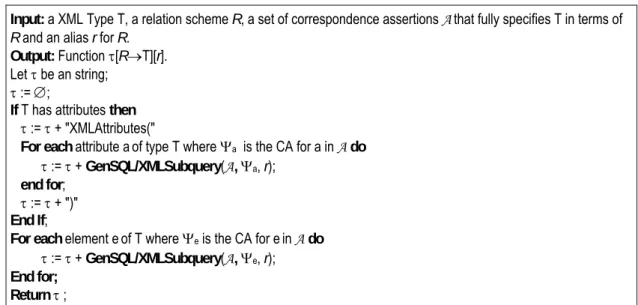
Figure 7 presents the algorithm GenConstructor that generates the constructor function τ[R→T][r]. Figure 8 presents the algorithm GenSQL/XMLSubquery, where ϕ is a path of the form l1. ... .ln, as defined in Definition 6, and Joinϕ(r) is defined by the
following SQL fragment:
R1r1,..., Rnrn
WHERE r.a1l1 = r1.b1l1 AND … AND r.am1l1 = r1.bm1l1
AND r1.a1l2 = r2.b1l2 AND … AND r1.am2l2 = r2.bm2l2
…
Input: a XML Type T, a relation scheme R, a set of correspondence assertions A that fully specifies T in terms of
R and an alias r for R.
Output: Function τ[R→T][r]. Let τ be an string;
τ := ∅;
If T has attributes then
τ := τ + "XMLAttributes("
For each attribute aof type Twhere Ψa is the CA for ain Ado τ := τ + GenSQL/XMLSubquery(A, Ψa, r);
end for; τ := τ + ")"
End If;
For each element e of Twhere Ψeis the CA for e in Ado
τ := τ + GenSQL/XMLSubquery(A, Ψe, r);
End for; Return τ ;
Figure 7 – Algorithm GenConstructor
Input: a set of correspondence assertions A that fully specifies T in terms of R, the CA [T/e] ≡ [R/δ] in A where e is an element or attribute of type Te, and an alias r for R
Output: a SQL/XML sub-query
Let Q be an string;
In case of
Case 1: If e is a single occurrence element, Te is a simple type and δ = a, then
Q := "XMLFOREST(r.a AS \"e\")";
Case 2: If e is a single occurrence element, Te is a simple type and δ = ϕ.a, then Q := "XMLFOREST( (SELECT rn.a FROM Joinϕ(r)) AS \"e\")";
Case 3: If e is a multiple occurrence element, Te is a simple type and δ = {a1,...,an}, then
Q := "XMLCONCAT( XMLFOREST(r.a1 AS \"e\")," + …+ "XMLFOREST(\"e\", r.an AS \"e\") )"; Case 4: If e is a multiple occurrence element, Te is a simple type and δ = ϕ/ {a1,...,an}, then
Q := "XMLCONCAT( (SELECT XMLFOREST( rn.a1 AS \"e\", … , rn.an AS \"e\" ) FROM Joinϕ(r)) )"; Case 5: If e is a multiple occurrence element, Te is a simple type and δ = ϕ/ a, then
Q := "(SELECT XMLAGG( XMLFOREST( rn.a AS \"e\" ) FROM Joinϕ(r))"; Case 6: If e is a single occurrence element, Te is a complex type and δ = ϕ, then
Q := "(SELECT XMLELEMENT(\"e\", " + GenConstructor(Te, Rn, A, rn) + ") FROM Joinϕ(r) ) " Case 7: If e is a multiple occurrence element, Te is a complex type and δ = ϕ, then
Q := "(SELECT XMLAGG( XMLELEMENT(AS \"e\",
+ GenConstructor(Te, Rn, A, rn) + ") ) FROM Joinϕ(r) )";
Case 8: If e is a single occurrence element, Te is a complex type and δ = NULL, then Q := "XMLELEMENT(\"e\", " + GenConstructor(Te, R, A, r) + ")";
Case 9: If e is an attribute, Te is a simple type and δ = a, then Q := " r.a AS \"e\" ";
Case 10: If e is an attribute, Te is an simple type and δ = ϕ.a, then Q := " (SELECT rn.a FROM Joinϕ(r)) AS \"e\" ";
End case; return Q ;
The correctness of these algorithms follows from the propositions and theorem below. In what follows, let T be a XML Schema type, R be a relation scheme, A be a set of correspondence assertions that fully specifies T in terms of R, and r be an alias for R. Proposition 1: Let Ψ be the CA [T/e] ≡ [R/δ] for element e of type Te in A. Let
GenSQL/XMLSubquery (A, Ψ, r) = Qe[r]. Let r be a tuple of σS(R) and S be the set of
<e> elements resulting from evaluating Qe[r] in σS with r replaced by r. Then, we have
that S ≡Ar/δ. (See [13] for the proof).
Proposition 2: Let Ψ be the CA [T/a] ≡ [R/δ] for attribute a of type Ta in A. Let GenSQL/XMLSubquery (A, Ψ, r) = Qa[r]. Let r be a tuple of σS(R) and va be the value
resulting from evaluating Qa[r] in σS with r replaced by r. Then, we have that va = f (v),
where v is the only value inr/δ, and f is a function that maps SQL values to XML values [5]. (See [13] for the proof).
Theorem 1:
Let a1,...,ak be the attributes of T and let e1,...,em be the elements of T.
Let GenConstructor(R, r, T, A )=τ[R→T][r]
Let r be a tuple of σS(R).
Let $t be an <e> element of type T whose extended content is constructed from
σS(τ[R→T][r])(r). Then, $t≡Ar.
Proof: Let a1,...,ak be the attributes of T. Let Ψaibe the CA for ai in A and Tai be the type
of ai, for 1≤i≤k. Assume that Ψaiis of the form [T/ai] ≡ [R/δai]. Let e1,...,em be the elements
of T. Let Ψeibe the CA for ei in A and Tei be the type of ei, for 1≤i≤m. Assume that Ψeiis
of the form [T/ei] ≡ [R/δei]. Let τ[R→T][r] be the constructor function generated by
GenConstructor. From the algorithm, we have that:
τ[R→T][r] = XMLAttributes(Qa1[r], … Qak[r]), Qe1 [r], … Qem[r], where
Qai[r] = GenSQL/XMLSubQuery(A,Ψai,r), for 1≤i≤k
Qei[r] = GenSQL/XMLSubQuery(A,Ψei,r), for 1≤i≤m
Let r be a tuple of σS(R). Let $t be an <e> element of type T whose extended content is constructed from σS(τ[R→T][r])(r). For 1≤i≤k, let vai be the value resulting from
evaluating Qai[r] in σS with r replaced by r.For 1≤i≤m, let Sei be the set of <ei> elements
resulting from evaluating Qei[r] in σS with r replaced by r. Therefore, $t = <e a1 ="va1" …
ak ="vak"> Se1 ... Sem </e>. From Proposition 1, we have Sei ≡A r/δei, for 1≤i≤m. From
Proposition 2, we have vai = f (v), for 1≤i≤k, where v is the only value in r/δai, and f is a
function that maps SQL values to XML values. So, from Definition 10 (ii), we have that DATA($t/@ai) ≡Ar/δai, 1≤i≤k. Therefore, from Definition 10 (iv), we have that $t≡Ar.
In what follows, for simplicity, let τ[R→T](r) denote the function σS(τ[R→T][r])(r) that constructs the extended content of an instance $t of T such that $t≡Ar.
Consider, for example, the SQL/XML definition of PurchaseOrder_XML, shown in Figure 3. The constructor function τ[ORDERS_REL→PurchaseOrder_Type](O) (lines 3 to 29) constructs the extended content of an instance of PurchaseOrder_Type from a tuple
of ORDERS_REL. The constructor function contains four sub-queries, one for each element or attribute of PurchaseOrder_Type. In GenSQL/XMLSubquery, each subquery is generated from the CA of the corresponding element or attribute. Figure 3 shows the assertion that generates each SQL/XML subquery of
τ[ORDERS_REL→PurchaseOrder_Type](O).
We will show that τ[ORDERS_REL→PurchaseOrder_Type](O) constructs the extended content of an instance $P of PurchaseOrder_Type, for each tuple O of an instance of ORDERS_REL, such that $P is semantically equivalent to O, as specified by the assertions of PurchaseOrder_XML.
Let ORDERS_DB be an instance of the relational schema ORDERS_DB. Let
CUSTOMER_REL, ORDERS_REL, PRODUCTS_REL and LINE_ITEMS_REL be the
instances that ORDERS_DB associates with the relation schemes CUSTOMER_REL,
ORDERS_REL, PRODUCTS_RELand LINE_ITEMS_REL of ORDERS_DB, respectively. Let O be a tuple of ORDERS_REL and let $P be an instance of PurchaseOrder_Type whose extended content is constructed with τ[ORDERS_REL→
PurchaseOrder_Type](O). From Definition 10 and from Ψ1, Ψ2, Ψ3 and Ψ11, we have that $P ≡AO iff:
(1) DATA($P / @ID) ≡AO / ORDER_NO,
(2) $P / OrderDate ≡AO / ORDER_DATE,
(3) $P / Customer≡AO / FK1, and
(4) $P / LineItem ≡AO / FK2-1.
Proof of (1): From line 4 of Figure 3, we have that:
DATA($P / @ID) = { v| v = f(O.ORDER_NO) and v≠ NULL }. From Definition 7 (ii), we have that
O / ORDER_NO = { D | D = O.ORDER_NO and O.ORDER_NO ≠ NULL }. So, from Definition 10 (ii), we have that: DATA($P / @ID) ≡AO / ORDER_NO.
Proof of (2): From line 5 of Figure 3, we have that:
$P / OrderDate = { $D | $D=<OrderDate>f(O.ORDER_DATE) </OrderDate> and
O.ORDER_DATE ≠ NULL }. From Definition 7 (ii), we have that:
O / ORDER_DATE = { D | D = O.ORDER_DATE and O.ORDER_DATE ≠ NULL }. So, from Definition 10 (i), we have that: $P / OrderDate ≡A O / ORDER_DATE.
Proof of (3): From lines 6-17 of Figure 3, we have that:
$P / Customer = { $C | ∃C ∈CUSTOMER_REL such that
C.CUST_NO = O.CUST_NO and the extended content of $C is constructed from τ[CUSTOMERS_REL→Customer_Type](C)}.
In following, we show that, given a tuple C ∈ CUSTOMER_REL and an element $C
whose extended content is constructed from τ[CUSTOMERS_REL→Customer_Type](C), then $C ≡AC. From Ψ4,Ψ5, e Ψ10, we have that $C ≡AC iff:
(3.1) $C / Name ≡AC / CUST_NAME,
(3.2) $C / Address ≡AC / NULL, and
Proof of (3.1):The proof follows from line 7 of Figure 3 and is similar to the proof of
(2).
Proof of (3.2):From lines 8-12 of Figure 3, we have that:
$C / Address = { $A } where the extended content of $A is constructed from τ[CUSTOMERS_REL→Address_Type](C).
In following, we show that, if the extended content of $A is constructed from
τ[CUSTOMERS_REL→Address_Type](C) then $A ≡AC.From Ψ6, Ψ7, Ψ8 and Ψ9, we have
that$A ≡AC iff
(3.2.1) $A / Street ≡AC / STREET,
(3.2.2) $A / City ≡AC / CITY,
(3.2.3) $A / State ≡AC / STATE, and
(3.2.4) $A / ZIP ≡AC / ZIP.
The proofs of (3.2.1), (3.2.2), (3.2.3) and (3.2.4) are similar to the proof of (2) and fol-low from lines 9, 10, 11 and 12 of Figure 3, respectively. So, from (3.2.1), (3.2.2), (3.2.3) and (3.2.4), we have that $C / Address = {$A} where $A ≡AC.
From Definition 7 (i), we have that C / NULL = {C}. Therefore, from Definition 10 (iii), we have that $C / Address ≡AC / NULL.
Proof of (3.3): From lines 13-15 of Figure 3, we have that
$C / Phone = S1∪S2 ∪S3 where:
S1 = { $H | $H = <Phone> f (C.PHONE1) </Phone> and H≠NULL },
S2 = { $H | $H = <Phone> f (C.PHONE2) </Phone> and H≠NULL }, and
S3 = { $H | $H = <Phone> f (C.PHONE3) </Phone> and H≠NULL }.
From Definition 7 (iii) we have that:
C / {PHONE1, PHONE2, PHONE3} = { H | ( H = C.PHONE1 or H = C.PHONE2 or H = C.PHONE3 ) and H ≠ NULL }. Therefore, from Definition 10 (ii), we have that:
$C / Phone ≡AC / {PHONE1, PHONE2, PHONE3}.
So, from (3.1), (3.2) and (3.3), we have that:
$P / Customer = { $C | ∃C ∈CUSTOMER_REL such that C.CUST_NO = O.CUST_NO and $C≡A C }. From Definition 2 (i), we have that:
O / FK1 = { C | ∃C ∈CUSTOMER_REL such that C.CUST_NO = O.CUST_NO }.
Therefore, from Definition 10 (iii), we have that: $P / Customer ≡AO / FK1.
Proof of (4): From lines 18-29 of Figure 3, we have that:
$P / LineItem = { $L | ∃L ∈INTEMS_REL such that L.ORDER_NO = O.ORDER_NO and the extended content of $L is constructed from
τ[LINE_ITEMS_REL→LineItem_Type](L) }.
In following, we show that, given a tuple L ∈ LINE_ITEMS_REL and an element $L
whose extended content is constructed from τ[LINE_ITEMS_REL→LineItem_Type](L), then
$L ≡AL. From Ψ12, Ψ13, Ψ17 and Ψ18, we have that $L ≡AL iff:
(4.1) $L / ItemNo ≡AL / ITEM_NO,
(4.2) $L / Product ≡AL / FK3,
(4.3) $L / Quantity ≡AL / QUANTITY, and
The proofs of (4.1), (4.3) and (4.4) are similar to the proof of (2) and follow from lines 19, 26 and 27 of Figure 3, respectively.
Proof of (4.2): From lines 19-25, we have that
$L / Product = { $D | ∃D ∈PRODUCTS_REL such that D.PROD_NO = L.PROD_NO and the extended content of $D is constructed from
τ[PRODUCTS_REL→ Product_Type](D) }.
In following, we show that, given a tuple D ∈PRODUCTS_REL and an element $D
whose extended content is constructed from τ[PRODUCTS_REL→ Product_Type](D), then
$D ≡AD. From Ψ14, Ψ15 and Ψ16, we have that $D ≡AD iff:
(4.2.1) $D / Name ≡AD / NAME,
(4.2.2) $D / Price ≡AD / PRICE, and
(4.2.3) $D / TaxRate ≡AD / TAX_RATE.
The proofs of (4.2.1), (4.2.2) and (4.2.3) are similar to the proof of (2) and follow from lines 21, 22 and 23 of Figure 3, respectively. So, from (4.2.1), (4.2.2) and (4.2.3), we have that:
$L / Product = { $D | ∃D ∈PRODUCTS_REL such that D.PROD_NO = L.PROD_NO and and $D≡A D }.
From Definition 2 (i), we have that:
L / FK3 = { D | ∃D ∈PRODUCTS_REL such that D.PROD_NO = L.PROD_NO }.
Therefore, from Definition 10 (iii), we have that: $L / Product ≡AL / FK3.
So, from (4.1), (4.2), (4.3) and (4.4), we have that:
$P / LineItem = { $L | ∃L ∈INTEMS_REL such that L.ORDER_NO = O.ORDER_NO and and $L≡A L }.
From Definition 2 (ii), we have that:
O / FK2-1 = { L | ∃L ∈ITEMS_REL such that L.ORDER_NO = O.ORDER_NO }.
Therefore, from Definition 10 (iii), we have that: $P / LineItem ≡AO / FK2-1.
6. Conclusions
We argued in this paper that we may fully specify an XML view in terms of a relational schema using view correspondence assertions, in the sense that the assertions define a mapping from instances of the relational schema to instances of the XML view schema.
We presented an algorithm that generates, based on the view correspondence assertions, the SQL/XML view definition. Moreover, we showed that the SQL/XML query generated by the algorithm correctly represents the mapping defined by the view correspondence assertions.
As future work, we envision a number of extensions to our mapping formalism to express broader types of view schema. We are working in generalizing our mapping formalism and algorithm to deal with XML views of object-relational data.
References
[1] Adams, D., Oracle® XML DB 10g Release 2 Developer's Guide.
http://www.oracle.com/technology/documentation/database10gR2.html, 2005. [2] Benham, S.E., IBM XML-Enabled Data Management Product Architecture and
Technology. In: XML Data Management, Native XML and XML-Enable Database
[3] Carey, M. J., Kiernan, J., Shanmugasundaram, J., Shekita, E. J., Subramanian, S. N., XPERANTO: Middleware for Publishing Object-Relational Data as XML Documents. In: Proceedings of the 26th International Conference on Very Large
Data Bases, Pages 646–648, 2000.
[4] Eisenberg, A., Melton, J., Kulkarni, K., Michels, J.E. and Zemke, F., SQL:2003 has been published. In: ACM SIGMOD Record, Volume 33, Issue 1 (March 2004),
COLUMN: Standards, Pages 119–126, 2004.
[5] Eisenberg, A., Melton, J., SQL/XML and the SQLX Informal Group of Companies.
ACM SIGMOD Record, Volume 30, Issue 3 (September 2001), COLUMN: Stan-dards, 2001.
[6] Fernández, M., Kadiyska, Y., Suciu, D., Morishima, A., Tan, W., SilkRoute: A framework for publishing relational data in XML. In: ACM Transactions on
Data-base Systems (TODS), Volume 27, Issue 4 (December 2002), Pages 438–493, 2002.
[7] Hernandez, M.A., Miller, R.J., Haas, L., Yan, L., Ho, C.T.H., Tian, X., Clio: A semi-automatic tool for schema mapping. In: International Conference on
Man-agement of Data, Proceedings of the 2001 ACM SIGMOD International Confer-ence on Management of Data, Page 607, 2001.
[8] Krishnaprasad, M., Liu, Z. H., Manikutty, A., Warner, J. W., Arora, V., Kotsolo-vos, S., Query Rewrite for XML in Oracle XML DB. In: Proceedings of the 30th
In-ternational Conference on Very Large Data Bases, Pages 1122-1133, 2004.
[9] Liu, Z. H., Krishnaprasad, M., Arora, V., Native XQuery Processing in Oracle XMLDB. In: Proceedings of the ACM SIGMOD International Conference on
Man-agement of Data, Pages 828 - 833, 2005.
[10]Popa, L., Velegrakis, Y., Miller, R. J., Hernandez, M. A., Fagin, R., Translating Web Data. In: Proceedings of the International Conference on Very Large Data
Bases, Pages 598–609, 2002.
[11]Rys, M., XML Support in Microsoft SQL Server 2000. In: XML Data Management,
Native XML and XML-Enable Database Systems, Chaudhri, A.B., Rashid, A., and Zicari, R. (eds.), Addison Wesley, 2003.
[12]Vidal, V. M. P., Araujo, V. S., Casanova, M. A., Towards Automatic Generation of Rules for the Incremental Maintenance of XML Views over Relational Data. In:
WISE 2005, Pages 189-202, November, 2005.
[13]Vidal, V.M.P., Casanova, M.A., Lemos, F.C. Automatic Generation of XML Views of Relational Data. In: Technical Report (http://lia.ufc.br/~arida). Universidade
Federal do Ceará, November, 2005.
[14]Yu, C., Popa, L., Constraint-Based XML Query Rewriting For Data Integration.
In: Proceedings of the 2004 ACM SIGMOD International Conference on Manage-ment of data, SESSION: Research sessions: Data Integration, Pages 371–382, 2004.