Combinatorial Testing for
Tree-Structured Test Models with Constraints
Takashi Kitamura
∗, Akihisa Yamada
∗†, Goro Hatayama
‡, Cyrille Artho
∗, Eun-Hye Choi
∗,
Ngoc Thi Bich Do
§, Yutaka Oiwa
∗, Shinya Sakuragi
‡∗National Institute of Advanced Industrial Science and Technology (AIST), Japan, Email:{t.kitamura, c.artho, e.choi, y.oiwa}@aist.go.jp
† University of Innsbruck, Austria, Email: [email protected]
‡ Omron Social Solutions Co., Ltd., Japan, Email: {goro hatayama, shinya sakuragi}@oss.omron.co.jp § Posts & Telecommunications Institute of Technology, Vietnam, Email: [email protected]
Abstract—In this paper, we develop a combinatorial testing technique for tree-structured test models. First, we generalize our previous test models for combinatorial testing based on and-xor trees with constraints limited to a syntactic subset of propositional logic, to allow for constraints in full propositional logic. We prove that the generalized test models are strictly more expressive than the limited ones. Then we develop an algorithm for combinatorial testing for the generalized models, and show its correctness and computational complexity. We apply a tool based on our algorithm to an actual ticket gate system that is used by several large transportation companies in Japan. Experimental results show that our technique outperforms existing techniques.
I. Introduction
Combinatorial testing (CT) is expected to reduce the cost and improve the quality of software testing [16]. Given atest modelconsisting of a list of parameter-values and constraints on them, a CT technique calledt-way testing requires that all combinations of values oftparameters be tested at least once. Test generation fort-way testing is an active research subject. Consequently, various algorithms and tools with different strengths have been proposed so far, e. g.,aetg[7],acts[23], [22],casa[10],pict[8], cit-bach[19], and calot [21].
The Classification Tree Method (ctm) [12], [17], [5], [14],
[15] is a structured technique for test modeling in CT. The method uses classification trees and propositional logic con-straints to describe test models. The effectiveness of CT in practice heavily depends on the quality of test modeling, while it is a difficult task requiring creativity and experience of testers [11], [1]. ctm is expected to be an effective technique to the important task, and is a key technique in CT [15].
Algorithms that generatet-way tests for such tree-structured models deserve further investigation. Tool cte-xl [14]
gen-erates 2- or 3-way tests for ctm. In that work [14], the
mechanism of test generation is explained for a simple tree without constraints; however, our interest is in mechanisms for general trees with constraints. Inspired by Oster et al. [20], we [9] took a transformation approach. This approach trans-forms tree-structured test models to non-structured ones and feeds them to standard CT tools such as the aforementioned
This work was done when the 2nd and 6th authors were in AIST.
ones [7], [8], [10], [19], [22], [21]. This approach has a clear advantage: We can leverage recent and future advances in standard CT tools. However, the technique [9] inherits the limitation from previous transformation approaches [20]; they confine the constraints to a syntactic subset of propositional logic.
The goal of this paper is to provide a transformation technique for tree-structured test models with constraints in full propositional logic, which we callTprop. To this aim, we
provide the following contributions:
1) We first examine a direction of translating test models of
Tprop to one which [9] can handle (called Tmr).
Unfor-tunately, we conclude this direction is not feasible; we prove thatTprop is strictly more expressive than Tmr.
2) Motivated by this fact, we develop a transformation algorithm dedicated toTprop. We prove the correctness of
our algorithm, showing that the semantics of test models are preserved, and thet-way coverage is ensured. 3) We further analyze the runtime complexity of our
algo-rithm. We show that our algorithm achieves complexity
O(|N| · |φ|), significantly improving O(|N|4) stated by earlier work [9], where |N| is the number of nodes and |φ|is the length of the constraints in a test model. 4) We implement the algorithm and conduct experiments in
an industrial setting showing our technique outperforms the test generation tool forctm[14].
This paper is organized as follows. Section II gives an overview of the proposed technique. Section III definesTprop.
Section IV investigates the expressiveness ofTmrandTprop. In
Section V, we explain the transformation algorithm dedicated to Tprop. Section VI shows experimental results of our
tech-nique in comparison withcte-xl. Section VII discusses related work, and Section VIII concludes.
II. TransformationApproach
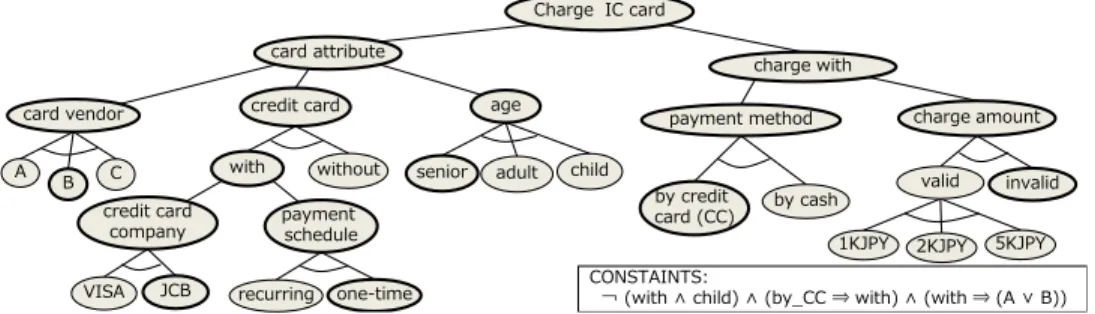
In this section, we overview the transformation approach for tree-structured test models. Fig. 1 shows a calot test model of charging IC cards in a ticket gate system for railway stations. The test model consists of two parts: anand
-xor tree describing parameter-values, and propositional-logic
age senior child A B C charge with without credit card card vendor payment schedule recurring one-time VISA JCB charge amount payment method by credit card (CC) by cash
1KJPY 2KJPY 5KJPY valid invalid adult
Charge IC card
CONSTAINTS:
¬ (with ∧ child) ∧ (by_CC ⇒ with) ∧ (with ⇒ (A ∨ B)) card attribute
credit card company
with
Fig. 1. A test model for an IC Card charge function.
1 # List of parameters and values 2 card vendor : A , B , C
3 credit card : with , without
4 age : senior , adult , child
5 payment method : by CC , by cash
6 charge amount : valid , invalid
7 payment schedule : recurring , one time ,
-8 credit card company : VISA , JCB ,
-9 valid : 1 KJPY , 2 KJPY , 5 KJPY ,
-10
11 # CONSTRAINTS
12 IF [ payment method ] = " credit card "
13 THEN [ credit card ] = " with ";
14 ( NOT ([ age ] = " child " AND [ credit card ] = " with " ));
15 IF [ credit card ] = " with "
16 THEN ([ card vendor ] = "A" OR [ card vendor ] = "B" );
17 IF [ credit card company ] = " -"
18 THEN ( NOT [ credit card ] = " with ")
19 ELSE [ credit card ] = " with ";
20 ...
Fig. 3. PICT code for Fig. 2
The and-xor tree describes the basic structure of the test model by decompositional analysis of the input domain. In Fig. 1, the input domain is first decomposed into two or-thogonal test aspects: card attribute andcharge with. Fur-ther analysis decomposes the former into three aspects: the card vendor, the availability of acredit card function, and the age of the card holder. An arced edge denotes an xor
-composition, while its absence represents anand-composition.
Such trees specifytest modelsby regarding eachxor-node as a
parameter (classificationinctm) and its children as the values
(classes) of the parameter.
The propositional logic constraints describe dependency among parameter-values in a test model. The constraints in Fig. 1 express the following:
1) ¬(with ∧ child): A child cannot have a card with credit card functionality.
2) by CC ⇒ with: To pay by credit, the card must have credit card functionality.
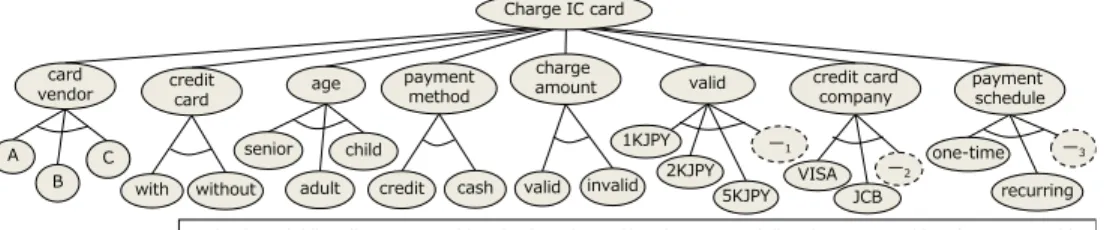
3) with ⇒ (A∨B): credit card functionality is available only when the IC card vendor is A orB, but notC. Our transformation approach, using flattening algorithm, transforms the tree-structured test model of Fig. 1 to the
flat test model of Fig. 2. Note that several extra nodes are introduced and constraints are manipulated, in order to keep the semantic equivalence.
The flattened tree is converted to a standard format of CT, e. g., thepictcode in Fig. 3. Correspondence between Fig. 2
and the pict code is straightforward: Each xor-node at the
second level of the tree is a parameter in thepictmodel, and
children of an xor-node are values of the parameter. Table I shows 2-way test suite for this model generated by pict.
III. Syntax andSemantics ofTprop
The test modeling languageTprop, which is a general form
of tree-structured test models including classification trees, describesand-xortrees and constraints using full propositional logic. The syntax ofTprop is defined as follows:
Definition 1 (Tprop). The language Tprop is the set of tuples
(N,r,↓,@, φ)s. t.
• (N,r,↓) is a rooted tree, where N is the set of nodes, r
is the root node, and↓assigns each node a the set of its children↓a;
• @ assigns each node a its node type @a ∈
{and,xor,leaf};
• @a=leaf if and only if↓a=∅;
• φdescribes constraints as a propositional formula given
by the following BNF: φ ::= true| false | a(∈ N)| ¬φ | φ∧φ|φ∨φ|φ⇒φ
We call a ∈ N an and-node, xor-node, or leaf-node if it is associated by@withand,xor, orleaf, respectively. We denote the parent of a by↑a, if a is not the root node r. We call an element of Tprop atest tree/model(of Tprop).
The semantics of a test tree in Tprop is defined as a set of
test cases. By defining a notion of aconfigurationofTprop, we
can derive test cases from it.
Definition 2(Configuration). A (valid)configurationof a test tree s=(N,r,↓,@, φ)is a subset C⊆N of nodes that satisfies the following conditions:
1) The root node is in C: r∈C.
2) If a non-root node is in C, then so is its parent: a ∈
C∧a,r⇒ ↑a∈C.
3) If an and-node is in C, then so are all of its children: a∈C∧@a=and⇒ ∀b∈ ↓a.b∈C.
4) If an xor-node is in C, exactly one of its children is in C: a∈C∧@a=xor⇒ ∃!b∈ ↓a.b∈C.
5) C satisfies the constraintφ, i. e., C|=φ. We denote the set of all configurations of s by C(s).
¬ (with ∧ child) ∧ (by_CC ⇒ with) ∧ (with ⇒ (A ∨ B)) ∧ (—1 ⇔ ¬ valid) ∧ (—2⇔ ¬ with) ∧ (—3⇔ ¬ with) age senior adult charge amount A B payment method credit cash with without credit card card vendor invalid valid 1KJPY 5KJPY 2KJPY valid —1 JCB credit card company —2 one-time recurring —3 payment schedule VISA child Charge IC card
Fig. 2. The flattened tree forcharge IC card.
TABLE I
Apair-wise test suite obtained from the test model inFig. 1.
No. vendor credit card age payment method charge amount credit card company payment schedule valid
1 B with senior by CC invalid JCB one-time
-2 A with adult by cash valid VISA recurring 1KJPY
3 C without child by cash valid - - 3KJPY
4 B with senior by cash valid VISA one-time 3KJPY
..
. ... ... ... ... ... ... ... ...
The definition of test cases assumes the basic setting of CT. LetPbe a set ofparameters (classifications)where eachp∈P
is associated with a setVp ofvalues (classes)of p, then atest case is avalue assignment γ to P, i. e., γ(p) ∈Vp for every p∈P. For a test tree s∈Tprop, we interpret eachxor-node p
of s as a parameter (p ∈P) and its children as the values of the parameter. Some parameters may be absent in a test case, since some xor-nodes may so in a configuration. To express
this, we add a special value⊥to Vp for such a parameter p,
representing “−” in Table I.
Definition 3 (Test cases forTprop). Let s=(N,r,↓,@, φ)be a test tree, and C a configuration of s. Thetest casetcC ofC is the mapping on P={p∈N|@p=xor}defined as follows:
tcC(p)= (
v s. t. v∈ ↓p∩C if p∈C
⊥ if p<C
Note that tcC(p) is uniquely defined due to condition 4 of Definition 2. The set of all the test cases of s is called thetest suite of s and denoted by~s; i. e., ~s={tcC|C∈ C(s)}.
Example 1. There are 165 configurations that satisfy the test tree in Fig. 1 according to Definition 2. The highlighted nodes in Fig. 1 constitute such a configuration, say C. By Definition 3, this configuration induces the following test case
tcC, which corresponds to the first test case in Table I:
tcC= card vendor7→B, credit card7→with age7→senior,
payment method7→by CC, charge amount7→invalid credit card company7→JCB, payment schedule7→one-time valid7→ ⊥
Definition 4 (t-tuples and t-way test suite). Let s be a test model and t a positive integer. A t-tuple(of values) is a value assignment on t parameters, i. e., a mapping τ:π→N such thatπis a set of txor-nodes andτ(p)∈ ↓p∪ {⊥}. A t-tuple is
possibleif it appears in~sandforbiddenotherwise. A t-way test suite of s is a set of test cases that covers all possible t-tuples of s at least once.
IV. Expressiveness ofTmrandTprop
The aim of this paper is to develop a transformation technique for test generation for Tprop models. There are two
plausible options for it. Option (a) is to convert aTprop model
to an “equivalent” Tmr model and then apply the previous
technique in [9] (i. e., using the flattening algorithm forTmr).
Option (b) is to develop a new flattening algorithm dedicated toTprop. This section shows that approaches with option (a) is
infeasible or disadvantageous.
A. Correspondence and Expressiveness
First, we provide the notion of expressiveness of test mod-eling languages. We define it referring to a similar notion provided in [13]1; however here, we consider it based on correspondence of test suites up to renaming.
Definition 5 (Correspondence). Let Γ and Γ0 be sets of test
cases on parameters P and P0, respectively. We say that Γ corresponds toΓ0, denoted byΓ'Γ0, if and only if there exist
bijections par:P→ P0 and val
p :Vp →Vpar(p) for all p∈P
that induce a bijection map : Γ → Γ0 which is defined as
follows: map(γ)=γ0s. t. γ0(par(p))=val
p(γ(p)).
Example 2. Consider the test models s and s0∈T
prop in Fig. 4. By Definition 3, ~s = {γ1, γ2, γ3} and ~s0 ={γ01, γ 0 2, γ 0 3}, where γ1={a7→foo,b7→1} γ10 ={x7→2,y7→α} γ2={a7→foo,b7→2} γ20 ={x7→2,y7→β} γ3={a7→bar,b7→3} γ30 ={x7→1,y7→ ⊥}
1In [13], it is defined based on correspondence of configurations without
Fig. 4. A small example for ~s '
~s0.
Fig. 5. A test model that cannot be expressed inTmr.
Then~s'~s0. That is, we can find bijections par and val that induce a bijection map defined in Definition 5, as follows:
par(p)= ( x (if p=a) y (if p=b) vala(v)= ( 2 (if v=foo) 1 (if v=bar) valb(v)= α (if v=1) β (if v=2) ⊥ (if v=3) One may think that correspondence should be checked regarding thet-way tests for allt(≤the number of parameters). However, this is not needed, as the next theorem states:
Theorem 1. Suppose that~s'~s0is derived by a bijection map, and Γa t-way test suite of s.Γ0={map(γ)|γ∈Γ}is a
t-way test suite of s0.
Proof. We show that any possiblet-tupleτ0 of s0 is covered by Γ0. Take any possible t-tupleτ0 of s0. Letτ be thet-tuple of s which corresponds to τ0, i. e., map(τ) = τ0 (here, map is naturally extended for t-tuples). First, we show that τ is possible in s. Sinceτ0is possible, it appears in some test case δ0 ∈
~s0. By assumption, we have a corresponding test case
δ∈~s s. t.map(δ)=δ0. Becauseδ∈~s, all tuples inδ are possible including the corresponding t-tupleτof s. Next, we show thatτ0is covered byΓ0. SinceΓcovers allt-tuples, there must exist a test case γ ∈Γ that covers τ. It is obvious that
map(γ) coversτ0, and henceτ0is covered by Γ0.
Definition 6 (Expressiveness). Let T and T0 be languages.
We say T is at least as expressive asT0, denoted by T &T0,
if for any s0 ∈T0 there exists s∈ T s. t.
~s '~s0. We say T is (strictly) more expressive thanT0, denoted by T >T0, if T &T0 and T T0; and T isas expressive asT0, denoted by T 'T0, if T&T0 and T .T0.
Proposition 1. The relations .,'and <are transitive. B. Tprop is more expressive than Tmr, i. e., Tmr<Tprop
Here, we compare the expressiveness ofTmr andTprop. We
first revisit Tmr [9].
Definition 7 (Tmr). The language Tmr is the subset of Tprop consisting of tuples of form s=(N,r,↓,@, φmr), whereφmr is a conjunction of formulas of form “¬(a∧b)” or “a ⇒ b” with a,b ∈ N. We call a constraint of the former or latter form a←mex→- orreq−→-constraint, and write “a←mex→b” or “areq−→b”, respectively.
Here we provide three lemmas, whose proofs are found in Appendix. The first lemma tells that an and-node coincides
with all its children in a configuration.
Lemma 1. Let s=(N,r,↓,@, φ)be anand-xortree and C be a configuration of s. For any n∈N and n0∈ ↓n s. t.@n=and, n∈C if and only if n0∈C.
The next lemma states that nodes that do not occur in any configuration can be removed from a test tree.
Lemma 2. Let t1=(N,r,↓,@, φmr)∈Tmr, and N0⊂N be the set of nodes which never appear inC(t1). Let t2∈Tmr be the tree obtained from t1 by removing all nodes in N0and all
req − → -and mex←→-constraints which involve nodes in N0, i. e., a mex
←→ b and areq−→b for some a∈N0 or b∈N0. ThenC(t
1)=C(t2). The following lemma ensures that any subtree that does not contain xor-nodes can be reduced to a single node by
manipulation of constraints.
Lemma 3. Let t1 ∈Tmr, and t01 be a subtree of t1 that does
not contain xor-nodes. We denote the root node of t10 by n
and the set of nodes of t01 by N0. Then ~t1=~t2, where t2
is obtained by sequentially applying to t1 the following:
1) For eachreq−→-constraint areq−→b in t1, replace it with n req −→b if a∈N0\ {n} and by a→−reqn if b∈N0\ {n}.
2) For each←mex→-constraint amex←→b in t1, replace it with n mex ←→
b if a∈N0\ {n}and by a←mex→n if b∈N0\ {n}.
3) Remove all the nodes in N0\ {n}from t1.
The following theorem shows that the transformation tech-nique developed for Tmr [9] is not applicable to Tprop in
general. The proof exemplifies a test model inTpropand shows
that it cannot be expressed inTmr.
Theorem 2. Tprop is more expressive than Tmr, i. e., Tmr < Tprop.
Proof. It is easy to show that Tmr .Tprop, since a
mex ←→ b and
a req−→ b are merely ¬(a∧b) and a ⇒ b respectively. In the following, we show Tprop Tmr by giving a tree s ∈ Tprop
which cannot be expressed inTmr.
Take the tree in Fig. 5 as s. There are the following seven test cases in ~s: γ1={ a7→a1, b7→b1, c7→c1 } γ2={ a7→a1, b7→b1, c7→c2 } γ3={ a7→a1, b7→b2, c7→c1 } γ4={ a7→a1, b7→b2, c7→c2 } γ5={ a7→a2, b7→b1, c7→c1 } γ6={ a7→a2, b7→b1, c7→c2 } γ7={ a7→a2, b7→b2, c7→c1 }
Assume that there exists a trees0∈Tmrsuch that~s'~s0 is derived by bijectionsparandval. Let us writepar(p)=p0,
val(v) = v0, and map(γ) = γ0. Note that b0
1 cannot be an ancestor of a0, since in that case Definitions 2 and 3 impose “γ0(b0)
, b01 ⇒ γ
0(a0) = ⊥ for every γ0 ∈
~s0”, which contradicts either the test caseγ3orγ7. Similarly,b02cannot be
a r b a1 a2 x b1 b2 y … … c c2 z … c1
Fig. 6. Required tree structure for test models that correspond to Fig. 5.
an ancestor ofa0. Thus, we knowa0,LCA(a0,b0),b0, where LCA(a0,b0) expresses theleast common ancestorofa0andb0. Analogously, b0,LCA(b0,c0),c0 and c0,LCA(c0,a0),a0. Moreover, thexor-nodes in s0are exactlya0,b0, andc0, since there can be only these three parameters in test cases of s0. This also entails thata0
i,b 0 i, andc 0 i are not⊥. Since γ01, γ05 ∈ ~s0 with γ01(a 0) = a0 1 and γ 0 5(a 0) = a0 2, it follows that a01,a02 ∈ ↓a0 in s0. Analogously, b01,b02 ∈ ↓b0 and
c01,c02∈ ↓c0.
We conclude that the structure of s0 is as shown in Fig. 6, where black subtrees contain onlyand- orleaf-nodes. Dashed
nodes x, y, and z must not appear in any test case, as ~s0 contains only a01,a02,b01,b02,c01, and c02. Thus, we consider the tree in Fig. 5 instead of Fig. 6, as ensured by Lemma 2 and Lemma 3.
If s0 has no constraint, then~s0contains eight test cases. On the other hand, ~s has seven test cases; thus~s ; ~s0. If s0 includes at least one constraint, then the size of~s0 is either 8 or at most 6. Why? Let αbe the number of removed test cases by adding one constraint tos0. In the case forureq
− →v, α= 0 if v∈Y∨u=v 2 if v∈X∧u∈X∧ ↑u,↑v 4 if v∈X∧u∈Y 8 if v∈X∧u∈X∧ ↑u=↑v∧u,v
where X = {a01,a20,b01,b02,c10,c02} and Y = {r,a0,b0,c0}. For a mex
←→-constraint,αis either 2, 4, or 8. Note that by addingmex←→ -and/orreq−→-constraints, the number of test cases cannot increase. Hence the size of~s0cannot be 7, and ~s ; ~s0. Theorem 2 shows the impossibility of translation of a
Tprop model to an equivalent Tmr model based on the
de-fined notion of “equivalence” in Definition 6, and hence the infeasibility of option (a). Here, one may think of another elaborated technique for such a translation, that may enable the transformation approach of option (a). The technique is to introduce extra “dummy” nodes to realize translation ofTprop
to Tmr preserving equivalence. That is, additional nodes are
introduced in test models of Tmr to realize such a translation
of Tprop to Tmr models, and these nodes are also taken into
account also for the generation of t-way combinatorial test suites, but finally are filtered out in the resulting test suite.
However, in this paper we do not tackle this approach, at least as the first attempt to achieve our goal. It is since we guess this approach with such an elaboration for sticking to option (a) is less advantageous than option (b). The first reason for this is that additional “dummy” nodes introduced
Algorithm 1: remove-and-seq(N,r,↓,@, φ;a)
Input: A trees=(N,r,↓,@, φ) inTpropand a targeta∈N Output: A treesinTprop, withoutand-sequences belowa
1 foreachb∈ ↓ado 2 (N,r,↓,@, φ)←remove-and-seq(N,r,↓,@, φ;b) 3 if @a=@b=andthen 4 φ←φ|b→a 5 ↓a← ↓a\ {b} ∪ ↓b;N←N\ {b} 6 return(N,r,↓,@, φ)
for translation in option (a) become “dummy” parameters and values in standard test models processed for generation of
t-way combinatorial test suites. These extra elements may cause undesirable side effects of generation of larger sized test suites than necessary as well as higher computation costs for test generation. Contrarily, the technique of option (b), that develops a flattening algorithm forTprop, can do without
such an elaboration, and thus can avoid such side effects. The second reason is that, as we will show in Section V-D, the flattening algorithm forTpropdeveloped in option (b) achieves
complexityO(|N|·|φ|), which is lower than that of the algorithm for Tmr[9] analyzed as O(|N|2· |φ|).
V. FlatteningAlgorithm forTprop
Motivated by the result in the previous section, we develop aflattening algorithmfor Tprop that inputs a test tree in Tprop
and then transforms it into an equivalentflat oneinTpropf . We
also show its correctness proof and complexity analysis.
A. Outline of the flattening algorithm
First we define theflat test trees as follows:
Definition 8 (Tpropf ). Language T f
prop is a subclass of Tprop s. t. (1) the root node is anand-node, (2) all the nodes in the second level arexor-nodes, and (3) all the nodes in the third level areleaf-nodes.
The height of a tree inTpropf is always two; hence we call
such trees ‘flat’. Flat test trees have the same structure as test models in existing combinatorial testing tools, such as pict [8], acts [23], [22], cit-bach [19], aetg [7], and calot [21]. Thus, tests can be generated by feeding a flattened test model to these tools.
Next, we show that every test tree in Tprop can be
trans-formed to a flat one. In other words, we prove the following:
Theorem 3. Tprop.T f prop.
The proof of this theorem is to demonstrate the correct-ness of the transformation, achieved by algorithm flatten
we develop. The algorithm applies three sub-algorithms,
remove-and-seq,remove-xor-seq, andliftin this order, but the order of the first two can be swapped.
Note that we only consider test trees whose root node is an
and-node here; test trees whose root node is anxor-node can
b b cc aa d d ee rr cc aa rr d d ee 𝜙|𝑏→𝑎 𝜙 Fig. 7. remove-and-seq. b b cc aa d d ee rr 𝜙 b′ b′ cc aa d d ee b b rr 𝜙 Fig. 8. remove-xor-seq. Algorithm 2: remove-xor-seq(N,r,↓,@, φ;a)
Input: A trees=(N,r,↓,@, φ) inTpropanda∈N Output: A tree s0
in Tprop, withoutxor-sequences belowa
1 foreachb∈ ↓ado 2 (N,r,↓,@, φ)←remove-xor-seq(N,r,↓,@, φ;b) 3 if @a=@b=xorthen 4 N←N∪ {b0} whereb0 is a fresh node 5 @b0← and;↓b0← {b};↓a← ↓a\ {b} ∪ {b0} 6 return(N,r,↓,@, φ)
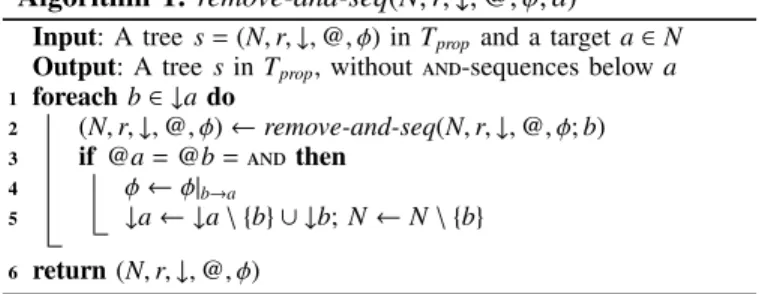
Algorithm remove-and-seq (see Algorithm 1 and Fig. 7), removes all and-sequences below a given target node a in
a tree s. When consecutive and-nodes a and b are found,
it deletes the second and-node b. Then, all the occurrences
of the second and-node b in φ are replaced by its parent a.
By recursively visiting all the nodes of the input tree starting from the root, remove-and-seq(N,r,↓,@;r) removes all and -sequences from the input tree (N,r,↓,@).
Algorithmremove-xor-seq(see Algorithm 2 and Fig. 8) re-movesxor-sequences in a given tree, but it does so differently from remove-and-seq. When it finds a consecutive xor-nodes
a andb, a freshand-nodeb0is inserted in between. This
ap-proach differs from others [20], [9], which remove the second
xor-node in anxor-sequence. As the correspondence between
two test suites requires a bijection between their parameters, deletingxor-nodes (i. e., parameters) is not appropriate in this
setting. It is not obvious if at-way test suite is preserved, even when the number of parameters has changed. On the other hand, our algorithm is shown to preserve this equivalence (see Theorem 1 and Theorem 4).
Algorithmliftis applied after the previous two algorithms; it requires that the input tree be free ofand- andxor-sequences (i. e., trees whereand-nodes andxor-nodes appear alternately). If there exists an xor-and-xor-sequence of nodesa,b, and c, then the second xor-node cis ‘lifted’ to a direct child of the root noder. However, this operation causescto always appear
Algorithm 3: lift(s). 1 functionlift(s)
Input: A trees=(N,r,↓,@, φ) inTpropwithoutand- and xor- sequences
Output: A trees0 inTpropf
2 O← ∅;H← ∅;ψ←true//global variables 3 foreacha∈ ↓r do lift-sub(N,r,↓,@, φ;a) 4 ↓r← ↓r∪O 5 return(N∪H,r,↓,@, φ∧ψ) 6 subfunctionlift-sub(N,r,↓,@, φ;a) 7 foreachb∈ ↓ado 8 foreachc∈ ↓bdo 9 (N,r,↓,@, φ)←lift-sub(N,r,↓,@, φ;c) 10 H←H∪ {b˜}whereb˜ is a fresh node 11 @˜b←leaf;↓c← ↓c∪ {b˜};O←O∪ {c} 12 ψ←ψ∧(b⇔ ¬b˜);φ←φ|c→b 13 ↓b← ∅; @b←leaf b b ff aa d d ee cc b b ff aa d d ee cc b b 𝜙 𝜙|𝑐→𝑏∧ (b⇔ ¬ b) rr rr
Fig. 9. The main process of lift(s).
in a configuration, which should not be the case if its parent
b is not in the configuration. Thus, every occurrence of c in constraintφis replaced byb, which is equivalent according to Lemma 1. Furthermore, in order to express the case whereb
is not in the configuration, an extra leaf node ˜bis added as a child ofc(see Fig. 9). The new option ˜b should be chosen if and only ifbis not in the configuration, which is ensured by adding constraintb⇔ ¬b˜ as a conjunction to constraint φ.
Algorithm 3 uses the sub-algorithmlift-sub, which takes a tree s and an xor-node a, indicating the target of “lifting”.
It recursively applies itself to grandchildren of a, which are again xor-nodes due to the pre-condition. We prepare three global variables O, H, and φ, in order to store “lifted” xor -nodes (e. g.cin Fig. 8), newly-createdleaf-nodes (e. g. ˜b), and formulas added in the procedure (e. g.b⇔ ¬b˜), respectively.
B. Correctness proof
The correctness of our new algorithm is stated formally as follows:
Theorem 4. For s∈Tprop,~s'~flatten(s).
The theorem is proved by showing the correctness of the three sub-algorithmsremove-and-seq,remove-xor-seq, andlift. Here we present a correctness proof only for theliftalgorithm. Correctness proofs of the other two, which are not as obvious as one may expect, can be found in Appendix.
Lemma 4. For s ∈ Tprop without and- and xor-sequences, ~s'~lift(s).
Proof. The process of algorithmlift is an iteration of lifting each xor-node at the third level to the first level (see lines 7– 15 in Algorithm 3). We prove that every time the procedure is applied, the set of test cases remains unchanged. Suppose that the procedure is applied to anxor-and-xorsequence of nodes
a,b, andcin a tree t1∈Tprop (left part of Fig. 9), yielding a
tree t2 (right part of Fig. 9).
Let us split the set of configurations fort1into the following two subsets: The set of configurations (1) without b: {C ∈ C(t1) | b < C} and (2) with b: {C ∈ C(t1) | b ∈ C}. We split t2 analogously: The set of configurations (3) withoutb: {C∈ C(t2)|b<C}and (4) with b: {C∈ C(t2)|b∈C}. Based on this case analysis, the following can be induced:
(i) (2) and (4) are equivalent. ∵ In both sets (2) and (4),
b is included in the configurations. This means that c
is included in both sets of configurations as well. The only difference that may arise in such a situation is that
˜
bmay be included in the configurations in (4), but not in the configurations in (2). However, this difference never occurs, due to the added constraint b⇔ ¬b˜.
(ii) The set of configurations obtained by addingcand ˜b to each configuration in (1) is equivalent to (3).∵Sincebis not included in any of these configurations, we can safely remove the sub-trees belowbin botht1andt2. Then, the only difference that may arise between such trees is that a childdiofcmay appear in a configurationCin (3) but
not in (1). However, due to the added constraintb⇔ ¬b˜, ˜
b∈C. Hence,di cannot appear inCdue to Definition 2.
On the other hand, c and ˜b are always included in the configurations.
Test cases are preserved in both (i) and (ii). For (i), the sets of configurations int1andt2are equivalent, and the differences in the tree structures betweent1andt2do not affect test cases (since they do not affect the relationship between xor-nodes
and their children). For (ii), the only difference between the sets of configurations (2) and (4) is that ˜b is included in (4) but not in (2).
Since cis not in (2), tcC(c)=⊥for everyC in (2). Hence,
we conclude the claim by considering in Definition 3 the identitypar and the followingvalp:
valp(x)= ( ˜
b if p=cand x=⊥
x otherwise
C. Complexity analysis
In this section, we analyze the runtime complexity of our new flattening algorithm. We state the main result first.
Theorem 5. The computational complexity of flatten(s) is O(|N| · |φ|)for s=(N,r,↓,@, φ).
The proof is done by showing the complexity of the three sub-algorithms. Here we only show the complexity analysis for lift, which is the most interesting part. The other two can be analyzed in a straightforward manner.
Lemma 5. The complexity of lift(N,r,↓,@, φ)is O(|N| · |φ|). Proof. Let T(s) denote the complexity of lift(s) and T0(s,a) that oflift-sub(s;a).
First, we show that T0(s,a) is O(|N0| · |φ|) by induction on
N0, where N0denotes the set of the nodes belowa.
The algorithm lift-sub iteratively applies the operations of lines 11–14 to all grandchildren c1, . . . ,ck of the given node a. The worst-case complexity of line 14 isO(|φ|), while lines 11–13 can be done in constant time. Accordingly, line 14 dominates the complexity of this procedure. We obtain the following, where eachNi is the set of the nodes belowci:
T0(s,a)=T0(s,c1)+O(|φ|)+· · ·+T0(s,ck)+O(|φ|)
=T0(s,c1)+· · ·+T0(s,ck)+t·O(|φ|)
By applying the induction hypothesis to each T(s,ci), we
proceed as follows:
=O(|N1| · |φ|)+· · ·+O(|Nk| · |φ|)+t·O(|φ|)
=(O(|N1|)+· · ·+O(|Nk|))·O(|φ|)+t·O(|φ|)
=O(|N1|+· · ·+|Nk|+t)·O(|φ|)
Finally, lift calls lift-sub for all children a1, . . . ,ak of the
root node r. Thus, the complexity oflift is as follows, where
Ni denotes the set of nodes below ai: T(s)=T0(s,a1)+· · ·+T0(s,ak)
=O(|N1|)·O(|φ|)+· · ·+O(|Nk|)·O(|φ|)
=O(|N1|+· · ·+|Nk|)·O(|φ|)
Since N1∪ · · · ∪Nk =N\ {r,a1, . . . ,ak}, we conclude T(s)=
O(|N| · |φ|).
The complexities of the other two sub-algorithms are proved in a similar manner. In summary, we have
• the complexity ofremove-and-seq:O(|N| · |φ|), • the complexity ofremove-xor-seq: O(|N|), and • the complexity oflift:O(|N| · |φ|).
Here we assume set operations that add or remove one element are computable in constant time.
Note that remove-and-seq and remove-xor-seq keep the number of nodes within O(|N|) and the length of constraints withinO(|φ|) for input trees=(N,r,↓,@, φ). This is required to guarantee the complexity of the entire procedure.
D. Complexity analysis in comparison
The computational complexity of the new algorithm, con-cluded as O(|N| · |φ|), is significantly lower than that of our previous work [9] as statedO(|N|4). There are two reasons for this. One reason is that our new algorithm has a clear recursive structure that allows an accurate complexity analysis. After a similar refinement, the complexity of the algorithm in [9] would beO(|N|2· |φ|).
The other reason is an improvement of the algorithm
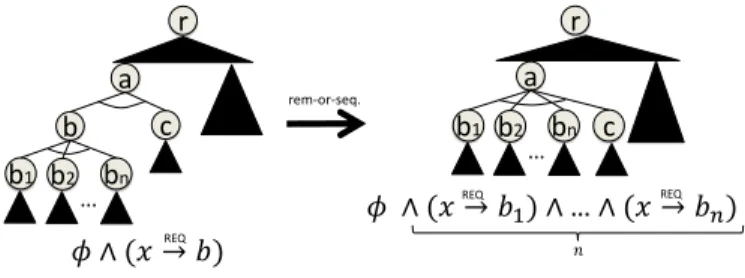
remove-xor-seq. Fig. 10 illustrates the basic process of the
remove-xor-seq counterpart in [9] (using notations of the current paper). We can observe that it collapsesxor-sequences,
𝜙 ∧ (𝑥 → 𝑏1) ∧…∧ (𝑥 → 𝑏𝑛) b c a b1 bn r 𝜙 ∧ (𝑥 → 𝑏) c a r REQ REQ rem-or-seq. b2 … b1 b2 bn … REQ 𝑛 Fig. 10. remove-xor-seq(s) in [9].
but this comes at the cost of making the size of constraints larger by the order of the size of input test trees. More specifically, this results in an output test tree with constraints φ0 whose size is O(|N| · |φ|).2 Trees output by
remove-xor-seq is passed to the downward sub-algorithmlift(N,↓,@, φ0), whose complexity isO(|N| · |φ0|). Hence, we haveO(|N| · |φ0|)=
O(|N| ·(|N| · |φ|))=O(|N|2· |φ|). On the other hand, the current version ofremove-xor-seqof the flattening algorithm forTprop
keeps the length of constraints within O(|φ|) as well as the number of nodes withinO(|N|) for input trees=(N,r,↓,@, φ).
VI. ExperimentalResults
We have implemented the flattening algorithm (in C++) in our tool calot, which is then combined with pict (ver. 3.3) and acts(ver. 2.9). Experiments compare calot with Classi-fication Tree Editor (cte-xl, ver. 3.5) [12], [17], [14], a test generator for ctm and the only competitor that can process
tree-structured test models as far as we know (see Section VII).
As a benchmark set, we described test models incalotand
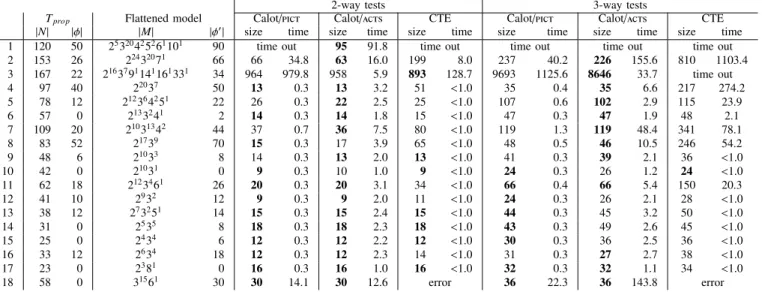
in ctm for 18 API functions of an actual ticket gate system. Experiments were performed on a machine with Intel Core i7-4650U CPU 1.70G Hz with 8 GB Memory and Windows 7. Table II shows the results of our experiments for 2-way and 3-way testing. Columns 2 and 3 show the sizes of the input models inTprop, in terms of the number of nodes and the size
of constraints (|N|and|φ|). Columns 4 and 5 show the sizes of the flattened models, measured by the size of the model and the constraints (|M| and |φ0|). For example, test model 1 written in Tprop contains 120 nodes and the size of the constraints
is 50. It is flattened to a model |M| = 25320425261101 with constraints of size|φ0|=90; herexyrepresents that the model
hasyparameters withxvalues. The right part comparescalot withpict,calotwithacts, and cte-xl, in terms of number of generated test cases and execution times (in seconds). For the numbers of test cases, the smallest ones are highlighted for each test model.
Execution time forcalotincludes the time for flattening and
that for test generation by eitherpictoracts, although the time
for flattening was less then 0.03 seconds for all models. For
2Here, note that we cannot have the following derivation, since the derived
logical formula is not a legitimate constraint ofTmr: φ∧((xreq−→b1)∧(x req −→b2)∧ · · · ∧(x req −→bn)) ⇐⇒φ∧(xreq−→(b1∧b2∧ · · · ∧bn))
cte-xl, since it only has a GUI, we measured the execution
time with a stopwatch. Timeout is set to 3,600 seconds. The results show that calot outperforms cte-xl w. r. t. the
number of generated test cases, with one interesting exception of No. 3 for 2-way testing. In some test models, the difference is considerable; e. g. in test model 4 for 3-way testing, the number of test casescalotgenerates is six times smaller than
what cte-xl yields. Regarding execution time, although the
results forcte-xlare inaccurate,calot excels overcte-xlby an order of magnitude in quite few examples. Again there is one exception (No. 2 for 2-way testing), but in this casecte-xl generates three times as many test cases as calotdoes.
In addition, it is worth noting thatcte-xldoes not support
t-way testing with t≥4, while calot supports anyt that the back-end engine admits. Moreover, little implementation effort enables further extensions incalotfor other coverage criteria,
e. g., see [8].
VII. RelatedWork
Test generation for t-way testing is an active research subject in CT. Consequently, various algorithms and tools with different strengths have been proposed so far, e. g.,
aetg[7],acts[18], [23],casa[10],pict[8],cascade[24],cit -bach[19], andcalot [21]. For example, the algorithm in [22]
can efficiently handle test models with complex constraints. The algorithm in [21] specializes in minimizing thet-way test suite within an allowed time. Our transformation approach can enjoy such various strengths of different algorithms. Note also that all of these algorithms and tools, except forcte-xl, cannot
directly handle tree-structured test models.
cte-xl[14] is the only technique, except forcalot, that can
process tree-structured test models fort-way testing. Their test models and ourTpropare essentially equivalent;cte-xluses
so-calledclassification trees, whilecalotusesand-xortrees. The major difference appears in the algorithms for test generation. Although the algorithm in cte-xl has not been revealed in detail, from a partial explanation in [14], we can observe that it directly constructs test cases from a tree-based test model. Thus, unlike calot, cte-xl cannot benefit from the various
algorithms and tools for standard t-way test case generation. Superiority of the calot approach is demonstrated through
experiments in Section VI.
We have previously developed a restricted transformation algorithm for tree-structured test models with constraints [9]. The contribution of this paper over that work [9] is threefold. (1) We develop a transformation algorithm for tree-structured test models with constraints written in full propositional logic (called Tprop), motivated by the fact that the permitted
con-straints in previous work [9] (calledTmr) are limited to a
syn-tactic subset of propositional logic. The proof ofTmr<Tpropin
Theorem 2 indicates that previous algorithms cannot be used for our goal. (2) We refine our complexity analysis. In [9], we stated that the complexity of the previous algorithm isO(|N|4). This paper shows that of the new algorithm to beO(|N|·|φ|). (3) Our case study is another important contribution. By relaxing
TABLE II
Test case generation using calot and cte-xl for the train ticket gate system.
2-way tests 3-way tests
Tprop Flattened model Calot/pict Calot/acts CTE Calot/pict Calot/acts CTE
|N| |φ| |M| |φ0| size time size time size time size time size time size time
1 120 50 25320425261101 90 time out 95 91.8 time out time out time out time out
2 153 26 22432071 66 66 34.8 63 16.0 199 8.0 237 40.2 226 155.6 810 1103.4 3 167 22 2163791141161331 34 964 979.8 958 5.9 893 128.7 9693 1125.6 8646 33.7 time out 4 97 40 22037 50 13 0.3 13 3.2 51 <1.0 35 0.4 35 6.6 217 274.2 5 78 12 212364251 22 26 0.3 22 2.5 25 <1.0 107 0.6 102 2.9 115 23.9 6 57 0 2133241 2 14 0.3 14 1.8 15 <1.0 47 0.3 47 1.9 48 2.1 7 109 20 21031342 44 37 0.7 36 7.5 80 <1.0 119 1.3 119 48.4 341 78.1 8 83 52 21739 70 15 0.3 17 3.9 65 <1.0 48 0.5 46 10.5 246 54.2 9 48 6 21033 8 14 0.3 13 2.0 13 <1.0 41 0.3 39 2.1 36 <1.0 10 42 0 21031 0 9 0.3 10 1.0 9 <1.0 24 0.3 26 1.2 24 <1.0 11 62 18 2123461 26 20 0.3 20 3.1 34 <1.0 66 0.4 66 5.4 150 20.3 12 41 10 2932 12 9 0.3 9 2.0 11 <1.0 24 0.3 26 2.1 28 <1.0 13 38 12 273251 14 15 0.3 15 2.4 15 <1.0 44 0.3 45 3.2 50 <1.0 14 31 0 2535 8 18 0.3 18 2.3 18 <1.0 43 0.3 49 2.6 45 <1.0 15 25 0 2434 6 12 0.3 12 2.2 12 <1.0 30 0.3 36 2.5 36 <1.0 16 33 12 2634 18 12 0.3 12 2.3 14 <1.0 31 0.3 27 2.7 38 <1.0 17 23 0 2381 0 16 0.3 16 1.0 16 <1.0 32 0.3 32 1.1 34 <1.0 18 58 0 31561 30 30 14.1 30 12.6 error 36 22.3 36 143.8 error
limitations on constraints, we are now able to compare the transformation approach withcte-xl.
Our work is inspired by Oster et al. [20], who applied CT to Software Product Lines (SPLs). An SPL is expressed as a feature model, an and-or tree with constraints. Their
flattening algorithm transforms a feature model to a flat one, (a feature model whose height is two) and a set of products is obtained as at-way test suite for the SPL. The class of feature models in [20] restricts the constraints to the same syntactic subset as Tmr. Also, we can observe that a similar technique
to our flattening algorithm is used in [3] for the setting of SPL testing. Compared to these work, our contribution reveals several important facts of the proposed technique such as expressiveness, correctness, and complexity analysis. We expect that our contributions can be also used to advance their approach for SPL.
VIII. Conclusions andFutureWork
This paper presented a transformation approach to gener-ating t-way tests for tree-structured test models with propo-sitional logic constraints. Practicality of our technique was evaluated by experiments in an industrial setting; they demon-strated superiority of our technique over the state-of-the-art tool cte-xl. Also, the paper contains several theoretical contributions. We provedTmr<Tprop; to our knowledge, there
is no published proof for this non-trivial result. We also proved the correctness and complexity of the algorithm.
Prioritizedt-way testing extendst-way testing with the pri-ority notion to express importance of different test aspects [2], [6], [15]. For tree-structured test models, cte-xl has already
introduced priorities [14]. For future work, we plan to connect the notion of priority for standard t-way testing and that for tree-structured testing via our transformation approach. We will also investigate the relation between tree-structured test modeling and combinatorial testing with shielding pa-rameters [4]. Shielded parameters may not appear in some
test cases, depending on whether some other parameters have specified values. This feature may open up new ways to model hierarchical dependencies in tree-structured test models, but it has so far not been extensively analyzed.
Acknowledgment
We are grateful to the anonymous reviewers of the paper for their constructive and careful comments. The first author would like to thank Hitoshi Ohsaki for his support and insightful comments at an early stage of this work. This work is in part supported by JST A-STEP grant AS2524001H.
References
[1] M. N. Borazjany, L. Yu, Y. Lei, R. Kacker, and R. Kuhn. Combinatorial testing of ACTS: A case study. In Proc. of ICST’12, pages 591–600. IEEE, 2012.
[2] R. C. Bryce and C. J. Colbourn. Prioritized interaction testing for pair-wise coverage with seeding and constraints. Inform. Software Tech., 48(10):960–970, 2006.
[3] A. Calvagna, A. Gargantini, and P. Vavassori. Combinatorial testing for feature models using citlab. InProc. of ICST 2013 Workshops, pages 338–347, 2013.
[4] B. Chen, J. Yan, and J. Zhang. Combinatorial testing with shielding parameters. InProc. of APSEC’10, pages 280–289, 2010.
[5] T. Y. Chen, P.-L. Poon, and T. H. Tse. An integrated classification-tree methodology for test case generation. Int. J. Softw. Eng. Know., 10(6):647–679, 2000.
[6] E. Choi, T. Kitamura, C. Artho, and Y. Oiwa. Design of prioritized N-wise testing. In Proc. of ICTSS’14, LNCS 8763, pages 186–191. Springer, 2014.
[7] D. M. Cohen, S. R. Dalal, M. L. Fredman, and G. C. Patton. The AETG system: An approach to testing based on combinatiorial design. IEEE Trans. Software Eng., 23(7):437–444, 1997.
[8] J. Czerwonka. Pairwise testing in real world: Practical extensions to test case scenarios. InProc. of PNSQC’06, 2006.
[9] N. T. B. Do, T. Kitamura, N. V. Tang, G. Hatayama, S. Sakuragi, and H. Ohsaki. Constructing test cases for N-wise testing from tree-based test models. InProc. of SoICT’13, pages 275–284. ACM, 2013. [10] B. J. Garvin, M. B. Cohen, and M. B. Dwyer. Evaluating improvements
to a meta-heuristic search for constrained interaction testing. Empirical Softw. Eng., 16(1):61–102, 2011.
[11] M. Grindal and J. Offutt. Input parameter modeling for combination strategies. Inin Proc. of IASTED’07 on Software Engineering, pages 255–260. ACTA Press, 2007.
[12] M. Grochtmann. Test case design using classification trees. InProc. of STAR 1994, 1994.
[13] P. Heymans, P. Schobbens, J. Trigaux, Y. Bontemps, R. Matulevicius, and A. Classen. Evaluating formal properties of feature diagram languages.Proc. of IET Software, 2(3):281–302, 2008.
[14] P. M. Kruse and M. Luniak. Automated test case generation using Classification Trees.Software Quality Professional, pages 4–12, 2010. [15] D. R. Kuhn, R. N. Kacker, and Y. Lei. Introduction to Combinatorial
Testing. CRC press, 2013.
[16] D. R. Kuhn, D. R. Wallace, and A. M. Gallo. Software fault interactions and implications for software testing. IEEE Trans. Software Eng., 30(6):418–421, 2004.
[17] E. Lehmann and J. Wegener. Test case design by means of the CTE XL. InProc. of EuroSTAR, 2000.
[18] Y. Lei and K.-C. Tai. In-parameter-order: A test generation strategy for pairwise testing. InProc. of HASE’98, pages 254–261. IEEE, 1998. [19] T. Nanba, T. Tsuchiya, and T. Kikuno. Using satisfiability solving for
pairwise testing in the presence of constraints. IEICE Transactions, 95-A(9):1501–1505, 2012.
[20] S. Oster, F. Markert, and P. Ritter. Automated incremental pairwise testing of software product lines. InProc. of SPLC’10, LNCS 6287, pages 196–210. Springer, 2010.
[21] A. Yamada, T. Kitamura, C. Artho, E. Choi, Y. Oiwa, and A. Biere. Optimization of combinatorial testing by incremental SAT solving. In
Proc. of ICST’15, pages 1–10. IEEE, 2015.
[22] L. Yu, Y. Lei, M. N. Borazjany, R. Kacker, and D. R. Kuhn. An efficient algorithm for constraint handling in combinatorial test generation. In
Proc. of ICST’13, pages 242–251. IEEE, 2013.
[23] L. Yu, Y. Lei, R. Kacker, and D. R. Kuhn. ACTS: A combinatorial test generation tool. InProc. of ICST’13, pages 370–375. IEEE, 2013. [24] Y. Zhao, Z. Zhang, J. Yan, and J. Zhang. Cascade: A test generation
tool for combinatorial testing. InProc. of ICST 2013 Workshops, pages 267–270, 2013.
Appendix A. Omitted proofs
Proof of Lemma 1. The proof is straightforward from the
con-dition (3) in Definition 2.
Proof of Lemma 2. Let t01 be the tree obtained by adding a mex
←→-constraint r ←mex→ n for each n ∈ N0 where r is the root node. Let t001 be the tree obtained by removing all mex←→- and req
−→-constraints that involve any nodes inN0except for themex ←→ -constraints added int0
1. We prove the following:
1) C(t1)=C(t01). Sincen∈N0is a node which never appears in any configuration of t1 and the root node is always in a configuration of t1, adding such constraints makes no difference betweenC(t1) andC(t01).
2) C(t01)=C(t001). We consider the following three forms of the constraint:
a) a req−→ b with a ∈ N0 and b is any node in t01: Since
a∈N0, this constraint does not affectb. Further, since
a mex←→ r, a still does not appear in any configuration after removingareq−→b.
b) a req−→ b with a is any node in t01 and b ∈ N0: Since
b∈N0,a∈N0. Hence, the case follows case a). c) a mex←→ b with a ∈ N0 or b ∈ N0 and both are not r:
Analogous to a).
3) C(t001) = C(t2). By removing all the nodes in N0 and all the mex←→-constraints between the root node and nodes in N0 from t00
1, we obtain t2. The removal makes no
difference between C(t100) and C(t2), since nodes in N0
are not referred to by any other constraints in t001. Proof of Lemma 3. We show that these procedures do not change the test suite. For 1) and 2), the claim follows Lemma 1. For 3), it is because (i) the subtree contains no
xor-nodes and hence any nodes in N0\ {n} do not appear in
the test suite according to Definition 3, and (ii) no constraint involves any node in N0\ {n}after applying 1) and 2).
Lemma 6. Let s = (N,r,↓,@, φ) ∈ Tprop and t = remove-and-seq(N,r,↓,@, φ;r). Then, ~s = ~t and thus ~s'~t.
Proof. Algorithm 1 applies to every and-sequence in s the
following two steps: 1) substituting the second and-node of
the and-sequence in φ by its parent (line 4), and 2) deleting
the secondand-node from the tree (line 5). We show that each
of these steps preserves the test suite of an input tree. 1) This step yieldss0=(N,r,↓,@, φ0) whereφ0=φ|b→a. To
prove~s⊆~s0, supposetcC ∈ ~s. Due to Lemma 1, we have C |= φ|b→a and thus C ∈ C(s0). Hence by definition, tcC ∈~s0. Analogously we have ~s⊇~s0, concluding~s=~s0
.
2) This step yields s00 =(N\ {b},r,↓0,@, φ0) where ↓0(x)=
(
↓(a)\ {b} ∪ ↓(b) if x=a
↓(x) otherwise
It is easy to show thatC∈ C(s0) if and only ifC\ {b} ∈ C(s00), since b does not occur in condition φ0, which is used by both s0 and s00. Below we show that tc
C =tcC0
whereC0=C\ {b}.
• Suppose tcC(p)= v. Then, p ,b since b is not an xor-node, andv,b sinceb is not child of anxor
-node. Hence,p,v∈C0and alsov∈ ↓0p. Accordingly, tcC0(p)=v.
• SupposetcC0(p)=v. Then, v∈ ↓0p and p,a since a is not an xor-node. Thus, v∈ ↓p. Also, p,v∈C,
sincev∈C0. HencetcC(p)=v.
This concludes~s0=~s00.
Lemma 7. Let s = (N,r,↓,@, φ) ∈ Tprop and t = remove-xor-seq(N,r,↓,@, φ;r). Then~s'~t.
Proof. Algorithm 2 is an iteration of the procedure shown in Fig. 8. Each time it is applied to an xor-sequence of a ∈
N and b ∈ ↓a in a tree s yielding s0, we can prove ~s ' ~s0 by regarding the identity par and the following valp in
Definition 5:
valp(v)= (
b if p=a andv=b0
v otherwise
Proof of Theorem 4 . From Lemmas 6, 7, and 4, each of the three steps in the algorithm flatten preserves test cases up to