Development of a Framework for More Effective
Implementation of Total Quality Management
Principles in Apparel Manufacturing
S.M. Rashadur Rahaman Setu
Jr. Executive, R&D (MASCO GROUP)
Md. Helal Hossain
Management Trainee Officer, Planning Dept. INTERSTOFF APPARELS LTD
Md. Tanjim Hossain
Executive, R&D Dept. (MASCO GROUP)
Jahid Sarkar
Lecturer, National Institute of Textile Engineering & Research doi: 10.19044/esj.2016.v12n28p472 URL:http://dx.doi.org/10.19044/esj.2016.v12n28p472
Abstract
The purpose of this paper is to develop a model or framework of total quality management (TQM) implementation in Textile and RMG industry. Textile and RMG Industry is an important sector for Bangladesh in terms of industrial expansion of the country, earning foreign currency and creating job opportunities. However, it faces subtle problems due to labor unrest, political instability and owner’s ignorance. TQM is an approach that focuses on customer satisfaction. Therefore, implementation of TQM is a challenging task. Through a self-administrative survey from 50 Industries of textile and RMG industry in Bangladesh data have been collected. This paper identifies ten key factors of TQM implementation in the Textile and RMG Industry in Bangladesh. These are Leadership, Communication, Strategic Quality Planning, Training, Customer Satisfaction, Continuous Improvement, Employee Involvement & Satisfaction, Culture, Supplier Satisfaction and Teamwork.
Keywords: TQM, Dimension of TQM, TQM framework Introduction
Bangladesh historically lags behind in industrialization (Sharker, MZH; Sobhan, Md A; and Sultana, S 2006). After liberation, the Government of Bangladesh has been endeavoring to improve its industrial growth (Karim,S 2009). From an economically conservative culture
Bangladesh is gradually processing towards the new era of open market policies and globalization. The RMG industry of Bangladesh started in the late 1970s and became a prominent player in the economy within a short period of time (Haider, 2007). In Bangladesh, in particular, these industries play a very significant role in the economic development in terms of employment generation especially for blue collar workers. It is also the biggest source of foreign exchange earnings. It employs a large number of people, mostly consisting of women workforce. In the 1980s the RMG industry of Bangladesh was concentrated mainly in manufacturing and exporting woven products. Since the early 1990s, the Knit section of the industry has started to expand [3]. The garment product base ranges from ordinary shirts, T-shirts, trousers, shorts, pajamas, ladies wears, under garments for men , women, children and sportswear to sophisticated high value items like quality suits, branded jeans items, cotton and leather jackets, sweaters, and caps etc.
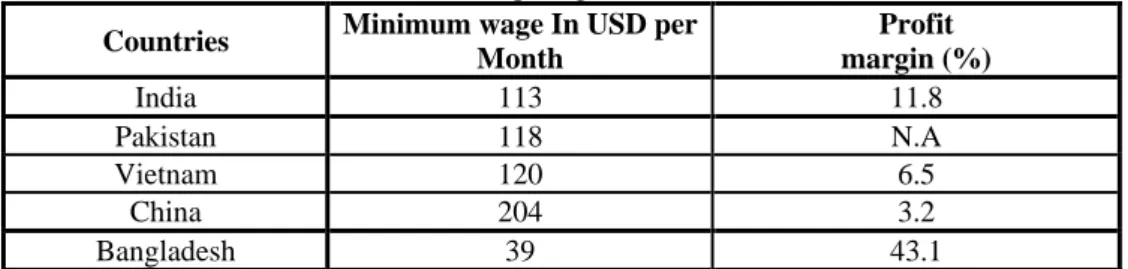
Before phasing out, the Multi -Fiber Arrangement (MFA) in the North American market and preferential market access to European markets were dominant factors for the success of the Bangladeshi garment industry. Low labor cost was/is another factor of success. As explained by Warner International (1998), when the hourly apparel labor cost of Bangladesh is only $0.30, it is $ 10.12 in USA. Bangladesh is in a strong position in the global market. This is evident from the fact that the growth rate of garment exports in Bangladesh is significantly higher (81.3%) than that of several strong competitors such as Indonesia (31.2%), Mauritius (23.8%) and Dominican Republic (21.1%) ( Rashid, MA 2006).
Table 1: Comparative picture of Minimum Wages and Profit margin in the Garments Sector of different competing Countries(EPB).
Countries Minimum wage In USD per
Month Profit margin (%) India 113 11.8 Pakistan 118 N.A Vietnam 120 6.5 China 204 3.2 Bangladesh 39 43.1
Companies actually compete on three major issues; Quality, Price and Delivery. If the choice is to compete in the market place on the basis of product or service price, then the level of competition is clearly defined; the low-cost provider wins. However, companies choosing the low cost approach may find themselves losing premium business to competitors while retaining the low-margin business in the long term (Karim,S 2009) [2]. In order for companies to survive and grow in the future, it is essential that they deliver high quality goods and services. The concept of quality management
and sophisticated production process is recent in Bangladesh and the country is in a partial awareness state (Mamun, MZ and Islam, N 2002). Many companies understand that TQM is necessary for them to remain competitive, retaining their market share and to be able to respond to changing competitive demand in today business world. Based on some studies, not all companies are able to implement TQM successfully (Ross, Ghobahdian, Ahire et al. Gulbro et al.,Yusof, 2000).
The value of this research is one of the primary steps towards reaching the needs of textile garment sector that are trying to implement TQM in their business. With a better understanding of this issues, it can be a groundwork for the development of an appropriate TQM framework for practical implementation by the garment sector.
Research Objectives:
Main objectives of this study are as follows-
To develop a model which can be used more effectively to implement Total Quality Management.
To identify the barriers for implementing TQM
To improve productivity and product quality
To improve the quality of garments industry of Bangladesh by implementing TQM approaches
Methodology
For conducting empirical research, there are two methods of data collection: Qualitative and quantitative. These two methods have their strengths and weaknesses. In order to avoid their respective disadvantages, one important way to strengthen a research design is to use both qualitative and quantitative methods. In this study we adopted following research strategies.
Literature review:
Literature review has been conducted to identify the pillars required to implement TQM in practice. Articles that are related with TQM are reviewed to find out TQM framework.
Questionnaire Survey:
A thorough study has been done to analyze the present condition of product quality. A questionnaire is developed to obtain maximum information and perceptions with regard to management’s practices on TQM, the implementation of numerous quality initiatives, how the process of implementation was conducted, the benefits of TQM and problems company faced as well as the factors that contribute to the success of TQM. Data has
been collected through observation method, e-mail, interviews from 50 factories and analyzed. Besides interviews, Short visits at the plant are made. After analyzing this we made a Framework.
Case Study:
In an attempt to understand the reality of TQM approaches in Textile Garments industries, a case study is conducted in Fakir Apparels Ltd. Although the case study approach has a number of drawbacks, it also has a number of unique advantages. Reason for the drawbacks is the lack of statistical evidence from research findings. The case study can provide practical assistance to Fakir Apparels in implementing this TQM model in practice, and can also provide a better understanding of the model.
What is TQM:
Earlier definitions of a customer included one who was impacted by the product. TQM philosophy extends the Concept of impact to every individual or department within the organization. The external customer is only the final part in the customer chain. This makes everyone a customer of, and a supplier to, someone else in the chain. This new definition of customer asks for altogether different outlook to the question about responsibility of quality. Since quality inputs and outputs are demanded and expected at aery point on the chain, no one is spared from performing the quality function. In fact quality becomes a routine duty of every individual. This is the new culture of TQM.
TQM is the integration of all functions and processes within an organization in order to achieve continuous improvement of the quality of goods and services. The goal is customer satisfaction.
Total Quality Management (TQ, QM or TQM) is sweeping “culture change” efforts to position a company for greater customer satisfaction, profitability and competitiveness.
Concept from Quality Gurus
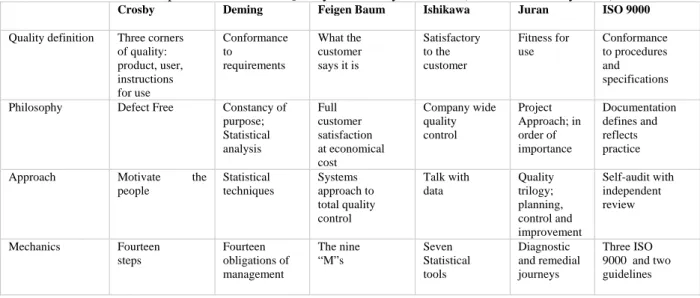
An extensive review of literature was carried out to identify the concept of TQM from quality gurus such as Deming (1986), Juran (Juran and Gryna, 1993), Crosby (1979), Feigenbaum (1991), and Ishikawa (1985). Their propositions are the foundation for understanding the concept of TQM. The following subsections present the main principles and practices of TQM proposed by these quality gurus.
Figure shows a summary of their theories and definitions made by these experts as compared to the current ISO 9000 key elements.
Table 2: Comparison of ISO and Quality Gurus Key Elements (Richardson, Terry 1997)
Crosby Deming Feigen Baum Ishikawa Juran ISO 9000 Quality definition Three corners
of quality: product, user, instructions for use Conformance to requirements What the customer says it is Satisfactory to the customer Fitness for use Conformance to procedures and specifications
Philosophy Defect Free Constancy of purpose; Statistical analysis Full customer satisfaction at economical cost Company wide quality control Project Approach; in order of importance Documentation defines and reflects practice
Approach Motivate the
people Statistical techniques Systems approach to total quality control Talk with data Quality trilogy; planning, control and improvement Self-audit with independent review Mechanics Fourteen steps Fourteen obligations of management The nine “M”s Seven Statistical tools Diagnostic and remedial journeys Three ISO 9000 and two guidelines
REASONS FOR POPULARITY OF TQM:
Total quality management has become the synonym of the success for most of the organizations in the world and this is gaining popularity day by day. The reasons can be attributed to the beneficial consequences of TQM.
Guaranteed Customer Satisfaction and Increased Market Share: In TQM culture, the customer is the most important part of process line and if process quality is attained, customer satisfaction is guaranteed. Quality product and services ensure not only the customer's future return but also fewer complaints and lower warranty costs. Higher profits improve reputation and hence increased market share.
Cost Reduction: Decrease in cost under warranty is not the only target of cost reduction to be achieved. The higher the quality, the lower the number of inferior products. The reasons for reduction in cost due to high quality are:
less consumption of energy and saving of working hours,
less replacement of materials, and
less stoppage of machines for inspection of final output.
The effect of cost reduction leads to prompt deliveries and higher productivity levels, and simultaneously lower cost for repair and reworking.
Conducive environment: TQM provides an environment where fear is eliminated. When fear is absent, it leads to the consequences where:
employees take pride in their work because they can admit to their mistakes and provide opinion,
employees feel respected and accepted because they feel as part of the team, and
employees strive not only for their own interest but also for interest of organization.
AXIOMS OF TQM:
The essential elements of TQM as a process-oriented approach can be represented by only three main principles.
Commitment (to never ending quality improvement & innovation).
Scientific knowledge (of the proper tools and techniques for the 'technical change').
Involvement (all in one team for the social change).
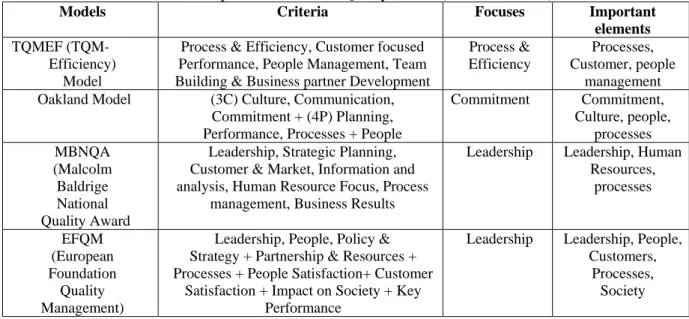
Comparison of Different Quality Models
Table 3: Comparison of Different Quality Models (Al-Musleh, 2010)
Models Criteria Focuses Important
elements
TQMEF (TQM- Efficiency)
Model
Process & Efficiency, Customer focused Performance, People Management, Team Building & Business partner Development
Process & Efficiency
Processes, Customer, people
management Oakland Model (3C) Culture, Communication,
Commitment + (4P) Planning, Performance, Processes + People
Commitment Commitment, Culture, people, processes MBNQA (Malcolm Baldrige National Quality Award
Leadership, Strategic Planning, Customer & Market, Information and analysis, Human Resource Focus, Process
management, Business Results
Leadership Leadership, Human Resources, processes EFQM (European Foundation Quality Management)
Leadership, People, Policy & Strategy + Partnership & Resources + Processes + People Satisfaction+ Customer
Satisfaction + Impact on Society + Key Performance
Leadership Leadership, People, Customers,
Processes, Society
Reliability
Reliability refers to whether you get the same answer by using an instrument to measure something more than once (Bernard, H.R. 2000). Reliability concerns the extent to which an experiment, test, or any measuring procedure yields the same results in repeated trials (Carmines, E. G. and Zeller, R. A. 1979); it is a statistical measure of how reproducible the survey instrument’s data are (Litwin, M. S.1995). Coefficient alpha measures internal consistency reliability among a group of items combined to form a single scale. It is a statistic that reflects the homogeneity of the scale. Generally, reliability coefficients of 0.70 or more are considered good (Nunnally, J.1967).
Table 4: Internal Consistency Analysis
Scales No. of Items Cronbach’s Alpha
1. Leadership 6 0.297
2. Communication 5 0.601
3. Strategic Quality Planning 5 0.291
4. Training 5 0.254
5. Customer Satisfaction 5 0.680
6. Continuous Improvement 5 0.633
7. Employee Involvement and Satisfaction 5 0.666
8. Culture 5 0.541
9. Supplier Satisfaction 5 0.006
10. Teamwork 5 0.455
Factor Analysis
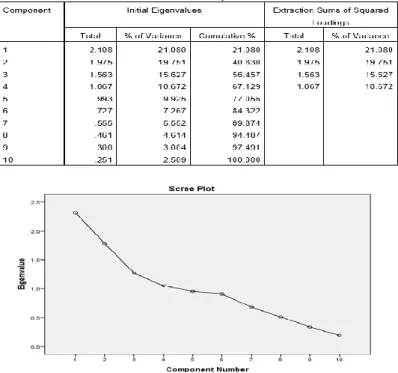
Factor analysis addresses the issue of analyzing the interrelationships among a large number of items and then explaining these items in terms of their common underlying dimensions (factors). In fact, the general purpose of factor analysis is to find a way of condensing or summarizing the information into a smaller set of new composite dimensions (factors) with a minimum loss of information. Four scales contain about more than 60% variance which is good for this study and Scree Plot (Below) shows that all the values of the scales are reliable and First Four scales have greater than 1 eigenvalue.
Table 5: Factor Extraction (Evaluation)
A Framework of TQM
The framework of TQM consists of the 10 elements of TQM where four elements are main targets in this study. Of the 10 TQM elements Leadership, Strategic Quality Planning, Training and Continuous Improvement are the most important.
Figure: A Framework of TQM
To implement the proposed framework at first we have to implement these four phases which will be ensured total implementation process.
Leadership Planning Training Continuous
Improvement Top management commitment Management participation Top management learning Empowerment Top management encouragement Role model Pursuit of long-term business success Vision statement Quality policy Overall business performance plan Product quality goal Quality improvement
plan Formulation of vision
and plan
Education and training plan Team work learning
Quality awareness education Training for quality
management knowledge Job training Formal education
promotion
Supplier quality audit Supplier communication Inventory management
Inspection Use of quality tools Customer satisfaction
survey Quality Warranty Improving employee
commitment
Results and findings
The results of the case study conducted in Fakir Apparels Ltd.
Area Before Implementation After Implementation
Defect % 9 10
Rework % 6 <5
Reject % 3 <3
Quality % 65 85
Efficiency % 60 65
Team Approach Weak Strong
Reward System No Yes
TQM Knowledge of workers
Findings:
1. A LPTC framework for TQM implementation 2. Higher productivity
3. Higher profits
4. Good environment by maintaining communication & teamwork 5. Overall lower implementation cost
Conclusion:
A number of conclusions have been obtained from this research. Thus, a quality management theory related to Apparel Industry of Bangladesh has been developed.
First, the instruments for measuring TQM implementation are reliable and valid, and can be used by other researchers to test the effects of TQM. The reliable and valid instruments can also be used in testing the time dimension of TQM implementation.
Second, several conclusions have been obtained from testing the two theoretical models, which are listed as follows:
1. TQM implementation has positive effects on employee satisfaction, customer satisfaction, and strategic business performance;
2. Leadership including top management commitment is first and crucial factor for implementing TQM.
3. Vision statement, Quality policy and planning by communicating with all other department play vital role for implementing TQM. Employee participation, recognition and reward have positive effects on employee satisfaction;
4. Continuous improvement which is the main goal of TQM can be achieved through Training and Teamwork.
5. If we can ensure continuous improvement, then a culture will develop that will help to build relationship among management, employee, supplier and customer. Thus we can ensure employee, customer and supplier satisfaction.
Third, the case study reveals that the TQM implementation model developed in this study is applicable in practice. This model can be used in Apparel Industries of Bangladesh to improve their TQM implementation efforts.
Scope of further research:
Further research could be directed to overcome limitations of current study. Since it is difficult for a pilot survey to reveal all information especially the real performance data from enterprises- studies based on case-study method would be more appropriate to develop precise empirical models.
References:
1. Sharker, MZH; Sobhan, Md A; and Sultana, S 2006, Management Accounting Development and Practices in Bangladesh, BRAC University Journal, Vol.III, No.2, pp.113-124.
2. Karim,S 2009, The Impact of Just-in-Time Production Practices on Organizational Performance in the Garments and Textiles Industries in Bangladesh, Doctoral Thesis, Dhaka University.
3. (Haider, 2007)
4. Rashid, MA 2006, Rise of Readymade Garments Industry in Bangladesh: Entrepreneurial Ingenuity or Public Policy, Paper Presented at the Workshop on Governance and Development, organized by the World Bank and BIDS at Dhaka on 11-12 November.
5. Export Promotion Bureau, Bangladesh (EPB).
6. Mamun, MZ and Islam, N 2002, Total Quality Management (TQM) Practices of the Bangladeshi and Thai Companies: A Comparative Analysis, Pakistan’s Seventh International Convention of Quality Improvement, October 26-27, at Marriot Hotel, Karachi.
7. (Ross, 1994, Ghobahdian, 1995, Ahire et al., 1996, Gulbro et al., 2000) (Yusof, 2000).
8. Richardson, Terry (1997), Total Quality Management, Delmar Publishers, New York.
9. Ahmed Mohammed Al-Musleh (Total Quality Management
Development of A Framework Principles in the Construction Companies with Special Reference to the Construction Companies in the State of Qatar) December 2010
10.Bernard, H.R. (2000), Social Research Methods: Qualitative and Quantitative Approaches, Sage Publications, Thousand Oaks
11.Carmines, E. G. and Zeller, R. A. (1979), Reliability and Validity Assessment, Sage Publications, Beverly Hills.
12.Litwin, M. S. (1995), How to Measure Survey Reliability and Validity, Sage Publications, Thousand Oaks
13.Nunnally, J. (1967), Psychometric Theory, McGraw-Hill, Inc., New York.