June
2
016
Contents
Acting Auditor-General’s comments
1
1
Our products and services
3
1.1 Introduction 4
1.2 Role of the Auditor-General 4
1.3 Guiding legislation 4
1.4 Our funding, outputs and targets 5
1.5 Communication of findings 5
1.6 Accountability and reporting publications 5
2
Factors shaping our audit program
9
2.1 A relevant, responsive and risk-based program 10
2.2 Where do we get our ideas? 10
2.3 Deciding on the program 12
3
Performance Audit work program
13
3.1 Overview of our performance audit program 14
3.2 Delivering our audits 14
3.3 Planned performance audit outputs for 2016–17 16
4
Financial Audit work program
35
4.1 Overview of our financial audit program 36
4.2 Delivering our audits 36
4.3 Planned financial audit outputs for 2016–17 37
5
Information Systems Audit
43
5.1 Overview of our ISA program 44
5.2 Delivering our audits 44
5.3 Planned ISA outputs for 2016–17 44
6
Our themes
49
6.1 Overview of our themes 50
the Victorian Auditor-General’s
Annual Plan 2016–17
was prepared pursuant to the requirements of section 7A of the Audit Act 1994, and tabled in the Victorian Parliament on 8 June 2016. ISBN 978 1 925226 64 5 Photography Cover
the Parliament of Victoria Korkusung / shutterstock.com
Page 3
swanston street, Melbourne chameleonseye / shutterstock.com
Page 9
looking across the Yarra to the Arts centre and eureka tower niklevedev / shutterstock.com
Page 13
A car-carrying ship docked in Melbourne Bikeriderlondon / shutterstock.com Page 35 financial Audit sebra / shutterstock.com Page 43
information systems Audit Gonin / shutterstock.com
Page 49
Ballarat town Hall
Acting Auditor-General’s comments
This annual plan is a primary accountability mechanism for my office. The reports my office plans to produce in 2016–17, as well as the topics we intend to cover the following year, are shown in Figure 1 on page 2.As in previous years, extensive consultation has been undertaken with a wide range of stakeholders to develop this program. This year, consultation was expanded to include Parliamentary Committees in addition to departments, portfolio agencies, and integrity and oversight bodies, further ensuring that our primary stakeholders in Parliament and their nominated committees are provided with adequate opportunities to offer input into the development of our audit program. This year, we will report on audits of public participation in government decision-making, regulating gambling and liquor, effectiveness of the Victorian Public Sector Commission, and information and communications technology strategic planning in the health sector, among many other important topics.
As outlined on page 14, a restructure of our Performance Audit division has been undertaken this year, to better target audit effort and maximise our impact across the public sector. In addition, we have also further developed and strengthened the methodology and criteria we use to guide our topic assessment and selection. These measures are designed to direct our efforts towards doing the right audits at the right time, and using our resources to make a difference in the community. I welcome Parliament’s recent passage of the Integrity and Accountability Legislation Amendment (A Stronger System) Act 2016 amending the Audit Act 1994 (the Act). This new legislation provides my office with the capacity to consider and report on the performance of bodies delivering
government services under contract. While it goes a long way towards delivering on the Victorian Government’s pre-election commitment to provide us with robust and unfettered
follow-the-dollar powers, further reforms are needed to bring the Act up to date with the contemporary public sector, preserve the independence of Parliament’s auditor, and improve transparency and accountability to the Victorian community. Figure 1 on page 2 identifies five audits that may utilise the new follow-the-dollar powers.
The Annual Plan 2016–17 has been prepared and tabled in the transition between the resignation of Victoria’s 26th Auditor-General and the commencement of Victoria’s 27thAuditor-General. Consequently, drawing on the incoming Auditor-General’s fresh perspective, the issues and areas of audit focus we have currently proposed in this Annual Plan may well be subject to review and revision. We will continue to communicate with audited agencies across the year and advise our agency contacts on any potential changes to their programs.
Finally, I thank the members of the community, Parliamentarians and public sector staff who have engaged with us as part of our planning process to help create this topical and comprehensive program of audits. I encourage you to continue doing so as part of our planning processes for future years.
Figure 1: Proposed VAGO reports to Parliament and other key publications, 2016–17 and 2017–18
2016–17 2017–18
Performance audits
Community safety
Diverting young people from the criminal justice system Developing and evaluating justice policies Managing community correction orders Managing private prisons $
Regulating gambling and liquor Managing sex offenders
Property and exhibit management
Education
Effectiveness of school governance
Environment
Effectiveness of the Environmental Effects Statement process Implementing the Victorian Coastal Strategy Enhancing food and fibre productivity Meeting future water security challenges $
Managing Victoria's planning system for land use and development Mining rehabilitation Meeting obligations to protect Ramsar wetlands Victoria's air quality Effectively planning for growth
Health and human services
Access to public dental services in Victoria Clinical governance of Victorian health services Efficiency and effectiveness of hospital services: Emergency care Community-based youth services $
Community health centres $
Infrastructure
High Value High Risk High Value High Risk
Maintaining state-controlled roadways Managing the level crossing removal program Managing school infrastructure
Managing Victoria's public housing
Investments
Audit committee governance Fraud and corruption prevention strategies in the public sector Board performance Implementing the taxi industry reforms
Effectively managing freight growth Local government and economic development Effectiveness of the Victorian Public Sector Commission Reforming the skills system
Internal audit programs Supporting workers in transitioning industries Managing the performance of rail franchisees V/Line passenger services
Managing public sector records Workforce participation Public participation and community engagement—Local
government sector
Workforce planning Public participation in government decision-making
Follow-up program
Three limited scope follow-up audits Three limited scope follow-up audits Financial audits
Auditor-General’s Report on the Annual Financial Report of the State of Victoria, 2015–16 (sector wide)
Auditor-General’s Report on the Annual Financial Report of the State of Victoria, 2016–17 (sector wide)
Local Government: 2015–16 Audit Snapshot (local government sector)
Local Government: 2016–17 Audit Snapshot (local government sector)
Portfolio Departments and Associated Entities: 2015–16 Audit Snapshot (sector wide)
Portfolio Departments and Associated Entities: 2016–17 Audit Snapshot (sector wide)
Public Hospitals: 2015–16 Audit Snapshot (health sector) Public Hospitals: 2016–17 Audit Snapshot (health sector) Technical and Further Education Institutes: 2016 Audit Snapshot
(education sector)
Technical and Further Education Institutes: 2017 Audit Snapshot (education sector)
Universities: 2016 Audit Snapshot (education sector) Universities: 2017 Audit Snapshot (education sector) Water Entities: 2015–16 Audit Snapshot (environment sector) Water Entities: 2016–17 Audit Snapshot (environment sector) Information systems audits
Health ICT strategic planning Digital dashboard: Status review of major ICT projects and initiatives – Phase 3
Hospital patient data security ICT disaster recovery planning $
Security of infrastructure control systems for trains Security and privacy over surveillance technologies Financial systems controls report Financial systems controls report
VAGO accountability products
Annual Plan 2017–18 Annual Plan 2018–19 Annual Report 2015–16 Annual Report 2016–17
Note: indicates a new report not in the previous annual plan. $ indicates audits with follow-the-dollar potential. Yellow shading indicates Financial Audit reports.
1
Our products
and services
1 Our products and services
1.1 Introduction
The Auditor-General is required to prepare and table an annual plan before 30 June that describes the proposed work program (Figure 1) for the coming financial year (section 7A of the Audit Act 1994). This provides Parliament, the public sector and the community with an opportunity to assess our goals, understand our priorities, and scrutinise our proposed work program for 2016–17 and 2017–18.
1.2 Role of the Auditor-General
The role of the Auditor-General is to provide independent assurance to Parliament and the Victorian community on the financial integrity and performance of the state. We do this primarily by undertaking financial audits and performance audits of public sector entities. The entities themselves are accountable to Parliament for their use of public resources and the powers conferred on them by Parliament.
1.3 Guiding legislation
The principal pieces of legislation governing and guiding the Auditor-General and the Victorian Auditor-General’s Office (VAGO) are:
• the Constitution Act 1975, which establishes the role of the Auditor-General and gives the Auditor-General complete discretion in the performance and exercise of his/her functions and powers
• the Audit Act 1994, which establishes the Auditor-General’s mandate, provides the legal basis for his/her powers, and identifies the Auditor-General’s responsibilities.
Under the Audit Act 1994, the Auditor-General has the power to audit departments, public bodies, councils and other entities controlled by the state or a public body.
The key responsibilities of the Auditor-General as established by legislation are:
• financial audits
• performance audits
• publications for accountability and reporting purposes, such as the annual plan and annual report. In addition, to increase the impact of our audits, the Auditor-General conducts other audit and accountability activities that relate to his/her primary responsibilities.
1.3.1 The need for legislative change
The Audit Act 1994 (the Act) is now seriously out of date and, after more than 20 years, is failing to keep pace with contemporary trends in public service delivery. While extensive reforms to the Act recommended in a 2010 Parliamentary inquiry have yet to occur, VAGO welcomes the Victorian Government’s decision to undertake a broad review of the Act in 2016.
The recently passed Integrity and Accountability Legislation Amendment (A Stronger System) Act 2016 delivers on urgent reforms sought by VAGO, such as follow-the-dollar powers—the capacity for performance audits to call for information from bodies providing government services under contract. The audit program on page 2 identifies five audits that may utilise any new follow-the-dollar powers provided to the Auditor-General.
Further changes are needed to bring the Act up to date with the contemporary public sector, preserve the independence of Parliament’s auditor, and improve transparency and accountability to the Victorian community. More information on VAGO’s priorities for reform is available on our website at www.audit.vic.gov.au.
1.4 Our funding, outputs and targets
The resources allocated to VAGO each year to deliver our products and services are determined through Victoria’s annual budget process. Under the State Budget framework, our resourcing is based on two output groups:
• Output 1: Parliamentary reports and services—this includes our reports to Parliament on both performance and financial audits, as well as our response to inquiries from Parliament and the public.
• Output 2: Audit reports on financial statements—this covers activities related to our financial audit function.
Performance measures for these VAGO outputs are published each year in the State Budget Papers and are reproduced in Figures 2 and 3. We will report on achievement of these targets in our annual report.
More information on the planned outputs of our performance, financial and information system audit functions is included in Parts 3, 4 and 5 of this annual plan.
1.5 Communication of findings
As part of supporting VAGO’s core audit functions, we have a stakeholder engagement framework that aims to share the results of our audit findings and to encourage agencies to act on audit recommendations.
We engage with stakeholders through a range of mechanisms including briefings and
presentations to Members of Parliament, integrity bodies and audited agencies. We communicate findings of audits through presentations, meetings and one-on-one briefings to stakeholders, and also through the provision of media releases, submissions to inquiries and reviews, lectures, articles and occasional papers. We also provide information on our website
(www.audit.vic.gov.au)—including reports, short videos and other summaries.
1.6 Accountability and reporting publications
The Audit Act 1994 includes accountability and reporting requirements for VAGO—specifically, that VAGO table an annual plan (see section 1.1) and an annual report in Parliament.The annual report contains VAGO’s financial statements and a report of operations. The financial statements are required to be audited by an independent auditor who is appointed by the Public Accounts and Estimates Committee. The report of operations and financial statements need to comply with reporting requirements of the Audit Act 1994, the Financial Management Act 1994, the Financial Reporting Directions and Standing Directions of the Minister for Finance and applicable Australian Accounting Standards. The annual report includes an acquittal of our output performance measures established in the State Budget Papers. It also includes an appendix of Key Audit Themes—a summary of the most frequent and significant audit findings, which offer opportunities for agencies to learn from the experience of others.
1 Our products and services
Figure 2: Output 1—Parliamentary reports and services
Performance measure Unit of measure 2016–17 target 2015–16 expected outcome 2015–16 target 2014–15 actual Quantity
Auditor-General’s reports number 36 36 36 36
Quality
Average score of audit reports by external/peer assessors
per cent 80 80 80 86 Overall level of external satisfaction
with audit reports and services— Parliamentarians
per cent 85 85 85 81
Timeliness
Inquiries from Members of Parliament and the public responded to within 28 days
per cent 95 95 95 98 Reports completed on time per cent 90 90 90 97
Cost
Total output cost (a) $ million 16.9 15.9 16.7 16.1
(a) The higher 2016–17 target reflects indexation.
Source: 2016–17 Budget Papers.
Figure 3: Output 2—Audit reports on financial statements
Performance measure Unit of measure 2016–17 target 2015–16 expected outcome 2015–16 target 2014–15 actual Quantity
Audit opinions issued on nonfinancial performance indicators
number 110 110 110 108 Audit opinions issued on the
financial statements of agencies
number 547 547 547 547
Quality
External/peer reviews finding no material departures from professional and regulatory standards
per cent 100 100 100 86
Timeliness
Audit opinions issued within statutory deadlines
per cent 98 98 98 99
Management letters issued to agencies within established time frames (a)
per cent 90 90 90 91
Cost
Total output cost (b) $ million 25.7 24.7 24.1 22.9
(a) Management letters are issued to audited agencies on matters arising from audits, including observations about the quality of internal controls in place, accounting issues and compliance with applicable laws and standards.
(b) The higher 2016–17 target reflects indexation and increased employee costs.
1.6.1 Other publications
In addition to VAGO’s stakeholder engagement, we occasionally produce publications including better practice guidance, information pieces and occasional papers and contributory articles in books and journals.
Through our audit work, we collect information, knowledge and experience that has relevance beyond solely acquitting our legislative responsibilities. While we have strict secrecy provisions around audit evidence, there is some information that we are able to share which can be used by external stakeholders to help inform their own activities.
Better practice guidance
From time to time, the Auditor-General publishes better practice guidance in relation to an aspect of public sector activity where we have found systemic problems with performance or accountability.
Information pieces
VAGO publishes occasional information pieces on areas of high public interest to maximise the value to the community from the information we collect. This is achieved with consideration to secrecy provisions under the legislation and adds transparency to complex areas of public sector activity.
Articles and publications on results of audits
In order to drive action on audit findings and to share lessons from our audits, we occasionally publish papers or contribute articles to books and journals, based on our reports to Parliament.
1.6.2 Strengthening Victoria’s accountability framework
VAGO has a unique perspective on the regulatory and policy framework governing the
accountability of the Victorian public sector. We draw on our experience, expertise and research to contribute to the development of audit and accountability policy in the Victorian public sector, including reforms to legislation, regulation and standards. This takes the form of submissions to relevant Parliamentary or government inquiries, meetings with entities, and comments on exposure drafts. These activities help to increase the impact of our audits, as they ensure that the audit function remains robust and relevant to the Victorian community.
In 2016–17, VAGO will:
• continue to provide submissions to relevant Parliamentary or other inquiries
• continue to provide advice to government and advocate changes to the Audit Act 1994 • respond to exposure drafts of new accounting and auditing standards relevant to the Victorian
public sector
• meet with representatives of agencies developing policy on audit and accountability issues • monitor other developments in legislation, regulation and policy, and provide advice on audit
and accountability implications
2
Factors
shaping our
audit program
2 Factors shaping our audit program
2.1 A relevant, responsive and risk-based
program
In developing a quality work program, VAGO gathers a wide range of information, applies rigorous analysis, and undertakes extensive stakeholder consultation to identify and guide the development of our audit topics and areas of focus.
This input also ensures that our audit program keeps up with the changing priorities and challenges of the Victorian public sector.
2.2 Where do we get our ideas?
To identify potential performance and financial audit topics we: • perform environmental scanning• consult with external stakeholders.
2.2.1 Environmental scanning
Environmental scanning is a year-round process which includes ongoing research as well as the identification of key risks and challenges for public sector performance and accountability. It provides audit teams with an understanding of the particular context of that sector, as well as any relevant policy goals and service objectives set by the government of the day.
Our scanning includes consideration of research, statistical data and reports from external sources, information gathered from audits, and the examination of underlying trends to identify recurring findings. Key risks against our responsibilities under legislation are also considered as part of this process.
Examples of scanning activities include sourcing information from the Australian Bureau of Statistics, Parliamentary committees, other Auditor-General offices, integrity bodies, various documentation— such as budget papers and annual reports—and agencies’ strategies and structures.
We also use input from members of the community who have shared their concerns about public sector performance and accountability. Examples of proposed audits arising from issues raised by the community in the past year include:
• Managing Victoria’s public housing, 2016–17 (page 26) • Mining rehabilitation, 2017–18 (page 22)
• Maintaining state-controlled roadways, 2017–18 (page 25).
2.2.2 Stakeholder consultation
We consult widely to gather information and ideas for audit topics and to discuss the merits of, and approach to, potential audit topics. We seek input from Parliamentarians, Parliamentary committees, the public sector and other key stakeholders. This consultation helps us to refine our audit topics and areas of focus.
We analyse consultation feedback to identify recurring themes and instances of high relevance to our mandate. These are then fed into the planning process for consideration.
Public sector and other key sector stakeholders
Along with gathering information from the public sector, we consult heads of agencies, boards, audit committees and agency staff to help us understand the context of the information we have gathered and to assess the value of potential audit topics. We also consult other Victorian integrity bodies including the Independent Broad-based Anti-corruption Commission (IBAC) and the Victorian Ombudsman.
Audit teams also meet with representatives from industry, peak bodies, advocacy groups, community groups, unions and academics. This engagement can be through one-on-one meetings, facilitated focus groups, roundtable discussions and surveys.
Examples of proposed audits arising from issues raised by public sector and other key stakeholders in the past year include:
• Reforming the skills system, 2017–18 (page 32)
• Implementing the Victorian Coastal Strategy, 2017–18 (page 21) • Security and privacy over surveillance technologies, 2017–18 (page 46). Parliamentarians
The interests of Parliamentarians are particularly relevant to our work, as they represent the interests of their communities. Throughout the year, we collect ideas and feedback from
Parliamentarians on our work program through Parliamentary report tabling briefings, one-on-one meetings, surveys and correspondence.
Examples of proposed audits arising from issues raised by Parliamentarians in the past year include:
• Effectiveness of the Environmental Effects Statement process, 2016–17 (page 19) • Effectiveness of school governance, 2017–18 (page 19)
• Community-based youth services, 2017–18 (page 24). Public Accounts and Estimates Committee
Our key mechanism for consulting Parliament on our proposed audit program is through the Public Accounts and Estimates Committee (PAEC). The Audit Act 1994 requires us to seek PAEC’s comments on our draft annual plan.
This year, PAEC provided useful inputs to our annual plan, including proposed audits for our future audit program and suggestions to improve the transparency and accountability of the plan. Our legislation requires us to publish in the annual plan any changes to the draft plan suggested by PAEC that the Auditor-General does not adopt. Figure 4 identifies the suggestions and responses provided to PAEC for areas that we have not included in our 2016–17 annual plan.
Figure 4: VAGO response to PAEC’s suggested changes not included in the Annual Plan 2016–17
PAEC consideration VAGO response For the performance audit on V/Line
Passenger Services, in lieu of recent developments occurring in V/line, this performance audit should be moved to 2016–17 instead of 2017–18.
Keeping the proposed audit in 2017–18 allows sufficient time for V/Line to fully implement corrective actions currently underway, and enables the audit to determine whether these actions have addressed the range of service delivery issues recently encountered.
Input for future audit topics
We will continue to consult with key stakeholders, including audited agencies and their audit committees, as we develop audit topics for future annual plans. VAGO also welcomes ideas
2.3 Deciding on the program
Our scanning, consultation and analysis led to the identification of a large range of possible audit topics for 2016–17 and 2017–18. Each potential audit topic was assessed as part of the selection process, and then the balance and coverage of the program was considered as a whole.
2.3.1 Assessing topics
Potential financial audit areas of focus are selected by considering how effectively they cover our legislative obligation to assess waste, probity and financial resource management, and address risks within the operating environment of the audited agency.
Potential performance audit topics are assessed based on a consideration of the following factors. Risk
We use a definition of risk consistent with AS/NZS ISO 31000:2009 Risk Management. For each topic, we assess the possible impact and consequences if the public sector services were not delivered or if government’s objectives were not achieved.
Materiality
Materiality describes the size or scale of the relevant operational area or public sector program. It is a concept that helps us consider how significant the audit will be to the Victorian community. We consider three kinds of materiality:
• economic materiality—for example, cost of program, economic impact of activity
• social materiality—for example, number of people affected, community impact and interest • environmental materiality—for example, biodiversity, pollution, impact on the environment. Potential for VAGO to have an impact
In examining the potential impact of a particular audit topic, we seek to determine if it has the potential to:
• improve the achievement of government’s desired outcomes or program objectives (effectiveness) • improve the management of public resources (efficiency, economy)
• identify solutions to significant systemic portfolio risks/challenges. Potential for VAGO to address matters of public interest
We also consider the potential for an audit topic to address matters of significant public interest— specifically, if the audit topic has the potential to improve:
• public confidence in the integrity of public administration
• outcomes for key segments of the community (e.g. vulnerable people, regional Victoria and Indigenous Australians)
• the public’s understanding of high-profile, contentious issues. Balance and coverage of the program
When finalising topic selection, we consider whether we have effectively covered our legislative obligations to review efficiency, effectiveness, economy and compliance with all relevant Acts and to consider waste, probity and resource management. We also consider the spread of activity across both the sectors and selected themes, and the number of standalone and other topics, as well as ensuring that there is coordination between the financial audit and performance audit programs. Additionally, we consult with integrity bodies and agencies to minimise duplication across the broader integrity system.
We believe that this process has created a balanced, efficient and effective audit program for 2016–17 and 2017–18 that addresses our legislative obligations while remaining responsive to areas of public interest.
3
Performance
Audit work
3 Performance Audit work program
3.1 Overview of our performance audit program
Performance audits assess whether an agency is meeting its aims effectively, using its resources economically and efficiently, and complying with legislation. They typically extend beyond the examination of the financial affairs and transactions of a government agency to encompass wider management issues of significance to the community.Performance audits may examine all or part of an agency’s activities, or the activities of a number of agencies. They can provide assurance about activities that are performed well or represent better practice, and also identify opportunities for further improvement.
New Performance Audit divisional structure
In late 2015, we restructured the Performance Audit division in order to better target audit effort and maximise our impact across the public sector. Instead of being structured in accordance with traditional sectors, the division is now structured with the following groups:
• Community safety • Education • Environment
• Health and human services • Infrastructure
• Investments.
These groups were formed in recognition of the numerous cross-portfolio issues that have emerged in recent times, resulting from government activities and operations that span various sectors.
3.2 Delivering our audits
Performance audits are conducted in accordance with relevant standards issued by the Australian Auditing and Assurance Standards Board. These standards cover planning, conduct, evidence, communication, reporting and other elements of performance audits.
As each audit typically takes six to 10 months to plan and execute, we will have commenced around half of the planned topics for the 2016–17 year at the time of this plan’s publication. This is why we include a two-year program in the plan.
Our performance audits often involve complex issues and multiple agencies. Thus, after we have consulted with stakeholders as part of the development of the annual plan, we will typically undertake more detailed planning and scoping to refine the criteria and lines of inquiry related to an audit. We normally do this by gathering and reviewing relevant documents as well as consulting with key stakeholders—including agencies, interest groups, academics and others—about the key issues. We then finalise the audit specification before commencing the conduct phase.
Performance audits can be conducted at any stage of a program’s life cycle. In many instances, there is value in conducting an audit in the early, formative stages of a program, particularly where a program addresses matters of public significance or involves a potential substantial investment by the state. The findings from an audit conducted during the formative stage provide an
opportunity for assessing whether a program has been set up in a way that supports achievement of its intended outcomes. For example, the 2008–09 audit on the Port of Melbourne Channel Deepening Project assessed how effectively the business case prepared by the Port of Melbourne Corporation informed the decision to proceed with the project.
The 2007–08 audit on the new ticketing system tender examined the governance and planning arrangements for the tender and the extent to which the associated tender process was consistent with sound procurement principles. Both of these audits were conducted at specific times early in their respective project’s life cycle, so as to provide the projects with the greatest opportunity to ensure they were set up for success in their formative stages. In planning for our performance audits, each audit is carefully scheduled following consideration of the optimal value its findings can generate, both for the program itself and for the broader community.
Our performance audits are typically delivered by in-house staff who are specially trained by us, however, we do periodically engage experts to advise our performance audit teams on complex and technical issues. We also use contractors to supplement our staff resources where required. Performance audit criteria
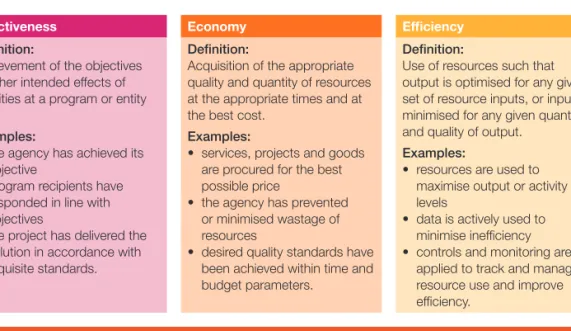
To reach conclusions against our audit objectives, we determine criteria against which to assess agency performance. We develop our audit criteria in accordance with relevant standards issued by the Australian Auditing and Assurance Standards Board and in consultation with the audited agencies. While criteria are specific to the audit topic and scope, our criteria often share common areas of focus. Figure 5 illustrates the types of criteria commonly included in performance audits. Figure 5: Performance audit common criteria
Effectiveness Economy Efficiency
Definition:
Achievement of the objectives or other intended effects of activities at a program or entity level.
Examples:
• the agency has achieved its objective
• program recipients have responded in line with objectives
• the project has delivered the solution in accordance with requisite standards.
Definition:
Acquisition of the appropriate quality and quantity of resources at the appropriate times and at the best cost.
Examples:
• services, projects and goods are procured for the best possible price
• the agency has prevented or minimised wastage of resources
• desired quality standards have been achieved within time and budget parameters.
Definition:
Use of resources such that output is optimised for any given set of resource inputs, or input is minimised for any given quantity and quality of output.
Examples:
• resources are used to maximise output or activity levels
• data is actively used to minimise inefficiency • controls and monitoring are
applied to track and manage resource use and improve efficiency.
Compliance
Definition:
Compliance of an agency/program with all relevant Acts.
Examples:
• agencies can demonstrate compliance with objectives, functions and requirements of relevant legislation • agencies have systems and processes to monitor compliance and address instances of noncompliance.
3.3 Planned performance audit outputs
for 2016–17
In 2016–17, we plan to deliver 26 performance audits drawn largely from the topics listed in this annual plan. The topics cover a wide range of issues and areas across the public sector which may be specific to one sector or may span multiple sectors.
Our audit program strikes an appropriate balance between predictability and responsiveness, thus maximising its value to Parliament, the public sector and the community.
The following section sets out proposed specifications for our 2016–17 and 2017–18 performance audits. For each audit listed, we outline our proposed objective and the issues we intend to examine. We also set out the proposed agencies, where this can be determined based on the objectives and issues. Otherwise, we signal where we are likely to choose a selection of agencies from a particular sector or from across the public sector, after further detailed planning and scoping.
3.3.1 Proposed performance audit program specifications
COMMuNITy SAFETy
Diverting young people from the criminal justice system, 2016–17
Objective To assess the effectiveness of strategies to divert young people away from the criminal justice system.
Issues The trajectory into the criminal justice system starts early in life. Current systemic and welfare responses appear to have only a limited impact on preventing early contact with child protection and the youth justice system from escalating into a cycle of incarceration.
This audit will focus mainly on people in the youth justice system at risk of becoming immersed in the adult criminal justice system. This includes young people at the pre-sentencing and deferral of sentencing stage, and young offenders managed in the community through parole, probation, youth supervision orders, youth attendance orders or Youth Justice Centre orders. The audit will examine a range of youth justice support and diversion programs, including the adequacy of agencies’ planning and delivery of services for young offenders and relevant reporting.
This audit is the third in a series of audits focusing on children and young people at risk. It follows the 2014 audit Residential Care Services for Children and the 2015 audit Early Intervention Services for Vulnerable Children and Families. It is also one of a series of planned or recently delivered audits focusing on managing offenders in the community, including Administration of Parole (2016), Managing community correction orders and Managing sex offenders.
Proposed agencies The Department of Health & Human Services, Victoria Police and relevant courts.
Managing community correction orders, 2016–17
Objective To assess the effectiveness and governance of community corrections programs. Issues This audit is part of the series of planned audits examining the administration of programs for managing offenders in the community. Other proposed or recently delivered audits in this area include Diverting young people from the criminal justice system, Administration of Parole (2016) and Managing sex offenders.
Community corrections orders involve the management and supervision of offenders in the community. These offenders are serving court-imposed orders either as an alternative to imprisonment or as a condition of their release from prison. Community safety is dependent on these programs being effective, efficient and well governed.
This audit will examine the efficiency and effectiveness of community corrections programs with a focus on maintaining public safety, achieving social and financial benefits, and training and support for community corrections staff. The audit will also assess the appropriateness of and performance against key performance indicators and measures.
Proposed agencies Corrections Victoria and Victoria Police.
Regulating gambling and liquor, 2016–17
Objective To examine the effectiveness and efficiency of the Victorian Commission for Gambling and Liquor Regulation in regulating gambling and liquor activities.
Issues Alcohol and gambling are accepted parts of the Australian culture and generate positive impacts for the state in the form of revenue and employment. However, misuse of alcohol and gambling can result in significant short-term and long-term harm for individuals, their families, their friends and the wider community.
The Victorian Commission for Gambling and Liquor Regulation is responsible for regulating gambling and liquor licensing. It oversees more than 21 000 liquor licences and manages the statewide cap of 30 000 gaming machines. The commission also collects approximately $1.8 billion per year in revenue on behalf of the state. The audit will examine the commission’s regulatory practices, including the licensing and compliance monitoring of venues. The audit will also examine relevant activities of the Department of Justice & Regulation and Victoria Police.
Proposed agencies The Victorian Commission for Gambling and Liquor Regulation, the Department of Justice & Regulation and Victoria Police.
Developing and evaluating justice policies, 2017–18
Objective To assess the effectiveness of advice and strategies for informing the development of justice policies, including monitoring and reporting on justice policy outcomes.
Issues The responsibilities of the Department of Justice & Regulation are devolved and include the Attorney-General, police and corrections, emergency services and consumer affairs, as well as gaming and liquor regulation. The community’s safety is dependent on the administration of an effective and efficient justice system.
In recent years, the Department of Justice & Regulation has implemented a series of strategies that aim to improve community safety. Outcomes from these strategies include longer sentences, greater prisoner numbers, fewer parolees who are subject to supervision on release, an increase in the detection of crime and related court cases. Despite these strategies, Victoria Police data indicates the total crime rate is rising.
Given the significant direct and indirect economic cost and social effects of justice policies, it is imperative that they are underpinned by a sound evidence base.
Managing private prisons, 2017–18
Objective To assess whether prison services contracted under public private partnerships (PPP) are operating effectively and providing value for money.
Issues The Department of Justice & Regulation manages several public private partnership contracts for prison services.
Contracts for the Fulham Correctional Centre Prison Services Agreement (October 1995) and the Port Phillip Prison Services Agreement (July 1996) have recently been extended for approximately 20 years each, representing a combined nominal investment by the state of over $4.5 billion over the life of the contracts.
Fulham Correctional Centre and Port Phillip Prison are unique amongst the private prisons in Victoria in that they are the only two ‘full service’ contracts in Victoria. This means the private sector provides both correctional and accommodation services, and Corrections Victoria monitors and manages the private sector provision for these services.
Together, these two prisons account for nearly 30 per cent of the total prisoner capacity in Victoria. This audit will assess the value for money received by Victorian tax payers through these two PPP contracts, and assess the adequacy of the Department of Justice & Regulation’s governance and oversight processes for private prisons. The audit will also examine the adequacy of services provided by private prisons to Victoria’s prison population.
Proposed agencies The Department of Justice & Regulation and Corrections Victoria.
Managing sex offenders, 2017–18
Objective To assess whether serious sex offenders subject to detention or supervision orders and registrants on the Victorian Register of Sex Offenders living in the community are managed effectively.
Issues The Sex Offenders Registration Act 2004 requires certain offenders who commit sexual offences to keep police informed of their whereabouts and other personal details for a period of time. It also provides for the establishment of a Register of Sex Offenders and sets out the requirements for offenders to be included on the register.
As at 30 June 2015, there were 6 056 sex offenders registered in the Victorian Register of Sex Offenders, which is an increase of over 500 from the previous financial year.
Under the Serious Sex Offenders (Detention and Supervision) Act 2009, serious sex offenders who pose an ongoing and unacceptable risk to the community may be subject to post-sentence supervision or detention. At 30 June 2015, there were 116 serious sex offenders subject to a supervision order and two subject to a detention order. Serious sex offenders subject to a supervision order are managed by specialist case managers at Corrections Victoria, either in the community or in the Corella Place or Emu Creek residential facilities in Ararat. Serious sex offenders subject to a detention order reside in a unit within Hopkins Correctional Centre, Ararat. The audit will focus on how effectively Corrections Victoria manages sex offenders to ensure continued protection of the community. This includes ensuring that offenders are subject to a level of surveillance and monitoring in accordance with their supervision orders and the offender’s assessed level of risk, and that any additional conditions imposed are complied with.
Proposed agencies The Department of Justice & Regulation and Victoria Police.
3 Performance Audit work program
Property and exhibit management, 2017–18
Objective To ensure that Victoria Police is conducting its property and exhibit management functions efficiently and effectively.
Issues In the course of its activities, Victoria Police collects a vast range of exhibits—property that is intended to be presented to a court as evidence—and other property. This can include seizures of property and goods in relation to offences, lost or abandoned property, or property that may be temporarily handed in as part of a condition, for example, a bail condition. Property and exhibits are held at local police stations and in other police facilities and storage warehouses.
While this is primarily an administrative function of policing, mismanagement of property and exhibits poses risks to the administration of justice and can impact the community’s perception of police integrity. Past reviews have identified issues with property and exhibit management including overcrowded stores, deficiencies in record keeping, lack of training and weaknesses in property audits.
Proposed agencies Victoria Police.
EDuCATION
Effectiveness of school governance, 2017–18
Objective To assess the effectiveness of governance arrangements within Victoria’s autonomous schools model.
Issues In Victoria, government schools operate under an autonomous model, with the school principal and school council responsible for operating the school. While the Department of Education & Training provides guidance and support, accountability for school performance is largely devolved to the school.
Effectively governing schools comes with many challenges. Most school principals begin their career as classroom teachers but take on responsibility for issues such as staffing, asset management and financial management. These are operational areas that the Department of Education & Training would have previously managed.
Similarly, school councils have a key governance and accountability role. These councils rely heavily on volunteers and need the right mix of skills and competencies to perform effectively. Attracting capable volunteers who can contribute to improved governance also comes with challenges, especially in rural and small schools.
Proposed agencies The Department of Education & Training and selected schools.
ENVIRONMENT
Effectiveness of the Environment Effects Statement process, 2016–17
The audit will examine the rigour of the EES process, the quality of information for decision-making, the monitoring of conditions imposed through the process, and the extent to which previously recommended reforms have been implemented. It will also assess whether the current framework is equipped to deal with issues such as climate change impacts.
Proposed agencies The Department of Environment, Land, Water & Planning and the Environment Protection Authority.
Enhancing food and fibre productivity, 2016–17
Objective To examine the extent to which agricultural research, development and extension are used to drive innovation, productivity and practice change.
Issues Victoria’s agricultural sector makes a significant contribution to the state’s economy. During 2014–15, Victoria’s food and fibre exports were valued at $11.6 billion—27 per cent of Australia’s total food and fibre exports.
While agricultural productivity continues to grow worldwide, the rate of growth in Australia has slowed since the 1980s and 1990s. Sustained agricultural productivity growth continues to be challenged by climate variability, increasing production costs, increasingly competitive markets and intensified consumer demands.
Productive, competitive agricultural industries are underpinned by effective and efficient research, development and extension (RD&E) which can lead to enhanced farming systems and practices that increase the value and volume of production and reduce input costs.
The audit will examine how the Department of Economic Development, Jobs, Transport & Resources prioritises, delivers, monitors and evaluates agricultural RD&E activities.
Proposed agencies The Department of Economic Development, Jobs, Transport & Resources.
Managing Victoria’s planning system for land use and development, 2016–17
Objective To assess whether the Department of Environment, Land, Water & Planning is effectively managing planning schemes and the planning permit system, and whether it has achieved the intended outcomes of the Planning and Environment Act 1987.
Issues Planning decisions can have a significant impact on local communities, the environment, key industries and the broader economy. For this reason, it is important that such decisions are based on evidence and supported by a clear and transparent decision-making process that complies with the requirements of the Planning and Environment Act 1987. Effective application and oversight of these processes is essential for preventing inappropriate land use and
development, and for enabling Parliament and the wider community to have confidence in the planning system.
The audit will provide assurance about whether the Department of Environment, Land, Water & Planning and selected councils are appropriately managing the statutory planning system and controlling land use and development to ensure the protection and conservation of land in Victoria. Proposed agencies Department of Environment, Land, Water & Planning and selected local councils.
Meeting obligations to protect Ramsar wetlands, 2016–17
Objective To assess the effectiveness of management of Ramsar wetlands, including whether Victoria is effectively meeting its national and international obligations, and the effectiveness of interagency collaboration.
Issues As a signatory of the Ramsar Convention, Australia must list and protect its wetlands of international importance. Effective management of these wetlands requires the states, territories and Commonwealth governments to collaborate to meet Ramsar obligations. It also relies on good knowledge of the environmental, social and economic values and benefits of the wetlands and management of the numerous potential threats to these.
This audit will provide assurance as to whether management, monitoring and evaluation practices are meeting responsibilities under the Ramsar Convention. It will examine how relevant obligations under the Victorian Waterway Management Strategy are being met, and how individual strategic management plans for each site are developed and implemented to effectively deliver the objectives and strategies in the statement for each site.
Proposed agencies The Department of Environment, Land, Water & Planning, Parks Victoria, Melbourne Water, other selected catchment management authorities and local councils.
Effectively planning for growth, 2016–17
Objective To examine how effectively the state is planning for infrastructure and service provision, in both growth areas and developed areas, to meet the needs of the rapidly growing population. Issues Victoria will grow substantially over the next 30 years. Current forecasts indicate that the state’s population could reach up to 10 million by 2051, with 2.2 million people in regional areas and 7.8 million in greater Melbourne. Growth and change require effective planning and considerable investment in infrastructure and services of all types. The long-term risks of poorly managing growth are among the most serious facing Victoria. It is important that individual agencies and the state effectively plan for the delivery of necessary infrastructure and services to meet the needs of its growing population, as well as managing other issues such as urban encroachment into peri-urban agricultural lands, which may impact the state’s long-term food security.
The audit may examine a selection of regional growth plans and will provide assurance on the effectiveness of planning for the delivery of the required infrastructure and services of growing communities by a selection of state government agencies and local councils.
Proposed agencies The Department of Environment, Land, Water & Planning, the Department of Treasury & Finance, the Metropolitan Planning Authority and selected state government agencies and local councils.
Implementing the Victorian Coastal Strategy, 2017–18
Objective To assess the effectiveness of the Victorian Coastal Strategy and its implementation in sustainably planning and managing Victoria’s coastal assets.
Issues The coast provides great social, cultural, economic and environment benefits for all Victorians. Tourism and commercial uses such as ports, shipping, fishing and aquaculture
The Victorian Coastal Strategy is the state government’s key policy commitment for coastal, estuarine and marine environments. This audit will examine the strategy’s delivery and the extent to which the coastline and its values are being sustainably managed.
Proposed agencies The Department of Environment, Land, Water & Planning, Victorian Coastal Council, Parks Victoria and selected coastal councils.
Meeting future water security challenges, 2017–18
Objective To assess the effectiveness of Victoria’s water reform program to improve the security of the state’s water supplies, with a focus on drinking water.
Issues Water management has been in the public eye in recent times, as a drought in Victoria between 1997 and 2009 led to fears of water shortages and the commissioning of the Victorian Desalination Plant. The government is currently in the process of developing a new statewide water plan, Water for Victoria.
The Office of Living Victoria was previously responsible for administering Melbourne’s agenda for water reform under Melbourne’s Future Water Strategy. This responsibility has now been moved to the Department of Environment, Land, Water & Planning after serious issues were found with the way the Office of Living Victoria was administering this process.
This audit will consider whether water is being managed to balance drinking water needs with other uses, such as irrigation. The audit will provide assurance on whether water is allocated efficiently and equitably to different uses, and on the state’s preparedness to effectively implement the Water for Victoria plan and related urban water strategies, to be prepared by March 2017. Proposed agencies The Department of Environment, Land, Water & Planning and a selection of water entities.
Mining rehabilitation, 2017–18
Objective To assess the effectiveness of the mine rehabilitation regulatory framework.
Issues The rehabilitation of mine sites is necessary to return land and water sources affected by mining activity to an acceptable environmental standard. This involves ensuring that any landforms and structures are stable and that any water sources are of acceptable quality. Rehabilitation can involve a number of activities such as the removal and safe disposal of hazardous materials, reshaping the land, the restoration of topsoil and revegetation with native species. Monitoring programs are required to ensure that measures undertaken are effective, as former mine sites can require long-term maintenance.
If the state fails to properly regulate, monitor, evaluate and report on the rehabilitation of mine sites, there can be significant social, environmental and economic impacts.
This audit will assess whether the state is effectively monitoring, reporting and enforcing
compliance in line with the mine rehabilitation regulatory framework. It may also assess whether the current system of rehabilitation bonds is sufficient to cover the cost of rehabilitating mining sites. Proposed agencies The Department of Environment, Land, Water & Planning, the Department of Economic Development, Jobs, Transport & Resources and the Environment Protection Authority.
3 Performance Audit work program
Victoria’s air quality, 2017–18
Objective To assess how effectively and efficiently Victoria’s air quality is monitored and managed. Issues Victoria’s 2013 State of the Environment report found that our air quality has continued to improve overall. However, while there have been significant gains in managing some aspects of air pollution, such as vehicle exhaust emissions, there has been less progress in other areas, including airborne particles, industrial emissions and odour.
This audit will assess progress in managing Victoria’s air quality, complementing the Hazelwood Mine Fire Inquiry and related processes. It will follow up on VAGO’s 2002 audit Managing Victoria’s Air Quality and examine Victoria’s implementation of the national and state frameworks for managing air pollution and monitoring air quality. It will not include areas directly covered by the Hazelwood Mine Fire Inquiry, such as the management of potential health effects from air pollution, but it will focus on the overall management and monitoring of air quality.
Proposed agencies The Department of Environment, Land, Water & Planning and the Environment Protection Authority.
HEAlTH AND HuMAN SERVICES
Access to public dental services in Victoria, 2016–17
Objective To assess the effectiveness of access to public dental health services in Victoria. Issues Lack of timely access to public dental services for basic restorative and preventive care can result in poor oral health, particularly for already disadvantaged and vulnerable groups who rely on public services. Delayed access can also mean emergency care procedures are needed for preventable conditions.
This audit will assess whether public dental health services in Victoria are accessible and appropriately distributed across the state, and address the growing demand for general dental, preventative and emergency services.
Proposed agencies The Department of Health & Human Services, Dental Health Services Victoria and selected dental health providers.
Efficiency and effectiveness of hospital services: Emergency care, 2016–17
Objective To determine whether public hospital emergency departments (ED) manage patients efficiently and effectively.
Issues High and uneven population growth across metropolitan Melbourne and Victoria places pressure on metropolitan and regional EDs. Overcrowding and prolonged length of stay in EDs can lead to poorer health outcomes for patients and unnecessary costs for the health sector. High demand on EDs can also have flow-on effects, including ambulance ramping and bypass. Previous VAGO audits have identified lost opportunities to free up hospital resources. The National Emergency Access Target (NEAT) was agreed by the Council of Australian Governments (COAG) in 2011. NEAT measures the percentage of patients leaving an ED within
Clinical governance of Victorian health services, 2017–18
Objective To assess the effectiveness of the clinical governance of Victorian health services. Issues Within health services both in Australia and overseas, poor governance and leadership have been identified as significant factors in poor patient outcomes, including increased mortality rates. A recent example involved a regional health service that was found to have a higher than average number of avoidable infant deaths. A Department of Health & Human Services review of this health service noted failings in leadership and clinical governance during this period, but the health service’s national accreditation status (and the department’s monitoring status) remained clear.
Previous performance audits, including those that focused on staff and patient safety, indicate persistent shortcomings in the devolved governance model of Victorian health services. The Department of Health & Human Services has been conducting training and education to improve the capability of health service boards of management, including the leadership and clinical governance skills of board members.
The primary aim of national accreditation standards is to protect the public from harm and to improve the quality of health service provision. This audit will examine whether the Department of Health & Human Services’ reliance of these accreditation standards is sufficient for assessing the effective leadership and clinical governance of health services.
Proposed agencies The Department of Health & Human Services and selected health services.
Community-based youth services, 2017–18
Objective To assess whether government-funded community-based youth services are achieving effective outcomes for young people and represent value for money.
Issues Services for young people need to be well-coordinated, easy to access and responsive. There are currently 127 community services providers registered with the Department of Health & Human Services to provide community-based child and family services and out-of-home care services. Youth services and youth justice initiatives received $155.7 million in the 2015–16 State Budget. Service providers complete regular self-assessments as part of their obligations to the Department of Health & Human Services, however, they have never been subject to a performance audit.
This audit will provide assurance to Parliament on the effectiveness, efficiency and economy of government-funded community-based youth services.
Proposed agencies The Department of Health & Human Services, a selection of government-funded youth services, Youth Justice Community Support Service partners, community-based child and family services, out-of-home care services operated by councils, Indigenous organisations, religious groups and unaffiliated not-for-profit providers.
Community health centres, 2017–18
Objective To assess the efficiency and effectiveness of community health centres and the Department of Health & Human Services in providing community health care.
Issues Community health centres (CHC) aim to improve the health and wellbeing of Victorians through the provision of primary health care. Priority access is given to disadvantaged populations with the poorest health and the greatest economic and social needs.
Victoria’s 88 CHCs operate under two distinct legal and governance arrangements—32 are independently managed while the remaining 56 are part of rural or metropolitan health services. CHCs have never been the focus of a VAGO performance audit in the last decade. This audit will provide important insights and assurance to Parliament on the performance of
government-funded CHCs, and the Department of Health & Human Services’ related oversight and governance arrangements.
Proposed agencies The Department of Health & Human Services and a selection of community health centres operating in Victoria.
INFRASTRuCTuRE
High Value High Risk, 2016–17
Objective To determine whether the High Value High Risk (HVHR) process has been effectively updated and applied to sufficiently and reliably assure the deliverability of HVHR projects.
Issues This is the third audit examining whether the HVHR process is improving the delivery of the intended benefits of major infrastructure and ICT investments on time and within budget.
The HVHR process is critical for assuring the successful delivery of the state’s $52 billion capital program. In total, 40 projects with a combined total estimated investment (TEI) of $31 billion in 2015–16 have been classified as HVHR projects.
The scale of government expenditure on capital projects and our previous findings of weaknesses in the application and effectiveness of the HVHR process are the basis for proceeding with a third audit in this area.
The audit will provide an updated view on the effectiveness of the HVHR process by examining: • progress in addressing VAGO’s earlier recommendations about the application of the HVHR
process to project development and procurement, and market-led proposals
• its effectiveness during project implementation, using a sample of HVHR projects in the transport and health portfolios that have reached this stage.
Proposed agencies The Department of Treasury & Finance, the Department of Economic Development, Jobs, Transport & Resources, the Department of Health & Human Services, Public Transport Victoria, VicRoads, Monash Health, the Royal Children’s Hospital Melbourne and the Royal Victorian Eye and Ear Hospital.
Maintaining state-controlled roadways, 2016–17
Objective To assess whether Victoria’s road network is being efficiently and effectively maintained. Issues The need to improve road maintenance practices and increase the state’s road
maintenance investment was identified by VAGO in its 2008 audit of the regional arterial road network. Nevertheless, maintenance budgets have been reduced and still remain below the level of funding required to maintain roads to the required service standards. Although additional budget allocations were made in 2013, 2014 and 2015, concerns remain over the standard of maintenance and safety implications for road users.
Managing school infrastructure, 2016–17
Objective To examine the effectiveness, efficiency and economy of the Department of Education & Training’s planning for new school infrastructure and maintenance of existing school infrastructure. Issues School infrastructure, consisting primarily of school buildings, is essential for the
achievement of educational outcomes. At June 2015, Victorian school buildings, excluding land, were valued at $8.5 billion. Commencing in 2015–16, the government embarked on a significant education investment program aimed at providing all Victorians with access to high-quality education and training through all stages of their lives. However, for the first time in 15 years, no new schools will be opened in 2016. In January 2016, the government acknowledged that it faced huge challenges to build enough schools to accommodate the 190 000 extra students predicted to flood the education system between 2016 and 2026.
Proposed agencies Department of Education & Training.
Managing Victoria’s public housing, 2016–17
Objective To determine whether the Department of Health & Human Services is managing public housing efficiently and effectively.
Issues For vulnerable people, access to stable and affordable housing is critical for minimising the impact of mental illness, drug use, criminal behaviour and unemployment. Public housing is provided for low-income Victorians who are most in need of support and a place to stay. These people also have access to community housing provided through a partnership between the government and not-for-profit registered housing agencies.
At June 2015, the state’s public housing stock was valued at $17.8 billion.
Previous audits undertaken in 2004, 2010 and 2012 have identified substantial shortcomings in the management of public housing and related risks, including excessive vacancies, rental arrears, damage and vandalism or destruction of property.
Proposed agencies Department of Health & Human Services.
High Value High Risk, 2017–18
Objective To determine whether the expected benefits of a selection of completed HVHR projects are being realised.
Issues Under the government’s HVHR process, infrastructure and ICT projects identified as being high value and/or high risk are subject to more rigorous scrutiny and approval processes, to ensure that these major investments are delivered successfully, on time, within budget, and with the intended benefits delivered in line with planned costs and time lines.
HVHR projects include large-scale, long-term projects, as well as hospital constructions, road upgrades, public transport improvements and other social infrastructure projects. As of December 2015, the total budget of projects undergoing the HVHR process was approximately $34.7 billion. This is the fourth in a series of HVHR audits. Previous audits have mostly focused on the planning, development and delivery of these projects up to their commissioning. This audit will focus on the extent to which the expected benefits of completed HVHR projects are being realised.
Proposed agencies The agencies covered in the audit will depend on the projects selected for examination.
Managing the level crossing removal program, 2017–18
Objective To determine whether the level crossing removal program is being managed efficiently and effectively.
Issues The level crossing removal program aims to remove 50 crossings by 2022—including 20 by 2018—at an estimated cost of $5 to 6 billion. At June 2015, three packages of works involving 17 level crossings were underway. A new body has been established to oversee the program, the Level Crossing Removal Authority.
Key intended benefits of the program include improved travel around Melbourne for train
passengers and road users, stimulated economic growth and revitalised local communities through the rebuilding of some train stations.
The audit will assess the basis on which crossings to be removed were identified and prioritised, and whether the expected benefits of the program—such as improved travel for train and road users—are being realised.
Proposed agencies Level Crossing Removal Authority, VicRoads, Public Transport Victoria and VicTrack.
INVESTMENTS
Audit committee governance, 2016–17
Objective To examine the effectiveness of governance arrangements for audit committees, including their composition, operational arrangements and information received.
Issues Audit committees play a key accountability role in public sector agencies. Their role is primarily to provide independent assurance regarding risk management, internal controls, financial statements, compliance requirements, and internal and external audit.
A number of factors can significantly impact an audit committee’s effectiveness in providing independent assurance. This includes its member composition and operating arrangements— including its terms of reference, roles and responsibilities, lines of communication and reporting, and the type and extent of information it receives from management.
Proposed agencies The Department of Education & Training, the Department of Health & Human Services, the Department of Economic Development, Jobs, Transport & Resources, the Department of Justice & Regulation, the Department of Environment, Land, Water & Planning, the Department of Treasury & Finance, the Department of Premier & Cabinet and Victoria Police.
Board performance, 2016–17
Objective To examine whether public sector boards are effectively governing the agencies for which they are responsible.
Issues Public sector boards perform key governance roles—they have a critical role in leading public sector agencies and enabling them to achieve the objectives set for them by government. They are accountable for the overall effectiveness of the entities they govern and need to have the