University of Nebraska - Lincoln
DigitalCommons@University of Nebraska - Lincoln
Library Philosophy and Practice (e-journal) Libraries at University of Nebraska-Lincoln
Summer 7-24-2017
Professional Development Programmes for
Polytechnic Library Staff in Ghana: Challenges and
Prospects
Micheal Owusu-Acheaw
Follow this and additional works at:http://digitalcommons.unl.edu/libphilprac Part of theLibrary and Information Science Commons
Owusu-Acheaw, Micheal, "Professional Development Programmes for Polytechnic Library Staff in Ghana: Challenges and Prospects" (2017).Library Philosophy and Practice (e-journal). 1581.
1
Professional Development Programmes for Polytechnic Library Staff in Ghana: Challenges and Prospects
By
M. Owusu-Acheaw Koforidua Technical University
Koforidua, Ghana
Email: [email protected]
ABSTRACT
The study assessed professional development programmes available for Polytechnic Library staff in Ghana, and examined their prospects and challenges. The survey method was employed and quantitative approach was adopted for the study which involved only professional Library and para-professional staff of the Polytechnics in Ghana. Out of 80 copies of questionnaire sent out, 72 were retrieved representing a response rate of 90%. The study revealed that most of the staff were aware of the term “professional development”. They also confirmed that knowledge they acquired through professional development had also improved on their work performance considerably. Again, the study showed that Library staff had attended several professional development programmes which included workshops, seminars and conferences. Furthermore, the study revealed that professional development programmes were associated with challenges such as lack of finance and inadequate budget. However, the study recommends that Head Librarians should continue to allow staff to participate in workshops, seminars and training especially on the use of the electronic resources in the Library. Again, Head Librarians should liaise with the various Library committees to enforce the regulation by National Council for Tertiary Education for all tertiary libraries to benefit from 10% of the Academic Facility User Fee(AFUF) to enable them manage the libraries more effectively.
Keywords: Professional Development, Library staff, Staff Development, Lifelong learning., Academic Libraries
2
Professional development is a lifetime educational process, which is both worldwide and personalized. It is a general obligation for all Librarians to engage in professional development in order to meet the rapid changes in Librarianship and also maintain professionalism (Pan and Hovde, 2010).
Professional Development (PD) covers the various types of learning opportunities that result in the personal and professional growth of an employee. It focuses on the process, by which employees may engage in targeted training, conferences, seminars, on the job training, and formal coaching to enhance their performance and better prepare themselves for future responsibilities (Chartered Institute of Personnel Development, 2008).
It is significant to note that excellence in the quality of service provision in any information center is not easy to achieve, if the staff are not highly qualified. This is because the dynamism in the job market requires changes not only in what we learn, but also how we learn in the classroom and beyond (Lamptey and Corletey, 2011)
Professional development is the process by which members of professional associations maintain, improve and broaden their knowledge and skills to develop their personal qualities required in their professional lives (Lamptey and Corletey, 2011). It is the key to improving one’s career opportunities, both today and for the future. Indeed it is also through the involvement in professional development activities that enhances or increases knowledge and skills of individual professional in relation to his or her work (Lamptey and Corletey, 2011).
Professional development also aims at increasing and enhancing professional qualification of an individual. This is because participating in the professional development plan is a sign of showing assurance to professional growth (Broady-Preston, 2009). To keep professional skills up to date
3
and be abreast of new and changing technologies do not only benefit the professional, but also equip him/her with requisite skills and experiences (Broady-Preston, 2009). Professional development activities therefore can aid the new Librarian put his/her theoretical knowledge acquired into practice. (Pan and Hovde, 2010).
Motivation of staff and the efficient organization of a Library system are the main functions of a good Library manager and should involve the proper use of training. Staff training and development should be tailored towards the Library needs and services. The authors opined that managers must know the tasks that individual perform on a daily basis and that staff also should have sound understanding of the organization in which they work (Castelyn, 2007).
In this information age, individuals need knowledge, ability and skills in order to function effectively and perform efficiently in an organization and that the effectiveness and success of an organization depended on the people who formed and worked in the organization. This means that employees should be able to perform their duties and contribute meaningfully to the organizational goals (Olaniyan and Ojo, 2008).
Indeed, the Library profession has become aware of the increasing variety of information formats, and that the changing nature of Library users demand appropriate skills to address them hence the need for professional and development programmes (Abba and Damha, 2009).
Continuous education and staff professional development have become a household name among professional Librarians. Library Staff should engage in continuous education and professional development activities, especially because of the changes that have been brought about by the emergence of the “Information and Communication Technology” (ICT) era.
4
Professional development should always make a positive impact that would assist to make an organization stronger, more effective and better, to cope with the challenging environment in the job market. It is important to put on record that, no matter how carefully job applications are screened, there will still be a gap between what employees do know, and what they should know. Hence the acquisition of professional development activity is needed to fill the gap (Owusu-Acheaw, 2007).
Several authors including Agbo (2015), Ramachander (2013), Coke (2012) and Davis and Lordstrom (2011), have done much studies on professional development both globally and on the African scene. In Ghana. a number of studies have been done on professional development. These include researches undertaken by Asante and Alemna (2015), Borteye and Ahenkorah-Marfo (2013), Dzandza (2012), Lamptey and Corletey (2011), Adanu (2007), Owusu-Acheaw (2007) and Alemna (2001) respectively. However, all these studies had different focuses and did not identify types of professional needs of Library Staff. This study therefore addresses prospects and challenges associated with professional development programmes for Polytechnic Library Staff in Ghana.
Statement of the Problem
Professional development programmes are vital tools to enhance productivity and expose Library staff to new trends of development in the world. The absence of professional development activities, however, will lead to poor quality of service provision by the Library staff. It is consequently appropriate for Head Librarian to upgrade their staff, to enable them meet the challenges in the “global world”. It is therefore, paramount for constant and acceptable professional development programmes for Polytechnic Library Staff through well-defined goals meant to position the Library Staff to meet the dynamism in the changing information technology systems.
5
Authors like Asante and Alemna (2015) and Borteye and Ahenkorah-Marfo (2014), emphasized the lack of finance as one of the major deficiency in the professional development programmes in the libraries of Polytechnics in Ghana. This is likely to affect delivery of quality service to clients. Again, this state will not expose staff to be well-informed with the changing current trends in the profession. Ultimately, staff will not be able to contribute towards achieving the mandate of the Polytechnics in Ghana. It is as a result of the above reasons that have necessitated the conduct of this research to examine professional development opportunities available in the Polytechnics and ascertain their prospects and challenges.
Objectives of the Study
Specifically, the main objectives of the study are as follows:
i. To identify the types/forms of professional development needs of Polytechnic Library staff in Ghana.
ii. To determine the benefits of professional development programmes to Polytechnic Library
Staff in Ghana.
iii. To examine the challenges and prospects associated with professional development of Polytechnic Library staff in Ghana.
Research Questions
This study attempts to address the following research questions.
1. What are the types and forms of professional development programmes available for Polytechnic Library Staff in Ghana?
6
2. Are there benefit Polytechnic Library Staff in Ghana would derive from professional development programmes?
3. What are the challenges associated with professional development of Polytechnic Library staff in Ghana?
LITERATURE REVIEW
A study conducted by Davis and Lordstrom (2011) explored the role of staff development committees in relation to issues of motivation, morale and education of Library Staff. Their study highlighted the importance of professional development and therefore created staff development and training programmes to address staff development needs. Davis and Lordstrom (2011) concluded that the institutions should place importance on developing individual staff to have critical skills to function effectively in order to serve faculty staff, students and community members to turnout and increase workplace cooperation. Their study also revealed the importance of institutions’ staff development to their staff and focused on staff development as a way of assisting individuals to develop their professional competence in the work place.
Al-Ling (2009) emphasized that professional Librarians need to upgrade themselves in order to meet demands from the public. He discussed the need and the importance of continuous professional development for Librarians and indicated that such training could be done through several methods. He elaborated on a number of approaches to professional development which professional Librarians must take advantage of and be abreast of. These avenues included current awareness, pursuing continuing education provided by professional associations and Library systems, Al-Ling (2009) concluded that Librarianship has entered a very dynamic period and that
7
Librarians must work hard through professional development to meet the challenges in this global world.
Coke (2012) emphasized that professional development is a source of motivation to Library staff and will urge them to contribute meaningfully to the attainment of organizational goals. This means that committed staff are needed in the organization to effectively push ahead the objectives of the organization. He further opined that, because of the current information explosion syndrome, Librarians who enter the work force should possess the willingness and eagerness to learn constantly and quickly in order to enhance their skills in the Library.
According to Pan and Hovde (2010) professional development opportunities can help new staff in the Library implement theoretical knowledge into practice, apply “generalized concepts” they have learnt from Library school to specific responsibilities and ultimately become familiar with given job situations. According to them, for the new staff in the Library, occupational training begins from the moment they step into the profession. Professional development programmes should therefore be available for such staff. Pan and Hovde (2010) further affirmed that, conferences and meetings sponsored by professional associations provide a forum not only for learning, but also for professional exchange. According to them presentations, posters, panel sessions and exhibitions bring experts in the profession together; keep them abreast of current trends relating to problems and their solutions.
Eke (2011) confirmed that collaborative opportunities come primarily through networking and professional development programmes. According to them, participants meet at conferences in order to locate researchers they can work with. Conference centers basically, offer grounds for researchers of like interest to meet and agree on problems to write about. They also affirmed that
8
another benefit of professional development programmes for Library Staff is networking. According to them, theories of conferences and workshops more often than not provide the platform for participants to exchange views, share experiences, learn from best practices and develop networks with colleagues outside one’s domain.
Jennerich (2006) enumerated several benefits of professional development programmes to Library Staff. These included; enhancing the experiences of new staff and conveying to them how staff are welcomed, offering the climate for enhancing learning and self-improvement, increasing expectations and decreasing staff anxiety, improving group communication, offering tools to staff to tackle problems constructively, and finally, invigorating the need for personal development and team work.
Eke (2011) also emphasized that the cost of participation is one of the major obstacles to participation in conferences, workshops, seminars among others. He noted that normally, fees include cost of registration, transportation, accommodation and food. He further stated that one of the obstacles is non-acceptance of submitted papers. Organizers of conferences, workshops and seminars normally accept quality papers and those whose papers are not accepted may not attend the conference.
It is worthy to note that Asante and Alemna (2015) also brought to the fore that finance has been one of the obstacles to professional development in Ghana. This is because many institutions like Wa and Bolgatanga Polytechnics do not have enough budgets and thus may not be able to offer several opportunities to many staff. Another obstacle is lack of sponsorship. This equally links with the budget of the Library. If the budget of the Library is big enough then the institution may be able to sponsor many staff. Further, to the above issues is the lack of interest. This may happen
9
as a result of stale programmes, poor quality delivery of services, unattractive conference venues, and poor quality of food, accommodation and the lack of social activities, among others.
RESEARCH METHODOLOGY
The research design used was a survey method approach and quantitative method was only adopted. The study was cross-sectional and data was collected at different points from all the 10 Polytechnics Libraries in Ghana. The study covered Takoradi, Accra, Kumasi, Ho, Tamale, Sunyani, Koforidua, Cape Coast, Wa, and Bolgatanga Polytechnic Libraries in Ghana.
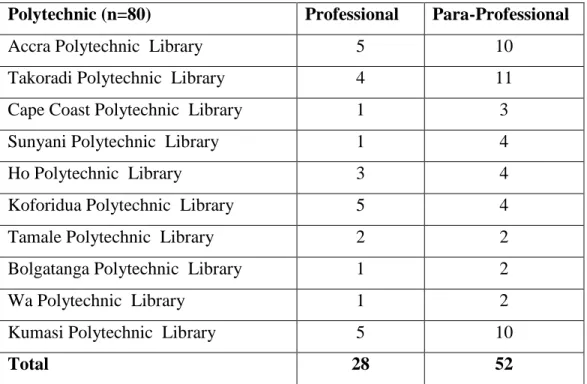
The population of the study covered Library Staff of the Polytechnic Libraries. The total population was eighty (80). Library Staff were made up of professional Librarians and para-professionals. For the purpose of this study, Professional Librarians are staff who possess post-graduate degree in Library or Information Studies, and para-professionals are Library staff that hold certificates, diplomas or first degrees in Library or Information Studies.
Table 1. Population of the Study
Polytechnic (n=80) Professional Para-Professional
Accra Polytechnic Library 5 10
Takoradi Polytechnic Library 4 11
Cape Coast Polytechnic Library 1 3
Sunyani Polytechnic Library 1 4
Ho Polytechnic Library 3 4
Koforidua Polytechnic Library 5 4
Tamale Polytechnic Library 2 2
Bolgatanga Polytechnic Library 1 2
Wa Polytechnic Library 1 2
Kumasi Polytechnic Library 5 10
Total 28 52
state
10
The population of the research was eighty (80), and the researcher took all into consideration. This is supported by Saunders et al (2014), who posited that the researcher could use the whole population if it can be managed by the researcher within the research period.
respective
Data was gathered from January to March 2016 by using only questionnaire. The principal researcher booked respective appointments with all the staff to personally administer questionnaire to them individually. The questionnaire was designed in line with the objectives of the study which included types of professional development, benefits and challenges of professional development programmes. In all, eighty (80) copies of the questionnaire(s) were given out and seventy-two (72) were retrieved representing a response rate of 90% of the sample.
The data collected from the questionnaire were analyzed with the use of Statistical Package for Social Sciences (SPSS). The results were organized according to the objectives of the research. Quantitative analysis was used to present the results of the study. Tables, charts and histogram of the results of the study were used to display and interpret the results of the study.
11
PRESENTATION OF FINDINGS
Understanding of Professional Development
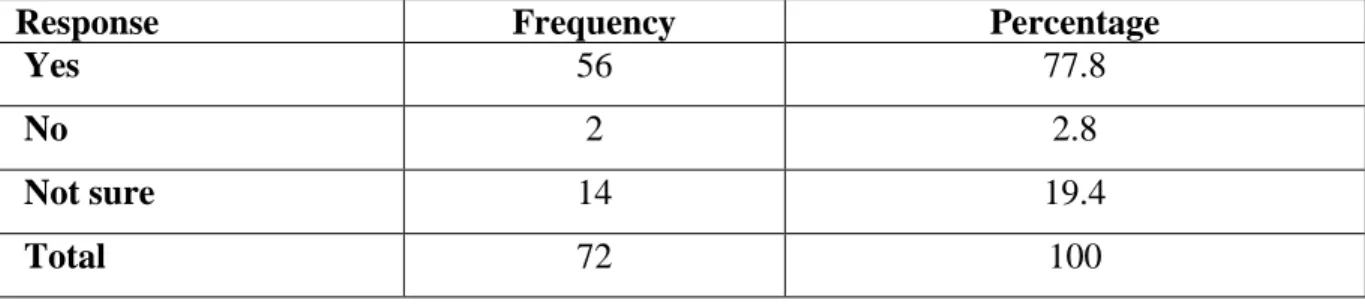
The researcher wanted to find out whether respondents were conversant with the term “professional development”. The responses are presented in Table 1.
Table 1: Understanding of the Term Professional Development
Source: Field data, 2016.
As represented in Table 1, out of the 72 total respondents, 56 (77.8%) of the respondents had knowledge of the term “Professional Development”, 2 (2.8%) had no knowledge of the term “Professional Development” and 14 (19.4%) were not sure of the term “Professional Development”. This suggests that the majority of the respondents - 56 (77.8%) had knowledge of the term “Professional Development”.
Professional Development Programmes Attended
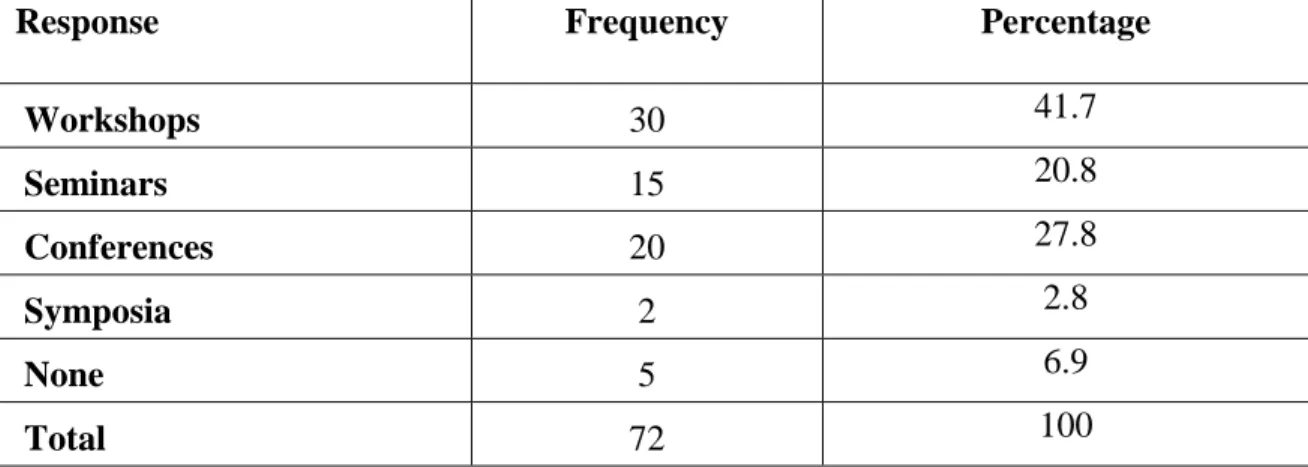
Respondents were asked to indicate the type of professional development programmes they had attended. The aim was to find out how respondents in the Polytechnics had access to
professional development programmes. Data collected is presented in Table 2. Table 2. Professional Development Programmes Attended
Response Frequency Percentage
Yes 56 77.8
No 2 2.8
Not sure 14 19.4
12
Response Frequency Percentage
Workshops 30 41.7 Seminars 15 20.8 Conferences 20 27.8 Symposia 2 2.8 None 5 6.9 Total 72 100
Source: Field data, 2016.
As observed from Table 2, out of 72 the total respondents of , 30 (41.7%) indicated that workshops were the professional development programmes they normally attended, 15 (20.8%) indicated that seminars were the professional development programmes they normally attended, 20 (27.8%) indicated that conferences were the professional development programmes they normally attended, 2 (2.8%) indicated that symposia were the professional development programmes they normally attended, while 5 (6.9%) indicated that they had not attended any professional development programmes. This depicts that the majority of the respondents - 30 (41.7%) attended workshops as a professional development programme.
Knowledge Acquired and Work Performance
The researcher wanted to find out how knowledge gained from the Library school had helped in the job performance of respondents. Data collected is presented in Table 3.
Table 3: Knowledge Acquired and Work Performance
Response Frequency Percentage
To a large extent 60 83.5
Not always 2 2.7
To some extent 10 13.8
13
Source: Field data, 2016.
Table 3 indicates that, out of the 72 total respondents, 60 (83.5%) said that to a large extent, the acquired knowledge had helped in their work performance, 2 (2.7%) of the respondents indicated that the acquired knowledge from the Library school had not always helped them in the performance of their jobs and 10 (13.8%) said to some extent, the acquired knowledge had helped in their work performance. This confirms that most of the respondents, - 60 (83.5%) had acquired knowledge through professional development that helped in their work performance.
Relevance of Professional Development Programmes Attended
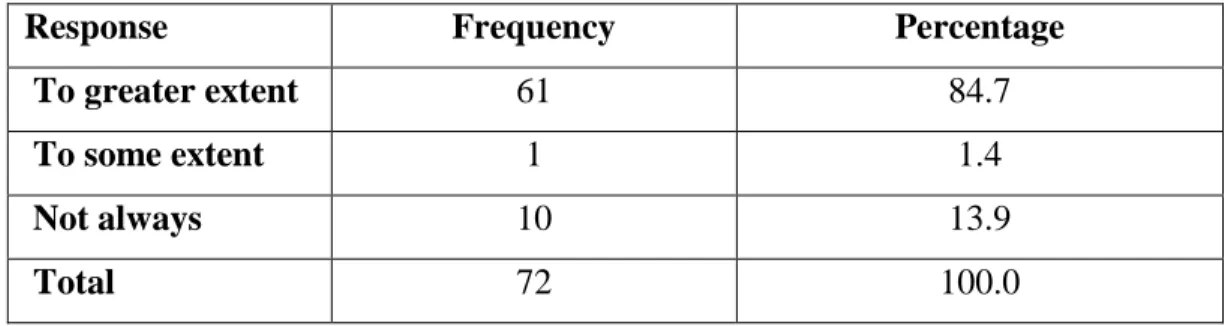
The researcher wanted to find out how professional development programmes they had attended had been relevant to their job schedules. The responses are presented in Table 4.
Table 4: Relevance of Professional Development Programmes Attended
Response Frequency Percentage
To greater extent 61 84.7
To some extent 1 1.4
Not always 10 13.9
Total 72 100.0
Source: Field data, 2016.
Based on Table 4 above, out of the 72 total respondents, 61 (84.7%) indicated a positive stand to the relevance of the professional development programmes attended, while 1 (1.4%) indicated that to some extent the professional development programmes attended were relevant. Also, 10 (13.9%) agreed that sometimes the professional development programmes they had attended had been relevant to their job schedules. This confirms that the majority of the respondents-61 (84.7%)
14
agreed that professional development programmes they had attended were relevant to their work schedules.
Benefits of Professional Development Programmes
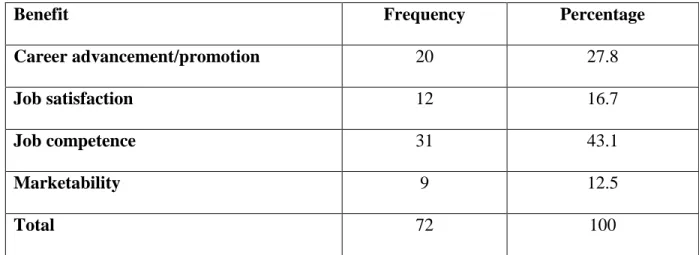
As part of the study, the researcher wanted to find out the benefits of professional development programmes to Library Staff. The data collected is presented in Table 5.
Table 5: Benefits of Professional Development Programmes
Benefit Frequency Percentage
Career advancement/promotion 20 27.8
Job satisfaction 12 16.7
Job competence 31 43.1
Marketability 9 12.5
Total 72 100
Source: Field data, 2016.
As can be seen in Table 5, out of the 72 total respondents, 20 (27.8%) said they attended professional development programmes to achieve career advancement or for promotion, 12 (16.7%) said they gained job satisfaction, 31 (43.1%) said it increased their job competence, while 9 (12.5%) said it enhanced their marketability. This result indicates that a considerable number of the respondents, - 31 (43.1%) said job competence was the leading benefit they derived for attending professional development programmes.
15
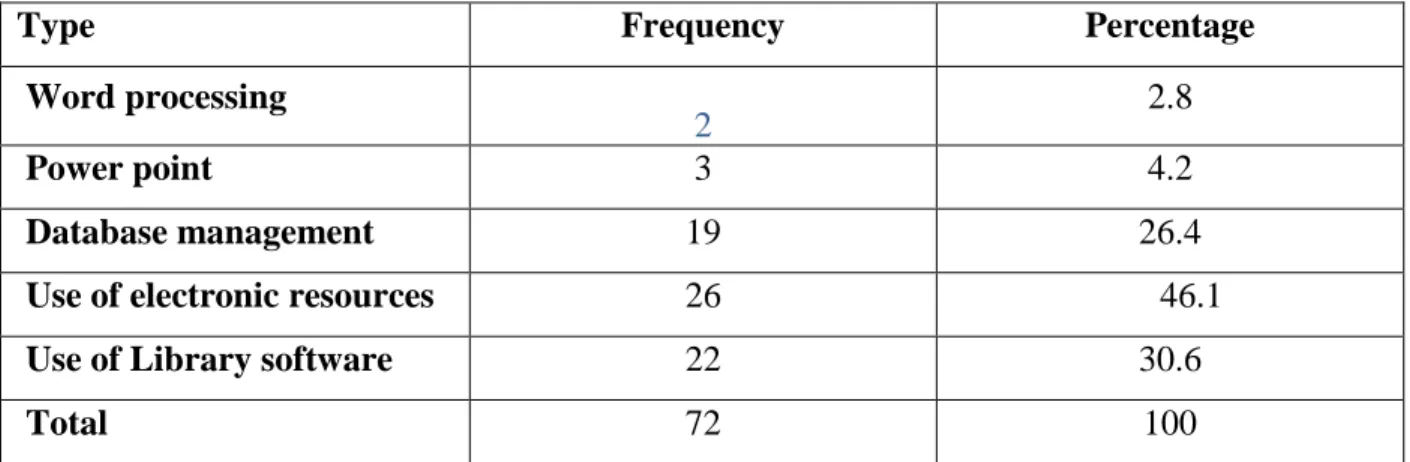
Respondents were asked to indicate what type of ICT training needs they needed in their professional development programmes. The responses are presented in Table 6.
Table 6: ICT Training Needs of Staff
Type Frequency Percentage
Word processing
2 2.8
Power point 3 4.2
Database management 19 26.4
Use of electronic resources 26 46.1
Use of Library software 22 30.6
Total 72 100
Source: Field data, 2016.
As represented in Table 6, out of the 72 total respondents of , 2 (2.8%) needed ICT training on word processing, 3 (4.2%) needed training on power point, 19 (26.4%) needed training on database management, 26 (46.1%) needed training on use of electronic resources while 22 (30.6%) needed training on the use of Library software. This depicts that most of the respondents 26 (46.1%) needed training on the use of electronic resources.
Motivation to Participate in Professional Development Programmes
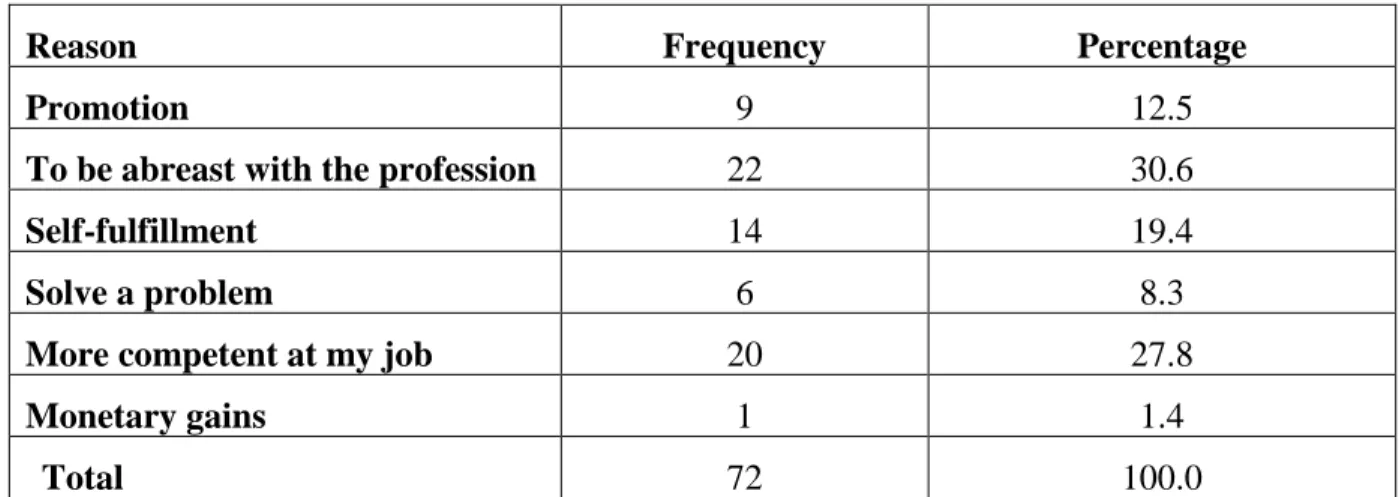
Respondents were asked what motivates them to take part in professional development programmes. Data collected is presented in Table 7.
16
Table 7: Motivation to Participate in Professional Development Programmes
Reason Frequency Percentage
Promotion 9 12.5
To be abreast with the profession 22 30.6
Self-fulfillment 14 19.4
Solve a problem 6 8.3
More competent at my job 20 27.8
Monetary gains 1 1.4
Total 72 100.0
Source: Field data, 2016.
As represented in Table 7, out of the 72 total respondents, 9 (12.5%) were motivated by promotion, 22 (30.6%) were motivated to be abreast of the professional, 14 (19.4%) were motivated by self-fulfillment, 6 (8.3%) were motivated by solving a problem, 20 (27.8%) were motivated by being competent with their job, while only 1 (1.4%) was motivated by monetary gains. This shows that most of the respondents, 22 (30.6%) were motivated to attend professional development programmes because they wanted to be abreast of the trends of issues in their profession.
Challenges of Professional Development Programmes
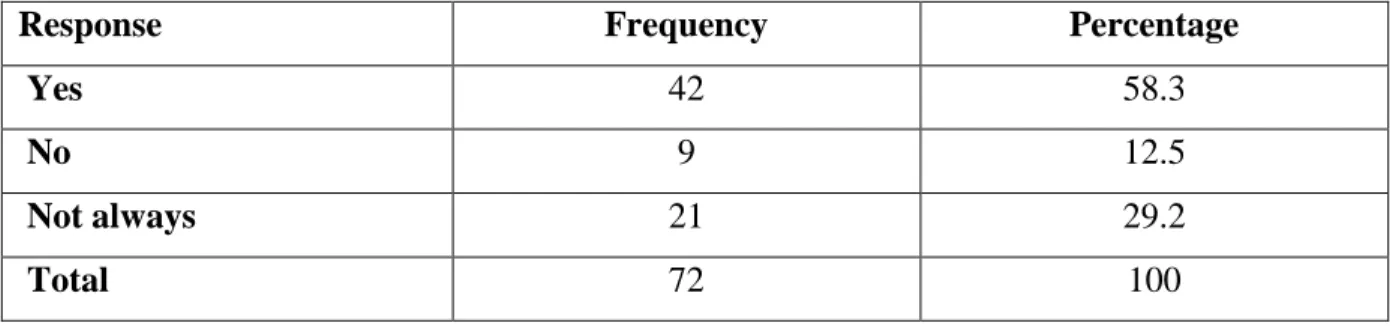
Having in mind the unwillingness of the institution to sponsor staff for professional development programmes, the researcher wanted to find out from the respondents if they had challenges in getting approval from Management for staff professional development activities. The researcher wanted to find out the challenges they went through before getting approval to participate in professional development programmes. Data collected is presented in Table 8 below.
17
Table 8: Challenges of Getting Approval for Staff
Response Frequency Percentage
Yes 42 58.3
No 9 12.5
Not always 21 29.2
Total 72 100
Source: Field data, 2016.
As can be seen from Table 8, out of 72 respondents, 42 (58.3%) said that they had challenges of getting approval for professional development programmes from Management, 9 (12.5%) said they did not encounter challenges. On the other hand, 21 (29.2%) of the respondents indicated that they did not always get approval from Management to attend professional development programmes. This proves that the majority of the respondents - 42 (58.3%) said there were challenges of getting approval for professional development programmes.
Barriers for Effective Professional Programmes
The researcher sought to find out from respondents whether there were barriers to effective professional development programmes in their institutions. The responses are presented in Table 9 below.
Table 9: Barriers for Effective Professional Programmes
Barriers Frequency Percentage
Lack of interest 7 9.7
Content not related to work schedule 11 15.3
Lack of personal finances 21 29.2
Lack of financial assistance from the institution 25 34.7
18
Too much work load 1 1.4
Lack of time 4 5.6
Total 72 10
Source: Field data, 2016.
As represented in Table 9, out of the 72 total respondents, 7 (9.7%) said lack of interest was one of the barriers to effective professional development programmes, 11 (15.3%) said content of such programmes was not related to work schedule. Also 21 (29.2%) of the respondents said lack of personal finances, 25 (34.7%) indicated lack of financial assistance from the institution, 3 (4.2%) said family pressure, 1 (1.4%) said too much work load, while 4 (5.6%) said lack of time were all barriers to professional development of staff. The statistics above indicates that most of the respondents, - 25 (34.7%) agreed that lack of financial assistance from the institution was one of the major barriers to professional development programmes.
DISCUSSION OF FINDINGS
Professional Development Programmes
The understanding of professional development programmes among the Library Staff cannot be overestimated and that the knowledge acquired from professional development programmes had affected their work performance. The study revealed that 60 of the respondents, representing 88.5% saw a considerable improvement in their work performance after attending professional development programmes. This finding agrees with the research of Lamptey and Corletey (2011) that professional development “is a conscious updating of professional knowledge and the improvement of professional competence throughout a person’s working life”. Lamptey and Corletey (2011) also believe that it is through the participation in certain activities that will enhance or increase the knowledge and skills of a professional in relation to his or her work. The researchers
19
finding further agree with Coke (2012), Eke (2011), Pan and Houde (2010), and Broaden-Preston (2009), who variously reported that professional development activities of staff have positive influence on job performance.
Linking this with the types of professional development programmes they attended, 50 respondents, representing 78.5% indicated that workshops and conferences dominated the list. This agrees with t the research outcome of Crossham et al (2005) that professional development is the continuing education of persons which may consist of upgrading of skills and competence. Agbo (2015) re-iterated that conferences, seminars and workshops are the types of professional development programmes available at the Library. The finding is similar to that of Eke (2011) who reported that most Librarians attend conferences and workshops to learn about professional issues, to brainstorm with colleagues, and share ideas with colleague within the profession.
Our research also confirmed that respondents had gained knowledge in the areas of traditional Library practice, ICT applications in Library management, marketing of Library services, as well as the publishing of scholarly articles. In all, ICT knowledge and traditional practice of managing the Library were the most common representing, 36.1%.of the respondents. This concurs with a study by Ramachander (2013) that Library staff are at the centre of any academic library.
Benefits of Professional Development Programmes
The benefits of professional development programmes usually manifest in the career of the individual. When respondents were asked about the type of training needed by the Library Staff which benefit them in their day to day activities in the Library they indicated classification, cataloguing and reader services as their preferred choices. With reference to ICT training needs of
20
the respondents, the research revealed that there were various ICT needs of the Library Staff. Among these needs were Word Processing, Power Point, Database Management, Use of Electronic Resources, as well as Library Software. However, use of the E-Resources dominated the list, with 26 respondents, representing 46.1%. This revelation is in line with the findings of Lamptey and Corletey (2011), Pan and Hovde (2010) and Abba and Damha (2009) who brought to the fore the importance of professional development for Library staff, and urged Library Staff to position themselves in the changing information technology systems in order to meet current job performance . This agrees with Al-Ling’s (2009) finding that Professional Librarians need to upgrade themselves in order to meet demands from the public. The findings also confirmed Broader-Preston’s (2009) finding that, as one participates in professional development programmes, one is able to show commitment to one’s professional growth. Eke’s (2011) study confirmed the benefits of professional development programmes, and said that collaboration opportunities come primarily through networking derived from professional development programmes.
The study revealed that staff were motivated to attend professional development programmes, because they wanted to “be abreast with the profession” and “to be competent on the job market”. The findings of the study confirmed Eke’s (2011) findings that motivation comes when staff attend professional development programmes and listen and interact with “senior colleagues” in the same fields. These findings are also similar to that of Jennrich (2006) and Alemna() (2001) who reported that staff engaged in professional development for “promotion” or “career advancement”, job satisfaction” and “monetary gains”, “career advancement”, “promotion’, “job satisfaction”, ‘job competence”, and “marketability”.
21
Challenges of Professional Development
Challenges are inbuilt factors that impede the progress of organizational development. All institutions have their inherent problems. As to whether their Libraries and Staff had challenges associated with the growth of professional development, the majority of the respondents - 42 representing 58.3% agreed that, there were challenges. Among the challenges listed, 25 of the respondents representing 34% indicated lack of financial assistance from the institution for professional development as the main one. Several authors, such as Asante & Alemna (2015), Agbo (2013) and Davis and Lordstrom (2011) agreed to the issue of financial challenge as part and parcel of the inhibiting factors against advancement of career development in every profession including Librarianship. The researcher agrees with Borteye and Ahenkorah-Marfo (2014) who stressed that one of the challenges of professional development of staff is that some staff were unable to participate in seminars, workshops and conferences because of lack of financial assistance from their institutions.
CONCLUSION
Due to the rapid changes in the profession, in the midst of the dynamics of society, professional development activity must be a permanent and continuous issue within all Polytechnic Libraries in Ghana. Professional development programmes aim at equipping the individual with the requisite skills, competencies and knowledge to enhance individual’s performance at the work place.
22
Librarians in this global world cannot exempt themselves from professional development programmes due to the current challenges in the professional.
The study brought to light that most of the staff were aware of the term “professional development”, and the knowledge they acquired through professional development programmes had also improved on their work performance considerably. This was confirmed by sixty (60) respondents representing 88.5%. The study revealed that professional development programmes were associated with many challenges, such as, lack of finance, lack of interest, content not related to work schedule, lack of personal finances, and lack of institutional finance as leading factors. This is confirmed by forty-two (42) respondents representing 58.3%. In addition, the results showed that workshops and conferences were the most professional development programmes attended, even though seminars and symposia were also available for staff. Equally, the outcome of the research proved that Librarians needed the traditional Library knowledge, as well as the use of the electronic resources. The study revealed that staff were motivated to attend professional development programmes for the following reasons; “promotion”, “to be abreast with the profession”, “self-fulfillment”, “solve a problem”, “more competence on job” and “monetary gains”.
Recommendations
Based on the findings from the study, the researcher make the following recommendations.
Professional development should be an ongoing process and should not be limited to only workshops and conferences. Because, professional development is a lifetime learning process.
23
Library Staff should embrace professional development programmes to enhance their skills and competences and stop trivial excuses like “lack of time”, “too much workload”, “family pressure”, etc.
Finally, Heads of the various institutions should allocate more funds to cater for the professional needs of Library Staff. Heads of the Libraries should liaise with the various Library committees to enforce the regulation by National Council for Tertiary Education for all tertiary libraries to benefits from 10% of the Academic Facility User Fee (AFUF
References
Abba, T. and Dawha, E. M. K. (2009). Assessment of Personnel Training Needs in the Ibrahim Banbagida Library. Federal University of Technology. Nigeria Library Philosophy and Practice. Available at: http://u;unllib.unl.edu/LPP/abba2.htm. (Accessed 12/12/15).
Adanu, S. A. (2007). Continuous Professional Development in State-Owned Universities in Ghana. Library Management. 28.(6) 293-305.
Agbo, A. D. (2015). Staff Training and Development Programmes in Nigerian University
Libraries. The case of Michael Okpare University of Agriculture, Umudike International
Journal of Multidisciplinary Research and Development 2(2) 553-557.
Ai-Ling, Y. (2009). Continuous Professional Development for Librarians Journal PPM. University of Malaya, Kuala Lumpur: Persatuan Pustakawan Malaysia.
http://ir.uitm.edu.my/11575/1/AJ_HEE%20KYEUNG%20RYU%20PPM%2009.pdf
24
Asante, E. and Alemna, A. (2015). Training and Development Issues: Evidence from Polytechnic
Libraries in Ghana. Library Philosophy and Practice available at
http://digitalcommons.unl.edu.libphilprace (Accessed 18/10/15).
Borteye, F. M. and Ahenkorah-Marfo, M. (2013). Staff Development of Library Association in
the Kwame Nkrumah University of Science and Technology, Kumasi, Ghana, Journal of
Science and Technology. 22 (1) 105-113 available at
http://dn.doi.org/10.4314/just.4.33il.11 (Accessed20/09/15).
Broady-Preston, J. (2009). Continuing Professional Development, its role in the changing education and qualification landscape of the information profession, a case study of the UK.
New Library World 110/5/6/265-279.
Chartered Institute of Personnel and Development (2008). www.cipd.co.uk (Accessed 10/10/15).
Coke, M. A. (2012) Professional development 2.0 for libraries, developing an online personal learning network. Library Hitech News 29(3) 1.
Crossham, A. F., Fields, A. J. and Oliver, G. (2005). Where to From Here? Continuing Professional Development in New Zealand (Ifla Cpdwl Paper) T. Library Review, 56 (7) 573-584.
Available at http://repository.openpolytechnic.ac.nz/handle/11072/487 (Accessed
10/10/15).
Cukwoma, S. and Cakanwa, P. (2008). Human Resources Development Programmes in Nigeria Academic Libraries: A Comparative Study of Universities in Imo State. Samara Journal of Information Studies. 8(2) 38-45.
25
Davis E, L. and Lordstrom, K. (2011). Creating Effective Staff Development Committee; A case
study, Utah State University, Library Faculty and State Publications
http://digitalcommons.usu.edu/lib-pubs/107 (Accessed 18/11/15).
Dzandza, P. E. (2012). Professional Development of Library Staff in Private Universities in Ghana (Unpublished MPhil Thesis) University of Ghana, Legon.
Eke, H. N. (2011). An Empirical Study of the Impact of Nigeria Library Association Conference Attendance on Librarians Professional Development PNLA Quarterly 75 (4). Available at
http://works.bepress.com/heleneke17 (Accessed 29/4/15).
Hurych, J. (2002). Continuing Professional Education as an Ethical Issue. In Continuing Professional Education for the Information Society. IFLA fifth World Conference of Continuing Professional Education for the Library and Information Science Professions, Germany, (256-263).
Jennrich, E. Z. (2006). The long-term View of Library Staff Development: The Positive Effects on a large Organization. College and Research Libraries News 67(10) 612-614.
Lamptey, R. B. and Corletey, A. (2011). Building Strong Libraries and Library Association through Continuing Professional Development, the case of Ghana Library Association. Available at http://conference.ifla.org/ifla77 (Accessed 20/10/15).
Owusu-Acheaw, M. (2007). Staff Development and Employee Welfare Practices and Their Effect on Productivity in Three Special Libraries in Ghana. Ghana Library Journal 19 (1) 84-88.
26
Ramchander, L. (2013). Professional Development of Libraries in Self-Financed Management. Institutions of Indian National Capital Region. Asian Journal of Multidisciplinary Studies
1(3). Available on www.aims.co.in (Accessed 18/10/15).
Saunders, M, Lewis, P. and Thornhill, A. (2014). Research Methods for Business Students 6th ed.,