ENTERPRISE AND INNOVATION
RESEARCH PAPER SERIES I ISSN NUMBER 1176-1997
Employee Social Liability - More than just low social capital within
the workplace I Rachel L. Morrison and Keith Macky
Paper 34-2014
AUT Business School WF Building 42 Wakefield Street Auckland 1010 0800 AUT UNI
ENTERPRISE AND INNOVATION
Enterprise and Innovation is an interdisciplinary forum for original research undertaken within AUT University. The aims of the forum are to provide a channel for the dissemination of working papers for discussion prior to subsequent development.
Enterprise and Innovation Research Papers are reviewed before publication. Notes to contributors and submission details are listed on the inside back cover. Copies of existing Research Papers are archived at the Enterprise and
Innovation website and can be downloaded as Adobe Acrobat (PDF) files. Links at the site will direct you to where you can download Adobe Acrobat Reader free if you do not have it.
Website: http://www.aut.ac.nz/business/enterprise
You can also obtain copies of papers in print (subject to availability) free of charge by writing to:
The General Editor Enterprise and Innovation Faculty of Business AUT University Private Bag 92006 Auckland 1020 New Zealand Tel: +64 (0) 9 917 9999 Fax: +64 (0) 9 917 9968 Email: [email protected]
Copies are also archived at the National Library ISSN 1176 1997
Enterprise and Innovation Research Paper Series
Enterprise and Innovation is an interdisciplinary forum for original research undertaken within the AUT Business School. The aims of the forum are to provide a chanel for the dissemination of working papers for discussion.
NOTES TO CONTRIBUTORS
Two hard copies of the paper must be submitted. These must be printed on one side of A4 paper and be accompanied by an identical copy on disk (or e-mailed as attachments by arrangement). MS-Word format preferred. The main text should be preceded by an abstract of no more than 150 words. The paper should be formatted in accordance with the following guidelines:
Text Body Arial 12 pt
Section Headings Arial 14 pt, align left Section Sub-Headings Arial 12 pt, align left, italic Abstract Arial 12 pt, italic
Justification Full
Line Spacing 1.5
Page Setup Margins Top, left, bottom, right: 25mm
Page Numbers Abstract and title page unnumbered, page 1 starts for text, Centred at page bottom
Headers None
Footnotes To be numbered and collected at the end of the paper as endnotes.
Bibliography Should be set out in Harvard Style as in the example below: Casson, M. (1997), Information and Organisation, Clarendon Press, Oxford
Gereffi, G. (1994), “The Organization of Buyer-Driven Global Commodity Chains:
How U.S. Retailers Shape Overseas Production Networks”, In: Commodity Chains and Global Capitalism, (Eds, Gereffi, G. and Korzeniewicz, M.) Praeger, Westport,
Conn, pp. 95-122
Cox, H., Mowatt, S. and Prevezer M. (2002), “The Firm in the Information Age:
Organizational Responses to Technological Change in the Processed Foods Sector”,
Industrial and Corporate Change, Vol 11, No 1, pp. 135-158
Government Administration Select Committee, (2003), “Weathertightness of
Buildings in New Zealand”, Report of the Government Administration’s Committee
Enquiry into the Weathertightness of Buildings in New Zealand, Office of The Clerk,
House of Representatives, Wellington, pp.117 (Report i5b) Available:
http://www.clerk.parliament.govt.nz/Content/SelectCommitteeReports/i5b.pdf (Accessed 2003, April 1)
The General Editor reserves the right to make any changes to formatting or presentation in accordance with series style.
ISSN 1176-1997
EMPLOYEE
SOCIAL
LIABILITY
–
MORE
THAN
JUST
LOW
SOCIAL
CAPITAL
WITHIN
THE
WORKPLACE
Rachel L. Morrison and
Keith Macky
2014 © - Copyright of the Author(s)
Corresponding author Rachel Morrison Business School
Auckland University of Technology Private Bag 92006 Auckland 1142 New Zealand Tel: +64-(0) 9-921-9999 x5457 Fax: +64-(0) 9-921-9990 e-mail: [email protected]
The opinions and views expressed in this paper are those of the author(s) and not necessarily those of AUT of the General Editor or Review Panel of Enterprise and
Innovation.
AUT
A
UTHORSR
ACHELM
ORRISONDr Rachel Morrison teaches undergraduate and post graduate Organisational Behaviour within Faculty of Business and Law. Rachel has published articles in a variety of academic Management and Psychology journals and has edited two research volumes on organisational relationships with international collaborators; Friends and Enemies in Organizations: A work Psychology Perspective and Relationships in Organizations: A work Psychology Perspective.
K
EITHM
ACKYDr Keith Macky is an Associate Professor of Human Resource Management at the Auckland University of Technology (AUT) in the School of Business. Prior to AUT he has taught a wide variety of courses at the University of Auckland and Massey University in New Zealand, including HRM, Organizational Behavior, Work Psychology, the Sociology of Work, and Organization Development. Keith has also held senior consulting positions in Cap Gemini, Ernst & Young and KPMG. He was made an Associate Fellow of the Human Resources Institute of New Zealand (AFHRINZ) in 2010 for contributions “to the advancement of knowledge and professional practice in HRM.” His current research interests include: high-performance work systems, work intensification and employee well-being, work engagement, social liability as the flip side to social capital, and a critical analysis of whether generational differences at work really exist or are a managerial myth in the making.
E
MPLOYEES
OCIALL
IABILITY–
M
ORE THAN JUST LOW SOCIAL CAPITAL WITHIN THE WORKPLACEA
BSTRACTWe describe a construct termed employee social liability (ESL); the antithesis of employee social capital. A conceptualisation of social liability does not yet exist and is the aim of this paper. We propose that ESL arises from workplace social networks and comprises four distinct components: negative behaviour from others, distrust of others, unwanted social demands on resources, and a lack of reciprocity. Social networks therefore include relationships that build an employee’s social capital, others that create social liabilities and some relationships that might do both. An individual can therefore have high or low levels of capital and many or few liabilities. We propose that employees with high social capital, and relatively few social liabilities, should also have improved well-being and performance outcomes.
Key words: Organizational relationships, Social capital, Social liability, Engagement, Well-being, Careers
A
CKNOWLEDGMENTSThis work was supported by the New Zealand Work Research Institute, an institute of AUT University; and the AUT Faculty of Business and Law Contestable Research Project Fund [grant number RP2013-5].
I
NTRODUCTIONSocial capital in the workplace is a construct that has received a great deal of recent attention in both the academic and practitioner literature, having been of interest to researchers for several decades (for example; Adler & Kwon, 2002; Andrews, 2010; Behtoui & Neergaard, 2012; Carr, Cole, Ring, & Blettner, 2011; Lazarova & Taylor, 2009; Maurer, Bartsch, & Ebers, 2011; Nahapiet & Ghoshal, 1998; Oldroyd & Morris, 2012; Zahra, 2010). Social capital is a broad, multilevel term and, as such, has been described as an attribute of nations and geographic regions (Fukuyama, 1995), communities (Jacobs, 1961; Putnam, 1995), organizations (Leana & VanBuren, 1999) and individuals (Coleman, 1990a; Coleman, 1990b; Kouvonen et al., 2006; Labianca & Brass, 2006; Portes, 1998). However in spite of this large body of research, evidence remains sparse on social capital as it pertains to the work context specifically. Given the amount of time that workers in the global economy spend at work, as opposed with interaction with neighbours or friends, this is an important gap (Suzuki et al., 2010).
Although social capital has been defined in many different ways, most researchers generally agree that relationships, networks, and norms are important dimensions of the concept. According to one view (the social cohesion definition) social capital is conceptualised as a group attribute and analysed in terms of those features of social relationships that facilitate collective action for mutual benefit. It is therefore seen as a characteristic of social groups rather than individuals (Kawachi, 1999); being derived from shared experiences which, in turn, foster mutual trust and reciprocity (Shortt, 2004). In contrast, the network theory of social capital holds that, because it is created in the connections among and between individuals, social capital is an asset of the individual (Coleman, 1990a; Coleman, 1990b; Kouvonen et al., 2006; Labianca & Brass, 2006; Portes, 1998). Our conceptualisation of social capital and liability, like that of Labianca and Brass (2006) and others, focuses on individuals’ positions within social networks and the potential to improve their own outcomes, as well as those of their group, because of these social contacts (Burt, 2000; Coleman, 1990a).
Although scholars have focused on the benefits accrued from acquiring social capital, both in and out of the workplace; very little attention has been given to the potential all employees have to also acquire “liabilities” in their social and workplace
networks. The aim of this paper therefore is to extend the concept of social capital to incorporate the potential liabilities that might accrue to individuals from their social network. First we review the extant views on social capital at the individual employee level of analysis. A conceptual differentiation is then made between social capital and social liability, with the latter defined and expanded upon. Proposed antecedents and consequences of social liabilities are then explored and a model to guide future research is presented. The paper ends with a discussion of the potential impact and importance on this construct for individuals and organisations.
D
EFININGE
MPLOYEES
OCIALC
APITAL ANDL
IABILITYE
MPLOYEES
OCIALC
APITALSobel (2002, p.139) takes an individual, economic view of social capital, stating that social capital describes “circumstances in which individuals can use membership in groups and networks to secure benefits”. This reflects the definition of Pierre Bourdieu (1986) who states "Social capital is an attribute of an individual in a social context. One can acquire social capital through purposeful actions and can transform social capital into conventional economic gains. The ability to do so, however, depends on the nature of the social obligations, connections, and networks available to you."
Glaeser, Laibson and Sacerdote also take an individual perspective but confuse antecedents of social capital with social capital itself stating; “we define individual social capital as a person's social characteristics – including social skills, charisma, and the size of his Rolodex – which enable him to reap market and non-market returns from interactions with others.” (Glaeser, Laibson, & Sacerdote, 2002, p. F438). While individual characteristics may indeed make social capital easier to acquire, they are best thought of as antecedents to acquiring genuine social capital but with no guarantee that the returns will be obtained (in the same way that one may own a business but that venture may not make money).
Thus employee social capital can be taken to be the sum of the resources that accrue to an individual, by virtue of possessing networks (Bourdieu & Wacquant, 1992). Most people are embedded in social situations and can therefore take advantage of the wider social relations in which their ties are embedded. We are
specifically looking at the workplace as the context for the ties and are therefore focusing on individual employees as the level of analysis. If an individual’s social capital is his or her network of social connections that assist them in functioning in society (Coleman, 1990a), we can therefore define employee social capital as: An employee’s network of social connections that provides resources that enhance functioning at work (i.e. in their role as employees), assisting in achieving goals and likely to improve health and well-being.
Workplace social capital is generally conceptualised as comprising two constructs: trust and reciprocity, (Kouvonen et al., 2006; Suzuki et al., 2010) and as being on a continuum from low to high. Therefore employees with high levels of trust and reciprocity in their workplace relationships and social networks would be said to have high levels of social capital. Duffy et al. (2012; p. 644), state… “…to thrive in work contexts, individuals must develop social capital, make high-quality connections with capable others, and maintain some positive standing in the work environment.”
T
RUSTWhile trust remains a construct that lacks a universally accepted definition in organisational research, there is agreement that it is a psychological state with both affective and motivational components (Kramer, 1999). As an affective psychological state, trust (or lack thereof) is seen as developing from people’s experiences over time, of how they have been treated or have seen others treated. Trust develops when the actions of others are expected to be beneficial or at least not harmful to one’s own interests (Robinson, 1996). Trust also invokes conceptions of benevolence, predictability and fairness (Cunningham & MacGregor, 2000).
Mayer et al. (1995) state trust is "the willingness of a party to be vulnerable to the actions of another party based on the expectation that the other party will perform a particular action important to the trustor, irrespective of the ability to monitor or control that other party" (Mayer et al., 1995; p. 712). For the individual, having trust in others reflects social capital in the sense that there is an expectation that others’ behaviours will be beneficial to the self. Trust is therefore both an input to and an outcome of relationships. As a socio-emotional outcome of interpersonal relationships trust becomes, as Kramer (1999) points out, an important precursor to increased cooperation, altruism and extra-role behaviours between organisational members. Such behaviours in turn help sustain a climate of trust where, according to
social exchange theory (Blau, 1964; Emerson, 1976, 1987), employees respond in kind with behaviours that further sustain trust and commitment.
R
ECIPROCITYThe second component of social capital is reciprocity, measured by items such as, “would you say that most of the time people in your company try to be helpful, or that they are mostly just looking out for themselves?” (Suzuki et al., 2010). People will often evaluate their relationships, particularly workplace relationships, in terms of investments (such as time spent, effort, and support offered) and outcomes (such as support received and favours granted). A central proposition of equity theory (Adams, 1965; Blau, 1964) is that people have a tendency to seek reciprocity in relationships and will be depressed or distressed if they perceive the relationship to be inequitable (Bakker et al., 2000). Reciprocity exists when a person’s investments and outcomes in a given relationship are proportional to the investments and outcomes of the other person (Bakker et al., 2000).
E
MPLOYEES
OCIALL
IABILITYIn this section we seek to introduce a new concept Employee Social Liability (ESL) as it relates to the accrual of, not resources, but “liabilities”. Liabilities are those members of one’s network who, intentionally or unintentionally, pose a hindrance to an individual’s functioning and achievements at work. Employee social liability can be thought of the antithesis of social capital in the workplace. Related to the definition offered for of social capital, we therefore define employee social liability as: An employee’s network of social connections that hinder them in their functioning at work, detracting from achieving goals and likely to negatively impact their health and well-being.
ESL is a composite construct that we propose is comprised of four components. We see social liabilities arising from a range of situations within an employee’s social network, some of which may be temporary, giving rise to transient social liabilities, while others are more endemic and serve as a more sustained source of hindrance, distraction, and stress. These situations include having negative relationships and interactions with others, relationships that are characterised by a lack of reciprocity and low cooperation, individuals that engender distrust, people who serve as distractions from one’s tasks or who are otherwise unhelpful, and those who display at different times varying combinations of such qualities. A social
network can therefore be (or become) dysfunctional in many ways. For example, there may be negative relational norms (such as non-disclosure, favouritism, undermining or sabotage), it could contain individuals with whom negative relationships exist, or where there is a lack of trust and/or reciprocity. We propose that social networks with such features, instead of adding to an individual’s social capital, can instead be considered a social liability.
Expanding on the above, we propose that ESL is a higher level construct made up of four components, which are:
1. distrust and suspicion of colleagues,
2. lack of reciprocity and cooperation from colleagues,
3. exposure to negative relationships and/or interactions at work, and 4. high social demand and interpersonal distractions at work.
The first two components are closely (negatively) related to existing social capital measures (trust and reciprocity) but the second two would be unique to the higher level ESL construct. Each is described below. And are shown graphically in Figure 1 (Path 1 to Path 4).
Figure 1: Relations among employee social liability (ESL), individual differences (the person), organisational climate (the organisation), and organisational consequences (the outcomes)
1.DISTRUST IN WORK RELATIONSHIPS (PATH 1)
Because the actions of others may generate perceptions of vulnerability or threat, it is reasonable to suggest that individuals will become defensive of the self if they have distrusting relationships with others. We therefore see distrusting relationships as a form of social liability for the individual. This liability is a function of the extent to which individuals perceive the behaviour of others as (a) threatening or increasing a sense of vulnerability; (b) harmful to one self-interests; (c) undermining their efforts and competency in the job; and (d) unfair, self-serving, and unsupportive. Research into trust and distrust in organisations is not new. Salient here is the early work of Deutsch (1960) who differentiates between trust and distrust, conceptualising trust as an individual's confidence in the intentions of a relationship partner as well as the belief that a relationship partner would behave as they hoped. Deutsch viewed distrust as, not simply a lack of trust, but rather as actual suspicion; confidence about a relationship partner's undesirable behaviour. Distrust “entails a state of perceived vulnerability or risk that is derived from individuals’ uncertainty
regarding the motives, intentions, and prospective actions of others on whom they depend” (Kramer, 1999, p.517).
Therefore distrust is understood to be the belief that others will not act in one's best interests, and further, may even engage in potentially injurious behaviour (Govier, 1994). We include these elements in our concept of distrust and, if present, they will likely be a source of social liabilities in the employee’s workplace social network.
2.LACK OF RECIPROCITY AND LOW COOPERATION FROM COLLEAGUES (PATH 2)
As previously stated trust is an important precursor to reciprocity and cooperation between organisational members. Such behaviours, in turn, help sustain a climate of trust where, according to social exchange theory (Blau, 1964; Emerson, 1962, 1987), employees respond in kind with trusting, committed behaviours. On the other hand, if employees experience distrust they will likely also believe that colleagues will not reciprocate favours, and cooperation will be low, negatively impacting on productivity and goal attainment.
Those within a social network who do not reciprocate, or who act uncooperatively, will contribute to social liability for their colleagues. The implication is that, because things done for others will not be reciprocated, this creates a sunk social cost that will never generate a return. Low cooperation means you can’t ask others to help out, leading to a climate of low social support in the network which adds to the demands on an employee rather than acting as a resource.
3.EXPOSURE TO NEGATIVE RELATIONSHIPS AND INTERACTIONS AT WORK (PATH 3)
Labianca and Brass (2006) proposed negative social capital (negative relationships with others that detract from work and well-being) as being important when examining social networks. Negative social relationships are characterized by the intensity of dislike an employee has towards, or percieves from, others in their collegial relationships. Further, these authors maintain that these negative relationships can have greater power than positive relationships to explain workplace outcomes (Labianca & Brass, 2006).
In terms of negative interactions. ambivalent relationships (or frenemies); i.e., relationships characterised by both positivity and negativity) have been found to be among the most stressful to manage (Duffy, Ganster, & Pagon, 2002; Uchino, Holt-Lunstad, Smith, & Bloor, 2004; Uchino, Holt-Holt-Lunstad, Uno, & Flinders, 2001).
Although it would be nice to think that supportive and friendly relationships would not also be undermining, research suggests the opposite; that people often experience both support and conflict or undermining from the same person (Duffy et al., 2002; Duffy et al., 2012; Gottlieb & Wagner, 1991). When interactions with others in your social network are inconsistent this can result in perceptions of relational insecurity as well as a lack of control, trust, and predictability in the relationships (Duffy et al., 2002).
Duffy et al. (2012) investigated undermining in the context of envy in the workplace, hypothesising that when employees experience envy they will be more likely to engage in undermining behaviours, so long as they are also relatively less psychologically connected (socially identified) with their colleagues and are not prevented by strong norms discouraging undermining. Duffy, et al., (2002) conducted a study where police officers filled out a survey about how often their closest colleagues undermined and/or supported them. Officers who felt undermined were, unsurprisingly, less committed at work, experienced more physical health problems and were more likely to take unauthorized breaks and be absent from work. Being undermined was a major source of stress. And when the underminer was also, at other times, supportive recipients experienced even lower commitment, had more health issues, and missed comparatively more work.
An explanation for this is that when a colleague is a consistently selfish or undermining, individuals know what to expect, and can devise strategies for minimizing interactions and avoiding collaboration. But if that colleague takes in some situations and gives in others, it’s harder to avoid the relationship altogether, Duffy et al state “…it takes more emotional energy and coping resources to deal with individuals who are inconsistent in their provision of support and undermining behaviors.” (p. 337). Such resource expenditures, we argue, go beyond merely subtracting from ones pool of capital; but instead create on-going liabilities with one’s workplace social network that saps resources in the form of time, emotional energy, and cognitive load.
4.DISTRACTION AND OTHER SOCIAL DEMANDS (PATH 4)
One potential cost to an individual with high capital comes from the proportionally greater number of requests from others in their social network for advice and information. They are the “thought leaders” and “experts” and people turn
to them for help (Oldroyd & Morris, 2012). For example Oldroyd and Morris cite Grove (1983; p. 67), who describes the constant request for information and advice received by managers as “the plague of managerial work.” Similarly, Perlow (1999) demonstrates that frequent coworker interruptions experienced by high performing, visible software engineers ultimately led to what she calls a “time famine”; they had too many information requests and could no longer properly perform their jobs. The other source of social demand is from time wasters, chatters and distracters. In a study of managerial attitudes to workplace friendships, 17% of managers felt that these relationships resulted in distraction from work and over half believed that they caused or contributed to gossip (Berman, West, & Richter, 2002). It is possible that workplace designs that allow for distracting and unwanted interpersonal interactions, such as ‘hot-desking’ and open plan offices, will increase employee social liabilities. Maintaining interpersonal relationships in these contexts potentially generates social process losses at the expense of job task achievement.
It is worth noting that Berman et al. differentiate between “close” friendships and “casual” friendships at work. Casual friendships tend to require less maintenance and involve fewer distractions than close or best friends, thus they may provide a sounding board, promote teamwork, and help to accomplish work-related tasks without the distraction or obligations to spend time that are associated with best friends (Berman et al., 2002). We propose that the very close friends in one’s social network, though they may provide the greatest social capital, also contribute relatively more to an employee’s social liability because of the additional demands such friends can place on resources.
A
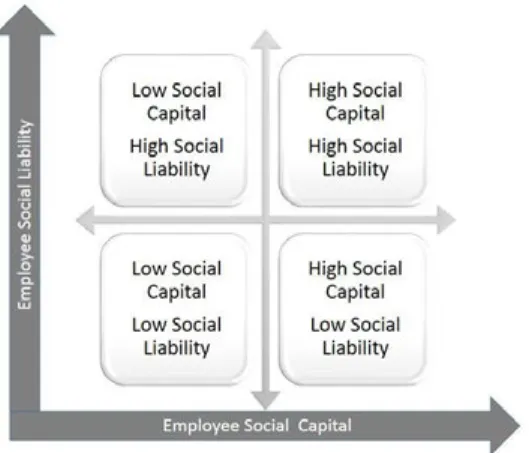
TWO FACTOR THEORYFrom the above discussion, what we are proposing is that any given social network that one is a member of will likely include relationships that build social capital and other relationships that create a liability (or even relationships that may be beneficial but, at times, might become a liability). We propose therefore that an individual will have some measureable amount of both capital and liability. Increasing the former while reducing the latter should improve individual well-being. It is not a “zero sum” game; we do not suggest that social liability necessarily detracts from social capital. Indeed high levels of both would be extraordinarily resource consuming (in terms of managing both positive and negative relationships). Low
levels of both would not help, but neither would it necessarily hinder an employee’s organisational life, other than being excluded from potentially valuable social networks (Putnam, 1995). Figure 2 shows our proposed matrix. Employees can be placed within any of the four areas depending on the level of social capital and liability and the implication of this is described below.
Figure 2: Proposed ESL / ESC matrix structure
1.LOW SOCIAL CAPITAL /HIGH SOCIAL LIABILITY
This is the “worst” scenario for an employee. They may be part of a dysfunctional work group or team, with no reciprocity and distrust (low social capital) as well as negative relational norms (such as non-disclosure, undermining, and conflict). Team members may be low status, unskilled and poorly networked (i.e., be able to offer little in the way of useful connections or information). There may also be some relatively enjoyable relationships that do little but distract from work (i.e., chatting, non-work activities, and gossip). There may also be people in the network who dislike or are in competition with the individual, and who engage in non-disclosure, favouritism, bullying or sabotage (high social liability).
2.HIGH SOCIAL CAPITAL /HIGH SOCIAL LIABILITY
This scenario would potentially be very consuming in terms of emotion, effort and time. This person may be part of a well-functioning work group or team, there would probably be reciprocity and trust among some of the members (high social capital) and possibly some positive relational norms (such as information sharing and cooperation). The network would include visible, high status, skilled and well networked individuals (i.e., “useful” connections). However, there may also be some relationships that do little but distract from work (chatting, non-work activities, gossip) or that are valuable but “expensive” in terms of effort and time. There may also be people in the network who dislike one another or are in competition, and who engage in non-disclosure, favouritism, bullying or sabotage.
3.LOW SOCIAL CAPITAL /LOW SOCIAL LIABILITY
Someone with this type of network would probably be part of a dysfunctional work group or team, or alternatively would be quite socially isolated at work, perhaps in a virtual or nominal team with little interaction or task interdependence. People would perhaps work independently of and isolated from others. There would be low reciprocity and distrust (low social capital) as well as negative relational norms (such as non-disclosure, favouritism, bullying or sabotage). This may also describe loners in organisations who actively withdraw from joining social networks; or who may be highly task focused and prefer to work alone. Team members, if any, may be low status, unskilled and poorly networked and, though the team members do not actively work against one another, neither do they distract from work.
4.HIGH SOCIAL CAPITAL /LOW SOCIAL LIABILITY
This is the “best” scenario. This person will be part of a well-functioning work group or team. Members would be trusting, and effort and interactions would be reciprocal. There would be positive relational norms (such as information sharing and cooperation). Team members would probably be visible, productive, high status, skilled and well networked, easily able to provide benefits to one another at work and, perhaps, in a wider social context. The team members do not actively work against one another, nor do they distract from work, interpersonal interaction is positive, useful and work-related.
In sum, we propose that high employee social liability is qualitatively different from “low social capital” and that being able to conceptualise and measure it within a
workplace context will be useful both from an individual (working well-being) and organisational (organisational climate, productivity) perspective.
In the section that follows, we examine the relations among employee social liability and organizational issues including, cohesion, engagement, career success, organisational climate, well-being, and performance.
A
NTECEDENTS TOE
MPLOYEES
OCIALL
IABILITY INO
RGANIZATIONSThe antecedents of ESL will originate from two sources, the individual and the organisation. We propose that some people, as a result of their personality, social skills and/or work related behaviour will go through life acquiring relatively more liabilities. These are perhaps those individuals others would describe as being less “likable”. In addition there are organisational factors beyond interpersonal interactions; the wider organisational context or climate will either support or supress various behaviours of organisational members. There may be zero tolerance for the social demands of off task communication, others may allow, or even encourage, competition between employees, and still others encourage trusting and collaborative workplace behaviour. All will be likely to have an impact on whether a particular employee will acquire liabilities as a result of their behaviour.
F
AILURE TO MANAGE/
MAINTAIN HIGH QUALITY RELATIONSHIPSThe primary antecedent to the presence or acquisition of social liabilities are likely to be characteristics in an individual that relate to skill in, and focus on, maintaining good and long lasting interpersonal relationships – or, more precisely, a lack thereof. That is to say, characteristics related to having “low quality” relationships in one’s social network.
Relationship quality has been measured in numerous ways by organisational researchers in the last fifty years (e.g., Carmeli, Brueller, & Dutton, 2009; Dansereau, Graen, & Haga, 1975; Duchon, Green, & Taber, 1986; Sias, 2005; Wat & Shaffer, 2004). At a peer or collegial level is thought to be a product of variables such as trust, support and self-disclosure (Kram & Isabella, 1985; Odden & Sias, 1997; Sias, 2005; Sias & Cahill, 1998), at the supervisor / subordinate level it is most commonly measured in the context vertical dyad linkage (Dansereau et al., 1975; Duchon et al., 1986) and leader member exchange (LMX) and is a function of reciprocal influence, extra contractual behaviour exchange, mutual trust, respect and liking, and a sense of common fate (Deluga & Perry, 1994; Dienesch & Liden, 1986; Gerstner & Day,
1997; Graen, Novak, & Sommerkamp, 1982; Graen & Uhl-Bien, 1995; Kang & Stewart, 2007; Schriesheim, Castro, & Cogliser, 1999). The three antecedents that we propose will impact on the quality of work relationships are personality, emotional intelligence and deviant workplace behaviours. Each is described below.
1.PERSONALITY
The “big five” personality dimensions (openness, conscientiousness, extraversion, agreeableness and emotional stability) predict how we operate within relationships both in and out of the workplace. Agreeable people have been found to be relatively more considerate, forgiving, nurturing, and tolerant, while disagreeable people are more likely to be inconsiderate, vengeful, argumentative, and uncooperative (Colbert, Mount, Harter, Witt, & Barrick, 2004). Therefore it seems likely that disagreeable individuals will be more likely to engage negatively with others in the workplace, exhibit interpersonally deviant behaviour and, as a result, acquire social liabilities (Mount, Barrick, & Stewart, 1998).
Conscientiousness, along with agreeableness, is thought to play a role in emotional regulation in both interpersonal and work settings (Larsen, 2000; Salovey & Mayer, 1990) and extraversion, and neuroticism have been found to influence the likelihood that individuals will experience negative emotions, with those scoring as both introverted and high in neuroticism being more likely to experience negative mood (Larsen, 2000; Larsen & Ketelaar, 1989; Larsen & Ketelaar, 1991).
The recent literature on maladaptive personality in both clinical (Krueger, Derringer, Markon, Watson, & Skodol, 2012) and workplace (Guenole, 2014) settings also informs our propositions here. Given that maladaptive personality reflects the very extremes of normal-range personality constructs, it may occur too infrequently to be of use in predicting ESL widely, nonetheless it gives weight to our proposition regarding the relationship between the big 5 and failure to create and maintain high quality relationships (Dilchert, Ones, & Krueger, 2014).
Proposition 1 and 2: Those with low emotional stability (negative affect), low
extraversion (detachment), low agreeableness (antagonism), low conscientiousness (disinhibition) will be more likely to both engage in deviant behaviours (Path 5), and also to fail in creating and maintaining high quality relationships (Path 6) (See Figure 1).
2.EMOTIONALINTELLIGENCE
In the context of acquiring social liabilities, we are interested in the skills or characteristics of the individual that are likely to influence the initiation, management and maintenance of high quality relationships. Social and emotional competence are the most obvious antecedents of these abilities and the theory of emotional intelligence proposed by Salovey and Mayer (1990) provides a framework to examine these competencies. Emotional intelligence is the awareness of, and the ability to manage, both one’s own and others’ emotions. As measured by the MEIS or the MSCEIT, it has been found to be related to increased pro-social behaviour and positive peer relationships (Mayer, 1998; Salovey, Mayer, Caruso, & Lopes, 2001), and to negatively predict poor relations with friends, maladjustment and negative behaviour, particularly for males (Brackett, Mayer, & Warner, 2004). Consequently we expect to find emotional intelligence to be negatively related to effective relationship creation and maintenance.
Proposition 3: Those with low emotional intelligence, particularly the factors
associated with social competence will have more low quality relationships and/or negative relationships, fewer high quality relationships and consequently relatively higher levels of social liabilities (Path 7).
3. “BAD” BEHAVIOURS
Bad or deviant behaviour in the workplace has received a great deal of attention from scholars in recent years (Bennett & Robinson, 2000; Griffin & Lopez, 2005; Lee & Allen, 2002; Robinson & Bennett, 1995). Deviant behaviour can be defined as “…voluntary behavior that violates significant organizational norms and in so doing threatens the well-being of an organization, its members, or both” (Robinson & Bennett, 1995; p. 556). It includes verbal abuse such as being quarrelsome (Albert & Moskowitz, 2014; Moskowitz, 2010) and aggressive (Hershcovis & Barling, 2010; Neuman & Baron, 2005), highly politicised activity such as favouritism and gossip, withholding work effort, physical violence, bullying (Einarsen, 1999; Einarsen & Skogstad, 1996; Gardner et al., 2013), sexual harassment and even sabotage (Griffin & O’Leary-Kelly, 2004). Deviant behaviours which impact on the quality and quality of collegial relationships are termed interpersonal deviance whereas those which are more directly harmful to the organization such as working on personal matters,
stealing from the organisation or “slacking off” at work are termed organisational deviance (Bennett & Robinson, 2000).
Thus, not all deviant behaviour is related to interpersonal interaction so, as well as having a profound negative impact on the quality of collegial relationships, it is reasonable to assume that individuals engaging in organisational deviance would also acquire relatively more social liabilities in their networks through the negative perceptions their colleagues would have of their behaviour (i.e., stealing from the organisation, dragging out work to get overtime or spending too much time day-dreaming) (Bennett & Robinson, 2000).
Proposition 4 and 5: “Bad” behaviour will be related to deficits in creating and
maintaining high quality relationships (Path 8) and there is also a proposed direct link from bad behaviour to employee social liabilities (Path 9).
Taken together (propositions 1-5) predict a relationship between the individual level factors and relationship quality / maintenance. As stated earlier, we propose that this higher level construct will be a key predictor of ESL.
Proposition 6: The failure to manage / maintain high quality relationships will
be predict whether or not employees acquire social liabilities at work (Path 10).
O
RGANISATIONAL CLIMATEOrganisational climate can be defined as the shared perceptions and meaning attached to policy, practice and procedures, as well as the specific organisational behaviours that are rewarded, supported and expected (Schneider, Ehrhart, & Macey, 2013). Alternatively it can be conceptualised as the degree of trust, morale, conflict, equity, leader credibility, resistance to change, and scapegoating (Burton, Lauridsen, & Obel, 2004). We propose a two-way, interactive relationship between employee social liabilities and organisational climate whereby a poor organisational climate will create an environment conducive to the existence of (or at least one tolerant of) negative relationships, bullies and deviant behaviours (Vartia, 1996). In addition it is likely that a workplace where people are working against one another and acting in ways detrimental to their colleagues’ careers and well-being (i.e. social liabilities) will be one that would be characterised as having a negative climate.
Proposition 7: Increased employee social liabilities in a workplace will have
or toxic climates will foster relatively more employee social liabilities for employees (Path 11).
C
ONSEQUENCES OFE
MPLOYEES
OCIALL
IABILITYW
ELL-
BEINGEmployee well-being is a multi-dimensional construct that goes well beyond job satisfaction to include notions such as job-induced stress, fatigue, work-life conflict, and happiness (Boxall & Macky, 2014). Individual well-being is in part a function of the quality of the relationships an employee has with other people at work, and in the wider community, influenced by the degree of trust, reciprocity, social support and cooperation experienced in those relationships (Grant, Christianson, & Price, 2007). Drawing on the Job Demands-Resources Model (Bakker & Demerouti, 2008; Bakker, Demerouti, de Boer, & Schaufeli, 2003; Demerouti, Bakker, Nachreiner, & Schaufeli, 2001) we propose that individuals with higher levels of social liabilities in their social network will be faced with increased demands on their resources in order to manage these relationships, thereby resulting in higher job stress and reduced satisfaction with the job. The more effort required to deal with these negative relationships, the greater the strain experienced (Hakanen, Bakker, & Schaufeli, 2006). Adding to this, relationship difficulties at work could also negatively spill-over into non-work life resulting in work-life conflict (Eby, Casper, Lockwood, Bordeaux, & Brinley, 2005; Halbesleben, Harvey, & Bolino, 2009).
Proposition 8: Increased Employee Social Liabilities will decrease worker
well-being at work (Path 12) (see Figure 1).
W
ORKE
NGAGEMENTThe concept of engagement is relatively new and replete with conflicting definitions. At a general level, engaged employees invest physical, emotional and cognitive energy in their work, are psychologically present and absorbed in their work, are cognitively focused, and emotionally connected with others in the delivery of their tasks (Kahn, 1990, 1992). Extending this, we draw on Schaufeli and Salanova’s (2011) differentiation between work and employee engagement in that the former deals with the relationship people have with their work, rather than with their occupation, role or organisation. Kahn (1990) theorised that a direct psychological precondition of engagement is that of safety, with perceptions of social
support and relationships primary influences of perceived safety. According to Kahn (1990), supportive managers and interpersonal relationships based on trust lead to experiences of psychological safety with others. On this basis we posit that employees with a high level of social liability in their workplace social network are unlikely to also express high levels of engagement in their work. More, specifically, there is evidence that resources are important drivers of employee work engagement and that this relationship is reciprocal (Bakker, Demerouti, & Xanthopoulou, 2012). We therefore draw on the job demands-resources model to suggest a motivational process whereby poor low-quality workplace relationships characterised by distrust, task distractions and low cooperation result in higher demands on resources to cope, leading to disengagement with work. At its extreme, social liabilities could therefore be manifested in increased emotional exhaustion and cynicism towards others. Furthermore, conservation of resources (COR) theory (Hobfoll, 2001) proposes that we strive to protect and accumulate resources. Employees with more resources than that needed to meet the demands of the job are more likely to be engaged employees (Halbesleben, 2011). We therefore argue that social liability demands decrease the available resources employees need to achieve their work tasks and goals, thereby reducing work engagement.
Proposition 9: Increased Employee Social Liabilities will decrease levels of
employee engagement (Path 13).
C
AREER SUCCESSIt is widely accepted that social capital influences career success (Burt, 1992; Gabbay & Zuckerman, 1998) and the importance of using ones social networks in the achievement of career goals features regularly in both academic and practitioner literature. For example Seibert, Kraimer, and Liden (2001) found that having the increased social resources that social capital provides enhances an individual’s career through access to information, access to resources and career sponsorship. Lin and Dumin (1986) also established a strong link between social capital and career success. They found that access to desirable, high status occupations was provided by both having a strong social position (e.g., coming from a “good” family) and through social ties (friends and acquaintances).
We propose that social liabilities would also have an impact of career success albeit a negative one. Because it is the antithesis of social capital, we propose that
impact on ones career of having social liabilities would be far greater than that of simply having “low social capital”. For example, having low status, unskilled, or very few members in your network would offer few social resources so would be unlikely to aid in your career progress, but neither would it necessarily be harmful. On the other hand, having someone who dislikes or doesn’t respect you, and is willing to put effort into activities such as negative rumour and gossip, sabotage and deliberate obstruction could actually do great damage your career.
Imagine if you will, a situation where a psychologist, previously working in the hospital system goes for a job within a private practice. It turns out that someone on the interview panel worked with her ten years ago, supervising her as a new graduate. If this senior psychologist had a good experience of the supervisory experience, and respected the hard work and intellect of the candidate, she would likely recommend her to the rest of the panel before the interview even took place. The candidate would, almost without a doubt, be shortlisted for the position. On the other hand, if the panel instead heard that the candidate was slightly neurotic, a bit lazy, rude and unsympathetic to clients, she would perhaps not even be offered an interview, and would have no chance to redeem herself or to show how she’d changed in the intervening decade.
The above illustrates the power of social capital and social liabilities respectively. On the other hand, having no social capital in this situation would perhaps be reflected by the case of an international candidate interviewing for the same job; a candidate judged solely by her CV and the interview. She would not have the advantage of a supporter on the panel (social capital), but neither would she be haunted and ultimately punished by a year of “bad behaviour” (Bennett & Robinson, 2000) as a new graduate (social liability). These examples illustrate, once again, the importance of conceptualising social liability as a phenomena quite separate from simply having low social capital.
Proposition 10: Increased Employee Social Liabilities will negatively impact
long term career success (Path 14).
G
ROUP/
TEAM COHESIONWe propose that a negative relationship would exist between increased social liabilities and team cohesion, because many of the accepted antecedents of
cohesion are less likely to take place in an environment characterised by negative social interactions.
Envy, for example is both likely to elicit the acquisition of social liabilities and has been found to reduce cohesion (Duffy & Shaw, 2000). We propose that the envy of others may mean that an individual will acquire more social liabilities. This is because envy includes the perception that a person lacks another’s superior achievement or belongings and, further, they either desire it or (importantly) they wish the other lacked it (Duffy & Shaw, 2000), necessitating ill feeling towards the envied other. According to Vecchio (1995), who adapted social psychology findings to a work setting, the potential reactions to envy at work may include sabotage, back-stabbing, harassment or ostracism of the rival, and bolstering one’s own self-image. Thus envy will logically create saboteurs, enemies and “haters”, individuals working against one another, fitting well with our conceptualisation of ESL.
In addition numerous studies with a focus on cohesion outline indicators of cohesion that are conceptually opposite to ESL. For example a feeling of identification and attraction to the group (Johnson & Johnson, 1991), group members getting along and helping each other (Koys & DeCotiis, 1991), and the presence of friendliness, helpfulness and trust (Boxx, Odom, & Dunn, 1991).
Proposition 11: Increased Employee Social Liabilities will decreased
cohesion in the workplace (Path 15).
P
ERFORMANCEExtending the above propositions regarding the proposed impact of ESL on wellbeing, engagement, career success, and cohesion, we anticipate that these will mediate both team and individual performance. In turn, team and individual performance influence organisational outcomes (see Figure 1).
Proposition 12: Increased Employee Social Liabilities will have a negative
impact on performance via reduced employee wellbeing, lower work engagement and low cohesion (path 16).
C
ONCLUSIONSThe research reviewed suggests that the acquisition of social liabilities could have profound negative and long lasting effects on individuals in several ways, including their well-being, performance and, ultimately, career success. Social liabilities can cause harm to individuals through exposure to negative acts, it will be
likely to reduce collegiality through the acquisition of distrusting and uncooperative relationships, and the social costs inherent in distraction and social demands will reduce productivity and achievement in a variety of ways. A long term impact of ESL is the harm to the careers of those who acquire it; even if they change jobs or move to a different organisation. The “global village” and the rise of social networking mean that the ease with which people can be contacted and researched allows bad behaviour witnessed, and enemies acquired, to haunt an individual for decades after an event.
The propositions suggested in this paper are eminently testable and therefore provide future research directions towards understanding the effects of ESL at both the individual and organisational level. Before this can take place, however a valid and reliable measure of ESL needs to be devised. A variety of measures of the four underlying components (social demand, negative acts, lack of reciprocity and distrust) exist and these must to be researched, reviewed and tested for their predictive power as parts of the higher level construct, ESL. The nomological network of this new construct needs to be tested and the resulting scale needs to be validated. This will be the aim of the authors moving forward with this project.
At the individual level, an awareness of the potentially destructive impact that social liabilities bring is of great importance. Most white collar workers and business owners are cognisant of social capital, if not by name, then by meaning. They know that creating relationship networks, knowing “useful” people, and being owed favours will help them, both in their daily work and in their long term career. At the supervisory / management level, it is important that there is an awareness of the antecedents and potential outcomes of this phenomenon and to be aware of the variety of contextual and personal factors that engender a network filled with liabilities and how the damaging impacts of social liabilities might be managed.
R
EFERENCESAdams, J. S. (1965). Inequity in social exchange. In L. Berkowitz (Ed.), Advances in experimental social psychology (Vol. 2, pp. 267-299). New York: Academic Press.
Adler, P. S., & Kwon, S. W. (2002). Social capital: Prospects for a new concept. Academy of Management Review, 27(1), 17-40. doi:10.2307/4134367 Albert, L. S., & Moskowitz, D. S. (2014). Quarrelsomeness in the workplace: An
exploration of the interpersonal construct within the organizational context. Organizational Psychology Review, 4(1), 27-48. doi:
10.1177/2041386613492786
Andrews, R. (2010). Organizational social capital, structure and performance. Human Relations, 63(5), 583-608. doi:10.1177/0018726709342931
Bakker, A., Demerouti, E., & Xanthopoulou, D. (2012). How do engaged employees stay engaged? Ciencia & Trabajo, 14(special issue)(15-21).
Bakker, A. B., & Demerouti, E. (2008). Towards a model of work engagement. Career Development International, 13, 209-223.
Bakker, A. B., Demerouti, E., de Boer, E., & Schaufeli, W. B. (2003). Job demands and job resources as predictors of absence duration and frequency. Journal of Vocational Behavior, 62, 341-356.
Bakker, A. B., Schaufeli, W. B., Demerouti, E., Janssen, P. M. P., Van der Hulst, R., & Brouwer, J. (2000). Using equity theory to examine the difference between burnout and depression Anxiety Stress Coping, 13, 247–268.
Behtoui, A., & Neergaard, A. (2012). Social capital, status and income attainment in the workplace. International Journal of Sociology and Social Policy, 32(1), 42 - 55. doi:10.1108/01443331211201752
Bennett, R. J., & Robinson, S. L. (2000). Development of a measure of workplace deviance. Journal of Applied Psychology, 85, 349-360.
Berman, E. M., West, J. P., & Richter, M. N. (2002). Workplace relations: Friendship patterns and consequences (according to managers). Public Administration Review, 62(2), 217-230.
Blau, P. M. (1964). Exchange and Power in Social life. New York: Wiley. Bourdieu, P. (1986). Forms of Capital. In J. G. Richardson (Ed.), Handbook of
Theory and Research for the Sociology of Education (pp. 241-260). Westport: Greenwood Press.
Bourdieu, P., & Wacquant, L. (1992). An Invitation to Reflexive Sociology. Chicago, IL: Chicago University Press.
Boxall, P., & Macky, K. (2014). High-involvement work processes, work intensification and employee well-being. Work, Employment and Society (forthcoming).
Boxx, W. R., Odom, R. Y., & Dunn, M. G. (1991). Organizational values and value congruency and their impact on satisfaction, commitment, and cohesion. Public Personnel Management, 20, 195-205.
Brackett, M. A., Mayer, J. D., & Warner, R. M. (2004). Emotional intelligence and its relation to everyday behaviour. Personality and Individual Differences, 36, 1387–1402.
Burt, R. S. (1992). Structural holes: The social structure of competition. Cambridge, MA: Harvard University Press.
Burt, R. S. (2000). The network structure of social capital. Research in Organizational Behaviour, 22, 345-423.
Burton, R. M., Lauridsen, J., & Obel, B. (2004). The impact of organizational climate and strategic fit on firm performance. Human Resource Management, 43(1), 67-82.
Carmeli, A., Brueller, D., & Dutton, J. E. (2009). Learning behaviours in the workplace: The role of high-quality interpersonal relationships and
psychological safety. Systems Research and Behavioral Science, 26, 81-98. doi:10.1002/sres.932
Carr, J. C., Cole, M. S., Ring, J. K., & Blettner, D. P. (2011). A measure of internal social capital among family firms. Entrepreneurship: Theory and Practice, 35(6), 1207-1227. doi:10.1111/j.1540-6520.2011.00499.x
Colbert, A. E., Mount, M. K., Harter, J. K., Witt, L. A., & Barrick, M. R. (2004). Interactive effects of personality and perceptions of the work situation on workplace deviance. Journal of Applied Psychology, 89(4), 599-609. doi: 10.1037/0021-9010.89.4.599
Coleman, J. S. (1990a). Foundations of social theory. Cambridge, MA: Belknap Press of Harvard University Press.
Coleman, J. S. (1990b). Social capital in the creation of human capital. American Journal of Sociology(Suppl), 95-120.
Cunningham, J. B., & MacGregor, J. (2000). Trust and the design of work:
Complementary constructs in satisfaction and performance. Human Relations, 53(12), 1575-1591.
Dansereau, F., Graen, G., & Haga, W. J. (1975). A vertical dyad linkage approach to leadership within formal organizations. Organizational Behavior and Human Performance, 13, 46-78.
Deluga, R. J., & Perry, J. T. (1994). The role of subordinate performance and ingratiation in leader-member exchanges. Group & Organization Studies, 19(1), 67-86.
Demerouti, E., Bakker, A. B., Nachreiner, F., & Schaufeli, W. B. (2001). The job demands - resources model of burnout. Journal of Applied Psychology, 86, 499- 512.
Deutsch, M. (1960). The effect of motivational orientation upon trust and suspicion. Human Relations, 123-139(13).
Dienesch, R. M., & Liden, R. C. (1986). Leader-member exchange model of leadership: A critique and further development. Academy of Management Review, 11(3), 618-634.
Dilchert, S., Ones, D. S., & Krueger, R. F. (2014). Maladaptive Personality Constructs, Measures, and Work Behaviors. Industrial and Organizational Psychology, 7(1), 98–110.
Duchon, D., Green, S. G., & Taber, T. D. (1986). Vertical dyad linkage: A longitudinal assessment of antecedents, measures, and consequences. Journal of Applied Psychology, 71(1), 56-60.
Duffy, M. K., Ganster, D. C., & Pagon, M. (2002). Social Undermining in the Workplace. The Academy of Management Journal, 45(2), 331-351. Duffy, M. K., Scott, K. L., Shaw, J. D., Tepper, B. J., & Aquino, K. (2012). A social
context model of envy and social undermining. Academy of Management Journal, 55(3), 643-666.
Duffy, M. K., & Shaw, J. D. (2000). The Salieri Syndrome: Consequences of Envy in Groups. Small Group Research, 31(3), 3-23.
doi:10.1177/104649640003100101
Eby, L. T., Casper, W. J., Lockwood, A., Bordeaux, C., & Brinley, A. (2005). Work and family research in IO/OB: content analysis and review of the literature (1980-2002). Journal of Vocational Behavior, 66, 124-197.
Einarsen, S. (1999). The nature and causes of bullying at work. International Journal of Manpower, 20(1/2), 16-27. doi:10.1108/01437729910268588
Einarsen, S., & Skogstad, A. (1996). Bullying at work: Epidemiological findings in public and private organizations. European Journal of Work and
Organizational Psychology, 5(2), 185-201.
Emerson, R. (1962). Power-dependence relations. American Sociological Review, 27, 31-41.
Emerson, R. (1976). Social Exchange Theory. Annual Review of Sociology, 2, 335-362. doi:10.1146/annurev.so.02.080176.002003
Emerson, R. (1987). Toward a theory of value in social exchange. In K. S. Cook (Ed.), Social Exchange Theory (pp. 11-58). Newbury Park, CA: Sage. Fukuyama, F. (1995). Trust. New York: Free Press.
Gabbay, S. M., & Zuckerman, E. W. (1998). Social capital and opportunity in corporate R&D: The contingent effect of contact density on mobility expectations. Social Science Research, 27, 189-217.
Gardner, D., O'Driscoll, M. P., Bentley, T., Catley, B., Cooper-Thomas, H. D., & Trenberth, L. (2013). When Workplaces Go Sour–Bullying at Work. In R. L. Morrison & H. D. Cooper-Thomas (Eds.), Relationships in Organizations: A Work Psychology Perspective. London: Palgrave Macmillan.
Gerstner, C. R., & Day, D. V. (1997). Meta-analytic review of leader-member exchange theory: Correlates and construct issues. Journal of Applied Psychology, 82(6), 827-844.
Glaeser, E. L., Laibson, D., & Sacerdote, B. (2002). An Economic Approach to Social Capital. The Economic Journal, 112(483), F437-F458.
Gottlieb, B. H., & Wagner, F. (1991). Stress and support in close relationships. In J. Eckenrode (Ed.), The Social Context of Coping (pp. 165-188). New York: Plenum Press.
Govier, T. (1994). Is it a jungle out there? Trust, distrust, and the construction of social reality. Dialogue, 33, 237-252.
Graen, G. B., Novak, M. A., & Sommerkamp, P. (1982). The effects of leader-member exchange and job design on productivity and satisfaction: Testing a dual attachment model. Organizational Behavior and Human Performance, 30, 109-131.
Graen, G. B., & Uhl-Bien, M. (1995). Relationship-based approach to leadership: Development of leader-member exchange (LMX) theory of leadership over 25 years: Applying a multi-level multi-domain perspective. The Leadership Quarterly, 6(2), 219-247.
Grant, A., Christianson, M., & Price, R. (2007). Happiness, health, or relationships? Managerial practices and employee wellbeing tradeoffs. Academy of Management Perspectives, 21, 51-63.
Griffin, R. W., & Lopez, Y. P. (2005). “Bad Behavior” in organizations: A review and typology for future research. Journal of Management, 31(6), 988-1005. doi:10.1177/0149206305279942
Griffin, R. W., & O’Leary-Kelly, A. M. (2004). The dark side of organizational behavior. San Francisco: Jossey-Bass.
Guenole, N. (2014). Maladaptive Personality at Work: Exploring the Darkness. Industrial and Organizational Psychology, 7, 85-97.
Hakanen, J. J., Bakker, A. B., & Schaufeli, W. B. (2006). Burnout and work engagement among teachers. Journal of School Psychology, 43, 495-513. Halbesleben, J. R. B. (2011). The consequences of engagement: The good, the bad,
and the ugly. European Journal of Work and Organizational Psychology, 20(1), 68-73.
Halbesleben, J. R. B., Harvey, J., & Bolino, M. C. (2009). Too engaged? A
conservation of resources view of the relationship between work engagement and work interference with family. Journal of Applied Psychology, 94(6), 1452-1465.
Hershcovis, M. S., & Barling, J. (2010). Towards a multi-foci approach to workplace aggression: A meta-analytic review of outcomes from different perpetrators. Journal of Organizational Behavior, 31, 24-44. doi:10.1002/job.621
Hobfoll, S. E. (2001). The influence of culture, community, and the nested self in the stress process: Advancing conservation of resources theory. Applied Psychology: An International Review, 50, 337-370.
Jacobs, J. (1961). The Death and Life of Great American Cities. New York: Random House.
Johnson, D. W., & Johnson, F. P. (1991). Joining Together: Group Theory and Group Skills. Englewood Cliffs, NJ: Prentice Hall.
Kahn, W. A. (1990). Psychological conditions of personal engagement and disengagement at work. Academy of Management Journal, 33, 692-724. Kahn, W. A. (1992). To be fully there: Psychological presence at work. Human
Relations, 45, 321-349.
Kang, D., & Stewart, J. (2007). Leader-member exchange (LMX) theory of leadership and HRD. Leadership and Organization Development Journal, 28(6), 531-551. Kawachi, I. (1999). Social capital and community effects on population and individual
health. Annals of the New York Academy of Sciences, 896, 120-130. Kouvonen, A., Kivimäki, M., Vahtera, J., Oksanen, T., Elovainio, M., Cox, T., . . .
Wilkinson, R. G. (2006). Psychometric evaluation of a short measure of social capital at work. BMC Public Health, 6, 251. doi:10.1186/1471-2458-6-251 Koys, D., & DeCotiis, T. (1991). Inductive measures of psychological climate. Human
Relations, 44, 265-285.
Kram, K., & Isabella, L. (1985). Mentoring alternatives: The role of peer relationships in career development. Academy of Management Journal, 28(1), 110-132. Kramer, R. M. (1999). Trust and distrust in organizations: emerging perspectives,
enduring questions. Annual Review of Psychology, 50(569-598).
Krueger, R., Derringer, J., Markon, K. E., Watson, D., & Skodol, A. E. (2012). Initial construction of a maladaptive personality trait model and inventory for DSM-5. Psychological medicine, 42(9), 1879-1890.
Labianca, G., & Brass, D. J. (2006). Exploring the social ledger: Negative relationships and negative asymmetry in social networks in organisations. Academy of Management Review, 31(3), 596–614.
Larsen, R. J. (2000). Toward a science of mood regulation. Psychological Inquiry, 11, 129-141.
Larsen, R. J., & Ketelaar, T. (1989). Extraversion, neuroticism and susceptibility to positive and negative mood induction procedures. Personality and Individual Differences, 10, 1221-1228.
Larsen, R. J., & Ketelaar, T. (1991). Personality and susceptibility to positive and negative emotional states. Journal of Personality and Social Psychology(61), 132-140.
Lazarova, M., & Taylor, S. (2009). Boundaryless careers, social capital, and knowledge management: Implications for organizational performance. Journal of Organizational Behavior, 30(1), 119-139. doi:10.1002/job.545
Leana, C. R., & VanBuren, H. J. (1999). Organizational Social Capital and Employment Practices. The Academy of Management Review, 24(3), 538-555.
Lee, K., & Allen, N. J. (2002). Organizational citizenship behavior and workplace deviance: The role of affect and cognitions. Journal of Applied Psychology, 87, 131-142.
Lin, N., & Dumin, M. (1986). Access to occupations through social ties. Social Networks, 8, 365-385.
Maurer, I., Bartsch, V., & Ebers, M. (2011). The Value of Intra-organizational Social Capital: How it Fosters Knowledge Transfer, Innovation Performance, and Growth. Organization Studies, 32(2), 157-185.
doi:10.1177/0170840610394301
Mayer, J. D. (1998). A systems framework for the field of personality. Psychological Inquiry, 9, 118-144.
Mayer, R. C., Davis, J. H., & Schoorman, F. D. (1995). An integrative model of organizational trust. Academy of Management Review, 20, 709-734.
Moskowitz, D. S. (2010). Quarrelsomeness in daily life. Journal of Personality, 78(1). doi:10.1111/j.1467-6494.2009.00608.x
Mount, M. K., Barrick, M. R., & Stewart, G. L. (1998). Five-factor model of personality and performance in jobs involving interpersonal interactions. Human
Performance, 11, 145-165.
Nahapiet, J., & Ghoshal, S. (1998). Social capital, intellectual capital, and the organizational advantage. Academy of Management Review, 23(2), 242-266. doi:10.2307/259373
Neuman, J. H., & Baron, R. A. (2005). Aggression in the workplace: A
social-psychological perspective. In S. Fox & P. E. Spector (Eds.), Counterproductive work behavior: Investigations of actors and targets (pp. 13-40). Washington, DC: American Psychological Association.
Odden, C. M., & Sias, P. M. (1997). Peer communication relationships, psychological climate, and gender. Communication Quarterly, 45, 153-166.
Oldroyd, J. B., & Morris, S. S. (2012). Catching falling stars: A human Resource response to social capital’s detrimental effect of information Overload on star employees. Academy of Management Review, 37(3), 396-418.
doi:doi.org/10.5465/amr.2010.0403
Perlow, L. A. (1999). The time famine: Toward a sociology of work time. Administrative Science Quarterly, 44, 57-81.
Portes, A. (1998). Social Capital: Its Origins and Applications in Modern Sociology. Annual Review of Sociology, 24, 1-24. doi:DOI: 10.1146/annurev.soc.24.1.1 Putnam, R. (1995). Bowling Alone: America's Declining Social Capital. Journal of